The Watchtower, July 1, 1920
Download: PDF — The Watchtower, July 1, 1920
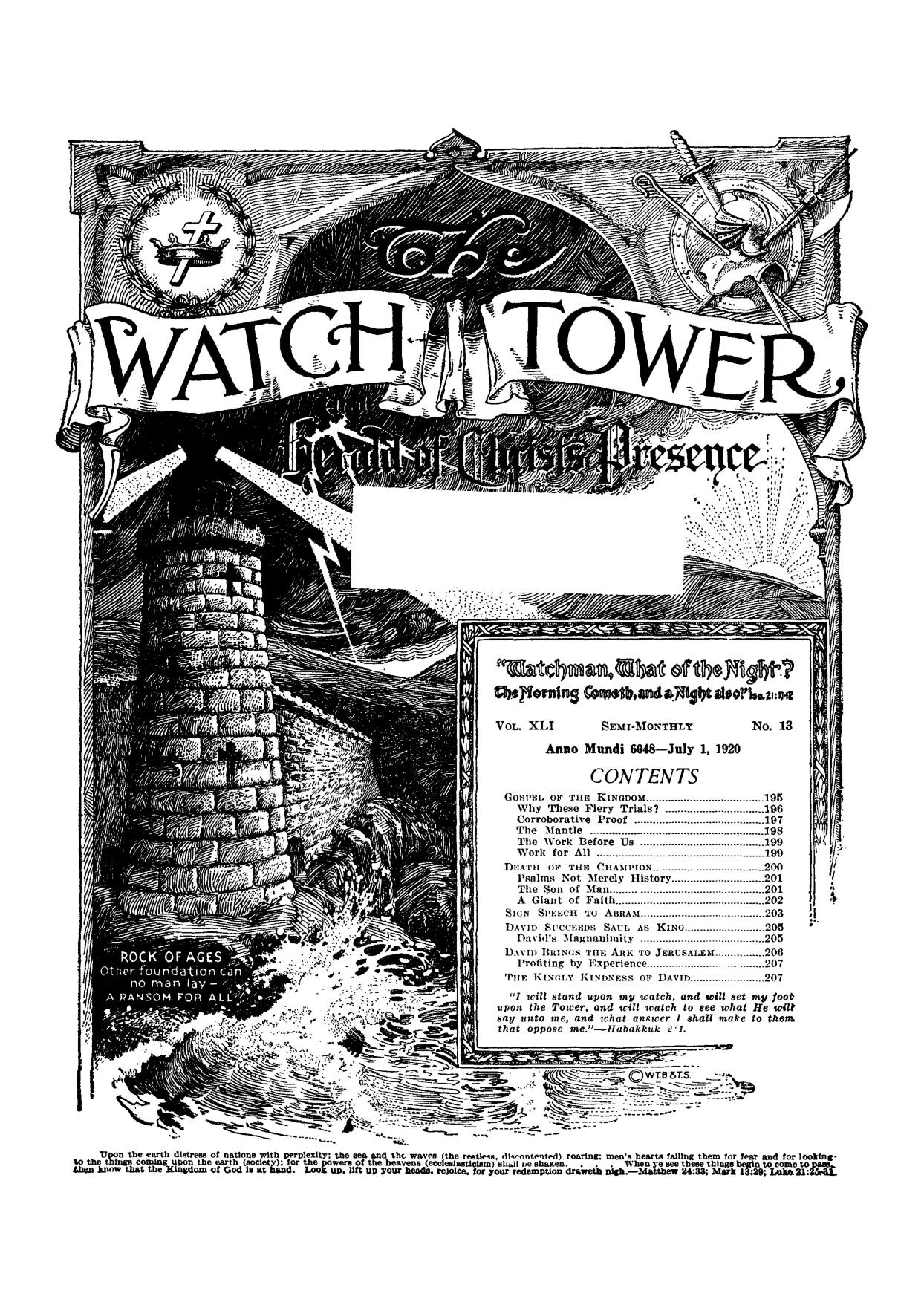
David Succeeds Saul as King..........
David’s Magnanimity .........................
David Brings the Ark to Jerusalem Profiting by Experience......................
The Kingly Kindness of David.........
No. 13
ROCK'OF AGES
Other foundation can
A
no man lay - • » PANSOM FOR ALl'7
Vol. XLI
Semi-Monthly
Anno Mundi 6048—July 1, 1920
CONTENTS
Gospel of the Kingdom.....
Why These Fiery Trials? Corroborative Proof .........
The Mantle .......................
The Work Before Us .......
Work for All .....................
Death of the Champion...
Psalms Not The Son of A Giant of Sign Speech
Merely History.
Man....................
Faith...................
to Abram...........
.195 .196 .197 .198 .199
.199
.200 .201 .201 .202 .203
.205 .205 .206 .207 .207
“I will stand upon my watch, and will set my foot-upon the Tower, and will watch to see what Ue wilt say unto me, and what answer 1 shall make to them that oppose me.”—Habakkuk 2 1.
©WTB5T.S.
. Up?n the el!rth dls<ieM of nations with perplexity: the sea and the waves (the restless, <1 Discontented) roaring: men's hearts falling them for fear and tor looking-to the things coming upon the earth (society); for the powers of the heavens (ecclesiasticlsm) skull *>e shaken. . . . When ye see these things begin to come to pass*, then know that the Kingdom ot God is at hand. Look up. lift up your heads, rejoice, for your redemption draweth nigh.—Matthew 24:33; Mark 13:29; Luka31:3&^L
THIS JOURNAL AND ITS SACRED MISSION
THIS journal is one of the prime factors or instruments in the system of Bible instruction, or “Seminary Extension”, now bein« presented in all parts of the civilized world by the Watch Tower Bible & Tract Society, chartered A. D. 1884, “For the Promotion of Christian Knowledge”. It not only serves as a class room where Bible students may meet in the study of the divine Word but also as a channel of communication through which they may be reached with announcements of the Society’s conventions and of the coming of its traveling representatives, styled “Pilgrims”, and refreshed with reports of its conventions.
Our “Berean Lessons” are topical rehearsals or reviews of our Society’s published Studies most entertainingly arranged, and very helpful to all who would merit the only honorary degree which the Society accords, viz., Verbi Dei Minister (V. D. M.), which translated into English is Minister of God's Word. Our treatment of the International Sunday School Lessons is specially for the older Bible students and teachers. By some this feature is considered indispensable.
This journal stands firmly for the defense of the only true foundation of the Christian’s hope now being so generally repudiated —redemption through the precious blood of “the man Christ Jesus, who gave himself a ransom [a corresponding price, a substitute] for all”. (1 Peter 1:19: 1 Timothy 2 : 6) Building up on this sure foundation the gold, silver and precious stones (1 Corinthians 3: 1115; 2 Peter 1:5-11) of the Word of God, Its further mission is to “make all see what is the fellow-ship of the mystery which. . .has been hid in God, ... to the intent that now might be made known by the church the manifold wisdom of God”—“which in other ages was uot made known unto the sons of men as it is now revealed”.—Ephesians 3 : 5-9,10.
It stands free from all parties, sects and creeds of men. while it seeks inore and more to bring its every utterance into fullest subjection to the will of God in Christ, as expressed in the holy Scriptures. It is thus free to declare boldly whatsoever the Lord hath spoken—according to the divine wisdom granted unto us to understand his utterances. Its attitude is not dogmatic, but confident; for we know whereof we affirm, treading with implicit faith upon the sure promises of God. It is held as a trust, to be used only in his service; hence our decisions relative to what may and what may not appear in its columns must be according to our judgment of his good pleasure, the teaching of his Word, for the upbuilding of his people in grace and knowledge. And we not only invite but urge our readers to prove all its utterances by the infallible Word to which reference is constantly made to facilitate such testing.
TO US THE SCRIPTURES CLEARLY TEACH
That the church Is “the temple of the living God”, peculiarly “his workmanship” : that its construction has been in progress throughout the gospel age—ever since Christ became the world’s Redeemer and the Chief Corner Stone of his temple, through which, when finished, God’s blessing shall come “to all people”, and they find access to him.—1 Corinthians 3: 16, 17; Ephesians 2:20-22; Genesis 28:14; Galatians 3 : 29.
That meantime the chiseling, shaping, and polishing of consecrated believers In Christ’s atonement for sin, progresses; and when the last of these “living stones”, “elect and precious,” shall have been made ready, the great Master Workman will bring all together in the first resurrection : and the temple shall be filled with his glory, and be the meeting place between Gwl and men throughout the Millennium.—Revelation 15 : 5-8.
That the basis of hope, for the church and the world, lies in the fact that “Jesus Christ, by the grace of God, fasted death for e-rery man,” “a ransom for all,” and will be “the true light which lighteth every man that cometh into the world ', “in due tune”.—-Hebrews 2:9; John 1: 9 ; 1 Timothy 2:5, C.
That the hope of the church is that she may be like her Lord, “see him as he is.” I>e “partakers of the divine nature*,’ and share his glory as his joint-heir.—1 John 3:2; John 17:24; Romans 8:17; 2 Peter 1:4.
That the present mission of the church is the perfecting of the saints for the future work of service: to develop in herself every grace; to he God’s witness to the world; and to prepare to be kings and priests in the next age.—Epliewians 4; 12; Matthew 24: 14 ; Revelation 1:6; 20 : 6.
That the hone for the world lies in tl>e blessings of knowledge and opportunity to be brought to all by Chrisfs Millennial kingdom, the restitution of all that was lost in Adam, to all the willing and obedient, at the hands of their Redeemer and his glorified church, when all the wilfully wicked will be destroyed.—Acts 3:19-23; Isaiah 35.
Published oy
WATCH TOWER. BIBLE &-TRACT SOCIETY
124 COLUMBIA HEIGHTSo BROOKLYN, NY.,U S A
Foreign Offices : British: 34 Craven Terrace, Lancaster Gate, London W. 2 ; Australasian: 405 Collins St., Melbourne, Australia ; South African: 123 Plein St., Cape Town, South Africa.
Please Address the Society in Every Case.
ANNUAL SUBSCRIPTION PRICE $1.00 IN ADVANCE CANADIAN AND FOREIGN SUBSCRIPTION PRICE $1.50 SEND MONEY BY EXPRESS OR POSTAL ORDER, OR BY BANK DRAFT FROM FOREIGN COUNTRIES BY INTERNATIONAL POSTAL ORDERS ONLY (Foreign translations of this journal appear in several languages)
Editorial Committee: This journal is published under the supervision of un editorial committee, at least three of whom have read and approved as truth each and every article appearing in these columns. The names of the editorial committee are: J. F. Butherford, W. E. Van Amburgh, F. H. Robison, G. H. Fisher, W. E. Page.
Terms to the Cord’s Poor: AH Bible students who, by reason of old age or other Infirmity or adversity, are unable to pay for this journal, will be supplied free if they send a postal card each May stating their case and requesting Such provision. We are not only willing, but anxious, that all such be on our list continually and in touch with the Berean stu 'ies.
Nnfir* tn ftuhairihm • W« do not, aa a role, seed a eard of acknowlodgment for a renewal or nrooce KO ouwnwrj. for g pew aublcnptfoni Receipt and entry of renewal ere indicated rtthln a month by chance Io expiration dote, ae shown on wrapper lebel.
GWtered a* Second Claev Matter at Brooklyn. N. K. Faetojfce under the Act of March 3rd, 1879.
SUMMER CONVENTIONS
Our June 15th issue contained fuller announcements of July and August Bible Student Conventions to be held under the auspices of the International Bible Students Association; but for convenience we herewith mention some of the principal items of information again.
Los Angeles, Calif., July 3-5: Communications regarding local particulars—program, lodging rates, etc.—should be addressed to F. P. Sherman, 1051 South Grand Avenue, Los Angeles, Calif.
Tacoma, Wash., July 8-11: This location will admirihly serve friends in both the American and Canadian Pacific Northwests. Special railway rates are procurable on ♦he fare-and-a-third certificate plan, for particulars of which see June 15th issue of The Watch Tower, page 188. Address communications to C. F. W. Lundberg, 307 Provident Building, Tacoma, Wash.
Minneapolis, Minn., July 16-18: For local information apply to Otto Kjoerlein, 215 W. 35th St., Minneapolis, Minn. Special railway rates obtainable.
Columbus, Ohio, July 27-August 1: Sessions will bo held In Memorial Auditorium. Other information obtainable from F. D. White, 147 Winner Ave., Columbus, Ohio. Special railway rates.
Toronto, Ont., July 29-August 1: Fuller particulars from Watch Tower Bible and Tract Society, 270 Dundas St., W., Toronto, Ont.
Efforts are being made to arrange for an Atlantic States or Northeastern convention.
“The Finished Mystery”
Revelation and Ezekiel Commentary
Exposes the duplicity of the clergy; explains the cause of the distress of nations; and foretells the blessing of the people in the near future.
For the publication and circulation of this book during the war many Christians suffered great persecution—being beaten, tarred and feathered, imprisoned, and killed.— Mark 13:9.
Ectry Christian and order-looing person sheuid read it
Revised, illustrated edition, cloth bound, $1.00 postpaid.
(Paper cover, magazine edition 20c)
GOSPEL OF THE KINGDOM
‘\lnd this (/osptd of the kingdom shall he preached in all the meld for a a itness unto all nation*: and then shall the end eome."—Matthew d1,:!'/
THE Gentile time-; ended in 1914, and many expected that the church would be glorified by that time. We can now see that 1914 is a date clearlv marked in the Scriptures, although it did not mark the complete glorification of all the members of the body of Christ. The harvest period of forty years closed in 1918; but since then a gleaning work has been in progress, and there is yet more work for the church to do. Since these important dates have passed many have asked. Why are members of the body of Christ yet this side the vail ? The answer seems to be, That they might give a testimony to the world that the kingdom of heaven is at hand, and that they might have the necessary experiences to perfect them, making them meet for use in that kingdom. The body members on this side are the ambassadors of Christ; and if they are to deliver a message to the world, and should fail or refuse to deliver it, the very stones would cry out in their stead. It seems evident from an examination of the Scriptures that a great privilege is granted unto the church in delivering a message concerning the kingdom.
Five days before the crucifixion of the Master, while he sat on the side of the mount of Olives, his disciples approached him privately and inquired: “Tell us, . . . what shall be the sign [proof] of thy coming [presence |, and of the end of the world?’’ (Matthew 24: 3) Jesus answered the questions and his answer shows that it wa* not given so much for the benefit of those who inquired and who heard his answer then, a<. more particularly, for those this side the vail at the time of the fulfillment of his prophetic words. It is reasonable to conclude that St. Matthew did not record at that time all the conversation which took place, but that he did record the salient points, the most important parts. It is not at all unreasonable for us to draw the conclusion that Jesus said much more to them and probably asked, Why do you inquire of me concerning these things? It is reasonable to suppose that the spokesman of the disciples replied in substance: Master, you have told u> that you will establish your kingdom al some future time, at your second ■coming ; you have told us that our kingdom is not of thi> world and you have taught us to pray for the coming of your kingdom, that the will of God might be done on earth as it is done m beaten. We recall the promise •made to our father Abraham that all the families of the •earth should be blessed through his seed and we understand that blessing will come when your kingdom is •established; yea, the very essence of your teaching has been and is concerning your coming kingdom, and we are looking forward to it with joyful expectancy! We would understand that it would be good news to all who are in the right condition of heart and who are anxious for the establishment of your kingdom.
ANSWER NOT THEN UNDERSTOOD
The disciples were then consecrated, but they were not justified nor begotten by the holy spirit; and their minds, therefore, were not illuminated. Hence they could not clearly understand the full meaning of Jesus’ words given in answer to their question. As St. Paul puts it: “Now, an animal man does not receive the things of the spirit of God, for they are foolishness to him; and he is not able to understand, because they are spiritually examined”. (1 Corinthians 2: 14, Diaglott) They were animal men, not spiritual. That they did not understand is evidenced by the fact that after the death and resurrection of the Lord, when two of the disciples walked with him to Emmaus, they said to him: “We trusted that it had been he which should have redeemed Israel”. (Luke 24:21) Forty days later, when the same disciples were standing on the side of the Mount of Olives with the Master, just before his ascension into heaven, they asked him: “Wilt thou at this time restore again the kingdom to Israel?” (Acts 1:6) Under his direction they waited at Jerusalem, and at Pentecost they were begotten and anointed of the holy spirit and their minds w'ere illuminated and then they began to understand God’s great arrangement.
Thereafter they did not expect to see a fulfillment of the prophetic answer of the Lord Jesus in their day. We know from the words of St. Paul that he did not expect the Lord’s return for some time. He expressed it as his greatest desire that the Lord might return and that he might be with him, but this he expected at a future time. From these observations we must conclude that the saints this side the vail at the time of the appearance and during the second presence of the Lord must be the ones to whom his answer was really addressed and the ones able to understand it. We must keep in mind also that the words of the Master set forth in his answer are prophetic words, dealing with things future; and prophecy can be understood only after being fulfilled or while in course of fulfillment. According to that rule, then, we could not clearly understand the prophetic words of Jesus until the time for fulfillment.
HIS ANSWER EXAMINED
Our appreciation of the Master’s answer and the present duty and obligation of the church will more clearly 195
appear to us if we get the proper setting. When Zede-kiah, the last king of Israel, had reached the fulness of his iniquitous reign, Jehovah said concerning him: “Remove the diadem, and take off the crown: this shall not be the same: exalt him that is low, and abase him that is high. I will overturn, overturn, overturn, it: and it shall be no more, until he come whose right it is; and I will give it [to] him.” (Ezekiel 21:26,27) It is well known that at this time the first universal Gentile empire was established, with Nebuchadnezzar as the ruler; and the Gentile times beginning there covered a period of seven symbolic times, or 2,520 years. The date of the beginning being 606 B. C., it would follow that the Gentile times would end in 1914; i. e., the legal lease of power would at that time expire and then the time would be due for him “whose right it is” to receive and exercise kingly authority.
In the Revelation which Jesus gave to St. John we read: “We give thee thanks, 0 Lord God Almighty, which art, and wast, and art to come; because thou hast taken to thee thy great power, and hast reigned. And the nations were angry, and thy wrath is come.” (Revelation 11:17,18) The happening of the event here recorded in Revelation would mark definitely the end of the Gentile dominion. We find that the events which actually transpired agree exactly with the calculation as set forth in Biblical chronology, and prove definitely that the Gentile times legally and chronologically ended in the fall of the year 1914, at which time the nations did become angry and God’s wrath began to be visited upon them. Jesus answered that nation would rise against nation, and kingdom against kingdom; and this we find had the beginning of its fulfillment in the year 1914 in the great world war. Then would come, he said, “famines, and pestilences, and earthquakes [revolutions], in divers places”. (Matthew 24:7) That a famine has been in the earth since the war and that it is gradually increasing is admitted by all. That the pestilential prophecy has been fulfilled and is yet in course of fulfillment all agree. That revolutions have overthrown Russia and Germany, and are threatening in other parts of the world is likewise a fact. Jesus said: “All these are the beginning of sorrows”. One translator puts it: “These miseries are but the early pains of childbirth”. We would understand, therefore, that the world war and the other things incidental thereto marked the end of the Gentile times, the beginning of the passing away of the old order and the birth pangs incident to the incoming of the new.
It is interesting to mark the fulfillment of the prophetic utterances of the Master as recorded in verses 9 to 12. Satan, the god of the present evil order of things which is breaking in pieces, seeing his empire crumbling, directs his forces against the seed of promise. Evidence which has come to light since the world war ended shows that the persecution of Christians began in Germany, Austria-Hungary, Great Britain, Canada and the United States practically at the same time. In Austria-Hungary, then the stronghold of the Papal system, a number of Bible students were shot to death because of their faithfulness to the Lord. Others were imprisoned and kept in prison as much as three years. In Germany, Bible students, followers of the Master, who held conscientious scruples against taking human life, were hated and persecuted, some of them put in the front ranks of the army, and fell at the first charge. In Great Britain a number of Bible students were imprisoned. In Canada they were fined, imprisoned without the advantage of a trial and defense, and in many ways ill-treated. In the United States many were mobbed, tarred and feathered, kicked, abused, and thrown in jail without a charge being placed against them. Others were imprisoned and some beaten until they died from their injuries. The answer of Jesus in the light of these facts shows that the prophetic utterances of the Master in verse 9 has been fulfilled.
According to Dr. Weymouth’s rendering, that verse reads: “And at that time they will deliver you up to punishment and will put you to death, and you will be objects of hatred to all the nations because you are called by my name”. We should have in mind that the nations referred to mean Christendom, so-called.
It will be recalled that the fiery trials within the church have come since the great world war began. “And then shall many be offended, and shall betray one another, and shall hate one another.” (Verse 10) It hardly needs discussion to remind the Lord’s people that these words had a literal fulfillment in recent years, many having taken offense without just cause or excuse, and often indulging in expressions of hatred and ill will. To “betray one another” is not limited to the delivering of one by another to some tribunal, but it does mean any act of disloyalty, faithlessness, or dishonesty toward another; one who betrays a confidence or trust. Therefore any one who would willfully or deliberately seek to undermine or do injury to his brother by willful misrepresentation of his brother to his injury, or to the injury of his good name and reputation amongst his brethren, would be a traitor or a betrayer; and, of course, any one who would misrepresent his brother to an enemy or any one else would likewise come within the meaning of the Master's words as used in this text—all of which has had a fulfillment within the time mentioned.
During this period of time since 1914, true to the prophetic utterances of the Master, false prophets or teachers have arisen amongst the Lord’s people and have deceived many; and because of the iniquities (injustices) which have been indulged in, the love of many has waxed cold. All these things of necessity must transpire, because the Lord foretold they would.
WHY THESE FIERY TRIALS?
Many of the Lord’s dear children have asked, Why have so many fiery trials come upon the church ? Even these fiery trials have stumbled some. It is apparent from the Scriptures and from the facts that there are two potent reasons why the church has been subjected to fiery trials during the past few years: (1) In fulfillment of the prophetic utterances of the Master and that such experiences might so burn away the dross that the approved ones would be made manifest; and (2) that the saints withstanding the fiery trials might be prepared to give a testimony to Christendom in due time. The fiery trials and experiences are not merely for making manifest those who arc disapproved, but more particularly to manifest those who are approved. St. Paul indicates this when he says: “Yet once more I shake not the earth only, but also heaven. And this word. Yet once more, signifieth the removing of those things that are shaken, as of the things that are made, that those things which cannot be shaken may remain.” (Hebrews 12: 26. 27) “For there must of necessity be differences of opinion among you, in order that it may be plainly seen who are the men of sterling worth among you.’’ (1 Corinthians 11:19, Weymouth) That these severe experiences would come to the church at this time is evident from the Master’s words when he said: “But he that shall endure unto the end. the same shall be saved”.
CORROBORATIVE PROOF
Heretofore Tile Watch Tower has set forth the experiences of Elijah and Elisha as foreshadowing the experiences and work of the church. One of the main lessons evidently intended to be taught by the experiences of these two Godly men was that the church at one period of its experiences would need a greater degree of the Lord’s spirit than at another time, which would mean the absence of fear and the possession of perfect love, faith and confidence in the Lord. Briefly we review some of these experiences here to emphasize this point.
Elijah appeared before Ahab and told him that there would be no rain for three years. Thon he disappeared. At the end of that period, under the Lord's direction. Elijah refumed. At that time Obadiah, a servant of Ahab, together with the king and others, was searching for Elijah. Obadiah seemed to be a man who desired to sene God. and yet wo under the predominating inti lienee of Ahab ; therefore is a picture of the great company class. When Elijah met him and asked him to inform the king of his return. Obadiah declined for fear that Elijah would not appear and that the king would become angry with him (Obadiah) and put him to death. But being assured that he would appear. Obadiah obeyed. A meeting was arranged between the king and the prophet. The king accused the prophet of being the cause of the great scarcity of rain, in answer to which the prophet declared to the king that he was the one responsible because he had forgotten God, led the people into idolatry, associated with him an unrighteous woman as his queen, and installed the prophets of Baal instead of the prophets of God. Elijah then proposed a test as to who is God; and this test definitely proved to all present that Jehovah is God. When the prophets of Baal failed to meet the test, then, under Elijah’s direction, they were put to death. Elijah was bold and fearless then.
But shortly thereafter, Jezebel (modern ecclesiasti-eism), learning of what had taken place concerning the prophets of Baal, informed Elijah that she would kill him within twenty-four hours, and then he fled. Elijah was brave and fearless in the presence of the king and hundreds of prophets of Baal; but when a woman got after him he was frightened and hid away. Without going into the detail of all the fulfillment of this prophecy, we confine ourselves here to a few parts of it.
In the close of the year 1Q17 and the beginning of 1918 there was a wide distribution of “The Finished Mystery” and the “Fall of Babylon” tract. At the annual meeting of the Society in 1918, in view of the treatment received by a number of Bible students from those in authority and the denial of the right of many brethren to military exemption, it was deemed proper to pass a resolution and present the same to the “powers that be” ; consequently a resolution (See Z ’18 - 25) was passed and a committee appointed to present the same to the President of the United States and the Secretary of War and the Provost-Marshal General. This resolution among other things said:
“We bold that the fi'ucliiugs of .Tomis and the Apostles forbid nil his I rue followers Io engage in mortal combat or war: that early in I he Christian era this teaching was departed from l>\ those claiming to be his followers ami that for many centuries past the clergy of both Catholic and Protestant church systems hate departed from the teachings of Jesus and the Apostles, substituting therefor man-made doctrines, and have taught the divine right of kings to rule and that the kingdoms of this world constitute the kingdom of the Lord, and have mixed the religion of Jesus Christ with the politics of the world, which lias resulted in confusion amongst Christian peoples, and which the Lord denounces as Babylon and as an abomination in his sight ; that the Lord through many of itis holy prophets foretold that such an alliance would result between civil and ecclesiastical powers on earth which would bring upon both the imlignat ion of God, causing wuts. revolutions and miarehj, which would be overruled by him for the purging of the nations of the earth to the end that he might establish among the people a pure and righteous government."
This marked the beginning ()f t|1(, fiery experiences of lite Lord's people in this land. Elijah and Elisha were then walking together. By this wo mean that the prophet Elijah and the prophet Elisha both represented I he same class of people but at different periods in the church's history, and pictured different works to be done by the same people. Then during the great whirlwind (the world war) fiery experiences arose in the chariot, the vehicle, the Society, and a separation of the work to be done by the Elijah and the Elisha classes was clearly marked, the Elijah part of it passing away. When we have in mind that Elijah and Elisha were both used as types, then we must understand that their experiences were foreordained of God and the experiences in the antitype are likewise ordained of the Lord.
As Elijah and Elisha walked together after the first smiting of the Jordan, Elijah said to Elisha: “Ask what I shall do for thee, before 1 be taken away from thee. And Elisha said, I pray thee, let a double portion of thy spirit be upon me.” (2 Kings 2:9) The word double here means not a duplication, but twice as much. The parable of the wise and foolish virgins shows that the wise virgins (little Hock) refused to give oil to the foolish virgins (great company), but directed them to go and purchase in the market of experience. Unlike, however, was the experience of Elijah and Elisha. Elijah replied to Elisha: “Thou hast asked a hard thing: nevertheless, if thou see me when I am taken from thee, it shall be so unto thee; but if not, it shall not be so.” By this we would understand that those discerning the experiences marking the end of the work pictured by Elijah and marking the beginning and progress of the work pictured by the prophet Elisha would be greatly strengthened in faith, therefore in love, and therefore would be devoid of the spirit of fear and enabled to perform confidently and fearlessly the remaining work of the church granted unto them by the Lord to be done. “Herein is our love made perfect, that we may have boldness [fearless frankness in the proclamation of the truth] in the day of judgment [which judgment is now upon the nations, as well as upon the church]: because as he is, so are we in this world [i. e., we are viewed from the standpoint of new creatures and not human beings]. There is no fear in love; but perfect love casteth out fear.”—1 John 4: 17,18.
The experiences of Elijah and Elisha when compared show that Elisha did have a double portion of the spirit. Elijah clearly pictured the experiences of the class that would become fearful and draw back for a time from the full performance of duty; while Elisha pictured a class who, with full confidence in the Lord, understand that their strength comes from the Lord and not from self, and who boldly and fearlessly go forth in the performance of duty. In other words, the same people at different times, moved by a different degree of the spirit of love and confidence are pictured by these two prophets.
When Elijah was threatened by Jezebel he fled and asked God that he might die, because he thought his work was completed. When Elisha was encompassed by a whole army at Dothan, who had come with the avowed purpose of taking him prisoner and putting him to death, he was calm and fearless. In the year 1918, when the persecution of the church began, there was a sudden cessation of the work. A spirit of fear laid hold on the church generally and many believed that the work was fully completed and asked that they might die. It was evident, however, that the Lord permitted these fiery experiences in order to prepare them for something to follow, and more particularly to prepare them for his kingdom. In view of the past trying experiences and the still disturbed condition of earth it must be clearly seen by all that it now requires a greater portion of the spirit to go forth with the message of truth and proclaim it than it did when everything was serene. And if we discern that God marked out these things in types for our benefit, if we discern the point or line of demarcation between the two works, then such of necessity must have a tendency to increase our confidence, our faith in and our love for the Lord and Master and our heavenly Father; and knowing that if God be for us there can be none against us, wc can with fearlessness go forward in his service.
THE MANTLE
Elijah and Elisha journeyed together from Gilgal to Bethel, to Jericho, and to the Jordan. Reaching the Jordan, Elijah took his mantle and wrapped it together and smote the waters, and they were divided hither and thither, so that they went over on dry ground. Undoubtedly Elijah possessed his mantle during his entire journey. His mantle therefore would very fitly, it seems, represent the truth or message to be delivered by the Elijah class. When he reached the Jordan, the account reads: “Elijah took his mantle, and wrapped it together, and smote the waters.” Wrapping together means to fold up and would therefore suggest a concentration of the message of truth on some specific thing. When “The Finished Mystery” was issued in 1917, together with extracts from it published in The Bible Students Monthly that year and the beginning of 1918, the message was concentrated particularly against Babylon, viz., the church systems as distinguished from the true church; and the true church was magnified in the explanation of it. There has probably been no one message delivered that has caused such a widespread discussion am on" the people as that which was delivered against Babylon. Necessarily, therefore, it caused some division among the people.
Shortly after they had crossed the Jordan, a fiery chariot separated Elijah and Elisha, and Elijah’s mantle fell from him. In the spring of 1918 the war, pictured by the whirlwind,' was its height. The fiery experiences of the church which came then as a result of an assault upon the Society and its work marked the separation of the Elijah and Elisha work, Elijah being taken away and Elisha left; i. e., the Elijah part of the work ceased here, to be followed by the Elisha work, which work must be done by the truly consecrated, the saintly class. “He [Elisha] took up also the mantle of Elijah that fell from him, and went back, and stood by the bank of Jordan.” His standing there would indicate a period of waiting; and following the spring of 1918 there was a period of waiting in which the church this side the vail was practically inactive so far as a public witness was concerned.
We also observe (1 Kings 19:16) that Elisha was anointed by Elijah in the place or stead of Elijah. Anointing means designation to office; therefore Elisha was designated to fill the same office filled by Elijah; hence of necessity both men must typify the same class, but doing separate works.
A WORK OF SLAUGHTER
The prophet Ezekiel describes a slaughtering work that must be done, saying: “Behold, six men came from the way of the higher gate, which lieth toward the north, and every man a slaughter weapon in his hand; and one man among them was clothed with linen, with a writer’s inkhorn by his side: and they went in, and stood beside the brasen altar.” (Ezekiel 9:2) The one man here described it is generally understood and agreed' represented the seventh messenger of the church. His work is described in verse 4, wherein he is directed to “go through the midst of the city, . . . and set a mark upon the foreheads of the men that sigh and that cry for all the abominations that be done in the midst thereof”. The great work of Brother Russell and that which he did was to impress indelibly upon the minds of those who desired to know the truth the philosophy of the ransom sacrifice, the mystery, the gathering out and completion of the church. In nominal Zion during the harvest period have been a great many honest Christian people who were sighing for relief from the bondage there. The Psalmist pictures them as wandering in the wilderness in a solitary way, hungering and thirsting for righteousness. In all of Brother Russell’s discourses he took occasion to call attention to consecration. He did not preach exclusively a restitution sermon. He declined to do such. That was not exclusively his work.
All of the men described in verse 2, coming from the way of the higher gate, which lieth toward the north, clearly indicates that they have a commission from the Lord to do a specific work. They all went in and stood beside the brasen altar, suggesting the thought that they were of the priestly order, performing a priest’s duties. Our thought is that the six here represented the compact or organized movement of the followers of the Master in performing the work that the Lord commissioned the church to do at the time under consideration. The Watch Tower Bible & Tract Society was organized by Brother Bussell under the direction of the Lord without doubt; and as has heretofore been suggested, it was his thought that it wotdd be his successor and do the work that he did not do. Our thought is, as heretofore expressed, that the six num therefore typified the Watch Tower Bible & Tract Society and all Christians working in harmony in the proclamation of the message and in the performance of the work that the Lord would have his people to do during a specified time. It will be obsened that the instruction to these, then, was to do a slaughtering work. “And to the others he said in mine hearing, Go ye after him through the city, and smite: let not your eye spare, neither have ye pity: slay utterly old and young, both maids, and little children, and women: but come not near any man upon whom is the mark; and begin at my sanctuary.” The smiting work here mentioned is clearly not to be done upon the consecrated who have been brought to a knowledge of the truth. This would seem to show' clearly that there is no divine commission for some to form separate organizations amongst the consecrated for the purpose of carrying on what they conceive to be the Lord’s work; but that the Lord would be pleased to operate and perform his work through the channel which he organized to do Ins work. The slaughtering here mentioned is not with carnal weapons. "For the weapons of our warfare are not carnal, but mighty through God to the pulling down of strongholds." (2 Corinthians 10:4) The weapons to be used consist of the sword of the spirit, the message of truth.— Ephesians 6: 17.
It will be observed also in examining the account of Elisha that ho was anointed to do a slaying work. (1 Kings 19:17) The prophet shows that during the Millennial reign the Messiah will call before him all the people and smite them with the rod of his mouth. Understanding these symbolic words, therefore, we see that the smiting or slaughtering does not mean to do injury to one physically, but it does mean that the truth should be used to smite the error and expose erroneous doctrines and systems, to make manifest to Christians their true condition and to cause their leaders to cease the pretense of being Christians, who are not Christians.
THE WORK BEFORE US
Various organizations now among nominal Christians are assuming to bring in the Lord's kingdom. They have taught error and kept the people in ignorance and blindness to God’s purpose. Evidently the time is at hand when the truth shall be used as a slaughter weapon to slaughter these false systems of doctrine and point out the true, consoling message to those who desire to hear the truth. The message, of course, will begin with professing Christians, designated as the sanctuary class, and with the ancient men, the clergy of the ecclesiastical systems; and the truth will expose all that misrepresents God’s plan and make manifest the message concerning his kingdom.
Again referring to Elisha: after Elijah was taken up we observe (2 Kings 2: 13, 14) that Elisha first took up the mantle that fell from Elijah and went back and stood at the Jordan. After standing there for some indefinite time, during which the mantle must have been in existence, “he took the mantle of Elijah that fell from him, and smote the waters”. Thus is shown a period of waiting between the time he took up the mantle and the time he did the smiting. The way now seems to be open to go forward in the Lord’s work, and the first thing to be done would seem to be the taking up of the message of truth, the wrapped-up part of that message, particularly “The Finished Mystery”, and use it. This “fell down” or was laid down in the spring of 1918. Under the Lord’s direction, the ZGs were printed and stored in various parts of the country, however, about that time; and now the Lord seems to be opening the way for the church to take up this slaughter weapon, this wrapped-up part of the message, and use it.— Ezekiel 21 : 14,15.
To this end June 21st has been set as the date for the beginning of this work and doubtless every one who loves the Lord and who is not fearful nor ashamed and who wanted to have a part in the Lord’s work, will have sought the opportunity to participate in this work while it lasts. The ZG is being sold for 20c per copy, which is so very cheap that it is within the reach of almost every one. The paper in it would cost that much now, to say nothing about the added cost; and past experience has shown that those who purchase are much more likely to read than one who receives it as a free gift.
There was prepared a revised edition of the Seventh Volume in cloth binding shortly after the ZGs were printed, and this will be for sale and distribution as soon as the ZG work is finished ; and then all copies of "'The Finished Mystery" will be ready for distribution. Let this work be done orderly and in the order named and we believe the Lord’s favor will be upon it.
WORK FOR ALL
Referring again to the answer Jesus made to the disciples’ question, we must keep in mind that his answer pertains specifieially to the question. The first part of the answer designates or fixes the beginning of sorrows or birthpangs and then shows how the trouble will progress. After the fiery experiences coming upon the church, and after admonishing his followers to endure cheerfully to the end. he then specifically states the general work that must be done throughout Christendom, saying: “And this gospel of the kingdom shall be preached in all the world for a witness unto all nations; and then shall the end come”. It will be noted he does not say the gospel that has been preached to the meek throughout the entire Gospel age shall be preached. What gospel then could he mean? The gospel means good news. The good news here is concerning the end of the old order of things and the establishment of Messiah’s kingdom. It means the dark night of sin and sorrow is passing away. It means that Satan’s empire is falling, never to rise again. It means the sun of righteousness is rising rapidly, its healing beams penetrating the darkness and driving back that which obscures the truth and bringing to the people that which will bless, comfort, strengthen and uplift them. It means the coming in of the Golden Age, the glorious time of which all the prophets wrote and of which the Psalmist sang songs of gladness and hope.
A modern translation of this text illuminates it: “And this good news of the kingdom shall be proclaimed throughout the whole world to set the evidence before the Gentiles, and then the end shall come”. Plainly this would seem to indicate that now the church must engage in the proclamation of this good news as a witness to the nations of earth, and then the old order will entirely pass away and the new will be here. Surely there could be no tidings so good, no news so comforting and helpful to the peoples of earth in this time of distress. Evidently this verse means that the witness must be given to the nations designated as Christendom. All of Christendom is now in distress and perplexity. They have experienced great trouble, but there is even greater trouble yet to come. Before that greater trouble comes, this message must go to the people as a testimony. It is evidently the same message and the same class of which the prophet Isaiah had a vision and about which he wrote: “How beautiful upon the mountains are the feet of him that bringeth good tidings, that publisheth peace; that bringeth good tidings of good, that publisheth salvation; that saith unto Zion, Thy God reigneth!”—Isaiah 52: 7.
Manifestly, then, it shows that the last members of the body of Christ, the feet members on earth, not the great company class, are the ones that now must stand before, or above, the kings of this earth and bring to them the good news, publishing peace and salvation, because the Lord is here. He has taken unto himself his great power and reigns I
It will be observed that in the order named this message must be delivered between the time of the great world war and the time of the “great tribulation” mentioned by the Master in Matthew 24: 21,22. This message could not have been delivered prior to the beginning of the world war. Clearly, then, the Master intended for us to understand that a time would come when the church must declare to the world as a witness that the old order is ending and will shortly pass away forever. And the fact that he said that for the elect’s sake the time of trouble would be shortened and much flesh saved warrants us beyond doubt in announcing now to the world the message, “Millions Now Living Will Never Die”.
Therefore it seems that now is the time for the church to proclaim far and wide in Christendom this good news. Hence it is the purpose of the Society to ask every public speaker, all the Pilgrim brethren, all the elders of classes, all who can give a public discourse in every part of Christendom, to prepare a discourse upon the subject: “The World Has Ended—Millions Now Living Will Never Die,” and to herald this message as a witness to Christendom; and it would seem if the church fails to do this, the very stones will cry out. There is now in course of preparation by the Society a booklet on this subject, which will be ready for distribution shortly. The Society will make Sunday appointments for Pilgrim brethren at places suitable for public meetings. Remember that a poor auditorium is a disadvantage to a meeting. We earnestly request the friends where such assignments are made to rent a well located and popular meeting place and thoroughly advertise a public meeting.
What a blessed privilege the church now has of being the ambassadors of the Lord’s kingdom and engaging in delivering this good news to all of Christendom; and while doing it, being confident that as soon as the. work is completed the Lord will take unto himself all those who shall constitute his body, and then their joy shall be full and pleasure shall be theirs for evermore!
“To the work! to the work ! there is labor for all;
Soon the kingdom of darkness and error shall fall, And the name of Jehovah exalted shall be
Tn the loud-swelling chorus, Salvation is free!"
DEATH OF THE CHAMPION
“Out of the mouth of babes and sucklings hast thou established strength, . . . that thou "lightest still the enemy and the avenger.”—Psalm 8'2.
IN A recent Sunday School lesson we treated the historical events of David’s battle with Goliath. We now look with still deeper interest at the bearing which that incident has on the outworking of God’s plan.
The subjective emotions of David in connection with his fight with Goliath, the Philistine giant, are recorded for our benefit in the eighth Psalm. A part of what now stands as a superscription to the ninth Psalm, belongs in fact as a sub-scription to the eighth Psalm. It must be remembered that in olden times the Psalms were not divided into verses as they now are; nor was there any space between the Psalms themselves. It would be very easy, therefore, to confuse the sub-scription of a foregoing Psalm with the superscription of a following Psalm, unless we have some system by which to work. The Lord has not left us in the dark in this matter, for he has given us a complete detached Psalm; that is, one standing alone, which was evidently intended to serve as a model. Such a Psalm is the third chapter of Habak-kuk. Here we are enabled to see that the title acts as a superscription, followed by the Psalm proper; the designation of the Psalm, and often also an intimation of the ■event which gave rise to it, being attached as a subscription.
Therefore, understanding a part of what is now the superscription to Psalm 9 to belong properly to Psalm 8, we have the designation: For the Chief Musician, concerning “Muth-Labben”—the Death of the Champion.
PSALMS NOT MERE HISTORY
It would he a mistake, however, to suppose that the eighth Psalm was written, or that any of the Psalms were written, merely as another record of a historical event. That would not be true; for the historical events were well attested in the Books of Samuel, of Kings, and of Chronicles. The Psalms, in so far a< they touch upon historical incuts, iecord for our benefit the feelings of devotion, of exaltation, of faith, of contrition, etc., which those incidents called forth. Furthermore, all those Psalms which are marked with David’s name have a prophetic application to the greater than David. David’s Son and David’s Lord ; and many of those not so marked have a like application.
Goliath very well illustrates the great opponent and defier of God and of the Beloved One. He seems to be associated with and to represent the idea of imperfection. Six is a number which attaches to those things and agencies which fall short of divine approval, worthiness of which is indicated by the figure seven. Too much cannot be made of this, but it is a matter of great interest to note that Goliath had six pieces of armor mentioned, that he was six cubits and a span in height, and that “his spear’s head weighed six hundred shekels of iron”. Another ignoble personage of history who merited and received divine disapproval was Nebuchadnezzar. In defiance of God he erected an image “whose height was threescore [sixty cubits and the breadth thereof six cubits'’-, while the summons to worship was issued by six instruments of music. The Man of Sin bears the same unenviable figure in multiples. 6(Hi; while the numbers connected with him are divisible by six — -42, 12(>0.
TURNING-POINT FOR DAVID
The death of this unapproved champion, who defied God and the hosts of his people Israel, proved to be the turning point in David’s life. David was a “stripling”, and is referred to in the Psalm as a “babe”. Doubtless he seemed so in comparison with the mighty and armored Philistine. In this song of praise it is but seemly that we find David filled with thoughts of the excellence of Jehovah’s name, his greatness, and his condescension in noticing him and in enduing him with strength.
The excellency of Jehovah Adonim, the Lord of all the earth, begins and ends the Psalm. Set between these declaration? there are four members which contrast God and Man alternately. This is the form in which the praise of Jehovah is formulated.
If we turn to 1 Samuel 17 we find that this thought of praise to Jehovah as the Lord of ail the earth prevails in every word that David uttered. He built up his confidence and that of King Saul by referring to the deliverance which Jehovah had given him from the lion and the bear, expressing faith that the same Jehovah would deliver him before the hand of Goliath. There was no selfish desire for glory in all this, but rather “that all the earth may know that there is a God in Israel”. Tlhis is the underlying thought in this eighth Psalm, whiich celebrates this great victory and which embodies some great thoughts of Jehovah.
AN ASSOCIATED PSALM
The same thought and almost the same words (are to be found in Psalm 144: 3:
“What is man that thou art mindful of him? Or the son of man that thou visitest him?”
And this hundred-forty-fourth Psalm is also “a Psalm of David”. It begins:
"Blessed lie Jehovah my strength.
Who tcacheth my bands to war, and my fingers to fight My goodness and my fortress: my high tower and my deliverer;
My shield, and lie m whom I trust ;
Who subdueth peoples under me.
Lord, what is man that thou takest knowledge of him? Or the son of man that thou makest account of him?’.
It is singular that in the Septuagint this Psalm bears the title, “A Psalm of David concerning Goliath”, It will be noted also that in Psalm 144 there is reference to the vain and false words of the strange children, the 1’philistines. There are also the words commemorative of the deliverance of David: “Who delivereth David his servant, front the hurtful sword”.
Having established the circumstances which called this eighth Psalm forth we are better prepared t<o look for its application. The Lord through the Apostle has guided us in this matter and puts it beyond a doubt that the Psalm relates also to the true. David, David’s Son and David’s Lord, and to the subjection to him <of the world to come. The world is not to be put in subjection to angels, but to him who is emphatically “the Son of Man”. In Hebrews 2: .1-9 the vail is lifted a little and we are shown how “David, being a prophet”, spoke not of himself alone but rather of him who should come. Both the Psalm and the historical incident tell us that all things aie to be put under his feet, in subjection to him. “But now we see not yet all things put under him. But we see Jesus, who was made a little lower than the angels for the suffering of death, crowned with glory and honor, that he, by the grace of God, should taste death for every man.”
THE SON OF MAN
It is in Psalm 8 that Christ is first alluded to as “the Son of Man”, God’s human son. And this first occurrence of the title fixes for us its meaning. It refers to dominion in the earth. This is the underlying subject of the Psalm. It is addressed to “Jehovah our Adonim”; and the title Adonim always expresses lordship in relation to the earth, while the title Jehovah is used in connection with the thought of lordship in relation to covenants. The Psalm begins and ends with a reference to the earth: “0 Jehovah our Adonim, how excellent is thy name in all the earth”.
God made man in the first place “to have dominion” over God’s works in the earth. (Psalm 8:6; Genesis 1: 28) He fell through disobedience and lost that dominion along with his life and perfect environment. This ruin is to be repaired when “the Son of Man”, “the second Adam.” “the last Adam." is given this dominion over the earth for the purpose of making it new. As the Son of Man he is heir of the whole earth; as the Son of Abraham he is heir to the land, as the Son of David he is heir to the throne. The one who is David’s Lord (Adonai) is also “David’s Son” according to the flesh. He is “the Root” from which David is to spring or is to get his new life, and he is “the Offspring of David”. —Revelation 22:16.
DEFIER MARKED FOR DEATH
There is another Goliath who in God’s purpose is to be destroyed, another great champion who has long been defying God and terrorizing “Christendom”, the antitypical Israelites, even as the people of Israel “were dismayed and greatly afraid”. (1 Samuel 17:11, 24) “Give me a man, that we may fight together,” was the cry of Goliath. And in due course God gave him a man. It was not a giant in stature, but “a babe and a suckling”, strong in faith, to whom he ordained strength, that he might “still the enemy and the avenger”. So shall it be with that other great enemy of God and of Israel. The Son and Lord of David took part of flesh and blood, thus becoming “the Son of Man”, “that through death he might destroy him that hath the power of death, that is, the devil; and deliver them who through fear of death were all their lifetime subject to bondage”.—Hebrews 2:14, 15.
But we “see not yet” this happy event fulfilled. The Lord Jesus has come and has given himself as a ransom price for all, but certain phases of the redemptive work have yet to be completed. The price has been provided; but Messiah is only now putting forth his great power to take possession, and it is for this reason that “the nations are angry”. (Revelation 11:18) As David of old told prophetically just what would happen to Goliath, so our Lord Jesus has spoken in like strain of the final destruction of Satan. If he is staying the execution we may be sure that it is in perfect accord with the various features of God’s plan.
THE TRIUMPHANT ONE
Another work is yet to be done. He must finish calling out the church and finish dealing with those who are thus called out. They must have experiences like their Lord’s that they may be worthy of jointheirship with him in his kingdom. (2 Timothy 2:12) Then too, there must be the ridding of the earth of the iniquitous systems which Satan has used as his accoutrements.
Jesus took part of flesh and blood. He became a human being, having come to this earth over which he is to have dominion. He was made “a little lower than the angels” with a view to tasting death. And we read that “in the days of his flesh” he said with reference to this earth, over which he was to have dominion: “The foxes have holes, and the birds of the air have nests; but the Son of Man hath not where to lay his head,” that is, has not appropriated any estate or built any homestead for himself. This is the first occurrence of the title, the Son of Man, in the New Testament.—Matthew 8: 20.
While as the only keeper of the Law he had the right to all the earth, the time for exercising that dominion was “not yet”. That time is now, and the Apostle John was given a vision of it. He says: "I looked, and behold1 a wrhite cloud, and upon the cloud one sat like unto the Son of Man, having on his head [not now merely a place to lay his head] a golden crown, and in his hand a sharp, sickle. And another angel came out of the temple, crying with a loud voice to him that sat on the cloud, Thrust in thy sickle and reap; for the time is come for thee to reap; for the harvest of the earth is ripe. And he that sat on the cloud thrust in his sickle on the earth; and the earth was reaped.” (Revelation 14: 14-16) This is the last occurence of the title “Son of Man” in the New Testament.
A GIANT OF FAITH
In the elementary interpretation of Psalm 8 we recognize David, “the stripling,” endued with divine strength. We hear him ascribe praise to the Giver of all dominion. We see him acknowledge his own unworthiness, as though taken aback at the very audacity of his own faith. We listen to his prophetic words to Goliath: “This day will Jehovah deliver thee into mine hand; and I will smite thee, and take thine head from thee; and I will give the carcases of the host of the Philistines this day unto the fowls of the air, and to the wild beasts of the earth; that all the earth may know that there is a God in Israel. And all this assembly shall know that Jehovah saveth not with sword and spear; for the battle is Jehovah’s, and he will give you into our hands.”—1 Sam. 17 :46, 47.
That was a dramatic scene, but as nothing in comparison with the great battle between the beast and the Lamb. The battle is now joined, and Satan’s head is to be “bruised”. The direction of his empire shall be fatally interfered with. The challenge has been taken up. An angel has cried with a loud voice, “saying [in almost the very words of David] to all the fowls that fly in the midst of heaven, Come and gather yourselves together unto the supper of the great God; that ye may eat the flesh of kings, and the flesh of captains, and the flesh of mighty men, and the flesh of horses, and of them that sit on them, and the flesh of all men, both free and bond, both small and great. And I saw the beast [all those agencies which hold to and espouse the dominion-over-conscience idea] and the kings of the earth, and their armies, gathered together to make war against him that sat on the horse, and against his army. And the beast was taken, and with him the false prophet. . . . These both were cast alive into a lake of fire burning with brimstone. . . . And I saw an angel come down from heaven, having the key of the bottomless pit and a great chain in his hand. And he laid hold on the dragon, that old serpent, which is the devil, and Satan, and bound him [Greek, kept him bound] a thousand years, and cast him into the bottomless pit, and shut him up, and set a seal upon him.”—Revelation 19:17-20:3.
Here in this great symbolic scene on earth begins the full realization of the eighth Psalm. Then the Son of Man will exercise dominion in the earth and finally, at the end of that thousand years, will be seen the great final victory, “the death of the champion” (muth-lab-ben) as it applies not only to Satan’s activities but also to his person; for the time shall have come to “destroy him that hath the power of death, that is, the devil”.
SIGN SPEECH TO ABRAM
[We publish the following communication, believing that there is much in it meriting consideration. We leave the time feature suggestions to the judgment of the reader. Ed. Com.]
Hear Brethren:
In the 15th chapter of Genesis is recorded how the word of the Lord came unto Abram in a vision, saying: “Fear not, Abram: I tun thy shield, and thy exceeding great reward”. Abram was concerned, and wondered how any reward could come to his seed when lie was childless. He inquired of the Lord about the matter, and was informed that his own heir should come forth out of himself. To reassure Abram, the Lord told him that as he was unable to number the stars of heaven, just so would his seed be for multitude.
…