Life everlasting in freedom of the sons of God (1966)
Download: PDF — Life everlasting in freedom of the sons of God (1966)
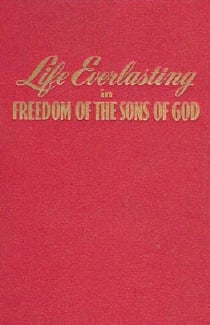
Life Everlasting
in
FREEDOM OF THE SONS OF GOD
"For the creation was subjected to futility, not by its own will but through him that subjected it, on the basis of hope that the creation itself also will be set free from enslavement to corruption and have the glorious freedom of the children of God." -Romans 8:20,21.
COPYRIGHT, 1966
by
WATCH TOWER BIBLE & TRACT SOCIETY
OF PENNSYLVANIA
First Edition
2,000,000 COPIES
PUBLISHERS
WATCHTOWER BIBLE AND TRACT SOCIETY
OF NEW YORK, INC.
INTERNATIONAL BIBLE STUDENTS ASSOCIATION
Brooklyn, New York, U.S.A.
Made in the United States of America
Dedicated to the God of Freedom
and Published to
and Published to Strengthen the Earnest Expectation Of the Creation While "Waiting for the Revealing of the Sons of God"
Symbols of Scripture translations quoted from or cited herein:
AS - American Standard Version Bible, by the American Committee of Revision, of 1901
AT - The Complete Bible; An American Translation, by J. M. P.
Smith and E. J. Goodspeed, of 1939
4V - Authorized or King James Version Bible, of 1611
CCD - The Holy Bible, a Catholic translation sponsored by the Episcopal Committee of the Confraternity of Christian Doctrine, of 1952
Dy - Roman Catholic English Translation of the Latin Vulgate made at Douay and Rheims, as of 1510
JPS - The Holy Scriptures, A New Translation, by The Jewish Publication Society of America, as of 1977
Mo -A New Translation of the Bible, by Dr. James Moffatt, as of 1922
NEB - The New English Bible; New Testament, as of 1961
Ro - The Emphasised Bible · A New Translation, by Joseph
B. Rotherham, as of 1897
RS -The Holy Bible: Revised Standard Version, as of 1552
Yg ~ Young's Literal Translation of the Holy Bible, by Robert Young, as of 1892
Any Bible quotation or citation not followed by any specific abbreviation is made from the New Testament (NY) or revised edition of 1861. Other translations of the Bible may be quoted or cited, but with the name of the translation not abbreviated. Any quotation or citation B C E. stands for "Before Our Common Era," and C E. stands for "Of Our Common Era," thus designating the number of the year before or after the year 1 C E.
CONTENTS
CHAPTER PAGE
1 Why Human Creation Will Yet Be Set Free 5
2 The Enslavement of Mankind to Transgression and Death 36
3 The Liberator—A Son of God 58
4 Being Immersed into the Liberator 82
5 The Lord's Evening Meal—A Liberation Supper 120
6 Heaven's Way of Ruling the "Congregation of God" 157
7 Subjection to the "Superior Authorities" 188
8 God's Gift of Marriage 219
9 The Places of Man and Woman in God's Arrangement 243
10 A Different Fight—Against Wicked Spirit Forces 267
11 God's Neutral Congregation or Neutral Nations, Which? 295
12 The Sacredness of the Blood of Free Men 321
13 Earth-wide Movement of "Men of Good Will" to Freedom 344
14 A Paradise of Freedom for Human Sons of God 379
Chart 31
Subject Index 401
Index to Scriptures Cited 407
Why Human Creation Will Yet Be Set Free
OU enjoy being free. Naturally so, for man was created to be free. Man has a built-in love of freedom. Appreciating his own freedom, the man who is unselfish likes to see others—his equals—free. If a man is made to feel that he is not free, he longs to become free; he makes an effort to gain his freedom. Never will he be satisfied with anything less than freedom. That is why today man's heart rejoices at the news that a day of liberation is coming, or, better still, that that day is at hand!
2At the start of human history the happy state of man was one of freedom. Today, thousands of years since then, it is very evident that there has been a loss of freedom on the part of humankind, the human creation. From people's talk in general one might be led to think that this loss of freedom has happened to only a part of the human family. For instance, in political circles today there is talk about a "free world," leaving the idea that there is an "unfree world." Political parties or governments that have recently ariseen think that certain peoples under other forms of rulership need to be "liberated."
So they feel it to be their obligation to "liberate" such peoples, whether by fair means or by foul. There is a political slogan that human society cannot exist part slave and part free. There are honest souls that resent it when any part of the population seems to be treated as slaves or second-class humans. Hence protest demonstrations occur. There are "freedom marches." War is fought to block enslavers.
3 Whatever amount of equal freedom the human creation may enjoy in various parts of the earth, the freedom or liberty actually enjoyed is only partial, extending only as far as it goes. There is yet a fuller measure of it to be enjoyed by all. In view of this complete freedom yet to be realized, all men are yet slaves to a less or greater extent. All need a liberation that man of himself has proved unable to bring about. Man's enslavers are stronger than he himself is. Liberation in full must yet come to all, without exception, for the loss of freedom such as man had at his beginning has been suffered by all mankind.
4 Look at the things that are outside the body of man but that affect him. Then you can see that the human creation is politically, socially and religiously the victim, the slave, yes, the prisoner of the system of things that mankind has built up during the past four thousand years. Thus the human creation is like the political dictator who governs others like slaves but who has become the prisoner of his man-made government, he being in continual fear for his life because of violently inclined discontented persons or ambitious rivals. Clearly something is wrong with the present system of things on earth.
There is no real contentment with it anywhere. But how are men to be liberated from it? Not strangely there are radical extremists who would overturn all that is old and long established. There are likewise extremists who selfishly hold onto the old and refuse to make any bargain with the opposite extremists. Unhappily the human creation is caught in between these opposing forces of bitter extremes. In the face of this, how can the human creation really be free, enjoying full liberty?
5 Some individuals or groups think that they can of themselves keep their independence and stay neutral and deal with the extremists of both sides but showing favoritism to neither. Yet even then, do they enjoy freedom of action or of choice? How strong are they to resist the pressures from either side or from both sides? They cannot help but be cramped. They cannot help but be affected by the changing of dominance in world affairs from one side to the other. Neutral or not, they are still part of this enslaving system of things that is outside man's body.
Turn, now, from the seen and felt things outside man's body, those that block free movement and action and that force one to make choices against one's own will. Everything indicates that there are other forces and influences that are playing upon the human creation. What man or woman can authoritatively say that there are not unseen superhuman, supernatural forces and influences? Such a question will be scouted at by persons who persuade themselves to believe that only what is material exists—materialists they call themselves, and they refuse to believe in invisible, supernatural, spirit persons, good and bad.
In order to believe in the existence of these they must see such persons with their own natural eyes.
Yet how unbalanced these materialistically minded persons are in such an attitude! How so? Because they believe that the wind blows; that the force of gravity makes an object thrown into the air fall back to the ground, that an electric current drives the motor of a streetcar; that cosmic rays are continually bombarding our planet earth from all directions, these most powerful of all rays come from somewhere in outer space and their existence being detected by a so-called Geliger counter. By believing in the existence of such inanimate invisible realities but not believing in the existence of unseen spirit persons, the shortsighted materialists unknowingly open themselves up to be victimized by any existing spirit persons that may be evil-minded. They do not guard themselves against being robbed of their mental and moral freedom by these malicious spirits. At the same time they want to believe that there are intelligent persons alive on other planets, and they vainly try to get in touch with them by radar.
8 Today men may boast of being free because of having their own freely elected democratic form of government. Yet they may actually be slaves in bondage to unseen heavenly oppressors and thus be lying in the power of supernatural masters who are mightier than even supermen. Thus from the realm of invisible spirit persons all the human creation can be affected and controlled, and not merely men and women in insane asylums who are afflicted with some unbreakable kind of obsession. Certainly man would need help from someone higher than himself to be liberated from such unseen enslavers.
How could man, of his own self, liberate himself from such freedom-hating spirit forces, since they are heavenly, immaterial, invisible, superior in power and beyond our human reach? Let us not be blinded by materialism. Let us not keep ourselves in the dark regarding spirit persons that interfere with human liberty. Written information about them we have at hand, and it comes from reliable sources that lay bare these spirit enemies and that show us how to resist them successfully and to gain deliverance from them.
FREEDOM NEEDED, TOO, FROM HUMAN IMPERFECTIONS
So much for things outside the human body that cramp human freedom. What about things within the human body itself that keep man from freely doing all the good and proper things that he would like to do? From our very birth we find ourselves in a bondage to our own human imperfections. If we are not crippled badly in body, we, early or late, come to appreciate that we are crippled in mind, no matter how well formed our physical bodies may be. There is a conflict between the body and the mind. The mind may be ambitious in a right direction, but the body may have other desires that are not according to its actual needs and better health. The mind does not find itself free to use the body as its servant, its instrument, in carrying out the best of thoughts; but the imperfect body, with downward cravings, acts as a drag on the person. At times he longs for release from the body, or at least from its inborn weaknesses, defects and wrong tendencies. Who or what can bring him this release, that he may be the better kind of person that he would like to be?
Why can he not cultivate perfection of body and mind?
10 Despite the continual struggle between body and mind, despite the enslaving system of things into which man has been born during these past thousands of years, man finds life to be sweet even with his limited measure of freedom. He would like to keep hold of it. If given a perfect set of conditions within and without himself, he would enjoy living as man everlastingly. But why does not man live forever? Medical science tells us that the human body is so marvelously constructed that it really ought to live on endlessly, ever repairing itself. Physicians cannot explain why it does not do so. The human body has such a marvelous defensive system within itself that they wonder why it is that man ever gets sick. They have to admit that all mankind, the free and the slave, the rich and the poor, the well educated and the ignorant unschooled, are in a grinding bondage. The expanding graveyards throughout the earth testify to this. This bondage is the bondage to that great enemy Death.
11 It is not just a case of untimely death. It is not just that men turn murderers and kill others criminally. It is not just that wars come along, modern wars, and kill even the home population far from the battlefield. It is not just that accidents occur, in airplanes, in motorcars on the roads, in mines and factories. It is not just that calamities occur, hurricanes, floods, earthquakes and pestilences. Even if we escape such things, still Death knocks at our door. Individually we get a disease, we get sick, and we die. If we live long enough, we get old, we grow frail, our bodily parts and functions wear out, and we die.
12 One man is reported to have reached an age of nine hundred and sixty-nine years, and yet Death caught up with him, even though not in a violent way. He failed of everlasting life; he did not survive to even a thousand years of life. Today few men survive to a hundred years or more of life. In one of the most progressive lands of the earth the average span of human life has been lifted by medical science to around seventy years. But medical science of men has to this day been unable to deliver mankind, even a single man, from this sorrowful bondage to Death, and it never will. Human medical science is not the promised liberator. The medical scientists themselves are in bondage to this common enemy, Death.
13 Not that our human creation will never be set free from all forms of bondage. Today hope of an early liberation shines brightly. So it is only a question of who the liberator will be. As we in the light of sure hope look forward to glorious freedom, for all our race, let no one imagine that perfect freedom means an absence of law or government, a state of anarchy, every free person being a law to himself. Not at all! Forever after our human creation has been liberated and given perfect freedom, man must still be subject to law. There must still be a rule of law. Even man with perfect freedom cannot escape this. Why not? Because all the universe, of which man is a part, is run by law, and that is a good thing, a wise thing. If there were universal anarchy, our universe would be destroyed.
14 Man did not make these laws governing the known and visible universe.
Its laws were in operation long before man ever entered into this nuclear, space age in which he launches astronauts aboard spaceships, into orbit around the earth, and now prepares to send cosmonauts to the moon and bring them back. Man cannot become an anarchist toward this material universe and try to violate its laws without getting hurt. He finds it to his benefit to conform to the laws of the universe. Even materialistic science today is interested in learning all the rules and regulations of this universe in which we live, in order to act in harmony with them intelligently and learn how to take advantage of these laws in a practical and beneficial way. Man is not liberating himself from these laws, removing them or putting them out of operation. Rather, he understandingly accepts his subjection to them and tries to enjoy his freedom to the full within the range of all this operation of universal law. This brings him pleasure rather than a sense of being oppressed.
PERFECT HUMAN FREEDOM UNDER LAW
15 So, too, our human creation, when liberated and brought to the freedom of human perfection, will inescapably be subject to law that issues forth from a source higher than man. To endless time man will be affected by the laws that govern our sun, this star that is one of the billions of stars in our marvelous galaxy, the Milky Way. In the earthly paradise, into which our planet earth will be transformed, perfected man will rejoice in the unchangeable laws governing the sun and will regulate his life by it, counting time by it, taking his needed rest after it sets in the west and arising refreshed when it ushers in the dawn.
15 Man will rejoice in the moon and the stars that appear by night and in the heavenly regulations that control them, man likely harnessing the tides daily caused by the moon. Man will experience pleasure in the variety and the steady succession of the seasons due to the regular movement of the axially tilted earth around the sun in obedience to heavenly law. In whatever part of the paradise earth he lives man will regulate his life according to the manifestation of these seasonal changes. Because universal law beyond his control is thus functioning, obliging man to conform, he will not feel enslaved. He will not feel this operation of law to be an invasion of his rights and liberties. He will find it to be a pleasure and benefit to mold his living according to those unchangeable laws. He will be thankful that such laws were put into force. He will enjoy his freedom by doing so.
17 Man is thus not lord of the universe. He is and ever will be subject to universal law. The things in heaven and earth play their influence upon him, and he cannot alter them. Not that these stars and planets in the heavens and the forces in operation on the earth are gods and goddesses, as many peoples of ancient times and even of today have thought, so that they have worshiped them or tried to appease them. Rather, these lifeless, unintelligent things affect man, and man must recognize and submit to the laws governing such created things. Within the spacious realm of the endless operation of these law-keeping things, perfect man will enjoy his earthly paradise and enjoy human freedom to a perfect degree.
18 So true freedom lovers do not desire an absence of right and beneficial law. Safe freedom is enjoyed within the framework of law. Rightly understanding them, we are glad for the timetested, trustworthy laws of the universe. We are grateful for the things of the universe that are kept in order by law so as to have the best effect upon us. Subjecting ourselves to them is no hardship and is not to our hurt. If, now, we wisely and beneficially subject ourselves to these inanimate objects and forces that were created for our good, why should we not, rather, subject ourselves to the One who created them and established the laws to govern them? We cannot escape being subject to him any more than we can escape being subject to the influence of those created things that affect us. Our denying the existence of the Creator of these things will not do away with our dependence on this Creator and our being subject to him and being affected by what is his will for our human creation. To fight against Him would be just as advantageous to us as our fighting against the laws governing the inanimate universe. For us creatures to fight against him and act contrary to his will and decisions will not prevent him from making our earth a paradise for the everlasting home of our human creation, subject to divine law.
19 Of course, for us to recognize that there is the one Creator of all things means for us to recognize ourselves as his creatures. This means that we recognize this Creator as the one Lawgiver for all things, animate and inanimate. As his creatures we are bound to recognize our obligation toward him.
But what is wrong or bad about that? In ignorance many ancient peoples looked upon the shining heavenly bodies and the forces that operate in our earth as being deities, and they felt a sense of obligation to them and rendered religious service to them. If they felt obligated to the created things, why should not we more enlightened people feel an obligation to the living Creator of such once-worshiped created things? The worship by those ancient idolaters toward such created things worked to their injury in all ways and did not bring them everlasting life, because it was a false worship. It was really a worship of malicious superhuman, supernatural spirit persons in the unseen heavenly realm. It robbed them of religious freedom and made them slaves of superstition and of the practicers of magic, sorcery and astrology.
RELIGIOUS FREEDOM
20 Exactly opposite to that, our worship of the true Creator of all things does not work toward our hurt. It is the true worship and has his blessing, and it works to our everlasting good. It works toward our liberation! Our accepting him as our Creator may move us to subject ourselves to his laws, but this by no means takes away from us true freedom. In fact, our decision to accept and obey him as our Creator and Lawgiver is always left to us to do of our own free will. When we subject ourselves wisely to the heavenly bodies and earthly forces that affect us and regulate much of our living, we do not lose our freedom, do we? No! And so, too, our willingly subjecting ourselves to the will and law of the Creator does not deprive us of pure, safe, beneficial freedom. Hence, we should not fear to subject ourselves to the Creator's rule of law.
21 Today materialistic scientists are continually interesting themselves in the laws of the universe and probing deeper and deeper in order to discover them and understand them so as to get benefit from their discoveries. How much more should we interest ourselves in the Creator himself and in his laws for our human creation and earnestly seek to know and understand them. This is even more enlightening than the discovery of universal laws and it works to our greater benefit. It frees us from bondage to superstition, idolatry, immoral practices, extreme fear of mortal men, devils, false religious doctrines and systems, and false hopes. Continued subjection to God's beneficial laws keeps us free from such hurtful, enslaving things.
22 The laws of the universe are not written down in books for us to read. We merely observe them in operation and come to know them by study, by discovery or by testing out ideas expressed regarding them. We are not yet acquainted with all of them. But the Creator's laws for man have been written down and have been preserved till now. A king who for forty years judged his nation according to the set of divine laws given to it made this estimate of the Creator's laws; also giving the Creator's name:
28 "The heavens are declaring the glory of God; and of the work of his hands the expanse is telling. One day after another day causes speech to bubble forth, and one night after another night shows forth knowledge. . . . The law of Jehovah is perfect, bringing back the soul. The reminder of Jehovah is trustworthy, making the inexperienced one wise. The orders from Jehovah are upright, causing the heart to rejoice; the commandment of Jehovah is clean, making the eyes shine.
The fear of Jehovah is pure, standing forever. The judicial decisions of Jehovah are true; they have proved altogether righteous. They are more to be desired than gold, yes, than much refined gold; and sweeter than honey and the flowing honey of the combs. Also, your own servant has been warned by them; in the keeping of them there is a large reward."—Psalm 19:1-11, as written by King David of Jerusalem, 11th century B.C.E.
Sweeter also than honey and the flowing honeycomb is freedom or liberty. The joyful sound of liberty is pealed forth by God's law, "the law of Jehovah," which the psalmist David said was "perfect, bringing back the soul," bringing renewed life. That law was first given in writing to a people whom Jehovah their God had liberated from the enslaving power of mighty Egypt of the sixteenth century Before Our Common Era. It was the law of a freed nation. Over fifteen hundred years afterward a member of that nation who appreciated his freedom wrote to fellow worshipers of God and advised them to stay under the law of liberty, saying: "Keep on speaking in such a way and keep on doing in such a way as those do who are going to be judged by the law of a free people." (James 2:12)* On July 8, 1776, when the 2,000-pound bell rang in the tower of the State House (now Independence Hall) of Philadelphia in the State of Pennsylvania, then a British colony, few persons may have appreciated that engraved on that bell was a call for liberty copied from the ancient law of God.
What was that?
25 As the famous bell is on display, visitors can read on it the engraving: "Proclaim liberty throughout all the land unto all the inhabitants thereof.—Leviticus xxv, 10." To the new nation that then with gladsome sound proclaimed its independence from the colonial rule of the British Empire, the ringing of a bell with such an inscription might seem to have been very appropriate. Just four days previous, or on July 4, 1776, a Declaration of Independence had been adopted in its final form by the Second Continental Congress, declaring the thirteen North American colonies to be free and independent states and repudiating any connection with Great Britain. But originally the thrilling words on the Liberty Bell applied to God's ancient liberated people, and they applied to a Jubilee event every fifty years. That Jubilee law passed out of force nineteen hundred years ago, but its words of liberty have a prophetic application that will shortly take in, not only people living on the North American continent, but also people living on all other continents and the islands of the seas. The Jubilee is not just a piece of now dead ancient history.
25 Well, then, when will God cause the proclamation of liberty to be made, not just throughout a little area of land in the Middle East, but throughout all the earth to all the inhabitants thereof? Our painful appreciation of the slavery and bondage in which all our human creation lies and groans heightens our interest in this question.
Look back to the time when the Jubilee law was introduced. It was in the second year of God's liberation of his chosen people from the "house of slaves" in ancient Egypt. Under the visible leadership of his prophet Moses he had brought them into the peninsula of Sinai to the base of Mount Sinai or Horeb. There he gave them Ten Commandments that he himself had inscribed on tablets of stone and also a big body of other related laws. It was not God's purpose for them to remain in that wilderness, living miraculously on water and manna. That was not the land throughout which liberty was to be proclaimed to its inhabitants. They were to stay there for only a time. God was leading them by his prophet Moses to the land that He had promised to give to their God-fearing forefathers, Abraham, Isaac and Jacob, and it was to be a "land flowing with milk and honey." (Exodus 33:1-3; 19:1 to 20:21; 40:1-38) So God gave his people many laws that were to apply first after they had entered the Promised Land. God specially noted that fact when he gave the Jubilee law, saying:
27 "When you eventually come into the land that I am giving you, then the land must observe a sabbath to Jehovah. Six years you should sow your field with seed, and six years you should prune your vineyard, and you must gather the land's produce. But in the seventh year there should occur a sabbath of complete rest for the land, a sabbath to Jehovah. Your field you must not sow with seed, and your vineyard you must not prune...
88 "And you must count for yourself seven sabbaths of years, seven times seven years, and the days of the seven sabbaths of years must amount to forty-nine years for you. And you must cause the horn of loud tone to sound in the seventh month on the tenth of the month; on the day of atonement you people should cause the horn to
sound in all your land. And you must sanctify the fiftieth year and proclaim liberty in the land to all its inhabitants. It will become a Jubilee for you, and you must return each one to his possession and you should return each man to his family. A Jubilee is what that fiftieth year will become for you. You must not sow seed nor reap the land's growth from spilled kernels nor gather the grapes of its unpruned
vines. For it is a Jubilee. It should become something holy to you."—Leviticus 25:1-12.
29 What was the "liberty" that all of God's liberated people inhabiting that land "flowing with milk and honey" were to enjoy every Jubilee year? It was a liberty from indebtedness and from servitude to any of their fellow citizens. It was the time for the handing back of lost property that must not be separated for all time from the family line. If a citizen had fallen into debt and if, in order to pay his debt, he had sold himself or members of his family into servitude to his fellow citizens, then on the Jubilee he and other sold ones of his family must be set free, his debt being canceled, and he must be given enough provisions to start up a free life as a citizen with full rights again.
(Leviticus 25:39-43, 53, 54) The Jubilee meant restoration to freedom. Its purpose was to preserve a nation of free people.
50 If a man, a householder, was obliged to sell his hereditary possession, a field or a house in an unwalled city, the right of repurchase continued with him for a year. If during that time he or his fleshly relative was unable to repurchase the hereditary possession, then it would continue with the buyer until the Jubilee year. "It must go out
in the Jubilee, and he must return to his possession."
This conformed to the rule: "In this year of the Jubilee you should return each one to his possession." (Leviticus 25:13-31) Thus no family was to sink into the depths of perpetual poverty. Every family was to have its honor and respect, and so any family that lost its hereditary possession through falling into poverty was to regain its rightful property in the Jubilee year, and was to start life anew as a family with property. As the great Lawgiver said: "No one should come to be poor among you, because Jehovah will without fail bless you in the land that Jehovah your God is giving you as an inheritance to take possession of it."—Deuteronomy 15:4.
81 However, this absence of poverty in the land depended upon their obedience to the great Lawgiver, Jehovah their God. Because of their disobedience to his law or because of circumstances, there would continually be cases of poverty in the land. Foreknowing this, Jehovah God went on to say to his people: "Someone poor will never cease to be in the midst of the land. That is why I am commanding you, saying, 'You should generously open up your hand to your afflicted and poor brother in your land.'" (Deuteronomy 15:11) So, fifteen hundred years later, part of those words could be quoted by a benefactor of the poor of that nation, when he referred to his approaching death and said: "You always have the poor with you, but you will not always have me." (Matthew 26:8, 11) In his days it was not possible to carry out the Jubilee law in the land because of foreign oppression by Imperial Rome.
88 The Jubilee law was a wise and loving provision for God's ancient people. Because of it the God-given land got a rest or enjoyed a sabbath every fiftieth year in addition to the seven preceding sabbath years.
Like those sabbath years, it too was a "year of the release." (Deuteronomy 15:1-9) Not only did the land get a rest or sabbath and recover its productive strength, but the inhabitants of the land did also. That was not only a rest from working the soil but also a rest from the burden of debt and of servitude to a fellow citizen. What a liberty marked the Jubilee!
A WORLDWIDE JUBILEE APPROACHING!
However, was this all there was to the matter? Was this to be just a feature that no other ancient nation enjoyed? Has it lost its interest for us since it was forcibly interrupted? Did it have no other meaning except for the inhabitants of the land under that unusual law? If men today attach no importance to it and see nothing prophetic in it, Jehovah God certainly attached tremendous importance to the observance of the sabbath years and the Jubilee sabbath. He showed this when he emptied the land of its inhabitants for seventy years, letting them be deported to a distant foreign land. Why was this? In the chronicles of those ancient times we read this inspired answer: "Furthermore, he [the king of Babylon] carried off those remaining from the sword captive to Babylon, and they came to be servants to him and his sons until the royalty of Persia began to reign; to fulfill Jehovah's word by the mouth of Jeremiah [the prophet], until the land had paid off its sabbaths. All the days of lying desolated it kept sabbath, to fulfill seventy years."—2 Chronicles 36:20, 21.
34 That exile of God's people called for a liberation from that ancient seat of empire, Babylon, and Jehovah God brought this liberation in the last year of those seventy years, in 537 B.C.E.
(2 Chronicles 36:22, 23) But the liberated people could no longer observe the Jubilee even on their own land, this now being subject to the Persian Empire. Well, then, had the Jubilee law been in vain, ending up in nothing gained? No! That law calling for liberty to be proclaimed had a prophetic meaning, and for God the Lawgiver it had not lost its meaning. God's purpose in giving that liberty law has not failed. The law set forth a pattern that Almighty God will yet bring to reality. Where? Not just in that small Middle Eastern land where once it was in force, but also in all lands, in all the earth. What will that mean? Nothing less than this, that Jehovah God will cause liberty to be proclaimed throughout the whole earth to all its inhabitants.
59 Why can we be so confident about that? What authoritative basis is there for us to entertain such a bright hope? It is the Lawgiver's own word as found in writing in the Holy Bible. He inspired a letter to be written to a congregation of his worshipers in the city of Colossae, Asia Minor, in the first century of our Common Era. The inspired penman was a man deeply versed in the divine law, the Christian apostle Paul, writing from Rome, Italy, about the year 60 or 61 C.E. Writing to that congregation some of whose members thought that they should put themselves under the ancient law by which sabbath days and years had been established, Paul wrote: "Let no man judge you in eating and drinking or in respect of a festival or of an observance of the new moon or of a sabbath; for those things are a shadow of the things to come, but the reality belongs to the Christ."
(Colossians 2:16, 17) So the things in the ancient law given at Mount Sinai in Arabia foreshadowed real things to come, and those legal shadows gave a truthful and correct outline of those grand things to come. They excited good hopes.
One day the shadow would trace its way to the reality, the substantial thing, and then the shadow would cease. When would that be? It would be when the long-promised One, the real Christ or Messiah, would come. But when the apostle Paul wrote to the Colossian Christians Jesus Christ had already come to earth and done his work here as a man and had returned to the heavens. Hence that congregation of his followers there at Colossae was called Christian. The true Christ or Messiah of the inspired prophetic Scriptures had come in the year 29 C.E. and had finished his work as a man in 33 C.E. Therefore the time had come for the people under the ancient law to stop observing those shadowy practices, such as the observance of the new moon or first day of each lunar month, and the observance of the sabbath, whether the weekly sabbath, the Atonement Day sabbath, the seventh-year sabbath of the land or the fifteeth-year Jubilee sabbath of the land and its people.
Further inspired proof of the prophetic meaning of the Jubilee we find in the letter written to certain Christianized Hebrews. It refers to the priests who were taken from the family of Aaron, the brother of the prophet Moses, and says: "Men are rendering sacred service in a typical representation and a shadow of the heavenly things; just as Moses, when about to make the tent in completion, was given the divine command: For says he: 'See that you make all things after their pattern that was shown to you in the mountain.'
But now Jesus has obtained a more excellent public service, so that he is also the mediator of a correspondingly better covenant, which has been legally established upon better promises. For since the Law has a shadow of the good things to come, but not the very substance of the things, men can never with the same sacrifices from year to year which they offer continually make those who approach perfect."—Hebrews 8:5, 6; 10:1.
88 For centuries now those priests and their animal sacrifices have ceased, for since the year 70 C.E. there has been no Jewish temple or altar on Mount Moriah in Jerusalem. But such things have not been necessary, for the Christ has come. Therefore God let the typical earthly temple and its sacrifices and festivals pass out of existence, because those typical things were merely shadows and in God's due time they had to give way to the reality. So the Jubilee and its proclamation of liberty throughout the land was a "shadow of the good things to come."
SIX THOUSAND YEARS OF HUMAN EXISTENCE CLOSING
59 The time is fast drawing near for the reality that was foreshadowed by the Jubilee of liberty to be proclaimed throughout the earth to all mankind now oppressed by many enslaving things. In view of the earth-wide situation and the world's condition, it appears most urgent for the liberation like that of the Jubilee to come soon.
Most certainly the near future would be the most appropriate time for it. God's own written Word indicates that it is the appointed time for it. Here we are well along in the twentieth century of our Common Era. How long before our Common Era began was it that man was created and placed in his paradise home in what is now southwest Asia? The Holy Bible, which gives us the authentic account of man's creation, gives us a timetable running all the way back to his creation. The Bible runs this timetable or chronology all the way back from the year of release of God's people from Babylon in the first year of Cyrus the Great, the Persian king.—2 Chronicles 36:22, 23; Ezra 1:1:4."
49 Thus we can connect up the Bible's count of time with the world's count of time down to this date. By doing this it becomes evident that man is nearing the end of six thousand years of his existence and the beginning of the seventh period of a thousand years of his existence. The year of man's creation is generally spoken of as the Year of the World or Anao Mundi and symbolized by the letters A.M. Now if we take a copy of the popular Authorized or King James Version of the Bible, equipped with marginal references, we find that it gives the year of man's creation as 4004 B.C.E., which is according to the Bible chronology figured out by the eminent Irish Anglican prelate, Archbishop James Ussher (1581-1656). If we accept that date, then if we add 1,996 years, it gives us the total of 6,000 years. Then the seventh period of a thousand years of life for man would begin in the year 1997 C.E.
41 Since the time of Ussher intensive study of Bible chronology has been carried on. In this
The New Jewish Encyclopedia, of 1962, by D. Bridger and S. Wolk, under the heading of "Chronology, Jewish," says, on page 91: "It is not definitely known when the counting of time from Creation began. Some believe that it started in the second century C.E. The accepted differential between Jewish and general chronology is 3,760 years. By adding this figure to the curricular one arrives at the year One of the Jewish calendar. Thus the year 1960 C.E. is equivalent to the Jewish year 5,720. In Jewish chronology it is customary to mark the year before One as 'b.c.e.' (before common era), and the year after the year One, as 'c.e.' (common era)."
According to this Jewish calculation the year of man's creation would be 3760 B.C.E. However, it must be said that the Jewish chronologers reject the chronological help that is given in the last twenty-seven months of "the Christian Greek Scriptures," as, for instance, in Acts 13:20, 21—See the article "Why the Jewish Count of Time Differs," as published in The Waichtower under date of May 15, 1958, pages 297-300.
In the edition of the Holy Bible with "A Commentary and Critical Notes," by Adam Clarke, LLL, F.S.A., of the year 1836, Volume 1, page 41, gives the date of man's creation as "A.M. 1, B.C. 4004."
In the Murphy edition of The Holy Bible, Donay Version, containing the Approbation of James Cardinal Gibbons, Archbishop of Baltimore, Maryland, U.S.A., the footnote on Genesis 1:1 reads: "A.M. 1; Ante C. 4004". That is to say, Anno Mundl 1; Ante Christum 4004 (Year of World 1; Before Christ 4004).
In the new French edition of 1940 of La Sainte Bible, by J. N. Darby, the chronological data give the time of the first publication of the Bible in Messiah (Christ). In agreement with this is the German Lutheran clergyman, Abraham Calovius (Calov), born 1612 in Prussia, died 1686. See Chronological data in the Swedish Bible Thet ar All then Heliga Skrift Pä twentieth century an independent study has been carried on that does not blindly follow some traditional chronological calculations of Christendom, and the published timetable resulting from this independent study gives the date of man's creation as 4026 B.C.E.† According to this trustworthy Bible chronology six thousand years from man's creation will end in 1975, and the seventh period of a thousand years of human history will begin in the fall of 1975 C.E.
So six thousand years of man's existence on earth will soon be up, yes, within this generation. Jehovah God is timeless, as it is written in Psalm 90:1, 2: "O Jehovah, you yourself have proved to be a real dwelling for us during generation after generation. Before the mountains themselves were born, or you proceeded to bring forth as with labor pains the earth and the productive land, even from time indefinite to time indefinite you are God." So from the standpoint of Jehovah God these passing six thousand years of man's existence are but as six days of twenty-four hours, for this same psalm (verses 3, 4) goes on to say: "You make mortal man go back to crushed matter, and you say: 'Go back, you sons of men.' For a thousand years are in your eyes but as yesterday when it is past, and as a watch during the night." So in not many years within our own generation we are reaching what Jehovah God could view as the seventh day of man's existence.
48 How appropriate it would be for Jehovah God to make of this coming seventh period of a thousand years a sabbath period of rest and release, a great Jubilee sabbath for the proclaiming of liberty throughout the earth to all its inhabitants! This would be most timely for mankind. It would also be most fitting on God's part, for, remember, mankind has yet ahead of it what the last book of the Holy Bible speaks of as the reign of Jesus Christ over earth for a thousand years, the millennial reign of Christ. Prophetically Jesus Christ, when on earth nineteen centuries ago, said concerning himself: "For Lord of the sabbath is what the Son of man is." (Matthew 12:8) It would not be by mere chance or accident but would be according to the loving purpose of Jehovah God for the reign of Jesus Christ, the "Lord of the sabbath," to run parallel with the seventh millennium of man's existence.
44 The Jubilee year of God's ancient law was a "shadow of the good things to come." The substantial reality that it foreshadowed must yet without fail be introduced for the good of all the groaning human creation. The blessed time for its introduction is fast approaching. Shortly, within our own generation, the symbolical trumpet will be sounded by divine power, proclaiming "liberty in the land to all its inhabitants." (Leviticus 25:8-10) God foresaw the need for this and had it foreshadowed in his ancient law given through the prophet Moses. As his law foreshadowed this coming great worldwide Jubilee, he has laid the full legal basis for its full, glorious realization. Consequently there is now every reason why the human creation will yet be set free, not by men, but by Almighty God. The long-awaited time for this is at hand!
<tr><th>FREES
DATE ANNO MUNDI
EVENT
REFERENCE
1636 YTS. (Geschlag der Gen. 11.14.42, 12.34)
Creation of Adam (in early autumn)
Gen. 2:7
Birth of Seth
Gen. 5:3
Death of Adam
Gen. 5:5
End of 1st 1,000-year day of man's existence
Birth of Noah
Gen. 5:28, 29
Birth of Shem
Gen. 11:10
Mithraiah dies in this year; floodwaters fall (in November)
Gen. 5:27, 28
Flood subsidies; God gives law on sanctity of blood
Gen. 7:6, 11
Birth of Arpachshad
Gen. 9:4-6
427 YTS. (Geschlag der Gen. 11.14.42, 12.34)
Founding of Babel; beast comes out of sea
Gen. 11:10
End of 2d 1,000-year day of man's existence
Gen. 10:8-12; Rev. 13
Birth of Abraham
Gen. 11:32; 12:4
Abrahamic covenant made
Gen. 12:4, 7
Birth of Isaac; beginning of the "about 450 years"
Gen. 21:15, 15; Acts 13:17-20
Isaac weaned (age 5); Isbael (age 19) taunts Isaac; beginning of 400-year affliction
Gen. 21:18; 15:13; Acts 7:6
Birth of Esau and Jacob
Gen. 25:26
Joseph made prime minister of Egypt
Gen. 41:40, 46
Jacob and family move to Egypt
Gen. 47:9
430 YTS. (Ex. 12.30, 41; 215 yrs. Ex. 12.34, 12.34; chap. under "EVENT")
a. 2426
Egypt prominent as First World Power
Ex. 1:8
Deut. 34:7
Passover; Israel leaves Egypt; end of 400-year affliction; Law covenant made at Sinai
Ex. 12:12, 40:41; Gen. 15:13, 14; Ex. 24:8-8
<tr><th>DATE ANNO MUNDI
EVENT
REFERENCE
Israel enters Canaan under Joshua; count for Jubilee years begins Tishri (Ethanim) 10
Josh. 5: 6; Lev. 25
End of Joshua's war operations in Canaan; end of the "about 450 years" of Acts 13: 17-20; first sabbath year for Israel (in fall); 350-year period of Judges begins
Josh. 11: 23; 14: 7, 10-15; Lev. 25: 1-7
First Jubilee year begins Tishri (Ethanim) 10
Lev. 25: 8-12
Saul anointed as king of Israel
1 Sam. 10: 24
David becomes king
Acts 13: 21, 22
Solomon succeeds David as king
1 Ki. 2; 11, 12
Construction of Solomon's temple begins in his 4th year (in spring)
1 Ki. 6: 1
End of 3d 1,000-year day of man's existence
Nehoobam succeeds Solomon as king; 10 tribes secede
1 Ki. 11: 42, 43
Assyria, Second World Power, subjugates Israel, takes Samaria
2 Ki. 17: 6, 13, 18
Nebuchadnezzar rules as king of Babylon, Third World Power
Jer. 25: 1
17th Jubilee begins
Lev. 25
Nebuchadnezzar takes first Jewish captives to Babylon
2 Ki. 24: 12-18
Nebuchadnezzar takes Jerusalem by siege
2 Ki. 25: 3-7
<tr><th>Page Number
Text
References
Temple razed, Jerusalem destroyed (5th month): abandoned (7th month); 70-year desolation begins; Seven Gentle Times begin to count
2 Kli. 25: 8-10; Jer. 52: 12-14; 2 Kli. 25: 26
Bahylon falls to Medes and Persians; Medo-Persia becomes Fourth World Power; Darius rules
Dan. 5: 30, 31
Cyrus the Persian (in first year) decrees return of Jews
2 Chron. 36: 22, 23
Zerubbabel completes second temple
Ezra 6: 14, 15
Jerusalem's walls built by Nehemiah; 70 weeks of Dan. 8: 28 begin fulfillment
Neb. 1: 1; 2: 1, 11; 6: 15; Dan. 8: 24
Greece, Fifth World Power, rules Judea
Dan. 8: 21
Rome, Sixth World Power, rules Judea
John 19: 15; Rev. 17: 10
End of 4th 1,000-year day of man's existence
Birth of John the Baptist and Jesus
Luke 1: 60; 2: 7
(Fall) Jesus baptized, anointed; end of 69th "week" of Dan. 9: 24
Luke 3: 1, 2, 23
Nisan 14, Jesus sets up Lord's Supper; impaled; middle of 70th "week" of Dan. 9: 24
Luke 22: 20; 23: 33
Nisan 16, Jesus restructured; Sivan 6, Pentecost; outpouring of holy spirit; Christian congregation founded; Peter uses first key
Matt. 28: 1-10; Acts 2: 1-4, 14
Peter uses 2d key; Roman centurion Cornelius anointed, baptized; end of the 70 weeks of years
Acts 10: 34-48
Jerusalem council of apostles and older men decrees against blood and things strangled
Acts 15
Jerusalem and temple destroyed by the Romans
Dan. 9: 27; Luke 18: 42-44
<tr><th>DATE C.E.
DATE ANNO MUNDI
EVENT
2 Thess. 2:7
Last Jewish fortress, Masada, falls to Romans
c. 100
John, last of the apostles, dies
Emperor Hadrian rebuilds Jerusalem, making it a Roman colony called Ælla Capitolina
Roman Emperor Constantine, Pontifex Maximus, convokes first general council of bishops at Nicaea
Damascus (bishop of Rome, takes over title of Pontifex Maximus)
Augustine is converted to Roman Catholicism
Pope Leo III crowns King Charles (Charlemagne)
End of 5th 1,000-year day of man's existence
Pope Innocent VIII dies after a blood transfusion
Protestant League of Schmalkaid is entered into
Great Britain emerges as Seventh World Power
End of Holy Roman Empire
(July) First number of Zion's Watch Tower is published
Zion's Watch Tower Tract Society (now Watch Tower Bible & Tract Society of Pa.) is legally chartered
(October) Gentile Times end; World War I rages
The Watch Tower (Jan. 1) declares for Christian neutrality
First use of stored blood, by professor of medicine, University of Chicago; Watch Tower Society representatives imprisoned (June); World War I ends in November
(March) Watch Tower Society representatives released, exonerated the following year
League of Nations begins its sessions as Eighth World Power
<tr><th>1927
The Watchtower (Dec. 15) declares bloodshed a reason for God's vengeance at Armageddon—Gen. 9: 3, 4
(July 26) The name "Jehovah's witnesses" embraced
"Great Crowd" of Revelation 7: 9-17 identified at Washington (D.C.) assembly and in The Watchtower
Flood bank on a large scale established at Cook County Hospital
Theocratic organization of Jehovah's Christian witnesses completed
(September) World War II begins; League of Nations goes into inactivity
The Watchtower (July 1) exposes blood transfusion—Ps. 16: 4 (September) World War II ends; (October) United Nations Organization ratified
(October) Russia sends up first satellite; causes world to fear
(October 1) Pope John XXIII opens Vatican Council II
Pope John XXIII, at Council, publishes encyclical "Pacem in Terris" in which he praises United Nations Organization. June 3, he dies despite blood transfusions
(May) "Spy satellites" and astronauts increase world tension
(October 4) Pope Paul VI visits United Nations Headquarters in New York city, endorses United Nations and confers with president of U.S.A. December 8, he closes Ecumenical Council Vatican II
Theoretical World War II proves the existence of "king of the north" and the "king of the south" (Dan. 11: 5-7, 40). Expansion of organization of Jehovah's Christian witnesses continues, and international series of "God's Sons of Liberty" District Assemblies are scheduled to begin on June 22, in Toronto, Ontario, Canada. Book Life Everlasting—in Freedom of the Sons of God to be released Saturday, June 25, 1966
End of 6th 1,000-year day of man's existence (in early autumn)
End of 7th 1,000-year day of man's existence (in early autumn)
The Enslavement of Mankind to Transgression and Death
OR thousands of years men have looked for liberation from the enslavement in which the human creation in general finds itself. Few have been those persons who have looked for this liberation with understanding. Happy are those comparatively few who have come to know the irremovable basis for this sorely needed liberation. Among those who intelligently saw the historical steps that were being taken toward the liberation of our natural creation was a freedom fighter of nineteen hundred years ago. His writings on freedom have survived to this day and have brought a great degree of freedom to many among his millions of readers. He spent years in prison because of his fight for a most precious freedom, the freedom of worship or freedom of religion. A number of his prized letters were written from prison.
2 He was therefore a controversial figure, and so he was not loved by all but had many enemies, even enemies who sought to kill him.
Even today the mention of his name might stir up feelings of unfriendliness toward him, with possible contempt for him. He was Saul of the city of Tarsus in Asia Minor. As a young student of law in Jerusalem he violently acted against the principles of religious freedom. Then, suddenly, he became a follower of the man who publicly declared at Jerusalem: "If you remain in my word, you are really my disciples, and you will know the truth, and the truth will set you free."* Discipleship to this man made a difference in Saul of Tarsus, and he became a foremost fighter for the freedom of worship of the one living and true God. Undergoing a change of name, he became known as the apostle Paul, being sent forth to both non-Jews and Jews, both Greeks or Gentiles and Israelites. It was as such that he penned his excellent letters on religious freedom. Even those who do not claim to be Christians will read his letters with the greatest of benefit.
3 Let us now consider part of the letter that the apostle Paul wrote to the congregation of fellow disciples in Rome, Italy, in the first century of our Common Era. After referring to his own sufferings for his Christian faith, he goes on to speak, not merely of his own bright hope for the future, but also of the comforting hope for all our human creation. In chapter eight, verses eighteen to twenty-four, the liberty-loving apostle Paul writes:
"Consequently I reckon that the sufferings of the present season do not amount to anything in comparison with the glory that is going to be revealed in us.
For the eager expectation of the creation is waiting for the revealing of the sons of God. For the creation was subjected to futility, not by its own will but through him that subjected it, on the basis of hope that the creation itself also will be set free from enslavement to corruption and have the glorious freedom of the children of God. For we know that all creation keeps on groaning together and being in pain together until now. Not only that, but we ourselves also who have the first fruits, namely, the spirit, yes, we ourselves groan within ourselves, while we are earnestly waiting for adoption as sons, the release from our bodies by ransom. For we were saved in this hope."—Romans 8:18-24.
5 Even since those inspired words were written, every human thing that men have tried, to gain freedom from the enslavement in which they find themselves in so many ways, has failed, has proved futile. They will have to agree with the apostle Paul that "the creation was subjected to futility." Hence, as the apostle Paul says, "all creation keeps on groaning together and being in pain together until now." But we men and women who have been born into this state of things did not want this. It was not by our will, just as the apostle Paul says: "The creation was subjected to futility, not by its own will." By what or whom, then, was our human creation subjected to futile, vain efforts?
6 The apostle Paul says that this subjection to futility was "through him that subjected it," that is to say, through the Creator himself. That sounds like an injustice on the part of the Creator toward his human creation. But it was not so! Why not?
7 Because this does not mean that the Creator made our first human parents sickly, imperfect, transgressive or sinful, bound to die and thus suffer the ruining of all our right expectations for the future. In love and in display of his own praiseworthy workmanship the Creator made the first man and woman perfect. It was on the sixth creative day, toward its end, that God created them, thus bringing six days of creative work respecting our earth to a glorious end. "After that," as we read in Genesis 1:31, "God saw everything he had made and, look! it was very good. And there came to be evening and there came to be morning, a sixth day." Now concerning man's Creator, the prophet Moses wrote under inspiration, in Deuteronomy 32:4: "The Rock, perfect is his activity, for all his ways are justice. A God of faithfulness, with whom there is no injustice; righteous and upright is he." So for this perfectly acting God to pronounce the man and woman whom he had made "very good" means that they were humanly perfect, the products of perfect divine activity.
8 Of course, the first man and woman were subject to the laws of the universe, the effect of the movement of the sun, moon and stars and other forces that God had created earlier; but within all that functioning of the universe they could be free and happy. Being mortal creatures, they had to obey the demands of their own human makeup and eat of the foodstuffs that their Creator and heavenly Father made available for them. But such obedience to their needs was no slavery. It kept them free from enslavement to death due to self-starvation. (Genesis 1:29, 30) Being perfect creatures, they were not subject to sickness, to diseased minds, to wrong desires, to corruption of the flesh, or to a divine condemnation such as rests upon what is imperfect and perverted.
Thus they enjoyed a freedom such as we humans do not have today. They were earthly children of God, and they knew and enjoyed the "glorious freedom of the children of God."—Romans 8:21.
9 Their Creator did not set any vanity, frustration or futility before them but set before them a grand realizable goal. He also made other living things on earth subject to them. To that end he blessed them, rather than curse and condemn them, for the creation account in Genesis 1:26-28 says: 'God went on to say: 'Let us make man in our image, according to our likeness, and let them have in subjection the fish of the sea and the flying creatures of the heavens and the domestic animals and all the earth and every moving animal that is moving upon the earth.' And God proceeded to create the man in his image, in God's image he created him; male and female he created them. Further, God blessed them and God said to them: 'Be fruitful and become many and fill the earth and subdue it, and have in subjection the fish of the sea and the flying creatures of the heavens and every living creature that is moving upon the earth.' Instead of being told to bow down in worship to the fish of the sea, the flying creatures of the heavens, whether reptilians, birds or insects, and the other living creatures of the earth, the perfect man and woman were told to have these lower creatures in subjection.
CHILDREN OF FREEDOM
10 As the highest creation of the earth they enjoyed O what a glorious freedom!
This was rightly so, for they were made "in God's image," and he is a God of freedom. Idolatrous men today speak proudly of what they call "the goddess of liberty," idolizing their idea of her; but as regards man's Creator we read in the letter written by the apostle Paul to a Christian congregation in Greece, the birthplace of political democracy: "Now Jehovah is the Spirit; and where the spirit of Jehovah is, there is freedom." (2 Corinthians 3:17) So, since the first man and woman were the children of a free Father, Jehovah God, they would be free children. Their heavenly Father, Jehovah God, is the Father, not of slave children, but of the free! In support of that fact, the apostle Paul wrote to congregations in Galatia and Rome:
11 "Now because you are sons, God has sent forth the spirit of his Son [Jesus Christ] into our hearts and it cries out: 'Abba, Father!' So, then, you are no longer a slave but a son; and if a son, also an heir through God." (Galatians 4:6, 7) "For all who are led by God's spirit, these are God's sons. For you did not receive a spirit of slavery causing fear again, but you received a spirit of adoption as sons, by which spirit we cry out: 'Abba, Father!' The spirit itself bears witness with our spirit that we are God's children." —Romans 8:14-16.
12 According to God's own will for mankind as declared almost six thousand years ago, the whole earth was to become a realm of glorious freedom for God's children. That is what God the Creator meant when he blessed the first man and woman and told them to be fruitful and become many and fill the earth. From these two original humans the entire earth was to become filled with the free children of God. God purposed to bless the womb of that first woman, and she personally would become the mother of many sons and daughters.
Finally she would become the great-grandmother of a whole earthful of perfect God-like sons and daughters. Even at the age of a hundred and thirty years she would have been able to bring forth children. (Genesis 4:25) Being themselves free children of God, they would bring forth free grandchildren of God, in the image of the free God and according to the likeness of the God of freedom. All this will of God concerning the first man and woman was realizable under His blessing. No life of limited duration, of vanity, of frustration or of futility was set before them. They rightfully hoped to realize this will of God for them in God's due time, doubtless within his seventh creative day. To that end the Creator blessed that seventh creative day, for the creation account says:
…