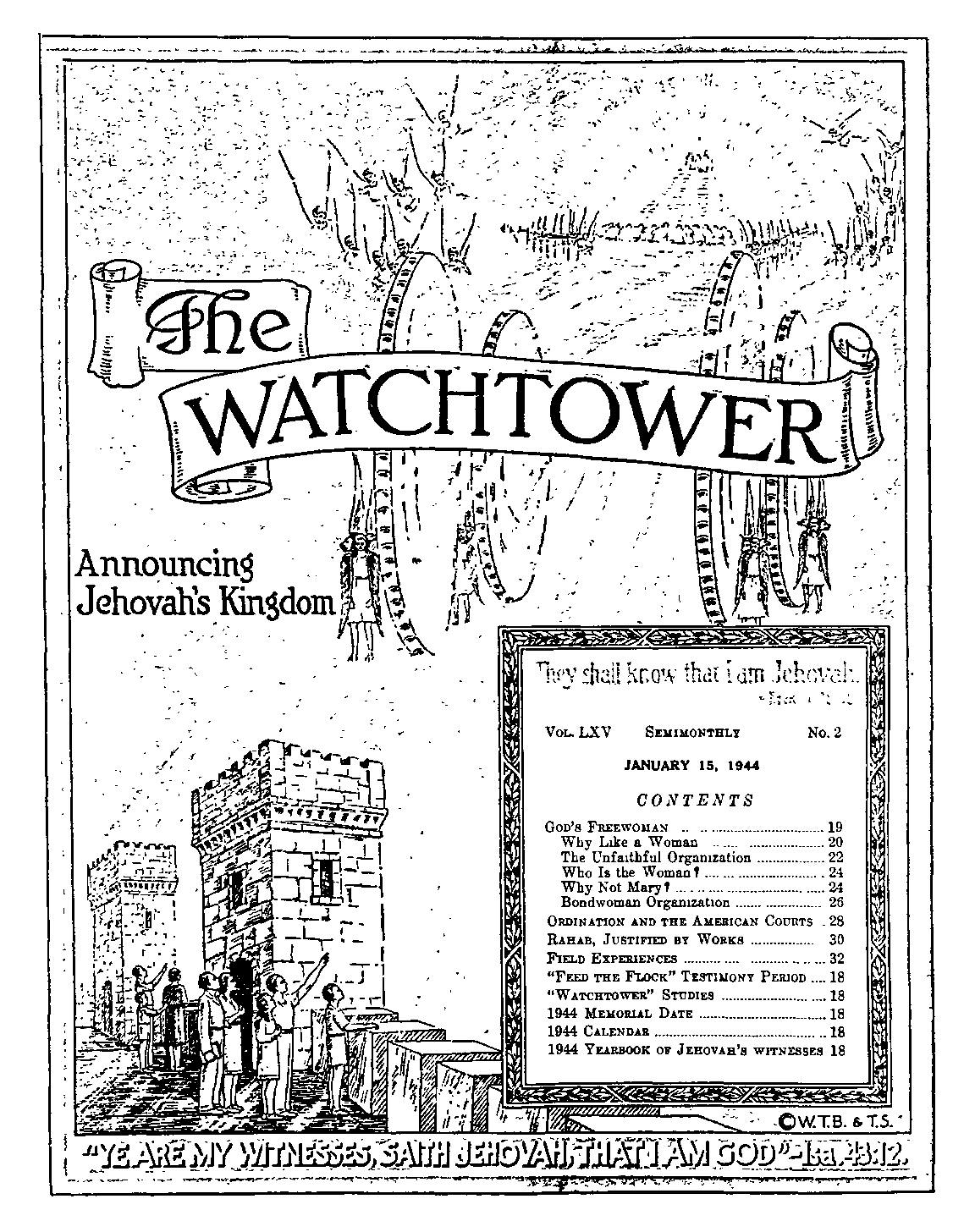
The Watchtower, January 15, 1944
Download: PDF — The Watchtower, January 15, 1944
“FEED THE FLOCK” TESTIMONY PERIOD
February, expected to be the blackest month of the Northern winter for food supplies, will not want for spiritual nourishment. The month has been named “Feed the Flock” Testimony Period. Great effort to reach the scattered sheep with “meat in due season” will be made by Jehovah’s witnesses and their companions. February will open a great three-month house-to-house campaign where- ever the magazine is permitted circulation, to increase the subscription list of The Watchtower. A special offer will be authorized of a year’s subscription for this journal, together with a copy of “The Truth Shall Make You Free’’ and Freedom in the New World as a premium, at the regular subscription rate of $1.00. For anyone's part in this special campaign considerable preparation will be required. Jehovah’s witnesses and companions will accordingly begin planning and preparing now to launch out at the opening of the campaign fully equipped and instructed, eager to exceed anything that has been attained heretofore in such an effort for 100,000 new American subscribers.
WATCHTOWER” STUDIES
Week of February 20: “God’s Freewoman,” 1-21 inclusive, The Watchtower January 15, 1944.
Week of February 27: “God’s Freewoman,” 22-42 inclusive, The Watchtower January 15, 1944.
1944 MEMORIAL DATE
Due to the interrupted or delayed communications with other countries under conditions of total war, the Memorial date for this year, namely Saturday, April 8,1944, after 6 p. m., Standard Tune, is here given early announcement.
1944 CALENDAR
The Watch Tower Society’s 1944 calendar features the yeartext, namely, “Teach me to do thy will; for thou art my God.” (Psalm 143:10) The up-to-date animated picture accompanying (in color) conforms to the text and illustrates how it is being carried out by those who now make the text their own. The calendar pad announces the bimonthly Testimony periods of 1944, and also the service themes and supporting scriptures of the alternating months. The calendar is now available, and will be mailed on a contribution of 25c a copy, or 5 copies to one address on a $1.00 contribution.
1944 YEARBOOK OF JEHOVAH’S WITNESSES
Despite the unfavorable conditions, the 1944 Yearbook of Jehovah’s witnesses has been produced covering the world-wide accomplishments of these Bible educators during this past service year of 1942-1943. The stirring report thereof has been prepared by the president of the Watch Tower Bible and Tract Society, and it sets out also the key-features and objectives of the work immediately ahead, thus providing valuable material for service discussions and also counsel for all educators of men of good-will. A daily text and comment covering each day of the year 1944, as based on The Watchtower, makes it a daily handbook of spiritual food. The new Yearbook, of over 350 pages, enclosed in a sturdy binding, may be had at 50c a copy, postpaid. Those associated in a group or company should combine orders and send through the local servant, to economize time and shipping expense.
The WATCHTOWER
ANNOUNCING JEHOVAH'S KINGDOM
Vol. LXV January 15, 1944 No. 2
GOD’S FREEWOMAN
"But the Jerusalem that is above is free, which is our mother. Wherefore, brethren, we are not children of a handmaid, but of the freewoman."-Gal. 4:26,31, Am. Rev.Ver.
JEHOVAH is the heavenly Father. Those on earth who know his Fatherhood are not ashamed of his J name, but pray, “Our Father, which art in heaven, Hallowed be thy name.” Jehovah is the matchless Organizer of perfection. He is the Father of his grand family in heaven and earth, a universal family. He knows how and is also able to rule this universal household well and to have it in subjection that thus order, peace and well-being may result. For this purpose he has his household of devoted children organized. Together they constitute or make up his universal organization. Jehovah, the Organizer thereof, being the divine Spirit, is invisible to that part of his organization which is on earth. Those of his household who are also spirit, namely, cherubim, seraphim, archangel and angels, are likewise invisible to earthly creatures, and they form the invisible part of his universal organization. Those creatures on earth who are in the flesh and are members of his household form the visible part of his universal organization.
2 It is well for us on earth that Jehovah’s invisible organization is orderly according to righteousness. Reason itself should convince us that it is orderly, regular and well-timed, and the condition of organizations of men cannot argue against that conviction. Imperfect men may trace their existence back to God, but not so their organizations in politics, business, labor, and society. Hence their organizations are no standards by which to judge as to God’s organization, but are as imperfect and sinful as their makers and members. To judge rightly we must look at those works of God visible to us, but unreached and untouched by man, namely, the sun, moon, stars, and planets. Then we gain some idea as to the glory, permanence, regularity and perfect order of God’s organization of living, invisible spirit creatures. As respects disorderly men on earth, “that which may be known of God is manifest to them; for God hath shewed it unto them. For the invisible things of him from the creation of the world are clearly seen, being understood by the things that are made, even his eternal power and Godhead.” (Rom. 1:19,20, margin) As respects those on earth who form the visible part of his organization, God’s own orderliness is set forth as the reason for them to strive to work together in peace and harmony. It is written: “Let all things be done unto edifying. For God is not the author of confusion [tumult; unquietness], but of peace, as in all churches of the saints. Let all things be done decently and in order.”-1 Cor. 14; 26, 33, 40; also Ex. 40: 4; 2 Chron. 29: 35.
1. (a) Who is the heavenly Father, and how does he see that order, peace and well-being of his household are kept? (b) Who make up the seen and the unseen part of his universal organization?
2 (a) What gives us reason to believe in the orderliness and regularity of God’s invisible organization? (b) What reason is set forth in Scripture for those of his visible organization to be at peace and harmony?
3 The word organization may not be found in any English translation of the Bible, but the key-thought of organization is expressed many times in the Bible, and visible organizations which God has used among men are described therein. The word organ does occur in the Bible; and this musical instrument suggests to us both arrangement to a scale and also harmony. (See Genesis 4:21; Job 30:31; 21:12; Psalm 150:4.) Organization and organ are both drawn from a language in which part of the Bible was written, namely, Greek. These words are drawn from the Greek word organon, which you will find in the Greek Septuagint Version of the Scriptures at Psalm 150: 4. Organon meant not merely a musical instrument, but any instrument for service. Its real thought is that of work; for organon is drawn from the Greek root-word ergein, meaning to work. The related word ergon means “work done or to be done”, and you will find it many times in the Greek text of the Bible. The modern scientific word erg means “a unit of energy or work”. Hence the essential idea of the thing called an organization is that of instrumentality and work. It follows that God’s organization would mean more than just his intelligent creatures. It would mean his obedient creatures as brought together into a united, harmonious whole, each one being given a place therein and duties to match and to fit in with those of the other members of the organization; and all such creatures working smoothly together and serving as God’s instrument in carrying out His purpose and getting His work done. Hence it comes that to organize means “to get things into smooth working-order”.
3. What are the root words back of “organization”, what is the basic idea of the thing called an “organization”, and what does “God's organization” mean?
4 In God’s organization every member thereof must perform his part or given duties. Otherwise, there is a disconnection in the organization and other members must for a time do extra duty trying to fill in for the lack of the member that failed of duty. Also, each member must not get in the way of other members in the doing of their given tasks. Otherwise, there is a rubbing together and clashing of operations, and trouble follows until the member out of order has been adjusted or put back in his right place, doing his own special work. Thereby every member renders or contributes his peculiar service to the organization as a whole and makes for its getting of God’s work done, to His pleasing and honor.
5 The best illustration of organization is the perfect human body with its proper number of members and its many vital organs, each having a particular part to play for the body’s health and ability to work. Using such illustration, a member of God’s organization long ago wrote: “The body is one, and hath many members, and all the members of that one body, being many, are one body: . . . For the body is not one member, but many. If the foot shall say, Because I am not the hand, I am not of the body; is it therefore not of the body? And if the ear shall say, Because I am not the eye, I am not of the body: is it therefore not of the body? If the whole body were an eye, where were the hearing? If the whole were hearing, where were the smelling? But now hath God set the members every one of them in the body, as it hath pleased him. And if they were all one member, where were the body? But now are they many members, yet but one body. And the eye cannot say unto the hand, I have no need of thee: nor again the head to the feet, I have no need of you. Nay, much more those members of the body, which seem to be more feeble, are necessary: and those members of the body, which we think to be less honourable, upon these we bestow more abundant honour; and our uncomely parts have more abundant comeliness. For our comely parts have no need: but God hath tempered [put together; combined] the body together, having given more abundant honour to that part which lacked: that there should be no schism [division; split] in the body; but that the members should have the same care one for another. And whether one member suffer, all the members suffer with it; or one member be honoured, all the members rejoice with it.”-1 Cor. 12:12, 14-26.
4 What is required of each member in God’s organization, and how do all members contribute toward it and Its work as a whole?
5 What is the best illustration of organization, and what detailed illustration of such did a member of God's organization give us?
6 Picturing how the organization must be closely bound together and must hold together by every member’s keeping his place and putting in his share of the work, the same writer says: “Dependent on Him [the Head of the body], the whole body-its various parts closely fitting and firmly adhering to one another-grows by the aid of every contributory ligament, with power proportioned to the need of each individual part, so as to build itself up in a spirit of love.” Or: “Under him [the Head], as the entire body is welded together and compacted by every joint with which it is supplied, the due activity of each part enables the body to grow and build itself up in love.”-Eph. 4:16, Weymouth and Moffatt translations.
7 To show the absolute need of holding fast to the head of the organization and thereby holding together with one another, the writer further says: “The Head, from whom the body, in all its parts nourished and strengthened by its points of contact and its connexions, grows with a divine growth.” Or: “That Head under whom the entire body, supplied with joints and sinews and thus compacted, grows with growth divine.” Or: “The Head, from whom the whole body, being supplied and compacted together by means of the joints and ligaments, grows with the increase of God.”-Col. 2:19, Weymouth; Moffatt; Emphatic Diaglott.
WHY LIKE A WOMAN
8 Because an organization of intelligent creatures of God may thus be illustrated by the human body, it is reasonable that God’s organization be likened to a woman, a wife. But why a “woman”? Primarily, because she is a creation. Hence she comes after her Maker, God, who is without beginning, and so is properly subject to her Creator and must serve his purposes in all due submission to them. Behold the first woman created! She was preceded by man. “For Adam was first formed, then Eve.” Therefore it was forbidden for her to “usurp authority over the man” Adam.-1 Tim. 2:12,13.
9 Why did God make woman and present her to Adam? “And the Lord God said, It is not good that man should be alone; I will make him an help meet for him.” (Gen. 2: 18) Adam was not incomplete in himself, that is to say, imperfect, but there was no counterpart to him in any of the animal creation on earth. No other creature on earth corresponded with him. God’s purpose was that the earth should be peopled with creatures of Adam’s kind. “For thus saith the Lord that created the heavens; God himself that formed the earth and made it; he hath established it, he created it not in vain [or to be a waste], he formed it to be inhabited: I am the Lord; and there is none else.” (Isa. 45: 18) Therefore, that he might not directly create all the perfect human creatures to fill the earth, but might finish his earthly creative work and rest therefrom, God created woman out of substance from the man Adam. God gave her to Adam, not as his directive head, but as a help, a working companion, one by whom to get work done, particularly the bringing forth of children into the earth and rearing them properly. “And God blessed them, and God said unto them, Be fruitful, and multiply, and replenish the earth, and subdue it: and have dominion over the fish of the sea, and over the fowl of the air, and over every living thing that moveth upon the earth.” (Gen. 1:28) Adam named all the earthly creatures over which dominion was to be wielded, and he also named his wife, Eve. (Gen. 2:19; 3: 20) All this made for human orderliness.
6 How did the apostle illustrate that the members of an organized body must hold together?
7 How did the apostle illustrate that the members must bold fast to the top one of the organization?
8 To what living creature may God's organization therefore be likened? and why to such person?
9 Why did God present Adam with woman, and what arrangement made for human orderliness?
10 Further describing the godly woman’s place and part, the inspired writer says: “For a man indeed ought not to cover his head, forasmuch as he is the image and glory of God: but the woman is the glory of the man. For the man is not of the woman; but the woman of the man. Neither was the man created for the woman; but the woman for the man.” (1 Cor. 11:7-9) Because of the likeness to this relationship between godly man and woman, the divine Word speaks of God’s organization as a woman or wife, and hence it speaks of God himself as having a woman. Thus it comes that the expression occurs: “For thy Maker is thy husband; Jehovah of hosts is his name.” (Isa. 54: 5, Am. Rev. Ver.) “And as the bridegroom rejoiceth over the bride, so shall thy God rejoice over thee.” (Isa. 62:5) God’s relationship to his organization as unto a woman or wife is repeatedly set forth in his Word. Therefore no one can say that such expressions as God’s "woman’’ or God’s “freewoman” are belittling to God and hence offensive. Such expressions are borrowed from his own Word. In Hebrew the word for woman (ishah) is the same as for wife.
11 God’s universal organization, which receives its life from God, is his creation and is made up of his holy and devoted creatures. As perfect woman was to be perfect man’s helpmeet, so God’s organization is properly His helpmeet and is subject to him for his purposes. As his organization, she was made for him and for his glory and must work with him, never trying to usurp authority over him, but holding to her proper place under the Supreme One. her divine Head. Hence, concerning those who, by God’s grace, are faithful, active members of his organization or woman, it is written: “For we are labourers together with God.” (1 Cor. 3:9) “We then, as workers together with him, beseech you also that ye receive not the grace of God in vain.”-2 Cor. 6:1.
10 What is the godly woman’s part and place respecting man, and why does it not belittle God to speak of his haring a “woman” or “wife”?
11. In what respects, then, is the universal organization Gods “woman”’ and how is this proved by what is written to members of her on earth?
12 From the above discussion it must not be deduced that Eve is used as a type or prophetic pattern of God’s universal organization or woman. No; the organization’s likeness to a woman is based on another woman, as will yet be shown. It was only after woman's creation on earth that God’s universal organization could be compared with the human female. The first man, being God’s perfect earthly creation and receiving his life from God, was a son of God: “Adam, which was the son of God.” (Luke 3: 38) With Adam’s coming to life there came into existence the earthly part of God’s universal organization. Universal means “present everywhere”, that is, existing throughout all creation. Everywhere where God’s intelligent creatures exist and serve him, there God’s organization exists, in unity, for all such faithful and obedient creatures must be organized to God’s will and purpose and so must belong and do belong to his organization. Rightly such organization is called his universal organization, as taking in all his holy living creatures. Before the making of an earthly creature in God's image and likeness, God’s universal organization was all spiritual, heavenly, and hence of a kind invisible to human eyes. After Adam’s creation he, as God’s perfect handiwork and son, became a part of the universal organization of his Maker. - Deut. 32: 4. 5.
13 As regards God’s universal organization before man’s creation, and which organization was then entirely spiritual, God’s only begotten Son was the beginning, hence first member, thereof. It was immeasurable time from his firstborn Son’s creation until God created the first man Adam, and thereafter in the due time God sent his only begotten Son to become a “son of man”, a perfect human, the exact equivalent of Adam in his innocence in Eden. Having given a perfect witness concerning Jehovah God his Father and dying as a martyr, the Son of God returned to life in the spiritual or heavenly realm. Then in a revelation he spoke to his disciple John on earth, saying: “These things saith the Amen, the faithful and true witness, the beginning of the creation of God.” (Rev. 3:14) Down till the time that this “beginning of the creation of God” was brought into existence there was no universal organization or woman of God in existence, and hence no living creature or creatures to colabor or co-operate with God in bringing forth his only begotten Son. God Almighty alone, and in a direct way, created or produced him, and thus this Son was God’s “only begotten” One. No creature produced thereafter had such distinction; for God did not let this Son be idle, but used him in His service in the bringing into existence all other creatures.
12 . When first could God’s universal organization be compared with woman, when did the earthly part of the organization come into existence, and how Is the organization universal?
13 . Who is the first member of that organization, how did be himself say so, and in what way Is be an “only begotten” one?
14 In such manner God’s universal organization began to grow with this only begotten Son as a start; wherefore the Scripture says: “God, who created all things by Jesus Christ.” (Eph. 3: 9) “Who is the image of the invisible God, the firstborn of every creature: for by him were all things created, that are in heaven, and that are in earth, visible and invisible, whether they be thrones, or dominions, or principalities, or powers: all things were created by him, and for him: and he is before all things, and by him all things consist.” (Col. 1: 15-17) “All things were made by him; and without him was not any thing made that was made.” (John 1:3) The only begotten Son was a proper foundation, a reliable base, with which God could begin his universal organization. Among the spirit creatures made through God’s firstborn creature the Bible names cherubim, seraphim, and angels, all of whom drew their life from Jehovah, the eternal “Fountain of life”, and hence were sons of God. Such sons were not left to their own devices, but were set in action, working with God and with one another under the firstborn Son, the first member of the organization. They were made a part of his organization, subject to him as Most High God, and all obedient to his will. At that time, therefore, God’s woman or universal organization was wholly spiritual or heavenly. As respects earthly human creatures who were yet to be made, God’s woman was “above”.
15 The first written information we have of God's woman colaboring with her “husband”, Jehovah God, is at Genesis 1: 26, which says: “And God said, Let us make man in our image, after our likeness: and let them have dominion over the fish of the sea, and over the fowl of the air, and over the cattle, and over all the earth, and over every creeping thing that creepeth upon the earth.” With these directive words God was calling into co-operation with himself his woman or organization “which is above”. He was addressing the first and chief one of that universal organization, namely, his only begotten Son. Here, then, we see God’s woman functioning together with him and in subjection to Him in bringing forth the first human creature, Adam, “which was the son of God.”
16 When Adam was put in the Edenic garden and given oversight of it, “to dress it and to keep it,” and then when God gave him the warning against eating of the forbidden fruit tree, Adam became a part of the universal organization of Jehovah God. (Gen. 2:15-17) Thereafter the woman was created and given to Adam to wife and they twain were instructed how they must co-operate in carrying out the divine mandate to fill the earth with a perfect, righteous race in God’s image and likeness. Then Eve also became a part of God’s universal organization. Adam and Eve were the visible, earthly part of it. In view of being created through it, they were children of that organization, God’s woman. At the same time they were members of it. Those who are members of the organization are said to be “children” of it. In receiving the divine mandate, Adam and Eve were instructed to be parent to others who should become earthly children and members of God’s universal organization.
14 How did God’s organization grow with that first member, how were such creatures "sons of God", and in what regard was God’s "woman" “above"?
15 What Is the first written record of God’s “woman" co-operating with him?
16 When was Adam, and when was Eve. made part of God’s organization, and how were they children as well as members of it?
17 God’s woman or universal organization now comprised two parts, a heavenly and an earthly, a part that is above and a part that is below, a spiritual part and a human part. Yet, both parts holding to the Creator as the Supreme One and doing His will in their particular parts of his universe, they were but one organization, at complete unity in God the Most High. Both parts were fully devoted to him, serving him of their own free will and doing their God-given duties in an organized manner. His law was as universal as his organization, because his will and rule must govern his entire organization. Such universal law commanded of them perfect obedience to Jehovah God in their particular field of operation. The first man Adam came under that universal law when God said to him: “Of every tree of the garden thou mayest freely eat: but of the tree of the knowledge of good and evil, thou shalt not eat of it: for in the day that thou eatest thereof thou shalt surely die.” (Gen. 2:16,17) It follows that the one who gets out of harmony with God’s universal rule of obedience can not be or remain a part of Jehovah's organization; for he thereby fails to perform his part of the organizational work. He no longer cooperates with the organization, and he tries to disturb and trouble it. He is out of harmony with the great Organizer Jehovah and not subject to His law.
THE UNFAITHFUL ORGANIZATION
18 At Eden the loving Father, Jehovah God, made provision to teach and nurture his earthly children in the way of eternal life. He appointed a spirit member of his universal organization, therefore one who was higher and of greater age than Adam and Eve, to instruct, enlighten and guide them in the path of obedience to the throne of God. The invisible overseer or overlord of humankind was Heylel, meaning “Lucifer” or “bright-shining one; light-bearer”. God also gave Lucifer a band of associates, fellow spirit creatures, to co-operate with him in such earthly oversight. In that way the Father, Jehovah God, provided for the teaching, training and rearing of his human son and daughter by means of His woman, his organization, of which Lucifer and his associate spirit helpers were all members.
17. (a) What two parts now composed the organization, and how was it yet one organization? (b) When did Adam come under the law of the organization, and when does one cease to be a part of It?
18. How did God provide for the teaching and rearing of His human son and daughter by means of his “woman"?
19 Adam and Eve, to prove themselves faithful members of the organization, must take heed and render obedience to the teaching and instruction which came from Him through the invisible part of His organization. Also Heylel, or Lucifer, must prove himself a faithful representative of God’s woman or organization by obediently transmitting God’s will and instructions and by loyally executing God’s orders and judgments toward humankind. In such position Lucifer was officially called ‘the anointed covering-cherub’; and regarding this it is written: “Thou hast been in Eden the garden of God;... Thou art the anointed cherub that covereth; and I have set thee so: thou wast upon the holy mountain of God; thou . . . wast perfect in thy ways from the day that thou wast created, till iniquity was found in thee.”-Ezek. 28:13-15.
20 Cherub Lucifer, by virtue of his office in God’s organization, was bound to uphold the throne or universal domination of Jehovah God, but he turned unfaithful to his anointing or commission as to man. So conducting himself, Lucifer brought reproach and caused shame to his mother, God’s woman. (Prov. 19: 26) He caused other creatures, spirit and human, to do the same. His iniquity lay in selfish rebellion against God the Father. Instead of delighting to keep on serving as an honorably placed member of his Father’s organization, Lucifer tried to use woman and man to make himself head of Jehovah’s universal organization and to take it out of the hands of God’s only begotten Son. Through such rebellion and attempted usurpation of power Lucifer transformed himself into Satan, which name means “opposer; antagonist”; and that toward his own Father, God Almighty. The universal organization is God the Creator’s own and is united to him in inviolable bonds, as his woman. Satan is not a creator, and so he aimed to get God’s woman or universal organization to divorce or break bonds with her God and Maker. Then she should attach herself to Satan, acknowledge him as her head and lord, and thus commit adultery with him, so committing a wicked breach of unfaithfulness to Jehovah God and his husbandship.
19. How must Adam and Eve prove themselves faithful members of the organisation, and how must Lucifer prove himself its faithful representative?
20. How did Lucifer bring reproach and cause shame to his “mother”? and bow did be aim to get her to commit adultery?
21 Satan succeeded in turning Adam and Eve away from God and out of His organization, by making a devil of himself. Devil means slanderer or defamer; and, to succeed, he denied God’s organization instructions to Adam and Eve and slandered God to them. The slander worked. For turning an attentive ear to it and disobeying organization instructions God dismissed Adam and Eve from His universal organization. No longer was it their mother. Of necessity, then, they must become the beginning of Satan the Devil’s organization.
22 Satan did not succeed in swinging God’s whole universal organization to his side and raping it. From Scripture it appears that he prevailed over the other spirit creatures assigned to him as man’s invisible overlord, or "covering cherub”, and these creatures forsook God’s heavenly organization and joined Satan the rebel, vowing allegiance to him as lord and head and subject to him as organizer. He became Beelzebub, “the prince of the demons.” (Matt. 12: 24, Am. Rev. Ver.) Mark that the members of his organization were those who had violated their obligations of fidelity and devotion to God, the husband of the organization to which they had belonged. Hence, in being likened to a woman or wife, Satan’s organization is pictured as an unfaithful woman that has turned against her proper husband and yoked up with a breaker of divine law. She has joined with Satan in mothering and nurturing organizations and works of wickedness under him. Long time there- after Babylon was brought forth as one of her children. Satan is spoken of as Babylon’s king and is addressed in these words: “How art thou fallen from heaven, O Lucifer, son of the morning! how art thou cut down to the ground, which didst weaken the nations! For thou hast said in thine heart, I will ascend into heaven, I will exalt my throne above the stars of God: I will sit also upon the mount of the congregation, in the sides of the north: I will ascend above the heights of the clouds; I will be like the Most High.”-Isa. 14: 4,12-15.
23 Because the city Babylon became the outstanding and dominant part of Satan’s earthly organization, his entire organization of invisible and visible parts is called “Babylon” in God’s Word. In derision of her claims to being a clean, virtuous organization of respectable antiquity God foretells her exposure and destruction and says: “Come down, and sit in the dust, 0 virgin daughter of Babylon, sit on the ground: there is no throne, O daughter of the Chaldeans: for thou shalt no more be called tender and delicate. Stand now with thine enchantments, and with the multitude of thy sorceries, wherein thou hast laboured from thy youth; if so be thou shalt be able to profit, if so be thou mayest prevail. Thou art wearied in the multitude of thy counsels. Let now the astrologers, the stargazers, the monthly prognosticators, stand up, and save thee from these things that shall come upon thee.”-Isa. 47:1,12,13.
21. Who became tbe beginning of Satan's organization, and how did he succeed In beginning it?
22 (a) With what others did Satan succeed, and why is his organization likened to an unfaithful woman? (b) How is earthly Babylon related to her, and in what language is Satan addressed as Babylon's “king”? 23. Why is Satan's organization as a whole called “Babylon”, and with what words does God in derision foretell her exposure and destruction?
WHO IS THE WOMAN?
24 The first human pair having ceased to be of God's universal organization, there was no longer any visible part of it on earth. God’s organization was without earthly or human children as members, and was again entirely above the earth and spiritual. At the time of pronouncing judgment upon Satan the Devil and his human dupes, and just before driving Adam and Eve out of the garden of Eden, Jehovah God said to that old Serpent, the Devil: “Upon thy belly shalt thou go, and dust shalt thou eat all the days of thy life: and I will put enmity between thee and the woman, and between thy seed and her seed; it shall bruise thy head, and thou shalt bruise his heel.” (Gen. 3:14,15) Who is the woman, the mother of this seed, toward whom this covenant or promise of God was made? Certainly not Eve, Satan’s tool to bring about Adam’s rebellion ; neither any of Eve’s female descendants, for more of these have been tools of Satan like their first mother Eve than those few women who have taken a position of enmity toward that Serpent Satan. Hence enmity toward that wicked one and his seed and, in turn, enmity from them has not been the peculiar distinguishing mark of earthly women.
25 Shoving aside all religious interpretations on whom “the woman” meant, we turn to the infallible Scriptures through which God gives the explanation. We learn that the woman is God’s own “woman”, his holy universal organization. That organization remained faithful to God and hence came into enmity or hostility with Satan and his organized seed. Thus God was foretelling that one of the members of his heavenly organization would be brought forth therefrom and would destroy Satan and his organization and thereby would execute to the full his mother’s enmity toward such wicked opposers of God. From Eden on God began to use woman, but not unfaithful Eve, as a symbol of his devoted organization above. He was speaking of woman in a prophetic sense, knowing that a few women would be born on earth whom he could use in his prophecies as a type or pattern of his universal organization which is spiritual, faithful to him.
24. (a) When did God's organization become all spiritual again? (b) Why could not Eve or her female descendants be the "woman” who God promised would bring forth the seed?
25. Who, then, is the woman? and in a general way what was God foretelling by that promise concerning the seed?
26 The promised seed of the woman is primarily Christ Jesus, the beloved Son of Jehovah God. Disclosing the Seed's enmity toward Satan the Serpent, the scripture says: "He that committeth sin is of the devil; for the devil sinneth from the beginning. For this purpose the Son of God was manifested, that he might destroy the works of the devil.” (1 John 3:8) His faithful followers are taken from among men and become members and hence children of God’s universal organization. Therefore it is written: “Forasmuch then as the children are partakers of flesh and blood, he also himself likewise took part of the same; that through death he might destroy him that had the power of death, that is, the devil; and deliver them who through fear of death were all their lifetime subject to bondage.” (Heb. 2: 14,15) God’s “woman” is thus the mother of a Liberator, the promised One who brings freedom. This fact shows that God’s woman never yielded to Satan’s importunities nor came into bondage to him. She is a “freewoman” and brings forth children unto freedom, which children are used to free others from bondage.
WHY NOT MARY?
27 Being God’s first creation and hence the very beginning or foundation of God’s universal organization, Christ Jesus as God’s only begotten Son is the foremost member of Jehovah’s organization or woman. No mere human seed of the sinner Eve could crush the Serpent’s head. Hence from his woman God brings forth this Son to execute his righteous purposes against Satan the Serpent and all his brood. The Son, Christ Jesus, was foreshadowed by the wise man, King Solomon; only Christ Jesus is surpassingly wiser than Solomon and constantly faithful. As Jesus said: “The queen of the south ... came from the uttermost parts of the earth to hear the wisdom of Solomon; and, behold, a greater than Solomon is here.” (Matt. 12: 42) As a type of Christ Jesus, the royal Seed of God’s woman, King Solomon wrote under inspiration to the other children of God’s woman: “Hear, ye children, the instruction of a father, and attend to know understanding. For I give you good doctrine, forsake ye not my law. For I was my father's son, tender and only beloved in the sight of my mother.” (Prov. 4: 1-3) His “mother” is the one referred to in the Father’s promise at Genesis 3:15. As firstborn member of the organization Christ Jesus is specially beloved by all members of God’s faithful organization.
28 Mary, the Jewish virgin, who became the mother of the boy Jesus, could not be the mother meant at Proverbs 4:3; neither could she be the parent of the promised Seed of the "woman”. Mary, who was espoused to Joseph, was not the wife or woman of Jehovah God the Father, because God’s only begotten Son, the Seed, existed long before Mary. By a divine miracle God’s already living Son laid aside his heavenly glory and merely received human nature through Mary. Such human nature the Son of God laid aside after thirty-three and a half years, that it might be offered up in sacrifice and its merit be presented in heaven at God’s throne as a ransom price to free all believing humankind from sin and its penalty, death. Hence the “woman” whose Seed God’s only begotten Son is was God’s universal organization. Jesus was a member of that holy organization at the time he was brought forth therefrom and sent down to earth to become the “man Christ Jesus”. - Luke 1: 30-35, 37; Matt. 1:18-25.
26 Who, primarily, Is the seed, from what form of life are his followers taken, and how is their mother a "freewoman”?
27 How does God bring forth the Son from the “woman’, and in what words does King Solomon show the Son's tender relationship to the “mother”?
28 Why could not Mary be the “woman” that mothers the Seed? and when did tbe Son come forth from the real woman?
29 Because of that special relationship to Jehovah’s organization as his real mother the following is reported concerning Jesus after his baptism and anointing with God’s spirit: “While he yet talked to the people, behold, his mother and his brethren stood without, desiring to speak with him. Then one said unto him, Behold, thy mother and thy brethren stand without, desiring to speak with thee. But he answered and said unto him that told him, Who is my mother! and who are my brethren! And he stretched forth his hand toward his disciples, and said, Behold my mother and my brethren! For whosoever shall do the will of my Father which is in heaven, the same is my brother, and sister, and mother.” (Matt. 12:46-50; Catholic Douay Version) Jesus’ earthly relationship to Mary the Jewess was merely secondary and temporary as compared with his eternal relationship to Jehovah’s universal organization or “woman".
30 Adam’s wife Eve thought that Cain, their firstborn, would prove to be the promised seed, the Serpent-slayer; but he showed himself to be “of that wicked one”, Satan the Serpent, and hence a member of his organization. (1 John 3:12) Cain slew his brother Abel, because Abel separated himself from the side of Satan’s organization and took the side of Jehovah’s organization and served as a witness for Him. The True Seed. Christ Jesus, had not yet come and offered the ransom sacrifice for such men of faith as Abel, and so this first witness of Jehovah was only a typical representative of God’s organization or woman. He could not address Jehovah as "Father”. After Abel other witnesses of Jehovah arose, such as Enoch, Noah, Melchizedek, and Abraham, all being typical representatives of God’s woman, of whose coming Seed they bore testimony. -Heb. 11:4-19; 7:1-15.
29. By what words on a certain occasion did Jesus show his relationship to Mary was secondary and temporary in comparison with that to His real “mother"?
30. Of whose organization did Cain prove himself to be, and what was Abel, together with faithful men that followed him, as regards God’s organization?
31 As explained by the apostle Paul, the patriarch Abraham was used in a great prophetic drama as a type of Jehovah God, the Father of the promised Seed of the woman. Writing to Christ’s followers, who are sons of God, the apostle said concerning Abraham: “For in the sight of God in whom he believed, who gives life to the dead and speaks of things non-existent as though existing. Abraham is the father of all of us. As it is written, 'I have made you father of many nations.’ ” (Rom. 4:16,17, Weymouth) Thus Abraham was a prophetic pattern of Jehovah God himself; and from this viewpoint, or in God’s sight, Abraham is the father of all believing followers of Christ Jesus, The Seed. In other words, Jehovah God is the Greater Abraham. For such reason Abraham in the prophetic drama could not remain in Babylon's territory, at Ur of the Chaldees. So God said to him: “Get thee out of thy country, and from thy kindred, and from thy father’s house, unto a land that I will shew thee: and I will make of thee a great nation [meaning Abraham was to have seed or offspring], and I will bless thee, and make thy name great; and thou shalt be a blessing: and I will bless them that bless thee, and curse him that curseth thee: and in thee shall all families of the earth be blessed.”-Gen. 12: 1-3.
32 Babylon, the chief city of the Chaldeans, together with Ur of the Chaldees, represented Satan’s organization. or “woman”. Abraham’s departure from Babylon’s dominion agrees with the fact that Jehovah God has no connections or relationship with Satan’s organization. By bearing in mind that Abraha a typified his heavenly Friend, Jehovah God, it is seen that God’s promise or covenant to Abraham foretold that Jehovah would bring forth a Seed which would become a Government or “nation”, and by which Seed Jehovah God would make his own name great and would be the Sender of great blessings. The receivers of such blessings would be creatures on earth who blessed or praised the name of Jehovah, the Greater Abraham; whereas those who cursed Jehovah’s name would receive the divine curse, meaning everlasting destruction. Even though Satan the Devil should cause the vast majority of humankind to curse Jehovah’s name and suffer destruction, yet there would be representatives of all families or tribes of the earth that would prove worthy of blessing. Such was God’s covenant with Abraham, commonly called “the Abrahamic covenant ’; and Abraham showed belief in it by clearing out of Babylon.
31 . As explained by Paul, In what sense is Abraham the father of all Christian sons of God, and how would this tact affect his remaining in any part of Babyions territory?
32 . (a) With what fact does Abraham’s departure from Ur of the Chaldees agree? (b) What, then, in brief, did God's promise or covenant to Abraham foretell?
33 The patriarch Abraham brought out with him a wife, Sarah, a close kinswoman whom he called his sister, saying: “She is the daughter of my father, but not the daughter of my mother; and she became my wife.” (Gen. 11: 29; 12: 11-13; 20:2, 11-13) This being true, she was a freewoman. At the time that her husband entered the Promised Land to which God led him she was sixty-five years old, but was barren of children. For ten years Abraham and Sarah sojourned in the new land, but she continued barren. God had meantime assured Abraham: “He that shall come forth out of thine own bowels shall be thine heir. . . . Look now toward heaven, and tell the stars, if thou be able to number them: ... So shall thy seed be.” Abraham “believed in the Lord”, and Jehovah “counted it to him for righteousness”. (Gen. 15: 4-6) Now it began to seem that Sarah was not to be directly the mother of Abraham’s heir.
34 A relief measure then suggested itself. “Now Sarai, Abram’s wife, bare him no children: and she had an handmaid, an Egyptian, whose name was Hagar.” (Gen. 16:1) Hagar is not mentioned in Scripture as having come with them out of the land of the Chaldeans. Evidently when Abraham passed through Canaan and for a time sojourned in Egypt to escape famine, this Egyptian woman was taken into the household and assigned to the work of handmaid to Sarah. Later when Abraham came up out of Egypt, it was with this bondwoman or handmaid Hagar. (Gen. 12:11-20; 13:1) Years later “Sarai said unto Abram, Behold now, the Lord hath restrained me from bearing: I pray thee, go in unto my maid; it may be that I may obtain children by her. And Abram hearkened to the voice of Sarai. And he went in unto Hagar, and she conceived.” In due time “Hagar bare Abram a son: and Abram called his son's name, which Hagar bare, Ishmael”. (Gen. 16: 2,4,15) What, then, does this part of the drama mean?
BONDWOMAN ORGANIZATION
35 Abraham representing Jehovah God, then Sarah as his wife pictured God’s woman. At the time of God’s promise in Eden, at Genesis 3:15, he and his universal organization or woman were both ancient of days just as Abraham and Sarah were past middle age at the time of the establishing of the Abrahamic covenant. Just as the wife Sarah continued barren for years afterward and the hope of a seed by her seemed unlikely of realization, so with God’s woman. His organization continued barren of the Promised Seed for more than four thousand years after God’s covenant-promise in the garden of Eden, and more than nineteen centuries after his covenant with Abraham. His organization, as pictured by Sarah, was and is heavenly, or spiritual, being made up of spirit creatures, and so is above. It could thus bring forth a heavenly or spiritual seed, in God’s heavenly image. The earthly part of God’s organization had vanished at Adam and Eve’s rebellion in Eden, but this did not impair God’s power to put a member of the heavenly organization, a child of his woman pictured by Sarah, upon the earth to bless and vindicate God’s name and to free men from Satan and his organization. Sarah was submissive to Abraham and called him “lord”. So God’s heavenly organization served Jehovah God as Lord, her Maker and Supreme One, and she is free to serve him. She did not divide her allegiance with Satan the Devil, and so is not in bondage to him. -1 Pet. 3:5,6.
33. Who was Abraham’s wife and what was her standing? and why did it begin to seem as if she would not directly be mother to Abraham's seed?
34. What relief measure was then suggested, and what did its execution produce?
35. What was pictured by Abraham and Sarah’s old age, her barrenness, her free standing, and her submission to Abraham as her lord?
36 During the barrenness of God’s woman humankind were sinking ever deeper in bondage to sin and the arch-sinner Satan the Devil. Their transgression was increasing. Then Hagar’s counterpart came into existence and produced an offspring, in fulfillment of the prophetic drama of Abraham and his household. How? Note must here be made of the fact that Abraham duly had a son by his wife Sarah and to that son the heirship to the Abrahamic promise was decreed. This son, Isaac, passed on the birthright to the covenant-promise to his son Jacob. Jacob (or Israel) had twelve sons and a daughter, and to escape the famine in Canaan they all moved down into Egypt under God’s direction and guidance. During 215 years of sojourning in that land they became twelve tribes, of great populousness, but yet abiding separate from the Egyptians. In selfish fear and under the promptings of Satan, the god of Egypt, the Egyptians took steps to destroy the Israelites. Then God brought them forth from such great oppression and bondage in Egypt, and by the hand of the prophet Moses he made them a free people. On the very last day of their bondage in Egypt Jehovah God entered into a covenant with the Israelites through Moses as mediator, to make them his people, a “people for his name”. The covenant was made valid, operative and binding over the blood of the passover lamb, which all faithful families of the Israelites killed, sprinkling its blood upon the doorposts and lintels of their dwellings.
37 The Israelites now became God’s covenant people, and when he delivered them from Egypt and the Red sea, it was as his covenant people that he saved them. By Moses Jehovah God led them a two months’ journey through the Arabian wilderness to Mount Sinai, the mountain of God. There he inaugurated the covenant he had made with them in Egypt giving them the basic law of the Ten Commandments and all related statutes and ordinances, and also establishing a priesthood of the tribe of Levi among them. Thereby Jehovah organized them as a nation, his typical Theocratic nation. They were then a Theocratic national organization, that is, an organization put in working order by Jehovah the great Theocrat and subject to his law. As such they could well be symbolized as a woman, belonging to Jehovah God and in covenant relationship with Him. At Jeremiah 31:32, God speaks of that law covenant with the Israelites as “the covenant that I made with their fathers, in the day that I took them by the hand, to bring them out of the land of Egypt; which my covenant they brake, although I was an husband unto them, saith the Lord”. Jehovah God was as a husband to that covenant nation, just as Abraham was a husband to his concubine, Sarah’s Egyptian handmaid, who bare Abraham the son Ishmael. Then, at that deliverance of the covenant people of Israel from Egypt, was enacted the great counterpart of the drama of Abraham when he came forth from Egypt with the Egyptian bondwoman Hagar. - Amos 9:7.
36. (a) During the barrenness of God's "woman" what was happening to humankind? (b) What developments in the history of Abraham's descendants led up to the appearing of Hagar’s counterpart?
37. How was enacted the great counterpart of Abraham's going forth from Egypt with the Egyptian bondwoman Hagar?
38 At Mount Sinai, through the inauguration of God’s law covenant with the Israelites by their mediator Moses, the greater Hagar or antitypical Hagar brought forth her offspring pictured by Ishmael. This was after the great travail of coming forth from Egyptian bondage. Mount Sinai having become associated with the Hagar organization, the mountain became a symbol of the same organization as Hagar symbolized. But would the seed of the Hagar organization prove to be the promised seed of God’s woman?
39 The prophetic drama foreshadows the answer to such question. Ishmael, Hagar’s son, was a child of a bondwoman, and Jehovah God did not accept him as the promised seed of Abraham. True, Ishmael was Abraham’s son, but not by his free wife, Sarah. Sarah was seventy-five years old at Ishmael’s conception, and if she was to have a child of her own body it must now be by the power of the spirit of God. The child’s birth must be by a miracle of God and hence must be “after the spirit” of God. Hagar, however, was a young woman still capable, according to nature's law, of bearing children. Hence her child by Abraham was not miraculous, but was natural or “after the flesh”, and not by any intervention of the great Spirit, Almighty God. Though he was Abraham’s offspring, Ishmael’s standing was determined by his mother’s position in the household, which was that of a maidservant, a bondwoman. He was a slave child.
38. When did antitypical Hagar bring forth her offspring, and by what mountain also was the same organization pictured?
39. Why was Hagar’s son Ishmael born "after the flesh”? and what was his standing in the household, and why?
40 Just opposite thereto, God’s woman, whose seed must fulfill the prophecy to bruise the Serpent’s head, is His “freewoman”. She is not under any other organization; she is above. She is spiritual, heavenly, and she only is capable of bringing forth the Seed “after the spirit”, a heavenly Seed. The promised Deliverer must be the son of God’s “freewoman”. Hence only a son by Abraham’s freewoman, his true wife, could typify truthfully the Seed of God’s woman.
41 Hagar’s son Ishmael felt himself the heir of the Abrahamic covenant by reason of fleshly ties with Abraham. Likewise the offspring of the Hagar organization, God’s covenant people Israel, thought to prove themselves to be the promised seed of Abraham by their works of the flesh according to the law covenant. But in vain! All attempts to keep the law simply exposed them as sinners, and each year they had to offer for their sins typical sacrifices of animals whose blood could not take away human sins. The law of the covenant would never have been given to them had they not been sinners in the first place. Hence it is written: “Wherefore then serveth the law! It was added because of transgressions, till the seed should come to whom the promise was made; and it was ordained by angels in the hand of a mediator.” (Gal. 3:19) “The law is not made for a righteous man, but for the lawless and disobedient, for the ungodly and for sinners, for unholy and profane, for murderers of fathers and murderers of mothers, for manslayers, . . . and if there be any other thing that is contrary to sound doctrine.” (1 Tim. 1: 9-11) All efforts of the Israelites to justify themselves by fleshly works of the law failed. “For by the works of the law shall no flesh be justified.” (Gal. 2: 16) This proved they were not the seed of God’s woman, his free, perfect and heavenly organization. They were not members of it. They were not the real Theocratic nation. They were merely a typical Theocratic organization.
42 The Israelites were children of merely a secondary organization, which was only temporary, and which was to exist only till the true Seed should come of the true woman and wife of Jehovah God, the Greater Abraham. Being a part of the Hagar organization and imperfectly doing the works of the law never did relieve them of the condemnation of sin in a real way. They never rose higher than the standing of the children of the bondwoman organization, symbolized by Hagar. Who, then; is the Seed of God’s freewoman? and who today visibly represents her on earth! That becomes the absorbing theme of our next article.
40. Why is God's “woman” as a “freewoman” and capable of bringing forth the Seed? and who only of Abraham’s household could therefore typify the promised Seed?
41. How did the offspring of the Hagar organization try to prove themselves to be Abraham’s promised seed, but what did they prove themselves actually to be?
42. Of what grade of organization, then, were the natural Israelites, and what was their standing therefore?
ORDINATION AND THE AMERICAN COURTS
THE Supreme Court of the United States recently considered the legal status of the ministers of Jehovah God as ordained ministers under the law of the land. Among other things concerning this question they were advised by Jehovah’s witnesses that which appears below.
It is not necessary to know theology, philosophy, art, science and ancient classic languages to preach the gospel. One is not required to wear a distinctive garb, live in a parsonage, ride in an expensive automobile, have a costly edifice in which to preach, and command a high salary, to qualify as a minister of Jehovah God. Jehovah’s witnesses emulate their Leader, Christ Jesus, and His apostles, rather than the ancient or modern scribes and Pharisees, the “recognized” orthodox clergy. Instead of a program of choir and organ music followed by discourse on science and philosophy of men, that the people must come to hear in the nominal recognized sects’ churches, Jehovah’s witnesses devote all their time to studying and teaching the Bible and carrying God’s message to the people at their homes. They are ministers in the real and true sense and serve all the people. Paul, the apostle, said that the true minister teaches publicly and from house to house. (Acts 20:20; Luke 22:24-27) It is written that Christ Jesus “went round about the villages, teaching”, and “preaching the gospel of the kingdom”. (Mark 6:6; Matt. 9: 35; Luke 8:1) The apostle Peter advises each minister of Jehovah God: “For even hereunto were ye called: because Christ also suffered for us, leaving us an example, that ye should follow his steps." (1 Pet. 2:21) Jesus expressly commanded His twelve ordained ministers to go from house to house: “And as ye go, preach, saying, The kingdom of heaven is at hand.” -Matt. 10:7,10-14.
In the four Gospel accounts of the ministry of Jesus, the words “house” and “home" appear more than 130 times, and in the majority of those times it is in connection with the preaching activity of Jesus, the great Exemplar. His example of carrying the gospel message to the people at their homes and in the public ways was “true worship”. He said: “But the hour cometh, and now is, when the true worshippers shall worship the Father in spirit and in truth: for the Father seeketh such to worship him. God is a Spirit: and they that worship him must worship him in spirit and in truth.” (John 4:23,24) His apostle James further describes such worship by ministers of Almighty God, at James 1: 27 : “For the worship that is pure and holy before God the Father, is this: to visit the fatherless and the widows in their affliction, and that one keep himself unspotted from the world.”-Syriac Version, Murdock’s Translation.
Jehovah’s witnesses realize that the people of the nations are confronted with a clear, serious and immediate danger of everlasting destruction, unless they take their stand on the side of Jehovah God and his kingdom. The quickest and most effective way to reach them is at their homes. The duty of such ordained ministers of Jehovah’s witnesses is likened unto that of a trusted watcher in a weather bureau. If such a one learns that a great storm or tidal wave approaches, he is obligated to sound a warning to his neighbors. Should he fail or refuse to do so, and instead flees to protect his own life without warning others, he would be guilty of a crime of the worst kind. (Ezek. 33:6) Faithful Noah preached of an impending disaster upon the world “that then was” and prepared an ark under God’s directions, as a witness to his faith in the word of God. The flood came and all were destroyed except Noah and his family. -Genesis, chapters 6 to 8; Heb. 11:7; Luke 17:26,27; 2 Pet. 2:4,5.
The purpose of the warning given by Jehovah’s witnesses is not to threaten the people with destruction if they fail to obey the warning of Almighty God and His commandments. The primary purpose of such warning is to enable all such persons who love righteousness to gain the benefits of living under a government of righteousness, a government of which Christ Jesus shall be the invisible King and the faithful men of old mentioned in Hebrews, chapter 11, the rulers as visible princes. (Ps. 45:16; Isa. 32:1; Mic. 5:1-5; Matt. 8:11; Rev. 11:15) The benefits of that government will be unlimited prosperity, perfection of mind and body, everlasting life, the privilege of having property and all material things necessary for the convenience of man, and the opportunity of marrying and bringing forth children who will never die and will bless God forever. “Of the increase of his government and peace there shall be no end.”-Isa. 9:6,7. See also Pss. 67:6,7; 72:1,4,7,8; Isa. 11:5-9; 25:6-8; 65:20-23; Mic. 4:3,4; Rev. 21:1-4.
Every one of Jehovah’s witnesses who serves as a full-time minister has agreed never to discontinue this occupation of preaching. These Jehovah God has anointed and sent forth that they might “offer unto the Lord an offering in righteousness” (Mal. 3:3; Heb. 13:15; Phil 3:7-14), which offering in righteousness is the praise of Jehovah God and the testimony to His name by devoting themselves faithfully in obedience to His commandment to preach this gospel of the Kingdom. The covenant obligations of each one thus taken into the covenant require faithfulness in proclaiming the name and the kingdom of Jehovah God. They are truly ministers or preachers of this gospel. Such covenant obligations imposed by Jehovah deny to the one in such covenant the privilege of turning aside to engage in other work, since they, by making such covenant, have chosen to follow in the footsteps of Christ Jesus and to sacrifice every right and privilege that would conflict with Jehovah’s purpose. The work done by Jehovah’s witnesses is of national importance and is for the welfare of the people of the nation. The Scriptures declare that “covenantbreakers . . . are worthy of death”.-Rom. 1:31,32. See also Ezek. 3:17-19; 33:7-9; Jer. 26:20-23; Heb. 10:38; 2 Pet. 2:20-22.
…