The Watchtower, July 1, 1990
Download: PDF — The Watchtower, July 1, 1990
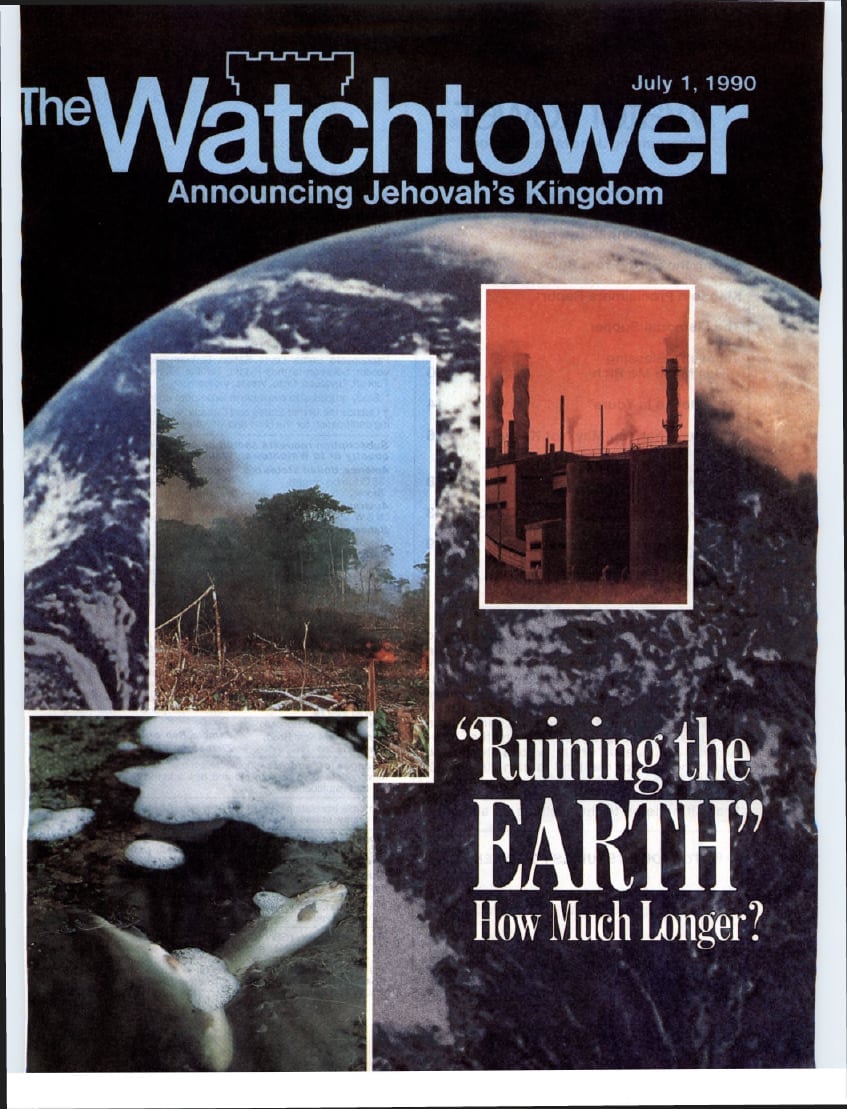
The Watchtower July 1,1990 Announcing Jehovah's Kingdom
"Ruining the EARTH" How Much Longer?
In This Issue
What Is Man Doing to the Earth? 3
Saving the Earth From Ruin 5
Kingdom Proclaimers Report 7
The Memorial Supper 8
Jehovah's Blessing
Has Made Me Rich 10
“This House Is Yours” 14
A Jordan That You May Not Know 16
The Coming Finale of “the Book of
the Wars of Jehovah” 18
Settling the Universal Issue for Good 23
Honor Jehovah With Your Riches 29
Cover photo: Richard Bierregaard, WWF
THE PURPOSE OF THE WATCHTOWER is to exalt Jehovah God as the Sovereign of the universe. It keeps watch on world events as they fulfill Bible prophecy. It comforts all peoples with the good news that God's Kingdom will soon destroy those who oppress their fellowmen and that it will turn the earth into a paradise. It encourages faith in the now-reigning King, Jesus Christ, whose shed blood opens the way for mankind to gain eternal life. The Watchtower, published by Jehovah's Witnesses continuously since 1879, is nonpolitical. It adheres to the Bible as its authority.
WATCHTOWER STUDIES FOR WEEKS OF
August 6: The Coming Finale of the "book of the Wars of Jehovah." Page 18. Songs to Be Used: 64, 52.
August 13: Settling the Universal Issue for Good. Page 23. Songs to Be Used: 33, 14.
Average Printing Each Issue: 13,950,000 Now Published in 108 Languages.
Semimonthly Languages Available by Mail: Afrikaans, Arabic, Cebuano, Ghichawe, Chinese, Ghichawe, Danish, Danish, Efik, Eriken, Eriken, English, Faroese, French, Greek, Hikayonan, Hungarian, Igbo, Iolco, Italian, Japanese, Korean, Malagasy, Maltese, Newwegian, Portuguese, Rarotonga, Romania, Russian, Samoan, Seepel, Sesehot, Shona, Spaniol, Swahili, Tangal, Thai, Tselong, Tewana, Ukrainian, Xhosa, Yuzu, Zulu
Monthly Languages Available by Mail: Armenian, Bengali Bili, Bislama, Bulgarian, Croatian, Czech, Fijian, Greenlandic, Guajuani, Gun, Hausa, Hindi, Hindi Moto, Icelandic, Kannada, Kannada, Malayalam, Malayalam, Malayalam, Papamento, Samar-Leyte, Sango, Serbian, Sibai, Sintiense, Sloivan, Solomon Islands-Plandi, Tahitian, Tamil, Telugu, Tongan, Turkish, Tuvaluan, Urdu, Venda, Vietnamese
Study articles also available in large-print edition.
† Outside the United States and Canada, write U.S. office concerning certification for the blind and visually impaired.
Subscription requests should be sent to the office in your country or to Watchtower, Walkkill, N.Y. 12589, U.S.A.
country or to Watchtower, Walkifil, N.Y. 12899, U.S.A.
America, United States of,
25 Columbia Heights,
Brooklyn, N.Y. 11201
Australia, Box 280, Ingleburn,
N.S. W255
Bahamas, Box N-1247,
Barmados, Fontabelle Rd.,
Bridgetown
Canada LTG 4Y4, Box 4100,
Hattleton Hills (Georgetown),
Ontario
New Zealand WT 1RN,
The Ridgeway, London
Germany, Federal Republic
of, postfach 20,
D-6251 Selters/Taunus 1
Ghana, Box 760, Accra
Guyana, Box 50, Brickdam
Hawaii 9819 19,
2065 Km IV/Dr, Honolulu
Hong Kong, 4 Kent Road,
Kowloon Tong
Post, Post, Post, Post,
Changes of address should reach us 30 days before your moving date. Give us your old and new address (if possible, your old address label).
The Bible translation used is the New World Translation of the Holy Scriptures, unless otherwise indicated.
Would you welcome more information or a free home Bible study? Please write Watch Tower, using the appropriate address above.
This is part of a worldwide Bible educational work that is supported by voluntary donations.
© 1990 Watch Tower Bible and Tract Society of Pennsylvania. All rights reserved. Frederick W. Franz, President
The Watchhouse (ISBN 0043-1087) is published semiquarterly with a monthly price of $15.00. 25 Colourable Heights, Brooklyn N.Y. 11201. Second-class postage paid at Brooklyn, N.Y., and at additional mailing offices. Mail envelopes and address changes to W. Printed in U.S.A. kill, N.Y. 12569.
WHAT IS MAN DOING TO THE EARTH?
THREE HUNDRED years ago, man lived much closer to nature. For the most part, he was not threatened by man-made changes to the
global environment in the way he is today. The industrial revolution had not begun. There were no power stations, factories, automobiles, or other sources of widespread pollution. The thought of man's ruining the whole earth may have been hard for him to imagine.
Yet, even back then, a warning about global ruination was in wide circulation. That warning was found in the last book of the Bible, and it foretold a time when God would intervene in man's affairs to "bring to ruin those ruining the earth."—Revelation 11:17, 18.
How comforting for all who are concerned about modern man's mismanagement of the earth to know that the Creator of our magnificent planet will save it from ruin! 'But,' you may wonder, 'have we really reached such a critical situation that God's intervention is needed?' Well, consider some of the facts and judge for yourself.
Forests
Forests beautify the earth and provide food and shelter for several million different species. As trees grow and manufacture food, they perform other vital services, such as absorbing carbon dioxide and releasing precious oxygen. Thereby, National Geographic says, "they offer one antidote to the global warming that threatens life on earth as we know it."
But man is ruining his forest heritage. North American and European forests are dying from pollution. And the demands of industrial nations are decimating tropical forests. An African newspaper explained that in 1989, "66 million cubic metres [of tropical wood were] expected to be exported —48 percent to Japan, 40 percent to Europe."
Also, in some lands, farmers burn forests to create farmland. Soon the fragile forest soil becomes exhausted, and the farmers have to burn more forest. It is estimated that in this century alone, nearly half the world's forests have vanished.
Oceans
Earth's oceans also play a vital role in cleaning the atmosphere, and man's activities are ruining them. Vast quantities of carbon dioxide are absorbed by the oceans. In turn, phytoplankton absorbs carbon dioxide and releases oxygen. Dr. George Small explains the importance of this life cycle: "70 percent of the oxygen added to the atmosphere each year comes from plankton in the sea." Yet, some scientists warn that phytoplankton could be seriously depleted because of ozone reduction in the atmosphere, which is believed to be caused by man.
Also, man dumps garbage, oil, and even
"We must save the oceans if we want to save mankind."
—Jacques Cousteau
toxic wastes into the ocean. While some countries agree to limit the wastes they allow to be dumped at sea, others refuse. One Western nation even reserves the right to dump nuclear wastes at sea. Famed ocean explorer Jacques Cousteau warns: "We must save the oceans if we want to save mankind."
Drinking Water
Man is ruining even his drinking water! In poor lands, millions of people die each year because of contaminated water. In richer nations, water sources are contaminated by, among other things, fertilizers and pesticides that wash into rivers and seep into groundwater. In 1986 the world production of pesticides was 2.3 million tons, and the rate of increase is reported to be 12 percent per year.
Another source of pollution is chemical dumps. "The metal drums containing the chemicals," explains Scientific American, "are nothing less than time bombs that will go off when they rust through." This type of pollution, the journal adds, is happening "worldwide in thousands of chemical waste dumps."
The result? All over the earth, once pure rivers are being turned into industrial sewers. It is estimated that 20 million Europeans drink water from the Rhine, yet this river is so polluted that sludge dredged from its bed is too dangerous to use for landfill!
Farming Practices
Alarmingly, man is even ruining his farmland. In the United States alone, 20 percent of the land set aside for irrigation has been damaged, according to Scientific American. Why? Because overirrigation adds too much salt to the soil. Many countries have ruined much valuable land in this way. "As much land is now being taken out of production due to salinization as is being brought into production through new irrigation projects," states The Earth Report. Another widespread problem is overgrazing, which may be contributing to the spread of deserts.
Too Many Motor Vehicles
So much for our planet's land and water. But what about its air? This too is being ruined, and the culprits are many. To mention just one, consider the automobile. Following are warnings from three influential scientific journals: "Motor vehicles generate more air pollution than any other single human activity." (New Scientist) "There are currently 500 million registered automobiles on the planet . . . Filling their tanks consumes about one third of the world's production of oil. . . . The number of automobiles is increasing more quickly than the population." (Scientific American) "Petrol [gasoline] in all phases of production, use and disposal is a major source of environmental degradation and disease."—The Ecologist.
Yes, our planet is being abused, ruined. Its seas, drinking water, farmlands, and even its atmosphere are being polluted to an enormous extent. Surely, this alone would suggest that the time is near for God to intervene and "bring to ruin those ruining the earth." (Revelation 11:18) However, there are other, even worse, ways in which the earth is being ruined. Let us see just what they are.
SAVING THE EARTH FROM RUIN
ONCE before in human history, God saved the earth from ruin at the hands of men. He did so by means of a global flood in the days of Noah. We have no record that men were ruining the physical environment back then. But the earth was ruined in another way to such an extent that God felt the need to act with the utmost severity.
The Bible reports: "The earth came to be ruined in the sight of the true God and the earth became filled with violence. So God saw the earth and, look! it was ruined, because all flesh had ruined its way on the earth." (Genesis 6:4, 11, 12) Yes, in Noah's day God viewed the earth as ruined because of the violence and wickedness of mankind.
Similarly, when ancient Israel began taking possession of the Promised Land, God warned: "You must not pollute the land in which you are; because it is blood that pollutes the land . . . And you must not defile the land." (Numbers 35:33, 34) Hence, Canaan was ruined because of the bloodguilt of its inhabitants. A horrible example of this was their practice of sacrificing young children to their gods.
The Canaanites were also grossly immoral, and this too affected God's view of the land. He warned Israel: "Do not make yourselves unclean by any of these [immoral practices], because by all these things the nations whom I am sending out from before
you have made themselves unclean. Consequently the land is unclean, and . . . the land will vomit its inhabitants out." (Leviticus 18:24, 25) Immorality and bloodshed ruined Canaan to such an extent that God destroyed the Canaanite nations.
The Ruining of the Earth
What about today? Are we not also living in an age of uncontrolled violence, blood-shed, and immorality? Regardless of what man does to try to rectify the damage he has done to the physical earth, he can never restore to life the estimated one hundred million who have died in his wars during this century; nor can he bring back the millions murdered by criminals or the countless sad victims who die of hunger. Certainly, he cannot restore the estimated 40 to 60 million unborn babies whose lives are ended by abortion each year. Can we doubt that the earth is being ruined in God's sight by such things—not to mention by the immorality that is so rampant today?
Reason tells us that God must soon act to save the earth from man's ruinous activities, and Bible prophecy confirms this. But what will he do? The Bible says that he will "bring to ruin those ruining the earth." (Revelation 11:18; compare Matthew 24: 3-14.) Just as a landlord ejects a destructive tenant, so God will "eject" those who ruin his beautiful creation, the earth.
The Bible states: "As regards the wicked, they will be cut off from the very earth; and as for the treacherous, they will be torn away from it." (Proverbs 2:22) This coming divine action the Bible calls Armageddon. (Revelation 16:16) Jesus
The Bible says that God will "bring to ruin those ruining the earth."
—Revelation 11:18
also called it "great tribulation such as has not occurred since the world's beginning until now, no, nor will occur again." (Matthew 24:21) It will be even greater than the Flood.
Is this an extreme or unjust solution?
No, God, as the Creator of the earth, has the right to decide who will inhabit it. He also has the right to hold man responsible for his actions. Moreover, if God permits man to continue his course unchecked, the earth will be ruined for everyone, and life will become impossible. On the other hand, by 'bringing to ruin those ruining the earth,' God preserves our earthly heritage for appreciative ones. The Bible promises: "For the upright are the ones that will reside in the earth, and the blameless are the ones that will be left over in it."—Proverbs 2:21.
With God's help, millions have found the strength to show themselves blameless because they want to be left over to enjoy God's creation. They also follow God's high moral standards and avoid violence and bloodguilt even indirectly. Hence, they are not ruiners of the earth in this important sense.
An Earth Saved From Ruin
Such ones now have the joyful prospect of seeing the earth transformed from its
present ruined state into a healthy paradise. Why, even their bodies will be cleansed, purified of the ruinous effects of sin. The Bible's last book describes God's provision for making all of this possible as a symbolic "river of water of life." On each side of this river, "there were trees of life producing twelve crops of fruit, yielding their fruits each month. And the leaves of the trees were for the curing of the nations."—Revelation 22:1, 2.
This inspired vision is a guarantee that God will save the earth and mankind on it from ruin. Other prophecies give an advance glimpse of that restored earth. Consider, for example, Isaiah's poetic foreview: "The wilderness and the waterless region will exult, and the desert plain will be joyful and blossom as the saffron. Without fail it will blossom, and it will really be joyful with joyousness and with glad crying out." (Isaiah 35:1, 2) At that time there will be no polluted seas, ruined topsoil, or toxic atmosphere.
More important, the earth will not be ruined by violence, bloodshed, or immorality. Only those who respect God, his standards, and his creation will be there. (Revelation 21:7, 8) Listen now to the glorious results of all these things: "[God] will wipe out every tear from their eyes, and death will be no more, neither will mourning nor outcry nor pain be anymore. The former things have passed away. . . . 'Look! I am making all things new.'"—Revelation 21:4, 5.
What a happy outcome! How glad we are that God will shortly "bring to ruin those ruining the earth!" And how much these inspired promises move us to want to serve the God who will save the earth from ruination and make it a paradisaic home for righthearted mankind!
Kingdom Proclaimers Report
THE "great persecution" against the early Christian congregation served to scatter many disciples of Christ. (Acts 8:1) However, this persecution backfired because those who were scattered "went through the land declaring the good news of the word." (Acts 8:4) Philip continued to preach, and "with one accord the crowds were paying attention." (Acts 8:6) As persecution backfired in the first century, so it did in a village in northern Thailand.
A special pioneer of Jehovah's Witnesses began preaching in this village, but at first the villagers would not listen. When he talked to the local preacher, however, the people gathered around to listen. Some came to realize that the Witness knew the Bible better than their minister, so they began to study the Bible with the pioneer even though others harassed them. Some of their ducks were killed, the pioneer's life was threatened, and the house of one interested man was burned down. The man said: "They can burn my house, but they cannot burn my heart." Those studying with the Witness rode a long distance by bicycle to attend meetings at the Kingdom Hall. Four of them got baptized, and six others still attend meetings along with them.
Reward for Honesty
The brothers in Zambia have built a good reputation for honesty, and this has resulted in blessings to them, as well as helped others to identify the truth. An elder, who is a regular pioneer, was traveling on a bus and overheard a Witness on the bus talking to others about the resurrection. A passenger asked her: "Why do you Witnesses claim that your religion is the only true one?" The brother joined the conversation and said to the passenger that Jehovah will reward his Witnesses because they teach the truth from the Bible.
After midnight on this long journey, the bus arrived at a roadblock. It was raining hard. A soldier entered the bus and asked if there were any of Jehovah's Witnesses on board. There were three. Then he said: "Okay, Witnesses remain seated, the rest go out with your bags." All the others went out in the rain, and after the inspection, they came back with their luggage and their clothing soaked.
Back on the bus, the soldier said: "The reason I let the Witnesses remain is that they are honest people. We have had much experience and found that they are the only ones who are honest; when we ask what is in their bags, they tell us the truth." As the bus drove on, the brother asked: "Which is the true religion?" One person answered: "The one that is not soaked in the rain."
Yes, honesty helps identify the true religion, and it certainly has its rewards!
The Memorial Supper
AFTER Jesus washes his apostles' feet, he quotes the scripture at Psalm 41:9, saying: "He that used to feed on my bread has lifted up his heel against me." Then, becoming troubled in spirit, he explains: "One of you will betray me."
The apostles begin to grieve and say to Jesus one by one: "it is not I, is it?" Even Judas Iscariot joins in asking. John, who is lying next to Jesus at the table, leans back on Jesus' breast and asks: "Lord, who is it?"
"It is one of the twelve, who is dipping with me into the common bowl," Jesus answers. "True, the Son of man is going away, just as it is written concerning him, but woe to that man through whom the Son of man is betrayed! It would have been finer for that man if he had not been born." After that, Satan again enters Judas, taking advantage of the
opening in his heart, which has become wicked. Later that night, Jesus fittingly calls Judas "the son of destruction."
Jesus now tells Judas: "What you are doing get done more quickly." None of the other apostles understand what Jesus means. Some imagine that since Judas is holding the money box, Jesus is telling him: "Buy what things we need for the festival," or that he should go and give something to the poor.
After Judas leaves, Jesus introduces an entirely new celebration, or commemoration, with his faithful apostles. He takes a loaf, says a prayer
of thanks, breaks it, and gives it to them, saying: "Take, eat." He explains: "This means my body
which is to be given in your behalf.
Keep doing this in remembrance of me."
When each has eaten of the bread, Jesus takes a cup of wine, evidently the fourth cup used in the Passover service. He also says a prayer of thanks over it, passes it to them, asks them to drink from it, and states: "This cup
denmation of death. For the Jews who become Christ's followers, the celebration will replace the Passover.
The new covenant, which is made operative by Jesus' shed blood, replaces the old Law covenant. It is mediated by Jesus Christ between two parties—on the one hand, Jehovah God, and on the
means the new covenant by virtue of my blood, which is to be poured out in your behalf."
So this is, in fact, a memorial of Jesus' death. Each year on Nisan 14 it is to be repeated, as Jesus says, in remembrance of him. It will call to the memory of the celebrants what Jesus and his heavenly Father have done to provide escape for humankind from the con-
other, 144,000 spirit-begotten Christians. Besides providing for the forgiveness of sins, the covenant allows for the formation of a heavenly nation of king-priests. Matthew 26:21-29; Mark 14:18-25; Luke 22:19-23; John 13:18-30; 17:12; 1 Corinthians 5:7.
What Bible prophecy does Jesus quote regarding a companion, and what application does he make of it?
Why do the apostles become deeply grieved, and what does each of them ask?
* What does Jesus tell Judas to do, but how do the other apostles interpret these instructions?
What celebration does Jesus introduce after
Judas leaves, and what purpose does it serve?
Who are the parties to the new covenant, and what does the covenant accomplish?
Jehovah's blessing has made me rich
As told by Elsie Meynberg
"THE blessing of Jehovah that is what makes rich, and he adds no pain with it." (Proverbs 10:22) I have personally experienced the truthfulness of this Bible proverb. Allow me to tell you how.
When I was only six, I listened in on my mother's discussions with a Bible teacher who visited
us, and I noted how enthralled my mother was by what she was learning. One cold winter night, I went downstairs for a glass of water and found Mother reading next to the open oven door. Instead of scolding me as I expected, she put her arm around me and explained that God's name is Jehovah. The warmth in her voice told me that what she had learned was very important to her.
After a few more discussions with the Bible teacher, Mother set out on foot to share with the neighbors the good news she had learned. However, she was not
always well-received. We lived in the country near Beatty, Saskatchewan, Canada, and our neighbors were mostly relatives of ours, staunch Lutherans or Evangelists. Nevertheless, Mother continued to visit them.
I would watch through frosty windows as Mother struggled to bring the horses from the barn, knowing that she was
not accustomed to hitching them up. At other times she would go off to the meetings or the field ministry despite Father's complaints. He was not in agreement with Mother's new faith, but she was determined. She would always return with an inner happiness that was evident to all. "The blessing of Jehovah—that is what makes rich," she would say. I used to wonder what she meant by that. Although I was only six, I too wanted to serve Jehovah.
One day I was on the roof with my father, where he was repairing the shingles. Mother and my sister Eileen were leaving with a group in a Model T Ford to take part in an "information march."
They were going to parade through the town with placards advertising a Bible talk.
"You will never be so foolish, will you?" Father asked me. But even though I was a girl who just delighted in climbing, I would much rather have been in that information march than up on the roof. However, they said I was too short to carry a placard.
Meeting the Challenge of the Ban
Finally, my first opportunity to share in Kingdom preaching came in November 1940. What excitement! Since the preaching work of Jehovah's Witnesses was banned in Canada at the time, we went out in the middle of the night and left the booklet End of Nazism at the door of every house.
When I was nine years old, I determined to dedicate my life to Jehovah and be baptized. Because of the persecution, we were not told the location of the meeting, but we were led to a place in the forest where a large group of Witnesses were enjoying a "picnic." There my older sister Eleanor and I were among the many who were baptized in the cold waters of a nearby lake.
School in those days began with the class saluting the flag and singing the national anthem. Despite the accusing stares of our classmates, we would respectfully refuse to participate because of the Bible's teaching on idolatry. (Daniel, chapter 3) My cousin Elaine Young, who was also a Witness, had to walk four miles to school, but each day she would be dismissed for not saluting the flag. Afterward she would walk all the way home again. She did this for half the school year so that she would not be marked absent and fail the course.
After leaving school, I worked in a bank. But a test came when I was denied my request to attend the international convention of Jehovah's Witnesses in New York in 1950. I had some savings and decided to quit and start in the full-time ministry. So Elaine and I moved to the city of Regina. "She will be home begging by spring," taunted some. However, I was able to provide for myself by working as a part-time housemaid. The richness of Jehovah's blessings has kept me in his full-time ministry ever since.
Achieving Our Goal
In 1955 Elaine and I were thrilled to be invited to the 26th class of Gilead and later to receive assignments to Bolivia, South America. There were only about 160 Witnesses in the whole country at the time. Eventually, we headed for Tarija to join two other missionaries in our first assignment.
Tarija was a beautiful town. It was so interesting to see the women in their traditional dress carrying burdens on their heads. The people were pleasant and would never tell us they were not interested. They evidently felt that it was more polite to tell us to call again at a time when they knew they would not be at home. It took a while to get used to that.
One day we were talking to a man at his door when a jeep stopped and out leaped a furious, red-faced priest. "If you don't stop talking to those girls, you will be excommunicated!" he yelled at the man. Turning to us, he threatened: "You have no right to preach here. If you don't stop, I'll take further measures." By this time many neighbors had come out to watch. So we simply went on with our work, placing many books and Bibles with the curious onlookers.
Having spent two years in this pretty valley where peaches, peanuts, and grapes thrive, we were not at first happy to receive a change of assignment to Potosi, a bitterly cold mining city situated at an elevation of over 13,000 feet.
We were used to the frigid Canadian winters, but the difference was that in Potosi the homes normally had no heat. However, in Potosi there was the warm association of a Christian congregation, whereas no congregation had yet been formed in Tarija.
liquid. The first night in our new home, I went out to use the outdoor toilet. But when I turned on my flashlight, the whole floor seemed to come alive with cockroaches. Lizards scuttled away, and huge toads eyed me from the corners. I decided I could wait till morning.
Later, we were by the river and thought that we would rest on a log we saw there. However, we decided we would first make
Opening Up New Territory
Next, Elaine and I were assigned to Villamontes to open up the preaching work there. The truck we took was loaded with contraband sugar, so to avoid problems with the police at the toll bars, the driver did not set out until nightfall. How we wished that we had brought a flashlight along, for suddenly something stirred beside us under the canvas! It was the truck driver's helper.
At five in the morning, we stopped. Sick from the exhaust fumes and laden with dust, we crawled out. A landslide had blocked our
a return visit nearby. When we returned,
the log was gone. Excited passersby told
us that a massive snake had been there.
I'm glad we didn't try to sit on that "log"!
What we enjoyed most about Villamontes was visiting people in the evening. We would find them sitting on wicker chairs out on the sidewalks, sipping an herbal drink called maté. We spent many a happy hour explaining the Kingdom promises in such surroundings. But more difficult times came after Elaine married and I was reassigned to Vallegrande with a new partner.
way. Finally, after four hours of hard work, the owner had his helper take the vehicle across the narrow ledge that had been cleared. The owner would not even look as the truck edged its way across with the outer of its dual wheels turning in midair above the seemingly bottomless abyss at the side of the road. Elaine and I crossed on foot. As we continued toward Villamontes in the truck, the hairpin turns on the mountain passes were so tight that the driver was repeatedly forced to back up and maneuver around them. Finally, after 35 exhausting hours, we arrived.
Like the Wild West
To reach Vallegrande, another exhausting trip of three days was required, and this time I was alone. The narrow dirt roads seemed to wind on forever into the wilderness. At last I arrived as the sun was setting. The bus disturbed the tran-
In Our Next Issue
Soon—A World Without Pain!
It was a new experience for Elaine and me to be completely on our own. Also new to us were the tropical insects. Large hardshell beetles would drop on us after crashing into the light above our heads. Tiny flies would give us painful bites, causing itchy lumps that oozed a clear
'Against Knowledge
—Falsely So Called'
Do We Really Need the Originals?
quillity of a town where horses were more common than motor vehicles. People stared from under the eaves, which projected over the sidewalks and were supported by posts. Some of the men who leaned against the posts wore gun belts with revolvers. Almost everyone seemed to be wearing black. I thought: 'Why this is just like the wild West'
And it was, in effect. Disputes were settled with the gun. Even though it was a town of just ten thousand people, murder and violence were common at that time. The population was dominated by a gang that took over the toll bar at the entrance of town. The gang members made their living by stopping the buses and robbing them. Farmers were also robbed as they brought their produce into town. Young girls were raped at gunpoint before their parents' eyes. Mothers would not even let their daughters go alone to the corner to shop.
Imagine our thoughts when the gang leader entered the Kingdom Hall one day. He was drunk. The circuit overseer, who was giving the talk, grew pale. "I believe!" yelled the gang leader as he thumped the back of the bench with such force that it broke. Then he grabbed the circuit overseer. But suddenly he calmed down, and an old school friend of his in the audience was able to lead him away.
Eventually, an army general challenged the gang leader to a duel. The general had a dead dog hung up in the plaza with a sign saying: "Get out of town, or the same will happen to you." The gangster left, and conditions improved in Vallegrande.
former owners, it headed there, and they had to lead us out onto the trail again.
Challenges—But Still Rich
Sometimes we traveled for 12 hours on horseback to preach in outlying villages. A schoolteacher in one of the villages received us hospitably and later became one of Jehovah's Witnesses. One time I borrowed a mule to go out there, but every time it passed the home of one of its
As is true of many other missionaries, I have found that the greatest challenge may not be the heat or the insects, the cold or the altitude, or even the disease and the poverty. Rather, it can be personality conflicts. 'Why do such difficulties arise in Jehovah's organization?' I wondered, and I even began to doubt that Jehovah was making me rich with blessings. Then I recalled the scripture about Jehovah's blessing at Proverbs 10:22. The second part of the verse says, "And he adds no pain with it." So we should not blame Jehovah for these difficulties. I came to realize that they are part of what Adam passed on to us and are included in what Paul describes at Romans 8:22: "All creation keeps on groaning together and being in pain together."
I had been corresponding with Walter Meynberg of the Canadian Bethel, and while I was on vacation in Canada in 1966, we were married and were assigned to La Paz, the principal city of Bolivia. What a blessing it has been to see the congregations here multiply from just one when I arrived in Bolivia to 24, in every corner of the city. It has been similar in other cities of the country. Indeed, the group of about 160 publishers who were preaching the good news in Bolivia when I first arrived in 1955 has grown to some 7,000!
My mother's determined example that she set so long ago has resulted in more than ten of my immediate family being in the full-time service. I am delighted to say that my father became a dedicated Witness, and over 30 persons with whom I was privileged to study the Bible have been baptized. Are these not riches? Yes, I believe they are. Indeed, 'the blessing of Jehovah—that is what has made me rich.'
"THIS HOUSE IS YOURS"
THIS house is yours—to it we've added." How fittingly these words summed up the feelings of those who had just completed two years of hard work at the Watch Tower Society's Australia branch office! The words were addressed to Jehovah God, and they were part of a song composed for a special occasion. What occasion? The dedication of new extensions to the Bethel home and factory.
Expansion So Soon?
Surprisingly, less than seven years earlier, a similar dedication had taken place for the then newly built Bethel complex at Ingleburn, on the southwestern outskirts of Sydney, Australia. Why was further expansion needed so soon?
For one thing, the number of Witnesses in Australia has grown from fewer than 32,000 in 1981 to a peak of 51,152 in October 1989, and that necessitated an increase in the Bethel staff. In addition, there was a dramatic increase in the amount of literature that Australia sent to other branches. At present, Australia produces publications in 37 different languages to serve the needs of Fiji, Indonesia, Papua New Guinea, New Caledonia, New Zealand, Solomon Islands, Tahiti, Vanuatu, Niue, Western Samoa, Tonga, Tuvalu, and Wallis Islands, as well as Australia. Hence, the Bethel family has grown rapidly to 164 members.
To accommodate this growing family, early in 1987 a new three-story office extension was completed, providing much-needed additional office space. Next, the Governing Body approved the construction of a three-story factory enlargement and a five-story residence extension. In January 1988 work began on the new factory addition, which would provide a further 38,800 square feet of floor space. A few months later, work began on the residence extension, which would provide 51 more bedrooms.
Sacrifices and Generous Giving
Invitations were sent to congregations throughout the country calling for volunteers who could become part of a "construction family" for up to two years. The response was overwhelming, and volunteers from all trades responded readily. More than 700 separate application forms were received, and over the construction period, a total of 270 volunteers came and worked on the project for periods ranging from two weeks to almost two years.
One Witness owned an earth-moving business in the northern state of Queensland. He sold part of his business, and he and his wife became part of the construction family from its inception. He purchased a large tracked excavator and did most of the necessary excavating work at no cost to the Society. When the bulk of the excavation was completed, he sold the machine and then stayed on to work in other areas of construction. This is just one example of the fine, selfless spirit shown by all throughout the project.
Witnesses donated the use of concrete truck pumps to pour the 4,300 cubic yards of concrete needed for the eight floors in the two buildings. Others donated the materials needed for three 5,800-gallon concrete water tanks, and Witnesses working at the factory donated their labor to construct the tanks.
Not all the volunteers were skilled tradesmen, of course. Indeed, many young men learned new skills right on the site. Several became competent bricklayers as
C. Barber
they helped to lay the half million
T. Jaracz
D. Sydlik
bricks needed for the project. Others learned to lay wall and floor tile, and in just a few weeks, one sister became very proficient at hanging wallpaper.
Dedication Day
Dedication day, Saturday, November 25, 1989, dawned clear and sunny—a beautiful, late spring day. The second level of the new factory addition had been cleared to form the main auditorium for the dedication program. Closed-circuit television tied in sections of the other two factory floors and the shipping floor, the Bethel auditorium, and the Bethel dining room. This allowed comfortable indoor seating for more than 3,000.
Because space was limited, only those baptized for about 40 years were invited to attend, along with personal guests of the Bethel and construction families. Refreshments were available during the morning, and a tasty box lunch was provided at midday. At 9:00 a.m., the annual meeting of the Watchtower Society of Australia was held, and all 21 members of the Australia corporation attended. After the necessary legal details had been
cared for, others were invited into
the meeting, and all were delighted to hear a discourse by Theodore Jaracz of the Governing Body.
At 1:45 p.m., 15 minutes of Kingdom music introduced the dedication program. The audience was happy to hear reports, interesting anecdotes, experiences, and comments by the three members of the Governing Body present. Of these, Carey Barber and Daniel Sydlik were making their first visit to the land down under. Brother Barber spoke on the subject "The Harvest Is the End of the Age," while Brother Sydlik handled the theme "Happy Is the People Whose God Is Jehovah." Brother Jaracz, who was serving the Australia branch as zone overseer, delivered the dedication discourse.
A delightful feature of the program was the singing of a four-stanza song just before the dedication discourse. Based on Isaiah's words at Isaiah 60:22, the title of the song was "The Little One Becomes a Thousand." In the lyrics gratitude was expressed to Jehovah that many willing volunteers had been privileged to add to 'his house' in this part of the worldwide field.
Scenes From the Promised Land
A JORDAN
THAT YOU MAY
NOT KNOW
Pictorial Archive (Near Eastern History) Est.
THE very mention of the Jordan River may call to your mind familiar scenes: Israelites under Joshua crossing its drained bed near Jericho; Naaman bathing seven times in its waters to be healed of leprosy; many Jews, and then Jesus, coming to be baptized there by John. —Joshua 3:5-17; 2 Kings 5:10-14; Matthew 3:5, 13.
Evidently, all these famous events occurred in the long and best-known part of the Jordan, the section south of the Sea of Galilee and on down to the Dead Sea. But diligent students of God's Word may overlook another stretch of the Jordan—the northern portion of the river and its surrounding area. Note the map. * The low region in the center is part of the Great Rift Valley, the geological fault extending from Syria to Africa.
The three main sources of the Jordan River are streams that come from snow melting on lofty Mount Hermon. The easternmost stream (page 17, top) emerges from a limestone cliff near the base of the
mountain. This is where Caesarea
Philippi was located; recall that Jesus
visited there shortly before he
was transfigured on "a lofty mountain."
(Matthew 16:13-17:2) Another stream emerges from the mound where the city of Dan was built, in which Israelites of the northern kingdom set up a golden calf. (Judges 18:27-31; 1 Kings 12:25-30) A third stream joins with these two to form the Jordan River, which falls over a thousand feet in about seven miles.
Then the valley flattens into the Hula Basin, causing the waters of the Jordan to spread, creating a broad, marshy area. In ancient times much of the water collected in a shallow body known as Lake Hula (or Huleh). But Lake Hula is not there anymore because in recent times the upper Jordan was straightened, canals were added to drain the marshy area, and the outlet of the lake was deepened. Hence, if you look at a map of the area and see, north of the Sea of Gallilee, a lake (Hula), you will know that the map is of the region in ancient times, not of how you will find it today.
If you visit, though, you will find a nature reserve that can give you an idea of how the area looked in Biblical days, when it was home to special types of plants, such as waving forests of papyrus and reeds. —Job 8:11.
The area was home to a constantly changing assortment of birds. Herons, storks, pelicans, turtledoves, and other birds abounded, in part because the swamp and lake formed an excellent resting area on the migration route between Europe and Africa. (Deuteronomy 14:18; Psalm 102:6; Jeremiah 8:7) Other creatures appropriate to the area would have been less visible, but
Pictorial Archive (Near Eastern History) Est.
basalt rocks; this damlike formation was the reason why water backed up and created Lake Hula. You can see
Sea of Galilee
Animal photos: Safari-Zoo of Ramat-Gan, Tel Aviv
their presence made passage across the Hula Basin uninviting. These likely included the lion, the hippopotamus, the wolf, and the wild boar. (Job 40:15-24; Jeremiah 49:19; 50:44; Habakkuk 1:8) During some periods
Based on a map copyrighted by Pictorial Archive [Near Eastern History] Est. and Survey of Israel.
mosquito-borne malaria prevailed, evidently one of the fevers mentioned in the Bible.
Understandably, both individual travelers and large caravans would skirt this swampy area. So where could they cross the Jordan River in the valley north of the Sea of Galilee?
Nearer the Sea of Galilee was an outcropping of
part of the outcropping on page 16. As the Jordan plunges through it south to the Sea of Galilee (visible in the distance), it moves so swiftly that white water results. Clearly, ancient travelers would have found it dangerous to descend into
Between the swampy area of the Hula Basin and the gorge was a short, level stretch where the water flowed quietly. Here ancient travelers could ford the river safely, and it became
that deep gorge and cross the swift Jordan waters.
part of a main travel route through the Promised Land. Now there is a bridge at this location, which is still a prime spot to cross the Jordan.
The Hula Basin is today a fertile agricultural area; there are even fishponds. All of this is possible because of the abundant waters that flow down this part of the Jordan River.
THE COMING FINALE OF "THE BOOK OF THE WARS OF JEHOVAH"
"It is said in the book of the Wars of Jehovah."—NUMBERS 21:14.
IT IS little appreciated by men of today that the God of the Bible, Jehovah, is a warrior, a manly person of war. This fact was dramatized when he delivered his people of ancient times from oppression in Egypt. Pharaoh had been incited by the invisible enemy of that people, Satan the Devil, to try to work them to death. Now, coming to a realization of what he was losing by letting the Israelites go free, Pharaoh and his military forces went in pursuit of them.
2 Pharaoh, however, did not discern
2. On what ancient occasion did Jehovah display to the Egyptians that he was a warrior God, and how did he do it?
that the God of the Israelites could become a warrior God in order to deliver His people. As those Egyptian forces were pressing through the dry bed of the Red Sea in vengeful pursuit, the God of the endangered Israelites took action and drowned the charioteers and the horsemen, letting the heaped-up waters cave in upon the escape corridor that had been miraculously opened for the Israelites.—Exodus 14: 14, 24-28.
3 Safe on the eastern bank of the Red
In their victory song, the Israelites characterized Jehovah as what sort of God, but what fact do the nations of today ignore?
Sea, the jubilant Israelites sang a victory song, extolling their heavenly Deliverer: "Let me sing to Jehovah, for he has become highly exalted.
The horse and its rider he has pitched into the sea. My strength and my might is Jah, since he serves for my salvation. This is my God, and I shall laud him; my father's God, and I shall raise him on high. Jehovah is a manly person of war. Jehovah is his name. Pharaoh's chariots and his military forces he has cast into the sea, and the choice of his warriors have been sunk in the Red Sea." (Exodus 15:1-4) There at the Red Sea, Jehovah displayed himself as a warrior capable of spectacular deeds. This fact the worldly nations have ignored.
4 The prophet Moses, who led in the singing of that inspired song, spoke of Jehovah as "my father's God." The Hebrew Abraham was an outstanding forefather of the nation of Israel. From him, through Isaac and Jacob and the 12 sons of Jacob, stemmed the 12 tribes of Israel. Abraham proved himself to be an exemplary worshiper of Jehovah God. He was a man of such strong faith that when Jehovah called him to leave his home in Ur of the Chaldeans, he unhesitatingly set out for the land that Jehovah was going to show him, confident that God would fulfill His promise to give it to him and to his offspring.
5 Because of Abraham's magnificent faith, Jehovah promised to give Abraham a "seed," or offspring, by means of which all the families of the earth, including the families of today, would bless themselves. (Genesis 12:2, 3; 22:17, 18) Abraham was brought into such a close relationship with his God that he was known as "Jehovah's friend," God himself calling the faithful patriarch "my friend."—James 2:23; Isaiah 41:8.
Although moving about like a stranger in the Promised Land, Abraham proved that he could act as a fighter, a warrior. On one occasion four kings from outside invaded the Promised Land and made off with Abraham's nephew Lot and Lot's family. Abraham, moved by strong family ties, armed 318 of his male servants, and together with reinforcements from three of his local allies, Aner, Eshcol, and Mamre, he chased after the marauders. Making a surprise attack upon them by night, Abraham and his band defeated the invaders, even though they were a far superior force. A "slaughter of the kings" occurred. (Hebrews 7:1; Genesis 14:13-17) Abraham rescued Lot and his family and recovered all that was stolen.
5. Those jubilant 12 tribes of Israel stemmed from what common forefather, and whose friend did this one become because of what quality?
7 Abraham recognized that his military exploit had proved successful only with the help of Jehovah God, and on his triumphal journey homeward, he was able to make a public acknowledgment of that fact. He knew that the approved priest of his God was to be found in the city of Salem. So to that city he marched. The latter part of Genesis chapter 14 informs us of what then took place:
8 "And Melchizedek king of Salem brought out bread and wine, and he was priest of the Most High God. Then he blessed him and said: 'Blessed be Abram of the Most High God, Producer of heaven and earth; and blessed be the Most High God, who has delivered your oppressors into your hand!' At that Abram gave him a tenth of everything. After that the king of Sodom said to Abram: 'Give me the souls, but take the goods for yourself.'
At this Abram said to the king of Sodom: 'I do lift up my hand in an oath to Jehovah the Most High God, Producer of heaven and earth, that, from a thread to a sandal lace, no, I shall take nothing from anything that is yours, in order that you may not say, "It was I who made Abram rich." Nothing for me! Only what the young men have already eaten, and the share of the men who went with me, Aner, Eshcol and Mamre—let them take their share.'" —Genesis 14:18-24.
As these verses show, Melchizedek, the royal priest of the city of Salem, confirmed Abraham's conviction that it was the Most High God who fought for him and his military forces and gave him the victory. King-Priest Melchizedek did not detract from Jehovah's part in the matter.
The Book of Jehovah's Wars
10 The description in Genesis 14 of the invasion of the Promised Land and of Abraham's defeating of the armed invaders is the first mention of warfare in the Holy Scriptures. Thus, more than four centuries before his exploit at the Red Sea, Jehovah displayed himself as a warrior, "a manly person of war." Yet, that was only a beginning. Far greater and more resounding victories would follow, including a final one in this "conclusion of the system of things."—Matthew 24:3.
11 According to what is said at Numbers 21:14, a "book of the Wars of Jehovah" was written up. This reliable record, or history, of God's wars in behalf of his people, perhaps had its beginning with this battle in behalf of the faithful Abraham. Moses knew of this book but gives us no further details about it. Hence, we are not informed of all the ways that Jehovah demonstrated himself to be a warrior during the period of time covered by that book of the Wars of Jehovah. Since the mention of that book, however, the major portion of the Holy Bible came to be written, and this gives us plenty of accounts of Jehovah's military exploits.
The Greater Melchizedek—A Warrior
12 After Abraham defeated Chedorlaomer and his confederate kings, Melchizedek blessed him. King-Priest Melchizedek prophetically pictured One who would be the High Priest of the Most High God and also a mighty warrior backed up by the Supreme God. Psalm 110, composed under inspiration by the warrior-king David, is addressed to this One greater than Melchizedek of Salem when it says: "The rod of your strength Jehovah will send out of Zion, saying: 'Go subduing in the midst of your enemies.' Jehovah has sworn (and he will feel no regret): 'You are a priest to time indefinite according to the manner of Melchizedek!' Jehovah himself at your right hand will certainly break kings to pieces on the day of his anger."—Psalm 110:2, 4, 5.
13 The inspired writer of the book of Hebrews revealed the identity of the One to whom those words were really addressed when he said: "A forerunner has entered in our behalf, Jesus, who has become a high priest according to the manner of Melchizedek forever." (Hebrews 6:20) In the following chapter of Hebrews, the greatness of Melchizedek of old is explained.
But his priestly greatness is, nevertheless, surpassed by the One whom he foreshadowed, the resurrected, glorified Jesus Christ, who entered into the holy presence of Jehovah God himself with the value of a sacrifice far grander than anything that King-Priest Melchizedek of Salem could ever have offered.—Hebrews 7:1-8:2.
14 The royal priest Melchizedek blessed a warrior, the victorious Abraham. But what about the Greater Melchizedek, the Founder of true Christianity? The clergy of Christendom claim to represent Jesus Christ in blessing the armies of so-called Christian nations and praying for them. But has Jehovah's High Priest in heaven backed up the clergymen of Christendom in this? Has he thus accepted responsibility for all the bloodspilling that has gone on during the so-called Christian Era, including the blood that was shed during World Wars I and II? Absolutely not! At no time did he authorize his true disciples to make themselves a part of this world and to join in its blood-spilling militarism.
The Warrior God Makes a Beautiful Name for Himself
15 Nehemiah 9:10 refers to Jehovah's deliverance of the 12 tribes of Israel from Egypt, saying: "Then you gave signs and miracles against Pharaoh and all his servants and all the people of his land, for you knew that they acted presumptuously against them [the Israelites]; and you proceeded to make a name for yourself as at this day." —Compare Exodus 14:18.
16 The prophet Isaiah refers to the quality of this name when he speaks of Jehovah as "the One making His beautiful arm go at the right hand of Moses; the One splitting the waters from before them in order to make an indefinitely lasting name for his own self." And addressing Jehovah, he says: "Thus you led your people in order to make a beautiful name for your own self." (Isaiah 63:12-14) Appealing to Jehovah to act again for his people, Daniel addressed him as "you who brought your people out from the land of Egypt by a strong hand and proceeded to make a name for yourself as at this day."—Daniel 9:15; Jeremiah 32:20.
17 In due time, Jehovah God will send forth Jesus Christ, the Greater Melchizedek, as a mighty warrior. By means of him, Jehovah will make a name for himself surpassing anything in the past as described in the book of the Wars of Jehovah or in the Hebrew Scriptures of the Holy Bible. In the last chapter of the second-to-last book of the Hebrew Scriptures, an international attack against Jerusalem is foretold. (Zechariah 14:2) Then, according to verse 3, "Jehovah will certainly go forth and war against those nations as in the day of his warring, in the day of fight." In this way the God of the Bible will show all the modern nations that he is still the warrior God he was in the days of ancient Israel.
18 This is a prospect yet ahead of us. But which Jerusalem will suffer such an all-out attack? The prophecy was not fulfilled upon the Jerusalem of Zechariah's day. That city was destroyed by the armies of Rome in 70 C.E. Jerusalem was rebuilt, however, and today is viewed as sacred by Christendom as well as by the fleshly
19. Which Jerusalem will be the subject of an all-out attack by the nations?
nation of Israel. In the six-day war of 1967, fleshly Israel took possession of all rebuilt earthly Jerusalem. However, there is not a shred of evidence that Jehovah God took any part in the fighting then. His enthroned King, Jesus Christ, does not reign in earthly Jerusalem, and it is no longer "the city of the great King," that is, of Jehovah. —Matthew 5:35.
19 No, this official capital city of the Jewish member of the United Nations is not the Jerusalem mentioned in Zechariah's prophecy. Rather, Zechariah is referring to the Jerusalem that we read about in the book of Hebrews. There, Paul addresses anointed Christians and says: "You have approached a Mount Zion and a city of the living God, heavenly Jerusalem, and myriads of angels." (Hebrews 12:22) This heavenly Jerusalem is none other than God's Messianic Kingdom, represented on earth today by a small band of anointed Christians who cherish the hope of being fellow rulers with Jesus Christ in that Kingdom. These will be the object of the prophesied attack.
20 Neither these, however, nor the great crowd of Christians with an earthly hope who have come out of all the nations to join them in pure worship need fear the outcome of this attack. When the fright-inspiring armies of Sennacherib, the king of Assyria, came against Jerusalem during the reign of King Hezekiah, the endangered Israelites were given a calming view of the situation when King Hezekiah said to them: "With him there is an arm of flesh, but with us there is Jehovah our God to help us and to fight our battles." The result was that "the people began to brace themselves upon the words of Hezekiah the king of Judah." (2 Chronicles
32:8) Jehovah's Witnesses of today, when threatened by the national forces of this world system, can brace themselves upon similar words from a king greater than Hezekiah, Jesus Christ.
21 At that time, the faith-inspiring words of Jahaziel the Levite will be called to mind: "You will not need to fight in this instance. Take your position, stand still and see the salvation of Jehovah in your behalf. O Judah and Jerusalem, do not be afraid or be terrified. Tomorrow go out against them, and Jehovah will be with you." (2 Chronicles 20:17) Yes, throughout that dangerous time, Jehovah will be with his people. Their safety and preservation will depend upon his fighting for them. And fight he will, by means of his warrior King, Jesus Christ! The result? The total annihilation of the Devil's visible organization on earth.—Revelation 19:11-21.
22 How beautiful a name God will make for himself by his awe-inspiring victory in
(a) What will be the triumphant conclusion of the book of the Wars of Jehovah, and what will Jehovah make for himself thereby? (b) What will lovers of Jehovah's name be moved to do by his victory?
Questions for Review
What do men of today little appreciate about the God of the Bible, Jehovah?
What war did Abraham fight, and who gave him the victory?
What is "the book of the Wars of Jehovah"?
What will be the finale of "the book of the Wars of Jehovah," and in what will it result?
this "the war of the great day of God the Almighty" at Har-Magedon! (Revelation 16:14, 16) A new chapter, as it were, will be added to the book of the Wars of Jehovah. It will be a triumphant conclusion, a grand finale with regard to this system of things. The entire book will show that
Almighty God has never lost a battle. How jubilantly lovers of Jehovah's name will laud him thereafter! Then, indeed, the last verse of the book of Psalms will be grandly carried out: "Every breathing thing—let it praise Jah. Praise Jah, you people!" —Psalm 150:6.
SETTLING THE UNIVERSAL ISSUE FOR GOOD
"Jehovah himself at your right hand will certainly break kings to pieces on the day of his anger."—PSALM 110:5.
THE universal sovereignty of the Creator of heaven and earth is the foremost issue before men and angels. Shortly, the issue will be settled for all time, but for many centuries Jehovah's enemies have challenged his sovereignty. Indeed, the destruction in 70 C.E. of the city of Jerusalem together with its temple dedicated to Jehovah may have cast doubt on the universalness of the Creator's sovereignty. Nevertheless, there was a valid reason why Jehovah did not then choose to be a warrior God in behalf of fleshly Israel.
2 What was the reason? By that time Jehovah God had turned his favor to a new nation, a spiritual Israel, "the Israel of God," as the apostle Paul calls the congregation of Jesus Christ. (Galatians 6:16) So far, though, during all the so-called Christian Era, Jehovah has not fought for spiritual Israel as a warrior God in the same
way that he fought for natural Israel under the Mosaic Law covenant. He even permitted Roman soldiers, at the instigation of the Jews, to put Jesus Christ to death on a torture stake at Calvary. That was 37 years before the second destruction of Jerusalem by the Romans, in 70 C.E.
3From the days of the prophet Moses down to the reign of King Hezekiah of Jerusalem, Jehovah God fought miraculously for the nation of Israel, and the Israelites fought under him with lethal weapons. (Deuteronomy 1:30; 3:22; 20:3, 4; Joshua 10:42) But not so in the case of spiritual Israel! From the death of Jesus Christ outside Jerusalem down through our Common Era, this warrior God has not chosen to fight in physical warfare for the Israel of God. Correspondingly, he has not authorized the spiritual Israelites making up the Christian congregation to
3, 4. From the days of Moses down to King Hezekiah, how had God shown himself to be a warrior, but in the case of the spiritual Israelites, what has been true as to his fighting and their fighting?
fight with material weapons of war. Christians have another kind of warfare to wage.
4 In agreement with this, one of the leading fighters for the Christian faith wrote to fellow Christians at Corinth, Greece: "The weapons of our warfare are not fleshly, but powerful by God for overturning strongly entrenched things. For we are overturning reasonings and every lofty thing raised up against the knowledge of God; and we are bringing every thought into captivity to make it obedient to the Christ; and we are holding ourselves in readiness to inflict punishment for every disobedience, as soon as your own obedience has been fully carried out." (2 Corinthians 10:4-6) Earlier in the same letter, Paul spoke of "the weapons
of righteousness on the right hand and on the left."—2 Corinthians 6:7; see also Ephesians 6:11-18.
Jehovah to Fight at Armageddon
5 Jesus Christ, when on earth, never resorted to lethal weapons in self-defense. On the night of his betrayal in the garden of Gethsemane, his devoted disciple Simon Peter drew a sword and struck off the ear of the servant of the Jewish high priest.
…