The Watchtower, September 15, 1927
Download: PDF — The Watchtower, September 15, 1927
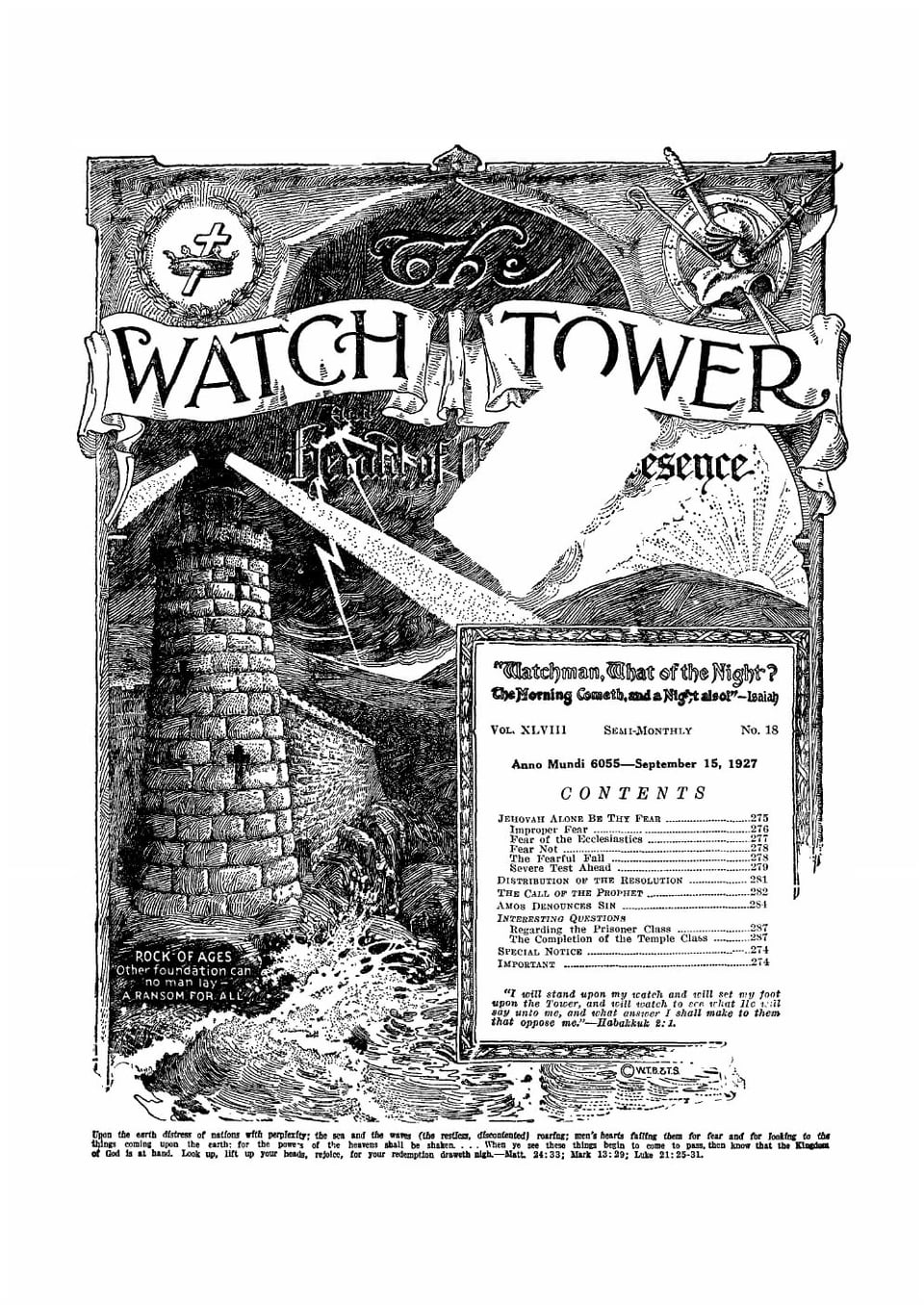
"Watchman, What of the Night?
The Morning Cometh, and a Night also!"—Isaiah
VOL. XLVIII SEMI-MONTHLY No. 18
Anno Mundi 6055—September 15, 1927
CONTENTS
JEHOVAH ALONE BE THY FEAR .................................................. 275
Improper Fear ............................................................................. 276
Fear of the Ecclesiastics ............................................................ 277
Fear Not God .............................................................................. 278
The Fearful Fail ......................................................................... 279
Severe Test Ahead ..................................................................... 280
DISTRIBUTION OF THE RESOLUTION ........................................... 281
THE CALL OF THE PROPHET ....................................................... 282
AMONG DEFENDERS SIN ............................................................ 283
INTERESTING QUESTIONS
Regarding the Prisoner Class .................................................. 287
The Completion of the Temple Class ........................................ 287
SPECIAL NOTICE ........................................................................ 274
IMPORTANT ............................................................................... 274
"I will stand upon my watch and will set my foot upon the Tower, and will watch to see what He will say unto me, and what answer I shall make to them that oppose me."—Habakkuk 2:1.
Upon the earth distress of nations with perplexity; the sea and the waves (the nations, disseminated) roaring; men's hearts failing them for fear and for looking to the things coming upon the earth; for the powers of the heavens shall be shaken.—When ye see these things begin to come to pass, then know that the Kingdom of God is at hand. Look up, lift up your heads, rejoice, for your redemption draweth nigh.—Matt. 24:33; Mark 13:29; Luke 21:25-31.
THIS JOURNAL AND ITS SACRED MISSION
This journal is published by the WATCH TOWER BIBLE AND TRACT SOCIETY for the purpose of aiding the people to understand the divine plan. It provides systematic Bible study in which all its readers may regularly engage. It gives announcement of the visits made to Bible classes by traveling speakers, announces conventions, and gives the reports thereof. The International Sunday School lessons are treated in harmony with the Scriptures.
It adheres strictly to the Bible as God's revealed Word of Truth. It stands firmly upon the great ransom sacrifice as the fundamental doctrine by which all doctrines are measured. It is free from parties, sects, and creeds of men. It does not assume a dogmatic attitude, but confidentially invites a careful examination of its utterances in the light of the infallible Word of God. It does not indulge in controversies, and its columns are not open to personalities.
TO US THE SCRIPTURES CLEARLY TEACH
THAT JEHOVAH is the only true God, the Maker of heaven and earth, and the evidences to every living; that the Logos was the beginning of his creation; that the Logos became a man; that he is now the Lord Jesus Christ in glory, clothed with all power in heaven and earth.
THAT GOD created the earth for man, created perfect man for the earth and placed him upon it; that man wilfully disobeyed God's law and was sentenced to death; that by reason of Adam's wrongful act all men are born sinners and without the right to life.
THAT JESUS was made a human being in order that he might become the Redeemer of man; that he gave his life a sacrifice for man and thereby produced the ransom price; that Jesus the divine arose from the dead, ascended into heaven, and presented the value of his human sacrifice as the redemptive price for man.
THAT for many centuries God, through Christ, has been selecting from amongst men the members of his church, which constitutes the body of Christ; that the mission of the church is to follow the footsteps of her Lord Christ Jesus, grow in his likeness, give testimony to the name and plan of Jehovah God, and ultimately be glorified with Christ Jesus in his heavenly kingdom; that Christ, Head and body, constitutes the "seed of Abraham" through which all the families of the earth shall be blessed.
THAT THE WORLD HAS ENDED; that the Lord Jesus has returned and is now present; that Jehovah has placed Christ Jesus upon his throne and now commands all nations and peoples to hear and obey him.
THAT THE HOPE of the peoples of earth is restoration to human perfection during the reign of Christ; that the reign of Christ will afford opportunity to every man to have a fair trial for life and those who obey will live on earth for ever in a state of happiness.
PUBLISHED BY
117 ADAMS STREET . . . BROOKLYN, N.Y. U.S.A.
OFFICERS
J. F. RUTHERFORD President
W. E. VAN AMBURGH Secy & Treas.
YEARS SUBSCRIPTION PRICE: UNITED STATES, 1.00; CANADA AND MISCELLANEOUS FOREIGN,1.50; GREAT BRITAIN, AUSTRALASIA AND SOUTH AFRICA, 7s. American remittances should be made by Express Money Order or Postal Order. Remittances from British South African and Australasian remittances should be made to branch offices only. Remittances from scattered foreign territory may be sent to the Brooklyn office, but by International Postal Money Orders only.
(Foreign translations of this journal appear in several languages.)
TERMS TO THE LORD'S POOR: All Bible Students who, by reason of old age or other infirmity or adversity, are unable to pay for this journal, may be supplied free if they send a postal card each May stating their case and enclosing a stamp. They need not only willing, but anxious, that all such be on our list continually and in touch with the Berean studies.
Notice to Subscribers: We do not, as a rule, send a card of acknowledgment for renewal or for a new subscription. A renewal blank (card) for notice of renewal will be sent with the next journal one month before the subscription expires. Change of address, when requested, may be expected to appear on address label within one month.
Entered as Second Class Mail Matter at Brooklyn, N. Y. Postoffice. Act of March 3rd, 1879.
BIBLES
The Bible because of its binding has always been associated with the ecclesiastics. Therefore the Bible has become a reproach in the eyes of many people. There seemed no good reason why the Bible should not be bound as other books are bound. It is the Word of God, and the people should be induced to love it. The Society has arranged to furnish Bibles in plain binding at moderate prices. Below we give a list:
Item
Description
Price
P120 41 x 78
French Morocco
$4.00
P130
do Full Leather
5.65
K60 48 x 61
French Morocco
8.40
EDITORIAL COMMITTEE
J. F. RUTHERFORD
W. E. VAN AMBURGH J. HEMERY R. H. BARBER E. J. COWARD
FOREIGN OFFICES: British: 34 Craver Terrace, Lancaster Gate, London W. 2; Canadian: 38-40 Irwin Avenue, Toronto, Ontario; Australasia: 405 Collins St. Melbourne, Australia; South Africa: 6 Lele St., Cape Town, South Africa. Please address the SOCIETY in every case.
SPECIAL NOTICE
On another page of this issue will be found a statement concerning the distribution of the new booklet Freedom for the Peoples. Read it carefully and get ready to do your part.
ERRATUM
In The Watch Tower of Sept. 1, page 271, paragraph 2, second line, "page 111" should be "page 211".
IMPORTANT
Time and again we have called the attention of our readers not to remit currency in unregistered envelopes. It is a temptation to men to steal. A man who has been in the Postal service forty-two years has been arrested and will doubtless go to prison because he opened our mail and was caught at it by the officials. Not only is it a temptation to weak men, but you lose your money and then cannot understand why you do not hear from us. Please observe what we have said time and again: Remit by post office money order or New York draft. Do not send personal checks on any bank outside of New York.
By Means of "The Watch Tower"
"Resurrection Body"
Z June 15, 1921
Week of Oct. 2 . . . 1-22
Week of Oct. 16 . . . 1-25
"The Overcomers"
7 July 1, 1921
Week of Oct. 30 . . . 1-35 The WATCH TOWER
AND HERALD OF CHRIST'S PRESENCE
Vol. XLVIII | SEPTEMBER 15, 1927 | No. 18
JEHOVAH ALONE BE THY FEAR
"Sanctify the Lord of hosts himself; and let him be your fear, and let him be your dread."—Isaiah 8:13.
JEHOVAH sets forth in his Word instruction to the anointed Servant class. He tells the members thereof of whom they shall fear and what they shall not fear. The above text and its context strongly support the conclusion that now is the time to understand what is proper and improper fear. At least it is due time to have a better understanding thereof. It is written that "Light is sown for the righteous". (Psalm 97:11) The Servant class is righteous by reason of the fact that the members thereof are in Christ and therefore God declares such righteous or right with him. It is this class that he instructs and leads in the right way. (Psalm 25:9; Proverbs 3:5, 6) 'Jehovah covers himself with light as with a garment.' (Psalm 104:2) His due time is here to draw his Servant class more clearly into his light. He has sent his beloved Son to his temple. He has provided the Bridegroom with the robe of righteousness for the members of the Servant class on earth. He has given to these the garments of salvation. They are identified as his. It seems to be his due time for them to have a better understanding of his purposes.
2 There is a proper fear to have and there is an improper fear to be exercised by the anointed class. Concerning this the Scriptures are explicit. Generally the term fear, as expressed in degrees of progression, means apprehension, anxiety, dread, fright and terror. Man well knows that he is imperfect and weak. If he learns that he is to be brought into the presence of one of far greater power than himself, and knows not whether such a one be his friend or enemy, he is apprehensive. He becomes anxious to have the approval of the greater one that he may fare well. If he has nothing to show him that the greater one is friendly he begins to dread the ordeal. As he advances to the greater one's presence, who he observes has a harsh countenance, he becomes frightened. If the greater one speaks to him in violent and threatening language he becomes terrified. Fear is also properly defined as reverential awe of the greater and more powerful one, and therefore the smaller one is solicitous to avoid the displeasure of the greater one.
3 Different texts of Scripture show the various shades of meaning that are properly given to the word fear. By these the anointed class can understand what is proper to fear and what they should not fear. It is written: "The fear of the Lord is the beginning of wisdom." (Psalm 111:10) The fool does not fear God. The wise man does. Man knows that he is imperfect and weak. He learns that God is all-powerful. He understands that some day he may have to appear before the judgment bar of God. (Romans 14:10, 11) Having a proper conception of his own imperfections, and understanding something of the greatness of Jehovah, man is apprehensive as to what will be the result when he appears before the judgment bar of the Lord; and he has a desire to know what is the proper course for him to take. He therefore has fear for the Lord. He is now beginning to get some wisdom. That means that what knowledge he has received he is using properly. As his knowledge concerning the Creator increases he has a reverential awe of the Almighty God. He learns that God is just and metes out justice to all.
4 Knowing of his own imperfection he knows he cannot be right with God. He learns that the mercy of God endures for ever, and that in his loving kindness he has provided through the merit of his beloved Son the means to justify those who come to him in God's appointed way. He believes what he has just learned. He has faith in God. He trusts God as his Friend and Benefactor, and therefore exercises faith in his appointed way through Christ; and he consecrates himself by agreeing to do God's will. Because of his faith in Christ, and because of the blood of Jesus presented to Jehovah as a sin offering for man, and by reason of the judicial determination by Jehovah the one making a consecration is justified. Being now justified he has peace with God. (Romans 5:1) That means that the man through Christ has a standing with God and knows that God is his Friend and Benefactor. He is begotten by the spirit of God and can properly call God his Father. He has an abiding confidence in Jehovah now as the Father of the new creation, and the more his knowledge of God grows the greater is his loving devotion to the Lord. As long as he remains in Christ and is obedient to God he does not dread Jehovah and his judgment but he knows that if he should fall away from Christ his standing before God would cease and then it would be a dreadful and terrible thing to fall into the hands of the living God.
(Hebrews 10:31) He therefore properly fears God. He fears to displease Jehovah. He fears that he might fail to receive the approval of God and that would be a dreadful and terrible thing.
5 For the servant of the Lord to incur the displeasure and disapproval of Jehovah would mean to that servant the most terrible thing. Therefore the fear of the Lord which marks the beginning of wisdom continues with man as a new creature to the end. His reverence, his adoration, and his love for God increase. His anxiety to please God also increases because it is his greatest desire to have the approval of Jehovah. It is proper for him to fear God because to fail of the approval of God would mean the loss of everything. Therefore says the apostle, “Work out your own salvation with fear and trembling.” (Philippians 2: 12) Over such the Lord exercises a watchful care. “Behold, the eye of the Lord is upon them that fear him, upon them that hope in his mercy.” (Psalm 33: 18) “He honoureth them that fear the Lord.” (Psalm 15: 4) “The fear of the Lord is clean, enduring for ever.” (Psalm 19: 9) God places his special protection about them that fear him. “O fear the Lord, ye his saints; for there is no want to them that fear him.” (Psalm 34: 7-9) “Ye that fear the Lord, trust in the Lord: he is their help and their shield.”—Psalm 115: 11.
6 The apostle expresses the same meaning of fear when he says: “Having therefore these promises, dearly beloved, let us cleanse ourselves from all filthiness of the flesh and spirit, perfecting holiness in the fear of God.” (2 Corinthians 7: 1) Holiness within the meaning of this scripture means a complete and absolute devotion to the Lord. Such is prompted by love. The new creature should have fright or dread if he finds himself partially devoted to the Lord and partially devoted to some part of Satan’s organization. He could not perfect holiness in the Lord by following such a course. The new creature cannot serve the Lord and serve the Devil. He is emphatically instructed: “Ye cannot drink the cup of the Lord, and the cup of devils: ye cannot be partakers of the-Lord’s table, and of the table of devils.” (1 Corinthians 10: 21) Those whom God approves must be unreservedly devoted to him as his servant. It is in such that the Lord delights. “Behold my servant, whom I uphold, mine elect, in whom my soul delighteth; I have put my spirit upon him; he shall bring forth judgment to the Gentiles.”—Isaiah 42: 1.
IMPROPER FEAR
7 “The fool hath said in his heart, There is no God.” (Psalm 14: 1) The fool does not fear God because he has not sufficient sense to believe God. The fool knows nothing of the works and wisdom of God. (Psalm 92: 6) Wisdom is too high for such. (Proverbs 24: 7) But a fool is usually much afraid of other men. There are fools besides those who are imbecile or idiots. The man who refuses to gain knowledge from God but seeks the approval of men and the plaudits of men is a great fool, even though he may have much learning in other matters. It is to this foolish class that the man belongs who thinks it is an evidence of weakness to acknowledge God as supreme above all. It is the same thing that makes a clergyman who is wise in his own conceit afraid to give the Lord God glory and credit for the wisdom expressed in the Bible.
8 It is written that the fear of man bringeth a snare. Why is that true? Because he who fears man puts his trust in men and not in the Lord. One man becomes a leader or teacher of Bible doctrines and other men follow him because they trust him and they fear that disaster will befall them if they do not do exactly as their leader tells them. In order for the one to be strong in the Lord he must accept the truth in the love of the truth and bear in mind that truth emanates from Jehovah. The one who reverences man or fears man, or who fears disaster might result because he goes contrary to the teachings of some man, will sooner or later discover some defect in the man or leader whom he trusts; and his confidence will be shaken in what he believes. This is often observed where one accepts a doctrine and holds to it because of his confidence in man; and failing to trust the Lord he falls away, even though he for a time followed the truth. Each man must make the truth his own, and his trust must be in the Lord and not in man. “The fear of man bringeth a snare: but whoso putteth his trust in the Lord shall be safe.”—Proverbs 29: 25.
9 Should we not have honor and respect for some who are in the service of the Lord more than we have for others? Yes; one should be honored and respected in proportion to his faithfulness to the Lord. If we see that the Lord is using some in a more extensive way than others, we should have respect for such and try to cooperate with such to the Lord’s glory, but not to the glory of man. This does not mean to have a reverential awe for man. In the days of the apostles there were some who followed Paul and some Apollos and some others, evidently because they had more respect or reverence for one than they did for the other. The apostle emphatically pointed out that such a course is wrong. He said: “Who then is Paul, and who is Apollos, but ministers by whom ye believed, even as the Lord gave to every man? ... For we are labourers together with God: ye are God’s husbandry, ye are God’s building.” (1 Corinthians 3: 5, 9) Workers together cooperate. All in the truth should cooperate with each other to the Lord’s praise. Remembering that God sets the members in the body as it pleases him, each one should strive to do his or her part with full respect and consideration to the other members of the body, because such is the Lord’s way. Such, however, is not fear of man but a fear to do contrary to the Lord’s appointed way.
10 Cooperation in serving the Lord is true fellowship between Christians. Fellowship does not mean to get together and gossip and shake hands and smile at one another or spend the time with senseless talk.
Fellowship properly means partnership; and all who are in the Lord are partners with Christ Jesus, the chief One of the new creation; and all should cooperate and fellowship with such, which means to further the interests of the partnership. This is the reason why that the Lord's people consist of those who are working together harmoniously to the Lord's glory. For this reason it is written: "Let nothing be done through strife or vain-glory; but in lowliness of mind let each esteem other better than themselves." (Philippians 2:3) The reverence or worship of men or leaders, and the fear of such, is truly a snare of the Devil.
11 It has ever been the purpose of Satan the enemy to turn the people away from God. He uses various methods to accomplish his purpose. He has caused men to teach doctrines that represent Jehovah as a great fiend who will torture every one who incurs God's displeasure. The doctrine of eternal torment is a sample. Many, because of fear of eternal torment, have been driven into the church systems. They do not fear God, but have feared torture, which they desire to escape. Their fear of God has been taught by men who were acting as the tools of the enemy Satan. For this reason millions of people draw near the Lord with their lips, but they have neither love for nor fear of God. Thus the prophet expresses it: "Wherefore the Lord said, Forasmuch as this people draw near me with their mouth, and with their lips do honour me, but have removed their hearts far from me, and their fear toward me is taught by the precept of men."—Isaiah 29:13.
12 God commissioned the members of the church to preach the gospel to the teachable ones. He planted his church a pure and noble vine. In his Word he points out the proper course of action for members of the church to take. Among other things the Christian is commanded to keep himself unspotted from the world. (James 1:27; 4:4) That means the preaching of the gospel was intended to be a witness to the people concerning God's plan of salvation and not for the purpose of converting the world. The world will be converted in due time, and that due time is during the reign of the Messiah.
13 The clergy took exactly an opposite course to what the Scriptures pointed out they should take. They concluded that they must convert the world and bring the ruling classes of the nations into the church, and when they had accomplished that work then the Lord would command that the governments be turned over to them and they, the churches, would be the chief ones in the kingdom. They did not fear God; but they feared that when Christ would come if they had not brought in the nations they would lose their position as rulers. Instead of following the Scriptural injunction they leaned to their own selfish ways. (Proverbs 3:5, 6) They reasoned that if they should be left out as rulers in the kingdom, that would be a great calamity.
14 Such was exactly the condition that prevailed amongst the clergy of the Jewish time at the first coming of the Lord. The Devil entrapped them and induced them to join forces with the rich and influential of that time. They therefore were not ready to accept Jesus as the Messiah because he did not come with a great display of power and influence and did not honor the clergy and put them forward. He did not cause them to dress in purple and fine linen or red gowns and red caps and sit on thrones of velvet. He told them the truth, that they were hypocrites. Had they feared the Lord they would have changed their course of action.
15 In more recent years the clergy of the various denominational systems saw their membership growing less and that the people were falling away from the church systems. They began to make overtures to the rich and influential, and openly declared that the church must be thrown open to these powerful and influential ones and they must be brought in. The clergy therefore prostituted the gospel of Christ and made common cause with influential worldly men and feared to take any course that would offend such worldly men. The clergy therefore made the church system a part of the world, or Devil's organization.
16 When the harvest time of the Lord came at his second presence, and the preaching of his presence and kingdom began and progressed, the clergy concluded that some quick action must be taken, for fear that they had been somewhat derelict in converting the world, and that their own positions of greatness were in jeopardy. They reasoned that they must get together and form an alliance or federation of the various denominational systems and present a solid front and thus increase their strength and influence with the rich and powerful and also impress the people with their greatness and with their ability to set up the kingdom about which they had preached. A world-wide movement began, resulting in the formation of a confederacy, which is called the Federation of Churches.
17 One of the prime movers of this organization was an American of great wealth and probably the richest man the world had produced up to that time. J. P. Morgan contributed one hundred thousand dollars to start the federation. What was the inducing cause for the formation of this confederacy? Manifestly not the fear of God nor the desire to honor him, but it was the fear of the clergymen and big church men that unless they took a decided action in the federation they would be left out of the ruling factors. They were like the scribes and Pharisees of old. The clergy united with the rich, influential and powerful, and drew together the denominations regardless of doctrines. They compromised doctrines that they had tenaciously held to up to that time. So far as the truth of God's Word was concerned that did not enter into the matter.
Man could believe what he pleased just so he supported the organization.
18 The World War came on. The commercial and political powers controlled and operated the military. The clergy were already united with them, and they feared lest they would lose the influence of their allies unless they boldly advocated the shedding of human blood. They made recruiting stations of their church buildings and urged the young men into the war. Concerning them God's prophet says: "In thy skirts is found the blood of the souls of the poor innocents: I have not found it by secret search, but upon all these." (Jeremiah 2:34) They were willing to disregard the command of the Lord, "Thou shalt not kill," and to take an exactly contrary course; and that of itself proves that they did not fear the Lord but feared to lose their own power and influence.
19 The World War moved some of the clergy to think for a time. A number of them got together and issued a manifesto announcing that the then existing evidence tended to show the kingdom of heaven near. The World War ended; and seeing no evidence of the kingdom of Christ in operation the preachers again feared lest they would lose out, and they made another desperate move. The commercial and political elements of the Devil's organization made and wrote a treaty of peace. A draft of the compact of the League of Nations had been made but not adopted. Quickly the clergy saw that if the League of Nations should be formed and the clergy left out, the church systems would suffer and the preachers would lose their power and influence. Hence the Federation of Churches, before the adoption of the League of Nations Compact, passed a resolution urging the formation of a League of Nations and declaring it to constitute the political expression of God's kingdom on earth. In that resolution they said: "The church can give a spirit of good will without which no League of Nations can endure." Of course they meant their church systems.
20 It was not the fear of God that led them to endorse the League of Nations, but they did so in utter disregard of his Word. God, through his prophet, says concerning such confederacy: "Associate yourselves, O ye people, and ye shall be broken in pieces; and give ear, all ye of far countries: gird yourselves, and ye shall be broken in pieces; gird yourselves, and ye shall be broken in pieces. Take counsel together, and it shall come to nought; speak the word, and it shall not stand: for God is with us."—Isaiah 8:9, 10.
FEAR NOT
21 The anointed of the Lord are specially warned by him not to favor any kind of confederacy and not to have the fear that the clergy or other selfish men have. The prophet represents the Servant class speaking: "For the Lord spake thus to me with a strong hand, and instructed me that I should not walk in the way of this people." (Isaiah 8:11) Then the Lord speaks to the Servant class through the prophet and to the members thereof, saying: "Say ye not, A confederacy, to all them to whom this people shall say, A confederacy; neither fear ye their fear, nor be afraid. Sanctify the Lord of hosts himself; and let him be your fear, and let him be your dread."—Isaiah 8:12, 13.
22 In 1918 the Lord came to his temple; and the faithful entered into the joy of the Lord and into the secret place of the Most High. It was then that the anointed class began to have a clearer vision of God's organization and of the enemy's organization. The Lord began to say to them: 'Do not hesitate to stand aloof from these alliances. Jehovah of hosts shall defend you; therefore let him alone be your fear.' The title Jehovah of hosts means that the great God Jehovah has provided ample protection for the Servant class; that he has an army or host to defend his own and to keep them from all harm; and that those who fear Jehovah alone shall be saved. Hence he says to his anointed: "Sanctify the Lord of hosts himself; and let him be your fear, and let him be your dread." That sanctuary is the holy place, the secret place of the Most High, and therefore the place of complete safety for the anointed Servant. Those who have entered into this place need have no fear of anything, but are to fear only the Lord. Those who do sanctify the Lord of hosts, to them he shall be a complete defence and strength. The lesson that the anointed class draws from these prophecies is that the Servant is to put his trust wholly and completely in Jehovah, to fear him and fear him alone, and know that the Lord will shield and protect him as long as he is faithful in the performance of the duties the Lord lays upon him.
THE FEARFUL FALL
23 From approximately 1874 to 1914 the Lord restored to the consecrated ones of earth the great fundamental truths that have been hid by the agencies of Satan. That work of restoration of the truth was foreshadowed by Elijah. (Matthew 17:11, 12) Therefore the work of the Servant class during the period of time above mentioned was foreshadowed by Elijah. The Servant class doing the Elijah work had expected the Lord to complete his church, fully establish his kingdom, and take all the anointed class into the kingdom by 1914. Up to that time they were bold in declaring the truth. When Jezebel got after Elijah after the slaying of the prophets of Baal, Elijah manifested much fear and fled. When the World War came on and Jezebel, to wit, ecclesiasticism, aided and abetted by her allies began to manifest much enmity toward the Lord's people, many of the consecrated became fearful and refrained from further proclamation of the truth.
24 In 1918 the Lord came to his temple, and fiery trials upon the church increased. Jezebel became more active. Together with her allies she began to press hard against the anointed class. Some of these became fearful, and for that reason fled and ceased their boldness in the proclamation of the message of truth against the unholy alliance.
Then when the Lord revealed to the church that Christ had come to his temple, that Jehovah had provided the robe of righteousness for the bride class, the garments of salvation for the anointed, and that the Stone, namely God's anointed King, was laid in Zion, many of those who had become fearful or indifferent or inactive stumbled over that Stone and fell. Others were ensnared by the enemy Satan, had their heads twisted and their hearts made bitter; and they fell. The Lord God had foretold this through his prophet in connection with the fear that should come upon the faithful when he said: "Sanctify the Lord of hosts himself; and let him be your fear, and let him be your dread. And he shall be for a sanctuary; but for a stone of stumbling, and for a rock of offence, to both the houses of Israel; for a gin and for a snare to the inhabitants of Jerusalem. And many among them shall stumble, and fall, and be broken, and be snared, and be taken."—Isaiah 8:13-15.
25 Then the prophet of God shows that the giving of the testimony of God's witnesses would be limited to the faithful anointed Servant class when he said: "Bind up the testimony, seal the law among my disciples." (Isaiah 8:16) The law of God is his will, whether expressed or unexpressed. He has expressed His will concerning the Servant class by giving them positive commandment that they must be his witnesses. These the Lord will honor and continue to honor as long as they are faithful to him.
26 Those approved by the Lord and who entered into the joy of the Lord were not only ready but anxious to do the will of God. To these approved ones God has given a clearer vision of his plan. He enables them to see the Devil's organization in all its hideousness and to see the Lord's organization more clearly than ever before; and seeing this and having an abiding confidence in the Lord, the anointed class does not fear the Devil nor any of his instruments. This lack of fear is not due to any inherent qualities in the members of the Servant class, but it is due to their complete confidence in the Lord. They see that the great Jehovah of hosts has an army to do his bidding and that he will protect those who are faithful and who joyfully continue to represent him. These anointed ones have made Jehovah alone their fear, and they fear no other, and to them the Lord is a sanctuary. Being in his sanctuary they dwell in the shadow of his almighty hand, and are wholly and completely safe.
27 The anointed class does not have or manifest a "cocksure" attitude. They do not perform foolhardy things. They do not consider themselves immune from the attacks of the enemy; and they know that their safety depends entirely upon the strength of Jehovah of hosts, and that so long as they dwell in his secret place and abide under his almighty shadow, they are safe. Therefore the Servant class properly fears Jehovah.
The members thereof fear to lose his favor, and know that unfaithfulness on their part will result in the loss of everything for ever. These fear lest they should fail to obey the commandments of God. A failure might be due to indifference or negligence. A refusal to obey would be willfully taking a wrongful course. Therefore if one of the anointed has an opportunity to obey the commandment of the Lord to be his witness and fails or refuses to obey that commandment, he is in great danger.
28 Those who will be overcomers, and who will gain a complete victory and have an abundant entrance into the kingdom, are those who will abide in the secret place of the Most High and dwell under the almighty hand of Jehovah. Such have no need for fear of man or Devil. Their faith being complete and their trust in God being absolute, and he being their sanctuary, they joyfully sing: "The Lord is my light and my salvation; whom shall I fear? the Lord is the strength of my life; of whom shall I be afraid? ... For in the time of trouble he shall hide me in his pavilion: in the secret of his tabernacle shall he hide me: he shall set me upon a rock. And now shall mine head be lifted up above mine enemies round about me: therefore will I offer in his tabernacle sacrifices of joy; I will sing, yea, I will sing praises unto the Lord."—Psalm 27:1, 5, 6.
SEVERE TEST AHEAD
29 From time to time there are some who suggest that all trials and tests are done, that now the anointed are marching triumphantly on and will never again have such severe trials as in the past. Probably the desire to have it thus is father to the thought. Such scriptures as Revelation 12:17 and others strongly indicate that there is a great test yet to be endured by the faithful. The kings and rulers of the earth have been warned that God's kingdom is at hand; that God has set his King upon his throne; and that Satan's organization must fall; and that their kingdoms constitute the visible part of Satan's organization. The peoples must hear the testimony that the Devil's organization has long been the responsible one for their oppression. The anointed Servant of God must give that witness.
30 It is manifest that the faithful will give witness to those strong truths which shall have to do with sweeping away the refuge of lies, and will bring down upon their heads the indignation of the enemy. That old dragon is exceedingly wroth with the remnant of the seed that remains. (Revelation 12:17.) The giving of the strong witness against him and his agencies will bring this greater wrath upon the witnesses. The forces of the enemy will be gathered and are being gathered to Armageddon. The Servant class, small in number and insignificant in strength, would be destroyed instantly except for the protection that the Lord of hosts has provided. The army of Jehovah of hosts is certain to win. The faithful Servant class that continues to abide in the secret place of the Most High and to perform Jehovah's commandments will certainly be overcomers.
But it is not certain that every one who is now of the Servant class will continue therein. He who continues faithfully to be a member of the Servant class will win. He who abides under the shadow of the Almighty, in his secret place, is absolutely certain of victory. But each should remember that the commission laid upon him by the Lord must be performed. Hence the Lord says to such: "Sanctify the Lord of hosts himself; and let him be your fear, and let him be your dread. And he shall be for a sanctuary."
31 The people to whom the Lord Jehovah will grant the kingdom must bring forth the fruits thereof. (Matthew 21:43) In order to bring forth the fruits thereof these must do the will of God by joyfully obeying his commandments. Such must be wholly on the side of the Lord. They must be entirely separate from any part of Satan's organization and not even so much as sympathize therewith. Even though imperfect in the flesh these members of the new creation can be loyal, faithful and true to the Lord God. Such perfection on their part Jehovah requires. For the encouragement of such God, through his prophet, says: "When thou passest through the waters, I will be with thee; and through the rivers, they shall not overflow thee; when thou walkest through the fire, thou shalt not be burned; neither shall the flame kindle upon thee."—Isaiah 43:2.
32 Of course there must be fiery experiences for the anointed class ahead; otherwise this promise would not be made. Those who love the Lord will not be thinking of what reputation they may or may not have amongst men. No faithful one amongst them will count his life dear to himself. Being advised of the secret place of the Most High, and having the witness of the holy spirit that he is dwelling there, and having the assurance that almighty power is exerted in his behalf and that Jehovah's purpose toward him is to bring him through victorious, he must not hesitate to joyfully perform the commission that the Lord God has laid upon him. This company will be small. The Lord refers to it as a remnant, which means the faithful ones left after the less faithful have withdrawn. The conditions surrounding this little faithful company may be such as to strike terror and dread into the hearts of all; but none of them will fear, none of them will have any dread or any terror of the enemy, because the Lord of hosts is their strength and shield. "In that day shall the Lord of hosts be for a crown of glory, and for a diadem of beauty, unto the residue of his people, and for a spirit of judgment to him that sitteth in judgment, and for strength to them that turn the battle to the gate."—Isa. 28:5,6.
33 It would not be right for one to speak harshly against his brother because his brother is an elder and does not take an active part in the service work. It would be proper, however, for one brother to point out the necessity of being obedient to God and to beseech his brother to faithfully perform his covenant. (Romans 12:1) That is exactly what The Watch Tower is trying to do. The Watch Tower would be derelict in its duty to the brethren if it did not stress the importance of giving the testimony today that Jehovah is God, Christ is King, and the kingdom is here. The elder or other one in the Lord's anointed class who fails or refuses to be aroused to the importance of performing his covenant is in an unfortunate position. He must judge himself, however, if he would not be judged by the Lord.
34 Therefore let each one who believes himself to be in the secret place of the Most High, and who desires to abide there and be under the protection of the Almighty, ask himself a few questions and give answer to himself to the questions. The following are some suggested questions: Do I see the Devil's organization pitted against God and his organization in a desperate effort to turn the people away from the Lord? Do I see that now is the time when the enemy of Jehovah must be brought to the attention of the people? Do I believe that the forces are preparing for Armageddon and that God would have notice thereof served upon the people? Do I understand that the anointed Servant class, the feet members of Christ, is the class to which God has delegated this work of giving the testimony to his name?
35 If these questions are answered in the affirmative then ask some more: Am I doing my part in the performance of the will of God as he has commanded? God has provided for the publication of books which carry the message of the kingdom; he has provided the radio to spread the message to the people both far and near; he has arranged that his anointed ones may call upon these hungry ones with the books and literature to enable them to read and get a knowledge of the plan. Am I doing what I can to give this message to the people as a witness to God's name? If I am not, is it because I fear the reproach that may come upon me for doing so? Do I fear the enemy or some part of his organization or some harm that might come to me? Do I love my God sufficiently to do what he has asked me to do? After a careful and prayerful self-examination then let each one do as he thinks God would have him do.
36 There are several ecclesias in the land wherein brethren who are acting as elders are opposing the service work. Whether they will ever get their eyes open sufficiently to see their mistake the Lord knows. There are some members of the ecclesias that are being misled by these blind leaders that may get their eyes opened at a time when they will greatly regret that they followed men or feared men. The responsibility of each consecrated one is to his God. These are therefore warned not to be misled by men. It is gratifying however to note that there are not many of the opposers and not many classes will tolerate them long. This is evidenced by the fact that although a less number partook of the memorial in 1927 than heretofore the reports show that there is a far greater number today actually in the field service work than ever before.
It is a healthy sign. Jehovah of hosts will give these faithful ones the victory through Christ.
QUESTIONS FOR BEREAN STUDY
What reason have we for believing that Jehovah God would now have his Servant class understand the subject of fear? Why does he thus instruct this class? Define the term Fear. What are the five degrees of progression covered by the word? Give scriptures to illustrate each.
What is the basis of all fear? ¶ 1, 2.
Distinguish between proper and improper fear. In what way may the fear of Jehovah God be said to be the beginning of wisdom? What steps will one take who is properly exercised by the spirit of fear? Why? ¶ 3-5.
Which is the Scriptural meaning of the term harness? Who among the Lord's people has genuine cause for fear? ¶ 6.
What cases of fear may Scripturally be classed as fools? In what way does the fear of man ensnare one? Distinguish between a proper and an improper reverence for those acting in the Lord's service. ¶ 7-9.
Show what is true fellowship among Christians and what is not. What methods does Satan use to turn the people away from God? ¶ 10, 11.
What commission was given to the church? Why did the clergy take an opposite course? What parallelism exists between the clergy class at the first advent and that of the second advent? ¶ 12-15.
What change of tactics did the clergy make during the harvest which marks the end of the age? What was the purpose of this change? Account for the apparently great growth of denominationalism since the harvest began. ¶ 16-18.
In what ways did the World War demonstrate the real condition among the clergy? Why have they heartily endorsed the League of Nations? ¶ 19, 20.
What instructions have the Lord's people regarding their attitude toward the church federation? What blessings from the Lord have come to all who have obeyed these instructions? ¶ 21, 22.
What is meant by the Elijah phase of the Lord's work? What movement did the antitypical Jezebel make against the Elijah phase of the work? What resulted? What refreshment did the Lord then give to his people? In this connection explain Isaiah 8:13-15, ¶ 23, 24.
What is meant by the will of Jehovah? What positive command has his Servant class received since 1915? What blessings have come to those who have joyfully obeyed? Account for their lack of fear at this time. How could members of this class bring themselves into great danger? Who among them will have an abundant entrance into the kingdom? ¶ 25-28.
What indications point to a great test ahead for the Lord's faithful followers? Why? What protection has been promised that class? Will all who are now of that class remain faithful to the very end? Give reasons for your opinion. ¶ 29, 30.
To whom will the Lord Jehovah grant the kingdom? What scriptures indicate that such will pass through severe experiences? Why does the Lord refer to this class as a remnant? ¶ 31, 32.
What duty have the brethren to perform to one another? What ten questions are suggested as a personal assistance to those who desire to fulfil their covenant at this time? Who among the Lord's people seem to cause most of the trouble in the ecclestias? What is probably the explanation of this condition? Who will ultimately win the victory? ¶ 33-36.
DISTRIBUTION OF THE RESOLUTION
HERETOFORE the Society has followed the policy of printing millions of copies of the Resolution and the speech in support of it for free distribution amongst the peoples. Announcement was made at the Convention at Toronto that this would be done for this year. Since then it has been determined that this time we will not make a free distribution. A paper thrown on the doorstep is usually destroyed.
It has been decided that the Resolution adopted by the Convention at Toronto and the speech in support of it, which were broadcast, together with an introductory chapter and another following, will be put into a sixty-four-page booklet and produced as cheaply as possible. This booklet will be supplied to all the classes at three cents per copy, and will be sold by them at five cents per copy to the public. This will afford an opportunity for everyone in the classes to have some part in the service, and it seems quite certain that the people will read much more readily than they would if a sheet were given to them.
We therefore urge upon the service directors in every part of the earth to organize the service work thoroughly, and assign everybody in the classes who is willing to work some territory, and have every house in every division of territory called upon and canvassed for the booklet.
As these booklets come off the press they will be shipped on consignment to the classes. We will ship to each class the quantity that the territory would seem to warrant; and of course each class will put forth every possible effort to get them into the hands of the people. Classes will be billed for the books at the rate above mentioned, and may remit as quickly as these are sold or sooner if convenient.
The general drive all over America will begin October 1st. The month of October therefore will be the time to specifically arrange to get these booklets into the hands of the people. Everyone in the classes will be able to devote some time either Saturday afternoon, Sunday or evenings. The responsibility is now upon the classes to see that this witness gets to the people, and let no one shirk his responsibility.
Every person who goes out should sell not less than one hundred per day and probably many more. By this means they will be able to pay their expenses so that they can have a part in the work and at the same time to provide something necessary. Let this be the most thorough canvass that has ever been made of the people.
The canvass can be brief, stating that here is a report of the greatest radio hook-up ever on earth, together with a resolution adopted by the people and a speech in support of it and a description of the distress of the peoples on earth and the reason thereof, what will be the result, and how the blessings of freedom and life and happiness will come to mankind. Surely every person will want a copy; and it has been produced in such a way that every person can avail himself of a copy.
The classes will have a sufficient amount so that in the poorer districts where some may be found who are unable to pay but who are able to read, the classes may give away some copies and do so without loss to themselves, as the sales of others will make up for those given away. We hope to see an enthusiastic response to this field work. It is the time to give the witness that Jehovah is God and Christ is King and that the kingdom of heaven is here.
THE CALL OF THE PROPHET
—OCTOBER 23—1 KINGS 19: 19, 20; AMOS 7: 10-15; ISAIAH 6: 1-8—
"And I heard the voice of the Lord, saying, Whom shall I send, and who will go for us? Then I said Here am I; send me."—Isaiah 6: 8.
THE present study brings before us the call of three prophets: Elisha, Amos and Isaiah. Their ministry differed much each from the other. Elisha's mission was to do a work, and to speak things which were necessary as occasion might arise; but he was one of the non-writing prophets; he left no written message. There is, therefore, no record of any utterance of his which is of the nature generally considered prophetic. Neither Elijah, his immediate predecessor, nor he who took up Elijah's work, was used of God to give forth messages telling of future events. They were the prophets of God because while they lived they were God's channel for conveying his will to his people Israel, and also in this that their work was prophetic in character inasmuch as it was typical of a work to be done in latter days.
2 Elisha was the son of a farmer in one of the rich valleys in the northern kingdom. He was chosen through Elijah, who was directly told to anoint Elisha to take up Elijah's work. Since Elisha's residence was told to Elijah, it is probable that the younger man was unknown to Elijah; besides Elijah had said that he was left alone.
3 It was a strange way that Elijah took to carry out his mission. Probably the older man was led to put a test upon the younger; for instead of telling Elisha of his commission and anointing him, as might have been expected from the command, Elijah found out Elisha as he was ploughing, cast his mantle upon him, and passed on.
4 The prophet's mantle was significant of the office; and Elisha understood at least that Elijah meant to call him, for he immediately left his ploughing and with submission asked that he might say farewell to his father and mother. Elijah bade him go back, as if he would say, I have not called you to follow me. The action was as if he had only intended Elisha to understand that the younger man had a call from God, but not necessarily to enter at once into service.
5 Elisha returned; but to show that he intended to obey what he understood was a call to privilege of service, he took a yoke of oxen, boiled their flesh on a fire made with the instruments of ploughing, and made a feast for the people. As the famine had now been in Israel for three and one-half years, for the much needed rain had fallen only a few weeks before, this action of Elisha when he had entered into his ministry may be taken as that which is typical of him during all his ministry; namely, that of grace and kindly care for the people. He went at once after Elijah and became his servant.
6 There was room for faith in his call, and had he been other than he was, there might have been a test for him in the abruptness of Elijah's manner of indicating the call, and then in his brusque way of answering his request. But the fact of the mantle was his evidence: he understood the prophet's meaning.
7 The second passage of Scripture in the study tells of the call of Amos. Forced to speak for himself in order to rebut the arrogant Amaziah, priest of the shrine at Bethel, who professed to serve Jehovah by means of the golden calves which the first Jeroboam had set up, Amos said that he was neither a prophet nor a prophet's son, but was a herdsman and a gatherer of wild figs. Probably he was a trader whose business took him northward into Bethel, and who had been stirred in spirit by the calf-worship he saw there. In saying he was no prophet, Amos did not mean to discount his office; his declaration that he spoke by the authority of the Lord shows that; and in saying that he was not a prophet's son he probably meant that he had not been a member of any school of the prophets.
8 Like Elisha Amos was a dweller in the fields. Jehovah had laid hold upon him while yet he was attending to his business in Tekoa. He was called to the service of the Lord in the days of Uzziah, king of Judah, about 120 years after the call of Elisha.
9 The schools of the prophets seem to have existed in Israel since the days of Samuel, who gathered young men to him, evidently that they might be trained for some service for the Lord. (See 1 Samuel 10: 5, 6, 10.) This arrangement continued in Israel, and the young men or companies were later known as "the sons of the prophets".
They were sons only in a spiritual sense. What part they had in the direct service of Jehovah does not appear; they were probably helpers or servants of such prophets as Elijah or Elisha. (See 2 Kings 2:3, 5, 7.) There is no record of God's taking any one out of such companies for special service, though it should be said that there is no direct evidence that he did not do so.
10 It has ever been that when God has wanted a special servant he has raised up one for himself, and fitted him for service with that which cannot be acquired in any school, nor which can be passed on from man to man. If Elijah cast his mantle over Elisha, it was God who gave his spirit to Elisha. This has ever been so. The holy spirit of God alone gives the true ordination of service; and everyone who is begotten of the holy spirit, and who comes into the knowledge of the truth, is thereby called to service. It is, however, true that the interpretation of the Word of God has ever come through some special source which God has ordained for the service of his people.
11 The Prophet Isaiah tells us of his call. (See Isaiah Chapter 6.) Whether or not the account is in its proper place in the record cannot be determined; it may have been that the things recorded in the earlier chapters had already been spoken; but the vision he received seems to have begun a definite phase of his ministry. Isaiah was a man of the city; Elijah, Elisha and Amos were men of the country; and, correspondingly, Isaiah's vision of his calling is set in the temple.
12 Isaiah sees in vision the Lord in the temple, and the house filled with the divine glory. This was in distinction from that which had hitherto been revealed; for Jehovah was ever represented in the tabernacle and in the temple by the ark, and by that light which the Jews called the Shekinah glory, the illuminated cloud. In his vision there were some of the usual manifestations which accompany the divine presence; the doors of the temple were shaken, and the house was filled with smoke.—See Exodus 19:18.
13 While Isaiah watched and heard, he was filled with a sense of unworthiness and cried, "Woe is me! for I am undone; because I am a man of unclean lips, and I dwell in the midst of a people of unclean lips: for mine eyes have seen the King, the Lord of hosts."—Isaiah 6:4, 5.
14 As he watched, one of the seraphim which he saw standing above the throne flew to him, carrying a burning coal which he had taken with the tongs from the altar. Isaiah's lips were touched; and he was told, "Thine iniquity is taken away, and thy sin purged." It was as if this action represented that Isaiah had been made partaker of the altar. He hears a cry, "Who will go for us?" and in joyful thankfulness for what has been done for him, for the privilege of the vision, for having been accepted of God and counted pure, for having his lips purged that he might speak the message of God, he immediately responds, "Here am I; send me." (Isaiah 6:7, 8) He was called only indirectly; his was a voluntary offer to do a service for God of which he heard.
15 These prophets of God were raised up for special occasions; and their acts become typical of things to come, as their written words are prophecies of things to come. Elisha as the follower of Elijah and prophet in his room and stead continued the work which Elijah did. Both became God's representatives to carry out his purpose in destroying Baalism from Israel. Elijah had seen Baalism established in Israel; Elisha did his work faithfully and saw it destroyed out of Israel.—See 1 Kings 16:32, 33; 2 Kings 10:28.
16 Amos is not as definitely shown to be typical in his person, and in his acts, though in his declaration at Bethel, he represents those who in the last days boldly proclaim against the iniquity which is foisted upon God's Israel, in the name of true worship of Jehovah.
17 Isaiah's call to office and the peculiar circumstances are very definitely typical. Indeed, he says of himself, "I, and the children whom the Lord hath given me, are for signs and for wonders in Israel from the Lord of hosts, which dwelleth in Mount Zion." (Isaiah 8:18) The temple Isaiah saw in vision is the Lord's establishment.
18 It was not, however, the Millennial throne of Christ which Isaiah saw; for the picture is not of the reign of Christ upon earth, but of a time of judgment among God's professed people. In referring to this vision of Isaiah Jesus said that it had a fulfillment in his day. (See John 12:40.) But like the other Messianic prophecies, that was only a miniature or partial fulfillment. It has been shown in detail in the columns of this journal that the setting of this vision refers to the time when the Lord Jesus comes again from heaven for judgement, now in Christendom, where a condition of things obtains, and on a large scale, which corresponds with the condition of the Jews when Jesus witnessed to them and against them.
19 It was in the year 1914 that the time had come for God to speak to his Son, who in the words of Scripture had until then been seated at the right hand of God, waiting until the time should come when his enemies would be made his footstool. It was then that Satan's kingdom was thrown into confusion. But it was not until the year 1918, after the great church systems had had their long test and had failed, first by helping the nations into war, then helping them to continue it, and, when the war was over, still continuing their mistake of supporting the League of Nations, first the idea and then the fact. Then it was that the Lord came to his temple for judgment, and gave the Isaiah class the opportunity of responding to the call, "Who will go for us".
20 From that time the work of witnessing to the fact of the second advent took a different phase, and it was not long before the Isaiah class realized themselves as rallied together for a service of witnessing that should not end till the desolation spoken against the unfaithful people of God had been completed.
Isaiah said, "How long, O Lord?" and the Lord answered, "Until the cities be wasted without inhabitant, and the houses without man, and the land be utterly desolate."—Isaiah 6: 11.
21 We quote from The Watch Tower November 1, 1932: "This is corroborated by the Lord in Matthew 24: 14. Clearly, then, is set forth the proof that the temple (or Isaiah) class must continue to declare this message of the kingdom until their earthly career is ended. They must be his faithful witnesses until Babylon's walls crumble to the ground."
…