The Watchtower, February 15, 1927
Download: PDF — The Watchtower, February 15, 1927
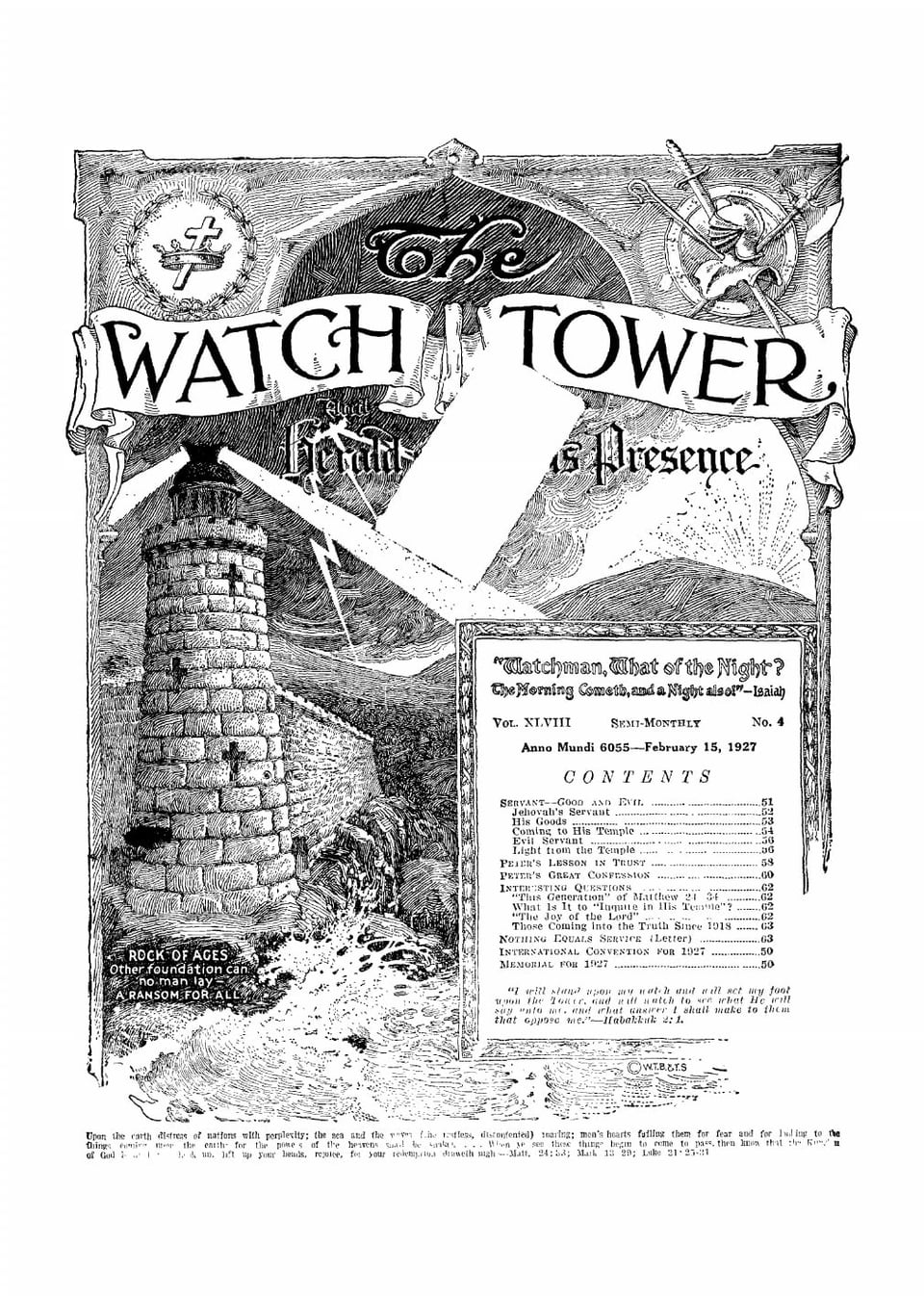
THE WATCH TOWER Herald of Presence
"Watchman, What of the Night? The Morning Cometh, and a Night also!"—Isaiah
VOL. XI.VIII SEMI-MONTHLY No. 4
Anno Mundi 6055—February 15, 1927
CONTENTS
SERVANT—GOOD AND EVIL .................................................. 51
Jehovah's Servant ............................................................. 52
His Goods ............................................................................. 53
Come into His Temple ........................................................ 54
Evil Servant ......................................................................... 55
Light from the Temple ....................................................... 56
PELEN'S LESSON IN TRUST .................................................... 58
PETER'S GREAT CONFESSION ............................................... 60
INTERNATIONAL QUESTIONS .................................................. 62
"This Generation" of Matthew 24:34 ................................. 62
What Is It to "Hunger in His Temple"? ............................. 62
"Those Coming in the Lord's Name" ................................. 62
These Coming in the Truth Since 1913 .............................. 63
NOTHING EQUALS SERVICE (Letter) ................................... 63
INTERNATIONAL CONVENTION FOR 1927 ............................. 50
MEMORIAL FOR 1927 .......................................................... 50
"Art thou asleep now, O ye watch, and wilt set my foot upon the Tower, and wilt watch to see what He will say unto me, and what answer I shall make to them that oppose me?"—Habakkuk 2:1.
Upon the earth distress of nations with perplexity; the sea and the waves thereof restless, disconsolate; mariners; men's hearts failing them for fear and for looking to the things coming upon the earth; for the powers of the heavens shall be shaken. ... Even so, when these things begin to come to pass, then know that the Kingdom of God is near. ... Look up, look up, look up your heads, rejoice, for your redemption draweth nigh.—Matt. 24:30; Mark 13:28; Luke 21:25-27 THIS JOURNAL AND ITS SACRED MISSION
THIS journal is published by the WATCH TOWER BIBLE AND TRACT SOCIETY for the purpose of aiding the people to understand the divine plan. It provides systematic Bible study in which all its readers may regularly engage. It gives announcement of the visits made to Bible classes by travelling speakers, announces conventions, and gives the reports thereof. The International Sunday School lessons are treated in harmony with the Scriptures.
It adheres strictly to the Bible as God's revealed Word of Truth. It stands firmly upon the great ransom sacrifice as the fundamental doctrine by which all doctrines are measured. It is free from parties, sects, and creeds of men. It does not assume a dogmatic attitude, but confidently invites a careful examination of its utterances in the light of the infallible Word of God. It does not indulge in controversies, and its columns are not open to personalities.
TO US THE SCRIPTURES CLEARLY TEACH
THAT JEHOVAH is the only true God, the Maker of heaven and earth, and is from everlasting to everlasting; that the Logos was the beginning of the creation; that the Logos became a man, and he is now the Lord Jesus Christ in glory, clothed with all power in heaven and earth.
THAT GOD created the earth for man, created perfect man for the earth and placed him upon it; that man willfully disobeyed God's law and was sentenced to death; that by reason of Adam's wrongful act all men are born sinners and without the right to life.
THAT JESUS was made a human being in order that he might become the Redeemer of man; that he gave his life a sacrifice for man and thereby produced the ransom price; that Jesus the divine arose from the dead, ascended into heaven, and presented the value of his human sacrifice as the redemptive price for man.
THAT for many centuries God, through Christ, has been selecting from amongst men the members of his church which constitutes the body of Christ; that the mission of the church is to follow in the footsteps of her Lord Christ Jesus, cross in his likeness, give testimony to the word and plan of Jehovah God, and ultimately be glorified with Christ Jesus in his heavenly kingdom; that Christ, Head and body, constitutes the "seed of Abraham" through which all the families of the earth shall be blessed.
THAT THE WORLD HAS ENDED; that the Lord Jesus has returned and is now present; that Jehovah has placed Christ Jesus upon his throne and now commands all nations and peoples to hear and obey him.
THAT THE HOPE of the peoples of earth is restoration to human perfection during the reign of Christ; that the reign of Christ will afford opportunity to every man to have a fair trial for life and those who obey will live on earth for ever in a state of happiness.
PUBLISHED BY
WATCH TOWER BIBLE & TRACT SOCIETY
117 ADAMS STREET . . . BROOKLYN, N.Y. U.S.A.
OFFICERS
J. F. RUTHERFORD President
W. E. VAN AMBURGH Secy & Treas.
YEARLY SUBSCRIPTION PRICE: UNITED STATES, 1.00; CANADA AND MISCELLANEOUS FOREIGN,1.50. Annual United States and Canadian Subscribers are entitled to remittances should be made by Express or Postal Money Orders; or by Bank Draft, Canadian, British South African and Australian remittances should be sent by express, and remittances from converted foreign territory may be made to the Brooklyn office, but by International Postal Money Orders only.
(Foreign translations of this journal appear in several languages.)
TERMS TO THE LORD'S POOR: All Bible Students who, by reason of old age, sickness, inability or adversity, are unable to pay for this journal, will be supplied free if they send a postal card each May stating their case and requesting such provision. We are not only willing to help, but desire to see such on our list continually and in touch with the Brethren studies.
Notice to Subscribers: We do not, as a rule, send a card of acknowledgment for a renewal or for a new subscription. A renewal blank (carrying notice of expiration) will be sent with the journal one month before the subscription expires. Change of address, when received, may be expected to appear on address label within one month.
Entered as Second Class Mail Matter at Brooklyn, N. Y. Postoffice. Act of March 3rd, 1879.
1927 INTERNATIONAL CONVENTION
The general convention of the International Bible Students Association for 1927 will be held July 18th to 26th, at Toronto, Canada. Announcement is made now to permit the friends throughout the earth to get ready. Brethren are expected from many countries.
Toronto is the capital of Ontario and has a population of more than five hundred thousand, with another hundred thousand in the vicinity. It is a railway center. It is only short distance from Niagara Falls. The city has provided beautiful fair grounds and all its buildings for the convention. One of the buildings has a seating capacity of ten thousand. The grounds are situated on the lake front, segregated from the busy travel, and in a very pleasant location. It is expected that the entire proceedings of the convention will be broadcast from our own station, remote control being installed at the convention auditorium.
This will be the only large convention during the year. All classes desiring to hold local conventions should notify the Society as early as possible so that pilgrims may be routed in that way if at all possible.
MEMORIAL FOR 1927
The memorial of our Lord's death will be celebrated in 1927 on Friday, April 15th, after 6 p.m. The method of calculation is as follows: The new moon nearest the spring equinox occurs in the morning of April 2nd, which marks the beginning of Nisan, at sundown on that day. Counting fourteen days thereafter the fourteenth of Nisan begins at sundown, about 6 p.m. on April 15th, which is Friday. Announcement is made at this time that the brethren may begin to make preparations.
BIBLES
The Bible because of its binding has always been associated with the ecclesiastics. Therefore the Bible has become a reproach in the eyes of many people. There seemed no good reason why the Bible should not be bound as other books are bound. It is the Word of God, and the people should be induced to love it. The Society has arranged to furnish Bibles in plain binding at moderate prices. Below we give a list:
P120
4 1/2 x 7 1/2, French Morocco
$4.00
P125
do with concordance
$4.35
P130
do Full Leather
$5.65
P135
do with concordance
$5.80
K50
4 1/2 x 6 1/2 French Morocco
$3.40
K55
do with concordance
$3.57
K70
do Full Leather
$4.85
K75
do with concordance
$5.20
For Patent Index add 50¢ to above prices The WATCH TOWER
AND HERALD OF CHRIST'S PRESENCE
Vol. XLVIII FEBRUARY 15, 1927 № 4
SERVANT—GOOD AND EVIL
"Who then is a faithful and wise servant, whom his lord hath made ruler over his household, to give them meat in due season? Blessed is that servant, whom his lord, when he cometh, shall find so doing."—Matthew 24: 45, 46.
THE greatest promise to man is, "In thy seed shall all the families of the earth be blessed." That promise involves the ransom sacrifice, because without "the seed" the ransom price would not function. "The seed" is God's Anointed One. God did not say that the promise involves "seeds"; he spoke only of one seed, to wit, The Christ. That seed is composed of Jesus Christ the Head, and the church making up the members of his body. These are all one in Christ.—Galatians 3: 28.
2 The Scriptures abundantly testify to the oneness of Christ. This oneness God began to foreshadow in the ceremonies provided for the Israelites. In the institution of men to serve in the priest's office Aaron and his sons were selected and brought before the Lord. The anointing oil was poured upon the head of Aaron, and not upon the heads of his sons. (Leviticus 8: 12) The sons were required to wear bonnets; signifying that they looked to their head, the high priest, for authority, and that they would be controlled by his mind and his will and not by their own.
3 The anointing oil, poured upon the high priest's head, ran down upon his beard and his garments, covering his body; thus saying in effect that all the under-priests received their authority through the head. (Psa. 133: 1-3) The antitype of this began with Jesus' baptism at the Jordan. There Jesus was anointed of the holy spirit. This anointing signified that he was commissioned as God's representative.
4 At Pentecost the disciples received the anointing of the holy spirit, which anointing came from Jehovah through the beloved Son, their Head. Since then all who have received an anointing from God have received it through Christ Jesus, the Head, and are counted as members of his body—not being considered as individuals. The anointing constitutes the authority to act, and all action must be taken in harmony with the Head. These facts show the oneness of Christ.
5 Jesus had been on earth for three and one-half years, and was about to take his departure. He had laid the foundation of the church and had selected his disciples from out of the world. For those who were faithful to him and for all those who should afterwards believe on his name and be faithful, he prayed that they might be made one.—John 17: 16-21.
6 When Jesus instituted the memorial of his death he invited his disciples to eat of the bread and partake of the wine, and explained that this symbolized the breaking of his body and the pouring out of his life, and that if they would share with him in his kingdom they must share with him in his suffering and death. Later the apostle defined the meaning of this memorial, and declared that the bread represents the common union of the body members with the Head and with each other, and that the drinking of the blood represents the sharing of the members with the Head in a sacrificial death—that all are of one bread and that all are of one body, and are therefore one.—1 Cor. 10: 16,17.
7 It is made plain in the Scriptures that all are called in one hope of their calling, and that all those who are begotten and anointed of the spirit are one body and one spirit. "There is one body, and one spirit, even as ye are called in one hope of your calling." (Ephesians 4: 4) Again, the apostle states that God "hath put all things under his feet, and gave him [Christ] to be the head over all things to the church, which is his body" (Ephesians 1: 22, 23), and "Ye are called in one body".—Colossians 3: 15.
8 The human body, with its various members each performing its proper function under the supervision of the head, is used to illustrate the body of Christ, and shows the oneness of the latter. The apostle, in connection with his statement of the function to be performed by each member of the body, says: "For by one spirit are we all baptized into one body, whether we be Jews or Gentiles, whether we be bond or free; and have been all made to drink into one spirit. For the body is not one member, but many." (1 Corinthians 12: 13, 14) This arrangement is made by Jehovah, and he sets the members in the body for his purposes. "But now hath God set the members every one of them in the body, as it hath pleased him.
. . . Now ye are the body of Christ, and members in particular."—1 Corinthians 12:18, 27.
9 So completely is the oneness of Christ recognized in the Scriptures that the Lord Jesus speaks of the weaknesses of the body members as though they were his own weaknesses. "O God, thou knowest my foolishness; and my sins are not hid from thee. Let not them that wait on thee, O Lord God of hosts, be ashamed for my sake; let not those that seek thee be confounded for my sake, O God of Israel. Because for thy sake I have borne reproach: shame hath covered my face. I am become a stranger unto my brethren, and an alien unto my mother's children."—Psalm 69:5-8.
10 When Jehovah anointed his beloved Son with his spirit he thereby commissioned him to do a specific work, and this work is set forth by the terms of the commission, to wit: "The spirit of the Lord God is upon me; because the Lord hath anointed me to preach good tidings unto the meek: he hath sent me to bind up the brokenhearted, to proclaim liberty to the captives, and the opening of the prison to them that are bound; to proclaim the acceptable year of the Lord, and the day of vengeance of our God; to comfort all that mourn."—Isaiah 61:1, 2.
11 The Lord Jesus applied the terms of this commission to himself. Each member of the body is commissioned to do his part of the work here designated, by reason of the fact that he is a member of the body of Christ. Everything must be done, however, under the supervision of the Head. (Luke 4:18, 19) Jesus directed his disciples to go forth and fulfil this commission by preaching the gospel of his kingdom. This they were to do both while he was with them and after he was taken away from them. (Matthew 10:7; Luke 9:6, 10) When Jesus had finished his earthly ministry he committed to his disciples, and those who thereafter should become his disciples, the interests of his kingdom, and commanded that they should go forth and preach the same.—Matthew 28:20.
12 When Jesus ascended on high he was commanded to sit down and remain inactive as against the Devil until God's due time to make the enemy his footstool. (Psalm 110:1; Hebrews 10:12, 13) When the due time came for him to act God sent him forth to perform his duty against Satan. Then it was that the body members on earth were permitted to have an understanding of the Devil's organization, as distinguished from the Lord's organization, and to appreciate the privilege of allying themselves with the Lord. When the Lord comes forth to judge and to make war these faithful body members are shown as following after him as his willing supporters. (Psalm 110:3; Revelation 19:11-14) These scriptures prove conclusively the oneness of Christ, and the harmonious action always of Jesus Christ the Head and his faithful members, as one body.
JEHOVAH'S SERVANT
13 A servant is one who is commissioned and empowered to work for or serve in behalf of his master. Jehovah God is Master over all. It is he who planned and is executing and carrying out his plan in regard to the redemption and deliverance of man. There is One whom Jehovah has commissioned to carry his plan into operation, and who is always acting in harmony with Jehovah's will. That One is his beloved Son Christ Jesus.
14 The "elect of God" means the chosen one or selected one to carry out God's purposes. The Christ therefore is his elect; it is the chosen seed of promise through whom the blessings of God shall come to the people. That elect or chosen one is thus composed of Christ Jesus the Head and those members of his body who shall prove faithful. This elect or chosen one, the composite body, is The Servant of the Most High God. Christ Jesus himself is called God's "righteous servant". (Isaiah 53:11) When the body members are added to him and become a part of him, they constitute therefore a part of The Servant.
15 Concerning this Servant, God through his prophet says: "Behold my servant, whom I uphold, mine elect, in whom my soul delighteth; I have put my spirit upon him; he shall bring forth judgment to the Gentiles." (Isaiah 42:1) Thus the Lord, through his prophet, identifies the one commissioned in Isaiah 61:1, 2, as his elect Servant. It is upon this elect Servant that the Lord God puts his spirit, and it is to this Servant that the Lord God commits the authority of judgment. "He shall not fail nor be discouraged, till he have set judgment in the earth: and the isles shall wait for his law."—Isaiah 42:4.
16 Having identified his Servant as his beloved elect, then Jehovah more specifically defines the duties of that Servant, to wit: "I the Lord have called thee in righteousness, and will hold thine hand, and will keep thee, and give thee for a covenant of the people, for a light of the Gentiles; to open the blind eyes, to bring out the prisoners from the prison, and them that sit in darkness out of the prison house."—Isaiah 42:6, 7.
17 It is this Servant then that must bear the light of truth to the nations of earth, and open the eyes of the blind that they may understand, and bring from the prison houses the prisoners who are there held by their prison keepers because of fear; and to liberate them who are held in darkness, that they might see the beauties and glories of God's plan. This prophecy undoubtedly applies to the Lord Jesus and to the members of his body. All the work that the body members do they must do in the name of the Head, Christ Jesus.
18 Then the Lord shows the absolute devotion of his Servant to the cause of righteousness. "Who is blind, but my servant? or deaf, as my messenger that I sent? who is blind as he that is perfect, and blind as the Lord's servant? Seeing many things, but thou observest not; opening the ears, but he heareth not. The Lord is well pleased for his righteousness' sake; he will magnify the law, and make it honourable."—Isaiah 42:19-21.
19 The faithful Servant of the Lord Jehovah has always been blind to every temptation or allurement that would tend to turn his mind away from God. He at all times has been faithful and true to his Father. He has turned a deaf ear to every word of enticement. For this reason Jehovah is pleased with his righteous Servant, and this righteous Servant magnifies Jehovah's law and makes it honorable. These scriptures further identify the Lord Jesus Christ and his body members as God's elect Servant. Then the prophet says to this Servant: 'You are commissioned as my witnesses to declare my name that I am Jehovah God.' (Isaiah 43:10, 12) This applies likewise to the Head of the faithful members of the body.
20 Again God's prophet, writing concerning his Servant, says: "Thus saith the Lord, the Redeemer of Israel, and his Holy One, to him whom man despiseth, to him whom the nation abhorreth, to a servant of rulers, Kings shall see and arise, princes also shall worship, because of the Lord that is faithful, and the Holy One of Israel, and he shall choose thee. Thus saith the Lord, In an acceptable time have I heard thee, and in a day of salvation have I helped thee: and I will preserve thee, and give thee for a covenant of the people, to establish the earth, to cause to inherit the desolate heritages; that thou mayest say to the prisoners, Go forth; to them that are in darkness, Shew yourselves. They shall feed in the ways, and their pastures shall be in all high places."—Isaiah 49:7-9.
21 This prophecy clearly applies to the Lord Jesus; and the Apostle Paul, after calling attention to the fact that each member of the body on earth is an ambassador of Christ, applies this same prophecy to the body members. (2 Corinthians 6:1, 2) Again Jehovah God, speaking to Jesus and for the members of his body, says: "Hear now, O Joshua the high priest, thou, and thy fellows that sit before thee: for they are men wondered at; for behold, I will bring forth my servant the BRANCH." (Zechariah 3:8) The Branch mentioned in this text is Christ, the beloved One of God, and is here designated as Jehovah's Servant.
22 Seeing then that The Servant of Jehovah is The Christ, and that The Christ is composed of Jesus and the faithful members of his body, we find it proper to apply the term "Servant" to Jesus Christ alone or to Jesus Christ and the members of his body collectively as one; and sometimes it is applied only to the members of the body of Christ yet on earth.
FEET OF HIM
23 The human body is used to picture the body of Christ. The feet of a body of necessity are the members nearest to the earth. God, through his prophet, and using this figure, makes it so clear that there is no doubt as to who constitutes his Servant. Speaking of the last members on earth who represent The Christ, he says: "How beautiful upon the mountains are the feet of him that bringeth good tidings, that publisheth peace; that bringeth good tidings of good, that publisheth salvation; that saith unto Zion, Thy God reigneth!"—Isaiah 52:7.
24 Here the prophet of God not only shows that the faithful members on earth are a part of the body of Christ, but shows that the interests of the kingdom are committed to them as God's watchmen. They watch for the kingdom interests, and use their best endeavors to safeguard those interests. This they do by harmoniously proclaiming the message of his kingdom, as it is written: "Thy watchmen shall lift up the voice; with the voice together shall they sing; for they shall see eye to eye, when the Lord shall bring again Zion."—Isaiah 52:8.
HIS GOODS
25 Almost all the parables or dark sayings proclaimed by the Lord Jesus related to the kingdom of heaven. His disciples had propounded to him a question concerning his second coming. They did not understand the import of it, of course; but no doubt the Lord overruled their question in order that he might use the occasion to teach important lessons. He then related that which is known as the parable of the talents. He represents himself as a man about to travel into a far country who, before he departs, calls his servants and delivers unto them his goods. (Matthew 25:14-19) The Christ collectively is The Servant of Jehovah God, and the body members are a part of that Servant; they are also the servants of Christ himself, who is their Head.
26 The goods mentioned in this parable undoubtedly represent kingdom interests. The Lord then shows that on his departure he gives to the various members talents according to their several ability. Ability here means the spirit of the Lord, the measure of one's consecration. A complete consecration to the Lord, a joyful submission to his holy will and a loyal devotion to him, represent man's ability. Such ability increases more and more, in proportion to one's being filled with the spirit of the Lord. Therefore we may properly say that ability represents the full devotion to the Lord and the spirit of the Lord that one possesses.
27 Talents and goods are both valuable things and therefore represent kingdom interests. Just before Jesus was crucified he said unto his disciples: "I appoint unto you a kingdom, as my Father hath appointed unto me." (Luke 22:29) The "talents" given to his servants in different proportion therefore represent kingdom interests committed unto them individually, in proportion as each one has devoted himself to the Lord. All of them collectively had possession of his "goods", which represent all of his kingdom interests.
28 After a long time, the lord of those servants cometh, and reckoneth with them." The parable shows that the time must come when the Lord would return to take account with his servants to whom he had committed the kingdom interests, represented by all his goods.
The parable then shows that when the Lord does come and take account with his servants he finds two classes. One of these classes he calls "good and faithful" and the other class he calls "wicked".
HIS COMING
29 The text first hereinabove cited, and under consideration in this article, relates to a "faithful and wise servant". The question is propounded: "Who then is a faithful and wise servant?" And then the statement is made: "Blessed is that servant, whom his Lord when he cometh, shall find so doing."
30 The proof is quite clear and convincing that the second presence of our Lord dates from 1874, and that from that time forward the Lord Jesus has been gathering together those who have made a covenant with the Lord God by sacrifice. (Psalm 50:5) Jesus declared that he would be present in the end of the age and conduct the harvest work, which would mean a gathering work. (Matthew 13:30) The fact that a great harvest work progressed from about 1874 forward is the best evidence of the Lord's presence at that time and since. From that time forward the Lord has been doing a preparatory work. During this preparatory work the great truths that had long been hid from God's people by reason of the action of the enemy were restored to his people.
31 Among other things, Jesus stated that one of the signs of his presence would be this: "For as the lightning cometh out of the east, and shineth even unto the west; so shall also the coming of the Son of man be." (Matthew 24:27) The word here translated lightning means bright shiner or sun. As the sun arises in the east and travels gradually toward the west, causing one's pathway to increase in brightness, even so has it been during the presence of the Lord. The light upon the pathway of the Christian has increased more and more as the perfect day has approached.—Proverbs 4:18.
32 The best proof of the time of the fulfilment of a prophecy or prophetic utterance is the physical facts showing its fulfilment. From 1874 forward the truth has been gradually unfolded, the light has increased, and the harvest work has progressed. It will be observed, however, that the question propounded in Matthew 24:45 does not relate merely to the evidence of the presence of the Lord. It will be found that the time, as related to that question, is the same as the time related to the fulfilment of the prophecy concerning the details.
COMING TO HIS TEMPLE
33 The Scriptures show that at the end of the day of God's preparation the Lord Jesus, as God's Messenger, suddenly comes to his temple. The context shows that he comes for the purpose of judgment, and that it will be a fiery time. (Malachi 3:1-3) The parable of the talents shows that the Lord comes to take account with his servants. The scriptures relative to the Lord coming to his temple show that he comes for the purpose of examination and judgment. Therefore the coming to his temple, and the fulfilment of the parable of the talents, must of necessity synchronize; and they do synchronize.
34 The presence of the Lord, referred to in the beginning of Matthew 24th chapter, is from the Greek word parousia. But the word used with reference to his coming when he finds his Servant faithful and wise is from an entirely different word, to wit, erchomai, and means to arrive. Proof has heretofore been submitted in THE WATCH TOWER which it is believed conclusively shows that the Lord came to his temple in 1918. That also synchronizes with the time when the Lord began the fulfilment of the parable of the talents.
35 The important question now under consideration is, Who is the faithful and wise servant here mentioned? The wise servant is that servant who uses the knowledge he has derived from the Lord according to God's will. One who takes a course of action in harmony with the divine rules is wise. One of the titles given to the Lord Jesus is The Faithful and True. The faithful servant is one who is diligent in using all the faculties with which he is endowed, and all of the opportunities he has, to safeguard and mind the interests of the kingdom of heaven committed unto him.
36 Let us now consider the words of the Lord Jesus, translating literally the Greek word "coming" where it appears. Jesus had already stated what would be the evidences of his presence, or parousia. Then to his disciples he said: "Watch therefore; for ye know not what hour your Lord doth come [arrive]." This arriving (erchomai), it seems, of necessity must relate to the time when the man who has been traveling in a far country returns to his servants and arrives at where they are. The Lord then gives an illustration of how the good man of the house, had he known just when the thief would come, would not have permitted his house to be broken into. The lesson being taught thereby is that the good man should have been watchful; even so now The Servant must be watchful. He then adds: "Therefore be ye also ready: for in such an hour as ye think not, the Son of man cometh [arrives]. Who then is a faithful and wise servant, whom his Lord hath made ruler over his household, to give them meat in due season? Blessed is that servant, whom his Lord, when he cometh [arrives], shall find so doing."—Matt. 24: 42, 46.
37 It does not seem reasonable to apply these verses to the time of the presence of the Lord in 1874. So far as the facts show there was no one at that time who was specially examined and found approved and made ruler over all of the Lord's goods. There was no one in 1874 feeding the household of faith meat in due season. It was after that time that the work of the harvest appeared, and particularly the work of restoration of the truths concerning the ransom, restitution and the second presence of the Lord.
Since the words of the Master show that he refers to the time when he arrives to take account with his Servant, the irresistible conclusion is that the scripture applies in 1918; that is, after the Lord came to his temple and began taking account with those to whom he had committed kingdom interests.
38 The scriptures heretofore cited prove beyond a question of a doubt that God's chosen Servant whom he approves and in whom he delights is The Christ; that The Christ consists of Jesus and the faithful members of his body; and that the Scriptures often speak of the body members as the Lord, because they are a part of the Lord. (Acts 9:4, 5) The inference must now be drawn that when the Lord comes to his temple he finds a faithful and wise Servant class.
39 The parable of the talents shows that when the Lord comes to his temple he does find a class to whom he has committed kingdom interests, made up of members who have acted wisely and who are faithful. "And so he that had received five talents, came and brought other five talents, saying, Lord, thou deliveredst unto me five talents: behold, I have gained beside them five talents more. His lord said unto him, Well done, thou good and faithful servant; thou hast been faithful over a few things, I will make thee ruler over many things: enter thou into the joy of thy lord."—Matt. 25:20, 21.
40 There were some who had five talents and some who had two, and each one had been faithful in proportion to his ability and opportunity; and to all such the Lord said: "You have been faithful, and I am going to make you ruler over many things." This corresponds exactly with what Jesus said in Matthew 24:46, 47: "Blessed is that servant, whom his lord, when he cometh, shall find so doing. Verily I say unto you, that he shall make him ruler over all his goods."
41 Surely those whom the Lord found faithful when he came to his temple were blessed. These had been faithful in looking after his goods; that is to say, his kingdom interests committed to them; and he expresses his pleasure in them and appoints unto them greater things. Since Jesus speaks of his body members as himself, and since the Scriptures definitely locate The Servant as The Christ, then the irresistible conclusion is that "the faithful and wise servant" mentioned by the Lord is a class, made up of those whom he finds faithful at the time he comes to his temple.
THE FACTS
42 One of the best evidences of the correct understanding of a scripture is the application of the facts to the scripture, and the finding that these facts exactly fit. In 1914 the Lord took unto himself his great power as King. There followed a fight in heaven—the Lord Jesus on one side, supported by his angels; and the Devil and his angels on the other side. The Devil was cast out. Then the Lord came suddenly to his temple. In harmony with the parable, he came to his temple to take account first with his servants. Judgment must begin at the house of God.—1 Peter 4:17.
43 There was much distress and perplexity on the earth at that time. The consecrated Christians were being persecuted by the Devil's organization, the war furnishing a pretext for this wicked persecution. Notwithstanding this, there were a few consecrated Christians throughout the earth who stood firm for the Lord and for his cause, and were putting forth their best efforts to declare the message of his kingdom. At the same time they were putting forth their best efforts to serve with meat in due season all those who believed in the Lord. His household consisted of all the spirit begotten ones, because they are the household of faith.
44 There was a wide distribution of some free literature in the latter part of 1917 and the beginning of 1918. This literature specifically declared the presence of the kingdom. It was put out by the Society. It brought much persecution upon the Lord's people. It caused a division. It seemed to be the Lord's will that this work should go on. The kingdom interests seemed to demand it. There was a wide circulation of Volume Seven of STUDIES IN THE SCRIPTURES, and this added to the persecution of those who were faithfully striving to serve the Lord and watch for his kingdom interests.
45 After the persecution of 1918 those who had stood firm for the Lord were more highly honored by him than ever, because given wider opportunities of service. It was as though he had said to them in audible phrase: "You have proved your faithfulness under adversity. You have not accomplished any profit to me, but because of your faithfulness I will make you ruler over many things. Enter now into the joy of your Lord."
46 Since that time those who have loved the Lord and have had his spirit have gone forward, joyfully proclaiming the message of his kingdom; and these have appreciated the fact that the joy of the Lord is their strength. To them God has given a clearer vision of his plan than they had before. In harmony with his prophecy there have come flashes of light from the temple, illuminating the minds of the faithful ones. This has encouraged them to greater activity and loving zeal for the Lord. With no boasting these can truly say that they are blessed of the Lord.
47 Jesus said that he would make them 'ruler over all his goods'. To rule, as stated here, means to be appointed as a convoy or guard or escort. It would mean then that those faithful ones are designated by the Lord to look after his kingdom interests on the earth. Now let each one answer the question for his own satisfaction: Who on earth are now earnestly and zealously looking after the kingdom interests by proclaiming the day of God's vengeance, holding up the standard for the people, testifying that Jehovah is God, and declaring that the kingdom of heaven is at hand?.
All who answer truly must admit that there is but one small body of Christian people on earth, and that these are working harmoniously together to this end, and that there is none other so doing. The same class of Christians collectively are feeding each other upon the Word of God, and are diligently endeavoring to feed the prisoners who are also of the household of faith.
48 There seems to be no ground, within the meaning of the Scriptures, for concluding that “the faithful and wise servant” refers to any individual person, but does have reference to the feet members of Christ on earth—those who are blind to everything except to the will of the Lord, and who are harmoniously lifting up their voices together in declaring his message of the kingdom.
EVIL SERVANT
49 All who were begotten and anointed of the holy spirit and thereby in Christ constituted a part of The Servant class. The parable of the talents shows that some of That Servant class, when the Lord came to his temple, were found to be unfaithful; and to such the Lord said: “Thou wicked and slothful servant, . . . Take therefore the talent from him, and give it unto him which hath ten talents. . . . And cast ye the unprofitable servant into outer darkness: there shall be weeping and gnashing of teeth.”—Matt. 25: 26, 28, 30.
50 Undoubtedly then the evil servant is made up of that part of the Servant class who were found unfaithful when the Lord came to his temple. “But and if that evil servant shall say in his heart, My lord delayeth his coming; and shall begin to smite his fellowservants, and to eat and drink with the drunken: the lord of that servant shall come in a day when he looketh not for him, and in an hour that he is not aware of, and shall cut him asunder, and appoint him his portion with the hypocrites: there shall be weeping and gnashing of teeth.”—Matthew 24: 48-51.
51 Call to mind now the facts, how that in the latter part of 1917, which was the beginning of 1918, there began to be a division amongst the Lord’s people who claimed to be consecrated and in present truth. Some said, in substance if not in terms, “There is no more work to be done”; and they refused to do any more. They were not content with this, but went about saying all manner of evil against their fellow servants and smiting them; that is to say, those who had been fellow servants with them, and who still remained faithful to the Lord, were the objects of the assaults of the others, who had taken a different course.
52 The “drunken” mentioned in the above text of necessity must be that class mentioned by the Apostle Paul as drunken on the false doctrines of this world. This evil servant class, many of them at least, began to sleep so far as the work was concerned; and a dark time was on the church. “For they that sleep, sleep in the night; and they that be drunken are drunken in the night.”—1 Thessalonians 5: 7.
53 The facts show that the controversy and trouble and smiting began in 1917, before the Lord came to his temple. The words of the Master are: “The lord of that servant shall come in a day when he looketh not for him, and in an hour that he is not aware of.” Those who turned away from present truth in 1917, and since, do not believe that the Lord has come to his temple; and they oppose those who have called attention to the fact of the Lord’s coming to his temple. The evil servant clearly does not refer to an individual human being, but does refer collectively to those who were found unfaithful when the Lord arrived at his temple.
54 What is here said is no reflection on anything that has heretofore been written. Some have claimed that the scripture, “The faithful and wise servant,” specifically applies to Brother Russell. He never made that claim himself. That Brother Russell was greatly used of the Lord no one can doubt who knew him. That the Lord used him more wonderfully than any one on earth since St. Paul’s day there can be no doubt. But that does not at all affect the explanation of this scripture. It is clearly manifest from the scriptures hereinbefore cited that the elect Servant of God is Christ, Jesus the Head and his body members; and that Christ Jesus speaks of these faithful members as a part of himself.
55 To say that “that faithful and wise servant” specifically applies to one individual and to none other would imply that a large proportion of the body members of Christ could not be classed either as faithful or wise. That would be doing violence to the scripture. It is only the wise and faithful that God has promised shall be preserved in this time of stress. “O love the Lord, all ye his saints: for the Lord preserveth the faithful.”—Psalm 31: 23.
56 In addition to this, the Lord has never promised to make one man the custodian of all of his interests on earth. All the kingdom interests are the Lord’s; and when the division came at the temple judgment he said to the faithful members on earth: “To you I will commit the duty to guard the interests of my kingdom, and to look after my household under my supervision.’ This is both consistent and reasonable. This should be a great encouragement to every one who can now examine himself and see that he is faithful to the Lord and is diligently trying to serve him.
57 The Lord is no respecter of persons. He judges us by our faithful devotion to him. All the members of the body of Christ now on earth are one, walking together as one, together harmoniously proclaiming the message of his kingdom, and collectively acting as his Servant and as his representative on earth as part of God’s great elect Servant. If any Christian becomes unfaithful he withdraws himself from this favored Servant class.
58 Furthermore, if the coming mentioned in the above text refers to the Lord's coming to his temple, and the text applies after he comes to his temple, it is manifest that this scripture could not be understood prior to 1918. The Lord does not interpret his Word in advance. He permits his people to fulfil or have part in the fulfilment of a scripture, and then later permits them to see what part they have had. No man is responsible for the interpretation of scripture. It is not of private interpretation. The words of the Lord in this text were prophetic; and when a prophecy is fulfilled or in course of fulfilment, it may be understood.
59 It is after the Lord comes to his temple that the faithful ones receive the robe of righteousness and the garments of salvation, and enter into the joy of the Lord. (Isaiah 61:10) Those who, upon examination of themselves, find the testimony that they have been faithful to the Lord, and that they are now faithfully trying to keep his commandments, have every reason to rejoice. They can see that the nominal church is completely cast off, and to that system no interests of the kingdom are committed. They can see that the evil servant class is not appointed to look after any of the kingdom interests. Seeing that the Lord has committed his work to those who are faithful and who love him, and has given promise to shield and protect and preserve such against the wiles of the enemy in this hour of stress, let all such rejoice and hope to the end that there shall be granted unto them an abundant entrance into his everlasting kingdom.
60 With these physical facts with which we are all familiar now in mind, let us read this scripture and answer the question: "Who then is a faithful and wise servant, whom his lord hath made ruler over his household, to give them meat in due season?" (Matthew 24:45) The answer to this is, Those found faithful when the Lord comes to his temple. The goods of the Lord are all his interests. The Lord has made this faithful and wise class ruler over all his goods, or kingdom interests, on earth. Continued faithfulness unto death is required of each one who remains in this wise and faithful Servant class.
61 Those who were once anointed and therefore in the Servant class, and who, since 1918, have refused to participate in announcing the kingdom, and who engage in smiting their fellow servants, and fellowship with the world, constitute the evil servant class. Therefore it now more clearly than ever appears to us that the obligation laid upon each one of the Servant class, from this time forward, is faithfulness in performing his or her part of the covenant with the Lord. To those who continue faithful he has promised to grant an abundant entrance into his everlasting kingdom.
QUESTIONS FOR BEREAN STUDY
What is the greatest promise made to man? What seed is referred to therein? How was the oneness of The Christ foretold unto Israel? When did the antitypical mounting begin, and what does it mean? ¶ 1-13.
What main fact was the memorial intended to emphasize?
How else is the oneness of The Christ illustrated in the New Testament? Explain Psalm 69:5-8. ¶ 6-9.
How does Isaiah 61:1,2 show the oneness of the Christ? How has this commission been carried out? ¶ 10-12.
Who is Jehovah's elect and righteous Servant? How does the prophet identify the one commissioned in Isaiah 61:1,2? How does he otherwise define that Servant's duties? ¶ 13-17.
Why is the servant said to be "blind" and "deaf"? How do we know that Isaiah 49:7-10 applies to the body members? Explain Zechariah 3:8. In what three ways is the term Servant used in the Scriptures? ¶ 18-22.
What two main facts are emphasized in Isaiah 52:7? ¶ 23, 24.
To what do the parables and dark sayings of our Lord generally refer? What is the setting of the parable of the talents? What are the "goods" and the "talents"? When the lord of the parable returns what two classes does he find? ¶ 25-28.
What question is propounded in the main text under consideration in this article? When did our Lord's second presence begin? What did he then do? How is he presently described in Matthew 24:27? Explain fully. ¶ 29-32.
When, how and why was the Lord to come to his temple? Explain the words parousia and erchomai, and show how they are used in Matthew 24. What would constitute a servant wise and faithful? Why does it seem unreasonable to apply erchomai to the beginning of the harvest? ¶ 33-37.
Summarize the Scriptural facts hitherto reviewed in this study, particularly the parable of the talents; and then explain the meaning of the Servant of Matthew 24:46, 47. ¶ 38-41.
How may we know when a scripture has been correctly applied? What was our Lord expected to do when he should come to his temple? What are the facts? ¶ 42-46.
How is the Servant a ruler over all the Lord's goods? What are the goods, and who are now entrusted therewith? ¶ 47, 48.
Who is the evil servant of Matthew 24:48-51? What similar fact does the parable of the talents show concerning this?
What are the physical facts in the case? ¶ 49-53.
How has Matthew 24:45-46 been applied heretofore by some? Did Brother Russell so apply the passage? What would such limited application imply respecting all other feet members of Christ? Summarize, now, the Scriptural proofs of the true application. ¶ 54-59.
What important lesson for the church is contained in this text which a too limited application might cause us to ignore? ¶ 60, 61.
THE MARVELOUS KINGDOM VOICE
"Oh, we're sending forth the message
And the many glad responses
Make each kindred heart rejoice!
For the broken-hearted listen
To the thrilling refrain:
The kingdom now is near at hand;
The King has come to reign!
"Yes, the tidings now are speeding
To the farthest ends of earth.
Full many a heart is gladdened,
While sighs give place to mirth,
As we herald wide the message,
Send it creeping through the air,
The kingdom now is here."
PETER'S LESSON IN TRUST
—APRIL 10—MATTHEW 14: 22-33—
"But straightway, Jesus spake unto them, saying, Be of good cheer; it is I; be not afraid."—Matthew 14: 27.
THE incident of Peter's cry to his Master as he was sinking in the lake, recorded in the passage set for today's study, occurred a long time after the call of the apostles. Jesus, after a very busy time of ministry in Capernaum, sought a little time of rest for himself and his disciples. Taking ship across the northern part of the little sea of Galilee he made for the eastern shore, which was not so densely populated as the western or Galilean side. But he left the neighborhood of Capernaum, with the people all excited because of the miracles he had been doing and because of the wondrous words which they had heard fall from his lips.
2 The people followed him, some in boats; but many walked and ran round the northern end of the lake; and instead of getting the rest he desired, Jesus found himself encompassed with thousands of people who craved to hear him and to see miracles wrought. He talked with them well on into the day, and then the disciples reminded him both of his own need for food, and also that of the people's. Then he wrought one of his greatest miracles. He fed a multitude of five thousand men besides women and children, with five little barley loaves and two fishes, which a boy had brought. It is evident that Jesus had not gone with the disciples to this other side of the lake to stay, or they themselves would have had some provision.
3 Now still further excited by the great miracle the people were ready to make Jesus king. But the Master bade his disciples dismiss the crowd, while he himself would go up into the mountain apart; the disciples were then to take boat and go across to the other side, where he would meet them later. It was one of the outstanding days of Jesus' ministry.
4 Some of our Lord's miracles were wrought in the quiet of a home, with few to witness and not many to hear. But this was a miracle witnessed by a whole countryside; and inasmuch as the people were ready to follow him as their leader in revolt against the Roman power, it became for Jesus that which might have been a test; for here was a ready road for glory of a certain kind. Jesus, always balanced because of his loyalty to his Father, put himself into the safest possible position; getting away from the people he went to his Father in prayer.
5 There were occasions in our Lord's life when he needed to adjust himself to the circumstances, accepting his Father's providences. When meeting with some disappointment among the Pharisees in the south he turned to his Father in acceptance, and said, 'I thank thee, O Father, Lord of heaven and earth, because thou hast hid these things from the wise and prudent, and hast revealed them unto babes'; and adding, as manifesting acceptance of his Father's will, "Even so, Father: for so it seemed good in thy sight." (Matthew 11: 25, 26) These words indicate that our Lord had been working along a certain course which his Father had now indicated he should no longer follow. These were occasions when Jesus must needs get close to his Father.
6 While Jesus retired to the mountain the disciples dealt with the people; then, as the Master had instructed them, they started to go across to the other side of the lake, expecting to reach there before the night closed upon them. But a storm arose, evidently one of the squalls to which the lake was subject. The east side of the lake, where Jesus then was, is mountainous; and under certain atmospheric conditions winds rush down the steep mountain side and churn the lake surface into fury. The disciples rowed hard against the storm; they toiled all night. But though the other shore was only a few miles away they could not make headway, and many times that night their lives must have seemed to them to be in peril.
7 Jesus on the mountaintop may have been sheltered from the wind; we do not know; but we do know that he saw the disciples in the stress of the storm. Early next morning, before the day broke but just at the break of dawn, the disciples saw an appearance on the water. In their alarm they thought that it was a phantom, and they were afraid. Accustomed as they were to the fact of supernatural forces when in company with their Lord, now they were afraid of this because he was not with them. But soon they heard the voice of the Lord, in his familiar tones speaking to them and saying, 'Be of good cheer; it is I; be not afraid.'
8 Peter, impulsive, but with a little hesitancy about its being the Lord, because he had made as if he would have passed by them (See Mark 6: 48.), cried, 'Lord, if it be thou, bid me come unto thee on the water.' Jesus said, 'Come.' Without hesitancy, and fearless of the storm, Peter leapt over the side of the boat and began to walk toward Jesus, who was also walking on the water but apparently not toward them. After walking a little space Peter suddenly realized what he was doing; and, looking at his feet instead of at Jesus, he began to sink. It is hard to suppose that Peter the fisherman was unable to swim, or that under ordinary circumstances he would have been fearful of putting his swimming powers to the test; but under the unusual conditions fear seized upon him, and he said, 'Lord, save me!'
9 Jesus put forth his hand and took hold of Peter, saying, 'O thou of little faith, wherefore didst thou doubt?' (Matthew 14: 27-31) The accounts read as if it was Peter's impulsive love which now took Jesus to the boat, as if he had been trying the disciples.
Together they walked to the boat, and as they climbed over the side the wind ceased. Then those who were in the boat worshiped Jesus, saying, "Of a truth thou art the Son of God." There was no further trouble; a little more rowing and they were on the farther shore. There is no need to think, as has been suggested, that a further miracle was wrought and that the boat was thereby carried to the shore.
10 This passage is given as Peter's lesson in faith. It was a great lesson, an object lesson, a concrete instance of immediate help, which in after life must often have stood him in good stead. But as a test of faith it could hardly have been the greatest that Peter was ever called upon to bear. The great tests of faith, whether in the days that were then past or later during the Gospel Age—whether such as that which came to Abraham when he was called upon to offer his son as a sacrifice, or those tests which came upon Jesus, or those which from time to time have been experienced in the lives of Christians—are those which arise out of the conditions of life and purpose, not out of sudden experiences such as Peter's impulse to go across the water to the Lord. They come in heavy pressure, not in sudden emotion.
11 What then is the value of this incident? Undoubtedly it must have had a great effect upon Peter's life, and in later days have been of great value to him; yet we may say that the incident was brought about and the miracle was wrought chiefly for the church of God; and surely unknown thousands of Christians have been helped by it. The readiness of the Lord to answer prayer has comforted and cheered and blessed many of his people who have called to him in distress; and though, as unthinkingly or as impulsively as Peter they may have cried to him, and even though the Lord has been in heaven, yet the response sometimes has been as quick as it was in Peter's case.
12 It is a gracious provision which God has made for his own that the prayer of his child carries quicker than light. Light travels at 186,000 miles per second, and the light of the sun takes eight minutes to reach the earth. How much further than the sun from the earth is the throne of God we do not know, but the prayer of his child reaches him, and his answer comes back so quickly as to eliminate time and space. For actual purposes the Christian is as if he were in the presence of God.
13 The graciousness of God in his dealings with his children is illustrated by Jesus' readiness to help Peter. Peter's faith failed him; but there was no further rebuke from the Lord, except his exclamation, "O thou of little faith, wherefore didst thou doubt?" It may be said that it was because of Peter's impulsive nature the incident happened. But how glad the Lord's people have been that it did happen; for the instance shows that when God's children make mistakes through their impulsiveness, yet God in his grace is ready not only to condone but to use the incident for the advancement of his kingdom!
14 The apostles little knew that the incidents of that day, the miracle of feeding the multitude, Jesus retiring for prayer, their long night of toil in rowing, his appearing to them just as morning was breaking, and the rest and refreshment they had in his presence, as well as Peter's venture, were all types or illustrations of things in the kingdom of heaven.
15 Jesus broke the bread of life when he was here upon earth; he went up into the mountain (heaven) to be with his Father. His disciples have been tossed about on the sea through the long Gospel Age, endeavoring as it were to row to the other side, where the Lord said he would meet them. Then when faith and strength were almost spent, ere the morning of the new day broke, Jesus appeared to them, calmed their fears by his presence, the storm ceased, and he lands with them on the other side of that long dark night of toil and waiting, at the time and place where he intended that he would meet them.
16 It is not possible for Christians to get the intended value and comfort out of these illustrations unless there is a correct understanding of the manner of Jesus' return. He has already returned, but not as expected by Christendom; it has tied itself so fast to its misconceived dogmas and interpretations as to prevent itself from walking in the light and perceiving the progress of truth. It holds that the resurrection of Jesus was a reunion of his spirit and his fleshly body, and therefore that he must be in human form for ever.
17 It follows, according to orthodoxy, that our Lord's return must be in such manner as to enable any human eye to see him. But all the scriptures show that this is not the case; that he is a spirit being; and that his presence on his return would be discernible only by those who perceived him through his truth, and in the fulfilment of those things which would to them manifest his presence.—John 14:19; 1 Peter 3:18.
18 The Lord's presence is now thus discerned, and those who thus see him realize that the beloved Master is once again with his disciples, comforting them, blessing them, and will be with them in this special manner till the time when they will be changed and made like him and see him as he is. Then the time will have come for the full ministry of his truth to go forth to the world, for its blessing and full deliverance.
QUESTIONS FOR BEREAN STUDY
When did the incidents mentioned in this lesson occur?
What miracle did Jesus perform at this time, and what effect did it have on the people? What did Jesus then do? 1-4.
Was Jesus ever disappointed? What does Matthew 11:25, 26 indicate? What happened during the night when the disciples were on the lake? Why were they afraid when the Master finally appeared? 5-7.
What did Peter say and do? Why did he begin to sink?
What lesson was in this for Peter and for the other disciples as well? Was this the greatest test of faith that came to them? What constitutes the maximum test of faith? ¶ 8-10.
What is the value of this incident to us now? Was it typical? What error of orthodoxy has blinded Christendom to the meaning of this picture? Explain the picture. ¶ 11-16. How do we now discern the presence of the Lord? ¶ 17, 18.
PETER'S GREAT CONFESSION
—APRIL 17—MATTHEW 16: 13-24—
"Thou art the Christ, the Son of the living God."—Matthew 16: 16.
THIS incident of Jesus' question concerning himself, and Peter's answer, has a very important place in Jesus' ministry. Its time was probably about six months before the end of his ministry. Jesus had proclaimed the message of the kingdom in all Galilee, even as earlier he had served in Jerusalem and Judea. His public work was now therefore well on toward completion. There was however still much for him to do; for there were many places which had not yet had the advantage of his witness and ministry. It was in reference to the last phase of his work, and the shortness of time remaining, that he said when sending out the seventy, "The harvest truly is great, but the labourers are few."—Luke 10: 2.
…