The Watchtower, March 1, 1945
Download: PDF — The Watchtower, March 1, 1945
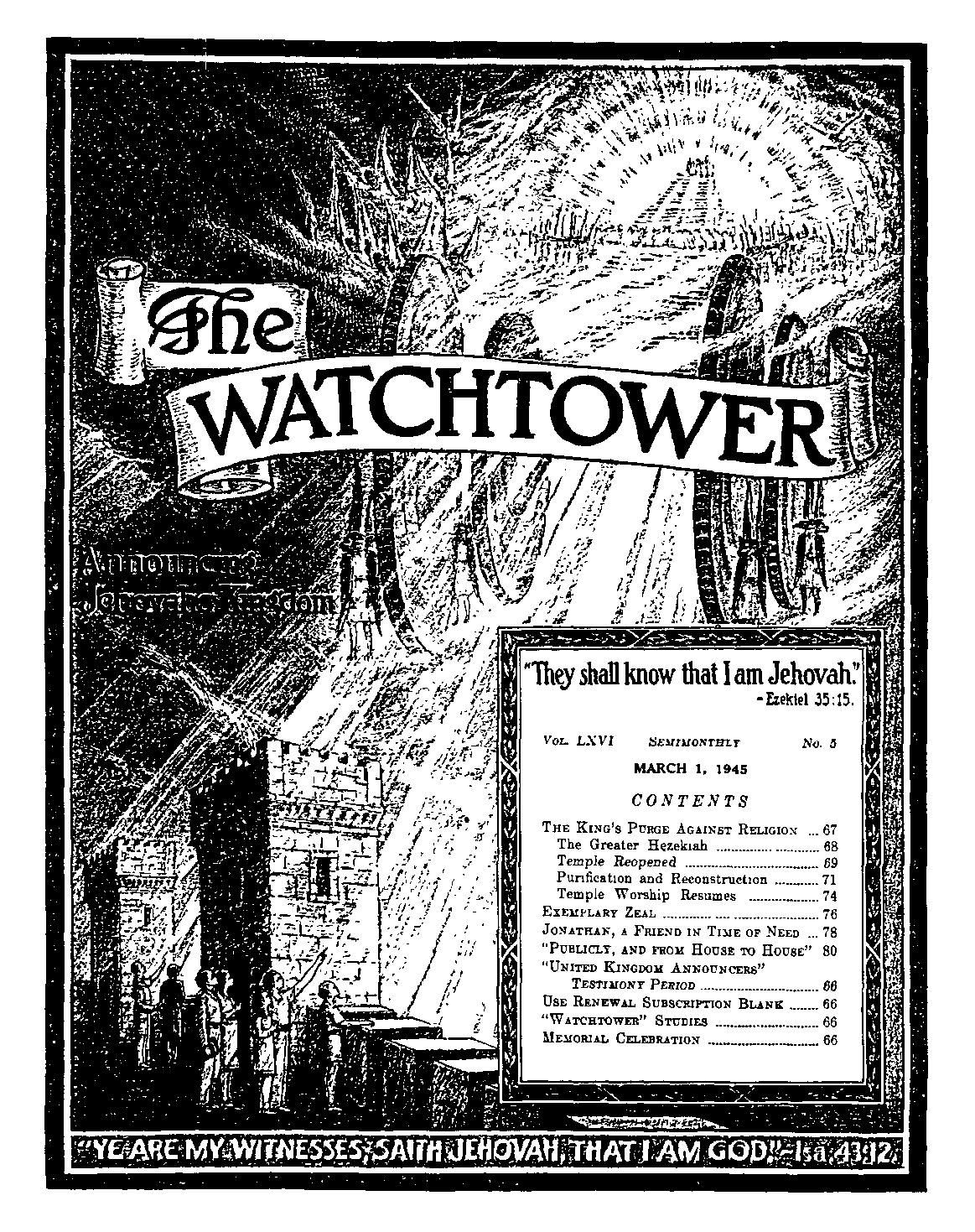
No. 5
MARCH 1, 1945
CONTENTS
The King’s Purge Against Religion ... 67
B
The Greater Hezekiah ..............
Temple Reopened .......................
Purification and Reconstruction Temple Worship Resumes ......
Exemplary Zeal ...........................
Vol. LX VI Semimonthly
■ /
They shall know mat I am Jehovah.'
-Ezekiel 35:15.
Jonathan, a Friend in Time of Need ... 78
“Publicly, and from House to House” 80 “United Kingdom Announcers”
Testimony Period
Use Renewal Subscription Blank
“Watchtower” Studies
Memorial Celebration
^EeWATCHTOWEK
Published Semimonthly By
WATCH TOWER BIBLE & TRACT SOCIETY 117 Adams Street - - Brooklyn 1, N.Y., U.S.A.
Officers
N. H. Knorr, President W. E. Van Amburgh, Secretary “And all thy children shall be taught of Jehovah; and great shall be the peace of thy children.” - Isaiah 54:13.
THE SCRIPTURES CLEARLY TEACH
THAT JEHOVAH is the only true God and is from everlasting to everlasting, the Maker of heaven and earth and the Giver of life to his creatures; that the Logos was the beginning of his creation, and his active agent in the creation of all other things, and is now the Lord Jesus Christ in glory, clothed with all power in heaven and earth, as the Chief Executive Officer of Jehovah;
THAT GOD created the earth for man, created perfect man for the earth and placed him upon it; that man willfully disobeyed God’s law and was sentenced to death; that by reason of Adam’s wrong act all men are born sinners and without the right to life;
THAT THE LOGOS was made human as the man Jesus and suffered death in order to produce the ransom or redemptive price for obedient ones of mankind; that God raised up Jesus divine and exalted him to heaven above every other creature and above every creature’s name and clothed him with all power and authority;
THAT GOD’S CAPITAL ORGANIZATION is a Theocracy called Zion, and that Christ Jesus is the Chief Officer thereof and Is the rightful King of the world; that the anointed and faithful followers of Christ Jesus are children of Zion, members of Jehovah’s organization, and are his witnesses whose duty and privilege it is to testify to the supremacy of Jehovah, declare his purposes toward mankind as expressed in the Bible, and to bear the fruits of the Kingdom before all who will hear;
THAT THE OLD WORLD ended in A. D. 1914, and the Lord Jesus Christ has been placed by Jehovah upon his throne of authority, has ousted Satan from heaven and is proceeding to the establishment of the “new earth” of the New World;
THAT THE RELIEF and blessings of the peoples of earth can come only by and through Jehovah’s kingdom under Christ, which has now begun; that the Lord’s next great act is the destruction of Satan’s organization and the complete establishment of righteousness in the earth, and that under the Kingdom the people of good-will that survive Armageddon shall carry out the divine mandate to "fill the earth” with a righteous race.
ITS MISSION
THIS journal is published for the purpose of enabling the people to know Jehovah'God and his purposes as expressed in the Bible. It publishes Bible instruction specifically designed to aid Jehovah’s witnesses and all people of good-wilL It arranges systematic Bible study for its readers and the Society supplies other literature to aid In such studies. It publishes suitable material for radio broadcasting and for other means of public instruction in the Scriptures.
It adheres strictly to the Bible as authority for its utterances. It is entirely free and separate from all religion, parties, sects or other worldly organizations. It is wholly and without reservation for the kingdom of Jehovah God under Christ his beloved King. It is not dogmatic, but invites careful and critical examination of its contents in the light of the Scriptures. It does not indulge in controversy, and its columns are not open to personalities.
Yeablt SuBscaimoK Pbicb
Unttbo Statzs. 31.00; all other countries. 11.60. American currency; Great Britain. Avstbalabia, and South Africa. Os American remittances should be made by Poatal or Express Money Order or by Bank Draft. British. South African and Australasian remittances should be made direct to the respective branch offices. Remittances from countries other than those mentioned may be made to the Brooklyn office, but by International Postal Money Order only.
Fobbion Orness
British 34 Craven Terrace, London, W. 2. England
Australasian __________- 7 Beresford Road. Strathfield. N. S. W„ Australia
South African Boston House Cape Town. South Africa
Indian 167 Love Lane, Bombay 27. India
Please address the Society in every case.
Translations of this journal appear In several languages.
ALL SINCERE STUDENTS OF THE BIBLE who by reason of Infirmity, poverty or adversity ere unable to pay the subscription price may have The Watchtower free upon written application to the publmneis. made once each year, stating the reason for so requesting it M e are ^lad to thus aid the needy, but the written application once each year 1 required by the postal regulations.
Notice to Subscribers: Acknowledgment of a new or a renewal subscription will be sent only when requested Change of address, when requested, may be expected to appear on address label within one month. A renewal blank (carrying notice of expiration) will be sent with the journal one month before the subscription expires.
Printed In the United States of America Entered as second-class matter at the post office at Brooklyn, N. Y., under the Act of Ma>ch s, 1819.
“UNITED KINGDOM ANNOUNCERS” TESTIMONY PERIOD
The four-month-long Watchtower campaign ends with this “United Kingdom Announceis” Testimony Period during the entire month of April. It should crown with triumph the objectives of the campaign. By the maintenance of united activity of all Kingdom announcers, under Jehovah’s blessing, it will do so. Keep to the fore always, therefore, the campaign offer, to wit, a year’s subscription for The Watchtower together with the free book “The Kingdom Is at Hand” and the free booklet One World, One Government, at the special rate of $1.00. We want our regular Watchtower readers to know that a share in this campaign is open to them, and if they will write in to ns expressing their desire we shall take pleasure in putting them in touch with an organized company with whom to co-operate. Each one should also make out his report of activities, that such may be included in the compilation of the general results throughout the land for this blessed campaign.
USE RENEWAL SUBSCRIPTION BLANK
The blank sent you one month before expiration of your Watchtower subscription should be filled out and returned to the Brooklyn office or to the Branch office in the country where you reside. Servants in the companies, and individuals, when sending in renewals for The Watchtower, should always use these blanks. By filling in these renewal blanks you are assured of the continuation of your Watchtower from the time of expiration, and without delay. It will also be a great help if you sign your name uniformly, and note any recent change of address, on the renewal slip.
“WATCHTOWER” STUDIES
Week of April 1: “The King’s Purge Against Religion,” fl 1-19 inclusive, The Watchtower March 1, 1945.
Week of April 8: “The King’s Purge Against Religion,” fl 20-41 inclusive. The Watchtower March 1, 1945.
MEMORIAL CELEBRATION
The time to celebrate the Memorial this year is after 6 p.m., Standard Time, on Wednesday, March 28. At an agreed hour, let each company assemble on that night, and the anointed ones thereof partake of the emblems, their companions the “other sheep” being present as observers. Before the Memorial emblems are partaken of, let a competent brother deliver a brief discourse extemporaneously ar read paragraphs selected from past Watchtower articles on the Memorial to those assembled. Since the breaking of bread and drinking of wine both symbolize the death in which Christ’s body-members share, both the bread and the wine should be served together at partaking, the bread being unleavened and the wine red. Most certainly Jesus and his disciples used red wine to correspond with his blood poured out in death, and we should harmonize with them. Let all companies or groups report their celebration, showing both the total attendance and partakers.
ANNOUNCING JEHOVAH’S KINGDOM
Vol. LXVI
March 1, 1945
No. 5
THE KING’S PURGE AGAINST RELIGION
“And if any one thinketh that he worshippeth God {ministers to God], and doth not restrain his tongue, but Jus heart deceiveth him; his worship [ministry] is vain. For the worship [ministry] that is pure and holy before God the Father, is this: to visit the fatherless and the widows in their affliction, and that one keep himself unspotted from the world."—Jas. 1:26, 27, Murdock; Lamsa; Luther.
iCTEHOVAH has strengthened” is the meaning I of the name “Hezekiah” or “Hizkijahu”. The
J one king who bore that name was a wholehearted worshiper of the true and living God, whose name is “Jehovah”. The only true God is against all religion; and the king's name, Hezekiah, proved to be prophetic of him in his kingly deeds, for Jehovah strengthened Hezekiah to clear out religion from the kingdom of Judah. Tn all the kingdom there was not a more courageous and aggressive foe against religion, which religion is the curse of any kingdom or government. Let all religionists object now to this declaration, just as their forefathers did twenty-six centuries ago; but the facts of the reign of Hezekiah, king of Judah, prove the truth of this. The facts also show the benefit to a people and nation of getting rid of the accursed thing, religion.
2 There is no king on earth today, not even in so-called "Christendom”, that has the fearlessness and conviction of heart to take the course that Hezekiah did. As a result all of “Christendom” and her many peoples continue eating the bitter fruits of the practice of religion. Their kings fight against Jehovah God and hence do not have His backing. But there is one king in the universe whom Jehovah has strengthened to defy rulers and peoples and to take righteous action against religion. That king of Jehovah was in fact prefigured by King Hezekiah. This means that Hezekiah’s antireligious action foreshadowed like action by Jehovah’s mighty King in these days. Who are the people that today enjoy the benefits of such a purge? The investigation reveals there is one such people. They are a lone people, comparatively few in number. Ask the religionists who they are; for this outstanding people draw the fire of all the religionists and their religious gods. A clue
1 How did Hezekiah’s name prove to be prophetic of his kingly deeds? 2. (a) tVhat king in “Christendom” or elsewhere has the courageous conMCtion to take the action like Hezekiah's? (b) What people today enjoy the benefit of bis purge against religion, and bow may we determine their identity?
to guide truth-seekers to the correct answer is found in this: That the ancient king whose name means “Jehovah has strengthened” became, by his uncompromising course of action, the foremost witness of Jehovah of those critical days.
3 When Hezekiah came to the throne of the little kingdom of Judah, midway between Egypt and Assyria, religion was in dominance in all the earth, as fully so as in A.D. 1914. Religion was confined not just to Egypt and Assyria, but on Judah’s northern border was the neighbor kingdom of Israel, composed of brother tribes to Judah, and it had gone over to religion, which is demonism. Consequently that apostate kingdom was near to ruin and Hezekiah was soon due to see it destroyed by Assyria. On the west border of Judah was the nation of the Philistines, never anything but religionists, worshipers of demon gods. Yet there was religious pressure still closer to home than all such demon-worshiping neighbors, for even the throne of the kingdom of Judah had gone over to indulging in religion. Yes, Hezekiah’s own father had forsaken the worship of Jehovah God and had corrupted the entire kingdom by enforcing religion upon it, religion of the basest kind. The effects of this were ruinous to the nation, as the candid facts of Bible history show.
4 The little independent kingdom of Judah lost the strength which conies from the true worship of the Most High God. It became the ball to be batted around by the religious foes, north, west, and south. There was nothing that could save it from being swallowed up whole by the great contending worldpowers except one thing, and that was, the clean abandonment of religion and the return to the pure worship of the Lord God. The choice lay between religion with destruction and Jehovah’s worship with national salvation. This fact is of the highest
3. At Hezekiah’s coming to the throne, to what extent was religion in dominance in all the earth9
4. What was the only thing to eave the kingdom of Judah9 and why must individuals today consider this Important fact and act wisely9 importance to notice. The nations of ‘'Christendom” are unchangeably committed to their ways, and are too far gone to take this truthful fact to heart and amend their course. Their destruction at Armageddon is clearly in sight. It is left for individuals among such doomed religionized nations to take heed to this fact and to take personal action, with the wisdom of King Hezekiah. Then they will receive personal benefit, regardless of what befalls the nations. Hence each individual, feeling responsibility personally for his own destiny, will consider the written record of Hezekiah’s decisive course, mindful of this divine statement concerning Hezekiah’s nation: “Now all these things happened unto them for ensamples: and they are written for our admonition, upon whom the ends of the world are come.” —1 Cor. 10:11, 6.
5 The inspired record of Chronicles was, for convenience, divided into two parts, namely, First Chronicles and Second Chronicles, and was written in completeness after the independent Theocratic kingdom of the Israelites had been overthrown. Being written from the standpoint of what the influence and value of Jehovah's worship was respecting the nation, the Chronicles account surveys and gives us the proved facts concerning the disastrous effects of religion upon a most highly favored nation. Hence the record about Hezekiah’s acts in behalf of Jehovah’s worship and his acts against demonism or religion is found in greatest detail in 2 Chronicles, chapters 29-32. A corresponding record is found at 2 Kings, chapters 1S-20, but with less detail and less emphasis on Hezekiah's reconstructive work toward Jehovah’s worship. In the days of this faithful king the outstanding prophets of Jehovah were Hosea, Isaiah and Micah, and doubtless these three had a great bearing upon the course chosen by the king. The reign of Hezekiah, king of Judah, is therefore a marked period deserving of our earnest study, because it cast shadows that are prophetic of history that is made in our times.
6 “Hezekiah began to reign when he was five and twenty years old, and he reigned nine and twenty years in Jerusalem. And his mother's name was Abijah, the daughter of Zechariah. And he did that which was right in the sight of the Lord, according to all that David his father had done.” So reads 2 Chronicles 29: 1, 2. Hezekiah was a descendant of King David, the first king out of the tribe of Judah; and David, when reigning at Jerusalem, was said to be ‘sitting upon the throne of Jehovah’. His son Solomon “sat on the throne of Jehovah as king instead of David his father, and prospered; and all Israel obeyed him”. (1 Chron. 29: 23, Am. Stan. Ver.)
5 From what standpoint were the Chronicles written? and why is Hezekiah's reign a marked period deserring ot our study?
G. In what special capacity did Hezeklnb reign, and why?
Thus Hezekiah, a successor also of Solomon, sat upon the throne of Jehovah as the visible representative on earth of the Most High God. He reigned by the grace of God, a thing which the religious kings of “Christendom” claim to do, but without Scriptural foundation. Hezekiah was anointed king by God’s high priest in Israel. He reigned at the city where Jehovah had chosen to put his name by having his temple located there.
T To Hezekiah on his throne this commandment of Jehovah applied: “And it shall be, when [the king] sitteth upon the throne of his kingdom, that he shall write him a copy of this law in a book out of that which is before the priests the Levites: and it shall be with him, and he shall read therein all the days of his life: that he may learn to fear the Lord [Jehovah] his God, to keep all the words of this law and these statutes, to do them: that his heart be not lifted up above his brethren, and that he turn not aside from the commandment, to the right hand, or to the left: to the end that he may prolong his dayin his kingdom, he, and his children, in the midst of Israel.” (Deut. 17:18-20) Such law of commandments which the king must study and by which he must himself be governed was the law of God’s covenant made with Israel through the prophet Moses. For all these reasons Hezekiah’s kingdom was a typical Theocracy; that is, it was a visible government subject to Jehovah God as the real King, and in such government the visible king on the throne at Jerusalem must execute the law of The Theocrat, Jehovah.
THE GREATER HEZEKIAH
’ In such relationship to the great Theocratic Ruler, Jehovah, King Hezekiah pictured or prefigured Jehovah’s anointed King, namely, Christ Jesus. Hezekiah's kingdom was typical, and years after his death it passed away. Christ Jesus’ kingdom is the real Theocratic Government, and its duration is aS eternal and imperishable as is its King, who is immortal, having the “power of an endless life”. “Of the increase of his government and peace there shall be no end.” (Isa. 9: 6, 7) Hence Hezekiah’s coming to the throne of the typical kingdom in 745 B.C. pictured Christ Jesus’ being installed in the throne of the heavenly Theocratic Government by Jehovah A.D. 1914. (See the proof of this date in the book "The Kingdom Is at nand".) As at Hezekiah’s coming to power the religious rule of his predecessor Ahaz ended, so in 1914 the lease of power of the Gentile nations to rule the earth, particularly through religious “Christendom”, ran out. Those “times of the Gentiles” Jehovah had permitted for 2,520 years, during the last fifteen centuries of which the nations of “Christendom” had pretended to rule by the grace of God. With the ending of such Gentile times in 1914, the time came for Jehovah to put his real Theocratic Government in action by Christ Jesus. Jehovah’s time came for him, by His kingdom, to clear his name against the nations which had blasphemously laid claim to his name and which had grossly misrepresented him toward their subjects.
’ Since Hezekiah foreshadowed Christ Jesus as King, then the acts of Hezekiah during his reign would set a pattern of what Christians might expect Christ Jesus to do when he is enthroned and receives authority and the command to rule in the midst of his enemies. (Ps. 110: 1, 2; Rev. 12: 10) It is marvelous to see the agreement and correspondency of the facts since 1914 with what facts are recorded concerning King Hezekiah. This stands as further convincing proof that "the kingdom of God is nigh at hand” and that his King Christ Jesus reigns in the Theocratic Government. Therefore we cannot afford to close our eyes to such corresponding facts, for they vindicate Jehovah’s infallible Word and his Kingdom purpose.
10 Hezekiah’s course was a sudden, swift about-face from that of his father and predecessor Ahaz. It was a course in harmony with that of the ‘man after God’s own heart’, King David; and hence Hezekiah is spoken of rather as the son of David than as of King Ahaz. The account concerning Hezekiah, as briefly given at 2 Kings IS: 3-6, says: “And he did that which was right in the eyes of Jehovah, according to all that David his father had done. He removed the high places, and brake the pillars, and cut down the Asherah: and he brake in pieces the brazen serpent that Moses had made; for unto those days the children of Israel did burn incense to it; and he called it Nehushtan [not Nahash, meaning ‘serpent’, but Nehushtan, meaning ‘a piece of brass’]. He trusted in Jehovah, the God of Israel: so that after him was none like him among all the kings of Judah, nor among them that were before him. For he clave to Jehovah; he departed not from following him, but kept his commandments, winch Jehovah commanded Moses.”—Am. Stan. Ver.
"'Hezekiah’s speedy action against those enticements of religion and his enforcement of the commandments of Jehovah God remind us of Christ Jesus. As soon as he was brought forth in 1914 as the Theocratic King to act for Jehovah, he at once moved against the organization of religion. He promptly began the “war in heaven” against the hosts of religion up there, namely, Satan the Devil and all his demon angels. These he cast clear out of the heavenly heights and down to the vicinity of this earth. (Rev. 12:1-12) Therefore it is here at the earth that religion and everybody and everything connected with it must yet be dealt with finally by Jehovah’s King Christ Jesus. Those Christian saints who have been raised from the dead to a heavenly union with Christ Jesus since the establishment of Jehovah’s kingdom do not have to contend with religion and its forces up there, as the holy angels were obliged to do since Satan rebelled at the garden of Eden. (Job 1: 6-12; 2:1-7) But the consecrated followers of Christ Jesus yet alive on this earth as Jehovah’s witnesses, these do have to contend with religion’s hosts. But Christ Jesus, their reigning King, is with them and their companions, and leads them in the conflict between God’s truth and worship and the opposers thereof, error and religion.
TEMPLE REOPENED
” Today “Christendom” is faced with the necessity of a postwar global arrangement. Her nations are paying great deference to religion and its leading representatives, particularly those representing the religious-totalitarian Vatican City. After the Dumbarton Oaks Conference of 1944, near Washington, D.C., which drew up a suggestion for world organization, the United States Department of State invited the Roman Catholic Hierarchy in America and other religionists to comment upon the suggested plan. A convocation of Roman Catholic archbishops and bishops meeting at the nation’s capital have done so and published their comment and recommendations. We ask. Was this according to the pleasure of the Greater Hezekiah, Christ Jesus the King? For an answer, it is only necessary to note that when Hezekiah ascended the throne of Judah he threw out religion. He knew religion for what it was. Grieved at the reproach it had brought upon Jehovah’s name and the deadly damage it had done to His typical Theocratic organization in Israel, Hezekiah took steps to purge it out from among God’s covenant people. In the very first year of his reign he did that which distinguished his reign and which showed his likeness to Christ Jesus, regarding whom it was prophesied: “The zeal of thine house hath eaten me up,”—Ps. 69: 9.
" Relative to Hezekiah the Bible says: “He in the first year of his reign, in the first month, opened the doors of the house of the Lord [Jehovah], and repaired them.” (2 Chron. 29:3) This is not saying
12 . How does “Christendom" In planning for the postwar world differ from Hezekiah In his course?
13 When during his reign did Hezekiah open the doors of the Lord's bouse? that Hezekiah was made king in the first month of the year. As ordained by Jehovah God through Moses, the year of God’s covenant-people began with the month Nisan, which, roughly, corresponds with our month of April. (Ex. 12: 1,2; Deut. 16:1) The first occurrence of the month of Nisan after Hezekiah’s becoming king was when he began to do this notable thing. In fact, a comparison of the time given in Chronicles with that in 2 Kings, chapters 16-18, indicates that King Hezekiah reigned two years jointly with his father King Ahaz. (See the chart on page 174 of "The Kingdom Is at Hand”.) Whether this two-year regency of Hezekiah was because King Ahaz was set aside by the interference of the king of Assyria, the Bible does not say. However that be, the fact is clear that there was a period of time between Hezekiah’s becoming king and his coming to the temple work in the early spring-month of Nisan. Also, his entire reign being twenty-nine years long, it was early in his reign, suddenly, with a priority ahead of the economic or military affairs of the nation, that he came to Jehovah’s temple at Jerusalem.
14 This significant action of Hezekiah’s reign foreshadowed an event that was also later foretold by the prophet Malachi, saying: “Ye have wearied Jehovah with your words. Yet ye say, Wherein have we wearied him? In that ye say, Every one that doeth evil is good in the sight of Jehovah, and he delight-eth in them; or where is the God of justice? Behold, I send my messenger, and he shall prepare the way before me: and the Lord, whom ye seek, will suddenly come to his temple; and the messenger of the covenant, whom ye desire, behold, he cometh, saith Jehovah of hosts. But who can abide the day of his coming? and who shall stand when he appeareth? for he is like a refiner's fire, and like fullers’ soap: and he will sit as a refiner and purifier.” (Mal. 2: 17; 3: 1-3, Am. Stan. Ver.) Nineteen hundred years ago when Christ Jesus came to the temple after his tumultuous ride into Jerusalem and cast out the money-changers and business racketeers from the temple, that was only a miniature fulfillment of Malachi’s prophecy. Christ Jesus was not then reigning as King, as Hezekiah was when Hezekiah came to the temple and took the situation in hand there. Hence the complete and final fulfillment must be after Christ Jesus becomes acting King for Jehovah A.D. 1914. At Jesus’ first coming, his entry into the temple and clearing out the undesirables was three and a half years after his baptism and his anointing with the spirit of God. Correspondingly, his coming to the work of the great spiritual temple of God was that much time after his being given authority to rule as King in the heavenly Zion, namely, three and a half years from the fall of 1914, or in 1918. Just as King Hezekiah began his temple activities in the spring of the year, in the first month of God’s appointed year, so was the coming of the Greater Hezekiah, Christ Jesus, to the spiritual temple of God in the spring of 1918. The facts bear this out.
15 But why was there need for Hezekiah to open the doors of the house of Jehovah God and to repair them? It was because of the damaging effects and intolerant aggressions of religion against the true worship, the prescribed service of the living God. Jehovah. When Hezekiah became king, there was need of a great reconstruction work throughout all the realm of the kingdom, owing to the inroads and desolations that religion had made in the land. The Theocratic law which should have governed and controlled the action of the preceding king, Ahaz, was disobeyed and Ahaz turned from Jehovah’s worship and law and commandments and sold himself to religion. He yielded himself to the wicked demons under Satan in order to break up Jehovah’s Theocratic organization from within and to put down His worship therein. Hence Ahaz shut the doors of the temple at Jerusalem. Listen to the record of the religious zeal of King Ahaz:
14 “For he walked in the ways of the kings of [apostate] Israel, and made also molten images for Baalim. Moreover he burnt incense in the valley of the son of Hinnom, and burnt his children in the fire, after the abominations of the heathen whom the Lord [Jehovah] had cast out before the children of Israel. He sacrificed also and burnt incense in the high places, and on the hills, and under every green tree.” When the enemies of the kingdom of Judah tried to crash in this independent nation, the rival kingdom of Israel from the north, and Syria from the northeast, the Philistines from the west, and the Edomites from the southeast, then King Ahaz showed the effect of religion upon him. He displayed worldliness; he indulged in spiritual adultery on a national scale by seeking to buy help from the political world-power, Assyria. He sought such mercenary worldly help at the expense of Jehovah’s temple; but it only put his country in a position like that of the recent puppet states of Nazi Germany’s dictator. He was hurt more than helped. —2 Chron. 28: 1-21.
" The record of religion’s ruinous effects upon a nation says concerning Ahaz: “And in the time of his distress did he trespass yet more against the 15 Why was there need for Hezekiah to open the temple doors and repair them ?
16. What does 2 Chronicles say concerning King Ahaz’ religions zeal’ and to what coarse did it lead him during the national emergency’ 17. What does 2 Chronicles say regarding the effect of Ahaz' religious practices’ and hem^ what did Hezekiah see the need of on ascending the throne?
Lord [Jehovah]: this is that king Ahaz. For he sacrificed unto the gods of Damascus, which smote him: and he said, Because the gods of the kings of Syria help them, therefore will I sacrifice to them, that they may help me. But they were the ruin of him, and of all Israel. And Ahaz gathered together the vessels of the house of God, and cut in pieces the vessels of the house of God, and shut UP THE DOORS OF THE HOUSE OF THE LORD [Jehovah], and he made him altars in every corner of Jerusalem. And in every several city of Judah he made high places to burn incense unto other gods, and provoked to anger the Lord God of his fathers.” (2 Chron. 28:22-25) That was the state of the nation when Ahaz quit. And that was what Hezekiah had to face on ascending the throne of the typical Theocracy. He at once saw the need of a nation-wide reconstructive work. It must be done in regard to the things which religion or devilism had torn down among Jehovah God’s covenant people.
18 The young king, doubtless tutored to some extent by the prophets Hosea, Isaiah and Micah, saw that the basis of all true reconstruction work of an enduring kind for the people is the restoration and cultivation of the worship of Jehovah God. Hezekiah was well familiar with the psalmist’s faithful saying, if he was not himself the composer of the saying: “Blessed is the nation whose God is Jehovah, the people whom he hath chosen for his own inheritance. There is no king saved by the multitude of a host: . . . Our soul hath waited for Jehovah: he is our help and our shield.*’ (Ps. 33:12,16,20, Am. Stan. Ver.) Hezekiah appreciated that ‘putting the kingdom’s interests first’ meant the faithful carrying on of the worship of Jehovah by keeping covenant with Him.
19 Considering now the modern counterpart of this: When Christ Jesus the King came to the temple in 1918, he saw the immediate need of a great reconstruction work. He saw it must be done before the battle of Armageddon if any flesh on earth, primarily his devoted followers, were to be saved. All about them religion was dominant. A pretense of worship of the true God was then being practiced on religion’s “high places”. Such high places were contrary to the commandments of God and competed with God’s true temple of worship and divided up the people into local groups of worship in a mixed-up sectarian- manner. The so-called “Christian nations” making up “Christendom” were engaged in a devastating conflict, World War I, and the clergy of all denominations were blessing and praying for the contending sides. Religious parishioners and congregations were offering up their loved sons to the “god of this world” and were immolating them upon the fires of the god Mars as well as teaching the fiery doctrines of “purgatory” and a red-hot hell. Every religionist had his own idea of God and thought and worshiped accordingly. Spiritual fornication or illicit relationship with this world was everywhere practiced. The clergy of all denominations were flirting with a proposed League of Nations for the common security of the different styles of political governments of this world. All the nations and religious organizations were against Jehovah God and his kingdom and worship, much the same as they are against these in this year of 1945.
20 Back in 1918 the nations scattered and restrained those who, like the priests and Levites belonging to the temple at Jerusalem, were trying to lead in the carrying on of Jehovah’s worship. The ruling powers of “Christendom” shut up the doors of His visible organization in the endeavor to shut down and close out the heavenly Father’s business, the proclamation of the good news of Jehovah’s kingdom by Christ Jesus. The ruling powers carried on as if malting raids on Jehovah’s temple for what treasures they could seize. They mutilated the appearance of the “temple” class and thrust upon them a lot of unclean rubbish to make it inconvenient for Jehovah’s servants and to crowd his service out of their lives. Also the “evil servant” class who professed God’s worship made alliance with the worldly powers for self-protection and conspired against those who were seeking to be Jehovah’s servants and trying to worship him and do his witness work. The ineffaceable records of 1918 show what the conspiracy of political rulers, commercial traffickers and religionists, and the “evil servant” class did to ban, proscribe, suppress, despoil and destroy those seeking to worship the Lord God at his temple. The general effect of this was to put even the sincere worshipers of Jehovah in fear of the ruling authorities. It caused them to slack their hand and seal their lips with respect to giving fearless, uncompromising testimony about the Devil’s organization and Jehovah’s newly established kingdom. At such a condition Jehovah God was displeased, and his anointed King at the temple was under obligation to do something about it. He acted as did Hezekiah.
PURIFICATION AND RECONSTRUCTION
21 Hezekiah struck at the root cause of trouble of the entire situation. To do this, his subjects must be cleansed of the soils and pollutions of religion and its hindrances to their worship of the true God.
20 . What did King Ahaz* depredations against the temple picture? and what action was therefore necessary?
21 Bow did Hezekiah strike at the root of the trouble, and take care of the personnel of the temple?
As no king in Israel before him had done, he struck at the ‘‘high places” of worship and their un-Theocratic, divisive effects. Out with them! On the other hand, the priests and Levite servants of the Most High God had been scattered from the temple and deprived of employment there, and had been robbed of support for their service there. How King Hezekiah brought all these covenant servants of the Lord God unto him at the temple and united them to him in divine service, the record goes on to say, as follows:
22 “And he brought in the priests and the Levites, and gathered them together into the east street, and said unto them. Hear me, ye Levites, sanctify now yourselves, and sanctify the house of the Lord God of your fathers, and carry forth the filthiness out of the holy place. For our fathers have trespassed, and done that which was evil in the eyes of the Lord our God, and have forsaken him, and have turned away their faces from the habitation of the Lord, and turned their backs. Also they have shut up the doors of the porch [in front of the Holy of the temple], and put out the lamps, and have not burned incense [inside the Holy upon the golden altar] nor offered burnt offerings in the holy place unto the God of Israel. Wherefore the wrath of the Lord was upon Judah and Jerusalem, and he hath delivered them to trouble, to astonishment, and to hissing, as ye see with your eyes. For, lo, our fathers have fallen by the sword, and our sons and our daughters and our wives are in captivity for this.”—2 Chron. 29:4-9.
23 Who will deny Hezekiah’s words and say that religion is not ruinous? Let the religious nations of “Christendom”, every one of whom is against Jehovah God and his King Christ Jesus, survey the war-stricken, strife-torn, oppressed and bereaved condition of this earth today and then answer honestly. Is it any improvement over the global conditions in 1918 and 1919, when they rejected the testimony of Jehovah’s witnesses concerning his Righteous Government by Christ Jesus and followed religion's lead into the League of Nations and into “Catholic Action” of the Vatican? Jehovah’s witnesses wait for a true-to-fact answer from the nations and their spiritual advisers, the Vatican and the religious clergy. We still stand by the slogan widely publicized in 1938 and afterwards, that “religion is a snare and a racket” and is the enemy of Jehovah God and of his' King Christ Jesus. We know Hezekiah’s words agree.
21 At the temple King Hezekiah disclosed his purpose to the gathered priests and Levites, saying: “Now it is in my heart to make a covenant with 22? \\ hat instructions and admonition did he give to the priests and Levites at the temple’'
23. Whj cannot the religious nations in their present condition deny Hezekiah’s uords against religion? and with what modern slogan do his words agree* „ , .
24. What covenant did Hezekiah tell them he proposed to make? and why* Jehovah, the God of Israel, that his fierce anger may turn away from us. My sons, be not now negligent; for Jehovah hath chosen you to stand before him, to minister unto him, and that ye should be his ministers, and burn incense.” (2 Chron. 29:10,11, Am.Stan. Ver.) The covenant proposed was not because God’s law covenant with Israel by Moses had been abolished (such abolition did not come until Christ’s death many centuries later). The covenant was to be one of faithfulness, expressing renewed faithfulness toward God’s covenant with his chosen people. Hezekiah’s making of such covenant of faithfulness toward God’s worship and service was as if the law covenant had been inaugurated anew toward Israel. And the effect would be to turn the divine wrath away from the nation of Israel.
” God’s servants at the temple must take a leading part in this effort toward faithfulness and integrity to Jehovah God. Hence Hezekiah warned the temple priests and Levites: ‘Be not negligent about the purification and reconstruction work concerning Jehovah’s worship and the organization for such. Redeem the time for the setting of all things in order for the Theocratic worship and service. Jehovah’s worship in its purity and its beauty of holiness must be restored, and all this for a vindication of His name and for a testimony to his supremacy and Godship.’ Knowing that God had chosen them and that they therefore had the divine ordination, the Levites could go right ahead in God’s service with confidence, unconcerned about displeasing Satan and his demons and the Baal-priests of religion and the un-Theocratic objectors who wanted their own convenient and preferred “high places” of sacrifice and incense-burning. The temple is the legally decreed place for God’s united worship.
26 The historic facts from and after 1918 show an action parallel to that of Hezekiah toward the temple servants. The spring of 1919 was marked by the release from unjust imprisonment of those falsely accused servants who were foremost in God's witness work and in the legal corporation, the Watch Tower Bible and Tract Society. This was a token that the King Christ Jesus was breaking down the religioustotalitarian bars and throwing open the doors of Jehovah’s temple-service. He gathered to himself at the temple a faithful remnant of consecrated ones on earth who had been anointed with God’s spirit as his commissioned and ordained witnesses. Before these he set Jehovah’s witness-work. Now the doors of temple worship are open to stay! To the faithful remnant who responded to the call to temple service thenceforth Christ Jesus, “the son of David,” said:
” “These things saith he that is holy, he that is true, he that hath the key of David, he that openeth, and no man shutteth; and shutteth, and no man openeth; I know thy works: behold, I have set before thee an open door, and no man can shut it: for thou hast a little strength, and hast kept my word, and hast not denied my name. Behold, I will make them of the synagogue of Satan, which say they are Jews, and are not, but do lie; behold. I will make them to come and worship before thy feet, and to know that I have loved thee. . . . Him that overcometh will I make a pillar in the temple of my God, and he shall go no more out: and I will write upon him the name of my God [Jehovah], and the name of the city of my God, which is new Jerusalem, which cometh down out of heaven from my God: and I will write upon him my new name.”—Rev. 3:7-12.
” By means of articles published in The Watchtower attention was called to the fulfillment of divine prophecy. Thereby Christ Jesus the King called attention to the open door and bade his faithful remnant of true followers on earth to enter into Jehovah's service as his witnesses and publishers of his kingdom. There was a gathering of those of the remnant all over the earth into a unity of service, using as their instrument the Watch Tower Bible and Tract Society and its related legal corporations. In September, 1919, the international convention of Jehovah’s witnesses at Cedar Point, Ohio, which had for its theme the fearless resumption of God’s work as announcers of his kingdom, gave powerful stimulation to the gathering of Jehovah’s consecrated remnant of faithful worshipers. The international convention three years later at the same place, namely, in 1922, and at which the slogan was sounded forth mightily, “Advertise the King and his kingdom,” added still further impetus to the gathering of all the anointed remnant into a unity of service at God’s Theocratic organization under Christ Jesus the King.
29 The King called for a renewal of their faithfulness in God’s service, and the remnant did in effect enter into a covenant of faithfulness, to keep integrity toward Jehovah God as his faithful and true witnesses. Through the steady, regular publications of the Watch Tower Society, the King Christ Jesus pointed out plainly the commission of the remnant from Jehovah. God to be his witnesses or ministers of his gospel, despite the objecting howls of all the religionists. From God’s Word the King made clear to the remnant that Jehovah God and his Christ are the “Higher Powers” to whom they should be subject and obedient; and that there is only one way and one place at which to worship the true God Jehovah, and that is by unitedly serving Him at his Theocratic organization under the King Christ Jesus. The issues of the Watchtoiver magazine and other publications of the Society since 1919, distributed world-wide, stand forth beyond overturning as witnesses to the foregoing as true facts. All this bears witness that the remnant of Jehovah’s consecrated faithful ones have not been negligent down through the years but have been active in carrying out their ordination from Jehovah God.
” Turn again back to the ancient record of the typical activities which foreshadowed the purge against religion within God’s visible organization that has actually taken place. We read: “Then the Levites arose, . . . and they gathered their brethren, and sanctified themselves, and came, according to the commandment of the Icing, by the words of the Lord, to cleanse the house of the Lord. And the priests went into the inner part of the house of the Lord, to cleanse it, and brought out all the uncleanness that they found in the temple of the Lord into the court of the house of the Lord. And the Levites took it, to carry it out abroad into the brook Kidron. Now they began on the first day of the first month [Nisan] to sanctify, and on the eighth day of the month came they to the porch of the Lord: so they sanctified the house of the Lord in eight days; anil in the sixteenth day [or two days after the yearly passover day] of the first month they made an end. Then they went in to Hezekiah the king, and said. We have cleansed all the house of the Lord, and the altar of burnt offering, with all the vessels thereof, and the shewbread table, with all the vessels thereof. Moreover all the vessels, which king Ahaz in his reign did cast away in his transgression, have we prepared and sanctified, and, behold, they are before the altar of the Lord.”—2 Chron. 29: 12-19.
31 As in that typical picture of old, so during the nineteen centuries down to this year 1945 religion has contaminated everything that has to do with actual Christianity. Religion, which is demonism, has sullied it and cluttered it up with the unclean trash of the paraphernalia, doctrines, traditions, clergy system, ritual, and holidays of demonism. (See Cardinal Newman’s book, “An Essay on the Development of Christian Doctrine,” chapter 8; also Religion, pages 56, 57.) Religion has removed the proper “vessels” for the Lord’s service and has substituted and added the forbidden things of demonism. It has thereby hidden the Bible truth and the correct worship of God from the many congregations of people.
30 How did the cleansing and refurnishing of the temple at Jerusalem proceed to a conclusion?
31 . What in the antltjpe corresponds with the mess that religion made back there with the Interior of the temple and its vessels?
” Christ Jesus, Jehovah’s King at the temple, is also God’s High Priest. His zeal for God’s house could not let the contamination by religion or demonism rest upon God’s visible organization, nor let religion longer hinder and confuse the proper worship of the one true and living God. Hence from 1919 onward the work has gone forward of purifying the temple worship of his followers, Jehovah’s witnesses, from all taints and besetting sins of religion. Only thus has the divine wrath been turned away from them. Christ Jesus has led them in the restoration and the burnishing up of the truth and in purifying the visible Theocratic organization from all the uncleanness of religion and its bondage. He once said: “The truth shall make you free” (John 8: 32); and he led his remnant onward into the fullness of the freedom wherewith Christ Jesus makes us free from religion and its captivity to Satan’s organization. All during this reconstructive Christian work and the restoration of the pure Bible truth and worship, the combined forces of religion and their political and commercial allies have fought the Bible educational work of Jehovah’s witnesses under Christ Jesus. Religion’s fight against these has been a fight against God and his King; but it has always been a losing fight, and always will be such.
TEMPLE WORSHIP RESUMES
” God’s temple is a joyous place, a blessed place. During the reign of King Solomon the building of the temple at Jerusalem and its dedication in all its glory and beauty and holiness were events of abounding joy and jubilation. Jehovah God himself took part in its dedication by awe-inspiring miraculous manifestations of glory-bordered clouds and fire from heaven. (1 Kings 8; 2 Chronicles 5-7) In even a grander degree the completion of cleansing the reopened temple and the restoration and resumption of Jehovah’s united worship there should be, and it was, an occasion of superabounding joy, gladness and praise. Appreciating this, the divinely guided Hezekiah arranged that the occasion should be marked and observed with due dignity, grandeur and rejoicing. “Then Hezekiah the king rose early, and gathered the rulers of the city [of Jerusalem], and went up to the house of the Lord. And they brought seven bullocks, and seven rams, and seven lambs_, and seven he goats, for a sin offering for the kingdom, and for the sanctuary, and for Judah. And he commanded the priests the sons of Aaron to offer them on the altar of the Lord [Jehovah].” —2 Chron. 29:20, 21.
34 Not only the rulers but all the congregation of people of the city of Jerusalem, the capital of the typical Theocracy, were present to witness this renewal of Jehovah’s worship at his temple. The temple had not been cleansed soon enough to celebrate the reopening of the temple by the annual passover observance, which fell on Nisan 14, now several days past. Besides that fact, before even the slaying of the passover lamb could be done at the temple in preparation for the feast it was in keeping with holiness that there first be rendered at the temple the offering for the sins of the rulers and the people as prescribed in God’s law. (Leviticus 4) By King Hezekiah’s provision, and with the co-operation of the temple servants and the rulers, this was done. So they proceeded to make an atonement for all the kingdom of Judah.—2 Chron. 29:22-24.
” Hezekiah believed in putting all temple servants to work. Determined that the message of God’s praise should be sung forth, he put the Levites at their stations and equipped them to sound out the gladness of the occasion and to lead in God’s praises. “And Hezekiah commanded to offer the burnt offering upon the altar. And when the burnt offering began, the song of the Lord began also with the trumpets, and with the instruments ordained by David king of Israel. And all the congregation worshipped, and the [Levite] singers sang, and the trumpeters sounded: and all this continued until the burnt offering was finished. And when they had made an end of offering, the king and all that were present with him bowed themselves, and worshipped. Moreover Hezekiah the king and the princes commanded the Levites to sing praise unto the Lord with the words of David, and of Asaph the seer. And they sang praises with gladness, and they bowed their heads and worshipped.” (2 Chron. 29:25-30) At that joyful sound of Jehovah’s praise there at his reopened.and purified temple the demon gods of religion must have trembled with rage.
” True to that typical picture, the King Christ Jesus at the temple interceded for his faithful remnant on earth and cleansed them from their iniquity of lip by the spirit of God. (Isa. 6: 1-11) Their prayers for God’s forgiveness on the basis of his sacrifice were heard and answered. The King then equipped them with greatly increased knowledge and understanding of God’s Word, particularly with the message of the vindication of Jehovah’s name by his kingdom under Christ. With this equipment, and with the spirit of God filling them, the joyous remnant went forth as Jehovah’s witnesses. They sounded forth his name and his kingdom by
35 How did Hezekiah pnt the temple servants to work and make the occasiOD one of praising Jehovah9
36 What la the antitype of such offering sacrifice for Hint and such singing forth of Jehovah’s praises? word of mouth and by books, booklets, magazines, tracts, radio, sound-car, and portable phonographs, and by all means that their King at the temple provided. So doing, they worshiped Jehovah God at his temple in a true way, and God was well pleased and favored their work.
” King Hezekiah reminded the people that they must render their support to God’s worship at the temple. Said he: “Now ye have consecrated yourselves unto the Lord, come near and bring sacrifices and thank offerings into the house of the Lord.” The congregation of Jerusalem then responded thankfully and with free and liberal hearts. Hundreds of burnt offerings they brought forward, and 3,GOO other consecrated animal victims. The burnings of the animal sacrifices were made on the copper altar, which was fifteen feet high and thirty feet square on top, and which stood in the priests’ court of the temple. “But the priests were too few, so that they could not flay all the burnt offerings: wherefore their brethren the [non-priestly] Levites did help them, till the work was ended, and until the other priests had sanctified themselves: for the Levites were more upright in heart to sanctify themselves than the priests. And also the burnt offerings were in abundance, with the fat of the peace offerings, and the drink offerings for everv burnt offering.” —2 Chron. 29:31-35.
38 That agrees with the fact that since 1918 those of God’s consecrated remnant had to purify themselves from religion’s soils and hindrances. The opportunities for witness work were abundant, and the laborers were few. Hence, as the witnessing continued on, more of those hearing forsook religion and consecrated themselves to God, and these Jehovah added to his consecrated remnant and laid upon them service responsibilities as his witnesses. Thus all the remnant in all the earth unitedly joined in offering sacrifice of praise.
” One thing must not be overlooked. The restoration of the temple to God’s worship not only provided employment there for all Levites, priests and nonpriests, but also called for the services of the servants who were not Levites, the so-called “Nethinim”. They were not Israelites at all; but they had abandoned demonism and become devoted to Jehovah’s service at his temple in Jerusalem, rendering assistance to the Levites, even though in menial ways. These Nethinim must be understood as rendering their part at this revival of Jehovah’s worship at his temple, even though they are unmentioned. There is no doubt that they rejoiced with Jehovah’s chosen nation. This fact faithfully pictures that, owing to the Kingdom proclamation by Jehovah’s obedient remnant of witnesses from and after 1919, many persons outside the remnant saw the reconstruction work of Jehovah’s worship in progress. They showed good-will toward Jehovah and his organized people by abandoning religion and coming over onto the side of his Theocratic organization, his Kingdom. Christ Jesus, the Good Shepherd, brought these as his “other sheep” to the temple, where there are many opportunities for service as companions and helpers to the temple remnant. In good-will they then expressed their consecration to Jehovah God and his kingdom by joyfully joining in his service at the temple, “day and night.” —1 Chron. 9:2; Josh. 9:22-27; John 1O:1G; Rev. 7:15.
80 How gratifying all this has been is visible today among Jehovah’s anointed remnant at the temple, yes, and among their multitudinous companions of good-will, the Lord’s “other sheep”, who will be rewarded with endless life on earth under the Kingdom for their faithful service of Jehovah God at his temple. This cause for overwhelming gratitude and joy at the revival of the faithful and fearless worship of Jehovah since his King caine to the temple in 1918 is echoed forth in these words of history: “So the service of the house of the Lord was set in order. And Hezekiah rejoiced, and all the people [at Jerusalem], that God had prepared the people: for the thing was done suddenly." —2 Chron. 29:35, 36.
41 So suddenly was a like thing done back in 1919; so unexpectedly were the tables turned upon Jehovah’s religious enemies, and so seemingly as in the twinkling of an eye was His relieving of his oppressed witnesses and their prohibited worship of him, that it took all “Christendom” by surprise! But it answered the heart prayer of Jehovah's faithful remnant on earth. The Lord God had declared that he would take out of the worldly nations a “people for his name”. (Amos 9:12; Acts 15:14) Now the sudden reopening of the antitypical temple of Jehovah by his King Christ Jesus in 1919 and the gathering of his faithful consecrated remnant thither demonstrated before all the world that he had prepared a people for his name in the earth. The remnant’s prompt response to the revived and renewed witness work in 1919 proved that fact. And, too, while the amazed and chagrined enemies look on, Jehovah’s revived witnesses have followed after their King Christ Jesus in the reconstruction work; and the service in connection with Jehovah’s temple
40 For wbat feelings and expreaaiona waa this a cause, both In the type and in the antitype?
41 . How in the antitype is it true that “the thing was done suddenly”? and how does the King express bis rejoicing? of worship has been set in Theocratic good-order. The sacrifice of His praise burns fiercely in the fires of zeal for God’s house; and the trumpet announcements of His kingdom and the Scriptural songs of his glory rise from the lips of his active servants and witnesses. The King Christ Jesus rejoices at the blessed event. He bids his faithful remnant on earth to enter into his joy; and he also causes his “other sheep” at the temple to gambol with Theocratic joy before him.
EXEMPLARY ZEAL
THE zealous Elect Servant, or Chosen Servant, of Jehovah God is Christ Jesus, his beloved Son, as foretold at Isaiah 42:1. Jehovah used faithful servants of old, designated by him as “prophets”, to do work in His name. Those prophets and their work foreshadowed greater work to be done in the future. The prophet Elijah faithfully served Jehovah God, and he was used of Jehovah to express His abhorrence concerning the Devil religion, Baalism. Elijah and his work foreshadowed the work done by faithful men on the earth under the direction of Christ Jesus, God’s Elect Servant, for the period of time from about A.D. 1878 to the year 1918. Elijah was taken away in a whirlwind, and Elisha succeeded him in the office of prophet and servant of God. The work that Elisha thereafter did foreshadowed the work done on the earth by the faithful followers of Christ Jesus and done under the direction of Christ Jesus, God’s Elect Servant, from and after the time that he came to the temple of Jehovah in the year 1918.—Mal. 3: 1-3; 4:5, 6.
Zealous activity in God’s service brought Elijah and Elisha in contact with a military captain named Jehu, and who became king of Israel. King Jehu was a type or prophetic picture of Jehovah’s Elect Servant Christ Jesus and sometimes he also foreshadowed Christ’s faithful followers The fulfillment of the prophetic drama involving Jehu must take place after the Lord Jesus came to the temple of Jehovah A.D. 1918. Captain Jehu, in the service of King Ahab of Israel, came in contact with the prophet Elijah, and lived for more than twenty-eight years of the period of the prophet Elisha. This appears to mean that, during the years from 1878 to 1918, generally known as the “Elijah period”, Jehovah began to prepare a people to be witnesses to his name at the end of the world, and that those who proved faithful during that period were brought over into the subsequent “Elisha period”, which began A.D. 1918; and that these faithful ones were made members of Jehovah’s Theocratic organization and hence were designated as the “faithful aud wise servant” class. This would show that Jehovah’s witnesses are embraced within the fulfillment of the drama of Jehu.
In support of the above conclusion that Jehu pictured Jehovah’s Elect Servant, please note the following. Jehu was horn under Jehovah’s law covenant with the nation of Israel and was therefore an Israelite, in covenant relationship with Jehovah. The fact that Jehu was against Baal-worship is further proof that he was in the favor of the Lord God.—2 Ki. 13:1-6; 14: 23-27.
The name Jehu means Jehovah is He. His name is emphatic in calling attention to the fact that Jehovah is He that is the Supreme One. This is the same fact to which the remnant of Jehovah’s witnesses under his great Servant Christ Jesus call the people’s attention. Moreover, the name of Jehu’s father and grandfather are significant. Jehoshaphat, the name of Jehu’s father, means Jehovah-judged, that is, Jehovah-vindicated! And Nimshi, the name of Jehu’s grandfather, means extricated, it being related to the name Moses referring to Moses’ being drawn out of the river Nile. Taken together, the two names Nimshi and Jehoshaphat would apply to that which is taken out or pulled out and used for the vindication of Jehovah’s name at the end of the world.
It was Jehovah who gave orders for the anointing of Jehu to be king over the kingdom of Israel. (1 Ki. 19:15, 16) Therefore the anointing of him was by Jehovah. Jehu’s superior, King Ahab, was never anointed by Jehovah. So far as the record discloses, Jehu was the only man ever anointed by order of Jehovah to be king o\er that ten-tribe kingdom of Israel. God’s original words to the prophet Elijah were: “And Jehu the son of Nimshi shalt thou anoint to be king over Israel.” Later, Elijah's successor, Elisha, acting under directions from the Lord, instructed his “young man” to go and perform the anointing; saying: “And when thou comest thither, look out there Jehu the son of Jehoshaphat the son of Nimshi, and go in, and make him arise up from among his brethien. and carry him to an inner chamber; then take the box of oil, and pour it on his head, and say, Thus saith the Lord. I have anointed thee king over Israel. Then open the door, and flee, and tarry not." The record is: “And he arose, and went into the house; and he poured the oil on [Jehu's] head, and said unto him, Thus saith the Lord God of Israel, I have anointed thee king over the people of the Lord, even over Israel.”—2 Ki. 9:2, 3, 6.
…