The Watchtower, December 1, 1943
Download: PDF — The Watchtower, December 1, 1943
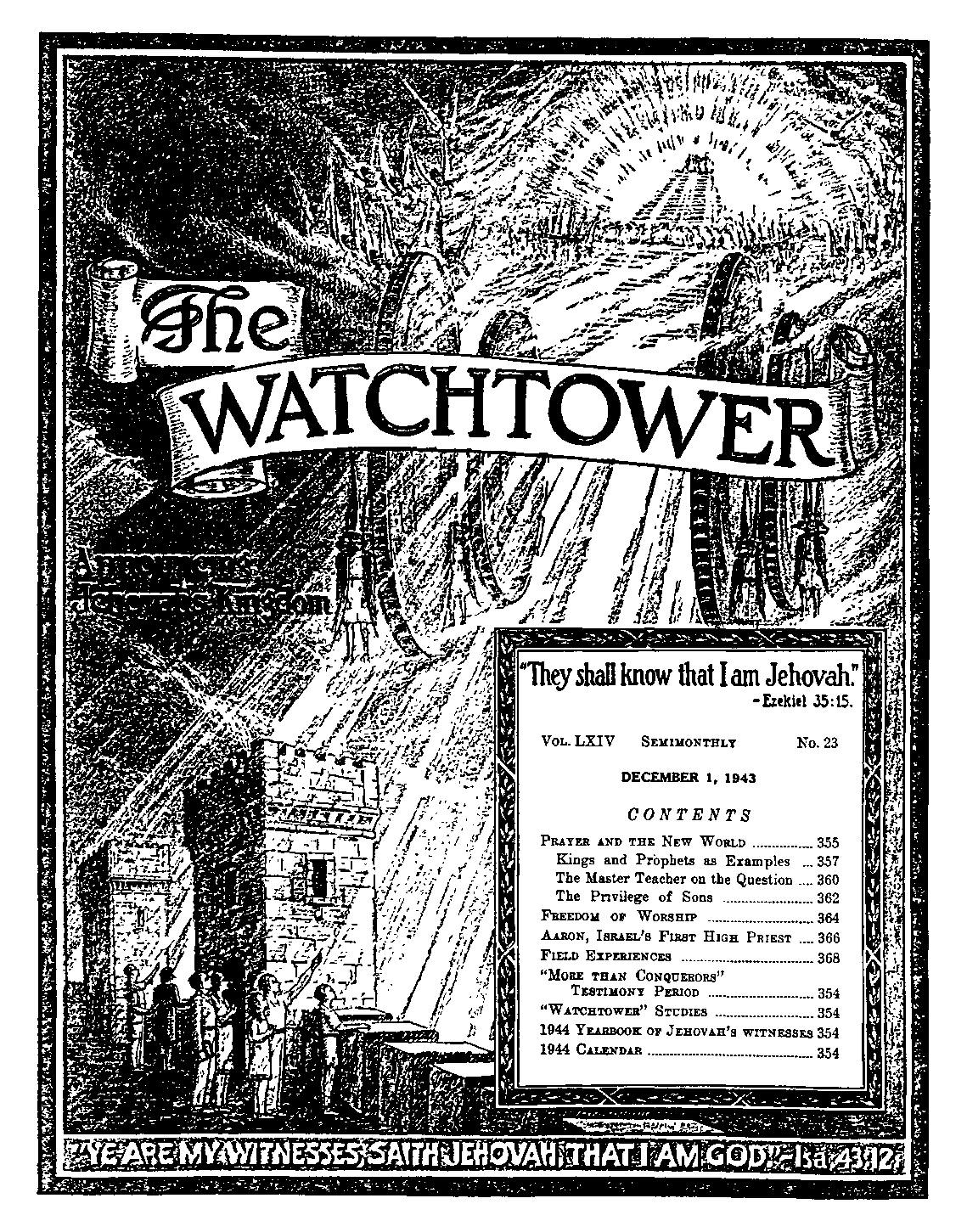
“MORE THAN CONQUERORS” TESTIMONY PERIOD
December has been set aside as the Testimony Period above named. Suffice it to say there will be much for each to conquer who takes part therein. All who conquer self-love and who permit nothing to sever them from the love of God which is in Christ Jesus will take hold of the privileges of the month. The means of testimony that will be to the forefront will be the latest publications, the book “The Truth Shall Make You Free” and the booklet Freedom in the New World, both to be presented to all prospects on a 25c contribution. As winter then sets in in the Northern Hemisphere, the placing of the literature should be followed up by starting Bible studies, primarily with the new book, in as many homes of obtainers of literature as possible. Let the testimony thus be most deeply impressed and continue on through the winter-bound months. Your report on service at the month’s close should show, besides literature placed, new book studies requiring back-calls of you. Set your affairs in order now for a conqueror’s part m the campaign with Freedom’s message. Write us direct, if necessary.
“WATCHTOWER” STUDIES
Week of January 2: “Prayer and the New World," 1-22 inclusive, The Watchtower December 1, 1943.
Week of January 9: “Prayer and the New World,” 23-43 inclusive, The Watchtower December 1, 1943.
1944 YEARBOOK OF JEHOVAH’S WITNESSES
Despite the unfavorable conditions, the 1944 Yearbook of Jehovah’s witnesses has been produced covering the world-wide accomplishments of these Bible educators during this past service year of 1942-1943. The stirring report thereof has been prepared by the president of the Watch Tower Bible and Tract Society, and it sets out also the key-features and objectives of the work immediately ahead, thus providing valuable material for service discussions and also counsel for all educators of men of good-will. A daily text and comment covering each day of the year 1944, as based on The Watchtower, makes it a daily handbook of spiritual food. The new Yearbook, of over 350 pages, enclosed in a sturdy binding, may be had at 50c a copy, postpaid. Those associated in a group or company should combine orders and send through the local servant, to economize time and shipping expense.
1944 CALENDAR
The Watch Tower Society’s 1944 calendar features the yeartext ; namely, “Teach me to do thy will; for thou art my God.” (Psalm 143:10) The up-to-date animated picture accompanying (in color) conforms to the text and illustrates how it is being carried out by those who now make the text their own. The calendar pad announces the bimonthly Testimony periods of 1944, and also the service themes and supporting scriptures of the alternating months. The calendar is now available, and will be mailed on a contribution of 25c a copy, or 5 copies to one address on a $1.00 contribution.
Vol. LXIV | December 1, 1943 | No. 23
PRAYER AND THE NEW WORLD
"O thou that hearest prayer, unto thee shall all flesh come.” (Ps. 65:2) "And it shall come to pass, that before they call, I will answer; and while they are yet speaking, I will hear.’’—Isa. 65:24.
JEHOVAH is within the reach of prayer by human creatures here on earth. He is not too lofty, nor too far removed, to be able to hear the expressions to him made by puny creatures amid our sinful and imperfect conditions. Neither is he indifferent and unconcerned. “The eyes of Jehovah are unto the righteous, and his ears unto their cry.” (Ps. 34: 15, Young) Only the lawless he tunes out: “The sacrifice of the wicked is an abomination to the Lord: but the prayer of the upright [without any animal sacrifice as a persuasion] is his delight.” (Prov. 15:8) By his powers, which are more wonderful and incomprehensible than radio, he is able to detect and pick up man's unvoiced petition offered within the hidden retreats of the heart or mind. And his powers of response are just as marvelous, to His glory. “Now unto him that is able to do exceeding abundantly above all that we ask or think, according to the power that worketh in us, unto him be glory.”—Eph. 3: 20, 21.
2 The primary issue of God’s glorious universal domination must be settled here at the earth. Because of this Jehovah God could not be and is not indifferent toward the prayers of worthy creatures on this small planet. Rather than showing unconcern or preoccupation with other matters of seemingly greater importance respecting his unbounded universe, the Most High God of heaven and earth invites true prayer. He watches for it. The time is near when all creatures that gain life everlasting in peace, health and happiness will regularly draw near to him in prayer. That time is the righteous New World which Jehovah God creates. The central government of the New World, the heavenly kingdom of his royal Son. has been established; and the establishment and operations of the “new earth” draw nigh. Hence it is timely that the subject of prayer in its relation to the New World be examined. Prayer to the great Life-giver is vital to all life-seekers.
3 No religious prayer-book can give us the proper instructions and set the right standard as to this grand privilege of communion with the mighty Creator. We must go to the Bible for answers to our many questions on this subject and for our model of prayer. The Bible was written by men who were inspired by the unfailing Hearer of prayer and who enjoyed and used the privilege of calling upon him in praise, thanksgiving and request. None of them were religionists. None of them, therefore, went in for the religious practices, formulae and mechanical-routine repetitions of prayers, things that amuse the demons but do not please the true God. The Bible writers showed up the emptiness and uselessness of religious prayers, and set forth in the Record the true and acceptable way to approach the living God. Today numberless prayers are being offered in private homes, in legislatures, on battlefields and on battleships, and in religious buildings, by men and women without respect of their side of the global war. Such prayers from both sides, addressed to the same God, presumably, are all for victory and lasting peace. Such prayers from opposite sides marked also World War I, and other conflicts and tribulations of worldly nations. The settlement of the matter in dispute was determined, not by religious praying of clergy or laity, but by the might of the military winner rather than the righteousness of the cause. Or if there was any settlement approaching righteousness, it did not usher in lasting peace with justice, morality and prosperity for the common man. Of what value actually was the religious praying except as a false bolster to the morale of the loser as well as the winner? The losers lost not only the fight but also faith in prayer and in God.
1 Why may righteously-disposed creatures on earth hopefully offer prayer, even within their hearts, to the Most High God?
2 Why is Jehovah not indifferent or unconcerned about prayer of creatures on earth? and why is it now timely to examine this subject of prayer anew?
3 Why go to the Bible rather than religious prayer-books for answers to our questions, and why are religious prayers inconsistent, useless, and destructive of faith?
4 True prayer, offered in the right manner to the right One and on right matters, does count and bring results. The Bible Record gives many examples of praying rightly by men and women. It shows why their action was accepted and responded to by the One addressed. Their cases were written down and preserved for our instruction and encouragement. Religionists look upon the statement at Genesis 4:26 as the first account of praying by men, namely: “Anti to Seth [the son of Adam and Eve], to him also there was born a son; and he called his name Enos: then began men to call upon the name of the Lord [literally, the name of Jehovah].” That was 235 years after the first man's creation; and, if praying at all, it was religious praying. Actually, it was the beginning of where men called themselves or their selfchosen false gods by the name of the one true God, Jehovah, the Supreme One. It was religious hypocrisy, which brought reproach upon Jehovah’s name because it was a taking of his name in vain, and hence was religious sin.
4. What kind of prayer does count, and what can be said co concerning Genesis 4:26 as being the first account of prayer by men?
5 More than a hundred years before Enos, his uncle Abel had lived and he offered acceptable sacrifice to Jehovah God. Although no prayer by Abel on that or any other occasion is reported, yet it is certain that in connection with his sacrifice Abel offered prayer to the Lord God, that his offering by fire might be accepted. The favorable answer to his prayer roused hatred and envy of his religious brother Cain, who thereafter slew Abel. But even Abel’s blood, which soaked the ground, cried out to God in a prayer for His vengeance against the religious bloodletter. (Heb. 11:4; 12: 24; Gen. 4: 10, 11) Why were Abel’s sacrifice and prayer accepted of Jehovah God? Because such were offered in faith; and “without faith it is impossible to please him: for he that cometh to God must believe that he is, and that he is a rewarder of them that diligently seek him”.—Heb. 11: 6.
6 Faith means, yes, a belief in the true and living God, but that with an acceptance of His word as true and a hearty reliance upon it. Such confidence is shown by living in harmony with it, waiting for its fulfillment. Abel heard of God’s word, spoken in Eden, which sentenced his father Adam to death, but which also gave promise of a New World, established by God through the Seed taken from the womb or body of his holy universal organization. That Seed was to be hated by the great Seducer because the Seed would refuse to compromise God’s cause. He was to be bruised at “his heel” for that reason. But, let the hatred and painful treatment be what it might, the Seed of God’s organization was promised to overcome the seductive Serpent or Deceiver and to destroy him from the universe. This would insure a new, righteous and peaceable world. (Gen. 3: 14, 15, 17-19) Abel testified in belief of that divine word, and offered sacrifice and prayer accordingly. His prayer was unselfish, being for vindication of God’s word as true. For his faith and faithful conduct God accounted him righteous even though descended from condemned Adam. Meeting such requirements Abel could address God and find acceptance. Less could not be required of men today who want to pray without feeling it foolish but having certainty of being heard.
5. What evidence is there that more than a century before Enos prayer was offered to God, and why were such prayer and sacrifice acceptable to God?
6 Concerning what did Abel exercise faith in God, and what does his case show as the least or minimum requirements for prayer by men to be acceptable?
7 Abel is promised a “better resurrection”. He will be back on earth in the New World to which he looked ahead by faith. He will be one of the “princes in all the earth” then, as one of the representatives of the invisible Government of God's King, Christ Jesus, whose sacrifice Abel’s slain lamb foreshadowed. (Heb. 11:35,39,40; Ps. 45: 16) Other faithful men of old who will be associate princes with Abel were likewise praying men. Their prayers were heard of God and answered for reasons like his. The patriarch Abraham prayed, and he was called the “father of all them that believe”. (Rom. 4:11) He was given the specific promise that God would make His name great by vindicating it against all that cursed the name of Jehovah. He would bless all the families of the earth that blessed His holy name. Abraham might be a party to this covenant by coming out from this world and living differently and doing so in hope of the promised world to come. Thenceforth Abraham’s sacrifices and prayers were all in harmony with that divine word of promise. Prayers of religionists are all for the sake of things of this world and its governments; they are not in the interest of the righteous New World and its Theocratic Government. (Gen. 12: 1-3; 14: 22, 23; 15: 2-8; 20:7,17) The true Seed of Abraham, Christ Jesus, the King of the New World, said to the patriarch's natural descendants: “Your father Abraham rejoiced to see my day; and he saw it, and was glad.” — John 8: 56.
8 Abraham’s natural heirs of the covenant-promise followed his example as to communion with the covenant-keeping God. Isaac prayed for his barren wife that a son might be provided to whom the birthright promise might be handed down. His blessing upon Jacob, when passing onward to this son the promise of covenant blessings, was in itself a prayer to God. (Gen. 25:21; 27:27-29) After the dream of the ladder traveled by angels between heaven and earth Jacob’s vow to God was a form of petition to Him. Jacob’s wrestling all night with an angel and requesting a blessing before meeting his twinbrother Esau was also a strong supplication to the Lord and was in keeping with the hope of the New World. — Gen. 28:16-22; 32:24-30.
9 Just 430 years passed after making the covenant with Abraham concerning the blessing of all families of the earth through the great nation that God would bring forth through him. Then God added thereto another covenant, based on his law given through the prophet Moses. This covenant was to continue in effect until the promised Seed, Christ Jesus, should come. (Gal. 3:16,17,19,24) In the terms of such law covenant very little, indeed, is said concerning prayer. There is the blessing which was to be pronounced upon the whole covenant nation of God, as stated at Numbers 6: 22-27: “And the Lord spake unto Moses, saying, Speak unto Aaron [the high priest] and unto his sons, saying, On this wise ye shall bless the children of Israel, saying unto them, The Lord bless thee, and keep thee; the Lord make his face shine upon thee, and be gracious unto thee: the Lord lift up his countenance upon thee, and give thee peace. And they shall put my name upon the children of Israel; and I will bless them.” The nation of Israel foretold and prefigured the new nation of spiritual Israel, the apostle’s blessing upon whom corresponds with that of Israel’s high priest, namely: “And as many as walk according to this rule, peace be on them, and mercy, and upon the Israel of God.”—Gal. 6:16.
7 (a) What future prospects are there for Abel? (b) In harmony with what were Abraham’s prayers, and why did he rejoice?
8. What is there to show that Isaac and Jacob were men of prayer?
9. What was added in due time to the Abrahamic covenant, and for how long? and what statement of prayer did it instruct the priests to offer for the whole nation?
10 The law covenant through Moses also gave the outline of prayer to be made in recognition of God’s goodness every third year at the time an Israelite brought the tithes of his increase before the altar of the Lord at the temple. This included a confession of faithful obedience to God and closed with the petition: “Look down from thy holy habitation, from heaven, and bless thy people Israel, and the land which thou hast given us, as thou swarest unto our fathers, a land that floweth with milk and honey.” —Deut. 26:1-15.
11 The mediator of the law covenant with Israel, Moses, was an outstanding man of prayer with God. During the forty-year journey through the wilderness, when God signaled for the camp to move, Moses always acknowledged Him before and after the move. “And it came to pass, when the ark set forward, that Moses said, Rise up, Lord, and let thine enemies be scattered; and let them that hate thee flee before thee. And when it rested, he said, Return, O Lord, unto the many thousands of Israel.” (Num. 10:35, 36) When the ten plagues were visited upon Egypt Moses several times entreated God at the request of Pharaoh for the lifting of the plagues. (Ex. 8:9, 28-30; 9: 27-33; 10: 17,18) At Mount Sinai, when the Israelites sinned against the Lord by the worship of a golden calf, Moses acted as intercessor. He besought the Lord to spare the people upon whom His name was called, and that for His name’s sake. (Ex. 32:11-14, 30-34) Later the murmuring of the Israelites against Jehovah at the false, discouraging report of ten of the spies back from the Promised Land also required the intervention of Moses. (Num. 14:13-19) The Ninetieth Psalm bears the title: “A prayer of Moses, the man of God”; and the next psalm is understood to be Moses’ composition too. It closes with this promise from God to his chosen people: “He shall call upon me, and I will answer him: I will be with him in trouble; I will deliver him, and honour him. With long life will I satisfy him, and shew him my salvation.” (Ps. 91:15, 16) Moses was inspired to declare himself a type or prophetic figure of a greater prophet and mediator to come, namely, Christ Jesus. This One also proved to be a mighty intercessor and man of prayer.—Deut. 18:15-19; Acts 3:20-23.
10 What instruction respecting prayer did it give in connection with offering tithes?
11 What is there in the Record and in the Psalms to show that Moses was an outstanding man of prayer, and in this whom did he prefigure?
KINGS AND PROPHETS AS EXAMPLES
12 The psalms composed by the shepherd-king David show where he belongs in the study of this subject; and David was a type of the Good Shepherd, the King of kings, Christ Jesus. Psalm 72 ends with the words: “The prayers of David the son of Jesse are ended.” The prophet Samuel, who anointed the shepherd-boy David to be Israel’s future king, said to the Israelites when they had asked and been given a human king: “Moreover, as for me, God forbid that I should sin against the Lord in ceasing to pray for you: but I will teach you the good and the right way.” Samuel prayed for the nation because they were God’s covenant people and his visible Theocratic organization upon whom the name of Jehovah was called. “For the Lord will not forsake his people for his great name’s sake; because it hath pleased the Lord to make you his people.”—1 Sam. 12: 22, 23.
13 David’s public prayer shortly before his death, when turning over the kingdom and the temple preparations to his son Solomon, glorifies the true Theocracy and universal domination of God. Concerning this it is written: “Wherefore David blessed the Lord before all the congregation: and David said, Blessed be thou, Lord God of Israel our father, for ever and ever. Thine, O Lord, is the greatness, and the power, and the glory, and the victory, and the majesty: for all that is in the heaven and in the earth is thine; thine is the kingdom, O Lord, and thou art exalted as head above all. Both riches and honour come of thee, and thou reignest over all; and in thine hand is power and might; and in thine hand it is to make great, and to give strength unto all. Now therefore, our God, we thank thee, and praise thy glorious name.” — 1 Chron. 29:10-13.
14 At the dedication of the completed temple King Solomon publicly offered up praise and thanksgiving to God, and a fervent petition for the blessing and protection of His chosen nation and for prosperity on the worship of Jehovah at the place where he had put his name. He added: “And let these my words, wherewith I have made supplication before Jehovah, be nigh unto Jehovah our God day and night, that he maintain the cause of his servant, and the cause of his people Israel, as every day shall require; that all the peoples of the earth may know that Jehovah, he is God; there is none else.” (1 Ki. 8:14-60, Am. Rev. Ver.) Among the successors of Solomon to the throne who also offered supplication and praise to the Most High the Record includes kings Jehoshaphat. Asa, Hezekiah and Josiah.
12 (a) What compositions reveal David as a man of prayer, and whom did he typify? (b) At the time of the nation's switchover to a kingdom, what position did Samuel take as respects prayer?
13 When turning over the kingdom to Solomon, what did David offer up to God, and what did it specially glorify?
14 At the dedication of the temple what did Solomon offer up to God, and how did it close?
15 The royal rulers of the nation were not alone in exercising this privilege toward God; those of the people thereof did also. In his discussion of the subject the apostle James writes: “Confess your faults one to another [not to a priest in a confessional box], and pray one for another, that ye may be healed. The effectual fervent prayer of a righteous man availeth much. Elias was a man subject to like passions as we are. and he prayed earnestly that it might not rain; and it rained not on the earth by the space of three years and six months. And he prayed again, and the heaven gave rain, and the earth brought forth her fruit.” (Jas. 5:16-18; 1 Ki. 17: 1; 18:42-44) During the drought Elijah’s part in raising a widow's son to life was accomplished with supplication to Jehovah.—1 Ki. 17: 19-24.
16 Elijah’s successor was also much given to calling upon the Lord. His cry at the edge of the Jordan after he had smitten its waters, "Where is the Lord God of Elijah?” was answered by Elijah’s God with the dividing of the river waters to permit Elisha's passage. When he was used of Almighty God to raise the Shunammite’s son from the dead, “he went in therefore, and shut the door upon them twain, and prayed unto the Lord.” The miracle followed. At Dothan, when his young servant cried out in terror at the enemy host surrounding them and threatening their destruction, “Elisha prayed, and said, Lord, I pray thee, open his eyes, that he may see. And the Lord opened the eyes of the young man; and he saw: and, behold, the mountain was full of horses and chariots of fire round about Elisha.” Again the prophet prayed, and the Syrian hosts were smitten with open-eyed blindness, as Elisha led them into the camp of the Israelites. (2 Ki. 2:14; 4: 33-35; 6:17-20) Elisha and his predecessor Elijah were both used of God to foreshadow Jehovah’s “strange work” through his faithful witnesses in these modern times before he brings in the New World in completeness. The communication of those ancient men with the God of heaven shows that the work of Jehovah’s witnesses in these days cannot be effected by them without likewise calling upon God for help, protection and blessing.
15 Who else besides the Israelite kings ottered prayer, and what does the apostle James testify concerning Elijah as doing so?
16 (a) What instances are there showing Elisha was a man of prayer? (b) What were Elijah and Elisha used to foreshadow, and what did their recourse to prayer indicate concerning this?
17 Other men of Israel who figure prominently in the panorama of prayer are Job, Jonah, Habakkuk, Jeremiah, Ezra, Nehemiah, and Daniel. Job, a contemporary of the prophet Moses, was an example of patient endurance with integrity toward God. He drew near to Jehovah both in prosperity and in affliction, and after his restoration. He is a pictorial representation of all humans who maintain their integrity during this time when wickedness is permitted and who are thereby accounted worthy of life in the New World. Job was instructed to act as intercessor for self-styled friends who had wronged him grievously; and the Record tells us: “And the Lord turned the captivity of Job, when he prayed for his friends: also the Lord gave Job twice as much as he had before.”—Job 1: 5, 20,21; 42:8, 10.
18 Jonah had the unique experience of lifting his heart and voice to Almighty God from the belly of a sea-monster. From that living submarine he was heard; and concerning this the account says: “Then Jonah prayed unto the Lord his God out of the fish’s belly, and said, I cried by reason of mine affliction unto the Lord, and he heard me; out of the belly of hell [(margin) out of the belly of the grave] cried I, and thou heardest my voice.” In being delivered from that tomblike condition Jonah primarily pictured Christ Jesus, who was raised from the dead on the third day to be the King of the New World. In praying down in the depths of the sea he also pictured the remnant of the members of the body of Christ’s followers. These were apparently the “children of death” in 1918, but were brought forth from their sepulchral condition of Christian inactivity in 1919. (Jonah 2:1,2; Ezek. 37:1-14) Thereafter such remnant, like Jonah, applied themselves to the work of preaching God’s message to the nations threatened with destruction at the battle of Armageddon by the “strange act” of God. (Jonah 3:1-10) Those Ninevites who repented at Jonah's preaching escaped destruction which came upon Nineveh in due time. Persons now repenting at the message of Jehovah’s witnesses will be spared by Jehovah’s executioners at Armageddon to find everlasting life in the New World.
19 Jeremiah also found it necessary to seek the face of the Lord who sent this prophet to bear witness to His name and purpose. (Jer. 32:16; 7:16; 14:11; 42:4) For forty years Jeremiah declared the day of God’s vengeance against hypocritical religionists and their temple and city, for the vindication of Jehovah’s name. In this Jeremiah pictured the Lord’s witnesses now engaged in his “strange work” which warns of his “strange act” of destruction upon religious “Christendom” in the tribulation of Armageddon. The prophet Habakkuk foretold of like destruction upon the hypocritical religious organization. His thrilling description, in chapter three, of God’s “strange act” at the final end of the world is headed or introduced by the words: “A prayer of Habakkuk the prophet upon Shigionoth [(margin) or, according to variable songs; (Roth.) in the manner of an ode].” (Hab. 3:1) His exclamation at the vision indeed constitutes a prayer that Jehovah’s faithful remnant and their companions now pray, that Jehovah may avenge and vindicate his name upon his enemies before bringing in the New World in its fullness. The prophets Hosea and Joel exhorted God’s people caught in the snare of religion to turn to him with supplications for his mercies and for help to walk thereafter according to His covenant.—Hos. 14:1, 2; Joel 2: 15-17.
17 What instances are there to show whether Job engaged in prayer? and whom did be pictorially represent?
18 Where is Jonah recorded as praying? and whom did be picture there and also in preaching to Nineveh thereafter?
19 (a) Why was It necessary for Jeremiah to pray? and whom did be picture? (b) What prayer did Habakkuk offer? and what did Hosea and Joel urge God's people to do?
20 Ezra, the scribe and priest, was one who joined the remnant of Jews that had left their exile in Babylon and returned to the Holy Land to rebuild the temple on Zion's hill. Rather than require a military escort from the ruler of Babylon, Ezra reports, “so we fasted, and besought our God for this; and he was entreated of us.” They safely reached the temple site without incident. Among the restored remnant of Jehovah’s people Ezra found conditions that deserved to be laid before the Lord God. The Record reads: “Now when Ezra had prayed, and when he had confessed, weeping and casting himself down before the house of God, there assembled unto him out of Israel a very great congregation of men, and women, and children: for the people wept very sore.” Then the troublesome matter was straightened out in harmonv with God’s law. —Ezra 8:22, 23; 10:1.
21 Nehemiah was another one concerned about the condition of the remnant that had quit Babylon to go up to worship and serve Jehovah in the land which he had given them. Very much depressed at the news brought to him, Nehemiah says: “And it came to pass, when I heard these words, that I sat down and wept, and mourned certain days, and fasted, and prayed before the God of heaven.” Repeatedly he asked the Lord to be attentive to his prayer that he might be used of him toward the betterment of the state of the remnant. His prayer was answered, and he was used for the rebuilding of the walls of Jerusalem. While engaged in that work, with enemies all round about threatening violence, Nehemiah says, “nevertheless we made our prayer unto our God, and set a watch against them day and night, because of them.” In surprising time the city walls were raised up between the Jews and the enemies. —Neh. 1:4,6,11; 4:9; 6:15.
20 On what two special occasions did Ezra pray to God? and with what results?
21 What special record of prayer is made concerning Nehemiah abroad and at Jerusalem, and its results?
22 The great test that led to Daniel’s being cast into the lions’ den for his faithfulness came because he was a man who could not be restrained from prayer to God. His enemies had the decree framed limiting all prayer for thirty days to King Darius of Medo-Persia. Then Daniel knowingly “went into his house; and his windows being open in his chamber toward Jerusalem, he kneeled upon his knees three times a day, and prayed, and gave thanks before his God, as he did aforetime”. Daniel’s course of open and known communion with God despite heathen decrees was approved by the great Judge of all in that He rescued Daniel from the lions’ fangs. (Dan. 6:10, 21-27) Supplication to God also brought to Daniel the recovery and interpretation of Nebuchadnezzar’s lost dream of the terrible metallic image. (Dan. 2:16-19) Prayer also preceded the revelation to Daniel of the seventy weeks of years leading up to Messiah the Prince’s appearance on earth (Dan. 9:3,4,20-27); also the marvelous prophecy as to the hostilities of “the king of the north” and “the king of the south” at the “time of the end”, and the standing up of the mighty Prince of God’s people to bring in the New World.—Dan. 10:2,3,12; 11:1-45; 12:1-13.
23 After the flight of several centuries from Malachi, the last of the old Hebrew prophets, there appeared another prophet, who was a miniature fulfillment of Malachi’s propheev concerning Elijah. (Mal. 4:5,6; Matt. 11:13,14; 17:10-13) This favored prophet was John the Baptist, the forerunner of the true Seed of Abraham upon whom all blessings for all families of the earth rest. John's father was a man of faith and prayer. That is sure from the Record: “According to the custom of the priest’s office, his lot was to burn incense when he went into the temple of the Lord. And the whole multitude of the people were praying without, at the time of incense. And there appeared unto him an angel of the Lord, standing on the right side of the altar of incense. And when Zacharias saw him, he was troubled, and fear fell upon him. But the angel said unto him, Fear not, Zacharias: for thy prayer is heard; and thy wife Elisabeth shall bear thee a son, and thou shalt call his name John.” —Luke 1: 9-13.
22 Into what trialsome experience did prayer lend Daniel? and what responses were given to his prayers on other occasion?
23 Who was sent as a miniature fulfillment of Malachi's prophecy concerning Elijah, and what shows his father was a man of prayer?
24 John grew up in the deserts till his testimony concerning Jehovah’s purpose and the coming of the Messiah was due to begin. Disciples or learners gathered about John at his preaching. He baptized the repentant ones in water. Among other things, he showed them their relationship to God and instructed them as to approaching and addressing Him. Hence Jesus’ followers asked the Master for like instruction; as recorded: “And it came to pass, that as he was praying in a certain place, when he ceased, one of his disciples said unto him, Lord, teach us to pray, as John also taught his disciples.” (Luke 11:1) Others “said unto him, Why do the disciples of John fast often, and make prayers, . . . but thine eat and drink?” (Luke 5:33) Jesus then explained why they did not fast.
25 All the above-noted men lived and died before Jesus’ death and resurrection and ascension to heaven. Upon what basis, then, could those men draw nigh to God in prayer and find a hearing ear and answer from Him! The religious belief is that any and all men anywhere and at any time may offer a prayer and, if it is sincere and earnest, it will find its way to God and be accepted of him. The Bible reply does not support that. The men whose prayers were accepted of old time were men of faith in the true and living God, Jehovah. Because they believed in his existence and supremacy, they also believed and depended upon his word. Hence they avoided religion and its worship of demon gods and its acceptance of man’s word, particularly the word of religious clergymen. They believed God’s word as it was added to by His further revelations from time to time. Always it pointed to the coming of his Seed, the Deliverer, and the creating of a new world. So they did not fall in with the schemes and policies of men regarding this old world under demon rule. In hope of the new world they walked according to God’s word and devoted themselves to pleasing him. Their faith and devotion to God and his purpose brought them a measure of righteousness or justification, which then made them acceptable with God. Such justification was a picture of the true justification that should come to Christ’s faithful followers.—Rom. 4:22-25.
26 From Moses’ time forward till Christ those whose prayers God recognized were faithful members of his chosen people of Israel. They were in relationship with the Most High God by the covenant of his law given through Moses the mediator. Thus they were persons in covenant bonds with God and who were endeavoring to be faithful to the covenant by loving obedience. Any who were aliens and strangers to the nation of Israel and outside its covenant must approach God through his organized people and in the manner of worship he had ordained in connection with his temple. Only thus could strangers, such as Rahab, the Gibeonites, Jael, Ruth, the Nethinim, the widow of Zarephath, Naaman the Syrian, Ebed-melech, and others, find any favor from God and any answer to prayer. To this effect King Solomon said, when dedicating the temple: “Moreover concerning the stranger, which is not of thy people Israel, but is come from a far country for thy great name’s sake, and thy mighty hand, and thy stretched out arm; if they come and pray in this house; then hear thou from the heavens, even from thy dwelling place, and do according to all that the stranger calleth to thee for; that all people of the earth may know thy name, and fear thee, as doth thy people Israel, and may know that this house which I have built is called by thy name.” (2 Chron. 6: 32, 33) Such provision for the “stranger" should be of great encouragement and consolation to those who feel far off from Jehovah and unacquainted with Him, and who now are inclined to “seek the Lord, if haply they might feel after him, and find him”.—Acts 17: 27.
24 Who gathered about John the Baptist, and what proof is there that he taught them to pray?
25 Upon what basis could the men of old before Moses draw near to God in prayer and get a bearing and answer?
26 From Moses onward what further basis for offering acceptable prayer was there, and how only could “strangers" approach God in prayer and receive answer ?
THE MASTER TEACHER ON THE QUESTION
27 The argument may be raised, that the aboverelated cases of communication between God and man were before the coming of Christ Jesus and that since his coming the conditions respecting prayer have been radically changed and all formality has been cast out. Those arguing so depend heavily on Jesus’ condemnation of the procedure of the Jewish religionists of his day. They quote his words: “And when thou prayest, thou shalt not be as the hypocrites are: for they love to pray standing in the synagogues and in the corners of the streets, that they may be seen of men. Verily I say unto you, They have their reward. But thou, when thou prayest, enter into thy closet, and when thou hast shut thy door, pray to thy Father which is in secret; and thy Father which seeth in secret shall reward thee openly. But when ye pray, use not vain repetitions, as the heathen do: for they think that they shall be heard for their much speaking. Be not ye therefore like unto them: for your Father knoweth what things ye have need of, before ye ask him. After this manner therefore pray ye: Our Father which art in heaven, Hallowed by thy name. Thy kingdom come. Thy will be done in earth, as it is in heaven. Give us this day our daily bread. And forgive us our debts, as we forgive our debtors. And lead us not into temptation, but deliver us from evil.” (Matt. 6: 5-13; Luke 11:1-4) “Woe unto you, scribes and Pharisees, hypocrites! for ye devour widows’ houses, and for a pretence make long prayer: therefore ye shall receive the greater [condemnation].” —Matt. 23:14; Mark 12:40; Luke 20:47; 18:9-11.
27 Since Christ, what radical argument may be made by some concerning prayer, and upon what words of Jesus do they base their argument?
28 Are Jesus’ words to be understood as holding down all prayer by his followers to private prayer unobserved by all others, even by fellow Christians? Do his words cut out all public prayer amid an audience? Is there to be no regularity about prayer in the endeavor to avoid repetitions? Do Jesus’ words condemn Daniel for three times daily offering petition to God where he could be observed by his enemies and hence be turned over by them to the lions? Where should prayer be presented, and how? These and many other questions can be answered satisfactorily by looking at the Record which has the approbation and imprimatur of Jehovah God and his High Priest, Christ Jesus. That very Record closes with prayers written so they can be read by all: “Even so, come, Lord Jesus. The grace of our Lord Jesus Christ be with you all. Amen.”—Rev. 22:20, 21.
29 To the Samaritan woman at the well near Mount Gerizim Jesus said: “Woman, believe me, the hour cometh, when ye shall neither in this mountain, nor yet at Jerusalem, worship the Father. But the hour cometh, and now is, when the true worshippers shall worship the Father in spirit and in truth: for the Father seeketh such to worship him. God is a Spirit: and they that worship him must worship him in spirit and in truth.” (John 4:21,23,24) The hour has come where worship of Jehovah God, including prayer, is not restricted to any city or building. It is no longer needful, as in Daniel’s case, to pray with one's windows open and face turned toward the site of ancient Jerusalem. It is not necessary, as in the case of worshipers in the temple at Jerusalem, to pray with the face westward toward the Holy of Holies. Since the “Most High dwelleth not in temples made with hands”, one’s posture or the direction of petition and thanksgiving need not be toward any earthly site. One’s attention and offering should be to the God of heaven and earth. “For from the rising of the sun even unto the going down of the same [from east to west] my name shall be great among the Gentiles [the nations]; and in every place incense [accompanying prayer] shall be offered unto my name, and a pure offering: for my name shall be great among the heathen, saith the Lord of hosts.” —Mal. 1:11.
28. What questions, therefore, arise concerning prayer? and why may the Bible record be expected to give satisfactory answers?
29. What did Jesus say to the Samaritan woman at the well respecting worship, and what does this indicate as to posture, direction or place in offering prayer?
30 At the very beginning of his earthly ministry as Jehovah’s “faithful and true witness” Jesus is observed at prayer, in the presence of John the Baptist. “Now when all the people were baptized, it came to pass, that Jesus also being baptized, and praying, the heaven was opened, and the holy [spirit] descended in a bodily shape like a dove upon him, and a voice came from heaven, which said, Thou art my beloved Son; in thee I am well pleased.” (Luke 3: 21, 22) That voice was a response to Jesus’ petition. The apostle Paul’s words, at Hebrews 10: 5-10, indicate that, while thus praying, Jesus had in mind Psalm 40:6-8: “Sacrifice and offering [of animals] thou didst not desire; mine ears hast thou opened: burnt offering and sin offering hast thou not required. Then said I, Lo, I come: in the volume of the book it is written of me, I delight to do thy will, O my God: yea, thy law is within my heart.” This was an expression of Jesus’ consecration of himself to his God and Father, Jehovah.
31 The Father’s voice from heaven and the sending down of his spirit or active force on Jesus was open proof of his acceptance of Jesus’ consecration and the offering of himself. Jesus’ attitude at his water baptism was prayerful. This shows his followers that the occasion of being immersed in water is a time of serious consideration, one of looking to God and asking for help to carry out what is symbolized by such baptism, namely, one’s consecration to God.
32 Jesus prayed to the Most High God, His Father Jehovah. He did not pray to himself, which he would have been doing if he were a member of a religious “trinity of three persons in one God”. Jesus was on earth. His God and Father was in heaven. Regularly during his earthly witness to God’s kingdom Jesus offered supplication and thanksgiving to God. If Jesus were God Almighty Most High himself, then it was foolish for Jesus thus to pray; for he would be praying to himself and would be hypocritical, deceiving any who heard and observed him at prayer on numerous occasions. It was fitting, however, for him to offer up petition to God, for he is Jehovah’s Son: “who in the days of his flesh, when he had offered up prayers and supplications with strong crying and tears unto him that was able to save him from death, and was heard in that he feared; though he were a Son, yet learned he obedience by the things which he suffered; and being made perfect, he became the author of eternal salvation unto all them that obey him; called of God an high priest after the order of Melchisedec,” (Heb. 5:7-10) The priest- king of old, Melchizedek, publicly prayed Jehovah’s blessing upon Abraham.—Gen. 14:18-20; Heb. 7:1.
30. When was Jesus first observed in prayer, and what does the apostle Paul indicate was on Jesus' mind at the time?
31. What do the Father’s voice and the descent of the spirit therefore prove? and what should be the attitude of Jesus' followers at time of water baptism?
32. What foolish deductions respecting prayer does the “trinity” doctrine lead to, and why was it fitting for Jesus to pray to God?
33 In the sermon on the mount Jesus’ words concerning prayer in secret did not mean that thenceforth Jesus did not go up as a Jew the three required times each year to the temple at Jerusalem and join in the public prayers that were there offered by all the congregation at the time of offering the incense. (Luke 1: 9,10; Rev. 5:8; 8: 3, 4) Jesus’ presence at such feasts in Jerusalem is repeatedly reported. As a Jew according to the flesh he was “made of a woman, made under the law”, and said he: “Think not that I am come to destroy the law, or the prophets: I am not come to destroy, but to fulfil.” Accordingly he continued celebrating the feast of the passover until the paschal sacrifice was fulfilled in himself and he became “Christ our passover”. (Gal. 4:4; Matt. 5:17; 1 Cor. 5:7) So it was that Jesus is reported at his last typical passover feast and as offering up in the hearing of those come to the feast this request: “Now is my soul troubled; and what shall I say? Father, save me from this hour: but for this cause came I unto this hour. Father, glorify thy name.” “Then came there a voice from heaven, saying, I have both glorified it, and will glorify it again. The people therefore, that stood by, and heard it, said that it thundered: others said, An angel spake to him. Jesus answered and said, This voice came not because of me, but for your sakes.” (John 12: 20-30) Jesus did not violate his own instructions concerning secret prayer; for his Father answered his public prayer with public response.
34 Jesus was anointed with God’s spirit to be the King of the Government of the New World, and all his petitions to his Father were in behalf of that world to come. In Jesus particularly the primary- issue of Jehovah’s universal domination was at stake. How so? Because Jesus is Chief Executive in the Government through which God has chosen to exercise his universal sovereignty and through which also he will for ever vindicate his blasphemed name. Satan the Devil and would-be usurper of the universal domination tried to destroy the Government at its very root by striving to make Jesus fail of worthiness of the kingship. He used all his devilish arts and means to make Jesus come to terms with him and break his faultless integrity toward the Most High God. But Jesus was uncompromising toward God’s adversary. He proved that Jehovah’s chief Son and highest officer in His universe was unbreakably loyal and faithful and true to Him. To keep his grip on his integrity toward Jehovah, Jesus drew on the divine strength by supplication to Him. This enabled him to vindicate his Father's name and word by unswerving obedience and a correctness of course on earth. So he proved worthy to exercise the powers of the New World government and vindicate Jehovah’s name at the battle of Armageddon. For related reasons, namely, to keep integrity and share with Jesus in vindicating God's name, his faithful followers need likewise to resort to prayer.
33. After Jesus’ words concerning prayer in secret, what about bis own joining in public prayer at the temple or offering up personal prayer there’
34 (a) How was the primary issue particularly at stake In Jesus, and why would this fact specially require prayer on his part? (b) Why, then, is it appropriate for his followers to pray?
35 Jesus must have been praying behind no shut door of a secret closet but in the hearing of others, when that recorded at Luke 11:1, 2 occurred: “And it came to pass, that as he was praying in a certain place, when he ceased, one of his disciples said unto him, Lord, teach us to pray, as John also taught his disciples. And he said unto them, When ye pray, say, Our Father which art in heaven, Hallowed be thy name. Thy kingdom come. Thy will be done, as in heaven, so in earth.” Jesus did not brush the subject of prayer aside as from henceforth an indifferent matter, governed by suddenly arising emergencies and not having directive objectives. He showed that divinely guided prayer concerns itself with the New World and its Government which will cause God’s name to be hallowed in all creation. He did not teach that prayer be offered to his human mother or to any saints after death, to act as intercessors. It should be offered up to the Creator of the New World. Address to Jehovah, not alone as God but in the new relation of “Our Father", was by no means indicating that the so-called “Fatherhood of God” toward all men was now established and that all men on earth, as creatures, could approach God and address him as “Our Father”.
36 Universal "Fatherhood of God” doctrine does not fit in with Jesus’ words to the religionists: “Ye are of your father the devil, and the lusts of your father ye will- do. He was a murderer from the beginning, and abode not in the truth, because there is no truth in him. When he speaketh a lie. he speaketh of his own: for he is a liar, and the father of it.” (John 8: 44) Fatherhood of God did not apply to Cain, the brother of Abel: “Not as Cain, who was of that wicked one, and slew his brother. And wherefore slew he him? Because his own works were evil, and his brother's righteous.”—1 John 3: 12.
THE PRIVILEGE OF SONS
37 Men assume that, because they are descended from a creature of God, the first man Adam, they are sons of God and may address him in petition as “Our Father”. Contrariwise, this very form of approach as introduced by Jesus shows who only may draw near to God and make known their requests to him. The disciples whom Jesus thus taught were, first of all, members of the Jewish nation which was in the law covenant with God, and hence were His people. Also these men had left all to follow the Son of God. Thus, besides what they were naturally as Jews by birth, they were wholly consecrated to God as Jesus was. They were men of faith in Jehovah God like their forefathers Noah, Abraham, Isaac, and Jacob. They believed in God’s Word, and especially his promises concerning the coming Messiah or Christ, the Seed of Abraham. In expression of that belief they followed Jesus. He knew that God’s spirit was to be poured out upon all consecrated flesh of this kind and that these would be begotten of God’s spirit to become his spiritual children, spiritual Israelites, the children of the One whom Abraham typified, Jehovah. As such prospective children of God Jesus taught them to express themselves to God as “Our Father”. The other Jews that did not believe on him could not use this prayer. Therefore it is written: “He came unto his own, and his own received him not. But as many as received him, to them gave he power to become the sons of God, even to them that believe on his name: which were born, not of blood, nor of the will of the flesh, nor of the will of man, but of God.”—John 1:11-13.
35 Where was Jesus’ praying when he was afterward asked to teach his disciples to pray, and what did be then show as to divinely guided prayer?
36 When introducing the form of address “Our Father", why could not Jesus have been teaching the "Fatherhood of God" toward all men?
37. By the address “Our Father" what was Jesus really show in? and why could he properly teach bis disciples to pray thus to God?
38 Such spirit-begotten sons of God, being anointed of Him and proving faithful to death, are all to be associated with Christ Jesus in the Government of the New World. Rightly their prayer would be looking toward that coming world and in the interest of God’s kingdom. The apostle Peter wrote to such, saying: “Nevertheless, we, according to his promise, look for new heavens and a new earth, wherein dwelleth righteousness. Wherefore, beloved, seeing that ye look for such things, be diligent that ye may be found of him in peace, without spot, and blameless.” (2 Pet. 3:13,14) Such sons make up the “Israel of God”, not after the flesh but after the spirit, and hence His “holy nation”. (1 Pet. 2:9) Prior to Christ “Israel after the flesh” was the only nation having access to God during the time of their favor with him. Thereafter the “holy nation” of spiritual Israel was the only body of people privileged to pray to Jehovah God as “Our Father” and with answers in view. This exclusive privilege of these spiritual sons of God continued down to the setting up of the heavenly Government of the New World in A.D. 1914 and the coming of its King to the temple thereafter in 1918. Since then God’s favor has been going out to those who were foreshadowed by the “strangers” that lined themselves up with God’s chosen people of old. Clearing up of the privileges of these present-day companions of the remnant of God’s “holy nation” will be made later.
38 . Toward what would the prayers of his disciples be looking, and till when has their privilege of prayer to God been exclusive?
39 In addition to his words in the sermon on the mount Jesus gave some final instructions concerning prayer to his disciples on the night of his betrayal and arrest. He said: “I am the way, and the truth, and the life: no man cometh unto the Father, but by me. ... I go unto my Father. And whatsoever ye shall ask in my name, that will I do, that the Father may be glorified in the Son. If ye shall ask any thing in my name, I will do it. If ye abide in me, and my words abide in you, ye shall ask what ye will, and it shall be done unto you. Ye have not chosen me, but I have chosen you, and ordained you, that ye should go and bring forth fruit, and that your fruit should remain: that whatsoever ye shall ask of the Father in my name, he may give it you. . . . Verily, verily, I say unto you, Whatsoever ye shall ask the Father in my name, he will give it you. Hitherto have ye asked nothing in my name: ask, and ye shall receive, that your joy may be full.” —John 14: 6,12-14; 15: 7,16; 16: 23, 24.
40 After his conversation which included the above words Jesus then, in the presence of the eleven faithful disciples, “lifted up his eyes to heaven.” He prayed for them, and for all those who would believe on Jehovah God and Christ Jesus through their testimony or witness. Then he led them out to the garden of Gethsemane, where he prayed apart from them and received strength to endure the supreme test just ahead.—John 17:1-26; 18:1; Matt. 26:36-46.
41 The sum of the above is this: Henceforth no creature on earth could go to God with petition and have His recognition and answer unless he came by way of Christ Jesus and offered his requests in the name of the Son of God. Jesus’ faithful course of integrity toward God even unto death proved him worthy of a resurrection to life in the spirit and a return to his Father in heaven; and thereby Christ Jesus was opening up a way for believing humankind to come to God.
42 By his ransom sacrifice Jesus takes away the sin of such believers, and by this they are made acceptable to God as his children. Of old Moses was mediator between Jehovah and Israel. Now Christ Jesus, whom Moses foretold and prefigured, is the “one mediator between God and men” of spiritual Israel. Hence approach to the great Hearer of prayer may be, not direct, but only through his Son. All prayer must be offered up in his name. (1 Tim. 2: 5, 6) God does not deny himself, neither does his Son deny him; and hence the above rules regarding prayer may not be by-passed and ignored. To try to do so would be presumptuous and would meet with no success.
39. What additional instructions concerning prayer did be give his disciples on the night of his betrayal and arrest?
40. Thereafter on that same night what prayer did he himself offer?
41. What do Jesus above instructions show as to offering prayer henceforth, and how did he himself open up the way for it?
42. Why thenceforth must all prayer be offered up in Jesus’ name?
43 The subject is a large one, because it is important. We are at the portals of the New World. Men of good-will desire and expect to enter into life everlasting in that world without end. They are asking about the privilege and the proprieties of prayer. A related article in the next succeeding issue of this magazine will answer such questions.
43. With whom does the subject of prayer next concern Itself, and why?
FREEDOM OF WORSHIP
FREEDOM of worship comes from Jehovah God, the Giver or life. It is granted and secured only to those unselfishly devoted to Almighty God. This fundamental freedom was guaranteed by Jehovah long before worldly governments of man were established. It began with the history of man and has accompanied the faithful down through the old world. It is the foundation freedom of the New World. This freedom was claimed by the apostles Peter and John before the ancient Sanhedrin court, where they declared: “We ought to obey God rather than men.’’ (Acts 5:29) Jehovah guaranteed to them freedom to preach, for it is written: “They ceased not to teach and preach Jesus Christ.”—Acts 5:42.
Although worldly governments must recognize this right, they can no more grant to Jehovah’s witnesses the liberty to worship God than they can give to God the liberty of receiving such worship The immortal freedom to preach as a minister of Almighty God soars high above the reach of earthly powers or decrees.
Today, in all the earth, there is but one people who enjoy freedom of worship. It cannot be taken from them. Who are these people? Jehovah's witnesses! All others are forced, through blindness, ignorance, or fear, to serve Satan the Devil in spite of the constitutional compacts of freedom in liberal democratic nations. This unbreakable guarantee has been held by Jehovah’s servants only by a fight on many fronts throughout the world. Such battles today are like those of the Israelites in ancient times to protect that granted them by Jehovah.
The acts-of the apostles and the words of Jesus describe our fight today against our enemies as not against flesh and blood, but against the Devil and his demon spirit creatures, deceiving and directing visible rulers of this evil world. (Eph 6:12) Therefore the weapons of our warfare are not carnal. (2 Cor. 10:4) Our weapons are: the shield of faith, the helmet of salvation, the breastplate of righteousness. and the sword of the spirit, which is the Word of God.—Eph. 6:13-18.
The faithful course of the apostles proves that they were the first to claim in court their supreme, God-given and legally guaranteed right to worship God as commanded by Him. This was centuries before the writing of the Magna Charta or the Bill of Rights. This claim they made to keep open the field of worship established by Almighty God. The “recognized” religious clergy opposed their preaching and goaded the officials to persecute the apostles —“unrecognized” ministers. Today the religious priests, rabbis and preachers put pressure upon the officials and rabble elements of the nations and engineer the persecution of Jehovah’s faithful witnesses and cause their ministerial status to be ignored.
In 1933 the Jesuits, through Hitler—the “housepainter”—stole the German government. He made his first payment to the fellow conspirators, the Catholic Hierarchy, by banning Jehovah’s witnesses, confiscating their property and literature, and placing in concentration camps all such faithful ministers as he had not killed In 1933 there began in the United States the invasion of the field of worship by wholesale arrests of Jehovah’s witnesses in New Jersey, under the rule of Catholic-Hague gangsters, which other states followed.
In 1935 the flag-salute persecution in the United States overran every state in the Union, accompanied by suffering and destruction. Along with and following these moves came a widespread increase of arrests of Jehovah’s witnesses for preaching the gospel, throughout every state of the Union.
In 1939 war machines thundered out of Germany Hitler struck through Austria, Czechoslovakia, Poland, and overran continental Europe, and Italy betrayed and stabbed prostrate France in the back. Then the Nazi-Fascist-Catholic Hierarchy-American Legion combine in the United States launched a campaign of violence against defenseless and helpless Jehovah’s witnesses about June 3, 1940, the day the United States Supreme Court handed down its notorious judgment against liberty in the flag case Along with this came nation-wide destruction, death, mobs, and assaults against Jehovah’s witnesses, their children and their property in almost every state in the country This continued without abatement for more than two years. The states of Texas, Oklahoma, Arkansas, Mississippi, Illinois, Indiana and Kentucky took the lead in this invasion of the field of freedom by violence. The false arrests of Jehovah’s witnesses increased throughout the nation and mounted up to several thousands annually Many cases were carried through to high courts to secure the right of Jehovah’s witnesses under the Bill of Rights to preach the gospel. On June 8, 1942, the United States Supreme Court struck what was thought to be the final, death blow against Jehovah’s witnesses by approving the notorious license-tax laws against their charitable preaching activity. Then what?
The floods of illegal arrests and avalanches of violence during the years 1940 to 1942 did not deter Jehovah’s faithful fighting witnesses. They pushed straight ahead against demonized encroachments and continued preachingthe gospel, paying the cost of their warfare in casualties, loss of liberty, beatings, scourgings, and other violence, from border to border and from coast to coast, to say nothing of being tossed, nation-wide, into the fiery furnace of unfavorable newspaper publicity. Condemned to rot in judicial shackles and fetters and made fit to die in the eyes of the public, Jehovah’s witnesses, nevertheless, stood firm, courageous, and immovable in keeping their preaching covenant to Jehovah God against these dark, fierce storm clouds of destruction. Greatly outnumbered, with demon hosts driving the municipalities on to assault God’s people throughout the nation, Jehovah’s witnesses stood firm.
…