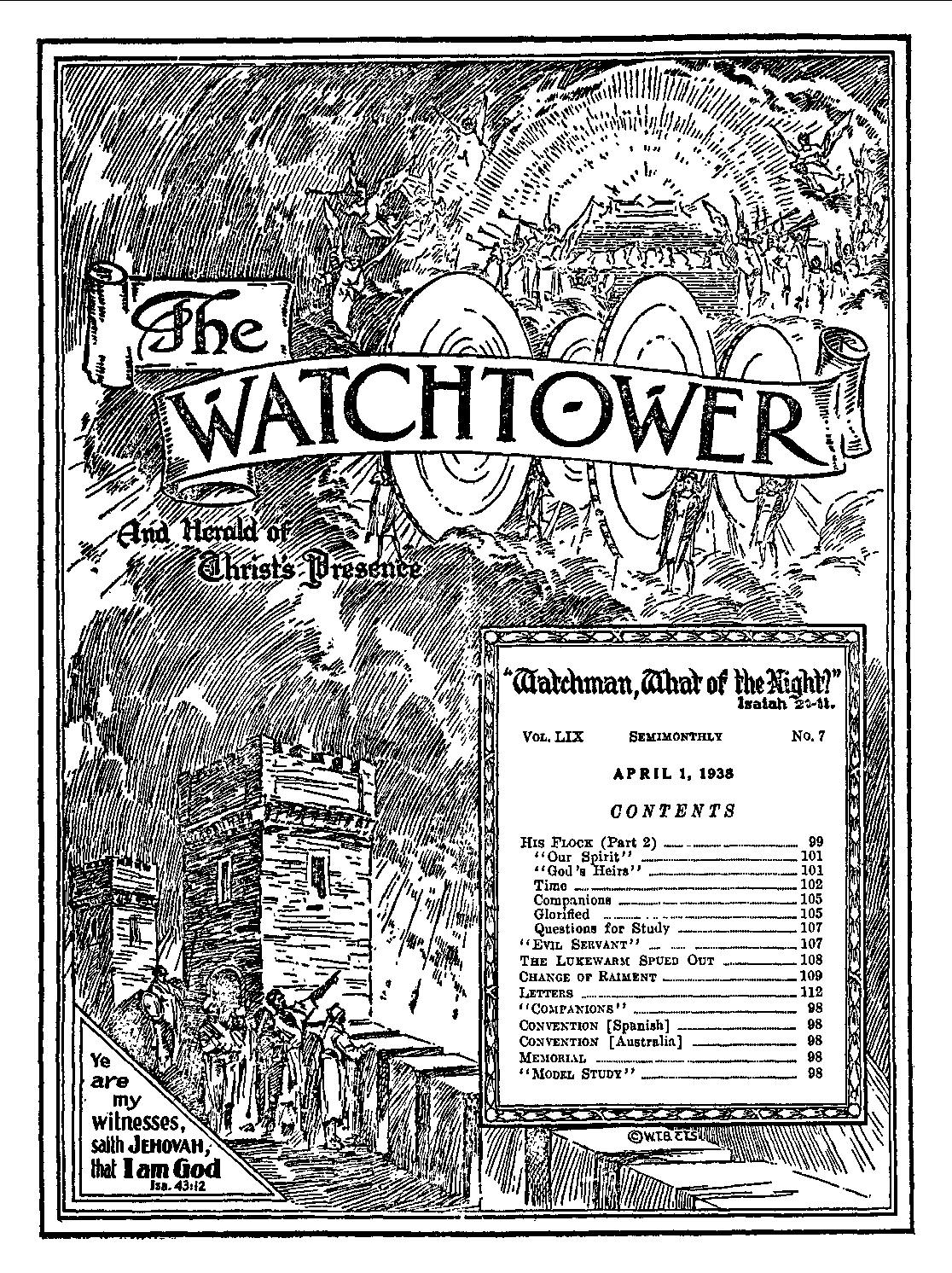
The Watchtower, April 1, 1938
Download: PDF — The Watchtower, April 1, 1938
“COMPANIONS”
The Memorial season this year will be marked by the testimony period named “Companions”, from April 9 to 17, inclusive. The name indicates that all that are companions in Jehovah’s service, to wit, the anointed remnant and the Jona- dabs, will signalize this period by intense united activity throughout all the world. The campaign strategy will offer the unusual combination of a year’s subscription for Consolation together with the book Enemies (or Riches') and the new booklet Cure, all on a $1.00 contribution. This announcement has been supplemented by much detailed information in recent issues of the Informant. The magnitude and scope of this campaign calls for careful planning and advance arrangements, losing no time. A faithful report in the regular way will be awaited from you at the close of the testimony.
CONVENTION
A convention of Jehovah’s witnesses and companions will be held at San Antonio, Texas, April 15-17 inclusive. Both the Spanish and English-speaking people of the Lord will be served at that convention. The convention will open at the meeting place, 323 Matamoros Street, at 8: 30 a.m. on Friday the 15th. All brethren should bring their phonographs, with the necessary records. Those desiring accommodations will please address J. D. Carter. 517 Stonewall St., San Antonio, Texas. A joint meeting of English and Spanish will be held on the evening of the 15th to celebrate the Memorial.
CONVENTION
Jehovah’s witnesses will assemble in convention at Sydney, Australia, April 22-25 inclusive. This convention will serve both Australia and New Zealand. The public address of the president will be radiocast. All who love and serve Jehovah will be welcome.
MEMORIAL
The date for the celebration of the name of Jehovah God and to the sacrifice of his Vindicator, Christ Jesus, in 1938 is Friday, April 15, after six p.m. After six p.m. on April 15 let each company of the anointed assemble and celebrate the Memorial, their companions the Jonadabs also being present. Let the emblems be unleavened bread and real red wine. The Lord and his apostles used real red wine in symbol of His blood, and the anointed should follow their lead.
“MODEL STUDY”
This new 64-page booklet, though plainly bound, is of great value to all engaged in the service in conjunction with the latest phonograph series of recorded speeches on “Hypocrisy Exposed ’ ’ and ‘ ‘ Religion and Christianity ’ ’. The booklet contains specially prepared questions and answers, in logical order and based on the above-mentioned series of recorded speeches, and is an indispensable aid to everyone who would conduct or participate in a study of said series at gatherings of newly interested people. The booklet is obtainable at 5c a copy.
Vol. LIX
April 1, 1938
No. 7
HIS FLOCK
PART 2
“I am the good shepherd, and know my own, and my own know me, just as the Father knoweth me, and I know the Father; and my life I lay down for the sheep. And other sheep have I, which are not of this fold: those also I must needs bring, and unto my voice will they hearken, and there shall come to be one flock, one shepherd.”—John 10:14-16, Roth.
JEHOVAH raised up Jesus out of death, exalted him to the highest place next to Jehovah, and clothed him with full power and authority to gather the “little flock", and later to gather his “other sheep”. Within a short time after the exaltation of Christ Jesus, and while the disciples were waiting at Jerusalem for the fulfillment of his promise that he would pray Jehovah, who would send them another comforter, there came the power of God’s spirit upon them. It was then and there that “the spirit itself” began to bear witness, as recorded by the apostle. The manifestation and operation of the holy spirit in, upon, about and through the faithful disciples, and for them, was the way the spirit bore witness of their being the sons of God and heirs together with Christ Jesus. God had sent to them the “helper” and “comforter”, as Jesus had promised, and the testimony or “witness” was beginning to be given to them and thereafter came upon all who are called to share in the kingdom, as Jesus had invited his faithful disciples to share in the kingdom when he was with them.
2 From the day of Pentecost until the coming of Christ Jesus to the temple in 1918, the holy spirit taught the Lord’s true followers: “But the Comforter, even the holy spirit, whom the Father will send in my name, he shall teach you all things, and bring to your remembrance all that I said unto you.” (John 14: 26, A.R.V.) The spirit testified to the apostles of and concerning Jesus, as he had told them: “But when the comforter is come, whom I will send unto you from the Father, even the spirit of truth, which proccedeth from the Father, he shall testify of me.” (John 15:26) The spirit guided them into all truth and showed them the things to come: “Howbeit when he, the spirit of truth, is come, he will guide you into all truth: for he shall not speak of himself; but whatsoever he shall hear, that shall he speak; and he will shew you things to come. He shall glorify me; for he shall receive of mine, and shall shew it unto you. All things that the Father hath are mine: therefore said I, that he shall take of mine, and shall shew it unto you.”—John 16:13-15.
3 The operation of the holy spirit upon the disciples was not arbitrarily guiding them automatically, but, as the Scriptures show, there was much searching, discussion and controversy between the disciples and the spirit directed them in the right way, because they sought to do God’s will. They were not men learned in many languages, but the holy spirit gave them the power to preach the Lord’s message intelligently in many languages. (Acts 2:4) In the companies of the consecrated there were many teachers, but the “holy spirit” separated Barnabas and Saul (Paul) to do pioneer work in the name of the Lord. ‘ ‘ As they ministered to the Lord, and fasted, the holy [spirit] said, Separate me Barnabas and Saul for the work whereunto I have called them. ... So they, being sent forth by the holy [spirit], departed unto Seleucia; and from thence they sailed to Cyprus.”— Acts 13:2,4.
4 When the apostles were assembled at Jerusalem to give consideration to the work which the Lord had committed into their hands, “the spirit” guided them into the proper discernment of God’s will. Then they sent chosen men to do the work and gave them letters of instruction, which read: “ ... For it seemed good to the holy [spirit], and to us, to lay upon you no greater burden than these necessary things.”—Acts 15:23-28.
5 Paul and Barnabas were forbidden by the “spirit” to operate in certain localities: “Now when they had gone throughout Phrygia and the region of Galatia, and were forbidden of the holy [spirit] to preach the word in Asia, after they were come to Mysia, they assayed to go into Bithynia: but the spirit suffered them not.”—Acts 16:6,7.
6 Certain men who had mature minds and who were devoted to God were made elders or overseers in the church at Ephesus, not by election conducted by members of the company or congregation, but by the “spirit” they were ‘made overseers’. “... Take heed therefore unto yourselves, and to all the flock, over the which the holy [spirit] hath made you overseers, to feed the church of God, which he hath purchased with his own blood.” — Acts 20:17-28.
7 When Paul went about preaching the gospel, ‘the holy spirit witnessed in every city, saying that bonds and afflictions abide me.’ (Acts 20:23) “The spirit” operating in one named Agabus testified to Paul of coming persecutions. (Acts 21:10,11) Through the apostles Peter and John “the spirit” was imparted to others who were consecrated and baptized. (Acts 8:14-18) “The spirit” operated in the same way through Paul toward others at Corinth who were consecrated and baptized, and thereafter by operation of the spirit “they spake with tongues, and prophesied”. (Acts 19:1-6) The same was true with like consecrated ones of the Galatians and the Thessalonians. (Gal. 3:5; 1 Thess. 1:5,6) It is written that Jesus first began to declare the good news to the disciples, who heard him, and “God also bearing . . . witness, both with signs and wonders, with divers miracles, and gifts of the holy [spirit] ”. — Heb. 2:3, 4.
8 “The spirit” manifested itself in various ways, but always the same spirit: “Now there are diversities of gifts, but the same spirit. But the manifestation of the spirit is given to every man to profit withal.” (1 Cor. 12:4,7) The spirit is given to bear witness to every man who is consecrated and baptized into the body of Christ. “For by one spirit are we ail baptized into one body, whether we be Jews or Gentiles, whether we be bond or free; and have been all made to drink into one spirit. For the body is not one member, but many.”—1 Cor. 12:13, 14.
9 Spiritual gifts and the witness of the spirit arc only to those who are “in Christ”, being baptized into his death and therefore prospective members of the “little flock”, and these God sets in the body as it pleases him. (1 Cor. 12:18,28,31) All who receive the gift of the holy spirit, and who have the testimony thereof, must exercise such spiritual gifts in love, that is to say, unselfish devotion to God. (1 Cor. 13:1,2) One might make a consecration to do the will of God, but the holy spirit would not operate through such person unless love or unselfish devotion to God is the moving cause for his action. If one seeks to glorify himself, such would be contrary to the spirit of God. So it is written to those who are baptized into Christ, and who are moved by unselfishness: “That in every thing ye are enriched by him, in all utterance, and in all knowledge; even as the testimony of Christ was confirmed in you: so that ye come behind in no gift; waiting for the coming of our Lord Jesus Christ.” —1 Cor. 1: 5-7.
10 Until the second coming of Christ Jesus “the spirit” searches all the deep things of God and the spirit teaches those in Christ Jesus the things which God has given to such. “But God hath revealed them unto us by his spirit; for the spirit searcheth all things, yea, the deep things of God. Now we have received, not the spirit of the world, but the spirit which is of God; that we might know the things that are freely given to us of God. Which things also we speak, not in the words which man’s wisdom teacheth, but which the holy [spirit] teacheth; comparing spiritual things with spiritual.” (1 Cor. 2:10,12,13) Since the coming of Christ Jesus to the temple all such teaching and instruction is subject to his direction and he instructs those of the temple company.
11 Before the ascension of Christ Jesus into heaven and the coming of the holy spirit the apostles did not know and understand the mystery of God, but by the testimony and operation of the holy spirit that mystery was revealed to the apostles in due season. (Col. 1: 26, 27; Eph. 3: 4, 5) “The holy spirit” testified or bore witness to the apostles and other saints through the Scriptures, which God had caused the faithful prophets to write. (Heb. 3:7-10) The tabernacle arrangement and the typical sacrifice were made clear to the apostles, and so Paul testified; as it is written: “Whereof the holy [spirit] also is a witness to us; for after that he [(Diaglott) it] had said before [through the prophet Jeremiah (31:33,34)], This is the covenant that I will make with them after those days, saith the Lord; I will put my laws into their hearts, and in their minds will I write them.”—Heb. 10:15, 16.
12 John, the inspired witness of the Lord, addressing those in Christ Jesus, wrote: “And it is the spirit that beareth witness, because the spirit is truth.” (1 John 5:6) The “comforter” or “helper” is the holy spirit. (John 14:16,17) It is “the spirit” that bears testimony or witness to the church, but not to the world. “And I heard a voice from heaven, saying unto me, Write, blessed are the dead which die in the Lord from henceforth: Yea, saith the Spirit, that they may rest from their labours; and their works do follow them. ’ ’—Rev. 14:13; 2: 7, 11, 17, 29.
13 “The spirit” operated through the faithful apostles after they were spirit-begotten and wholly devoted to God: “He [God] saved us, not on account of those works in righteousness which we did, but according to his own mercy, through the bath of regeneration, and a renovation of the holy spirit, which he poured out on us richly through Jesus Christ our Savior.” (Titus 3:5,6, Diaglott) “But we are bound to give thanks to God always for you, brethren beloved by the Lord, because God chose you a firstfruit for salvation, in sanctification of spirit [renovation of the holy spirit] and belief of truth.” (2 Thess. 2:13, Diag.) The begetting of the spirit, and therefore the testimony of the holy spirit, are not the experiences which Jonadabs have; only those who are begotten of the spirit and called to the high calling have such experiences.
“OUR SPIRIT”
14 The apostle wrote of himself and those “of like precious faith” who are of the “little flock”: ‘The spirit beareth witness at the same time to our spirit,’ “to our spirit” (Syriac and Douay Versions). That does not mean that the spirit of God is co-operating with our spirit in testifying to ourselves that we are his children, as though God needed our spirit to confirm or support his testimony; but the spirit of God that bears witness “to” our spirit, that is, to the spirit of adoption which God has sent into our hearts crying, “Abba, Father” (Rom. 8:15); and thus the spirit of God bears witness at the same time to our spirit (that is, to those who arc in Christ) that we occupy the relationship with God that justifies us in addressing him as “Father”, because we are his spirit- begotten sons. No one could have that testimony except the spirit-begotten ones.
15 What is “our spirit”? It is that invisible, propelling or moving power within us, there residing and operating since having been begotten by Jehovah God as spiritual children or sons. It is not natural with us, that is to say, it is not inherited from Adam, but Jehovah put such spirit in his begotten sons, and it makes use of all of our natural powers, faculties and endowments in doing the will of God our heavenly Father, and causes us to perform unselfishly and in an unselfish manner show our devotion to God. It is “our spirit”, that is, the spirit possessed by and given to all the members of the body of Christ, and each one who is a member of the body of Christ should and must possess it.
16 The spirit of the body of Christ is “saved” and preserved by and to God’s faithful remnant who continue faithful and completely devoted to God and his kingdom up to and in the day of the presence of Christ Jesus at the temple of God. (1 Cor. 5:5) “And the very God of peace sanctify you wholly; and I pray God your whole spirit and soul and body be preserved blameless unto the coming of our Lord Jesus Christ.” (1 Thess. 5:23) To those who have received “the spirit of adoption” into the body of Christ the admonition is given, to wit, ‘Glorify God ... in your spirit, which is his.’ (1 Cor. 6:20) “Be holy both in body and in spirit.” (1 Cor. 7:34) ‘Have the spirit of faith.’ (2 Cor. 4:13) ‘Worship God in spirit.’ (John 4:23,24) ‘Pray in the spirit.’ (Eph. 6:18) “Love in the spirit.” (Col. 1: 8) “Renew a right spirit within me.” (Ps. 51:10) ‘Be of a faithful spirit.’ (Prov. 11:13) ‘Have fellowship [partnership] in the spirit.’ (Phil. 2:1) ‘Be an example in spirit.’ (1 Tim. 4:12) “Fervent in spirit.” (Rom. 12:11; Acts 18: 25) Be “bound in the spirit” to go in God’s service. (Acts 20: 22) ‘Serve God with your spirit.’ (Rom. 1:9; 7:6) ‘Be stirred in spirit to testify.’ (Acts 17:16) ‘Pressed in the spirit to testify.’ (Acts 18:5) ‘Stand fast in the spirit.’ (Phil. 1:27) ‘Be circumcised in the spirit, inwardly.’ (Rom. 2:29) ‘Let your spirit rejoice in God.’ (Luke 1:47) Such spirit of a sound mind God gives to his spirit-begotten ones who are faithful. (2 Tim. 1:7) All of this is different from the natural man: “The spirit of man, which is in him.”—1 Cor. 2:11.
17 The witness and operation of the holy spirit to the spirit-begotten ones, such as set forth in the foregoing scriptures, is the stamp or “seal” of identification and is therefore the prior proof and “earnest” or foretaste to those who have it of their future inheritance after being clothed with a spirit body in the kingdom. (2 Cor. 1: 22; 5:5; Eph. 1:13,14; 4: 30) It is only the spirit-begotten sons who compose the “little flock” that have such seal or proof. Those who will compose the “great multitude” and who are now called “Jonadabs” do not have that seal with the holy spirit, because they are saved not to a spiritual inheritance and do not look for such inheritance.
“GOD’S HEIRS”
18 “The spirit” testifies or bears witness at the same time to our spirit of adoption “that we are the children of God: and [that] if children, then [we are] heirs; heirs of God, and joint-heirs with Christ [Jesus].” It is the spirit-begotten, anointed little flock of the Lord’s sheep that have this witness. But how do they have such testimony of the spirit at this day, when the Lord is gathering the great multitude, and in such a way that the Jonadabs do not have it? How may the Jonadabs determine that they are without or lacking in such testimony of the spirit and therefore are not in line for the heavenly kingdom? If they are not in a covenant for the kingdom they are not to partake of the memorial of the death of Christ Jesus; and therefore how may the Jonadabs know this important fact? It is important that they should be able to determine; and by what means will they determine the question ?
19 As it appears in the Scriptural testimony hereinbefore considered, the witness of the spirit had a definite beginning, and that definite time was marked at Pentecost time. The testimony of the apostles of the Lord given at that time is proof of such, at which time many were amazed at what they saw take place and hearing what these apostles said. At that outpouring of the holy spirit was the first fulfillment of the prophecy long before uttered by the prophet Joel, at 2: 28, 29. That time or operation of the holy spirit was foreordained and predestinated. “According as he hath chosen us in him before the foundation of the world, that we should be holy and without blame before him in love: having predestinated us [a predestinated time also] unto the adoption of children by Jesus Christ to himself, according to the good pleasure of his will. ... In whom also we have obtained an inheritance, being predestinated according to the purpose of him who worketh all things after the counsel of his own will.”—Eph. 1:4, 5,11.
20 This is proof that God did not adopt the holy prophets as his sons and they never had the witness of the spirit. God predestinated the time for the beginning of the adoption through Christ Jesus, his beloved Son, who was the first and head of the house of sons. Even John the Baptist, the last of the prophets, the forerunner of Christ Jesus, and who followed Christ Jesus until he suffered martyrdom at the hand of Herod, was not adopted and has no heavenly inheritance. (Matt. 11:11) John the prophet did not teach his disciples to pray “Our Father”. – Luke 11:1, 2.
21 God having foreordained and predestinated and marked the time for the beginning of the witness of the spirit, is it to be expected that God would mark the time when the gathering of the earthly company or “other sheep” of the Lord Jesus would begin, and the time when the witness of the spirit by and through the “comforter” would cease to be given? Also, would the mere having a manifestation of the spirit of God as the holy prophets had in the past and as manifested by them, and as the Jonadabs may now have, be any proof that one was or is adopted into the family of God and therefore a joint-heir with Christ Jesus? Or would additional proof be required upon examination to show that one is in line for the kingdom ? These questions must be properly considered and answered as we proceed.
TIME
22 Jehovah carries out his purpose exactly according to the time fixed by him; and after an event has come to pass, it often pleases the Lord to make known the importance of that specific time when the event did come to pass. A.D. 33 marked the time when spiritual adoption began. A.D. 1918 marked the time when Christ Jesus finished his work of preparing the way before Jehovah and when he came straightway to the temple. (See The Watchtower August 1, 1926.) A.D. 1922 marked the second outpouring of the holy spirit as prophesied by Joel. (See The Watchtower November 15, 1925.) 1931 marked the time when Jehovah revealed to the anointed the new name, which he had given to them. (See The Watchtower October 1, 1931.) 1935 marked the time when Jehovah revealed to his people the identity of the “other sheep”, or the “great multitude”. (See The Watchtower August 1,15,1935.) All of these dates are therefore important. The outpouring of the holy spirit at Pentecost in A.D. 33 being the beginning of spiritual adoption, there the understanding of spiritual things began, and hence was the beginning of the “witness” of “the spirit” to the spirit-begotten ones and marked the dividing of the spiritual class from the “natural man” class. (1 Cor. 2:13-15) Now we observe the Scriptural proof that the Lord Jesus is gathering his “other sheep”, who will compose the great multitude; and now spiritual understanding is not decreasing, but rather increasing, because the antitypical Pentecost began after the Lord’s arrival at the temple and reached a climax in A.D. 1922, when the Lord’s people understood as never before their relationship to the kingdom and what they must do to bear witness or testimony concerning Jehovah and his King and kingdom.
23 Is there Scriptural proof that the time for the exercise of spiritual discernment is here and that the adoption of the spiritual or royal sons is about over or is no longer the general work of the Lord? Yes; and it is the fact that the prophecies and the types relating thereto, to the other sheep, the Jonadabs, the great multitude, are being revealed by the Lord to his people and understood by them. The spiritual remnant, according to the known and proved rule of action by which Jehovah discloses his prophecies, are now understanding; and that rule is that such understanding would not be given unless the prophecy or the types were fulfilled or beginning to be fulfilled or were in course of fulfillment. Therefore the disclosing of the fulfillment of the prophecies, and the meaning thereof, is proof that the time for the adoption of the spiritual or royal sons is about over and is no longer the general work of the Lord. In 1918, when the Lord came to the temple, the announcement was made, “Millions now living will never die,’’ and the spiritual sons did not then understand that such relates to the “great multitude” class. At that time their understanding was that the great multitude was a spirit class, and in that conclusion they were not correct. The opening to them of the understanding in regard to the Jonadabs, or great multitude, ‘men of good will toward God,’ must be proof marking the time that the gathering of the “other sheep” had begun or is beginning. The giving of the ‘‘new name’’, and the revelation thereof, constitutes the giving of the spiritual “penny”, which is important to the Lord’s vineyard laborers, the spiritual class, and coming as foretold, at the closing days of the work. (See The Watchtower November 15, December 1, 1933.) It was in 1931 that the Lord revealed to his spiritual sons that they must go throughout the land and mark the people in their foreheads, that is, those of the earthly class who have the desire for righteousness and the kingdom. (The Watchtower September 1, 1931) It was in 1935 that the Lord revealed to his people the identification of the class thus marked, and disclosing them, that such constituted the great multitude. (See The Watchtower August 1, 15, 1935.) This proves that the Lord was beginning to gather the class or company other than those who were spirit-begotten, which earthly class would not and could not have the witness of the spirit. (Rom. 8:16, 17) John the Baptist was the last of the prophets, selected before spiritbegetting began, and, speaking of Christ’s body members, he announced this rule: “He [Christ, or the spiritual class] must increase, but I [the earthly faithful class, of which John was a part] must decrease.” (John 3:30) But with the ending of the selection of the spiritual class and the beginning of the gathering of the great multitude, that announced rule is exactly reversed in its application. It reasonably follows, therefore, that the majority gathered by the Lord to himself since 1931, and particularly since 1935, would be and are of the earthly class or great multitude, which “other sheep” would not have the witness of the holy spirit, which is given to the spiritual sons. (Rom. 8:16,17) That would not necessarily mean that after such dates there would be none spirit- begotten. If one who was once in line for the kingdom becomes unfaithful and falls out or is cleared out (Matt. 13:41,42), then surely the Lord would bring in another one to fill that vacated place in the body of Christ. (Matt. 22:1-14) In line with this conclusion the Lord said: “Hold that fast which thou hast, that no man take thy crown.” (Rev. 3:11) It follows that the one who is brought in to fill such a vacated place would have the witness of the spirit and that witness of the spirit will enable such a one to see and appreciate that he is a spiritual son of God.
24 How would such, who is brought in to fill a vacated place, know and recognize ‘the witness of the spirit’? He could not know by what some other person tells him, but he must know it for himself from the witness of the spirit. When did he hear the message and accept it ? would not be the deciding point. Whether this occurred before or after 1931 would not be the point of determination. But this is the important thing, to wit: When did he devote himself without condition unto the Lord, and what thereafter did God’s spirit guide him to see and to appreciate as open for him and his place? If he saw and appreciated the heavenly things and the great privilege of being dead with Christ Jesus and thereafter forever living with Christ in the spirit, and he responded joyfully to the service under the conditions set before him, that would be testimony. Did he set his heart on heavenly things, and not on things in the earth ? One cannot properly be indifferent to the reward set before him; and one who sees that the reward is to be with Christ in heaven and who then joyfully responds and follows where the Lord leads, if he is called to the heavenly calling he will see and appreciate it, and therefore have the witness of the spirit that he is a prospective joint-heir with Christ Jesus.
25 Striking examples of the same are given in the experiences of Moses and Paul. Moses saw that his future reward set before him by the Lord was earthly; as it is written: “. . . For he had respect unto the recompence of the reward.” (Heb. 11:24,26) Paul saw that God had fixed his future reward with Christ Jesus in heaven and that he could not serve the Lord forever except in that place, and therefore he set his heart wholly on the kingdom, and he wrote to his fellow followers of Christ Jesus these important words: “Yea, doubtless, and I count all things but loss, for the excellency of the knowledge of Christ Jesus my Lord: for whom I have suffered the loss of all things, and do count them but dung, that I may win Christ, and be found in him, not having mine own righteousness, which is of the law, but that which is through the faith of Christ, the righteousness which is of God by faith: that I may know him, and the power of his resurrection, and the fellowship of his sufferings, being made conformable unto his death: if by any means I might attain unto the resurrection of the dead. Not as though I had already attained, either were already perfect; but I follow after, if that I may apprehend that for which also I am apprehended of Christ Jesus. Brethren, I count not myself to have apprehended; but this one thing I do, forgetting those things which are behind, and reaching forth unto those things which are before, I press toward the mark for the prize of the high calling of God in Christ Jesus.” (Phil. 3: 8-14) Then the apostle admonishes others who have set their heart and hope on the kingdom to be of like mind: “Let us therefore, as many as be perfect [who are mature believers (Weymouth)], be thus minded: and if in any thing ye be otherwise minded, God shall reveal even this unto you.” — Phil. 3:15.
26 Evidently the witness concerning one’s status or place is not dependent on what any man or organization or society may say. It is of the spirit, and each one must come to know it for himself, whether he is of the spirit or not, and must be convinced and prove it by his course of action. No real Jonadab strives for or looks forward to a reward of the high calling in heaven, as did the apostle Paul, for the reason that God by his spirit does not implant such an impulse or hope in his heart. It is Jehovah God who does the calling, and it is Jehovah who sets the members in the body of Christ as it pleases him. (1 Cor. 12:18; 1 Thess. 2:12; 5:24; 2 Thess. 2:14) Addressing the spirit-begotten ones who have the witness of the spirit, and who are anointed of the Lord, the apostle says: “And you have an anointing from the holy one; you all know it [you know the issue and what is Jehovah’s purpose and your relationship to him]. I have not written to you because you do not know the truth, but because you know it, and because no lie is from the truth.” (1 John 2: 20, 21, Diag.) If one docs not have the witness of the spirit, that of itself is strong and persuasive evidence that he is not of the spiritual class, but he is of the earthly class if he has devoted himself to God.
27 The opening of life to the Jonadabs or “other sheep ’ ’ certainly could be no reason for any consecrated person to be indifferent as to the outcome of his own course. All of the consecrated and spirit-begotten ones must become men of understanding, that is, they must come to have an appreciation of their being called to the high calling and therefore of their relationship to Jehovah and Christ Jesus. Jehovah, through Christ Jesus, has opened or revealed the meaning of his prophetic pictures concerning those who are “of good will”, that is, the Jonadabs, or “other sheep”, and this he has done particularly since 1931; and such a consecrated and true Jonadab can see and appreciate the Lord’s provision for him and the Lord’s rules of gathering his “other sheep”, and so doing he falls in line therewith and joyfully adapts himself to the Lord’s provisions. Says the apostle: ‘Examine yourself, whether you be in the faith; prove your own selves,’ as to whether Christ be in you and you in Christ, or whether you are of the “other sheep” of the Lord. (2 Cor. 13: 5) Thus it is seen that each one must make his own examination in the light of the Scriptures, together with the facts well known to him, and thereby determine whether or not he has the witness of the spirit, whether or not he is begotten and anointed of the spirit, and therefore in line for a place in the heavenly kingdom of Christ Jesus, the heir of all things; and, if he has not this spirit and loves and serves God, whether or not he is in line for a place in the other company of the Lord’s sheep, to wit, the great multitude.
28 Some of the laborers in the Lord’s vineyard were brought in or ‘hired’ at the beginning of the last “hour”, to wit, 1930 and 1931. (See The Watchtower November 15, December 1,1933.) If prior to that time one fully and unconditionally consecrated himself to do God’s will and that consecration was accepted and acted upon by the Lord, then, reasonably and in the light of the Scriptures, there could be but “one hope” or calling for such consecrated one, and that would be “the high calling”. Addressing only the called ones, begotten of the spirit, the inspired writer of the Word says: “There is one body, and one spirit, even as ye are called in one hope of your calling; one Lord, one faith, one baptism, one God and Father of all, who is above all, and through all, and in you all.”— Eph. 4:4-6.
29 That one hope in which all such are called is the hope of being joint-heirs with Christ Jesus in his heavenly inheritance. Such a hope means that the consecrated ones with great pleasure and joy look forward to and expect in God’s time to receive a heavenly place with Christ Jesus the King. As Christ Jesus, the elect servant of Jehovah, when on earth was blind to everything save the doing of his Father’s will concerning the kingdom, so likewise those who have the hope of being with him in that kingdom must be blind to everything else and refuse to compromise with or let anything of the Devil’s organization or this world interfere with the full performance of duty and obligation, which the Lord lays upon those who are running for the prize of the high calling.
30 If one has the hope of the high calling and his expectation is that he will be for ever with Christ Jesus in heaven, then he must be dead to everything earthly; as it is written: “Set your affection on things above, not on things on the earth. For ye are dead, and your life is hid with Christ in God.” (Col. 3:2,3) “Wherefore, if ye be dead with Christ from the rudiments of the world, why, as though living in the world, are ye subject to ordinances?” (Col. 2:20) Such is the hope of the “little flock”; but the Jonadabs, or “other sheep”, do not have that hope. The Jonadabs do not expect to die; their hope is to find protection during the expression of God’s wrath at Armageddon and that they may live for ever upon the earth, and that means that they would do violence to God’s Word and put themselves in jeopardy by partaking of the Memorial emblems. Those of the little flock look upon all things of the earth as temporary and upon the things of heaven as everlasting, and there their heart and affection are set. They know they must be dead with Christ Jesus in order to live with him, and therefore they are duty-bound to observe the Memorial by partaking of the emblems; and thus the clear distinction is marked between two portions of the Lord’s sheep.
31 Both those of the little flock and those of the great multitude, by being baptized in water, thereby outwardly testified that they are fully consecrated to do the will of God. Those of the little flock go much farther than that. All who will live with Christ Jesus in his kingdom must be baptized into the death of Christ, and it is only the sheep of the little flock that are so baptized into Christ’s death. “Know ye not, that so many of us as were baptized into Jesus Christ were baptized into his death ? Therefore we are buried with him by baptism into death; that like as Christ was raised up from the dead by the glory of the Father, even so we also should walk in newness of life. For if we have been planted together in the likeness of his death, we shall be also in the likeness of his resurrection.”—Rom. 6: 3-5.
32 One who is begotten of the holy spirit, and who has received the adoption of sonship into the body of Christ, and who has the witness of the spirit that he is a son of God, has been reconciled to God and is a new creature now, even while sojourning in an organism of flesh. “Therefore if any man be in Christ, he is a new creature; old things are passed away; behold, all things are become new. And all things are of God, who hath reconciled us to himself by Jesus Christ, and hath given to us the ministry of reconciliation.”— 2 Cor. 5:17,18.
33 The Jonadabs, or ‘ ‘ other sheep ’ ’, are in a different condition. The Jonadabs have fled to the Lord and there found refuge. They are still human creatures, not even justified, because the receiving of life everlasting depends upon their faithful obedience within God’s organization and faithfully abiding there until the wrath of God is passed at Armageddon. It follows, therefore, that a Jonadab would not have the witness of the spirit that he is a son of God. The Jonadab must show his appreciation of the goodness of God by faithfully obeying the commandments of the Lord, and continue to seek meekness and righteousness and to joyfully await the time when he shall be fully ushered into the flock of the Lord and receive life everlasting on earth.
34 As to the consecrated, spirit-begotten ones of the little flock, the Lord deals with them as one body, and as a class or company they receive an increase of knowledge and understanding, and to them as a company are committed the kingdom interests of the Lord in the earth. (Matt. 24:47) Some of the individual members of the little flock may by reason of physical weakness or like hindrances be handicapped or limited in their service, but each one must be faithful to the Lord in doing what he can do to perform his covenant. He must not be governed or discouraged by physical weakness, sickness or disabilities of organism, but must hold fast with confidence in the Lord and continue to rejoice in the hope of being with the Lord, and that even unto the end. “But Christ as a son over his own house; whose house are we, if we hold fast the confidence and the rejoicing of the hope firm unto the end.” (Heb. 3:6) He must be governed or controlled in his action by the witness of the spirit, and not by temporary passion or feeling. His hope is based upon faith, and not upon feeling. Such new creatures are born not alone of the truth (symbolized by water), but also by the spirit. “Jesus answered, Verily, verily, I say unto thee, Except a man be born of water and of the spirit, he cannot enter into the kingdom of God. That which is born of the flesh is flesh; and that which is born of the spirit is spirit.”—John 3: 5, 6.
35 It is those who are spirit-begotten and brought into Christ as new creatures that have received the spirit of adoption, whereby they cry unto God, addressing him, “Abba, Father”; and it is those only who have the witness of the spirit that they are the sons of God and joint-heirs with Christ Jesus.
36 Those who have received the spirit of adoption have a spirit of love for God, because only those who have a true and sincere love for God would sincerely cry and address him as Father. (2 Tim. 1: 7, 8) Those of the little flock have the spirit of subjection unto the Father of spirits at the time ‘of chastening of his sons’. (Heb. 12:9) Such Jehovah ‘begat by his own will with the Word of truth’, and not according to any man’s will, and therefore such begotten sons have the spirit of truth. (Jas. 1:18) When their eyes of discernment are open, such are free from religion and have the testimony of the spirit of such freedom. (Gal. 4: 9,10) Such of the little flock appreciate their great privilege of dying a sacrificial death with Christ Jesus, because they know and realize that such is the condition precedent to their entering into his life and glory. “It is a faithful saying: For if we be dead with him, we shall also live with him: if we suffer, we shall also reign with him; if we deny him, he also will deny us.” (2 Tim. 2:11,12) The Scriptures show a clear distinction between those of the little flock, who have a witness of the spirit, and those of the “other sheep” or “great multitude”, who have not the witness of the spirit. But such distinction is no excuse or justification for the remnant of the “little flock” to become heady, austere, and to lord it over those of the “other sheep”. “Let no man glory in men,” not even in himself. (1 Cor. 3:21) One who glories in himself or who attempts to lord it over others, boasting of his own position, is a foolish person. The true followers of Christ Jesus who have the witness of the spirit glory in the Lord: “But he that glorieth, let him glory in the Lord. For not he that commendeth himself is approved, but whom the Lord commendeth.’’—2 Cor. 10:17,18.
COMPANIONS
37 Those who are of the "other sheep" or great multitude, are the companions of the sheep of the little flock, and the sheep of both flocks must love each other and dwell together in peace and joy. (Psalm 122) One who is of the little flock, and who therefore has the witness of the spirit, will be guided by the Word of God and will not have a desire to boast of his superiority over others now, nor to make those of the “other sheep” feel abashed in his presence. In the service the anointed remnant should take the lead and the Jonadabs should joyfully serve with them, but the motive or moving cause of each one must be an unselfish devotion to God and his kingdom. The Lord is gathering his sheep, and he will judge them according to his own perfect wisdom. All the sheep must be harmless, and each one must render good unto others as opportune is afforded, and especially to those who are serving God and his King. Christ Jesus loves his sheep that he gathers into the fold, and all the body members must love them also; for “if any man have not the spirit of Christ, he is none of his”. (Rom. 8:9) The anointed remnant will be diligent to help the “other sheep”, and they will do so unselfishly, and the “other sheep”, or Jonadabs, will joyfully cooperate with the remnant, and all will move forward together in giving a witness to the kingdom. In the Lord’s due time all will be of one joyful fold.
GLORIFIED
38 The body members will be glorified together with Christ Jesus, because such is the promise of Jehovah. But the individuals who receive such glory must perform the conditions imposed upon them prior to entering into glory. Upon what conditions does the spirit continue to bear witness to those begotten of the spirit? The Scriptural answer is: “If so be that we suffer with him, that we may be also glorified together.’’ According to another version of this part of the text it reads: “If at least we are suffering together, in order that we may also be glorified together.” (Rotherham) That means that Jehovah, Christ Jesus, and all the body members are subjected to a like reproach at the hands of the enemy. The Devil has constantly reproached God; and, said the Lord Jesus: “The reproaches of them that reproached thee are fallen upon me.” (Ps. 69: 9) The apostle applies those same words to the members of the body to whom the spirit bears witness. (Rom. 15:3; 2 Tim. 2:11; Col. 1:24) Necessarily all the members of the royal house must prove their integrity toward Jehovah and must participate in the vindication of his name; therefore, of necessity, they will suffer persecution at the hands of Satan and his agents. “For it became him, for whom are all things, and by whom are all things, in bringing many sons unto glory, to make the captain of their salvation perfect through sufferings.’’—Heb. 2:10.
39 Those of the little flock could not be made perfect without suffering with Christ Jesus, and participating ‘in such suffering’ is what constitutes a part of the witness of the spirit. For this reason the apostle said: “Who now rejoice in my sufferings for you, and fill up that which is behind of the afflictions of Christ in my flesh for his body’s sake, which is the church.” (Col. 1:24) Because of his complete faithfulness to God the apostle suffered at the hands of the enemy, and concerning himself and his fellow followers of Christ he said: “We must through much tribulation enter into the kingdom of God.” (Acts 14:22) It is those who endure suffering and hardness as good soldiers of Christ Jesus, and who continue faithful unto death, that shall enter into his glory. – Rev. 2:10.
40 Do not the Jonadabs now suffer reproach? and is not that a testimony to them that they are God’s children? They do suffer reproach because of their faithfulness in testifying to the truth, and such suffering is a testimony to them, in that they are companions of God’s anointed sons and therefore serving in God’s organization. The faithful men of God from Abel to the last of the prophets suffered great reproach because of their devotion to God, but such suffering did not bring them into the relationship of sons of God in heaven. Suffering results to all of God’s sheep, because they are opposed by the Devil. Christ Jesus is the author of salvation to all them that obey him, some of whom are made perfect on the earth, and some perfected in heaven, and all must suffer at the hands of the enemy, and do so suffer. (Heb. 5:8, 9; 11:1-40; 10:33) God marks out the steps that must be taken by his spiritual sons, and Christ Jesus has led and blazed the way that all such must travel. (Rom. 8:29,30) Jonadabs are not conformed to the image of the likeness of Christ Jesus. They are not of ‘the seed of Abraham according to the promise’, because they are not justified by faith and are not baptized into the death of Christ (Gal. 3: 7-29) Jonadabs must learn obedience by the things which they suffer for righteousness’ sake, because they cannot learn it in any other way. Such is a condition put on them of faithfulness to God under stress.
41 Those who are of good will toward God and who devote themselves to God by making a consecration to do God’s will ‘are no longer natural men’ of Satan’s organization, because they have taken their stand on the side of the Lord and are in the way of life. Therefore the preaching of God’s Word to such is not foolishness, but it is wisdom and gives them joy. (1 Cor. 2:14,12) They are not like other human creatures, because the Word of God to them is life and it points them the way to everlasting life.—1 Cor. 1:21,25; John 17:3.
42 Christ Jesus and his body members are spiritual. The Jonadabs or “other sheep” are human or earthly, and therefore the Jonadabs could never be joint-heirs with Christ Jesus, and such Jonadabs do not have the “firstfruits of the spirit”. (Rom. 8:23) While they cease from their groaning because of the abominations done in Satan’s world, they patiently await their deliverance from bondage and their ushering fully into the liberty of human sons. (Luke 3: 38) This relation they will enjoy at some time, when all are brought into one fold. The great multitude was predestinated as a company of the Lord’s sheep, and not as a definite number. They are not called and sealed as members of the royal house of sons (Revelation 7:3-8), but they do receive ‘the mark in their foreheads’, being given an understanding of Jehovah’s purpose toward them, and they identify themselves by taking their place with the Lord’s anointed organization. It is true that the Jonadab is commanded to say, as set forth in Revelation 22:17: “Come,” that others who hear may become Jonadabs. But that is not the giving of the mark in the forehead, because it is God's anointed organization that is commissioned to deliver the message that marks those who are marked in the forehead. It is the Lord’s message that does the marking, which message or kingdom interest is committed into the hands of the anointed servant.
43 The baptism of the Jonadabs is the baptism in water and signifies that they have devoted themselves to God and his organization, similarly to those who had John’s baptism. (Acts 8:14-18; 19:1-3) The sheep of the little flock are in the covenant with Christ Jesus for the kingdom, which his Father will give them. The Jonadabs are not in that covenant. When Christ Jesus established the memorial of his death, he invited his disciples to enter into a covenant for the kingdom, and commanded that they should keep the memorial of his death, thereby testifying that they were in the covenant to be dead with him and, if faithful, would be glorified with him. Only those who are spirit-begotten and in the covenant for the kingdom, and who are therefore dead with Christ Jesus, can properly partake of the memorial of his death. It is to such, and such only, that his words apply, to wit: ‘Except ye cat of my body and drink of my blood, ye have no life in you.’ Only such have the promise of immortality, or ‘life within themselves’. Only such are partakers with or partners in the sufferings of Christ and his glory to follow. The “other sheep”, or Jonadabs, composing the great multitude, the Lord gathers to his organization, and there they must ‘abide until the death of the high priest’, that is, the completion of the royal priesthood, and then they must continue to fully obey, and in due time shall receive justification unto life and receive life through Christ Jesus, the anointed Son of God.
44 And now we see that the Lord Jesus at Pentecost began the gathering of the little flock, which flock is taken out of the world and anointed with Christ Jesus to be witnesses to the name and kingdom of Jehovah. That work continues to the coming of the Lord Jesus to his temple and the gathering of the faithful little flock into the temple. Then he begins the selection of his “other sheep”, who compose the great multitude; and when this flock is gathered and completed, the “little flock” of sheep will be for ever with the Lord in his throne, because he so promised, and the great multitude or “other sheep” serve before the throne. Their hearts will be filled with endless joy, and all of the Lord’s own, redeemed by his precious blood and gathered unto himself, will constitute one fold under the leadership and ownership of Christ Jesus, the Good Shepherd, and all will be under Jehovah God, the Great Shepherd. All the gathered ones will prove that Satan is a liar, and that God is truth and righteousness, and all will have their part in the vindication of Jehovah’s name.
QUESTIONS FOR STUDY
1. What provision did Jehovah make for gathering the “sheep” into his fold? Since when, and how, has “the spirit itself’’ been bearing witness as stated at Romans 8: 16?
2. How has the ministry been performed as promised by Jesus and recorded at John 14: 26? At John 15: 26? At John 16: 13-15?
3-7. Point out examples of the operation of the holy spirit upon the disciples of Jesus in the time of the apostles.
8. Show that “the spirit’’ is always the same spirit though manifest in various ways.
9. To whom are spiritual gifts and the witness of the spirit given? and for what purpose?
10,11. What service is seen in the manifest operation of “the spirit” as stated at 1 Corinthians 2: 10,12,13? At Colossians 1: 26, 27 and Ephesians 3: 4, 5? At Hebrews 3: 7-10?
12, 13. Show further, with scriptures, that “the spirit” bears witness only to those who are spirit-begotten.
14, 15. What is "our spirit", in the statement at Romans 8: 16? How, and of what, does “the spirit” ‘bear witness to our spirit’? Who, then, have the testimony of “the spirit”?
16, 17. Quote other scriptures showing this spirit to be different from “the spirit of man”. To what does the apostle refer as our being ‘sealed with that spirit’ and now having “the earnest of our inheritance”?
18-21. Show that the element of “due time” is involved in this matter. Point out some facts showing that the witness of the spirit had a definite beginning.
22. In this connection point out the importance of the dates A.D. 33, 1918, 1922, 1931, and 1935.
23. What is the proof (a) that the time for the exercise of spiritual discernment is here? (b) That the adoption of spiritual sons is about over? (c) That the time is here for the gathering of the ‘ ‘ other sheep ’ ’ and that the work in connection therewith is in progress? Explain whether that would mean that after 1931, and particularly after 1935, there would be none spirit-begotten.
24. How would one who is brought in to fill a vacated place know and recognize ‘the witness of the spirit’?
25, 26. Point out some examples, and further scriptures, showing how one may know whether he is of the spirit-begotten or is of the earthly class.
27-30. Apply 2 Corinthians 13: 5 as serving to enable one to determine whether he is in line for a place in the heavenly kingdom or is one of the other company of the Lord’s sheep. Also Ephesians 4: 4-6. Colossians 3: 2, 3 and 2: 20.
31. Explain the baptism of those of the little flock and that of those of the great multitude.
32, 33. As to justification, how does the condition of those who are spirit-begotten differ from that of the Jonadabs?
34. Does the Lord deal with the little flock as a class or as individual members thereof?
35, 36. Apply other scriptures showing a distinction between those who have the witness of the spirit and those who have not that witness.
37. How are the sheep of the two flocks related to each other, as shown at Psalm 122 ? How in their conduct toward each other, and in the service?
38, 39. Upon what conditions will the spirit-begotten continue to have the witness of the spirit and ultimately enter into the promised glory? How, and why, is suffering a requirement?
40. Do the spiritual sons and the Jonadabs suffer the same things? and for the same reason? and to the same end?
41, 42. Why is it a matter of wisdom and duty to preach God’s Word to those of good will toward Him? How are their condition and position affected thereby?
43. What is the position of the Jonadabs, and that of the little flock, in relation to the covenant for the kingdom? How is this related to partaking of the Memorial?
44. What, then, is seen to be the time and order in which the little flock and the “other sheep” are gathered and there ultimately “come to be one flock, one shepherd”?
“EVIL SERVANT”
THAT the Lord’s people may be informed of some of the activities of the “evil servant” class the following is published:
One Anderson has “spilled over” and talked out of turn in so far as his coconspirators are concerned. He talked in the presence of reliable witnesses and, among other things, said the following: That the Roman Catholic Hierarchy sold to the Museum in London a correct writing of the entire Bible for $550,000.00, and that they expected to show by this newly discovered Bible manuscript that the Watch Tower publications are all wrong; that one Salter together with certain clergymen or priests of the Roman Catholic organization in Canada and elsewhere is preparing to publish certain things which they think will be derogatory to the Watch Tower publications and to the Society in general. He reports Salter as being exceedingly active with Catholic priests in preparing their ammunition for a joint attack at an early date. This is to advise that all who are devoted to the Lord and his kingdom interests should in no wise be disturbed, regardless of what the “man of sin”, made up of the clergy and the “evil servant” class, may publish. The Lord has informed his people that the battle is his.
Our business is to proclaim his truth, and he will take and press forward in the work that the Lord has given care of the result. Let everyone be of good courage us to do.
THE LUKEWARM SPUED OUT
THE message to “the church of the Laodiceans” (Rev. 3:14-22) describes a condition in the church of a number who desire to avoid the reproach that falls upon the faithful witnesses of the Lord. Not doing the Lord’s will according to his command they are in bad repute with him and have not a good name, and for this reason they are poor and blind and wretched and miserable and naked. As such the Lord says to them: “I know thy works, that thou art neither cold nor hot: I would thou wert cold or hot. So then because thou art lukewarm, and neither cold nor hot, I will spue thee out of my mouth. Because thou sayest, I am rich, and increased with goods, and have need of nothing; and knowest not that thou art wretched, and miserable, and poor, and blind, and naked: I counsel thee to buy of me gold tried in the fire, that thou mayest be rich, and white raiment, that thou mayest be clothed, and that the shame of thy nakedness do not appear; and anoint thine eyes with eyesalve, that thou mayest see. As many as I love, I rebuke and chasten: be zealous therefore, and repent. Behold, I stand at the door, and knock; if any man hear my voice, and open the door, I will come in to him, and will sup with him, and he with me. To him that overcometh will I grant to sit with me in my throne, even as I also overcame, and am set down with my Father in his throne. He that hath an ear, let him hear what the Spirit saith unto the churches.”
The lukewarm ones who claim to have received all the truth prior to 1917, their leader having passed from the earth in 1916, fail to discern the two great organizations, of Satan on one side and of Jehovah on the other. They have followed the course of speaking easy concerning the religious clergy and other portions of the Devil’s organization. They especially avoid saying anything against oppressive Big Business and militarism and other parts of the Devil’s organization that oppress the people. They prefer to take the course of least resistance, that they may not receive any reproach but rather have the approval of the peoples of the world. God foreshadowed this condition in his record concerning the tribe of Ephraim, which mixed itself with the Devil’s organization and of which it is written: “Ephraim is joined to idols.” Then Ephraim is likened unto a cake half baked or underdone, and who says: “I am become rich.” — Hos. 4:17; 7:8; 12: 8.
The Lord is long-suffering with these, but he gives fair warning and says to them: ‘Because you are neither hot nor cold, I will spue [literally, vomit] you out of my mouth [as a detestable thing].’
The Lord gives counsel to these, evidently for the purpose and benefit of awakening some of the lukewarm ones that they might repent and become zealous, and get in line for the kingdom. He tells such that the way for them to become rich is to go and buy of him gold tried in the fire, and white raiment that they may be attired, and obtain ointment and anoint the eyes, that they may see. Thus he shows them that the true riches in Christ come to those who actually go through the fiery trials and receive the reproaches resulting from faithful service unto God. The reproaches that fell upon God and upon Christ Jesus must of necessity fall upon all those who receive the Lord’s approval. (Rom. 15:3) "When he hath tried me, I shall come forth as gold." — Job 23:10.
“White raiment” (Rev. 3:18) identifies the wearer as one of the Lord’s approved ones, and this he buys by faithful devotion to the Lord and his service. The “eyesalve”, eye ointment, evidently means the spirit of the Lord, which is an unselfish devotion to God made manifest by joyful obedience in keeping or doing the commandments of God. “The commandment of the Lord is pure, enlightening the eyes.” (Ps. 19:8) “Open thou mine eyes, that I may behold wondrous things out of thy law.” (Ps. 119:18) Those who get the eyes open see visions, even as the prophet Joel foretold. That is to say, they discern the truth now due to be understood. (Joel 2:28,29) “Thine eyes shall see the King in his beauty.” (Isa. 33:17) Such, with the eyes open, see that the kingdom has come. They see that “The Stone”, which is God’s anointed King, and which Stone others have rejected, has become the head of the corner, and they rejoice to say: “This is the Lord’s doing; it is marvellous in our eyes. This is the day which the Lord hath made; we will rejoice and be glad in it.” (Ps. 118:23, 24) The faithful ones of Laodicea Jesus permits to share in his meal of joy, saying: “I will come in to him, and will sup with him, and he with me.” The time has come to vindicate his Father’s name, and he invites those who really love him, and who have proved it, to enter into his joy. The kingdom service is now meat and drink to such faithful ones. – John 4:34.
Those who refuse or fail to heed the warning given to them must of necessity be cast away or spued out, and then they become members of the “evil servant” class, concerning which the Lord Jesus prophesied, saying: “But and if that evil servant shall say in his heart, My lord delayeth his coming; and shall begin to smite his fellowservants, and to eat and drink with the drunken: the lord of that servant shall come in a day when he looketh not for him, and in an hour that he is not aware of, and shall cut him asunder, and appoint him his portion with the hypocrites: there shall be weeping and gnashing of teeth.”— Matt. 24:48-51.
…