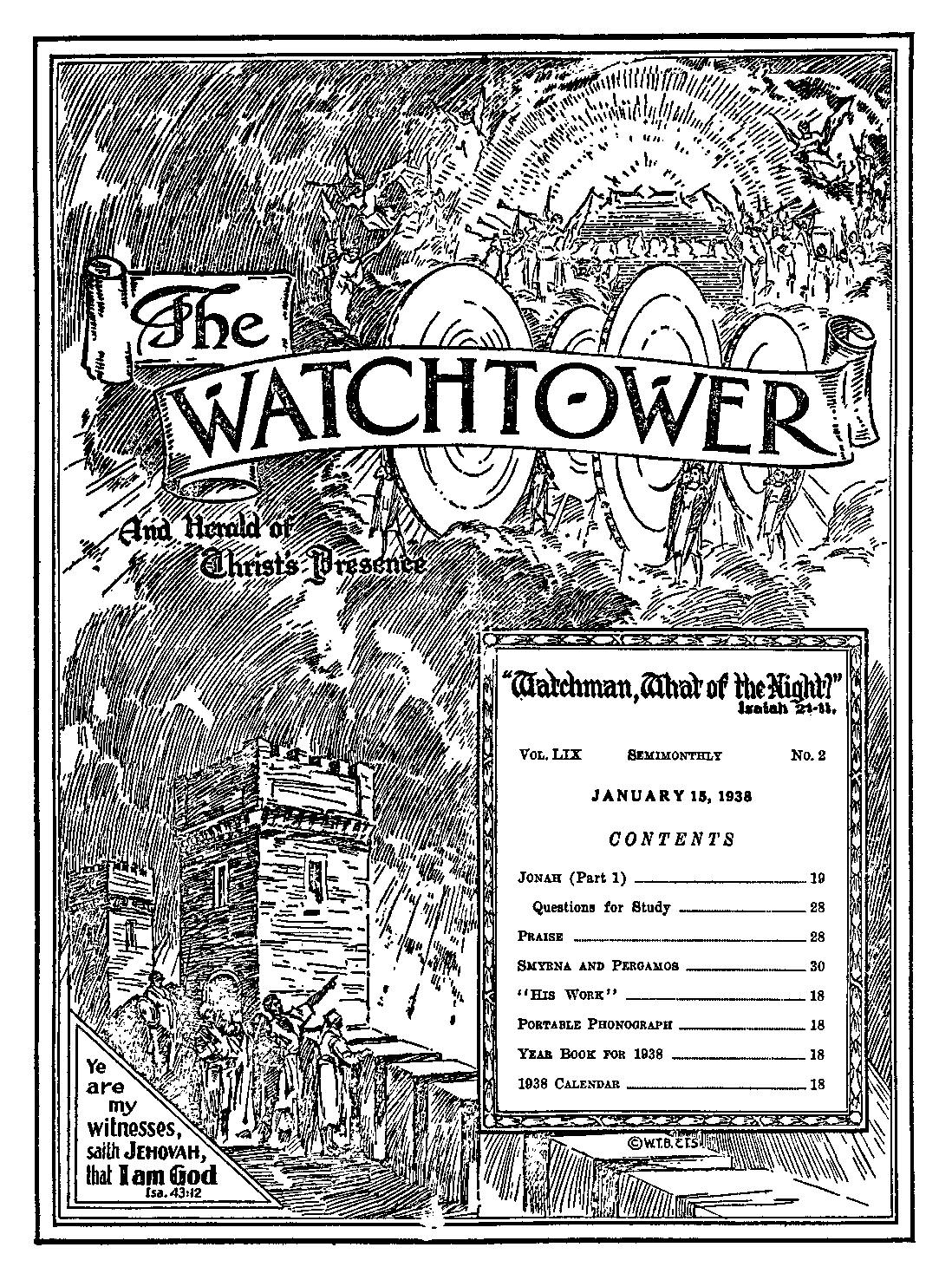
The Watchtower, January 15, 1938
Download: PDF — The Watchtower, January 15, 1938
“HIS WORK”
The term “His Work’’ applies to the nine days, February 5 to 13 inclusive, as the next period of special united testimony by all those who delight in Jehovah. It will feature the combination of the two latest books, Enemies and Riches, to be placed with all contributors of 50c. This testimony, taking place in midwinter, will require considerable planning and arranging, and all who give a part in Jehovah’s “strange work’’ first place will arrange all that is due. Detailed instructions appear in the Informant; which you should study and closely follow. Let each worker render a faithful report at the end of the period.
PORTABLE PHONOGRAPH
The Society now manufactures and has to offer a light-weight phonograph, which is 14 by 13 by 5 inches in size, and covered with brown cloth and having rounded corners. It weighs 9 pounds 13 ounces. With the three phonograph discs which can be carried in it, it weighs 12 pounds 6 ounces. The volume of sound is strong, and the tone is of the best quality. As shipped out from our factory, the phonograph is timed properly, at 78 r.p.m., and should be checked from time to time. This model, including three discs, is offered on a contribution of $10.00; without the three discs, $8.00. Remittances should accompany orders. Also specify the particular discs wanted.
YEAR BOOK FOR 1938
The Year Book for 1938 embodies the features that have made the issues for previous years so valuable to all who declare themselves on Jehovah’s side and who are actively interested in and participating in the publishing of his name and his kingdom. The president’s report contained therein gives an accurate and comprehensive account of the state of the Lord’s work in the various lands throughout the earth, showing in considerable detail the activities and efforts put forth during the service year just ended and the results thereof. Then there is the year text for 1938 and a pointed comment thereon. This, together with well chosen daily texts and explanatory comments thereon from The Watchtower, makes this Year Book one of everyday help and use for all the Lord’s faithful. The edition is limited; hence the contribution of 50c per copy.
1938 CALENDAR
The text for the calendar year 1938 is: ‘Be not afraid: the battle is God’s.’ (2 Chron. 20: 15) The calendar art picture was specially painted to fit this text and beautifully illustrates it and its action. Beneath the picture on the calendar base appears a letter from the president of the Society setting forth the several united service periods for the year and serving as a ready reference for the kingdom publishers. The calendar pad also indicates the dates of these testimony periods. Company servants should send in a combination order for all wanting calendars. Remit, with order, at 25c each, or $1.00 for five.
Vol. LIX
January 15, 1938
No. 2
JONAH
“The fear of man bringeth a snare; but whoso putteth his trust in the Lord shall be safe.”—Prov. 29: 25.
PART 1
JEHOVAH caused his faithful servants of old to record in his Word that which he purposed to perform in future years. Those faithful men acted under the direction of God and spoke and wrote, not the will of any creature, but as they were “moved by the holy spirit” of the Almighty God. (2 Pet. 1:21; 2 Sam. 23:2) Those men were the willing servants of Jehovah God, and they performed service for the benefit of others who lived after them. Nor did those faithful men know just why they thus spoke or wrote, although they searched diligently in their efforts to know. They knew only that they were doing according to the will of God, announcing his favor that should come to others after them; and that was all that was necessary for them to know. They obeyed gladly. It is written that “the spirit of Christ . . . was in them” (1 Pet. 1:11); which means that they were unselfish in God’s service, moved by love to do always his will. This is the criterion that serves well for the remnant to now follow. It is the spirit of Christ that holds the remnant together, and that same spirit moves them to joyfully do the will of Jehovah God. If the servant of the Lord fears to do God’s will because of what man might do to him, that fear is certain to bring him into a snare. If he fears God and trusts him implicitly, he is always sure to have Jehovah’s protection.
2 Now the Lord Jesus is at the temple of Jehovah, having gathered unto himself his “faithful and wise servant”, and there He enlightens the servant by unfolding the prophecies of God long ago written. Thus he does as the representative of Jehovah; and now the servant in the temple beholds the glory of God through the revelation of his purpose, and the faithful appreciate this today as it never before was possible for any creature on earth to appreciate these things. The more the faithful study the prophecies, the more they are impressed with the great truth that such prophecies were written in the ages past for the aid and comfort of God’s people now on earth, and which comfort they so much need in this evil day. Some of the faithful company have been in the narrow way for many years, while others have recently entered that blessed way, and all of the servant company now “filled with the knowledge of his will in all wisdom and spiritual understanding” are striving to be “fruitful in every good work” and to ‘increase in the knowledge of God’, that they may more efficiently give attention to the kingdom interests committed into their keeping; and thus they show forth the praises of him who has called them out of darkness into his marvelous light. Therefore the servant appreciates as never before the force of the prophetic words: “Thy word is a lamp unto my feet, and a light unto my path.” (Ps. 119:105) To them the Word of God is meat and drink, and the knowledge and understanding thereof fill them with joy.
3 Now the servant company clearly sees that all the prophecies of God point forward to the gradual development and to the complete establishment of his kingdom under Christ, which means that soon that righteous government, resting upon the shoulder of Christ Jesus, shall bring to the people peace and salvation, and, above all, will redound to the everlasting vindication of Jehovah’s word and name, clearly demonstrating to all creatures that there is but one true and almighty God, whose name alone is Jehovah, and who is the complete expression of unselfishness. Furthermore, the “faithful and wise servant” now more keenly appreciates the fact that the earthly interests of the glorious kingdom are now committed into their hands and that it is their great privilege to put forth every possible effort to advance those kingdom interests. While they see that salvation to everlasting life is the greatest blessing that can come to an individual creature, they can also clearly discern that the paramount purpose of the kingdom is to convince all creation of the majesty, glory and supremacy of Jehovah and that their own faithfulness in giving closest attention to the “goods” committed to them fully insures those of the servant class that they may have a part in the vindication of the name of the Most High. Therefore the kingdom is of the greatest importance. This glorious prospect set before the servant company induces the members thereof to solemnly determine that by the grace of God nothing shall cause them to cease their unstinted service to the King. No creature, male or female, shall be permitted to stand in the way of faithful and continuous service to the Lord and his kingdom, and that regardless of the supposed obligation one creature has toward another. Nor shall wicked angels or the Devil himself stop their forward movement. Beset with great persecution and suffering bodily pain, and with death staring him in the face, the servant will not permit any of these things to deter him in his loyal and faithful devotion to the King and kingdom. There is nothing worth while to be compared with the kingdom, and anything presented before the servant and which tends to interfere with his faithful service must be spurned and pushed aside. To everything else he is blind; as it is written: “Who is blind, but my servant? or deaf, as my messenger that I sent? who is blind as he that is perfect, and blind as the Lord’s servant?’’—Isa. 42:19.
4 With the faithful servant of the Lord it is the kingdom first, last, and all the time. As the apostle Paul said, so say all of the servant company: “This one thing I do”; and in doing this he shows himself dependable, reliable, trustworthy, and faithful and true. In the performance of his duty the servant is thrilled with joy, and amidst the strongest opposition he continues to push forward, proclaiming the name and singing the praises of Jehovah and his King. As he goes forward the Lord continues to unfold to the vision of the servant company His prophecy, and this he does in order that those of the remnant may “through patience and comfort of the scriptures . . . have hope”.
5 During the past few years and since the coming of Christ Jesus to the temple the Lord has been pleased to reveal to his people the meaning of his prophecies, thus proving to them the foregoing precious promise. Now it appears to be the will of God that those who love and serve him may have a vision and an appreciation of the prophecy of Jonah and that this, when understood and appreciated, will have the effect of bestirring the faithful to greater energy in the performance of duty. It has been observed that Jehovah has often permitted his faithful people to have some part in the fulfillment of prophecy and sometime thereafter he gives to them a knowledge and an appreciation of the meaning thereof. That appears to be true with reference to the prophecy of Jonah, which, by the grace of the Lord, is here considered.
6 The name “Jonah” means “dove”, and the name’s being given to him by Jehovah of itself proves that it is significant. The first mention of the dove appears at Genesis, the eighth chapter, in connection with the abating of the waters of the deluge. Jesus referred to himself as “greater than Jonah”. (Matt. 12:41, A.R.V.) When the child was presented at the temple of God, his name was called Jesus, and at that time there was offered ‘a pair of turtledoves, according to the law of God’. (Luke 2:21-24) At his baptism the holy spirit, dove-like, descended upon the Lord Jesus, when God acknowledged him as his beloved Son. (Matt. 3:16) In symbolic phrase the eyes of Jesus are said to be “as the eyes of doves”. (Canticles 5:12) When his church is gathered unto him, Christ Jesus speaks of her as “my dove”. (Cant. 6:9) The Scriptures symbolically speak of the dove as swift in movement (Ps. 55: 6); as dwelling in security high up in the rocks (Jer. 48:28) ; and the Scriptures also refer to the dove as in a state of humiliation. Referring to God’s faithful servants, the psalmist speaks of them as being in a state of humiliation and then adds: “Yet shall ye be as the wings of a dove covered with silver, and . . . [shimmering (Rotherham)] gold.” (Ps. 68:13) Jesus directed his disciples to be as “harmless as doves”. (Matt. 10:16) It should be expected, therefore, that Jonah, at some time, pictured or represented the faithful followers of Christ Jesus, particularly the remnant or faithful servant class now on the earth.
7 Jonah was the son of Amittai; which name means “truthful”. Christ Jesus and his church are the sons of him that is “holy and true”. (Rev. 6:10) Jehovah God is the Father of Christ and his church: “ Of his own will begat he us with the word of truth.” (Jas. 1:18) Jonah, to be sure, was a mere man and was used to play parts in a prophetic picture made by Jehovah to foreshadow his purpose in the preparation for and development of his kingdom, and more particularly referring to the work that precedes the setting up of the kingdom. At some points in this prophetic picture Jonah represented the Lord Jesus, and at other points the faithful remnant; while at other places he pictured those and played the part representing those who agree to do the will of God and who then become murmurers, manifesting the “elective elder” spirit. The pictures made and appearing in the prophecy of Jonah disclose the Devil’s organization, particularly the political and commercial elements, as well as the religious element thereof, and show the faithful servant commissioned and sent forth to give warning to the men of that organization. It also discloses the people of good will who are held in subjection to Satan’s organization and which people have a desire for righteousness, and further shows that the remnant, the witnesses of Jehovah, are commissioned and sent forth to warn, instruct and aid such persons of good will, which people, giving heed to the warning, become the “great multitude”. It discloses also the “faithful servant” class, commissioned and sent forth to declare the “day of [the] vengeance of our God”, and discloses that this work must be done and completed before the battle of the great day of God Almighty. While much of the prophetic picture has now been fulfilled upon the earth or is in course of fulfillment, the prophecy is “meat in due season” for the household of faith and given for the comfort of such. Those who love to serve God will study the prophecy with keen interest, and its careful and prayerful study is recommended to all such. The prophecy discloses pitfalls along the way of God’s consecrated people, and the information now enables them to more clearly see their privilege and duty of fearing God and serving him devotedly at all times.
8 Jonah was commissioned by Jehovah and commanded to perform a certain specific service: “Now the word of the Lord came unto Jonah, the son of Amittai, saying, Arise, go to Nineveh, that great city, and cry against it; for their wickedness is come up before me.” (Jonah 1:1,2) The time of this command, when Jonah prophesied, appears to have been during the reign of King Jeroboam, who was of the third generation of Jehu, upon the throne, ruling the ten tribes. God had declared that the house of Jehu should reign for four generations after Jehu, and these successive reigns of his offspring were, to wit: (1) Jehoahaz; (2) Joash or Jehoash; (3) Jeroboam; and (4) Zachariah. The prophet Elisha lived after Jehu’s death and into the time of the reign of Joash, the second generation.—2 Ki. 13:14-21; 15:11,12.
9 Jonah the prophet is mentioned in connection with the reign of Jeroboam, the third of Jehu’s generations who ruled over the ten-tribe kingdom of Israel, to wit: “He restored the coast of Israel from the entering of Hamath unto the sea of the plain, according to the word of the Lord God of Israel, which he spake by the hand of his servant Jonah, the son of Amittai, the prophet, which was of Gath-hepher. For the Lord saw the affliction of Israel [by the Syrians], that it was very bitter; for there was not any shut up, nor any left, nor any helper for Israel.” (2 Ki. 14:25,26) Thus it appears that Jonah prophesied during or before the reign of Jeroboam and quite likely was acquainted and in touch with the prophet Elisha. It appears that Jonah was a Galilean of the tribe of Zebulun. He was the “son of Amittai, the prophet, which was of Gath-hepher”, and therefore he was under the ten-tribe kingdom of Israel. That part of Israel was then indulging in the Devil religion of worshiping the golden calves at the cities of Dan and Bethel and was therefore “an evil and adulterous generation”, being so described by the Lord himself. (Matt. 12:38-41) Gath-hepher was in Galilee. (Isa. 9:1; Matt. 4:15,16) The kingdom of the ten tribes continued in wickedness under the reign of Joash, the second of Jehu’s generations, as it is written: “And he did that which was evil in the sight of the Lord; he departed not from all the sins of Jeroboam the son of Nebat, who made Israel sin [in practicing the Devil religion of calf worship] ; but he walked therein.” (2 Ki. 13:11) Concerning the son of Joash it is written: “In the fifteenth year of Amaziah the son of Joash king of Judah, Jeroboam the son of Joash king of Israel began to reign in Samaria, and reigned forty and one years. And he did that which was evil in the sight of the Lord; he departed not from all the sins of Jeroboam the son of Nebat, who made Israel to sin.” (2 Ki. 14:23,24) Zachariah, son of Jeroboam, had a like record of wickedness. (2 Ki. 15:8-12) The descendants of these wicked kings had made no improvement at the time Jesus was on earth, and Jesus spoke of them in the vicinity of Galilee and said: “The men of Nineveh shall rise in judgment with this generation, and shall condemn it; because they [the people of Nineveh] repented at the preaching of Jonas; and, behold, a greater than Jonas [Christ Jesus] is here.” (Matt. 12:41) The Israelites did not repent, and they too were of a perverse generation, and Jesus thus spoke at Galilee, as shown by the record at Matthew 13:1.
10 The fulfilling of the prophetic picture recorded in the prophecy of Jonah-appears to be after A.D. 1914. It was in that year that Jehovah enthroned his King, Christ Jesus. There began “the day of Jehovah”, and hence the beginning of the time for the vindication of God’s word and name. (Kev. 11:16-18) The day for the vindication of Jehovah’s name having come, the time was then due for the message thereof to be declared to the nations. It was the duty of those in covenant with Jehovah to declare that his kingdom had come and the time for his vindication had arrived. For about forty years prior to that time, or since about the year 1874 (A.D.), the “Greater than Jonah”, as the Messenger and representative of Jehovah, had caused his devoted followers in the earth to preach to the so-called “spiritual Israel” (otherwise called the followers of Christ in “Christendom”) that the time was due for the King and his kingdom and that all should repent and give their allegiance to the Lord. “Christendom” proved to be exactly like the Jew religionists in refusing to hear and to repent, and instead continued to practice the Devil religion; and the words of Jesus apply to such more strongly than to the Jews, namely, “This is an evil generation: they seek a sign; and there shall no sign be given it, but the sign of Jonas the prophet.”—Luke 11:29.
11 Jehovah having placed his King, Christ Jesus, upon his throne in the year 1914, thereafter God’s vengeance must come upon Satan’s organization. At that time applies the scripture: “The nations were angry, and thy wrath is come.” (Rev. 11:18) His wrath must be not only upon this so-called “spiritual Israel”, that practiced the Devil religion, but upon the political part of the nations or Satan’s organization, pictured in the prophecy particularly by the second world power, Assyria, of which the city of Nineveh was the capital or metropolis. In the great antitypical city, that is. the Devil’s organization, there were then some persons of good will whose lives were in danger, they being no part of God’s organization, nor in fact a part of Satan’s organization, but held in subjection by the Devil and by his representatives on the earth. For the interest of these people of good will God makes provision.
12 Prior to and for some time after A.D. 1914 the consecrated servants of the Lord on the earth were chiefly interested in looking for and attempting to gather a spiritual class who had made a covenant with God by sacrifice. (Ps. 50:5) They understood that their work was to gather what they called the “wheat” class, and therefore the consecrated put forth their efforts to that end and were convinced in their own minds that they were gathering such to the Lord. As to the others of mankind, they were left to themselves in so far as surviving the time of trouble or Armageddon was concerned. Such persons were not consecrated ; and as the servants of the Lord believed and preached that such persons would get ‘restitution blessings’ after Armageddon, and that then would be the proper time to look after them, so they reasoned, Why bother about them now ? That well described the attitude of the Jews toward the people of Nineveh in the time of Jonah.
13 Nahum’s prophecy is directed against Nineveh, but the record does not disclose that he went to that city and delivered his message. The prophet Jeremiah sent a written message of the Lord by the hand of Prince Seraiah to the city of Babylon to be read publicly there, and it was for the benefit of the people of Israel who were captives in that land. (Jer. 51: 59-64) With Jonah it was different. To him Jehovah said: “ Arise, go to Nineveh, that great city, and cry against it.” Jonah was commanded to leave his native land, where he was serving amongst his own people, and go to a heathen people, who were not in a covenant with God. It appears that that was a disagreeable task for Jonah. It was like the command (and which was disagreeable) that the Lord gave to Peter to go and preach the kingdom message to the Gentiles. (Acts 10:27,28) Jonah did not feel disposed to go to Nineveh.
14 During the Elijah period, from 1874 to 1914, the consecrated servants of the Lord on earth sought out only those disposed to make or who had made a covenant by sacrifice, and such they sought to find in the midst of the religious or so-called “church” organizations. The servants of the Lord had no thought then of proclaiming the message of the kingdom to a people of good will who would look for life on the earth and who would be spared during the battle of the great day of God Almighty and who would ultimately form the great multitude. They said little or nothing about the coming time of trouble. As one leading spirit in the work at that time stated from the platform: “We say little about the time of trouble because the people have enough trouble now.” That the witnesses for Jehovah must do such a work of proclaiming the day of God’s vengeance and warning to others is clearly shown by the commission given by Jehovah in these words: ‘to declare the day of the vengeance of our God and to comfort all that mourn.’ (Isa. 61:1,2) Otherwise stated, with the coming of the King the commission laid upon those devoted to the Lord was to begin toe proclamation of God’s vengeance against Satan’s organization and to give warning, that others might find safety and find it only in the Lord’s organization.
15 Jonah received a specific commandment to go to a heathen or non-Jewish city and there to warn the people of the coming disaster about to fall upon that city, and to do so that those who would repent might find a place of protection and safety. Nineveh at that time had never taken any of the Israelites captive and transported them to that country. For that reason there was no Israelite at Nineveh to receive a warning, and therefore the warning was specifically for non-Jews. Without a previous example as a guide, and seemingly without justification of doing such work, the task appeared to Jonah to be very difficult and a very hard one upon him. It was his duty, however, to be obedient to the Lord. It must be kept in mind always, however, that Jonah is not to be blamed, because he was merely a man playing a part in a prophetic picture. This particular part of the picture foretold the witnesses of Jehovah in the day of Jehovah being directed or commanded to give warning to the people of good will that they might ultimately find safety and be gathered into the great multitude. Jehovah did not send Jonah to Nineveh for the purpose of having the people there circumcised, nor to proselyte them and bring them into the Jewish crowd. Manifestly God’s purpose in sending Jonah to Nineveh was to contrast the faith of his covenant people with that of a heathen people, which latter would show greater faith upon less information coming to them; and today it can be seen that that is exactly what is made known amongst many of those who are consecrated, as compared with people of good will who hear the truth for the first time. The Israelites, who had sworn to do God’s will and obey his commandments, had not repented and would not repent and amend their ways upon receiving the warning and message of God; and now Jehovah would prove that even a heathen people, when learning the truth, would show more faith in Jehovah than the Israelites showed, and would repent and seek the way of righteousness, even at the warning or preaching of a foreigner, and of a Jew at that. The people of Nineveh did show greater faith than the Jews. Today some of the Jonadabs show greater faith than many of the prominent ones supposed to be of the “servant” class.
16 Years after Jonah had been sent to Nineveh an army officer, presumably a non-Jew, came to Jesus and gave evidence of his faith in the Lord, and Jesus said of him: “Verily I say unto you, I have not found so great faith, no, not in Israel.” (Matt. 8:10) All these examples demonstrate the fact that some become careless and indifferent and show a lack of faith in God and in Christ after so much has been done for them. The fact that the people of Nineveh did show faith in God when they heard his message should have put the Israelites to shame because of their lack of faith. But it appears to have had the very opposite effect, and they became offended that God showed any interest or gave any attention toward the heathen that had not come into the camp of the Israelites. Likewise “ Christendom”, the religionists, are offended that God should show any favor toward those who do not become members of their respective so-called “church” organizations. The same spirit is manifested by those of the “elective elder” class, who think themselves better than others and hold themselves aloof from those who come to a knowledge of the truth and who are supposed to be in the Jonadab company.
17 Nineveh was the capital city of the ancient empire of Assyria. The name means “dwelling of Ninus”. Ninus is Nimrod, the son of Cush or Belus. Nimrod, after he had built Babylon, extended his domain to Assyria and built Nineveh and other cities. (Gen. 10:11; see book Prophecy, page 146) The Lord in his Word describes it as “that great city”. Historical writers claim that the distance around its walls was sixty miles, showing that it covered a large area. Concerning that city it is written in the prophecy: “Nineveh was an exceeding great city of three days’ journey,” and in that city there were “more than sixscore thousand persons that [could] not discern between their right hand, and their left hand”. (Jonah 3:3; 4:11) No doubt it appeared to Jonah as a very great task for one lone man to go and try to accomplish anything in that great city, and, furthermore, he would not receive much honor by going there at all.
18 Jonah had been preaching among the Jews, and no doubt had what he thought quite a good reputation amongst them. Likewise prior to 1914 Jehovah’s consecrated servants on earth had specialized on preaching amongst the religious systems of the land called “Christendom” and had directed their darts chiefly against the clergy, and these prominent servants in particular regarded themselves as men of some reputation among the people. With the coming of the “day of Jehovah”, in 1914, God would have his servants declare the day of his vengeance against all parts of Satan’s organization, including the political systems, which element for a long time had been ruling as the representatives of the Devil. Nineveh stood for the political element of Satan’s world organization, and likewise the political element filled a similar place with the coming of the King. The message declaring “the kingdom of heaven is at hand” and that such kingdom must override and supplant all other kingdoms of the world, made the issue quite a political one, and the proclamation of such a message afforded an excuse for the enemies to falsely charge that God’s faithful servants are Communists. They have done that very thing. God’s time having arrived to have his vengeance declared against all nations, that must be done, and, to be sure, the proclamation of that message would bring down upon those who proclaimed it the indignation of all the elements of Satan’s organization, including the political element. If Nineveh was to be destroyed, then that city must be advised of its impending doom and the people informed of the cause of its downfall, in order that Jehovah’s Word might be vindicated when the fall came. Therefore Jonah was commanded to “go to . . . that great city, and cry against it”. Likewise with the beginning of Jehovah’s day the time for the destruction of “Christendom” drew nigh, and before that destruction takes place Jehovah’s witnesses, at his command, must go forth and declare, ‘The doom of “Christendom” is impending,’ and also announce God’s reason for its destruction, in order that when the fall takes place the Word and name of Jehovah will be vindicated. Also the proclamation affords the opportunity for all persons of good will to hear and believe the truth and to flee to the place of protection, which God has provided for such. In sending Jonah to Nineveh, therefore, God made a clear and distinctive picture relative to the duties laid upon his consecrated servants at the beginning of the day of Jehovah.
19 Nineveh was a very wicked city and, says the scripture, “their wickedness is come up before me.” That means that Jehovah was giving attention to the wickedness of that people. That wickedness did not consist of assaults committed by the Ninevites upon the Israelites, for the reason that in the day of Jonah the people of Nineveh had not made any offensive move against the Israelites. At least fifty years after Jonah's prophecy the Assyrians or Ninevites committed their first assault upon the Israelites. (2 Ki. 15:19,20) Later the Assyrians assaulted Jerusalem, during the reign of Hezekiah. (2 Ki. 18:9-37) This shows that the wickedness in Nineveh against which Jonah was commanded to declare God’s vengeance was the general wickedness that prevailed in that city, and which the Ninevites had carried to the extreme. (Jonah 3:8) Compare this fact with the further facts that prior to 1914 the politicians or political rulers of “Christendom” made no particular effort to persecute Jehovah's people who were engaged in the Elijah work. No one was arrested then because of going from house to house and preaching the gospel. The political elements regarded such preachers as another group of religionists, and paid no attention to them. However, those political elements were guilty of much wickedness because forming a part of Satan’s organization and practicing great unrighteousness. Therefore their time was up with the coming of Christ Jesus to the throne in 1914, and they must be warned. That marked the end of the time when Satan should act as the invisible ruler of this world and continue to do so without interruption. (Luke 21:24) Sodom and Gomorrah were similar cases. (Gen. 18: 20-23; 19:1-25) It clearly appears that Jehovah always gives notice before executing his vengeance against his enemies. That rule was followed with reference to Nineveh.
20 God sent Jonah to give warning to the people of that city and to provide an opportunity for those who desired to do right to get in the right way and find the way of escape. Surely there were some people in that wicked city of Nineveh who desired righteousness but who were entirely ignorant of the right way to go. Likewise a condition similar was found in “Christendom”. With the coming of the Lord Jesus as King in the year 1914 the whole world was under the dominating control of Satan, he operating chiefly through his religious agents, and the people were in the dark as to the means of escape or fleeing to a place of safety and being protected at Armageddon. About the time of the coming of the Lord Jesus to the temple the warning began to be sounded in ‘‘ Christendom ’’, but that matter was not then understood even by the consecrated. On February 24, 1918, for the first time the message, “The world has ended, millions now living will never die,” was publicly proclaimed; but those proclaiming that message did not then understand its real purpose. It was then thought that the time for ‘restitution’ was at hand. It was not then understood to be a definite effort to make known to the people of good will that God would provide security and protection for them during Armageddon and that such would form the “great multitude”. Not until years afterwards did God’s consecrated people on earth understand that the great multitude is not a spiritual class. This is another evidence that God has his message declared in due time regardless of whether the ones declaring it understand the reason or not. The servants of the Lord, who are always anxious and willing to obey God’s commandments, He will guide, and cause them to do the right thing. Jonah was commanded to go to Nineveh, and it was his duty to obey and leave the result entirely in the hand of the Lord. This shows that when God’s consecrated people are commanded to do a particular work, they should know nothing short of complete obedience. Do it as commanded and leave the result entirely with the Lord.
21 It appears that Jonah desired to maintain what he thought was his good reputation amongst the Israelites, and, fearing that he might lose this, he sought to escape the responsibility that God had placed upon him, and therefore he did not obey and go to Nineveh as commanded. “But Jonah rose up to flee unto Tarshish, from the presence of the Lord, and went down to Joppa; and he found a ship going to Tarshish; so he paid the fare thereof, and went down into it, to go with them unto Tarshish from the presence of the Lord.”—Jonah 1: 3.
22 Apparently Jonah was relying on the grace and mercy of God to save the Ninevites in his own good way, and so Jonah concluded that if he went to Nineveh and preached to them that they were to be destroyed, such would not come to pass, because of God’s great mercy. Therefore Jonah would reason that if he went to Nineveh and did as commanded, he would become a laughingstock to the heathen people and likewise to the Jews at home, and would be greatly ridiculed and humiliated and thus lose his reputation. So Jonah concluded he would not go to Nineveh. That his reasoning or excuse was as here stated is shown by his own words uttered later: “And he prayed unto the Lord, and said, I pray thee, O Lord, was not this my saying, when I was yet in my country ? Therefore I fled before unto Tarshish: for I knew that thou art a gracious God, and merciful, slow to anger, and of great kindness, and repentest thee of the evil.” (Jonah 4:2) His state of mind and course of action have found many duplications amongst men who think themselves to be prominent in God’s service.
23 Instead of obeying God’s commandment, Jonah tried to flee to Tarshish, a city situated in the land now known as Spain and then located at the far west end of the Mediterranean sea and directly opposite from Nineveh. No one seemed to know much, if anything, about what lay west of the “great pillars of Hercules”, that is, the rock of Gibraltar, and so Jonah sought to go about as far as man was supposed to be able to go in those days. He would rather start in a new country on his own hook than to go where commanded and then get ridiculed by the people at home as well as the people of Nineveh. Jonah’s action cannot be construed as meaning that he forsook God and desired to take up a form of heathen worship. Had such been Jonah’s purpose, God would not have shown mercy to him later and miraculously saved him and given him further service. Had Jonah been unfaithful in that he had turned wholly to Satan, God would have abandoned him entirely to destruction. It was manifestly the commission that God had placed upon him that he did not want to obey, and that for fear of what men might say about him, that is to say, the losing his reputation and being ridiculed. He therefore sought to escape by going to the far west. It may be reasonably concluded also that he feared that the people of Nineveh would regard his preaching of coming destruction as a threat that the Israelites, under the direction of their God, would make war upon the Ninevites, and that the Ninevites, hearing this, would organize their army and prosecute a campaign against Israel, and Jonah would be charged with stirring up strife. Here is a clear case in which man leaned to his own understanding and did not trust and acknowledge Jehovah God. The proverb states the situation clearly, that the fear of man leads one into the snare of the Devil. When one undertakes to serve the Lord, and then hesitates, fails or refuses to do so because of fear of what man might do to him or what might befall him from men by reason of his faithful service, such a one is absolutely certain to get himself into a bad position. The Lord was making this clear in the picture, and now reveals it in order that his people may be instructed fully in the right way.
24 Instead of obeying God, Jonah went down to Joppa, a seaport town of Palestine, situate on the east end of the Mediterranean sea. Joppa means “beauty”, and may well represent what some of the consecrated sought to be and to do in 1918, when they thought it well to be near to the people (representing the “sea”), and thought themselves in appearance to be very beautiful and sweet, and hence not to stir up any criticism of themselves or cause the people to become indignant against them. The World War was on from 1914 to 1918, and the preaching of God’s kingdom and of his vengeance against the world organization of the Devil afforded an excuse and opportunity for the clergy to enlist the political and commercial elements to join them in the persecution of God’s people, and this caused many of those consecrated to fear losing their good name and reputation, if not their very existence. Harsh criticism, ridicule and persecution did not look good to them, even though some of the consecrated did go to prison for obeying the Lord’s commandment. At that time many of the Elijah-time consecrated insisted that nothing should be said about the coming trouble or the derelictions of the clergy, and the politicians and financiers, but, to use their own language: “We should speak about love and be kind and considerate to everyone, and induce everybody to believe and see that we have walked with Jesus and learned of him.” Such was a slander on the name of Jesus, but they did not know it, evidently. Jesus was not sweet with the hypocritical clergy when it came to trimming them, and he did it in such emphatic phrase that there could be no doubt about his purpose, and he did it in obedience to his Father’s will.
25 Jonah went to Joppa to find a way to escape his duty and to save his good name. Not all of God’s people sought to escape the responsibility in 1918. In the face of threats of arrest and severe punishment some continued to push on in making proclamation of the King, and in the proclamation of the kingdom message and the vengeance of God, and to that end such literature as The Finished Mystery and Kingdom News was widely distributed. While that message was chiefly against ecclesiastics, it was also directed against the political element and afforded that element an excuse and opportunity to take a hand in the persecution and to put in action stringent measures to hinder the proclamation of the truth. In that time some remained faithful and true to the Lord, while others became unfaithful, and all of them came under the strict surveillance of the political, religious element ruling the land. There were some righteous and faithful ones amongst the ancient Israelites, such as Daniel, Shadrach, Meshach and Abednego, Jeremiah and others, but that did not save the entire city of Jerusalem from going into captivity. So likewise, during the World War, the faithfulness of a few did not prevent the entire company of God’s people from going into captivity. Taking the consecrated as a whole at that time, they got away from their God-given commandment and, like Elijah, they fled and became inactive. (1 Ki. 19:1-3) Those who because of selfishness and a desire for ease did not favor a positive stand against all political systems and the religionists cared chiefly for themselves and their own good reputation and edification of themselves, and to prepare themselves to go to heaven without further work; and so they argued: “Let us be sweet and talk sweet, and see that we do not say anything that might offend the rulers.” They regarded the political rulers as the “higher powers”, and in this, of course, they were wrong. Others who were weak in faith were influenced by such arguments and, being fearful, they fled also, while a few insisted on standing firm for the kingdom. The result was that the entire work of preaching the gospel was greatly hindered, and with that God was displeased. (Isa. 12:1) The fact that God later continued and has since continued to show his favor to his people proves that they had not become entirely unfaithful and repudiated the blood of Christ Jesus and the kingdom, but were yielding to fear of what man might do to them.
26 When Jonah started on his flight he did not go northwest to Tyre and there attempt to board a ship, but he went down to Joppa and found a ship going to Tarshish, which city of Tarshish did a large commercial business with the mother city of Tyre, which latter city was somewhat in the direction of Nineveh: “Tarshish was thy merchant by reason of the multitude of all kind of riches; with silver, iron, tin, and lead, they traded in thy fairs. ”—Ezek. 27:12.
27 Jonah paid his passage charges and went aboard the ship, and thus used his money not in the service of Jehovah, but he gave his money to the commercial traffickers, that is, patronage to them; which might well represent salving the commercialists in later days for personal favor. Those who fled during the World War from the Lord’s service thought it well to appease the wrath of the money-changers and political gangsters by using their money to buy war bonds and otherwise carrying flags and showing their devotion to Satan’s organization.
28 Jonah did not let his light shine as God had commanded him. He attempted to flee “from the presence of the Lord”. The facts corresponding to his action are these: During the World War there was a sidestepping of duty which God had laid upon his people. The kingdom interests were of greatest importance, and to side-step this and avoid the obligation of obeying the commandments of God was an effort likewise to flee from the presence of the Lord. To compromise or soft-pedal the message of the Lord and, instead, to talk “sweet and soft-like”, and to be silent about the kingdom, and especially about God’s announced vengeance against all of Satan’s organization, was also an effort to flee from the presence of the Lord. The World War was in fact a commercial war, although the religionists raised and loudly proclaimed the slogan that ‘the war was to make the world safe for democracy’. Any person who dared stand firm for God and his kingdom under Christ was regarded by the war advocates as a person of no reputation, the scum of the earth, and worthy only of imprisonment or destruction. The fact is, the religionists then, by conspiracy, framed prosecution against some of the faithful and caused them to be incarcerated in prison for a time, and until the war ended; and since then these same hypocritical religionists have howled against Jehovah’s witnesses and contemptuously point out those who did go to prison, calling them “jailbirds”. During the World War many of those professing consecration thought that by taking their place near the commercial and political elements, and being rather sweet and nice toward them and appearing to be entirely friendly, thus they could maintain their good name and reputation. Keep in mind that the prophetic drama of Jonah pictures the various elements, and not specifically individuals, that is, the various ones supposed to be the witnesses of the Lord.
29 Jonah no doubt thought he was safe from all harsh criticism and free to maintain his good name, when he got aboard that ship and sailed away to Tarshish. He was not at ease there long, however. Jehovah raised a great hurricane that lashed the ship“ But the Lord sent out a great wind into the sea, and there was a mighty tempest in the sea, so that the ship was like to be broken.” (Jonah 1:4) That hurricane was not for the purpose of driving Jonah unwillingly to obey, but mercifully to save Jonah from his wrongful course, and more particularly to make a dramatic picture to serve as a sign and a guide for the consecrated people in the day of Jehovah. The World War was not the great antitypical “great wind” or hurricane, because God did not bring on that world war. The “great wind” foreshadowed that which God brings about, because the record is: “Jehovah sent out a great wind upon the sea.” (A.R.V.) That foreshadowed the “war in heaven”, beginning by God’s anointed and enthroned King against Satan and his organization, the wicked demons in heaven. (Ps. 110:1,2; Rev. 11:17,18; 12:1-10) The effect of that war in heaven was the casting of Satan down to the earth and “to take peace from the earth”. (Rev. 6:4) When Satan was cast down to the earth, he began to bring woe after woe upon the peoples of earth, and he continues to do so. The people of the earth, alienated from God by reason of the practice of Satan’s religion, and supporting his commercial and political misrule, have since felt the great trouble and woe and are greatly agitated, even as the sea was agitated by the storm. In the spring of 1918 the Lord Jesus appeared at the temple of God clothed with all power in heaven and in earth, but he did not use that power to halt the World War merely to stop the nations from fighting amongst themselves, but that an opportunity might be had for Jehovah’s witnesses to proclaim his name in the earth. The World War had nothing to do with the wrath of God, which in due time will be exercised to the complete destruction of Satan’s organization.
30 During the World War there was a great agitation amongst the people, and many of those who had consecrated to do the will of God thought there would be no letup of that war but that it would lead straight on without a stop to the climax at Armageddon. But not so. There was yet a work to be done, and that work consists of giving testimony to the name of Jehovah according to his purpose and which must be done before he exercises his final wrath against Satan’s organization. This was shown in the prophetic picture of Jonah. There was a work for Jonah to do, and God would give him that opportunity.
31 It appears that the sailors who were manning the ship from Joppa were not Israelites, that is, those in covenant with God, but were men of the non-Jew nations employed by the commercial traffickers to row the ship. Being non-Jews apparently they had no knowledge of Jehovah, but, seeing how the ship was being lashed by the storm, they were greatly frightened. ‘‘ Then the mariners were afraid, and cried every man unto his god, and cast forth the wares that were in the ship into the sea, to lighten it of them. But Jonah was gone down into the sides of the ship; and he lay, and was fast asleep.”—Jonah 1:5.
32 No doubt those sailors were sincere men and desired to do the right thing as far as they knew it. At least they pictured a class of people who have a desire for righteousness. During the troublesome time of 1914 and onward the honest people of the various nations engaged in the war loved peace and righteousness and did not advocate or promote the war, and they did not willingly oppose God, and they were in great distress of mind. They knew that the religious crowd could not be enjoying the favor of God, because that crowd was unrighteous. Although claiming to represent Christ Jesus, the Prince of Peace, the clergy were howling that blood might be shed, and they used their so-called “church” buildings as recruiting stations. So these good people of the world, being in distress, greatly desired relief, and, as did those sailors propelling Jonah’s ship, ‘every man cried to his own god’, that is, they sought peace and quiet from all sources, but, not knowing of Jehovah’s provision, they did not look to him to grant their desire. The ship being in distress, the sailors east overboard much jetsam, that they might save the ship. So likewise during the darkest days of the world strife, the common people who desired peace were willing to make much sacrifice to bring the trouble to an end, and therefore they threw into the sea their substance that peace might result, that is to say, they put their efforts forth at a sacrifice to bring about peace and quiet.
33 The record is that Jonah went down into the hold or “innermost parts of the ship” (R.V.) and there, thinking himself to be safe, he took it easy, went to sleep, loving to slumber. He was like a captive or prisoner in a cell. He was sleeping, like the “ten virgins”, who had expected the bridegroom to comebut became drowsy and went to sleep. (Matt. 25:1-13) During the latter part of the World War, and for some time after, the Lord’s consecrated people on the earth slept and remained inactive as to their privileges of service. Many of them said: “We will keep quiet and wait for the Lord to take us home.”
34 Jonah appears to have been the only paid passenger aboard that ship. The commander of the vessel, hearing the prayers and cries of his sailors, sought out Jonah to see what he was doing. “So the shipmaster came to him, and said unto him, What meanest thou, O sleeper? arise, call upon thy God, if so be that God will think upon us, that we perish not.” (Jonah 1:6) The commander would be the official representative of all the sailors, and there pictured the same class as mentioned in the scripture as “they that go down to the sea in ships” and experience great trouble and distress. (Ps. 107:23-27) The ship’s master or commander was at his wits’ end and, being at his wits’ end, he sought out Jonah and, finding him asleep, commanded him to get up and do something. This part of the picture shows that God would preserve his servant class on the earth during the time of stress that came upon them during the World War, and would bring them out that they might carry again his message to the people, and particularly point out to those of good will the right course of action to take; which people up to that time had been in the employ of Satan’s commercial organization and under the control of his political, religious crowd, because they knew nowhere else to go. Those people of good will cried for help, and were prisoners, such as described in the Scriptures (Isa. 42: 6,7), or, that is, they represented such prisoners.
35 Jonah at this point at rest and asleep, picturing God’s consecrated people on earth, being commanded to get up shows that the Lord in his due time commanded his consecrated people to arise and busy themselves in the Lord’s service to the end that those of good will might find the right way to go to Jehovah’s organization and there find protection and safety. The sailors in the ship, including the master, therefore picture the people of good will and honest heart, who desire to go in the right way, which way the Lord opens to them; and those who obey him constitute his “other sheep” and form the “great multitude”, which multitude in due time enters the service of the Lord and proclaims his Word and his praises. The fulfillment of this part of the prophetic picture required the Lord’s consecrated people to be awakened to their privileges; and so, in 1919, they were awakened, and when they got awake they were sent forth by the Lord to engage in his service. As Jonah was later given the opportunity to carry the message to the heathen of Nineveh, so were Jehovah’s witnesses awakened, in 1919, and t hereafter given the opportunity of bearing the testimony to the non-Judah class, that is to say, to those persons of good will who will form the great multitude. This work of proclaiming the message must be done before the wrath of God is expressed completely at Armageddon, and this fact is a further corroborative proof that the Lord’s people are engaged properly in his service in now carrying forward vigorously the work in which they are engaged.
36 To Jonah the ship’s master said: “Arise, call upon thy God, if so be that God will think upon us, that we perish not.” Thus the people of good will speak to Jehovah’s witnesses, because they see that the Almighty God, whom his consecrated ones serve, is the God of justice, the Father of mercies, and the Mighty One and only One to bring comfort. Those people of good will who ultimately form the great multitude, not being in a covenant with Jehovah and not knowing how they might approach God, seek information at the hands of the antitypical Jonah class, that is to say, God’s consecrated and commissioned people. The Jonadabs or people of good will, being prisoners who have been held in restraint by religionists, had not directed their prayers to Jehovah, not knowing of the privileges they might have. They have looked to the faithful servant class of the Lord for information that they might find and go in the right way. It is therefore the privilege and duty of Jehovah’s witnesses to render all possible aid to those persons of good will and to enable them to see the way of the Lord, and in doing this they must carry the message of the kingdom to such people and assist them to understand its meaning and encourage them to engage in the service of God and his kingdom. That this is their duty and privilege is made certain by the utterance of the Lord, to wit: “Thus saith the Lord, In an acceptable time have I heard thee [the Jonah class in the day of wrath], and in a day of salvation have I helped thee: and I will preserve thee, and give thee for a covenant of the people, to establish the earth, to cause to inherit the desolate heritages; that thou mayest say to the prisoners, Go forth; to them that are in darkness, Shew yourselves. They shall feed in the ways, and their pastures shall be in all high places.” (Isa. 49:8,9) “I the Lord have called thee in righteousness, and will hold thine hand, and will keep thee [in the time of storm], and give thee for a covenant of the people, for a light of the Gentiles [non-spiritual Israelites, pictured by the ship’s master and the sailors, and by the Ninevites]; to open the blind eyes, to bring out the prisoners from the prison, and them that sit in darkness out of the prison house. ” —Isa. 42:6,7.
37 This is further and strong evidence that Jehovah God will think upon those of good will toward him and will sec that those who obey his commandments shall not perish at Armageddon but may be spared and taken through that time of his great wrath. That prophetic picture at this point shows what a great privilege God has given to his remnant now on the earth, and also the weighty responsibility he has placed upon them, and that they cannot escape that responsibility by resting at ease. On the contrary, they must arise and do the will of God, as commanded, and carry the message of his name and his kingdom under Christ to all those who are of good will that they may find the way of escape and the place of safety. This and other prophetic pictures prove Jehovah’s great love and consideration for the remnant now on earth and that he caused all these things to be written aforetime in his Word for the aid and comfort and for the strengthening of the hope of his faithful witnesses. This prophecy of Jonah, as it continues to unfold before the eyes of Jehovah’s people, is an added incentive to them to energetically and actively engage in his service that the interest of God’s kingdom under Christ may be properly served and advanced and that they may have some part in the vindication of the name of the Most High.
38 Fearing what man might say about him and that he might become a laughingstock and be subjected to great ridicule and thereby lose his reputation amongst men, Jonah found himself, by reason thereof, in a very great dilemma. How could he escape disaster? and how could the ship be kept afloat?
(To be continued)
QUESTIONS FOR STUDY
1. How and for what purpose was divine prophecy provided? Did the prophets understand why they thus spoke or wrote? How does their action serve as a criterion for the remnant to follow?
2. How at the present are the prophecies serving the purpose for which they were provided?
3,4. What is now seen as to the purpose of the kingdom at present being established? How do those of the servant company regard their position, privilege and obligation in relation to the kingdom?
5. What gracious privilege for Jehovah’s faithful people is seen to have attended the fulfillment of prophecy? How do they regard their having had that privilege?
6, 7. Point out the significance of the name Jonah. Also of Jonah’s being the son of Amittai. Whom did Jonah represent in this prophetic picture, and how? What important matters are disclosed in the prophecy of Jonah?
8-10. Point out some facts of record showing when “the word of the Lord came unto Jonah”, and why he was given the command stated at Jonah 1: 2. When and how does the prophetic picture recorded in the prophecy of Jonah have fulfillment?
11. When does Revelation 11: 18 apply? Upon whom or what was God’s wrath or vengeance then due?
12. Show that the attitude of the Jews toward the people of Nineveh in the time of Jonah was prophetic.
13. Compare Jeremiah’s delivery of the Lord’s message to Babylon and the commission given to Jonah concerning Nineveh.
14. Compare the activities of the Lord’s consecrated servants in the Elijah period with what is required since the coming of the King.
15. Why did the commission given to Jonah seem to him a difficult task? Show that this was a part of the prophetic picture. What was God’s purpose in sending Jonah to Nineveh? What was foreshown in the response of the Ninevites to the warning given through Jonah?
16. What was foreshown in the attitude of the Israelites toward God’s favoring the Ninevites with a message from him?
17. Cite some facts of interest here concerning Nineveh. Compare the previous work done by Jonah with that which he was here commanded to do.
18,19. Explain the wickedness mentioned in Jonah 1: 2, and its ‘coming up before Jehovah’. Compare this with facts concerning the political element of “Christendom”.
20. Account for the condition of Nineveh, as calling for the warning given through Jehovah’s prophet Jonah, and show that the situation was prophetic.
21-23. Explain Jonah’s rising and deciding to flee to Tarshish instead of going to Nineveh, and his reason therefor.
24. Apply the prophetic fact of Jonah’s ‘going down to Joppa’ instead of doing as God had commanded.
25. Point out the fulfillment of the prophetic fact that the presence in Jerusalem of a few faithful ones did not save that city from captivity.
26-28. How and for what purpose have some of those pictured by Jonah ‘taken ship and paid their fare from Joppa to Tarshish’ instead of ‘going to Nineveh’ as God has commanded?
29,30. Explain that part of the picture recorded at Jonah 1:4.
31-33. Who were the mariners mentioned in verse 5? What was pictured by their position and action there recorded? What is seen to have been foreshown in the statement here concerning Jonah?
34, 35. What was foreshown by that part of the picture recorded at verse 6?
36, 37. Verse 6 here, in connection with Isaiah 49: 8,9 and 42: 6, 7, contains what instruction for the remnant as to present privilege and responsibility?
38. Account, then, for Jonah’s finding himself in this great dilemma.
…