The Watchtower, August 1, 1931
Download: PDF — The Watchtower, August 1, 1931
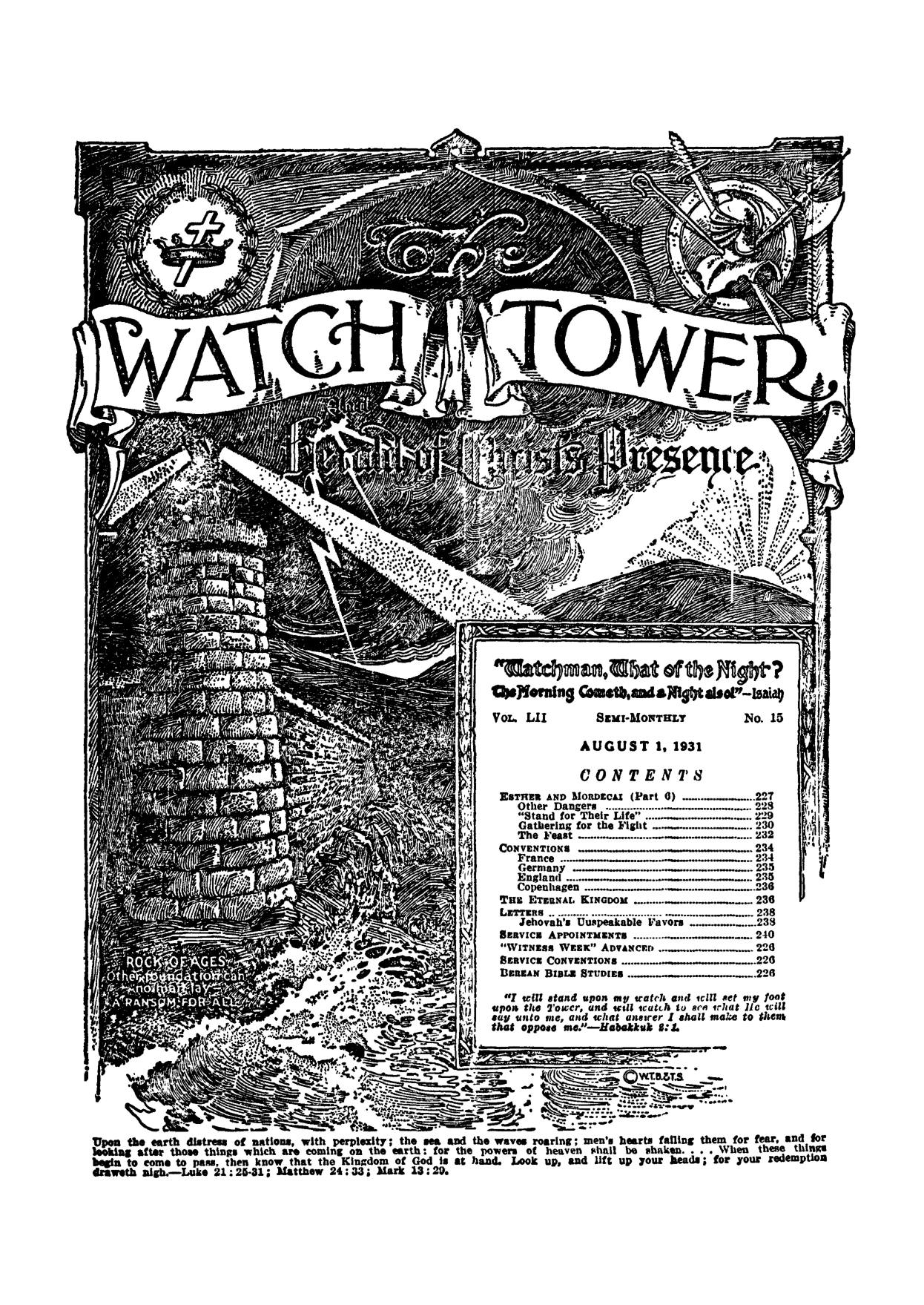
“WITNESS WEEK” ADVANCED
In the calendar for 1931 announcement is made of “Witness Week’’, August 29 to September 7. This special period of united action in bearing testimony to the praise of Jehovah among the people in all lands has been changed slightly, owing to the fact that the Columbus Convention occurs so late in July. “Witness Week’’ will be September 4 to 13 inclusive.
Vol. LII
August 1,1931
No. 15
ESTHER AND MORDECAI
“Ye lovers of Jehovah! hateyewrong. He preserveth the lives of his men of kindness, from the hand of lawless ones he rescueth them.”—Ps. 97: 10, Roth.
PART 6
JEHOVAH changes not; neither do his laws change. Being no respecter of persons he fixes his laws, and his creatures are rewarded according to their compliance therewith. When a creature is favored by receiving from the Lord the privilege of doing service to the Lord and then fails to show an appreciation of such privilege, or abuses the same, he is certain to lose God’s favor, and the privileges will be taken away from him and given to another. Haman had received great favors from the king and had the privilege and opportunity of using his substance for good. He did not appreciate his privilege. He had no gratitude or thankfulness for what he had received. He abused his privilege to gratify a selfish desire, and he lost everything. What he had was taken from him and given to another. “On that day did the king Ahasuerus give the house of Haman, the Jews’ enemy, unto Esther the queen. And Mordecai came before the king; for Esther had told what he was unto her. And the king took off his ring, which he had taken from Haman, and gave it unto Mordecai. And Esther set Mordecai over the house of Haman. ’ ’—8:1,2.
2 Jesus gave a demonstration of this same rule when he said: “Take therefore the talent from him, and give it unto him which hath ten talents. For unto every one that hath shall be given, and he shall have abundance; but from him that hath not shall be taken away even that which he hath.’’ (Matt. 25:28, 29) The same divine rule is shown in the case of Shebna and Eliakim. (Isa. 22:15-25; Watch Tower, 1928, page 197) Many have been given opportunities of serving God and his kingdom, and for selfish reasons have abused such privilege and have lost God’s favor, and that which they had received in the way of service has been taken away from them and given to another. This rule proves that everything done in the name of Jehovah that is pleasing to him must be done because of love for God. The very opposite of love is selfishness; and where the motive for service is selfish the service cannot be pleasing to God.
3 When Christ Jesus came for judgment at the temple of God he found a selfish class who had been serving God with a selfish motive; and the Lord removed their privileges from them, which they had enjoyed, and such formed the “evil servant’’ class. At the same time he found a faithful company who have been giving attention at the altar of the Lord because they love the Lord, and of these he constituted the “faithful and wise servant’’ class, and to this class he committed all of his goods, namely, all the privilege of service to the Lord on earth from the time of coming to the temple until Armageddon.
4 Mordecai and Esther were of the same family, thereby picturing those who are espoused to Christ and who are represented in the remnant. Mordecai pictures the class that was found faithful when Christ came to the temple for judgment, while Esther pictures that part of the remnant that the Lord has brought unto himself since the judgment began at the temple. The house of Haman was given to Esther after Haman was hanged; and this foreshadows that the privileges of those forming the “evil servant” class, and which they once had and enjoyed and might have continued to enjoy had they been faithful and true to God, were taken away from them and given to the class pictured by Esther. It is interesting to note at this point that those who have come fully into the truth since 1922 have joyfully and zealously entered the service of the Lord and have not been heard to murmur or complain.
5 Haman had enjoyed the privilege of serving close to the king. He was privileged to have the king’s ring with which to seal decrees or documents and which constituted them unalterable. He was, therefore, clothed with much authority and responsibility. He abused that privilege and selfishly used it to gratify his own wicked desires. Haman pictures the clergy in particular, and all others of those who with them were once in line for the kingdom and who enjoyed the distinctive privilege of speaking in the name of the Lord, and who abuse the privileges had and use the same to gratify self. This class includes the “evil servant” class, “the man of sin, the son of perdition.”
6 The privileges taken away were given to the “ faithful servant” class, represented by Mordecai, and to Esther, representing specifically the bride. This rule was again forcibly stated by Jesus to the Pharisees when he said: “Therefore say I unto you, The kingdom of God shall be taken from you, and given to a nation bringing forth the fruits thereof.”—Matt. 21: 43.
7 The Amalekites were the descendants of Esau who sold his birthright because of his lack of appreciation thereof and to gratify his selfish desires. Esau pictures the clergy, “the man of sin,” and all such like who fail to show an appreciation of what God has done for them and who treat God’s favor in a contemptible manner. The birthright once enjoyed by Esau was given to Jacob, who pictured God’s faithful people, that is, those who now constitute the remnant. Peter declared the same divine rule when he stood before his faithful brethren and said of Judas: “ For he was numbered with us, and had obtained part of this ministry. For it is written in the book of Psalms, Let his habitation be desolate, and let no man dwell therein; and his bishopric let another take.” (Acts 1:17,20) This is further proof that Judas foreshadowed the “evil servant” class, “the man of sin, the son of perdition.”
8 Preservation is sure only to those who love God, and love for God is proven by the full obedience of the creature to the commandments of the Lord and doing so with a proper and unselfish motive. At so many times and in so many places in the Scriptures God has stated and illustrated the unchangeable rule, in this regard in particular. It surely appears that many have been exceedingly dull of comprehension in failing to see and observe such rule. Their faculties have been dulled by selfishness in the heart. With this in mind, with what force are the words of wisdom: “Keep thy heart with all diligence; for out of it are the issues of life.”—Prov. 4:23.
OTHER DANGERS
9 The Scriptures support the conclusion, as hereinbefore stated, that the close relationship between the commercial, political and ecclesiastical elements of the world will be broken and the ecclesiastical element will be cast away and destroyed before Armageddon. (See Light 2, page 108.) But even after that the remnant will be in danger from other enemies, and must walk circumspectly and strictly obey God’s law, if they would be preserved. Bear in mind that Satan’s purpose now is to destroy the remnant, and he will continue to have and use earthly agents until Armageddon sweeps his power and organization completely away. God’s people must be prepared and be on the alert, that they may be sure of receiving the protection of Jehovah from these other enemies.
10 Esther had once risked her life by appearing unbidden before the king, and it became necessary for her to do so again. On the first occasion she had exposed the wicked work of Haman, which brought about his execution. Probably Esther thought that such was sufficient to arouse the king to the necessity of taking further action to save her people. The king had not taken any action to save the Jews, and this gave Mordecai and Esther much concern. Two months and more had passed since the hanging of Haman, and the day was rapidly approaching when the terrible slaughter that had been ordered by the king’s decree, which Haman had written would take place. It must be remembered that the laws of the Medes and Persians could not be changed. Whatever this part of the divine drama of Esther shows, it forcibly illustrates this fact: that God has purposed to permit the Devil to go his limit in wickedness until Armageddon, and that there he will clean out the Devil and his organization, and that until that time God’s witnesses on earth must continue to bear testimony to the Word and name of Jehovah. They must continue doing that which will merit their preservation by Jehovah and their deliverance from the enemy and his agencies, and this they must do even after the ecclesiastics are entirely out of the way. The fight will not be done until Satan and his organization are completely done.
11 Again Esther approached the king unbidden, but this time without the bait of a banquet. Before the king she prostrated herself and wept with deep emotion. “And Esther spake yet again before the king, and fell down at his feet, and besought him with tears to put away the mischief of Haman the Agagite, and his device that he had devised against the Jews.” (8:3) Ahasuerus then knew that Mordecai and Esther were of the same family, that both of them had rendered to him unselfish and valuable service, and the presumption must be indulged that he loved his queen. “Then the king held out the golden sceptre toward Esther. So Esther arose, and stood before the king.” (8:4) This was an invitation from the king for Esther to make known her request. This appearance before the king was evidently upon the advice of Mordecai, because he was either present or very near by at the time, as the facts show. The queen then spoke and said: “If it please the king, and if I have found favour in his sight, and the thing seem right before the king, and I be pleasing in his eyes, let it be written to reverse the letters devised by Haman the son of Hammedatha the Agagite, which he wrote to destroy the Jews which are in all the king’s provinces; for how can I endure to see the evil that shall come upon my people? or how can I endure to see the destruction of my kindred?” (8:5,6) Esther was willing to face death, but she would save her people.
12 Even though Esther requested the king to reverse the decree devised by Haman, that was impossible, because it had been written amongst the laws of the Persians and Medes, therefore could not be altered. (1:19) Likewise God has decreed that Armageddon shall be fought and that all Satan’s forces shall be gathered together against the people, and this is unalterable.—Zech. 14:1-3.
13 Some have foolishly deceived themselves and others by saying that all days of danger for the people of God passed with the ending of the World War. Be not thus deceived. God has also caused to be written by his prophet: “Prepare war, wake up the mighty men, let all the men of war draw near; let them come up. Let the [nations] be wakened, and come up to the valley of Jehoshaphat: for there will I sit to judge all the [nations] round about.’’—Joel 3:9,12.
14 Neither will the earthly elements of Satan’s organization relent to alter their decree to exterminate God’s remnant. They are acting under the direction of Satan. (See Revelation 12:17; 16:13-16.) It may therefore be expected that every part of Satan’s wicked organization will continue to march on to Armageddon with the full determination to completely destroy God’s remnant and to stop all witness work to Jehovah’s name upon the earth. There is no alternative left for the remnant. They must take the course which God has pointed out for them, knowing that their continuous unselfish devotion to the Most High will insure his preservation and deliverance of them.
15 While Ahasuerus could not reverse his written decree, he could make provision to meet the emergency, and this he did. “Then the king Ahasuerus said unto Esther the queen, and to Mordecai the Jew, Behold, I have given Esther the house of Haman, and him they have hanged upon the gallows, because he laid his hand upon the Jews. Write ye also for the Jews, as it liketh you, in the king’s name, and seal it with the king's ring; for the writing which is written in the king’s name, and sealed with the king’s ring, may no man reverse.’’—8: 7, 8.
16 Haman had dictated the decree that called for the wholesale slaughter of the Jews, chief amongst whom was Mordecai. Now Mordecai, at the request of the king, would dictate the decree authorizing the Jews not only to defend themselves but to destroy their adversaries. The king’s scribes were called, and they wrote according to all that Mordecai commanded them. “Then were the king’s scribes called at that time in the third month, that is, the month Sivan, on the three and twentieth day thereof; and it was written, according to all that Mordecai commanded, unto the Jews, and to the lieutenants, and the deputies and rulers of the provinces which are from India unto Ethiopia, an hundred twenty and seven provinces, unto every province according to the writing thereof, and unto every people after their language, and to the Jews according to their writing, and according to their language. ’ ’—8: 9.
17 In this writing Mordecai, without doubt, had the counsel of the Lord and wrote with divine wisdom. The angels of Jehovah would be there, following Jehovah’s instructions to make a picture to fore shadow future days and events that must come to pass, and which are now at hand.
18 Even so today, Christ Jesus is present with his retinue of angels, and by these holy instruments the Lord is directing the course of his people. The “servant’’ class, therefore, under the supervision of Christ, now seek to interpret and understand the divine law of the great Jehovah God and thereby to be properly advised as to what course they must take today, and in the very near future, in view of the gravity of the situation. God’s remnant cannot follow the course of the “false prophet” to change times and laws, but must abide strictly by the provision of the divine law as it is written. God has not changed and will not change his decree for Armageddon, nor restrain the enemy from making his assault upon his people; but he will furnish all the needed power for a counter-assault that will completely wipe the enemy out of existence.
19 Mordecai made haste and wrote and dispatched letters of instruction to every province of the empire, directing the officers of the empire and the Jews what to do: “And he wrote in the name of king Ahasuerus, and sealed it with the king’s ring, and sent letters by post on horse back, riding on swift steeds that were used in the king’s service, bred of the stud.” (8:10, R. V.) This Mordecai did in full harmony with the king’s commandment. He took haste to do so, and the king put at his command his fast steeds to bear the message to the one hundred and twenty-seven provinces.
20 Likewise the remnant class today will make haste in the publication, for the instruction of God’s remnant, of only such things as are in harmony with the will of God, and such will have God’s seal of approval. That which is now for the safety, comfort and encouragement, warning and success of God’s anointed people, will be published to the ends of the earth, and to every part of Satan’s organization. There will be no secret about them, but the proclamation of the truth will go forth far and wide. In recent months God has made known to his people the meaning of much that has heretofore been hidden, and may not those things be taken as proof that Armageddon is near, and that the publication business concerning it and the kingdom of God requires hasty diligence and perseverance on the part of the remnant? Let every one of the remnant class, then, do full duty with a joyful heart. The great battle is rapidly approaching.
“STAND FOR THEIR LIFE”
21 The royal decree not only provided for the defensive, but commanded the Jews to take the offensive. “Wherein the king granted the Jews which were in every city to gather themselves together, and to stand for their life, to destroy, to slay, and to cause to perish, all the power of the people and province that would assault them, both little ones and women, and to take the spoil of them for a prey. Upon one day, in all the provinces of king Ahasuerus, namely, upon the thirteenth day of the twelfth month, which is the month Adar. The copy of the writing, for a commandment to be given in every province, was published unto all people, and that the Jews should be ready against that day to avenge themselves on their enemies. ’ ’—8: 11-13.
22 Likewise God’s remnant must do more now than merely to take a defensive stand before their enemies. They must take the aggressive and make spoil of God’s enemies who are the enemies of God’s people. They must represent God’s cause to his glory. This is no time to lie supinely on the back or to go about with hands and head hanging down. The remnant must be bold and fearless, energetic to act with diligence in doing what the Lord has commanded to be done. Now is the appointed time for the remnant to declare the day of the vengeance of our God against Satan’s organization. (Isa. 61:2) The remnant must make haste to do this by all the means which God has provided to make known his purpose to destroy the enemy and his organization at Armageddon. Let each one of the remnant ask himself now, Am I doing my part? Be not deceived, nor permit yourselves to be browbeaten, by the false claims that you are engaged in a book-selling scheme. The work of the remnant is to make known the truth that God commands now must be declared, and he has chosen the means by which this shall be done.
23 Mordecai, by order of the king, was clothed in royal apparel and given a crown of gold. (8:15) He occupied an honorable position in the king’s service. Likewise now the remnant have ‘bought of the Lord gold, tried in the fire, and white raiment that they might be clothed’, and that they might ‘hold fast to their crowns’. (Rev. 3:11,18) Jehovah the King Eternal has provided them with the opportunity to have some part in the vindication of his name and for the blessing of his “holy nation”. The remnant occupy an honorable place in Jehovah’s organization. When the decree dictated by Mordecai reached the people, “the Jews had joy and gladness, a feast and a good day.” (8:17) Even so today, the remnant do not wear long faces or mourn because they see a real fight just ahead. On the contrary, they are eager for the fray and rejoice in the prospect of seeing the great executive officer of Jehovah clear out the Devil and his crowd to the glory of the Almighty God, which also means their own deliverance. The Lord has built up Zion, and it shall not be desolated by the enemy; and never again shall God’s faithful people be scattered and trodden down.—Ps. 102:16-18; 147:2.
24 Fully assured of God’s protection and preservation, the remnant now rejoice in gladness and are feasting and having a good day because of what they see approaching. These are saying one to another: “Let us be glad and rejoice.” (Rev. 19:7) To them the approaching fight means the vindication of God’s name and the everlasting joy of those who follow in the right way.
25 The people of the various provinces began to see that the God of the Jews is the God of power and blessing: “And many of the people of the land became Jews; for the fear of the Jews fell upon them.” (8:17) They saw that God’s power was working in behalf of the Jews, and therefore they thought it wise to come over to the side of Jehovah. Those people could not become Jews without embracing the true faith of the Jews. This is conclusive proof that the book of Esther proceeds from Jehovah God and has a proper place in his Word, even though his name is not mentioned therein.
26 Today the truth is being told as never before, and many people are seeing the power of good working amongst God’s people. They are giving honor to God’s witnesses and making inquiry of and concerning Jehovah, and thus they become earthly Jews, which means to give ‘praise to Jehovah God’. Many letters are received at this office, bearing testimony to the fact that the people are seeing the truth and turning away from the Devil’s organization and turning their heart to Jehovah God.
GATHERING FOR THE FIGHT
27 The fateful thirteenth day of the twelfth month approached, when the great fight must take place. “The Jews gathered themselves together in their cities throughout all the provinces of the king Ahasuerus, to lay hand on such as sought their hurt; and no man could withstand them; for the fear of them fell upon all people.” (9:1,2) Immediately following the issuance of the decree to “stand for their life”, the Jews would be organizing and fortifying themselves for the fight. Likewise in these last days ‘the way of the kings of the east is prepared’ for the final assault upon Satan’s organization. (Rev. 16:12) God’s true people gather together to fight shoulder to shoulder in the warfare, and this they do in obedience to God’s commandment. (Rev. 19:17,18) No man can withstand them, because they are his own. Confidently trusting in the Lord they joyfully anticipate the great fight just ahead.
28 The officers of King Ahasuerus helped the Jews. “And all the rulers of the provinces, and the lieutenants, and the deputies, and officers of the king, helped the Jews; because the fear of Mordecai fell upon them.” (9:3) This does not have reference to the officers of Satan’s organization, nor foreshadow the officers of this world aiding God’s people. The king here pictures God’s anointed king, Christ Jesus, and the ‘rulers, lieutenants and deputies’ have reference to the retinue of the holy angels of Christ Jesus, and to the resurrected members of his body, all of whom will have a part in the fight and will be used by the Lord God to help his remnant now upon the earth. All these unseen forces are gathering for the great battle. The remnant is now doing its part to make known what is about to come to pass.
29 The fame of Mordecai spread throughout the provinces, because it is evident that the people saw that God was with him. (9:4) Mordecai and his popularity here picture the faithful “servant” or remnant class as described in the prophecy of Micah (5:7-9). When the day arrived, the Jews not only defended themselves but took the offensive and had their own way with their enemies. “Thus the Jews smote all their enemies with the stroke of the sword, and slaughter, and destruction, and did what they would unto those that hated them.”—9:5.
30 Christ and those of his risen body members, and all of his holy angels, will do the actual slaughter work of the enemy at Armageddon. The remnant will not do that, because their weapons are not carnal. (2 Cor. 10:4) The remnant has a specific part to perform, and their part is to sing the praises of Jehovah while preparation is being made for the fight and while the fight goes on. This God beautifully illustrates in another experience with Israel.—2 Chron. 20: 21-24.
31 On the day of battle fighting took place in the immediate vicinity of the palace where Esther and Mordecai were. (9:6) This seems to say that the great battle of the day of God Almighty will center around God’s people and that the chief objective of the enemy will be to destroy those who are on the side of Jehovah, but instead the enemy will suffer complete defeat. Those at the palace who had conspired against the Jews fell in the slaughter on that fateful day. Their position of honor and trust or office was no protection whatsoever to them. Even so now at the end of the world, all the anti-kingdom forces of Jehovah must be and will be destroyed regardless of office or previous position. This necessarily will include the “evil servant” class, “the man of sin, the son of perdition,” and those who have become offended and who are gathered out and are ready for destruction as the Lord said.—Matt. 13:42.
32 When the peoples of Israel were delivered from their oppressors on a former occasion, and the oppressors perished at the hand of the Lord, the song of Deborah and Barak was sung, which contained these words appropriate to God’s people when the victory of Armageddon is complete with the downfall of the enemy: “So let all thine enemies perish, O Jehovah; but let them that love him be as the sun when he goeth forth in his might.”—Judg. 5:31, A. R. V. See also Matthew 13:43.
33 The king took the side of Esther and Mordecai and the other Jews, which is further evidence that in this part of the drama he pictures the Lord Jehovah. Those slain at Shushan were reported to the king. “And the king said unto Esther the queen, The Jews have slain and destroyed five hundred men in Shushan the palace, and the ten sons of Haman; what have they done in the rest of the king’s provinces? now what is thy petition? and it shall be granted thee; or what is thy request further? and it shall be done.” (9:12) Esther then requested that another day be devoted to the work of making a clean-up of the enemies of the Jews. The king granted this request and the fighting went on for another day and three hundred more of the enemy fell.—9:13-16.
34 This suggests that God’s remnant have a special zeal for the Lord impelling them on to fully complete the work God has assigned to them to do and to not become weary in well doing. “Therefore, we should not flag in doing well; for we shall reap, at the proper season, if we do not relax. ’ ’—Gal. 6: 9, Diag.
35 The request of Esther corresponds to Joshua’s prayer to Jehovah that he would cause the sun and the moon to stand still to give time for the complete destruction of the enemy. (Josh. 10:10-14) As Aaron and Hur held up the hands of Moses that the Israelites might whip the Amalekites to a finish, even so did Esther uphold the hands of her brethren that they might make a complete rout and clean-up of their enemies at the royal capital. This is an indication that the true remnant will engage in that fight with full faith in God and with a burning zeal, following the Lamb whithersoever he leads, and will continue with joy the work until complete victory is won.
36 The ten sons of Haman were hanged on a gallows, probably the very one their father had caused to be erected for Mordecai. Ten being a symbol of completeness, this seems to represent the complete destruction of God’s enemies. These sons of Haman were Amalekites, and under Jehovah’s decree all must perish. God’s faithful servant Samuel spared not Agag the king, but hewed him to pieces; and even so now God’s elect servant, in whom he delights, will completely destroy all of Jehovah’s enemies: “Let there be none to extend mercy unto him; neither let there be any to favour his fatherless children. Let his posterity be cut off; and in the generation following let their name be blotted out. Let the iniquity of his fathers be remembered with the Lord: and let not the sin of his mother be blotted out. Let them be before the Lord continually, that he may cut off the memory of them from the earth. ’ ’—Ps. 109:12-15.
37 At the capital city of Shushan the Jews went after their enemies on the fourteenth day with the same vigor as they had the day previous. They did not balk, kick or complain against “more service”. They had the zeal peculiar to the Lord’s house. (Ps. 69: 9) A like zeal was exhibited by the sons of Simeon who went to Mount Seir, in the days of King Hezekiah, and smote the Amalekites. (1 Chron. 4:41-43) God’s word of vengeance follows the Amalekite until his word and name are completely vindicated.
38 At the slaughter in Persia the Jews ‘laid not their hand on the prey’, even though they were authorized by the king to do so. Whatsoever gain or prey there was went to the king. This foreshadows that in this day the motive of God’s remnant is not self-enrichment, but their objective is the honor of Jehovah’s name. To the same effect it is written: “And thou shalt devote their gain unto the Lord, and their substance unto the Lord of the whole earth.”—Mic. 4: 13, R. V.
39 Self-interest does not enter into the matter at all. The personal salvation and glory of God’s people is merely incidental. The great all-important thing is the vindication of Jehovah’s name.
THE FEAST
40 In all the provinces outside of the capital city the slaughter ended with the thirteenth day of the twelfth month, and the fourteenth day was a day of rest, feasting and gladness. At the capital city both the thirteenth and fourteenth days were given to slaughter and the fifteenth day was a day of rest, feasting and gladness. (9:17,18) This act on the part of the Jews is in exact harmony with the words of the Psalm which show that the Jews mentioned in the book of Esther were in God’s favor and that God directed the great drama. “Thou hast turned for me my mourning into dancing: thou hast put off my sackcloth, and girded me with gladness; to the end that my glory may sing praise to thee, and not be silent. O Lord my God, I will give thanks unto thee for ever.” (Ps. 30:11,12) The Jews at the capital city were at headquarters, and it was fitting that they should put in double time.
41 Who wrote the book of Esther does not appear from the divine record, but it is probable that Mordecai wrote it. It was Mordecai who arranged for the feast day and directed all the Jews of the provinces to observe it. “And Mordecai wrote these things, and sent letters unto all the Jews that were in all the provinces of the king Ahasuerus, both nigh and far, to stablish this among them, that they should keep the fourteenth day of the month Adar, and the fifteenth day of the same, yearly, as the days wherein the Jews rested from their enemies, and the month which was turned unto them from sorrow to joy, and from mourning into a good day; that they should make them days of feasting and joy, and of sending portions one to another, and gifts to the poor.”—9:20-22.
42 Haman had employed the pur or lot as a wicked device against the Jews, and, this being turned upon his own head and he and his sons hanged, the feast had of the Jews, that followed, was called the feast of Pur-im. “The Jews ordained, and took upon them, and upon their seed, and upon all such as joined themselves unto them, so as it should not fail, that they would keep these two days according to their writing, and according to their appointed time every year; and that these days should be remembered and kept throughout every generation, every family, every province, and every city; and that these days of Purim should not fail from among the Jews, nor the memorial of them perish from their seed. And the decree of Esther confirmed these matters of Purim; and it was written in the book. ’ ’—9: 27, 28, 32.
43 Josephus, in his commentaries, mentions the fact that in his time all the Jews of the inhabitant world kept the feast of Purim. This feast of the Jews continued to be celebrated, and this fact is another proof that the book of Esther is of divine origin and has a proper place amongst the books of the Bible.
44 God had given the Jews the victory, and they gave an expression of their gratitude and appreciation thereof in fixing this feast day and making it perpetual. The faithful Jews, Mordecai and Esther, had to do with the establishing of the feast, and the other Jews who worshiped Jehovah joined them in the festival. It was the mere fact that Mordecai was a Jew that brought down upon his head the wrath of Haman. Manifestly, therefore, it was his faithfulness to Jehovah God that thus marked Mordecai for slaughter.
45 The critics of the book of Esther therefore have no argument left. The book is entirely authentic and a part of the divine Scriptures, intended to teach and teaching a lesson to God’s people now on the earth.
46 The feast of jubilation of the Jews seems to foreshadow that some of the remnant will be on the earth even after Armageddon, and that they will greatly rejoice because of the complete vindication of Jehovah’s holy name. Also that the remnant will then be used to help the people that have been brought through that terrible time of trouble. The people will look to them for help, and God will use them. “And the remnant of Jacob shall be in the midst of many people as dew from the Lord, as the showers upon the grass, that tarrieth not for man, nor waiteth for the sons of men. And the remnant of Jacob shall be among the Gentiles in the midst of many people as a lion among the beasts of the forest, as a young lion among the flocks of sheep; who, if he go through, both treadeth down, and teareth in pieces, and none can deliver. ’ ’— Mic. 5:7,8.
47 Then, as never before, God’s remnant on the earth will engage in “sending portions one to another, and gifts to the poor”, for there will be many needy ones then to help. The commandment to the Jews to perpetually observe the feast of Purim suggests that the people during the reign of Christ will keep in mind the foul work of the Haman class that has defamed God’s word and name. The multitudes that will come forth from the tomb will be taught of and concerning it, and will feast and rejoice at the remembrance of God’s great victory. The prophet of the Lord declares that ‘Jehovah of hosts shall make unto all the people a feast’. (Isa. 25: 6) These words imply that it is Jehovah the mighty and victorious Warrior that makes the feast and in commemoration of his great victory and the deliverance of his people. Surely the feast will not be merely to gratify the animal appetite of man for food, but it will be a feast of rejoicing, as pictured particularly by the ‘refined wines upon the lees’. Throughout the millennial reign of Christ this feast will be continued. Then at the end of the thousand years, when Satan the invisible head of the Haman class, and Haman himself, and all the others of that crowd whom he represented, are released from death and go up to attack again the people of the Lord, Jehovah’s word in the past concerning Satan’s nefarious work will not fail. The people will have it in mind, and they will trust Jehovah for preservation, and because of their love for him he will preserve them and deliver them. Then the Haman class, all the forces of Gog and Magog, and the Devil himself, will be completely annihilated, and Jehovah’s name will be exalted for ever. (Rev. 20:1-9) It is interesting to note that the feast of Purim was celebrated in the last month of the year and at the full moon, picturing the fulness of the complete vindication of God’s Word or law, and it reminds us of the song of the sweet singer of Israel: “Thou crownest the year with thy goodness; and thy paths drop fatness. They drop upon the pastures of the wilderness; and the little hills rejoice on every side. The pastures are clothed with flocks; the valleys also are covered over with corn; they shout for joy, they also sing.’’— Ps. 65:11-13.
48 The book of Esther concludes with the statement that “king Ahasuerus laid a tribute upon the land and upon the isles of the sea”. (10:1) Following Armageddon all the earth shall be subdued under Christ, the King and executive officer of Jehovah, and all humankind will be required to render tribute unto the great Prince to the glory of Jehovah God the King eternal.
49 It is stated that Mordecai was next to the king and went about seeking the wealth of his people and speaking peace to all his seed.—10: 3.
50 May not this mean that after Armageddon God will have some of his faithful remnant or servant class on the earth, and assign them to some honorable work for the good of the people; and that they will also be used to the glory of God in speaking peace to the people, and probably that will be the due time for God to bring forth the princes of the earth, the faithful prophets, and even Mordecai himself, to join in the work for the general welfare of the people?
51 Esther here disappears from the scene, suggesting that the remnant are not so much concerned with the prospect of personal gain and glory in the kingdom, but are deeply concerned with the work which God has given them to do to the honor and vindication of his name. It is even so today with those who are fully devoted to the Lord. They are not concerning themselves about when they are going to reach the kingdom, but they are concerned about being faithful and true to the Lord in performing the duties that he has now laid upon them. They appreciate their privileges and are eager to show forth their appreciation thereof.
52 The book of Esther is a striking dramatic picture of God’s provision for the care of his own people. Being in the world but not of it, they are surrounded on every side by the wicked enemy that seeks their destruction; but the remnant need not fear. “Our God, whom we serve, is able to deliver” and will deliver his own people. Let each one of the remnant be fully concerned with the work of proving his love for God and for his kingdom. The Lord is feeding his people upon these things convenient for them in these last days, that the remnant might be encouraged and strengthened to press on and that their hope may be strong, looking to that blessed day when they shall see the name of Jehovah completely vindicated. He has given his Word, and his Word is sure and his promises certain to be kept. Now let all the remnant be fully assured that “Jehovah preserveth all them who love him”.
53 Long ago Jehovah caused this dramatic picture to be set down in the book of Esther and made it a part of the Holy Scriptures. The time has come to reveal its meaning to his men of loving-kindness, who are his remnant now on the earth. That which guarantees preservation is love for Jehovah, and the remnant prove their love by their unselfish devotion to God, in this, that they joyfully obey his commandments. They must ‘do good and hate wrong’ and be wholly on the side of Jehovah, standing shoulder to shoulder in harmonious action in his organization. Therefore he says to them: “Ye lovers of Jehovah! hate ye wrong. He preserveth the lives of his men of kindness, from the hand of lawless ones he rescueth them.” (Ps. 97:10, Roth.) Let the high praises of Jehovah be proclaimed, and his name extolled henceforth and for evermore.
QUESTIONS FOR BEREAN STUDY
1-3. Explain the statement that ‘Jehovah is no respecter of persons’. Relate recorded instances of its application. How is it clearly illustrated since the Lord’s coming to the templet
4-6. Describe the fulfilment of the prophetic picture recorded in Esther 8: 1,2.
7, 8. How does the prophetic record concerning Esau now find fulfilment? Why has God in his Word so often stated and illustrated the rule here mentioned? Why have so many failed to see and observe the rule? Apply Proverbs 4: 23.
9. What is the great danger which God’s people will constantly face?
10. Though Haman was hanged and his house given to Esther and put in charge of Mordecai, what was the situation which must next be met, and what does it illustrate?
11, 12. Relate what next took place. What did the king do regarding Esther’s request?
13-15. Point out how some have failed to follow the course illustrated in Esther’s further appealing to the king in behalf of the Jews.
16-18. Compare the decree dictated by Haman with that written by Mordecai. Under whose direction was each of these decrees prepared? How is Esther 8: 7-9 having fulfilment?
19, 20. Point out the fulfilment of Esther 8: 10.
21, 22. What is the lesson for the remnant to take from verses 11-13?
23, 24. What is prophetically pictured in verses 15-17?
25, 26. What important evidence lies in the last statement in verse 17? How is this statement having its fulfilment at this time?
27, 28. How are God’s people having part in fulfilment of that which was pictured in Esther 9:1,2? How does verse 3 apply ?
29, 30. Compare the fulfilment of Esther 9: 4,5 with that of 2 Chronicles 20: 21-24.
31, 32. What is suggested by the record of verses 6-112 Compare this with the fulfilment of the prophetic song recorded in Judges 5: 31.
33-35. Point out the lesson contained in the record of verses 12-16.
36, 37. Relate what took place in Shushan on the fourteenth day of the month. Cite other instances in which the zeal of the Lord’s people against the enemy was particularly manifest.
38, 39. Though authorized to “take the spoil”, “they laid not their hands on the prey.” Point out the significance of this.
40. What is the significance in the fact that at Shushan the fourteenth day also was given to slaughter?
41-45. How may we conclude as to who wrote the book of Esther? How does the harmony of historic fact with the statement of Esther 9: 27, 28, 32 serve as further proof of the divine origin and purpose of the book of Esther?
46,47. The feast of jubilation following the victory foreshadowed what? What is suggested in the provision (a) that it should be observed perpetually? (b) That it was to be celebrated in the last month of the year and at the full moon?
48-50. What is prophetically shown in the king’s ‘laying a tribute upon the land and upon the isles of the sea’? What was pictured in Mordecai’s great interest in the welfare of “his people”?
51. What is suggested by the fact that Esther here disappears from the scene?
52, 53. What, then, is (a) the origin of the book of Esther? (b) Its purpose? (c) The important lesson contained therein?
CONVENTIONS
“And in that day shall ye say, Praise the Lord, call upon his name, declare his doings among the people, make mention that his name is exalted.”—Isa. 12:4.
THE TIME referred to in the above prophecy is the present time. “This is the day which the Lord hath made; we will rejoice and be glad in it.” This truly expresses the heart sentiments of those who are now devoted to Jehovah. This is the time to which the prophetic words of Jesus applied that ‘this gospel of the kingdom shall be preached as a witness to the nations’. Those who have received the love of the truth and are fully devoted to Jehovah are doing these very things as mentioned in the foregoing scriptures. They have entered into the joy of the Lord and delight to obey his commandments and thus have some part in the work of vindicating Jehovah’s name.
FRANCE
While the gospel has been preached in other nations of Christendom during the past few years, comparatively little has been done in France. Now, however, it seems that the Lord is directing his witnesses to France and the work of preaching the gospel of the kingdom is taking on life. Following the World War many Polish people moved into France; and a goodly number of these, having received the truth and loving the truth, entered into the service of proclaiming the message of the kingdom. As the interest increased a number of English colporteurs went into France and the French brethren have also become more active.
About a year ago it was thought an effort should be made to hold a convention of the Lord’s people at Paris. To have a large and successful convention there appeared to be a very difficult task, but, trusting in the Lord, it was undertaken. The Lord added his rich blessing, thus proving that the time had come to give a witness in that land. A four days’ convention was held in a well located and beautifully appointed hall in the city of Paris, and to the joyful surprise of many approximately 3,000 consecrated attended. According to the best count that could be made there were attending the convention, to wit, 1,450 Germans, 778 English, 551 Polish, 200 French, and smaller numbers from many other countries. It was found in canvassing the convention that twenty-three nationalities were present but almost all of them understood one of the languages, English, Polish, French or German. Discourses were given in these languages, sometimes as many as three interpreters being on the platform at a time. It was rather difficult to arrange a program of so many different languages spoken, but by the Lord’s grace this was arranged and proved to be very satisfactory and successful. The president of the Society delivered several addresses, and these were interpreted in turn in French, German and Polish. It was a time of real joy and everyone present seemed to be rejoicing greatly in the opportunity of having some part in starting the work on a better basis in France. Practically all of the friends took part in the field service work. Many of these had to canvass by having their canvass written on a card, being unable to talk the French language. The result of the field service was 1,329 bound books and 14,557 booklets, and, added to this, the books and booklets placed at the public meeting brought the total of pieces of literature, books and booklets placed in the hands of the people, up to 16,776.
The public meeting was well attended and it was especially noted that everybody was exceedingly orderly and quiet. Heretofore when public meetings have been attempted in Paris there has been some disturbance or an effort to break up the meeting. This was entirely absent on the present occasion. Everyone present gave the keenest attention, and this was emphasized by those present taking away nearly 900 books and booklets. The interest created at this meeting was unusual for Paris. The Society maintains an office in Paris, and for several days following a number of persons called at this office to get more books. One gentleman drove a long distance in a taxicab, of course paying his taxicab fare, which cost him more than all the books, and he bought all the books the Society has in French. A week later, when some had had time to read their books, three different persons called at the office and, expressing their joy in what they had learned, asked for permission to get into the field and put the books out also.
In addition to the public meeting the president of the Society delivered a lecture over the Vitus radio station, which was delivered first in English and then by a French speaker in the French language. Ten days later the president of the Society delivered another radio lecture over the same station. The radio is creating much interest in and about Paris, and the Lord has put his blessing upon this effort to spread the truth.
The discourses at the convention were along lines set forth in The Watch Tower concerning the kingdom interests and the great privilege now of proclaiming the truth and making known Jehovah’s name. It would be difficult to imagine how this number of people could be brought together that would be more joyful in the Lord than those who attended. An enthusiastic spirit permeated the convention during the entire period, and when it was concluded everyone was heard to say: “Surely this is the best convention yet”; and of course it was the best ever held in Paris, and probably no better had been held anywhere else. The time seems now certain for the widening of the work in France. A number of colporteurs have gone into France and Belgium, and more are making arrangements to enter the service. The Lord thus indicates to his people that the time has come to give a strenuous testimony throughout France, and it is believed that this will result in much good in awakening the people to their privileges and in encouraging some of good will to take their stand on the side of Jehovah and the kingdom. The Society expresses its deep gratitude to Jehovah for arranging this convention in France. His name has been defamed there by the clergy and there must be many people of good will who would love to know the truth concerning God and his gracious provision for mankind. Let those who are in France be encouraged to press on with the work now.
A new location for the office has been found where there is more room, and better light. In addition thereto the Lord has provided a home in which the office force can live reasonably and comfortably as one family and also provide some shelter for a few colporteurs that will be kept constantly in the city of Paris.
GERMANY
A three-day convention had been arranged at Berlin, Germany, for May 30 to June 1. Because of the financial stress in the land and much unemployment, and for the further reason that many of the German brethren had attended the Paris convention, it was not expected there would be such a great attendance at Berlin. However, when the Lord’s people have a chance to come together those who really love him make every effort to get together. The result was that at Berlin fully 10,000 attended the convention. It was the most inspiring scene. The convention was held in the great Sports Palace hall. Public address system was installed so that everyone could easily hear. The music was led by an orchestra of more than 100 pieces, and the songs sung by that great audience showed a fervor and devotion to God and to his kingdom. The discourses were inspiring and helpful and in line with present truth. The attention was profound and the brethren gave evidence of the fact that they were deeply appreciating the truth. This was more fully demonstrated in their response to calls for the field service. On service day fully 8,000 took part in the field service.
The meeting for the public was held on Monday night in the same great hall and after the convention had adjourned. By that time fully half of the brethren were compelled to return to their homes, leaving approximately 5,000 at the convention. The total number attending the public meeting, however, was 16,000. The great hall was packed out and another hall connected by wire and voice amplifiers was also filled. The public audience frequently manifested its approval of the rebuke administered to the clergy for deceiving the people and expressed their joyful approval of the opportunity that awaits them for the blessings of the Lord in the kingdom. Nearly 12,000 books and booklets were disposed of at this meeting. The final checking up of the books and booklets disposed of during the convention and public meeting was a grand total of 146,505. This is a remarkable result in view of the conditions that now exist in that land. The German brethren are in good spirit and are pressing the battle to the gate, rejoicing in their privileges to be witnesses to the name of Jehovah.
ENGLAND
A convention of the British brethren was held at Alexandra Palace, beginning Friday night June 12 and concluding Tuesday afternoon June 16. The convention was attended by approximately 3,500 of the consecrated. Never before at a convention held in this land was there so much unity of spirit of everyone present, and it could not have been better anywhere else. The brethren show a joyful determination to press on with the work, and the convention here was without a question of doubt a wonderful stimulus and blessing to the brethren. The convention was addressed by the president of the Society and a number of the other brethren, but the best feature of the entire convention was the field service work, in which practically all present participated. And thus an opportunity was afforded each one to preach the good news of the kingdom.
The public meeting was held on Sunday evening in what is known as the Great Hall of Alexandra Palace. The Great Hall has a seating capacity of approximately 10,000, and the place was entirely filled, many turned away. The interest manifested at the public meeting was unusual. Heretofore the public meetings held at London have been at Royal Albert Hall. This time it was determined to take a hall in a different part of the city, and doubtless many were able to attend the public meeting who heretofore had not had the opportunity. The total of placements of books and booklets during field service and the public meeting was, to wit, 10,105.
By the Lord’s grace the consecrated attending the convention were permitted to see more clearly than ever before that now notice must be served on the peoples of Christendom, both the rulers and the ruled, and that this must be done by the anointed remnant before the final end. Everyone went away from the convention fully determined to avail himself or herself of every opportunity henceforth to make known God’s name in the land, rejoicing in the opportunity of having some part in the vindication thereof. The convention tour throughout Europe was brief but attended by many blessings.
COPENHAGEN
A convention of the Scandinavian brethren was held June 5-7 at Copenhagen. Because being engaged in the Society’s affairs in another part of Europe it was impossible for the president to attend this convention. Brothers Martin and Emery, and Brother Burton of London, served at the convention, together with other brethren from Scandinavia. The attendance at the convention was 360. The field service was participated in by practically all who attended, resulting in placing in the hands of the people books and booklets to the number of 2,816. It was an enthusiastic convention and all the brethren present by rising vote voluntarily expressed their loving devotion to the Lord and to his organization on the earth and desired this fact to be communicated to the other brethren throughout the earth.
COLUMBUS NEXT!
Everywhere throughout Europe, as well as in America, the hearts of the brethren are turning toward Columbus, Ohio, which convention will be held July 24-30. All would love to attend and so expressed themselves everywhere we have gone, but of course for all to attend is impossible. The Messenger will be published, giving a detailed report of the convention, however, and thus all the brethren throughout the earth will have an opportunity to know more fully about what there takes place. Reports from various parts of the United States and Canada show an increasing interest and determination on the part of the brethren to get to Columbus if by any means it is possible. Special trains will be run from various parts and many will travel by private conveyance. It is anticipated that Columbus will bring great blessings to those who attend. Let all those who love the Lord Jehovah present the matter before Him and with full confidence look for a blessing and the exaltation of his name at this convention.
THE ETERNAL KINGDOM
JEHOVAH has promised that he will establish a righteous government on earth and that man shall benefit therefrom. He has promised that such government shall be established in honesty and administered in justice and equality toward all. His promise is that it shall be a government of peace and prosperity and that it shall stand for ever.
Jehovah never fails in a fulfilment of his promise. The period between the time of making the promise and the time of its fulfilment may seem long to man, but in his own due time God will faithfully perform all that he has promised. (Josh. 23:14; 1 Ki. 8: 56; Isa. 40:26) In order that those who call upon him may have complete confidence, God says to them: “So shall my word be that goeth forth out my mouth: it shall not return unto me void; but it shall accomplish that which I please, and it shall prosper in the thing whereto I sent it.” (Isa. 55:11) “I have spoken it, I will also bring it to pass; I have purposed it, I will also do it.”—Isa. 46:11.
A promise may be stated in plain terms or words; or a promise may be implied by the course of action taken by the one having power and authority to make and execute promises. In both of these ways God has given promise to establish on earth a righteous government for the blessing of the people. His Word is true, and is given for the enlightenment of men that man’s faith may be fully established in God.—2 Tim. 3:16; John 17:17.
Having complete faith in Jehovah as the great God in whom is all power and wisdom, Abraham left his native land and journeyed to a strange country in obedience to God’s command. God said to Abraham: “And I will make of thee a great nation, and I will bless thee, and make thy name great; and thou shalt be a blessing; and I will bless them that bless thee, and curse him that curseth thee; and in thee shall all the families of the earth be blessed.” (Gen. 12:2, 3) These words can be construed to mean only that God purposes to establish a nation of righteousness for the blessing of all the families of the earth, and this he will do in his own due time.
Later the Lord said to Abraham: “I am the Almighty God. . . . And I will make thee exceeding fruitful, and I will make nations of thee, and kings shall come out of thee.” (Gen. 17:1, 6) These words can mean nothing less than God’s expressed purpose of establishing upon earth a government for the benefit of men, over which Jehovah God must reign as the great Supreme Power.
Jehovah then showed his purpose to delegate the active exercise of the governing power to One in full harmony with himself and who would obey his orders. Therefore God inspired Jacob on his deathbed to prophesy: “The sceptre shall not depart from Judah, nor a lawgiver from between his feet, until Shiloh come; and unto him shall the gathering of the people be.” (Gen. 49:10) This is a promise that he would delegate the right to rule to Shiloh and unto him should the gathering of the people be.
“Shiloh” means tranquil one and peaceful one, and therefore must mean that the government God will establish by and through Shiloh will be a government of peace and righteousness. God can use any one whom he may choose to give utterance to a prophecy for him. He caused Balaam to prophesy concerning earth’s ruler: “And his king shall be higher than Agag, and his kingdom shall be exalted. . . . There shall come a Star out of Jacob, and a Sceptre shall rise out of Israel, and shall smite through the princes of Moab. . . . Out of Jacob shall come he that shall have dominion, and shall destroy him that remaineth of the city.” (Num. 24:7,17,19, margin) From this prophecy no other reasonable conclusion is possible than that in God’s due time he will place his king upon the throne, that he will clothe him with all power and authority to establish a righteous government, and that he will destroy the evil rule of Satan over the people.
After God had used Moses to serve as a visible deliverer of the Israelites from Egypt, he caused Moses to prophesy: “I will raise them up a Prophet from among their brethren, like unto thee, and will put my words in his mouth; and he shall speak unto them all that I shall command him. And it shall come to pass, that whosoever will not hearken unto my words which he shall speak in my name, I will require it of him.” (Deut. 18:18, 19) The conclusion to be drawn from this prophecy is that Moses was a type of the One whom God will make the ruler over all the earth and who shall exercise righteously the power and authority conferred upon him by Jehovah, and therefore the kingdom to be established must be God’s kingdom. This is a guarantee that the government will be righteous.
The holy spirit means the power of God. It is holy because it is complete and is exercised by the Holy One. It is invisible to man, yet the result of the operation thereof is observed by man.
God can exercise his invisible power upon the mind of any creature whom he may desire to use. In times of old he put his holy spirit upon men who were called prophets, or seers; and these men spoke the words which God willed them to speak. The prophets were wholly devoted to God; and, as the apostle puts it, they spoke as they were moved upon by the spirit of Jehovah. (2 Pet. 1:21) Therefore the statements made concerning the coming government, and made by the holy prophets, are the statements from Jehovah himself.
Among these holy prophets was Daniel. By the mouth of Daniel God caused a brief history of the world powers to be given, and then caused Daniel to say: “And in the days of these kings shall the God of heaven set up a kingdom which shall never be destroyed: and the kingdom shall not be left to other people, but it shall break in pieces and consume all these kingdoms, and it shall stand for ever.”—Dan. 2:44.
…