The Watchtower, August 15, 1927
Download: PDF — The Watchtower, August 15, 1927
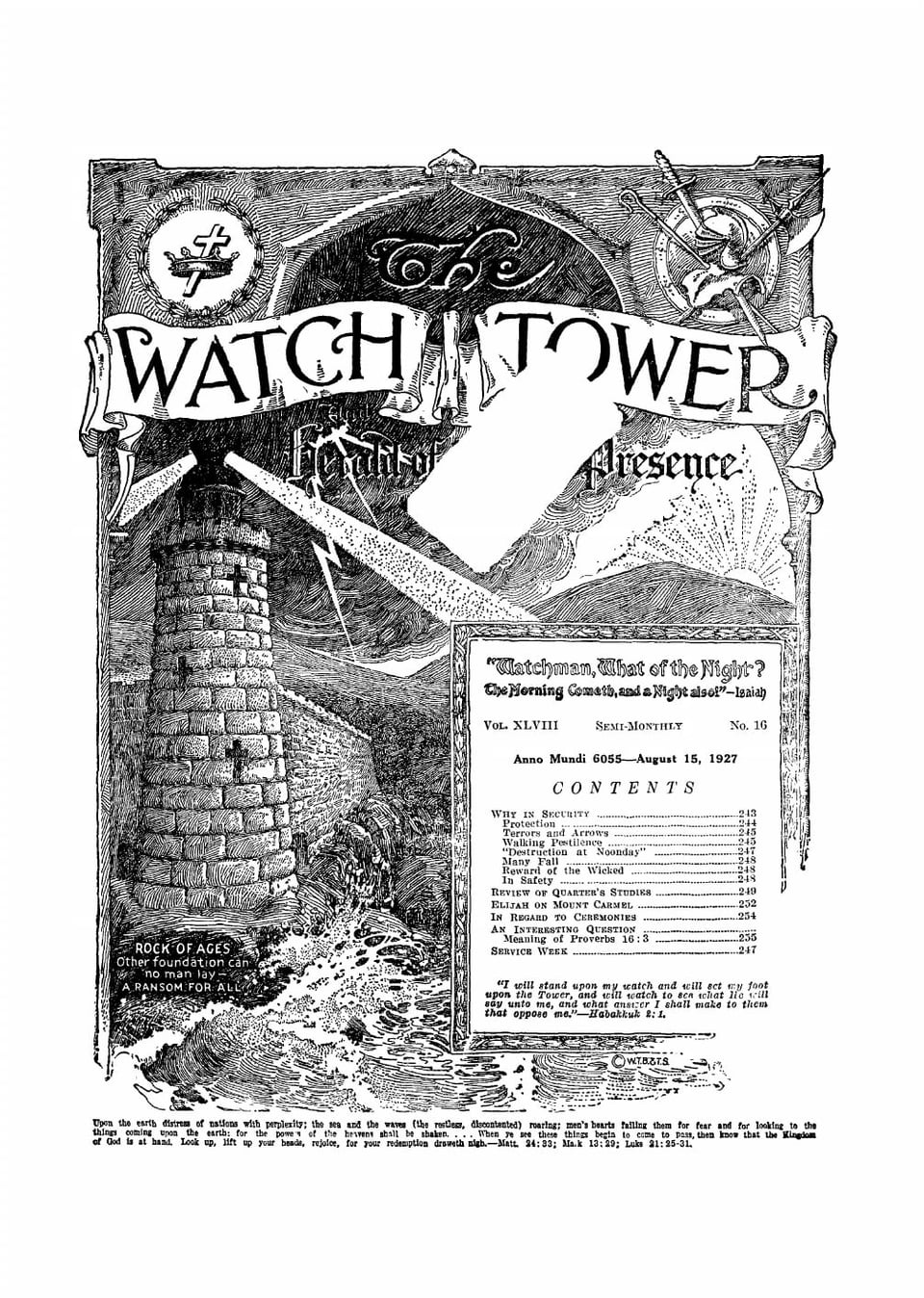
THE WATCH TOWER
"Watchman, What of the Night?
The Morning Cometh, and a Night also!"—Isaiah
VOL. XLVIII SEMI-MONTHLY No. 16
Anno Mundi 6055—August 15, 1927
CONTENTS
WHY IN SECURITY .................................................. 243
Protection ............................................................. 244
Traps and Arrows .................................................... 245
Walking Pestilence ................................................... 245
"Destruction at Noonday" ........................................... 247
Many ills ............................................................... 248
Reward of the Wicked ............................................... 248
In Safety ............................................................... 248
REVIEW OF QUARTER'S STUDIES ................................. 249
ELIJAH ON MOUNT CARMEL ....................................... 252
IN RECENT CENTURIES ............................................. 254
AN INTERESTING QUESTION ....................................... 255
Meaning of Proverbs 16:3 .......................................... 256
SERVICE WEEK ...................................................... 247
"I will stand upon my watch and will set my foot upon the Tower, and will watch to see what He will say unto me, and what answer I shall make to them that oppose me."—Ezekiel 3:21.
ROCK OF AGES
Other foundation can no man lay—A RANSOM FOR ALL!
Upon the earth distress of nations with perplexity; the sea and the waves (the restless, discontented) roaring; men's hearts failing them for fear and for looking to the things coming upon the earth; for the powers of the heavens shall be shaken.... When ye see these things begin to come to pass, then know that the Kingdom of God is at hand. Look up, lift up your heads, rejoice, for your redemption draweth nigh.—Matt. 24:30; Mark 13:29; Luke 21:29-31.
THIS JOURNAL AND ITS SACRED MISSION
THIS journal is published by the WATCH TOWER BIBLE AND TRACT SOCIETY for the purpose of aiding the people to understand the divine plan. It provides systematic Bible study in which all its readers may regularly engage. It gives announcement of the visits made to Bible classes by travelling speakers, announces conventions, and gives the reports thereof. The International Sunday School lessons are treated in harmony with the Scriptures.
It adheres strictly to the Bible as God's revealed Word of Truth. It stands firmly upon the great ransom sacrifice as the fundamental doctrine by which all doctrines are measured. It is free from parties, sects, and creeds of men. It does not assume a dogmatic attitude, but confidentially invites a careful examination of its utterances in the light of the infallible Word of God. It does not indulge in controversies, and its columns are not open to personalities.
TO US THE SCRIPTURES CLEARLY TEACH
THAT JEHOVAH is the only true God, the Maker of heaven and earth, and is from everlasting to everlasting; that the Logos was the beginning of all creation; that the Lord God created a man that is the Lord Jesus Christ in glory, clothed with all power in heaven and earth.
THAT GOD created the earth for man, created perfect man for the earth and placed him upon it; that man willfully disobeyed God's law and was sentenced to death; that by reason of Adam's wrongful act all men are born sinners and without the right to life.
THAT JESUS was made a human being in order that he might become the Redeemer of man; that he gave his life a sacrifice for man and thereby produced the ransom price; that Jesus the Divine arose from the dead, ascended into heaven, and presented the value of his human sacrifice as the redemptive price for man.
THAT for many centuries God, through Christ, has been selecting from amongst men the members of his church, which constitutes the body of Christ; that the mission of the church is to follow in the footsteps of Lord Christ Jesus, living in his likeness and in conformity to the word and plan of Jehovah God and ultimately be united with Christ Jesus in his heavenly kingdom; that Christ, Head and body, constitutes the "seed of Abraham" through which all the families of the earth shall be blessed.
THAT THE WORLD HAS ENDED; that the Lord Jesus has returned and is now present; that Jehovah has placed Christ Jesus upon his throne and now commands all nations and peoples to hear and obey him.
THAT THE HOPE of the peoples of earth is restoration to human perfection during the reign of Christ; that the reign of Christ will afford opportunity to every man to have a fair trial for life and those who obey will live on earth for ever in a state of happiness.
PUBLISHED BY
117 ADAMS STREET . . . BROOKLYN, N.Y. U.S.A.
OFFICERS
J. F. RUTHERFORD President
W. E. VAN AMBURGH Sec'y & Treas.
Variable Subscription Price: United States, 1.00; Canada and Miscellaneous Foreign,1.50; Great Britain, Australia, New Zealand, South Africa, Ts. American remittances should be made by Express or Postal Money Orders, or by Bank Draft. Canadian, British South African, Australian, New Zealand, and South African remittances may be made to the Brooklyn office, but by International Postal Money Order only.
(Foreign translations of this journal appear in several languages.)
Terms to the Lord's Poor: All Bible Students who, by reason of old age or other infirmity or adversity, are unable to pay for this journal, will be supplied free if they send a postal card each May, stating their name, address, and such provision. We are not only willing, but anxious, that all such be on our list continually and in touch with the Berean studies.
Notice to Subscribers: We do not, as a rule, send a card of acknowledgement for a renewal, nor for a change of address. A renewal blank (with notice of expiration) will be sent with the journal one month before the subscription expires. Change of address, when requested, may be expected to appear on address label within one month.
Entered as Second Class Mail Matter at Brooklyn, N. Y. Postoffice. Act of March 3rd, 1879.
BIBLES
The Bible because of its binding has always been associated with the ecclesiastics. Therefore the Bible has become a reproach in the eyes of many people. There seemed no good reason why the Bible should not be bound as other books are bound. It is the Word of God, and the people should be induced to love it. The Society has arranged to furnish Bibles in plain binding at moderate prices. Below we give a list:
P120 44 x 78, French Morocco $4.00
P125 do with concordance 4.35
P130 do Full Leather 5.65
K135 do with concordance 5.80
K60 44 x 61 French Morocco 3.40
K65 do with concordance 3.57
K70 do Full Leather 4.85
K73 do with concordance 5.20
EDITORIAL COMMITTEE
J. F. RUTHERFORD
W. E. VAN AMBURGH J. HEMERY R. H. BARBER E. J. COWARD
FOREIGN OFFICES: British: 34 Craven Terrace, Lancaster Gate, London W. 2; Canadian: 88-40 Irwin Avenue, Toronto, Ontario; Australasian: 435 Collins St. Melbourne, Australia; South Africa: 6 Lello St., Cape Town, South Africa. Please address the Society in every case.
SERVICE WEEK
The Lord heretofore has blessed the efforts put forth by the friends annually, in engaging in one week of special service. August 28th to September 5th is set aside this year for Service Week. Notice is given now that the classes everywhere may make their arrangements so that they can devote as much time as possible during that week to service. The director will please make arrangements for canvassing parties during that period. The Service Week as observed this year will close on Labor Day; and that should be made a special drive day, concluding with a testimony meeting on the evening of September 5th. This matter should be kept before the Lord that we may have his blessing.
BETHEL HYMNS FOR SEPTEMBER
Sunday
Monday
Tuesday
Wednesday
Thursday
Friday
Saturday
By Means of "The Watch Tower"
"The Resurrection" "The First Resurrection"
Z May 15, 1927 Z June 1 1927
Week of Sept. 11 . . . 1-30-56 Week of Sept. 25 . . . 1-23-51 The WATCH TOWER AND HERALD OF CHRIST'S PRESENCE
Vcl. XLVIII
AUGUST 15, 1927
No.16
WHY IN SECURITY
"Because thou hast made the Lord, which is my refuge, even the Most High, thy habitation, there shall no evil befall thee, neither shall any plague come nigh thy dwelling." —Psalm 91: 9, 10.
[Continued from last issue]
JEHOVAH carries out his purposes according to his sovereign will. Nothing causes him to haste nor to be disturbed. He is slow to anger, but when his due time comes to act he takes action. "The Lord is merciful and gracious, slow to anger, and plenteous in mercy. He will not always chide; neither will he keep his anger for ever." (Psalm 103:8, 9) For sixty centuries he had been reproached by the Devil and his instruments. Time and again he has given a demonstration of his power that the people might not forget his name and his goodness, and this he has done for the benefit of man. The masses have been drawn away from God by the enemy. Few have realized and appreciated or now realize and appreciate that Jehovah is the Most High, the Creator of heaven and earth, the Giver of life to all, the Almighty God, and the one from whom all blessings flow. To know him means life. It is his will that the human race shall have an opportunity for life. Therefore all must be brought to a knowledge of the truth.—1 Timothy 2:3, 4.
2 For a long while the issue was and still is, Who is God? Satan has blinded most of the people to the truth; and now in particular the Devil has brought forth his agencies to exercise much influence amongst the people to prove that Jehovah is not God. God means the Creator of everything good. The self-constituted wise instruments of Satan insist that God did not create man. Many other means the Devil uses to turn the mind of the people away from Jehovah. God has announced his purpose to dash to pieces Satan's organization and to restrain the enemy and give a testimony to his name for the good of humankind. This time of trouble such as never before was known seems near at hand. Before it falls it is God's announced purpose to have a witness given to the world that he is God and that he will demonstrate that fact shortly. Those who engage joyfully in giving that witness are in special danger of Satan and his organization; and for their encouragement the Lord, through his prophet, has assured them of a place of safety, and that this is the secret place of the Most High.
Christians to put great trust in men and in man-made organizations. This of course has been largely the result of a measure of blindness induced by the influence of the enemy. Some have put their trust in their leaders, who are but men claiming to be the representatives of Christ; and when their confidence in their leader is shaken they turn away from the Lord. Others have put their trust in princes or rulers, also merely men. Those who stand in the final test must put their trust in the Lord. It is better for one to trust the Lord. "It is better to trust in the Lord, than to put confidence in man: it is better to trust in the Lord, than to put confidence in princes." (Psalm 118:8, 9) Those who have full faith in and love for God make him their refuge. For such there is a secret place of safety, and that is the secret place of the Most High.
4 When Christ Jesus, the great Executive Officer of the Most High, came to his temple his first work was to take an account with those who had made a covenant to do God's will. Some he found faithful, and to these he said: "You have been faithful over a few things; I will make you ruler over many things: Enter into the joy of your Lord." This carries with it the thought that the time has come when God will make for himself a name in the earth; and the fact that his name is to be vindicated is a great joy to Christ. He invites the faithful who have been safeguarding his kingdom interests to enter into that joy. The performance of the duties and obligations laid upon the faithful requires them to give a witness to the name of Jehovah. The giving of this witness subjects such ones to great danger at the hands of the enemy. If they are on the right side, the Almighty God exercises his power for their protection. He grants unto such the garments of salvation, brings them under the robe of righteousness, and admits them to his secret place. To such he says: "Because thou hast made the Lord, which is my refuge, even the Most High, thy habitation, there shall no evil befall thee, neither shall any plague come nigh thy dwelling."—Psalm 91:9, 10.
5 Christ is here represented as speaking to his faithful brethren on earth; and he gives them the assurance that because Jehovah is their refuge, and the Most High their habitation, no evil shall befall them and no plague or destructive pestilence shall come nigh their dwelling-place, which is in the secret place of the Most High.
Let each one keep in mind, however, that he must abide in that secret place in order to be at all times in security. In the last issue of The Watch Tower verses one to three of the Psalm were discussed. Now we continue the examination of the Psalm verse by verse.
PROTECTION
6 Speaking now to those in the secret place the prophet says: "He shall cover thee with his feathers, and under his wings shalt thou trust: his truth shall be thy shield and buckler."—Psalm 91:4.
7 The remnant class, composing a part of The Servant of God, because on this side the veil are in the open field engaging the enemy in battle. The enemy goes forth to make war against them, seeking their destruction. "And the dragon was wroth with the woman, and went to make war with the remnant of her seed, which keep the commandments of God, and have the testimony of Jesus Christ." (Revelation 12:17) This little company of witnesses for the Lord have a vision of the enemy and his organization in all of the hideousness thereof. Being small in number and having no power in themselves, they feel exceedingly insignificant and inadequate to meet the enemy. Before that terrible giant they could not stand alone for a moment. Others have become fearful and fallen back. Will the remnant do likewise? They will not. They need the protection, and for their encouragement the prophet of God says to them: 'Fear not; for the Most High is your dwelling-place because you have made him your refuge.' "He shall cover thee with his feathers, and under his wing shalt thou trust: his truth shall be thy shield and buckler." (Verse 4) For this faithful remnant there is here given assurance of provision of a covering, a hiding place, a condition of great safety and protection. When danger is near, a hen covers her little ones under her feathers and hides them under her wings. This illustration the prophet uses showing the protection God affords to his little ones. When the enemy would slay them he hides them in the secret place of his tabernacle.—Psalm 27:5, 6.
8 There are those today who at one time professed to be followers of Christ and to be enlightened in the truth of his presence, but who have turned away and become enemies of the truth. These conspire against those who are serving the Lord and enter into various schemes to do them injury. They resort to all manner of slander and false accusation. These are the instruments of the enemy Satan used in an endeavor to destroy those that love and serve God. The remnant thus engaged in the Lord's service know that they have no strength of their own, but they have made the Most High their refuge. The prophet represents such as praying, "Hide me from the secret counsel of the wicked; from the insurrection of the workers of iniquity: who whet their tongue like a sword, and bend their bows to shoot their arrows, even bitter words." (Psalm 64:2, 3) "Keep me as the apple of the eye; hide me under the shadow of thy wings, from the wicked that oppress me, from my deadly enemies who compass me about."—Psalm 17:8, 9.
9 Thus praying they cease not to work, because Jehovah has commissioned them to work. It is the time for God's witness; and in answer to their prayer he says to them: "And I have put my words in thy mouth, and I have covered thee in the shadow of mine hand, that I may plant the heavens, and lay the foundations of the earth, and say unto Zion, Thou art my people." (Isaiah 51:16) The message of truth continues to go out from the mouths of the remnant, and this message is like a sharp sword, and at the same time they are hid from the enemy. "And he hath made my mouth like a sharp sword; in the shadow of his hand hath he hid me, and made me a polished shaft; in his quiver hath he hid me."—Isaiah 49:2.
10 The Most High has provided for the faithful a shield and a buckler, both of which are defensive to ward off blows of the enemy. That which constitutes these defensive weapons is the truth of God's Word. Only those who love and serve the truth therefore could have these weapons. God causes his light to shine upon his Word with ever increasing brilliancy as the faithful ones come near to the end of the way.—Proverbs 4:18.
11 The buckler was more particularly used to safeguard the heart or vital organs. Symbolically the heart represents the seat of motive or that which prompts one's action. God supplies his people with the truth and the understanding thereof, which increases their love for him. They receive the truth in the love thereof and unselfishly devote themselves to make known the truth to others that God's name might be magnified. Their motive in serving must be love. In harmony with this thought the apostle emphasizes the necessity for the Christian to be thus armed in the final conflict: "Finally, my brethren, be strong in the Lord, and in the power of his might."—Ephesians 6:10.
12 Be it observed that the apostle does not say that the fight is against fleshly weaknesses. He does not say that our warfare is against "flesh merely". On the contrary he positively says: "We wrestle not against flesh and blood, but our warfare is against principalities, powers, and the rulers of darkness of this world," thereby describing the Devil and his wicked organization. He says to the Christian: "Put on the whole armor of God," that ye may be able to withstand in the evil day; "that ye may be able to stand against the wiles of the devil." Then he adds: "Above all, taking the shield of faith, wherewith ye shall be able to quench all the fiery darts of the wicked." No one could abide in the secret place of the Most High unless he has absolute faith and confidence in the Most High.
Those who do abide there have full and complete protection.
13 Without this protection one quickly falls before the enemy. During the past few years the facts well known have clearly demonstrated this. One day a brother to all intents and purposes is in full harmony with the truth and serving the truth. Suddenly he becomes offended or disgruntled. He immediately goes into darkness and quickly joins the enemy. It is manifest that he has left the secret place of the Most High because of some wrong doing or lack of faith. The loss of his faith necessarily would take him out of that condition of safety and remove his shield and the buckler.
14 The wedding garment means to be doing the work in the Lord's appointed way. Putting off the wedding garment would mean to cease doing it the Lord's way, even though claiming to be a Christian. Having the garments of salvation means that such a one is identified with the saved class and has on the wedding garments. Removing it would identify him with the enemy class. Being under the robe of righteousness means that such a one has the approval of the Lord because of his faith and loving devotion in doing God's holy will. A loss of faith and a contrary course would bring one out from under the robe of righteousness. Those who dwell in the secret place of the Most High abiding there, remain faithful and abide under the shadow of him who is all-powerful; and such are safe from the bitter attacks of the enemy. It is in that condition of safety the Lord hides him as a hen covers her brood with her feathers and her wings.
TERRORS AND ARROWS
15 "Thou shalt not be afraid for the terror by night, nor for the arrow that flieth by day."—Psalms 91:5.
16 Having been cast out of heaven Satan's actions are confined to the earth. It is a dark time for the earth. "Darkness covers the earth [the governing factors] and gross darkness the people," that is, the individuals who make up the world. That the condition of darkness ensues at the same time the Lord comes to his temple is shown by the words of the prophet: "Arise, shine; for thy light is come, and the glory of the Lord is risen upon thee. For, behold, the darkness shall cover the earth, and gross darkness the people: but the Lord shall arise upon thee, and his glory shall be seen upon thee." (Isaiah 60:1, 2) "Therefore rejoice, ye heavens, and ye that dwell in them. Woe to the inhabitants of the earth, and of the sea! for the devil is come down unto you, having great wrath, because he knoweth that he hath but a short time."—Revelation 12:12.
17 Not only is it a time of great darkness for the earth and the people thereof but a time of great terror. The people turn away from God. It is a terrible time of distress and perplexity. It is a time in which professed Christian ministers have their masks torn away, and their hypocrisy appears to the people. Many who have professed to walk in the light of present truth have turned away. The Devil, knowing that his time is short to prepare for Armageddon, is greatly enraged, particularly at the remnant, because that remnant insists on proclaiming the name of Jehovah and his kingdom. In his rage he goes forth to destroy them. They being in the light can see the Devil's organization and its wicked methods of operation. The greatness and magnitude of his organization, his power and the wickedness of that organization would strike terror to the heart of any one seeing it except for faith in the Almighty God who is the refuge of the faithful remnant. To them God's prophet says: "You need not fear for this terror by night in this time of darkness, because you have made the Most High your habitation and almighty power is exercised in your behalf." Onward the remnant marches, together lifting up their voices with joy in proclaiming the message, Jehovah is God, Christ is King upon his throne, the kingdom of heaven is here.
18 "Nor for the arrow that flieth by day." For the Christian it is the new day, because upon them the Sun of righteousness has arisen. The light of God's new day is shining with increased power. Greater light is come to the world upon everything except the Word of God. Because of the greater light the Christian walks in the light; and because he walks in the light and proclaims the message of the kingdom he is the target for the darts of the enemy. The arrow of the enemy flies by day. The Christian goes forth in the open field telling the glad tidings of the kingdom and the greatness of our God. The arrow of the enemy would instantly destroy such except for the protection of Almighty God. But because he is of the remnant, he who has made God his refuge and is in the secret place of the Most High, is safe from these arrows of the enemy. The Christian has no occasion to be afraid; but on the contrary he sings aloud the song of deliverance.
WALKING PESTILENCE
19 Continuing to speak of the perils abroad the prophet tells those in the secret place that they are not to be afraid "for the pestilence that walketh in darkness, nor for the destruction that wasteth at noonday".—Verse 6.
20 A pestilence is a destructive plague. Darkness is the very opposite of light. This statement of the prophet then must mean something that is abroad in the darkness and that it is destructive. We have seen that the "noisome pestilence" is a destructive plague resulting from covetousness and a wicked desire to possess at any cost what belongs to another, which leads to gross wickedness. Here then is mentioned another destructive plague. What could it mean?
21 Fear of the enemy or his organization is a destructive plague and therefore a pestilence, because it is destructive of faith, and faith is essential to the safety of the Christian. That fear is a destructive plague is supported by the following scriptures: "Hear my voice, O God, in my prayer: preserve my life from fear of the enemy.” (Psalm 64:1) “Fear took hold upon them there, and pain, as of a woman in travail.” (Psalm 48:6) “Be not afraid of sudden fear, neither of the desolation of the wicked, when it cometh.” (Proverbs 3:25) “When your fear cometh as desolation, and your destruction cometh as a whirlwind; when distress and anguish cometh upon you.”—Proverbs 1:27.
22 Fear of man is a snare. (Proverbs 29:25) Where there is complete trust and faith in the Lord there is no fear. “Perfect love casteth out fear.” (1 John 4:18) There can be no complete faith without love. Unselfish devotion to God is the result of absolute faith and trust in him. Those who have made the Most High their habitation have no occasion for fear. They love him, and therefore count not their lives dear unto them but trust their all into his care.
23 Light is the very opposite of darkness. Truth is light. (Psalm 119:105; Proverbs 6:23) Jehovah God covers himself with light as with a garment. (Psalm 104:2) He who dwells in the secret place of the Most High is therefore dwelling in the light. (1 John 1:5-7) In the nominal church the clergy are, in the language of the prophet, “out of the way through strong drink; they err in vision, they stumble in judgment.” (Isaiah 28:7) To them the vision of the divine plan is hid and sealed. (Isaiah 29:11) The same rule then must obtain among those once enlightened with the truth. If they lose their vision of God’s plan, the way becomes dark and they fall. Unless the Christian has the truth and feeds upon the truth he will perish. “Where there is no vision, the people perish; but he that keepeth the law, happy is he.” (Proverbs 29:18) Where there is no vision, there is no light and there is an absence of faith; and where faith grows weak, fear takes hold. The conclusion therefore is that the pestilence that walketh in darkness is the fear that lays hold upon the Christian because of darkness.
24 When the Lord came to his temple in 1918, and began the inspection and judgment of his people, great trouble fell upon the house of God. There followed a great test of faith. Many who had devoted themselves to what they thought was character development had shown themselves strong before temptations of the flesh. They had made some friends amongst the Devil’s organization. They were looked upon as unusual persons by the world. They had gladly stood up and contended for the doctrines of faith once delivered to the saints. But when the Lord came to his temple, and the great time of stress was upon the world and those who were in the world, the situation was changed. ‘To then stand and boldly testify to the name of the Lord God required faith and courage because it was reproof of the course of Christendom. Fear laid hold upon some. As the times grew darker their fear increased. Fear of Satan and his organization stalking about in the darkness became a plague or pestilence to those of little faith in God. Because of the fear that laid hold upon such Christians during the stress of 1918, their faith was destroyed by this pestilence walking in the darkness.
25 He who fears the enemy is defeated before the fight really begins. Before Gideon went into battle he separated all the fearful of his army and sent them to the rear. (Judges 7:3-6) Elijah was fearful of Jezebel and her political ally; and loving his life he fled to the wilderness. Fear always produces disastrous results. Only those who put their trust in the Lord are safe. The fear of man or man-made organizations removes the protection and safety. “The fear of man bringeth a snare: but whoso putteth his trust in the Lord shall be safe.” (Proverbs 29:25) Darkness continues on the earth and gross darkness on the people, and fear has laid hold upon all. (Isaiah 21:17, 18) The exception to this rule are those Christians that dwell in the secret place of the Most High. To such the Lord says: “Fear thou not; for I am with thee: be not dismayed: for I am thy God; I will strengthen thee, yea, I will help thee; yea, I will uphold thee with the right hand of my righteousness.... For I the Lord thy God will hold thy right hand, saying unto thee, Fear not: I will help thee.”—Isaiah 41:10, 13.
26 Upon this point the Scriptures point out that the great company class contains those that sit in darkness and in the shadow of death, and being bound in affliction and iron; because they rebel against the words of God and neglect or contemn the counsel of the Most High. (Psalm 107:10, 11) They are fearful and in danger of destruction by that pestilence that walketh in the darkness. God in his mercy hears the cries of the sincere ones and brings them out of the shadow of death.
27 The time of darkness upon the earth will continue until the great conflict of Armageddon. As that time approaches the prophet declares: “All faces shall gather blackness.” (Joel 2:6) (See also Nahum 2:10.) That a time of great darkness and stress is yet ahead finds abundant support in the Scriptures.—Isaiah 24:18-21.
28 But let the saints remember that the Elijah work is done. Elisha did not fear. The enemy in great strength came upon him in the night time. When he was at Dothan the enemy came in the darkness and surrounded him with horses and chariots and a great host of men. Only one man was in the company of Elisha, and that man greatly feared the enemy. That is proof that Elisha did not fear. He said: “Fear not; for they that be with us are more than they that be with them.” (2 Kings 6:16) Elisha’s confidence was in God and he feared nothing that man could do unto him. Then at the petition of Elisha the eyes of his servant were opened and he beheld that God had surrounded Elisha with a great angelic host. This vision was given as an assurance to Elisha that almighty power was being exercised in his behalf. Those in the secret place of the Most High are to do and are doing the Elisha work. They do not fear the enemy. They fear only the Lord and trust him absolutely.
"The angel of the Lord campeth round about them that fear him, and delivereth them."—Psalm 34:7.
29 They have made Jehovah their refuge and the Most High their habitation; and for this reason the Lord says to them: 'Thou shalt not be afraid of this pestilence that stalketh about in the darkness.' Otherwise stated, 'Because of your faith and confidence in the Almighty God there is no occasion for you to fear that which others fear.' These see the Devil and his organization in all of its hideousness and are not ignorant of his subtle and cunning devices. They know that the witness must now be given to the name of Jehovah that he is God; and they fear not to give it because they are abiding under the shadow of the Almighty.
"DESTRUCTION AT NOONDAY"
30 At the time the secret place of the Most High is made available for the obedient ones the prophet of God shows that there will be abroad a "destruction that wasteth at noonday".
31 The opening of the temple of heaven brought greater light to the saints on earth, because there followed flashes of light from the temple illuminating the minds of those who were walking in the light. It immediately became a time of greater light to some and greater darkness to others. Since the coming of the Lord to his temple, and the beginning of the work foreshadowed by Elisha, there has been a greater measure of the holy spirit enjoyed by the people of God who are really devoted to him. To them the way has grown brighter and brighter.
32 Noonday symbolically represents a period of greatly increased light. As used in this text the term well represents a condition into which the Lord has brought the temple class. Many parts of the divine plan have become so clear that those that are not consecrated can understand much thereof. In this noonday of increased light the prophet of God seems to consider those who might have been there or remained there had they been joyfully obedient to the increased light that came to the anointed class. It is manifest from the apostle's words that one class is greatly profited by the light while others suffer. He speaks of that which "wasteth at noonday" resulting in destruction. The word "wasteth" here used means to swell up with pride or haughtiness, which is manifested in contemptuous and overbearing treatment of others. It means to be puffed up with oneself or with pride or glorying in other men. The Apostle Paul mentioned this in his day.—1 Corinthians 4:4-7.
33 Now take note of the facts as they are well known to many. Following 1918 when the Lord came to his temple the light upon God's plan continued to increase. Some in the truth because of self-conceit and pride rejected the increased light for the reason they had not brought it forth themselves or it had not been brought forth by some to whom they were specially close. They were offended and resisted the light of truth and became lawless and refused to conform themselves to the light. They refused to humble themselves under the mighty hand of God in performing the work that he gave his people to do. (1 Peter 5:6) Swelling up with pride and haughtiness they manifested a contempt for the increased light of truth and became overbearing toward their brethren who tried to walk in the light and proclaim the truth. The result was that they wasted away and soon turned entirely against the Lord and his truth and rejoined the world, which is the Devil's organization. Such have taken a delight in an overbearing, contemptuous manner of treatment toward others who are trying to serve the Lord. Of course the Lord foreknew this and foretold it.
34 "Destruction," as used by the prophet in this text, means to be cut off in ruin. Some having trusted in leaders or in themselves have thereby been puffed up and have been blinded by the light of truth. (Colossians 2:18) Walking in their own selfish way they failed to recognize that the Head of the church is Christ Jesus, and that Almighty God is the Head thereof, and that the Lord is doing his work in his own good way. They became disobedient, proud and puffed up, and the Devil turned them away from clearer light, and their lawless course caused them to waste away and their faith and hope to suffer destruction. (Jude 11) Some of these well known to others have been smitten with blindness and madness, and that at the very time when the Lord is causing his light to shine as the brightness of noonday for those who are obedient to him. The same rule announced to fleshly Israel must apply to Israel after the spirit, because the former foreshadowed the latter and because the fixed rules of God never change. "The Lord shall smite thee with madness, and blindness, and astonishment of heart: and thou shalt grope at noonday, as the blind gropeth in darkness, and thou shalt not prosper in thy ways: and thou shalt be only oppressed and spoiled evermore, and no man shall save thee."—Deuteronomy 28:28, 29.
35 The light of truth continues to shine as the noonday, even as foretold by the prophet. (Isaiah 30:26) The same malady that has led some to destruction, such stalks about and lurks in the pathway of all of God's people. Who then is safe and where is a place of safety? The prophet answers: 'He that dwelleth in the secret place of the Most High, and abideth under the shadow of the Almighty' is in safety. He need not fear. Such have no selfish schemes of their own to accomplish. They desire to know nothing except the Lord's will. Joyfully they conform to the Lord's arrangement and delight at all times to glorify his name. Let the anointed ones who are under the robe of righteousness, and therefore in the secret place, learn well this lesson, that only those who are joyfully obedient to the Lord's commands can continue to abide under the shadow of the Almighty, and once they do abide there they are no longer fearful.
MANY FALL
36 The prophet of God further speaks to those in the secret place of the Most High and says: "A thousand shall fall at thy side, and ten thousand at thy right hand; but it shall not come nigh thee. Only with thine eyes shalt thou behold, and see the reward of the wicked."—Psalm 91:7, 8.
37 It is manifestly clear that the prophet is here speaking concerning those who are in Christ or claiming to be in Christ. Those in Christ during the period of the harvest time necessarily would be walking side by side until the great testing time arrived. Those claiming to be Christians would be, figuratively speaking, on the right-hand side of those Christians who are fighting the good fight of faith. Then it may be truly said that some are at the right hand and others by the side. To the faithful the prophet of God says: "A thousand shall fall at thy side." Necessarily this would not take place until the time of judgment, which judgment begins at the house of God.—1 Peter 4:17.
38 The Lord came to his temple for judgment. The prophet of God declares that the Lord comes suddenly to his temple. The prophet further says that at the time of coming to his temple would be a time of fiery trials; that the Lord would then purify the truth and purge those who claim to represent him, that the truth might shine with greater clearness and that the approved ones might offer unto the Lord an offering in righteousness. (Malachi 3:1-3) True to this prophecy, since 1918, the Lord in his temple has been clarifying the truth by giving to his people a clearer vision thereof. No man is responsible for this clearer vision of the truth, and no man can justly take any credit therefor whatsoever. The truth is Jehovah's truth; and Christ Jesus as the great Priest and Executive Officer is doing the work of refining. He is purging the anointed class, that the approved ones might be made manifest and that they might thereafter give a faithful witness to the name of God and his plan.
39 Side by side these walked until the time of the judgment began and the refining work was inaugurated. When the Lord came to his temple and found some faithfully safeguarding the kingdom interests, and on taking account thereof, because of their faithfulness such were invited to enter into the joy of the Lord. (Matthew 25:23) At the same time others became offended and refused to carry on the work of the kingdom. They fell away. Whether actually one thousand fell or whether this number represents the aggregate number falling makes no difference. The facts that are well known show that since 1918 a great many have fallen who prior to that time had walked by the side of their brethren who still by the Lord's grace are joyfully proclaiming the message of his King and his kingdom.
40 Up to and prior to 1918 nominal Christendom had claimed to be on the side of the Lord. By reason of that claim the position of such would be properly on the right hand of the Lord's true and faithful people. It was only shortly after 1918 when united Christianity, as it is called, fell completely away from the Lord and his kingdom and openly embraced the Devil's organization. These conditions seem clearly to fit the prophet's statement: "And ten thousand shall fall at thy right hand." That number symbolically represents all or a complete falling of the systems. How many in those organizations or systems had ever really made a covenant with the Lord we cannot know. The systems, however, are gone for ever from the favor of God because they repudiated the Lord and his kingdom.
41 It seems clearly marked out in the Scripture that the wicked are lawless ones; that is to say, those who have made a covenant with the Lord and have received some light and then refused to go in the light which the Lord gives them, or those who have seen the light and because thereof have wickedly turned against the anointed of the Lord. Lucifer saw the light and deliberately turned away from it because of his selfish ambition. He became that Wicked One. Therefore the wicked within the meaning of this prophecy must be those who have had some knowledge of the Lord and deliberately turned against him and who go contrary to him and his truth. The apostle warned the church against this very danger. (2 Peter 3:17) Those who hate instruction and cast God's Word away from them are designated as wicked.—Psalms 50:16-20.
42 The Scriptures declare that when the Lord comes to his temple he first tries the righteous and then metes out judgment to the wicked. "The Lord is in his holy temple, the Lord's throne is in heaven: his eyes behold, his eyelids try, the children of men. The Lord trieth the righteous: but the wicked, and him that loveth violence, his soul hateth. Upon the wicked he shall rain snares, fire and brimstone, and an horrible tempest: this shall be the portion of their cup. For the righteous Lord loveth righteousness; his countenance doth behold the upright."—Psalms 11:4-7.
IN SAFETY
43 To those who are faithful God, through his prophet, now says that 'while others are turning, you who are in the secret place of the Most High are in safety. The wasting pestilence shall not injure you.' 'Only with thine eyes shalt thou behold, and see the reward of the wicked.'—Verse 8.
44 By the eye visions are had. The faithful see the judgments of the Lord and rejoice because they are right. They have nothing to do whatsoever with the judgment and punishment of the wicked. That belongs to God, who does it through his great Priest. The Apostle Paul wrote: "The Lord shall judge his people. It is a fearful thing to fall into the hands of the living God." (Hebrews 10:30, 31) In this connection the apostle is speaking concerning those who repudiate the Lord and the redemptive blood whereby man is purchased and who do despite to the light that came to them by the truth and through the holy spirit.
Such are they who turn away from the Lord. Their course is that of the wicked.
45 Those in the secret place of the Most High can have and do have a vision or understanding of these things, and they have nothing more. Their safety is made certain because they have made Jehovah their refuge and the Most High their habitation. As long as such abide in that place of security they are absolutely safe. Those who continue to abide under the shadow of the Almighty, in the secret place of the Most High, will continue to sound forth his praises. The importance of faithful and joyful service to the Lord cannot be overstated. Each one in the secret place of the Most High is in the temple class, and "in his temple doth every one speak of his glory."—Psalm 29:9.
(To be continued)
QUESTIONS FOR BEREAN STUDY
In whose interest does Jehovah act in carrying out his purposes? What has been and is now the issue among mankind? Explain the object and method of Satan's activity in the earth. How has this activity affected humanity in general and Christians particularly? What is the God-given provision for the Christian's safety? ¶ 1-3.
What duties and obligations are now laid upon those whom the Lord has found faithful since he came to his temple? Upon what condition is the divine protection assured to such? ¶ 4, 5.
For whose encouragement were the words of verse 4 of this Psalm written? Why? Who are the workers of iniquity? How only may the sincere follower of Christ today be shielded from the injurious assaults of the enemies of righteousness? ¶ 6-10.
What piece of armor was used in olden times to protect the vital organs of a soldier, and what is its symbolism as applied in the Scriptural description of the Christians' warfare? What are some unmistakable marks that identify the faithful Christian of today? ¶ 11-14.
Describe the conditions prevalent among mankind in general today. Amidst these conditions what is the portion of those who constitute the remnant of God's people upon earth, and what course do they pursue? How is the true Christian affected when he beholds manifestations of the enemy's rage? ¶ 15, 18.
David praised God in Psalm 91. Who are particularly affected by the pestilence, and why? ¶ 19-24.
Cite some Scriptural examples of manifestations of fear among those to whom the Lord gave opportunity to put their trust in him. Is any provision made by God for such? ¶ 25, 26.
How long will the time of darkness upon earth continue? Why has God preserved a record of the experience of Elisha? Explain briefly what is meant by the expression "unfailing work"; also when and how that work is done. ¶ 27-29.
Explain that portion of the Psalm which refers to the "destruction that wasteth at noonday". May those who recognize the danger avail themselves of protection from it, and how? ¶ 30-35.
Verses 7 and 8 of this Psalm were written to and concerning whom? Who is responsible for the clarified vision of the truth which is now enjoyed by those who fear the Lord? And why are these so favored? Who and how much have "seen the day"? ¶ 36-40.
Who is "that wicked one" and who are "the wicked"? What action is taken by the Lord toward the righteous and the wicked when he comes to his temple? ¶ 41, 42.
The responsibility of judgment and punishment of the wicked rests with whom? What is the portion and privilege of those who are adjudged by the Lord as worthy of his continued favor? ¶ 43-45.
REVIEW
SEPTEMBER 25 -
"Jehovah has established his throne in the heavens; and his kingdom ruleth over all."—Psalm 103:19.
THE studies of the past quarter have brought us once again into contact with the early leaders of Israel in the days of the setting up of the kingdom of Israel. There is much varied instruction intended in these Scripture records which we have studied. There is that which was intended for the church of God in the present day, when God should bring the faithful of his people to see that he had started a kingdom by the coming of his Son, and that these records were intended to be treasure-stores of guidance for them.—See Romans 15:4.
2 Further, and most important to us, is that the things done were illustrative of things to be done in the days when God would establish his kingdom in the earth, that they might the better do God's work in this day. Then also there are the lessons of life and conduct, for guidance and instruction in all those things which fill up the life and make the servant of God more profitable. For though a willing heart and mind, and a desire to serve God, are more to God and can be of greater service to him than mere ability, yet all the history of the ways of God with man shows that where there is full development of life combined with willingness and loyalty to God, such a one is a better servant. Good intention is not in itself so valuable as educated good intention.
3 The lessons have given us great variety of illustration in these things. The first was of Saul, who was chosen first king of Israel because Israel wanted to be like their neighbors. Under Samuel they had been raised from a very low condition of national life to a fairly prosperous and united people, and that in the best possible way for them; for they were brought back to favor with God which through their carelessness and forgetfulness they had lost.
4 The destruction of Shiloh, when the ark was lost and the priests were slain, was a terrible disaster to Israel. God made no move to give them back that which they had so carelessly lost; for the people were to blame for allowing so low a condition to prevail in Israel.
God is never in a hurry to restore his own lost position amongst his people; his ways on human reckoning are surely slow in some things.
5 God now gave Israel a king according to their wish; but the Prophet Hosea says that God gave them a king 'in his anger'. (Hosea 13: 11) The fact was that the people were really rejecting Jehovah as their King. He had wanted them to be unlike the nations, that the nations might see a people who worshiped the God of heaven and were being blessed by him, and that thus the nations might have a light to guide them. Israel in wishing to be like their neighbors were, however, ignorantly countering God's purpose. God gave them Saul, and to aid him God gave Saul a heart to do the unusual work to which the providences and purposes of the Lord now called him.
6 Saul lost out. He began to feel himself important; he became impatient of restraint; he would not wait for God's prophet when Samuel apparently delayed. He did not discern that he was being tried as to whether or not he would truly serve God. When commanded to destroy the Amalekites he took his own way of carrying out God's instruction through his prophet.
7 Knowing that he must lose the kingdom to David, Saul defied God by trying to kill David. His failure and his sin were in large measure caused by his wilfulness, urged on by jealousy. At last, going to the witch at Endor for guidance and thus to the Devil, he became a completed type of the leaders of a false Christendom who, driven to darkness and at last cast off by both God and men, seek light from wizards which only peep and mutter. (See Isaiah 8: 19.) When God gave Israel a king Samuel thought that his work was done; but God had much for him yet to do, and there is evidence that he did much to guide David in the preparation of his mind for the great work which he was to do when God should take the kingdom from Saul.
8 Saul was a farmer's son. David was the youngest of eight sons of Jesse of Bethlehem and minded his father's sheep. He was chosen to be Israel's king when yet in early youth. He was a boy of spirit, and with a great desire to serve the God of Israel. Through his fight with Goliath he was brought into contact with Saul. Saul soon came to see in David his successor to the throne, for he was the brightest of Israel's young men; and Saul then tried to kill him. David fled; and such was the condition of Saul's kingdom that before long there came to David hundreds of disaffected men. He became leader of a band of 600 strong men.
9 Saul now made war against David, and no doubt the early verses of Psalm 27 describe some of his experiences. David proved his loyalty to Jehovah by refraining, on two occasions, from slaying Saul when Saul was entirely in his power. Here was loyalty to God. There was no hastening for the kingdom, no ambition but to honor God. By his acts David put himself in a strange light with his men—they would hardly understand his leniency toward the man who sought his life. But Saul was God's anointed; hence David would preserve him rather than hurt him.—Psalm 105: 15.
10 It was not until Saul had run his sorry length, and David had learned his lessons in faith and generalship, that God's time came for David to ascend the throne of Israel. Even then his faith was tried; for at first only the tribe of Judah made him king. God does try his servants, but ever in their trial there is that which enables them to carry on. David surely did not doubt that he was to be king of all Israel; in this case he knew that the opposition was wrong and that they who were opposing him were doing so contrary to the will of God. Yet he was patient.
11 At last David became king of all Israel. His first important act was to prepare a place on Mt. Zion (which he had taken from the Jebusites) for the ark, which was yet in Kirjath-jearim. He proposed as soon as possible to build it a glorious house. With great rejoicings, though after a serious setback in the death of Uzzah, the ark was set in its temporary home on Zion; and God then had an organization on Zion which would carry out his purposes.
12 Though there is nothing out of time with God, yet Israel then occupied only a small portion of the land promised to Abraham. So David began a series of wars, which made him and Israel master of all the countries which God had given to Abraham in his original promise. (Genesis 15: 18) David thus represented God's kingdom being set up in power. But his work is a picture of that which the great King of kings does (and is now doing) in the earth, namely, that of breaking down all those things which are in opposition or would be hindrances to the establishment of righteousness on earth. Thus after the ark was brought to Zion, the truth of God was reestablished, and the covenant with Abraham was established insofar as it related to the land of inheritance.
13 After his wars David began to make plans for the temple which, since he was a lad in the fields of Bethlehem, he had desired to build for the ark of God. (Psalm 132: 6) The Prophet Nathan encouraged him. But God sent Nathan to say that he could not permit his house, which was to represent peace, to be built by a man of war. Yet God would honor David in his desire, and would build him a house. Then God gave David a covenant of promise, saying that David should never want a son to sit upon the throne of Israel.
14 David could not see the end of that promise and how it would be fulfilled by The Christ. This promise is like that which was given to Abraham, and which was confirmed to him by God's oath, but which oath Paul says was for the children of faith, that they might have a sure hope. (See Hebrews 6: 18.) This promise to David of the heirship to the throne becomes to these same faithful ones "the sure mercies of David". (Isaiah 55:3) God has made known to his faithful people not only the fact that he is bringing to pass his covenant made with Abraham; he has also shown them that he is now setting up the throne of David.
They now know and proclaim that David's great Son has returned from heaven to set up the everlasting kingdom of God upon earth.
15 The studies reminded us of the great blot in David's life; his sin in the matter of taking Bathsheba, Uriah's Canaanitish wife, and then in meanly trying to defraud him and finally causing his death. David seemed to have lost sight of what was right. Yet when in his judicial capacity as king and supreme judge in Israel Nathan the prophet put a case to him, David immediately ordered the death of the wrong-doer. Then said Nathan to him, "Thou art the man!" David's sin was brought home to him. He acknowledged his wrong and obtained forgiveness; but he was punished by the early death of the son born to the union, and then by having trouble of like kind thrust into his family.
16 The lesson for all is, "Let him that thinketh he standeth, take heed lest he fall." (1 Corinthians 10:12) Sin rarely attacks openly, and in it there is always that which tends to blind the conscience. The follower of Christ is given the holy spirit, which sets him free from the law of sin and death; but there is all the more need to watch the motions of sin as they may approach, lest the law of liberty be transgressed. That God accepted David (and also Bathsheba) is shown by the fact that Solomon, who was to be the son to build the house of the Lord, was born of this union. The sin was great because it also brought dishonor upon God; for David was his representative. But the forgiveness was also great. Jesus, the great Son of David, came through the marriage with Bathsheba.
17 Consequent upon the sentence that David should have much trial, there came a period of much dissension in his house. This was to be expected. Indeed, had his family life been otherwise there would be reason for thinking that the restraining hand of God had providentially kept his family; for David had married many wives and had sons strong in will, all reared in the "rough and tumble" of a soldier's home and life. It may be presumed that God, to bring his sentence upon David, did little more than remove restraint and let the natural forces of evil work in David's home. It has been a surprise to many that young Solomon should have been so fine a product of so evil an environment; but it is proper to presume that David paid special care to the training of Solomon, and that both by God and by his father, and also by his mother, who we may not suppose was in any way a loose or unworthy woman, Solomon was preserved from much evil.
18 David's last days were blessed of God; his heart was set on the preparation for the building of the temple, and surely that preparation included the preparing of Solomon's mind and heart as well as the actual building material. Solomon then came to the throne, when he was about twenty years of age. He immediately showed that he was a man of decision, and that he was determined to destroy the elements of unrest which were found in some of his father's servants. After a short time he went formally to Gibeon, where the tabernacle was, to avow his allegiance and that of the people of God.—1 Kings 3:4.
19 There in a dream, when God offered him the choice of what he would have, Solomon made the great choice of wisdom in preference to riches and honor and greatness in the sight of men. This enabled God to bless him with riches and honor as well as with wisdom. Solomon then devoted his wisdom and all he had to the building of a magnificent temple for the ark and for the service of God, according to the pattern which his father had given him, and according to his own desire of ornamentation.—1 Kings 3:9.
20 God honored the temple by manifesting his glory at its dedication, and the purport of the establishment of the kingdom was now completed. God had a king set upon his throne in peace, and a temple raised which not only was to be for the service of Israel but was in picture a house of prayer for all nations. Solomon, however, indulged himself in his riches and lost the glory of single-hearted service for God. There is no reason for thinking that he became a profligate; for though there is the record of his hundreds of wives and his many more hundreds of concubines, the presumption is rather that Solomon wished to live on a scale of magnificence, and that he kept this great establishment in pursuit of his extravagant ideas. The natural consequence, of course, ensued. When he was about sixty his life was worn out, and his kingdom was ready for disruption. Then when Rehoboam his son was set upon the throne the people refused to bear the heavy burdens of taxation necessary to keep up such a costly and wasteful government, and the kingdom was rent in twain.
QUESTIONS FOR BEREAN STUDY
Of what benefit to us are the records of the beginning of the ancient kingdom of Israel? Why is such knowledge important to the Christian at this time? ¶ 1, 2.
Why did Israel desire a king? Why did God permit them to lose the ark at Shiloh? What caused Saul's rejection, and what does this teach us? ¶ 3-7.
Why did Saul wage war on David, and how was this overruled for David's good? How did David manifest special respect and loyalty to God at that time? ¶ 8-10.
What did David do as soon as he became king? Why did he wage war on other nations? Why was not the temple built by him? What promise did God make to him? ¶ 11-14.
What great blot rests upon David's otherwise fine record, and what lesson does this teach us? How did God manifest his forgiveness? Was Solomon given special care and training by his father? ¶ 15-17.
What great decision did Solomon make that pleased the Lord? How did God then greatly honor him? How did Solomon later fall, and what happened to his kingdom soon after his death? ¶ 18-20.
ELIJAH ON MOUNT CARMEL
——OCTOBER 2—1 KINGS 18——
"Choose you this day whom ye will serve."—Joshua 24: 15.
THE course of the kingdom of Israel ran swiftly downward; for though he made pretense of worship Jeroboam had no love for Jehovah but was merely serving selfish interests. He is known in the Scriptures as Jeroboam the son of Nebat, "who made Israel to sin." In accordance with God's word through Ahijah he was not allowed to establish a dynasty, and Israel soon became a prey to intrigue and rebellion.
2 After a period of about sixty years Ahab, son of Omri, an army chief who had seized the throne, became king. He was a man of some ability, and was not given to violent impulses such as some of the kings of Israel were; but he had no regard for Jehovah. (1 Kings 16: 31) He married Jezebel of Tyre, a daughter of the priest of Baal, a woman altogether unscrupulous and of much greater spirit than he had as a man. Full of self-will she soon assumed the ascendancy in the power of the throne. She determined to destroy the worship of Jehovah and to establish in Israel the worship of Baal and of Ashtoreth.
…