The Watchtower, January 15, 1927
Download: PDF — The Watchtower, January 15, 1927
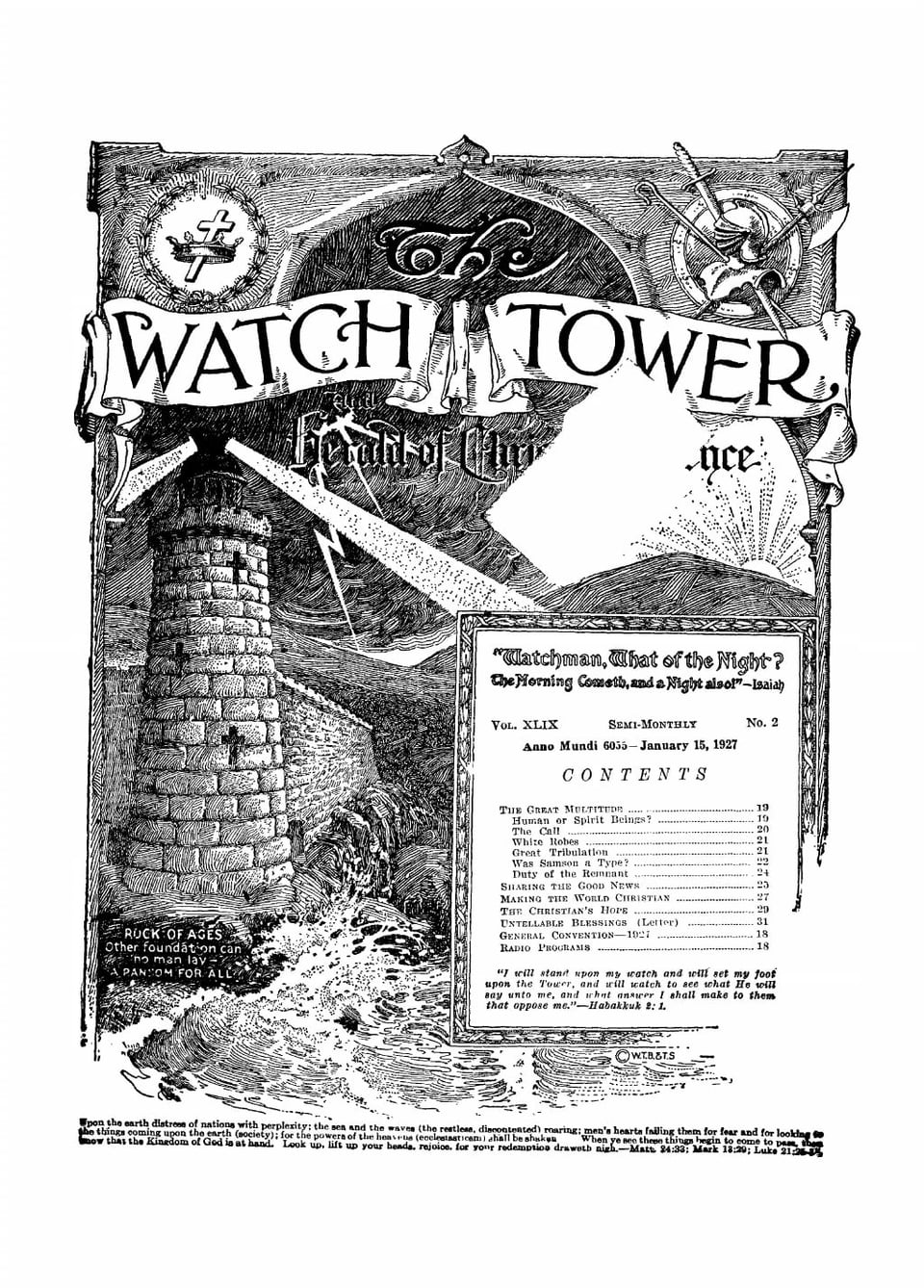
WATCH TOWER
"Watchman, What of the Night? The Morning Cometh, and a Night also!"—Isaiah
VOL. XLIX SEMI-MONTHLY No. 2
Anno Mundi 6055—January 15, 1927
CONTENTS
THE GREAT MULTITUDE .................................................. 19
Human or Spirit Beings? .................................................. 19
The Call ................................................................. 20
White Robes ............................................................. 21
Great Tribulation ....................................................... 23
Was Samson a Type? .................................................... 23
Duty of the Remnant ................................................... 24
SHARING THE GOOD NEWS ............................................. 25
MAKING THE WORLD CHRISTIAN ..................................... 27
THE CHRISTIAN HOPE .................................................. 29
UNBELIEVER'S BLESSINGS (LUCY) ................................. 31
GENERAL CONVENTION 1927 .......................................... 18
RADIO PROGRAMS ...................................................... 18
"I will stand upon my watch and will set my foot upon the Tower, and will watch to see what He will say unto me: 'I shall answer I shall make to them that oppose me.'"—Habakkuk 2:1
Upon the earth distress of nations with perplexity; the sea and the waves (the restless, disoriented) roaring; men's hearts failing them for fear and for looking to the things coming upon the earth (society); for the powers of the heavens (ecclesiastical) shall be shaken. When ye see these things begin to come to pass, then know that the Kingdom of God is at hand. Look up, lift up your heads, rejoice, for your redemption draweth nigh.—Matt. 24:38; Mark 13:29; Luke 21:25-26 THIS JOURNAL AND ITS SACRED MISSION
This journal is one of the prime factors or instruments in the system of Bible instruction, or "Seminary Extension" now being presented in all parts of the civilized world by the Watch Tower Bible & Tract Society, chartered A.D. 1884, "For the Promotion of Christian Knowledge." It not only serves as a class reader, but its Bible students may meet in the study of the divine Word but also as a channel of communication through which they may be reached with announcements of the Society's conventions and of the coming of its traveling representatives, styled "Pilgrims", and refreshed with reports of its conventions.
Our "Berean Lessons" are topical rehearsals or reviews of our Society's published Studies most entertainingly arranged, and very helpful to those who are seeking to teach the Berean Record or the Very Best Writer (V. D. M.), which translated into English is Minister of God's Word. Our treatment of the International Sunday School Lessons is specially for the older Bible students and teachers. By some this feature is considered indispensable.
This journal stands firmly for the defense of the only true foundation of the Christian's hope now being so generally repudiated—redemption through the precious blood of the man Christ Jesus, who gave himself a ransom (a corresponding price or substitute) for all, (1 Peter 1:19; 1 Timothy 2:6). Building upon this sure foundation, the gold, silver and precious stones (1 Corinthians 3:11-15; 2 Peter 1:5-11) of the Word of God, its further mission is to "make all see what is the fellowship of the mystery which . . . has been hid in God"—to the intent that now might be made known by the church the manifold wisdom of God—"which in other ages was not made known unto the sons of men, as it is now revealed" Ephesians 3:5-10.
It stands free from all modern sects and denominations, and seeks to safeguard its every utterance into fullest subjection to the will of God in Christ, as expressed in the holy Scriptures. It is thus free to declare boldly whatsoever the Lord hath spoken—according to the divine wisdom granted unto us to understand his utterances. Its attitude is not dogmatic, but confident; for we know whereof we affirm, treading with implicit faith upon the sure promises of God. It is held as a trust, to be used only in his service; hence our decisions relative to what we do and what we appear to the world must be according to our judgment of his good pleasure, the fulfilling of his word for the building of his people in grace and knowledge. We would only in this but urge our readers to prove all its utterances by the infallible Word to which reference is constantly made to facilitate such testing.
TO US THE SCRIPTURES CLEARLY TEACH
That the church is "the temple of the living God," peculiarly "his worshipping;" that its construction has been in progress throughout the gospel age—even since Christ became the world's Redeemer and the Chief Corner Stone of his temple, through which, when finished, God's blessing shall come "to all people", and they find access to him.—1 Corinthians 3:16, 17; Ephesians 2:20-22; Genesis 28:14; Galatians 3:29.
That means that the gathering and polishing of consecrated believers in Christ's atonement for sin, progresses; and when the last of these "living stones" "elect and precious," shall have been made ready, the great Master Workman will bring all together in the first resurrection; and the temple shall be filled with his glory, and be the meeting place between God and men throughout the Millennium.—Revelation 15:5-8.
That the basis of hope, for the church and the world, lies in the fact that "Jesus Christ, by the grace of God, tasted death for every man," Heb. 2:9; John 1:9; 1 Timothy 2:6, 8.
That the hope of the church is that she may be like her Lord, "see him as he is," be "partakers of the divine nature," and share his glory as his joint-heir.—1 John 3:2; John 17:24; Romans 8:17; 2 Peter 1:4.
That the hope of the world is that the coming of the King for the future work of service to develop in herself every grace; to be God's witness to the world; and to prepare to be kings and priests in the next age.—Ephesians 4:12; Matthew 24:14; Revelation 1:6; 20:6.
That the hope for the world lies in the blessings of knowledge and opportunity to be brought to all by Christ's Millennial kingdom, the restitution of all things lost in Adam, to all the willing and obedient at the hands of their Redeemer and his glorified church, when all the wilfully wicked will be destroyed.—Acts 3:19-23; Isaiah 35.
PUBLISHED BY
WATCH TOWER BIBLE & TRACT SOCIETY
18 CONCORD STREET BROOKLYN, N.Y., U.S.A.
FOREIGN OFFICES: British: 34 Craney Terrace, Lancaster Gate, London W. 2; Canadian: 38-40 Irwin Avenue, Toronto, Ontario; Australasian: 495 Collins St., Melbourne, Australia; South African: 6 Leile St., Cape Town, South Africa.
PLEASE ADDRESS THE SOCIETY IN EVERY CASE
YEARLY SUBSCRIPTION PRICES: UNITED STATES, 1.00; CANADA AND MEXICO,1.05; FOREIGN, $1.50. GUARANTEE: AUSTRALASIA AND SOUTH AFRICA, 7s. American remittances should be made by Express or Postal Money Orders, or by Bank Draft, Canadian, British, South African or Australasian. Remittances from other countries should be made to the Brooklyn office, but by International Postal Money Orders only. (Foreign translations of this journal appear in several languages.)
EDITORIAL COMMITTEE: This journal is published under the supervision of an editorial committee, at least three of whom have read and approved as true each and every article appearing in these columns. Members of the editorial committee: J. F. Rutherford, W. E. VAN AMBURGH, J. HEMERY, R. H. BARBER, E. J. COWARD.
TERMS TO THE LORD'S POOR: All Bible Students who, by reason of old age or other infirmity or adversity, are unable to pay for their journals will be supplied free of charge. Send a postal card each May stating their name and requesting such provision. We are not only willing, but anxious, that all such be on our list continually and in touch with the Berean studies.
NOTICE to Subscribers: We act, as a rule, on a card of acknowledgment for a month's subscription. The notice of non-receipt (including notice of expiration) will be sent with the journal one month before the subscription expires. Change of address, when requested, may be expected to appear on address label within one month.
Entered as Second Class Matter at Brooklyn, N. Y. Postoffice, Act of March 3rd, 1879.
I.B.S.A. BEREAN BIBLE STUDIES
By Means of "The Watch Tower"
"Sacrifice and Obedience" "The Temple of God"
Z June 15, 1926 Z August 1, 1926
Week of Feb. 6 . . . 1-24 Week of Feb. 27 . . . 1-32
Week of Feb. 13 . . . 25-49 Week of Feb. 27 . . . 1-33-35
1927 INTERNATIONAL CONVENTION
The general convention of the International Bible Students Association for 1927 will be held July 18th to 26th, at Toronto, Canada. Announcement is made now to permit the friends throughout the earth to get ready. Brethren are expected from many countries.
Toronto is the capital of Ontario and has a population of more than two hundred thousand, with another hundred thousand in the vicinity. It is a railway center. It is only a short distance from Niagara Falls. The city has provided its beautiful fair grounds and all its buildings for the convention. One of the buildings has a seating capacity of ten thousand. The grounds are situated on the lake front, segregated from the busy travel, and in a very pleasant location. It is expected that the entire proceedings of the convention will be broadcast over our own wireless, remote control being installed at the convention auditorium.
This will be the only large convention during the year. All classes desiring to hold local conventions should notify the Society as early as possible so that pilgrims may be routed in that way if at all possible.
RADIO PROGRAMS
The following stations are broadcasting the kingdom message:
WBRR, New York, 416.4 meters, Sun., Tues., Thurs., Fri.
WYOD, Batavia, Ill., 275 meters, daily.
CKCJ, Toronto, Ont., 291 meters, daily.
CHUC, Sandusky, Ohio, 389 meters, Sun., Thu., Thursday.
KRE, Seattle, Wash., 309 meters, Sunday, 9 to 10 p.m.
HKQ, Spokane, Wash., 394.5 meters, Sunday, 9 to 10 p.m.
KFWM, Oakland, Calif., 207 meters, Sun., Mon., Thurs., Sat.
BETHEL HYMNS FOR FEBRUARY
Sunday
Monday
Tuesday
Wednesday
Thursday
Friday
Saturday
The WATCH TOWER
AND HERALD OF CHRIST'S PRESENCE
Vol. XLIX JANUARY 15, 1927 № 2
THE GREAT MULTITUDE
"After this I beheld, and, lo, a great multitude, which no man could number, of all nations, and kindreds, and people, and tongues, stood before the throne, and before the Lamb, clothed with white robes, and palms in their hands."—Revelation 7:9.
JEHOVAH gave unto his beloved Son, Jesus Christ, a revelation of things which must come to pass, and which he was to show unto his servants. This revelation Jesus Christ gave unto John, a servant of the Lord, in sign or symbolic language. John seems to have pictured or represented the members of the body of Christ, and particularly those found faithful at the end of the age.
2 The Book of Revelation has always been difficult to understand. The reason for this seems to be that it is prophecy, and prophecy can be understood only when fulfilled or in course of fulfilment. It is evident that the Lord intended his church to understand it in his own due time. As the prophecies of Revelation are unfolded "the servant class" might expect to have some understanding thereof. Being a part of the Word of God it of course must be found strictly in harmony with other parts of Jehovah's Word.
3 Many of the prophecies, in both the Old and the New Testament, show that the world comes to a final end amidst a time of great tribulation. The seventh chapter of Revelation refers to that time of great tribulation and declares that before it comes God will cause his servants to be sealed in their foreheads. By this we understand that the faithful servant class would be given a clearer mental vision and a deeper heart appreciation of the divine plan as the church reaches the state of completion this side the veil. The increased knowledge would bring increased faith to those who love God and would give these a full assurance of God's protecting care.
4 The Revelator declares that the sealed ones number one hundred and forty-four thousand, divided into twelve companies. This is understood to mean that the members of the body of Christ number one hundred and forty-four thousand, and that these members shall receive the divine nature and shall reign with Christ during the Millennial Age. It seems clearly to include all those whom the Lord Jesus finds faithful when he comes to his temple and who thereafter continue loyal and faithful even unto death. Such are the recipients of God's favor and receive his care and protection in the day of vengeance.
5 The Prophet Isaiah seems to refer to the same class when he mentions those to whom God becomes a crown of glory and a diadem of beauty in the close of the age: "In that day shall the Lord of hosts be for a crown of glory, and for a diadem of beauty, unto the remnant of his people, and for a spirit of judgment to him that sitteth in judgment, and for strength to them that turn the battle to the gate."—Isaiah 28:5, 6.
6 Those found to be overcomers are made to sit down with the Lord on his throne and are given power over the nations. (Revelation 2:26; 3:21; 20:6) Then the vision discloses another company without number, which is described as "a great multitude" which stand before the throne. The question is propounded: "What are these . . . and whence came they?" And the answer is given: "These are they which came out of great tribulation."
HUMAN OR SPIRIT BEINGS?
7 Because the 144,000 members of the body of Christ receive the divine nature and are assigned to twelve tribes, and because it is stated that the great multitude is from all nations, kindreds, peoples and tongues, the argument has been advanced that the great multitude is that throng of people who will be resurrected to human perfection and who will live on earth for ever. Is the great multitude made up of human beings or beings possessing the spirit nature? This question we must determine from the Scriptures.
8 The fact that the 144,000 members of the body of Christ are divided up or assigned to twelve divisions, according to the names of Jacob's sons, does not mean that these are taken from twelve and only twelve different nations or people. God organized Israel into twelve tribes. In his covenant with that people he promised that if they would be obedient to him he would make of them a kingdom of priests and an holy nation, a peculiar treasure unto him above all other peoples. (Exodus 19:5, 6) It is quite evident that had Israel been faithful to the Lord and her covenant the entire number of the kingdom class would have been taken from the twelve tribes of Israel. Satan the enemy, working through the priests and other members of the clergy of Israel, turned the Israelites away from God and away from his anointed King.
There was only a remnant of Israel who accepted Christ and who were made a part of the 144,000, even as the prophet had foretold.—Romans 11:5; Isaiah 1:9.
Jesus came to Israel and offered himself as King, but was rejected. After Israel, under the leadership of the clergy and rulers, had rejected the anointed King he said unto them: “The kingdom of God shall be taken from you, and given to a nation bringing forth the fruits thereof.” (Matthew 21:43) St. Paul’s argument is that only a remnant of Israel after the flesh was selected, that all the other branches were broken off, and that in their places other branches were grafted in. (Romans 11:5-24) The apostle’s argument very plainly shows that the favor of being members of the kingdom class was taken away from the Jewish people and given to peoples of other nations, to those of the Gentiles who met the requirements of God; and that therefore these were selected and are to be assigned to the twelve tribes of Israel, as the Revelator shows.
10 The nation which brings forth the fruit of the kingdom is made up, as the Scriptures show, of those who are spirit begotten, who accept Christ Jesus as the anointed King, and who faithfully serve him and show forth the praises of God even unto the end. (1 Peter 2:5-10) In selecting these God is no respecter of persons. In the acceptable day whosoever makes a consecration to do the will of God and is accepted and begotten of the holy spirit, and who thereafter faithfully performs his covenant, has the assurance that he shall have an abundant entrance into the kingdom of God.—2 Peter 1:5-11.
11 The promise is to all who meet the requirements; and in selecting them God makes no distinction between Jew or Gentile, bond or free. (Galatians 3:27-29) What God does and is doing is that he takes those whom he accepts as members of the body of his beloved One, and then he assigns them to their respective places in one of the twelve divisions of the kingdom class. It is not improbable that the Lord assigns each tribe to some special work in his great plan, because he sets the members in the body as it pleaseth him.—1 Corinthians 12:18.
12 The facts show that those who give evidence of being members of the body of Christ have been taken from various peoples, nations and tongues on earth. Of those who compose the little flock a specific number is named; but the great multitude is without number (Revelation 7:9), being merely described as coming from every nation, kindred, people and tongue. This would in no wise prove that the great multitude is a human class, but on the contrary all the facts and the scriptures bearing upon the matter under consideration show that those who form the great multitude constitute a spirit class, born on the spirit plane.
13 The Scriptures show that during the Gospel Age there is but one call, and that is to the high calling. (Ephesians 1:18; 4:4) Jesus stated that “many be called, but few chosen”. (Matthew 20:16) The call takes place at the time of consecration, justification and acceptance by Jehovah. All who are called are begotten of the holy spirit, and these have entered into a covenant to do the will of God. At the beginning there is no division between the little flock and the great company class, God does not arbitrarily assign some to one class and some to another. In the atonement day sacrifice this is shown in the manner of selecting the Lord’s goat and the scapegoat.
14 Those who faithfully perform the covenant which they have made shall have an abundant entrance into the kingdom and shall constitute the kingdom class. Those who are negligent and indifferent or fearful concerning the performance of their covenant are describ d as ‘blind and unable to see afar off’. (2 Peter 1:9) The blind ones undoubtedly constitute the great multitude class, who are pictured by the prophet as sitting in darkness, for the reason that they have disregarded the Word of God. They not only are blind but are brought low and are held in prison and must go through great tribulation. (Psalms 107:10-16; 142:5-7; 102:19, 20; 79:11) Many of these blind ones have been and are workers in the denominational system, but they work not according to the rules nor in the way that God has provided that they shall work. (2 Timothy 2:5) The fiery test comes upon them for the purpose of testing their work; and their work is destroyed, as the apostle states, yet they are saved as by fire.—1 Corinthians 3:12-15.
15 The facts show that there are now more than 144,000 persons on earth who claim to be consecrated to the Lord, and who are with the denominational systems. These have conceived it to be their work and duty to convert the world and to set up the kingdom for Jehovah. They are like a woman who has birth pains and yet brings forth nothing. They have been subject to a lord other than Jehovah. The clergy have ruled them, and have done so under the supervision of their overlord the Devil.—John 8:44.
16 The sincere saints in the denominational systems come to see their condition, which is represented by the words of the Prophet Isaiah: “O Lord our God, other lords beside thee have had dominion over us: but by thee only will we make mention of thy name. . . . Like as a woman with child, that draweth near the time of her delivery, is in pain, and crieth out in her pangs; so have we been in thy sight, O Lord. We have been with child, we have been in pain, we have as it were brought forth wind; we have not wrought any deliverance in the earth; neither have the inhabitants of the world fallen.”—Isaiah 26:13, 17, 18.
17 These see that their work is in vain, that they have accomplished nothing, that they have been misled by the clergy, their lords, and by their overlord the Devil; and they come to a determination to abide by Jehovah's Word and it alone.
It is certain that all such who have been begotten by the holy spirit must either die for ever or live for ever, and those who live must live as spirit beings. Not all who shall have part in the resurrection shall be of the same class, because "one star differeth from another star in glory. So also is the resurrection of the dead."—1 Corinthians 15:41, 42.
18 The Psalmist describes a class as constituting the bride of Christ, and then another class who are not of the bride but who are companions to the bride. These also are called virgins, which means that they have been purified through the washing of the Word and of the blood of the Lord. This larger company is described by the prophet as entering into the palace of the King, but they are not a part of the royal family. (Psalm 45:14, 15) Of necessity such must be spirit beings and not human beings, because human beings cannot be of or associated with the heavenly kingdom class.
19 The Revelator describes such as a great multitude before the throne and before the Lamb, clothed with white robes and having palms in their hands. This scripture shows that the great multitude is made up of spirit beings, because human beings cannot stand before the throne of the Lord. The palm is a symbol of martyrdom. A martyr is one who becomes a witness by reason of giving up his life. Other scriptures show that the great multitude does bear witness unto God by reason of the kind of death that the members thereof shall die. It is by their death that they testify that they are for Jehovah.
20 The vision of Revelation shows this great multitude class standing before the throne, singing praises to Jehovah and to the Lamb, Christ Jesus; and there is associated with them at that time the angels of heaven. The angels here mentioned are undoubtedly spirit beings; and those who associate with these angels in giving praise to God and to Christ, as described by the Revelator, of necessity must also be spirit beings.
WHITE ROBES
21 In the vision given St. John the great multitude is shown standing before the throne of God and clothed with white robes. What could these white robes represent? They could not be the same as the robe of righteousness mentioned by the Prophet Isaiah (61:10); because there the word "robe" is in the singular, whereas each one of the great multitude is described as being arrayed in a robe; hence the white robes here mentioned are numberless. The robe of righteousness is God's mark of approval, given to the body members of Christ when he comes to his temple; that is to say, those whom the Lord finds faithful when he comes to his temple he covers with the robe of righteousness, showing their approval by him. Those who died in the faith prior to our Lord's coming to his temple are shown in Revelation 6:11 as being given white robes, that is to say, approval; and then they are told that they must rest until their brethren finish their course. Jehovah furnishes the robe of approval, the robe of righteousness; then Christ Jesus uses it as a covering to those of the temple class who are approved.
22 Wherever used in the Scriptures a robe is a symbol of approval. When picturing the approval of the bride of Christ it is the approval of a body collectively. But the approval of the great multitude is the approval of many individually; therefore the latter company is represented as each having a robe. After coming to a knowledge of the fact that they have been approved by the Lord the great multitude are shown as rejoicing. They have learned of the loving kindness of God and his beloved Son; and they are then pictured as standing before the throne, singing the praises of Jehovah and of his beloved Son. In this song of praise the angels of heaven join with them.
GREAT TRIBULATION
23 But how do these obtain God's approval, seeing that they were negligent in the fulfillment of their individual covenants to do the will of God? The context of Revelation 7:9 discloses that St. John wondered as to their identity; and the answer is found in the language of one of God's prophets, which prophet appears to be Isaiah. The language of the scripture indicates that the question had been propounded to one of the elders, or prophets. Then the elder repeats the question: "What are these which are arrayed in white robes? and whence came they?" (Revelation 7:13) The prophet is then represented as saying: 'You do not know who these are? Then I will tell you. These are they which came out of great tribulation and have washed their robes and made them white in the blood of the Lamb. Therefore they are before the throne of God and serve him day and night in his temple.'
24 Be it noted that these are approved by the Lord and become servants in the temple, but are not a part of the temple class. The time and conditions under which the approval was received by them are shown to be during the time of great tribulation. This approval is evidenced by the robe that each one is represented as wearing, and the approval is because of faithfulness in the time of great trouble.
25 The World War was the beginning of sorrows upon the nations, which compose Satan's earthly organization. The war then suddenly ceased; and God, through Christ, sent forth his servants to declare the message of the kingdom; and when that is done the end must come. (Matthew 24:14) That final end of Satan's organization is marked by great tribulation such as the peoples of earth have never before known and never will know again.—Matthew 24:29, 32.
26 The elder who gives the answer to John in Revelation clearly seems to represent the Prophet Isaiah, for the reason that Isaiah tells of the great tribulation and declares who will be involved in it. It is the great battle of Armageddon. It is during that trouble that the Lord treads the wine-press and crushes out the grapes of the vine of the earth. (Isaiah 63:1-6) In that trouble all of Satan's organization shall fall. The Lord planted the church a true and noble vine; but under the leadership of men who became false prophets, namely the clergy, there developed a false system which turned the Christian arrangement into a degenerate plant of a strange vine. The vine of the earth is Satan's organization, of which ecclesiasticism is a part; and it must be crushed and will be crushed, in the day of God's wrath.—Revelation 14:18-20.
27 The great multitude is now being held in the ecclesiastical systems as prisoners. Those who remain there will partake of her sins and suffer her plagues. (Revelation 18:4) It is the duty of the church, "the servant" class, to send to these prisoners the message concerning God's kingdom, whether they all come out of the prisons or not. Those who take their stand on the Lord's side will be the object of persecution and oppression by the Devil's representatives. Then will be their crucial test as to whether or not they will stand for the Lord or give way to the Devil's organization. That which will enable them to stand in this test will be their faith in the blood of the Lamb, shed for the salvation of mankind. The blood of the Lamb and their faith therein will bring the approval of God to those who stand the test, and this approval is symbolized by the white robes which they are represented as wearing.
28 This great tribulation class is not of the bride of Christ which, together with the Bridegroom, is designated Zion. Being spirit-begotten ones, once anointed but having lost their anointing, they nevertheless are a part of God's organization, symbolized by the city of Jerusalem. Because they take their stand on the side of the Lord in the time of great stress they become targets for the representatives of Satan, and are therefore pictured by the Prophet Zechariah as a part of the city that goes into captivity. The tribulation is shown by the prophet to begin when all of the Devil's organization is gathered for Armageddon. The day of the Lord is the day of his wrath, and that is the time when Armageddon is fought. "For I will gather all nations against Jerusalem to battle; and the city shall be taken, and the houses rifled, and the women ravished; and half of the city shall go forth into captivity, and the remnant of the people shall not be cut off from the city. Then shall the Lord go forth, and fight against those nations, as when he fought in the day of battle." (Zechariah 14:2, 3) This prophecy shows that the part of the city that goes into captivity is the great company class, whereas the faithful "remnant" are kept by the power of the Lord.
29 The Scriptural picture of the great company class is a general one and represents specifically those of the consecrated who are in the denominational systems at this time. There are doubtless other consecrated ones, outside of the denominational systems, some who have once been brought to a knowledge of present truth, but who fall back into the great company class by reason of their indifference or negligence in representing the Lord. The general twofold picture given in Revelation is (1) the little flock, constituting the kingdom class; and (2) the great multitude, constituting those who will be servants of the Lord in the temple but not a part of it.
WAS SAMSON A TYPE?
30 The Bible gives at some length an account of the birth and experiences of Samson, including his tragic death. The entire account should be carefully read in this connection. (See Judges 13th to 16th chapters inclusive.) The question often arises among Bible Students: Was Samson a type, and if so of what? Strictly speaking he was not a type, but it seems quite clear that Samson foreshadowed or illustrated some particular part of the outworking of God's plan. It has been suggested by some that he represented the socialists or the anarchists who will destroy the social order of mankind. That conclusion does not seem to be warranted by the Scriptures and by the known facts. Samson seems to have foreshadowed the great tribulation class, the great multitude. In support of this the following is submitted for the consideration of Bible Students:
31 St. Paul, in the eleventh chapter of Hebrews, names a number of men who received a good report from God because of their faith. Among the ones there mentioned is Samson. It hardly seems probable that God would use a man whom he approved because of his faith to picture a faithless, unbelieving class such as socialists or anarchists who have no confidence whatsoever in God. If Samson is a type of anything, or if he foreshadows anything, it would be reasonable that God would use him to foreshadow some class in the outworking of his plan that would manifest faith in God. In describing those who were faithful St. Paul, amongst other things, said of them: "Out of weakness [they] were made strong". (Hebrews 11:34) Samson, once weak, was made strong in his death, and became a witness for God by the manner of his death. Even the circumstances of his birth marked him as an instrument for God's use.
32 The wife of Manoah was barren. The angel of the Lord appeared unto her and told her that she would conceive and bring forth a son, and that "no razor shall come on his head: for the child shall be a Nazarite unto God from the womb; and he shall begin to deliver Israel out of the hand of the Philistines". (Judges 13:5) She told her husband Manoah; and at his request and prayer to God the angel again appeared unto Manoah and his wife and confirmed what had been said to the woman about the child's birth. In due time Samson was born.
23 The word Nazarite, here used, means one who is consecrated or separated from others. The understanding is, then, that from the time of his birth Samson was separated as a consecrated one unto God, to represent Jehovah God. Before the foundation of the world God foreordained that he would take from amongst men those who should constitute his church. (Ephesians 1:4, 5) All who are called to be of the church are called in one hope of membership in the body of Christ, and none are called to the great company. All who are called must be consecrated unto God and separated from the world, therefore all such must be Nazarites in spirit unto God. This includes every one begotten and anointed of the holy spirit. Samson, being a Nazarite, would foreshadow all such.
24 The name Samson means "brilliant light, or sunlight, or that which reflects light". From the time one is begotten of the holy spirit he becomes a light-bearer and reflects the light of the Lord, more or less. The name Samson therefore would foreshadow the light-bearing class or consecrated Christians.
25 The hair is a covering for the head, and grows out from the head. The facts show that the strength of Samson was in his hair. The strength of every Christian comes from and through his Head, Christ Jesus. (2 Corinthians 12:9, 10; Ephesians 6:10) When the high-priest of Israel was anointed, the anointing oil was poured upon his head, and of course upon his hair, and ran down upon his beard. (Psalm 133:2) All who are begotten of the holy spirit and inducted into the body of Christ receive the anointing of the holy spirit through the Head, Christ Jesus. When Samson's hair was cut off he lost his strength. When a Christian loses his anointing he is separated from the body of Christ as a member thereof, but he still may be a Christian if he has faith in the great ransom sacrifice. As his faith is weak, so is he weak. If his faith grows stronger, he may grow stronger.
26 The prophecy concerning Samson was to the effect that "he shall begin to deliver Israel out of the hand of the Philistines". But be it noted that he did not finish the work of deliverance from the Philistines, who represent the Devil's organization. In like manner great numbers of people have become Christians, and for a time have taken a bold stand for the Lord and have begun a good work of delivering God's people from the Devil's organization; then they lose interest, manifest a lack of faith, yield to other influences, and discontinue the work. Samson in this respect would picture a class who once started to follow the Lord and then became lukewarm or fearful.
27 Concerning Samson we read: "And it came to pass afterward, that he loved a woman in the valley of Sorek, whose name was Delilah." (Judges 16:4) Samson entered into an illicit relationship with this woman of Sorek. The word Sorek means a vine, and would therefore well picture those members of the consecrated who become a part of the vine of the earth. Delilah seems to well represent the ecclesiastical systems which constitute a part of the Devil's organization and over which the Devil is lord. Many Christians have yielded to the flattery and influence of ecclesiasticism and have entered into illicit relationship with such systems.
28 The Scriptural account is that the "lords of the Philistines" said to Delilah: 'Entice Samson and find out wherein his strength lies, that we may bind him and afflict him; and we will pay you well for it.' (Judges 16:5) The lords are the chief ones in the ecclesiastical systems, the clergy; and their overlord is the Devil. They have always sought to destroy the power and influence of the zealous and active Christians who are working for the Lord. For some time Samson withstood the enticements of Delilah; but finally he yielded to her pleadings and diplomacy, and disclosed to her wherein lay his strength. Delilah was false to Samson, and for pay betrayed him to the Philistines. The ecclesiastical systems have been false to the great number of true Christians therein; and for pay, to wit, to gain favor with the Devil's organization in order to obtain power and influence, they have betrayed these true Christians into the hands of the Devil and his organization.
29 Delilah accomplished her purposes by causing Samson to sleep upon her knees; and while asleep she had his hair cut off. Then the Philistines came upon him, took him in custody, and put out his eyes. Great numbers of Christian people have been lulled to sleep by the pleadings and diplomacy practised by the Devil through the ecclesiastical systems, and thereby have been removed from the Lord and have lost the strength of the Lord. Having lost the anointing they have had the eyes of their understanding put out. They have become blind, because they have disregarded the Word of God, having yielded to the influence of those in the ecclesiastical systems.—Psalm 107:10-16; 2 Peter 1:9.
30 When the Philistines had put out Samson's eyes they made him a prisoner. There is a great multitude of Christians who have been made blind to God's plan and purposes by the fraud and deceit practised upon them in the ecclesiastical systems, and by the work of the clergy in particular, and have become and are now held as prisoners in the prison-houses of the ecclesiastical systems. These prisoners realize that in the systems there is no truth, and they pray and cry unto the Lord.—Psalm 102:17-20.
31 The Psalmist, later describing the great company class, says: "For he [God] hath broken the gates of brass, and cut the bars of iron in sunder." (Psalm 107:16) The Philistines held Samson in fetters of brass and iron and caused him to grind in the prison-house. Then in the course of time Samson was released, amid destructive conditions. The record further reads: "Howbeit the hair of his head began to grow again after he was shaven." (Judges 16:22) This seems to indicate that Samson began to recover his strength.
This would also indicate that the class whom Samson represented would eventually begin to recover the strength they had lost.
42 We are now at the end of the age. The remnant of the Lord, otherwise described as the temple class or "the servant" (Isaiah 42:1), now begin to recognize from the Lord's Word that there is in the ecclesiastical systems a great number of people who love the Lord and who have faith in the blood of Christ Jesus; that these are prisoners in the prison-houses of the ecclesiastical systems (Isaiah 49:9); that these are blind and sit in darkness (Psalm 107:10-14; 2 Peter 1:9); and that it is now the duty and privilege of "the servant" class to carry the message of truth to these prisoners in the prison-houses, that their blind eyes may be opened.—Isaiah 42:6, 7.
43 It is the Word of the Lord that brings strength to those who are weak. It is said of the prisoners that "they shall feed in the ways, and their pastures shall be in all high places". (Isaiah 49:9) The food without doubt must be brought to them from the Lord in his own good way through those who are witnesses for the Lord. As this great multitude sees the truth and feeds upon it the members thereof will grow in faith and strength. As these begin to take their stand on the side of the Lord they will of necessity become the targets of persecution by the systems, and especially by the prison-keepers thereof.
44 It was about the time that Samson's hair began to grow that the lords of the Philistines gathered themselves together to offer a great sacrifice unto Dagon their god (Judges 16:23) and to have a festival of rejoicing; which, however, ended in disaster. Now the Devil is gathering together his forces for Armageddon. The great company class, beginning to learn of the truth, shall see and understand that the Devil's organization is to be destroyed.
45 Meanwhile the Philistines, particularly the high ones amongst them, were using Samson for sport and making sport of him. (Judges 16:25) Likewise the clergy now delight to make sport of any true Christian; and, judging from this, as their prisoners take their stand on the side of the Lord these clergy will use them for sport and will oppress them.
46 The record is that Samson called on the Lord and said: "O Lord God, remember me, I pray thee, and strengthen me, I pray thee, only this once. O God, that I may be at once avenged of the Philistines for my two eyes." (Judges 16:28) Similarly the great company, as prisoners, are represented as crying to the Lord thus: "Help us, O God of our salvation, for the glory of thy name; and deliver us, and purge away our sins, for thy name's sake. Wherefore should the heathen say, Where is their God? let him be known among the heathen in our sight, by the revenging of the blood of thy servants which is shed. Let the sighing of the prisoner come before thee; according to the greatness of thy power preserve thou those that are appointed to die; and render unto our neighbours sevenfold into their bosom their reproach, wherewith they have reproached thee, O Lord."—Psalm 79:9-12.
47 Again their prayer to the Lord is recorded: "I cried unto thee, O Lord: I said, Thou art my refuge and my portion in the land of the living. Attend unto my cry; for I am brought very low: deliver me from my persecutors; for they are stronger than I. Bring my soul out of prison, that I may praise thy name: the righteous shall compass me about; for thou shalt deal bountifully with me." (Psalm 142:5-7) Even as God heard Samson and granted him strength, so does the prophet show that he now hears the prayers of the imprisoned multitude and that "the Lord looseth the prisoners".—Psalm 102:19, 20; 146:7.
48 Samson knew that the Philistines would die. The great company class know that the Devil's organization must die. Samson with renewed strength determined to die by pulling down the building wherein he was held. The great multitude of Christians, as they feed upon the Word of God and grow stronger and learn that the harvest is past and that they cannot be of the kingdom class, will take a determined stand on the side of the Lord, knowing that by so doing they will be pulling down the Devil's structure on their own heads. But they resolve to die as witnesses for the Lord. In the very final and crucial test they prove their faith in God and suffer martyrdom. They die in the great time of trouble or in the time of tribulation. Note the Revelator says that they, as a great multitude, stand before the throne of God; that they are clothed with white robes, representing that they are approved; and they have palms in their hands, representing that they fall as martyrs to the cause of Jehovah.
DUTY OF THE REMNANT
49 From the arguments heretofore submitted in THE WATCH TOWER, based upon the Scriptures, it is clear that the Lord God has commissioned the remnant to speak to those who form the great company class, to carry to them the message of truth, and to bid them as prisoners in the ecclesiastical systems to come forth and take their stand unreservedly on the side of the Lord. Seeing that it is God's due time to have this done let every child of the Lord who is really devoted to God and to his cause gird up his loins and, with the song of deliverance upon his lips, proceed to carry the message to those who are held in the prison-houses.
50 The Lord God will have this message carried to those who are his. The question for each one of us is: "What part shall I have in this blessed work?" To enable the great company class, who are prisoners, to grow strong they must get some knowledge of the Devil's organization and of the Lord's organization, and of God's means of bringing deliverance to them. Let the message of deliverance be carried far and wide to those who are hungry to know the truth!
QUESTIONS FOR BEREAN STUDY
Whom did John represent? Why is Revelation so hard to understand? When and by whom should it be understood?
Who are "sealed in their foreheads" and what does that signify? ¶ 1-4.
What is the crown of glory and diadem of beauty mentioned in Isaiah 28:55? Who will be on the throne and who will be before it? ¶ 5, 6.
Will the great multitude have spirit nature? Why are the 144,000 declared to be in twelve divisions? How do the natural branches broken off (Romans 11:5-24), and who constitute the new branches grafted in? ¶ 7-11.
Why is the tribulation class described as innumerable? Are any called to be of that class? How then is the class made up? ¶ 12-14.
What has been the futile ambition of Christians in the denominational system, and how do they now feel? (Isaiah 26:13; 13:11, 18) ¶ 15-17.
Who are the companions of the bride, and why are they called virgins? (Psalm 45:14, 15) Why is the great multitude represented in Revelation as having palm branches? Who were associated with them in singing, and what do these facts prove as to their nature? ¶ 18-20.
Why are they represented as wearing white robes? How do these garments differ from the robes of righteousness? What does the robe symbolize in Scripture? ¶ 21, 22.
How and when does the great multitude obtain God's approval? ¶ 23, 24.
What is the tribulation out of which they come, and who is represented by the elder that answered the Re却ator respecting them? How is the period of tribulation otherwise pictured in Revelation? ¶ 25, 26.
What is our present responsibility toward the great company? What does Zechariah 14:2, 3 show concerning them? What information do we have as to who will constitute the great company and the little flock respectively? ¶ 27-29.
Was Samson a type? Did he foreshadow the faithless radicals of our day? ¶ 30, 31.
What were the circumstances of his birth? Why was he called a Nazirite? Who are Nazarites today? ¶ 32, 33.
What does the name Samson mean, and what is the significance of his strength being in his hair? ¶ 34, 35.
Why was it prophesied that "he shall begin to deliver Israel"? Who was the woman that caused his downfall, and where was she from? What does this mean? Who were back of the scheme, and what did they do with Samson after his hair was cut off? Apply the picture. ¶ 36-40.
How does Psalm 107:16 agree with this picture? Why is it mentioned that Samson's hair began to grow again? How shall the Samson class receive strength? ¶ 41, 43.
What did the sacrifice unto Dagon, and the Philistines' merriment over Samson, foreshadow? How does Samson's prayer parallel with that of Psalms 79:9-12 and 142:5, 6, 7, 8, 9, 10, 11, 12, 13, 14?
Did Samson know that he was pulling down the building on his own head? What did this illustrate? ¶ 48.
What now is the manifest duty of the remnant class? ¶ 49, 50.
SHARING THE GOOD NEWS
—MARCH 6—ACTS 8:4-8; 2 CORINTHIANS 5:14-20—
"Ye shall be my witnesses."—Acts 1:8.
THE scriptures set for this study tell of the spreading of the gospel from Jerusalem, and state it as a ministry of good news intended to bless the world. The study calls attention to the words of Jesus as he led his disciples to Bethany and gave them commission as his witnesses; it carries on to the preaching of the gospel in Samaria, and to Paul's declaration of the authority and the ministry itself as God's instrument for the reconciliation of the world.
2 For true cooperation with God it is necessary to have a proper understanding of the purpose of Jesus in sending his disciples into the world to preach the gospel. The thought which has ruled Christendom since her various churches were established, and the theory upon which they have operated, is that the apostles were sent out to begin a work which should through them spread throughout the world and ultimately bring all men to a knowledge of Christ. Organized religion still professes to hold this idea; it is the denominations' justification for their existence.
3 That God intended to have all men know of his purpose toward them is certain. Paul says of this, "God ... will have all men to be saved, and to come unto the knowledge of the truth" (1 Timothy 2:4); but that he intended to have this work accomplished by the church while yet he allowed evil to rule in high places ought never to have been conceived. It is one of the snares of the evil one into which organized religion has fallen. The disciples and the church which followed them were to be witnesses, and were to be in the world something like the prophets of Israel were to that people—witnesses for God. Also the witness of the church was intended to bring a measure of responsibility upon men; for by it God, who hitherto had not spoken to men, now commanded all men everywhere to repent.—Acts 17:30.
4 The apostles were appointed by Jesus to carry on his work. It should ever be remembered that Jesus was God's Apostle, sent into the world to represent God, to fulfil the prophecies spoken long before (See Romans 15:8.), to declare that the kingdom of heaven was about to be established, and to confirm the same by marvelous works, thereby proving that he came from God. His ministry was, however, limited to his own people according to the flesh; he was sent only to the lost sheep of the house of Israel. Therefore Jesus made no attempt to tell other peoples the message he had from God. And to his own people his ministry was limited to three and one-half years, during which a considerable amount of his time was spent privately and not with the multitudes.
5 Since Jesus came to enlighten the world—as John says, "That was the true Light, which lighteth every man that cometh into the world"; and Jesus himself said, "I am the light of the world" (John 1:9; 8:12) —it was necessary that his ministry must go abroad among all men.
He had truth to proclaim, the essence of which was that the rule of sin over men must come to an end, that men themselves had responsibility toward God, that God intended to establish righteousness in the earth, and that all men must conform thereto or suffer the consequences of their disobedience to God. And coupled with this was the message that God was doing this in love for the whole world, even for those whose minds were alienated from him.—Colossians 1:21.
6 Besides this witness to God's purpose, Jesus had God's name to set forth. He was sent to declare who God is. He is a God of love, and is gracious and compassionate toward those who have erred unwittingly or unwillingly; yea, even toward those who have knowingly transgressed against him, if they repent and manifest a desire to be in harmony with his will. And the disciples were to be witnesses for Jesus as he was for God, both in message and in life.
7 The apostles became the treasurers of the truth. They had the Old Testament Scriptures to refer to, with perhaps goodly stores in memory; and then to these the words of their Master were added, for the truths which Jesus spoke were brought to their mind by the holy spirit. Therefore, though they were imperfect, they were qualified to represent him as he had represented God. (1 Corinthians 11:1) God had charged Jesus with a mission for which he was responsible; therefore when he appointed the apostles they were really his representatives to continue his message in his way, and in his spirit.
8 For a time the apostles served in Jerusalem, and God blessed their ministry. They realized that the Lord was with them; they were continually conscious of having the power of the holy spirit to enable them to do their work. Naturally enough they found much work in Jerusalem; for the great increase in the number of believers, and the fact that many of them altered their manner of living, gave them all a busy time. Then came the necessity to see even to the domestic affairs of the believers.
9 But the Lord did not let this condition continue for long. The malice of the Jewish leaders, whetted by the blood of the martyr Stephen, began a sharp persecution which drove many of the disciples out of Jerusalem. Some went to Samaria, and many Samaritans listened to their word and believed in Jesus. A great work was now begun; Samaria was stirred much as Jerusalem had been. No doubt their readiness to accept the truth was partly due to the ministry of Jesus begun at Sychar. (John 4:39) Thus, as Jesus had indicated, the spreading out of the good news was first to Samaria.—Acts 1:8.
10 The account of this ministry in Samaria is given in the 8th chapter of the Acts of the Apostles. It is not without significance that this first preaching of the good news to other than Jews is described by Luke in many different terms, each intended to indicate or emphasize some particular phase thereof.—See Acts 8:4, 5, 12, 14, 25, 35.
11 The next portion of our study takes us to Paul's statement respecting the ministry, its calling and authority. He speaks not for himself but for all. All who have seen the love of Christ are constrained to follow Paul in his service for Christ. There are obligations upon all such. Those who believe in God through Christ find life, and Paul judges that there is an obligation upon all these to realize that that life should be lived in the service of the ministry. "For the love of Christ constraineth us; because we thus judge, that if one died for all, then were all dead: and that he died for all, that they which live should not henceforth live unto themselves, but unto him which died for them, and rose again."—2 Corinthians 5:14, 15.
12 The salvation of the believer from the guilt and power of sin is not the special question in the foregoing text; the point of the argument is that believers in Christ receive life as in advance of the day of salvation, because God has a ministry for them. Theirs is not life to be enjoyed in itself, but is given that it may be devoted to the service of God, as Jesus devoted his life; and those who share in his ministry will share in the glory which God has given to him. "If we suffer, we shall also reign with him."—2 Timothy 2:12.
13 Paul raises a high platform for the Christian ministry, not to bring the ministers into prominence but to show the high place which the ministry itself holds. He who is called to be a minister for God must be a new creature, begotten of God's holy spirit; none other can have a share. And there are two things to be noted: It is the ministry of reconciliation wherein God speaks to the world, and the ministers have the Word of Reconciliation. In other words, there are the work and the authority, the ministry and the Word.—See 2 Corinthians 5:16-19.
14 Men are alienated from God, and God would have them reconciled to himself. They are away from him, alienated in mind and desire; they neither want him nor the truth. His ministry is to restore mankind to himself. As God's method of reconciliation is based upon an atonement for man's sin Paul, in the proclamation of his message of salvation, necessarily speaks of God's attitude toward sin. Paul says that God was not charging the world's sin against it. (2 Corinthians 5:19) First, God will have men know of his good will, then of the provision which he has made for their acceptance.
15 The teachers of Christendom have led men to believe that God's attitude toward the world is one of sustained anger because of sin, and they have taught that he is vengeful and would not be appeased unless satisfied by the blood of a victim. That there is a propitiation made for sin by the sacrifice of Jesus is certain. (1 John 2:2) But it is God himself who has provided it all; and it is manifest therefore that the propitiation is not to appease his wrath, but rather that he may be just while yet providing a way for the erring children to come back to himself.
16 The world's sin is not forgotten, but the death of Christ and the life value of that death offered in heaven make sin atonement. Whoever, therefore, will accept it will thereby find his sin forgiven and he himself acceptable to God. During the ministry of this good news, in the interval of time between the two advents, only a comparatively few have heard and accepted the doctrine of grace. But God has provided a day, now opening, in which all men who have not heard shall hear and have a full opportunity of accepting salvation by Christ; and the dead shall have as full a chance as the living, for they are to be raised that they may have their opportunity.—John 5:25.
17 Paul says of God's ministers, "We are ambassadors for Christ." (2 Corinthians 5:20) The common thought respecting this word ambassador is that Paul uses it in the modern political acceptance of the term; but that is not correct. An ambassador nowadays is appointed only to a friendly nation, to reside among them while representing his home government; he is friendly to them, leaving only when the friendly relationship is disrupted. While God cares for the world of mankind, he has no relationship whatever with the world as such; its institutions, its organizations, are unfriendly to him.
18 This world has been ruled by Satan, the god of this world. Its institutions, whether political or ecclesiastical, are of human design and without relation to God's will or pleasure. James says, "Know ye not that the friendship of the world is enmity with God? whosoever therefore will be a friend of the world, is the enemy of God." (James 4:4) What Paul means in 2 Corinthians 5:20 is that Christ's ambassadors go from him with authority to speak on his behalf; but in no sense are they sent to settle down or to try to bring perfect relationship between the authority of Christ and the authorities of this world. The Roman Catholic church has claimed to rule in the kingdoms of this world, and has sent its "ambassadors" to many nations; but it has done so entirely on its own authority, with no sanction from God.
19 Jesus sent his messengers with authority to speak for him, but with no authority to direct the course of this world, or to regulate anything save those things which belong to the church of God. (Matthew 18:18) In this ministry only those who are new creatures in Christ Jesus are entitled to serve, those who have the spirit of God and the spirit of Jesus. As no human institution can confer these blessings, it follows that no human institution can make a man a minister of God. The divine ministry does not fail; it will accomplish that to which it was sent.—Isaiah 55:11.
QUESTIONS FOR BEREAN STUDY
What is the "orthodox" purpose of preaching the gospel?
What is God's purpose? ¶ 1-3.
For what reasons was Jesus sent into the world? ¶ 4-5.
Why were the apostles appointed? What work did they do following Jesus' ascension? ¶ 7-10.
What is St. Paul's argument in 2 Corinthians 5:14-19? ¶ 11-14.
What do the clergy insist is God's attitude toward the sinful world? What is the truth on this point? ¶ 15, 16.
How are we "ambassadors" for Christ, and what is our duty as such? ¶ 17-19.
MAKING THE WORLD CHRISTIAN
—MARCH 13—MATTHEW 28:16-20; ACTS 16:6-16—
"Go ye therefore, and make disciples of all the nations."—Matthew 28:19, R. V.
THROUGHOUT this series of studies we are reminded of the fact that the common conception of the purpose of Jesus in sending out his disciples into the world is very different from that which the Scriptures themselves convey. Neither the records of the words of Jesus nor the words or epistles of the apostles give warrant for the commonly held thought that the work begun by Jesus, continued by the apostles and by the church, is to make the world Christian.
2 That it is God's purpose to eventually have all men enlightened by the message of Jesus and made acquainted with his own purpose through him is clear. Paul says, "God will have all men to be saved, and to come unto the knowledge of the truth" (1 Timothy 2:4); and Paul's own word for knowledge means accurate knowledge. Nor is God limited to a good desire in this; he purposes to do it—he will have all men to be saved.
3 Paul states the matter in the reverse order to that commonly understood by evangelists and others; he says that men are first to be saved and then brought to a knowledge of the truth, whereas the clergy would bring men to the truth that they may be saved. It is evident that he and they have different conceptions of God's purpose. Paul sees the dead millions who have not known God saved from the bondage of death; and the living millions, ignorant of God through lack of knowledge as well as through the misdirection of false teachers, delivered from the power of evil; and all with clear knowledge at liberty to accept his truth.
…