The Watchtower, March 15, 1926
Download: PDF — The Watchtower, March 15, 1926
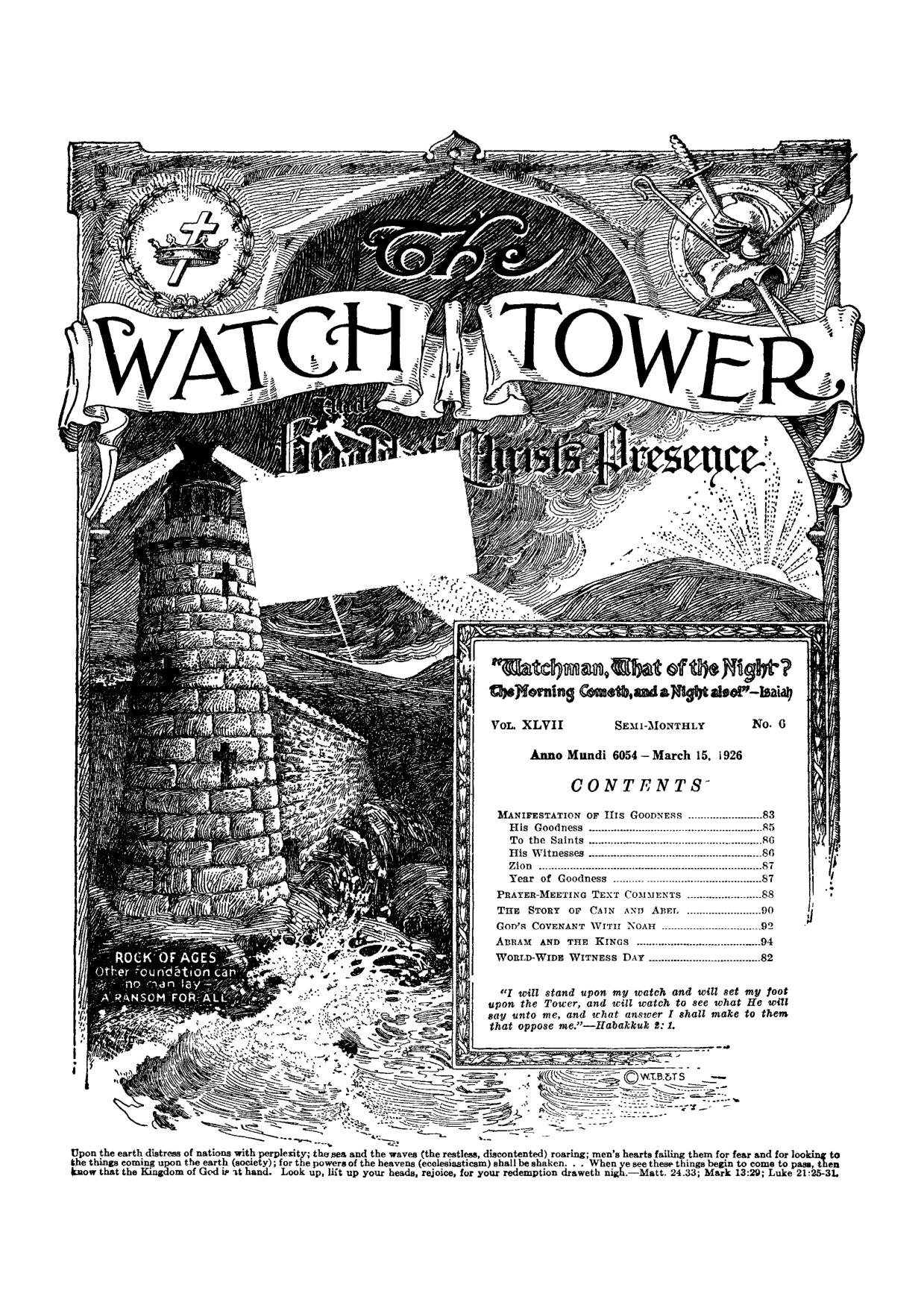
Upon the earth distress of nations with perplexity; theses and the waves (the restless, discontented) roaring; men’s hearts failing them for fear and for looking to the things coming upon the earth (society); for the powers of the heavens (ecolesiasticsm) shall be shaken. . . When ye see these things begin to come to pass, then know that the Kingdom of God i? it hand. Look up, lift up your heads, rejoice, for your redemption draweth nigh.—Matt. 24.33; Mark 13:29; Luke 21:25-31*
THIS JOURNAL AND ITS SACRED MISSION
THIS joaznal is ona of the prime factors or instruments in the system of Bible instruction, or “Seminary Extension’^ now being presented in all parts of the civilized world by the Watch Tower Bible & Tract Society, chartered A. D. 1884, “For the Promotion of Christian Knowledge”. It not only serves as a class room where Bible students may meet in the study of the divine Word but also as a channel of Communication through which they may be reached with announcements of the Society’s conventions and of the coming of its traveling representatives, styled “Pilgrims”, and refreshed with reports of its conventions.
Our “Berean Lessons” are topical rehearsals or reviews of our Society’s published Studies most entertainingly arranged, and very helpful to all who would merit the only honorary degree which the Society accords, viz., Verbi Dei Minister (V. D. M.), which translated into English is Minister of God’s Word, Our treatment of the International Sunday School Lessons is specially for the older Bible students and teachers. By some this feature is considered indispensable.
This journal stands firmly for the defense of the only true foundation of the Christian’s hope now being so generally repudiated •—redemption through the precious blood of “the man Christ Jesus, who gave himself a ransom [a corresponding price, a substitute] for all”. (1 Peter 1:19; 1 Timothy 2:6) Building up on this sure foundation the gold, silver and precious stones (1 Corinthians 3: Ills : 2 Peter 1:5-11) of the Word of God, its further mission is to “make all see what is the fellowship of the mystery which. . .has been hid in God, ... to the intent that now might be made known by the church the manifold wisdom of God”—“which in other ages was not made known unto the sons of men as it is now revealed”.—Ephesians 3:5-9,10.
It stands free from all parties, sects and creeds of men, while it seeks more and more to bring its every utterance into fullest subjection to the will of God in Christ, as expressed in the holy Scriptures. It is thus free to declare boldly whatsoever the Lord hath spoken—according to the divine wisdom granted unto us to understand his utterances. Its attitude is not dogmatic, but confident; for we know whereof we affirm, treading with implicit faith upon the sure promises of God. It is held as a trust, to be used only in his service; hence our decisions relative to what may and what may not appear in its columns must be according to our judgment of his good pleasure, the teaching of his Word, for the upbuilding of his people in grace and knowledge. And we not only invite but urge our leaders to prove all its utterances by the infallible Word to which reference is constantly made to facilitate such testing.
TO US THE SCRIPTURES CLEARLY TEACH
That the church is “the temple of the living God”, peculiarly “his workmanship” ; that its construction has been in progress throughout the gospel age—ever since Christ became the world’s Redeemer and the Chief Corner Stone of his temple, through which, when finished, God's blessing shall come “to all people”, and they find access to him.—1 Corinthians 3:16, 17; Ephesians 2:20-22; Genesis 28 :14 ; Galatians 3 : 29.
That meantime the chiseling, shaping, and polishing of consecrated believers in Christ’s atonement for sin, progresses ; and when the last of these “living stones”, “elect and precious,” shall have been made ready, the great Master Workman will bring all together in the first resurrection ; and the temple shall be filled with his glory, and be the meeting place between God and men throughout the Millennium.—Revelation 15 : 5-8.
That the basis of hope, for the church and the world, lies in the fact that “Jesus Christ, by the grace of God, tasted death for every man.” “a ransom for all,” and will be “the true light which lighteth every man that cometh into the world”, “in due time”.— Hebrews 2:9; John 1: 9 ; 1 Timothy 2:5, 6.
That the hope of the church is that she may be like her Lord, “see him as he is,” be “partakers of the divine nature’,’ and share his-glory as his joint-heir.—1 John 3 :2 ; John 17:24; Romans 8 :17 ; 2 Peter 1:4.
Tnat the present mission of the church is the perfecting of the saints for the future work of service; to develop in herself every grace; to be God’s witness to the world; and to prepare to be kings and pnests in the next age.—Ephesians 4 :12 ; Matthew 24; 14 ; Revelation 1:6; 20 : 6.
That the hope for the world lies in the blessings of knowledge and opportunity to be brought to all by Christ’s Millennial kingdom, the restitution of all that was lost in Adam, to all the willing and obedient, at the hands of their Redeemer and his glorified church, when all the wilfully wicked will be destroyed.—Acts 3 :19-23, Isaiah 35.
Published BX
WATCH TOWER BIBLE & TRACT SOCIETY |8 CONCORD STREET « n BROOKLYN, NY, USA-FOREIGN OFFICES : British: 34 Craven Terrace, Lancaster Gate, London W. 2; Canadian: 38-40 Irwin Avenue, Toronto, Ontario; Australasian: 495 Collins St., Melbourne, Australia; South African: 6 Lelie St., Cape Town, South Africa.
Please Address the Society in Every Case
YEARLY SUBSCRIPTION PRICE: United States, $1.00; Canada and Miscellaneous Foreign, $1.50 ; Great Britain, Australasia, and South Africa, 7s. American remittances should be made by Express or Postal Money Orders, or by Bank Draft. Canadian, British, South African, and Australasian remittances should be made to branch offices only. Remittances from scattered foreign territory may be made to the Brooklyn office, but by International Postal Money Order’s only. (Foreign translations of this journal appear in several languages.)
EDITORIAL COMMITTEE: This journal is published under the supervision of an editorial committee, at least three of whom have read and approved as truth each and every article appearing in these columns. The names of the editorial committee are: J. F. Rutherford, W. E. Van Amburgh, J. Hemery, R. H. Barber, E. J. Coward. TERMS TO THE LORD’S POOR: All Bible Students who, by reason of old age or other infirmity or adversity, are unable to pay for this journal, will be supplied free if they send a postal card each May stating their case and requesting such provision*. We are not only willing, but anxious, that all such be on our list continually and in touch with the Berean studies.
Notice to Subscribers: We do not. as a rule, send a card of acknowledgment for a renewal or for a new subscription A renewal blank {carrying notice of expiration) will be sent with the jou’-nal one month before the subscription exoires. Change of address, wBen requested, may be expected to appear on address label within one month.
Entered as Second Class Matter at Brooklyn, N. Y. Postoffice Act of March 3rd. 1879.
ANOTHER WORLD-WIDE WITNESS, MARCH 28
With each succeeding world-wide witness it has become more apparent that the Lord is pleased to have his people thus make concerted efforts in their work of witnessing for him and for his kingdom. His blessing has especially attended each of the witness days thus far arranged, and the hearts of his people have been refreshed and strengthened. Sunday, March 28th has been appointed as the next world-wide witness, the general topic for that date being “COMFORT FOR THE PEOPLE”.
MORE BRETHREN FOR BETHEL
The Society will require several more brethren soon, for service in the factory and the office at Brooklyn,
Single brethren residing in the U. S. who desire to enter this branch of the Lord’s work will please write for questionnaire blank. These blanks, properly filled out and returned to us, will be kept on file here; and the applicants called in as occasion require.
“STUDIES IN THE SCRIPTURES”
These Studies are recommended to students as veritable Bfblo keys, discussing topically every vital doctrine of the Bible. More than eleven million copies are in circulation, in nineteen languages. Two sizes are issued in English only : The regular maroon cloth, g-ml stamped edition on dull finish paper (size 5"x7g"). and the maroon cloth pocket edition on thin paper ‘(size 4"x6j(") ; both sizes are printed from the same plates, the difference being in the margins. Questions in both editions. The pocket edition—Volumes I, II. Ill, 75c each; Volumes IV, V, VI, VII, S5c each.
Series J, The Divine Plan of the Ages, giving outline of the divine plan revealed in the Bible, relating to man’s redemption and restitution : 350 pages, plus indexes and appendixes, 35c. Magazine edition 20c. Also procurable in Arabic, Armenian, Dano-Norwegian, Finnish, French, German, Greek, Hollandish, Hungarian, Italian, Polish, Roumanian, Slovak, Spanish, Swedish, and Ukrainian: regular cloth style, price 75c.
Series II, The Time is at Hand, treats of the manner and time of the Lord’s second coining, considering the Bible testimony on this subject: 333 pages, 35c. Obtainable in Arabic, Dano-Norwegian, Finnish, French, German, Greek, Polish, and Swedish. 75«
• copy. ___ __ _ _ _ _
Series III, Thy Kingdom Come, considers prophecies which mark events connected with “the time of the end”, the glorification of the church and the establishment of the Millennial kingdom; it also contains a chapter on the Great Pyramid of Egypt, showing its co-robor.-'iion of ce'fain Bible teachings: 386 pages, 35c. Furnished also in Dano-Norwegian, Finnish, French, German, Greek, Polish* and Swedish, 75u
Series IV, The Battle of Armageddon, shows that the dissolution of the present order of things is in progress and that all of the human panaceas offered are valueless to avert the end predicted in the Bible. It contains a special and extended treatise on our Lord’s great prophecy of Matthew 24 and also that of Zechariah 14 • 1-9 : 656 pages, 40c. Also in Dano-Norwegian, Finnish, French, Greek, German. Polish, and Swedish. 85c.
Series V, The Atonement Between God and Mnn, treats an all important subject, the center around which all features of divine grace revolve. This topic deserves the most careful consideration on the part of all true .Christians : 618 pages, 40c. Procurable likewise in Dano-Norwegian, Finnish, French, German, Greek,
AND HERALD OF CHRISTS PRESENCE
Vol. XLV.II
Mabch 15, 1926
No. 6
MANIFESTATION OF HIS GOODNESS
"Thou crownest the year of thy goodness.”—Psalm 65:11, Margin.
THIS entire psalm is a prophecy. It was composed by David, one of God’s approved prophets. A prophecy can be understood when it has been fulfilled or is in the course of fulfilment. The more nearly fulfilled the clearer will be the understanding and appreciation thereof.
2 The conclusion seems to be warranted that the Lord sometimes placed his prophets in environments that would naturally influence their thoughts and words. David was a lad of the soil. From his childhood he was familiar with the hills and the valleys, the brooks and the grazing land, the haunts of the wild beasts and the corral of the sheep. By experience he knew of the seeding time and the time of the harvest, and he knew how to rejoice with others of the land when there was an abundant crop. He saw many nights in the hills of Judea and there reveled in the glory of God’s creation.—Psalm 8: 3-5; 19:1-3.
8 In the evening he would stand upon the hilltop watching the sun sink beyond the great sea and the darkness creeping in, and then he was moved to say: “Thou makest darkness, and it is night, wherein all the beasts of the forest do creep forth.” Impressed with the wonderful scenes which from his point of vantage he beheld, he exclaimed: “0 Lord, how manifold are thy works! in wisdom hast thou made them all: the earth is full of thy riches. So is this great wide sea.” (Psalm 104: 20-25) Leading his flocks into green pastures, and watching them rest by the brook of sweet waters, he was moved to say: “The Lord is my shepherd; I shall not want. He maketh me to lie down in preen pastures: he leadeth me beside the still waters.” —Psalm 23:1, 2.
‘Knowing the necessity and importance of the early and latter rains to grow and mature the crops, and seeing that the Lord furnished these, he was moved to give glory to God therefor. Watching the grapes and figs, the corn and other grain, growing in their respective seasons to maturity for the harvest, and that in abundance, he gave credit and glory to God for these; and when the year was ended and the granaries and wine vats were full, when the old folks were happy and the children romped with joy, he turned his grateful heart to God and said: ‘Thou crownest the year of thy goodness, because all this we have comes from thy gracious hand.’
6 As David meditated upon the loving kindness of God he would take his harp with which he was experienced and, sweeping its strings with trained fingers, to its accompaniment he sang praises to the great and good Giver of every perfect gift. And then, marking the time when the people would march up to Jerusalem to indulge in feast and song, he was moved to say: “Praise waiteth for thee, 0 God, in Zion.” But these words had a far deeper significance than David understood. He was a prophet and spoke as the mouthpiece of God and for the benefit of others. He left his psalms behind him to be used by those who should follow after and who loved Jehovah God.
6 In the course of time Hezekiah, a descendant of David, succeeded him and sat upon the throne of Israel. That was after the temple had been builded and was in use. David did not see the temple. This same sixtyfifth psalm was later used by Hezekiah for the temple service and it is known as the temple song of praise on behalf of Israel and all nations.
T It seems quite impossible for one picture to mark out the entire course of the church, therefore sometimes one person was used by the Lord to show one thing while another person would be used by the Lord to show another thing or work in connection with his church. David’s name, as we know, means beloved; and he was therefore a type of the beloved of God, which is Christ, Head and body. David, in composing this psalm, would be speaking in some measure for all the church throughout the age; but that would not mean that the church at all times would have an understanding of the psalm. Surely God intended for the antitypical David class to understand it. But when ?
8 In view of the fact that this sixty-fifth psalm was prepared for use in the temple service, and was used for this purpose, may we not be warranted in suggesting that the understanding of the psalm would first begin with those who are of the temple class? Not until the Lord took his power and began his reign was the temple of God opened. (Revelation 11:17-19) Then
it was that the Lord came to his temple. (Malachi 3:1) Is it not to be expected that the Lord would permit those of the temple class to see some of the beauties of these precious prophecies, which for a long while have been kept a secret?
8 It is interesting to note the time that this psalm was first used as a temple song. The history of the Jewish people shows that it was first used at the time of the first full harvest reaped in Palestine after Sennacherib’s army had fallen before Jerusalem. It was then sung, not only for Jews but for all nations. God intended that greater light should be thrown upon this picture sometime. May we then not also be warranted in concluding that the prophecy now beginning to be understood will be completely fulfilled after the happening of that which the fall of the Assyrian army did in fact picture? It seems well that we here consider what happened to Sennacherib’s army and what that meant.
10 The name Sennacherib means “Moon-god” and is a symbol of sin. This Assyrian king first directed his efforts to the crushing of the enemies of Assyria, and then he turned his attention to Samaria and later to Hezekiah, king of Judah. Sennacherib attacked the fenced cities of Judah and took them. Then Hezekiah removed the silver and the gold from the temple and from the king’s house and gave it to Sennacherib, evidently for the purpose of appeasing his wrath and stopping his march on Jerusalem. Surely in this he showed lack of faith in God, but thereafter the Lord forgave him. Sennacherib determined to take Jerusalem; but before beginning the assault he sent messengers up to Jerusalem to deliver a message to King Hezekiah, for the evident purpose of destroying Hezekiah’s confidence in God. He believed that he could break down Hezekiah’s confidence and faith in Jehovah and that he would cease his rebellion and give his allegiance to the king of Assyria and that then Assyria would control all of Palestine.
11 The messengers of Sennacherib appeared before the walls of Jerusalem and boasted of the great power of their king and reproached the Almighty God. When Hezekiah heard the insolent message from the Assyrian king he was greatly troubled. He rent his clothes and covered himself with sackcloth, and then he went into the house of the Lord. He called a messenger and sent him to Isaiah, the prophet of God, with the message that “this day is a day of trouble, and of rebuke, and blasphemy : for the children are come to the birth, and there is not strength to bring forth. It may be the Lord thy God will hear all the words of Rabshakeh, whom the king of Assyria his master hath sent to reproach the living God; and will reprove the words which the Lord thy God hath heard: wherefore lift up thy prayer for the remnant that are left”.—2 Kings 19: 3, 4.
12 The Prophet Isaiah had confidence in God. He trusted him implicitly and the Lord directed him what to do. And then he sent King Hezekiah this message: “Thus shall ye say to your master, Thus saith the Lord, Be not afraid of the words which thou hast heard, with which the servants of the king of Assyria have blasphemed me. Behold, I will send a blast upon him, and he shall hear a rumour, and shall return to his own land; and I will cause him to fall by the sword in his own land.”—2 Kings 19: 6, 7.
13 King Hezekiah, being strengthened in faith because of the message received from God’s prophet, sent away the messengers of Sennacherib. Then Sennacherib wrote another insolent letter to King Hezekiah and sent his messengers with it unto the king of Judah. In this letter he said: “Let not thy God in whom thou trustest deceive thee, saying, Jerusalem shall not be delivered into the hand of the king of Assyria. Behold, thou hast heard what the kings of Assyria have done to all lands, by destroying them utterly; and shalt thou be delivered? Have the gods of the nations delivered them which my fathers have destroyed: as Gozan, and Haran, and Rezeph, and the children of Eden which were in Thelasar?”—-2 Kings 19:10-12.
14 Hezekiah received the letter and read it and then he went up in the house of the Lord and spread the letter before the Lord. In his extremity he laid the whole burden before the Lord and called upon him for needed help. No one has ever thus called upon the Lord without receiving some reward for his faith. “And Hezekiah prayed before the Lord, and said, 0 Lord God of Israel, which dwelleth between the cherubims, thou art the God, even thou alone, of all the kingdoms of the earth; thou hast made heaven and earth. Lord, bow down thine ear, and hear: open, Lord, thine eyes, and se6; and hear the words of Sennacherib, which hath sent him to reproach the living God. Of a truth, Lord, the kings of Assyria have destroyed the nations and their lands, and have cast their gods into the fire: for they were no gods, but the work of men’s hands, wood and stone; therefore they have destroyed them. Now therefore, 0 Lord our God, I beseech thee, save thou us out of his hand, that all the kingdoms of the earth may know that thou art the Lord God, even thou only.”—• 2 Kings 19 : 15-19.
15 Only the Devil could prompt such a contemptuous and insolent letter as that sent by the Assyrian king to Hezekiah. Up to that time there had never been such expressed insolence against Jehovah God. The Devil is the author of all such presumptuousness, arrogance and insolence. The time had come for the Lord Jehovah to rebuke this arrogance in order that the people might know and keep in mind that he is the great Jehovah. The Lord there directed Isaiah to prophesy against Sennacherib thus:
16 “Whom hast thou reproached and blasphemed ? and against whom hast thou exalted thy voice, and lifted up thine eyes on high ? even against the Holy One of Israel. By thy messengers thou hast reproached the Lord, and hast said, With the multitude of my chariots I am come up to the height of the mountains, to the sides of Lebanon, and will cut down the tall cedar trees thereof, and the choice fir trees thereof: and I will enter into the lodgings of his borders and into the forest of his Carmel. . .. But I know thy abode, and thy going out, and thy coming in, and thy rage against me. Because thy rage against me and thy tumult is come up into mine ears, therefore I will put my hook in thy nose, and my bridle in thy lips, and I will turn thee back by the way by which thou earnest. ... Therefore thus saith the Lord, concerning the king of Assyria, He shall not come into this city, nor shoot an arrow there, nor come before it with shield, nor east a bank against it. By the way that he came, by the same shall he return, and shall not come into this city, saith the Lord. For I will defend this city, to save it, for mine own sake, and for my servant David’s sake.”—2 Kings 19:23,23,27-36.
17 Now because of the faith of Hezekiah in Jehovah God, and because of his refusal to render obedience to the Devil and his representatives, the Lord God gave him assurance that this cruel and presumptuous invader should not prevail; and Hezekiah relied upon the Lord.
18 There must have been much suppressed excitement in the holy city that night. Before its walls were now encamped a mighty army of warriors under the leadership of a general who had never before known defeat. The old men of Israel inside of the walls would be ’ook-ing as best they could to the protection of their wives and little ones, while the younger and more vigorous men would keep watch on the wall, armed and ready for an attack. With trembling and fear the inhabitants of the city would wait for what might come before the dawn of another day. It was a night of great suspense. Some would have faith in King Hezekiah, and in Isaiah as God's prophet, and would believe that the Lord would hear their prayers and would speak to the people through the prophets and would protect them, while many others would be without faith.
19 The Lord God pulled the curtains of night about the walls of the holy city and it lay wrapped in dark ness. No one would dare go outside of the walls of the city that night. With the first grey streaks of morning light coming over the eastern horizon the watchmen on the walls and in the towers would be straining their eyes expecting that with the coming of day they would see the enemy in battle array moving against the city. But to their great amazement and surprise as they looked they saw no one stirring. There seemed to be no life in the camp of the enemy. With the light of day fully come, the sentinels discovered what had transpired. While the Israelites had waited breathlessly for the assault of the enemy the Lord had stretched out his right hand against the enemy, and now there lay prone in the dust the lifeless bodies of one hundred and eighty-five thousand of Sennacherib’s bravest warriors. — 2 Kings 19: 35-37.
20 The Assyrian army, under Sennacherib, was a type of the Devil’s organization. Now at this time the Devil is gathering all of his forces to make war against the Lord. (Revelation 17:14) Satan and his visible representatives, to wit, big business, big politics, and especially big preachers, arrogantly assume that the earth is theirs, that they are for the earth, and that they shall control the earth. They despise God and despise every one who proclaims the truth. In the great battle of God Almighty he will so completely rebuke these arrogant ones that all the haughty will be brought low. At this time he will get himself a name that the peoples of earth may know that Jehovah is God.
21 The sixty-fifth psalm, as a temple song, was first sung at the full harvest following the downfall of Sennacherib. The first full and complete harvest, in a symbolic sense, following Satan’s overthrow will be the end of the period of restoration, when the peoples will be brought back into harmony with God and all will have learned of God’s glory. It will be a time when the knowledge of the glory of the Lord has filled the earth as the waters fill the deep. The fall of Sennacherib’s army pictures the fall of Satan's empire. The year of God’s goodness is the period of blessing that follows this.
HIS GOODNESS
22 To be good, in the fulness of that word, means tobe everything that is true, reliable, benevolent, gracious, pure, righteous, holy, and in everything and in every way opposed to that which is evil. God is good. His goodness has been from everlasting and will be to everlasting. He is merciful and loving. “For thou, Lord, art good, and ready to forgive; and plenteous in mercy ur.tc all them that call upon thee.” (Psalm 86: 5) “For the Lord is good, his mercy is everlasting; and his truth endureth to all generations.” (Psalm 100:5) “Praise ye the Lord. 0 give thanks unto the Lord; for he is good for his mercy endureth for ever.” (Psalm 106:1) “Hear me, O Lord; for thy lovingkindness is good: turn unto me according to the multitude of thy tender mercies.”—Psalm 69 : 16.
*' To know God is to have life. (John 17:3; Psalm 34: 8; 25 : 8; 37 : 23; 84: 11) God’s goodness has been manifested to all who have sought to know him. “The year,” in the psalm under discussion, evidently means the period of time in which the goodness of God will be manifested toward all; that is to say, all will come to a knowledge of the glory and goodness and loving kindness of our God.
24 God was good to Adam. He gave Adam everything that an honest heart could desire. Adam became evil, and God manifested goodness to him even in entering judgment against him and causing him to meet it in the manner in which he did. Then God made manifest his goodness toward Abraham and to him promised that through his seed all the families of the earth should be blessed. The Lord God was good to the natural descendants ol Abraham. He delivered them from the oppression in Egypt; he fed them in the wilderness; he shielded them from their enemies; and notwithstanding that they repeatedly fell away from him he led them into the land of great riches, and had they been obedient to him they would have received everything that he promised them. “Truly God is good to Israel, even to such as are of a clean heart.”—Psalm 73:1.
25 Why are there so few people in all the earth who know of God and his goodness? Because Satan has blinded the minds of the people and turned them away from God. (2 Corinthians 4:3,4) Satan, through his emissaries, has induced the people for centuries to believe that God is a fiend who delights in torturing the wicked with endless fire and brimstone. Such is a foul defamation of the good name and reputation of God. The loving God takes no pleasure in the suffering of the wicked. He would have all men to be saved and come to a knowledge of the truth if they would so choose. Instead of being what Satan has made him appear to be, on the contrary “God is love”. He so loved the world that he gave his only begotten Son that the peoples of earth might have an opportunity to live.—John 3:16; 10:10.
26 Everything God has done, or will do, is good. He is the perfect expression of unselfishness, which is love. Through the death and resurrection of his beloved Son he opened the way for those who have sought him that they might be brought back into harmony with him; and not only that, but he has made it possible for these to become members of the royal family of heaven.
27 God was under no obligation to provide for man a way to life. The first man possessed life, and had he shown an appreciation of the goodness of God he would have continued to live. Following solely the rule of justice God would have wiped out man for ever. It was his goodness that provided redemption for man. (Hosea 13:14) The ransom once provided, the Lord began to manifest his goodness toward those who desired to do right that they might seek after him and find him. (Acts 17: 27) In due time he brought to these a knowledge of the truth.
TO THE SAINTS
28 During the Gospel Age there has been a proclamation of the message of truth so that those who have had a hearing ear might hear and learn of the goodness of God. Through his beloved Son he opened the way for men to learn of his goodness. (John 14:6) In the earth his beloved Son was and is the great light to enlighten those who have sought the right way. To such Jesus said: “If any man will come after me, let him deny himself, and take up his cross, and follow me.” (Matthew 16:24) The Lord, through his prophet, to such has said: “Good and upright is the Lord: therefore will he teach sinners in the way.” (Psalm 25: 8) “0 taste and see that the Lord is good: blessed is the man that trusteth in him.”—Psalm 34: 8.
29 Some have shown their faith in God’s goodness and loving kindness and have consecrated themselves to do his will, trusting in the precious blood of Jesus. To such the Lord God has manifested his goodness by justifying them. (Romans 8: 33; 5:1, 9) Then in the exercise of his loving kindness the Lord invites such to an exalted place in his kingdom as joint heirs with his beloved Son to whom he promised the kingdom. That these might enter the narrow way that leads to life and glory he begets them by his own Word of Truth to a hope of life with Christ Jesus.—James 1:18; 1 Peter 1:1-3.
20 Such consecrated ones God in his goodness anoints, thereby designating them to some position in his kingdom. (2 Corinthians 1: 21) Thus begotten and anointed, these become new creatures in Christ. (2 Corinthians 5:17) “Every creature of God is good.” (1 Timothy 4:4) Being in Christ Jesus their imperfections are covered by his merit. This is not the robe of righteousness that covers them but the merit of Christ which stands good for their imperfections.
81 If the Christian then obeys the Lord he will go in the way which the Lord directs and will receive his blessings. (Proverbs 3: 5, 6) He is now a good man by reason of being in Christ. “The steps of a good man are ordered of the Lord; and he delighteth in his way.” (Psalm 37: 23) Those who walk humbly and uprightly before God shall always be the recipients of his goodness, “For the Lord God is a sun and shield: the Lord will give grace and glory; no good thing will he withhold from them that walk uprightly.”—Psalm 84:11.
28 When one of his children, because of inherited weakness, stumbles and falls and then humbly seeks his help, God’s loving kindness is quickly made manifest to such. “For thou, Lord, art good, and ready to forgive; and plenteous in mercy unto all them that call upon thee.” (Psalm 86:5) The saint who thus walks with the Lord continues to learn of his goodness and desires to know more of his righteous ways. “Thou art good, and doest good: teach me thy statutes.” (Psalm 119: 68) As the saint experiences God’s goodness manifested to him in so many ways on so many occasions his hope grows stronger and his heart in gladness finds expression in the words of David: “Surely goodness and mercy shall follow me all the days of my life; and I will dwell in the house of the Lord for ever.”—Psalm 23:6.
HIS WITNESSES
83 Satan and all of his emissaries have testified against God and defamed his good name. The time approaches when God will make for himself a name in the earth, to the end that the people might know of the way to life. For this purpose he provides for himself witnesses. Whom should we expect that he would choose for his witnesses? Surely those, and those only, who love him. Those who really love the Lord keep his commandments. —John 14:15, 21; 15:10.
34 When the Lord Jesus came to his temple, which the proof shows was in 1918, and began the examination of his saints, the approved ones he brought under the robe of righteousness. These entered into the joy of the Lord. These appreciate the goodness of God. These say: “I will greatly rejoice in the Lord, my soul shall be joyful in my God.” (Isaiah 61: 10) To such who thus appreciate the goodness of God he says: “Ye are my witnesses ... that I am God.” The Lord then indicates the time when those thus chosen for his witnesses might give testimony to his goodness. That time is when all the nations are gathered together. (Isaiah 43: 9-12) That time is now, when all nations are assembled under their god, Satan the Devil. All are turned away from Jehovah God and all ignore his goodness.
35 Only those who truly love the Lord are on his side. Those who govern the world not only ignore God but push him into a corner, and false prophets in the name of the Lord prophesy lies to the people to blind them. God will shortly give a demonstration of his power, that the people might learn that he is the true and living God who alone provides the way to life. He will rebuke the arrogance of Satan and bring low his haughty and proud representatives. This was foreshadowed by the destruction of Sennacherib’s army.
36 While the Lord is preparing for this great time of trouble upon the Devil’s army his witnesses, those who love the Lord, will be singing his praises because he has called them out of darkness into his marvelous light. (1 Peter 2: 9, 10) Now the saints realize that the Lord has come to his temple, that he has examined and found some faithful; and these that walk in the light of the Lord begin to have a clearer view of the prophecy of this sixty-fifth psalm as well as other prophecies. Being of the temple class they can see, to some extent at least, the meaning of this temple song and they join in its sweet refrain: “Praise waiteth for thee, 0 God, in Zion.”
ZION
37 The city of David was called Zion because it was typical of God’s organization. (1 Kings 8:1) The chief corner stone of that blessed organization is Christ, the true and tried and faithful one. (Isaiah 28:16) It is Zion, symbolized by the woman, that gives birth to the kingdom or holy nation which shall rule all the nations of the earth. (Revelation 12:4; Isaiah 66:7,8) It is the city [government] of the great King. (Psalm 48:2) God will never forget her, and his loving kindness will always be shown to her. (Isaiah 45:15) It is the habitation which the living God hath chosen for himself and through which he will bring back to himself all the peoples of earth who will obey his righteous laws. —Psalm 32:18.
38 The government or righteous nation, the “man child”, was born in 1914 when God set his king upon his holy hill of Zion. (Psalm 2:6; Revelation 11:17) After that others of the faithful, even the remnant, shall be born in Zion and become part thereof. (Revelation 12:1-17; Isaiah 66: 7, 8) These will for ever sing of the loving kindness of our God.
39 In due time those who will be of the great company class will be born, and these shall be servants of the government before the throne of the Lord. God shall wipe away all tears from their eyes and they shall be glad and sing his praises and tell of his goodness.— Revelation 7: 9-17.
40 In due time the ancient worthies, who were tried and proven faithful and true unto God, shall be brought forth perfect men and be given a place in this blessed government of Zion, the new nation, because God hath prepared a place for them in that government. (Hebrews 11:16) The new government, or kingdom, will then be complete and a new heaven and a new earth will then constitute the new world.
YEAR OF GOODNESS
41 Then will begin the year of goodness mentioned by the prophet, during which time God’s loving kindness and goodness will be manifest to all. That year of goodness is a period of time marked by the reign of the Messiah. This will begin to be made manifest to the world after the great time of trouble in which God will make for himself a name, and which was foreshadowed in the destruction of the Egyptian army (Exodus 14:13-25); in the fall of the Assyrian army (Isaiah 37 :1-35) ; and in other instances.-2 Chronicles 20: 1-20.
42 The temple class now see the beginning of the fulfilment of the prophecy spoken by David, and they rejoice. So seeing they appreciate that it is their privil-lege,in obedience to God’s command, to go through the gates and point the people to the way of the kingdom; to give a witness to the good name of Jehovah God and thus prepare the people to receive his loving kindness; to tell the people that God will have a highway for their return to him and a way of holiness, which way of holiness will mark out the rules by which the people may walk if they would receive of his goodness. They see now that it is their privilege to gather out the stumbling stones, to wit, the false doctrines by which the enemy has blinded the people and defamed the good name of God. They see then their privilege to lift high God’s standard for the people and thus be witnesses in obedience to his commands.
43 In his due time the Lord God will gather together all under Christ. “That in the dispensation of the fulness of times, he might gather together in one all things in Christ, both which are in heaven and which are on earth; even in him.” (Ephesians 1:10) Then all who have ever been of the human race, and who have tasted of the loving kindness of our God and who have proven faithful under the test, will be brought into and become a part of Zion. They will enter God’s organization.
441 hen Zion will be a monument to the everlasting praise of our God. When "the year” of his goodness, namely the Millennium, is done, that year-will be crowned and its crown will be God himself, who is the perfect expression of goodness. Then will the prophecy spoken by David have its complete fulfilment: “Thou crownest the year of thy goodness.” The way of the Lord shall provide an abundance of blessings and joy for all of his creatures: “And thy paths drop fatness.” (Psalm 65:11) Then David, the perfect man on earth and a glorious prince, will smile at his own prophecy. He will see that the environment in which God had placed him when he was king of Israel was conducive to his uttering the prophecy: “Praise waiteth for thee, 0 God, in Sion.” He will rejoice to see its fulfilment.
45 When David composed this prophetic psalm the people marched to the city of Jerusalem, called Zion, and sang praises unto Jehovah God. At the first bountiful harvest following their deliverance they sang this song for themselves and for all other nations. At the end of “the year” of the manifestation of God's goodness the temple class will be singing the song of praise; and all the nations of earth, and everything that hath breath, will join together in that song of praise.— Psalm 150.
46 Now the temple class can see the great privilege of being witnesses for God, testifying to his goodness and telling the people that Jehovah is God. While so doing they can, with gladness of heart, lift their heads to heaven and say: “Praise waiteth for thee, 0 God, in Zion.” That blessed day shall come when every thing in heaven and in earth shall praise him.
QUESTIONS FOR BEREAN STUDY
When is prophecy understandable? How did the Lord sometimes influence the thoughts and words of his prophets? fl 1,2.
Mention some phrases of the Psalmist which were doubtless based on personal experience. Did David’s utterances have a deeper meaning than he realized? How do we know? fl 3-5.
How was this sixty-fifth psalm later used and what was it then called? Whom did David, voicing the praises of this song, represent? If 6,7.
When and by whom did God intend that this psalm should be understood? When was it first used as a temple song? Mention the circumstance. If 9-12.
How was King Hezekiah strengthened in his distress? How did he then reply to Sennacherib and what was the latter’s response? How did Hezekiah then pray to God? 7 13-15.
How did Isaiah prophesy against Sennacherib? Portray the situation in the holy city that night, and tell what the Israelites beheld at the break of day. fl 16-19.
What was typified by the Assyrian army and its downfall? What would the following harvest, when this temple song was first used, represent ? If 20, 21.
What is goodness? What is “the year” which is crowned thereby? If 22,23,41.
Mention some special instances of God’s goodness since the fall in Eden. Why is not God’s goodness generally recognized? If 24-27.
Why are various truths hidden in past ages now being made known? How is a proper appreciation of God’s goodness manifested, and how does the Lord specially favor those who do so? How does he treat those of his children who stumble? If 28-32.
Why does the Lord need witnesses, and who are they? Are any others than these on the Lord’s side? What is now the duty of the saints? fl 33-36, 42.
Why was the name Zion applied to the city of David? Are any born in Zion after she gives birth to the man child or new government? If so, who? fl 37-40.
What will Zion eventually consist of? How is “the year”, the Millennium, to be “crowned”? fl 43,44.
Who will eventually sing this temple song? Who only can sing it today ? fl 45, 46.
PRAYER-MEETING TEXT COMMENTS
TEXT FOR APRIL 7
“Glorious things are spoken of thee, 0 City of God."— Psalm 87:3.
HE original word here rendered “glorious” is sometimes used to.convey the thought of extremely bad things as well as the thought of extremely good things. The city of God is symbolically used to represent God’s organization. Satan the enemy, and his emissaries, have always indulged in speaking the worst things possible about Zion and have made it appear as black in the eyes of all those who are under the Devil’s control. (Psalm 121:5-7) The enemy accused those of Zion before God until he was cast out of heaven. His emissaries on the earth continue to speak evil against those of Zion. Thus we see how the word “glorious” is sometimes used to express the •worst things.
But one who is so fortunate as to be of Zion rejoices under such slander and persecution because glorious, yea, extremely good things are spoken of the faithful by all who have the spirit of the Lord. For this reason St. Peter says to the faithful: “If ye be reproached for the name of Christ, happy are ye; for the spirit of glory and of God resteth upon you; on their part he is evil spoken of, but on your part he is glorified.”—1 Peter 4:14.
Those who are not faithful to the Lord will not be the objects of the evil darts of the enemy; but those who suffer the assaults of the enemy, because of their faithfulness to the Lord, have every reason to rejoice.
When the peoples of the earth are relieved of the blindness caused by Satan the enemy they will turn to Zion and come with songs of praise upon their lips and they will say glorious things concerning Zion.—Revelation 3:9; Isaiah 49: 23.
The holy angels of heaven and the saints beyond the vail are now rejoicing over Zion. (Revelation 12:10,12) The saints this side the vail are rejoicing also because of the birth of the new government and their privilege of declaring the praises of Jehovah. Hence now glorious (good) things are being said of Zion, and the time will come when all will speak of her glory. The saints have the privilege now of seeing this coming glory and of using the faculties with which they are endowed to praise Jehovah God by being his witnesses.
TEXT FOR APRIL 14
"'Rule thou in the midst of thine enemies." — Psalm 110:2.
HE chief corner stone of Zion is Christ Jesus. When the due time came for him to take his power and reign, which we understand to have been in 1914, Jehovah sent him forth with full power and authority to oust Satan and to take possession. The command of the heavenly Father is found in the words of the text: “Bule thou in the midst of thine enemies?’ There Zion, the organization of God, gave birth to the new government or nation, symbolized by the man child which is to rule all the people of the earth. Then came the time for great rejoicing in heaven, because Satan the enemy was cast out.—Revelation 12:10,12. That rejoicing is now taken up by the saints on this side the vail, and it is their privilege and duty to represent God and to sing his praises by telling the people that the kingdom of heaven is at hand. Singing the praises of God means to perform faithfully the office of witness for him. (Isaiah 43:10,12) All the anointed now can participate in this witness by placing in the hands of the people the printed message, advising them of the standard which the Lord is raising up for the people, and pointing them to the highway and the way of holiness by which they may return to life. With joy these saints are now proclaiming: “Blessed be the Lord out of Zion.”
TEXT FQR APRIL 21
"The Lord will roar from Zion."—Amos 1:2.
ONE part of the commission given by the Lord to those of Zion is to declare the day of the vengeance of our God and to comfort all that mourn. (Isaiah 61:2) Those who love the Lord and who are faithful to him will obey his commandments. To declare the day of vengeance of our God is to plainly tell the people that Jehovah is the only true God, the Creator of heaven and earth; that his disloyal son, Lucifer, the Devil has blinded the people and put stumbling stones in their way and brought great reproach upon God’s name; that the time has arrived when God has sent forth his beloved Son, Christ Jesus, who reigns; that Satan has been cast out of heaven and that God’s righteous indignation is about to be expressed against Satan’s earthly organization. This must be told in no uncertain terms. The faithful will be volunteers, in the day of God’s wrath, to tell this message to the people. (Psalm 110: 3) To know these great truths and fail or refuse to tell them would mean to be unfaithful. The Lord will roar from Zion by having his faithful witnesses in the earth to declare this message of his righteous indignation.
But how can the witness of God be a comfort to those who mourn and at the same time declare the message of his vengeance? It is the oppressed people of earth who mourn. They mourn because of the oppressor, the Devil, and his instrumentalities; because of the wickedness that is upon every hand and because they see no relief therefrom. To tell the people that God’s kingdom is here and that his kingdom will relieve them from the oppressor and deliver them from all their sorrows, and that if they are obedient they will receive the blessings of peace, prosperity, life, liberty and happiness; such will bring comfort to their hearts.
By faithfully so representing the Lord the saints who are members of Zion will be sending forth the praises of God out of Zion. Therefore let all the saints lift up the standard for the people and say to them that the day of deliverance is here and that God now will get for himself a name such as the people for ever shall remember.
TEXT FOR APRIL 28
"The Lord is my light and my salvation."—Psalm 27:1.
THE words of David here recorded applied to him in time of danger of the enemy. The saints this side the vail, and who are in Zion, are now in the greatest of danger because the Devil, that old Dragon, goes forth to make war against those who keep the. commandments of God and who have the testimony of Jesus Christ. (Revelation 12:17) While in greatest danger the saints know of their absolute and certain safety. Each one of the faithful knows that our God is all-powerful and that no power can prevail against him. Therefore they rest in full assurance of faith that if they remain faithful to the Lord he will preserve them and keep them from all harm.—Psalm 31: 23.
All the light of truth which is theirs, and which is shed upon their pathway, is from the Lord God. (Psalm 119:105) For the benefit of these faithful ones the light is shining with increased brilliancy as the perfect day approaches. (Proverbs 4:18) The threats, bluffs, and bluster of the enemy and his visible emissaries are sufficient to frighten to death the negligent ones if they could really see and appreciate the. power of the Devil’s organization. But to the faithful these threats and bluffs and noise are as nothing. They rest in full confidence in the Lord and continue to sing his praises out of Zion and say: “The Lord is my light and my salvation; whom shall I fear ? The- Lord is the strength of my life; of whom shall I be afraid ? ... And now shall mine head be lifted up above mine enemies round about me:-therefore will I offer in his tabernacle sacrifices of joy’; I will sing, yea, I will sing prarcs unto the Lord.”—Psalm 27:1, 6.
THE STORY OF CAIN AND ABEL
----April 25—Genesis 4:1 to 26—
—(Temperance Lesson)
"Am I my brother’s keeper?”—Genesis 4- 9.
WHILE in the garden of Eden Adam and Eve retained their continence; it was only after their expulsion that the original command, “Be fruitful and multiply and replenish the earth,” was obeyed. In course of time Cain was born; and Eve, perhaps expecting that her son would be the one of whom God had spoken, the seed to bring deliverance, said, “I have gotten a man with the help of Jehovah.” (Genesis 4:1, A. S. 17.) She attributed the birth of this first child born into the world to the blessing of their Creator. Later Abel his brother was born.
2 Nothing is related of the earliest days of the family; but when they grew up the brothers took the necessary two phases of the pastoral-agricultural life; these men were not wild hunters fearing for their lives, or killing for pleasure and in order to eat. Abel became a keeper of sheep and Cain a tiller of the ground. There is nothing whatever to indicate that Adam guided his children to serve Jehovah or to make offerings to him; it may be assumed that such instruction was entirely lacking. But in the process of time both Cain and Abel decided to offer to Jehovah. How long a period elapsed before Cain brought of the fruit of the ground and Abel of the firstlings of his flock, as an offering to Jehovah, we do not know. Evidently a considerable time had elapsed; for the expression “in process of time” (Genesis 4:3) reads in the margin, “at the end of days.”
3 In a way not stated Jehovah had respect to Abel and his offering, but to Cain and to his offering he had not respect. Cain was very angry, and went about with a fallen countenance. God asked him why these things were, and said, “If thou doest well, shalt thou not be accepted? and if thou doest not well, sin lieth at the door.” (Genesis 4:7) The full import of the words is not easy to comprehend, but the main idea to be conveyed is apparent. Cain was assured that if he sought to do well he would have God’s blessing in being made able to overcome any evil suggestions, and that he should have rule over his spirit and have power over the enemy.
4 Cain did not correct himself but allowed hatred of his brother to possess him, until finally he determined to kill Abel. He talked with Abel, and (according to the Sinaitic and other versions) he asked Abel to go into the field. While there Cain slew him. John says he did this because Abel’s works were righteous and his own were evil.—1 John 3:12.
6 Jehovah now said to Cain, “Where is Abel thy brother?” Cain replied, “I know not,” and in rudeness of spirit said, “Am I my brother’s keeper?” God then said to him, “What hast thou done? the voice of thy brother’s blood crieth unto me from the ground. And iow art thou cursed from the earth, which hath opened her mouth to receive thy brother’s blood from thy hand.”
eo
(Genesis 4: 9-11) From that time whenever Cain tilled the ground it should not yield its increase to him, and he was made a fugitive and a wanderer in the earth.
6 Cain apparently expressed no regret for what he had done, but complained of his punishment. He said, “My punishment is greater than I can bear.” Even if the softer marginal reading, “My iniquity is greater than that it may be forgiven,” is taken, the sense is unaltered. Like his father Adam, Cain was an unrepentent sinner. He further said, “Behold, thou hast driven me out this day from the face of the earth; and from thy face shall I be hid; and I shall be a fugitive and a vagabond in the earth; and it shall come to pass, that every one that findeth me shall slay me.” (Genesis 4: 14) Cain was seized with the weakness and fear which come upon those who do injury to others. The slayer was afraid lest he himself should be slain; the one who had taken his brother out in the field was afraid he might be caught in a lonely place.
7 Jehovah, while not extending compassion to him, yet gave him a measure of protection from such death as he feared. The Authorized Version says God set a mark on Cain lest any finding him should smite him, and this has come down as “the brand of Cain”. But there is a different reading (See A. S. V.) which says that God appointed a sign for Cain lest he should be slain, as he feared. God neither branded Cain nor gave him an assurance that he should not be slain. His assurance was rather that it should be known that whoever should slay Cain vengeance should be taken on him sevenfold, and none would readily involve himself in such a penalty.
8 The presence of the Lord from which Cain feared to be driven was almost certainly the cherubic representative of Jehovah placed at the east of the garden to keep the way of the tree of life. (Genesis 3: 24) It is reasonable to think that this representative of God, which also represented man and his dominion, the chief of the beasts of the field, of cattle, and of birds, remained for a considerable time, that the children of Adam might realize the fact that mankind was not enjoying the primeval happiness because of his wilful sin against God. There is some proof of this in the fact that the cherubic representation of God is one of the chief traditions of the race. It is found in Assyria in the winged lion and the winged bull, in Egypt in the sphinx, which is a representation of a lion with a human head. Its true symbolism is, of course, found in the Hebrew Scriptures. (Exodus 25:20; Ezekiel 10:14) The first home of the human race would be as near the garden as possible, and surely it was to this presence that Cain and Abel brought their offering, and from which Cain feared to be sent. He feared not for his loss of any communion, but only for his life. Probably God’s acceptance of
Abel’s offering was as if fire came from the glittering sword and consumed the sacrifice.—See Leviticus 9:24; 2 Chronicles 7:1.
’ The Apostle Paul tells why Abel’s sacrifice was acceptable to God while Cain’s was not. It was because Abel’s was offered in faith. (Hebrews 11:4) Abel believed that God in due time would deliver them from the curse of sin and death. Evidently Cain had no faith in such deliverance, and did not look for a seed who should deliver them. Abel’s sacrifice was offered in view of what God had done in Eden when he had provided Adam and Eve with the covering. He offered a life as a covering for his need. Cain’s offering was bloodless; he paid to God his homage of the fruits of the ground, but his offering had no possible acknowledgment of sin.
10 These two phases of mind are those which even yet make the distinction between those acceptable to God and those not acceptable. There are even yet comparatively few who follow the way of Abel and faith, who acknowledge their need of a covering for sin and that they have no right of themselves to live, and who look in faith to God, both for his promised reward for their own faith, and the fulfilment of his promise to save mankind. But there are many who follow the way of Cain, however unconsciously. These will now and again acknowledge their indebtness to God for such good things as come to them, but they content themselves with such acknowledgment and think that God also should be satisfied. These do not acknowledge their need of a ransom and that a sin-offering should be made on their behalf.
11 Cain’s complaint of his punishment, and his fear of being slain by whosoever should find him, indicates a measure of public disgrace and also that the brothers were now well along in years; and that the first, family was fruitful. As Seth whom Eve received as from the Lord in place of Abel (Genesis 4:25) was born when Adam was 130 years old, it is probable that the murder of Abel, which resulted in the loss of both sons to the family, did not long precede the birth of Seth.
12 Without doubt Cain was made a type of those who, rejecting God, must be cast off by him, cast from his presence, and at the mercy of any destructive forces without any further protection from him. (See 2 Thessalonians 1:9; Jude 11.) Cain went away, evidently taking with him as his wife a sister who sympathized with him. He began to prosper, and from him came men of energy and ability, those who first made a business of agriculture, who were first to learn the arts of music and the use of mechanical instruments. Cain and his immediate descendants are typical of the world of humanity, those who use the advantages and pleasures of nature and human life.
13 The question raised by Cain, “Am I my brother’s keeper?” is very frequently quoted as if it should be answered in the affirmative. While no man can be responsible for another man’s moral rectitude, yet each follower of Jesus is called to help his brother in all needful things; he must follow Paul’s word, "Bear ye one another’s burdens, and so fulfil the law of Christ.” —Galatians 6: 2.
14 We have already noted that, like his father Adam, Cain manifested an entire absence of any regret or sorrow for what he had done. Adam was evidently rebellious against God, and made no call for any remission of his sentence, nor made any offer to do better. Neither did Cain. He expressed sorrow, but it was for himself. Human nature has not changed, and those who have Cain’s spirit are never sorry for their transgressions; their only sorrow is for what may happen to themselves. Both Adam and Cain sinned wilfully in that their sin was done willingly and in defiance of God. Cain is made in Scripture a type of those who sin against God to their own destruction.—Jude 11; 1 John 3:12.
15 God said that Abel’s blood cried from the ground for vengeance. Justice must be maintained; Cain must suffer for his sin. But the apostle shows that the blood of a Redeemer substitute is found, and that the blood of Jesus, speaking better things than the blood of Abel (Hebrews 12:24), is used as a ransom price for the deliverance of all who will come to God by him. A Redeemer is provided for Adam and for Cain; and both these men will yet have opportunity of getting back into harmony with God, in the kingdom of the Redeemer now being established.
16 This sad incident of hatred and murder was not, as is sometimes said, the result of momentary envy and jealousy. Cain was not envious of his brother’s acceptance with Jehovah. It was the first instance of that condition so plainly described by Jesus when he said, "Men loved darkness rather than light, because their deeds were evil.” (John 3:19) Cain was evil in heart and had the spirit of the Devil; he hated the goodness of Abel. (1 John 3 :12,14) Then when the time came that they offered to God, and Abel found acceptance while he did not, Cain determined not to bear it any longer; he put his brother to death. And in fear, pleading for his life, he only lengthened his punishment.
…