The Watchtower, October 15, 2000
Download: PDF — The Watchtower, October 15, 2000
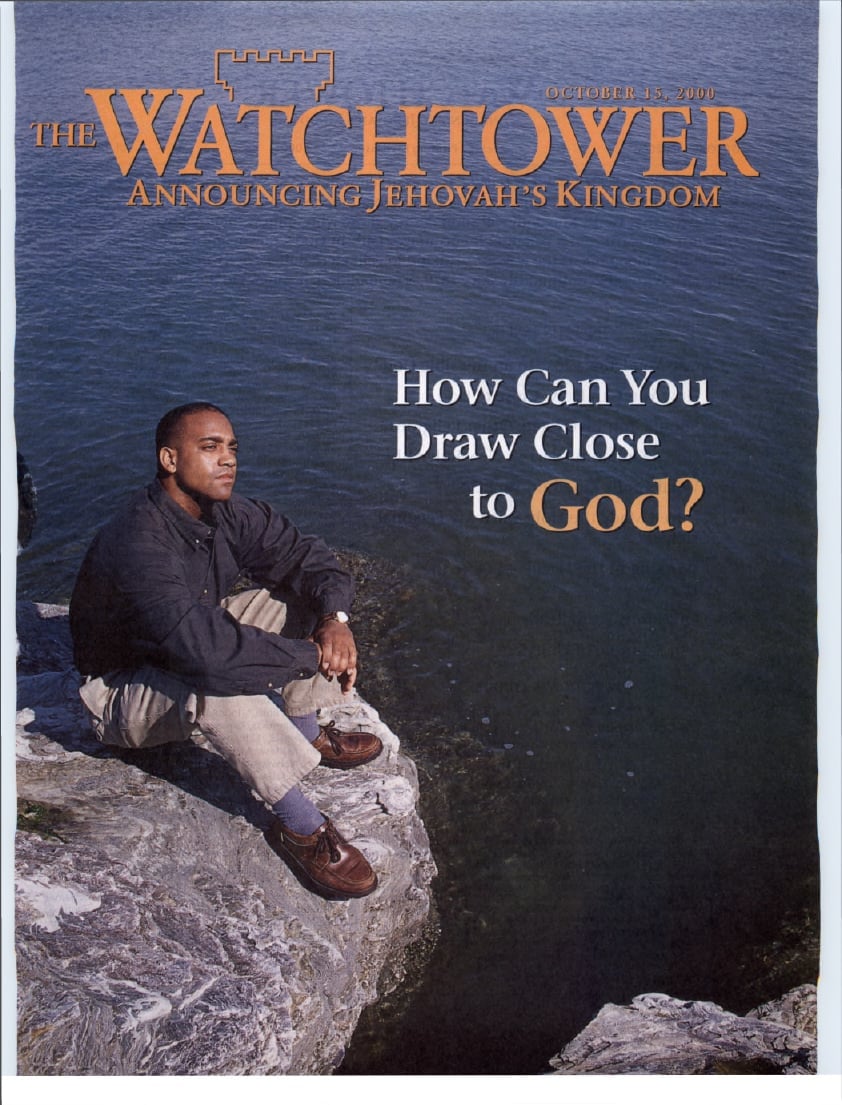
How Can You Draw Close to God?
THE WATCHTOWER
ANNOUNCING JEHOVAH'S KINGDOM
OCTOBER 15,2000
Average Printing Each Issue: 22,398,000
THE PURPOSE OF THE WATCHTOWER is to exalt Jehovah God as Sovereign Lord of the universe. It keeps watch on world events as these fulfill Bible prophecy. It comforts all peoples with the good news that God's Kingdom will soon destroy those who oppress their fellowmen and that it will turn the earth into a paradise. It encourages faith in God's now-reigning King, Jesus Christ, whose blood blood opens the way for mankind to gain eternal life. The Watchtower, published by Jehovah's Witnesses continuously since 1879, is nonpolitical. It adheres to the Bible as its authority.
IN THIS ISSUE
3 Can You Draw Close to an Invisible God?
8 Should You Investigate Other Religions?
10 God's Kingdom-Earth's New Rulership
15 What God's Kingdom Will Do
21 Have I Made the Holy Spirit My Personal Helper?
25 Working in the "Field"-Before the Harvest
30 Questions From Readers
32 "An Example of Unity"
WATCHTOWER STUDIES
NOVEMBER 27—DECEMBER 3:
God's Kingdom—Earth's New Rulership.
Page 10. Songs to be used: 146, 119.
DECEMBER 4-10:
What God's Kingdom Will Do.
Page 15. Songs to be used: 220, 222.
Publication of The Watchtower is part of a worldwide Bible educational work supported by voluntary donations. The Bible translation used is the New World Translation of the Holy Scriptures - with references, unless otherwise indicated.
The Watchtower (ISSN 1021-8438) is a mall office by Watchtower Bible and Tract Society of New York, Inc.; Milton G. Henschel, President; Lyman A. Swingle, Secretary-Treasurer; 25 Columbia Heights, Brooklyn, NY 11210-2483; Periodicals Postage Paid at Brooklyn, NY, and at additional mailing offices. POSTMASTER: Send address changes to Watchtower, Wallis, NY 12589.
Changes of address should reach us 30 days before your moving date. Give us your old and new address (if possible, your old address label).
© 2000 Watch Tower Bible and Tract Society of Pennsylvania.
All rights reserved. Purchased in U.S.A.
Semimonthly
ENGLISH
Would you welcome more information or a free home Bible study? Please send your request to Watch Tower, using the appropriate address below.
America, United States of: Wafil, NY 12589, Australia. Box 280, Inglebury, NSW 1890, Bahamas. Box N=1247, Nassau, N.P. Barbados: Fontablelle Rd., Bridgetown, Britain. The Ridgway, London NW7 1RN. Canada: Box 4100, Halton Hills (Georgetown, Ontario L7G 4Y4. Germany: Niederslater, Am Steinlein, D6518 Schlern. Ghana: P.O. Box 670, Accra, Uganda: 50 Brickdam, Georgetown 16. Hawai'i 96918, 2055 Kumu IV, Honolulu, Hong Kong: 4 Kent Road, Kowai Tong. India: Post Bag 10, Lonaya, Mumbai, India. Indonesia: Dugbal, Wicklow, Jamaica: P.O. Box 103, Old Harbour, St. Catherine, Japan: 1271 Nakashinden, Ebina City, Kanagawa Pref, 243-0496. Kenya: P.O. Box 7478, Nairobi. New Zealand: P.O. Box 75-142, Manurewa. Nigeria: P.M. B.190, Benin City, Edo State, Philippines. Republic of: P.O. Box 2044, 1060 Manila. South Africa: Private Bag 20267, Krugersdorp, 1740. Ternadou and Tobago, Republic of: Lower Rapey Street and Laxil Lane, Curtec, Zambia: Box 33459, Lusaka 10101. Zimbabwe: P.Bag 4-6113, Avondale.
NOW PUBLISHED IN 137 LANGUAGES. SEMIMONTHLY LANGUAGES AVAILABLE BY MAIL: Afrikaans, Albanian, Amharic, Arabic, Armenian, Bengali, Bicol, Bislama, Bulgarian, Cebuano, Chichwa, Chinese, Chinese (Simplified), Cilbema, Croatian, Czech, Danish, Dutch East Aroma, Finnish, Finnish, French, Georgian, Greek, Guajar, Gun, Hebrew, Hillaygon, Hindi, Hiri Motu, Hungarian, Igbo, Iloko, Italian, Indonesian, Japanese (also Bralle), Kannada, Kinyaward, Korea (also Bralle), Latvian, Lingua, Lithuania, Macedonian, Malagasy, Malayalam, Maltese, Marathi, Myanmar, Nepali, New Guinea Pidgin, Norwegian, Pangasian, Papelamento, Polish, Portuguese (also Braille), Punjabi, Rorotanog, Romanian, Sinhalese, Shona, Slovak, Slovenian, Solomon Islands Pidgin, Spanish, Sranantongo, Swahili, Swedish* Tagalog, Tahitian, Tamil, Telugu, Tai, Tigrinya, Tongan, Tishilua, Tsonga, Tswana, Turkish, Tukai, Ukrainian, Urdu, Vietnamese, Wallisian, Xhosa, Yoruba, Zulu
MONTHLY LANGUAGES AVAILABLE BY MAIL: Azerbaijani, Cambian, Cambilian, Chitonga, Gilgite, Greenlandian, Hausa, Icelandic, isokar, Koshak, Kilbua, Kirghiz, Kirund, Kwanyam/ Kwanyam, Moore, Niuean, Ossetian, Otelat, Oteala, Persian, Ponanep, Sango, Silizat, Tijar, Tivkues, Tumbuka, Tuvaluan, Umbundu, Yapese, Zande
Study articles also available in large-print edition.
Audiocassettes also available.
Can You Draw Close to an Invisible God?
'How can I develop a close relationship with someone I cannot see?' you may ask. That might seem to be a valid question. But consider:
HOW important is sight to developing loving and lasting relationships? Are not unseen factors equally, if not more, important? Indeed! For that reason some people have developed a close relationship with others through regular correspondence—their letters honestly conveying likes, dislikes, goals, principles, sense of humor, and other personality traits or interests.
Blind people too demonstrate that sight is not critical to developing a close relationship with another person. Consider the example of Edward and Gwen, a married couple who are blind.* Edward met Gwen at a school for the blind, where she was a fellow adult student. He admired Gwen's qualities, especially her honesty in speech and conduct, and her excellent attitude toward work. In turn, Gwen was attracted to Edward because, in her words, "he displayed all the qualities I was brought up to believe were important." A courtship budded, and three years later they were married.
"When you are together," says Edward, "blindness does not really make a difference in building a relationship with another person. You might not be able to see each other, but feelings are not blind." Now, 57 years later, they are still deeply in love. They explain that the secret to their wonderful relationship
involves at least four things: (1) noticing the qualities of the other person, (2) thinking about and being drawn to those qualities, (3) maintaining good communication, and (4) doing things together.
These four points are vital to any good relationship, whether between friends, marriage partners or, more important, between humans and God. In the following article, we will see how applying these points can help us to develop a close relationship with God, even though we cannot see him.* How You Can Draw Close to God
"Draw close to God, and he will draw close to you," says
James 4:8. Showing how much Jehovah God wants humans to have a close relationship with him, he gave his Son in our behalf.
IN RESPONSE to that loving overture, the apostle John wrote: "We love [God], because he first loved us." (1 John 4:19) But for us personally to draw close to God, we must take certain steps. They are similar to the four ways that we draw close to fellow humans, as outlined in the preceding article. Let us now examine these.
Observe God's Wonderful Qualities
God has many wonderful qualities, some of the most outstanding being his love, wisdom, justice, and power. His wisdom and power are abundantly demonstrated both in the distant universe and in the world around us, from mighty galaxies to tiny atoms. The psalmist wrote: "The heavens are declaring the glory of God; and of the work of his hands the expanse is telling."—Psalm 19:1; Romans 1:20.
Creation also reflects God's love. The way we are made, for example, shows that God wants us to enjoy life. He gave us the ability to see colors, to taste and smell, to appreciate music, to laugh, to enjoy beauty, also giving us many other faculties and traits that are not absolutely essential for life. Yes, God truly is generous, kind, and loving—qualities that undoubtedly contribute to his being "the happy God."—1 Timothy 1:11; Acts 20:35.
Jehovah glories in the fact that the exercise of his sovereignty and the support of it by his intelligent creatures are based primarily on love. (1 John 4:8) True, Jehovah is the Universal Sovereign, but he treats humans, especially his loyal servants, as a loving father treats his children. (Matthew 5:45) He spares nothing that is for their good. (Romans 8:38, 39) As mentioned, he even gave the life of his only-begotten Son in our behalf. Yes, God's love is the reason we exist and have the prospect of eternal life.—John 3:16.
Jesus gave us deep insight into God's personality because he perfectly imitated his Father. (John 14:9-11) He was totally unselfish, considerate, and thoughtful. On one occasion, Jesus was presented to a man who was deaf and had a speech impediment. You can imagine that the man might have been uncomfortable in crowds. Interestingly, Jesus took this man to a private spot and cured him there. (Mark 7:32-35) Do you appreciate people who are sensitive to your feelings and who respect your dignity? If so, then you will definitely draw closer to Jehovah and Jesus as you learn more about them.
Think About God's Qualities
Someone can have wonderful qualities, but we need to think about that person in order to be drawn to that one. The same applies to Jehovah. Meditating on his qualities is a vital second step in drawing close to him. King David, a man who truly loved Jehovah and was "agreeable to [Jehovah's] heart," said: "I have remembered days of long ago; I have meditated on all your activity; I willingly kept myself concerned with the work of your own hands." Acts 13:22; Psalm 143:5.
When you observe the wonders of creation or read God's Word, the Bible, do you, like David, meditate on what you see and read? Imagine a son who has just received a letter from his father for whom he has deep affection. How would he view that letter? He certainly would not just scan its contents and toss it into a drawer. Rather, he would study it, extracting from it every detail and nuance. Likewise, God's Word should be precious to us,
just as it was to the psalmist who sang: "How I do love your law! All day long it is my concern."—Psalm 119:97.
Maintain Good Communication
Good communication is the lifeblood of any relationship. It involves speaking and listening—and not just with the mind but with the heart as well. We speak to the Creator by means of prayer, which is worshipful address to God. Jehovah delights in the prayers of those who love and serve him and who acknowledge Jesus Christ as His chief representative.—Psalm 65:2; John 14:6, 14.
In the past, God spoke to humans in a variety of ways, including in visions, in dreams, and through angels. Nowadays, however, he
does so by means of his written Word, the Holy Bible. (2 Timothy 3:16) The written Word has many advantages. It can be consulted at any time. Like a letter, it can be savored over and over again. And it is not subject to the distortions that often mark oral retelling. So think of the Bible as a large collection of letters from your beloved heavenly Father, and through these letters allow him to speak to you daily.—Matthew 4:4.
For instance, the Bible sets out Jehovah's view of right and wrong. It explains his purpose for mankind and for the earth. And it reveals his dealings with a broad range of people and nations, from loyal worshipers to bitter enemies. By having his interactions with humans recorded in this way, Jehovah has painted an exceptionally detailed portrait of his personality. He reveals his love, joy, sorrow, disappointment, anger, mercy, concern—yes, the range of his thoughts and feelings, and the underlying reasons for these—all in a way humans can readily understand.—Psalm 78:3-7.
After you have read a portion of God's Word, how can you benefit from your reading? And, in particular, how can you draw closer to God? First, think about what you have read and learned about God as a person, letting the points reach your heart. Then in prayer tell Jehovah your thoughts and innermost feelings about the material you have considered and how you will try to benefit from it. That is communication. Of course, if you have other things on your mind as well, these can certainly be included in your prayer.
Do Things Together With God
The Bible says of certain faithful men of old that they walked with, or before, the true God. (Genesis 6:9; 1 Kings 8:25) What does that mean? Essentially that they lived each day as though God were right there with them. True, they were sinful. Yet, they loved God's laws and principles, and they lived in harmony with God's purpose. Jehovah is drawn to such ones, and he cares for them, as shown at Psalm 32:8: "I shall make you have insight and instruct you in the way you should go.
I will give advice with my eye upon you."
You too can have Jehovah as an intimate friend—one who walks with you, cares for you, and gives you fatherly advice. The prophet Isaiah described Jehovah as being "the One teaching you to benefit yourself, the One causing you to tread in the way in which you should walk." (Isaiah 48:17) As we experience
these benefits, we sense Jehovah's presence "at [our] right hand," as it were, just as David did.
—Palm 16:8.
God's Name-Focus of His Qualities
Many religions and an increasing number of Bible translations fail to use and make known God's personal name. (Psalm 83:18) Yet, in the original Hebrew text, that name—Jehovah—appears about 7,000 times! (Inconsistently, while removing the divine name, most Bible transla-
Jehovah Responds to Your Love for Him
RELATIONSHIPS are two-way. As we draw close to God, he responds by drawing closer to us. Consider his feelings for aged Simeon and Anna, both of whom received special mention in the Bible. The Gospel writer Luke tells us that Simeon was "righteous and reverent," awaiting the Messiah. Jehovah observed these fine qualities in Simeon and
old man by revealing to him that "he would not see death before he had seen the Christ." Jehovah kept his promise and directed Simeon to the infant Jesus, brought by
His parents to the temple in Jerusalem. Thrilled and deeply appreciative, Simeon embraced the infant and prayed: "Now, Sovereign Lord, you are letting your slave go free in peace according to your declaration; because my eyes have seen your means of saving." —Luke 2:25-35.
"In that very hour," Jehovah also demonstrated his love for 84-year-old Anna by directing her to Jesus as well. This precious widow, the Bible tells us, was always at the temple "rendering sacred service" to Jehovah. Overflowing with appreciation, she, like
Simeon, thanked Jehovah for his extraordinary kindness, after which she spoke about the child "to all those waiting for Jerusalem's deliverance."—Luke 2:36-38.
Yes, Jehovah observed how deeply Simeon and Anna loved and feared him and how concerned they were with the outworking of his purpose. Do such Bible accounts not draw you to Jehovah?
Like his Father, Jesus also discerned the real inner person. While teaching at the temple, he observed a "needy widow" donate just "two small coins of very little value." To other observers her gift would have been insignificant but not so to Jesus. He praised this woman because she gave all she had. (Luke 21:1-4) Hence, we can rest assured that Jehovah and Jesus appreciate us if we give them our best, whether our gift is great or small.
While God rejoices in those who love him, he feels hurt when humans turn away from him and follow a course of wrongdoing. Genesis 6:6 tells us that Jehovah "felt hurt at his heart" because of the badness of mankind before the Flood of Noah's day. Later, obedient Israelites repeatedly "put God to the test, and they pained even the Holy One of Israel," says Psalm 78:41. Yes, God is not an aloof "First Cause" without feelings. He truly is a person, one whose feelings are not unbalanced or dulled by imperfection, as are ours.
Reflecting on Jehovah's creation is one way to draw close to him
tors retain the names of the many false gods mentioned in the original text, such as Baal, Bel, Merodach, and even Satan!)
Some people feel that the omission of God's name is a trivial matter. But think: Is it harder or easier to develop a close, enlightened relationship with a nameless person? Such titles as God and Lord (which are also used of false gods) might
draw attention to Jehovah's power, authority, or position, but only his personal name identifies him unequivocally. (Exodus 3:15; 1 Corinthians 8:5, 6) The personal name of the true God captures his qualities and characteristics. Theologian Walter Lowrie rightly stated: "A man who does not know God by name does not really know him as a person."
Consider the example of Maria, a sincere Catholic living in Australia. When Jehovah's Witnesses first met her, Maria allowed the Witnesses to show her God's name in the Bible. How did she respond? "When I first saw God's name in the Bible, I wept. I was so moved by the knowledge that I could actually use and use the personal name of God." Maria continued to study the Bible, and for the first time in her life, she got to know Jehovah as a person and was able to build a lasting relationship with him.
Yes, we can "draw close to God," even though we cannot see him with our literal eyes. We can "see" his exquisitely beautiful personality in our minds and hearts and thereby grow in our love for him. Such love
"is a perfect bond of union." -Colossians 3:14.
Should You Investigate Other Religions?
"I HAD attended Christian meetings for nearly a year, and I enjoyed telling others about God's Kingdom," says Miguel, who is now one of Jehovah's Witnesses in South America. "Then I started listening to religious programs on the radio and watching religious preachers on television. I thought that such programs could help me to understand people of other religions better. I realized that their teachings were not in harmony with the Bible, but I was curious."
In the same land, Jorge was zealous in teaching others about true worship. Yet, at one point, he too began listening to religious radio and television programs. "You need to know what others are thinking," he used to say. When asked about the potential dangers of such exposure to false teachings, he would answer: "Nothing could undermine the faith of one who knows Bible truth." These experiences raise an important question, Is it wise to listen to what others believe?
Recognizing True Christianity
After the apostles died, true worship became contaminated by the progressive development of many forms of imitation Christianity. Foreseeing this, Jesus disclosed one way to distinguish these counterfeit forms of Christianity from true
Christianity. First, he warned: "Be on the watch for the false prophets that come to you in sheep's covering, but inside they are ravenous wolves." Then he added: "By their fruits you will recognize them." (Matthew 7:15-23) Jesus' true followers practice what he taught, and they are easily recognized by their fine fruits. Just as Jesus himself did, they visit people to explain God's Kingdom from the Scriptures.
Following Jesus' example, they stand apart from the world's politics and social controversies. They accept the Bible as God's Word and respect it as the truth. They make God's name known. And since they strive to practice the love that God teaches, they do not share in wars. Instead, they treat one another as brothers.-Luke 4:43; 10:1-9; John 13:34, 35; 17:16, 17, 26.
According to the Scriptures, it is possible to "see the distinction between a righteous one and a wicked one, between one serving God and one who has not served him." (Malachi 3:18) True worshipers today are united in thought and deed, just as the first-century Christians were. (Ephesians 4:4-6) Once you identify such a body of genuine Christians, why should you be inquisitive or curious about the beliefs of others?
Beware of False Teachers
The Bible acknowledges that even after learning Bible truth, there is a danger of spiritual contamination from false teachings. The apostle Paul warned: "Look out: perhaps there may be someone who will carry you off as his prey through the philosophy and empty deception according to the tradition of men, according to the elementary things of the world and not according to Christ." (Colossians 2:8) What a graphic picture this text paints! Like beasts wanting to carry you off and devour you, teachers can pose a real danger.
True, Paul took note of what others believed. He once began a discourse by saying: "Men of Athens, I behold that in all things you seem to be more given to the fear of the deities than others are. For instance, while passing along and carefully observing your objects of veneration I also found an altar on which had been inscribed 'To an Unknown God.'" (Acts 17:22, 23) Paul, however, did not regularly feed his mind on the philosophies of Greek orators.
It is one thing to inform yourself about the origins and beliefs of false religions but quite another to feed on them." Jehovah has appointed "the faithful and discreet slave" to provide teaching based on his Word. (Matthew 4:4; 24:45) Paul himself wrote: "You cannot be partaking of 'the table of Jehovah' and the table of demons. Or 'are we inciting Jehovah to jealousy'?" —1 Corinthians 10:20-22.
Some false teachers may formerly have been true Christians, but at one point they turned from truth to error. (Jude 4, 11) This should not surprise us. After speaking of "the faithful and discreet slave" that represents the body of anointed Christians, Jesus spoke of the "evil slave," a class that complains, "my master is delaying," and starts to beat its fellow slaves. (Matthew 24:48, 49) Often, these individuals and their followers have no clear teachings of their own; they are interested only in destroying the faith of others. Concerning them, the apostle John wrote: "If anyone comes to you and does not bring this teaching, never receive him into your homes or say a greeting to him." —2 John 10; 2 Corinthians 11:3, 4, 13-15.
Sincere people who are searching for the truth do well to consider carefully what they hear from different religions. In time, God will bless honesthearted individuals who seek the truth. The Bible says of godly wisdom: "If you keep seeking for it as for silver, and as for hid treasures you keep searching for it, in that case . . . you will find the very knowledge of God." (Proverbs 2:4, 5) Having found this knowledge of God through the Bible and the Christian congregation and having seen how Jehovah blesses those who are guided by that knowledge, true Christians do not continue listening to false religious teachings.—2 Timothy 3:14.
GOD'S KINGDOM EARTH'S NEW RULERSHIP
"The kingdom . . . will crush and put an end to all these kingdoms, and it itself will stand to times indefinite."-DANIEL 2:44.
THE Bible is God's revelation to humans. The apostle Paul wrote: "When you received God's word, which you heard from us, you accepted it, not as the word of men, but, just as it truthfully is, as the word of God." (1 Thessalonians 2:13) The Bible contains what we need to know about God: information about his personality, his purposes, and his requirements for us. It has the best counsel on family life and daily conduct. It details prophecies that were fulfilled in the past, are being fulfilled now, and will be fulfilled in the future. Yes, "all Scripture is inspired of God and beneficial for teaching, for reproving, for setting things straight, for disciplining in righteousness, that the man of God may be fully competent, completely equipped for every good work."—2 Timothy 3:16, 17.
What confidence can we have in the Bible?
2 Of paramount importance in the Bible is its theme: the vindication of God's sovereignty (his right to rule) by means of his heavenly Kingdom. Jesus made that the focal point of his ministry. "Jesus commenced preaching and saying: 'Repent, you people, for the kingdom of the heavens has drawn near.'" (Matthew 4:17) He showed what place it should have in our lives, urging: "Keep on, then, seeking first the kingdom and his righteousness." (Matthew 6:33) He also showed how important it is by teaching his followers to pray to God: "Let your kingdom come. Let your will take place, as in heaven, also upon earth."—Matthew 6:10.
How did Jesus emphasize the Bible's theme?
Earth's New Rulership
3 Why is the Kingdom of God of such great importance to humans? Because it will soon take an action that will forever change the rulership of this earth. The prophecy at Daniel 2:44 states: "In the days of those kings [now ruling on earth] the God of heaven will set up a kingdom [a government in heaven] that will never be brought to ruin. And the kingdom itself will not be passed on to any other people. It will crush and put an end to all these kingdoms [earthly governments], and it itself will stand to times indefinite." When God's heavenly Kingdom rules completely, never again will humans control the earth. Divisive and unsatisfactory human rule will forever be a thing of the past.
4 The Chief Ruler in the heavenly Kingdom, under Jehovah's immediate direction, is the one best qualified—Christ Jesus. Before coming to earth, he existed in heaven as God's "master worker," being the first of all God's creations. (Proverbs 8:22-31) "He is the image of the invisible God, the firstborn of all creation; because by means of him all other things were created in the heavens and upon the earth." (Colossians 1:15, 16) And when Jesus was sent to earth by God, he did God's will at all times. He endured the most difficult of tests and died faithful to his Father.—John 4: 34; 15:10.
5 For his loyalty to God even to death, Jesus was rewarded. God resurrected him to heaven and gave him the right to be King of the heavenly Kingdom. (Acts 2:32-36) As the King of the Kingdom, Christ Jesus will have the awesome assignment from God to lead myriads of powerful spirit creatures in removing human rule from the earth and ridding our
globe of all wickedness. (Proverbs 2:21, 22;
2 Thessalonians 1:6-9; Revelation 19:11-21;
20:1-3) Then God's heavenly Kingdom under
Christ will be the new ruling authority, the
only government over the entire earth.—Revelation
11:15.
6 God's Word says of earth's new Ruler: "To him there were given rulership and dignity and kingdom, that the peoples, national groups and languages should all serve even him." (Daniel 7:14) Because Jesus will imitate God's love, great will be the peace and happiness under his rule. (Matthew 5:5; John 3:16; 1 John 4:7-10) "Of the increase of his government and of peace there will be no end, . . . to uphold it with justice and with righteousness." (Isaiah 9:7, Revised Standard Version) What a blessing it will be to have a Ruler who rules with love, justice, and righteousness! Thus, 2 Peter 3:13 foretells: "There are new heavens [God's heavenly Kingdom] and a new earth [a new earthly society] that we are awaiting according to his promise, and in these righteousness is to dwell."
7 Surely God's Kingdom is the very best news for all who love what is right. That is why, as part of the sign that we now live in "the last days" of this wicked system, Jesus foretold: "This good news of the kingdom will be preached in all the inhabited earth for a witness to all the nations; and then the end will come." (2 Timothy 3:1-5; Matthew 24:14) That prophecy is being fulfilled now, as about six million Jehovah's Witnesses in 234 lands devote more than a billion hours a year telling others about God's Kingdom. Appropriately, each of their places of worship for some 90,000 congregations worldwide is called a Kingdom Hall. There, people come to learn of the incoming new government.
What type of rule can we expect from the King of the Kingdom?
How is Matthew 24:14 being fulfilled today?
Associate Rulers 8 There will be associate rulers with Christ Jesus in God's heavenly Kingdom. Revelation 14:
In every land Jehovah's Witnesses make the Kingdom their main teaching
1-4 foretold that 144,000 persons were to be "bought from among mankind" and resurrected to heavenly life. These include men and women who, instead of being served, humbly served God and fellow humans. "They will be priests of God and of the Christ, and will rule as kings with him for the thousand years." (Revelation 20:6) Their number is much smaller than the "great crowd, which no man was able to number, out of all nations and tribes and peoples and tongues" who will survive this system's end. These too render God "sacred service day and night," but they do not have a heavenly calling. (Revelation 7:9, 15) They form the nucleus of the new earth as subjects of God's heavenly Kingdom.—Psalm 37:29; John 10:16.
9 In choosing those who would rule with Christ in heaven, Jehovah selected faithful humans who had experienced life with all its problems. There is virtually nothing that people have been through that these king-priests have not also experienced. So their life on earth will enhance their ability to rule over humans. Even Jesus himself "learned obedience from the things he suffered." (Hebrews 5:8) The apostle Paul said about him: "We
have as high priest, not one who cannot sympathize with our weaknesses, but one who has been tested in all respects like ourselves, but without sin." (Hebrews 4:15) How comforting to know that in God's righteous new world, people will be ruled by loving, sympathetic kings and priests!
Was the Kingdom in God's Purpose?
10 Was the heavenly Kingdom part of God's original purpose when he created Adam and Eve? In the Genesis creation account, there is no mention of a Kingdom that would rule mankind. Jehovah himself was their Ruler, and as long as they obeyed him, there was no need for any other rulership. Genesis chapter 1 shows that Jehovah, likely through his first-born heavenly Son, dealt with Adam and Eve. The account uses such expressions as "God said to them" and "God went on to say" to them.-Genesis 1:28, 29; John 1:1.
11 The Bible says: "God saw everything he had made and, look! it was very good." (Genesis 1:31) Everything in the garden of Eden was absolutely perfect. Adam and Eve lived in a paradise. They had perfect minds and perfect bodies. They could communicate with their Maker and he with them. And by remaining faithful, they would bear perfect children.
There would have been no need for a new heavenly government.
12 As the human family multiplied, how would God communicate with all of them? Consider the stars of heaven. They are grouped together in island universes called galaxies. Some galaxies contain a billion stars. Others contain about a trillion. And scientists estimate that there are about 100 billion galaxies in the observable universe! Yet, the Creator says: "Raise your eyes high up and see. Who has created these things? It is the One who is bringing forth the army of them even by number, all of whom he calls even by name. Due to the abundance of dynamic energy, he also being vigorous in power, not one of them is missing."—Isaiah 40:26.
13 Since God can keep track of all these heavenly bodies, surely it would be no problem for him to keep track of a far smaller number of humans. Even now, millions of his servants pray to him daily. Those prayers reach God instantly. So communicating with all perfect humans would have presented no problem for him. He would not have needed a heavenly Kingdom to keep track of them. What a marvelous arrangement—to have Jehovah as Ruler, to have direct access to him, and to have the prospect of never dying, living forever on a paradise earth!
"It Does Not Belong to Man"
14 However, humans—even perfect ones—would forever need Jehovah's rule. Why? Because Jehovah did not create them with the capacity for being successfully independent of his rule. That is a law of humankind, as the prophet Jeremiah acknowledged: "I well know, O Jehovah, that to earthing man his way does not belong. It does not belong to man who
is walking even to direct his step. Correct me, O Jehovah." (Jeremiah 10:23, 24) It would be folly for humans to think that they could successfully regulate society without Jehovah ruling them. It would be contrary to the way they were made. Independence from Jehovah's rule would, without fail, result in selfishness, hate, cruelty, violence, wars, and death. 'Man would dominate man to his injury.'—Ecclesiastes 8:9.
15 Sadly, our first parents decided that they did not need God as their Ruler, and they chose to live independently from him. As a result, God no longer sustained them in perfection. They were now like an electric appliance cut off from its source of power. So in time, they would slow down and stop—in death. They became like a defective pattern, and that condition was all they could pass on to their offspring. (Romans 5:12) "The Rock [Jehovah], perfect is his activity, for all his ways are justice. . . . They have acted ruinously on their own part; they are not his children, the defect is their own." (Deuteronomy 32:4, 5) True, Adam and Eve were influenced by the rebel spirit creature who became Satan, but they had perfect minds and could have rejected his wrong suggestions.—Genesis 3:1-19; James 4:7.
16 History testifies abundantly to the result of independence from God. For thousands of years, people have tried every form of human government, every economic and social system. Yet, wickedness continues to "advance from bad to worse." (2 Timothy 3:13) The 20th century proved that. It was filled with vicious hatreds and the most violence, warfare, hunger, poverty, and suffering of any time in history. And no matter what medical advances have been made, sooner or later everyone dies. (Ecclesiastes 9:5, 10) By trying to direct their
How does history testify to the result of independence from God?
WWI soldiers: U.S. National Archives photo; concentration camp:
Oswestry Museum; child: UN PHOTO 186156/1. Isaac
History testifies to the bad results of independence from God
own steps, humans have allowed themselves to become prey to Satan and his demons, so much so that the Bible calls Satan "the god of this system of things." -2 Corinthians 4:4.
The Gift of Free Will
17 Why would Jehovah let humans go their own way? Because he created them with the marvelous gift of free will, the faculty of freedom of choice. "Where the spirit of Jehovah is, there is freedom," said the apostle Paul. (2 Corinthians 3:17) No one wants to be a robot, having someone else decide every second of the day what he will say and do. But Jehovah required humans to use that gift of free will responsibly, to see the wisdom of doing his will and remaining subject to him. (Galatians 5:13) So freedom was not to be absolute,
How was God's gift of free will to be used?
Points for Review
What is the theme of the Bible?
Who make up earth's new rulership?
Why can human rule independent of God never be successful?
as that would result in anarchy. There was to be a regulating of it within the boundaries of God's benevolent laws.
How must free will be exercised?
18 By letting the human family go its own way, God has, once and for all time, demonstrated that we need his rulership. His way of ruling, his sovereignty, is the only right way. It results in the greatest happiness, satisfaction, and prosperity. This is because our minds and bodies were designed by Jehovah to work best when in harmony with his laws. "I, Jehovah, am your God, the One teaching you to benefit yourself, the One causing you to tread in the way in which you should walk." (Isaiah 48:17) Free choice within the boundaries of God's laws would not be burdensome but would result in a delightful variety of food, homes, art, and music. Properly exercised, free will would have resulted in a wonderful, ever-fascinating life on a paradise earth.
19 But because of their bad choice, humans alienated themselves from Jehovah, becoming imperfect, degenerating, and dying. So they would need to be redeemed from that sad condition and brought back into a proper relationship with God as his sons and daughters.
The agency God chose to accomplish this is the Kingdom, and the Redeemer is Jesus Christ. (John 3:16) Through this arrangement, truly repentant ones—like the prodigal son of Jesus' illustration—will be reconciled to God and accepted back by him as his children.—Luke 15:11-24; Romans 8:21; 2 Corinthians 6:18.
20 Without fail, Jehovah's will is going to be
How is God's purpose to be fulfilled by the Kingdom?
accomplished on earth. (Isaiah 14:24, 27; 55: 11) By means of his Kingdom under Christ, God will fully vindicate (justify or prove) his right to be our Sovereign. The Kingdom will bring an end to human and demon rule over this earth, and it alone will rule from heaven for a thousand years. (Romans 16:20; Revelation 20:1-6) But during that time, how will the superiority of Jehovah's way of ruling be demonstrated? And after the thousand years, what role will the Kingdom have? The following article will consider these questions.
"Let your kingdom come. Let your will take place, as in heaven, also upon earth."
-MATTHEW 6:10.
WHEN Jesus taught his followers to pray for God's Kingdom, he knew that its coming would bring an end to thousands of years of human rule independent from God. During all that time, God's will was not being done on earth in general. (Psalm 147:19, 20) But after the establishment of the Kingdom in heaven, God's will is to be done everywhere. The time for the awe-inspiring transition from human rule to God's heavenly Kingdom rule is getting very near.
2 Marking this transition will be the period of time that Jesus called the "great tribulation such as has not occurred since the world's beginning until now, no, nor will occur again." (Matthew 24:21) The Bible does not say how
long that time period is to be, but the calamities that are to take place during it will be worse than anything the world has ever seen.
At the beginning of the great tribulation, something will happen that will be a severe shock to most people on earth; the destruction of all false religion. That will not be a shock to Jehovah's Witnesses, for they have long anticipated this. (Revelation 17:1, 15-17; 18:1-24) The great tribulation ends at Armageddon when God's Kingdom crushes the entire Satanic system.—Daniel 2:44; Revelation 16:14, 16.
3 What will this mean to people "who do not know God and those who do not obey the good news" about his heavenly Kingdom in the hands of Christ? (2 Thessalonians 1:6-9) Bible prophecy tells us: "Look! A calamity is going forth from nation to nation, and a great tempest itself will be roused up from the remotest parts of the earth. And those slain by Jehovah will certainly come to be in that day from one end of the earth clear to the other end of the earth. They will not be bewailed, neither will they be gathered up or be buried. As manure on the surface of the ground they will become." -Jeremiah 25:32, 33.
4 For thousands of years, Jehovah God has tolerated wickedness, long enough for righthearted individuals to see that human rule is a catastrophe. For example, in the 20th century alone, more than 150 million people were killed in wars, revolutions, and other civil disorders, according to one source. Man's viciousness was especially seen during World War II when some 50 million were killed, with many of them dying horrible deaths in Nazi concentration camps. Just as the Bible foretold, in our time 'wicked men and impostors have advanced from bad to worse.' (2 Timothy 3:1-5, 13) Today, immorality, crime, violence, corruption, and contempt for God's standards are rampant. Thus, Jehovah is fully justified in bringing this wicked system to its end.
5 The situation now is similar to that in Canaan some 3,500 years ago. The Bible says: "Everything detestable to Jehovah that he does hate they have done to their gods, for even their sons and their daughters they regularly burn in the fire to their gods." (Deuteronomy 12:31) Jehovah informed the nation of Israel: "It is for the wickedness of these nations that Jehovah your God is driving them away from before you." (Deuteronomy 9:5) Bible historian Henry H. Halley noted: "The worship of Baal, Ashtoreth, and other Canaanite gods consisted in the most extravagant orgies; their temples were centers of vice."
6 Halley showed how gross their wickedness had become, for in one of many such areas, archaeologists "found great numbers of jars containing the remains of children who had been sacrificed to Baal." He said: "The whole area proved to be a cemetery for new-born babes. . . . Canaanites worshipped, by immoral indulgence, as a religious rite, in the presence of their gods; and then, by murdering their first-born children, as a sacrifice to these same gods. It seems that, in large measure, the land of Canaan had become a sort of Sodom and Gomorrah on a national scale. . . . Did a civilization of such abominable filth and brutality have any right longer to exist? . . . Archaeologists who dig in the ruins of Canaanite cities wonder that God did not destroy them sooner than he did."
Inheriting the Earth
7 Just as God cleansed Canaan, he will soon cleanse the entire earth and give it to those
"There is going to be a resurrection of both the righteous and the unrighteous"
who do his will. "The upright are the ones that will reside in the earth, and the blameless are the ones that will be left over in it. As regards the wicked, they will be cut off from the very earth." (Proverbs 2:21, 22) And the psalmist says: "Just a little while longer, and the wicked one will be no more . . . But the meek ones themselves will possess the earth, and they will indeed find their exquisite delight in the abundance of peace." (Psalm 37:10, 11) Also removed will be Satan, so that "he might not mislead the nations anymore until the thousand years were ended." (Revelation 20:1-3) Yes, "the world is passing away and so
is its desire, but he that does the will of God remains forever."-1 John 2:17.
8 Summing up the grand hope for those who want to live forever on earth, Jesus said: "Happy are the mild-tempered ones, since they will inherit the earth." (Matthew 5:5) Likely he was referring to Psalm 37:29, which foretold: "The righteous themselves will possess the earth, and they will reside forever upon it." Jesus knew that it was Jehovah's purpose to have righthearted ones live on a paradise earth forever. Jehovah says: "I myself have made the earth, mankind and the beasts that are upon the surface of the earth by my great power .
. . , and I have given it to whom it has proved right in my eyes."—Jeremiah 27:5.
A Marvelous New World
9 After Armageddon, God's Kingdom will usher in a marvelous "new earth" in which "righteousness is to dwell." (2 Peter 3:13) What a tremendous relief it will be for Armageddon survivors to be rid of this oppressive wicked system of things! How delighted they will be to have entered the righteous new world under the heavenly Kingdom government, with marvelous blessings and everlasting life in view!—Revelation 7:9-17.
10 No more will people be threatened by war, crime, hunger, or even predatory animals. "I will conclude with [my people] a covenant of peace, and I shall certainly cause the injurious wild beast to cease out of the land
What kind of world will God's Kingdom usher in?
What bad things will no longer exist under Kingdom rule?
...And the tree of the field must give its fruitage, and the land itself will give its yield, and they will actually prove to be on their soil in security." "They will have to beat their swords into plowshares and their spears into pruning shears. They will not lift up sword, nation against nation, neither will they learn war anymore. And they will actually sit, each one under his vine and under his fig tree, and there will be no one making them tremble." —Ezekiel 34:25-28; Micah 4:3, 4.
11 Sickness, sorrow, and even death will be eliminated. "No resident will say: 'I am sick.' The people that are dwelling in the land will be those pardoned for their error." (Isaiah 33: 24) "[God] will wipe out every tear from their eyes, and death will be no more, neither will mourning nor outcry nor pain be anymore. The former things have passed away. . . . 'Look! I am making all things new.'" (Revelation 21:4, 5) When he was on earth, Jesus
Why can we have confidence that physical ailments will end?
demonstrated his ability to do those things by the power that God had given him.
With the backing of the holy spirit, Jesus went throughout the land healing the lame and curing the sick.-Matthew 15:30, 31.
12 Jesus did even more. He raised the dead. How did humble people react? When he resurrected a 12-year-old girl, her parents "were beside themselves with great ecstasy." (Mark 5:42) This was another example of what Jesus will do earth wide under Kingdom rule, for then "there is going to be a resurrection of both the righteous and the unrighteous." (Acts 24:15) Imagine the great ecstasy when group after group of the dead come back to life and are reunited with their loved ones! No doubt there will be a great educational work under Kingdom supervision so that "the earth will certainly be filled with the knowledge of Jehovah as the waters are covering the very sea."—Isaiah 11:9.
Jehovah's Sovereignty Vindicated
13 By the end of the thousand years of Kingdom rule, the human family will have been restored to perfection of mind and body. The earth will be a global garden of Eden, a paradise. Peace, happiness, security, and a loving human society will have been attained. Never in human history before Kingdom rule was anything like this seen. What a vast contrast will then have been demonstrated between the previous thousands of years of miserable rulership by humans and the magnificent rulership by God's heavenly Kingdom of a thousand years! The rule of God through his Kingdom will have been shown to be completely superior in every respect. God's right to rule, his sovereignty, will have been totally vindicated.
14 At the end of the thousand years, Jehovah will allow perfect humans to exercise their free choice as to whom they want to serve. The Bible shows that "Satan will be let loose out of his prison." He will again try to mislead humans, some of whom will choose independence from God. To prevent 'distress from rising up a second time,' Jehovah will annihilate Satan, his demons, and all who rebel against Jehovah's sovereignty. No one could object that any humans who are destroyed eternally at that time did not have a chance or that their wrong course was due to imperfection. No, they will be like perfect Adam and Eve, who willingly chose to rebel against Jehovah's righteous rule.—Revelation 20:7-10; Nahum 1:9.
15 On the other hand, likely the vast majority of people will choose to uphold Jehovah's sovereignty. With every rebel annihilated, the righteous will stand before Jehovah, having passed the final test of loyalty. These loyal ones will then be accepted by Jehovah as his sons and daughters. They therefore come back into the relationship that Adam and Eve had with God before they rebelled. Hence, Romans 8:21 will be fulfilled: "The creation itself [humankind] also will be set free from enslavement to corruption and have the glorious freedom of the children of God." The prophet Isaiah foretells: "[God] will actually swallow up death forever, and the Sovereign Lord Jehovah will certainly wipe the tears from all faces."—Isaiah 25:8.
The Hope of Everlasting Life
16 What a wonderful prospect awaits faithful ones, to know that God will forever shower down on them an overflow of spiritual and material benefits! The psalmist rightly said: "You are opening your hand and satisfying the [proper] desire of every living thing."
(Psalm 145:16) Jehovah encourages those of the earthly class to have this hope of life in Paradise as part of their faith in him. While the issue of Jehovah's sovereignty is more important, he does not ask people to serve him with no prospect of a reward. Throughout the Bible, loyalty to God and the hope of eternal life are inseparably bound together as necessary parts of a Christian's faith in God. "He that approaches God must believe that he is and that he becomes the rewarder of those earnestly seeking him."—Hebrews 11:6
17 Jesus said: "This means everlasting life, their taking in knowledge of you, the only true God, and of the one whom you sent forth, Jesus Christ." (John 17:3) Here he tied in knowing God and his purposes with the reward that this brings. As an example, when a wrongdoer asked to be remembered after Jesus came into his Kingdom, Jesus said: "You will be with me in Paradise." (Luke 23:43) He did not tell the man to have faith even if he did not get a reward. He knew that Jehovah wants his servants to have the hope of everlasting life on a paradise earth to help sustain them as they meet with various trials in this world. Thus, looking forward to the reward is a vital help in enduring as a Christian.
How did Jesus show that it was proper to be sustained by our hope?
Points for Review
What transition in rulership are we nearing?
How will God judge the wicked and the righteous?
What conditions will exist in the new world?
How will Jehovah's sovereignty be fully vindicated?
The Future of the Kingdom
18 Since the Kingdom was a subsidiary government that Jehovah used to bring the earth and its human inhabitants into perfection and reconciliation to him, what role is there for the King Jesus Christ and the 144,000 kings and priests after the Millennium? "Next, the end, when he hands over the kingdom to his God and Father, when he has brought to nothing all government and all authority and power. For he must rule as king until God has put all enemies under his feet."—1 Corinthians 15:24, 25.
19 When Christ hands over the Kingdom to God, how are the scriptures to be understood that speak of it as lasting forever? The Kingdom's accomplishments will endure forever. Christ will be honored forever because of his role in working for the vindication of God's sovereignty. But since sin and death are then completely removed, and mankind has been redeemed, this ends the need for him as a Redeemer. The Millennial Rule of the Kingdom will also have fully accomplished; so there will no longer be a need for a subsidiary government to remain between Jehovah and obedient mankind. Thus, "God may be all things to everyone."-1 Corinthians 15:28.
20 What future role will Christ and his joint rulers have after the Millennial Reign is completed? The Bible does not say. Yet, we can be certain that Jehovah will give them many further privileges of service throughout his creation. May all of us today uphold Jehovah's sovereignty and be granted eternal life, so that in the future, we will be alive to find out what Jehovah has purposed for the King and his fellow kings and priests, as well as for his entire awesome universe!
HAVE I MADE THE HOLY SPIRIT MY PERSONAL HELPER?
THEOLOGIANS, not to speak of people in general, have any number of ideas about the identity of God's holy spirit. Yet, such uncertainty is unnecessary. The Bible clearly explains what the holy spirit is. Rather than being a person, as some claim, it is the powerful active force that God uses to carry out his will. Psalm 104:30; Acts 2:33; 4:31; 2 Peter 1:21.
Since the holy spirit is so closely related to the accomplishment of God's purposes, we should want our lives to be in agreement with it. We should want it to be our personal helper.
A Helper—Why Needed?
Anticipating his departure from earth, Jesus reassured his disciples: "I will request the Father and he will give you another helper to be with you forever." And again: "Nevertheless, I am telling you the truth. It is for your benefit I am going away. For if I do not go away, the helper will by no means come to you; but if I do go my way, I will send him to you."—John 14:16, 17; 16:7.
Jesus gave his disciples a serious commission by instructing them: "Go therefore and make disciples of people of all the nations, baptizing them in the name of the Father and of the Son and of the holy spirit, teaching them to observe all the things I have commanded you." (Matthew 28:19, 20) No easy task this, for it was to be accomplished in the face of opposition.—Matthew 10:22, 23.
Opposition from outside was to be accompanied by a degree of friction from within the congregation. "Now I exhort you, brothers,"
Paul wrote Christians in Rome about 56 C.E., "to keep your eye on those who cause divisions and occasions for stumbling contrary to the teaching that you have learned, and avoid them." (Romans 16:17, 18) This situation would grow worse once the apostles died. Paul warned: "I know that after my going away oppressive wolves will enter in among you and will not treat the flock with tenderness, and from among you yourselves men will rise and speak twisted things to draw away the disciples after themselves."—Acts 20:29, 30.
God's help was needed to counteract these obstacles. He did so through Jesus. After his resurrection, on the day of Pentecost 33 C.E., some 120 of his followers "all became filled with holy spirit."—Acts 1:15; 2:4.
The disciples recognized that the holy spirit poured out on this occasion was the help that Jesus had promised. They undoubtedly now better understood the identification that Jesus had provided: "The helper, the holy spirit, which the Father will send in my name, that one will teach you all things and bring back to your minds all the things I told you." (John 14: 26) He also called it 'the helper, the spirit of the truth.'—John 15:26.
How Is the Spirit a Helper?
The spirit was to serve as a helper in several ways. First, Jesus promised that it would bring back to the minds of his disciples the things he had told them. By this he meant more than just helping them to recall words. The spirit was to help them to understand the deeper meaning and significance of what he had taught.
(John 16:12-14) In short, the spirit was to lead his disciples to a better understanding of the truth. The apostle Paul later wrote: "It is to us God has revealed them through his spirit, for the spirit searches into all things, even the deep things of God." (1 Corinthians 2:10) For Jesus' anointed followers to pass on accurate knowledge to others, their own understanding needed to be well-grounded.
Second, Jesus taught his disciples to pray and to do so often. If they at times were unsure about what they should pray for, the spirit could intercede for or help them. "In like manner the spirit also joins in with help for our weakness; for the problem of what we should pray for as we need to we do not know, but the spirit itself pleads for us with groanings unuttered."—Romans 8:26.
Third, the spirit was to assist Jesus' disciples in publicly defending the truth. He warned them: "They will deliver you up to local courts, and they will scourge you in their synagogues. Why, you will be haled before governors and kings for my sake, for a witness to them and the nations. However, when they deliver you up, do not become anxious about how or what you are to speak; for what you are to speak will be given you in that hour; for the ones speaking are not just you, but it is the spirit of your Father that speaks by you."—Matthew 10:17-20.
The holy spirit would also help to identify the Christian congregation and move its members to make wise personal decisions. Let us discuss these two aspects of this subject in more detail and see what significance they have for us today.
To Serve as an Identifying Mark
For centuries the Jews served under the Mosaic Law as God's chosen people. Because they rejected Jesus as the Messiah, he foretold that shortly they themselves would be rejected: "Did you never read in the Scriptures, 'The stone that the builders rejected is the one that
has become the chief cornerstone. From Jehovah this has come to be, and it is marvelous in our eyes? This is why I say to you, The kingdom of God will be taken from you and be given to a nation producing its fruits." (Matthew 21:42, 43) Once the Christian congregation was founded at Pentecost 33 C.E., Christ's followers became the "nation producing its fruits." From then on, this congregation was God's channel of communication. To enable people to recognize this transfer of divine favor, God provided an unmistakable identifying mark.
At Pentecost the holy spirit enabled the disciples to speak in languages they had never learned, causing onlookers to react with astonishment and ask: "How is it we are hearing, each one of us, his own language in which we were born?" (Acts 2:7, 8) The ability to speak in unknown languages, along with the "many portents and signs [that] began to occur through the apostles," led some three thousand persons to recognize that God's spirit was truly operative.—Acts 2:41, 43.
Also, by bringing forth "the fruity of the spirit"—love, joy, peace, long-suffering, kindness, goodness, faith, mildness, self-control—Christ's disciples were clearly identified as being God's servants. (Galatians 5:22, 23) Love, in fact, outstandingly identified the true Christian congregation. Jesus foretold: "By this all will know that you are my disciples, if you have love among yourselves."—John 13:34, 35.
Members of the early Christian congregation accepted the leading of God's holy spirit and took advantage of the help it offered. While Christians today realize that God is not now raising the dead and performing miracles as in the first century, they allow the fruitage of God's spirit to identify them as being genuine disciples of Jesus Christ.—1 Corinthians 13:8.
A Helper in Making Personal Decisions
The Bible is a product of holy spirit. Thus, when we allow ourselves to be persuaded by
the Bible, it is as though the holy spirit were instructing us.
(2 Timothy 3:16, 17) It can help us to make wise decisions. But do we let it?
What about our choice of occupation or employment? Holy spirit will enable us to view a prospective job from Jehovah's standpoint. Our employment must harmonize with Bible principles, and preferably it ought to help us pursue theocratic goals. The salary or the prominence and prestige connected with a job are truly of lesser importance. More significant is whether it provides us with the necessities of life and allows us sufficient time and opportunity to fulfill our Christian obligations.
A desire to enjoy life is normal and proper. (Ecclesiastes 2:24; 11:9) So a balanced Christian may pursue recreation for refreshment and for enjoyment. But he ought to choose recreation that reflects the spirit's fruitage, not the kind that features "the works of the flesh." Paul explains: "Now the works of the flesh are manifest, and they are fornication, uncleanness, loose conduct, idolatry, practice of spiritism, enmities, strife, jealousy, fits of anger, contentions, divisions, sects, envies, drunken bouts, revelries, and things like these." Becoming "egotistical, stirring up competition with one another, envying one another" are also to be avoided.—Galatians 5:16-26.
It is similar with regard to choosing friends. It is wise to choose them according to spirituality, not according to outward appearance or possessions. The man David was obviously God's friend, for God described him as being "a man agreeable to [his] heart." (Acts 13:22) Ignoring outward appearance, God chose David to be king of Israel, according to the principle: "Not the way man sees is the way God sees, because mere man sees what appears to the eyes; but as for Jehovah, he sees what the heart is."—I Samuel 16:7.
Thousands of friendships have faltered because they were based on outward appearance
or on possessions. Friendships based on uncertain riches can end suddenly. (Proverbs 14: 20) God's spirit-inspired Word advises us that when choosing friends, we should pick those who can assist us to serve Jehovah. It tells us to concentrate on giving rather than on receiving because giving brings greater joy. (Acts 20: 35) Time and affection are among the most precious things we can give our friends.
To a Christian seeking a marriage mate, the Bible provides spirit-inspired advice. In a way, it says: 'Look beyond the face and the figure. Look at the feet.' The feet? Yes, in this sense: Are they being used to carry out Jehovah's work of preaching the good news, and are they thus comely, as it were, in his sight? Are they shod with the message of truth and the good news of peace? We read: "How comely upon the mountains are the feet of the one bringing good news, the one publishing peace, the one bringing good news of something better, the one publishing salvation, the one saying to Zion: 'Your God has become king!'" —Isaiah 52:7; Ephesians 6:15.
…