The Watchtower, April 15, 1995
Download: PDF — The Watchtower, April 15, 1995
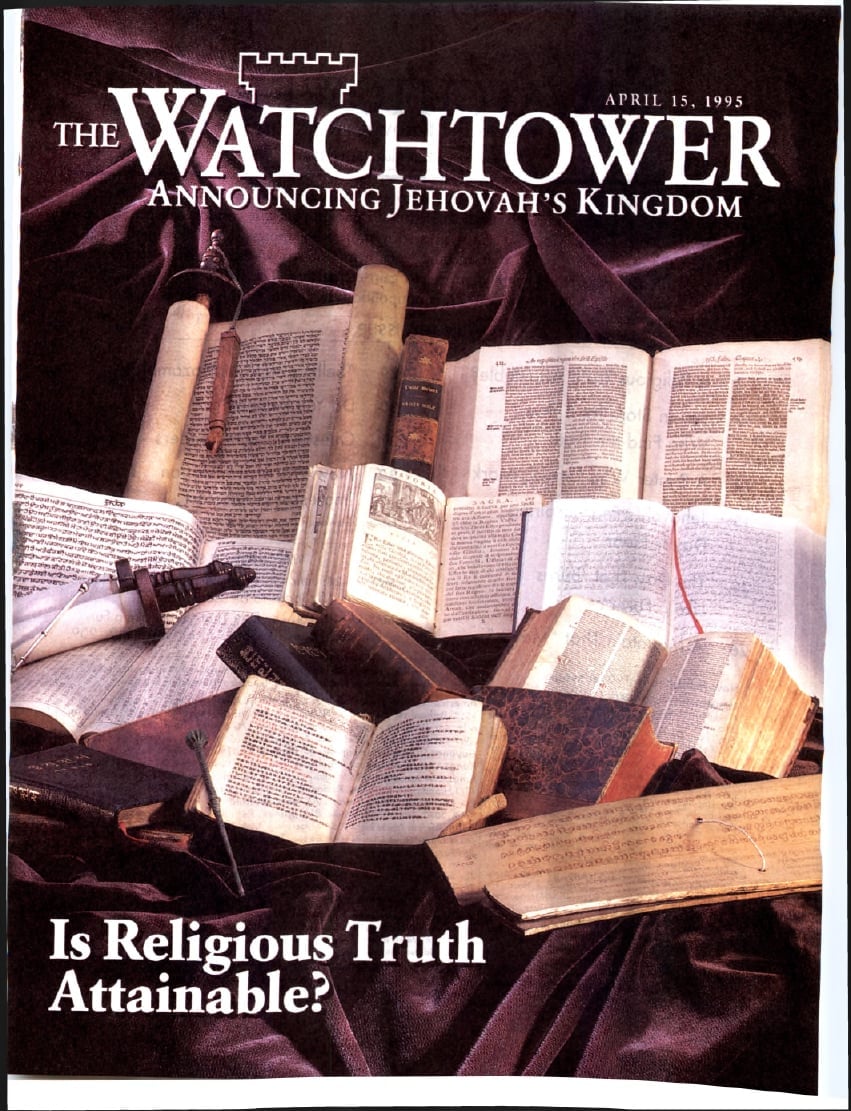
APRIL 15,1995 THE WATCHTOWER ANNOUNCING JEHOVAH'S KINGDOM
Is Religious Truth Attainable?
THE WATCHTOWER
ANNOUNCING JEHOVAH'S KINGDOM
April 15, 1995
Average Printing Each Issue: 16,100,000
Vol.116,No.8
THE PURPOSE OF THE WATCHTOWER is to exalt Jehovah God as Sovereign Lord of the universe. It keeps watch on world events as these fulfill Bible prophecy. It comforts all peoples with the good news that God's Kingdom will soon destroy those who oppress their fellowmen and that it will turn the earth into a paradise. It encourages faith in God's now-reigning King, Jesus Christ, whose shed blood opens the way for mankind to gain eternal life. The Watchtower, published by Jehovah's Witnesses continuously since 1879, is nonpolitical. It adheres to the Bible as its authority.
IN THIS ISSUE
3 Is Religious Truth Attainable?
7 Joy in Store for Those Who Find the Truth
10 A Printer Who Left His Mark
15 Jehovah's Fear-Inspiring Day Is Near
20 The Day That 'Burns Like a Furnace'
26 A Mountain That "Moves"
29 "Selling Salt" in Mozambique
30 Do You Remember?
31 Questions From Readers
32 New World Translation Impresses a Scholar
Page 3: Second from left: Courtesy of The British Museum;
Right: Sung Kyun Kwan University, Seoul, Korea
WATCHTOWER STUDIES
MAY 22-28: Jehovah's Fear-Inspiring Day Is Near. Page 15. Songs to be used: 189, 27.
MAY 29-JUNE 4: The Day That 'Burns Like a Furnace.' Page 20. Songs to be used: 112, 209.
SEMIMONTHLY LANGUAGES AVAILABLE BY MAIL-AFRICA, Albania, Albania, Arabic, Arabic Bengali, Bengal, Chinese, Bulgaria, Bulgarian, Cebuano, Chinese, Chinese (Simplified), Cebuano, Croatian, Czech, Dutch "Dutch", Efik, English "African", Also Brazilian, Eve, Finnish, French "French", Gael, German, Greek, Gilgamesh, Hindi, Hindi Mati, Hungarian, Igloo, Indonesian, Macedonian, Malay, Malayalam, Macedonian, Macedonian, Malayalam, Macedonian, Macedonian, Malayalam
MONTHLY LANGUAGES AVAILABLE BY ARMENIAN, Cambodian, Georgian, Greenlandian, GI, House, Hebrew, Icelandic, Kinyarwanda, Kwanyama/Ndonga, Lithuanian, Lithuaniaian, Moldese, Montenegro, Moorish,挪威,挪威,挪威,挪威
Study articles also available in large-print edition.
Audiocassettes also available.
© 1995 Watch Tower Bible and Tract Society of Pennsylvania. All rights reserved. Milton G. Henschel, President
If you would like to learn about Jehovah's Witnesses or their publications, please write to Watch Tower at the appropriate address below.
America, United States of, Wallis, N.Y. 12589, Australia. Box 280, ingleboro, N.S.W. 255. Bahamas: Box N-1247, Nassau, N.P. Barbados: Fontaleille 21, Bridgent, Canada: Box 410, Holton Hills (Georgetown), Ontario T1G 474 AY. England: The Ridgeway, London N.W. 179. NMP Germany: Niederslachte Am, Stimmler, D-56518 S爷ans. Ghana: Box 760, Accra. Guyana: 50 Bickram, Georgetown 10. Hawai'i 96819, 2055 Kum Iv Dh, Honolulu, Hong Kang: 4 Kert Road, Kawilow Tong, Inda. Post Bag 10, Lonaula Pune Di, Mah. 410 401. Ireland: 4 J.P. Jamesworth Road, Fingal, Dublin, Ireland. Jamaica: 4 Kington, Japan 1271 Kuala Lumpur, City Kuala Lumpur, Pahul. 243 434. Mauritius: P.O. Box 10, 03800, Mowareville 10. New Zealand: P.O. Box 142, Mowareville, Nigeria: P.M. B.109, Benin City, Edo State, Philippines. Republic of: P.O. Box 204, 1099 Manila, South Africa: P.O. Bag 20076, Krugerland, 1740. Trinidad and Tobago: Republic of: 50 Raisley Street & Loomi Lane, Curepe, Zambia: Box 33459, Luciano 10101. Zimbabwe: 50 Lower Raisley Street & Loomi Lane, Curepe, Zambia: Box 33459, Luciano 10101.
The Bible translation used is the New World Translation of the Holy Scriptures—With References, unless otherwise indicated.
Would you welcome more information or a free home Bible study? Please send your request to Watch Tower, using the appropriate address above.
Publication of "The Watchtower" is part of a worldwide Bible educational work supported by voluntary donations.
Changes of address should reach us 30 days before your moving date. Give us your old and new address (if possible, your old address label).
The Watcherhole (ISSN 0043-1087) is published semimonthly by Watcherhole Bible and Tract Society of New York, Inc. 25 Columbia Heights, NY. Second-digit postal code paid at Brooklyn, NY, and mailing offices. Postmaster: Send address changes to Watcherhole, Wallkill, NY 12589.
Printed in U.S.A.
Is religious truth attainable?
IN Sweden a spiritually inquisitive man in the university town of Uppsala decided to study the beliefs of the different religions in his town, even visiting
fins Historia (The History of Philosophy), Swedish author Alf Ahlberg wrote: "Many philosophical questions are of such a nature that it is not possible to give a definite an-
their places of worship. He listened as their clergy preached, and he interviewed some members. He noticed that only Jehovah's Witnesses seemed convinced that they had "found the truth." Considering the variety of religious opinions that exist, he wondered how the Witnesses could make such a claim.
Do you personally think that it is possible to attain to the truth regarding religion? Would it even be possible to determine what might be called the ultimate truth?
Philosophy and the Truth
swer to them. . . . Many people are of the opinion that all the metaphysical problems [relating to first principles of things] belong to this . . . group."
Consequently, those who through philosophy have endeavored to find an answer to the vital questions of life have often ended up dissatisfied or in anguish. In his book Tankelinjer och trosformer (Lines of Thought and Religious Faith), Swedish author Gunnar Aspelin said: "One thing we see is that nature is no more interested in man than in the butterfly and the mosquito . . . We are powerless, absolutely power-
Those who have studied philosophy have developed the view that the ultimate truth is not within mankind's reach. You may know that philosophy has been defined as "the science that endeavors to explain the origin of existence and life." In actual fact, though, it rarely goes that far. In Filoso-
less, in the face of those forces that play their game in the cosmos and in our inner world. This is the outlook on life that has so often appeared in literature toward the end of a century in which men have put their faith in progress and dreamed of a better future."
Is a Revelation of Truth Needed?
It is obvious that human efforts alone have not succeeded in finding the truth about life, and it seems that they never will. There is good reason, then, to conclude that some kind of divine revelation is necessary. What many call the book of nature provides some revelation. Even if it does not give conclusive details about the origin of life, it does show that there is something far more satisfactory than a purely materialistic explanation of life. A blade of grass that grows upward actually follows laws other than those governing a pile of rocks in a crumbling hole. Living things in nature build and organize themselves in a way that dead things do not. A noted student of law and religion thus had a basis for concluding: "[God's] invisible qualities are clearly seen from the world's creation onward, because they are perceived by the things made."—Romans 1:20.
But in order to find out who is behind all this building and organizing, we need a further revelation. Should we not expect such a revelation to exist? Would it not be reasonable to expect that the One who is responsible for life on earth would reveal himself to his creatures?
The Bible claims to be such a revelation. In this magazine we have often presented good reasons for accepting this claim, and many thinking people have. That the men who wrote the Bible were anxious to make it clear that what they wrote was not their own is in itself quite remarkable. More than 300 times, we find the prophets of the Bible using such expressions as, "This is what Jehovah has said." (Isaiah 37:33; Jeremiah 2:2; Nahum 1:12) You likely know that men and women who write books or articles are usually quite anxious to sign their works. Yet, those who wrote the Bible kept themselves in the background; in some cases it
is difficult to determine who wrote certain parts of the Bible.
Another aspect of the Bible that you may find significant is its inner harmony. This is really remarkable, considering that the Bible's 66 books were written over a period of 1,600 years. Suppose you went to a public library and chose 66 religious books that had been written over a period of 16 centuries. Then you had those individual books bound into one volume. Would you expect that volume to have a common theme and a harmonious message? Hardly. That would require a miracle. Consider this: The books of the Bible do have such a common theme, and they do corroborate one another. This demonstrates that there must be one mastermind, or author, who directed what the Bible writers recorded.
However, you will find a feature that proves the divine origin of the Bible more than anything else. Prophecies—information written in advance about what definitely would occur in the future. Expressions such as, "It must occur in that day" and, "It must occur in the final part of the days" are unique to the Bible. (Isaiah 2:2; 11:10, 11; 23:15; Ezekiel 38:18; Hosea 2:21-23; Zechariah 13:2-4) Many hundreds of years before Jesus Christ appeared on earth, prophecies in the Hebrew Scriptures gave details about his life—from his birth to his death. No other reasonable conclusion can be reached than that the Bible is the source of the truth about life. Jesus himself confirms this with the words: "Your word is truth."—John 17:17.
Even many who profess faith in the Bible believe that absolute truth is not attainable. U.S. clergyman John S. Spong commented: "We must . . . move from thinking we have the truth and others must come to SOME PHILOSOPHIES VERSUS THE TRUTH
POSITIVISM: The view that all ideas of a religious nature are unverifiable nonsense and that the object of philosophy is to unite the positive sciences to form a whole.
EXISTENTIALISM: Its advocates were very much influenced by the horrors of World War II and therefore came to have a pessimistic view of life.
It stresses examining man's anguish in the face of death and the emptiness of life. Existentialist author Jean-Paul Sartre said that since there is no God, man is abandoned and exists in a universe that is absolutely indifferent.
SKEPTICISM: Holds that it is impossible through observation and reason to reach any
objective, universal knowledge—any truth—about existence.
PRAGMATISM: Estimates the true worth of our convictions solely by their practical bearing on human interests, such as in reshaping education, morals, and politics. It does not consider that truth has any value in itself.
our point of view to the realization that ultimate truth is beyond the grasp of all of us." A Roman Catholic author, Christopher Derrick, gives one reason for such negative views concerning finding truth: "Any mention of religious 'truth' implies some kind of claim to know . . . You imply that somebody else may possibly be wrong; and that would not do at all."
As a thinking person, however, you would do well to consider some pertinent questions. If truth were not attainable, why would Jesus Christ say: "You will know the truth, and the truth will set you free"? And why would one of Jesus' apostles say that God's will is that "all sorts of men should be saved and come to an accurate knowledge of truth"? Why does the word "truth" occur over a hundred times in the Christian Greek Scriptures in connection with faith? Yes, why, if truth is unattainable?—John 8:32; 1 Timothy 2:3, 4.
Actually, Jesus not only pointed out that the truth is attainable but showed that finding it is required if our worship is to be approved by God. When a Samaritan woman wondered what the true form of worship was—the worship practiced by the Jews in Jerusalem or that practiced by the Samaritans on Mount Gerizim—Jesus did not answer by saying that truth is unattainable. Rather, he said: "True worshipers will worship the Father with spirit and truth, for, indeed, the Father is looking for suchlike ones to worship him. God is a Spirit, and those worshiping him must worship with spirit and truth."—John 4:23, 24.
Many people claim, 'The Bible can be interpreted in various ways, so one cannot possibly be sure of what truth is.' But is the Bible really written in such a vague way that you cannot be certain how it is to be understood? Granted, certain prophetic and symbolic language may be difficult to grasp. For example, God told the prophet Daniel that his book, containing much prophetic language, was not to be completely understood until "the time of the end." (Daniel 12:9) And it is evident that certain parables and symbols need to be interpreted.
It is clear, though, that as to basic Christian teachings and moral values essential to worship of God in truth, the Bible is very straightforward. It leaves no room for conflicting interpretations. In the letter to the Ephesians, Christian faith is spoken of as being "one," showing that there were not to be several faiths.
(Ephesians 4:4-6) Perhaps you may wonder, 'If the Bible cannot rightly be interpreted in many different ways, why are there so many different "Christian" denominations?' We find the answer if we look back to the time shortly after Jesus' apostles had died and an apostasy from the true Christian faith had developed.
'The Wheat and the Weeds'
Jesus foretold this apostasy in his parable of the wheat and the weeds. Jesus himself explained that "the wheat" represents true Christians; "the weeds" represent false, or apostate, Christians. "While men were sleeping," Jesus said, an "enemy" would sow weeds in the wheat field. This sowing began after the apostles had fallen asleep in death. The parable shows that this confusing of true Christians with false would continue until "the conclusion of the system of things." Thus, throughout the centuries, the identity of true Christians has been obscured because the religious field has been dominated by those who are merely nominal Christians. However, at "the conclusion of the system of things," a change would occur. "The Son of man" would "send forth his angels" to separate false Christians from true Christians. This meant that the Christian congregation would then be easy to recognize, having the status it had in the apostles' time.—Matthew 13:24-30, 36-43.
Both Isaiah's and Micah's prophecies foretell such a regathering of true worshippers "in the final part of the days." Isaiah says: "It must occur in the final part of the days that the mountain of the house of Jehovah will become firmly established above the top of the mountains, and it will certainly be lifted up above the hills; and to it all the nations must stream. And many peoples will certainly go and say: 'Come, you
people, and let us go up to the mountain of Jehovah, to the house of the God of Jacob; and he will instruct us about his ways, and we will walk in his paths.'" A clear-eyed look at the facts shows that Isaiah's prophecy is being fulfilled in our time.—Isaiah 2: 2, 3; Micah 4:1-3.
The growth of the Christian congregation, though, is not occurring through some human effort. Jesus foretold that he would "send forth his angels" to do a gathering work. He also indicated a very special purpose for it: "At that time the righteous ones will shine as brightly as the sun in the kingdom of their Father." (Matthew 13:43) This shows that an enlightening, or educational, work would be performed worldwide by the Christian congregation.
Jehovah's Witnesses see a fulfillment of these prophecies in the educational work that they are carrying out in 232 lands today. By comparing the Witnesses' beliefs, standards of conduct, and organization with the Bible, unbiased people can clearly see that these harmonize with those of the first-century Christian congregation. The Witnesses speak of their faith as "the truth" but not out of some presumption of personal superiority. Instead, they do so because they have extensively studied God's Word, the Bible, and they follow it as the only standard by which religion can rightly be measured.
The early Christians referred to their faith as "the truth." (1 Timothy 3:15; 2 Peter 2:2; 2 John 1) What was truth for them must also be truth for us today. Jehovah's Witnesses invite everyone to make sure of that for themselves by studying the Bible. We hope that by doing so you will also experience the joy that comes not only from having found a religion that surpasses others but from having found the truth!
Joy in store for those who find the truth
IN HIS attic, a Finnish man found the book The Divine Plan of the Ages. He started to read it on the spot, and before long he said to himself, 'This is the truth; this is the truth.' Upon coming down from the attic, he told his wife, "I have found the true religion."
This experience is unusual in the way this man found the truth, but many of Jehovah's Witnesses could relate a similar reaction. All of them can tell you of the joy it brings
to find the truth. The following experiences highlight this.
True Bible Teachings Bring Joy
Margarita Königer grew up in Munich, Germany, during World War II. Bombed and burning houses were a frequent sight. Her brother died in the war. As she attended Catholic church services, she heard prayers said for the German soldiers and the führer, Hitler. After the war, she
Many are impressed by the joy and good organization at assemblies of Jehovah's Witnesses
received a scholarship to attend a college in the United States as part of a student-exchange program. She found that people were friendly to her, so she wondered what it was that seemed to push people, whose natural desire is to live in peace, to distrust and hate one another during wartime. Back in Munich, she came in contact with Jehovah's Witnesses, and through a study of the Bible with them, she found the answers to her questions. She says: "I was shown from the Bible that wicked spirit forces are involved . . . The Bible calls them 'world rulers,' and, in fact, says that Satan 'is misleading the entire inhabited earth.'
...Judging by the ungodly, devilish actions of nations and peoples, how reasonable and satisfying this answer is!"—Ephesians 6:12; Revelation 12:9.
Margarita continues: "It brought me great joy to learn of God's provision for solving earth's problems. No, it will not be by means of some human ideology or administration, as proposed by worldly educators. Rather, the Bible shows that a new heavenly government will take charge of earth's affairs. . . . Jesus Christ taught his followers to pray: 'Let your kingdom come.' . . . I began to see that this kingdom is a real
government and that only by means of it will genuine, worldwide peace be achieved." During almost 30 years, Margarita has served as a missionary in some five African countries—the last 19 years being spent in proclaiming truth to the humble people of Ouagadougou, Burkina Faso.
Margarita's experience is not unique. Many have reacted just as positively when they have found that Christendom's clergy on both sides of the battle lines pray to God for victory. Honesthearted ones see the reasonableness of the Bible's explanation that God has nothing to do with man's wars but that these develop because "the whole world is lying in the power of the wicked one." These truth seekers learn that true Christians are to be "no part of the world" but are to remain neutral in its affairs. Recognizing that Jehovah's Witnesses have taken such a stand, these newly interested ones become convinced that they have found the truth. Such ones grow in hope and joy as they gain increased knowledge regarding why God has allowed wickedness and how he will shortly bring about peace and righteous conditions on the earth by means of his Kingdom.—1 John 5:19; John 17:16; Matthew 6:9, 10.
True Bible Principles Bring Joy
Daniel Rosero of Ecuador felt that life was meaningless, so he started to drink. The church he attended taught him that the only thing he had to look forward to was death and a fiery hell. He responded, "I'm going to burn, so let me drink!" He had a family of eight that he was not providing for, and he was always fighting with his wife, Delia. The turning point came one Sunday morning when they were visited by Jehovah's Witnesses and started studying the Bible. The first time Daniel attended a circuit assembly of Jehovah's Witnesses, he realized he had found the truth. He says: "The organization overwhelmed me. People got along, lots of them, together. You could feel love in the crowd. No one smoked. No dirty language. . . . I remember thinking, 'This is the truth!' It was not fear of death or fear of the world's end that moved me. It was the cleanness of the organization."
The entire Rosero family became Jehovah's Witnesses. Their family life and their economic situation improved as they applied Bible principles. Delia Rosero says: "You know I owe it all to the truth of the Bible. Who knows where my children would be without God's Word? All seven of them are baptized and stable. The truth has meant a completely new life, new happiness, for me."
The experience of the Rosero family is not unique. Many in our day are troubled by problems. One reason is that the moral standards provided in the Bible are generally no longer respected, as they were by earlier generations. Most religions have followed this trend, either in the name of tolerance or because they feel that with changing times old morals are out-of-date. So, like others, the Roseros were left to grope without the Bible's guidance. However, when such humble people come to understand God's view on morals and family life, they without delay apply what they learn. From their stories we can see the good results of doing so.
Joy Must Be Cultivated
This does not mean, however, that a Christian is in a constant state of euphoria. Obviously, the difficulties that people in general face, such as unemployment, sickness, and death, affect Christians too. Christians also have to put up a continual fight against their own imperfections and weaknesses. The Bible account says that Lot was "greatly distressed by the indulgence of the law-defying people in loose conduct" in the city of Sodom. Faithful Christians cannot avoid similar feelings when seeing wicked conditions prevail.—2 Peter 2:7, 8.
However, those who have found the truth have an advantage. For example, a believer who is mourning over someone who has died does not have to feel "sorrow just as the rest also do who have no hope." His grief will not be boundless. This is true regarding other problems too. The person who has found the truth knows that present hardships are only temporary. Hope makes it easier to bear up under difficulties. A balanced life-style also helps.—1 Thessalonians 4:13.
Paul gave Christians this exhortation: "Always rejoice in the Lord. Once more I will say, Rejoice!" (Philippians 4:4) This shows that while joy is within the reach of all of us, it also is possible not to have it. The anxieties of this old system of things could prove to be an obstacle. In addition, the Bible tells us that we need to cultivate joy, one of the fruits of God's spirit. (Galatians 5:22) If you continually take in knowledge of the truth and remind yourself of the spiritual riches it has brought and still brings, your joy will not diminish. It will become stronger as we approach the time when God "will wipe out every tear" from people's eyes and when neither "mourning nor outcry nor pain" will be anymore.—Revelation 21:4.
A printer who left his mark
Bibliothèque Nationale, Paris
HAVE you ever wanted to locate a passage in the Bible but could not recall where it was found? Yet, by remembering just one word, you were able to find it by using a Bible concordance. Or perhaps you have attended a Christian gathering where hundreds, or even thousands, in attendance were able to open their Bibles to read a text just seconds after it had been cited.
Robert Estienne's efforts have aided generations of Bible students
In either case, you owe something to a man with whom you may not be familiar. He made your Bible study easier, and he also played a part in ensuring that we today have accurate Bibles. He even influenced the way many Bibles look.
The man was Robert Estienne." He was a printer, born the son of a printer, in Paris, France, near the beginning of the 16th century. It was the age of the Renaissance and the Reformation. The printing press became a vehicle for both. Henri Estienne, Robert's father, was a printer of renown, producing some of the finest book editions to come out of the Renaissance. His work included academic and Biblical works for the University of Paris and its school of theology—the Sorbonne.
But let us focus on the son, Robert Estienne. Little is known of his formal education. Yet, from an early age, he mastered Latin and soon learned Greek and Hebrew as well. From his father, Robert learned the art of printing. When he took over Henri's press in 1526, Robert Estienne was already known as a scholar of high linguistic standards. Though he published critical editions of Latin literature and other scholarly works, his first and indisputable love was the Bible. Eager to accomplish for the Latin Bible what had already been done for the
Latin classics, Estienne set out to reestablish as nearly as possible the original fifthcentury text of Jerome's Latin Vulgate Bible.
A Refined Vulgate
Jerome had translated from the Bible's original Hebrew and Greek, but by Estienne's day, the Vulgate had been in existence for a thousand years. Many errors and corruptions had slipped in as a consequence of generations of transcribing the Vulgate. Moreover, during the Middle Ages, the Bible's divinely inspired words had become overlaid with a tangled skein of medieval legends, paraphrased passages, and spurious interpolations. These had become so mingled with the Bible's text that they began to be accepted as inspired writings.
To clear away all that was not original, Estienne applied the methods of textual criticism that were used for the study of classical literature.
He sought out the oldest and best manuscripts available. In the libraries in and around Paris and in such places as Évreux and Soissons, he uncovered several ancient manuscripts, one apparently dating from the sixth century. Estienne carefully compared the different Latin texts passage by passage, selecting only the passages that seemed to have the most authority. The work that resulted, Estienne's Bible, was first published in 1528 and was a significant step forward in refining the Bible's textual accuracy. Improved editions by Estienne followed. Others before him had attempted to correct the Vulgate, but his was the first edition to provide an effective critical apparatus. In the margins, Estienne indicated where he had omitted certain doubtful passages or where more than one reading was possible. He also noted the manuscript sources that gave authority for these corrections.
Estienne introduced many other features quite novel for the 16th century. He made a distinction between the Apocryphal books and God's Word. He placed the book of Acts after the Gospels and before the letters of Paul. At the top of each page, he supplied a few key words to help readers locate specific passages. This was the earliest example of what today is commonly called a running head. Instead of using the heavy Gothic, or black letter, type that originated in Germany, Estienne was one of the first to print the entire Bible in the lighter and easier-to-read roman type now in common use. He also provided many cross-references and philological notes to help clarify certain passages.
Many nobles and prelates appreciated Estienne's Bible, for it was better than any other printed edition of the Vulgate. For
The Royal Printer
beauty, workmanship, and utility, his edition became the standard and was soon being imitated all over Europe.
"Have you beheld a man skillful in his work? Before kings is where he will station himself," says Proverbs 22:29. Estienne's innovative craftsmanship and linguistic ability did not escape the notice of Francis I, king of France. Estienne became the king's printer of Latin, Hebrew, and Greek. As such, Estienne produced what still remain some of the masterpieces of French typography. In 1539 he began to produce the first and finest complete Hebrew Bible printed in France. In 1540 he introduced illustrations into his Latin Bible. But instead of the usual fanciful depictions of Biblical events common to the Middle Ages, Estienne provided instructive drawings based on archaeological evidence or on the measurements and descriptions found in the Bible itself. These wood-block prints depicted in detail such subjects as the ark of the covenant, the high priest's garments, the tabernacle, and Solomon's temple.
Using the special set of Greek type that he had ordered for printing the king's manuscript collection, Estienne went on to produce the first critical edition of the Christian Greek Scriptures. Although the first two editions of Estienne's Greek text were little better than Desiderius Erasmus' work, in the third edition of 1550, Estienne added the collations and references from some 15 manuscripts, including the fifth-century-C.E. Codex Bezae and the Septuagint Bible. This edition by Estienne was so widely accepted that it later became the basis for the so-called Textus Receptus, or Received Text, upon which many later translations were based, including the King James Version of 1611.
The Sorbonne Against the Reformation
With the ideas of Luther and other Reformers spreading all over Europe, the Catholic Church sought to control what the people thought by regulating what they read. On June 15, 1520, Pope Leo X had issued a bull ordering that no book containing "heresies" be printed, sold, or read in any Catholic land and demanding that the secular authorities enforce the bull within their domains. In England, King Henry VIII left the task of censorship to Catholic bishop Cuthbert Tunstall. However, in most of Europe, the undisputed authority in matters of doctrine, next to the pope, was the faculty of theologians at the University of Paris—the Sorbonne.
The Sorbonne was the v Catholic orthodoxy. For cerries it had been viewed as the rampart of the Catholic faith. The Sorbonne's censors opposed all critical editions and vernacular translations of the Vulgate, considering such as being not only "useless to the church but harmful." This was not surprising at a time when Reformers were calling into question church doctrines, ceremonies, and traditions that were not based on the authority of Scripture. However, many theologians at the Sorbonne considered the church's venerated doctrines to be more important than an accurate reading of the Bible itself. One
Estienne's instructive illustrations were imitated for generations
theologian said: "Once the doctrines are acquired, the Scriptures are like scaffolding that is removed after a wall is built." Most of the faculty were ignorant of Hebrew and Greek, yet they disdained the studies of Estienne and other Renaissance scholars who were delving into the original meanings of the words used in the Bible. One Sorbonne professor even ventured that "to propagate a knowledge of Greek and Hebrew would operate to the destruction of all religion."
The Sorbonne Attacks
Although the early editions of Estienne's Vulgate passed the faculty's censors, it had not been without controversy. Back in the 13th century, the Vulgate had been enshrined as the university's official Bible, and to many people its text was infallible. The faculty had even condemned the respected scholar Erasmus for his work on the Vulgate. That a local layman printer would have the audacity to correct the official text was alarming to some.
Perhaps more than anything, it was Estienne's marginal notes that worried the theologians. The notes cast doubt on the legitimacy of the text of the Vulgate. Estienne's desire to clarify certain passages resulted in his being accused of intruding into the realm of theology. He denied the charge, claiming that his notes were merely short summaries or philological in nature. For example, his note on Genesis 37:35 explained that the word "hell" [Latin, infernum] could not there be understood to be a place where the wicked are punished.
The faculty charged that he denied the immortality of the soul and the intercessory power of the "saints."
Estienne, however, had the favor and protection of the king. Francis I showed great interest in Renaissance studies, particularly the work of his royal printer. Reportedly, Francis I even visited Estienne and once waited patiently while Estienne was making some last-minute corrections to a text. With the king's support, Estienne withstood the Sorbonne.
Theologians Ban His Bibles
In 1545, though, events caused the full fury of the Sorbonne's faculty to be focused upon Estienne. Seeing the benefit of presenting a united front against the Reformers, the Catholic universities of Cologne (Germany), Louvain (Belgium), and Paris had earlier agreed to collaborate in the censorship of unorthodox teachings. When the theologians of Louvain University wrote the Sorbonne expressing their surprise that Estienne's Bibles had not appeared on Paris' list of condemned books, the Sorbonne lying replied that they would indeed have condemned them if they had seen them. Estienne's enemies within the faculty now felt confident that the combined authority of the faculties of Louvain and Paris would be sufficient to convince Francis I of the errors of his printer.
Meanwhile, having been warned of his enemies' intentions, Estienne got to the king first. Estienne suggested that if the theologians would produce a list of any errors they had found, he was quite willing to print these along with the theologians' corrections and to include them with each Bible sold. This solution won the king's favor. He asked Pierre du Chastel, his royal
lector, to see to the matter. In October 1546 the faculty wrote to Du Chastel protesting that Estienne's Bibles were "food for those who deny our Faith and support the current . . . heresies" and were so full of errors as to merit in their "entirety to be extinguished and exterminated." Unconvinced, the king now personally ordered the faculty to produce the censures so that they could be printed with Estienne's Bibles. This they promised to do, but actually they did all they possibly could to avoid having to produce a detailed list of supposed errors.
Francis I died in March 1547, and with him went Estienne's most potent ally against the power of the Sorbonne. When Henry II ascended the throne, he renewed his father's command that the faculty produce their censures. Yet, observing how the German princes were using the Reformation for political ends, Henry II was less concerned with the supposed advantages or disadvantages of the royal printer's Bibles than with keeping France Catholic and united under its new king. On December 10, 1547, the king's Privy Council decided that sales of Estienne's Bibles should be prohibited until the theologians could produce their list of censures.
Accused of Being a Heretic
The faculty now sought means to have Estienne's case turned over to the special court that had newly been set up to try cases of heresy. Estienne needed no reminder of the danger he was in. Within two years of its formation, the court became known as the chambre ardente, or "burning room." Some 60 victims were sent to the stake, including some printers and booksellers who were burned alive at the Place Maubert, just a few minutes' walk from Estienne's front door. Estienne's house was repeatedly searched for some thread of evidence against him.
Over 80 witnesses were questioned. Informers were promised a fourth of his goods if he could be convicted of heresy. Still, their only evidence was what Estienne had openly printed in his Bibles.
Again the king ordered that the list of the faculty's censures be turned over to his Privy Council. Intractable, the faculty answered that 'the theologians are not in the habit of putting in writing the reasons for which they condemn something as heretical but answer by spoken word only, which you must believe, or else there will be no end of writing.' Henry acquiesced. The final ban was imposed. Almost every Biblical work Estienne had ever produced was condemned. Although he had escaped the flames of Place Maubert, he decided to leave France in the face of a total ban on his Bibles and the likelihood of further harassment.
The Expatriate Printer
In November 1550, Estienne moved to Geneva, Switzerland. The faculty had made it illegal in France to publish any Bible except the Vulgate. Now at liberty to publish what he wished, Estienne reprinted his Greek "New Testament" in 1551, with two Latin versions (the Vulgate and Erasmus') in parallel columns. This he followed,
In Our Next Issue
Soon, No One Will Be Poor!
Benefiting From Daily Bible Reading
What Will Your Business Cost You?
in 1552, with a French translation of the Greek Scriptures in parallel with Erasmus' Latin text. In these two editions, Estienne introduced his system for dividing the Bible's text into numbered verses—the same system as is universally used today. Although others had previously tried different schemes for verse division, Estienne's became the accepted form. His French Bible of 1553 was the first complete Bible to provide his verse divisions.
Estienne's two-version Latin Bible of 1557 is also noteworthy for his use of God's personal name, Jehova, throughout the Hebrew Scriptures. In the margin of the second psalm, he noted that the substitution of 'Adho-nai' for the Hebrew Tetragrammaton (אדוהן) was based solely on Jewish superstition and should be rejected. In this edition, Estienne used italics to indicate the Latin words that were added to complete the sense of the Hebrew. This convention was later adopted in other Bibles, a legacy that has often puzzled today's readers accustomed to the modern use of italics to show emphasis.
Determined to put his learning at the disposal of others, Estienne devoted his life to the publication of the Holy Scriptures. Those today who value the Word of God can be grateful for his efforts and for the labor of others who painstakingly strove to uncover the words of the Bible as originally written. The process they started continues as we gain a more accurate knowledge of the ancient languages and discover older and more accurate manuscripts of God's Word. Shortly before his death (1559), Estienne was working on a new translation of the Greek Scriptures. He was asked: "Who will buy it? Who will read it?" He confidently answered: 'All learned men of godly devotion.'
JEHOVAH'S FEAR-INSPIRING DAY IS NEAR
"A book of remembrance began to be written up before him for those in fear of Jebovah and for those thinking upon his name."—MALACHI 3:16.
FEAR-INSPIRING! As day dawned on August 6, 1945, a great city was demolished in an instant of time. Some 80,000 dead! Tens of thousands mortally injured! Raging fire! The nuclear bomb had done its work. How did Jehovah's Witnesses fare during that catastrophe? There was only one Witness in Hiroshima—confined within the protective walls of a prison because of his Christian integrity. The prison collapsed into rubble, but our brother was not hurt. As he put it, he was atom-bombed out of prison—perhaps the only good thing that the bomb accomplished.
2 Fearsome as that bomb blast was, it fades into insignificance when compared to "the great and fear-inspiring day of Jehovah" that lies just ahead. (Malachi 4:5) Oh, yes, there have been fear-inspiring days in the past, but this day of Jehovah will surpass all of them.—Mark 13:19.
3 In Noah's day "all flesh had ruined its way on the earth," and God declared: "The earth is full of violence as a result of them; and here I am bringing them to ruin together with the earth." (Genesis 6:12, 13) As recorded at Matthew 24:39, Jesus said that people "took no note until the flood
came and swept them all away." But faithful Noah, "a preacher of righteousness," along with his God-fearing family, survived that Deluge.—2 Peter 2:5.
"So too," Jude 7 relates, "Sodom and Gomorrah and the cities about them, after they . . . had committed fornication excessively and gone out after flesh for unnatural use, are placed before us as a warning example by undergoing the judicial punishment of everlasting fire." Those ungodly people perished because of their disgustingly filthy life-style. Let sex-oriented communities of this modern world be warned! Note, however, that God-fearing Lot and his daughters were preserved alive during that catastrophe, even as Jehovah's worshipers will be protected during the fast-approaching great tribulation.—2 Peter 2:6-9.
5 Then consider the warning examples provided when Jehovah used invading armies to wipe out Jerusalem, the glorious city that had once been "the exultation of the whole earth." (Psalm 48:2) These tragic events took place, first in 607 B.C.E. and again in 70 C.E., because God's professed people abandoned true worship. Happily, loyal servants of Jehovah survived.
What can we learn from the judgments executed on Jerusalem?
The disaster of 70 C.E. (depicted below) is described as "a tribulation such as has not occurred from the beginning of the creation which God created until that time." It removed once and for all the apostate Jewish system of things, and certainly in that respect it "will not occur again." (Mark 13:19) But even this execution of divine judgment was merely a shadow of "the great tribulation" that now threatens the entire
awaited Kingdom rule of Messiah will take on new dimensions—"new heavens and a new earth . . . , and in these righteousness is to dwell." What a joyful prospect!
8 During our 20th century, world events have moved progressively toward a climax. Though the devastating of Hiroshima was no divine visitation, it may be included in the "fearful sights" that Jesus prophesied for the time of the end. (Luke 21:11) It
world system of things.—Revelation 7:14.
9 Why would God permit terrible calamities, with loss of so many lives? In the cases of Noah, of Sodom and Gomorrah, and of Jerusalem, Jehovah was executing judgment on those who had ruined their way upon the earth, who had sullied this beautiful planet with literal pollution and moral degradation, and who had apostatized from, or rejected, true worship. Today we stand on the brink of an all-inclusive execution of judgment that will engulf the entire world. 2 Thessalonians 1:6-9.
of the time of the civil war. (Bake 1911) It launched a nuclear threat that still hangs like a storm cloud over mankind. Thus, a headline in The New York Times of November 29, 1993, reads: "The Guns May Be a Bit Rusty but the Nuclear Arms Are Still Polished." In the meantime, international, interracial, and intertribal wars continue to reap a horrifying harvest. In former ages the vast majority of casualties were among the soldiers. Today, 80 percent of war casualties are reported to be civilians, not to mention the millions who flee their homelands as refugees.
"In the Last Days"
7 Those destructions of ancient times were prophetic of the fear-inspiring great tribulation described at 2 Peter 3:3-13. The apostle says: "You know this first, that in the last days there will come ridiculers with their ridicule, proceeding according to their own desires." Then, focusing on Noah's day, Peter writes: "The world of that time suffered destruction when it was deluged with water. But by the same word the heavens and the earth that are now stored up for fire and are being re-
How are world events moving to a climax?
served to the day of judgment and of destruction of the ungodly men." In the wake of that greatest of all tribulations, the long-
Why does Jehovah permit calamities?
(a) Of what were ancient divine judgments
prophetic? (b) What glorious prospect lies
ahead?
16 THE WATCHTOWER—APRIL 15, 1995
9 Religious leaders have often shown, and continue to show, "friendship with the world" by getting actively involved in wars and bloody revolutions.
(James 4:4) Some have collaborated with greedy barons of the commercial world as these mass-produce armaments and build up drug empires. For example, in reporting the assassination of a South American drug lord, The New York Times stated: "Hiding his drug dealing behind claims of legitimate business wealth and the image of a benefactor, he had his own radio show and was often accompanied by Roman Catholic priests." The Wall Street Journal reported that in addition to ruining the lives of millions who became drug addicts, this drug lord personally directed the murder of thousands. The Times of London noted: "The killers often pay for a special Mass to give thanks . . . at the same time as the victim's funeral mass is taking place elsewhere." What wickedness!
10 Who knows what havoc demon-inspired men may yet inflict on this earth? As 1 John 5:19 states, "the whole world is lying in the power of the wicked one," Satan the Devil. Today it is "woe for the earth and for the sea, because the Devil has come down to you, having great anger, knowing he has a short period of time." (Revelation 12:12) Happily, though, Romans 10:13 assures us that "every who calls on the name of Jehovah will be saved."
God Comes Near in Judgment
11 As to the immediate future of mankind, the prophecy of Malachi throws light on what is about to happen. Malachi is listed last in the long line of ancient Hebrew prophets. Israel had experienced the desolating of Jerusalem in 607 B.C.E. But 70 years later Jehovah had displayed merciful loving-kindness in restoring that nation to its land. Within a hundred years, however, Israel was again drifting into apostasy and wickedness. The people were dishonoring Jehovah's name, ignoring his righteous laws, and polluting his temple by bringing blind, lame, and sick animals for sacrifice. They were divorcing the wives of their youth so that they could marry foreign women.—Malachi 1:6-8; 2:13-16.
12 A purifying work was needed. It is described at Malachi 3:1-4. Like ancient Israel, Jehovah's modern-day Witnesses needed to be cleansed, so the purifying work described by Malachi can be applied to them. As the first world war drew toward its close, some of the Bible Students, as the Witnesses were then known, did not maintain
13. (a) What purifying has been necessary for the anointed priestly class? (b) How do the great crowd also benefit by cleansing?
clear-cut neutrality in worldly affairs. In 1918, Jehovah sent His "messenger of the covenant," Christ Jesus, to His spiritual temple arrangement to cleanse the small group of His worshipers from worldly blemishes. Prophetically, Jehovah had asked: "Who will be putting up with the day of [the messenger's] coming, and who will be the one standing when he appears? For he will be like the fire of a refiner and like the lye of laundrymen. And he must sit as a refiner and cleanser of silver and must cleanse the sons of Levi [anointed priestly group]; and he must clarify them like gold and like silver, and they will certainly become to Jehovah people presenting a gift offering in righteousness." As a purified people, they have done just that!
13 That anointed priestly group numbers only 144,000. (Revelation 7:4-8; 14:1, 3) What, though, of other dedicated Christians today? Now increasing into the millions, these form "a great crowd" that also has to be cleansed of worldly ways, 'washing their robes and making them white in the blood of the Lamb.' (Revelation 7:9, 14) Thus, by exercising faith in the ransom sacrifice of the Lamb, Christ Jesus, they are able to maintain a clean standing before Jehovah. They are promised survival through the entire great tribulation, the fear-inspiring day of Jehovah.—Zephaniah 2:2, 3.
14 Together with the priestly remnant, this great crowd must heed God's further words: "I will come near to you people for the judgment, and I will become a speedy witness against the sorcerers, and against the adulterers, and against those swearing falsely, and against those acting fraudulently with the wages of a wage worker,
with the widow and with the fatherless boy, and those turning away the alien resident, while they have not feared me . . . For I am Jehovah; I have not changed." (Malachi 3: 5, 6) No, Jehovah's standards do not change, so in fear of Jehovah, his people today must shun idolatry of all kinds and be truthful, honest, and generous as they continue to cultivate the Christian personality.—Colossians 3:9-14.
15 Jehovah extends an invitation to any who may have turned aside from his righteous ways, saying: "Return to me, and I will return to you." If these ask: "In what way shall we return?" he replies: "You are robbing me." And in answer to the further question: "In what way have we robbed you?" Jehovah states that they have robbed him by failing to bring their very best as offerings for his temple service. (Malachi 3: 7, 8) Having become part of Jehovah's people, we should indeed want to devote the best part of our energies, abilities, and material assets to the service of Jehovah. Thus, rather than rob God, we 'keep on seeking first the kingdom and his righteousness.' —Matthew 6:33.
16 There is a grand reward for all who put the self-serving, materialistic ways of the world behind them, as Malachi 3:10-12 indicates: "Test me out, please, in this respect,' Jehovah of armies has said, 'whether I shall not open to you people the floodgates of the heavens and actually empty out upon you a blessing until there is no more want.'" To all appreciative ones, Jehovah promises spiritual prosperity and fruitfulness. He adds: "All the nations will have to pronounce you happy, for you yourselves will become a land of delight."
Has that not proved to be so among the millions of God's thankful people throughout the earth today?
Integrity Keepers in the Book of Life
17 At this point, we may comment on the integrity of our Rwandan brothers and sisters. They have always brought the finest of spiritual offerings to Jehovah's spiritual house of worship. For example, at their "Divine Teaching" District Convention in December 1993, their 2,080 Kingdom publishers reaped a total attendance of 4,075. There were 230 new Witnesses baptized, and of these, nearly 150 enrolled in auxiliary pioneer service the following month.
18 When ethnic hatred burst forth in April 1994, at least 180 Witnesses, including the city overseer in Kigali, the capital, and his entire family, were killed. The six translators at the Watch Tower Society's office in Kigali, four of them Hutu and two Tutsi, continued working for several weeks under heavy threats, until the Tutsi had to flee, only to be killed at a checkpoint. Finally, carrying what was left of their computer equipment, the remaining four fled to Goma, in Zaire, where they loyally continued to translate The Watchtower into the Kinyarwanda language.—Isaiah 54:17.
19 These refugee Witnesses, though in dire circumstances, always asked for spiritual food ahead of material provisions. At great sacrifice, loving brothers from several lands were able to get supplies through to them. By word of mouth and by their orderliness under stress, these refugees have given a marvelous witness. They have indeed continued to bring of their best to Jehovah's worship. They have demonstrated a
conviction like Paul's expressed at Romans 14:8: "If we live, we live to Jehovah, and if we die, we die to Jehovah. Therefore both if we live and if we die, we belong to Jehovah."
20 Jehovah keeps record of all who serve him in integrity, Malachi's prophecy continues: "At that time those in fear of Jehovah spoke with one another, each one with his companion, and Jehovah kept paying attention and listening. And a book of remembrance began to be written up before him for those in fear of Jehovah and for those thinking upon his name."—Malachi 3:16.
21 How important it is today that we show godly fear in honoring Jehovah's name! Doing so, we will not suffer adverse judgment, as will those who admiringly support this world's systems. Revelation 17:8 relates that "their names have not been written upon the scroll of life." Logically, the preeminent name written in Jehovah's book of life is that of the Chief Agent of life, God's own Son, Jesus Christ. Matthew 12:21 declares: "Indeed, in his name nations will hope." Jesus' ransom sacrifice guarantees everlasting life for all who exercise
20, 21. (a) Whose names are not written in Jehovah's book of remembrance? (b) Whose names appear in the book, and why?
What judgments did Jehovah execute in Bible times?
Do You Recall?
How do conditions today parallel those of ancient times?
What purifying has taken place in fulfillment of Malachi's prophecy?
Whose names are written in God's book of remembrance?
faith therein. What a privilege it is to have our individual names added to Jesus' name in that scroll!
22 How will God's servants fare in the judgment? Jehovah answers at Malachi 3: 17, 18: "I will show compassion upon them, just as a man shows compassion upon his son who is serving him. And you people will
What distinction will be apparent when Jehovah executes judgment?
again certainly see the distinction between a righteous one and a wicked one, between one serving God and one who has not served him." The division will be plain to all: the wicked, separated for everlasting cutting-off, and the righteous, approved for everlasting life in the realm of the Kingdom. (Matthew 25:31-46) Thus a great crowd of sheeplike persons will survive the great and fear-inspiring day of Jehovah.
THE DAY THAT BURNS LIKE A FURNACE'
"Look! the day is coming that is burning like the furnace." -MALACHI 4:1.
DURING these last days, happy are those whose name Jehovah chooses to write in his book of remembrance. But what of those who fail to qualify for that privilege? Whether they are rulers or simply common people, how will they fare if they treat the proclaimers of God's Kingdom and their message with disdain? Malachi speaks of a day of accounting. At chapter 4, verse 1, we read: "For, look! the day is coming that is burning like the furnace, and all the presumptuous ones and all those doing wickedness must become as stubble. And the day that is coming will certainly devour them,' Jehovah of armies has said, 'so that it will not leave to them either root or bough.'
What questions arise in connection with Malachi 4:1?
2 Other prophets also compare Jehovah's judging of the nations to the torrid heat of a furnace. How aptly Ezekiel 22:19-22 applies to God's judging the sects of apostate Christendom! It reads: "This is what the Sovereign Lord Jehovah has said, 'For the reason that all of you have become as much scummy dross, therefore here I am collecting you together . . . As in collecting silver and copper and iron and lead and tin into the midst of a furnace, in order to blow upon it with fire to cause a liquefying, so I shall collect them together in my anger and in my rage, and I will blow and cause you people to liquefy. And I will bring you together and blow upon you with the fire of my fury, and you must be lique-
What graphic description of Jehovah's judgment is given by Ezekiel?
fied in the midst of her. As in the liquefying of silver in the midst of a furnace, so you people will be liquefied in the midst of her; and you will have to know that I myself, Jehovah, have poured out my rage upon you."
3A powerful illustration indeed! The clergy who have begged off from using Jehovah's name, even blaspheming that holy name, must meet up with that day of reckoning. Presumptuously, they claim that they and their political allies will establish the Kingdom of God on earth, or at least make the earth a fit place for the Kingdom.
Apostate Christendom has joined with political rulers in fighting terrible wars. History records the Crusades of medieval times, the forced conversions of the Spanish Inquisition, the Thirty Years' War that decimated Europe in the 17th century, and the Spanish Civil War of the 1930's, fought to make Spain safe for Catholicism. The greatest bloodletting came with the two world wars of our century, when Catholics and Protestants engaged in a free-for-all, indiscriminately slaughtering fellow believers as well as those of other religions. More recently, there has been murderous fighting between Catholics and Protestants in Ireland, between religious factions in India, and between the religious groups of the former Yugoslavia. The pages of religious history are also bloodied by the martyrdom of
The Complete Encyclopedia of Illustration/J. G. Heck
During the Spanish Inquisition many were forced to convert to Catholicism
thousands of faithful witnesses of Jehovah. Revelation 6:9,10.
5 We cannot but appreciate the justice of Jehovah's approaching execution of Babylon the Great, the world empire of false religion, together with its supporters. This execution is described at Revelation 18:21, 24: "A strong angel lifted up a stone like a great millstone and hurled it into the sea, saying: Thus with a swift pitch will Babylon the great city be hurled down, and she will never be found again. Yes, in her was found the blood of prophets and of holy ones and of all those who have been slaughtered on the earth."
What judgment awaits false religion?
6 In time, all enemies of righteousness, and those who adhere to them, "must become as stubble." Jehovah's day will burn among them like a furnace. "It will not leave to them either root or bough." In that day of accounting, young children, or boughs, will be dealt with justly according to Jehovah's assessment of their roots, their parents, who have oversight of these children. Wicked parents will have no posterity to perpetuate their wicked ways. But those who exercise faith in God's Kingdom promises will not be shaken. Hebrews 12: 28, 29 therefore exhorts: "Let us continue to have undeserved kindness, through which we may acceptably render God sacred service with godly fear and awe. For our God is also a consuming fire."
Is Jehovah a Cruel God?
7 Does this mean that Jehovah is a cruel, vindictive God? Far from it! At 1 John 4:8, the apostle states a fundamental truth: "God is love." Then, in verse 16 he adds emphasis, saying: "God is love, and he that remains in love remains in union with God and God remains in union with him." It is because of his love for mankind that Jehovah purposes to cleanse this earth of all wickedness. Our loving, merciful God declares: "As I am alive, . . . I take delight, not in the death of the wicked one, but in that someone wicked turns back from his way and actually keeps living. Turn back, turn back from your bad ways, for why is it that you should die?"—Ezekiel 33:11.
more often than the other three Gospel writers combined, yet at Mark 3:17, John himself is described as a 'Son of Thunder.' It was by inspiration from Jehovah that this Son of Thunder penned the apocalyptic messages of the Bible's final book, Revelation, which portrays Jehovah as the God who executes justice. This book is full of judgmental expressions, such as "the great winepress of the anger of God," "the seven bowls of the anger of God," and "the wrath of God the Almighty."—Revelation 14:19; 16:1; 19:15.
8 John refers to a.ga'pe, principled love,
9 Our Lord Jesus Christ, who is "the image of the invisible God," boldly declared Jehovah's judgments while here on earth. (Colossians 1:15) For example, there are the seven woes of Matthew chapter 23 that he forthrightly proclaimed against the religious hypocrites of his day. He concluded that condemnatory judgment with these words: "Jerusalem, Jerusalem, the killer of the prophets and stoner of those sent forth to her,—how often I wanted to gather your children together, the way a hen gathers her chicks together under her wings! But you people did not want it. Look! Your house is abandoned to you." Thirty-seven years later, judgment was executed by the Roman army under General Titus. It was a fearful day, prophetic of what will prove to be the most fear-inspiring day in all human experience—Jehovah's day, soon to break forth.
…