The Watchtower, November 1, 1976
Download: PDF — The Watchtower, November 1, 1976
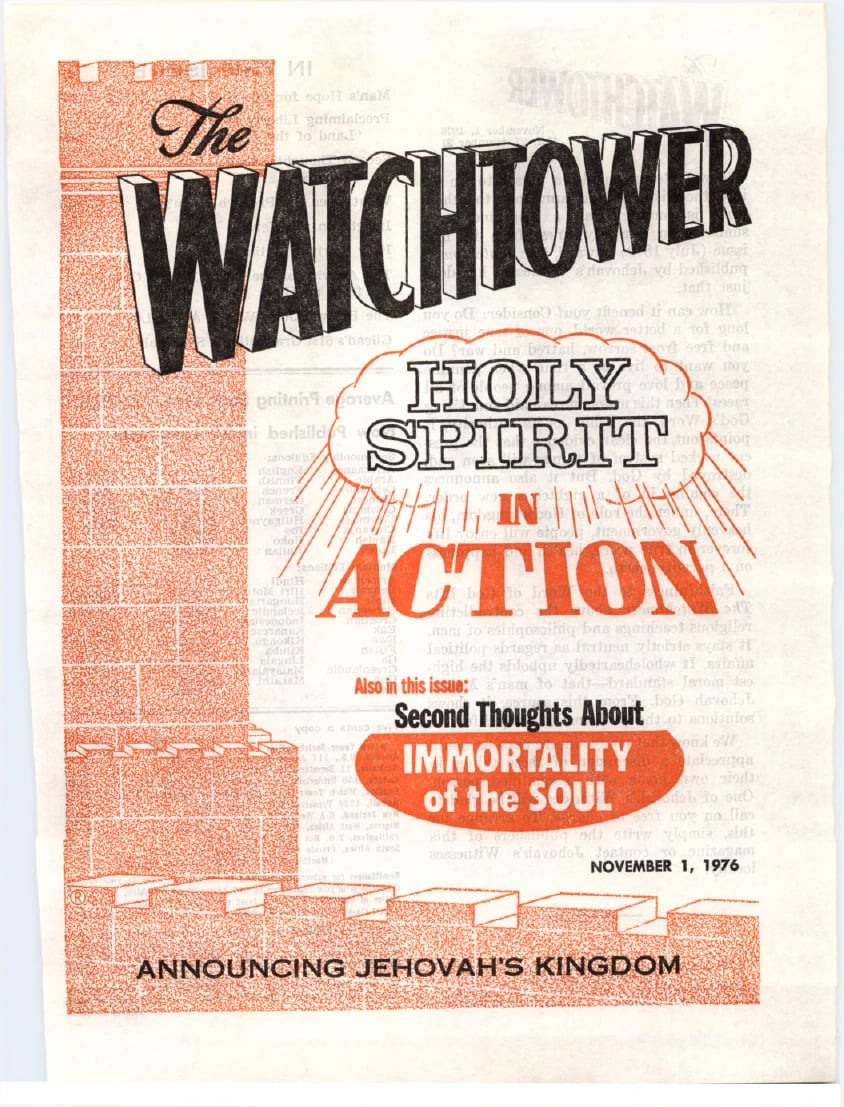
WATCHTOWER
HOLY SPIRIT
Also in this issue:
Second Thoughts About IMMORTALITY of the SOUL
NOVEMBER 1, 1976
ANNOUNCING JEHOVAH'S KINGDOM
WATCHTOWER Novem Vol. 97.
November 1, 1976
Vol. 97, Number 21
A watchtower enables a person to see far into the distance and announce to others what is coming. Can a magazine serve similarly in our day? Yes, from its first issue (July 1879) onward, The Watchtower, published by Jehovah's Witnesses, has done just that.
How can it benefit you? Consider: Do you long for a better world, one of true justice and free from sorrow, hatred and war? Do you want to live at a time when genuine peace and love prevail among people of all races? Then this magazine can aid you. Using God's Word, the Bible, as its authority, it points out the clear evidence that the present wicked system of things will soon end, destroyed by God. But it also announces the coming in of a righteous new order. There, under the rule of God's kingdom, his heavenly government, people will enjoy life forever in true peace, health and happiness on a paradise earth.
Faithfulness to the Word of God lifts The Watchtower above the contradicting religious teachings and philosophies of men. It stays strictly neutral as regards political affairs. It wholeheartedly upholds the highest moral standard—that of man's Maker, Jehovah God. From this source, it shows solutions to the problems of daily life.
We know that many sincere persons would appreciate a discussion of these things in their own home with a qualified person. One of Jehovah's Witnesses will be glad to call on you free of charge. To arrange for this, simply write the publishers of this magazine or contact Jehovah's Witnesses locally.
PUBLISHED BY
WATCH TOWER INVESTMENT CONTRACT SOCIETY
OF PENNSYLVANIA
117 Adams Street, Brooklyn, N.Y. 11201, U.S.A.
N. H. KNORR, President
GRANT SUITER, Secretary
IN THIS ISSUE
Man's Hope for Peace—Is It the U.N.?
Proclaiming Liberty in the "Land of the Free"
Second Thoughts About Immortality of the Soul
What Does the Proverb Mean?
Insight on the News
Holy Spirit in Action
The Activity of the Spirit Poured Out from on High
The Beloved John Writes About Love
Gilead's 61st Graduation a Spiritual Treat
Average Printing Each Issue: 10,375,000
Now Published in 79 Languages
Semimonthly Editions:
Afrikaans
English
Japanese
Swedish
Afrikaans
English
Kiwi
Taiwan
Cebuano
French
Malagasy
Filipino
Chinese
German
Norwegian
Xhosa
Chinese
German
Norwegian
Yoruba
Cibbona
Hillyonan
Sang
Zulu
Cinyanja
Ibo
Sesotho
Danish
Dano
Sesotho
Dutch
Italian
Sswahili
Monthly Editions:
Armenian
Hindi
Melanesian
Silozi
Bengali
Hindi Motu
Pampango
Slovenian
Bhilol
Hungarian
Pampango
Slovenian
Bohemanian
Icelandic
Pangasian
Tahitian
Bokemian
Icelandic
Pangasian
Tahitian
Eink
Konamean
Pangasian
Tahitian
Ewe
Kilongo
Romanian
Tsonga
Haina
Kilongo
Romanian
Tsonga
Ga
Lingala
Samar-Latey
Turkish
Germanic
Malayalam
Seped
Ukrainian
Gun
Marathi
Seped
Ukrainian
Hebrew
Sorban
Urdu
Five cents a copy
America, U.S. 117 Adams Street, Brooklyn, N.Y. N.12010
$1.50
Canada, 105 Bridgeway Ave., Toronto, Ontario M4A 125
$2.50
Enchance, Watch Tower House, The Ridway, London NW7 18N
$1.50
Hawaii, 1258 Princess St. Honolulu 08314
$1.50
$3.00
Nigeria, West Africa, P.O. Box 10, London, England
$11.00
Philippines, P.O. Box 2044, Manila 2800
P8
South Africa, Private Bag 2, P.O. Box 140, London, England
H1.30
(Monthly editions cost half the above rates.)
Remittances for subscriptions be sent to the office in your country. Otherwise send your remittance to 117 Adams Street, N.Y. 11201. Notice of expiration be sent at least two issues before submission expires. Second-class postage paid at Brooklyn, N.Y. and at additional mailing offices.
CHANGES OF ADDRESS should read us as thirty days before your move date. Give us your old and new address (if possible, your old address label). Write Watcherhouse, B.D. 1, Bed 300, Wallkill, New York 12589, U.S.A. POSTMASTER: Send Sand 3579 to Watcherhouse, N.Y. 12589.
The Bible translation used In "The Watchtower" is the modern-language "New World Translation of the Holy Scriptures," unless otherwise Indicated.
Printed in U.S.A.
MAN'S HOPE FOR PEACE
-IS IT THE U.N.?
</div>
ON THE grounds of the United Nations stands the statue of a man beating a sword into a plowshare. This sculpture, a gift of the U.S.S.R., serves to illustrate that the goal of the United Nations is world peace.
Throughout the years of its existence this international organization has been described as the "last best hope of mankind" and the "only alternative to international conflicts." In a joint communiqué signed on December 7, 1973, by Cardinal Maurice Roy and by Dr. Philip Potter, secretary-general of the World Council of Churches, the following appeared: "The World Council of Churches and the Roman Catholic Church have often stated that the United Nations Organization is the chief temporal hope for world peace."
More recently, however, many have expressed great disappointment in the United Nations. For example, a member of the United States House of Representatives spoke of it as failing "to offer either the promise or hope of world peace."
So what can we expect from the United Nations? Does the sculpture symbolizing the idea, "Let Us Beat Swords into Plowshares," really fit that organization?
The concept that the sculpture conveys is by no means original. It was expressed many centuries ago in a book that has been severely restricted in circulation in the U.S.S.R. That book is the Holy Bible, wherein we read at Isaiah 2:4: "He [Jehovah God] will certainly render judgment among the nations and set matters straight respecting many peoples. And they will have to beat their swords into plowshares and their spears into pruning shears. Nation will not lift up sword against nation,
neither will they learn war anymore."
Note that the 'beating of swords into plowshares' is not to be accomplished through human efforts. We cannot even look to the so-called Christian nations, for to this day they have not converted their weapons of war into implements of peace. Nevertheless, the fact that the United Nations, and the nations of Christendom individually, have until now failed to attain true peace does not mean that the fulfillment of Isaiah's prophecy is an impossibility. Not man, but the God whose very existence many nations deny, will bring about permanent peace in his way.
THE RECORD OF EARLY CHRISTIANS
There is clear evidence that peace is possible when people recognize the true God and want to do his will. From the year 36 C.E. onward non-Jews became a part of the Christian congregation. They, along with Christianized Jews, put forth sincere efforts to lay aside former prejudices. They became one people under the headship of the resurrected Jesus Christ and loyally submitted to God's will.
As an international brotherhood they did not involve themselves with the conflicts of the nations.
Also later, in the second and third centuries C.E., there were professing Christians who recognized that there had been a fulfillment of Isaiah 2:4 in their case. After quoting the words of Isaiah 2:3, 4, Justin Martyr wrote: "We who formerly used to murder one another do not only now refrain from making war upon our enemies, but also, that we may not lie nor deceive our examiners, willingly die confessing Christ." Similarly, Origen stated: "We no longer take up 'sword against nation,' nor do we 'learn war any more,' having become children of peace, for the sake of Jesus, who is our leader, instead of those whom our fathers followed."
A MODERN EXAMPLE
Even today there is an international brotherhood of Christians that has demonstrated to the world that it is possible to preserve peace. On August 1, 1958, at an international convention in New York city, this body of Christians, Jehovah's Witnesses, went on public record that they would maintain peace and unity among themselves. The resolution adopted by the 194,418 persons present at that assembly read in part: "Figuratively speaking, we have beaten our swords into plowshares and our spears into pruning shears and, although of so many nationalities, we will not lift up sword against one another because we are Christian brothers and members of the one family of God, neither will we learn to war against one another any more, but we will walk in God's paths in peace, unity and brotherly love."
Although there are more than two and a half times as many Witnesses today as
there were back in 1958, they continue to hold fast to this resolve. This is simply amazing when we consider that their number is greater than the population of any of more than forty independent nations now in existence—most of which are members of the U.N., but none of which have been able to beat their swords into plowshares. This demonstrates forcefully that peace cannot be gained apart from submission to God's commands.
HOW EARTH-WIDE PEACE WILL COME ABOUT
The record the nations have made reveals that they do not want to accept God's authority. For this reason the United Nations will never be able to bring lasting peace. That organization is made up of many nations that openly declare themselves to be anti-God and of others that make only a lip profession of trusting in the Most High. Therefore, the words of Isaiah 57:21 apply to them: "There is no peace,' my God has said, 'for the wicked ones.'"
In due time those who refuse to submit to God's authority will be judged as having forfeited the opportunity to continue living on earth. The Most High will not continue to tolerate men and nations that threaten peace and security. He will, as his Word says, "bring to ruin those ruining the earth." (Rev. 11:18) This great act of God will open the way for an era of earth-wide peace and total disarmament. Do you desire to see that time? If so, strive to live as did the early Christians, learning war no more. Accept the way of peace that is outlined in God's Word, the Bible. Thereby you can show that you want to submit to God's authority and truly desire to see peace brought about earth wide.
PROCLAIMING LIBERTY in the
"Land of the Free"
</div>
LAND of the Free"—Thailand means just that. Many still remember this land as "Siam," extolled in song as one of those "faraway places"—a picturesque and exotic land that finds much of its charm in its happy, easygoing people. These are proud of their native culture and of the fact that they have never suffered long subjection to others, as in the days of "empire building" when most neighbor countries became colonies of Britain or of France.
In the unfriendly world of today, Thailand struggles to preserve its traditional freedoms. But now a new kind of liberty is being proclaimed there. This includes not only freedom from oppressive human authorities, but also freedom from poverty, from sickness and even from death itself! All these freedoms came into prospect when Jesus told his disciples, "You will know the truth, and the truth will set you free."—John 8:32.
This "truth" is the powerful message set out in God's Word, the Bible. However,
for many years this truth seemed to make little progress in the "Land of the Free," especially among the largely Buddhist population. It was not that these Buddhists violently opposed the Bible message, as did the religious Jews who sought to kill Jesus. (John 8:36, 37) The Thai Buddhists are by nature tolerant; they appreciate freedom enough to grant it to others, especially in matters of religion. They have a common saying, "All religions teach people to do good." So, as would be expected, there is complete freedom to preach Bible truth in Thailand, and that has already proved to be a blessing to many honest-hearted ones.
Why, then, were early years of the proclamation of Bible truth in this land without marked progress? It must be put down to the environment and background of this peace-loving people. Through many centuries they have had little involvement in the turmoils of the nations. They have been a nation apart from the great, bustling world. They have been content to live placidly along their klongs (waterways), enjoying the abundance of rice and other products of the fertile soil. They have had no expectancy of a Messiah and no conception of a fatherlike God to whom they could pray. Their "Lord Buddha," as they respectfully call him, neither taught about God nor denied his existence. When asked about God they are apt to reply, in all honesty, "Mai koei kit," meaning "I have never thought."
Thailand has indeed been a 'faraway place' with regard to Bible truth.
PROCLAIMERS OF LIBERTY ENTER THAILAND
Have you not thrilled to read of the faith and endurance of the apostle Paul and his companions as they carried the truth to faraway nations? The first modern-day witnesses of Jehovah to enter southeast Asia had a similar task. They were just a handful, but they fanned out and crisscrossed a huge section of the Asian continent in their urge to proclaim the good news. Into Thailand, Indochina, Burma and across the Burma Road into China they went. They differed in nationality, appearance and personality, but they were easily recognized. How so? They all carried big bags. They needed them. These were full of books containing Jehovah's liberating message—in many languages. They were all resourceful, too, whether in providing for their simple needs, in avoiding cholera during epidemics or in getting a night's sleep in some bug-infested bed. They were beaten, robbed and even left for dead, but they carried on. They were sealed off, as it were, by strange languages. But they endured.
First of Jehovah's Witnesses to come to Thailand was Claude Goodman of England, on his way to India in 1931. He spent just one week in steaming Bangkok, visiting people in the business section and leaving much literature in English. Some five years later, Frank Dewar came from New Zealand, and he stayed for one year, witnessing also in English, after which he was joined by Willi Unglaube from Germany. Next there came an Australian, Ted Sewell, and another German, Kurt Gruber, who fled there from Penang to avoid internment at the outbreak of World War II in 1939. But still there was no progress among the native Thai people,
nor was there Bible literature available in the Thai language.
Then it happened! Kurt and Willi, who were making a preaching "sweep" through northern Thailand, appeared in Chiang Mai with their big bags. A book, in English, fell into the hands of Chomchai, the young and zealous headmistress of the Presbyterian Girls' School in that city. It was like a match dropping into dry kindling. Out on their bicycles went Chomchai and her companions, searching for those "two Witnesses." They soon found them, and following hours of discussion, they became free from Babylonish doctrines, such as the Trinity and hellfiretorment teachings. A few months later, a group including Chomchai and the former headmaster of the Presbyterian Seminary were baptized beside a waterfall. Chomchai began translating Bible literature from English into Thai, and until this day she perseveres at this work.
HARDSHIPS OF WAR YEARS
By 1941, all seemed set for a wider work of liberation, but by now it was a world at war. Early that year, the Japanese occupied Thailand. First the Australian Witnesses were interned for four years because their country was at war with Japan. Later the Germans were arrested because they were Jehovah's Witnesses, and these were outlawed by the Axis Powers. Willi Unglaube alone remained free, "underground" in the up-country (of northern Thailand) and was courageously supported by new Witnesses in that area. Some native Thai Witnesses were also arrested, including Chomchai. However, in spite of the Japanese occupation, Thai officials took willing action in releasing the German and Thai Witnesses.
By 1947, lines of communication were again open, Bible literature was pouring into the country and the first Thai Watch-tower magazine appeared—mimeographed and only at the rate of 200 copies a month at first, but how valuable to all those who could read only Thai!
By now there were 65 devoted Witnesses proclaiming the good news from door to door in the five congregations in the country. However, with a population of fifteen million, this could be only a beginning. The book "Let God Be True" was now on its way in the Thai language.
TRAINED HELP FROM 'FAR AWAY'
The faithful roving pioneers (full-time workers) had done their work of sowing seed throughout the length and breadth of the land. But now a different kind of work was needed. Missionaries from the Watchtower Bible School of Gilead in the United States arrived and set the pattern in conducting Bible studies in the homes of the people, and as these workers from 'far away' learned the native language themselves, their work became more effective. Native Thai "special pioneer" workers joined them in this service, and in due course a Kingdom Ministry School, conducted primarily for the training of local overseers, served a most useful purpose. Additional missionary workers, native Filipinos, came directly to Thailand from their own country and helped to add new spirit to the work.
Particularly from 1967 on, the proclamation of Bible truth has made significant advances in Thailand. The Witnesses had been preaching with a purpose, expecting results, and they were not disappointed. Over 40,000 Thai books, "Let God Be True" and From Paradise Lost to Paradise Regained, had been scattered far and wide throughout the country, and now the foreign and native missionaries were beginning to teach, as well as preach, in Thai. It is noteworthy, too, that quite a few of those preaching Bible truth were now from Buddhist backgrounds. They had been rewarded because of their 'seeking and groping' after God. (Acts 17:27) There they were, only one here and one there—but how precious they were!
NATIVE WITNESSES GET BUSY
One of the first of these to accept Bible truth was a girl who lived near the Burmese border. She was born a Buddhist, yet wanted to know about her Creator. Coming into possession of a Bible and a booklet in Thai, she was fired by the message she read and wanted to become a proclaimer of the truth she was learning. With her family, she had joined the Presbyterian Church, and there she asked to be trained as a preacher. But she only met with excuses. Then one day an earnest "special pioneer" Witness appeared on her doorstep. She had already been warned that he was a 'wolf in sheep's clothing,' but since he talked about the Bible she just had to listen and take from him the Thai book "Let God Be True." He was persistent in calling on her again and again, and did just what she had longed for—taught her the Bible and how to be a proclaimer of the good news. She, too, became a "pioneer" Witness.
Down in Bangkok, a Thai "pioneer" worker called on a young man who was a member of a typical hardworking ancestorshiping Chinese family. He, too, was searching. Once again, the combination of an honest heart, the book "Let God Be True" and patient teaching by the Witness produced results. In spite of violent opposition from that large family, he too accepted the liberation call and became a "pioneer" Witness.
In Phitsanulok, central Thailand, a sincere man had become an elder and a preacher in the Presbyterian Church. There was a rift, and his own church broke away from the parent body, but he continued to cycle some fifteen miles (24 kilometers) out there each Sunday to preach. Jehovah's Witnesses contacted him and he studied the truth with them.
Soon he was convinced. He continued his weekly cycle trips, but now to preach Bible truths. The false religious signs were taken down from the church building and it became a real Bible study center. Several other members of the church studied with him, and in due course these also were baptized by Jehovah's Witnesses.
A Thai Witness who learned the Bible message in the Netherlands returned with her Dutch husband to her native land. She visited her Buddhist relatives who were widely scattered over an area to the north of Phitsanulok. She invited them all to a family reunion, poured out Bible truths to them and took them to the congregation meetings in Phitsanulok. Many began to show interest, and they took turns at making the rugged trip to the meetings, four miles (6 kilometers) being traveled on foot. Taped talks were sent to them, including one by the circuit overseer entitled "What Jehovah's Witnesses Believe." When "pioneer" Witnesses were at last able to visit them, the joy they had on arrival made their fatigue vanish. These humble people were already offering prayer at each mealtime, and they had used tapes extensively in witnessing to the community. Shortly, the as-yet-unwed father of the family took his eight children with him to the district officer for the occasion of his legal marriage to their mother. Both of them came right out of Babylonish religion and also quit smoking.
Meanwhile the Witness from the Netherlands had sent Bible literature to other relatives. They also showed interest and "moved house" so that they could join the first group. Actually, moving house was really no problem to them. A few days' work with bamboo and leaves, and a fine new home awaited them!
to Paradise Regained. He pored over it in his isolation. Then he made a trip to Bangkok to get more Bible literature, and also for association and training along with Jehovah's people. On returning to his wife and farm he started preaching with great zeal and boldness in a largely Buddhist community. This was a wild gun-toting marijuana-smoking district situated on the fringe of the law. One of the "toughs" there, impressed by the calm behavior of the new Witness when the Witness was challenged to a fight, became interested. He also quit smoking and started bearing witness about the truth to others. As a result, he became a target of his former "gang" mates. To test him, they stole his buffaloes, and finally they shot and killed him. To avoid a violent "gang" vendetta, the other Witness, his wife and other interested ones now "moved house" to join the nearby group of Jehovah's Witnesses. Together, they built a small Kingdom Hall on a hill and set up their own homes around it. Now all of them could have peaceful association together and turn their attention to liberating still others.
Some thirty miles (48 kilometers) away, a young man of Islamic origin had obtained a Thai copy of From Paradise Lost
Over the years there have been problems in reaching this large Buddhist population, but perseverance is having its reward. Out of a total of more than 700 zealous Witnesses in Thailand, 213 have been baptized in the past two years. The attitude of the common people is changing, and that soft wall of polite mental resistance is beginning to break down. World events, even right on Thailand's doorstep, are making many doubt whether their philosophy of Tam Dee Dai Dee (Do Good —Receive Good) is sufficient in this present system of things. Truth—Bible truth is encouraging many to take more positive action in accepting Jehovah's kingdom by Christ Jesus, so that they may really be 'set free' with prospect of everlasting blessings on a paradise earth.
Second thoughts about IMMORTALITY OF THE SOUL
LIFE is a precious gift of God. In the face of danger people display a desire to remain alive. When someone dies, surviving loved ones usually cherish a hope that death has not "ended it all" for that one.
The Word of God holds out a marvelous hope for the dead. For example, Jesus stated: "This is the will of him that sent me, that I should lose nothing out of all that he has given me but that I should resurrect it at the last day. For this is the will of my Father, that everyone that beholds the Son and exercises faith in him should have everlasting life, and I will resurrect him at the last day."—John 6: 39, 40.
What happens between the time of a person's death and the resurrection "at the last day"? Have you been led to believe that, at death, an immortal "soul" separates from the body, remaining conscious and experiencing pleasure or torment while awaiting reunion with the body at the resurrection? Millions of persons who once believed such a teaching have had second thoughts about it. Why?
SOME SECOND THOUGHTS
For centuries noted Bible scholars and clergymen have seen a conflict between the doctrine of immortality of the soul and that of the resurrection. Among them was THE WATCHTOWER—NOVEMBER 1, 1976
Bible translator William Tyndale, who said: "In putting departed souls in heaven, hell, or purgatory you destroy the arguments wherewith Christ and Paul prove the resurrection . . . If the soul be in heaven, tell me what cause is there for the resurrection?" Tyndale also noted that the doctrine of immortality of the soul originated with "the heathen philosophers."
Similarly, Roman Catholic monsignor Ray T. Bosler wrote in a newspaper column that appeared in the fall of 1974: "The New Testament does not speak of the immortal soul distinct from the body. When the New Testament uses the word soul it refers to the real self—body and soul—that enters a new life with the resurrection. Our theologians disagree among themselves over just what the existence of the saints is like until the final resurrection. Theologians are speculating about the unknown here; so we cannot expect too much help from them."
The Jewish Encyclopedia comments: "The belief that the soul continues its existence after the dissolution of the body is a matter of philosophical or theological speculation rather than of simple faith, and is accordingly nowhere expressly taught in Holy Scripture."
What is the true Biblical view of the soul?
THE SOUL—WHAT IS IT? CAN IT DIE?
The first mention of the human soul in the Bible is at Genesis 2:7, which states: "And Jehovah God proceeded to form the man out of dust from the ground and to blow into his nostrils the breath of life, and the man came to be a living soul." Note, please, that man was not given, but came to be a living soul. The soul is the entire person, not an invisible part of him. Did you know that? Consider some further Scriptural statements to the same effect:
"And Joseph's sons who were born to him in Egypt were two souls." (Gen. 46:27) "Now in case some soul would present as an offering a grain offering to Jehovah . . ." (Lev. 2:1) "In case a soul sins by mistake . . ." (Lev. 4:2) "No soul of you must eat blood." (Lev. 17:12) "Fear began to fall upon every soul." (Acts 2:43) "Now, all together, we souls in the boat were about two hundred and seventy-six."—Acts 27:37.
This too has been recognized for centuries by noted Bible scholars. For instance, Martin Luther wrote concerning the word for soul in Biblical Hebrew: "It refers not only to a part of man, as we Germans speak of the soul, but it refers to the whole man as he exists with his five senses and as he maintains himself with meat and drink." Luther placed the doctrine of immortality of the soul among the "endless monstrous fictions in the Roman [Catholic] rubbish heap of decretals."
More recently, theologian Karl Barth remarked in a radio interview: "Never lose sight of the fact that the Bible depicts man in his unity, in his entirety, his soul, that is personal life, which can be distinguished from his body, but not separated from it, just as the body can be
distinguished from his soul but not separated from it."
Does that mean that when a person dies the soul dies? The Bible repeatedly mentions souls dying or being destroyed. To illustrate: "I must destroy that soul from among his people." (Lev. 23:30) "Everyone who has killed a soul . . ." (Num. 31:19) "Then Jesus said to them: I ask you men, Is it lawful on the sabbath . . . to save or to destroy a soul?'" —Luke 6:9.
What is the condition of a soul that has been killed or destroyed? Note the patriarch Job's description of what would have happened to him if he had died at birth: "For by now I should have lain down that I might be undisturbed; I should have slept then; I should be at rest." (Job 3: 13) As far as Job was concerned, the dead were undisturbed, asleep. In agreement with this the Scriptures further state: "As for the dead, they are conscious of nothing at all."—Eccl. 9:5; John 11:11-13; Acts 7:60; 1 Cor. 15:6, 18, 20, 51; 2 Pet. 3:4.
THE SOUL 'GOING' AND 'COMING' IN WHAT SENSE?
When describing the death of Jacob's wife Rachel, the Bible relates: "As her soul was going out (because she died) she called [her newborn son's] name Benoni." (Gen. 35:18) And with regard to the prophet Elijah's restoring to life the son of a certain widow, we read: "Finally Jehovah listened to Elijah's voice, so that the soul of the child came back within him and he came to life."—1 Ki. 17:22.
What is meant by the soul's "going out" and 'coming back' in these cases? This becomes clear from the translation of 1 Kings 17:22 in the New American Standard Bible: "And the Lord heard the voice of Elijah, and the life of the child returned to him and he revived." When persons die, their life as human souls ebbs away. It was life, not a conscious substance, that returned to the boy's body cells.
Thus Elijah said to the lad's mother: "See, your son [the whole person, not just his body] is alive."—1 Ki. 17:23.
IS THERE LIFE IN SHEOL/HADES?
Some have been puzzled about the following statement concerning "the king of Babylon": "Hell [shoohl', Hebrew] from beneath is moved for thee to meet thee at thy coming: . . . it hath raised up from their thrones all the kings of the nations. All they shall speak and say unto thee, Art thou also become weak as we? art thou become like unto us? Thy pomp is brought down to the grave [shoohl', Hebrew], and the noise of thy viols: the worm is spread under thee, and the worms cover thee." (Isa. 14:9-11, Authorized Version) What is the meaning of those verses?
Note that verse 4 of the same chapter introduces this account as a "proverb" (mashal, "proverbial saying," Hebrew; para'bola, "a parable," Latin Vulgate). Poetic language here represents inanimate things as speaking. Verse 8 furnishes a further example: "Yea, the fir trees rejoice at thee, and the cedars of Lebanon, saying, Since thou art laid down, no feller is come up against us."—Compare Judges 9:8-15.
Surely the Word of God is not suggesting that literal fir trees and cedars can rejoice and converse with one another. Nor is the understanding intended that souls of the dead are conscious in hell and seated on thrones. This account is simply a poetic prediction of the fall of the royal dynasty of Babylon as a world power.
Did you notice that the Authorized Version rendered the Hebrew word sh$ohl' as "hell" at verse 9, but as "the grave" at verse 11? The Bible commentary edited by Schaff-Lange says:
"The use of the word belongs predominantly to the poetic language of the Old Testament . . . Sheol appears as the aggregate of all graves. Who could venture to deny this aspect of the matter, at least for the 31st and 32d chapters of Ezekiel? It is the universal grave, which calls down to itself all earthly life, how high soever it may have reached."
Similar to the parable set out above is the one at Luke 16:19-31. Here Jesus describes 'a certain rich man' as undergoing fiery torment in ha'des (the Greek equivalent of she'ohl'), while "a certain beggar named Lazarus" receives blessings in 'the bosom of Abraham.' But once again there is no mention of souls suffering after physical death. This too is a parable; and, according to the context, the rich man depicts religious leaders of the Jews back there, whereas Lazarus represents the common people who accepted Jesus Christ. After Jesus' death, both of these classes underwent experiences that corresponded to the figurative language of Jesus. *
"THE FIRE THAT CANNOT BE PUT OUT"
What, though, did Jesus mean when he mentioned "the fiery Gehenna"? (Matt. 5:22, rendered "hell fire" in AV) An example of Jesus' teaching about Gehenna is found at Mark 9:43-48.
"And if ever your hand makes you stumble, cut it off; it is finer for you to enter into life maimed with two hands to go off into Gehenna, into the fire that cannot be put out. And if your foot makes you stumble, cut it off; it is finer for you to enter into life lame than with two feet to be pitched into Gehenna. And if your eye makes you stumble, throw it away; it is finer for you to enter one-eyed into the kingdom of God than with two eyes to be pitched into Gehenna, where their maggot does not die and the fire is not put out."
Was Jesus here sanctioning popular Jewish views of a condition of fiery torment after death?
Actually, there was no established view among Jews of that period with regard to the condition of the dead. Notes A Rabbinic Anthology compiled by Jewish scholars Claude Montefiore and Herbert Loewe:
"And, again, there is another confusion: for, according to one doctrine, when you die, you sleep till you 'rise' again at the general resurrection and for the last Judgment. According to another doctrine, when you die, you may, if you are righteous or repentant (and more especially if you are an Israelite), straightway enjoy in happy blessedness the life of the blessed world to come, and if you are wicked and an idolater and an enemy of Israel, you may, when you die, go straightway to hell. . . . Or, again, at the end of a period in hell, you may be annihilated. Or, again, you may be annihilated at your earthly death. Passages which imply or express all these various bizarre conceptions and confusions abound, and there is no one accepted theory or conception."
Did you notice that Jewish views about the condition of the dead included "sleep" until the resurrection, as well as possible 'annihilation'? Evidently annihilation is what Jesus had in mind by Gehenna, for on a later occasion he urged his disciples: "Do not become fearful of those who kill the body but cannot kill the soul; but rather be in fear of him that can destroy both soul and body in Gehenna."—Matt. 10:28.
But if this is true, why did Jesus asso-
clate "fire" with Gehenna? Some background information is provided in The New Bible Commentary (1965): "Gehenna was the Hellenized form of the name of the valley of Hinnom at Jerusalem in which fires were kept constantly burning to consume the refuse of the city. This is a powerful picture of final destruction." Scriptural references to Gehenna, therefore, furnish no basis for the doctrine of eternal conscious torment in hellfire.
"A FULLY PLATONIC POSITION"
If the Bible never mentions immortal souls leaving bodies at death, where did such an idea originate? Theologians borrowed it from the thinking of the Greek philosopher Plato, who, in turn, adopted it from pagan mystery religions that originated in ancient Babylon. Plato wrote: "Do we believe that there is such a thing as death? . . . Is it not the separation of soul and body? And to be dead is the completion of this; when the soul exists in herself, and is released from the body and the body is released from the soul, what is this but death?" (Phaedo, Sec. 64) Observes The Encyclopedia of Philosophy (1967):
"Everyone who maintains that the mind or the soul is a substance, in the sense that it could significantly be said to exist alone and disembodied, is thereby Platonizing, and everyone who identifies this putative substantial mind or soul as the real or true person is adopting a fully Platonic position."
As to the extent that Greek philosophy has influenced Christendom, Professor Douglas T. Holden declares in his book Death Shall Have No Dominion:
"Christian theology has become so fused with Greek philosophy that it has reared individuals who are a mixture of nine parts Greek thought to one part Christian thought."
According to the Bible, the human soul is the person himself. When an individual dies, therefore, the soul dies. (Ezek. 18: 4, 20) The dead are unconscious, unaware of either pleasure or pain as they await restoration to life by means of a resurrection.
(Ecel. 9:5, 10; Ps. 146:4; Acts 24:15) The popular religious teaching of
immortality of the soul came, not from the Word of God, but from Greek philosophy. In view of this, should not you too have second thoughts about immortality of the soul?
What Does the Proverb Mean?
"T THE righteous one is caring for the soul of his domestic animal, but the mercies of the wicked ones are cruel," says the proverb.—Prov. 12:10.
The righteous man has respect for all of God's creation. He also knows that animals were created for man's service and pleasure, and hence are to be treated as friends of humankind. Man's sinfulness, cruelty and the environmental unbalance he has brought about have made a small percentage of the animals vicious or, as sometimes termed, pests. But a righteous man seeks to know the needs and feelings of the animals, especially his domestic animals, caring for their life as a valuable property. This does not mean that he believes that they have the thoughts and feelings of humans, but that they deserve kind treatment.
Under the Mosaic law animals were protected from cruel treatment and were considered even in the sabbath laws, being allowed to eat what grew of itself in the farmer's field during the sabbath year. (Lev. 25:6, 7) A bull was not to be muzzled so that it could not eat some of the grain that it was expending its energy in threshing. (Deut. 25:4) A man finding a bird's nest might take the eggs or the young ones but he could not also take the mother, thus wiping out the entire family, ending the family line. (Deut. 22:6, 7) Also showing that Jehovah does
not forget the animals, he made specific mention of them to Jonah when Nineveh was in danger of destruction. He said to Jonah: "Ought I not to feel sorry for Nineveh the great city, in which there exist more than one hundred and twenty thousand men who do not at all know the difference between their right hand and their left, besides many domestic animals?" —Jonah 4:11.
The Septuagint Version renders the latter part of this proverb: "The bowels of the ungodly are unmerciful." The "bowels" as representing the deepest emotions of sympathy and compassion are, in the wicked one, unfeeling, cruel. He exhibits what might be termed a "compassionless compassion" such as is often seen among humans in gestures and speech that lack true feeling or actual results. The best of the wicked person's compassion or mercy is actually a cruelty, based on selfish motives or principles. As an example, we have seen wicked dictators who destroy their best friends and supporters, sacrificing them, as it were, to hold on to or increase their own power. Or, under a pretense of protecting the people or the state, they will attack the most law-abiding people in their nation (the true Christians residing there in a neutral and peaceful way), in order to have a "scapegoat" or to please certain influential religious or political elements, or even their own ego. This they do in spite of the fact that they know that these Christians are no threat to the peace or security of the state.
Such was the attitude of the Pharisees toward Jesus and the common people.—John 11:47-50; 12:9, 10; 7:49.
A VALUABLE PRICE WASTED
"Why is it that there is in the hand of a stupid one the price to acquire wisdom, when he has no heart?"—Prov. 17:16.
The "stupid one" here referred to is not a person who is merely uneducated or ignorant, but one who does not have a consciousness of his spiritual need. "Heart," right motive, love of true wisdom, a seeking for true understanding, are necessary to the acquiring of wisdom. All persons have, in a sense, the "price" to acquire wisdom, for God gives generously to all. "He makes his sun rise upon wicked people and good and makes it rain upon righteous people and unrighteous." (Matt. 5:45) The "price" is not money, but the things that God has given or set before all—a mind with which to think, senses to take in information, and access to true wisdom. The person has, basically, the creation to look at, the things created making known the invisible qualities of God. (Rom. 1:18-20) Also, he may have good parents, or true friends, or others who bring wisdom from God to his attention.
But the stupid one has no heart for understanding. His mind is on his own affairs, things that are not truly vital. With similar meaning, Proverbs 17:24 says: "Wisdom is before the face of the understanding one, but the eyes of the stupid one are at the extremity of the earth." The stupid one's mind is fluttering about fitfully from one thing to another and the thing of least importance is what interests him. So the "price"—the facilities, the ability and the opportunities he has, which may at times amount to more
than for one who 'has heart'—is wasted, thrown away.
ONLY BY GOD'S UNDESERVED KINDNESS DO THE RIGHTEOUS LIVE
Proverbs 11:31 states: "Look! The righteous one—in the earth he will be rewarded. How much more should the wicked one and the sinner be!"
The expression "Look!" calls attention to an important truth which must be considered. As Solomon declares, at Ecclesiastes 7:20: "There is no man righteous in the earth that keeps doing good and does not sin." No one in himself is deserving, but God's undeserved kindness is with those sincerely serving him. (1 Pet. 3:12) The righteous person, therefore, makes effort to do right, but sometimes stumbles, and the principle, "whatever a man is sowing, this he will also reap," applies. (Gal. 6:7) The righteous one will receive the "reward" of his mistakes in the form of discipline, which helps him to readjust himself so as to stay on the road to life. Since this receiving of a "reward" for unintentional errors is true with the righteous, the wicked person who deliberately chooses the bad way and has no repentance or makes no effort to turn to the way of righteousness certainly deserves more severe punishment and will be 'rewarded' for his badness. The Septuagint translation renders this proverb as follows: "If the righteous scarcely be saved, where shall the ungodly and the sinner appear?" The apostle Peter evidently quoted from the Septuagint at 1 Peter 4:17, 18. There Peter is speaking about God's judgment as beginning with the house of God, and he says: "Now if it starts first with us, what will the end be of those who are not obedient to the good news of God? 'And if the righteous man is being saved with difficulty, where will the ungodly man and the sinner make a showing?' "
Insight on the News
Rules governing the use of the American flag have been revised for the first time in thirty-four years. The new legislation affects when the flag may be displayed and its authorized location on automobiles; it also deletes the hand-over-heart salute requirement for women. The
The Flag
—"A Living Thing?"
revised code also adds: "The flag represents a living country and is itself considered a living thing."
If the flag is officially considered to be "a living thing," can it be said that Christians who respectfully decline to join in the flag ceremony are unreasonable in citing as their basis the Bible's command to "flee from idolatry"? (1 Cor. 10:14) Author Whitney Smith, director of the Flag Research Center and considered America's top expert on flags, advocates flying and saluting the flag. Yet even he recently admitted that "we've turned the flag into a civil religion."
Certainly where there is religious freedom, people whose conscience does not allow them to join in the rituals of the "civil religion" are not to be criticized. As the U.S. Supreme Court stated in 1943: "The refusal of these persons to participate in the ceremony does not interfere with or deny rights of others to do so. Nor is there any question in this case that their behavior is peaceable and orderly."
"Day Innocence Ended" was the headline of a recent editorial in Panama's "Star and
"Haunted by a Why?' "
Herald" newspaper. It pointed to August 4, 1914, as the day that "began the first holocaust [World War I] of this century," noting that "a half century of peace and progress, of tolerance, in a
word, of civilization, ended on that day in 1914."
"None, save the dwindling ranks of those who lived in the sunshine of the pre-1914 world," declared the editorial, "can strike the sad contrast between those days and these." And it raised the revealing questions: "Although the facts have been raked over a thousand times and more, men still probe the wounds, haunted by a 'Why?' whose answer eludes them."
THE WATCHTOWER NOVEMBER 1,1976
But the answer as to why 1914 marked such a turning point in history does not elude those who consider the Bible's prophecies about the "conclusion of the system of things." Jesus foretold that "nation [rising] against nation and kingdom against kingdom" would mark "a beginning of pangs of distress" for the world. He also forecast that this would be followed by many other things that characterize our generation, such as the "increasing of lawlessness" that causes "the love of the greater number [to] cool off." Certainly Christians need not be "haunted by a 'Why?' regarding the notable change since 1914. —Matt. 24:3, 7, 8, 12.
When the deadly flash flood struck Colorado's Big Thompson Canyon last summer, it
"It Can't Happen to Us"
is estimated that at least 150 persons were killed. One reason for the high death toll, according to the local sheriff, was that "we had trouble convincing them that the river was even coming up." He
said that "they'd want to know if it was going to be up to here or here," holding his hand first at leg and then at hip level to indicate water depth. "The problem is that there wasn't time to convince the people, to get the urgency across to them."
Authorities noted that the canyon was crowded with "flatland tourists" who had no idea what flash floods can do. But there were also many others who had built homes and cabins there, believing "It can't happen to us," though they had been warned of the ever-present danger.
A similar situation confronts mankind since the pivotal year of 1914. The fulfillment of Bible prophecy since then proves that a flash flood of destruction will soon end the present system of things. Jehovah's Christian witnesses have been warning people earth wide of this. But, as forecast in the Bible, the response is often similar to that of the Colorado flood victims. "In the last days there will come indicators . . . saying: 'Where is this promised presence of his? Why, from the day our forefathers fell asleep in death, all things are continuing exactly as from creation's beginning.'" —2 Pet. 3:3, 4; see also Matthew 24:3-44.
"Upon us the spirit is poured out from on high." Isa. 32:15.
THERE is now urgent need for holy spirit to be in action. This spirit has its source in Jehovah, the Most Holy God. It is the invisible active force that he puts in operation according to his holy will. But why is activity of holy spirit needed especially today in behalf of lovers of what is righteous, good and holy? It is because of what now confronts them.
2 Today an extraordinary "wild beast," a "false prophet" and a "dragon" dominate the earthly scene. The influence of this fear-inspiring trio reaches high up, even to the world's political rulers, "the kings of the entire inhabited earth." (Rev. 16:13, 14) This creates a grave danger for us common people, for the way in which our governmental rulers go affects us little people to a large degree. Yet, in spite of what our political rulers do, can we individually take a personal stand regarding the "wild beast," the "false prophet" and the "dragon"? To what extent
shall we let ourselves be influenced by these—only to our injury? What is our defense?
a The "wild beast" is on the loose world wide! This vicious creature is supported by the fiery-red "dragon." It is not a mere wild animal that has emerged from the dense forest of Brazil or from the jungle of some central African land. It is a kind of creature that has power, authority and even a throne. So it exercises rulership, not in the animal kingdom, but rulership in the political field. In this behalf, it has an intelligence like that of seven heads. It has a formidable power of aggression and of defense, like that of ten horns upon seven heads. That is why, in the prophetic book of Revelation or Apocalypse, it is described as a wild beast with seven heads and ten horns. It has won the admiration of patriotic people everywhere. They think that this symbolic wild beast of seven heads and ten horns is unconquerable. These admiring worshipers raise the challenging question: "Who is like the wild beast, and who can do battle with it?"—Rev. 13: 1-4.
4 All along, we common people have seen this "wild beast" in action, but, before now, have any of us identified it? Have any of us figured out why it is pictured the way in which it is in the book of Revelation? This "wild beast" is with us today, and frightened people wonder for how much longer it will be with us. The inspired Bible answers that it will be with mankind down to the last, until it meets the one that can "do battle with it" and destroy it.
Then it will be idolized no more.
This "wild beast" is a symbolic one, like the four wild beasts pictured in the prophecy of Daniel, chapter seven. Those four symbolized certain human governments, empires, political world powers, such as the Babylonian Empire, the Medo-Persian Empire, the Grecian Empire, and the Roman Empire, with something added to picture the modern-day Anglo-American dual world power. But what does the "wild beast" of Revelation, chapters thirteen through nineteen, symbolize? Human political rule as a whole, on a global scale. Although controlling the whole world, it is
not a federation of all national governments with a central world capital. It is made up of many political parts, which have been dominated throughout millenniums of time by a succession of seven world powers. On top of that, it has been dominated by the superhuman fiery-red "dragon."
6 Earthly government of all mankind today is of human source. Hence, Revelation 13:1 pictures it as "ascending out of the sea."
It has ascended out of the vast "sea" of humanity, which is just as restless as the literal sea, and dissatisfied, because it refuses to be subject to the rulership of the Creator of heaven and earth. (Isa. 57:20, 21) The rulership to which it sub-
jects itself is that of the superhuman fiery-red "dragon." This explains why Revelation 13:2 informs us that "the dragon gave to the [wild] beast its power and its throne and great authority." There is no mystery as to whom the "dragon" symbolizes. Revelation, chapter twelve, verse nine, plainly says that the "dragon" is the "original serpent, the one called Devil and Satan, who is misleading the entire inhabited earth." Satan the "dragon" is not alone in ruling all the political governments of the earth. He has legions of angels, superhuman spirits like himself, and these demons fight on the 'dragon's side over the issue of universal sovereignty.
7 The Christian apostle Paul calls Satan "the god of this system of things."
(2 Cor. 4:4) Like a god, this "dragon" has a prophet on the earth. What kind of prophet? A "false prophet" for he acts as the mouthpiece of the "dragon" that is "misleading the entire inhabited earth." (Rev. 12:9) Logically, then, his prophesying must be misleading and, consequently, "false." Are we today being misled by him?
8 Let us not make the mistake of thinking that this "false prophet" is an individual man. He is, in fact, a composite figure, a political system that stands out from all other governments. So much has this been the case that the "wild beast" has recognized the "false prophet" to be the dominant political entity of the day. And why not? Because it became the greatest world power of all human history according to Bible prophecy. So it has been allowed to speak as the representative for the whole "wild beast."
Particularly for the past two centuries this Anglo-American "prophet" has let its voice be heard with an authority that has not yet been overthrown. As the seventh world power referred to in Bible prophecy, this British-American dual world power has performed "signs" with which to impress all the peoples and to mislead them away from subjection to the Creator of heaven and earth. It has been the chief proponent and backer of the present-day United Nations organization for ensuring the peace and security of the world. (Rev. 19.20) The British-American political combination ranks among the first nuclear-powered military forces on earth. Trusting in its own strength, it does not prophesy in favor of rulership of all the earth by the Creator, Jehovah God.
"THREE FOUL SPIRITS LIKE FROGS"
10 In the face of the foregoing facts, can we truthfully say that this twentieth-century world scene is dominated by the symbolic "wild beast," "false prophet" and "dragon"? Yes! Hence, we all need to be warned about that God-defying trio, for it is bent on bringing about destruction of all mankind. How? Not by a nuclear third world war, but by a universal war at what the Bible calls Har-Magedon. The Bible's last book, Revelation, gives all people such a warning. Even though this book uses picture language, it is very clear and understandable as to the disastrous outcome of such a universal war for all mankind. As we read Revelation 16:13-16, we can see at what the warning, given in picture language, is driving. In The New English Bible the verses read:
11 "Then I saw coming from the mouth of the dragon, the mouth of the beast, and the mouth of the false prophet, three foul spirits like frogs. These spirits were devils, with power to work miracles. They were sent out to muster all the kings of the world for the great day of battle of God the sovereign Lord. . . . So they assembled the kings at the place called in Hebrew Armageddon."
12 The "foul spirits" that hop "like frogs" out of the mouths of the dragon, wild beast and false prophet are not literal spirit creatures such as devils or demons. Since they come out of three mouths, they picture propaganda, in this case propaganda as foul as frogs that puff themselves up and make a dismal croaking sound. The propaganda is forceful, with a driving or persuasive power.
Accordingly, the New World Translation of the Holy Scriptures says: "They are, in fact, expressions inspired by demons." They are "unclean inspired expressions" that come out of the mouths of the dragon, wild beast and false prophet. To what are those forceful expressions leading the rulers of the people? To no other eventuality but "the war of the great day of God the Almighty" at Har-Magedon. Yes, they are leading to war, not a war between man and man as in a nuclear third world war, but a war between man and God. Is this not something of the most serious kind? Indeed it is!
13 The march to the battleground of Har-Magedon is on! Is the foul, unclean propaganda persuading us individually to march with the "kings of the entire inhabited earth"? Are we going to let ourselves be propagandized into fighting against God the Almighty? If we personally do not want to do this, then how can we successfully resist the driving force of the "unclean inspired expressions" that issue from the dragon, wild beast and false prophet? We can do so only by the help of the counteractive force of the Almighty God's holy spirit. This is a far superior force, not foul, not unclean, but holy. In Revelation 4:5, its effectiveness is pictured as being sevenfold, like the seven lamps that symbolized "the seven spirits of God." The spirit of God is his holy invisible active force. If we are enlightened and strengthened by it, we can overpower the driving force of the three unclean "spirits of demons," or "expressions inspired by demons."—Rev. 16:14, American Standard Version; NW.
in dismay: Why, such a thing would mean my taking a stand against the whole world. That is frightening! Yes, to a person without the spirit of God, it would indeed be so. What if we were to face, unarmed, a literal wild beast and a fiery-red dragon along with a false prophet, all at one time? Would that not be terrifying? Yes! But what about our standing up against the larger things symbolized by the wild beast and fiery-red dragon and the false prophet? Certainly it ought to be far more terrifying to stand up against a beastlike worldwide system of political rule and a nuclear-powered "false prophet" and their superhuman controller, the great Dragon, Satan the Devil! Could a mere human do this without adequate protection? In our own strength we could never hold firm against the propaganda and pressure from such mighty sources and keep refusing to compromise so as never to be a sharer with them. That triple combination, involving heaven and earth, looms up like a lofty mountain in our pathway. How can we ever surmount it?
24 Here, likely, someone might exclaim
15 If we have God the Almighty with us, we can cope with the pressure and opposition of the whole world. Nineteen centuries ago the Christian apostle Paul met a martyr's death at the claws of the political "wild beast," and yet he fearlessly said: "If God is for us, who will be against us?" (Rom. 8:31) Hence, what may seem like an insurmountable mountain of opposition to us the Almighty God can make like a level piece of land. That is what He said to the governor of ancient Jerusalem, whom He commissioned to rebuild the temple in that city. To encourage the governor, Zerubbabel, to go ahead despite the mountainous opposition from worldly outsiders, God said to him: "Not by a military force, nor by power, but by my spirit," Jehovah of armies has said."—Zech. 4:6.
16 In the sixth century before our Common Era, the governor of Jerusalem put the spirit of God to the test by acting according to his commission from God. For proving God to be true, he had the joy of seeing the temple completed in the year 515 B.C.E. and of inaugurating it. (Zech. 4:8-10) Likewise, today our faith in the spirit of God is being put to the test, for we face opposition from the triple alliance of the "wild beast," the "false prophet," and the "dragon." We are obliged to put God's spirit to the test, in order to keep on worshiping Jehovah as God at his spiritual temple and to stay separate and distinct from the world. If we do so, we are bound to be on the victorious side during the "war of the great day of God the Almighty" at Har-Magedon.
SPIRIT POURED OUT FROM ON HIGH
17 Jehovah, the Source of holy spirit, has not failed his worshipers in this critical "time of the end," in which we have been since the World War year of 1914. Faithfully he has put holy spirit in action in behalf of his dedicated, baptized people. He foretold that he would do so. World War I of 1914-1918 C.E. was marked by worldwide hardship and a desolating persecution upon these conscientious students and proclaimers of God's written Word, the Holy Bible. That God was wise and correct in letting such a disciplinary trial come upon them, we do not question for a moment. It was even foreshadowed by what befell the ancient kingdom of Judah with its capital at Jerusalem. In chapter thirty-two of Isaiah's prophecy, Jehovah described the lamentable devastation that was to come upon his delinquent people
and what would follow when they repented and turned back to Him. He said:
18 "Beat yourselves upon the breasts in lamentation over the desirable fields, over the fruit-bearing vine. [Why?] Upon the ground of my people merely thorns, spiny bushes come up, for they are upon all the houses of exultation, yes, the highly elated town [Jerusalem]. For the dwelling tower itself has been forsaken, the very hubbub of the city has been abandoned; [the eminence] Ophel and the watchtower themselves have become bare fields, for time indefinite the exultation of zebras, the pasture of droves; until upon us the spirit is poured out from on high, and the wilderness will have become an orchard, and the orchard itself is accounted as a real forest. And in the wilderness justice will certainly reside, and in the orchard righteousness itself will dwell."—Isa. 32:12-16.
…