The Watchtower, October 1, 1967
Download: PDF — The Watchtower, October 1, 1967
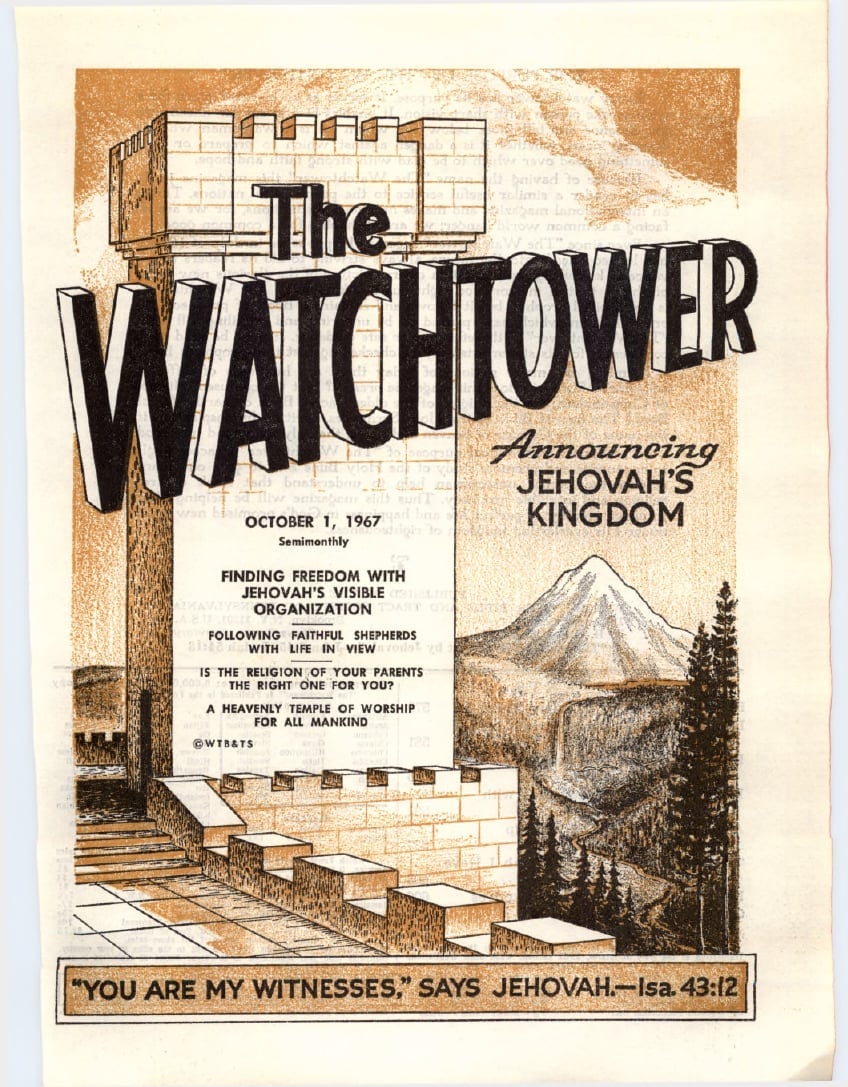
WATCHTOWER
OCTOBER 1, 1967 Semimonthly
FINDING FREEDOM WITH JEHOVAH'S VISIBLE ORGANIZATION
Announcing JEHOVAH'S KINGDOM
FOLLOWING FAITHFUL SHEPHERDS WITH LIFE IN VIEW
IS THE RELIGION OF YOUR PARENTS THE RIGHT ONE FOR YOU?
A HEAVENLY TEMPLE OF WORSHIP FOR ALL MANKIND
@WTB&TS
"YOU ARE MY WITNESSES," SAYS JEHOVAH.—Isa. 43:12
THE PURPOSE OF "THE WATCHTOWER"
Every watchtower has its purpose. It serves as an elevated place for a wide-awake person with sharp vision. It enables him to see far ahead into the distance and tell those below for whom he is a watchman what is drawing near, whether it is a danger against which to prepare or it is something good over which to be glad with strong faith and hope.
Because of having the name "The Watchtower" this magazine justly has to render a similar useful service to the people of all nations. This is an international magazine and makes no racial distinctions, for we are all facing a common world danger; we are all hoping for a common good.
Ever since "The Watchtower" began to be published in July of 1879 it has looked ahead into the future, always striving to aid its readers to advance in knowledge and to gain a clearer picture of the glorious new order of things that is in store for righteous mankind. No, "The Watchtower" is no inspired prophet, but it follows and explains a Book of prophecy the predictions in which have proved to be unerring and unfailing till now. "The Watchtower" is therefore under safe guidance. It may be read with confidence, for its statements may be checked against that prophetic Book.
Among the many nations of today there are hundreds of differing religions. Which one does this magazine present? Not the confused religions of Christendom, but the religion of the oldest sacred Book on earth. Which Book? The Sacred Bible of the Holy Scriptures, written by inspiration in the name of the Creator of heaven and earth, the only living and true God.
The sacred, nonpolitical purpose of "The Watchtower" is accordingly to encourage and promote study of the Holy Bible and to give our many readers the needed unsectarian help to understand that Book of true religion and infallible prophecy. Thus this magazine will be helping them to prove worthy of perfect life and happiness in God's promised new order under His everlasting kingdom of righteousness.
e3
PUBLISHED BY THE
WATCH TOWER BIBLE AND TRACT SOCIETY OF PENNYSVILANIA
117 Adams Street
Brooklyn, N.Y. N.1210, U.S.A.
N. H. KNORA, President
GRANT SUITE, Secretary
"They will all be taught by Jehovah."—John 6:45; Isaiah 54:13
CONTENTS
Beware of Desiring Injurious Things! 579
Is the Religion of Your Parents the
Right One for You? 581
Finding Freedom with Jehovah's
Visible Organization 585
Following Faithful Shepherds with
Life in View 591
A Heavenly Temple of Worship
"In the Sovereign Lord Jehovah I Have
Placed My Refuge" 603
Preach Release to Babylon's Captives 606
Questions from Readers 607
Average printing each issue: 5,000,000 Five cents a copy
"The Watchlower" is Published in the Following 74 Languages
</div>
"The Watchtower" is Published in the Following 74 Languages
Semiquarterly
Finish
Norwegian
Pow
Monthly
Arabia
German
Norwegian
Pillan
Malaysian
Caucasus
German
Soothin
Ga
Malaysian
Cinese
German
Slovenian
Gim
Malaysian
Chinese
Hokk
Swedish
Mju
Malaysian
Chihuahua
Hokk
Swedish
Hindi
Pamangano
Chihuahua
Japanese
Taiwan
Dunga
Pamangano
Dutch
Korean
Xhosa
Ibo
Polish
English
Malawai
Zhih
Kanarese
Sasu-Lega
Kilungo
Urukinan
Sango
Urukinan
Armenian
Bicol
Creation
Lingua
Urukinan
Bengali
Burmese
Ela
Yearly subscription rates
Watch Tower Society offices for semiquarterly editions
Australia
Arkansas St. Brooklyn
Brooklyn
N.W. 11201
Canada
Birmingham
Brooklyn
N.W. 11201
Canada
130 Bridgeland Ave. Tennesse 19, Ontario
$1
Jamaica
130 Bidgeland Ave. Tennesse 19, Ontario
$1
Jamaica
130 Bidgeland Ave. Tennesse 19, Ontario
$76
New Zealand
623 New Haven Ed. 4, Bucklewood
75c
Taiwan
41 Tranfax Bldg. Kingston
75c
DO YOU want to take the wise course and do what is right? "Of course," you reply. Then you cannot afford to ignore the counsel of God's Word, the Holy Bible. Far from its being an old-fashioned book, without any relevance to our day, it is as pertinent and germane to living in this latter part of
the twentieth century as when it first began to be put down in writing nearly 3,500 years ago.
For example, there are the wise warning words of the apostle Paul, calling our attention to the follies of the Israelites in the time of the prophet Moses: "Now these things became our examples, for us not to be persons desiring injurious things, even as they desired them." No question about it, today there is more desiring of injurious things than ever before in man's history.—1 Cor. 10:6-10.
Among many such that might be mentioned is the cigarette habit. According to Dr. Hollis S. Ingraham, health commissioner of New York State, the cigarette is the "most serious known lethal agent today . . . There is no other agent, whether it is bullets or germs or viruses, that is killing anything like as many Americans as the cigarette is." No wonder that such countries as Great Britain and Italy for
bid the advertising of cigarettes on TV and that the United States government requires each pack sold within its borders to contain the warning: "Caution: Cigarette smoking may be hazardous to health." And yet in 1966 cigarette shipments in the United States rose 2.2 percent over the previous year,
for a total of 522.5 thousand million cigarettes, or an average of 4,296 per year for each American over eighteen years of age. New York Times, February 28, 1967.
Another injurious thing in which people are indulging ever more and more are drugs that cause hallucinations, called "hallucinogens." Concerning them, Dr. Dana L. Farnsworth reports: "Our accumulating day by day experience with patients suffering the consequences of hallucinogens demonstrates beyond question that these drugs have the power to damage the individuals' psyche [personality], indeed, cripple it for life." Bearing him out is the report that appeared in the new York Daily News, April 27, 1967, about two young men who took LSD. One of these, a handsome nineteen-year-old, said: "When I see my face in the mirror, I see it turn into a thousand faces." He was semiconscious and strapped to a bed when a judge directed that he be committed to a state mental hospital.
The other was a twenty-one-year-old brilliant University of Texas student, whom a judge committed to a mental hospital for ninety days.
And then there is that injurious thing, promiscuous sex relations. Indulgence may seem to hold out promise of intense pleasure, but what frustration, grief and venereal disease are often associated with it! Thus Sweden, where premarital sex relations are no longer frowned upon, has the world's fastest-rising venereal disease rate, almost tripling in the past ten years, with 52 percent of the cases involving youths fifteen to nineteen years of age. Its illegitimacy rate is 12 percent, three times that of such other lands as Canada; and 92 percent of the brides under twenty are pregnant when they marry.
Not that youth alone errs in this regard. Promiscuity is becoming so prevalent that recently one of England's archdeacons dared to ask an assembly of Anglican bishops and archbishops: "Which of you has never in his life desired a strange woman?" Yet one who toys with infatuation by flirting risks becoming deeply involved in an illicit affair that may well bring harm to himself, to his loved ones and to the other person.
Then, again, a desired possession such as an automobile can be an injurious thing when given to an immature youth, as can be seen from the fact that teen-agers are involved in twice as many fatal auto accidents, proportionately, as are drivers over twenty-five years of age. Typical were the five teen-agers, all boys from five different homes, that were killed outside New York city shortly before midnight on April 9, 1967, as they tried to race a railroad train to a crossing, even to the extent of driving around the lowered gates. Using a car for excitement and thrills is making it an injurious thing.
Since desiring injurious things might be
said to be playing a game that is not worth the risk, why do so many do it? Why? Because of the sin of our first parents, for which reason "the inclination of the heart of man is bad from his youth up," even as the Creator, Jehovah God, himself stated right after the flood of Noah's day. Due to this inheritance we are prone selfishly to desire pleasures without due regard for God's laws governing them. The Creator gave us life with a purpose in mind, not merely to pursue pleasure. The desiring of injurious things is therefore as wrong as it is unwise, especially as we cannot harm ourselves without also affecting others.—Gen. 8:21; Mark 12:31.
What will help us to beware of desiring injurious things? A study of God's Word will, and that in three ways. First, believe it when it warns us that to desire injurious things incurs God's anger; and "we are not stronger than he is, are we?"—1 Cor. 10:22, 5.
Secondly, God's Word shows us just what things are injurious, harmful, and therefore to be avoided as unwise, if not also morally bad. By its laws and principles and historical record it educates us. As the inspired psalmist long ago wrote: "Your word is a lamp to my foot, and a light to my roadway."—Ps. 119:105.
And thirdly, the Bible helps us to beware of injurious things by impressing on our minds the value of good, true and wholesome things such as honest toll, wholesome family life and the worship of God, which bring a good conscience and hope of everlasting life for doing what is right. It shows that "godly devotion along with self-sufficiency" is great gain even now. Surely all such are reasons, as well as aids, for us not to be desiring injurious things.—1 Tim. 6:6; Eccl. 9:7-9; Rom. 6:23.
Is the Religion of Your Parents the right one for you?
MY PARENTS did not approve of our new religion," the young man explained, "and they did not hide their disapproval. My mother offered hundreds of prayers to try to make us return, as she sincerely believed that we had strayed into error."
The young man speaking was raised as a member of one of the prominent religions of Christendom. Recently, however, he and his wife had begun a serious study of the Bible, and what they learned caused them to change their religion. Was this proper? Is it right to leave the religion of one's parents? Is there a Scriptural precedent for making such a move? Let us see.
CHANGING ONE'S RELIGION
The patriarch Abraham is held forth in the Bible as an exemplary man of God. He is called "Jehovah's friend," and also is identified as "the father of all those having faith while in uncircumcision." (Jas. 2:23; Rom. 4:11) Did you realize that this outstanding man left the religion of his parents?
His father Terah lived near the southernmost tip of the famous Euphrates River in the Chaldean city of Ur. In that place idolatry was commonly practiced, and Terah apparently participated in idolatrous worship. Many years later the Israelite leader Joshua indicated this when he called the attention of the people to their ancestors, and said: "It was on the other side of the River [Euphrates] that your
forefathers dwelt a long time ago, Terah the father of Abraham and the father of Nahor, and they used to serve other gods. . . remove the gods that your forefathers served on the other side of the River and in Egypt, and serve Jehovah."—Josh. 24: 2, 14.
So Joshua urged that the people forsake the religion of their forefather Terah. Rather, they should imitate the faith of his son Abraham, who rendered exclusive devotion to the true God Jehovah. According to Jewish tradition, Abraham had taken the initiative and broken the idols of his father.
Another person who forsook her parents' religion and became a worshiper of Jehovah was Rahab. She was the Canaanite who concealed the Israelite spies, and received high commendation in the Scriptures for her faith. (Heb. 11:31; Jas. 2:25) Rahab explained to the spies what it was that prompted her to change her religion:
"We have heard how Jehovah dried up the waters of the Red Sea from before you when you came out of Egypt, and what you did to the two kings of the Amorites who were on the other side of the Jordan, namely, Sihon and Og, whom you devoted to destruction. . . . Jehovah your God is God in the heavens above and on the earth beneath. And now, please, swear to me by Jehovah that, because I have exercised loving-kindness toward you, you also will certainly exercise loving-kindness toward the household of my father.
. . and you must deliver our souls from death."—Josh. 2:9-13.
Rahab could perceive from the miraculous rescue of the Israelites out of Egypt that Jehovah is indeed "God in the heavens above and on the earth beneath"! The gods worshiped by her parents were incapable of accomplishing such wondrous deeds. Therefore, Rahab became a worshiper of Jehovah and was rewarded with the privilege of becoming an ancestress of the promised Messiah, Jesus Christ. —Matt. 1:1, 5.
Rahab's daughter-in-law Ruth also left the worship of her parents, and was similarly blessed. Due to famine in the land of Judah, Naomi, her husband and two sons moved to the land of Moab, where her sons married Moabite women, one of whom was Ruth. In time, Naomi's husband and sons died, leaving three widows. Naomi decided to return home to Judah, and so told her daughters-in-law: "Go, return, each one to the house of her mother." One of the girls did go, but Ruth refused to leave Naomi—Ruth 1:1-14.
At this Naomi said to Ruth: "Look! Your widowed sister-in-law has returned to her people and her gods. Return with your widowed sister-in-law.' And Ruth proceeded to say: 'Do not plead with me to abandon you, to turn back from accompanying you; for where you go I shall go, and where you spend the night I shall spend the night. Your people will be my people, and your God my God.'" (Ruth 1: 15-17) Ruth chose to worship Jehovah along with Naomi, rather than return to her people and worship their gods. In time, Ruth married Boaz the son of Rahab, and thus was blessed with becoming the great-grandmother of King David and an ancestress of Jesus Christ.—Ruth 4:18-22.
In the first century also, many persons left the religion of their parents in order to become true worshipers of Jehovah
God. The apostle Peter spoke approvingly of such persons, saying: "You were delivered from your fruitless form of conduct received by tradition from your forefathers." (1 Pet. 1:18) The forefathers that Peter referred to had followed Jewish religious traditions, but sincere Jews needed to leave such traditions and change their religion in order to gain God's approval.
The apostle Paul is a Jew who did this. He writes: "I was making greater progress in Judaism than many of my own age in my race, as I was far more zealous for the traditions of my fathers." (Gal. 1:14) Paul was "a son of Pharisees," and apparently had been raised by his parents as a member of that Jewish religious sect. (Acts 23:6; Phil. 3:5) But when he learned that the system of religious traditions practiced by the Pharisees was not approved by God, he did not hesitate to change his religion and become a Christian, even though this may have deeply grieved his Jewish parents.
REASON FOR THE CHANGE
In these instances the change of religion was not for mere convenience. It was not made for selfish reasons, such as to please a prospective marriage mate, for prestige, or to enhance one's social standing or business prospects. To the contrary, Abraham's worship of the true God Jehovah undoubtedly made him unpopular among the idol worshipers of the Mesopotamian city of Ur. Rahab's conversion to Jehovah's worship and her protection of the Israelite spies was done at the risk of her life. Also, Ruth's choice to serve Jehovah meant that she had to abandon her own country and people. And Paul's leaving the religion of his parents to become a Christian resulted in his suffering much persecution and hardship.—2 Cor. 11:23-27.
The change of religion by these persons was certainly not a matter of personal convenience! Rather, it was made on the basis of accurate knowledge concerning God and his purposes. They had taken in reliable information that demonstrated clearly that the way their parents worshiped was not pleasing to the true God, the Creator of heaven and earth. It is not improper to leave your parents' religion if its teachings are found to be out of harmony with God's Word the Bible. Instead, it is the courageous and right thing to do. And although such a change may be difficult to make, ultimately it brings beneficial results.
BENEFITS OF THE CHANGE
True, at the outset one's parents may be distressed, and even hostile. But remember: Jesus Christ warned that taking up true Christian worship would cause a division in some households. Yet, rather than encourage one to try to preserve peace by continuing to embrace false religious teachings and practices, Jesus said: "He that has greater affection for father or mother than for me is not worthy of me."—Matt. 10:34-37.
To refrain from true worship simply to please one's parents or grandparents is wrong. It will not truly benefit them, or you either. Real love is shown to them by being willing to put up with their disapproval, or even abuse, so that they may have the best possible opportunity to learn the truths from God's Word and come in line for the everlasting blessings that Jehovah God holds out to those that serve him.
Abraham's faithful course apparently had such beneficial effects upon his father Terah and other relatives. For when God directed Abraham to leave Mesopotamia with its bad environment of Babylonish false worship, his relatives, including Terah, went along with him.—Acts 7: 1-4.
Evidently the conduct of Terah's righteous son so impressed Abraham's close relatives that some of them eventually joined Abraham in true worship. What a grand reward for faithfully adhering to the religion approved by God!—Gen. 24:4, 50, 51.
The young couple mentioned at the beginning of this article also were richly blessed for remaining firm in their decision to change their religion. Although this change was greatly opposed by their parents, the young man explains:
"Every time my mother visited us we would talk among ourselves of the truths we had learned from God's Word—about the name of God, how to pray to him, the condition of the dead, and so forth. By our constantly talking of the good things that we had learned, she began to think and to compare. This was progress, as throughout all her life she had never doubted that the priests had the whole truth and nothing but the truth. Now she was asking herself: 'Why do they never mention the name Jehovah? Why do they keep the Bible to themselves? Why do they say that the soul is immortal since the Bible says it can die?'""—Ezek. 18: 4; Isa. 53:12.
Finally, the mother expressed a desire to learn about the things of which she heard her children speak. "You can imagine our joy," her son writes, "when one day our patience was rewarded by her asking us to talk to her about the Bible and Jehovah, saying: 'I am beginning to believe that the Catholics do not have all the truth after all.' Now, a few months later, my mother zealously shares Bible truths she has learned with others. So do my two sisters. Soon they plan to join my wife and me by symbolizing their dedication to serve Jehovah God by being baptized."
How happy and united Bible truths have made this family! The mother is truly grateful that her children did not unquestioningly follow the religion in which they had been reared. It was not the right religion for any of them. It should cause you to consider: Is the religion of your parents the right one for you?
THE RIGHT RELIGION FOR YOU
How can you determine this? If your parents are sincere, devoted people who live clean lives and attend religious services regularly, is this proof that their religion is the right one for you? One might understandably think so, but note that the apostle Paul indicates more is necessary.
When writing to the young man Timothy from confinement in prison, he observed that his mother and grandmother were exemplary women of faith. (2 Tim. 1:5) They lived clean, moral lives. But they did more. Note from Paul's following admonition to Timothy what identified the religion of Timothy's mother as the right one for Timothy too: "Continue in the things that you learned and were persuaded to believe, knowing from what persons you learned them [from his mother and grandmother] and that from infancy you have known the holy writings, which are able to make you wise for salvation through the faith in connection with Christ Jesus."—2 Tim. 3:14, 15.
Did you observe that Timothy's mother taught him the "holy writings"? The inspired writings of God's Word that were available during Timothy's infancy were the thirty-nine books of the Hebrew Scriptures. In 41 C.E. the Gospel of Matthew was written, and about 47-48 C.E. the apostle Paul set out on his first missionary tour, at which time no doubt Lois and Eunice were contacted and became Christian believers. From that time on
these faithful women could instruct Timothy in the Scriptures regarding "faith in connection with Christ Jesus." Their religion equipped them to do so.
Does the religion of your parents prepare them to do this? Can they turn directly to the Bible to answer questions about God, his Son, Christ Jesus, God's purposes and about what is proper conduct, as could Timothy's mother and grandmother? If not, it should cause you to question seriously whether their religion is the right one for you. For the true religion equips its adherents to provide this vital instruction.
It is not sufficient merely to feel that your parents' religion is the right one for you. Unless you can prove the correctness of their beliefs from the Scriptures, no amount of religious fervor or sincerity will make them right. It is foolish to conclude: "If my religion is good enough for father and mother, it is good enough for me." What would have happened if Rahab had reasoned that way, and relied upon the gods of her parents and continued to worship them? Why, they would have all suffered destruction with the rest of those in Jericho! As it was, because of her bold stand in favor of the true God Jehovah, "Rahab and her father and her mother and her brothers . . . and all who belonged to her, Joshua preserved alive." —Josh. 6:23-25.
In this day, too, all false religion faces a condemnatory judgment. Therefore, search the Scriptures! Examine your religion carefully in the light of their teachings. Abandon false religion, as the Bible commands: "Get out from among them, and separate yourselves." (2 Cor. 6:17) Find the religion that takes the Bible seriously and that equips each of its adherents to be a minister of God. This is the religion for you. Enjoy God's protection and blessing by accepting it.
OF HOW much benefit to you would be the gift of an around-the-world trip if you were bedridden? How much could you enjoy the latest model color television set if you had lost your eyesight? Of how much value to
less life so much of a problem? You are praying for freedom from these things too when you say, "Thy kingdom come." How so? Because, as the prophet Daniel foretold, "in the days of those kings the God
how much value to you, then, would be God's gift of everlasting life on earth if the present unhappy, fearful state of this world were to continue?
2 God's purpose to free man for everlasting life on earth is clearly stated in the Psalms: "The righteous themselves will possess the earth, and
or heaven will set up a kingdom that will never be brought to ruin. And the kingdom itself will not be passed on to any other people. It will crush and put an end to all these kingdoms, and it itself will stand to times indefinite." (Dan. 2:44) The grand King of that everlasting kingdom
they will reside forever upon it." (Ps. 37: 29) The prophet Isaiah verified this promise as being of God by referring to Jehovah as "the true God, the Former of the earth
and the Maker of it, He the One who firmly established it, who did not create it simply for nothing, who formed it even to be inhabited." (Isa. 45:18) Does it surprise you that God has purposed for man to inhabit the earth forever? It should
long ago revealed to his apostle John what will happen afterward: 'Look! The tent of God is with mankind, and he will reside with them, and they will be his peoples. And God himself will be with them. And he will wipe out every tear from their eyes, and death will be no more, neither will mourning nor outey nor pain be any more. The former things have passed away."—Rey. 21:3. 4.
not if you are familiar with the "Lord's prayer," because that is what you are requesting repeatedly when you pray: "Thy will be done in earth, as it is in heaven." —Matt. 6:10, AV.
But what of the unhappy, fearful conditions on the earth that would make end-
ORGANIZATION IS THE ORDER OF THE UNIVERSE
*Do not these promises of God give concrete reality to his kingdom? They mean that God will make his kingdom under
Christ just as real in governmental functions as the governments of men now ruling.
God's promises mean, too, that provision must be made to administer that kingdom and see that its laws are properly enforced. The prophet Jeremiah foretold this as the purpose of Jehovah, who says: "I will raise up over them shepherds who will actually shepherd them; and they will be afraid no more." (Jer. 23:4) Isaiah testified as to the benefits of this arrangement: "Look! A king will reign for righteousness itself; and as respects princes, they will rule as princes for justice itself." (Isa. 32:1) But this prophecy of Isaiah reveals something further, namely, that this administration of God's righteousness will begin even before God removes the governments of this system of things. For the prophecy continues: "And each one must prove to be like a hiding place from the wind and a place of concealment from the rainstorm, like streams of water in a waterless country, like the shadow of a heavy crag in an exhausted land." (Isa. 32:2) All this emphasizes a well-ordered arrangement of persons, a concerted, united effort to accomplish a purpose. That means organization.
To some persons, though, one's conforming to the rules or regulations of an organization is stifling to one's individuality. Others, reasoning similarly, say that God is dealing with them personally, directing each one in an understanding of the Bible. However, the spiritual laws of God are just as necessary to our well-being as natural laws; and who among the individualists would refuse to conform to God's law of eating and drinking, for example, for fear of losing his individuality? Men can go on hunger strikes in protest against social or political evils, but they
do not escape the need for food. Furthermore, these physical needs and the laws that govern them are common to all men. We are not free to pick and choose according to our individual whims.
Why, then, is it reasonable to believe that spiritual laws do not apply with the same uniformity to all? In fact, it is more important for God's living, intelligent creatures to have law, order and organization than it is for the inanimate, nonsoulical or soulless bodies of nature. Plants grow and stars move in orbit with no freewill choice. God's laws of nature control them and they cannot resist. As a result, the universe of such bodies is orderly and harmonious throughout. But man is a freewill agent and can, if he so desires, exercise his choice of action in an indiscriminate way. If all men were to do so, however, only a state of anarchy would result. So, to say that we do not need organization or that God directs each individual independently is to deny the interdependent order of the universe and the common provision that Jehovah has made for the sustenance of our physical needs. In fact, our very possession of free will should emphasize to us the need for organization, theocratic organization, that is, ruled by God from the top down.
THE BIBLE IS AN ORGANIZATIONAL BOOK
7 The Bible itself is an organizational book. The first words written by God's own finger, the Ten Commandments, were designed to form the basis for the theocratic administration of a national government with the descendants of Jacob or Israel as a chosen people and with Moses as mediator. (Ex. 19:3-8; 31:18) The children of Israel had been slaves in Egypt.
Moses had already freed himself from Egypt's yoke by fleeing to Midian, where he had lived for forty years. But Jehovah directed him to return to Egypt to represent the Israelites as one united body of people. Jehovah then made a common provision for them all, and any who expected to benefit from it had to act upon it in the same identical manner. All must conform in the selection of an animal, a male sheep or goat one year old, and sprinkle its blood on the doorposts of their houses. Then, by families, they must roast and eat its flesh and leave Egypt en masse about midnight as an orderly body, obeying common instructions and receiving a common deliverance. (Ex. 12:1-13, 21-39) When Jehovah brought them all to Mount Sinai in the wilderness, he gave them his Law organizing them as a theocratic nation.
All the Law or Torah that Jehovah inspired Moses to write was for this theocratic organization of Israel. So were all the other books that now comprise the Hebrew Scriptures, or the "Old Testament" as some persons refer to them. But over fifteen centuries later, Paul, himself an Israelite and an apostle of Jesus Christ, wrote concerning these books that make up three-quarters of our Bible: "For all the things that were written aforetime were written for our instruction, that through our endurance and through the comfort from the Scriptures we might have hope." (Rom. 15:4) By this, Paul meant that the Bible, as an instruction book for the theocratic organization of Israel, had now become a book of instructions for the organization of the Christian congregation.
9 As the canon of books of God's Word
was expanded and the Christian Greek Scriptures were added to complete the Bible, each book was written directly to the Christian congregation or to a member of the Christian congregation in its behalf. Thus the Bible is an organizational book and belongs to the Christian congregation as an organization, not to individuals, regardless of how sincerely they may believe that they can interpret the Bible. For this reason the Bible cannot be properly understood without Jehovah's visible organization in mind.
THE CHRISTIAN
CONGREGATION AS AN ORGANIZATION
10 Jesus did not begin the Christian congregation while he was still on earth. He did, however, select twelve apostles at that time, although Judas, who betrayed him, was replaced by another follower after Jesus' ascension to his Father in heaven. These "apostles of the Lamb" began to serve as foundation stones and pillars of the congregation after it was organized. (Rev. 21:14) This came on the day of Pentecost, 33 C.E., when the first Christian congregation was organized at Jerusalem. One hundred and twenty of Jesus' disciples were assembled together with one mind and purpose when Jehovah's spirit was poured out upon them, and the Christian congregation never lost this unity of thought as long as the apostles remained alive.—Acts 1:12-15; 2:1-4.
11 Though separated in person and groups assembling as Christian congregations, those composing the Christian congregation are still one united body, just as Israel was one typical theocratic nation. Paul said: "One body there is, and one spirit, even as you were called in the one hope to which you were called; one Lord, one faith, one baptism; one God and Father of all persons, who is over all and through all and in all."
(Eph. 4:3-6; Gal. 6:16; see also 2 Peter 2:5.) It is impossible, however, to harmonize this description with the picture by some of Christ's church being composed of individual mem-
ups. The flock of God has been scattered and hundreds of sects, just like those that Paul warned the Corinthian congregation against, now exist throughout Christendom. Has this advanced the theocratic order and the brotherhood of the Christian congregation? On the contrary, Christendom's religious disorganization has resulted in violent religious wars and perse-
bers scattered throughout all the contradictory sects of Christendom, all interpreting the Bible according to their own way of thinking. How could they, in such an unrelated condition, fulfill any kind of unified "purpose of a holy priesthood"?
12 Furthermore, in harmony with the prophecy of Isaiah 32:1, 2, quoted above, how could these members of the congregation serve as a "hiding place from the wind" and protect those whom they teach from winds of false doctrine if they are not united themselves as to God's truth?
cution. As an example and prophetic pattern of these reprehensible leaders of Christendom, the apostate priests of Israel were addressed by Jeremiah, at Jehovah's direction: "Woe to the shepherds who are destroying and scattering the sheep of my pasturage!" is the utterance of Jehovah. Therefore this is what Jehovah the God of Israel has said against the shepherds who are shepherding my people: 'You yourselves have scattered my sheep; and you kept dispersing them, and you have not turned your attention to them.' (Jeremiah 10:19-19)
Paul was opposed to such an unrelated, disunited course, because he counseled the Corinthian congregation: "Now I exhort you, brothers, through the name of our Lord Jesus Christ that you should all speak in agreement, and that there should not be divisions among you, but that you may be fity united in the same mind and in the same line of thought. For the disclosure was made to me about you, my brothers, by those of the house of Chloe, that dissensions exist among you. What I mean is this, that each one of you says:
them. (Jer. 23:1, 2, 11, 12) Jenovan will not allow such false shepherds to go unpunished.
THEOCRATIC ORDER RESTORED
24 But what of the scattered sheep? If theocratic order is to be restored to the Christian congregation, there must be a return to apostolic instruction. What Jeremiah's prophecy continues on to say must be accomplished: "And I myself shall collect together the remnant of my sheep out of all the lands to which I had dispersed them, and I will bring them back
I belong to Paul, 'But I to Apolos, 'But I to Cephas,' But I to Christ.' Does the Christ exist divided?"—1 Cor. 1:10-13.
13 But what is the situation today? During the nineteen intervening centuries since the first-century visible theocratic organization, the Christian congregation has undergone serious changes and split-
to their pasture ground, and they will certainly be fruitful and become many. And I will raise up over them shepherds who will actually shepherd them; and they will be afraid no more, neither will they be struck with any terror, and none will be missing,' is the utterance of Jehovah."
(Jer. 23:3, 4) Thanks to Jehovah and his purpose this has been accomplished, not through a Roman Catholic Ecumenical Council or a religious program of interfaith, but by slashing through the traditions of men and by a complete withdrawal of people from the corrupting influence of sectarianism. It has meant a drawing together of people following apostolic methods and instruction.
15 Today, Jehovah's visible theocratic organization has been restored. "Look! There are days coming,' is the utterance of Jehovah, 'and I will raise up to David a righteous sprout. And a king will certainly reign and act with discretion and execute justice and righteousness in the land. In his days Judah will be saved, and Israel itself will reside in security.'" (Jer. 23:5, 6) Under the direction of Christ Jesus, Jehovah's enthroned heavenly King, the Christian congregation on earth has again become apostolic in arrangements and methods of activity, adjusted to the needs of our modern day. This has made for unity, harmony, peace and working effectiveness within the ranks of true Christians. Does the organization you look to for spiritual guidance follow this theocratic pattern? Consider seriously these questions.
16 Do those taking the lead in your organization accept the Bible as God's Word, inspired by him as a revelation of his purpose and a book of instructions to direct us in the right way? Jesus did so, and taught his disciples to do likewise. (John 8:31; 32; 17:17; Ps. 119:105) Does the organization you look to provide regular assemblies for study of God's Word? First-century Christians were so assisted. (Heb. 10:25; Matt. 18:20; Rom. 16:5) Does it insist upon complete unity of doctrine and
thought within the congregation? Jesus' early disciples did. (1 Cor. 1:10-13; Jas. 3:16, 17) Is a theocratic procedure followed in making appointments to service positions? It was in the early congregation. (Acts 6:1-6; 14:23; 20:28) Do all associated with your organization put Kingdom interests first in their lives? Jesus taught his disciples to do so. (Matt. 6:33) Do they recognize their privilege and responsibility to preach from house to house? Those of the early apostolic congregation did. (Matt. 28:19, 20; Acts 5:42; 20:20; 1 Cor. 9:16) Do they preach the good news of God's kingdom? Jesus said they would. (Matt. 24:14) When faced with opposition, do they refuse to compromise the message of the Kingdom? The early congregation did. (Acts 4:19, 20; 5:29-32) Do all receive and accept counsel through the governing body? It is a stabilizing responsibility that the first Christians recognized. (Acts 2:42; 16:4, 5; Heb. 13:17) Do those charged with the responsibility of the organization work diligently to maintain it in a clean condition? The apostles of Jesus never lagged in this regard. (1 Cor. 5:1-5, 13; 1 Tim. 5:19-21) Is there a genuine love manifested among those in your congregation? Jesus said it would be a mark of the true congregation.—John 13:35.
17 Viewing the organization from a different position now, does the one you support make a distinction between "clergy" and "laity"? Such distinctions were unheard of among early Christians. (Matt. 23:8-12; 20:25-28; 1 Pet. 5:2, 3) Is financial support of your organization handled on a strictly voluntary basis? The early congregation never solicited funds. (Acts 11:29, 30; 2 Cor. 9:5-7) Is your organization active in world affairs? Jesus and his apostles refused to become a part of this world. (John 17:16, 17; Jas. 4:4) Do those associated with your organization seek political positions or reforms?
Those in the early congregation had a more permanent hope centered in God's kingdom. (2 Pet. 3:13, 14) Do national or racial barriers exist within your organization? There were none in first-century congregations. (Gal. 3:28; Rev. 7:9) Is discrimination practiced? Early Christians abided by the principle that "there is no partiality with God" but his "will is that all sorts of men should be saved and come to an accurate knowledge of truth." —Rom. 2:11; 1 Tim. 2:4; Jas. 2:1-4.
IDENTIFYING THE THEOCRATIC ORGANIZATION
18 Those in the apostolic organization did not fulfill these requirements for the Christian congregation in just a token way. They viewed their position in Jehovah's chosen visible channel as sacred and would allow nothing to jeopardize their standing with God. They had no fear of this world. (Matt. 10:26-28) Their only concern was to provide for the safety and well-being of the flock of God. Jesus pointed to this mark of the true visible organization in connection with a detailed prophecy relating to this time of the end. He said: "Who really is the faithful and discreet slave whom his master appointed over his domestics, to give them their food at the proper time? Happy is that slave if his master on arriving finds him doing so. Truly I say to you, He will appoint him over all his belongings."—Matt. 24:45-47.
19 Evidences are now conclusive that Jesus Christ was enthroned in heaven in 1914 C.E. and that he accompanied Jehovah to his temple in 1918 C.E., when
judgment began with the house of God. * (1 Pet. 4:17) After cleansing those belonging to this house who were alive on earth, Jehovah poured out his spirit upon them and assigned them the responsibility of serving as his sole visible channel, through whom alone spiritual instruction was to come. Those who recognize Jehovah's visible theocratic organization, therefore, must recognize and accept this appointment of the "faithful and discreet slave" and be submissive to it.
20 Today those thus charged with this grand privilege and responsibility are called Jehovah's witnesses, and have been since 1931. As a group they have been separated more and more from the sectarianism of Christendom from the 1870's onward. Since 1879 the Watch Tower magazine has been used by this collective group to dispense spiritual food regularly to those of this "little flock" of true Christians. (Luke 12:32) In 1884 they formed a legal servant, a corporation, called Zion's Watch Tower Tract Society, now known as the Watch Tower Bible and Tract Society of Pennsylvania. By 1919, having survived the fiery trials of World War I, this "faithful and discreet slave" class was no novice organization. True, the apostles were no longer in its midst, but they had left behind written instructions as part of Jehovah's great Record Book. Additionally, the modern-day members of this 1900-year-old Christian congregation had received from the days of the apostles onward a rich heritage of Christian loyalty and integrity, long and patient suffering of persecution, abiding faith in Jehovah's precious promises, confidence in the leadership of its invisible Lord and King, Jesus Christ, and obedience to its centuries-old commission to be witnesses in all the earth.—Acts 1:6-8.
22 In this spiritually mature condition they well qualify as those "who will actually shepherd them; and they will be
afraid no more, neither will they be struck with any terror, and none will be missing," because "a king will certainly reign and act with discretion and execute justice and righteousness in the land." Find freedom and security in their midst. Read the article that follows to learn how.
JEHOVAH'S purpose to provide freedom and everlasting life on earth for obedient mankind is already well under way. It is reaching a crucial stage of development in our generation with impending destruction of this present system of things and with the beginning of Christ's thousand-year reign of peace that will immediately follow. But none of us will receive life without putting forth some effort. Not that salvation comes by works alone. James, in writing to the first-century Christian congregation, said: "Faith, if it does not have works, is dead in itself. Indeed, as the body without breath is dead, so also faith without works is dead." (Jas. 2:17, 26) This means we must prove our faith by our course of action, by the things we do. It means that
righteous requirements of the King Jesus Christ must be met.
2 Even now, through his visible theocratic organization on earth, Jehovah is providing a campaign of spiritual instruction that is searching out those of our generation of honest heart toward God and changing over their lives to bring them into conformity with his reign of righteousness under his
King. The effectiveness of this campaign in growing numbers and spiritual advancement is an evidence that present unhappy, fearful conditions will terminate with this old system and the righteousness of Christ's reign will cover the earth. What will your position be when that time comes?
3 Make haste to identify the visible theocratic organization of God that represents his king, Jesus Christ. It is essential for life. Doing so, be complete in accepting its every aspect. We cannot claim to love God, yet deny his Word and channel of communication. We cannot accept apostolic teaching, yet reject our commission to teach others.
We cannot accept the house-to-house ministry, yet ignore God's moral requirements in everyday living. We cannot live an exemplary life, yet remain apathetic to the issue soon to be settled. We cannot preach the end of this system of things, yet seek to acquire all that this world has to offer in security or material benefits. Jehovah's visible organization is based firmly on the twelvefold foundation of the "apostles of the Lamb," with Jesus Christ himself being the foundation cornerstone. (Rev. 21:14, 19, 20; Eph. 2:20-22) Therefore, in submitting to Jehovah's visible theocratic organization, we must be in full and complete agreement with every feature of its apostolic procedure and requirements.
UNITY MAINTAINED BY SUBMISSION
Do not fear that you might lose your identity or freedom by submission. Members of the first-century Christian congregation willingly submitted themselves to the direction of the organization through its governing body. Even the apostles Peter and Paul did so. When matters of dispute arose, they were referred for settlement to the entire body of the twelve apostles and the older men of influence who served in the Jerusalem congregation. One such instance occurred about 49 C.E. Paul and Barnabas, on a missionary assignment in the Roman provinces of Asia Minor, had been baptizing uncircumcised Gentiles as Christians. When this became known in their home congregation in Antioch of Syria, certain men from Judea objected, saying: "Unless you get circumcised according to the custom of Moses, you cannot be saved." (Acts 15:1) Considerable discussion failed to settle the
matter, so Paul, instead of demanding any rights as an apostle, took the problem to the governing body in Jerusalem. There, after due consideration under the direction of God's holy spirit, the issue was settled and notice of the decision was sent to the Antioch congregation by a letter and a delegation representing the governing body. As a result, the congregation was freed from doubts and dissension. Acts 15:2-31.
5 This prompt action by Paul and the governing body had a unifying, preserving effect and was productive of increase. Later, as Paul and his party "traveled on through the cities they would deliver to those there for observance the decrees that had been decided upon by the apostles and older men who were in Jerusalem. Therefore, indeed, the congregations continued to be made firm in the faith and to increase in number from day to day." (Acts 16:4, 5) In this way today too the governing body of the Christian congregation serves the entire organization. Solutions to problems arising in one locality are widely circulated so that the unity and oneness of the entire organization might be maintained.
However, the governing body is not alone in administering Jehovah's spiritual provisions for your blessing and for the protection and unity of the congregations. As foretold by Isaiah: "And as respects princes, they will rule as princes for justice itself." (Isa. 32:1) Here prince is not to be understood in a political sense, for those called "princes" (or sarim, Hebrew) have no part in this present wicked system of things, soon to be destroyed. According to the sense of the word in Hebrew, those of Isaiah's prophecy are to serve in the theocratic organization as principal men in charge of groups of a thousand or a hundred or of fifty or of even ten.
Thus, the King Jesus Christ has placed men of the "faithful and discreet slave" class, and even men from among the "great crowd," whose hope it is to live on earth, in charge of congregations and groups of them, even of service groups of ten, giving them proportionate responsibilities. In this way they have become "shepherds" in the sense of Jeremiah 23: 4—Rev. 7:9-12.
IMITATORS OF FAITH, NOT MEN
"Those thus appointed are not called "princes," "shepherds" or "pastors," however, but are commonly called "servants." This emphasizes their relationship to the organization and their responsibility toward those in their charge. Jesus made this position quite clear to his apostles. "Jesus, calling them to him, said: 'You know that the rulers of the nations lord it over them and the great men wield authority over them. This is not the way among you; but whoever wants to become great among you must be your minister, and whoever wants to be first among you must be your slave.'" (Matt. 20:25-27) Since a slave or servant is one who ministers to the needs of a master or employer, those in positions of responsibility who are called "servants" are not ministered to but minister willingly to those in need in the congregation. In this they follow the example of Jesus, who said: "Just as the Son of man came, not to be ministered to, but to minister and to give his soul a ransom in exchange for many." (Matt. 20:28) Not only are such servants responsible to those in their charge but they are also liable to Jehovah God for
the welfare of these "sheep." It is only reasonable, then, that Jehovah would require the "sheep" to be willingly submissive to the shepherds. "Be obedient to those who are taking the lead among you and be submissive, for they are keeping watch over your souls as those who will render an account; that they may do this with joy and not with sighing, for this would be damaging to you."—Heb. 13:17.
In submitting yourself to Jehovah's visible organization as administered by such servants, you are still not required or expected to follow men. On the contrary, Paul counseled: "Remember those who are taking the lead among you, who have spoken the word of God to you, and as you contemplate how their conduct turns out imitate their faith." (Heb. 13:7) It is the faith of these men that is to be imitated and their course of conduct that is to be observed.
9 These men too, though occupying responsible positions of oversight themselves, recognize and submit to the superior appointment of the "faithful and discreet slave." In doing so, they are quick to heed the admonition of Peter, one of the earlier members of that body. He said: "Humble yourselves, therefore, under the mighty hand of God, that he may exalt you in due time." (1 Pet. 5:6) Acting for the "faithful and discreet slave," they realize the grave responsibility entrusted to them as representatives of the heavenly Kingdom government and constantly seek Jehovah's direction and spirit to enable them to discharge their assignment "for justice itself" in harmony with the righteousness of Jesus Christ's reign, not deviating at any time for the sake of expediency or self-aggrandizement. (Acts 8:4-17) Does the record of the modern "faithful and discreet slave" reveal that this has been the concern for Jehovah's "sheep" in these last days?
A brief review of some facts might be reassuring.
THE MODERN ELIJAH PREPARES THE WAY
10 Great strides in the theocratic procedure have been made since 1919 C.E. This is graphically portrayed in the prophetic drama of the ministries of the prophets Elijah and Elisha in ancient Israel. As foretold by Malachi: "Look! I am sending to you people Elijah the prophet before the coming of the great and fear-inspiring day of Jehovah. And he must turn the heart of fathers back toward sons, and the heart of sons back toward fathers; in order that I may not come and actually strike the earth with a devoting of it to destruction." (Mal. 4:5, 6) The original Elijah was a prominent witness of Jehovah in the tenth century B.C.E., five centuries before Malachi uttered his prophecy. This Elijah that was to come had a small-scale fulfillment in John the Baptist, but the Elijah of Malachi's prophecy was scheduled to appear in our own fateful day, just before and during the time of the end of this present system of things. True to the prophecy, in modern times the "faithful and discreet slave" has appeared to perform the foretold work of Elijah.
11 This began a period of making Jehovah's requirements in righteousness stronger within the modern congregation that might be likened to Israel in its earlier days in the Promised Land. At first, even though the nation was united under theocratic law and judges ruled, "what was right in his own eyes was what each one
was accustomed to do." Why did this loose organization exist? The account says: "In those days there was no king in Israel." (Judg. 21:25) So it was in the earlier days of the modern theocratic organization. Jehovah's administration of righteousness took a pronounced forward step with the return of the Christian congregation to apostolic teachings. But before the King, Jesus Christ, was enthroned in 1914 C.E. the organization was loosely administered. Each "ecclesia" or congregation was self-governed by elected "elders" and "deacons." But in 1914 Jehovah enthroned his King Jesus Christ, and from 1919 onward the time became due for Jeremiah's prophecy to be fulfilled: "And I myself shall collect together the remnant of my sheep out of all the lands to which I had dispersed them, and I will bring them back to their pasture ground, and they will certainly be fruitful and become many. And I will raise up over them shepherds who will actually shepherd them; and they will be afraid no more, neither will they be struck with any terror, and none will be missing," is the utterance of Jehovah."—Jer. 23:3, 4.
12 This benefit of theocratic administration did not come all at once. In 1932 the "elective elders" were replaced in the congregation by an appointed "service director," who was assisted by a group of mature members of the congregation democratically elected to their positions. But not until 1938 did the final change to strictly theocratic order take place. In that year, through the columns of The Watchtower, it was revealed from the Scriptures that the power of appointment of servants in congregations rightfully rests with the governing body of the "faithful and discreet slave" as directed by Jesus Christ from Jehovah's temple.* This important step in the restoration of theocratic order assured Jehovah's "sheep" that they would not again be separated into independent "flocks" by unscrupulous "shepherds."
The shepherds that Jehovah promised through Jeremiah would be those fully in agreement with Jesus' words that "they will become one flock, one shepherd."—John 10:16.
EXPANSION AND HEALING DURING ELISHA PERIOD
Thus came a strengthening of the Christian congregation and a safeguarding against the strenuous days ahead. These theocratically appointed shepherds whom Jehovah was raising up within the congregation were "to be like a hiding place from the wind and a place of concealment from the rainstorm." Not only was the visible organization of God due to experience a severe time of trial by persecution, but it was also due to "be fruitful and become many" as a result of the intense program of education ahead.
14 In 1942 the change came. In the throes of World War II, with the change in administrations of the second and third presidents of the Watch Tower Bible and Tract Society, the Elijah work passed away, having realized its purpose to Jehovah's praise. It had been actively directed toward beginning the work of "dividing the waters" of the symbolic Jordan River, that is, dividing the symbolic waters of the peoples, gathering the "other sheep" or "great crowd" to the right hand of the reigning King Jesus Christ. (2 Ki. 2:8; Matt. 25:31-46) As the Elisha class vigorously took up the "mantle of Elijah"
or the divine commission Elijah had so actively fulfilled, the time for unparalleled expansion had begun. The years since 1942 have told their tale regarding the exploits of the anointed Elisha class, accompanied by an ever-increasing number of the "great crowd."—Rev. 7:9-17.
15 To parallel the many miracles performed by the original Elisha, sixteen as compared with Elijah's eight, the modern Elisha class at once began arrangements for producing better preachers of the Kingdom good news in furtherance of the prophecy of Matthew 24:14. On February 1, 1943, the Watchtower Bible School of Gilead was set up for training missionaries and special representatives of the Watch Tower Society to serve in all parts of the earth. That same year, 1943, a new training program, the Theocratic Ministry School, began in the congregations of Jehovah's witnesses. At first only male students were enrolled in these schools, but in 1958 provision was made for the women of the congregations to enroll and participate.
10 As the work expanded, new congregations were formed, this requiring more servants to supervise the Kingdom preaching of the good news. To improve their service, a new feature was introduced in 1959, a Kingdom Ministry School with a four-week course of study, free to all overseers invited to be students. By the following year the school was established in the various lands, this resulting in better supervision of the congregations world wide.1 Tim. 3:1-7; Titus 1:5-9.
17 Just as Elisha of old raised from the dead the son of the Shunammite woman who befriended him, so the modern Elisha work has meant spiritual life from the dead for countless numbers.
(2 Ki. 4:17-37) Hundreds of thousands who were lying in a death state in their sins and under divine condemnation have been raised to a happy life in Jehovah's service, with the bright prospect of everlasting life under the Kingdom after this present system is destroyed at Armageddon. This gathering work has been intensified since 1942. During that crucial year of World War II incomplete reports showed upward of 106,000 persons proclaiming the good news. Due to the loving administration of the reigning King and the uniting efforts of his "faithful and discreet slave," and the "great crowd" and the appointed "shepherds," the increase has been continual until, in this year, just 25 years later, 1,150,000 were actively engaged in publishing the Kingdom message.
MAINTAINING CHRISTIAN STANDARDS OF CONDUCT
18 This strengthening of theocratic structure has brought a closer supervision of the organization as to Scriptural requirements in conduct of those associated. Christian standards have always been recognized by the modern "faithful and discreet slave" and have always been held up before the congregation as requirements in Christian living. Even as early as 1904, the first president of the Watch Tower Society, in his book The New Creation, outlined a Scriptural procedure for dealing with violators, even to the point of withdrawing from them the congregation's "fellowship and any and all signs or manifestations of brotherhood."18 But this extreme measure of excommunication or disfellowship was not widely practiced among the congregations and was not made a requirement on congregations un
til 1952. \dagger No longer could Christian conduct be viewed simply as a matter affecting only the individual or individuals involved. Paul wrote the Corinthian congregation in connection with a disfellowship case in the first-century congregation: "Do you not know that a little leaven ferments the whole lump?" (1 Cor. 5:1-6) No longer could those following the practices of the nations be allowed admittance to the congregation nor could those falling away to such practices be allowed to remain.
Thus it can be seen that the modern theocratic organization of shepherds of God's flock has only the interests of the Kingdom and of God's "sheep" at heart. As those "keeping watch over your souls," they know they "will render an account." It is vital to their discharge of Kingdom responsibilities that "none will be missing." To make certain of this, you must be taught: "Keep on, then, seeking first the kingdom and [God's] righteousness." —Matt. 6:33.
Such a theocratic view of matters will enable you always to keep pace with the organization, neither running ahead nor lagging dangerously behind. You will encounter trying circumstances. Do not be overcome by them. Wait on Jehovah and put your hope in him. (Ps. 37:34; 27:14) It might even be that reproof will be necessary on occasion. Do not become offended. If you do, you are undoubtedly taking yourself too seriously, falling to see the point of the reproof. Nor should you persuade yourself that you are of no use to the organization and quit simply because some mistake may be drawn to your attention. Rather, "my son, do not belittle the discipline from Jehovah, neither give out when you are corrected by him; for whom Jehovah loves he disciplines; in fact, he scourges every one whom he receives as a son."—Heb. 12: 5, 6.
…