The Watchtower, April 15, 1946
Download: PDF — The Watchtower, April 15, 1946
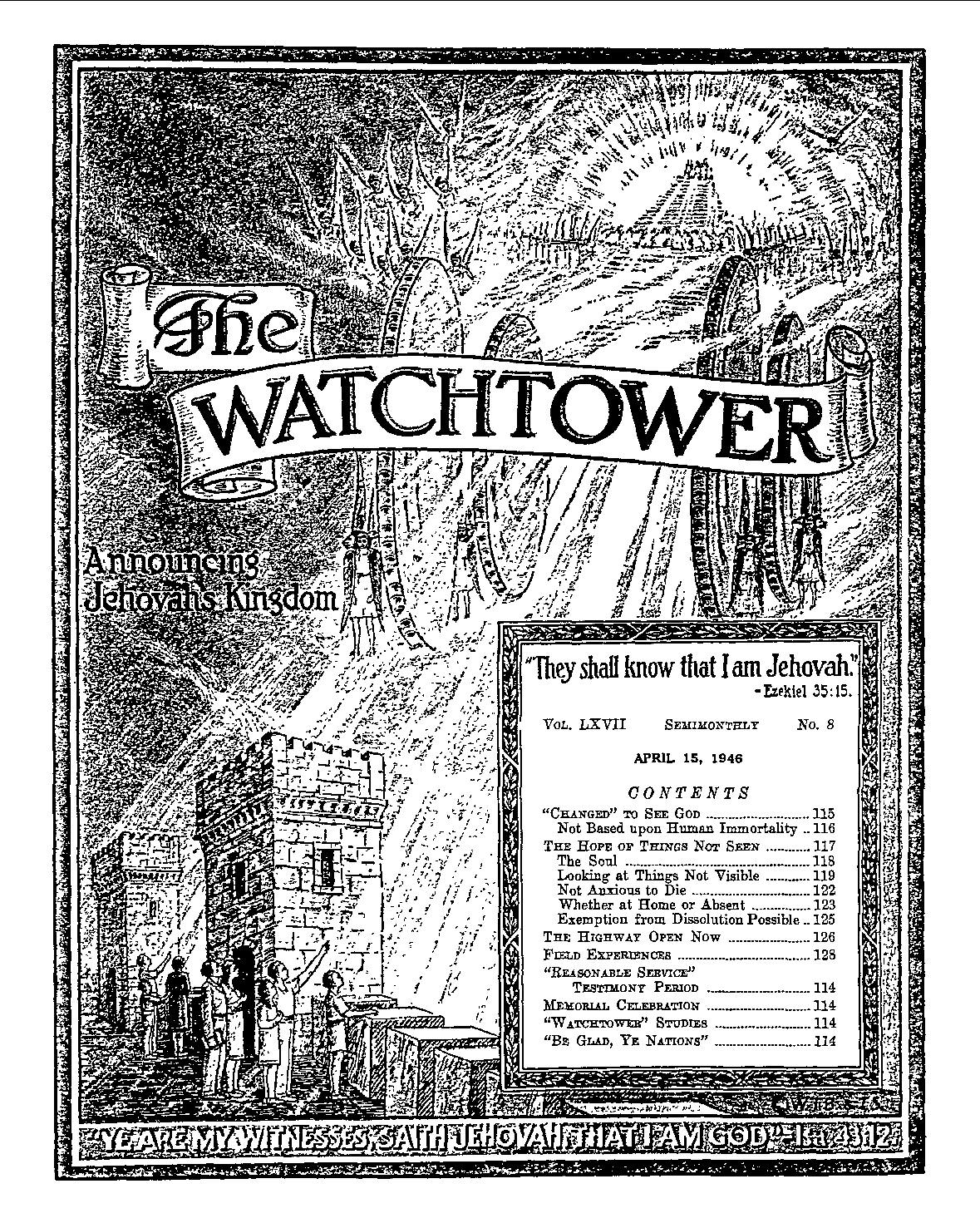
^EeWATCHTOWEK
’Published Semimonthly By
WATCH TOWER BIBLE & TRACT SOCIETY 117 Adams Street - - Brooklyn 1, N.Y., U.S.A-
Officers
N. H. Knobb, President W. E. Van Ambubgh, Secretary “And all thy children shall be taught of Jehovah; and great shall be the peace of thy children.” - Isatah 54:13.
THE BIBLE CLEARLY TEACHES
THAT JEHOVAH is the only true God, from everlasting to everlasting, and is the Maker of heaven and earth and Giver of life to his creatures; that the Word or Logos was the beginning of his creation and his active agent in creating all other things: and that the creature Lucifer rebelled against Jehovah and raised the issue of His universal sovereignty;
THAT GOD created the earth for man, made perfect man for the earth and placed him upon it; that man yielded to unfaithful Lucifer, or Satan, and willfully disobeyed God's law and was sentenced to death; that by reason of Adam's wrong act all men are born sinners and without the right to life;
THAT THE LOGOS was made human as the man Jesus and suffered death in order to produce the ransom or redemptive price for obedient men; that God raised up Christ Jesus divine and exalted him to heaven above every other creature and clothed him with all power and authority as head of God’s new capital organization ;
THAT GOD’S CAPITAL ORGANIZATION is a Theocracy called Zion, and that Christ Jesus is the Chief Officer thereof and is the rightful King of the new world; that the faithful anointed followers of Christ Jesus are Zion’s children, members of Jehovah’s organization, and are His witnesses whose duty and privilege It Is to testify to Jehovah’s supremacy and declare his purposes toward mankind as expressed In the Bible;
THAT THE OLD WORLD, or Satan’s uninterrupted rule, ended A.D. 1914, and Christ Jesus has been placed by Jehovah upon the throne, has ousted Satan from heaven, and now proceeds to vindicate His name and establish the “new earth”;
THAT THE RELIEF and blessings of the peoples can come only by Jehovah’s kingdom under Christ, which has begun; that His next great act Is to destroy Satan's organization and establish righteousness completely in the earth ; and that under the Kingdom the people of good-will surviving Armageddon will carry out the divine mandate to “fill the earth” with righteous offspring, and that the human dead in the graves will be raised to opportunities of life on earth.
ITS MISSION
HIS journal Is published for the purpose of enabling the people to know Jehovah God and his purposes as expressed In the Bible. It publishes Bible Instruction specifically designed to aid Jehovah’s witnesses and all people of good-will.
It arranges systematic Bible study for Its readers and the Society supplies other literature to aid In such studies. It publishes suitable material for radio broadcasting and for other means of public instruction in the Scriptures.
It adheres strictly to the Bible as authority for Its utterances. It Is entirely free and separate from all religion, parties, sects or other worldly organizations. It is wholly and without reservation tor the kingdom of Jehovah God under Christ bls beloved King. It Is not dogmatic, but invites careful and critical examination of Its contents in the light of the Scriptures. It does not Indulge In controversy, and Its columns are not open to personalities.
Yearly Subscription Price United States, $1.00; all other countries. $1.50, American currency; Great Britain, Australasia, and South Africa, 6s. American remittances should be made by Postal Note cr by Postal or Express Money Order or by Bank Draft. Outside of the United States remittances should be made direct to the respective branch offices. Remittances from countries other than those mentioned may be made to the Brooklyn office, but by International Postal Money Order only. Foreign Offices
Australia___________7 Beresford Rd., Strathfield, N. S. \V.
Canada 40 Irwin Ave., Toronto 5. Ontario England 34 Craven Terrace, London, W. 2 India ______________.._______ 167 Love Lane, Bombay 27
Newfoundland-------------------P. O. Box 521. St. John's
New Zealand 177 Daniell St.. Wellington. S. 1
Philippine Islands_____ , -------1219-B Oroquieta St.. Manila
South Africa 623 Boston House, Cape Town
Please address the Society In every case.
Translations of this journal appear in several languages.
ALL SINCERE STUDENTS OF THE BIBLE who by reason of Infirmity, poverty or adversity are unable to pay the subscription price may have The Watchtower free upon written application to the publishers, made once each year, stating the reason for so requesting it We are glad to thus aid the needy, but the written application once each year is required by the postal regulations.
Notice to Subscribers: Acknowledgment of a new or a renewal subscription will be sent only when requested. Change of address, when requested, mav be expected to appear on address label within one month. Old and new addresses must be given. A renewal blank (carrying notice of expiration) will be sent with the journal one month before the subscription expires.
Printed in the United States of America
Entered as second-class matter at the post office at Brooklyn, N. F., under the A.ct of March 3, 1879.
“REASONABLE SERVICE” TESTIMONY PERIOD
The final month of the current Watchtower campaign, April, is listed on the year’s service calendar as “Reasonable Service” Testimony Period. This means reasonable service to God, and the Watchtower magazine is devoted to God and the interests of His kingdom and hence the putting of this magazine in the hands of the people is a part of His “reasonable service”. The offer for this final month has a new feature added, namely, the new 64-page, colored-cover booklet “Be Glad, Ye Nations”. This is offered, together with the regular bound book, as a premium with each new year’s subscription for The Watchtower at the regular rate of $1. Doubtless many more readers of this magazine will want to get in on the closing month of this special activity; and we invite all such interested ones to write us, if necessary, in order to be teamed up with others in this “reasonable service”. The Society expects a report to be made in the accustomed way by each one-out in the field service during this Testimony Period.
MEMORIAL CELEBRATION
This year the time for celebrating the Memorial will be after sundown or after 6 p.m., Standard Time, of Tuesday, April 16. At an announced hour, each company should assemble on that night, and the anointed ones of them partake of the Memorial emblems, their companions the “other sheep" being present as witnesses. Before the emblems are partaken of, let some competent brother offer a brief speech extemporaneously or else read paragraphs selected from recent Watchtower articles on the Memorial to those met together. Since the breaking of the bread and drinking of the wine both symbolize the death in which the members of Christ’s body share, the bread and wine should both be served together at partaking. Unleavened bread and red wine should be served, to harmonize with the course of Jesus and his apostles. We expect all companies to notify us concerning their celebration, reporting both the number attending and the number of partakers.
“WATCHTOWER” STUDIES
Week of May 19: “The Hope of Things Not Seen,” fl 1-19 inclusive, The Watchtower April 15,1946.
Week of May 26: “The Hope of Things Not Seen,” fl 20-41 inclusive, The Watchtower April 15, 1946.
“BE GLAD, YE NATIONS”
The above title designates the new 64-page booklet published by the Watch Tower Society. The two treatises therein contained are closely related and complementary to each other, the first one being on the subject “Be Glad, Ye Nations”, and the second being on the people with whom to be glad, namely, “Jehovah’s witnesses in the Crucible.” Both these presentations, delivered by the Society’s president to great public audiences, have made profound impressions. Reading this booklet will leave you glad, we are certain. "Be Glad, Ye Nations" is published in a special cover of artistic beauty, and is now available at 5c a copy, mailed postpaid. Release of this booklet for campaign distribution is announced elsewhere.
ANNOUNCING
Vol. LXVII
JEHOVAH’S KINGDOM
April 15, 1946
No. 8
“CHANGED” TO SEE GOD
"We shall all be changed."—1 Cor. 15:51.
JEHOVAH God lives immortal in a heavenly I glory that is beyond all comparison and which
J no man can see or approach to. Man was not created to see such all-excelling divine glory.
’When scientific men exploded the first atomic bomb far out on the desert wastes of New Mexico that fateful Monday morning of July 16, 1945, the giant tower of steel from which the bomb was suspended vanished in the four trillion degrees of heat that was developed and a man of flesh six miles away who rashly looked directly at the explosion through blackened glasses was struck blind at the greatest brilliance that had yet flashed atop this earth. Yet this man-engineered burst of glory cannot be compared with the inherent glory of the Creator, who is the central Source of all nuclear energy. Man of frail flesh and blood, whose body is three-fourths water, could never survive before the presence of His full glory. Spealdng to the prophet Moses at Mount Sinai who had asked to be shown God’s glory, Jehovah said: “Thou canst not see my face: for there shall no man see me, and live.” (Ex. 33:20) The Christian apostle Paul was once struck blind for three days by a dazzling heavenly vision, and he could with real appreciation write concerning the Son of God, who is the image of God his Father: “The King of kings, and Lord of lords; who only hath immortality, dwelling in the light which no man can approach unto; whom no man hath seen, nor can see.” (1 Tim. 6:15,16; Acts 22:6-11; 9:3-9) It is self-evident, therefore, that flesh and blood can never go to heaven. Man is not so destined. “Flesh and blood cannot inherit the kingdom of God; neither doth corruption inherit incorruption.”—1 Cor. 15: 50.
3 Once we grasp the foregoing simple, uncontra-dictable truth, we are helped to get rid of religious errors and to understand aright the inspired writings of the Holy Scriptures. Faith is the conviction of things not seen by natural eye, and only by faith can we see or mentally perceive something of the weight of God’s glory as described in his written Word and as reflected somewhat in his visible works in sky and earth. (Heb. 11:1; Rom. 1:19, 20) For ns
any intelligent creature on earth to hope to appear in God’s exalted presence and to see his personal glory, such creature must expect to undergo a revolutionary change in himself that completely does away for ever with flesh and blood. This “change” is something not possible for man to accomplish, even when armed with modern science. No sane man could properly hope to experience such a change except such a thing were promised to him by Almighty God Jehovah.
4 Only Jehovah God could effect such a miraculous changing of creatures who were humans of flesh and blood to become immortal spirit creatures able to appear in God’s heavenly presence and to gaze upon him and live. Jehovah God has promised such a change to certain ones who gain his special favor. This promised “change” was long a mystery or sacred secret. It was not unlocked and disclosed until the coming of Jesus Christ, the Son of God. In fact, he was the first one to undergo this change from flesh to spirit. This is verified by one of his witnesses, the apostle Peter, who writes: “Christ also suffered for sins once, the righteous for the unrighteous, that he might bring us to God; being put to death in the-flesh, but made alive in the spirit; in which also he went and preached unto the spirits in prison.” (1 Pet. 3:18,19, Am. Stan. Ver.; Weymouth; Rotherham; Catholic Conf rat.) As to the part that Christ Jesus performed in opening up this mystery to the light of human understanding the apostle Paul writes Timothy, saying: “Suffer hardship with the gospel according to the power of God; who saved us, and called us with a holy calling, not according to our works, but according to his own purpose and grace, which was given us in Christ Jesus before times eternal, but hath now been manifested by the appearing of our Saviour Christ Jesus, who abolished death, and brought life and immortality [or, incorruption] to light through the gospel.”—2 Tim. 1:8-10, Am. Stan. Ver., and marginal reading; Rotherham.
5 This same apostle Paul wrote down further information regarding this mystery which Christ
revealed to him. It was about twenty years after the death and resurrection of Christ, and also after persecutions had flared up against the Christians with death to many of them, that Paul wrote the following to his brethren at Corinth: “That Christ died for our sins according to the scriptures; and that he was buried; and that he hath been raised on the third day according to the scriptures;... then he appeared to above five hundred brethren at once, of whom the greater part remain until now, but some are fallen asleep.... If Christ hath not been raised, your faith is vain; ye are yet in your sins. Then they also that are fallen asleep in Christ have perished. If we have only hoped in Christ in this life, we are of all men most pitiable. But now hath Christ been raised from the dead, the firstfruits of them that are asleep. Behold, I tell you a mystery: We all shall not sleep, but we shall all be changed, in a moment, in the twinkling of an eye, at the last trump: for the trumpet shall sound, and the dead shall be raised incorruptible, and we shall be changed. For this corruptible must put on incorruption, and this mortal must put on immortality. But when this corruptible shall have put on incorruption, and this mortal shall have put on immortality, then shall come to pass the saying that is written, Death is swallowed up in victory.”—1 Cor. 15: 3-6,17-20, 51-54, Am. Stan. Ver.
6 It must not escape our notice that the apostle Paul was writing the above things to his Christian brethren, and not to humankind in general. Hence men in general do not share in the hope and in the mystery which Paul here sets out. Paul makes it clear to Christians that their coming “change” is from a human state to a heavenly state. In the midst of the above discussion he shows the Christians the reason for such a radical change, when he says: “And as we have borne the image of the earthy, we shall also bear the image of the heavenly. Now this I say, brethren, that flesh and blood cannot inherit the kingdom of God; neither doth corruption inherit incorruption.” (1 Cor. 15:49,50) This bars out entirely the religious error that the Christians will take their flesh-and-blood organisms up to heaven. It bars out any idea that their human bodies will be “spiritualized” so that in the spiritual realm they will resemble and look like what they were on earth, a hunchback Christian on earth becoming a spirit hunchback in heaven, etc.
7 There are no grounds in reason or in Scripture for imagining that the “changed” Christians in heaven will look like the imperfect human creatures that they were on earth or that they will image or resemble human creatures at all. To the contrary, they will be heavenly images of God, their heavenly Father. Hence what they will personally look like in heaven no faithful Christians now know. So says the apostle John in writing the following, not to the world, but to the Christians: “Behold what manner of love the Father hath bestowed upon us, that we should be called children of God; and such we are. For this cause the world knoweth us not, because it knew him not. Beloved, now are we children of God, and it is not yet made manifest what we shall be. We know that, if he shall be manifested, we shall be like him; for we shall see him even as he is. And every one that hath this hope set on him purifieth himself, even as he [God the Father] is pure."—1 John 3:1-3, Am. Stan. Ver.
NOT BASED UPON HUMAN IMMORTALITY
•Another religious error is to imagine that such a change from earthly to heavenly is based upon some indwelling immortality of the human soul, “inherent immortality,” as it is usually called. It falls to the task of those so imagining to prove from Paul's writings that he bases this miraculous “change" upon the religious doctrine of “inherent immortality of the human soul”. What the apostle Paul discusses in 1 Corinthians 15 is the resurrection of the Christian dead. In answer to the questions, “How are the dead raised? and with what manner of body do they come?” Paul at once answers: “Thou foolish one, that which thou thyself sowest is not quickened except it die [it not being immortal]: and that which thou sowest, thou sowest not the body that shall be, but a bare grain, it may chance of wheat, or of some other kind; but God giveth it a body even as it pleased him, and to each seed a body of its own.” (1 Cor. 15: 35-38, Am. Stan. Ver.) In proof also that it is of dead ones and not of immortal ones that he is writing, Paul says: “If the dead are not raised, neither hath Christ been raised: and if Christ hath not been raised, your faith is vain; ye are yet in your sins. Then they also that are fallen asleep in Christ have perished.” (1 Cor. 15:16-18, Am. Stan. Ver.) Immortal ones cannot perish; neither could they sleep in death.
’ It stands indisputable, therefore, that the apostle bases the mysterious “change” of the faithful Christians upon no “inherent immortality” idea, but upon God’s miracle of resurrecting the dead. By resurrection not only does God restore the faithful Christians to life but he transfers them from the former life in the human body to heavenly life in the spirit realm as spirit creatures. At such resurrection to heavenly life in the kingdom of God the Christians who are faithful unto death are fully born as the spiritual children of God. In harmony with this, Christ Jesus said: “Except one be born anew, he cannot see the kingdom of God. . . . Except one be
April 15,1946 fHeWATCHTOWER. 117
born of water and the spirit, he cannot enter into the flesh; and that which is born of the spirit is spirit.” kingdom of God. That which is born of the flesh is —John 3:3-6, Am. Stan. Ver.
THE HOPE OF THINGS NOT SEEN
A STOUNDING as it may sound to sincere ZA persons who have accepted without question or investigation the doctrines of “Christendom”, the teaching of the “inherent immortality of the human soul” is a pagan or heathen doctrine. It did not start with Jehovah God and is nowhere taught in the inspired Hebrew Bible. It did not originate with Christ Jesus and is nowhere taught in the inspired writings of his disciples. Herodotus, the pagan Greek historian who lived in the fifth century before Christ, asserts that the pagan Egyptians were the first who entertained the idea of the “'immortality of the human soul”, and hence their mummies. (ii, 123) The Israelites sojourned 215 years in the land of Egypt, and yet what the prophet Moses wrote after leading them out flatly contradicts such Egyptians’ teaching of inborn human immortality. Moses records Jehovah God as saying to him: “The soul that turneth after such as have familiar spirits, and after wizards, to go a whoring after them, I will even set my face against that soul, and will cut him off.” (Lev. 20:6) “And whatsoever soul it be that doeth any work in that same day [Atonement Day], the same soul will I destroy from among his people.” (Lev. 23: 30) Moses wrote many other such expressions of death and destruction to human souls disobeying God.
2 In the fifth century before Christ, the pagan philosopher Socrates taught the “immortality of human souls” to the Greeks. In his last speech, before drinking the poison cup in his prison cell, he said: “Yea, were death to be the end of all, it would be truly a fortunate thing for the wicked to get rid of their body, and, at the same time, of their wickedness. But now, since the soul shows itself to us immortal, there can be for it no refuge from evil, and no other salvation than to become as good and intelligible as possible.” Socrates also said (and let those seeking life compare the religious doctrines of “Christendom” with this): “The soul, the immaterial part, being of a nature so superior to the body, can it, as soon as it is separated from the body, be dispersed into nothing, and perish? Oh, far otherwise. Rather this ■will be the result. If it takes its departure in a state of purity, . . . well, then, so prepared, the soul departs into that invisible region which is of its own nature, the region of the divine, the immortal, the wise, and then its lot is to be happy in 1. What kind of doctrine Is that of “human immortality”? and how does Moses contradict it?
2. What did that Grecian philosopher Socrates, as quoted by Plato, teach respecting the soul?
a state in which it is freed from fears and wild desires, and the other evils of humanity, and spends the rest of its existence with the gods.” Socrates’ foremost disciple, Plato, quotes him thus in his work entitled Phaedo.
’ This philosopher Socrates and his disciple Plato, both of whom believed in pagan gods and not in Jehovah God, were undeniably sinners. Jehovah’s prophet Ezekiel taught in the century preceding Socrates, and in direct opposition to what Socrates and Plato taught he said: “The soul that sinneth, the same shall die.” (Ezek. 18:4, Douay) On this soul controversy, with whom did Jesus Christ agree? with Socrates and Plato or with Moses and Ezekiel ? Christ Jesus agreed with Moses and Ezekiel and all other inspired prophets of Jehovah God. From their prophecies Jesus and his disciples made frequent quotations to show that they were truthful prophets.
* The notion that Jesus’ apostles and the faithful Christians of the first and second centuries after Christ believed in human immortality is a mistaken religious notion. It is well known that the Catholic religious sect teaches the doctrine of “purgatory”, or an intermediate state of human souls after death for their purification by torments before being admitted into heaven. She bases this “purgatory” doctrine upon the theory of the immortality of human souls. Pressed for proof of this purgatory-immortality teaching, the late American cardinal, James Gibbons, in his book entitled “The Faith of Our Fathers”, says, in chapter 16, on “Purgato y, etc.”, paragraph 12: “This interpretation is not mine. It is the "unanimous voice of the Fathers of Christendom.” Cardinal Gibbons refers to early writers, such as Augustine, who lived from 354 to 430 A.D.; and Irenaeus, of the second century, who wrote Adversus Haereses {Against Heresies), etc.; and Clement of Alexandria (A.D. 160-220), who wrote three books entitled “The Pedagogue”; also Tertullian (A.D. 160-240), who wrote De Anima {Concerning the Soul), De Resurrectione Carnis {Concerning the Resurrection of the Flesh), etc.
5 For reference’ sake we also mention Theophilus of Antioch, of the second century, who wrote three books Ad Autolycum {To Autolycus); and Arnobius, of the third century, who wrote seven books Contra Gentes {Against the Gentiles); and Athanasius
3. Wbat did Ezekiel, a century be to re, teacb on the soul? and with whom did Christ Jesus agree in this controversy?
4, 5. (a) On what doctrine does Catholicism base Its teaching of “purca-tory”? and to whom does Cardinal Gibbons refer for support? (b)To whom else can we refer as involved in the controversy? of Alexandria (A.D. 296-373), who attended the Council of Nice A.D. 325 and who wrote De Incarna-tione Verbi {Concerning the Incarnation of the Word).
' Come now two prominent religious clergymen of “Christendom”, and they declare some startling things regarding the faithful Christians of the first three centuries. In a book entitled “The Evolution of Immortality” Doctor S. D. McConnell, then rector of All Souls Church, New York city, tells of the confusion which early converts had who tried to harmonize their former religious beliefs with Christianity, and says: “Those who were Greeks brought to the new religion the Platonic idea that the individual soul is indestructible, being in fact an articulate portion of the substance of the mind of God. Those of Roman antecedents, having no inherited belief of a future life of any kind, were better prepared to comprehend the truth of Christ. The interaction of all these fragments of previous philosophy produced a confusion and uncertainty of mind which was not clarified for five centuries. Then the masterful Augustine, the man who fixed the lines in which the thought of the civilized world ran from the sixth century to the nineteenth, took Plato’s doctrine of THE INHERENT IMMORTALITY OF THE SOUL, disengaged it from metempsychosis and transmigration [of soul], and gained for it a general credence which it has held to this day. . . .
“Tertullian in his treatises On the Soul and On the Resurrection of the Flesh gives by far the fullest presentation of what was commonly believed in his circles; but it is quite impossible to make him consistent with himself or with other Christian writers of the same period. Upon the whole, however, he leaves the impression afterwards confirmed and fixed by Augustine, that he believes the soul to have an independent existence of its own, and to be of its own nature indestructible. The truth of the case seems to be that as the Greek influence gained the domination in the early church the Platonic doctrine of a natural immortality which it brought with it came to be accepted. The notion was withstood from the beginning as being subversive of the very essence of Christianity. Theophilus (Ad Autoly-cum II. 27), Irenaeus (Adv. Haeres. II. 34), Clement of Alexandria (The Pedagogues, I. 3), Arnobius (Cont. Gent. II. 24), and most weighty of all, Athanasius in his treatise on the Incarnation of the Word of God, all strenuously fought against it as a Pagan error which brought to nought the work of Christ.
“They were defeated, however, and the conception prevailed which is vulgarly current today, of an immortal soul and a mortal body, temporarily joined,
6. (a) What part did Augustine play In fixing belief concerning Immortality? (b) By whom was such pagan Greek notion withstood? but whose teaching came to be mistaken for Christ's? then severed, then reunited in an imperishable personality. Its currency has probably confused and obstructed the work of Christ among men more than all other obstacles combined. A Pagan speculation has masqueraded so long as an elemental Christian truth that now, when the intelligent world is well disposed to receive and comprehend Jesus’ revelation of a life to come, Plato stands across the path and is commonly mistaken for Christ.”—Pages 45-48 of The Evolution of Immortality (1901).
' Additionally, in a book entitled “The Winning of Immortality” Professor Frederick Palmer, A.B., D.D., then a member of the Harvard Divinity Faculty, says: “I have endeavored to sketch the growth of the doctrine of a future life from its appearance in Hebrew history through the line of Christian development to the present time. In doing this we come upon the fact that the belief which was counted orthodox in the first Christian centuries was different in one notable respect from that generally counted orthodox today. For while we regard it proper and Christian to hold that immortality is necessarily inherent in humanity, this was then regarded as improper and unchristian, the only true Christian view being that immortality was a VICTORIOUS PRIZE TO BE WON THROUGH FELLOWSHIP with Christ.
“I cannot but think that their orthodoxy was wiser than ours. For I am sure that one great deterrent to believing in a future life is, with many persons, the dread thought of the vast multitudes, the majority of mankind, according to some theologies, who, it is asserted, are condemned to conscious existence in wretchedness and torture forever. Such must be the result if perpetual existence is a necessity inherent in humanity. But if it is contingent [or conditional]; if the soul is not necessarily immortal, but may become so; if the failure to attain immortality proceeds along ordinary non-arbitrary lines [not arbitrary with God], and reaches a result which we see here imaged in the gradual elimination of decadent life, then the processes of the next world are redeemed from horror and made intelligible, almost veritable.
“Immortality as a necessity seems to me to have little to say for itself. As a goal to be attained, it is the prize of the high calling of God in Christ Jesus.” —Pages 9-11 of the Preface (1910).
THE SOUL
8 Immortality, as a necessity due to being inherent in all human souls, has only pagan superstitions and
7. (a) In this connection, how did orthodox Christian belief of the first Christian centuries differ from so-called “orthodoxy" now? (b) Is Immortality necessarily and arbitrarily Imposed upon humans, or bow is it attained?
8. Where shall we go for the truth upon the subject? heathen beliefs to speak for it. It has absolutely nothing to speak for it in the heaven-inspired Bible, the infallible Word of Jehovah God. Rather than appeal to any so-called “Fathers” of the second, third, and fourth centuries of this “Christian Era”, let us go back to original sources and draw out the inspired truth from Jesus and his disciples.
8 The apostle Paul explains that there are earthly creatures with bodies suited to human life and that there are spirit creatures with bodies adapted to heavenly life; and then he shows also what a human soul is, saying: “If there be a natural body [or soulical body], there is also a spiritual body, as it is written: The first man Adam was made into a living soul; the last Adam [Christ Jesus] into a quickening spirit.” (1 Cor. 15:44,45, Douay) Paul there quotes from Genesis 2:7, which reads: “And the Lord God formed man of the slime of the earth: and breathed into his face the breath of life, and man became a living soul.” (Douay} This proves that the living creature, the person himself, is the soul. It disproves the Platonic idea of “the soul, the immaterial part, being of a nature so superior to the body”. (1[ 2, page 8) The breath of life, which is invisible to man, combines with the body into which it is breathed, and these two in operation together make up the living human soul.
10 In the Bible a person’s existence as a living human soul is also called soul. That the human soul and this soul existence are not immortal and indestructible Jesus states, saying: “Fear ye not them that kill the body, and are not able to kill the soul: but rather fear him that can destroy both soul and body in hell.” (Matt. 10: 28, Douay} Hell, or Gehenna as it reads in the Greek original, is not God’s place for preserving souls for all eternity in torment, but is his place for destroying souls everlastingly. Warning that a selfish person goes into such soul destruction, Jesus said: “What doth it profit a man, if he gain the whole world, and suffer the loss of his own soul? Or what exchange shall a man give for his soul?” (Matt. 16:26, Douay} Losing one’s soul means losing all right, all opportunity, all privilege or possibility for soul existence in the future new world which God promises to create.
11 In further proof that the human soul is not immortal, but can be destroyed, and that it dies at a person’s death, the disciple James writes: ‘With meekness receive the ingrafted word, which is able to save your souls. My brethren, if any of you err from the truth, and one convert him: he must know that he who causeth a sinner to be converted from the error
9. As explained by the apostle Paul, what is a human soul?
10. What does Gehenna mean for the soul? and what does ‘losing one's own soul' mean?
11, What did James and Peter say as to death and destruction to the soul? of his way, shall save his soul from death, and shall cover a multitude of sins.” (Jas. 1:21; 5:19,20, Douay} The apostle Peter also proves that sinner souls are destroyed by God when he tells how Christ Jesus is the great Prophet whom Moses foretold, saying: “For Moses said: A prophet shall the Lord your God raise up unto you of your brethren, like unto me: him you shall hear according to all things whatsoever he shall speak to you. And it shall be, that every soul which will not hear that prophet, shall be destroyed from among the people.” (Acts 3:22,23, Douay} Christ Jesus is quoted, at Luke 9: 56 (Douay}, as preferring not to destroy human souls but to save and preserve them. There he said: "The Son of man came not to destroy souls, but to save.”
12 Disobedient human souls are destroyed by the judgment of God, but those who faithfully follow Christ as members of his church-body gain the prize of immortality in heaven which they seek. So avers the apostle Paul, saying: “The just judgment of God. Who will render to every man according to his works. To them indeed, who according to patience in good work, seek glory and honour and incorruption, eternal life: but to them that are contentious, and who obey not the truth, but give credit to iniquity, wrath and indignation. Tribulation and anguish upon every soul of man that worketh evil, of the Jew first, and also of the Greek: but glory, and honour, and peace to every one that worketh good, to the Jew first, and also to the Greek.” (Rom. 2: 5-10, Douay) Such incorruption or immortality Christ’s faithful followers receive, not at the instant of death, but at the time of the resurrection from death, as shown at 1 Corinthians 15, quoted above (V 5, page 116). All the scriptures of the Bible, therefore, are in agreement that the human soul is not immortal, but that when a man dies he dies as a soul and he would perish were it not for the resurrection of the dead; and that, at the resurrection, the faithful members of the church of God are raised to heavenly life and glory and at that moment they put on immortality, or become immortal heavenly souls like Christ Jesus.
LOOKING AT THINGS NOT VISIBLE
18 It was not the Platonic idea of possessing inherent human immortality of the soul, but it was the Biblical truth of the resurrection of the dead, that sustained Paul through all the hardships and dangers of his ministry as a preacher of the Kingdom gospel. His unshakable faith in God’s power to raise the dead is expressed in these words: “But as we have that same spirit of faith of which it is written,
12. (a) How does Paul show incorruption or immortality is a prize? and when do the winners receive it? (b) What, then, do all scriptures agree as to the soul and immortality?
13. Faith In what sustained Paul In his service? and what Is therefore the doorway into heavenly glories?
'I believed, and therefore I spoke’ (Ps. cxvi. 10), we too believe; therefore we also speak. For we know that He who raised the Lord Jesus will raise us also ■with Jesus, and will set us with you in His presence. For everything is for your sakes, in order that grace may increase with the increased number of its recipients, and so provoke abundant thanksgiving to the glory of God.” (2 Cor. 4:13-15, Weymouth) Not the death of the human body, but the resurrection from the dead, is the doorway by which each tried and tested faithful Christian enters into the promised heavenly glories and honor with Christ Jesus, the reigning Son of God.
14 Therefore a Christian who is very active in the field as a witness of Jehovah God does not need to grow faint and lose heart if he finds God’s service is quite wearing on the flesh and if his body is wasting away and his physical vigor is weakening. As he works on in the ministry of the Kingdom gospel his outward man may waste away and perish. That is to say, what he outwardly appears to be as a flesh-and-blood creature may grow old and battered through much affliction at the hands of the enemies of the Kingdom gospel. However, the more he carries on in service as God’s witness, the stronger he grows inwardly day by day, both in faith and hope and in spiritual strength and devotion. He is thus renewed each day, and this inward renewal gives him more than mere physical strength to keep persistently active in God’s service against all opposition and dangers. What he is inwardly, or this inward self, upholds him, and it expresses itself through his visible outward fleshly organism and holds his mind and body steadfast in the Christian ministry.
15 The loyal Christian holds fast to God’s appointed work and endures all the afflictions, persecutions and sufferings, and even death, that come on that account from the Devil’s servants. Thereby he proves himself worthy through Christ of the heavenly Kingdom glories which God has reserved for his faithful servants. Testifying in proof of the sustaining power of such hope of things not seen with the natural eye, the apostle Paul goes on to say: “Therefore we do not lose heart. But, even though our outward man does waste away, yet our inward man is renewed day by day. For our light and transitory affliction is achieving for us, beyond all proportion, an’eternal weight of glory—if we look not at the seen, but at the unseen; for the seen is temporary, but the unseen is eternal.” (2 Cor. 4:16-18, Weymouth) Hence, if we see that what is temporal or temporary is wasting away and about to die we need
14. Why does the active Christian not need to worry about outwardly wasting away and perishing? and what gives him more than physical strength to carry on?
15. How does the Christian prove worthy of the heavenly glories? and looking at what gives sustaining power? not worry. Our hope is of eternal glorious things in God’s new world of righteousness. There is no comparison between the two sets of things.
t« “For we know,” continues the apostle to his Christian brethren, “that if our earthly house of this tabernacle were dissolved, we have a building of God, an house not made with hands, eternal in the heavens. For in this we groan, earnestly desiring to be clothed upon with our house which is from heaven: if so be that being clothed we shall not be found naked.” (2 Cor. 5:1-3) Catholic and Protestant clergymen, who put Plato’s Socratic teachings in the place of Christ’s teachings, seize upon the foregoing words of Paul as proof that the human soul is immaterial, that it dwells unseen inside the human body, and that at death it leaves this “human coil” and goes into the invisible “world of the immortals”. But Paul did not say “we know” any such teachings of the pagan Greek philosopher Plato or Socrates, but warned his fellow Christians, saying: “Beware lest any man spoil you through philosophy and vain deceit, after the tradition of men, after the rudiments of the world, and not after Christ.” (Col. 2:8) Paul believed Christ, who taught that the human soul is not immortal but is destructible and that the first man was made a living soul and that all men descended from Adam are likewise souls that die because of sin. Hence Paul is wrongly interpreted by the Catholic and Protestant clergymen. These not only put Plato in place of Christ, but also put Satan the Devil in place of Christ; because the Devil tried to quiet Eve’s fears at sinning against God by saying: "Ye shall not surely die.”—Gen. 3: 4.
17 We must never leave out of mind that Paul was writing to his Christian brethren, and not to the world of mankind. To these brethren he wrote: “Our citizenship is in heaven; whence also we wait for a Saviour, the Lord Jesus Christ: who shall fashion anew the body of our humiliation, that it may be conformed to the body of his glory, according to the working whereby he is able even to subject all things unto himself.” (Phil. 3:20,21, Am. Stan. Ver.) These citizens of heaven had denied themselves as human creatures by giving themselves in full surrender to God through Christ in order to do God’s will. Answering to Jesus’ invitation, they had volunteered to lose their earthly life in God’s service in order that they might find heavenly life with Christ Jesus in his kingdom. (Matt. 16:24,25) God had accepted this dedication of themselves to him through Christ. God had justified them through Christ’s sacrificial blood and then had begotten them by his spirit of life to a future in heaven, to a hope
16. What Interpretation do religious clergymen place on Paul's words at 2 Corinthians 5 .*1-3? but what was Paul's position against such?
17. From the addressees and from God’s requirements upon them, how do we know Paul’s words' do not apply to mankind in general ? of life in the unseen realms of heavenly glory. Quite correctly Paul wrote to these spiritual children of God: “The spirit itself beareth witness with our spirit, that we are the children of God: and if children, then heirs; heirs of God, and joint-heirs with Christ; if so be that we suffer with him, that we may be also glorified together. For I reckon that the sufferings of this present time are not worthy to be compared with the glory which shall be revealed in us.” (Rom. 8:16-18) These facts do not allow for the words of Paul at 2 Corinthians 5:1-3 to be applied to all humankind in general.
18 The ancient Egyptians believed in an immortal soul dwelling inside the human body, and therefore mummified the bodies of their dead in order that the soul, disembodied at death of the body, might return to the selfsame human body in the judgment day. But nothing that Paul writes in 2 Corinthians, chapter 5, agrees with such pagan “immortal soul” error.
10 When he speaks of the Christians’ “earthly house of this tabernacle” as being dissolved at death, Paul is in no wise likening our human body to a tent that was taken down in death in order to be put together and set up again for a departed immortal soul to return to it and re-inhabit it in the day of resurrection and judgment. If, as Paul says, “in this we groan,” why would an immortal soul want to return and reinhabit such human body ? That would subject such immortal soul to groaning eternally in such body. Or it would mean that the immortal soul had to leave the “building of God, an house not made with hands, eternal in the heavens” so as to take up living quarters again in the house once vacated at death. Paul had no idea or desire that at the resurrection he should return to life in the fleshly body. This is clear from his words at Romans 7:23-25, saying: “I see another law in my members, warring against the law of my mind, and bringing me into captivity to the law of sin which is in my members. 0 wretched man that I am! who shall deliver me from the body of this death? I thank God through Jesus Christ our Lord.” Paul longed for complete deliverance from this dying, sinful body, and not for any putting it back on again in the resurrection.
20 By the word dissolved (or kataluein in the original Greek text) Paul was not referring to a taking down of a structure in order to rebuild it, as when the Israelites took down the sacred tabernacle in order to move it to a new location in the wilderness. By dissolved Paul referred to the destruction or complete dissolution of the human body never to be restored for future living. Jesus used this same word
18 19. (a) What was the Egyptian religious idea as to the course o£ the soul? (b) What arguments of Pau! show his words at 2 Corinthians 5:1-3 do not agree with such Egyptian idea?
20. What did Paul mean by the word “dissolved"? and what proof as to that meaning do we have in Scripture? when he said respecting the temple of Herod at Jerusalem which the Roman legions under Titus destroyed A.D. 70: “See ye not all these things? verily I say unto you, There shall not be left here one stone upon another, that shall not be thrown down [kataluein'].” (Matt. 24:2; Mark 13:2; Luke 21:6) Gamaliel used this same word when he said concerning the activities of Christ’s apostles: “Refrain from these men, and let them alone: for if this counsel or this work be of men, it will come to nought: but if it be of God, ye cannot overthrow [kataluein] it.” (Acts 5: 38, 39) Paul used the word again when he wrote: “Let us therefore follow after the things which make for peace, and things wherewith one may edify [build up] another. For meat destroy [kataluein] not the work of God.” (Rom. 14:19, 20) “For if I build again the things which I destroyed [kataluein], I make myself a transgressor.”—Gal. 2:18.
21 For the Christians, therefore, the apostle was not drawing a picture of a resurrection in which immortal souls reoccupy the same bodies that were dissolved in death. What Paul was saying at 2 Corinthians 5:1 was that Christians on earth are living a life in frail flesh which is subject to dissolution, and this is what he refers to as the outward man which perishes. (2 Cor. 4:16) But in place of such earthly life in the flesh, or in place of life as earthly souls, they hope to gain and will, if faithful, gain life as heavenly spiritual souls, life in a “building of God, an house not made with hands, eternal in the heavens”. That will be life in the spirit. Like Christ Jesus, they will die or be put to death in the flesh but be made alive in the spirit.—1 Pet. 3:18.
22 However, Paul shows that in his day and in all the centuries down to the setting up of the kingdom of God by Christ Jesus this dissolution of the “earthly house of this tabernacle” was not to be followed instantaneously by the Christians’ being clothed upon with incorruptible spirit bodies in heaven. Instead, the Christians dying during that period of time must “sleep in Jesus”. They must sleep the sleep of death in hope of being awakened to heavenly life after God’s kingdom is established and Christ Jesus comes into the kingdom. (1 Thess. 4:13,14) Hence concerning Stephen who was stoned after he told of his vision of “the Son of man standing on the right hand of God” it is written that Stephen “kneeled down, and cried with a loud voice, Lord, lay not this sin to their charge. And when he had said this, he fell asleep”. The Bible does not say that immediately his immortal soul left his stone-battered dead body and winged its flight up into heaven to stand
21. What did Paul mean, then, as to dissolution of one’s earthly house with a building of God being in store for one?
22. Why did Stephen and other faithful Christians “sleep”? and till when necessarily?
with Christ Jesus at the right hand of God.—Acts 7:55-60.
23 During this period of sleeping and waiting for the Kingdom's establishment these dead Christians are as “naked”. That is, they are as unclothed, living neither a life in the flesh nor a life in the spirit. During the time that Christ Jesus was dead in the tomb for three days he too was thus “naked”, waiting to be “made alive in the spirit”. He was not left thus naked for long, for “his soul was not left in hell, neither his flesh did see corruption”. (Acts 2:31) That is to say, Jesus was not left lifeless in hell, or Hades or the grave; his life was not left a victim to the grave. By the power of resurrection Jehovah God his Father restored him to life, but to life in the heavens which Jesus had left in order to become man. As for the fleshly body in which he had died, this did not see corruption by being left to rot and molder in the grave; but the apostle Paul says that Jesus’ “earthly house of this tabernacle” was “dissolved”. Just how it was dissolved is not said in Scripture, except that it was by the miracle of God. Thereafter, when appearing visibly to his disciples Jesus used the power which angels had used before him of materializing bodies of flesh and bone to make themselves seen to human eyes. Hence, as in Jesus’ case, so with his faithful followers: in the resurrection they are “clothed upon”.
NOT ANXIOUS TO DIE
24 Paul was not eager to die in order to be able to lay down the responsibilities and hardships of his service as a minister of God’s new covenant. He knew that for him to die meant being “naked” in death, asleep in the grave and awaiting the resurrection. True, he groaned in the flesh because of its infirmities and because of the afflictions which the enemies of the gospel brought upon him, but he did not want to quit the earthly service of God as quickly as possible and cease from the privilege of suffering for the vindication of Jehovah’s name and universal sovereignty. He did not desire death and its naked state in the grave of sleep. What he earnestly wanted was the return of Christ at the establishment of God’s kingdom in order that he might be clothed upon with heavenly life. This was the force of his words in saying: “For in this we groan, earnestly desiring to be clothed upon with our house which is from heaven: if so be that being clothed we shall not be found naked.”
25 This agrees with Paul’s expression in prison of what he preferred: “According to my earnest expec-
23. (a) During this "sleep" what was the Christians’ condition? (b) Was Jesus once in this state? and why did he not see corruption?
24. Why did Paul’s groaning in this body not make him eager to die? and what was his earnest desire?
25, 26. According to Philippians 1: 23, did Paul desire to Immediately depart from this life, or what did he prefer, and why? tation and hope, that in nothing shall I be put to shame, but that with all boldness, as always, so now also Christ shall be magnified in my body, whether by life, or by death. For to me to live is Christ, and to die is gain. But if to live in the flesh,—if this shall bring fruit from my work, then what I shall choose [of these two things] I know not. But I am in a strait betwixt the two, having the desire [for a third thing, namely] to depart [Greek: analuein] and be with Christ; for it is very far better: yet to abide in the flesh is more needful for your sake.”—Phil. 1: 20-24, Am. Stan. Ver.
28 The Emphatic Diaglott translates Paul’s words above at Philippians 1:23 as follows: “I am indeed, hard pressed by the two things;—(I have an earnest desire for the returning, and being with Christ, since it is very much to be preferred).” Such translation is because the only other place where this Greek word analuein occurs in the Bible is at Luke 12: 36, where Jesus says to his disciples: “Ye yourselves like unto men that wait for their lord, when he will return [analuein'] from the wedding; that when he cometh and knocketh, they may open unto him immediately.” What Paul preferred to living longer in the imperfect flesh or to dying and being naked and unclothed in death’s sleep was the returning of his Lord and Master Christ Jesus. Paul knew that then he would be resurrected to life in the “building of God, an house not made with hands, eternal in the heavens”, and thus Paul would then “be with Christ”.
27 Voicing still further his desire, not to be made naked by death until the resurrection time, but to be with Christ and be crowned with the prize of immortality, Paul writes: "For we [Christians] that are in this tabernacle do groan, being burdened: not for that we would be unclothed, but clothed upon, that mortality might be swallowed up of life.” (2 Cor. 5:4) Death, as an end to earthly anxieties, groan-ings and oppressions, was not what Paul wanted, because death not only strips us of a body but deprives us also of the privileges of serving God and his people in the flesh. Paul desired life immortal in the heavens that he might thereby serve Jehovah forever together with Christ Jesus. That meant a swallowing up of mortality by life, which takes place at the resurrection of the Christians, when the returned Christ calls them forth from the graves. The wonderful "change” that then takes place with the sleeping or dead members of the "body of Christ” Paul describes at 1 Corinthians 15: 42-44, 54, saying: “So also is the resurrection of the dead. It is sown in corruption; it is raised in incorruption: it is sown in dishonour; it is raised in glory: it is sown in weakness ; it is raised in power: it is sown a natural body; it is raised a spiritual body. There is a natural body,
27. Why did Paul ’want to be "clothed upon" rather than "unclothed"? and there is a spiritual body. So when this corruptible shall have put on incorruption, and this mortal shall have put on immortality, then shall be brought to pass the saying that is written, Death is swallowed up in victory.”
WHETHER AT HOME OR ABSENT
28 Such a miraculous change from natural to spiritual was never set before Adam in Eden. It was not set before his offspring after death entered into the world through sin. The apostle Paul limits the hope of such a stupendous change to those who have been begotten of God’s spirit, to become his spiritual children, and who are members of the “body of Christ”. Paul says: “Now he that hath wrought us for the selfsame thing is God, who also hath given unto us the earnest of the spirit.” (2 Cor. 5: 5) That is to say, in preparation for this change God has made these Christian believers to be “new creatures” as members of the “body of Christ”, and hence they conduct themselves differently from the world of mankind and have a different destiny or future in view. —2 Cor. 5:17.
28 Furthermore, as a pledge and first installment of the spirit life for which God has wrought them, he has poured out upon them his holy spirit or active force. In the days of the apostles, who laid their hands upon the baptized believers, the bestowal of this spirit from God was attended by various gifts to those receiving the spirit, such as the gift of speaking foreign languages, the gift of interpreting such tongues, the gift of prophecy, the gift of miracles, etc. Paul speaks of this spiritual pledge in the forepart of this second letter to the Corinthians whom God had anointed with his spirit: “Now he which stablisheth us with you in Christ, and hath anointed us, is God; who hath also sealed us, and given the earnest [the pledge, the guaranty] of the spirit in our hearts.” (2 Cor. 1:21,22) Only those anointed and having such a pledge or guaranty of God’s spirit have any reason to hope for a change from human to spirit in the resurrection. God’s spirit now given them is their advance pledge of a heavenly resurrection for them.
,0 Religious clergymen, Catholic and Protestant alike, have scoffed at The Watchtower for calling attention to this heavenly resurrection, which resurrection must be unseen or invisible to man’s eyes. They do not consider that Christ Jesus’ resurrection was unseen to the soldiers on guard at his tomb. Those soldiers merely saw the angel that descended in glory to roll away the stone to reveal an empty
28. Before whom has God set this hope of the “change”? and how has he “wrought" them for this?
29. How has God given such ones the “earnest of the spirit”?
30. Because of Jesus' own case, why is the heavenly resurrection not to be scoffed at because invisible? and why may Christians have faith in such invisible resurrection? tomb; but the resurrected Christ they did not see. Only his faithful disciples thereafter saw him manifest himself in flesh by on-the-spot materializations. But because God’s written Word holds out this hope of a spiritual or heavenly resurrection not seeable by man, and because they have the pledge of God’s spirit, the true Christians walk on in faith that this resurrection change will be their final reward if they abide faithful as servants of God and followers of his Son. The apostle Paul radiates this confidence of faith and hope when he writes: “Therefore we are always confident, knowing that, whilst we are at home in the body, we are absent from the Lord: (for we walk by faith, not by sight:) we are confident, I say, and willing rather to be absent from the body, and to be present with the Lord. Wherefore we labour, that, whether present or absent, we may be accepted of him.”—2 Cor. 5: 6-9.
ai Note that expression, “at home in the body.” In the past it has been mistaken to mean feeling at leisure in the human body and feeling entirely contented with present conditions and with ourselves and our surroundings as if we were lounging around lazily and comfortably in our own cozy home. Such cannot be the apostle’s meaning. He said he himself was “at home in the body” and hence “absent from the Lord”, not meaning at all that he was in a careless and indifferent spiritual condition by any setting of his affections on things here below and looking at transitory things.
32 The expression {endemein) which Paul used in his original letter means to reside in one’s own country, among one’s own folk; whereas the other expression (ekdemein) used in the same verses as a contrast means to reside in a foreign land, to be abroad, away from one’s own people, to travel. The thought of being comfortable in the body is not contained in the word, for, as Paul says, “in this we groan.” (Verse 2) Note how modern translation renders this Bible passage: "Come what may, then, I am confident; I know that while I reside in the body I am away from the Lord (for I have to lead my life in faith, without seeing him): and in this confidence fain would I get away from the body and reside with the Lord. Hence also I am eager to satisfy him, whether in the body or away from it.” {Moffatt) “Having good courage, therefore, at all times, and knowing that, remaining at home in the body, we are away from home from the Lord,—by faith are we walking, not by sight;—we have good courage, however, and are well pleased rather to be away from home out of the body, and to come home unto the Lord. Wherefore also we are ambitious, whether at
31. What has “at home in the body” been understood to mean? and why could not the apostle have meant that?
32. What is the meaning of Paul's original word and of the contrasting word? and is the thought of bodily comfort contained therein? home or away from home, to be well-pleasing unto him.”—Rotherham.
” Inasmuch as flesh and blood cannot inherit the kingdom of God, therefore the Christians, as long as they live in flesh on the earth, are not residing with Christ Jesus at God’s right hand. They are separated from him; and the limitations of their fleshly eyes make it necessary for them to look to him with the eye of faith. On joining the Lord Jesus in heaven, they will not take their human bodies with them, but they will have to get away from flesh-and-blood bodies by being raised from the dead as spirit creatures, clothed upon with immortality and incorruption. Christ Jesus is no more in flesh or fleshly. The apostle Paul so says at verses 15, 16, namely: “He died for all, that they which live should not henceforth live unto themselves, but unto him which died for them, and rose again. Wherefore henceforth know we no man after the flesh: yea, though we have known Christ after the flesh, yet now henceforth know we him [thus] no more.” Hence his followers must walk by faith.
84 The invisibility of things does not prove them non-existent. Hence, if the faithful Christian has God’s inspired Word and God’s spirit as a pledge, he can look forward confidently in hope of the promised things though yet unseen. “For what a man seeth, why doth he yet hope for? But if we hope for that we see not, then do we with patience wait for it.” —Rom. 8: 24, 25.
35 The apostle and his fellow Christians have confidence in the destiny which God has promised them in his Word. Hence they are willing and well-pleased to have God’s will fulfilled toward them, namely, to be forever away from human life in the flesh, to “be absent from the body”, and to reside and to be present and at home with Christ Jesus in God’s heavenly kingdom. Thus they show that they do not desire mere death with its naked condition, unclothed of privileges of serving Jehovah God. What they desire is to be united with Christ in God’s presence by the resurrection from the dead. And why not? For then they will enter into that “far more exceeding and eternal weight of glory” for which they have been proving themselves worthy amid the present momentary affliction which is but light in comparison. This accounts for the apostle Paul’s confident expression: “Remember that Jesus Christ of the seed of David was raised from the dead according to my gospel: . . . Therefore I endure all things for the elect’s sakes, that they may also obtain the
…