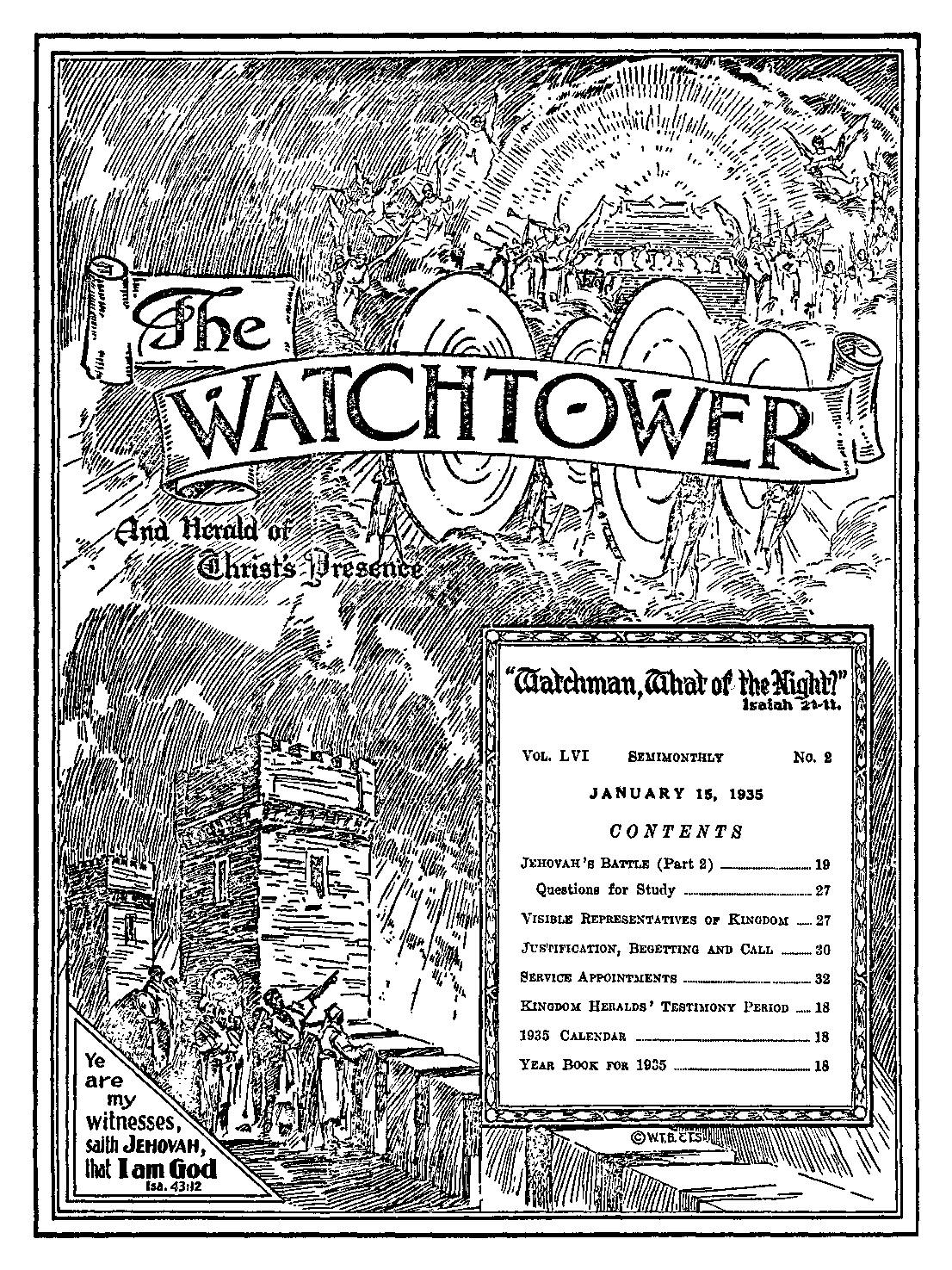
The Watchtower, January 15, 1935
Download: PDF — The Watchtower, January 15, 1935
KINGDOM HERALDS’ TESTIMONY PERIOD
This designates the nine days, February 2-10, in which the publishers of Jehovah's kingdom will unite their forces and put forth concentrated effort in getting a particular message into the hands of the people. In this case the message is that contained in the new book Jehovah; and with this testimony period this book is released to the public. It goes without question that every one who has taken the new name "Jehovah's witness" will want to have a full part in distributing this book, and every Jonadab who has taken his stand on the side of Jehovah will want to have as full a share therein as possible. Such appreciative ones will begin at once to consider the matter and to make all due preparations, as ordering supplies, arranging time and territory.
1935 CALENDAR
You will be especially pleased with the Society’s calendar for 1935. Full of action and graphically representing the astounding victory Jehovah will gain for his name’s sake, the calendar picture is most expressive of the year’s text and sets forth, too, the part that Jehovah’s witnesses must perform nil through 1935 and clear through to the glorious finish. The calendar also bears a letter from the president and naming the special service periods for the year. These particular service periods, both regional and world-wide, are also indicated on the calendar date pad. Order from the Society, the Brooklyn office or branch office, enclosing remittance with order, at 25c each, or five for $1.00 if sent to one address. Orders may be grouped and forwarded through the company director or sharpshooter.
YEAR BOOK FOR 1935
The prophet Ezekiel regularly measured the waters flowing out from the temple. The Society does likewise, and here announces the issue of the Year Book for 1935. This contains the president’s annual report, describing the purposes of the Society and briefly but comprehensively reviewing the activities, the experiences and the work accomplished during the service year just past by Jehovah’s witnesses and Jonadab brethren in the various countries where the Lord has placed them. Also the 1935 year text, with appropriate comment, is given, and daily texts and comments for your refreshment and instruction each day of the year. Only a limited edition is being printed; hence the Year Book is offered at 50c a copy. Remittance to cover should accompany order, forwarded to the Brooklyn office or branch office. Groups of Jehovah’s witnesses and Jonadabs should combine orders and send through local service director or sharpshooter.
Vol. LVI
January 15, 1935
No. 2
JEHOVAH’S BATTLE
"For Jehovah and for Gideon."–Judg. 7:18, A.R.V.
PART 2
JEHOVAH is great in mercy toward those who sincerely love him. Even though his covenant people have turned to folly, if they repent and earnestly seek the face of the Lord he will give heed to their penitent cries. The Israelites had turned to folly, but there were some among them who had not bowed the knee to Baal, and Gideon was one of such. Doubtless Gideon had cried unto the Lord, asking that Israel might be delivered from the hand of the enemy, and now God had sent his angel to Gideon and disclosed his purpose to save Israel. The words of Jehovah’s prophet here seem to be appropriate for Gideon to speak: "Shew us thy mercy, O Lord, and grant us thy salvation. I will hear what God the Lord will speak: for he will speak peace unto his people, and to his saints: but let them not turn again to folly."–Ps. 85:7, 8.
2 From 1878 to 1918 many persons came to a knowledge of the truth that was then revealed, and out from that large company came God’s remnant. At all times the enemy has harassed the faithful ones, and their persecution reached a point of climax in 1917 and 1918. When the Lord came to the temple of Jehovah end the faithful learned of that great truth and began to appreciate it, they were glad and there came upon them great peace. They needed strength, and God provided it. "The Lord will give strength unto his people; the Lord will bless his people with peace." –Ps. 29:11.
3 This does not mean that God’s anointed people will be spared from persecution and the assaults from the enemy, but it does mean that in all their trials and amidst all their persecution those who trust in Jehovah will have peace of mind and joy of heart. "Thou wilt keep him in perfect peace, whose mind is stayed on thee: because he trusteth in thee."–Isa. 26:3.
4 Mark that this promise is conditionally provided for those who keep the mind stayed upon and trust Jehovah. That means to learn his purpose and to be diligent in obeying his commandments. As the day of battle approaches, the trials will be greater, but the faithful will remember that the battle is Jehovah’s and that he cannot be defeated. With the coming of unity in the church there must be peace within God’s organization, and hence his prophet foretold the same thing in these words: "I was glad when they said unto me, Let us go into the house of the Lord. Our feet shall stand within thy gates, O Jerusalem. Pray for the peace of Jerusalem: they shall prosper that love thee. Peace be within thy walls, and prosperity within thy palaces. For my brethren and companions’ sakes, I will now say, Peace be within thee." –Ps. 122:1, 2, 6-8.
5 When the temple is cleansed no one will be permitted to be therein and remain and provoke strife. Why, then, is there today found amongst some of the companies of Jehovah’s witnesses evidence of confusion and strife? We may be sure that the ones provoking the controversies, if ever in the temple at all, will not remain very long. The King’s angels guarding the temple doors will see to it that the workers of lawlessness will be put out immediately and that no one shall enter and stand there save he that has clean hands and a pure heart. (Ps. 24:3-5) There must be and will be peace within God’s organization although the enemy continues with increased fury to assault and persecute the faithful. Peace of mind and prosperity will be the portion of those who fully and unselfishly devote themselves unto the Lord.
6 Discovering that he had been talking with an angel of the Most High, Gideon was greatly disturbed in mind and he needed to have his fears dispelled, and God provided the needed peace: "And the Lord said unto him, Peace be unto thee; fear not: thou shalt not die." (Judg. 6:23) The angel had withdrawn from Gideon’s sight at this point, but probably Jehovah still used the angel to speak to Gideon, and the message from Jehovah was that Gideon should not die, but should have peace. Call to mind how Jehovah began to assure his people through Christ Jesus following the great tribulation of 1917 and 1918 and to give them assurance that they should live to have a part in his work. Learning this the remnant responded in the language of the psalmist: "I shall not die, but live, and declare the works of the Lord. The Lord hath chastened me sore: but he hath not given me over unto death. Open to me the gates of righteousness: I will go into them, and I will praise the Lord." (Ps. 118:17-19) The remnant sec that the presence of Jehovah’s great Priest, Judge and Executioner at the temple does not mean adverse judgment and injury to them, but does mean prosperity and greater fields for service and more extended opportunities to prove their integrity toward the Most High.
7 Gideon, having his fears dispelled, proceeded with the work according to the will of God: "Then Gideon built an altar there unto the Lord, and called it Je- hovah-shalom: unto this day it is yet in Ophrah of the Abiezrites." (Judg. 6:21) The marginal reading of the words "Jehovah-shalom" is "The Lord send peace". The American Revised Version and the Rotherham marginal reading is "Jehovah is peace". Jehovah God had strengthened Gideon’s faith and given him peace. Likewise after 1918 Jehovah through Christ Jesus strengthened the faith and confidence of his people, and in such confidence of peace and prosperity from on high the faithful servant class, by the grace and strength of the Lord, began to build an organization called by the Lord’s name and through which they might make offerings unto him in true worship and in righteousness. To this day the organization still stands and the "peace of God [Jehovah- shalom] " is upon it, and sacrifice and praise to the Lord continue within and by that organization.– Heb. 13:15; Mal. 3:1-4.
8 Then Jehovah gave a further message to Gideon: "And it came to pass the same night, that the Lord said unto him, Take thy father’s young bullock, even the second bullock of seven years old, and throw down the altar of Baal that thy father hath, and cut down the grove [the Asherah] that is by it." (Judg. 6; 25) The record does not say that the angel returned to Gideon, and we know that the Lord could have delivered the message by the angel and without the angel’s again appearing to Gideon. The fact that Gideon was directed to begin his judgment work by sacrificing his father’s bullock is in line with the truth that the judgment proceedings by Christ Jesus, the great Judge anointed by Jehovah, must begin and do begin at the house of God. Why should Gideon first throw down the altar of Baal? The answer is that, had that altar been standing when the victory came to Gideon, the claim doubtless would have been made by some that the victory was the result of Baal’s favor, and that would be a further reproach on Jehovah’s name. "1 have declared, and have saved, and I have shewed, when there was no strange god [as Baal] among you: therefore ye are my witnesses, saith the Lord, that I am God." (Isa. 43:12) Baal's altar was then and is now the "table of devils". The covenant under which Gideon had been born required the destruction of images of false gods. (Ex. 23:24; Deut. 7: 5, 25) Gideon must be wholly for Jehovah ; hence he must destroy that altar.
9 Christ Jesus, the Greater Gideon, makes no compromise with the Devil, but boldly and uncompromisingly declares Jehovah’s message. All the members of the ‘elect servant’ class must likewise come out boldly, exclusively and undividedly on God’s side. Unfaithful ones frequently say to the faithful and bold: "Why say so much about the Devil and his organization? The brethren of older days and experience do not say much, if anything, about the Devil. Why not just preach only the message of love of God?" The Devil has attempted to lull to sleep those who have covenanted to do the will of God. The faithful and true in this day must be bold and unequivocal in the declaration of the truth. To his people the admonition of the Lord is: "And what agreement hath the temple of God with idols? for ye are the temple of the living God; as God hath said, I will dwell in them, and walk in them; and I will be their God, and they shall be my people. Wherefore come out from among them, and be ye separate, saith the Lord, and touch not the unclean thing; and I will receive you." (2 Cor. 6:16, 17) This is the day of the vengeance of our God, which must be boldly declared by his witnesses: "To proclaim the acceptable year of the Lord, and the day of vengeance of our God; to comfort all that mourn." (Isa. 61:2) "Herein is our love made perfect, that we may have boldness in the day of judgment; because as he is, so are we in this world." – 1 John 4:17.
10 The grove, or Asherah, constituted the wooden images of the female deity Ashtoreth, the companion of Baal, and therefore stood for the Devil’s organization. (Judg. 2:13; 3:7) Through Moses Jehovah had said to the Israelites in Moab: "Thou shalt not plant thee a grove of any trees near unto [R.V., an Asherah of any kind of tree beside] the altar of the Lord thy God, which thou shalt make thee. Neither shalt thou set thee up any image [R.V., pillar], which the Lord thy God hateth." (Deut. 16:21,22) To be true to his name and faithful to Jehovah God Gideon must at the beginning of his work hew down (‘fell’) the wicked grove or city of Asherah; likewise when Christ Jesus began judgment at the temple he, through his visible representatives on the earth, boldly declares against the wicked organization of Satan and casts the wicked thing to the ground.
11 The true worship and service of Jehovah must be upon his "Rock" or organization and must be done orderly and in the way Jehovah orders and directs. Hence the command to Gideon was: "And build an altar unto the Lord thy God upon the top of this rock [R.V., stronghold], in the ordered place [R.V., in the orderly manner], and take the second bullock, and offer a burnt sacrifice with the wood of the grove which thou shalt cut down." (Judg. 6: 26) The service of Satan must be entirely and utterly displaced with the service of Jehovah. After the coming of the Lord Jesus to the temple, and the beginning of judgment, there his faithful followers on earth began to see that they had many things in connection with the service of the Lord which they had brought along with them from Babylon, that these were filthy garments, and that they must be put away. In the year 1921, for the first time there was put into use by God’s people a year- and weekly-text calendar, and the theme thereof was "Jehovah’s Works", and since then it has been seen that Jehovah is the all-important One and that the vindication of his name is the paramount issue. It was a real test to Gideon to obey the order and to take the wood of the grove [Asherah] and burn it, and upon it sacrifice his father’s bullock. It was a case of loving Jehovah God more than father, brothers, or any earthly relation or thing. Jehovah’s covenant must be kept, and his orders obeyed. It has been a real test upon the remnant to break away from the habits or practices of their earthly rulers and of their so-called "spiritual fathers" and to boldly advance the service of God. These tests the faithful must bravely meet and faithfully perform in obedience to the commandments of God.–Matt. 10:37.
12 Gideon’s action is a criterion to guide all who arc truly devoted to Jehovah: "Then Gideon took ten men of his servants, and did as the Lord had said unto him; and so it was, because he feared his father’s household, and the men of the city, that he could not do it by day, that he did it by night." (Judg. 6:27) Ten is a symbol of earthly completeness. Shortly following 1914 Jesus cast down Satan to the earth; then he committed to the "faithful and wise servant" class, the remnant collectively, the whole, that is, all, of the testimony of Jesus Christ, and which is here symbolically pictured by the number ten, and these to whom the testimony was committed must cast down and openly and publicly reject all forms and ceremonies employed by Satan’s organization, and which ‘soiled garments’ were had by those faithful ones when they came out of Babylon. The latest idol is the League of Nations, the substitute for the kingdom of God, the "image of jealousy", the abominable thing, and which must be cast down. (Ezek. 8:5) Gideon did not fear that injury would be inflicted upon him by the members of his father’s house, but he feared that they would interfere with his work if he did it in the daytime; therefore he did it by night. He was not trying to hide himself and his work, but that he might get the job done without interruption or interference. He did it quietly. He could not hide or avoid the responsibility for the destruction of the idol of Baal, because all would know that he did it. He surprised the Baal worshipers and showed them that in the absence of the worshipers the idol was a helpless and vain thing. God’s remnant, under Christ, have taken a like course of doing a certain work of destroying idols and then exhibiting to the foolish and to the opposers that these former, false ceremonies are idol worship and are in vain.
13 When daylight came, Gideon had finished the job: "And when the men of the city arose early in the morning, behold, the altar of Baal was cast down, and the grove [Asherah] was cut down that was by it, and the second bullock was offered upon the altar that was built." (Judg. 6:28) In a like secret way God's faithful people got some work done during the time of their retirement in the wilderness condition for 1,260 days. (Rev. 12:6,14) During those days God’s faithful people were sheltered by the darkness of the night ‘from the face of the dragon’ and his earthly seed. During those days the Lord, through The Watchtower, gave to his people the correct view of Satan, "the beast," and the "image of the beast" and cast these things to the ground. (The Watchtower, January 1, 1921) Gradually these truths came to the light of day so that the people could know them. Then "Christendom", that is, the Baal worshipers, observed that Jehovah’s witnesses are challengers of Satan and his organization. The people have been plainly told that deliverance cannot come to them through the League of Nations or any other worldly scheme, such as the Catholic Guild Prayer Movement, launched by the Catholic hierarchy and endorsed by the "distinguished men" of the nation. They are told that their deliverance can come only through Christ Jesus and his kingdom.
14 Next morning the Baal worshipers inquired who had done these things, in destroying Baal’s image. The leaders in "Christendom" also ask one another why Jehovah’s witnesses are so much against them and why they are declaring against them and throwing them down: "And they said one to another, Who hath done this thing? And when they inquired and asked, they said, Gideon the son of Joash hath done this thing." (Judg. 6:29) Those of "Christendom" today who make such inquiries and who try to learn the answer are told that Jehovah’s witnesses are diligent in their work because Jehovah is God and Christ is King, and that the kingdom of God under Christ is the sole hope of humankind, and that God through Christ will destroy the Devil’s organization, and that he has sent Christ Jesus the Greater Gideon to do that work of destroying Satan’s organization to the end that the people might be relieved and God’s name vindicated. They are further told that Jehovah’s witnesses must declare these truths because God has commanded them so to do. The Resolution of November 27, 1921, adopted and put forth at Washington, D.C., and addressed to the "Conference on Limitation of Arms", was to that very effect. Since 1925 "Christendom" has been repeatedly informed that Satan has been cast out of heaven to earth, and that it has been done by Christ Jesus the Greater Gideon, and now "Christendom" has no excuse to be ignorant of that fact.
15 To be sure, the devil worshipers would want to kill Gideon for interfering with their god Baal: "Then the men of the city said unto Joash, Bring out thy son, that he may die: because he hath cast down the altar of Baal, and because he hath cut down the grove that was by it." (Judg. 6:30) The same wicked spirit is the reaction of "Christendom" to Jehovah’s witnesses because of their stand and their activities. These Baal worshipers call upon God to destroy Jehovah’s witnesses and their work. Even to this day those who were once of the "elective elder’’ class, and those who are of the "man of sin’’ group, are indignant toward Jehovah’s witnesses and subtly seek to have them destroyed. They ask to have Jehovah, whom Joash, Gideon’s father, foreshadowed, remove his protection from his witnesses that the opposers might vent their wrath on them and put them to death.
16 Joash did not yield to the entreaties of the Baal worshipers, but took his stand against them: "And Joash said unto all that stood against him, Will ye plead for Baal? will ye save him? he that will plead for him, let him be put to death whilst it is yet morning: if he [Baal] be a god, let him plead for himself, because one hath cast down his altar." (Judg. 6:31) Here is proof that Joash in this prophetic drama pictured or stood for or in the place of Jehovah God, because his argument is exactly in line with Jehovah ’s statement at Deuteronomy 32:37,38. It resembles the argument of Elijah against Baal recorded in 1 Kings 18: 27. The fact that Baal had been unable to protect himself against the destruction of his wooden image was proof that he is no god, and Joash in effect told the men so. His instructions to them to let Baal plead for himself were in full accord with Jehovah’s law. (Deut. 17:2-7; 13:6-10) This also shows that Joash (meaning "Jehovah-fired") represented Jehovah, the Father of the Greater Gideon, who is Christ Jesus. To be sure, Jehovah put that argument into the mind of Joash, because it forms a part of the prophetic drama. Likewise it was the Lord who caused to be prepared and promulgated the Resolution, that is, "The Challenge," by the faithful servant class, which was done at Cedar Point in 1922 and which was based upon Isaiah’s prophecy. Jehovah says to the Devil and his representatives: "Let them bring them forth, and shew us what shall happen : let them shew the former things what they be, that we may consider them, and know the latter end of them; or declare us things for· to come. Shew the things that are to come hereafter, that we may know that ye are gods; yea, do good, or do evil, that we may be dismayed, and behold it together. Behold, ye are of nothing, and your work of nought [margin, worse than nothing] : an abomination is he that chooseth you." (Isa. 41: 21-24) The remnant must be the bold and unqualified challengers of the Devil’s crowd.
17 Certainly the position of Joash shows that none of God’s people should argue for the enemy of God. In this day those who oppose the work being done by the Greater Gideon and his remnant thereby take the side of the Devil and they must do the arguing for the Devil and his henchmen. Only the Devil’s crowd could raise any objection to the active work of Jehovah’s witnesses, and no one fully devoted to Jehovah could interfere with the work of the remnant which they are now doing. Let the Devil and his seed plead for his own. Those now opposing the work being done under the Lord’s direction and against Satan thereby spell their own destruction. Fear of offending any part of the Devil’s organization must be completely put on the side, and the witnesses of the Lord must declare for God and his kingdom, and the vengeance of our God against the wicked one.
18 It was on that occasion, when Gideon showed his faith and confidence in God and when his father Joash took the position he did, that the name of Gideon was changed: "Therefore on that day he called him Jerub- baal, saying, Let Baal plead against him, because he hath thrown down his altar." (Judg. 6:32) The name "Gideon" means "tree feller" or "warrior". His name was changed to " Jerubbaal", meaning "Let Baal plead for himself"; hence showing that he was a witness against the Devil. The new name meaning "Let Baal plead for himself" clearly implies a witness for Jehovah and against the Devil, and to such witness the Devil has no power to successfully plead. Joash’s calling his son by a new name strongly suggests the giving of the new name by Jehovah to his faithful witnesses, who by reason of being in Christ are a part of the Greater Gideon. "Let all the nations be gathered together, and let the people be assembled : who among them can declare this, and shew us former things? let them bring forth their witnesses, that they may be justified; or let them hear, and say, It is truth." (Isa. 43:9) "For I beheld, and there was no man; even among them, and there was no counsellor, that, when I asked of them, could answer a word. Behold, they are all vanity; their works are nothing: their molten images [such as Baal] are wind and confusion." (Isa. 41:28,29) The challenge to Baal in modern times reached a climax in the adoption and in the promulgation of the message and resolution at Detroit, August 5, 1928, declaring for Jehovah and against Satan. Surely the Lord through his angel directed the preparation and the proclamation of that message, and thus showed that Jehovah’s witnesses are pursuing the right course in boldly testifying against Satan and his wicked hosts.
19 Stunned by the rebuke God had given them by the hand of Gideon, the enemy combined to bring about the destruction of Gideon and those who were with him: "Then all the Midianites and the Amalekites and the children of the east were gathered together, and went over, and pitched in the valley of Jezreel." (Judg. 6:33) There was no king of Israel at that time, but all the enemies of Israel, under the direction of Satan, united in a common cause of wickedness. They consorted together, and then, crossing the Jordan river, the enemy assembled in the valley of Jezreel, prepared for battle against Israel. That valley extends westward from the Jordan and forms the eastern entranceway to the plains of Esdraclon and the valley of Megiddo. The city of Jezreel stood at the western end of the valley of Jezreel. It belonged to the tribe of Issachar. (Josh. 19:17,18) There several years later Naboth was foully murdered in order to grab his vineyard, and there later the dogs licked the blood of King Ahab, the murderer, from his chariot. Ahab’s son Jehoram was slain at the same place, and there also old Jezebel was killed by the order of Jehu, and there before the gate of that city, the seventy sons of Ahab having been slain by Jehu’s order, their heads were piled up for Jehu to behold. "Jezreel" means "God’s seeding place", and thus suggests the great fertility of the valley. It was now about the conclusion of the harvest time and Gideon was threshing the wheat crop. This seems to point to the prosperity Jehovah has given to his remnant as described in the prophecy. (Ezek. 36:7-15, 29-38) Now Gog and his allies have consorted together and formed a conspiracy against Jehovah’s remnant, pictured by Gideon at this point. (Ezek. 38:10-16) The lust of the enemy is for spoil and murder, and to this end the enemy joined together in a common cause. (Ps. 83:1-6) The work of Jehovah’s witnesses, under the leadership of Christ Jesus, now prospers, however, and even in this present time of great world depression the witness work continues to prosper, notwithstanding the attacks of the enemy hordes in their effort to destroy Jehovah’s remnant. (Judg. 6:5) Since 1918 Satan and his field marshal Gog have gathered together all nations and are marching them on to the battle of the great day of God Almighty. (Rev. 16:14) The day of battle draws near, and the remnant are shouting for God and for his Vindicator.
20 Jehovah was making this picture and was directing Gideon, without a question of doubt. "But the spirit of the Lord came upon [margin: clothed] Gideon, and he blew a trumpet, and Abiezer was gathered after him." (Judg. 6:34) The coming of the Lord’s spirit upon Gideon is paralleled in the outpouring of the holy spirit described by Jehovah’s prophet. (Joel 2:28,29) The second outpouring of the holy spirit began with 1922. (Acts 2:16-18) That was the time when the 390 years and the 40 years of Jehovah’s bearing with "Christendom’s" iniquity had expired and after the siege of "Christendom" as a part of Satan’s organization must begin.–Ezek. 4:1-8; Vindication, Book One, page 57.
21 The day of battle is approaching, and Jehovah, maneuvering his forces as well as the enemy’s, calls upon the enemy to draw his weapons of war, and the blowing of the trumpet gives him notice. The sounding of the trumpet of the Lord summons all of his faithful ones to the fight: "And he shall send his angels with a great sound of a trumpet; and they shall gather together his elect from the four winds, from one end of heaven to the other." (Matt. 24: 31) "And it shall come to pass in that day, that the great trumpet shall be blown, and they [the remnant] shall come which were ready to perish in the land of Assyria [1917-1918 World War conditions], and the outcasts in the land of Egypt, and shall worship the Lord in the holy mount at Jerusalem."–Isa. 27:13.
22 Gideon’s trumpet was an alarm to the people to rally and prepare for war. It was in 1922 that Christ Jesus, the Greater Gideon, caused his angel to sound the first of the seven trumpets. (Revelation 8; Light, Book I, pages 99-113) It is stated that Abiezer, which means "father of help", was called and was gathered unto Gideon. Likewise now those of "father-helpt", that is, those helped by Jehovah, have gathered unto Christ, the Greater Gideon, and have turned their backs on "Christendom" and on all things connected with Satan’s organization. Those of Gideon’s own household took their stand with him; and so now all who look to God for help take their stand on the side of Christ Jesus, the great Vindicator.–Judg. 8:18-20.
23 Gideon assembled the northern tribes for war: "And he sent messengers throughout all Manasseh; who also was gathered after him: and he sent messengers unto Asher, and unto Zebulun, and unto Naphtali; and they came up to meet them." (Judg. 6: 35) He sent messengers to those of his own tribe, Manasseh, and to the tribes of Asher, Zebulun and Naphtali, and these he gathered unto him. Later the tribe of Ephraim was called to the colors. (Judg. 7: 24, 25; 8:1-3) From the four assembled tribes the army of Gideon was finally selected that put the enemy to flight, the tribe of Ephraim joining in the fight later on.
24 The men of the four tribes encamped about Gideon, but Gideon still seemed to have some doubt, and he asked God to give him some further proof that the Most High would support him as his servant and deliver Israel: "And Gideon said unto God, If thou wilt save Israel by mine hand, as thou hast said." (Judg. 6:36) This action on Gideon’s part furnishes no reason for criticism of Gideon. It is true the angel of the Lord had visited Gideon and had given him proof that God was with him, but it pleased the Lord to give Gideon further proof, Jehovah well knowing that a very severe test would come to Gideon later, when his army was whittled down to 300 men, and God was willing to now furnish cumulative evidence assuring Gideon that he still was in the favor of the Most High. That such is the rule followed by Jehovah toward his creatures is shown by his giving cumulative evidence to those who are his faithful witnesses today and hence on his side. The opposers criticize The Watchtower for having called attention time and again to the presence of the Lord Jesus at the temple and the act of vindicating Jehovah’s name, but be it known unto all that Jehovah has made the rule of "line upon line" and proof upon proof, to the end that no one may have excuse to say that he did not know and no one would have an excuse for being inactive in the Lord’s service. Otherwise stated, Jehovah emphasizes the importance of certain great truths by repeating them time and again. Those who now love the Lord rejoice in the continued unfolding of prophecy which teaches them the stupendous truths so important and which they now so much need. They delight to find these repeated and supported in many parts of the prophecies, and thus they have an assurance doubly given from the Lord that they are on his side.
25 The desire to have full assurance led Gideon to propose a test, and therefore he said to the Lord: "Behold, I will put a fleece of wool in the floor; and if the dew be on the fleece only, and it be dry upon all the earth beside, then shall I know that thou wilt save Israel by mine hand, as thou hast said." (Judg. 6:37) A fleece of wool would be the entire covering of a sheep, the wool being still on the skin, and would speak of a slain animal, picturing the Lamb of God. The sheep skin Gideon spread upon the threshing floor, a floor with a hard, dry surface. This place, being near the winepress and being a threshing floor, symbolically speaks of threshing and crushing of the enemy by the Greater Gideon. The test of Gideon proposed that the dew come upon the fleece only, and this shows it must be done by Jehovah, because men cannot make dew. God can make dew, and hence Gideon can properly place a test on God. "Who hath begotten the drops of dew?" (Job 38:28) "By his knowledge . . . the clouds drop down the dew." (Prov. 3:20) "The king’s . . . favour is as dew upon the grass." (Prov. 19:12) The time of this test was in the dry season, and the latter rains were entirely gone from the land. It was the time of dew, symbolizing also a season or time of blessing. (Gen. 27:39; Hag. 1:10; Deut. 33:28) It being the season of no rain, the dew had brought refreshment and reviving power. (Hos. 14:5; Mic. 5:7) Dew was also used as a symbol of the "oil of joy". (Ps. 133:1-3) "The fleece" employed in the test pictured the Lord Jesus Christ, "a Lamb as it had been slain." (Rev. 5:6) The dew descending upon the fleece would picture the Lord Jesus Christ, at 1914, as receiving the joy accompanying his commission from Jehovah to proceed with the work of vindicating his name. For a long period Jesus had waited, and now the command and commission had come to proceed with his great work, and that was a thrilling joy to him.
26 The request of Gideon to the Lord was that he would send the dew upon the fleece and that the ground beside it be dry. The dry ground round about the fleece well pictures Jehovah’s faithful servants, particularly from 1914 to 1918. It was in 1914 that Christ Jesus was enthroned; in 1918 he came to the temple and gathered unto himself those then found faithful. Those faithful ones sleeping in death had no reviving during that period of time, but must wait a "little season" in their graves. (Rev. 6:11) During that short period of time those faithful ones alive on the earth were trodden down and beaten like a threshing floor, and they were thus symbolized by the ground that was dry and which surrounded the fleece. (Rev. 11: 2) "Thus saith the Lord, For three transgressions of Damascus, and for four, I will not turn away the punishment thereof; because they have threshed Gilead with threshing instruments of iron." (Amos 1:3) The ‘dew upon the fleece’ pictured the Lord Jesus receiving his joy; while at the same time the dry ground around the fleece pictured his faithful ones who had not yet entered into the joy of the Lord.
27 If the test should prove right as Gideon had requested of Jehovah, "then," said he, "shall I know that thou wilt save Israel by mine hand, as thou hast said." In 1914 the Greater Gideon, Christ Jesus, received from Jehovah the joy-inspiring command to go forth with authority and rule in the midst of the enemy. (Ps. 110:2) Jesus then knew that Jehovah would vindicate His name and save by his hand those who put themselves wholly under the command of the Lord.
28 God granted Gideon’s request: "And it was so: for he rose up early on the morrow, and thrust the fleece together, and wringed the dew out of the fleece, a bowl full of water." (Judg. 6:38) The antitypical beginning of the fulfilment of that prophetic sign was in 1914, and Jehovah’s faithful remnant, by the grace of Ged, were permitted to see and understand it first in 1925, with the publication of the September 15 (1925) 'Watchtower, explaining the 110th Psalm under the title "The King in Action". Then it was that the remnant began to appreciate the truth that Jesus Christ had waited a long period of time to receive the "dew", that is, his joyful commission to act. As Gideon "wringed ... a bowl full of water" out of the fleece, even so Christ Jesus was given joy in a copious quantity, that is to say, a full measure of joy by the fact that he was now to act to vindicate his Father’s name. His cup of joy ran over. In commissioning him to go forward on this wonderful work of vindication Jehovah said to him: "Thou art fairer than the children of men; grace is poured into thy lips: therefore God hath blessed thee for ever. Gird thy sword upon thy thigh, 0 most Mighty, with thy glory and thy majesty. And in thy majesty ride prosperously because of truth and meekness and righteousness ; and thy right hand shall teach thee terrible things. Thine arrows are sharp in the heart of the King’s enemies; whereby the people fall under thee. Thy throne, O God, is for ever and ever: the sceptre of thy kingdom is a right sceptre. Thou lovest righteousness, and hatest wickedness: therefore God, thy God, hath anointed thee with the oil of gladness above thy fellows."–Ps. 45:2-7.
29 Then Christ Jesus invited his faithful followers, who upon examination were found to be faithful, to "enter . . . into the joy of thy lord". (Matt. 25:21) Thereafter Jesus Christ could well say in the prophetic language to the faithful: "Open to me, my sister, my love, my dove, my undefiled [freed from Satan’s organization, and covered with the robe of righteousness] : for my head is filled with dew [joy], and my locks with the drops of the night." (Cant. 5:2) Now Jesus Christ would share his great joy with those faithful standing with him.
30 If we keep in mind that this is a prophetic picture made and written long ago for the comfort and assurance of the remnant (Rom. 15: 4), then we can better appreciate why there must be another or second test. "And Gideon said unto God, Let not thine anger be hot [R.V., be kindled] against me, and I will speak but this once: Let me prove, I pray thee, but this once with the fleece; let it now be dry only upon the fleece, and upon all the ground let there be dev.’.’’–Judg. 6:39.
31 That prophetic picture was telling of things that must come to pass in the future; hence this second test, Gideon here pictured the remnant of God taken into the family of God under Christ Jesus, and the picture was made to reinforce and strengthen the faith of these devoted ones. It is hardly probable that Gideon originated the test in his own mind, but that these tests were suggested and made by the angel of the Lord. It is certain that the tests were according to the will of God, since God granted Gideon’s request. To establish to a certainty that the first test was not due to a trick of nature, as some might claim, the second test was arranged and made. The petition of Gideon for a second test shows that Christ Jesus does not make petition for his own gratification, but does so that the will of his Father might be done and that His name might be vindicated, and that his faithful followers, the remnant, might be fully assured. The request of Gideon that in the second test the fleece be left dry and that the ground round about the fleece be made wet with dew pictures Christ Jesus’ asking Jehovah that his faithful and approved followers might now enter into his joy and be made one with him and participate in the vindication of Jehovah’s name. (Eph. 1:10) It is in line with the truth Jesus uttered before his crucifixion: "And for their sakes I sanctify myself, that they also might be sanctified through the truth. Father, I will that they also, whom thou hast given me, be with me where I am; that they may behold my glory, which thou hast given me: for thou lovedst me before the foundation of the world." (John 17:19,24) In these "last days", when there is great stress upon all mankind, the remnant rejoice to see the fulfilment of these prophetic pictures, and this is an assurance to them that they are on the side of Jehovah; and therefore they arc made doubly strong. God granted Gideon’s request for the second test. "And God did so that night: for it was dry upon the fleece only, and there was dew on all the ground." (Judg. 6:40) Now as to the antitypical fulfilment of this part of the prophetic picture. It was in 1918 that the Lord Jesus appeared at the temple of Jehovah. The first antitypical fulfilment of this part of the picture was that of raising from the dead the faithful sons that slept in death. Under inspiration of the holy spirit the apostle Paul had testified that the faithful must wait in death until the appearing of the Lord Jesus at the temple, and that then such would receive the crown of life and enter fully into the joy of the Lord. (2 Tim. 4: 8; 2 Thess. 2:1) The resurrection of such faithful ones, as Paul, must precede the gathering of the faithful remnant yet remaining on the earth. (1 Thess. 4:14-17) Prior to his coming to the temple the Lord Jesus had been ushered into the "joy of Jehovah". (Neh. 8:10, A.R.V.) Into this joy he was ushered when enthroned and sent forth to rule, and this is pictured in the second test by only the fleece’s being dry. It was after the Lord had cast Satan out of heaven, and hence after he had received and entered into the joy of Jehovah, that he gathered the faithful and approved ones to the temple and they entered into the joy of the Lord. In the second test the dew was on all the dry ground round about the fleece. The ground wet by the dew here pictured the faithful and approved remnant class, showing that now they had entered into the "joy of the Lord" the beginning of which took place in 1922. In order that this point may be more clearly understood it is well here to repeat that the dew is a symbol of the joy of the Lord and of the refreshing blessing that comes through Jehovah. The dew upon the fleece while the ground about it was dry symbolized the Lord Jesus himself entering into the joy of Jehovah; and that was in the first test. In the second test the dew was upon the ground and the fleece was dry, thus picturing that the faithful ones gathered to the temple and anointed of the Lord had entered into the joy of the Lord. The divine approval of the faithful servant class was then confirmed upon them by the pouring out of God’s spirit upon all such flesh entering into the joy of the Lord Jesus Christ. It was there that the unifying process began in a special way. The dew of joy of dwelling together in unity began to distill upon Christ’s true brethren on earth. Those really and completely devoted to God have continued and do now continue to rejoice in the unity and harmonious action of those gathered at the temple. "Behold, how good and how pleasant it is for brethren to dwell together in unity!"–Ps. 133:1.
32 This unity reached a climax with the cleansing of the temple, and those who entered into and have remained in the temple have continued in this state of unity in Christ. That unity and harmonious action of the faithful remnant was pictured by the words of the psalmist, to wit: "It is like . . . the dew of Hermon, and as the dew that descended upon the mountains of Zion [even as he had commanded it in Gideon’s test] : for there the Lord commanded the blessing, even life for evermore." (Ps. 133:1-3) With this unity and harmonious action God has continued to send his refreshing truths to his people. When God fed his covenant people in the wilderness, first the "dew fell upon the camp" at night and then "manna fell upon it". (Num. 11: 9) Even so with the coming of the unity of the brethren of Christ, as pictured by the dew on the dry ground, there fell the heavenly bread of truth which the Lord has revealed and given to his people and which continues to give strength and hope to those who hold fast their faith and confidence with Christ Jesus.
33 The cleansing of the temple having taken place and the unity in Christ Jesus having come, then why are there certain companies of professed followers of Christ Jesus who have trouble among themselves and some among whom continue to provoke controversies and strife? There is but one answer to that question, and that is that the ones who cause dissension and strife and divisions amongst the brethren are not in the temple and do not appreciate the food that the Lord is giving to his people. If ever in the temple at all they have been ousted by the angel of the Lord. Those who still have and manifest the "elective elder’’ spirit, which is the spirit of "Rule or ruin", certainly cannot be included in the class mentioned by the psalmist as those that dwell together in unity. One wholly devoted to God and his kingdom does not desire to boss or to arrogantly rule over his brethren, but he delights to see his brethren have some part in the service and to encourage them to participate therein. The faithful ones do not seek the approval and honor of men, but they are diligent to do the will of God that they might have his approval and the approval by the Lord Jesus Christ.
34 It seems quite probable that there have been amongst the various companies in line for the kingdom those who have treated carelessly and with indifference the spiritual food the Lord has set before his people, and hence they are ignorant of God’s gracious provision for his faithful ones. The really zealous ones believe that God and Christ Jesus are the only teachers and that they are teaching the anointed by sending the message of truth to them through the Watch Tower publications, and believing this they are diligent to feed upon such precious truths and to help others to understand them. Those who thus do continue to grow strong in the Lord and in the power of his might. If a man thinks himself so important that he must interpret the Scriptures in his own way and put his interpretation before others for them to follow, and thus assumes to be a teacher, he is proud and knows not anything, and is certain to be found among those who cause controversies, confusion and strife. The Lord Jesus is the Teacher at the temple, and the truths that he sends to his people are the victuals upon which the faithful must and will feed. "If any man teach otherwise, and consent not to wholesome words, even the words of our Lord Jesus Christ, and to the doctrine which is according to godliness, he is proud, knowing nothing, but doting about questions and strifes of words, whereof cometh envy, strife, railings, evil surmisings, perverse disputings of men of corrupt minds, and destitute of the truth, supposing that gain is godliness: from such withdraw thyself." (1 Tim. 6:3-5) The faithful and true witnesses of Jehovah will not seek to do injury to one another, but will pursue the way of godliness pointed out for them by the Lord, and will thereby continue in his joy and in doing his will. "But godliness with contentment is great gain."–1 Tim. 6: 6.
35 The true remnant now rejoice to be a part of the Lord’s "threshing floor" or "threshing instrument." with which the Lord God threshes Satan’s organization. Such representatives do not fight among themselves, but they delight to fight against the enemy, and this they do by diligence and zeal in proclaiming the name of the King of eternity and of his anointed Ruler of the world, and the blessings he will bring. Christ Jesus is the "threshing floor" or means of threshing Satan’s crowd, and the faithful remnant are with him and hence a part of that threshing floor. "And, behold, here cometh a chariot of men, with a couple of horsemen. And he answered and said, Babylon is fallen, is fallen; and all the graven images of her gods he hath broken unto the ground. O my threshing [Babylon], and the corn of my floor: that which I have heard of the Lord of hosts, the God of Israel, have I declared unto you." (Isa. 21:9,10) The joy of threshing Satan’s organization and vindicating Jehovah’s name fills the heart of the Lord Jesus and overflows, and likewise is the joy and strength of the remnant. (Neh. 8:10) The faithful remnant have no desire to make war on anyone who is trying to serve the Lord, but they are bold, fearless and diligent and unrelenting in giving their testimony, which has been committed to them by Christ Jesus. Their continued fearlessness and zeal is a sign to the enemy that the enemy is about to be destroyed. "And in nothing terrified by your adversaries; which is to them an evident token of perdition, but to you of salvation, and that of God."–Phil. 1: 28.
36 When the faithful are severely criticized by others of the company with which they are associated, they are not to retaliate by indulging in controversies, but will busy themselves with the work which the Lord has committed into their hands. Their joy in the Lord must not be interrupted by indulging in personalities and unfruitful arguments with others. Their joy in having a part in the vindication of the name of Jehovah God has brought forth the faithful anointed or "young men" or youths on the side of Jesus Christ, and they are strong in the Lord and they continue in his strength and might. They not only are willing, but delight to go forward in the war for the Lord and for the honor of his name. They know that their part in this work is to sing the praises of Jehovah and of his King, and this they willingly do. "Thy people shall be willing in the day of thy power, in the beauties of holiness from the womb of the morning [morning of Zion, when she, God’s organization, begins housekeeping (Ps. 113: 9) ] : thou hast the dew of thy youth [that is, the youth of thy people]." (Ps. 110: 3) These faithful ones are as fresh as the morning dew and go forth with joy to the fight under the banner of the Lord. According to the R.V. marginal reading of this text: "Thy youth are to thee as the dew." These faithful and zealous soldiers under Christ Jesus are as dew upon many people, who receive refreshing from their efforts to magnify the name of Jehovah. "And the remnant of Jacob shall be in the midst of many people, as a dew from the Lord, as the showers upon the grass, that tarrieth not for man, nor waiteth for the sons of men." (Mic. 5:7) It is now the privilege and duty of the remnant in obedience to God’s command to lift up the standard for the people and to point them to the great truth that Jehovah is the only true God, the King of eternity, and that his kingdom under Christ Jesus, the Greater Gideon, is the sole and only hope for humankind. Those who see and believe this message and respond thereto are refreshed, and they in turn say to others, ‘Come, and drink of the water of life-truths.’ (Rev. 22:17) It is this faithful company of "young men" (that is, the strong ones) whom God has taken out as a people for his name and prepared for the work of this day that know Jehovah and gladly do that work.
37 Gideon called his faithful brethren to assemble for war, and so now Christ Jesus, the Greater Gideon, has assembled his faithful followers to war. Those called and assembled to the war were given a crucial test, and only the approved ones were permitted to engage in the final battle. The day of battle of God Almighty is at hand; and who is wholly on the Lord’s side, and who will engage in that battle? Who will joyfully meet the test and bravely and gladly continue to shout, "For Jehovah and for Gideon"?
(To be continued)
QUESTIONS FOR STUDY
1, 2. Apply the words of Psalm 85:7, 8, as appropriate for Gideon. Show that Psalm 29:11 has been fulfilled.
3-5. On what condition will joy, peace and prosperity attend the people of God?
6. What was the occasion for the words of assurance of Judges 6:23? How does this, together with Psalm 118:17-19, find application to the remnant in these days?
7. Show the fitness, then and now, of the name given by Gideon to the altar which he there built unto the Lord.
8-10. Point out the significance of the relationship involved in performing the command of verse 25. Why must Gideon first throw down the altar of Baal and cut down the grove by it? How do Gideon's boldness and clear-cut course of obedience fit the situation of the 'faithful servant' class today?
11. Explain and apply the command of verse 26, and the test involved then and now.
12, 13. Explain (a) the prophetic picture presented in Gideon's taking "ten men of his servants" and doing "by night" "as the Lord had said unto him"; also (b) that in what took place as recorded in verse 28.
14, 15. Show (a) that the prophetic record of verse 29 has been in course of fulfilment, (b) that also the action there taken and the demand made by the Baal worshipers (verse 30) were prophetic, and find fulfilment at the present time.
16, 17. How does verse 31, in connection with Deuteronomy 32:37, 38, indicate the prophetic position of Joash? Point out fulfilment of that prophetic situation. What does this clearly indicate concerning any who object to or interfere with the present activities of the remnant?
18. Account for Joash's "on that day" calling Gideon "Jerubbaal", and point out what is implied therein. Show the correspondency thereto, as prophecy being fulfilled, of Isaiah 43:9 and 41:28, 29.
19. Relate some historical facts concerning Jezreel. What is suggested in the meaning of the name? What was the occasion and purpose of the action described in verse 33? Apply the prophetic picture.
20-22. When and how does (a) the first part of verse 34 find a parallel? (b) The second part have fulfilment?
23, 24. What action did Gideon now take, and with what result? Explain whether (verse 36) Gideon was justified in or blamable for his asking God for further assurance. What fact definitely settles that question? Show that the same rule is followed by Jehovah toward his creatures today.
25-29. Show how appropriate was the test proposed by Gideon, both for its immediate purpose and in its prophetic significance. What was the result of the test, and how does that prophetic sign have fulfilment?
30-32. In view of Gideon's having declared (verse 37), "Then shall I know," how was he justified in asking God for still further assurance? Point out (a) the fitness of the test here proposed; (b) also how God met the request, and when and how this part of the prophetic picture has been fulfilled.
33. In view of what has taken place, account for trouble yet arising among certain companies of professed followers of Christ Jesus.
34. What is the evidence that 1 Timothy 6:3-5 is necessary instruction provided for the present time?
35, 36. With other scriptures, show further the fitness of the time and the place for providing this test and assurance for Gideon.
37. What was foreshown in Gideon's gathering together to him his faithful brethren and their being given a test?
VISIBLE REPRESENTATIVES OF THE KINGDOM
NEARLY everyone is familiar with at least a part of what is commonly called "The Lord’s Prayer": ‘Thy kingdom come; thy will be done on earth as in heaven. ’ Does that mean that the kingdom or government of God will hold sway in the earth just as rulership and control is now exercised among men by various national governments?
The kingdom or invisible rulership of the world will always be invisible to human eyes. But that righteous government of Jehovah will have among men representatives who will be visible. For a long period Satan has been the invisible ruler of the world, and his evil influence he has exercised over men who have made up the visible part of his organization and have been his representatives on earth and who have exercised authority. The kingdom of God and his Christ will exercise influence over the peoples of this earth, and therefore the earth will become God’s organization with visible representatives exercising power and Authority for good.
God has caused to be recorded in his Word a brief history of a certain class of loyal and faithful men who lived and died before the coining and death of Christ Jesus in the flesh. The record begins with Abel and runs through the list, including all the faithful prophets, of which John the Baptist was the last before Jesus. (Heb. 11:1-32) Those men, although faithful unto death, cannot be members of the kingdom or government, because they all died before the crucifixion and resurrection of Jesus Christ. Jesus Christ must be first and have preeminence over all. Such is the will of God expressed. (Col. 1:18) The value of his perfect sacrifice must first be presented in heaven as a sin-offering before any men could be invited into the covenant for the kingdom.
Jesus said concerning John the Baptist: "Among them that are born of women there hath not risen a greater than John the Baptist: notwithstanding, he that is least in the kingdom of heaven is greater than he." (Matt. 11:11) These words arc proof that John the Baptist is not of the royal government, the kingdom of heaven. He occupied the great and distinguished position of being the forerunner of Christ; and if he should have a place as a member of the kingdom, then manifestly he would not be the least.
All those faithful men had faith that God in his due time would establish a kingdom or government of righteousness. Having such faith some of them even left their own country and went into a strange land to be witnesses for Jehovah. This they did voluntarily. They could have returned to their own land and placed themselves under the governments of the world, had they so desired. "But now they desire [and by faith saw] a better country [government], that is, an heavenly: wherefore God is not ashamed to be called their God; for he hath prepared for them a city [an organization]."–Heb. 11:15,16.
God promised concerning the "seed" of Abraham that in that seed ‘all the families of the earth shall be blessed’. ‘The seed of Abraham according to the promise’ is the Anointed, Christ Jesus, and seated with him in the kingdom or government of God will be his body members, the true church. Abel, Abraham, Isaac, Jacob, and all the faithful prophets may properly be called faithful "elders" (Heb. 11:2) who must have their blessing through that ‘seed according to the promise’. They will be the first men of earth to receive such blessings by being raised out of death as perfect men.
A prince is the son of a king. Princes are leaders or head men among the people. The faithful "elders" were called "fathers" in Israel. They will no longer have that title when they are brought forth from the dead. "Instead of thy fathers shall be thy children, whom thou mayest make princes in all the earth." (Ps. 45:16) These men become the children of Christ, because they receive their blessings according to the covenant by and through Christ; and, the fact being that they are children of Christ the King, they are properly "princes". These faithful men or princes will be the visible representatives of God’s government on earth. They shall constitute the head ones or leaders amongst the people and shall lead them in the way of righteousness. The people will recognize them as the visible rulers or deputies of the heavenly kingdom of righteousness. That these men are to be associated with the kingdom as visible rulers under The Christ is further testified to by the prophet: "Behold, a king shall reign in righteousness, and princes shall rule in judgment."–Isa. 32:1.
The Scriptures disclose that Jehovah has a mighty organization through which he carries out his purposes. The chief or principal one of that organization under Jehovah is Christ the King. To that mighty King God gives all the nations as an inheritance, and he shall reign over them in righteousness. (Ps. 2: 8, 9) The kingdom will not be visible to human eyes, but the kingdom will have representatives on earth that will be visible to human eyes.
The visible representatives will be made up of those faithful men who before the coming of Christ to redeem mankind were faithful and true to God, and to whom God will give a "better resurrection". (Heb. 11:35) Such are the princes who shall carry into operation the judgments of the great King. As such representatives of the kingdom they will constitute a part of God’s organization. The people will seek them out that they may be instructed in the right way. These honest and faithful representatives of the kingdom will be so different from the officers of the present wicked world that all will readily see that the good and faithful representatives are members of God’s organization.
That this organization will include all the faithful prophets of God, raised to life as perfect men, and made representatives of the kingdom on earth, is further proved by the words of Jesus: "Ye shall see Abraham, and Isaac, and Jacob, and all the prophets, in [not of] the kingdom of God." The people shall come from every direction of the compass and sit down in the kingdom with these faithful men and learn of them. (Luke 13: 28, 29) "And I say unto you, That many shall come from the east and west, and shall sit down with Abraham, and Isaac, and Jacob, in the kingdom of heaven."–Matt. 8:11.
…