The Watchtower, February 15, 1931
Download: PDF — The Watchtower, February 15, 1931
CONVENTIONS
For convenience of all readers of The Watch Tower throughout the world, announcement is now made of conventions of those who love and serve Jehovah, as follows:
May 23 to 26, 1931, Paris, France.
May 30 to June 1, 1931, Berlin, Germany.
June (exact date announced later), 1931, London, England.
July 24 to 30, 1931, Columbus, Ohio, U. S. A.
Let all in America and Canada, if possible, make arrangements for their vacations during the period of the Columbus convention? in order that they may attend. This promises to be a very important convention to the people of God, at which many blessings from Jehovah may be expected. The president of the Society hopes to attend all the above conventions. A more detailed announcement will be made in The Watch Tower shortly.
MEMORIAL FOR 1931
The beginning of the Jewish month Nisan, the “beginning of months’’ according to Jehovah, is dated from the appearance of the new moon nearest the Spring equinox, according to the authorities. Such new moon this year appears at 2: 51 a.m., March 19. The first day of Nisan would begin, therefore, at 6 p.m., that evening, which time of day is the beginning of the Scriptural Jewish day.
Hence the fourteenth day of Nisan would commence at 6 p.m., April 1. It follows that the proper date for the celebration of the memorial of Jesus’ death would be after 6: 00 p.m., Wednesday, April 1, 1931. That will be the time at which the Lord’s anointed ones will desire to assemble together at their respective meeting places and celebrate the memorial instituted by our Savior.
Secretaries of classes are requested to report to The Watch Tower, immediately following celebration of the memorial, the number partaking in their respective places.
SERVICE CONVENTIONS
(In each instance class service director's name and address appear.)
Houston, Tex. Feb. 20-22
H. A. McElvy, 1518 Stanford St. Colored: J. W. Hall, 2401 Loraine St Spanish: Jose Renteria, 1807 Congress Av.
San Antonio, Tex. Feb. 27-Mar. 1
Dr. W. H. Dunn, 3012 Broadway
Colored: N. H. Keller, 222 Douglas Way Spanish: P. C. Moreyra, 1718 Guadalupe St
Denver, Colo. March 6-8
K. C. Reddish, 4785 Quitman St.
Los Angeles, Calif. March 13-15
W. F. Crawford, 526 W. Washington St.
San Francisco, Calif. March 27-29
N. A. Yuille, 195 W. Portal Av.
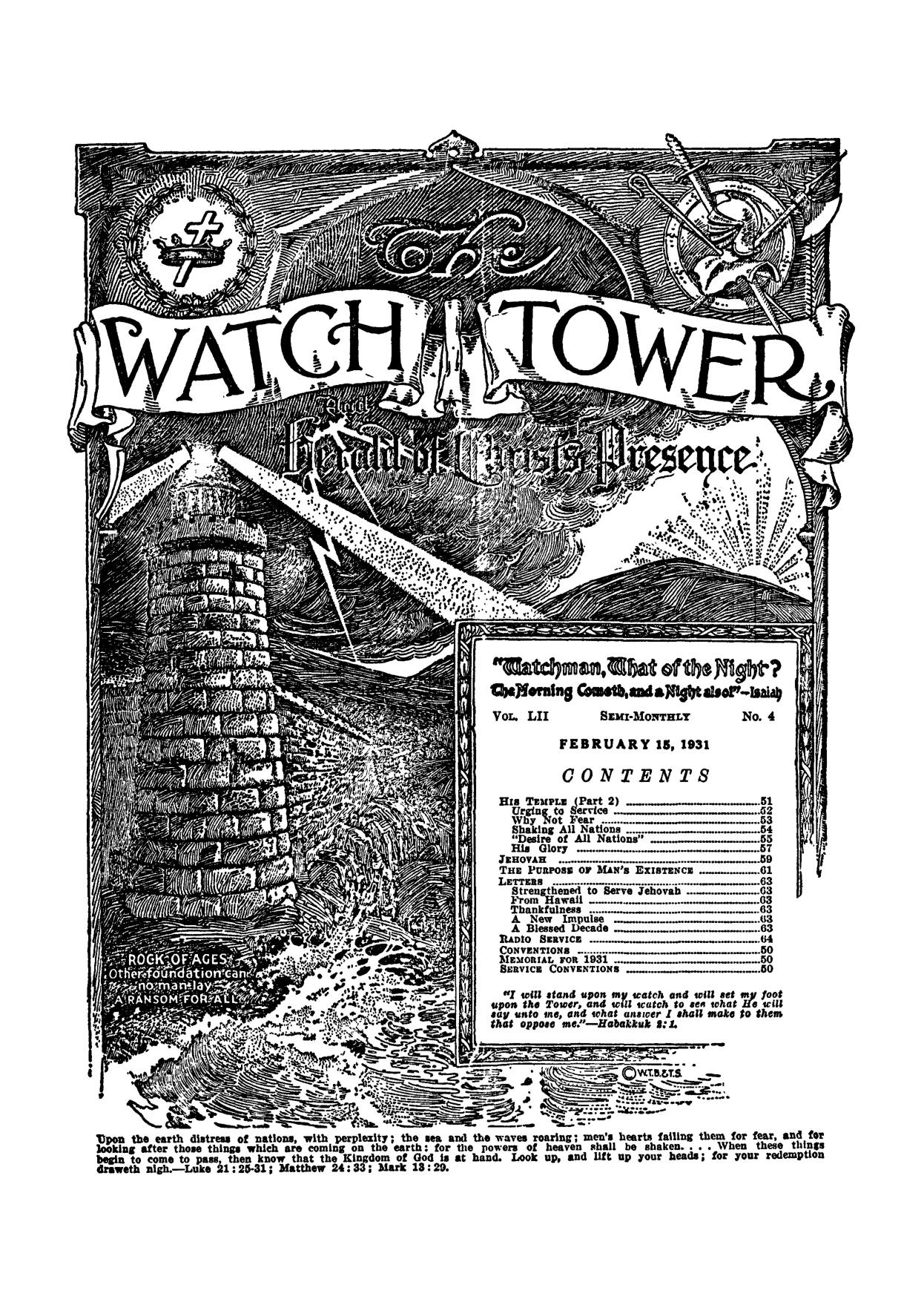
the WATCH TOWER
AND HERALD OF CHRIST’S PRESENCE
Vol. LII February 15, 1931 No. 4
HIS TEMPLE
“The desire of dll nations shall come.” — Hag. 2: 7.
PART 2
JEHOVAH does everything orderly. He chooses his own good time and seasons to bring to pass certain parts of his work, and this includes the messages he sends from time to time to his faithful people. The fact that the Lord is so explicit in the prophecies to name the month, day, and year, indicates that there is a specific time that the Lord sends to his people a message for their encouragement.
2 The last verse of the first chapter of Haggai’s prophecy shows the Jews doing work on the house of the Lord in the twenty-fourth day of the sixth month, in the second year of the reign of Darius, the king of Persia. The second chapter of Haggai’s prophecy begins with the statement that on the twenty-first day of the seventh month of the same year Jehovah commands his prophet to speak to Zerubbabel the captain, and to Joshua the high priest, and to the remnant of the people. The time here mentioned was about one month after the work had been begun afresh on the Lord’s temple. According to the law concerning the feast of tabernacles this day would be a sabbath day or holiday time when the people would be assembled at the altar for service unto Jehovah. That was a convenient time for the Prophet Haggai to address the leaders and the remnant, and it is certain that the Lord Jehovah had chosen that time. The message of the Lord was directed specifically to the leaders; therefore showing that a responsibility is laid upon them to be examples to the remnant, and examples of God’s favored ones in the course of action that they would pursue.
3 It is easy to see that there is a correspondency in the events then and in the action of the Lord’s people at this time. At certain fixed times the Lord sends a message to his people, and this shows a responsibility upon those who are put in position as leaders to be examples to the others, and examples of God’s flock. —1 Pet. 5:3
4 Solomon’s temple, which had been destroyed by the Babylonians some years previously, to wit, in the year 606 B. C., is described as being a glorious structure. Hearing of its greatness, and the grandeur of King Solomon, the Queen of Sheba made a pilgrim
age to Jerusalem. It is written that when she had seen Solomon’s way of ascent by which he went up into the house of the Lord there was no more spirit in her and she said to the king: “The half was not told me.’’ (1 Ki. 10:5-7) When the foundation of Zerubbabel’s temple was laid, which was about sixteen years prior to the occasion of Haggai’s prophetic speech here under consideration, there were then present some ‘who were ancient men that had seen the first house of the Lord’, or Solomon’s temple. Some of these men saw the foundation of Zerubbabel’s temple laid before their eyes, and when they saw it they wept with a loud voice. (Ezra 3:10-12) Those ancient men must have been few in number, if any, at the time when Haggai delivered the message to the remnant as set forth in his prophecy, because it was then eighty-six years after the destruction of Solomon’s temple.
5 On the sabbath day aforementioned, when Haggai stood up before the people he began his speech by saying to the leaders and the remnant: ‘Who is there among you [the remnant] that saw this house in its former glory?’ Solomon’s temple had been completely destroyed, and now another temple was to be built at the same place; and the prophet speaks of both as the same house. The temple represented God’s organization; and although there comes from time to time a change in the personnel of God’s organization, that makes no difference, because it is still the same organization. Such is the lesson here taught. The humble- minded would learn from this that regardless of what man of importance or prominence is in God’s organization, when he passes from the stage of action the organization is not affected one jot or tittle, but the work of Jehovah goes straight forward just the same.
6 Manifestly Haggai’s prophecy was not intended to cause these ancient or old men to dream of the departed glory that they had once seen, nor to cause them to weep because of desiring the days that were gone. He called their attention to the glory of Solomon’s temple in order that they might have a beneficial lesson, to wit, a lesson of faith in Jehovah and his Word. Thus trusting God, they could see a future
infinitely more grand and glorious than that of the past. God would now strengthen the faith of his people, and therefore directed his prophet to thus speak to them. Here was a splendid opportunity to exercise faith in God.
7 At the time Haggai thus spoke more than sixteen years had elapsed since the altar had been placed and the foundation laid. In all that time from the beginning the work had lain in neglect. The foundation, therefore, was all of the new temple now visible to human eyes. With these conditions about them Haggai said to the people: ‘How do you see the temple now? is it not in your eyes in comparison of it as nothing?’ (Vs. 3) The people were asked to believe that although there appeared only the foundation that had been previously laid, out from it would come something far surpassing the glories of Solomon’s day. That required a great deal of faith on their part. It was therefore a lesson of faith in Jehovah and his ability to accomplish his purposes.
8 Jehovah chooses his own way to humiliate human pride. He selects ‘the things which are not, to bring to naught the things that arc, that no flesh may glory in his presence’. (1 Cor. 1:28, 29) All who then heard the words of God’s prophet must have agreed that ‘‘except the Lord build the house, they labour in vain that build it”. (Ps. 127:1) Zechariah also prophesied concerning the same work, “For who hath despised the day of small things? for they shall rejoice to see the plummet in the hand of Zerubbabel with those seven; they are the eyes of the Lord, which run to and fro through the whole earth.” (Zech. 4:10, margin) To be sure, Jehovah could have chosen those to do his work who are far more brilliant mentally, and who have a better and higher standing amongst the people than the ones he did choose, but had he chosen them they would have boasted. God will not have his work done by those who pride themselves on their own ability to accomplish it. This should long ago have taught a lesson to many of the consecrated that no one can have pride in what he calls “character development” and thereby think he can make himself thereby qualified for God’s use in his kingdom. Each one can be a coworker with God, but he must work according to God’s rules.
9 Jehovah knows better than any creature that men must have their faith strengthened, and he provides that which is necessary to strengthen their faith; and so on the occasion that, through his prophet, he addressed the builders of the temple at Jerusalem, for their encouragement he said: “Yet now be strong, 0 Zerubbabel, saith the Lord; and be strong, 0 Joshua, son of Josedech, the high priest; and be strong, all ye people of the land, saith the Lord, and work; for I am with you, saith the Lord of hosts: according to the word that I covenanted with you when ye came out of Egypt, so my spirit remaineth among you; fear ye not.” — Hag. 2:4, 5.
10 Abraham is called “the father of the faithful”. He had his faith put to the strong test and he showed his complete confidence in Jehovah. Of him it is written that ‘he was strong in faith, giving glory to Jehovah the Almighty God’. (Rom. 4: 20) It is those who have a faith similar to that of Abraham that God has chosen as material for the building of his glorious antitypical temple. – Heb. 2:16, Diag.
11 Christ Jesus, the primary antitype of the prince and high priest who built the typical temple, was at all times strong in faith in Jehovah. He is God’s instrument in building the antitypical temple. When his enemies pressed him he said to them: “Destroy this temple [like as Satan’s organization had destroyed Solomon’s temple] and in three days I will raise it up.” (John 2:19) The Lord God had sent Zerubbabel to lay the foundation of the typical temple and he would have the people made strong in faith that it would be finished because his word and his name were involved. Therefore he caused to be written : ‘‘The hands of Zerubbabel have laid the foundation of this house; his hands shall also finish it; and thou shalt know that the Lord of hosts hath sent me unto you.” (Zech. 4:9) The Lord will now have the faith of his people made strong, and therefore he gives his word of assurance that his temple and the work in connection therewith shall be completed in his own due time and to his own glory.
URGING TO SERVICE
12 Some who have for a long while claimed to be followers of Christ Jesus have made strenuous objection to The Watch Tower’s repeatedly calling upon the anointed to be active in the service of the Lord God. Their criticisms have been caustic and with the manifest purpose of doing injury. The remnant see that such objectors are wrong. God has not called anyone to be a dreamer. Note that the emphasis of Haggai’s prophecy is upon faith and work: “Be strong, all ye people of the land, . . . and work; for I am with you, saith the Lord of hosts.’’ Thus the prophet was urging upon the people diligence in engaging in the service of the Lord.
13 The words of the prophet were therefore truly a service speech to his brethren. Those of God’s temple class must now follow that example or lead. They too must make service speeches to one another, that all may be encouraged to press on in the work. It is therefore certain that the Lord has directed his organization on earth to have what we call service meetings and service conventions, because the whole purpose of the remnant now on earth is service unto the Lord in connection with the temple.
14 Writing concerning this very day of Jehovah, his prophet says: “In that day it shall be said to Jerusalem, Fear thou not; and to Zion, Let not thine hands be slack. The Lord thy God in the midst of thee is mighty; he will save, he will rejoice over thee with joy; he will rest in his love, he will joy over thee with singing.” (Zeph. 3:16, 17) The Elijah work of the church is gone, and the present is no time to dream of it, its glories, its sweet times, its conventions or its assembling to talk about “character development”. The work of the remnant must now be done, and done speedily, in connection with the temple. No other work would meet with the Lord’s approval. Those who pursue any other course are workers of iniquity because they are going contrary to God’s commandments.
15 As the Lord organized his people to rebuild the temple at Jerusalem, even so now he has an organization on earth; and it is worse than foolish for anyone who claims to believe in God to say that he has no such organization. Every one who will admit the facts must say that the Watch Tower Bible and Tract Society, or those who faithfully stand together and who are called the “Society”, constitutes God’s visible organization. Christ Jesus, the glorified Head of the temple “not made with hands”, is directing the work now being done by the remnant. The remnant are joyfully doing this work in obedience to the commandments of the Lord, and they thus do it by telling the testimony of Jesus Christ which he has committed unto the remnant to be delivered. – Rev. 12:17; 14:1.
16 Jehovah’s promise to the builders of Zerubbabel’s temple was: “I am with you, saith the Lord of hosts.” This means a fight or work amidst opposition, because the Mighty One speaks of himself as the “Lord of hosts” or ‘Lord of battle’. By this the Lord also tells what work he will approve and prosper and how he will protect the workers while they are thus doing his will. It should be manifest to all that anyone who would take a course contrary thereto is a lawless worker, hence a worker of iniquity. These are the ones that the Lord Jesus sends his angels to gather out. The Lord shows his approval of those who are obedient to his commandments, and this approval is shown by bringing them under the robe of righteousness. The garments worn show that these are identified as being completely devoted to God and to his work. Satan and his emissaries will interfere, but the Lord will rebuke the enemy and bless his own people.
17 The promise of Jehovah to the Israelites was: “My spirit remaineth among you; fear ye not.” It is even so with God’s remnant of the present time. His spirit in the midst of his people is the power that accomplishes his work. Without his spirit no results could be had. “This is the word of the Lord unto Zerubbabel, saying, Not by might, nor by power, but by my spirit, saith the Lord of hosts.” (Zech. 4:6) Approximately 1922 there was a special effusion of the holy spirit upon God’s people, and that spirit has continued with those who have remained true to the covenant for the kingdom. These have not feared man or devil, but have manifested boldness in this day of judgment and have thus proven their unselfish devotion to Jehovah. (1 John 4:17) As the Samaritans persecuted and threatened the Jews when rebuilding the typical temple, even so now their counterpart, the religious hybrids and the “man of sin”, threaten God’s remnant and accuse them of all kinds of wickedness. But the remnant have no fear of any of these or of the Devil himself; but, trusting in the Lord, they go joyfully on in the service.
WHY NOT FEAR
18 The fact that the building of the temple was begun was a certain indication to the Jews that the end of their oppression was near and that then they would be secure in their own city. It was in 1918 that the construction of the antitypical temple began, and that fact is evidence to the faithful that the end is near when Satan’s organization shall be cleared out and God’s people shall be ever secure. This is indicated by the words of the Prophet Haggai, to wit: “For thus saith the Lord of hosts, Yet once, it is a little while, and I will shake the heavens, and the earth, and the sea, and the dry land.” (Hag. 2:6) Jehovah now makes known to his people what he can and will do to the enemy, and thus assures his people that they need not fear. God has announced his purpose to destroy the enemy and his organization, and the remnant know that he will do it. They believe what the Lord says: “At his wrath the earth shall tremble, and the nations shall not be able to abide his indignation.” – Jer. 10:10.
19 Paul first calls attention to one shaking at Mount Sinai, where the typical tabernacle was erected, and then he adds: ‘Yet once more I shake not the earth only, but also heaven, and this time everything in opposition to the temple of God shall be removed.’ (Heb. 12:19-27) To encourage the people of the Lord he makes known that it is not a great while now, but is “a little while”, until Jehovah God will completely clear out the enemy and thus finish the workers of iniquity. Referring to the same time, through his prophet Isaiah, God says: “Come, my people, enter thou into thy chambers, and shut thy doors about thee: hide thyself as it were for a little moment, until the indignation be overpast.” (Isa. 26: 20) Thus he again assures his people that while doing his work in connection with the temple they shall be under his protection and that it will be but a little while until his indignation will be completely expressed against the enemy. Already the Devil’s heavens have been shaken and have fallen to the earth or in close proximity thereto.
20 This shaking began in 1914; and the shaking still continues, and will continue until all opposition to the Lord and his kingdom is removed. Of the “heavens” and “earth” being shaken, the words are here used or stated in contrast to each other. Also the “dry land” and the “sea” are spoken of in contrast. The “dry land” well represents the order-loving people who have a sincere desire for righteousness, and this includes a great multitude who once agreed to do God’s will but who have not faithfully lived up to their privileges. The “sea” represents that godless people, alienated from Jehovah, who by organized efforts carry on the affairs of the present wicked world, and particularly the commercial and political and religious elements thereof, which with their mouths call upon the name of God and Christ Jesus and yet deny the Lord completely. It also includes particularly “the man of sin”, which is anti-God and anti-kingdom, all of which are like the troubled sea. (Isa. 57:20, 21) When the remnant see these things coming to pass they are told that they need have no fear but should rejoice in the fact that they are on Jehovah’s side and go boldly on in proclaiming the greatness of his work and singing praises to his name.
SHAKING ALL NATIONS
21 The prophet of Jehovah now speaks of the shaking of all nations, evidently referring specifically to the nations of “Christendom”. This shaking must take place in “the day of the Lord”, where we now are. We are progressing to the final shaking. The prophet of the Lord says: “And I will shake all nations, and the desire of all nations shall come; and I will fill this house with glory, saith the Lord of hosts. ” (Hag. 2:7) Following the World War, from and after 1918, the nations began to settle down and try to bring about peace. They even joined together to heal the deadly wound of one of the heads of the beast that came up out of the sea. (Rev. 13:3) They assembled together and formulated peace treaties, schemes of refinancing, disarmament compacts, and thus began to make themselves apparently feel somewhat secure, advancing to the day when they would cry, “Peace and safety.” Not yet has the claim of universal peace reached its climax; and when it does come, and the announcement is made, then sudden destruction shall come upon them.—1 Thess. 5: 3.
22 It appears to be clearly settled that the Lord will not permit the nations to bring about their own peace and safety and mend their conditions. The shaking financially and politically continues to increase each day, and all over the world at the time these words are written the rulers are in perplexity and the distress of the people increases. The shaking of the nations constituting Satan’s organization on earth continues, and it will continue until the final destruction. All things made by Satan, and which come under the control of Satan, must go down to destruction. Referring to the same shaking, the apostle wrote: ‘‘And this word, Yet once more, signifieth the removing of those things that are shaken, as of things that are made, that those things which cannot be shaken may remain.” (Heb. 12:27) It is manifest from these words that nothing shall be able to stand in this time of shaking except those who are in the secret place of the Most High, abiding under the shadow of his protection. This should be and is an added encouragement to God’s remnant on earth.
23 The day or hour of the complete overthrow, no one knows. But surely it is but just “a little while”, as the Lord says. When God’s faithful remnant have given the testimony committed to that class and that work is completed, then doubtless the final shaking and destruction will come. The remnant have thrown their fears to the winds, and must continue to do so and go boldly and joyfully on in obedience to God’s commandments, doing the work of the Lord in the face of all enemies and all opposition. It seems reasonable that when these are apparently hemmed in by Satan’s organization then the final conflict will come to pass. When all parts of Satan’s organization are gathered together to do battle against God’s anointed, the promise is, the remnant shall not be cut off from God’s organization. ‘For then shall the Lord go forth to fight’; and when he fights, everything in opposition to him shall fall. (Zech. 14:1-3) This and other scriptures show that the temple class will not and cannot be shaken.
24 God’s temple will not be removed, nor destroyed as was Solomon’s temple. The remnant constitute that part of the temple yet on earth, and therefore are ‘those things which cannot be shaken but which will remain’. This is further proof that the temple will remain to the glory of Jehovah God’s name. This proof is further supported by the words of Jehovah’s prophet Haggai, when he says: “And I will fill this house with glory, saith the Lord of hosts.” The fact that Jehovah here speaks of himself as “the Lord of hosts” shows that this time of ‘filling of the house with glory’ has reference to a time of war or fight, because thus Jehovah describes himself as the God of battle going on to victory and giving victory to his own.
25 Those who can now by self-examination determine that they are of the remnant of the Lord have no occasion for fear, but every reason to rejoice. Many of such are now being arrested and thrown into jail because they are faithfully giving the witness to the name of Jehovah. A money fine is imposed upon some of these, and this they pay in order to again go free. While it is true that all the money belongs to the Lord, it might be more pleasing to the Lord to stand firm and endure by going to prison rather than to pay fines. Anyone who quietly goes about preaching the gospel of God’s kingdom by carrying the printed message thereof to the people is doing so in obedience to God’s commandments and therefore could not be violating any law that is properly made and righteously enforced.
26 Satan’s instruments, the clergy and their allies, frequently have some of these faithful ones arrested and thrown into prison on the charge of ‘violating the Sunday law’ because they are carrying the gospel of the kingdom to the people. In this the clergy must know that they are doing wrong. In America Sunday
has always been recognized as the day especially set aside for preaching the Word of God. Those who are now engaged in thus preaching the gospel on Sunday, by carrying the books containing the message thereof to the people, are doing good to many and doing injury to no one.
27 The clergy are not interested in seeing that the name of Jehovah is kept free from reproach on Sunday. Their own selfish course of action proves this. Their real purpose is to prevent the people from having the truth. The Samaritans tried to prevent the rebuilding of the temple. Their counterpart, particularly those who were once enlightened in the truth and who have become wicked, try now to prevent the remnant from doing work in connection with the antitypical temple. Let no one fear what these workers of iniquity do or can do. Be of good courage; fear not, and press on, ‘‘For I am with you, saith the Lord of hosts.’’ Let no one who is of the remnant now agree with the enemy organization to refrain from or stop from preaching the gospel in order to escape punishment at the hands of Satan’s organization. The Lord is permitting this opposition for his own good purpose. We may not now clearly see why he is permitting it, but the fact that he does not restrain the persecuting hand of the enemy is sufficient reason to know that he has a good purpose in so doing. Probably the Lord’s purpose is to permit the enemy to convict himself by his own wilful course of action in persecuting those known to be doing good in the name of Jehovah.
28 God’s people are fighting the greatest battle that has ever been fought on earth, and it is now their privilege to have boldness in pressing the battle to the gate. No one should be harsh or discourteous or guilty of unseemly conduct toward the opposition, because such could not be pleasing to the Lord and would only increase the burdens of those who are already burdened. When opposition is presented by those who would interfere with the work, calmly, firmly, and yet boldly say in substance:
29 ‘I am not doing any harm to any person, but I am doing good to all who will hear. I am not engaged in a business enterprise for money gain, and therefore I could not be violating any tax or police law. I am voluntarily preaching the gospel of God’s kingdom because God has commanded this to be done in honor to his own name and for the benefit of the people. If you interfere with my work, then you must answer, not to me, but to Jehovah God. His kingdom is now at hand. A great crisis is now approaching, and it is his will and command that the people should be told about it, and no one should attempt to interfere with that work, and those who do interfere must take the responsibility. ’
30 Thus doing you will be a witness to the name of Jehovah, regardless of the immediate results. Let the remnant trust in the Lord of hosts; for he is more than all that can be against us.
“DESIRE OF ALL NATIONS’’
31 The prophet then states that after the shaking of all nations “the desire of all nations shall come’’. Various opinions are expressed by the translators in regard to these words, as used in Haggai 2:7. Some others render the text as follows: ‘‘The precious things [things to be desired, margin] of all nations shall come.” (A. R. V.) “The desirable things of all nations shall come.” (A. R. V.) These renderings of the text could hardly be correct, for the reasons hereinafter stated.
32 Another rendering of the text is: “And the delight of all nations shall come in.” (Roth.) This latter rendering and that of the Authorized (or “King James”) Version seem more nearly to express the proper conclusion in harmony with other scriptures. “The precious things of all nations” or “the desirable things of all nations” could not be the correct meaning, for the reason that all precious and desirable things which all the nations of the earth could contribute would not fill the house of the Lord with glory, as the text states ‘must follow’. It is that which shall come in conjunction with the ‘coming’ that ‘fills the house of the Lord with glory’. All nations will be so shaken at Armageddon that they will be completely destroyed, and therefore they could not contribute anything desirable to the house of the Lord. Besides this, the glory here mentioned seems to begin before the final shaking at Armageddon. Nor could the nations mentioned be confined to the ruling powers of the people, for the reason that these desire extremely selfish things. The nations here mentioned therefore seem clearly to mean the people composing earth’s human creation.
33 To what place does this ‘‘desire of all nations’’ come? The scripture text and the context certainly show that the coming is to the temple. Leeser’s translation supports this conclusion as it says: “shall come hither.” This is corroborated by Rotherham, who renders it: “ And the delight of all nations shall come in” to the temple. The Lord Jesus Christ, having completed the work of preparing the way before Jehovah, suddenly or straightway came to the temple in 1918. About four years before that time the shaking of the nations began; and it continues. Christ Jesus is the “messenger of the covenant, whom ye delight in”. Therefore Christ Jesus, the Head of the Christ, primarily must be “the delight of all the people” when they know him, because he is God’s representative. Jesus Christ came to the temple as the vicegerent of Jehovah. He is the “seed of promise” and is the desire of all nations and peoples, even though they know it not yet. Of him it is written: “In thy seed shall all the nations of the earth be blessed.”—Gen. 22:18.
34 The order-loving peoples of earth have a real desire for the coming of the true Messiah and Deliverer; but they have not been able to discern him, because of the blinding influence of Satan. The organization of Satan, working under the supervision of “the wicked one”, has kept the people in ignorance of the very one whom they really desire. This is proven by the words of the Apostle Paul: “The earnest expectation of the creature waiteth for the manifestation of the sons of God.” (Rom. 8:19) Today there are, without a doubt, millions of people of all nations who would gladly welcome the great Messiah if they knew him and his mission. Early in the history of man God caused this prophecy to be written: “Until Shiloh come, and unto him shall the gathering of the people be.” (Gen. 49:10) That God will extend his mercy and favor to the people after the temple is completed, and after the coming of Shiloh, the great Prince of Peace, is manifested to the world, is certain. That this will come at the completion of the temple is further shown by the words of the prophet: “Rejoice, 0 ye nations, with his people: for he will avenge the blood of his servants, and will render vengeance to his adversaries, and will be merciful unto his land, and to his people.”—Deut. 32:43.
35 The kingdom under Christ will bring the honest desires and the things precious, such as life, liberty and happiness. The delight of all the nations, however, is The Christ, and the desire of these nations is that of his coming in. The peoples of earth now groan in pain for deliverance, and wait for that deliverance that will come through Christ, even though they do not now know or understand the means of their deliverance. It was the great desire of his faithful followers that Christ should come, and he in whom these delight did come to his temple in 1918 and is now building up the temple class. Before the people can see and understand and be blessed the remnant must go out and preach the truth as a witness unto all the nations. The remnant must now point out to the people that Christ has come to his temple and that he is the one they have long desired. It is not so much the desirable things, but it is the Mighty One who brings the blessings, that is the desired One. Of this the people must be informed.
36 The house of Jehovah is the desire of the people, and Christ Jesus is the Head of that house. He has already come, and is gathering together unto himself all who will be of “the house”. The first work after his coming, in regard to the gathering, was the resurrection of those who had died faithful unto the covenant for the kingdom. And now those who die in the Lord are changed in a moment, in the twinkling of an eye; and finally those of God’s little remnant on the earth will be made a permanent part of the glorious house of God. With this completion of the temple class the coming will be full and complete and the “manifestation of the sons of God” will then be made, and will be the delight of all who love righteousness.
37 The shaking of the “heavens” and the “earth”, the “sea” and the “dry land”, began in 1914, and in 1918, “the desired one” came to his temple; and the remnant are the first ones permitted to discern this fact and to rejoice. The nations of earth composing Satan’s visible organization settle down to what they think is going to be lasting peace, and then there is a further shaking. During that time of assumed and comparative peace the faithful remnant, seeing the Lord has come to his temple, go forth with joy in the Lord and give testimony to the people that Jehovah is God and Christ is King, and that he is the One desired. Such is temple work on their part, and as they thus work the enemy desperately attempts to interfere and the Lord protects them and they go boldly on. With the complete desolation of Satan’s organization blindness will be completely removed from the eyes of the people and God’s word and name will be vindicated. The temple completed, then the people will realize that the one they have so long desired, that is to say, The Christ, has come and that with his coming their deliverance and blessing has also appeared. God’s temple is the mediatorial arrangement between Jehovah and the people of earth, and this will be the place the people will seek for their blessing. Concerning the house of the Lord thus completed it is prophetically written: ‘My house shall be called the house of prayer for all people. ’—Isa. 56: 7.
38 When the temple is completed, then the prophecies following will have a fulfilment, and the Lord now graciously shows his people in advance that such will come to pass in a little while. (Isa. 42:9) “All the ends of the world shall remember and turn unto the Lord: and all the kindreds of the nations shall worship before thee.” (Ps. 22: 27) Then “all nations shall serve him . . . and men shall be blessed in him; all nations shall call him blessed”. (Ps. 72:11, 17) ‘‘O praise the Lord, all ye nations: praise him, all ye people.” (Ps. 117:1) “And nations that knew not thee shall run unto thee because of the Lord thy God. ’ ’ (Isa. 55:5) “And the Gentiles [nations] shall come to thy light.” (Isa. 60:3) “And the nations shall bless themselves in him, and in him shall they glory.” - Jer. 4:2
39 The name “Jew” in the following prophecy stands for the temple class, Christ and his body members, because these are the ones that give praise to Jehovah God in his organization, which is pictured by Jerusalem; therefore it is written: “Yea, many people and strong nations shall come to seek the Lord of hosts in Jerusalem, and to pray before the Lord. Thus saith the Lord of hosts, In those days it shall come to pass, that ten men shall take hold, out of all languages of the nations, even shall take hold of the skirt of him that is a Jew, saying, We will go with you: for we have heard that God is with you.’’ — Zech. 8: 22, 23.
40 Then the name of Jehovah will be exalted. “From the rising of the sun even unto the going down of the same [symbolically meaning all the time] my name shall be great among the Gentiles [nations], . . . saith the Lord of hosts.” – Mal. 1:11
HIS GLORY
41 It is Jehovah’s name that is involved. He is the One that will be glorified, and this glory of Jehovah will be upon his house, as the prophet states: “And I will fill this house with glory.” Note that this statement follows the building of the temple. From the time the Lord Jesus Christ came to the temple and began the ‘gathering together his own unto himself’ the glory of the Lord appears upon the temple, and only the temple class see it for the present time. “The glory of the Lord is risen upon thee. . . . The Lord shall arise upon thee, and his glory shall be seen upon thee.” (Isa. 60:1, 2) The temple is Jehovah’s house, and the place of his final residence, because it is the temple class that execute his commandments. Therefore it is his glory that fills the house.
42 There is no record in the Bible that the glory of the Lord filled the temple of Zerubbabel at its dedication or at any other time. The reference in this verse must therefore be to the antitypical temple of God. With the coming of Christ Jesus to the temple the glory of the Lord, does start to fill the house. (Isa. 6:1-4) The words of Jesus refer to the same glory, when he said: “These things said Esaias, when he saw his glory, and spake of him.”—John 12:41.
43 Now ‘that day of the Lord’ is here and the temple is being brought to a completion, and for the encouragement of the remnant it is written in the prophecy: “In that day shall the Lord of hosts be for a crown of glory . . . unto the residue [remnant, the temple class] of his people.” (Isa. 28:5; Rev. 15:8) The “smoke” mentioned in the last above cited text symbolizes Jehovah’s glorious presence at his house. This glory of the Lord continues until he entirely fills the house with his glory. In due time the peoples of earth will come to discern the glory of the Lord upon his house. “And, behold, the glory of the God of Israel came from the way of the east, and his voice was like a noise of many waters: and the earth shined with his glory. And it was according to the appearance of the vision which I saw, even according to the vision that I saw when I came to destroy the city; and the visions were like the vision that I saw by the river Chebar: and I fell upon my face. And the glory of the Lord came into the house, by the way of the gate whose prospect is toward the east. So the spirit took me up, and brought me into the inner court; and, behold, the glory of the Lord filled the house.”—Ezek. 43:2-5.
44 Jehovah would have his people of Judah know that he was with them in building the temple and that if their faith in him was complete failure would be impossible. Therefore he caused his prophet to say: “The silver is mine, and the gold is mine, saith the Lord of hosts.” (Hag. 2:8) In the building of the antitypical temple Jehovah is the real builder of the house. Christ Jesus is the chief active Agent, but he is doing the work under Jehovah’s direction. Jehovah, therefore, would have his people understand that he is responsible for the temple and that having begun the good work, he will finish it in his own good time and to his own glory. The words of the prophet concerning the “silver” and the “gold”, used here, are both literally and symbolically true. It all belongs to Jehovah. Some men have assumed the ability to build the house of the Lord themselves; but they could not, and in this they have failed. Others have said that God has committed to one man all the truth that is brought forth in connection with the building of the temple of Jehovah; and in this they are wrong, and by reason of thus giving glory to the creature rather than to the Creator they have fallen into the snare.
45 The truth is likened unto silver “tried in a furnace of earth, purified seven times”. The truth, like all the silver of the earth, belongs to Jehovah God, and he makes it known to his faithful people in his own due time and for their encouragement. Men do not purify the truth, because the truth does not belong to them. God does that, and he performs this work through his Chief Executive Officer in his own due time. (Mal. 3:3) The Lord shows those who have made a covenant to do Jehovah’s will that they can acquire riches, represented by “gold”, only by faithfully engaging in his service, which faithful service necessarily brings upon them fiery trials and reproaches. (Rev. 3:18) Aside from engaging zealously in the service of the Lord as opportunity affords, it is impossible to have a part in the building of the temple of God. Let no one deceive himself or be deceived into believing that he may remain silent and inactive in this day of battle and be blessed by the Lord God as one of his remnant.
46 The ready money to carry on the Lord’s work does not always appear to be available or just at hand, and such as have little faith might become fearful that the work would be hindered or retarded for this reason. God would have his people know that his work shall not fail for want of money, because all of it is his, and the work of building the temple is his. Those who use their money in his work appreciate that to do so is a real privilege. Only those who love God will avail themselves of this privilege. The remnant of Israel that returned from Babylon must have been quite poor, and for this reason the word of the Lord was given to them that they need not fear because of their material poverty. Likewise today, God’s people on earth are quite poor so far as earthly holdings are concerned. They see the financial condition of the world growing worse, many persons out of employment, and distress increasing, and some may be inclined to think that they can do no more work or that the work is about done. No one needs to be disturbed on this account. The work of the Lord must and will continue to go forward until it is completed, to his glory.
47 Then God through his prophet further said to the Israelites at Jerusalem, who looked upon the foundation of the temple: “The glory of this latter house shall be greater than [that] of the former, saith the Lord of hosts.” Without a doubt those words were spoken for the purpose of encouraging the builders. Even so now, the remnant know that the temple of Jehovah shall soon be completed and that its glory and beauty will far exceed anything ever before built. The remnant of Israel had no need to be discouraged when looking upon the work that was begun on the temple, because of its appearance, but were admonished to have faith in God that he would make it a glorious structure. In like manner, those of the remnant of God’s people on earth look at themselves and at one another and they do not see much. They see that the number of zealous workers is small, and becoming even smaller: they see that many who once claimed to be of the Lord are now actually opposing the work, and these conditions tend to discourage the weaker ones. Jehovah would have such to know that if they will exercise faith in Him they will see the antitypical temple completed and infinitely greater than the typical temple. God is building it, and will make it the meeting place between himself and those who desire to be reconciled to him and live.
48 Jehovah continues to shower the remnant with his blessings of goodness. As the wrath of the enemy increases and the opposition to his people becomes more severe the Most High increases the light upon his Word and illuminates and increases the remnant’s vision, permitting them to see his bountiful provision for their protection and sustenance. In a little while the fight will be done, and of this the remnant are fully assured. In just a little while the name of Jehovah will be vindicated, and those of the temple will see Jehovah in full brightness of his glory. There is much for the remnant yet to do, however, and they must continue to feed upon God’s Word and do his service as the opportunity opens to them.
(To be continued)
QUESTIONS FOR BEREAN STUDY
1. What lesson lies in Jehovah’s explicit record of day, month, and year, in connection with many of the prominent prophecies?
2, 3. To whom was the Lord’s message by Haggai given? When? Point out the significance of each of these facts.
4, 5. Compare Zerubbabel’s temple with Solomon’s, (a) in regard to the site of the temple, (b) In regard to its glory. What did each of these temples represent? What highly important present lesson do these facts contain?
6, 7. Explain the purpose of Haggai’s words of verse 3. 8, 9. What do the Scriptures clearly show as to the basis on which Jehovah chooses those whom he uses to do his work? How does he strengthen them to accomplish his purpose?
10, 11. How does Romans 4: 20 qualify all who would have Jehovah’s approval?
12-14. Prove that The Watch Tower’s repeated encouragement and urge to activity in the service has been clearly Scriptural and therefore right.
15-17. What is clearly the position and the function of the Watch Tower Bible and Tract Society? How do the words of Jehovah, “I am with you,” have their application and complete fulfilment? How is Zechariah 4: 6 manifestly fulfilled to the remnant at this time?
18-20. When and how do Haggai 2: 6 and Hebrews 12: 27 have their fulfilment? In this connection, what is the assurance Jehovah gives to his people?
21-24. Explain how and when Haggai 2: 7 has its fulfilment. What is the privilege and duty of the remnant in the meantime? Identify “those things which cannot be shaken”, and account tor their being thus designated.
25-27. Describe that which was foreshadowed in the opposition by the Samaritans to the building of Zerubbabel’s temple. In this connection, how does Haggai 2:4 have special application at the present time?
28-30. In circumstance of opposition, what is the proper attitude and procedure? Why?
31-34. What is “the desire of all nations”, referred to in verse 7? “Shall come” where? How?
35-37. To what extent, and how, has this “desire” already “come” to the remnant? What is the present privilege of the remnant in this regard?
38-40. Quote scriptures showing how the people of earth will welcome the mediatorial arrangement inaugurated when the temple is completed.
41-43. Point out the time and manner of fulfilment of the prophecy, ‘‘I will fill this house with glory.’’
44-46. Why does Jehovah here say, “The silver is mine, and the gold is mine”? What does Revelation 3: 18 enjoin upon those who would be truly rich? How only can such riches be acquired?
47. What lesson and encouragement do God’s people now find in his declaration that ‘‘the glory of this latter house shall be greater than that of the former’’?
48. What may the remnant now expect on the part of the enemy? How has Jehovah graciously provided for his people in this regard? What is their great privilege and joy in the meantime?
THUS SAITH JEHOVAH OF HOSTS
Yet once a little it is, and I am shaking the heavens and the earth, and the sea and the dry land; and I will shake all the nations, and the Delight of all the nations shall come in; and I will fill this house with glory. . . . Mine is the silver and mine the gold. . . . Greater shall be the last glory of this house than the first, ... and in this place will I give prosperity.
JEHOVAH, the Almighty God, the Most High, is the Maker of all things good. He is from everlasting to everlasting, and there is none other. He covers himself with light for his garment, and all light proceeds from him. He created the heavens and stretched them out like a curtain and filled them with his reflected glory. He laid the chief corner stone and foundations of the earth and built it according to his sovereign will. In its youth he made the cloud for its garment of covering and the thick darkness for its swaddling-cloth. He set the sun in the heavens for the light of the earth by day, and the moon and the myriad of stars for its light by night. He even numbered the stars and gave each one a name. With him everything is order and there is no confusion. He causes the stars and the planets to take their respective places and move continuously in their assigned orbits. He has made the mountains to lift their heads high above the sea and has commanded the eagle to mount up above the rocky crag and to make her nest in the strong places. He has clothed the earth in verdure and filled the great forests with beasts and fowls of the air.
He created man in perfection and made him the prince of the earth. The eternal destiny of all creation he holds in his mighty hand. The depth of the riches of his wisdom and knowledge, and the height of his power and love, are too great for the comprehension of man. The Almighty One, however, condescends to invite man to come and reason with him and to learn of his way. To know and to obey God means to have life everlasting in peace and happiness. Where then should man expect to find knowledge and wisdom except in the revelation of the Almighty God? His Word is a fountain of knowledge and wisdom, ever flowing to supply refreshment and life to those who drink therefrom. He is the Fountain of life everlasting.
Jehovah God is the origin and source of all true prophecy. In proof of this statement it is written in Isaiah 44:6: “Thus saith Jehovah, the King of Israel, and his Redeemer, Jehovah of hosts; I am the first, and I am the last; and besides me there is no God. And who, as I, shall call, and shall declare it, and set it in order for me, since I established the ancient people? and the things that are coming, and that shall come to pass, declare unto them.”
The great Creator has revealed himself to his creatures by several names, each one of which is deeply significant. By his name JEHOVAH is meant his purposes toward his creatures. His name GOD denotes that he is the Creator of everything that is good. His name ALMIGHTY signifies that his power is without limitation and that nothing can successfully resist him. His name MOST HIGH means that he is supreme and above all.
Why is there such gross ignorance concerning God and his goodness toward men? The correct answer is
that long centuries ago Satan the enemy of God turned man into the paths of unrighteousness and rebellion and since then has blinded men to the truth. In doing this Satan has employed divers agencies, many of which have claimed to represent God but who in fact have misrepresented him. Practicing hypocrisy these men have been used by Satan to turn the people away from Jehovah and into darkness. God could have prevented this, to be sure, but his wisdom led him to permit the enemy to do his worst, that God might in his due time prove to all intelligent creation that he is supreme and that those who would have life must obey him and walk in the way of righteousness.
The greatest truth that all men must learn is that of and concerning the kingdom of God. That kingdom will completely vindicate God’s Word and his name and it will bring paradise and endless joy to the people.
There is no government on earth that is satisfying to honest men. There never was a government that was satisfactory to honest men. The reason is that there is so much dishonesty practiced amongst men; and all people are afflicted with disease, sickness and death. That unhappy condition began more than sixty centuries ago, when perfect man was in Eden. The rebellion of Satan led to the downfall of man and brought death upon all human creation. In that hour of distress God gave his word of promise that ‘the seed of the woman shall bruise the head of him who brought death upon mankind’. The “woman” there mentioned symbolically pictured God’s universal organization of righteousness. The promised “seed” is the offspring of that woman, or universal organization of God, and constitutes his kingdom. At the beginning God put his kingdom to the fore as the most important of all truths.
Years thereafter God gave Abraham and his wife the promise that by their seed all the families of the earth shall be blessed. God used them to make a prophetic picture. Abraham was a picture of God himself, while his wife Sarah pictured the universal organization of Jehovah God. The promise then made further disclosed that the “seed” that would bring blessings to the nations of the earth would be produced by and through a long period of testing and suffering and, when brought forth to completeness, shall constitute the kingdom of God.
To meet his requirements Jehovah has kept this seed shrouded in mystery for many centuries. Gradually he has unfolded this mystery to his prophets and faithful servants. He gave his Word of promise that the mystery should be completely solved and understood at the end of the world, otherwise known as “the last days”.
That time has now arrived. We are at the end of the world and in the last days. That does not mean the end of the earth, because the earth abides forever. It does not mean the end of time, because time shall never end. It means the end of the long dark period of time in which wickedness has predominated. It means the lifting of the veil of darkness and ignorance from the people to the end that the great light of God’s loving-kindness may shine into the mind of every man. That time is first marked by a great amount of trouble and suffering culminating in the greatest tribulation that earth has ever known. That trouble will be brief and will be the last, and it will usher in the rule of righteousness on earth. That rule of righteousness will bring the desire of every honest heart. As it progresses the earth will be filled with a happy and joyful race of people who will give honor and glory to the Most High God. To gain a knowledge of the kingdom of God is therefore of greatest importance to all people.
These precious and satisfying truths are set forth in the Bible, which is the Word of God. The study of the Bible is the most profound in which man can engage. Its understanding is to be preferred by far to all the gold and silver the world can produce. It enlightens the mind, makes glad the heart, and gives much strength to the man.
It has been claimed that the understanding of the Bible is limited to a few men called “the clergy”. That claim is not the truth. The Bible is given for the understanding, aid and comfort of all who love righteousness and who earnestly seek to know and to do God’s will. It is the Word of God. In Psalm 25: 14 it is written: “The secret of the Lord is with them that fear him; and he will shew them his covenant.”
Fear of the Lord God does not mean a morbid dread of impending disaster. A godly fear is awe and veneration of the creature for the Creator. It is man’s proper appreciation of the majesty and loving-kindness of the Most High, the man being deeply apprehensive lest he should transgress God’s righteous and unchangeable laws. The fear of man leads one into a snare. The fear of God is the beginning of wisdom and leads one in the way of life. In order for man to obtain life everlasting it is necessary for him to be brought to a knowledge of the truth. The truth of primary importance is that concerning Jehovah God. It is written in the Scriptures that ‘this is life
eternal, to know thee the only true God, and Jesus Christ, whom thou hast sent’.—John 17: 3.
Jehovah God has not pushed his name to the fore. At stated intervals he has brought his name prominently before his creation. This he has done by a demonstration of his unlimited power, which has always proved that the Devil is powerless against Jehovah when the latter deems it proper to exercise his great power against the wicked one. At these stated intervals God has brought his name before his creation, not for a selfish reason, but for the benefit of his creatures. Unselfishness has been his motive. This is another proof that “God is love”.
During the ages God has magnified his word of promise above his name. The time has come, however, when Jehovah’s name and word shall be exalted among his creatures. Then all creatures will know that the word of God is always true and that his name is above all and worthy to be praised.
God’s word of promise is perfect. It is his expressed will. In the ages he has moved majestically forward in carrying out his will as expressed in his Word. At stated intervals, to save the people from complete infidelity, he has brought his name prominently before them. Now the “seed of promise” is about completed and the time is at hand when the Lord will magnify his holy name before mankind. The issue will then be finally determined against Satan in favor of Jehovah. He will have a witness given in the earth of his purpose, and this witness must be given now. Who will profit by the testimony given?
The meek are those that are teachable. The wire man is he who desires to be taught the truth and to be guided by the truth. It is written in Psalm 25:9: “The meek will he guide in judgment, and the meek will he teach his way. ” It is furthermore written: “The meek shall inherit the earth, and shall delight themselves in the abundance of peace.” The student soon finds that the Bible is a great storehouse of knowledge and wisdom because it tells of Jehovah God. A knowledge of the Bible is now within the reach of all. Learn its contents and be greatly blessed. “Where do we get our Bible?” many ask. That question shall be answered in another address.
WHO hath proved the spirit of Jehovah? or or being his counsellor hath been giving him knowledge? With whom hath he taken counsel? . . . Lo! nations are as a drop on a bucket, and as fine dust on a balance are accounted. Lo! islands like an atom can he hoist. . . . All nations are as nothing before him. . . . Hast thou not known, hast thou not heard, that the God of age-past time, Jehovah, the Creator of the ends of the earth, fainteth not, neither groweth weary? There is no searching of his understanding. . . . They who wait for Jehovah shall renew their strength. – Isaiah.
THE PURPOSE OF MAN’S EXISTENCE
WAS man placed upon this earth to show what he could do, and thus to glorify and immortalize himself? You know, scientists and philosophers of this age think that the achievements of men are simply so wonderful and important to the universe that it would be a shame if the intelligence of earth’s great men perished at death; and so they believe that the mind or intellect of these great persons must live on after death that thus these precious minds might be preserved for the good of the universe.
Thus men attach much importance to men and to man’s attainments. But we are forced to ask, What about God? Surely man did not bring himself into existence. What things man achieves are confined to this green earth, and the mind and intellectuality which he develops from birth onward are not so wonderful and necessary to God’s operation of the universe that he must immortalize them after death. God suffers no loss or damage by the death of earth’s great musicians, poets, authors, composers, scientists, and builders; for God made the brains, the bodies and the faculties with which these men worked. Psalm ninety-four, verses eight, nine and ten, says: “Understand, ye brutish among the people; and ye fools, when will ye be wise? He that planted the ear, shall he not hear? he that formed the eye, shall he not see ? He that chastiseth the [nations], shall not he correct? he that teacheth man knowledge, shall not he know?”
The sacred Word also says: “Put not your trust in princes, nor in the son of man, in whom there is no help. His breath goeth forth, he returneth to his earth : in that very day his thoughts perish.” (Ps. 146: 3, 4) This rule applies to the thoughts of men of great earthly careers; none of them is an exception. There is no immortalizing of their minds at death, for Ecclesiastes, chapter nine, verse five, says: ‘‘The dead know not any thing.” Unless the Bible gave promise of a resurrection of the dead because of Jesus’ death in behalf of humanity, these great men would never live again. It does not do, therefore, for us to deify man and to magnify his importance and what he has accomplished in life.
Man did not call himself into being. It is equally certain that man did not formulate the purpose for which he was created. The great supreme God, Jehovah, who made man and gave him life, is the One who originated the purpose of man’s being. Hence men should not decide in their own minds what shall be their purpose in life, for in so doing they will err, no matter how much of a success they may appear to the world to attain. The proper thing, and the wisest, is to find out what was God’s will and purpose in bringing man into existence on this earth, and then to bring one’s whole life into accord with that divine purpose. The very fact that God made man superior to the brute beast and endowed him with such higher intelligence implies that God meant that man should use his mind to learn the will of his Creator and then do it lovingly and joyfully.
…