The Watchtower, March 1, 1930
Download: PDF — The Watchtower, March 1, 1930
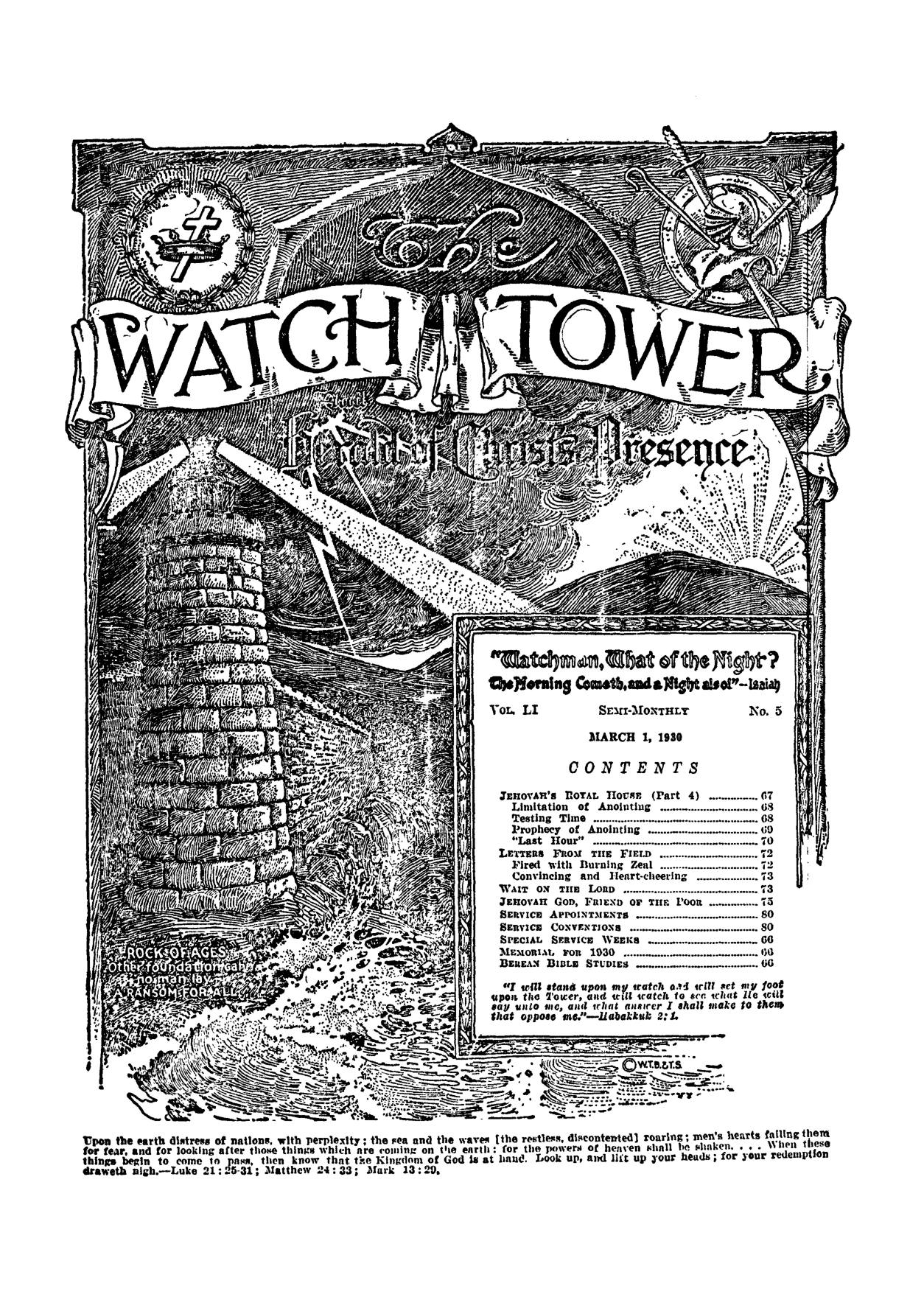
SPECIAL SERVICE WEEKS
Designating certain periods during the year for special service to the Lord in advertising his kingdom has had his blessing. This is the best evidence that we should continue the practice. Where a definite time is set and advance notice given, the anointed remnant can prepare and arrange their affairs so as to devote the entire time, if possible, to special field service.
For the year 1930 two periods have been selected. The first will be the period beginning April 26 and ending May 4. This will include two Sundays and two Saturdays. It is our hope that all the anointed can arrange to be free from secular duties and devote the time to magnifying the name of Jehovah.
Notice is now given in order that the anointed in every part of the earth may have ample time to prepare. The members of God’s elect servant still on the earth will look forward to this special drive with much enthusiasm and joy and will make every effort to devote the entire time in the field. It will be the privilege of God’s witnesses in every country throughout the earth to “sing unto the Lord a new song’’, using the means that he has graciously provided.
The second special drive for field service will be announced in due time.
Regional service directors and local service directors everywhere will please take notice and prepare the organization for an extraordinary effort during the period mentioned.
MEMORIAL FOR 1930
The beginning of the month of Nisan is determined in this manner: The appearance of the new moon nearest to the spring equinox according to the authorities. The new moon appearing nearest to the spring equinox in the year 1930 is at 12: 46 p.m., March 30.
The rule is to omit the first day and count the last. Fourteen days thereafter, or, to wit, the fourteenth day of Nisan, would begin after 6: 00 p.m. of April 12. Therefore the proper date for the celebration of the Memorial would be after 6: 00 p.m., Saturday, April 12, 1930. That will be the time at which the anointed of the Lord in various parts of the earth will desire to assemble together at their respective places of meeting and celebrate the memorial of our Lord’s death.
Vol. LI
March 1, 1930
No. 5
JEHOVAH’S ROYAL HOUSE
“These shall war against the Lamb, and the Lamb shall overcome them, for he is Lord of lords, and King of kings; and they also shall overcome that are with him, called and chosen and faithful.”—Kev. 17:14, R.V.
PART 4
JEHOVAH God is the builder of his royal house. (Heb. 3:4) There is one body that composes that house; and that is The Christ, which is God’s Anointed. “Now hath God set the members every one of them in the body, as it hath pleased him.’’ In this connection Paul further said: “For as the body is one, and hath many members, and all the members of that one body, being many, are one body; so also is Christ. For by one spirit are we all baptized into one body, whether we be Jews or Gentiles, whether we be bond or free; and have been all made to drink into one spirit.’’—1 Cor. 12:12, 13.
2 It may be contended by some that this scripture indicates that all who are justified by faith in the blood of Christ by the judicial determination of Jehovah, and who are begotten or brought forth as the children of God, are also anointed and assigned to places in the royal house. But be it noted that the apostle does not say that all who are spirit-begotten are baptized into the body of Christ. He is addressing the ‘sanctified ones of the church’. (1 Cor. 1:2) His statement is that all who have been baptized into the body of Christ have one and the same standing in Christ and that there is no longer any distinction between Jew and Gentile, bond or free. The gist of his argument is that all who are thus baptized into Christ are one. Likewise he wrote in another place: “Know ye not, that so many of us as were baptized into Jesus Christ were baptized into his death? For if we have been planted together in the likeness of his death, we shall be also in the likeness of his resurrection.”— Rom. 6: 3, 5.
3 It is clear from this last quoted text that those who will be like the Lord in his resurrection must likewise die a sacrificial death as did the Lord Jesus. The scapegoat was not sacrificed, and did not foreshadow the class that is sacrificed with Christ Jesus. The Lord’s goat on the typical day of atonement foreshadowed those who are sacrificed with Christ and who are therefore baptized into his sacrificial death. Such are the ones that are anointed to membership in the royal house of Jehovah.
4 Again the apostle wrote: “The spirit itself beareth witness with our spirit, that we are the children of God: and if children, then heirs; heirs of God, and joint-heirs with Christ; if so be that we suffer with him, that we may be also glorified together.” (Rom. 8:16, 17) Does not this Scriptural text indicate that all who are justified and spirit-begotten are also anointed as joint-heirs with Christ in his kingdom? The apostle does not here say that all the spirit-begotten ones have the witness that they are joint-heirs with Christ Jesus. The emphasis of the text must be laid upon those words, to wit, “if so be that we suffer with him, that we may be also glorified together.” Such are the conditions precedent, and these conditions cannot be ignored and the text applied to any and all who have covenanted to do God’s will.
5 The scapegoat class does not suffer with Christ Jesus and does not partake of his sacrificial death. These are all begotten or brought forth as sons of God, as heretofore set out, but, as the scapegoat showed, they are not selected for sacrifice. Such fail to present themselves unto the high priest even though they are acceptable as a sacrifice.—Rom. 12:1.
6 Paul wrote: “For we are his workmanship, created in Christ Jesus unto good works, which God hath before ordained that we should walk in them.” (Eph. 2:10) Does not this text mean that all who are spirit- begotten at the same time receive the anointing? In determining what is meant by this text we must have in mind the persons or creatures included therein. Manifestly when Paul uses the word “we” he applies it to himself and to others of like precious faith who have been chosen and are “faithful in Christ Jesus”. (Eph. 1:1) The words of Paul were written in harmony with God's purposes in selecting “the seed of Abraham”, which is The Christ. Therefore in using the word “we” he would include, not merely the spirit-begotten ones, but only those who had responded to the call and been chosen and received the anointing. The same must be said with reference to the following texts: Col. 1:24, 25; 3:3; Gal. 2:20; 3:27; 1 Pet. 4:13.
7 From the testimony of the scriptures considered up to this point the conclusion seemingly must be that spirit-begetting and anointing do not take place at one and the same time; that not all who are begotten of the spirit receive the anointing; that the class who will compose the great multitude does not receive the anointing and that none will get into the great multitude class by reason of losing the anointing. These conclusions being correct we are better enabled to understand why there is a great number of persons now on the earth who claim to love the Lord and to be followers of Christ Jesus and yet do not manifest a zeal for the Lord and his cause. We see that there is but a comparatively small number who seem to be wholly devoted to the Lord. The reason must be that the major portion of those claiming to be the followers of Christ have not been chosen and anointed.
LIMITATION OF ANOINTING
8 That the apostles and those closely associated with them were anointed is plainly shown from the Scriptures. After the death of such and until the second coming of the Lord probably a very few were anointed. From Pentecost until the second coming of the Lord there were some who were preaching Christ and him crucified; but the number thereof was quite small compared with that of the ones who claimed to be followers in the footsteps of the Master, and therefore indicates that but a small number had received the anointing. This, of course, is merely the expression of an opinion based upon the Scriptures and the facts as they appear.
9 At the second coming of the Lord Jesus Christ he began to ‘prepare the way before the Lord’ Jehovah. Greater light came to those who then sought to know and to do the will of God. The fundamental truths had long been greatly obscured, and during the period of time when Christ was ‘preparing the way before Jehovah’ these fundamental truths were restored to those consecrated and devoted to the Lord. It is but proper that we mention here that within that period of time Brother Russell was greatly used of the Lord in bringing these restored truths to the attention of the consecrated. He was earnest and zealous for the Lord in preaching the truth. Without a doubt he was one of the anointed of God and was faithful unto death. The same must be said of others who were blessed of the Lord and associated with him in the service during that period of time. It could hardly be said, however, that all who were brought to a knowledge of the truth during that period of time received the anointing of the holy spirit.
10 The work during that period of time was foreshadowed by the experiences of the Prophet Elijah. That Elijah the prophet had the spirit of the Lord there can be no doubt, because Elisha desired to receive a double portion of that spirit and did receive it. The Scriptures do not disclose the fact of the anointing of Elijah, but the Scriptures do fully disclose that he had the spirit of the Lord. It may well be said, then, that Elijah represented the anointed of God who earnestly and zealously engaged in the work of the church during the Elijah period. Not all of the consecrated, however, did thus during that period of time. As to Elisha it is written: “And Elisha the son of Shaphat [meaning judge, and may therefore be properly said to refer to the fact that Elisha represented the sons of God the Judge of all] . . . shalt thou anoint to be prophet in thy room [place or stead].” (1 Ki. 19:16) It may therefore be consistently said that Elisha foreshadowed God’s anointed who would have and manifest the larger measure of the spirit of the Lord during the period of time known as the Elisha period of the church’s work. It would also warrant the conclusion that it is the anointed of God that do the work unto the glory of the Lord during the Elisha period of the church.
TESTING TIME
11 The end of the Elijah work was marked by a period of special trial and testing. Jehovah sent his messenger for the purpose of preparing the way before him. He did prepare the way before Jehovah, and at the conclusion of that work the Lord suddenly came to his temple. (Mal. 3:1) That marked the end of the work foreshadowed by Elijah. A great testing time came upon the church at that time, and later followed the work foreshadowed by Elisha. God had foretold that the time of the coming of the Lord to his temple would be marked by fiery experiences. ‘‘ But who may abide the day of his coming? and who shall stand when he appeareth? for he is like a refiner’s fire, and like fullers’ soap.”—Mal. 3: 2.
12 It was then that judgment began upon the sons of God. The sons of Levi well pictured all and generally those who at that time had received a knowledge of the truth and who had been begotten or brought forth as the sons of God. One of the purposes of the Lord’s coming to his temple was to test these antitypical sons of Levi, as it is written: “And he shall sit as a refiner and purifier of silver; and he shall purify the sons of Levi, and purge them as gold and silver, that they may offer unto the Lord an offering in righteousness.”—Mal. 3: 3.
13 The Scriptures indicate that not all would be approved and come through that trial or test, but that some, failing to abide, would not stand. Those who did stand in that trial or test were approved, and the purpose was that the approved ones might ‘‘ offer unto the Lord an offering in righteousness”. The apostle makes it clear that such offering in righteousness includes the unstinted and loyal devotion of the approved ones to the Lord in singing forth his praises and in magnifying his name. (Heb. 13:15) It seems quite clear that the approved ones were chosen and anointed at that time.
14 If the approved ones at that test received the anointing of the Lord it would follow that those not approved would not receive the anointing of the Lord. If this conclusion is true, then it is to be expected that two different classes would be manifest from and after that time of the coming of the Lord to his temple. The facts that have since come to pass fully confirm this conclusion, as is well known by all who are devoted to the Lord.
15 At Pentecost the apostles received the anointing of the holy spirit. Then and there they began to preach to the multitude, “and the same day there were added unto them about three thousand souls.” (Acts 2:41) The divine record does not say, however, that all of those three thousand souls received the anointing of the holy spirit. The pouring out of the spirit on that occasion was a fulfilment of Joel’s prophecy. (Joel 2: 28-32) That was the first or miniature fulfilment of that prophecy. That there was to follow another fulfilment later and “before that great and notable day of the Lord” is made plainly to appear by the words of Peter, who on that occasion quoted the prophecy of Joel, to wit: “And it shall come to pass in the last days, saith God, I will pour out of my spirit upon all flesh: and your sons and your daughters shall prophesy, and your young men shall see visions, and your old men shall dream dreams: and on my servants and on my handmaidens I will pour out, in those days, of my spirit; and they shall prophesy.” (Acts 2:17, 18) The Scriptural proof that this prophecy had a larger fulfilment after the coming of the Lord to his temple in 1918 has heretofore been published in The Watch Tower (November 15, 1925).
16 The fulfilment of this prophecy implies the anointing of God’s begotten and chosen ones by the holy spirit. This conclusion seems correct for the reason that the language is: “Your sons and your daughters shall prophesy, and your young men shall see visions.” The clear inference from this language is that there should be a better understanding of the truth and that those understanding it would engage in telling the message to others. It therefore seems reasonable and Scriptural to conclude that during the period of the Elijah work of the church a comparatively small number of those who had been begotten of the spirit received the anointing and that with the coming of the Lord to his temple the spirit of the Lord was poured out “upon all flesh”, that is to say, upon all who had received the approval of the Lord and who were therefore chosen; and that all who were so anointed were commissioned to prophesy, or preach, and that they did so.
17 The prophecy of Joel quoted by Peter, referred to above, declares that “your young men shall sec visions”. “Young men” fitly represents those who are strong and vigorous in the Lord. Concerning such John wrote: “I write unto you, young men, because ye have overcome the wicked one.” True to the facts since the coming of the Lord to his temple, those who have taken a firm stand against the wicked one and his organization and have zealously served the Lord have had a much clearer vision of the divine purpose.
18 God’s prophet wrote: “Behold, I and the children whom the Lord hath given me are for signs and for wonders in Israel from the Lord of hosts, which dwelleth in mount Zion.” (Isa. 8:18) Thus it is shown that Isaiah and his sons represented the ones whom the Lord has chosen. Isaiah was given a vision in which he saw the Lord in his temple. (Isa. 6:1) Thus Isaiah there pictured those who receive the anointing of the Lord at the time of the pouring out of the holy spirit and corresponds to the prophecy with reference to the young men seeing visions. At the time of the vision Isaiah heard the voice of the Lord, as it is written: “Also I heard the voice of the Lord, saying, Whom shall I send, and who will go for us? Then said I, Here am I; send me. And he said, Go, and tell this people, Hear ye indeed, but understand not; and see ye indeed, but perceive not.”— Isa. 6: 8, 9.
19 Undoubtedly Isaiah at this point represented many of the Lord’s people who had not been active in proclaiming the message of truth; but now having received the cleansing, the approval and anointing, and hearing the voice of the Lord and receiving the command, this scripture shows a clear and positive commission given to those whom Isaiah represented to go and do the things mentioned in that commission. The anointing is not only an appointment to an official position, but a commission of authority to do the things designated therein. The vision mentioned by Isaiah coincides exactly in time and fact with the prophecy of Joel and its later fulfilment. It is also exactly in harmony in time and fact of fulfilment with the prophecy of Malachi concerning the purging of the sons of Levi to the end that the approved ones might offer an offering unto the Lord in righteousness.
20 Would not these scriptures therefore prove that from and after 1875, until the coming of the Lord to his temple, only a small number of those who had been brought forth or begotten as the sons of God received the anointing of the holy spirit; that after the coming of the Lord to his temple, and the testing of the antitypical sons of Levi, there was an outpouring of the holy spirit upon all the approved ones, and that these were sent forth to do the work in the name of the Lord, and that therefore that marks the time of the anointing of the feet members of Christ who joyfully preach the truth ?—Isa. 52: 7, 8.
PROPHECY OF ANOINTING
21 It was Isaiah whom the Lord used to give utterance to the prophecy: “The spirit of the Lord God is upon me; because the Lord hath anointed me to preach good tidings unto the meek: he hath sent me to bind up the broken-hearted, to proclaim liberty to the captives, and the opening of the prison to them that are bound.” (Isa. 61:1) That prophecy had a beginning of its fulfilment with the anointing of Jesus, as stated by him. That the prophecy was to have a particular fulfilment upon “the feet of him” is shown from other parts of the same prophet’s utterances.—Isa. 52: 6, 7.
22 Chapters fifty-nine to sixty-four, inclusive, of Isaiah’s prophecy show that the setting of the prophecy concerning the anointing has a specific application at the time the Lord comes to his temple and provides the robe of righteousness and brings the approved ones thereunder, the robe itself representing the approval. Clearly the robe of righteousness is the official vestment of the anointed company even as the ‘bridegroom deeketh as a priest’ who has just received the anointing. With the coming of the Lord to his temple and the trial and purging of the antitypical sons of Levi, the approved ones being brought under the robe of righteousness, or approval, are made by the prophet to say: “I will greatly rejoice in the Lord, my soul shall be joyful in my God: for he hath clothed me with the garments of salvation, he hath covered me with the robe of righteousness, as a bridegroom deeketh himself with ornaments, and as a bride adorneth herself with her jewels.”-—Isa. 61:10.
23 This clearly coincides with the latter fulfilment of Isaiah’s prophecy concerning the anointing (Isa. 61:1-3) and shows the anointing of those that are approved by the Lord upon the examination had at the time of coming to his temple. The approved ones rejoice, because they say: “He hath covered me with the robe of righteousness . . . and as a bride adorneth herself with her jewels.” The chosen and anointed ones are now counted as a part of the bride, and it is her privilege to rejoice and magnify the name of Jehovah and to have part in the fulfilment of that prophecy written: “The spirit and the bride say, Come.” (Rev. 22:17) There is every reason why the approved ones should at that time rejoice because they have the testimony that they have been chosen and have received the anointing of the Lord and have been commissioned to represent him.
24 It was Isaiah who was also used to utter the prophecy concerning the remnant. It is the remnant of God to whom the testimony of Jesus Christ is committed and who are therefore clothed with authority to give that testimony. (Rev. 12:17) In 1918, as we believe, upon coming to his temple, the Lord began the examination of his servants. The time had arrived when there must be a special witness given concerning the end of the world and the beginning of the kingdom of God. Who would be clothed with authority to do that work and give that witness? Manifestly those whom the Lord would find faithful upon examination at the time of coming to his temple and from that time forward. The antitypical sons of Levi were put to the test, and the approved ones were sent forth to offer unto the Lord an offering in righteousness, and, as the Prophet Isaiah foretold, they responded to the Lord, saying: “Here am I; send me.” These clearly seem to be the ones upon whom the spirit was poured out and who therefore receive the anointing. They received the garments of salvation, thereby identifying them with Christ; and the robe of righteousness, thereby indicating their approval; and therefore there was every reason for them to rejoice, and these are they who have since been singing forth the praises of God.
25 It is the anointed ones brought into the temple of God that have had the clearer vision of the truth. The facts as known are exactly in harmony with these conclusions based upon the Scriptures. It has been since 1918 that the Lord’s people have received a clearer vision of the divine purpose and have appreciated and rejoiced in the flashes of lightning that have come from Jehovah by and through the Head of the temple class, Christ his beloved One.
26 The Scriptures therefore seem to support the conclusion that from the days of the apostles until the coming of the Lord to his temple a very limited number received the anointing, and that when the Lord came to his temple there was an outpouring of his holy spirit, and therefore the anointing of all the approved ones, and such were commissioned to do the work of the church foreshadowed by Elisha.
“LAST HOUR’’
27 The words of Jesus prove that at the end of the world and about the time of his coming to his temple there would be false Christs. Since “Christ” means the anointed of God, “false Christs” would mean those who would claim to have the anointing but who in fact had not received the anointing of the holy spirit. Jesus said: “Then if any man shall say unto you, Lo, here is Christ, or there; believe it not. For there shall arise false Christs, and false prophets, and shall shew great signs and wonders; insomuch that, if it were possible, they shall deceive the very elect. ’’ (Matt. 24:23, 24) The “very elect” mentioned here means those chosen and anointed and commissioned to give the witness on earth; and these are the ones whom the others would attempt to deceive by themselves claiming to be the anointed of the Lord. This further supports the conclusion that the anointing was limited until the coming of the Lord to his temple. This is also corroborated by the testimony of John the apostle of Jesus Christ. The apostle’s words associate the anointing with the “last hour”. “Little children, it is the last time: and as ye have heard that antichrist shall come, even now are there many antichrists; whereby we know that it is the last time.” (1 John 2:18) The Diaglott renders this text: “It is the last hour.”
28 All false Christs would necessarily be antichrists, because claiming to be anointed when in fact not having received the anointing. The antichrist would be claiming to do a work in the name of Christ, but in fact that work would not be according to God’s Word in announcing his kingdom and magnifying his name. John declares that these conditions would be evidence of the last hour. Then the apostle adds: “They went out from us, but they were not of us; for if they had been of us, they would no doubt have continued with us; but they went out, that they might be made manifest that they were not all of us.” (1 John 2:19) This text clearly shows a separation going on during “the last hour”.
29 Those going out from the anointed company would by their course of action show that they had not received the anointing. It should be expected that there would then be a separation between those who are really devoted to the Lord and those who claim to be devoted to the Lord but do not show a zeal for his cause.
30 Further addressing the anointed ones the apostle says: “But ye have an unction [anointing] from the Holy One, and ye know all things.” It is the false Christs and false prophets, that is to say, those claiming to be the anointed of God but who have it not, that attempt to seduce and mislead the chosen ones even as Jesus foretold. The anointed see and understand the truth.
31 Further the apostle says: “I have not written unto you because ye know not the truth, but because ye know it, and that no lie is of the truth. . . . These things have I written unto you concerning them that seduce you. But the anointing which ye have received of him abideth in you, and ye need not that any man [who is not able to make lightnings] teach you: but as the same anointing [the anointed One, Christ the Head of the royal house, who is your teacher] teacheth you of all things [of his Father’s purpose], and is truth, and is no lie, and even as it hath taught you, ye shall abide in it [margin, the holy spirit].”— 1 John 2:18-27.
32 The testimony of Jesus is that upon taking account with his servants when coming to his temple there would be manifest a faithful class which he designates as “a faithful and wise servant” whom he makes ruler over all his goods or kingdom interests. This is a plain statement of the commission given to a specific class and therefore shows that such are the anointed ones of Jehovah. Jesus also stated that at the same time there would become manifest an “evil servant”. Surely that evil servant class does not receive the anointing. It is at approximately the same time that the “good and faithful” of the Lord are given the talent that has been neglected and for this reason taken away from the unfaithful. (Matt. 25: 26) This is another evidence that some are anointed and others not anointed.
33 It is certain from the Scriptures that the prisoners do not receive the anointing of the Lord. It seems equally clear and reasonable to conclude that the “lukewarm” have not received the anointing; otherwise, why would the warning be given to them, to wit: “So then because thou art lukewarm, and neither cold nor hot, I will spue thee out of my mouth. Because thou sayest, I am rich, and increased with goods, and have need of nothing; and knowest not that thou art wretched, and miserable, and poor, and blind, and naked: I counsel thee to buy of me gold tried in the fire, that thou mayest be rich, and white raiment, that thou mayest be clothed, and that the shame of thy nakedness do not appear; and anoint thine eyes with eyesalve, that thou mayest see.” (Rev. 3:16-18) The fact of such warning’s being given shows that after it is given, however, there is an opportunity for such lukewarm to arouse themselves and do what the Lord has commanded them to do and then receive his approval and the anointing.
34 The Lord gave another picture in that of the wedding garment. It hardly seems reasonable that any one would be invited to the wedding who had not made a covenant to do God’s will: “And when the king came in to see the guests, he saw there a man which had not on a wedding garment: And he saith unto him, Friend, how earnest thou in hither, not having a wedding garment? And he was speechless. Then said the king to the servants, Bind him hand and foot, and take him away, and cast him into outer darkness: there shall be weeping and gnashing of teeth. For many are called, but few are chosen.” (Matt. 22: 11-14) Surely those who had taken off the wedding garment or who did not have it on when the Lord came to his temple would not receive the Lord’s approval and therefore would not share in the anointing.
35 Upon earth at this time there are millions who call themselves Christian. The name is misapplied. Since “Christ” means the anointed of God, it is manifestly true that no one can be properly termed a Christian who is not in Christ and who has not received the anointing. Strictly speaking, then, it is only those who are in Christ and anointed of the Lord and who remain stedfast to the end that can be called Christian. “For we are made partakers of Christ [God's anointed], if we hold the beginning of our confidence stedfast unto the end.”—Heb. 3:14.
36 The sum of the matter, therefore, seems to be this: That the apostles and those closely associated with them received the anointing of the holy spirit of God; that after the death of such and throughout the centuries following, until the second coming of the Lord, a very limited number were anointed with the holy spirit; that with the second coming of the Lord Jesus Christ he ‘prepared the way before Jehovah’, as was foretold by the Prophet Malachi, and within that period of time a limited number of spirit-begotten ones were anointed, and that such were the ones who joyfully and faithfully engaged in the Elijah work of the church; that when the Lord came to his temple he began taking account with the consecrated and spirit-begotten ones, and, finding some whom he approved, these were chosen and anointed; that then was the time when there was a larger fulfilment of the prophecy uttered by Joel concerning the pouring out of the spirit upon all flesh, meaning that all the approved ones were anointed of the holy spirit and thereafter began the proclamation of the message of truth as commissioned; that the lukewarm must be warned that those who do arouse themselves may also receive the anointing and enter into the work which the Lord has provided for them; that the anointed ones at the coming of the Lord to his temple constitute the “faithful and wise servant” class and that such class is also foreshadowed in the prophecy of Isaiah concerning the laying of “the key of the house of David” upon the shoulder of Eliakim (Isa. 22: 20-22); and that such are the chosen ones of the Lord and so made manifest by the anointing.
37 But are these fully prepared to become members of the royal house of Jehovah? It is quite clear from the Scriptures that there is yet something which they must do.
(To be continued)
QUESTIONS FOR BEREAN STUDY
1-3. Jehovah’s royal house is built by whom? Composed of whom? Quote the Apostle Paul on this matter. What is the gist of the apostle’s argument here and in Romans 6:3, 5? How was this pictured by the two goats on the typical atonement day?
4. Point out the harmony of Romans 8: 16, 17 with the foregoing.
5. In Romans 12: 1 we are given what view of this same circumstance?
6. Make clear Paul's application of the word “we”, as used in Ephesians 2: 10.
7. In the light of the Scriptures thus far considered, account for the fact that among the great number of professed Christians so few seem to be fully devoted to the Lord.
8. What is apparent as to the comparative number of the anointed on earth from Pentecost until the second coming of the Lord?
9. To those consecrated and devoted to the Lord, what blessings attended the ‘preparing of the way before the Lord’? What seems reasonable as to the number anointed during that time?
10. Point out the class represented by Elijah, and the work foreshadowed by his experiences. Elisha’s being anointed to succeed Elijah foreshadowed what? What is foreshown in Elisha’s asking and receiving a double portion of the spirit?
11, 12. What was the purpose of the work foreshadowed by Elijah? Malachi 3: 2 shows what regarding the experiences of the church at the time of the Lord’s coming to his temple? Apply Malachi 3: 3.
13. Point out the purpose of the test or trial marking the work of ‘refining and purifying’.
14. The fact that a test is made in this respect implies what results?
15. What took place at Pentecost? What was the significance of that event?
16, 17. Describe the result of the ‘pouring out of the spirit upon all flesh’. When does the larger fulfilment thereof take place?
18-20. Whom did Isaiah and his sons represent? What was pictured by his vision, as mentioned in Isaiah 6:1? Explain the fulfilment of Isaiah 6:5, 8. Show the harmony therewith of the prophecy of Joel and its fulfilment. As to the anointing, what do these scriptures indicate regarding the period from 1875 to 1918?
21. Point out the fulfilment of Isaiah 61: 1. How is Isaiah 52: 6, 7 related thereto?
22, 23. How was Isaiah 61: 10 fulfilled, and when? What is the relation thereof to the declaration made in the first three verses of the same chapter and to Revelation 22: 17?
24, 25. To whom is the testimony of Jesus Christ committed? In this respect describe what took place upon the Lord’s coming to his temple. What are the facts in evidence of the fulfilment at that time of Isaiah 6:8?
26. What conclusion, then, seems Scriptural as to the comparative number anointed from the days of the apostles until the Lord’s coming to his temple?
27. What is meant by the term “false Christs”? Who are meant by “the very elect”? Show the harmony of Matthew 24: 23, 24 with 1 John 2: 18.
28, 29. To what class does 1 John 2: 19 refer? To what action taken by them?
30, 31. Explain what is meant by “unction from the Holy One”, referred to by John. Who have this unction? In what sense do they “know all things”?
32. What are the Lord’s “goods”, mentioned in Matthew 24: 47? Identify the “faithful and wise servant”. In what had this servant been “faithful and wise”, that the Lord, upon coming to his temple, ‘made him ruler over all his goods’? What is indicated by the fact that Jesus spoke of a “faithful and wise servant” and also of an “evil servant’’?
33. Show whether the “prisoners” and the “lukewarm” have received the anointing.
34. Apply the parable of the “wedding garment”.
35. Show the true meaning of the term “Christian”, and whether it has been correctly used.
36. Give a brief summary of what seems to have been the progress of the anointing of Jehovah’s witnesses from Pentecost to the present time.
37. What does our text indicate as to further requirement of those called and chosen, that, they may ultimately be members of Jehovah’s royal house?
LETTERS FROM THE FIELD
FIRED WITH BURNING ZEAL
Dear Brother Rutherford:
Christian greetings! I got hold of a copy of Prophecy late Sunday afternoon and have just finished reading it, some of it the second time. I could not wait any longer to write you and express my great appreciation for the blessing I have received from the reading of it. The next thing in order is to study it through at home and look up all the references. Martha and I will read it together and look up all the scriptures that have been cited.
The two “signs” of Revelation are made as clear as the noonday sun in San Diego. No middle ground left; compromise impossible. The fight is on to a finish; and what a glorious finish it will be! I long to be on the firing line when the last broadcast is fired into the vitals of old Babylon. Surely the old Dragon must be angry. His time must be short. But he will go down fighting. Look out for his arrows, and stick to your guns. He is going to try to get you, as certain as anything can be. But the Lord is your strength and shield, Jehovah is at the helm, and ho can suffer no defeat.
The little class here is fired with the burning zeal of the Lord, and the witness is being given better and with greater enthusiasm than ever.
May our dear Father bless you and keep you.
A. G. Eckols, Calif.
CONVINCING AND HEART-CHEERING
Dear Brother Rutherford:
We are unable to express our appreciation and gratitude for the most wonderful book you have presented to us yet. Prophecy is the most convincing and heart-cheering of all. Surely our heavenly Father is withholding no good thing from us!
The Lord loves you, and we love you very much, dear brother, for your untiring devotion to Jehovah and to the brethren; and, in closing, we know of nothing more appropriate to call to your attention for your encouragement than the last two paragraphs in Prophecy.
We are thankful to have a share with you in proclaiming the good news of the kingdom, and desire to be more faithful.
Yours for the honor of Jehovah’s name,
Minnie A. and Ethel M. Taylor, Colporteurs,
MORE PRECIOUS EACH DAY
Dear Brother Rutherford:
Greetings in the name of Jehovah and his dear Son. We feel as if we should be ungrateful indeed if we did not express our thanks and appreciation for the wonderful truth and enlightenment revealed in the book Prophecy. It is the most wonderful book we have read yet. Surely the truth is getting more and more precious every day, and is such a comfort in time of need, to spur us on to action in the service of the Lord.
It is the joy of our hearts to join you in this great witness work.
May the dear Lord richly bless you in your efforts to serve him more and more, and supply you with the needed strength, is our prayer for you.
Your brother and sister by his grace,
Mr. and Mrs. A. H. Sampley, Colporteurs.
RESOLVE TO CONTINUE WITNESS
We, of the International Bible Students Association, assembled at this convention, send our love and greetings to the Match Tower Bible and Tract Society, and to our dear Brother Rutherford, the president thereof, and thank our great God, Jehovah, for the flashes of lightning issuing from the temple through the columns of The Watch Tower.
And we all unitedly resolve to continue in this witness until the work on earth is finished.
Erie (Pa.) Ecclesia.
M. R. Maynard, Secretary.
WAIT ON THE LORD
[Fifteen-minute radio lecture]
EVERY good man and woman longs for a time to come when righteousness and peace shall reign on the earth; they long for a release from poverty, sin, and death; from disease, pain, and oppression. Most people have a sort of indefinite hope that these longings will be gratified in the far distant future, and when they get to heaven, if they are fortunate enough to win that prize. This hope, however, is not positive, clear-cut or satisfying. The reason for this is that from infancy to old age, people are taught certain doctrines that are not supported by the Scriptures, and these generally accepted and very popular doctrines, known as "orthodox” doctrines, blind people to the beauties and harmonies of the Bible and hinder them from having a proper hope.
Herewith are enumerated some of these false and blinding teachings. It is generally believed that all the saved go to heaven. This is considered so orthodox and proper that it is seldom questioned, and should anyone question it, he is at once branded as a heretic, as being unorthodox. Most people consider it a disgrace to be called a heretic, and these are so cocksure that all so-called orthodox teachings are right that they will refuse to investigate, even when proof to the contrary is given. It is not true that all the saved go to heaven. The Scriptures teach that the "church”, consisting of a little flock of faithful over- comers will go to heaven at the first resurrection. The Scriptures also teach that God created the earth to be man’s home and that eventually it will be inhabited with a race of human beings, men and women, each one sitting under his own vine and fig tree, with nothing to molest or make afraid. (Ps. 37:29; Isa. 60:21) The teaching that all people go to heaven blinds people to this beautiful and comforting Bible truth.
Another so-called orthodox teaching, believed by everybody, and hence very popular, is that when people die they are more alive than ever. To criticise this teaching is to invite condemnation, ostracism, and persecution. Yet the teaching is not true, and one who believes it cannot understand the resurrection of the dead, for the reason that if a person is not dead he cannot be resurrected. In Ecclesiastes 9: 5 we are told that "the dead know not any thing”. This is a statement made by one of God’s inspired prophets, and yet orthodoxy is so sure that the "orthodox” teaching is right that they will stubbornly deny the truth of this text and many others similar to it, and stick to the religion of their fathers because it is popular and hoary with age.
Another popular yet false teaching of orthodoxy is that the kingdom of God is within the heart of every Christian, and that the kingdom was set up by Jesus nearly 1900 years ago. This teaching blinds to the fact that the kingdom is a future kingdom, and that it will operate right here on earth, and is for the blessing of all the people of earth, both living and dead. With this false conception of the kingdom, people cannot offer the Lord's prayer intelligently. He taught us to pray as follows: "Thy kingdom come [future]. Thy will be done in earth, as it is in heaven.” Believing this false teaching that the kingdom is within each individual, a person cannot look forward in hope to the time of its establishment; neither can he properly understand what the kingdom blessings are. Now let us grasp the thought that the kingdom is to be established at the second advent of the Lord: that it will operate right on the earth and that it is for the purpose of blessing the people; that the blessings will consist of everlasting life, perfect health, perfect liberty, perfect happiness, and deliverance from sickness, pain, oppression and death, and the enjoyment of all these blessings right on this earth.
This being true, the most important teaching in the Bible is expressed in the words, “THY KINGDOM COME.’’ This coming kingdom is the hope of the world. Jesus always spoke of the kingdom, and always placed it far in the future; so did the disciples. Both Jesus and the disciples taught the people to “wait” for the kingdom. This waiting is necessary, because God has decreed that the kingdom shall be a thousand years long and that it shall begin at the second advent of the Lord. It was the divine purpose that Jesus should wait from the time of his resurrection until God’s appointed time to begin kingdom work. Hence we read of Jesus, as follows: “After he had offered one sacrifice for sins for ever, he sat down on the right hand of God: from henceforth waiting until his enemies be made his footstool.” (Heb. 10: 12, 13) When God’s due time should arrive, this waiting period would end, and then God would place his enemies under Jesus’ feet, which means, under his control.
While Jesus has been waiting till God’s due time for him to begin to exercise his power, all the rest of the human family have had to wait also. In Romans 8:19-22, we read: ‘‘ The earnest expectation of the creation waiteth for the manifestation of the sons of God. . . . Because the creation shall be delivered from the bondage of corruption into the glorious liberty of the sons of God. ’’
Not only must people wait for the kingdom, but all true Christians must preach this coming kingdom. This is what is meant by the word “gospel”. This word means “good news”, and refers to the good news that everybody who will accept the blessings may be blessed with life, liberty, peace, happiness, and deliverance from pain, oppression, sin and death. This gospel must be preached in order that the people may be comforted; that they may have hope; that they may come to a better understanding of the goodness and love of God, and thus be better enabled to serve him in spirit and in truth. Jesus always preached the kingdom, and so did his disciples.
The people cannot hope for any blessings from manmade schemes, such as a “league of nations”, federation of churches or prohibition laws. No man or set of men can bring blessings to the people, and no permanent blessings will ever come until the kingdom brings them; hence the people must wait for the kingdom. When the kingdom arrives, it will, first of all, destroy the wicked, corrupt kingdom of Satan, which now controls the earth; then it will proceed to convert the world, and will set up an entirely new and righteous financial, political and religious arrangement. It will not reform and use the present financial, political and religious organizations, because there is nothing good about them.
For many centuries men have tried to reform these wicked and unjust organizations by using the ballot box against them and also making reformatory laws, but they have signally failed to accomplish any reformatory work; neither have they succeeded in converting the world. Man-made schemes for converting the world always have failed and always will fail. Men do not possess either the wisdom or the power to do it, and this is why God has appointed his own time and his own way to accomplish this much-to-be-desired end. This explains why people must wait for the kingdom. No power or agency can convert the world, except the kingdom. The idea that God has commanded men to convert the world is absolutely unscriptural. In unmistakable terms the Bible tells us that the conversion of the world must wait until the kingdom is established.
Herewith are quoted some of the many texts that refer to this waiting period, which will end at the second coming of the Lord. In 1 Corinthians 1:7 Paul addresses the Corinthian church as follows: “So that ye come behind in no gift, waiting for the coming of our Lord Jesus Christ.” 1 Thessalonians 1: 9, 10 reads: “Ye turned to God from idols, to serve the living and true God; and to wait for his Son from heaven. ’’ In Romans 8:19-25 we find these words: “The earnest expectation of the creation waiteth for the manifestation of the sons of God. . . . The whole creation groaneth and travaileth in pain together until now. And not only they, but ourselves also, . . . even we ourselves groan within ourselves, waiting for our adoption, to wit, the deliverance of our body. For we are saved by hope: . . . but if we hope for that we see not, then do we with patience wait for it. ’ ’
In Galatians 5: 5 we read: “We through the spirit wait for the hope of righteousness by faith.” In Luke 23: 50, 51 are these words: “There was a man named Joseph, a counsellor; and he was a good man, and a just; . . . who also himself waited for the kingdom of God.”
When Jesus was on earth, he exhorted his disciples as follows: Be “ye yourselves like unto men that wait for the Lord, when he will return from the wedding”. In 1 Peter 1:3-5 we read: God “hath begotten us again unto a hope of life, by the resurrection of Jesus Christ from the dead, to an inheritance incorruptible, and undefiled, and that fadeth not away, reserved in heaven for you, who are kept by the power of God through faith unto salvation, ready to be revealed in the last time”.
This thought of waiting for the kingdom and its blessings is very forcibly brought to our attention in the Old Testament also. In Zephaniah 3: 8, 9 are these words: “Wait ye upon me, saith the Lord, until the day that I rise up to the prey; for my determination is to gather the nations, that I may assemble the kingdoms, to pour upon them mine indignation, even all my fierce anger .... Then will I turn to the people a pure language, that they may all call upon the name of the Lord, to serve him with one consent.” These texts tell us that the first work of the kingdom is to destroy the kingdoms and nations, and then turn a pure language (the truth) to the people so that they may all call upon him and serve him with one consent, not according to a great variety of different creeds.
Psalm 37:7 tells us not only to wait, but also not to fret about sin and evil in the world. It reads thus: “Rest in the Lord, and wait patiently for him: fret not thyself because of him who prospereth in his way, because of the man who bringeth wicked devices to pass.” In full harmony with this thought are the words of Jesus in Matthew 5:39, which read thus: “But I say unto you, That ye resist not the evil.” In the fifth chapter of James, after recounting the misuse of wealth by rich men in these last days, and their fraudulent methods of accumulating this wealth, and the persecution and oppression which they have brought upon the people, the apostle says: “Be patient therefore, brethren, unto the coming of the Lord. . . . Stablish your hearts: for the coming of the Lord draweth nigh.”
In Daniel 12:12 we read: “Blessed is he that waiteth, and cometh to the thousand three hundred and five and thirty days. ” This prophetic time period pertains to the second advent of the Lord. Job knew that he must die and wait in the grave until the kingdom would come. In Job 14:13, 14; 17:13; 19:25, 26 he says: “O that thou wouldest hide me in the grave . . . until thy wrath be past, that thou wouldest appoint me a set time, and remember me! . . . all the days of my appointed time will I wait, till my change come. If I wait, the grave is mine house: . . . For I know that my Redeemer liveth, and that he shall stand at the latter day upon the earth: and though . . . worms destroy this body, yet in my flesh shall I see God.”
The Prophet Habakkuk saw a wonderful vision from the Lord, and was told by the Lord as follows: “The vision is yet for an appointed time, but at the end it shall speak, and not lie: though it tarry, wait for it; because it will surely come.” (Hab. 2:1-3) After picturing the destruction of the wicked kingdoms of earth, Isaiah, speaking as the mouthpiece of Jehovah, says: “They shall not be ashamed that wait for me.” (Isa. 49:23) Those who do not wait for the Lord, but try to convert the world by using their own schemes and their own ways, will surely be ashamed.
The kingdom of Christ is even now just at the door. Soon its blessings will be apparent to all. It will resurrect all the dead, and convert the world. It will do away with the evil, oppressive, and unjust institutions of men and establish righteous, just, and benevolent institutions in their stead, which will be a blessing to all people. Should any of our hearers desire to know more about these blessings we commend to them a book written by Judge Rutherford and entitled Life. It is worth its weight in gold.
JEHOVAH GOD. THE FRIEND OF THE POOR AND OPPRESSED
[Thirty-five minute radio lecture]
THE ideals, standards and methods of Jehovah God are directly opposed to those of men. Through his prophet, Jehovah mentions this fact as follows: “My thoughts are not your thoughts, neither are your ways my ways, saith the Lord. For as the heavens are higher than the earth, so are my ways higher than your ways, and my thoughts than your thoughts.”—Isa. 55: 8, 9.
Among human beings, riches, power, influence and a host of friends are considered the most desirable things of earth. Even if these things are obtained by methods of fraud, oppression, lying and graft, their possessors are regarded as worthy of emulation, and the doors to the so-called highest society of the earth are open to them; and this is true even if they have been prosecuted and sent to the penitentiary for securing their wealth and other advantages illegally. Arrest, conviction, and the serving of a sentence, as a felon, does not debar the rich from being honored and respected and enjoying the favor of political office and other advantages, which should belong only to the honest and noble among men. The prophet of the Lord foretold this very condition, as follows: “Now we call the proud happy; yea, they that work wickedness are set up; yea, they that tempt God are even delivered.” (Mal. 3:15) Still another prophet foretold this condition, saying: “I have seen the wicked in great power, and spreading himself like a green bay tree. ’’—Ps. 37: 35.
In sharp contrast with this is the fact that the Bible is addressed to the poor of the earth, while from cover to cover, the great men of earth, the rich, the powerful and the wise are denounced for the misuse of their wealth, for their oppression of the poor, and warned that it will be difficult if not impossible for them to be pleasing to God.
Let us bear in mind that a rich man, as the Bible uses the term, does not necessarily mean a man with money. To be sure, a man with a large bank account, or stocks, or bonds, is a rich man. So also is the man who possesses a superior education; or has great power or influence; or who holds a public office or other position of importance and trust; likewise those who are very popular’ and boast of friends by the millions, are rich men, and when the Bible mentions rich men it often includes all such.
‘The love of money is a root of all forms of evil,’ says the apostle, in 1 Timothy 6:10. After speaking to the rich young ruler, Jesus said: “How hardly shall they that have riches enter into the kingdom of God! ’’ (Mark 10:23) In 1 Timothy 6:9, Paul says: “They that will be rich, fall into temptation, and a snare, and into many foolish and hurtful lusts, which drown men in destruction and perdition.” It is not a sin to be rich, but as this text suggests, they that “will” or determine to be rich are exposed to special temptations and to a special danger. First, there is the temptation to get the riches dishonestly, that is, to use fraudulent or oppressive methods in obtaining the riches. All men are selfish, because they are born in sin and shapen in iniquity, and as a result very few are able to resist the temptation to get riches dishonestly.
Then, having acquired the riches, there is a temptation to use the same in selfish ways, namely, to gratify pride, appetite, lust and other tendencies common to fallen man. Then, there is the temptation to use wealth in bribing public officials, purchasing public office, hiring lobbyists to corrupt legislation; to control the markets and to force prices up or down at will, and also to purchase immunity from punishment when arrested for violating the laws. Under the stress of these and other temptations, very few of earth’s rich men are able to stand. Another temptation is to put our trust in riches and to forget and neglect Jehovah God.
Those who are rich have little time to devote to a study of the Word of God. Speaking of this, Jesus said: “He also that received seed among the thorns, is he that heareth the word; and the care of this world, and the deceitfulness of riches, choke the word, and it becometh unfruitful.” (Matt. 13:22) Again, he said: “Woe unto you that are rich! for ye have received your consolation.” (Luke 6: 24) The Apostle James, also, in chapter 5, verses 1-4, says: “Go to now, ye rich men, weep and howl for your miseries that shall come upon you. Your riches are corrupted, and your garments are motheaten. Your gold and silver is cankered; and the rust of them shall be a witness against you, and shall eat your flesh as it were fire. Ye have heaped treasure together for the last days. Behold, the hire of the labourers who have reaped down your fields, which is of you kept back by fraud, crieth: and the cries of them which have reaped are entered into the ears of the Lord of Sabaoth. ’’
The Bible does not condemn riches, but it does condemn the love of money and the misuse of the same, and warns of the temptations connected with its possession. It is well known that practically all the boodlers, grafters, bribers, corrupters of public morals, oppressors of the people, bootleggers, and corrupters of courts, judges and jurors, are rich men. The poor man has not the money necessary to engage in these wicked crimes. This explains why the Bible contains so many texts aimed at the rich. There are scores of them.
There are probably five hundred poor people on earth to one rich man, yet it is the rich that control the governments, courts, legislation, the use of public funds, and the pulpit and the press; they also determine when wars shall be undertaken and plunge the world into debts for the conduct of wars, which are a burden to succeeding generations, who had no part in them. It is also well known that the rich always multiply their riches in times of war, while the poor furnish both the men and the cash necessary to carry on the war. It is true that the rich man pays large sums in the way of taxes; but these sums are added to the cost of food, clothing, and shelter, and passed on to the consumer, who is the poor man, because he outnumbers the rich by at least five hundred to one.
It is a well known fact that the rich are always the oppressors, and the poor are always the oppressed. This does not mean that there are no wicked people among the poor. It is true that many of the poor are selfish and wicked; and it is also true that many of them are driven to be so by the oppression of the rich. This is why, the Bible tells us, God will deliver the poor and needy from the hand of the oppressor. This is why God is declared to be the Defender and Deliverer of the poor. As a rule they are born in poverty, have not the means to get a proper education, and the positions of trust and office are not available to them as a result; hence they are kept in poverty perforce. Not being to blame for their condition, and not being oppressors themselves, Jehovah God becomes their Defender and Deliverer. To oppress and injure others who are unable to defend themselves is a wicked crime, from God’s standpoint.
Jesus was a poor man; for it is written of him that ‘he had not where to lay his head’. His disciples were poor as well as “unlearned and ignorant men”. Speaking of those whom God hath chosen to be heirs of the kingdom, Paul says (1 Cor. 1:26-29): “For ye see your calling, brethren, how that not many wise men after the flesh, not many mighty, not many noble are called; but God hath chosen the foolish things of the world, to confound the wise; and God hath chosen the weak things of the world to confound the things which are mighty; and base things of the world, and things which are despised, hath God chosen, yea, and things which are not, to bring to nought the things that are; that no flesh shall glory in his presence.”
In James 2:5,6 we read: “Hearken, my beloved brethren, Hath not God chosen the poor of this world rich in faith, and heirs of the kingdom which he hath promised to them that love him? But ye have despised the poor. Do not rich men oppress you, and draw you before the judgment seats?”
Speaking to the rich men of his day, Jesus said: “The publicans and the harlots go into the kingdom of God before you. ’’—Hatt. 21: 31.
The wise man says: “He that oppresseth the poor reproacheth his Maker: but he that honoureth him [his Maker] hath mercy on the poor.” (Prov. 14: 31) David also says: “Blessed is he that considereth the poor: the Lord will deliver him in time of trouble. The Lord will preserve him, and keep him alive; and he shall be blessed upon the earth.” This text tells us that those who consider the poor will be spared when the great battle of Armageddon takes place. This battle is for the very purpose of destroying oppression and the oppressors from the earth.
It will be profitable for us to read a few of the many texts which show clearly that God loves the poor and has blessings for them, and that cruelty and oppression will be punished. In Exodus 22: 21-25 we read: “Thou shalt neither vex a stranger, nor oppress him: for ye were strangers in the land of Egypt. Ye shall not afflict any widow, or fatherless child. If thou afflict them in any wise, and they cry at all unto me, I will surely hear their cry; and my wrath shall wax hot, and I will kill you with the sword .... If you lend money to any of my people that is poor . . . , thou shalt not be to him as an usurer, neither shalt thou lay upon him usury. ’’ This word translated “usury” means interest. The Lord never intended that a person should live by charging interest on money; but this is the basis of most of the wealth in the world.
…