The Watchtower, April 1, 1998
Download: PDF — The Watchtower, April 1, 1998
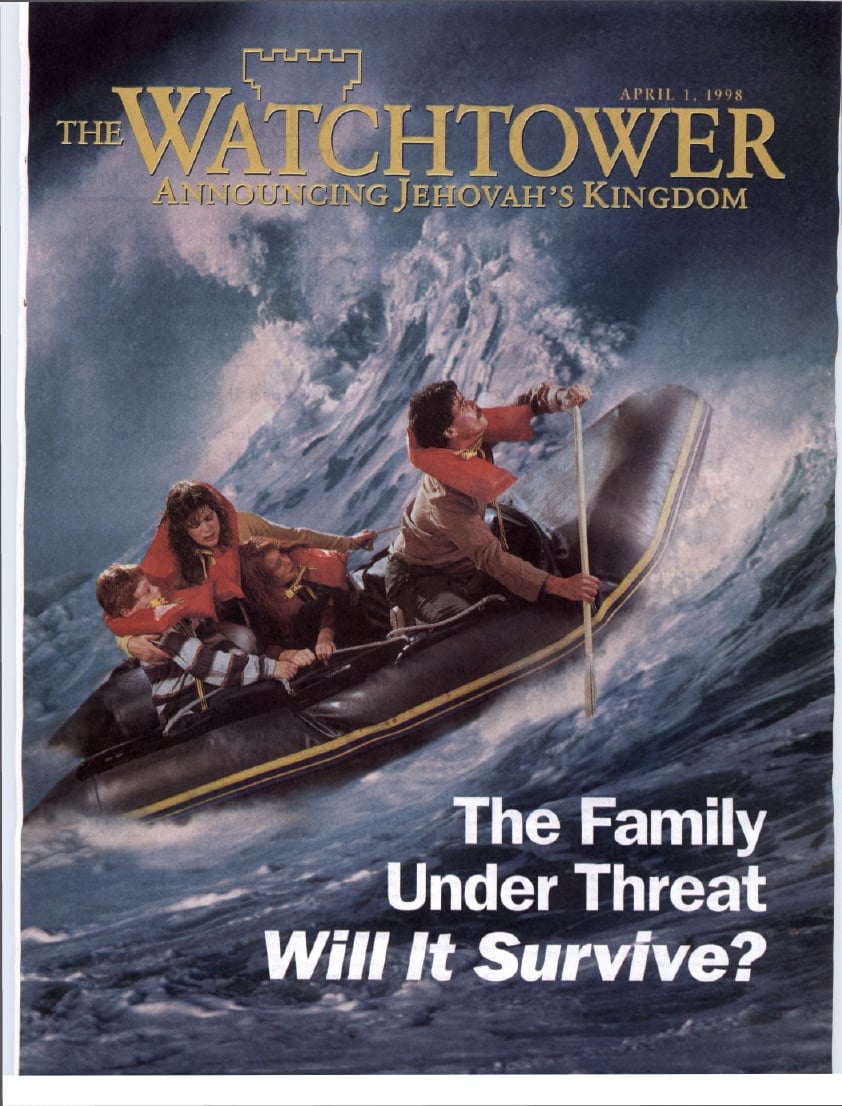
The Watchtower — April 1, 1998
Source: jw.org
Contents
The Family—An Emergency Case!
The Family—A Human Necessity!
“Strong and Convincing”
A Book for All People
A Book From God
“Your People Will Offer Themselves Willingly”
My Life as a Leper—Joyful and Spiritually Blessed
Do You Respect Their Dignity?
Please Join Us for a Special Event Saturday, April 11, 1998
The Family—An Emergency Case!
The Family—An Emergency Case!
“AND they lived happily ever after.” That fairy tale ending applies to fewer and fewer marriages nowadays. The wedding promise to love each other ‘for better or for worse as long as both shall live’ is all too often just rhetoric. The possibility of having a happy family seems to be a gamble with the odds against it.
Between 1960 and 1990, divorce rates more than doubled in most Western industrialized countries. In some lands they increased fourfold. For example, every year about 35,000 marriages are contracted in Sweden, and about half of them will break up, involving over 45,000 children. Couples cohabiting without marriage split up at an even greater rate, affecting further tens of thousands of children. A similar trend is emerging in countries all over the world, as can be seen from the box on page 5.
True, broken families and dissolution of marriages are not new in history. The Code of Hammurabi of the 18th century B.C.E. included laws that allowed divorce in Babylonia. Even the Mosaic Law, instituted in the 16th century B.C.E., permitted divorce in Israel. (Deuteronomy 24:1) However, family bonds have never been weaker than in this 20th century. More than a decade ago, a newspaper columnist wrote: “Fifty years from now, we may not even have any families in the traditional sense. They may have been replaced by collectives of different types.” And the trend since then seems to confirm his idea. The family institution has deteriorated so rapidly that the question, “Will it survive?” is becoming increasingly relevant.
Why is it so hard for so many couples to stick to each other and maintain a united family? What is the secret of those who have stuck together during a long life, happily celebrating their silver and golden wedding anniversaries? Incidentally, in 1983 it was reported that a man and a woman in the former Soviet republic of Azerbaijan celebrated their 100th wedding anniversary—at the age of 126 and 116 respectively.
What Is the Threat?
In many countries some of the grounds for legal divorce are adultery, mental or physical cruelty, desertion, alcoholism, impotence, insanity, bigamy, and drug addiction. However, a more general cause is that the fundamental attitude toward marriage and traditional family life has changed radically, especially during recent decades. Respect for an institution long held sacred has eroded. Greedy producers of music, motion pictures, TV soap operas, and popular literature have glorified so-called sexual freedom, immorality, loose conduct, and a self-centered life-style. They have promoted a culture that has polluted the minds and hearts of young and old alike.
A 1996 poll showed that 22 percent of Americans say that an extramarital affair can sometimes be good for a marriage. A special issue of one of Sweden’s biggest newspapers, Aftonbladet, urged women to get a divorce because “it can only be better.” Some pop psychologists and anthropologists have even speculated that man is “programmed” by evolution to switch mates every few years. In other words, they are suggesting that extramarital affairs and divorces are natural. Some even argue that a parental divorce may be good for the children, preparing them to cope with their own divorce some day!
Many youths no longer desire to live a traditional family life, with father, mother, and children. “I cannot imagine living all my life with the same partner,” is a popular view. “Marriage is like Christmas, just a fairy tale. I just don’t believe in it,” said an 18-year-old Danish lad. “The feeling is, why bother to live with [men] and wash their socks,” Noreen Byrne of the National Women’s Council in Ireland declared. “Just go out and play with them . . . A lot of women are deciding they don’t need men in order to survive.”
One-Parent Households on the Increase
All over Europe this attitude has led to a rapid increase in single motherhood. Some of these single parents are teenagers who feel that an unplanned pregnancy is not a mistake. A few are women who want to raise their child alone. Most are mothers who cohabit with the father for some time, without any plans to marry him. Newsweek magazine ran a cover story last year on the question “The Death of Marriage?” It stated that the percentage of live births outside marriage is increasing rapidly in Europe and that no one seems to care. Sweden may top the list, with half of all babies there born outside marriage. In Denmark and Norway it is close to half, and in France and England, about 1 in 3.
In the United States, two-parent families have declined dramatically in the last few decades. One report says: “In 1960, . . . 9 percent of all children lived in single-parent homes. By 1990, that number had soared to 25 percent. Today, 27.1 percent of all American children are born into single-parent homes, a number that is on the rise. . . . Since 1970, the number of one-parent families has more than doubled. The traditional family is so threatened today that it could be on the verge of extinction, say some researchers.”
In countries where the Roman Catholic Church has lost much of its moral authority, single-parent families are on the increase. Fewer than half of Italian households consist of mother, father, and children, and the traditional family is being replaced with childless couples and single-parent households.
The welfare system in some countries actually encourages people not to marry. Single mothers who receive public assistance would lose it if they married. Single mothers in Denmark get additional child-care subsidies, and in some communities, underage mothers get extra cash and have their rent paid for them. Thus, money is involved. Alf B. Svensson claims that a divorce in Sweden costs the taxpayers between 250 thousand and 375 thousand dollars in subsidies, housing allowances, and social assistance.
Churches of Christendom seem to do little or nothing to try to reverse this devastating trend among families. Many pastors and clergymen are wrestling with their own family crises, thus feeling incapable of assisting others. Some even seem to advocate divorce. Aftonbladet of April 15, 1996, reported that pastor Steven Allen from Bradford, England, composed a special divorce ceremony, which he suggests should serve as an official act in all British churches. “It is a service of healing to help someone come to terms with what has happened to them. It helps them realise that God still loves them and releases them from the hurt.”
So where is the family institution heading? Is there hope for its survival? Can individual families preserve their unity while under such a massive threat? Please consider the next article.
[Chart on page 5]
ANNUAL MARRIAGES COMPARED WITH DIVORCES IN SOME COUNTRIES
COUNTRY YEAR MARRIAGES DIVORCES
Australia 1993 113,255 48,324
Canada 1992 164,573 77,031
Cuba 1992 191,837 63,432
Czech Republic 1993 66,033 30,227
Denmark 1993 31,507 12,991
Estonia 1993 7,745 5,757
France 1991 280,175 108,086
Germany 1993 442,605 156,425
Japan 1993 792,658 188,297
Maldives 1991 4,065 2,659
Norway 1993 19,464 10,943
Puerto Rico 1992 34,222 14,227
Russian Federation 1993 1,106,723 663,282
Sweden 1993 34,005 21,673
United Kingdom 1992 356,013 174,717
United States 1993 2,334,000 1,187,000
(Based on 1994 Demographic Yearbook, United Nations, New York 1996)
The Family—A Human Necessity!
The Family—A Human Necessity!
IT IS claimed that human society feels only as good as its families feel. History shows that as the family arrangement erodes, the strength of communities and nations weakens. When moral decay destroyed families in ancient Greece, its civilization disintegrated, making it vulnerable to conquest by the Romans. The Roman Empire remained strong as long as families remained strong. But as centuries passed, family life weakened, and the strength of the empire waned. “The security and elevation of the family and of family life are the prime objects of civilization, and the ultimate ends of all industry,” commented Charles W. Eliot, former president of Harvard University.
Yes, the family is a human necessity. It has a direct effect on the stability of society and the well-being of children and future generations. No doubt, there are many, many single mothers who work very hard to rear fine children, and they should be commended for their hard work. However, studies show that children usually are far better off if they live in a family with both parents.
An Australian study of over 2,100 adolescents found that “teens from disrupted families had more general health problems, were more likely to display signs of emotional problems, and were more likely to be sexually active than kids from intact families.” A study conducted by the U.S. National Institutes of Health Statistics revealed that children from broken homes were “20-30 percent more likely to have an accident, 40-75 percent more likely to have to repeat a grade of school, and 70 percent more likely to be expelled from school.” And a policy analyst reports that “children from single-parent homes are far more likely to get involved in crime than those growing up in traditional homes.”
Home Is the Haven
The family arrangement offers a happy, upbuilding, and pleasant home to all. “The most important source of happiness and well-being is neither career, things, hobbies nor friends but the family,” a Swedish authority claims.
The Bible shows that every family on earth owes its name to the Grand Creator of families, Jehovah God, in that he instituted the family arrangement. (Genesis 1:27, 28; 2:23, 24; Ephesians 3:14, 15) However, in the inspired Scriptures, the apostle Paul foretold a vicious attack on the family, resulting in a breakdown of morality and human society outside the Christian congregation. He said that “the last days” would be marked by disloyalty, absence of “natural affection,” and disobedience to parents, even among those “having a form of godly devotion.” He urged Christians to turn away from such ones. Jesus foretold that opposition to God’s truth would divide families.—2 Timothy 3:1-5; Matthew 10:32-37.
God has not left us without assistance, though. In his Word much space is devoted to instructions concerning family relationships. It tells us how we can make the family a success and the home a delightful place where each family member has a responsibility to fulfill toward the others.a—Ephesians 5:33; 6:1-4.
Is it possible to achieve such a happy relationship in these days when the family is severely threatened? Yes, indeed! You can succeed in making your family an enjoyable, refreshing oasis in this tough, desertlike world. But this requires something from everybody in the family circle. Following are some suggestions.
Helping Your Family to Survive
One of the best ways a family can stay united is by spending time together. All members should willingly pool their spare time. That may mean sacrifices. You teenagers, for example, may have to sacrifice some favorite TV program, sports event, or outing with friends. You fathers, who usually are the major breadwinners, do not use leisure time just for a hobby or other personal interests. Plan activities with the family, perhaps how to spend weekends or vacations together. Of course, plan something that everybody will look forward to and enjoy.
Children need more than so-called quality time, that is, a set half an hour or so with the children periodically. They need quantity. A columnist in a Swedish daily writes: “During my 15 years as a reporter, I have met a great number of juvenile delinquents . . . A common denominator is that they seem to have been exposed to quality-time upbringing: ‘My parents had no time.’ ‘They never listened.’ ‘He was always traveling.’ . . . As a parent, you can always choose how much time you will give your child. Your choice is judged 15 years later by a ruthless 15-year-old.”
Proper View of Money
All members should also develop a proper view of money. They should be ready to pool what they can to cover the family’s common expenses. Many women have to get a job to make ends meet, but you wives should be aware of the dangers and temptations you might encounter. This world urges you to “fulfill” yourselves and to “do your own thing.” It may cause you to become independent and dissatisfied with your God-given role as a mother and homemaker.—Titus 2:4, 5.
If you mothers can be at home and be a guide and friend to your children, it will certainly contribute greatly toward building strong bonds that will help keep your family together through thick and thin. A woman can contribute outstandingly to making a home happy, secure, and functional. “It takes a hundred men to make an encampment, but one woman can make a home,” said a 19th-century politician.
If all in the family cooperate to live within the family’s total income, it will spare the family many problems. Couples should agree to keep life simple and to put spiritual interests first. Children should learn contentment, not demanding things that the family budget cannot support. Watch out for the desire of the eyes! The temptation to buy things you cannot afford, getting into debt, has led many families into shipwreck. It may be good for family unity if all pool their funds for a joint undertaking—a refreshing journey, some useful and enjoyable equipment for the home, or a contribution to support the Christian congregation.
Another form of “contribution” to a happy family spirit that all family members should pool is the sharing in cleaning and maintenance work—caring for the house, the garden, the car, and so forth. Each family member, even the younger ones, could be assigned some part of a task. You children, try not to waste your time. Instead, develop a spirit of helpfulness and cooperation; this will result in genuine friendship and companionship, which build family unity.
Value of Bible Education
In a united Christian family, the importance of regular Bible study is also stressed. Daily discussion of Bible texts and a weekly study of the Sacred Scriptures provide a basis for a united family. Basic Bible truths and principles should be discussed together in a way that stirs the hearts of all in the family.
Such family sessions should be educational but at the same time enjoyable and encouraging. A family in the north of Sweden used to have the children write down questions that came up during the week. These questions were then discussed at the weekly Bible study. The questions were often deep and thought-provoking and proved to be a reflection of the children’s thinking abilities and appreciation of Bible teachings. Some questions were: “Does Jehovah make everything grow all the time, or did he do it just once?” “Why does the Bible say that God created man ‘in his image’ since God is not a man?” “Didn’t Adam and Eve freeze during the winter in Paradise since they were barefoot and didn’t have any clothes?” “Why do we need the moon at night when it should be dark?” The children are now grown and are serving God as full-time ministers.
When handling family problems, you parents do well to strive to be positive and cheerful. Be considerate and flexible, yet consistent, when it comes to heeding important principles. Let the children see that love for God and his right principles always governs your decisions. The school environment is often very stressful and depressive, and the children need much encouragement in the home to counterbalance such an influence.
Parents, do not pretend to be perfect. Admit mistakes and apologize to your children when necessary. Young people, when Mom and Dad admit a blunder, grow in love for them.—Ecclesiastes 7:16.
Yes, a united family provides a home of peace, security, and happiness. The German poet Goethe once said: “He is happiest, king or peasant, who finds his happiness at home.” For appreciative parents and children, there should be no place like home.
True, the family is severely threatened today by the pressures of the world in which we live. But since the family is from God, it will survive. Your family will survive, and you will too if you follow God’s righteous guidelines for happy family life.
[Footnote]
For more details on this subject, see the 192-page book The Secret of Family Happiness, published by the Watchtower Bible and Tract Society of New York, Inc.
“Strong and Convincing”
“Strong and Convincing”
“STARTING tomorrow, I am going to use it in the preaching work, for the arguments it contains are really strong and convincing,” wrote one of Jehovah’s Witnesses from France. A Witness from the United States wrote: “I read it immediately and cannot wait to use it in the field ministry, as we meet so many people who are apathetic and who put no trust in the Bible.” What were they describing? The 32-page brochure entitled A Book for All People, which was released by the Watch Tower Society at the “Faith in God’s Word” District Conventions held during 1997/98.
This publication was prepared with a particular audience in mind—those who may be educated but who know very little about the Bible. Many such individuals have definite opinions about the Bible, although they have personally never read it. The purpose of the brochure is to convince the reader that, at the very least, the Bible is worthy of examination. The brochure does not push the reader to accept the view that the Bible is inspired of God. Instead, it lets the facts speak for themselves. The wording is not high-sounding but is clear and straightforward.
As the above-quoted comments indicate, those present at the conventions were eager to use this brochure in their field ministry. For example, in France a special witnessing campaign was organized for August 23 and 24 when hundreds of thousands of young visitors from around the world gathered in Paris for World Youth Day. About 2,500 Witnesses (mostly from 16 to 30 years of age) placed 18,000 copies of the brochure in English, French, German, Italian, Polish, and Spanish.
By all means, let us use this brochure, A Book for All People, in our ministry. May this publication prove valuable in convincing reasonable people that they should examine the Bible for themselves.
A Book for All People
A Book for All People
“God is not partial, but in every nation the man that fears him and works righteousness is acceptable to him.”—ACTS 10:34, 35.
1. How did one professor respond when asked what he thought about the Bible, and what did he decide to do?
THE professor was at home on a Sunday afternoon, not expecting any visitors. But when one of our Christian sisters called at his door, he listened. She spoke about pollution and the future of the earth—subjects that appealed to him. However, when she introduced the Bible into the discussion, he seemed skeptical. So she asked him what he thought about the Bible.
“It is a good book that was written by some intelligent men,” he replied, “but the Bible is not to be taken seriously.”
“Have you ever read the Bible?” she inquired.
Taken aback, the professor had to admit that he had not.
She then asked: “How can you voice a strong conviction about a book that you have never read?”
Our sister had a point. The professor decided to examine the Bible and then form an opinion about it.
2, 3. Why is the Bible a closed book for many people, and this presents us with what challenge?
2 The professor is not alone. Many people have definite opinions about the Bible even though they have never personally read it. They may possess a Bible. They may even acknowledge its literary or historical value. But for many, it is a closed book. ‘I do not have time to read the Bible,’ some say. Others wonder, ‘How could an ancient book possibly be relevant to my life?’ Such viewpoints present us with a real challenge. Jehovah’s Witnesses firmly believe that the Bible “is inspired of God and beneficial for teaching.” (2 Timothy 3:16, 17) How, though, can we convince people that regardless of their racial, national, or ethnic background, they should examine the Bible?
3 Let us discuss some reasons why the Bible is worthy of examination. Such a discussion can equip us to reason with those whom we meet in our ministry, perhaps convincing them that they should consider what the Bible says. At the same time, this review should strengthen our own faith that the Bible is, indeed, what it claims to be—“the word of God.”—Hebrews 4:12.
The World’s Most Widely Distributed Book
4. Why can it be said that the Bible is the world’s most widely distributed book?
4 First, the Bible deserves consideration because it is by far the most widely circulated and widely translated book in all human history. Over 500 years ago, the first edition printed from movable type came off Johannes Gutenberg’s printing press. Since then, an estimated four billion Bibles, in whole or in part, have been printed. By 1996 the complete Bible or portions of it had been translated into 2,167 languages and dialects.a More than 90 percent of the human family have access to at least part of the Bible in their own language. No other book—religious or otherwise—even comes close!
5. Why should we expect the Bible to be accessible to people the world over?
5 Statistics alone do not prove that the Bible is God’s Word. However, we should certainly expect a written record that is inspired of God to be accessible to people the world over. After all, the Bible itself tells us that “God is not partial, but in every nation the man that fears him and works righteousness is acceptable to him.” (Acts 10:34, 35) Like no other book, the Bible has crossed national boundaries and has overcome racial and ethnic barriers. Truly, the Bible is a book for all people!
A Unique Record of Preservation
6, 7. Why is it not surprising that none of the original Bible writings are known to exist, and what question does this raise?
6 There is another reason why the Bible deserves examination. It has survived both natural and human obstacles. The record of how it was preserved despite tremendous challenges is truly unique among ancient writings.
7 The Bible writers evidently recorded their words with ink on papyrus (made from the Egyptian plant of the same name) and parchment (made from the skins of animals).b (Job 8:11) Such writing materials, however, have natural enemies. Explains scholar Oscar Paret: “Both of these writing mediums are in the same strong measure endangered by humidity, by mold, and by various maggots. We know from daily experience how easily paper, and even strong leather, deteriorates in the open air or in a damp room.” So it is not surprising that none of the originals are known to exist; they probably disintegrated long ago. But if the originals succumbed to natural foes, how did the Bible survive?
8. Over the centuries, how were the Bible writings preserved?
8 Soon after the originals were written, handwritten copies began to be produced. In fact, copying the Law and other portions of the Holy Scriptures became a profession in ancient Israel. The priest Ezra, for example, is described as “a skilled copyist in the law of Moses.” (Ezra 7:6, 11; compare Psalm 45:1.) But the copies produced were also perishable; eventually they had to be replaced by still other handwritten copies. This process of copying the copies went on for centuries. Since humans are not perfect, did copyists’ mistakes substantially change the Bible text? The overwhelming evidence says no!
9. How does the example of the Masoretes illustrate the extreme care and accuracy of Bible copyists?
9 Not only were the copyists very skilled but they also had a deep respect for the words they copied. The Hebrew word for “copyist” has reference to counting and recording. To illustrate the extreme care and accuracy of the copyists, consider the Masoretes, copyists of the Hebrew Scriptures who lived between the sixth and the tenth centuries C.E. According to scholar Thomas Hartwell Horne, they reckoned “how many times each letter of the [Hebrew] alphabet occurs in all the Hebrew Scriptures.” Think what that means! To avoid omitting even a single letter, these devoted copyists counted not just the words they copied but the letters as well. Why, according to one scholar’s count, they reportedly kept track of 815,140 individual letters in the Hebrew Scriptures! Such diligent effort ensured a high degree of accuracy.
10. What compelling evidence is there that the Hebrew and Greek texts upon which modern translations are based accurately represent the words of the original writers?
10 There is, in fact, compelling evidence that the Hebrew and Greek texts on which modern translations are based represent with remarkable fidelity the words of the original writers. The evidence consists of thousands of handwritten copies of Bible manuscripts—an estimated 6,000 of all or portions of the Hebrew Scriptures and some 5,000 of the Christian Scriptures in Greek—that have survived to our day. A careful, comparative analysis of the many existing manuscripts has enabled textual scholars to detect any copyists’ errors and determine the original reading. Commenting on the text of the Hebrew Scriptures, scholar William H. Green could thus state: “It may be safely said that no other work of antiquity has been so accurately transmitted.” Similar confidence can be placed in the text of the Christian Greek Scriptures.
11. In light of 1 Peter 1:24, 25, why has the Bible survived to our day?
11 How easily the Bible could have perished were it not for the handwritten copies that replaced the originals, with their precious message! There is only one reason for its survival—Jehovah is the Preserver and Protector of his Word. As the Bible itself says, at 1 Peter 1:24, 25: “All flesh is like grass, and all its glory is like a blossom of grass; the grass becomes withered, and the flower falls off, but the saying of Jehovah endures forever.”
Into the Living Languages of Mankind
12. In addition to centuries of recopying, what other obstacle did the Bible face?
12 Surviving centuries of recopying was challenging enough, but the Bible faced another obstacle—translation into contemporary languages. The Bible must speak in the language of the people in order to speak to their hearts. However, translating the Bible—with its more than 1,100 chapters and 31,000 verses—is no easy task. Yet, over the centuries devoted translators gladly took on the challenge, facing seemingly insurmountable obstacles at times.
13, 14. (a) What challenge did Bible translator Robert Moffat face in Africa in the early 19th century? (b) How did Tswana-speaking people react when the Gospel of Luke became available in their language?
13 Consider, for example, how the Bible came to be translated into the languages of Africa. In the year 1800, there were only about a dozen written languages in all of Africa. Hundreds of other spoken languages had no writing system. This was the challenge facing Bible translator Robert Moffat. In 1821, at the age of 25, Moffat set up a mission among the Tswana-speaking people of southern Africa. To learn their unwritten language, he mixed with the people. Moffat persevered and, without the aid of primers or dictionaries, eventually mastered the language, developed a written form of it, and taught some Tswana to read that script. In 1829, after working among the Tswana for eight years, he finished translating the Gospel of Luke. He later said: “I have known individuals to come hundreds of miles to obtain copies of St. Luke. . . . I have seen them receive portions of St. Luke, and weep over them, and grasp them to their bosoms, and shed tears of thankfulness, till I have said to more than one, ‘You will spoil your books with your tears.’” Moffat also told of an African man who saw a number of people reading the Gospel of Luke and asked them what they had in their possession. “It is the word of God,” they replied. “Does it speak?” the man asked. “Yes,” they said, “it speaks to the heart.”
14 Devoted translators like Moffat gave many Africans their first opportunity to communicate in writing. But the translators gave the African people an even more precious gift—the Bible in their own tongue. Moreover, Moffat introduced the divine name to the Tswana, and he used that name throughout his translation.c Thus, the Tswana referred to the Bible as “the mouth of Jehovah.”—Psalm 83:18.
15. Why is the Bible very much alive today?
15 Other translators in various parts of the world faced similar obstacles. Some even risked their lives to translate the Bible. Think about this: If the Bible had remained only in ancient Hebrew and Greek, it might have “died” long ago, for those languages were in time virtually forgotten by the masses and were never known in many parts of the earth. Yet, the Bible is very much alive because, unlike any other book, it can “speak” to people the world over in their own language. As a result, its message remains “at work in [its] believers.” (1 Thessalonians 2:13) The Jerusalem Bible renders these words: “It is still a living power among you who believe it.”
Worthy of Trust
16, 17. (a) For the Bible to be trustworthy, what evidence should exist? (b) Give one example illustrating the candor of the Bible writer Moses.
16 ‘Can the Bible really be trusted?’ some may wonder. ‘Does it refer to people who undeniably lived, places that actually existed, and events that truly happened?’ If we are to trust it, there should be evidence that it was written by careful, honest writers. This brings us to another reason for examining the Bible: There is solid evidence that it is accurate and trustworthy.
17 Honest writers would record not just successes but also failures, not just strengths but also weaknesses. The Bible writers displayed such refreshing candor. Consider, for example, the forthrightness of Moses. Among the things he frankly reported were his own lack of eloquence, which in his view made him unfit to be Israel’s leader (Exodus 4:10); the serious mistake he made that prevented his entering the Promised Land (Numbers 20:9-12; 27:12-14); the deflection of his brother, Aaron, who cooperated with rebellious Israelites in making a statue of a golden calf (Exodus 32:1-6); the rebellion of his sister, Miriam, and her humiliating punishment (Numbers 12:1-3, 10); the profaneness of his nephews Nadab and Abihu (Leviticus 10:1, 2); and the repeated complaining and murmuring of God’s own people. (Exodus 14:11, 12; Numbers 14:1-10) Does not such frank, open reporting indicate a sincere concern for truth? Since the Bible writers were willing to report unfavorable information about their loved ones, their people, and even themselves, is there not good reason to trust their writings?
18. What stamps the writings of the Bible penmen as trustworthy?
18 The consistency of the Bible penmen also stamps their writings as trustworthy. It is truly remarkable that 40 men writing over a span of some 1,600 years are in agreement, even when it comes to minor details. However, this harmony is not so carefully arranged as to arouse suspicions of collusion. On the contrary, there is an obvious lack of design in the agreement of various details; often the harmony is clearly coincidental.
19. How do the Gospel accounts of Jesus’ arrest reveal agreement that is clearly unintentional?
19 To illustrate, consider an incident that took place on the night of Jesus’ arrest. All four Gospel writers record that one of the disciples drew a sword and struck a slave of the high priest, taking off the man’s ear. Only Luke, however, tells us that Jesus “touched the ear and healed him.” (Luke 22:51) But is that not what we would expect from the writer who was known as “the beloved physician”? (Colossians 4:14) John’s account tells us that of all the disciples present, the one who wielded the sword was Peter—a fact that is not surprising in view of Peter’s tendency to be rash and impetuous. (John 18:10; compare Matthew 16:22, 23 and John 21:7, 8.) John reports another seemingly unnecessary detail: “The name of the slave was Malchus.” Why does John alone give the man’s name? The explanation is provided by a minor fact stated in passing only in John’s account—John “was known to the high priest.” He was also known to the high priest’s household; the servants were acquainted with him, and he with them.d (John 18:10, 15, 16) It is only natural, then, that John should mention the injured man’s name, whereas the other Gospel writers, to whom the man evidently was a stranger, do not. The agreement between all these details is remarkable, yet clearly unintentional. There are scores of similar examples throughout the Bible.
20. What do people of honest heart need to know about the Bible?
20 So can we trust the Bible? Absolutely! The candor of the Bible writers and the Bible’s internal consistency give it the clear ring of truth. People of honest heart need to know that they can trust the Bible, for it is the inspired Word of “Jehovah the God of truth.” (Psalm 31:5) There are additional reasons why the Bible is a book for all people, as the next article will discuss.
[Footnotes]
Based on figures published by the United Bible Societies.
During his second imprisonment in Rome, Paul asked Timothy to bring “the scrolls, especially the parchments.” (2 Timothy 4:13) Paul possibly was asking for portions of the Hebrew Scriptures so that he could study them while in prison. The phrase “especially the parchments” may indicate that both scrolls of papyrus and others of parchment were involved.
In 1838, Moffat completed a translation of the Christian Greek Scriptures. With the help of a colleague, he finished translating the Hebrew Scriptures in 1857.
John’s familiarity with the high priest and his household is further shown later in the account. When another of the slaves of the high priest charges Peter with being one of Jesus’ disciples, John explains that this slave was “a relative of the man whose ear Peter cut off.”—John 18:26.
How Would You Answer?
□ Why should we expect the Bible to be the world’s most accessible book?
□ What evidence is there that the Bible has been accurately preserved?
□ What obstacles were faced by those who translated the Bible?
□ What stamps the Bible writings as trustworthy?
A Book From God
A Book From God
“Prophecy was at no time brought by man’s will, but men spoke from God as they were borne along by holy spirit.”—2 PETER 1:21.
1, 2. (a) Why do some question whether the Bible is relevant for modern living? (b) What three lines of proof can we use to demonstrate that the Bible is from God?
IS THE Bible relevant for people living on the brink of the 21st century? Some think not. “Nobody would advocate the use of a 1924 edition chemistry text[book] for use in a modern chemistry class—too much has been learned about chemistry since then,” wrote Dr. Eli S. Chesen, explaining why he felt that the Bible is outdated. On the surface, this argument seems to make sense. After all, man has learned much about science, mental health, and human behavior since Bible times. Therefore, some wonder: ‘How could such an ancient book be free from scientific inaccuracies? How could it contain counsel that is practical for modern living?’
2 The Bible itself gives the answer. At 2 Peter 1:21, we are told that the Bible prophets “spoke from God as they were borne along by holy spirit.” The Bible thus indicates that it is a book from God. How, though, can we convince others that this is so? Let us consider three proofs that the Bible is God’s Word: (1) It is scientifically accurate, (2) it contains timeless principles that are practical for modern living, and (3) it contains specific prophecies that have been fulfilled, as proved by historical facts.
A Book That Agrees With Science
3. Why has the Bible not been threatened by scientific discoveries?
3 The Bible is not a science textbook. It is, however, a book of truth, and truth can stand the test of time. (John 17:17) The Bible has not been threatened by scientific discoveries. When it touches on matters related to science, it is completely free from ancient “scientific” theories that proved to be mere myths. In fact, it contains statements that not only are scientifically sound but also flatly contradict the accepted opinions of the day. Consider, for example, the agreement between the Bible and medical science.
4, 5. (a) Ancient physicians did not understand what about disease? (b) Why was Moses no doubt familiar with the medical practices of Egyptian physicians?
4 Ancient physicians did not fully understand how disease spreads, nor did they realize the importance of sanitation in preventing sickness. Many ancient medical practices would seem barbaric by modern standards. One of the oldest medical texts available is the Ebers Papyrus, a compilation of Egyptian medical knowledge, dating from about 1550 B.C.E. It contains 700 remedies for various afflictions, “ranging from crocodile bite to toenail pain.” Most of the remedies were merely ineffective, but some of them were extremely dangerous. For the treatment of a wound, one of the prescriptions recommended applying a mixture of human excrement combined with other substances.
5 This text of Egyptian medical remedies was written about the same time as the first books of the Bible, which included the Mosaic Law. Moses, who was born in 1593 B.C.E., grew up in Egypt. (Exodus 2:1-10) Raised in Pharaoh’s household, Moses was “instructed in all the wisdom of the Egyptians.” (Acts 7:22) He was familiar with “the physicians” of Egypt. (Genesis 50:1-3) Did their ineffective or dangerous medical practices influence his writings?
6. What sanitary regulation in the Mosaic Law would be considered reasonable by modern medical science?
6 On the contrary, the Mosaic Law included sanitary regulations that would be considered reasonable by modern medical science. For example, a law regarding military encampments required that excrement be buried outside the camp. (Deuteronomy 23:13) This was a profoundly advanced preventive measure. It helped keep the water sources free from contamination and provided protection from fly-borne shigellosis and other diarrheic illnesses that still claim millions of lives each year, mostly in developing lands.
7. What sanitary regulations in the Mosaic Law helped to prevent the spread of infectious diseases?
7 The Mosaic Law contained other sanitary regulations that helped prevent the spread of infectious diseases. A person who had or was suspected of having a communicable disease was quarantined. (Leviticus 13:1-5) Garments or vessels that came in contact with an animal that had died of itself (perhaps from disease) were to be either washed before reuse or destroyed. (Leviticus 11:27, 28, 32, 33) Any person who touched a corpse was considered unclean and had to undergo a cleansing procedure that included washing his garments and bathing. During the seven-day period of uncleanness, he was to avoid physical contact with others.—Numbers 19:1-13.
8, 9. Why can it be said that the sanitary code in the Mosaic Law was far ahead of its time?
8 This sanitary code reveals wisdom that was far ahead of its time. Modern medical science has learned much about the spread and prevention of disease. For example, medical advances in the 19th century led to the introduction of antisepsis—cleanliness to reduce infections. The result was a significant reduction in infections and premature deaths. In the year 1900, life expectancy at the time of birth in many European countries and in the United States was less than 50. Since then, it has increased dramatically, not only on account of medical progress in controlling disease but also because of better sanitation and living conditions.
9 Yet, thousands of years before medical science learned how disease spreads, the Bible prescribed reasonable preventive measures as a safeguard against disease. Not surprisingly, Moses could speak of Israelites in general in his day as living to 70 or 80 years of age. (Psalm 90:10) How could Moses have known about such sanitary regulations? The Bible itself explains: The Law code “was transmitted through angels.” (Galatians 3:19) Yes, the Bible is not a book of human wisdom; it is a book from God.
A Practical Book for Modern Living
10. Although the Bible was completed nearly 2,000 years ago, what is true of its counsel?
10 Books offering advice tend to become outdated and are soon revised or replaced. But the Bible is truly unique. “Your own reminders have proved very trustworthy,” says Psalm 93:5. Although the Bible was completed nearly 2,000 years ago, its words are still applicable. And they apply with equal effect regardless of the color of our skin or the country in which we live. Consider some examples of the Bible’s timeless, “very trustworthy” counsel.
11. Several decades ago, what were many parents led to believe about the disciplining of children?
11 Several decades ago many parents—spurred on by “innovative ideas” on child rearing—thought it was “forbidden to forbid.” Setting limits for children, they feared, would cause trauma and frustration. Well-meaning counselors were insisting that parents refrain from anything more than the mildest correction of their children. Many such experts are now “urging parents to be a little stricter, to take control again,” reports The New York Times.
12. What does the Greek noun translated “discipline” mean, and why do children need such discipline?
12 All along, however, the Bible has offered specific, balanced counsel on the subject of child training. It advises: “Fathers, do not be irritating your children, but go on bringing them up in the discipline and mental-regulating of Jehovah.” (Ephesians 6:4) The Greek noun translated “discipline” means “upbringing, training, instruction.” The Bible says that discipline, or instruction, is evidence of parental love. (Proverbs 13:24) Children thrive under clear-cut moral guidelines that help them develop a sense of right and wrong. Properly administered discipline helps them to feel secure; it tells them that their parents care about them and about the kind of person they are becoming.—Compare Proverbs 4:10-13.
13. (a) When it comes to discipline, what caution does the Bible give parents? (b) What kind of discipline does the Bible recommend?
13 But the Bible cautions parents in this matter of discipline. Parental authority should never be abusive. (Proverbs 22:15) No child should ever be subjected to cruel punishment. Physical violence has no place in the family that lives by the Bible. (Psalm 11:5) Neither does emotional violence—harsh words, constant criticism, and biting sarcasm, all of which can crush a child’s spirit. (Compare Proverbs 12:18.) Wisely, the Bible warns parents: “Do not be exasperating your children, so that they do not become downhearted [or, “you will take all the heart out of them,” Phillips].” (Colossians 3:21) The Bible recommends preventive measures. At Deuteronomy 11:19, parents are urged to take advantage of casual moments to instill moral and spiritual values in their children. Such clear, reasonable counsel on child rearing is as relevant today as it was in Bible times.
14, 15. (a) In what way does the Bible provide more than just wise counsel? (b) What Bible teachings can help men and women of different races and nations to view one another as equals?
14 The Bible provides more than just wise counsel. Its message appeals to the heart. Hebrews 4:12 says: “The word of God is alive and exerts power and is sharper than any two-edged sword and pierces even to the dividing of soul and spirit, and of joints and their marrow, and is able to discern thoughts and intentions of the heart.” Consider an example of the Bible’s motivating power.
15 People today are divided by racial, national, and ethnic barriers. Such artificial walls have contributed to the wholesale slaughter of innocent humans in wars the world over. The Bible, on the other hand, contains teachings that help men and women of different races and nations to view one another as equals. For instance, Acts 17:26 says that God “made out of one man every nation of men.” This shows that there is really only one race—the human race! The Bible further encourages us to “become imitators of God,” of whom it says: “[He] is not partial, but in every nation the man that fears him and works righteousness is acceptable to him.” (Ephesians 5:1; Acts 10:34, 35) For those who truly seek to live by the Bible’s teachings, this knowledge has a unifying effect. It works on the deepest level—in the heart—dissolving the man-made barriers that divide people. Does it really work in today’s world?
16. Relate an experience showing that Jehovah’s Witnesses are a true international brotherhood.
16 Most certainly it does! Jehovah’s Witnesses are well-known for their international brotherhood, which unites people of different backgrounds who ordinarily would not be at peace with one another. During the ethnic clashes in Rwanda, for example, Jehovah’s Witnesses of each tribe protected their Christian brothers and sisters of the other tribe, endangering their own lives in the process. In one case, a Hutu Witness concealed in his home a Tutsi family of six from his congregation. Sadly, the Tutsi family were eventually discovered and killed. The Hutu brother and his family now faced the wrath of the killers and had to flee to Tanzania. Many similar examples were reported. Jehovah’s Witnesses readily acknowledge that such unity is possible because their hearts have been deeply touched by the motivating power of the Bible’s message. That the Bible can unite people in this hate-filled world is powerful proof that it is from God.
A Book of True Prophecy
17. How are Bible prophecies unlike man-made predictions?
17 “No prophecy of Scripture springs from any private interpretation,” says 2 Peter 1:20. Bible prophets did not analyze trends in existing world affairs and then make educated guesses based on their personal interpretation of these developments. Neither did they utter vague predictions that could be made to fit just about any future happening. Let us consider, as an example, a Bible prophecy that was extraordinarily specific and that predicted just the opposite of what people then living might have expected.
18. Why did the inhabitants of ancient Babylon no doubt feel very secure, yet what had Isaiah foretold about Babylon?
18 By the seventh century B.C.E., Babylon was the seemingly impregnable capital of the Babylonian Empire. The city straddled the Euphrates River, and the river’s waters were used to form a broad, deep moat and a network of canals. The city was also protected by a massive system of double walls, buttressed by defense towers. Babylon’s inhabitants no doubt felt very secure. Yet, in the eighth century B.C.E., even before Babylon rose to the height of its glory, the prophet Isaiah foretold: “Babylon . . . must become as when God overthrew Sodom and Gomorrah. She will never be inhabited, nor will she reside for generation after generation. And there the Arab will not pitch his tent, and no shepherds will let their flocks lie down there.” (Isaiah 13:19, 20) Notice that the prophecy foretold not only that Babylon would be destroyed but that it would become permanently uninhabited. What a bold prediction to make! Could Isaiah have written his prophecy after he had observed a desolate Babylon? History answers no!
19. Why was Isaiah’s prophecy not completely fulfilled on October 5, 539 B.C.E.?
19 On the night of October 5, 539 B.C.E., Babylon fell to the armies of Medo-Persia under Cyrus the Great. However, Isaiah’s prophecy was not completely fulfilled at that time. Following the takeover by Cyrus, an inhabited Babylon—although an inferior one—continued for centuries. In the second century B.C.E., about the time the Dead Sea Scroll of Isaiah was copied, the Parthians took control of Babylon, which was then viewed as a prize over which surrounding nations fought. Jewish historian Josephus reported that “a great number” of Jews were living there in the first century B.C.E. According to The Cambridge Ancient History, Palmyrene merchants founded a prosperous trading colony in Babylon in 24 C.E. So, as late as the first century C.E., Babylon was still not completely desolate; yet, Isaiah’s book had been completed long before then.—1 Peter 5:13.
20. What evidence is there that Babylon eventually became mere “piles of stones”?
20 Isaiah never lived to see Babylon become uninhabited. But true to prophecy, Babylon eventually became mere “piles of stones.” (Jeremiah 51:37) According to Hebrew scholar Jerome (born in the fourth century C.E.), by his day Babylon was a hunting ground in which “beasts of every type” roamed, and it remains desolate to this day. Any restoration of Babylon as a tourist attraction might lure visitors, but Babylon’s “progeny and posterity” are gone forever, as Isaiah foretold.—Isaiah 14:22.
21. Why were faithful prophets able to foretell the future with unfailing accuracy?
21 The prophet Isaiah did not make an educated guess. Neither did he rewrite history to make it appear to be prophecy. Isaiah was a true prophet. So were all the other faithful Bible prophets. Why were these men able to do what no other humans can do—foretell the future with unfailing accuracy? The answer is clear. The prophecies originated with the God of prophecy, Jehovah, “the One telling from the beginning the finale.”—Isaiah 46:10.
22. Why should we do our utmost to urge honesthearted ones to examine the Bible for themselves?
22 So is the Bible worthy of examination? We know that it is! But many people are not convinced. They have formed opinions about the Bible even though they may never have read it. Recall the professor mentioned at the beginning of the preceding article. He agreed to a Bible study, and after carefully examining the Bible, he came to the conclusion that it is a book from God. He eventually got baptized as one of Jehovah’s Witnesses, and today he serves as an elder! Let us do our utmost to urge honesthearted ones to examine the Bible for themselves and then form an opinion about it. We are confident that if they make an honest firsthand examination, they will come to realize that this unique book, the Bible, is indeed a book for all people!
Can You Explain?
□ How could you use the Mosaic Law to show that the Bible is not of human origin?
□ What timeless principles in the Bible are practical for modern living?
□ Why could the prophecy at Isaiah 13:19, 20 not have been written after the fact?
□ What should we encourage honesthearted ones to do, and why?
[Box on page 19]
What About the Unprovable?
The Bible contains various statements for which independent physical evidence is lacking. For example, what it says about an invisible realm inhabited by spirit creatures cannot be proved—or disproved—scientifically. Do such unprovable references necessarily put the Bible at odds with science?
This was the question facing a planetary geologist who began to study the Bible with Jehovah’s Witnesses some years ago. “I must admit that accepting the Bible was difficult for me at first because I could not prove some Bible statements scientifically,” he recalls. This sincere man continued studying the Bible and eventually became convinced that the available evidence demonstrates that it is God’s Word. “This lessened the yearning to have every Bible fact proved independently,” he explains. “A person with a scientific inclination must be willing to examine the Bible from a spiritual standpoint, or he will never accept the truth. Science cannot be expected to substantiate every statement in the Bible. But just because certain statements are unprovable, that does not mean that they are untrue. The important thing is that wherever provable the Bible’s accuracy is verified.”
[Picture on page 17]
Moses recorded sanitary regulations that were far ahead of their time
“Your People Will Offer Themselves Willingly”
Kingdom Proclaimers Report
“Your People Will Offer Themselves Willingly”
THE mighty Syrian army chief Naaman has leprosy. If left untreated, this loathsome disease can result in disfigurement and death. What is Naaman to do? Among those of Naaman’s household is a little girl, “captive from the land of Israel.” She boldly speaks out and identifies the prophet Elisha as the one who can heal Naaman.—2 Kings 5:1-3.
Because of her courageous stand, Naaman seeks out Elisha and is healed. Furthermore, Naaman becomes a worshiper of Jehovah! This experience, recorded in the Bible, took place in the tenth century B.C.E. (2 Kings 5:4-15) Today, many youths show similar courage in speaking out in behalf of Kingdom interests. The following experience from Mozambique bears this out.
Six-year-old Nuno is an unbaptized publisher of the good news. Even before he became an unbaptized publisher, Nuno would gather the children in his neighborhood, offer a prayer, and teach them the Bible, using the publication My Book of Bible Stories.
Many times Nuno wakes up early Saturday morning and reminds his family: “Today we go out in the field ministry.” His zeal for the ministry is manifest in other ways. While accompanying his parents in the street ministry in Maputo, Nuno often approaches people on his own. On one such occasion, a businessman came up to him and asked: “Why are you selling these magazines?” Nuno said: “I’m not selling the magazines, but I do accept contributions to help finance the preaching work.” The businessman responded: “Although I’m not interested, I’m impressed with your attitude and ability. I would like to make a contribution to this work.”
On another occasion, Nuno approached a man on the street and offered him the book True Peace and Security—How Can You Find It? The man asked: “Don’t you attend that school over there?” “Yes,” Nuno replied, “I attend that school, but today I’m presenting an important message from this book. It shows you that you can live in the new world that God will bring, as shown in the picture in this book.” Little did Nuno realize that the man he spoke to was a teacher at his school. Not only did the teacher accept the book but now he also regularly receives the Watchtower and Awake! magazines from Nuno.
When Nuno is asked why he likes to engage in the preaching work, he says: “I want to speak to people and teach them about Jehovah and his Son, Jesus Christ.” He adds: “And if the people don’t want to listen, there is no reason to get upset.”
Worldwide, thousands of youths like Nuno “offer themselves willingly” to teach and preach about God’s Kingdom. (Psalm 110:3) But this does not happen by chance. Parents who teach their children about Jehovah from infancy, set a good example in the ministry, and zealously pursue Kingdom interests will be richly rewarded.
My Life as a Leper—Joyful and Spiritually Blessed
My Life as a Leper—Joyful and Spiritually Blessed
AS TOLD BY ISAIAH ADAGBONA
I grew up in Akure, Nigeria. My family farmed yams, bananas, cassava, and cocoa. My father did not want me to go to school. He said to me: “You are a farmer. No one will ever ask you to read yams.”
STILL, I wanted to learn to read. In the evenings, I stood and listened at the window of a home where some children were being taught by a private teacher. That was in 1940 when I was about 12 years old. When the father of the children would see me, he would shout and chase me away. But I kept coming back. Sometimes the teacher did not come, and I would sneak in and look at the children’s books with them. Sometimes they let me borrow their books. That was how I learned to read.
I Join God’s People
In time I got a Bible and regularly read it before going to bed. One evening I read Matthew chapter 10, which shows that Jesus’ disciples would be hated and persecuted by men.
I remembered that Jehovah’s Witnesses had come to my house and were treated badly. It struck me that these might be the people Jesus had talked about. The next time the Witnesses called, I obtained a magazine from them. As I began to associate with them, I became a target of ridicule. Yet, the more that people tried to discourage me, the more convinced and joyful I became that I had found the true religion.
What really impressed me about the Witnesses was that, unlike the other religious groups in my area, they did not mix their worship with the customs and traditions of the local pagan religion. For example, although my family went to the Anglican church, my father kept a shrine to the Yoruba god Ogun.
After my father died, I was supposed to inherit the shrine. I did not want it, since I knew that the Bible condemns idolatry. I progressed spiritually with Jehovah’s help, and in December 1954, I was baptized.
Leprosy Strikes
Earlier that year, I noticed swelling and a loss of feeling in my feet. If I stepped on hot coals, there was no pain. After some time, reddish ulcers appeared on my forehead and lips. Neither I nor my family knew what was wrong; we thought it was eczema. I went to 12 herbalists looking for a cure. Finally one of them told us that it was leprosy.
What a shock that was! I was upset and did not sleep well. I had nightmares. But my knowledge of Bible truth and reliance on Jehovah helped me look to the future with confidence.
People told my mother that if I went to an oracle to offer sacrifices, I would get better. I refused to go, knowing that such an act would displease Jehovah. Realizing that my mind was made up on the matter, my mother’s friends suggested that she take a kola nut and touch my forehead with it. Then she could present the kola nut to the oracle to use in sacrifices on my behalf. I wanted no part of that and told her so. Finally she gave up her efforts to involve me in pagan religion.
By the time I went to the hospital, the leprosy had taken a firm hold. I had ulcers all over my body. At the hospital, they gave me drugs, and gradually my skin returned to normal.
They Thought I Was Dead
But my problems were far from over. My right foot became badly infected, and in 1962 it had to be amputated. After the operation, there were medical complications. The doctors did not expect me to live. A white missionary priest came to administer the last rites. I was too weak to speak, but a nurse told him that I was one of Jehovah’s Witnesses.
The priest said to me: “Do you want to change and become a Catholic so that you can go to heaven?” That made me laugh inside. I prayed to Jehovah for the strength to answer. With great effort I managed to say, “No!” The priest turned and walked away.
My condition worsened until the hospital staff thought I was dead. They covered my face with a sheet. They did not take me to the mortuary, though, since a doctor or a nurse first had to certify that I was dead. There was no doctor on duty, and the nurses had all gone to a party. So they left me in the ward overnight. When the doctor made his rounds the next morning, no one came to my bed because I was still covered up and presumed dead. Eventually, somebody noticed that the “corpse” under the sheet was moving!
Well, I recovered, and in December 1963 they moved me to the Abeokuta Leprosy Hospital Settlement in southwest Nigeria. I have lived there ever since.
Opposition to My Preaching
There were about 400 lepers in the settlement when I arrived, and I was the only Witness. I wrote to the Society, and they responded promptly by directing the Akomoje Congregation to contact me. So I never lost touch with the brothers.
As soon as I got to the settlement, I began preaching. The local pastor was not happy about that, and he reported me to the welfare officer who was in charge of the camp. The welfare officer was an older man who came from Germany. He told me that I had no business teaching the Bible because I had no schooling or certificate to do so; since I was unqualified, I would teach people incorrectly. If I persisted, I could be expelled from the settlement and denied medical treatment. He did not allow me to say anything in reply.
…