The Watchtower, April 15, 1997
Download: PDF — The Watchtower, April 15, 1997
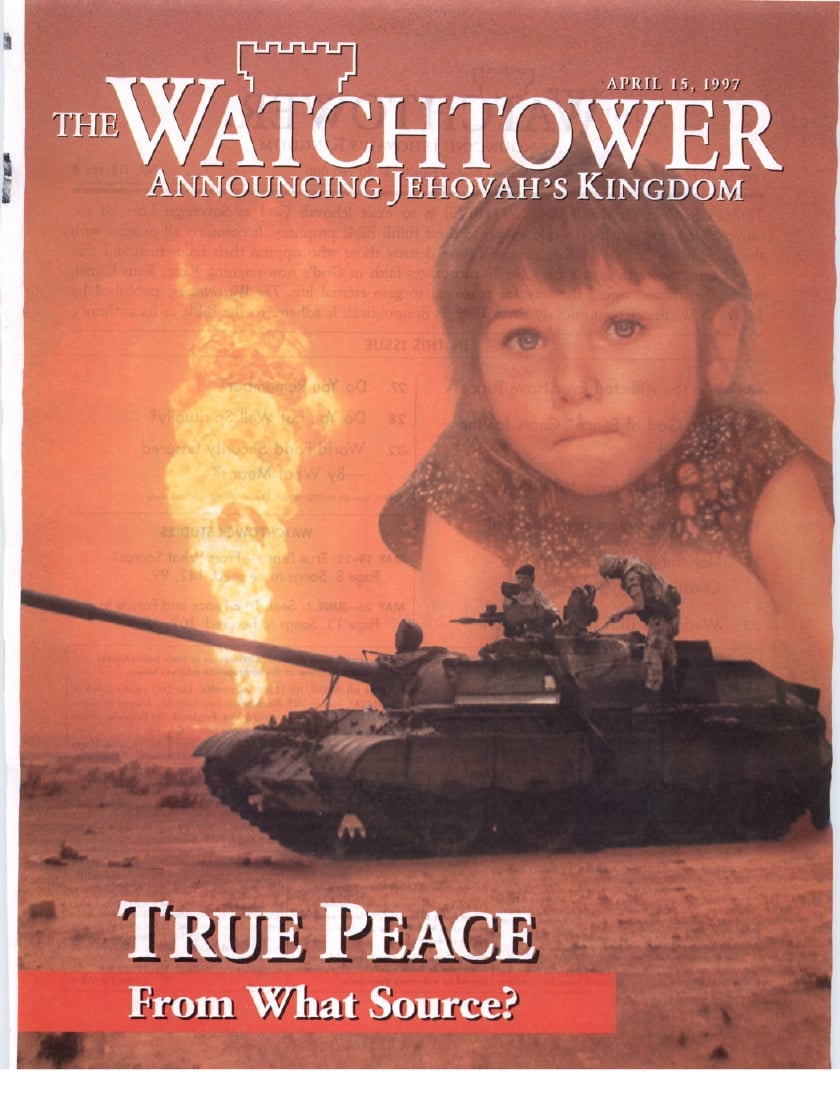
The Watchtower — April 15, 1997
Source: jw.org
Contents
Will the Afflicted Ever Have Peace?
“The God of Peace” Cares for the Afflicted
True Peace—From What Source?
Seek True Peace and Pursue It!
Naḥmanides—Did He Refute Christianity?
Weddings That Honor Jehovah
Do You Remember?
Do You Eat Well Spiritually?
World Food Security Ensured—By What Means?
Will the Afflicted Ever Have Peace?
Will the Afflicted Ever Have Peace?
WOULD you like to see an end to suffering, not only for yourself but for all mankind? Consider these examples:
Sonia has had more than her share of affliction.a First, she discovered that her husband had been having an adulterous affair for ten years. Then her youngest son became infected with HIV and died of AIDS. Two years later her other son became ill, and soon he too died of AIDS. “The final phase of his disease lasted so long,” Sonia recalls. “He suffered intense depression, lost his hair, and could not see well. It was very sad.”
Fabiana, a Brazilian university student, was concerned about the world’s social injustices. Then tragedy struck her own life. Her brother, suffering from depression, committed suicide. When Fabiana lost her job, a friend suggested that she seek a pai-de-santo (witch doctor), reasoning that for Fabiana to suffer such misfortune someone must have cast a spell on her! But the pai-de-santo brought no relief. Instead, Fabiana felt tormented, unable to sleep because of her adversities.
Ana’s affliction began much earlier in life. “When I was one year old,” she relates, “my mother abandoned me, so I was taken in by my grandmother.” Then, when Ana was only three years old, her grandmother died. Ana was sent to an orphanage in Rio de Janeiro, where she remained until she was 13. “We were treated very badly there, and I became rebellious,” she says. “As I grew up, I fought against just about everything.”
Affliction seems to touch the life of every human in one way or another. Indeed, we encounter stories of human tragedy on a daily basis—whenever we watch, read, or listen to the news. “Not until our . . . era of mass communication did it become practically impossible to escape constant bombardment by bad news,” writes Dr. Mary Sykes Wylie. “Wars, natural disasters, industrial catastrophes, highway carnage, crime, terrorism, sexual abuse, rape, domestic violence—all make trauma a horrible and daily leitmotif of the 20th century.” The Christian apostle Paul realistically summed up the human experience: “All creation keeps on groaning together and being in pain.”—Romans 8:22.
What about you? Are you experiencing affliction? What relief can you expect? Will you ever attain true peace? Sonia, Fabiana, and Ana found genuine comfort and a real measure of peace! You can read about it in the following article.
[Footnote]
Names in this article have been changed.
“The God of Peace” Cares for the Afflicted
“The God of Peace” Cares for the Afflicted
THE Bible makes it clear that David of old was no stranger to affliction. For several years he lived as a fugitive, relentlessly pursued by a wicked and obstinate king, who was bent on killing him. During this period of affliction, David hid himself in isolated places. But he did something more. He earnestly prayed to Jehovah about his adversity. “With my voice, to Jehovah I proceeded to call for aid,” he later wrote regarding his ordeal. “Before him I kept pouring out my concern; before him I continued to tell about my own distress.”—Psalm 142:1, 2.
Today, some would mock David’s reliance on God. They would say that prayer is just a psychological crutch and that in practical terms it is a waste of time. Yet, David’s confidence in God was not misplaced, for his enemies were eventually defeated. Looking back on his experience, David wrote: “This afflicted one called, and Jehovah himself heard. And out of all his distresses He saved him.” (Psalm 34:6) The true God to whom David turned is elsewhere called “the God of peace.” (Philippians 4:9; Hebrews 13:20) Will he bring relief from affliction, resulting in peace for us?
Jehovah Cares for You
Jehovah is not aloof concerning the adversities of his people. (Psalm 34:15) He is attentive to the needs not only of his servants as a group but also of each individual who fears him. When dedicating the temple in ancient Jerusalem, Solomon implored Jehovah to listen to “whatever prayer, whatever request for favor there may occur on the part of any man or of all your people Israel, because they know each one his own plague and his own pain.” (2 Chronicles 6:29) As Solomon acknowledged, each individual has his own unique affliction to endure. For one person it might be physical illness. For another, emotional distress. Some may be afflicted by the death of a loved one. Unemployment, economic hardship, and family problems are also common afflictions in these difficult times.
Think for a moment about ‘your own plague and your own pain.’ At times you have perhaps felt as did the psalmist David, who wrote: “I kept hoping for someone to show sympathy, but there was none; and for comforters, but I found none.” Yet, you can be assured that God cares about your situation, for later in the same psalm, David wrote: “Jehovah is listening to the poor ones, and he will indeed not despise his very own prisoners.”—Psalm 69:20, 33.
Applying David’s words in a broad sense, we can rest assured that the Creator of mankind listens to the prayers of those who are imprisoned, so to speak, by their afflictions. More than that, he reacts to their plight. Consider the following statements that reveal Jehovah’s compassion for the afflicted.
“You people must not afflict any widow or fatherless boy. If you should afflict him at all, then if he cries out to me at all, I shall unfailingly hear his outcry; and my anger will indeed blaze.”—Exodus 22:22-24.
“Shall not God cause justice to be done for his chosen ones who cry out to him day and night, even though he is long-suffering toward them?”—Luke 18:7.
“He will deliver the poor one crying for help, also the afflicted one and whoever has no helper. He will feel sorry for the lowly one and the poor one, and the souls of the poor ones he will save. From oppression and from violence he will redeem their soul, and their blood will be precious in his eyes.”—Psalm 72:12-14.
“He that is touching you [God’s people on earth] is touching my eyeball.”—Zechariah 2:8.
These few examples illustrate our Creator’s deep interest in the welfare of his people. Hence, we have good reason to follow the apostle Peter’s admonition: “Throw all your anxiety upon him, because he cares for you.” (1 Peter 5:7) But how will God help us during times of affliction?
How God Helps the Afflicted
As we have seen, when David suffered affliction, he earnestly prayed to God for guidance. At the same time, he took the initiative to alleviate the situation, using ingenuity to escape his pursuers. Thus, reliance on Jehovah combined with personal effort enabled David to endure his adversity. What can we learn from this?
When we are faced with affliction, it is certainly not wrong for us to take reasonable initiative to solve the problem. For example, if a Christian finds himself unemployed, will he not put forth effort to find work? Or if he is suffering from a physical ailment, will he not seek medical attention? Indeed, even Jesus, who had the power to cure all types of sickness, acknowledged that ‘the ailing need a physician.’ (Matthew 9:12; compare 1 Timothy 5:23.) Of course, some adversities cannot be removed; they simply must be endured. Nevertheless, a true Christian does not view suffering as a virtue in itself, as do some. (Compare 1 Kings 18:28.) Rather, he takes whatever steps he can to cope with his affliction.
At the same time, though, it is reasonable to take the matter to Jehovah in prayer. Why? First, by leaning on our Creator, we are helped to “make sure of the more important things.” (Philippians 1:10) For instance, when searching for employment, prayerful reliance on God will help us not to accept work that conflicts with Bible principles. We will also avoid being “led astray from the faith” by the love of money. (1 Timothy 6:10) Really, when making weighty decisions—regarding employment or any other facet of life—we need to follow David’s admonition: “Throw your burden upon Jehovah himself, and he himself will sustain you. Never will he allow the righteous one to totter.”—Psalm 55:22.
Prayer also helps us to keep our mental balance, so that our affliction does not overwhelm us. The apostle Paul wrote: “In everything by prayer and supplication along with thanksgiving let your petitions be made known to God.” With what result? “The peace of God that excels all thought will guard your hearts and your mental powers by means of Christ Jesus.” (Philippians 4:6, 7) Yes, peace, the peace of God. That peace “excels all thought,” so it can stabilize us when we are burdened with distressing emotions. It will ‘guard our hearts and mental powers,’ thus helping us to avoid reacting rashly and unwisely, which could add to our affliction.—Ecclesiastes 7:7.
Prayer can do still more. It can make a difference in how a situation works out. Consider a Bible example. When the apostle Paul was imprisoned in Rome, he encouraged fellow Christians to pray in his behalf. Why? “I exhort you more especially to do this,” he wrote to them, “that I may be restored to you the sooner.” (Hebrews 13:19) Paul knew that the persistent prayers of his fellow believers could make a difference as to when he would be released.—Philemon 22.
Will prayer change the outcome of your affliction? It may. We should realize, though, that Jehovah does not always answer our prayers in the manner that we may expect. Paul, for example, prayed repeatedly regarding his “thorn in the flesh”—perhaps a physical problem related to his eyesight. Instead of removing the affliction, God told Paul: “My undeserved kindness is sufficient for you; for my power is being made perfect in weakness.”—2 Corinthians 12:7-9.
So at times our adversities will not be removed. Rather, we will have opportunity to prove our reliance on our Creator. (Acts 14:22) Furthermore, we can be assured that even if Jehovah does not remove the affliction, he will “make the way out in order for [us] to be able to endure it.” (1 Corinthians 10:13) Yes, it is for good reason that Jehovah is called “the God of all comfort, who comforts us in all our tribulation.” (2 Corinthians 1:3, 4) He gives us what we need to endure with considerable peace.
Soon—A World Without Affliction!
The Creator promises that by means of his Kingdom, he will soon do away with mankind’s afflictions. How will he accomplish this? By removing Satan the Devil, the chief instigator of affliction and the foremost enemy of peace, whom the Bible identifies as “the god of this system of things.” (2 Corinthians 4:4) But soon his control over mankind will end. His being eliminated will open the way for countless blessings to come to those who fear God. The Bible promises that Jehovah will “wipe out every tear from their eyes, and death will be no more, neither will mourning nor outcry nor pain be anymore. The former things have passed away.”—Revelation 21:1-4.
Does a world without affliction sound too good to be true? We are so accustomed to living with adversity that we are hard-pressed to imagine its absence. But freedom from fear, anxiety, and calamity is just what God purposed for mankind at creation, and his purpose will succeed.—Isaiah 55:10, 11.
This is the hope that Sonia, Fabiana, and Ana, mentioned in the opening article, found. Sonia, whose two sons died of AIDS, gained much peace from the hope that the Bible holds out—a resurrection of the righteous and the unrighteous. (Acts 24:15) “One thing is certain,” she says, “our hope surpasses any pain whatsoever.”
While still living in the orphanage, Ana was visited by one of Jehovah’s Witnesses. “She showed me Jehovah’s name in the Bible,” says Ana, “and I cried for joy. I needed help badly, and I learned that there is a God who cares for us.” After leaving the orphanage, Ana accepted a Bible study and learned more about Jehovah’s promises. Then she dedicated her life to Jehovah and symbolized it by baptism. “Since then I have continued to rely on Jehovah through prayer, and I am comforted by the assurance that he will help me.”
Fabiana too has found much comfort and peace of mind in her affliction by learning about God’s promises for the future. “Learning the truth from the Bible is like leaving a very dark and gloomy place and entering a clear, bright, and pleasant room.”—Compare Psalm 118:5.
But how and when will literal peace all around the globe come about? Let us see in the following articles.
[Box on page 6]
The Many Faces of Affliction
▪ Approximately a quarter of the world’s population lives in extreme poverty, and millions more live in subhuman conditions that threaten their survival.
▪ More than 200 million children are undernourished.
▪ Each year diarrhea kills about three million children under five years of age.
▪ Infectious diseases killed some 16.5 million people in 1993 alone. Since some countries categorize illnesses differently, the true number may be much higher.
▪ An estimated 500 million people are affected by some type of mental problem.
▪ Suicide rates are increasing more rapidly among youths than in any other age bracket.
▪ “Hunger and unemployment have become blots on the world,” states The Unesco Courier. “There are 35 million unemployed in the world’s seven wealthiest nations, and in Brazil alone there are 20 million workers for whom having a job does not even mean that they will be able to eat their fill.”
[Pictures on page 7]
Prayer can help us focus on God’s promise of a world without affliction
True Peace—From What Source?
True Peace—From What Source?
“[Jehovah] is making wars to cease to the extremity of the earth.”—PSALM 46:9.
1. What marvelous promise of peace do we find in Isaiah’s prophecy?
“THE work of the true righteousness must become peace; and the service of the true righteousness, quietness and security to time indefinite. And my people must dwell in a peaceful abiding place and in residences of full confidence and in undisturbed resting-places.” (Isaiah 32:17, 18) What a beautiful promise! It is a promise of true peace brought about by God.
2, 3. Describe true peace.
2 What, though, is true peace? Is it simply the absence of war? Or is it merely a period during which nations prepare for the next war? Is true peace just a dream? Those are questions to which we need reliable answers. First, true peace is much more than a dream. God’s promised peace goes far beyond anything that this world can imagine. (Isaiah 64:4) It is not peace for a few years or a few decades. It endures forever! And it is not peace just for a privileged few—it embraces heaven and earth, angels and humans. It reaches out to people of all nations, ethnic groups, languages, and colors. It knows no frontiers, no barriers, no failures.—Psalm 72:7, 8; Isaiah 48:18.
3 True peace means peace every day. It means that you wake up each morning without a thought of war, without having to worry about your future, your children’s future, even your grandchildren’s future. It means complete peace of mind. (Colossians 3:15) It means no more crime, no more violence, no more families torn apart, no more homeless people, no more people starving or freezing, and no more despair and frustration. Better still, God’s peace means a world without sickness, pain, sorrow, or death. (Revelation 21:4) What a magnificent hope we have of enjoying true peace forever! Is not this the kind of peace and happiness that all of us yearn for? Is not this the kind of peace that we should pray and work for?
Mankind’s Failed Efforts
4. What efforts for peace have the nations put forth, and with what results?
4 For centuries, men and nations have spoken about peace, have debated peace, have signed hundreds of peace treaties. What has been the result? In the last 80 years, there has virtually never been a moment when some nation or group has not been at war. Clearly, peace has eluded mankind. So the question is, Why have all man’s efforts to establish international peace failed, and why is man incapable of bringing about true peace that will endure?
5. Why have mankind’s peace efforts consistently failed?
5 The simple answer is that mankind has not turned to the right source for true peace. Under the influence of Satan the Devil, men have created organizations that fall victim to their own weaknesses and vices—their greed and ambition, their lust for power and prominence. They have gone to institutions of higher learning and have established foundations and think tanks, which have only thought out more means of oppression and destruction. To what source have humans been directed? Where have they looked?
6, 7. (a) What record did the League of Nations make for itself? (b) What is the record of the United Nations?
6 Back in 1919 the nations put their trust in the League of Nations to establish permanent peace. That hope was shattered by Mussolini’s invasion of Ethiopia in 1935 and the civil war in Spain beginning in 1936. The League sank into oblivion with the outbreak of World War II in 1939. The so-called peace had not even lasted 20 years.
7 What about the United Nations? Has it provided any real hope of lasting peace earth wide? Hardly. Over 150 wars and armed conflicts have been fought since its inception in 1945! It is no wonder that Gwynne Dyer, a Canadian student of war and its origins, described the UN as “an association of poachers turned gamekeepers, not an assembly of saints,” and “a largely powerless talking-shop.”—Compare Jeremiah 6:14; 8:15.
8. Despite their peace talks, what have the nations been doing? (Isaiah 59:8)
8 Despite their talk of peace, the nations continue to invent and manufacture arms. The countries that sponsor peace conferences are often the very ones that lead in the manufacturing of weapons. Powerful commercial interests in these countries promote the production of death-dealing armaments, including diabolic land mines that every year kill or maim some 26,000 civilian adults and children. Greed and corruption are motivating forces. Bribes and kickbacks are part and parcel of the international arms trade. Some politicians enrich themselves from this source.
9, 10. What have worldly experts observed regarding wars and human endeavors?
9 In December 1995, Polish physicist and winner of the Nobel Prize for Peace Joseph Rotblat called on the nations to end the arms race. He said: “The only way to prevent [a new arms race] is to abolish war altogether.” Do you think that this is likely to happen? From 1928 onward, 62 nations ratified the Kellogg-Briand Pact, renouncing war as a way of settling differences. World War II clearly demonstrated that the pact was not worth the paper it was written on.
10 Undeniably, war has been a constant stumbling stone on mankind’s pathway of history. As Gwynne Dyer wrote, “war is a central institution in human civilization, and it has a history precisely as long as civilization.” Yes, virtually every civilization and empire has had its revered military heroes, its standing armies, its famous battles, its sacrosanct military academies, and its stockpile of weapons. However, our century has been marked by war more than any other, both in destructiveness and in loss of life.
11. What basic factor have world leaders overlooked in their quest for peace?
11 It is obvious that the world’s leaders have ignored the basic wisdom of Jeremiah 10:23: “I well know, O Jehovah, that to earthling man his way does not belong. It does not belong to man who is walking even to direct his step.” Without God in the picture, there can be no true peace. Does all of this mean, then, that war is inevitable in a civilized society? Does it mean that peace—true peace—is an impossible dream?
Getting to the Root Cause
12, 13. (a) What does the Bible reveal as to the basic, unseen cause of war? (b) How has Satan turned mankind’s attention away from the real solution to the world’s problems?
12 To answer those questions, we need to understand the causes of war. The Bible clearly states that the rebellious angel Satan is the original “manslayer” and “liar” and that “the whole world is lying in the power of the wicked one.” (John 8:44; 1 John 5:19) What has he done to further his designs? We read at 2 Corinthians 4:3, 4: “If, now, the good news we declare is in fact veiled, it is veiled among those who are perishing, among whom the god of this system of things has blinded the minds of the unbelievers, that the illumination of the glorious good news about the Christ, who is the image of God, might not shine through.” Satan does everything possible to turn mankind’s attention away from God’s Kingdom as the solution to the world’s problems. He blinds and sidetracks people with divisive social, political, and religious issues, so that these seem to be more important than God’s rulership. The recent worldwide surge of nationalism is a case in point.
13 Satan the Devil promotes nationalism and tribalism, the belief in the superiority of one nation, race, or tribe over others. Deep-seated hatreds that have been repressed for centuries are being revived to fuel more wars and conflicts. Federico Mayor, director-general of UNESCO, warned of this tendency: “Even where tolerance used to be the order of the day, a shift towards xenophobia is becoming more evident, and chauvinist or racist utterances that had seemed to be a thing of the past are heard more and more often.” What has been the result? The gruesome massacres in the former Yugoslavia and the tribal bloodbath in Rwanda are but two such developments that have made it to the headlines.
14. How does Revelation 6:4 portray war and its effect in our time?
14 The Bible foretold that in the time of the end of this system, a fiery-colored horse, symbolizing war, would gallop throughout the earth. We read at Revelation 6:4: “Another came forth, a fiery-colored horse; and to the one seated upon it there was granted to take peace away from the earth so that they should slaughter one another; and a great sword was given him.” Since 1914 we have seen this symbolic horseman “take peace away,” and the nations have gone right on fighting and waging war.
15, 16. (a) What has been the role of religion in wars and killings? (b) How does Jehovah regard what religions have done?
15 What must not be overlooked is religion’s role in these wars and killings. Mankind’s blood-drenched history can be attributed in great measure to the misguiding influence of false religion. Catholic theologian Hans Küng wrote: “There is no disputing that in negative, destructive terms [religions] have made and still make an enormous contribution. So much struggle, bloody conflicts, indeed ‘religious wars’ are to be held to their account; . . . and this also goes for the two world wars.”
16 How does Jehovah God regard false religion’s role in killings and wars? God’s indictment of false religion, recorded at Revelation 18:5, states: “Her sins have massed together clear up to heaven, and God has called her acts of injustice to mind.” False religion’s complicity with the political rulers of the world amounts to such bloodguilt, such a mass of accumulated sins, that God cannot possibly ignore it. He will soon completely eliminate this stumbling block on the way to true peace.—Revelation 18:21.
The Way to Peace
17, 18. (a) Why is it not just an unrealistic dream to believe that everlasting peace is possible? (b) What has Jehovah already done to ensure that true peace will come?
17 If men, through agencies such as the United Nations, cannot bring about true and lasting peace, from what source will true peace come, and how? Is it just an unrealistic dream to believe that everlasting peace is possible? Not if we turn to the right source of peace. And who is that? Psalm 46:9 answers by telling us that Jehovah “is making wars to cease to the extremity of the earth. The bow he breaks apart and does cut the spear in pieces; the wagons he burns in the fire.” And Jehovah has already started the process to end wars and establish true peace. How? By installing Christ Jesus on his rightful Kingdom throne in 1914 and by promoting the greatest educational campaign for peace in the history of mankind. The prophetic words of Isaiah 54:13 reassure us: “All your sons will be persons taught by Jehovah, and the peace of your sons will be abundant.”
18 This prophecy illustrates the principle of cause and effect—that is, every effect has its cause. In this case, Jehovah’s teaching—the cause—transforms warlike people into peace-loving people who are at peace with God. The effect is the change of heart that makes people peace lovers. This teaching that changes people’s hearts and minds is even now spreading worldwide as millions follow the example of the “Prince of Peace,” Jesus Christ.—Isaiah 9:6.
19. What did Jesus teach about true peace?
19 And what did Jesus teach about true peace? He spoke not merely of peace between nations but of peace between people in their relationships and of the inner peace that comes from a good conscience. At John 14:27, we read Jesus’ words to his followers: “I leave you peace, I give you my peace. I do not give it to you the way that the world gives it. Do not let your hearts be troubled nor let them shrink for fear.” How was Jesus’ peace different from that of the world?
20. By what means will Jesus bring true peace?
20 First, Jesus’ peace was closely tied in with his Kingdom message. He knew that the righteous heavenly government, composed of Jesus and 144,000 corulers, would put an end to war and warmongers. (Revelation 14:1, 3) He knew that it would bring about the peaceful paradisaic conditions that he offered to the evildoer who died at his side. Jesus did not offer him a place in the heavenly Kingdom, but he said: “Truly I tell you today, You will be with me in Paradise.”—Luke 23:43.
21, 22. (a) What wonderfully sustaining hope does true peace include? (b) What must we do to witness that blessing?
21 Jesus also knew that his Kingdom would bring comfort to all those mourning ones who exercise faith in him. His peace includes the wonderfully sustaining hope of the resurrection. Remember his encouraging words found at John 5:28, 29: “Do not marvel at this, because the hour is coming in which all those in the memorial tombs will hear his voice and come out, those who did good things to a resurrection of life, those who practiced vile things to a resurrection of judgment.”
22 Do you look forward to that time? Have you lost dear loved ones in death? Do you yearn to see them again? Then accept the peace that Jesus offers. Have faith like that of Martha, Lazarus’ sister, who said to Jesus: “I know he will rise in the resurrection on the last day.” But note Jesus’ exhilarating reply to Martha: “I am the resurrection and the life. He that exercises faith in me, even though he dies, will come to life; and everyone that is living and exercises faith in me will never die at all. Do you believe this?”—John 11:24-26.
23. Why is accurate knowledge of God’s Word essential in gaining true peace?
23 You too can believe in and benefit from that promise. How? By gaining accurate knowledge of God’s Word. Note how the apostle Paul emphasized the importance of accurate knowledge: “We . . . have not ceased praying for you and asking that you may be filled with the accurate knowledge of his will in all wisdom and spiritual comprehension, in order to walk worthily of Jehovah to the end of fully pleasing him as you go on bearing fruit in every good work and increasing in the accurate knowledge of God.” (Colossians 1:9, 10) This accurate knowledge will convince you that Jehovah God is the source of true peace. It will also tell you what you must do now so that you may join the psalmist in saying: “In peace I will both lie down and sleep, for you yourself alone, O Jehovah, make me dwell in security.”—Psalm 4:8.
Can You Explain?
□ Why have human peace efforts failed consistently?
□ What is the root cause of war?
□ Why is lasting peace not an unrealistic dream?
□ What is the source of true peace?
[Picture on page 8]
True peace is not a dream. It is God’s promise
[Picture on page 10]
Since 1914 the symbolic rider of the fiery-colored horse has taken peace away from the earth
[Picture on page 11]
Can religion and the UN bring peace?
[Credit Line]
UN photo
Seek True Peace and Pursue It!
Seek True Peace and Pursue It!
“He that would love life and see good days, . . . let him turn away from what is bad and do what is good; let him seek peace and pursue it.”—1 PETER 3:10, 11.
1. What famous words of Isaiah are sure to have certain success?
“THEY will have to beat their swords into plowshares and their spears into pruning shears. Nation will not lift up sword against nation, neither will they learn war anymore.” (Isaiah 2:4) Even though this famous text is displayed near the world headquarters of the United Nations in New York City, that world organization has not by any stretch of the imagination carried them out. However, as part of the unfailing word of Jehovah God, that declaration will not be without results.—Isaiah 55:10, 11.
2. What must “occur in the final part of the days,” according to Isaiah 2:2, 3?
2 The words found at Isaiah 2:4 are actually part of a marvelous prophecy, a prophecy about true peace—and it is undergoing fulfillment right in our own time. Before proclaiming the thrilling prospects of no more wars and weapons of war, the prophecy says: “It must occur in the final part of the days that the mountain of the house of Jehovah will become firmly established above the top of the mountains, and it will certainly be lifted up above the hills; and to it all the nations must stream. And many peoples will certainly go and say: ‘Come, you people, and let us go up to the mountain of Jehovah, to the house of the God of Jacob; and he will instruct us about his ways, and we will walk in his paths.’ For out of Zion law will go forth, and the word of Jehovah out of Jerusalem.”—Isaiah 2:2, 3.
People Can Become Peaceable
3. How can a person change from being belligerent to being peaceful?
3 Note that before people can pursue a peaceful course, they must be instructed in Jehovah’s ways. Obedient response to Jehovah’s teaching can change a person’s way of thinking and acting, so that one who has been belligerent becomes peaceable. How is this transformation accomplished? Romans 12:2 says: “Quit being fashioned after this system of things, but be transformed by making your mind over, that you may prove to yourselves the good and acceptable and perfect will of God.” We make our mind over, or motivate it in a different direction, by filling it with principles and precepts from God’s Word. Regular study of the Bible helps us to make this change and enables us to prove to ourselves what Jehovah’s will is for us, so we can see clearly the way we must go.—Psalm 119:105.
4. How does one put on the peaceable new personality?
4 Bible truth transforms not only our pattern of thinking but also our actions and personality. It helps us to do what the apostle Paul urged: “Put away the old personality which conforms to your former course of conduct and which is being corrupted according to his deceptive desires; but . . . be made new in the force actuating your mind, and . . . put on the new personality which was created according to God’s will in true righteousness and loyalty.” (Ephesians 4:22-24) The force that actuates the mind is internal. It is transformed and becomes powerful as our love for Jehovah and his laws grows, and it makes us spiritual and peaceable people.
5. How does the “new commandment” Jesus gave his disciples contribute to the peace among them?
5 The need for this transformation is seen from the instruction Jesus gave to his disciples during his final hours with them: “I am giving you a new commandment, that you love one another; just as I have loved you, that you also love one another. By this all will know that you are my disciples, if you have love among yourselves.” (John 13:34, 35) This Christlike, unselfish love binds the disciples together in perfect unity. (Colossians 3:14) Only those who are willing to accept and live by this “new commandment” will enjoy the peace that God promises. Are there any people doing this today?
6. Why do Jehovah’s Witnesses enjoy peace, in contrast with the people of the world?
6 Jehovah’s Witnesses endeavor to show love in their worldwide brotherhood. Though they are drawn from all the nations of the world, they do not get involved in the world’s controversies, even when they are subjected to severe political and religious pressure. As a united people, they are taught by Jehovah, and they enjoy peace. (Isaiah 54:13) They remain neutral in political conflicts, and they do not participate in wars. Some who were formerly violent have given up that life-style. They have become peace-loving Christians, imitating the example of Christ Jesus. And they wholeheartedly follow Peter’s advice: “He that would love life and see good days, let him restrain his tongue from what is bad and his lips from speaking deception, but let him turn away from what is bad and do what is good; let him seek peace and pursue it.”—1 Peter 3:10, 11; Ephesians 4:3.
Those Who Are Pursuing Peace
7, 8. Give examples of people who gave up warfare and became seekers of true peace. (Relate others that you might be familiar with.)
7 For example, there is Rami Oved, a former officer in a specialized antiterrorist squad. He was trained to kill his enemies. He fervently believed in his Israeli nationalism until the day that he discovered that the rabbis did not want him to marry the woman he loved simply because she was an Asian, a Gentile. He began to search for truth in the Bible. Then he came in contact with Jehovah’s Witnesses. His study of the Bible with the Witnesses convinced him that he could no longer be a fanatic nationalist. Christian love meant giving up war and weapons and learning to love people of every race. How surprised he was when he received a kind letter with the opening words, “My Brother Rami”! What was so unusual about that? The writer was a Palestinian Witness. “I thought that was incredible,” Rami says, “as Palestinians were my enemies, and here one of them was calling me ‘My Brother.’” Rami and his wife now pursue true peace in God’s way.
8 Another example is that of Georg Reuter, who served in the German army that invaded Russia during World War II. Soon he became disillusioned with Hitler’s grandiose scheme for world domination. When he returned from the war, he started to study the Bible with Jehovah’s Witnesses. He wrote: “At last, things were beginning to become clear to me. I realized that God was not the one to blame for all the bloodshed . . . I learned that it was his purpose to establish an earth-wide paradise with everlasting blessings for obedient mankind. . . . Hitler had boasted about his ‘Thousand-Year Reich’ but had only ruled for 12 [years]—and with what a ghastly outcome! It is Christ rather than Hitler . . . who can and will establish a thousand-year reign over the earth.” For some 50 years now, Georg has been serving as an envoy for true peace in the full-time ministry.
9. How does the experience of Jehovah’s Witnesses in Nazi Germany prove that they are courageous yet peaceable?
9 The integrity and neutrality of Jehovah’s Witnesses in Germany during the Nazi regime continue to be a testimony to their love for God and for peace even now, more than 50 years later. A booklet published by the United States Holocaust Memorial Museum in Washington, D.C., states: “Jehovah’s Witnesses endured intense persecution under the Nazi regime. . . . The courage the vast majority displayed in refusing [to renounce their religion], in the face of torture, maltreatment in concentration camps, and sometimes execution, won them the respect of many contemporaries.” Then it adds: “During the liberation of the camps, Jehovah’s Witnesses continued their work, moving among the survivors, making converts.”
A Much Greater Change
10. (a) What great change is needed for true peace to come? (b) How was this portrayed in the book of Daniel?
10 Does this mean that Jehovah’s Witnesses believe that they can bring peace to the whole world by means of some mass conversion to a belief in Christian neutrality? No! For peace to be restored to the earth, a much greater change is needed. What is that? Divisive, oppressive, and violent human rule must give way to rule by God’s Kingdom, for which Jesus taught his disciples to pray. (Matthew 6:9, 10) But how will that take place? In a divinely inspired dream, the prophet Daniel learned that in the last days, God’s Kingdom, like a huge stone ‘cut out not by human hands,’ would smash a giant image representing mankind’s political rulerships over the earth. Then he proclaimed: “In the days of those kings the God of heaven will set up a kingdom that will never be brought to ruin. And the kingdom itself will not be passed on to any other people. It will crush and put an end to all these kingdoms, and it itself will stand to times indefinite.”—Daniel 2:31-44.
11. By what means will Jehovah bring about the needed change for peace?
11 Why will this radical change in the world picture take place? Because Jehovah has promised that he will cleanse the earth of all those who are polluting and ruining it. (Revelation 11:18) This transformation will take place at Jehovah’s righteous war against Satan and his wicked world. We read at Revelation 16:14, 16: “They [that is, unclean inspired expressions] are, in fact, expressions inspired by demons and perform signs, and they go forth to the kings [the political rulers] of the entire inhabited earth, to gather them together to the war of the great day of God the Almighty. And they gathered them together to the place that is called in Hebrew Har–Magedon.”
12. What will Armageddon be like?
12 What will Armageddon be like? It will not be a nuclear apocalypse or a disaster provoked by humans. No, it is God’s war to end all human wars and annihilate all those who promote such wars. It is God’s war to bring in true peace for those who love peace. Yes, Armageddon is coming as Jehovah has purposed. It will not delay. His prophet Habakkuk was inspired to write: “The vision is yet for the appointed time, and it keeps panting on to the end, and it will not tell a lie. Even if it should delay, keep in expectation of it; for it will without fail come true. It will not be late.” (Habakkuk 2:3) Because of our human feelings, it might seem to be late, but Jehovah keeps his schedule. Armageddon will strike at the hour that Jehovah has predetermined.
13. How will God deal with the real culprit, Satan the Devil?
13 This decisive action will clear the way for true peace! But for true peace to be firmly established, something else must be done—the removal of the one who causes division, hatred, and strife. And that is just what the Bible prophesies will take place next—the abyssing of Satan, the fomenter of war and the father of lies. The apostle John saw this event in a prophetic vision, as recorded at Revelation 20:1-3: “I saw an angel coming down out of heaven with the key of the abyss and a great chain in his hand. And he seized the dragon, the original serpent, who is the Devil and Satan, and bound him for a thousand years. And he hurled him into the abyss and shut it and sealed it over him, that he might not mislead the nations anymore until the thousand years were ended.”
14. How may Jehovah’s triumphant action against Satan be described?
14 This is no dream; it is God’s promise—and the Bible says: “It is impossible for God to lie.” (Hebrews 6:18) Thus Jehovah could say through his prophet Jeremiah: “‘I am Jehovah: the One exercising loving-kindness, justice and righteousness in the earth; for in these things I do take delight,’ is the utterance of Jehovah.” (Jeremiah 9:24) Jehovah acts in justice and righteousness, and he delights in the peace that he will bring to the earth.
Rule by the Prince of Peace
15, 16. (a) Who is chosen by Jehovah to rule as King? (b) How is that rulership described, and who will share in it?
15 To ensure that true peace will come to all those living under his Kingdom arrangement, Jehovah has given the rulership to the true Prince of Peace, Jesus Christ, as foretold at Isaiah 9:6, 7: “There has been a child born to us, there has been a son given to us; and the princely rule will come to be upon his shoulder. And his name will be called Wonderful Counselor, Mighty God, Eternal Father, Prince of Peace. To the abundance of the princely rule and to peace there will be no end . . . The very zeal of Jehovah of armies will do this.” The psalmist also wrote prophetically of the Messiah’s peaceful rule: “In his days the righteous one will sprout, and the abundance of peace until the moon is no more.”—Psalm 72:7.
16 In addition, 144,000 spirit-anointed brothers of Christ will be ruling with him in the heavens. These are the joint heirs with Christ of whom Paul wrote: “For his part, the God who gives peace will crush Satan under your feet shortly. May the undeserved kindness of our Lord Jesus be with you.” (Romans 16:20) Yes, these will share from the heavens in Christ’s victory over the warmonger, Satan the Devil!
17. What must we do to inherit true peace?
17 So now the question is, What must you do to inherit true peace? True peace can come only in God’s way, and to gain it you must take positive steps. You must accept the Prince of Peace and turn to him. This means that you must accept Christ in his role as Redeemer and Ransomer of sinful humankind. Jesus himself said the famous words: “God loved the world so much that he gave his only-begotten Son, in order that everyone exercising faith in him might not be destroyed but have everlasting life.” (John 3:16) Are you willing to exercise faith in Christ Jesus as God’s Agent for bringing in true peace and salvation? There is no other name under heaven that can establish peace and guarantee it. (Philippians 2:8-11) Why? Because Jesus is God’s Chosen One. He is the greatest messenger of peace ever to walk the earth. Will you listen to Jesus and follow his example?
18. What should we do in response to Jesus’ words recorded at John 17:3?
18 “This means everlasting life,” said Jesus, “their taking in knowledge of you, the only true God, and of the one whom you sent forth, Jesus Christ.” (John 17:3) Now is the time to take in accurate knowledge by regularly attending the meetings of Jehovah’s Witnesses at the Kingdom Hall. These educational meetings will motivate you to share your knowledge and your hope with others. You too can become an envoy for God’s peace. You can enjoy peace now by trusting in Jehovah God, as stated at Isaiah 26:3, according to the New International Version: “You will keep in perfect peace him whose mind is steadfast, because he trusts in you.” In whom should you trust? “Trust in Jehovah, you people, for all times, for in Jah Jehovah is the Rock of times indefinite.”—Isaiah 26:4.
19, 20. What awaits those who today seek peace and pursue it?
19 Take your stand now for everlasting life in God’s peaceful new world. At Revelation 21:3, 4, God’s Word assures us: “Look! The tent of God is with mankind, and he will reside with them, and they will be his peoples. And God himself will be with them. And he will wipe out every tear from their eyes, and death will be no more, neither will mourning nor outcry nor pain be anymore. The former things have passed away.” Is that not the peaceful future that you yearn for?
20 Then remember what God has promised. “The meek ones themselves will possess the earth, and they will indeed find their exquisite delight in the abundance of peace. Watch the blameless one and keep the upright one in sight, for the future of that man will be peaceful.” (Psalm 37:11, 37) When that happy day comes, may we say with gratitude, “True peace at last! Thanks to Jehovah God, the source of true peace!”
Can You Explain?
□ What can help one to make changes in thought and action?
□ How have Jehovah’s Witnesses, individually and collectively, demonstrated their love for true peace?
□ How will Jehovah deal with all who promote hatred and war?
□ What will the rule by the Prince of Peace do for mankind?
[Pictures on page 14]
The words of Isaiah are fulfilled, not by the UN, but by those who respond to Jehovah’s teaching
[Pictures on page 15]
These two men made changes to pursue peace
Rami Oved
Georg Reuter
[Picture on page 16]
True peace will prevail under the rule of the Prince of Peace
Naḥmanides—Did He Refute Christianity?
Naḥmanides—Did He Refute Christianity?
THE Middle Ages. What do they bring to mind? Crusades? Inquisitions? Torture? Though not a period usually associated with open religious discussion, during that time, in the year 1263, one of the most unique Jewish-Christian debates of European history took place. Who were involved? What issues were raised? How can it help us today to identify the true religion?
What Sparked the Debate?
Throughout the Middle Ages, the Roman Catholic Church presented itself as the true religion. However, the Jewish people had never relinquished their claim to being the chosen people of God. The inability of the church to convince the Jews of the need to convert led to frustration and frequently to violence and persecution. During the Crusades tens of thousands of Jews were massacred or burned at the stake when given the choice between baptism or death. In many lands church-inspired anti-Semitism was the order of the day.
A different spirit, though, prevailed in Catholic Spain of the 12th and 13th centuries. Jews were allowed religious liberty—as long as they did not attack the Christian faith—and were even given important positions within the king’s court. But after about a century of such favor, Dominican priests took steps to lessen the Jewish influence in society and to convert the Jews to Catholicism. King James I of Aragon was pressured by the Dominicans to arrange for an official debate, the purpose of which was to prove the inferiority of the Jewish position and the need for all Jews to convert.
This was not the first Jewish-Christian debate. In the year 1240, an official dispute was held in Paris, France. Its main purpose was to put the Talmud, a book sacred to the Jews, on trial. However, the Jewish participants were allowed little freedom of speech. After the church declared its victory in this dispute, copies of the Talmud were burned en masse in the public squares.
But the more tolerant spirit of King James I of Aragon did not allow for such a mock trial. Realizing this, the Dominicans tried a different approach. As Hyam Maccoby put it in his book Judaism on Trial, they invited the Jews to a debate “in the guise of courtesy and persuasion, rather than denunciation as in Paris.” The Dominicans appointed as their chief representative Pablo Christiani, a Jew who had converted to Catholicism and had become a Dominican priest. By using Pablo Christiani’s knowledge of Talmudic and rabbinic writings, the Dominicans felt sure that they could prove their case.
Why Naḥmanides?
Only one figure in Spain held the spiritual stature to represent the Jewish side of the debate—Moses ben Naḥman, or Naḥmanides.a Born in about 1194 in the city of Gerona, Naḥmanides had in his teens already distinguished himself as a Biblical and Talmudic scholar. By the age of 30, he had written commentaries on most of the Talmud, and soon after he was a major voice in mediating the controversy over Maimonides’ writings that threatened to divide the Jewish community.b Naḥmanides is considered the greatest Jewish Biblical and Talmudic scholar of his generation and second perhaps only to Maimonides in his influence on Judaism during that period.
Naḥmanides exercised extensive influence over the Jewish community in Catalonia, and even King James I consulted him on various matters of State. His keen thinking abilities were respected by Jew and Gentile alike. The Dominicans realized that in order to humiliate the Jews effectively, he, their foremost rabbi, would have to be the one to debate.
Naḥmanides was reluctant to agree to the debate, realizing that the Dominicans had no intention of having a fair exchange. He was to answer questions but could not pose any. However, he acceded to the king’s request, asking that he be given permission to speak freely in making his responses. King James I agreed to this. Such an allowance for relative free speech was unprecedented and unrepeated throughout the Middle Ages, a clear evidence of the king’s high regard for Naḥmanides. Still, Naḥmanides was apprehensive. If he was considered overly antagonistic in the debate, there would be disastrous repercussions for both him and the Jewish community. Violence could break out at any time.
Naḥmanides Versus Pablo Christiani
The main setting for the debate was the king’s palace in Barcelona. Four sessions were held—July 20, 23, 26, and 27, 1263. The king personally presided at each session, attended also by various dignitaries of Church and State, as well as by Jews of the local community.
For the church the outcome of the debate was never in question. In their official account, the Dominicans stated that the purpose of the debate was ‘not in order that the faith should be put into dispute as if it were a matter of doubt, but in order to destroy the errors of the Jews and remove the confident faith of many Jews.’
Though almost 70 years old, Naḥmanides showed his clear thinking ability by seeking to limit the discussion to fundamental issues only. He began by saying: “[Previous] disputations between gentiles and Jews concerned many facets of religious observances upon which the fundamental principle of faith is not dependent. However, in this royal court, I wish to debate only about matters upon which the entire controversy is contingent.” It was then agreed that the subjects would be limited to whether the Messiah had already come, whether he was God or man, and whether Jews or Christians possess the true law.
In his opening argument, Pablo Christiani declared that he would prove from the Talmud that the Messiah had already come. Naḥmanides retorted that if this were the case, why did the rabbis who accepted the Talmud not accept Jesus? Instead of centering his arguments on clear Scriptural reasoning, Christiani referred time and again to obscure rabbinic passages to establish his arguments. Point by point Naḥmanides refuted these by showing that they were being quoted out of context. Reason would dictate that Naḥmanides could distinguish himself as more competent in debating these writings to which he had devoted a lifetime of study. Even when Christiani referred to Scripture, his argumentation highlighted points that were easily refutable.
Although restricted to answering questions, Naḥmanides was able to present powerful argumentation that showed why the position of the Catholic Church was unacceptable to both Jews and other thinking people. Regarding the Trinity doctrine, he declared: “The mind of any Jew or any man will not permit him to believe that the Creator of heaven and earth . . . would pass through the womb of a Jewish woman . . . and [would] later [be] turned over into the hands of his enemies, who . . . killed him.” Naḥmanides stated succinctly: “What you believe—and it is the root of your faith—is not acceptable to the [rational] mind.”
Highlighting an inconsistency that till this day has prevented many Jews from even considering the possibility of Jesus’ being the Messiah, Naḥmanides emphasized the extreme bloodguilt of the church. He said: “The prophet states that in the time of the Messiah, . . . they shall beat their swords into ploughshares, and their spears into pruning-hooks; nation shall not lift up sword against nation, neither shall they learn war any more. From the days of the Nazarene until now, the entire world has been full of violence and robbery. [Indeed], the Christians spill more blood than the rest of the nations, and they also lead immoral lives. How difficult it would be for you, my lord king, and these your knights if they would neither . . . learn war any more!”—Isaiah 2:4.
After the fourth session, the king called an end to the debate. He said to Naḥmanides: “I have never seen a man who was in the wrong argue as well as you did.” True to his promise, guaranteeing free speech and protection to Naḥmanides, King James I of Aragon sent him home, along with a gift of 300 dinars. At the request of the bishop of Gerona, Naḥmanides made a written record of the debate.
While declaring a decisive victory, the Dominicans were clearly upset. They later brought charges against Naḥmanides for blasphemies against the church, using his writings about the debate as proof. Dissatisfied with the king’s treatment of Naḥmanides, the Dominicans appealed to Pope Clement IV. Though more than 70 years old, Naḥmanides was banished from Spain.c
Where Lies the Truth?
Did the argument of either side help to identify the true religion? While each highlighted the errors of the other side, neither presented a clear message of truth. What Naḥmanides refuted so ably was not true Christianity but, rather, man-made doctrine, such as the Trinity teaching, invented by Christendom in the centuries after Jesus. Christendom’s immoral behavior and wanton bloodshed, so daringly highlighted by Naḥmanides, are also indisputable matters of record.
It is not difficult to understand why, under these circumstances, Naḥmanides and other Jews failed to be impressed by the arguments in favor of Christianity. Additionally, Pablo Christiani’s arguments were based, not on clear reasoning from the Hebrew Scriptures, but on poorly applied rabbinic sources.
No, Naḥmanides did not refute true Christianity. By his time the true light of Jesus’ teachings and proofs of his Messiahship had become obscured by false representation. The appearance of such apostate teaching was actually prophesied by Jesus and the apostles.—Matthew 7:21-23; 13:24-30, 37-43; 1 Timothy 4:1-3; 2 Peter 2:1, 2.
However, the true religion is clearly identifiable today. Jesus said regarding his true followers: “By their fruits you will recognize them. . . . Likewise every good tree produces fine fruit, but every rotten tree produces worthless fruit.” (Matthew 7:16, 17) We invite you to make that identification. Let Jehovah’s Witnesses help you undertake an objective investigation of the Scriptural proofs. You will thus learn the true meaning of all of God’s promises related to the Messiah and his rule.
[Footnotes]
Many Jews refer to Naḥmanides as “Ramban,” a Hebrew acronym formed from the initial letters of the words “Rabbi Moses Ben Naḥman.”
See the article “Maimonides—The Man Who Redefined Judaism” in The Watchtower of March 1, 1995, pages 20-3.
In 1267, Naḥmanides arrived in the land now known as Israel. His last years were filled with accomplishment. He reestablished a Jewish presence and a center for study in Jerusalem. He also completed a commentary on the Torah, the first five books of the Bible, and became the spiritual head of the Jewish community in the northern coastal city of Acre, where he died in 1270.
[Picture on page 20]
Naḥmanides argued his case in Barcelona
[Picture Credit Line on page 19]
Illustrations on pages 19-20: Reproduced from Illustrirte Pracht - Bibel/Heilige Schrift des Alten und Neuen Testaments, nach der deutschen Uebersetzung D. Martin Luther’s
Weddings That Honor Jehovah
Weddings That Honor Jehovah
The following article on Christian weddings was originally prepared in Ethiopia to provide helpful guidance in the Amharic language for many in that land who have recently become Jehovah’s Witnesses. It deals with some local customs and practices that may be different from those where you live. You will likely find the contrast quite interesting. At the same time, the article presents balanced Biblical counsel that you will see is applicable even if wedding customs differ in your locale.
“CHRISTIAN Weddings That Bring Joy” was the title of a fine study article in The Watchtower of April 15, 1984. The next article in that issue was entitled “Find Balanced Enjoyment at Wedding Feasts.” (For anyone contemplating marriage, there is additional wise counsel in the books Making Your Family Life Happy, chapter 2, and Your Youth—Getting the Best Out Of It, chapters 19 and 20.)a Many have become Jehovah’s Witnesses since those articles appeared, so we want to review some points that are particularly applicable to our area, as well as other suitable points that will help us to make weddings occasions that honor Jehovah, the Originator of marriage.
A question that might be considered first is, When should a wedding take place? Should the date be governed by the dates of the traditional local wedding season? Local belief is that any marriage concluded at any other time of the year would not be successful. This is a superstition without foundation, for many married couples who are happily and unitedly serving Jehovah did not marry during the traditional season. We do not believe in good or bad luck. (Isaiah 65:11; Colossians 2:8) We would not help unbelieving relatives to see the difference between truth and falsehood if we set a wedding date according to their superstitions. The fact is, Christians can get married in any month.
When a wedding talk is arranged after the necessary civil ceremony, it would be wise not to have a time gap of many days between the two events. If the couple would like to have a wedding talk in the Kingdom Hall, they should approach the congregation elders well ahead of time to request the use of the hall. The local elders will confirm that the arrangements for the ceremony would leave them with clean consciences. The time should be set so that there will be no conflict with any congregational activity. The brother chosen to give the wedding talk will meet beforehand with the prospective bridegroom and bride to offer helpful advice and to be sure that there are no moral or legal impediments to the marriage and that he is in accord with the plans for any social gathering to follow. The wedding talk should be about half an hour in length and given in a dignified manner, emphasizing the spiritual aspect. The wedding talk is definitely more important than any reception that may follow.
A Christian wedding is a good opportunity to show that we are “no part of the world.” (John 17:14; James 1:27) Our orderliness should stand out. This would mean that we would be on time instead of making people wait, possibly interfering with congregational activities. This is especially something for the bride to appreciate, since worldly relatives may urge her to be late—as if to enhance her importance. By being punctual a mature Christian sister can demonstrate that spiritual qualities, like humility and consideration, are important to her! Also, when a photographer is invited to record the occasion, orderliness is important. We do well to require that the photographer come dressed in jacket, tie, and formal trousers and that he does not interfere with the talk when he takes pictures. No pictures should be taken during the prayer. Our orderliness will honor Jehovah and give a fine witness. There is no need to try to conform to social formalities that would eclipse the real meaning of the event.
A reception is not a requirement for a successful wedding, but there is no Scriptural objection to such a happy occasion. However, such a gathering for true Christians should be different from worldly receptions marked by extravagance, heavy drinking, overeating, wild music, suggestive dancing, and even fights. The Bible categorizes “revelries” with the works of the flesh. (Galatians 5:21) It is easier to have proper control when it is not a very large gathering. There is no need to erect a tent to satisfy popular customs. Should some decide to use a tent for reasons of space or weather, this is a personal matter.
…