The Watchtower, August 15, 1996
Download: PDF — The Watchtower, August 15, 1996
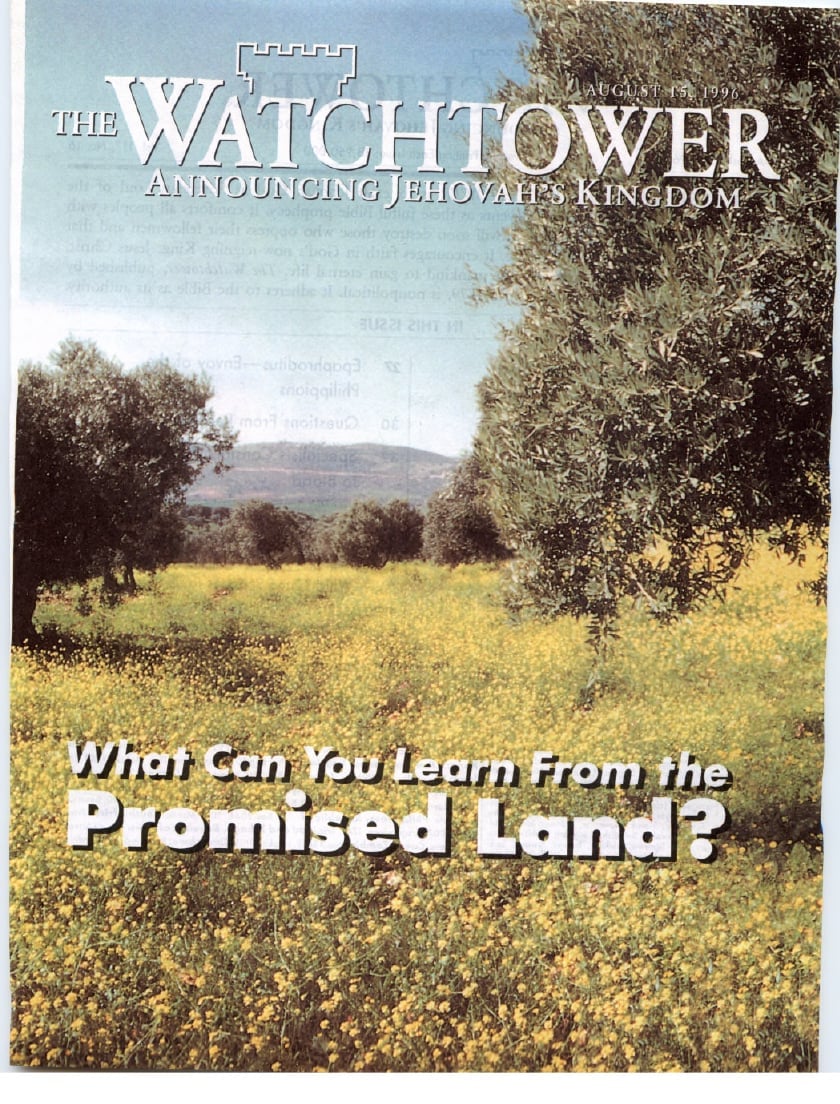
The Watchtower — August 15, 1996
Source: jw.org
Contents
A Visit to the Promised Land
Practical Lessons From the Promised Land
Jesus’ Coming or Jesus’ Presence—Which?
Will You Be Saved When God Acts?
Do You Remember?
A “Witness Heap” in the Land of the “Mountain of God”
Epaphroditus—Envoy of the Philippians
Questions From Readers
Specialists Consider Alternatives to Blood
Would You Welcome a Visit?
A Visit to the Promised Land
A Visit to the Promised Land
SUPPOSE a friend told you that he had purchased for you—as a gift—a brand-new house amid beautiful, quiet surroundings. ‘What does it look like?’ you would wonder. No doubt you would be eager to see this house for yourself, to walk through and inspect each room. After all, this is your new home!
In 1473 B.C.E., Jehovah bequeathed to the nation of ancient Israel a new home—the Promised Land, a strip of territory measuring about 300 miles [500 km] from north to south and 35 miles [55 km] wide, on an average.a Situated in what has been called the Fertile Crescent, the Promised Land was a delightful place to live, blessed with its own unique characteristics.
But why should you today be interested in a “home” that was given to someone else, especially someone living long ago? Because a knowledge of this historic land can enhance your appreciation of Bible accounts. “In the land of the Bible,” wrote the late Professor Yohanan Aharoni, “geography and history are so deeply interwoven that neither can be really understood without the help of the other.” Furthermore, at its height the Promised Land provided a small-scale example of what Paradise under God’s Kingdom will soon mean for mankind earth wide!—Isaiah 11:9.
During his earthly ministry, Jesus Christ drew upon common sights in the Promised Land to teach practical lessons. (Matthew 13:24-32; 25:31-46; Luke 13:6-9) We too can learn much in a practical way from a consideration of certain features of ancient Palestine. Let us walk through some of its rooms, so to speak, inspecting some distinct characteristics of this land that served as home to God’s people for many centuries. As we will see, there is much that we can learn from the Promised Land.
[Footnote]
The use of “Promised Land” in these articles views matters from the perspective of ancient times, as presented in the Bible, and without involvement in modern political/religious claims in the region.
[Picture Credit Line on page 2]
Cover: Pictorial Archive (Near Eastern History) Est.
[Picture Credit Line on page 3]
Garo Nalbandian
Practical Lessons From the Promised Land
Practical Lessons From the Promised Land
THE Promised Land of Bible record was certainly unique. In this relatively small area, we find a great variety of geographic features. In the north, there are snowcapped mountains; in the south, hot regions. There are productive lowlands, desolate wilderness areas, and hill country for orchards and for grazing flocks.
The diversity in altitude, climate, and soil allows for a wide variety of trees, shrubs, and other plants—including some that thrive in the cold alpine regions, others that grow in the torrid desert, and still others that flourish on the alluvial plain or the rocky plateau. One botanist estimates that some 2,600 plant varieties can be found in the area! The first Israelites who explored the land saw ready evidence of its potential. They brought back from one torrent valley a cluster of grapes so large that it had to be carried on a bar between two men! The valley was appropriately named Eshcol, meaning “Cluster [of Grapes].”a—Numbers 13:21-24.
But let us now take a closer look at some of the geographic features of this unique strip of land, particularly of the southern section.
The Shephelah
The western shore of the Promised Land is its coast with the Mediterranean Sea. About 25 miles [40 km] inland is the Shephelah. The word “Shephelah” means “Lowland,” but in reality this is a hilly area and can only be called low when compared with the mountains of Judah to the east.
Look at the accompanying cross-section map and note the relationship of the Shephelah to its surrounding territories. To the east are the mountains of Judah; to the west, the coastal plain of Philistia. Thus, the Shephelah served as a buffer zone, a barrier that in Bible times separated God’s people from their ancient enemies. Any army invading from the west would have to get through the Shephelah before it could move against Jerusalem, the capital city of Israel.
Such an incident occurred during the ninth century B.C.E. King Hazael of Syria, the Bible reports, “proceeded to go up and fight against Gath [likely at the border of the Shephelah] and capture it, after which Hazael set his face to go up against Jerusalem.” King Jehoash managed to stop Hazael, buying him off with an assortment of valuables from the temple and palace. Nevertheless, this account illustrates that the Shephelah was of crucial importance to the security of Jerusalem.—2 Kings 12:17, 18.
We might draw a practical lesson from this. Hazael wanted to conquer Jerusalem, but first he had to get through the Shephelah. Similarly, Satan the Devil is “seeking to devour” God’s servants, but often he must first penetrate a strong buffer zone—their adherence to Bible principles, such as those regarding bad associations and materialism. (1 Peter 5:8; 1 Corinthians 15:33; 1 Timothy 6:10) Compromise of Bible principles is often the first step toward committing serious sins. So keep that buffer zone secure. Follow Bible principles today, and you will not break God’s laws tomorrow.
The Hill Country of Judah
Further inland from the Shephelah lies the hill country of Judah. This is a mountainous area that produced good grain, olive oil, and wine. Because of its high elevation, Judah was also an excellent refuge. Thus, King Jotham built “fortified places and towers” there. In times of trouble, people could flee to these for safety.—2 Chronicles 27:4.
Jerusalem, also called Zion, was a prominent part of the hill country of Judah. Jerusalem seemed secure since it was surrounded on three sides by steep valleys, and the north side, according to first-century historian Josephus, was protected by a triple wall. But a refuge needs more than walls and weapons to maintain its security. It must also have water. This is essential during a siege, for without water, entrapped citizens would quickly be forced to surrender.
Jerusalem drew a supply of water from the Pool of Siloam. However, during the eighth century B.C.E., in anticipation of a siege by the Assyrians, King Hezekiah built an outer wall to protect the Pool of Siloam, enclosing it within the city. He also stopped up the springs outside the city, so that the besieging Assyrians would be hard-pressed to find water for themselves. (2 Chronicles 32:2-5; Isaiah 22:11) That is not all. Hezekiah found a way to divert an extra supply of water right into Jerusalem!
In what has been called one of the great engineering feats of antiquity, Hezekiah dug a tunnel from the spring of Gihon all the way to the Pool of Siloam.b Averaging 6 feet [1.8 m] in height, this tunnel was 1,749 feet [533 m] long. Just imagine it—a tunnel almost a third of a mile [half a kilometer] long, cut through rock! Today, some 2,700 years later, visitors to Jerusalem can wade through this masterpiece of engineering, commonly known as Hezekiah’s tunnel.—2 Kings 20:20; 2 Chronicles 32:30.
Hezekiah’s efforts to protect and increase Jerusalem’s water supply can teach us a practical lesson. Jehovah is “the source of living water.” (Jeremiah 2:13) His thoughts, contained in the Bible, are life-sustaining. That is why personal Bible study is essential. But opportunity for study, and the resulting knowledge, will not simply flow to you. You may have to ‘dig tunnels,’ such as through your hard-packed daily routine, to make room for it. (Proverbs 2:1-5; Ephesians 5:15, 16) Once you have begun, stick to your schedule, giving high priority to your personal study. Be careful not to let anyone or anything rob you of this precious water supply.—Philippians 1:9, 10.
The Wilderness Areas
To the east of the mountains of Judah is the Wilderness of Judah, also called Jeshimon, meaning “Desert.” (1 Samuel 23:19, footnote) At the Salt Sea, this barren region features rocky gorges and jagged cliffs. Dropping some 3,900 feet [1,200 m] in just 15 miles [24 km], the Wilderness of Judah is shielded against the rain-bearing winds from the west, and thus it receives only a limited amount of rainfall. This is no doubt the wilderness into which the goat for Azazel was sent on the annual Atonement Day. It is also where David fled from Saul. Here Jesus fasted for 40 days and was thereafter tempted by the Devil.—Leviticus 16:21, 22; Psalm 63, superscription; Matthew 4:1-11.
Approximately 100 miles [160 km] southwest of the Wilderness of Judah is the Wilderness of Paran. Many of Israel’s campsites during their 40-year trek from Egypt to the Promised Land were located here. (Numbers 33:1-49) Moses wrote of “the great and fear-inspiring wilderness, with poisonous serpents and scorpions and with thirsty ground that has no water.” (Deuteronomy 8:15) It is a wonder that millions of Israelites could survive! Yet, Jehovah sustained them.
May this serve as a reminder that Jehovah can sustain us too, even in this spiritually barren world. Yes, we too walk about among serpents and scorpions, even if not literal ones. We may have to have daily contact with people who have no qualms about spewing out poisonous speech that could easily infect our thinking. (Ephesians 5:3, 4; 1 Timothy 6:20) Those who strive to serve God despite these obstacles are to be commended. Their faithfulness is strong evidence that Jehovah is indeed sustaining them.
The Hills of Carmel
The name Carmel means “Orchard.” This fertile region to the north, some 30 miles [50 km] in length, is bedecked with vineyards, olive groves, and fruit trees. The headland of this hilly range is unforgettable in its grace and beauty. Isaiah 35:2 speaks of “the splendor of Carmel” as a symbol of the fruitful glory of the restored land of Israel.
Several notable events occurred in Carmel. It was here that Elijah challenged the prophets of Baal and that “the fire of Jehovah came falling” in proof of His supremacy. Also, it was from the top of Carmel that Elijah called attention to the small cloud that became a great downpour, thus miraculously ending the drought on Israel. (1 Kings 18:17-46) Elijah’s successor, Elisha, was at Mount Carmel when the woman of Shunem came seeking his help for her dead child, whom Elisha thereafter resurrected.—2 Kings 4:8, 20, 25-37.
The slopes of Carmel still contain orchards, olive groves, and vines. During the spring, these slopes are carpeted with a magnificent display of flowers. “Your head upon you is like Carmel,” said Solomon to the Shulammite maiden, perhaps alluding to the luxuriousness of her hair or to the way in which her shapely head rose majestically from her neck.—Song of Solomon 7:5.
The splendor that was characteristic of the hills of Carmel reminds us of the spiritual beauty Jehovah has bestowed upon his modern-day organization of worshipers. (Isaiah 35:1, 2) Jehovah’s Witnesses truly live in a spiritual paradise, and they agree with the sentiments of King David, who wrote: “The measuring lines themselves have fallen for me in pleasant places. Really, my own possession has proved agreeable to me.”—Psalm 16:6.
True, there are difficult challenges that God’s spiritual nation today must face, even as the ancient Israelites met with continual opposition from God’s enemies. Yet, true Christians never lose sight of the blessings that Jehovah has provided—including the ever-increasing light of Bible truth, a worldwide brotherhood, and the opportunity to gain everlasting life on a paradise earth.—Proverbs 4:18; John 3:16; 13:35.
“Like the Garden of Jehovah”
The ancient Promised Land was inviting to the eye. It has well been described as “flowing with milk and honey.” (Genesis 13:10; Exodus 3:8) Moses called it “a good land, a land of torrent valleys of water, springs and watery deeps issuing forth in the valley plain and in the mountainous region, a land of wheat and barley and vines and figs and pomegranates, a land of oil olives and honey, a land in which you will not eat bread with scarcity, in which you will lack nothing, a land the stones of which are iron and out of the mountains of which you will mine copper.”—Deuteronomy 8:7-9.
If Jehovah could provide such a rich, beautiful homeland for his ancient people, surely he can give to his modern-day faithful servants a glorious paradise extending earth wide—with mountains, valleys, rivers, and lakes. Yes, the ancient Promised Land with all its diversity was just a foretaste of the spiritual paradise that his Witnesses enjoy today and of the future Paradise of the new world. There the promise recorded at Psalm 37:29 will be fulfilled: “The righteous themselves will possess the earth, and they will reside forever upon it.” When Jehovah gives that Paradise home to obedient mankind, how happy they will be to inspect all its “rooms” and to have forever to do so!
[Footnotes]
One grape cluster from this region was recorded as weighing 26 pounds [12 kg], and another, more than 44 pounds [20 kg].
The spring of Gihon was located just outside the eastern boundary of Jerusalem. It was hidden in a cave; hence, the Assyrians likely did not know of its existence.
[Map on page 4]
(For fully formatted text, see publication)
GALILEE
Mt. Carmel
Sea of Galilee
SAMARIA
SHEPHELAH
Mountains of Judah
Salt Sea
[Credit Line]
NASA photo
[Map on page 4]
(For fully formatted text, see publication)
The Shephelah was a barrier between God’s people and their enemies
MI 0 5 10
KM 0 8 16
Plain of Philistia
Shephelah
Hill Country of Judah
Wilderness of Judah
Rift Valley
Salt Sea
Land of Ammon and Moab
[Map/Picture on page 5]
(For fully formatted text, see publication)
Hezekiah’s tunnel: 1,749 feet [533 m] long, cut through solid rock
Tyropoeon Valley
Siloam
CITY OF DAVID
Kidron Valley
Gihon
[Pictures on page 6]
In the Wilderness of Judah, David sought refuge from Saul. Later Jesus was here tempted by the Devil
[Credit Line]
Pictorial Archive (Near Eastern History) Est.
[Pictures on page 7]
Mount Carmel, where Elijah humiliated the prophets of Baal
[Credit Line]
Pictorial Archive (Near Eastern History) Est.
[Pictures on page 8]
“Jehovah your God is bringing you into a good land, a land of torrent valleys of water, springs and watery deeps issuing forth in the valley plain and in the mountainous region.”—Deuteronomy 8:7
Jesus’ Coming or Jesus’ Presence—Which?
Jesus’ Coming or Jesus’ Presence—Which?
“What will be the sign of your presence and of the conclusion of the system of things?”—MATTHEW 24:3.
1. What role did questions have in Jesus’ ministry?
JESUS’ skillful use of questions made his listeners think, even consider things from new perspectives. (Mark 12:35-37; Luke 6:9; 9:20; 20:3, 4) We can be thankful that he also answered questions. His answers illuminate truths that we might not otherwise have known or understood.—Mark 7:17-23; 9:11-13; 10:10-12; 12:18-27.
2. To what question should we give our attention now?
2 At Matthew 24:3, we find one of the most important questions Jesus ever answered. With the end of his earthly life near, Jesus had just warned that Jerusalem’s temple would be destroyed, marking the end of the Jewish system. Matthew’s account adds: “While he was sitting upon the Mount of Olives, the disciples approached him privately, saying: ‘Tell us, When will these things be, and what will be the sign of your presence [“coming,” King James Version] and of the conclusion of the system of things?’”—Matthew 24:3.
3, 4. What significant difference is there in how Bibles render a key word at Matthew 24:3?
3 Millions of Bible readers have wondered, ‘Why did the disciples ask that question, and how should Jesus’ reply affect me?’ In his reply Jesus spoke of the appearance of leaves showing that summer “is near.” (Matthew 24:32, 33) Hence, many churches teach that the apostles were asking for a sign of Jesus’ “coming,” the sign proving that his return was imminent. They believe that the “coming” will be the point when he takes Christians to heaven and then brings the end of the world. Do you believe that this is correct?
4 Instead of the rendering “coming,” some Bible versions, including the New World Translation of the Holy Scriptures, use the word “presence.” Could it be that what the disciples asked about and what Jesus said in reply differ from what is taught in churches? What really was asked? And what answer did Jesus give?
What Were They Asking?
5, 6. What can we conclude about the apostles’ thinking when they asked the question that we read at Matthew 24:3?
5 In view of what Jesus said about the temple, the disciples likely were thinking of the Jewish arrangement when they asked for ‘a sign of his presence [or, “coming”] and the conclusion of the system of things [literally, “age”].’—Compare “world” at 1 Corinthians 10:11 and Galatians 1:4, KJ.
6 At this point the apostles had but a limited grasp of Jesus’ teachings. They had earlier imagined that “the kingdom of God was going to display itself instantly.” (Luke 19:11; Matthew 16:21-23; Mark 10:35-40) And even after the discussion on the Mount of Olives, but prior to being anointed with holy spirit, they asked if Jesus was restoring the Kingdom to Israel then.—Acts 1:6.
7. Why would the apostles ask Jesus about his future role?
7 Yet, they did know that he would leave, for he had recently said: “The light will be among you a little while longer. Walk while you have the light.” (John 12:35; Luke 19:12-27) So they might well have wondered, ‘If Jesus is going to leave, how will we recognize his return?’ When he appeared as the Messiah, most did not recognize him. And over a year later, questions persisted about whether he would fulfill all that the Messiah was to do. (Matthew 11:2, 3) So the apostles had reason to inquire about the future. But, again, were they asking for a sign that he would soon come or for something different?
8. The apostles were likely speaking what language with Jesus?
8 Imagine that you were a bird listening to the conversation on the Mount of Olives. (Compare Ecclesiastes 10:20.) Probably you would have heard Jesus and the apostles speaking in Hebrew. (Mark 14:70; John 5:2; 19:17, 20; Acts 21:40) Yet, they likely also knew the Greek language.
What Matthew Wrote—In Greek
9. On what are most modern translations of Matthew based?
9 Sources back to the second century C.E. indicate that Matthew first wrote his Gospel in Hebrew. Evidently he later wrote it in Greek. Many manuscripts in Greek have come down to our time and have served as the basis for translating his Gospel into today’s languages. What did Matthew write in Greek about that conversation on the Mount of Olives? What did he write about the “coming” or “presence” that the disciples asked about and that Jesus commented on?
10. (a) What Greek word for “come” did Matthew use often, and what meanings can it have? (b) What other Greek word is of interest?
10 In the first 23 chapters of Matthew, over 80 times we find a common Greek verb for “come,” which is erʹkho·mai. It often conveys the thought of approaching or drawing near, as at John 1:47: “Jesus saw Nathanael coming toward him.” Depending on usage, the verb erʹkho·mai can mean “arrive,” “go,” “get to,” “reach,” or “be on one’s way.” (Matthew 2:8, 11; 8:28; John 4:25, 27, 45; 20:4, 8; Acts 8:40; 13:51) But at Matthew 24:3, 27, 37, 39, Matthew used a different word, a noun found nowhere else in the Gospels: pa·rou·siʹa. Since God inspired the writing of the Bible, why did he move Matthew to choose this Greek word in these verses when penning his Gospel in Greek? What does it mean, and why should we want to know?
11. (a) What is the sense of pa·rou·siʹa? (b) How do examples from Josephus’ writing bear out our understanding of pa·rou·siʹa? (See footnote.)
11 Pointedly, pa·rou·siʹa means “presence.” Vine’s Expository Dictionary of New Testament Words says: “PAROUSIA, . . . lit[erally], a presence, para, with, and ousia, being (from eimi, to be), denotes both an arrival and a consequent presence with. For instance, in a papyrus letter a lady speaks of the necessity of her parousia in a place in order to attend to matters relating to her property.” Other lexicons explain that pa·rou·siʹa denotes ‘the visit of a ruler.’ Hence, it is not just the moment of arrival, but a presence extending from the arrival onward. Interestingly, that is how Jewish historian Josephus, a contemporary of the apostles, used pa·rou·siʹa.a
12. How does the Bible itself help us to confirm the meaning of pa·rou·siʹa?
12 The meaning “presence” is clearly borne out by ancient literature, yet Christians are particularly interested in how God’s Word uses pa·rou·siʹa. The answer is the same—presence. We see that from examples in Paul’s letters. For instance, he wrote to the Philippians: “In the way that you have always obeyed, not during my presence only, but now much more readily during my absence, keep working out your own salvation.” He also spoke of abiding with them that they might exult “through [his] presence [pa·rou·siʹa] again with [them].” (Philippians 1:25, 26; 2:12) Other versions read “my being with you again” (Weymouth; New International Version); “when I am with you again” (Jerusalem Bible; New English Bible); and “when you once more have me among you.” (Twentieth Century New Testament) At 2 Corinthians 10:10, 11, Paul contrasted “his presence in person” with being “absent.” In these examples he plainly was not speaking of his approach or arrival; he used pa·rou·siʹa in the sense of being present.b (Compare 1 Corinthians 16:17.) What, though, about references to Jesus’ pa·rou·siʹa? Are they with the sense of his “coming,” or do they indicate an extended presence?
13, 14. (a) Why must we conclude that a pa·rou·siʹa extends over time? (b) What must be said about the length of Jesus’ pa·rou·siʹa?
13 Spirit-anointed Christians in Paul’s day were interested in Jesus’ pa·rou·siʹa. But Paul warned them not to be ‘shaken from their reason.’ First there must appear “the man of lawlessness,” which has proved to be the clergy of Christendom. Paul wrote that “the lawless one’s presence is according to the operation of Satan with every powerful work and lying signs.” (2 Thessalonians 2:2, 3, 9) Plainly, the pa·rou·siʹa, or presence, of “the man of lawlessness” was not just a momentary arrival; it would extend over time, during which lying signs would be produced. Why is this significant?
14 Consider the verse immediately before that: “The lawless one will be revealed, whom the Lord Jesus will do away with by the spirit of his mouth and bring to nothing by the manifestation of his presence.” Just as the presence of “the man of lawlessness” would be over a period of time, Jesus’ presence would extend for some time and would climax in the destruction of that lawless “son of destruction.”—2 Thessalonians 2:8.
Hebrew-Language Aspects
15, 16. (a) What particular word is used in many translations of Matthew into Hebrew? (b) How is bohʼ used in the Scriptures?
15 As noted, Matthew evidently wrote his Gospel first in the Hebrew language. So, what Hebrew word did he use at Matthew 24:3, 27, 37, 39? Versions of Matthew translated into modern Hebrew have a form of the verb bohʼ, both in the apostles’ question and in Jesus’ reply. This could lead to readings such as: “What will be the sign of your [bohʼ] and of the conclusion of the system of things?” and, “As the days of Noah were, so the [bohʼ] of the Son of man will be.” What does bohʼ mean?
16 Though having various senses, the Hebrew verb bohʼ basically means “come.” The Theological Dictionary of the Old Testament says: ‘Occurring 2,532 times, bohʼ is one of the most frequently used verbs in the Hebrew Scriptures and is at the head of verbs expressing motion.’ (Genesis 7:1, 13; Exodus 12:25; 28:35; 2 Samuel 19:30; 2 Kings 10:21; Psalm 65:2; Isaiah 1:23; Ezekiel 11:16; Daniel 9:13; Amos 8:11) Had Jesus and the apostles used a word with such a range of meanings, the sense might be debatable. But did they?
17. (a) Why may modern Hebrew translations of Matthew not necessarily indicate what Jesus and the apostles said? (b) Where else may we find a clue as to what word Jesus and the apostles may have used, and for what other reason is this source of interest to us? (See footnote.)
17 Bear in mind that modern Hebrew versions are translations that may not present exactly what Matthew penned in Hebrew. The fact is that Jesus could well have used a word other than bohʼ, one that fitted the sense of pa·rou·siʹa. We see this from the 1995 book Hebrew Gospel of Matthew, by Professor George Howard. The book focused on a 14th-century polemic against Christianity by the Jewish physician Shem-Tob ben Isaac Ibn Shaprut. That document set out a Hebrew text of Matthew’s Gospel. There is evidence that rather than being translated from Latin or Greek in Shem-Tob’s time, this text of Matthew was very old and was originally composed in Hebrew.c It thus may bring us closer to what was said on the Mount of Olives.
18. What interesting Hebrew word does Shem-Tob use, and what does it mean?
18 At Matthew 24:3, 27, 39, Shem-Tob’s Matthew does not use the verb bohʼ. Instead, it uses the related noun bi·ʼahʹ. That noun appears in the Hebrew Scriptures only at Ezekiel 8:5, where it means “entranceway.” Instead of expressing the action of coming, bi·ʼahʹ there refers to the start of a building; when you are in the entryway or on the threshold, you are in the building. Also, non-Biblical religious documents among the Dead Sea Scrolls often use bi·ʼahʹ regarding the arrival or commencement of priestly courses. (See 1 Chronicles 24:3-19; Luke 1:5, 8, 23.) And a 1986 translation into Hebrew of the ancient Syriac (or, Aramaic) Peshitta uses bi·ʼahʹ at Matthew 24:3, 27, 37, 39. So there is evidence that in ancient times the noun bi·ʼahʹ may have had a sense that differed somewhat from the verb bohʼ used in the Bible. Why is this of interest?
19. If Jesus and the apostles used bi·ʼah,ʹ what might we conclude?
19 The apostles in their question and Jesus in his reply may have used this noun bi·ʼah.ʹ Even if the apostles had in mind simply the idea of Jesus’ future arrival, Christ may have used bi·ʼahʹ to allow for more than what they were thinking. Jesus could have been pointing to his arrival to commence a new office; his arrival would be the start of his new role. This would match the sense of pa·rou·siʹa, which Matthew subsequently used. Such a use of bi·ʼahʹ would, understandably, have to support what Jehovah’s Witnesses have long taught, that the composite “sign” Jesus gave was to reflect that he was present.
Awaiting the Climax of His Presence
20, 21. What can we learn from Jesus’ comment about the days of Noah?
20 Our study of Jesus’ presence should have a direct bearing on our life and our expectations. Jesus urged his followers to stay alert. He provided a sign so that his presence could be recognized, though most would take no note: “As the days of Noah were, so the presence of the Son of man will be. For as they were in those days before the flood, eating and drinking, men marrying and women being given in marriage, until the day that Noah entered into the ark; and they took no note until the flood came and swept them all away, so the presence of the Son of man will be.”—Matthew 24:37-39.
21 During the days of Noah, most people of that generation just carried on with their normal affairs. Jesus foretold that it would be the same with “the presence of the Son of man.” The people around Noah might have felt that nothing would happen. You know differently. Those days, which spread over time, led to a climax, “the flood came and swept them all away.” Luke presents a similar account in which Jesus compared “the days of Noah” with “the days of the Son of man.” Jesus admonished: “The same way it will be on that day when the Son of man is to be revealed.”—Luke 17:26-30.
22. Why should we be particularly interested in Jesus’ prophecy in Matthew chapter 24?
22 All of this takes on special meaning for us because we are living at a time when we recognize the events that Jesus foretold—wars, earthquakes, pestilences, food shortages, and persecution of his disciples. (Matthew 24:7-9; Luke 21:10-12) Such have been in evidence since the history-changing conflict significantly named World War I, though most people treat these as normal parts of history. True Christians, however, sense the meaning of these momentous events, just as alert people understand from the leafing of a fig tree that summer is near. Jesus advised: “In this way you also, when you see these things occurring, know that the kingdom of God is near.”—Luke 21:31.
23. To whom do Jesus’ words in Matthew chapter 24 have special meaning, and why?
23 Jesus directed much of his reply on the Mount of Olives to his followers. They were the ones to share in the lifesaving work of preaching the good news in all the earth before the end would come. They would be the ones who could discern “the disgusting thing that causes desolation . . . standing in a holy place.” They would be the ones to respond by “fleeing” before the great tribulation. And they would be the ones particularly affected by the added words: “Unless those days were cut short, no flesh would be saved; but on account of the chosen ones those days will be cut short.” (Matthew 24:9, 14-22) But just what do those sobering words mean, and why can it be said that they provide a basis for us to have increased happiness, confidence, and zeal now? The following study of Matthew 24:22 will provide the answers.
[Footnotes]
Examples from Josephus: At Mount Sinai lightning and thunder “declared God to be there present [pa·rou·siʹa].” The miraculous manifestation in the tabernacle “showed the presence [pa·rou·siʹa] of God.” By showing Elisha’s servant the encircling chariots, God made “manifest to his servant his power and presence [pa·rou·siʹa].” When Roman official Petronius tried to appease the Jews, Josephus claimed that ‘God did show his presence [pa·rou·siʹa] to Petronius’ by sending rain. Josephus did not apply pa·rou·siʹa to a mere approach or momentary arrival. It meant an ongoing, even invisible, presence. (Exodus 20:18-21; 25:22; Leviticus 16:2; 2 Kings 6:15-17)—Compare Antiquities of the Jews, Book 3, chapter 5, paragraph 2 [80]; chapter 8, paragraph 5 [203]; Book 9, chapter 4, paragraph 3 [55]; Book 18, chapter 8, paragraph 6 [284].
In A Critical Lexicon and Concordance to the English and Greek New Testament, E. W. Bullinger points out that pa·rou·siʹa means ‘the being or becoming present, hence, presence, arrival; a coming which includes the idea of a permanent dwelling from that coming onwards.’
One evidence is that it contains the Hebrew expression “The Name,” written out or abbreviated, 19 times. Professor Howard writes: “The reading of the Divine Name in a Christian document quoted by a Jewish polemist is remarkable. If this were a Hebrew translation of a Greek or Latin Christian document, one would expect to find adonai [Lord] in the text, not a symbol for the ineffable divine name YHWH. . . . For him to have added the ineffable name is inexplicable. The evidence strongly suggests that Shem-Tob received his Matthew with the Divine Name already within the text and that he probably preserved it rather than run the risk of being guilty of removing it.” The New World Translation of the Holy Scriptures—With References uses Shem-Tob’s Matthew (J2) as support for using the divine name in the Christian Greek Scriptures.
How Would You Answer?
□ Why is it important to see the difference between how Bibles render Matthew 24:3?
□ What is the meaning of pa·rou·siʹa, and why is this of concern?
□ What possible parallel might exist at Matthew 24:3 in Greek and in Hebrew?
□ What key regarding time do we need to know in understanding Matthew chapter 24?
[Picture on page 10]
The Mount of Olives, which overlooks Jerusalem
Will You Be Saved When God Acts?
Will You Be Saved When God Acts?
“Unless those days were cut short, no flesh would be saved; but on account of the chosen ones those days will be cut short.”—MATTHEW 24:22.
1, 2. (a) Why is it normal to be interested in our future? (b) Natural interest may have been involved in what vital questions?
HOW interested are you in yourself? Many today carry self-interest to extremes, being egocentric. Yet, the Bible does not condemn appropriate interest in what affects us. (Ephesians 5:33) That includes being interested in our future. So it would be normal for you to want to know what your future holds. Are you interested?
2 We can be sure that Jesus’ apostles had such an interest in their future. (Matthew 19:27) Likely that was a factor when four of them were with Jesus on the Mount of Olives. They asked: “When will these things be, and what will be the sign when all these things are destined to come to a conclusion?” (Mark 13:4) Jesus did not ignore natural interest in the future—their interest and ours. Time and again he highlighted how his followers would be affected and what the final outcome would be.
3. Why do we link Jesus’ reply to our time?
3 Jesus’ reply set out a prophecy with a major fulfillment in our time. We can see this from the world wars and other conflicts in our century, the earthquakes that snuff out countless lives, the food shortages that bring sickness and death, and the plagues—from the Spanish influenza pandemic of 1918 to the current AIDS scourge. However, much of Jesus’ reply also had a fulfillment leading to and including the destruction of Jerusalem by the Romans in 70 C.E. Jesus warned his disciples: “Look out for yourselves; people will deliver you up to local courts, and you will be beaten in synagogues and be put on the stand before governors and kings for my sake, for a witness to them.”—Mark 13:9.
What Jesus Foretold, and What Occurred
4. What are some warnings included in Jesus’ reply?
4 Jesus went beyond foretelling how others would treat his disciples. He alerted them as to how they themselves should act. For example: “When you catch sight of the disgusting thing that causes desolation standing where it ought not (let the reader use discernment), then let those in Judea begin fleeing to the mountains.” (Mark 13:14) The parallel account at Luke 21:20 says: “When you see Jerusalem surrounded by encamped armies.” How did that prove accurate in the first instance?
5. What happened among the Jews in Judea in 66 C.E.?
5 The International Standard Bible Encyclopedia (1982) tells us: “The Jews were increasingly restive under Roman control and the procurators were increasingly violent, cruel, and dishonest. Open rebellion broke out in A.D. 66. . . . The war began when the Zealots seized Masada and then, under Menahem, marched on Jerusalem. Simultaneously Jews in the gubernatorial city of Caesarea were massacred, and news of this atrocity spread throughout the country. New coins were marked Year 1 through Year 5 of the revolt.”
6. The Jewish revolt produced what Roman response?
6 The Roman Twelfth Legion under Cestius Gallus marched from Syria, ravaged Galilee and Judea, and then attacked the capital, even occupying the upper section of “Jerusalem the holy city.” (Nehemiah 11:1; Matthew 4:5; 5:35; 27:53) Summarizing developments, the volume The Roman Siege of Jerusalem says: “For five days the Romans attempted to scale the wall, being repulsed time after time. At length the defenders, overpowered by the hail of missiles, gave way. Forming a testudo—the devise of locking their shields over their heads to protect themselves—the Roman soldiers undermined the wall and attempted to set fire to the gate. A terrible panic seized the defenders.” Christians inside the city could recall Jesus’ words and discern that a disgusting thing was standing in a holy place.a But with the city surrounded, how could such Christians flee, as Jesus had advised?
7. When victory was within reach in 66 C.E., what did the Romans do?
7 Historian Flavius Josephus relates: “Cestius [Gallus], aware of neither the despair of the besieged nor the feelings of the people, suddenly called off his men, abandoned hope though he had suffered no reverse, and flying in the face of all reason retired from the City.” (The Jewish War, II, 540 [xix, 7]) Why did Gallus retreat? Whatever the reason, his retreat allowed Christians to obey Jesus’ command and flee to the mountains and to safety.
8. What was the second phase of the Roman effort against Jerusalem, and what did the survivors experience?
8 Obedience was lifesaving. Before long the Romans moved to crush the revolt. The campaign under General Titus climaxed in a siege of Jerusalem from April to August 70 C.E. It chills one’s blood to read Josephus’ description of how the Jews suffered. Besides those killed fighting the Romans, other Jews were slaughtered by rival bands of Jews, and starvation led to cannibalism. By the time of the Roman victory, 1,100,000 Jews had died.b Of the 97,000 survivors, some were promptly executed; others were enslaved. Josephus says: “Those over seventeen were put in irons and sent to hard labour in Egypt, while great numbers were presented by Titus to the provinces to perish in the theatres by the sword or by wild beasts.” Even as this sorting out took place, 11,000 prisoners starved to death.
9. Why did the Christians not experience the outcome that the Jews did, but what questions remain?
9 Christians could be thankful that they had obeyed the Lord’s warning and had fled the city before the Roman army returned. Thus they were saved from part of what Jesus termed ‘great tribulation such as had not occurred since the world’s beginning until then, nor would occur again’ on Jerusalem. (Matthew 24:21) Jesus added: “In fact, unless those days were cut short, no flesh would be saved; but on account of the chosen ones those days will be cut short.” (Matthew 24:22) What did that mean then, and what does it mean now?
10. How have we previously explained Matthew 24:22?
10 In the past it was explained that the ‘flesh to be saved’ referred to Jews who survived the tribulation on Jerusalem in 70 C.E. The Christians had fled, so God could let the Romans bring a swift destruction. In other words, on account of the fact that the “chosen ones” were out of danger, the days of the tribulation could be cut short, allowing some Jewish “flesh” to be saved. It was felt that the surviving Jews foreshadowed those who would survive the great tribulation coming in our day.—Revelation 7:14.
11. Why does it seem that the explanation of Matthew 24:22 should be reconsidered?
11 But is that explanation consonant with what happened in 70 C.E.? Jesus said that the human “flesh” was to be “saved” out of the tribulation. Would you use the word “saved” to describe the 97,000 survivors, in view of the fact that thousands of them soon died of starvation or were slaughtered in a theater? Josephus says about one theater, at Caesarea: “The number of those who perished in combats with wild beasts or in fighting each other or by being burnt alive exceeded 2,500.” Though they did not die in the siege, they were hardly “saved.” And would Jesus consider them as being similar to happy survivors of the coming “great tribulation”?
Flesh Saved—How?
12. Who were the first-century “chosen ones” in whom God was interested?
12 By 70 C.E., God no longer viewed the natural Jews as his chosen people. Jesus showed that God had rejected that nation and would let its capital city, temple, and system of worship come to an end. (Matthew 23:37–24:2) God chose a new nation, spiritual Israel. (Acts 15:14; Romans 2:28, 29; Galatians 6:16) It was composed of men and women chosen out of all nations and anointed with holy spirit. (Matthew 22:14; John 15:19; Acts 10:1, 2, 34, 35, 44, 45) Some years before the attack by Cestius Gallus, Peter wrote to “the ones chosen according to the foreknowledge of God the Father, with sanctification by the spirit.” Such spirit-anointed ones were “a chosen race, a royal priesthood, a holy nation.” (1 Peter 1:1, 2; 2:9) God would take such chosen ones to heaven to reign with Jesus.—Colossians 1:1, 2; 3:12; Titus 1:1; Revelation 17:14.
13. What sense might Jesus’ words at Matthew 24:22 have had?
13 This identifying of the chosen ones is helpful, since Jesus foretold that the days of tribulation would be cut short “on account of the chosen ones.” The Greek word translated “on account of” can also be rendered “for the sake of” or “for . . . sake.” (Mark 2:27; John 12:30; 1 Corinthians 8:11; 9:10, 23; 11:9; 2 Timothy 2:10; Revelation 2:3) So Jesus could have been saying, ‘Unless those days are cut short, no flesh will be saved; but for the sake of the chosen ones those days will be cut short.’c (Matthew 24:22) Did something occur that benefited or was ‘for the sake of’ the Christian chosen ones trapped in Jerusalem?
14. How was “flesh” saved when the Roman army unexpectedly retreated from Jerusalem in 66 C.E.?
14 Recall that in 66 C.E., the Romans moved through the land, occupied upper Jerusalem, and began undermining the wall. Josephus comments: “If only he had persevered with the siege a little longer he would have captured the City at once.” Ask yourself, ‘Why would the powerful Roman army suddenly abandon the campaign and “flying in the face of all reason” retreat?’ Rupert Furneaux, a specialist in interpreting military history, comments: “No historian has succeeded in supplying any adequate reason for Gallus’s strange and disastrous decision.” Be that as it may, the effect was that the tribulation was cut short. The Romans retreated, with the Jews savaging them as they went. What of the anointed Christian “chosen ones” who had been trapped? The lifting of the siege meant that they were saved from any slaughter that threatened during the tribulation. Hence, those Christians who benefited from the cutting short of the tribulation in 66 C.E. were the saved “flesh” mentioned at Matthew 24:22.
What Does Your Future Hold?
15. Why would you say that Matthew chapter 24 should be of particular interest in our day?
15 Someone might ask, ‘Why should I be especially interested in this clarified understanding of Jesus’ words?’ Well, there is ample reason to conclude that Jesus’ prophecy was to have a larger fulfillment, beyond what happened up to and including 70 C.E.d (Compare Matthew 24:7; Luke 21:10, 11; Revelation 6:2-8.) For decades, Jehovah’s Witnesses have preached that the major fulfillment occurring in our time proves that we can expect a large-scale “great tribulation” just ahead. During it, how will the prophetic words at Matthew 24:22 be fulfilled?
16. What encouraging fact does Revelation provide about the approaching great tribulation?
16 Some two decades after the tribulation on Jerusalem, the apostle John wrote the book of Revelation. It confirmed that great tribulation lay ahead. And, being interested in what affects us personally, we may be relieved to know that Revelation prophetically assures us that human flesh will live through this coming great tribulation. John foretold “a great crowd . . . out of all nations and tribes and peoples and tongues.” Who are they? A voice from heaven answers: “These are the ones that come out of the great tribulation.” (Revelation 7:9, 14) Yes, they will be survivors! Revelation also offers us insight into how things will develop in the coming great tribulation and how Matthew 24:22 will be fulfilled.
17. The opening phase of the great tribulation will include what?
17 The opening phase of this tribulation will be an attack on a symbolic prostitute called “Babylon the Great.” (Revelation 14:8; 17:1, 2) She represents the worldwide empire of false religion, with Christendom being most reprehensible. According to the words of Revelation 17:16-18, God will put it into the heart of the political element to attack this symbolic harlot.e Think how it could appear to God’s anointed “chosen ones” and their associates, the “great crowd.” As this devastating attack on religion advances, it might seem that it will wipe out all religious organizations, including Jehovah’s people.
18. Why might it seem that no “flesh” will be saved through the opening part of the great tribulation?
18 This is where Jesus’ words found at Matthew 24:22 will be fulfilled on a large scale. As the chosen ones in Jerusalem appeared to be at risk, Jehovah’s servants might seem in danger of being eliminated during the attack on religion, as if that attack would wipe out all “flesh” of God’s people. Yet, let us bear in mind what happened back in 66 C.E. The tribulation caused by the Romans was cut short, allowing God’s anointed chosen ones ample opportunity to escape and remain alive. Thus, we can rest assured that the destructive attack on religion will not be allowed to kill off the global congregation of true worshipers. It will proceed quickly, as if “in one day.” Somehow, though, it will be cut short, will not be allowed to complete its objective, so that God’s people can be “saved.”—Revelation 18:8.
19. (a) After the first part of the great tribulation, what will be evident? (b) To what will this lead?
19 Other elements of Satan the Devil’s earthly organization will thereafter continue for a time, mourning the loss of dealings with their old religious paramour. (Revelation 18:9-19) At some point, they will notice that God’s true servants remain, “dwelling in security, all of them dwelling without wall” and appearing to be easy prey. What a surprise is in store! Responding to a real or threatened aggression against his servants, God will rise up in judgment of his enemies in the final part of the great tribulation.—Ezekiel 38:10-12, 14, 18-23.
20. Why will the second phase of the great tribulation not put God’s people in danger?
20 This second phase of the great tribulation will parallel what happened to Jerusalem and its inhabitants in the second attack by the Romans in 70 C.E. It will prove to be “great tribulation such as has not occurred since the world’s beginning until [then], no, nor will occur again.” (Matthew 24:21) We can rest assured, though, that God’s chosen ones and their associates will not be in the danger zone, at risk of being killed. Oh, they will not have fled to one geographic location. First-century Christians in Jerusalem could flee from that city to the mountainous region, such as Pella across the Jordan. In the future, however, God’s faithful Witnesses will be located all over the globe, so safety and protection will not be based on geographic location.
21. Who will do the fighting in the final battle, and with what result?
21 The destruction will not be by the forces of Rome or any other human agency. Instead, the book of Revelation describes the executional forces as being from heaven. Yes, that final part of the great tribulation will be carried out, not by any human army, but by “The Word of God,” the King Jesus Christ, assisted by ‘the armies that are in heaven,’ including resurrected anointed Christians. The “King of kings and Lord of lords” will carry out an execution far more thorough than the Romans did in 70 C.E. It will eliminate all human opposers of God—kings, military commanders, freemen and slaves, small ones and great. Even human organizations of Satan’s world will meet their end.—Revelation 2:26, 27; 17:14; 19:11-21; 1 John 5:19.
22. In what further sense will “flesh” be saved?
22 Recall that “flesh,” both of the anointed remnant and of the “great crowd,” already will have been saved when Babylon the Great goes down swiftly and completely in the first part of the tribulation. Likewise in the final part of the tribulation, “flesh” that has fled to Jehovah’s side will be saved. How this will contrast with the outcome for the rebellious Jews in 70 C.E.!
23. To what can surviving “flesh” look forward?
23 Thinking of the possibilities for your own future and that of your loved ones, note what is promised at Revelation 7:16, 17: “They will hunger no more nor thirst anymore, neither will the sun beat down upon them nor any scorching heat, because the Lamb, who is in the midst of the throne, will shepherd them, and will guide them to fountains of waters of life. And God will wipe out every tear from their eyes.” Surely, that is really being “saved” in a wonderful, lasting sense.
[Footnotes]
See The Watchtower of June 1, 1996, pages 14-19.
Josephus says: “When Titus entered he was astounded by the strength of the city . . . He exclaimed aloud: ‘God has been on our side; it is God who brought the Jews down from these strongholds; for what could human hands or instruments do against such towers?’”
Interestingly, Shem-Tob’s text of Matthew 24:22 uses the Hebrew word ʽa·vurʹ, which means “for the sake of, on account of, in order that.”—See preceding article, page 13.
See The Watchtower of February 15, 1994, pages 11 and 12, and the chart on pages 14 and 15, which sets in parallel columns Jesus’ prophetic reply found in Matthew chapter 24, Mark chapter 13, and Luke chapter 21.
See Revelation—Its Grand Climax At Hand!, pages 235-58, published in 1988 by the Watchtower Bible and Tract Society of New York, Inc.
How Would You Answer?
□ What two phases were there to the Roman army’s attack on Jerusalem?
□ Why is it unlikely that the 97,000 Jewish survivors in 70 C.E. made up the “flesh” mentioned at Matthew 24:22?
□ How were the days of Jerusalem’s tribulation cut short, and how was “flesh” thus saved?
□ In the approaching great tribulation, how will the days be cut short and “flesh” be saved?
[Picture on page 16]
Jewish coin struck after the revolt. The Hebrew lettering says “Year two,” meaning 67 C.E., the second year of their autonomy
[Credit Line]
Pictorial Archive (Near Eastern History) Est.
[Picture on page 17]
Roman coin struck in 71 C.E. On the left is an armed Roman; on the right a Jewess in mourning. The words “IVDAEA CAPTA” mean “Captive Judea”
[Credit Line]
Pictorial Archive (Near Eastern History) Est.
Do You Remember?
Do You Remember?
Have you appreciated reading the recent issues of The Watchtower? Well, see if you can answer the following questions:
□ Do Jesus’ words, “If you forgive the sins of any persons, they stand forgiven,” mean that Christians can forgive sins? (John 20:23)
There is no Scriptural basis for concluding that Christians in general, or even appointed elders in the congregation, have divine authority to forgive sins. The context of Jesus’ words seems to show that the apostles had provided to them through an operation of the spirit a unique authority to forgive or retain sins. (See Acts 5:1-11; 2 Corinthians 12:12.)—4/15, page 28.
□ What is outstanding about J. J. Stewart Perowne’s translation of the book of Psalms, first published in 1864?
In his translation Perowne tried to adhere “closely to the form of the Hebrew, both in its idiom and in the structure of the clauses.” In doing so he favored the restoration of the divine name in the form “Jehovah.”—4/15, page 31.
□ What guidance did Jesus give his followers as to their dealings with the governments of the world?
Jesus said: “Pay back, therefore, Caesar’s things to Caesar, but God’s things to God.” (Matthew 22:21) He also said: “If someone under authority impresses you into service for a mile, go with him two miles.” (Matthew 5:41) Jesus was here illustrating the principle of willing submission to legitimate demands, whether in human relations or in governmental requirements that are in harmony with God’s law. (Luke 6:27-31; John 17:14, 15)—5/1, page 12.
□ What does it mean to ‘walk in the truth’? (Psalm 86:11)
This includes abiding by God’s requirements and serving him in faithfulness and sincerity. (Psalm 25:4, 5; John 4:23, 24)—5/15, page 18.
□ What was accomplished by Jehovah’s sending Jonah to Nineveh?
As things worked out, Jonah’s preaching activity in Nineveh showed up the contrast between the repentant Ninevites and the stiff-necked Israelites, who were sorely lacking in faith and humility. (Compare Deuteronomy 9:6, 13; Jonah 3:4-10.)—5/15, page 28.
□ Who is the Serpent and who is “the woman” referred to at Genesis 3:15?
The Serpent is not the lowly snake but the one who used it, Satan the Devil. (Revelation 12:9) “The woman” is not Eve but Jehovah’s heavenly organization, the mother of his spirit-anointed servants on earth. (Galatians 4:26)—6/1, page 9.
□ How can a person get out of Babylon the Great and find safety? (Revelation 18:4)
He must completely separate himself from false religious organizations and also from their customs and the spirit they engender, and then he should find safety within Jehovah’s theocratic organization. (Ephesians 5:7-11)—6/1, page 18.
□ Why is the eagle frequently mentioned in the Scriptures?
Bible writers alluded to characteristics of the eagle to symbolize such things as wisdom, divine protection, and swiftness.—6/15, page 8.
□ Do God’s servants today who have the earthly hope have as much of God’s spirit as do spirit-anointed Christians?
Fundamentally, the answer is yes. God’s spirit is available in equal portions to both classes, and knowledge and understanding are equally attainable by both.—6/15, page 31.
□ Why is it beneficial for us today to examine the sacred service performed by Israel’s priests in the temple in Jerusalem?
By doing so we can come to appreciate more fully the merciful arrangement whereby sinful humans today become reconciled with God. (Hebrews 10:1-7)—7/1, page 8.
□ How did the second temple built in Jerusalem attain a greater glory than the one built by Solomon?
The second temple lasted 164 years longer than Solomon’s temple. More worshipers from many more lands flocked into its courtyards. More important, this second temple enjoyed the great distinction of having the Son of God, Jesus Christ, teach within its courtyards.—7/1, pages 12, 13.
□ When did God bring forth his spiritual temple?
This was in 29 C.E. when God showed his approval of Jesus’ baptismal prayer. (Matthew 3:16, 17) God’s approval of the presentation of Jesus’ body meant that, in a spiritual sense, an altar greater than that in Jerusalem’s temple had come into operation.—7/1, pages 14, 15.
□ Why should we be forgiving?
Forgiving an offender who has apologized is essential if we are to maintain Christian unity. Animosity and nursing a grudge will rob us of peace of mind. If we are unforgiving, we run the risk that some day Jehovah will no longer forgive our sins. (Matthew 6:14, 15)—7/15, page 18.
□ How could the Israelites become holy?
Holiness was possible only by their having a close relationship with Jehovah, the holy God, and by their pure worship of him. They needed accurate knowledge of “the Most Holy One” in order to worship him in holiness, in physical and spiritual cleanness. (Proverbs 2:1-6; 9:10)—8/1, page 11.
A “Witness Heap” in the Land of the “Mountain of God”
A “Witness Heap” in the Land of the “Mountain of God”
ON A map of the continent, if you follow the coastline of West Africa and move east along the Gulf of Guinea, at the point where the coast turns south, you will find Cameroon. If you continue south down the coast, you will come to a vast stretch of black sandy beaches. The black sand is the result of volcanic activities of Mount Cameroon.
This conical, 13,353-foot [4,070 m] mountain peak completely dominates the area. When the setting sun bathes the slopes of Mount Cameroon in light, it gives a spectacular show of vivid colors—mauve, orange, gold, and crimson. The sea and nearby swamps reflect all these tints like a mirror, making it almost impossible to separate the sky from the earth. It is easy to understand why the animist tribes of the region named the mountain Mongo Ma Loba, which is translated “Chariot of the gods,” or more commonly, “Mountain of God.”
Farther south, there are miles of white sandy beaches, lined with coconut trees. Apart from the idyllic coastline, much of the country is covered with dense equatorial forest, stretching to the border with Congo and Central African Republic and north to Nigeria and sub-Saharan Chad. The western part of the country is mountainous, reminding the traveler of parts of Europe. The hot climate, however, will not let you forget that you are just a stone’s throw from the equator. The diversity of its countryside leads many tourist guides to describe Cameroon as a replica of Africa in miniature. This impression is reinforced by the different ethnic groups and the more than 220 registered languages and dialects.
Were you to visit Cameroon, you might stay in one of the big hotels in the seaport of Douala, or the capital city, Yaoundé. But you could miss out on the opportunity of getting to know something about the lives of the people, especially of the more than 24,000 Witnesses of Jehovah, who have been busy building up a “witness heap” throughout this land of the “Mountain of God.”a Why not take a trip across the country to meet some of them? Your exploration of this West African land will certainly be richly rewarded.
By Dugout Canoe, Bush Taxi, or Bicycle?
Where the Sanaga, the longest river in Cameroon, reaches the ocean, it forms a large delta. To reach all the inhabitants of this vast region, Jehovah’s Witnesses often have to travel in dugout canoes. This is what the nine Kingdom publishers in the small group at Mbiako do. Two of them live 16 miles [25 km] away, in the village of Yoyo. For them to reach Mbiako requires vigorous paddling, yet they are always present at the Christian meetings. While visiting this group, a traveling overseer suggested showing the video Jehovah’s Witnesses—The Organization Behind the Name. But that is easier said than done. In such a remote village, where would he find a videocassette recorder, a television set, and the electricity to run them?
During the week of the visit, some publishers called on the pastor of a local church. To their surprise the pastor warmly welcomed them, and they had a spirited Bible discussion with him. Noticing that the pastor owned not only a VCR but also an electric generator, the brothers plucked up the courage to ask if they could borrow his equipment. Having enjoyed the Bible discussion earlier, the pastor agreed to help. Saturday evening 102 persons came to the showing, including the pastor and most of the members of his church. The two Witnesses from Yoyo brought a number of interested ones in two canoes. They thought little of having to paddle against the current of the rising tide. After seeing the video, they were deeply moved and encouraged, and they were proud to belong to such a great organization whose aim is to honor Jehovah.
To go where dugout canoes cannot reach, one can use the bush taxi. The parking areas where these taxis wait for passengers are always buzzing with life. Between the cold-water vendors, banana sellers, and bus boys, it is easy to become totally confused. The bus boys’ job is to get passengers into the waiting bush taxis, which are all, according to them, “ready to go.” However, “ready” should be taken only in the loosest sense of the word. Travelers have to spend hours, sometimes even days, waiting. Once all the passengers have been crammed inside and the driver has stowed the luggage, bags of produce, and sometimes even live chickens and goats, on the roof rack, the bush taxi moves onto the bumpy, dusty tracks.
One traveling minister, tired of this form of transport, opted for independence. He now makes all his trips by bicycle. He says: “Ever since I decided to use a bicycle to travel from congregation to congregation, I always arrive on time for the visit. True, the trip may take several hours, but at least I do not have to spend a day or two waiting for the bush taxis. During the rainy season, some roads almost completely disappear because of flooding. You have to take your shoes off to cross these stretches of mud and water. One day one of my shoes fell into a stream and was not recovered until several weeks later, when the daughter of one of the Witnesses caught it quite by accident while fishing! I am happy to be able to wear this pair of shoes again, after one of them spent some time with the fish. At times I go through areas where Jehovah’s Witnesses have never preached before. The villagers always ask me what I’ve got. So I keep magazines and brochures handy. Each time I stop, I offer these Bible-based publications and give a brief witness. I believe Jehovah will make these seeds of truth grow.”
…