The Watchtower, March 1, 1995
Download: PDF — The Watchtower, March 1, 1995
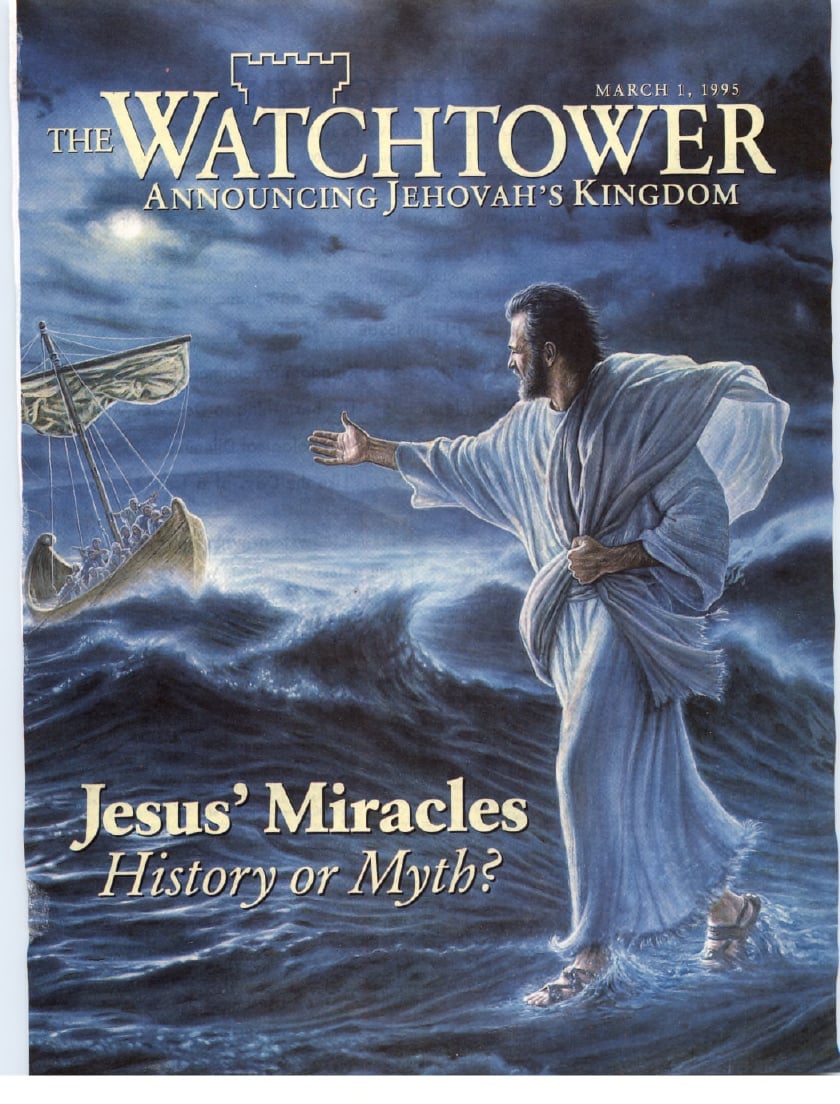
The Watchtower — March 1, 1995
Source: jw.org
Contents
Jesus’ Miracles—History or Myth?
Lessons From the Miracles of Jesus
Dedicated—To Whom?
Living Up to Our Dedication “Day After Day”
“Old Testament” or “Hebrew Scriptures”—Which?
Maimonides—The Man Who Redefined Judaism
God’s People Offer Themselves Willingly
The Best Thing to Do With My Life
A Theological Dilemma
“Like the Days of a Tree”
Would You Welcome a Visit?
Jesus’ Miracles—History or Myth?
Jesus’ Miracles—History or Myth?
“In the fourth watch period of the night he came to them, walking over the sea.”—Matthew 14:25.
FOR millions around the world, the belief that Jesus Christ worked miracles is almost as important as belief in God himself. The Gospel writers—Matthew, Mark, Luke, and John—describe some 35 of Jesus’ miracles. Their accounts suggest, however, that he performed many more supernatural feats.—Matthew 9:35; Luke 9:11.
These miracles were not performed for entertainment. They were intrinsic to Jesus’ claim that he was the Son of God, the long-awaited Messiah. (John 14:11) Moses had performed miraculous signs when he presented himself to the enslaved nation of Israel. (Exodus 4:1-9) Logically, the Messiah, the one prophesied to be greater than Moses, would also have been expected to produce some sign of divine backing. (Deuteronomy 18:15) The Bible thus calls Jesus “a man publicly shown by God to [the Jews] through powerful works and portents and signs.”—Acts 2:22.
In times past, people generally accepted without question the Bible’s portrayal of Jesus as a miracle worker. But in recent decades, the Gospel accounts have come under fire from critics. In his book Deceptions and Myths of the Bible, Lloyd Graham refers to the Bible account of Jesus walking on the water and goes so far as to say: “It takes a lot of ignorance to believe this literally, yet, literally, millions do. And then we wonder what’s wrong with our world. What better world would you expect of such ignorance?”
Impossible?
Such criticisms are not reasonable, however. The World Book Encyclopedia defines a miracle as “an event that cannot be explained through the known laws of nature.” By that definition, a color TV, a cellular phone, or a laptop computer would have been considered miracles just a century ago! Does it make sense to be dogmatic and call something impossible simply because we cannot explain it according to present scientific knowledge?
Another fact to consider: In the original Greek language in which the “New Testament” was written, the word used for “miracle” was dyʹna·mis—a word basically meaning “power.” It is also rendered “powerful works” or “ability.” (Luke 6:19; 1 Corinthians 12:10; Matthew 25:15) The Bible claims that Jesus’ miracles were a manifestation of “the majestic power of God.” (Luke 9:43) Would such works be impossible for an almighty God—One who has an “abundance of dynamic energy”?—Isaiah 40:26.
Evidence of Authenticity
A close examination of the four Gospels yields further evidence of their believability. For one thing, these accounts are markedly different from fairy tales and legends. Consider, for example, the false stories that circulated about Jesus in the centuries following his death. The apocryphal “Gospel of Thomas” relates: “When this boy Jesus was five years old . . . , he went through the village, and a lad ran and knocked against his shoulder. Jesus was exasperated and said to him: ‘You shall not go further on your way’, and the child immediately fell down and died.” It is not hard to see this story for what it is—a contrived piece of fiction. Furthermore, the capricious, mean-spirited child portrayed here bears no resemblance to the Jesus of the Bible.—Contrast Luke 2:51, 52.
Now consider the authentic Gospel accounts. They are free of exaggeration and fictitious overtones. Jesus performed miracles in response to genuine need, not to satisfy mere caprice. (Mark 10:46-52) Never did Jesus use his powers to benefit himself. (Matthew 4:2-4) And he never used them to show off. In fact, when curious King Herod wanted Jesus to perform a miraculous “sign” for him, Jesus “made him no answer.”—Luke 23:8, 9.
Jesus’ miracles also stand in stark contrast to the work of professional illusionists, magicians, and faith healers. His powerful works always glorified God. (John 9:3; 11:1-4) His miracles were free of emotional rituals, magic incantations, showy displays, trickery, and hypnotism. When Jesus encountered a blind beggar named Bartimaeus who cried, “Rabboni, let me recover sight,” Jesus simply said to him: “‘Go, your faith has made you well.’ And immediately he recovered sight.”—Mark 10:46-52.
The Gospel records show that Jesus performed his powerful works without props, specially planned staging, or trick lighting. They were performed out in the open, often in front of numerous eyewitnesses. (Mark 5:24-29; Luke 7:11-15) Unlike attempts by modern faith healers, his efforts to heal never failed because some ailing one supposedly lacked faith. Says Matthew 8:16: “He cured all who were faring badly.”
In his book “Many Infallible Proofs:” The Evidences of Christianity, Scholar Arthur Pierson says of Christ’s miracles: “Their number, the instantaneous and complete character of the cures he wrought, and the absence of one failure in the attempt even to raise the dead, put infinite distance between these miracles and the pretended wonders of this or any other age.”
Secular Corroboration
Pierson offers yet another argument that backs the Gospel accounts when he says: “No confirmation of the miracles of scripture is more remarkable than the silence of enemies.” Jewish leaders had more than ample motive for wanting to discredit Jesus, but his miracles were so well-known that opponents dared not deny them. All they could do was attribute such feats to demonic powers. (Matthew 12:22-24) Centuries after Jesus’ death, the writers of the Jewish Talmud continued to credit Jesus with miraculous powers. According to the book Jewish Expressions on Jesus, they dismissed him as being one who “followed the practices of magic.” Would such a comment have been made if it was even remotely possible to dismiss Jesus’ miracles as mere myth?
Further proof comes from fourth-century church historian Eusebius. In his book The History of the Church From Christ to Constantine, he quotes a certain Quadratus who sent a letter to the emperor in defense of Christianity. Quadratus wrote: “Our Saviour’s works were always there to see, for they were true—the people who had been cured and those raised from the dead, who had not merely been seen at the moment when they were cured or raised, but were always there to see, not only when the Saviour was among us, but for a long time after His departure; in fact some of them survived right up to my own time.” Scholar William Barclay observed: “Quadratus is saying that until his own day men on whom miracles had been worked could actually be produced. If that was untrue nothing would have been easier than for the Roman government to brand it as a lie.”
Belief in the miracles of Jesus is reasonable, rational, and fully in harmony with the evidence. Nevertheless, Jesus’ miracles are not dead history. Hebrews 13:8 reminds us: “Jesus Christ is the same yesterday and today, and forever.” Yes, he is alive in the heavens today, able to use miraculous powers in a far grander way than he did when on earth as a human. Furthermore, the Gospel accounts of his miracles (1) teach Christians practical lessons today, (2) reveal fascinating aspects of Jesus’ personality, and (3) point to a time in the near future when even more spectacular events will take place!
The next article will focus on three well-known Bible accounts to illustrate these points.
Lessons From the Miracles of Jesus
Lessons From the Miracles of Jesus
“NOW on the third day a marriage feast took place in Cana of Galilee . . . Jesus and his disciples were also invited to the marriage feast. When the wine ran short the mother of Jesus said to him: ‘They have no wine.’” This incident set the stage for Jesus’ first miracle.—John 2:1-3.
Was not such a problem too insignificant, too trivial, to bring to the attention of Jesus? Explains one Bible scholar: “Hospitality in the East was a sacred duty . . . Real hospitality, especially at a wedding feast, demanded a superabundance. If the supplies had [run out] at a wedding feast, the family and the young couple would never have lived down the shame.”
Jesus therefore took action. He observed “six stone water jars sitting there as required by the purification rules of the Jews.” Ritual washing before meals was customary among the Jews, and a good deal of water had been required to serve the needs of those present. “Fill the water jars with water,” Jesus ordered those serving the guests. Jesus was not “the director of the feast,” but he spoke directly and authoritatively. Says the account: “When, now, the director of the feast tasted the water, [it] had been turned into wine.”—John 2:6-9; Mark 7:3.
It may seem odd that something as commonplace as a wedding would be the setting for Jesus’ first miracle, but the incident reveals much about Jesus. He was a single man, and on subsequent occasions he discussed the advantages of singleness with his disciples. (Matthew 19:12) However, his presence at a wedding feast revealed that he was far from being antimarriage. He was balanced, supportive of the marriage arrangement; he viewed it as something honorable in the eyes of God.—Compare Hebrews 13:4.
Jesus was not the dour ascetic that church artists later made him out to be. He clearly enjoyed being around people and was not averse to socializing. (Compare Luke 5:29.) His actions thus set a precedent for his followers. Jesus personally demonstrated that they were not to be unnecessarily solemn or glum—as if righteousness meant joylessness. On the contrary, Christians were later commanded: “Always rejoice in the Lord.” (Philippians 4:4) Christians today exercise care to keep recreation within reasonable bounds. They find their joy in God’s service, but following Jesus’ example, they occasionally find time to enjoy one another’s company in a social setting.
Observe also the tenderness of Jesus’ emotions. He was under no obligation to perform a miracle. There was no prophecy in this regard that had to be fulfilled. Evidently, Jesus was simply moved by his mother’s concern and the plight of the couple getting married. He cared about their feelings and wished to spare them embarrassment. Does that not build your confidence that Christ has a real interest in you—even in your mundane problems?—Compare Hebrews 4:14-16.
Since each jar was “able to hold two or three liquid measures” of water, Jesus’ miracle involved a great volume of wine—perhaps 390 liters (105 gallons)! (John 2:6) Why such a huge quantity? Jesus was not promoting drunkenness, something God condemns. (Ephesians 5:18) Rather, he was demonstrating godlike generosity. Since wine was a common beverage, any surplus could be used on other occasions.—Compare Matthew 14:14-20; 15:32-37.
Early Christians imitated Jesus’ example of generosity. (Compare Acts 4:34, 35.) And Jehovah’s people today are likewise encouraged to “practice giving.” (Luke 6:38) However, Jesus’ first miracle also has prophetic import. It points to a future time when God will generously provide “a banquet of well-oiled dishes, a banquet of wine kept on the dregs,” completely eliminating hunger.—Isaiah 25:6.
What, though, of the many miracles Jesus performed that involved physical healing? What can we learn from them?
Doing Good on the Sabbath
“Get up, pick up your cot and walk.” Jesus spoke these words to a man who had been sick for 38 years. The Gospel account continues: “With that the man immediately became sound in health, and he picked up his cot and began to walk.” Surprisingly, not all were pleased by this turn of events. Says the account: “The Jews went persecuting Jesus, because he was doing these things during Sabbath.”—John 5:1-9, 16.
The Sabbath was intended to be a day of rest and rejoicing for all. (Exodus 20:8-11) By Jesus’ day, though, it had become a maze of oppressive, man-made rules. Scholar Alfred Edersheim wrote that in the lengthy Sabbath-law sections of the Talmud, “matters are seriously discussed as of vital religious importance, which one could scarcely imagine a sane intellect would seriously entertain.” (The Life and Times of Jesus the Messiah) The rabbis attached life-and-death importance to frivolous, arbitrary rules that regulated virtually every aspect of a Jew’s life—often with cold-blooded disregard for human feeling. One Sabbath rule decreed: “If a building fell down upon a man and there is doubt whether he is there or not, or whether he is alive or dead, or whether he is a gentile or an Israelite, they may clear away the ruin from above him. If they find him alive they may clear it away still more from above him; but if [he is] dead, they leave him.”—Tractate Yoma 8:7, The Mishnah, translated by Herbert Danby.
How did Jesus view such legalistic hairsplitting? When criticized for healing on the Sabbath, he said: “My Father has kept working until now, and I keep working.” (John 5:17) Jesus was not performing secular work in order to enrich himself. Rather, he was doing the will of God. Just as the Levites were allowed to continue their sacred service on the Sabbath, Jesus could rightfully carry out his God-assigned duties as the Messiah without violating God’s Law.—Matthew 12:5.
Jesus’ Sabbath-day cures also exposed the Jewish scribes and Pharisees as being “righteous overmuch”—rigid and unbalanced in their thinking. (Ecclesiastes 7:16) Certainly, it was not God’s will that good works be restricted to certain days of the week; nor did God intend the Sabbath to be an empty exercise in rule following. Jesus said at Mark 2:27: “The sabbath came into existence for the sake of man, and not man for the sake of the sabbath.” Jesus loved people, not arbitrary rules.
Christians today thus do well not to be overly rigid or rule oriented in their thinking. Those in authority in the congregation refrain from burdening others with excessive man-made rules and policies. Jesus’ example also encourages us to look for opportunities to do good. For instance, never would a Christian reason that he will share Bible truths only when he is formally engaged in the house-to-house ministry or when he is on the public platform. The Christian, says the apostle Peter, should be “always ready to make a defense before everyone that demands of you a reason for the hope in you.” (1 Peter 3:15) The doing of good has no time restrictions.
A Lesson in Compassion
Another outstanding miracle is recorded at Luke 7:11-17. According to the account, Jesus “traveled to a city called Nain, and his disciples and a great crowd were traveling with him.” To this day, burial sites can be seen to the southeast of the modern Arab village of Nein. “As he got near the gate of the city,” he encountered a noisy scene. “Why, look! there was a dead man being carried out, the only-begotten son of his mother. Besides, she was a widow. A considerable crowd from the city was also with her.” H. B. Tristram noted that “the mode of conducting a burial has not changed” from ancient times, adding: “I have seen the women preceding the bier, led by the professional mourning women. They fling up their arms, tear their hair, with the wildest gesticulations of grief, and shriek forth the name of the deceased.”—Eastern Customs in Bible Lands.
In the midst of such noisy chaos walked a grieving widow whose very visage must have been pain itself. Having already lost a husband, she viewed her son as, in the words of author Herbert Lockyer, “the staff of her age, and the comfort of her loneliness—the support and pillar of the home. In the loss of her only son, the last remaining prop had been swept away.” (All the Miracles of the Bible) Jesus’ reaction? In Luke’s eloquent words, “when the Lord caught sight of her, he was moved with pity for her, and he said to her: ‘Stop weeping.’” The expression “moved with pity” is drawn from a Greek word that literally means “intestines.” It means “to be moved as to one’s inwards.” (Vine’s Expository Dictionary of Old and New Testament Words) Yes, Jesus was moved to the depth of his very being.
Jesus’ own mother was likely a widow at this time, so he probably knew the pain of bereavement in losing his adoptive father, Joseph. (Compare John 19:25-27.) The widow did not have to implore Jesus. Spontaneously, “he approached and touched the bier,” in spite of the fact that under the Mosaic Law touching a corpse made one unclean. (Numbers 19:11) Through his miraculous powers, Jesus could remove the very source of uncleanness! “He said: ‘Young man, I say to you, Get up!’ And the dead man sat up and started to speak, and he gave him to his mother.”
What a stirring lesson in compassion! Christians are not to imitate the loveless, cold attitudes manifest during these “last days.” (2 Timothy 3:1-5) On the contrary, 1 Peter 3:8 exhorts: “Finally, all of you be like-minded, showing fellow feeling, having brotherly affection, tenderly compassionate.” When an acquaintance experiences a death or a serious illness, we cannot perform a resurrection or heal the sick one. But we can offer practical aid and comfort, perhaps simply by being there and weeping with them.—Romans 12:15.
This dramatic resurrection performed by Jesus also points to the future—a time when “all those in the memorial tombs will hear his voice and come out”! (John 5:28, 29) Earth wide, bereaved ones will personally experience Jesus’ compassion when departed mothers, fathers, children, and friends return from the grave!
The Lessons of the Miracles
Clearly, then, the miracles of Jesus were more than thrilling displays of power. They glorified God, setting a pattern for Christians who are urged to ‘glorify God.’ (Romans 15:6) They encouraged the doing of good, the showing of generosity, the displaying of compassion. More important, they served as a preview of the powerful works to be performed during Christ’s Millennial Reign.
While on earth, Jesus performed his powerful works within a relatively small geographic area. (Matthew 15:24) As glorified King, his jurisdiction will extend earth wide! (Psalm 72:8) Back then, those who received his miraculous cures and resurrections eventually died. Under his heavenly kingship, sin and death will be removed entirely, opening the way for everlasting life. (Romans 6:23; Revelation 21:3, 4) Yes, Jesus’ miracles point the way to a glorious future. Jehovah’s Witnesses have helped millions to develop a real hope of being a part of it. Until that time comes, what a marvelous foretaste of what will soon take place is provided by the miracles of Jesus Christ!
[Picture on page 7]
Jesus turns water into wine
Dedicated—To Whom?
Dedicated—To Whom?
“All that Jehovah has spoken we are willing to do and be obedient.”—EXODUS 24:7.
1, 2. (a) To what are some people devoted? (b) Is dedication limited to those with religious affiliations?
IN February 1945, the Zero-fighter pilots of Japan’s Yatabe Flying Corps were gathered in an auditorium. Each was handed a piece of paper on which to write whether he would volunteer to be a member of the kamikaze attack force. “I thought it was my calling to sacrifice myself at a time of national crisis,” says an officer who was present at that time. “Emotionally compelled to make myself available, I offered myself for the commission.” He was trained to operate and pilot an Ohka (a suicide rocket plane) and crash it into an enemy warship. However, the war ended before he had an opportunity to do so and thus to die for his country and his emperor. When Japan lost the war, his faith in the emperor was shattered.
2 At one time, many in Japan were devoted to the emperor, whom they believed to be a living god. In other lands, there have been and still are other objects of devotion. Millions are devoted to Mary, Buddha, or other divinities—often represented by idols. Swayed by sensational oratory, some pour their hard-earned money into the pockets of TV evangelists in wholehearted support that amounts to devotion. After the war, disappointed Japanese sought a new object to which they could dedicate their lives. For some, work became that object. East or West, many dedicate themselves to the accumulating of riches. Young people center their lives on musicians, whose life-styles they imitate. A large number today have become worshipers of self, making their own desires the object of their devotion. (Philippians 3:19; 2 Timothy 3:2) But are such things or people really worth a person’s whole-souled devotion?
3. How have some objects of devotion proved worthless?
3 When faced with reality, idol worshipers often become disillusioned. Devotion to idols results in frustration when the worshipers realize that their idols are no more than “the work of the hands of earthling man.” (Psalm 115:4) When scandals involving prominent evangelists are exposed, sincere people feel let down. When the “bubble” economy burst, workers experienced mental disorders as they found themselves on the list of those being laid off. Recent recessions delivered a severe blow to worshipers of Mammon. Debts incurred in the hope of making a lot of money became a burden with little prospect of being paid off. (Matthew 6:24, footnote) When idolized rock stars and other entertainers die or fade away, their worshipers are left abandoned. And those who have walked in a path of self-gratification often reap bitter fruitage.—Galatians 6:7.
4. What moves people to dedicate their lives to worthless things?
4 What moves people to dedicate themselves to such futility? To a great extent, it is the spirit of the world under Satan the Devil. (Ephesians 2:2, 3) The influence of this spirit is seen in various ways. An individual may be controlled by family tradition that has been passed down from his ancestors. Education and upbringing may strongly influence thinking. The atmosphere of the workplace may push “corporate warriors” to workaholism that may be life-threatening. A desire for more is engendered by the materialistic attitude of the world. The hearts of many are corrupted, moving them to devote themselves to their own selfish desires. They fail to examine whether these pursuits deserve such devotion.
A Dedicated Nation
5. What dedication to Jehovah was made over 3,500 years ago?
5 Over 3,500 years ago, one nation of people found a far worthier object of devotion. They dedicated themselves to the sovereign God, Jehovah. As a group, the nation of Israel declared its dedication to God in the wilderness of Sinai.
6. What was to be the significance of God’s name to the Israelites?
6 What moved the Israelites to act in this way? When they were in slavery in Egypt, Jehovah commissioned Moses to lead them to freedom. Moses asked how he should identify the God who had sent him, and God revealed himself as “I shall prove to be what I shall prove to be.” He directed Moses to say to the sons of Israel: “I shall prove to be has sent me to you.” (Exodus 3:13, 14) This expression indicated that Jehovah becomes whatever is needed in order to accomplish his purposes. He would reveal himself as the Fulfiller of promises in a way that the Israelites’ forefathers had never known.—Exodus 6:2, 3.
7, 8. What evidences did the Israelites have that Jehovah was a God worthy of their devotion?
7 The Israelites witnessed the affliction of the land of Egypt and its people by the Ten Plagues. (Psalm 78:44-51) Then, possibly more than three million of them, including women and children, packed up and moved out of the land of Goshen in one night, which in itself was a remarkable feat. (Exodus 12:37, 38) Next, at the Red Sea, Jehovah disclosed himself as “a manly person of war” when he saved his people from Pharaoh’s military forces by dividing the sea to let the Israelites pass and later by closing it to drown the pursuing Egyptians. As a result, “Israel also got to see the great hand that Jehovah put in action against the Egyptians; and the people began to fear Jehovah and to put faith in Jehovah.”—Exodus 14:31; 15:3; Psalm 136:10-15.
8 As though still lacking evidence for what God’s name means, the Israelites murmured against Jehovah and his representative Moses about shortages of food and water. Jehovah sent quail, rained down manna, and caused water to gush out of a rock at Meribah. (Exodus 16:2-5, 12-15, 31; 17:2-7) Jehovah also rescued the Israelites from the Amalekites’ attack. (Exodus 17:8-13) In no way could the Israelites deny what Jehovah later declared to Moses: “Jehovah, Jehovah, a God merciful and gracious, slow to anger and abundant in loving-kindness and truth, preserving loving-kindness for thousands, pardoning error and transgression and sin.” (Exodus 34:6, 7) Indeed, Jehovah proved himself to be a worthy object of their devotion.
9. Why did Jehovah give the Israelites the opportunity to express their dedication to serve him, and how did they respond?
9 Although Jehovah had the right to ownership of the Israelites because he had redeemed them out of Egypt, he, as the kind and merciful God, gave them the opportunity voluntarily to express their desire to serve him. (Deuteronomy 7:7, 8; 30:15-20) He also set out the conditions for the covenant between him and the Israelites. (Exodus 19:3-8; 20:1–23:33) When these conditions were related by Moses, the Israelites declared: “All that Jehovah has spoken we are willing to do and be obedient.” (Exodus 24:3-7) Of their own free will, they became a nation dedicated to the Sovereign Lord Jehovah.
Appreciation Leads to Dedication
10. On what should our dedication to Jehovah be based?
10 Jehovah, the Creator, continues to be worthy of our whole-souled devotion. (Malachi 3:6; Matthew 22:37; Revelation 4:11) However, our dedication should not be based on credulity, fleeting emotions, or coercion from others—even parents. It must be based on an accurate knowledge of truth about Jehovah and an appreciation for what Jehovah has done for us. (Romans 10:2; Colossians 1:9, 10; 1 Timothy 2:4) Just as Jehovah gave the Israelites the opportunity voluntarily to express their dedication, so he gives us a chance voluntarily to dedicate ourselves and to make that dedication public.—1 Peter 3:21.
11. What has our study of the Bible revealed about Jehovah?
11 Through a study of the Bible, we come to know God as a person. His Word helps us to discern his qualities as reflected in creation. (Psalm 19:1-4) We can see from his Word that he is not a mysterious Trinity who cannot be understood. He does not lose wars and thus does not have to renounce his Godship. (Exodus 15:11; 1 Corinthians 8:5, 6; Revelation 11:17, 18) Because he has fulfilled his promises, we are reminded of what his beautiful name, Jehovah, stands for. He is the Grand Purposer. (Genesis 2:4, footnote; Psalm 83:18; Isaiah 46:9-11) By studying the Bible, we come to understand clearly how faithful and trustworthy he is.—Deuteronomy 7:9; Psalm 19:7, 9; 111:7.
12. (a) What attracts us to Jehovah? (b) How do real-life experiences recorded in the Bible move one to want to serve Jehovah? (c) How do you feel about serving Jehovah?
12 What especially attracts us to Jehovah is his loving personality. The Bible demonstrates how loving, forgiving, and merciful he is in dealing with humans. Think of how he prospered Job after Job faithfully kept his integrity. Job’s experience highlights that “Jehovah is very tender in affection and merciful.” (James 5:11; Job 42:12-17) Think of how Jehovah dealt with David when he committed adultery and murder. Yes, Jehovah is ready to forgive even serious sins when the sinner approaches him with “a heart broken and crushed.” (Psalm 51:3-11, 17) Think of the way Jehovah dealt with Saul of Tarsus, who was at first a determined persecutor of God’s people. These examples highlight God’s mercy and generous willingness to use repentant ones. (1 Corinthians 15:9; 1 Timothy 1:15, 16) Paul felt that he could stake his very life on serving this loving God. (Romans 14:8) Do you feel the same way?
13. What great expression of love on the part of Jehovah compels righthearted ones to dedicate themselves to him?
13 For the Israelites, Jehovah provided salvation from bondage in Egypt, and he has prepared a means to save us from bondage to sin and death—the ransom sacrifice of Jesus Christ. (John 3:16) Paul says: “God recommends his own love to us in that, while we were yet sinners, Christ died for us.” (Romans 5:8) This loving arrangement compels righthearted ones to dedicate themselves to Jehovah through Jesus Christ. “For the love the Christ has compels us, because this is what we have judged, that one man died for all; so, then, all had died; and he died for all that those who live might live no longer for themselves, but for him who died for them and was raised up.”—2 Corinthians 5:14, 15; Romans 8:35-39.
14. Is the mere knowledge of Jehovah’s dealings enough to move us to dedicate our lives to him? Explain.
14 Still, having knowledge of Jehovah’s personality and his dealings with mankind is not enough. Personal appreciation for Jehovah must be cultivated. How can that be done? By applying the Word of God in our lives and seeing for ourselves that the principles found in it really work. (Isaiah 48:17) We have to feel that Jehovah has saved us from the mire of this wicked world under Satan’s rule. (Compare 1 Corinthians 6:11.) In our struggle to do what is right, we learn to rely on Jehovah, and we experience for ourselves that Jehovah is the living God, the “Hearer of prayer.” (Psalm 62:8; 65:2) Soon we feel very close to him and are able to confide our innermost feelings to him. The warm feeling of love for Jehovah grows in us. This will no doubt lead us to dedicate our lives to him.
15. What motivated one man, formerly dedicated to work, to serve Jehovah?
15 Many have come to know this loving God, Jehovah, and have dedicated their lives to serving him. Take for example an electrician who had a thriving business. There were times when he would start working in the morning and work through the day and on into the night, coming home at five o’clock the next morning. After resting for about an hour, he would go out to the next job. “I was dedicated to my work,” he recalls. When his wife started to study the Bible, he joined her. He says: “All the gods I had known up until that time were just waiting to be served, doing nothing to benefit us. But Jehovah took the initiative and sent his only-begotten Son to earth at great personal sacrifice.” (1 John 4:10, 19) Within ten months, this man was dedicated to Jehovah. After that, he concentrated on serving the living God. He took up the full-time ministry and moved to serve where the need was greater. He, like the apostles, ‘left all things and followed Jesus.’ (Matthew 19:27) After two months, he and his wife were called to serve at the branch of the Watch Tower Bible and Tract Society in the country where they lived, so that he could help with electrical work. For over 20 years, he has been working at the branch, doing the work he loves—not for himself but for Jehovah.
Make Your Dedication Public
16. What are some steps one would take in making a dedication to Jehovah?
16 After studying the Bible for a while, young and old alike will come to appreciate Jehovah and what he has done for them. This should move them to give of themselves to God. You may be one of these. How can you dedicate yourself to Jehovah? After taking in accurate knowledge from the Bible, you should act on that knowledge and exercise faith in Jehovah and Jesus Christ. (John 17:3) Repent and turn around from any past sinful course. (Acts 3:19) Then you will come to the step of dedication, expressing it in solemn words of prayer to Jehovah. This prayer no doubt will leave a lasting impression on your mind, for it will be the starting point of a new relationship with Jehovah.
17. (a) Why do the elders review prepared questions with newly dedicated ones? (b) What important step should be taken soon after one’s dedication, and for what purpose?
17 Just as Moses explained to the Israelites the conditions for entering a covenant relationship with Jehovah, elders in the congregations of Jehovah’s Witnesses help those who have recently made a dedication to examine just what is involved. They use prepared questions to confirm that each one fully understands the basic teachings of the Bible and is aware of what is involved in being a Witness of Jehovah. Then, a ceremony to make the dedication public is most appropriate. Naturally, a newly dedicated one is eager to let others know that he has come into this privileged relationship with Jehovah. (Compare Jeremiah 9:24.) This is properly done by undergoing water baptism in symbol of dedication. Being immersed in water and then being raised up symbolizes that he dies to his former self-seeking course of life and is raised to a new way of life, that of doing God’s will. It is not a sacrament, nor is it a ritual like the Shinto rite of misogi in which a person is supposed to be cleansed by water.a Rather, baptism is the public declaration of a dedication that has already been made in prayer.
18. Why can we be confident that our dedication will not be in vain?
18 This solemn occasion is an unforgettable experience, reminding the new servant of God of the lasting relationship he now has with Jehovah. Unlike the dedication that the kamikaze pilot made to his country and emperor, this dedication to Jehovah will not be in vain, for he is the eternal almighty God who accomplishes all that he sets out to do. He, and he alone, is worthy of our whole-souled devotion.—Isaiah 55:9-11.
19. What will be discussed in the next article?
19 However, more is involved in dedication. For example, how does dedication affect our day-to-day life? This will be discussed in the next article.
[Footnotes]
See Mankind’s Search for God, published by the Watchtower Bible and Tract Society of New York, Inc., pages 194-5.
Do You Recall?
□ Why has dedication as seen in the world ended in disappointment?
□ What moved the Israelites to dedicate themselves to Jehovah?
□ What moves us to dedicate ourselves to Jehovah today?
□ How do we dedicate ourselves to God?
□ What is the significance of water baptism?
[Picture on page 10]
Israel in Sinai dedicates itself to Jehovah
Living Up to Our Dedication “Day After Day”
Living Up to Our Dedication “Day After Day”
“If anyone wants to come after me, let him disown himself and pick up his torture stake day after day and follow me continually.”—LUKE 9:23.
1. What is one way we can measure our success as Christians?
“WERE we truly men of dedication?” The answer to this question, according to John F. Kennedy, the 35th President of the United States, is a factor in measuring the success of those in public office. The question could serve with deeper significance as a test for our success as Christian ministers.
2. How does a dictionary define the word “dedication”?
2 What, though, is dedication? Webster’s Ninth New Collegiate Dictionary defines it as “an act or rite of dedicating to a divine being or to a sacred use,” “a devoting or setting aside for a particular purpose,” “self-sacrificing devotion.” John F. Kennedy was apparently using the word to mean “self-sacrificing devotion.” For a Christian, dedication means much more.
3. What is Christian dedication?
3 Jesus Christ told his disciples: “If anyone wants to come after me, let him disown himself and pick up his torture stake and continually follow me.” (Matthew 16:24) Being set apart for divine use does not simply involve performing an act of worship on Sunday or when visiting some place of worship. It involves one’s whole life-style. To be a Christian means to disown oneself or to deny oneself while serving the God whom Jesus Christ served, Jehovah. In addition, a Christian picks up his “torture stake” by bearing up under any suffering that may be incurred for being a follower of Christ.
The Perfect Example
4. For what did Jesus’ baptism stand?
4 While on earth, Jesus demonstrated what dedicating oneself to Jehovah involves. His sentiments were: “Sacrifice and offering you did not want, but you prepared a body for me.” Then he added: “Look! I am come (in the roll of the book it is written about me) to do your will, O God.” (Hebrews 10:5-7) As a member of a dedicated nation, he was dedicated to Jehovah at birth. Still, at the commencement of his earthly ministry, he offered himself for baptism as a symbol of the presentation of himself to do Jehovah’s will, which for him would include offering his life as a ransom sacrifice. He thus set an example for Christians to do whatever it is that Jehovah wills.
5. How did Jesus demonstrate an exemplary view of material things?
5 After his baptism Jesus followed a life course that ultimately led to a sacrificial death. He was not interested in making money or in living a life of ease. Rather, his life revolved around his ministry. He admonished his disciples to “keep on . . . seeking first the kingdom and his righteousness,” and he himself lived up to these words. (Matthew 6:33) Why, once he even said: “Foxes have dens and birds of heaven have roosts, but the Son of man has nowhere to lay down his head.” (Matthew 8:20) He could have tailored his teachings in order to squeeze money from his followers. Being a carpenter he could have taken time off to make a beautiful piece of furniture to sell so that he would have a few extra pieces of silver. But he did not use his skills to seek material prosperity. As dedicated servants of God, are we imitating Jesus in having the right perspective of material things?—Matthew 6:24-34.
6. How can we imitate Jesus in being self-sacrificing, dedicated servants of God?
6 In putting his service to God first, Jesus did not seek his own interests. His life during the three and a half years of his public ministry was one of self-sacrifice. On one occasion after a busy day, without even taking the time to eat a meal, Jesus was willing to teach people who were “skinned and thrown about like sheep without a shepherd.” (Matthew 9:36; Mark 6:31-34) Although “tired out from the journey,” he took the initiative in talking with a Samaritan woman who came to Jacob’s fountain in Sychar. (John 4:6, 7, 13-15) He always put the welfare of others ahead of his own. (John 11:5-15) We can imitate Jesus by generously sacrificing our own interests to serve God and others. (John 6:38) By thinking in terms of how we can truly please God rather than do only the minimum required, we will be living up to our dedication.
7. How can we imitate Jesus in always giving honor to Jehovah?
7 Jesus was in no way trying to attract attention to himself by helping people. He was dedicated to God to do His will. So he always made sure that Jehovah, his Father, received all the glory for whatever was accomplished. When a certain ruler addressed him “Good Teacher,” using the word “good” as a title, Jesus corrected him by saying: “Nobody is good, except one, God.” (Luke 18:18, 19; John 5:19, 30) Are we, like Jesus, quick to direct honor away from ourselves toward Jehovah?
8. (a) As a dedicated man, how did Jesus set himself apart from the world? (b) How should we imitate him?
8 Throughout his dedicated life course on earth, Jesus demonstrated that he had set himself aside for divine service. He kept himself clean so that he could offer himself as “an unblemished and spotless lamb” to be the ransom sacrifice. (1 Peter 1:19; Hebrews 7:26) He observed all the precepts of the Mosaic Law, thus fulfilling that Law. (Matthew 5:17; 2 Corinthians 1:20) He lived up to his own teaching on morals. (Matthew 5:27, 28) No one could rightfully accuse him of bad motives. Indeed, he “hated lawlessness.” (Hebrews 1:9) As slaves of God, let us imitate Jesus in keeping our lives and even our motives clean in Jehovah’s eyes.
Warning Examples
9. To what warning example did Paul refer, and why should we consider this example?
9 In contrast with Jesus’ example, we have the warning example of the Israelites. Even after they declared that they would do all that Jehovah told them to do, they failed to do his will. (Daniel 9:11) The apostle Paul encouraged Christians to learn from what befell the Israelites. Let us examine some incidents that Paul referred to in his first letter to the Corinthians and see what pitfalls need to be avoided by dedicated servants of God in our time.—1 Corinthians 10:1-6, 11.
10. (a) How did the Israelites ‘desire injurious things’? (b) Why were the Israelites more accountable the second time they murmured about food, and what can we learn from this warning example?
10 First, Paul warned us not to be “desiring injurious things.” (1 Corinthians 10:6) That may remind you of the occasion when the Israelites complained about having only manna to eat. Jehovah sent quail to them. Something similar had happened about a year earlier in the wilderness of Sin, just before the Israelites declared their dedication to Jehovah. (Exodus 16:1-3, 12, 13) But the situation was not exactly the same. When Jehovah provided quail the first time, he did not call the Israelites to account for their murmuring. This time, however, things were different. “The meat was yet between their teeth, before it could be chewed, when Jehovah’s anger blazed against the people, and Jehovah began striking at the people with a very great slaughter.” (Numbers 11:4-6, 31-34) What had changed? As a dedicated nation, they were now held accountable. Their lack of appreciation for Jehovah’s provisions led them to complain against Jehovah, despite their having promised to do all that Jehovah had spoken! Complaining about Jehovah’s table today is similar. Some fail to appreciate Jehovah’s spiritual provisions through “the faithful and discreet slave.” (Matthew 24:45-47) Remember, though, that our dedication requires us gratefully to keep in mind what Jehovah has done for us and accept the spiritual food that Jehovah supplies.
11. (a) How did the Israelites pollute their worship of Jehovah with idolatry? (b) How could we be affected by a kind of idolatry?
11 Next, Paul warned: “Neither become idolaters, as some of them did.” (1 Corinthians 10:7) Here the apostle was evidently referring to the calf worship that took place right after the Israelites concluded the covenant with Jehovah at Mount Sinai. You may say, ‘As a dedicated servant of Jehovah, I will never get involved in idolatry.’ Note, however, that from the point of view of the Israelites, they did not cease to worship Jehovah; yet, they brought in a practice of calf worship—something disgusting to God. What did this form of worship involve? The people made sacrifices in front of the calf, and then they “sat down to eat and drink. Then they got up to have a good time.” (Exodus 32:4-6) Today, some may claim that they worship Jehovah. But their lives may be centered, not on worship of Jehovah, but on enjoyment of the things of this world, and they try to fit their service to Jehovah around these. True, this is not as extreme as bowing down to a golden calf, but it is not too different in principle. Making a god of one’s own desire is far from living up to one’s dedication to Jehovah.—Philippians 3:19.
12. From the experience of the Israelites with Baal of Peor, what do we learn about disowning ourselves?
12 A kind of entertainment was also involved in the next warning example that Paul mentioned. “Neither let us practice fornication, as some of them committed fornication, only to fall, twenty-three thousand of them in one day.” (1 Corinthians 10:8) The Israelites, enticed by immoral pleasure offered by the daughters of Moab, were led into worshiping the Baal of Peor in Shittim. (Numbers 25:1-3, 9) Disowning ourselves to do Jehovah’s will includes accepting his standards for what is morally clean. (Matthew 5:27-30) In this age of deteriorating standards, we are reminded of the need to keep ourselves clean from all sorts of immoral conduct, submitting to Jehovah’s authority to decide what is good and what is bad.—1 Corinthians 6:9-11.
13. How does Phinehas’ example help us to understand what dedication to Jehovah includes?
13 While many fell into the trap of fornication in Shittim, some lived up to the national dedication to Jehovah. Of them, Phinehas was outstanding in zeal. When he caught sight of an Israelite chieftain bringing a Midianitess into his tent, Phinehas at once took a lance in his hand and pierced them through. Jehovah told Moses: “Phinehas . . . has turned back my wrath from upon the sons of Israel by his tolerating no rivalry at all toward me in the midst of them, so that I have not exterminated the sons of Israel in my insistence on exclusive devotion.” (Numbers 25:11) Tolerating no rivalry at all toward Jehovah—that is what dedication means. We cannot allow anything to take the place that dedication to Jehovah should occupy in our hearts. Our zeal for Jehovah also moves us to keep the congregation clean by reporting gross immorality to the elders, not tolerating it.
14. (a) How did the Israelites put Jehovah to the test? (b) How does a complete dedication to Jehovah help us not to “tire out”?
14 Paul referred to another warning example: “Neither let us put Jehovah to the test, as some of them put him to the test, only to perish by the serpents.” (1 Corinthians 10:9) Paul here was talking about the time when the Israelites complained against God to Moses when they “began tiring out because of the way.” (Numbers 21:4) Do you ever make that mistake? When you dedicated yourself to Jehovah, did you think Armageddon was just around the corner? Has Jehovah’s patience been longer than you expected? Remember, we did not dedicate ourselves to Jehovah just for a certain period of time or merely until Armageddon. Our dedication continues forever. So, then, “let us not give up in doing what is fine, for in due season we shall reap if we do not tire out.”—Galatians 6:9.
15. (a) Against whom did the Israelites murmur? (b) How does our dedication to Jehovah move us to respect theocratic authority?
15 Finally, Paul warned about becoming “murmurers” against the appointed servants of Jehovah. (1 Corinthians 10:10) The Israelites murmured vehemently against Moses and Aaron when 10 of the 12 spies sent out to search the land of Canaan brought back bad reports. They even talked about replacing Moses as their head and going back to Egypt. (Numbers 14:1-4) Today, do we accept the leadership that is given to us through the action of Jehovah’s holy spirit? From seeing the bountiful spiritual table that is provided by the faithful and discreet slave class, it is clear whom Jesus is using to dispense “food at the proper time.” (Matthew 24:45) Whole-souled dedication to Jehovah requires us to show respect for his appointed servants. May we never become like some modern-day murmurers who have turned to a new head, so to speak, to lead them back into the world.
Is It My Utmost?
16. What questions may dedicated servants of God wish to ask themselves?
16 The Israelites would not have fallen into such grievous errors if they had remembered that their dedication to Jehovah was unconditional. Unlike those faithless Israelites, Jesus Christ lived up to his dedication to the finish. As Christ’s followers, we imitate his example of whole-souled devotion, living our lives “no more for the desires of men, but for God’s will.” (1 Peter 4:2; compare 2 Corinthians 5:15.) Jehovah’s will today is that “all sorts of men should be saved and come to an accurate knowledge of truth.” (1 Timothy 2:4) To that end, we are to preach “this good news of the kingdom” before the end comes. (Matthew 24:14) How much effort do we put into this service? We may wish to ask ourselves, ‘Is it my utmost?’ (2 Timothy 2:15) Circumstances differ. Jehovah is pleased to be served “according to what a person has, not according to what a person does not have.” (2 Corinthians 8:12; Luke 21:1-4) No one should judge the depth and sincerity of the dedication of another. Each should personally evaluate the extent of his own devotion to Jehovah. (Galatians 6:4) Our love for Jehovah should move us to ask, ‘How can I make Jehovah happy?’
17. What is the relationship between devotion and appreciation? Illustrate.
17 Our devotion to Jehovah deepens as we grow in our appreciation for him. A 14-year-old boy in Japan dedicated himself to Jehovah and symbolized this dedication by water baptism. Later, he wanted to pursue higher education and become a scientist. He never thought of the full-time ministry, but as a dedicated servant, he did not want to leave Jehovah and his visible organization. To realize his career goal, he attended a university. There he saw graduates of the university being forced to dedicate their entire life to their companies or to their studies. He wondered, ‘What am I doing here? Can I really pursue their way of life and dedicate myself to secular work? Am I not already dedicated to Jehovah?’ With renewed appreciation, he became a regular pioneer. His understanding of his dedication deepened and moved him to determine in his heart to go wherever he was needed. He attended the Ministerial Training School and received an assignment to serve as a missionary overseas.
18. (a) How much is involved in our dedication to Jehovah? (b) What reward can we reap from our dedication to Jehovah?
18 Dedication involves our whole life. We must disown ourselves and “day after day” follow Jesus’ fine example. (Luke 9:23) Having disowned ourselves, we do not ask Jehovah for a leave of absence, a furlough. Our lives conform to the principles Jehovah sets forth for his servants. Even in areas where we can make a personal choice, we do well to see whether we are doing our best to live a life dedicated to Jehovah. As we serve him day after day, doing our utmost to please him, we will succeed as Christians and will be blessed with a smile of approval from Jehovah, the One worthy of our whole-souled devotion.
Can You Explain?
□ What did dedication involve for Jesus Christ?
□ Why should we avoid murmuring against Jehovah?
□ In what way can we avoid letting idolatry subtly infiltrate our lives?
□ Remembering what will help us not to “tire out” in doing God’s will?
[Picture on page 17]
Dedicated Christians do “not give up in doing what is fine”
“Old Testament” or “Hebrew Scriptures”—Which?
“Old Testament” or “Hebrew Scriptures”—Which?
TODAY it is a common practice in Christendom to use the terms “Old Testament” and “New Testament” to describe the Hebrew/Aramaic and Greek language parts of the Bible. But is there any Biblical basis for using these terms? And for what reasons do Jehovah’s Witnesses generally avoid using them in their publications?
True, 2 Corinthians 3:14, according to the King James Version as well as some other older translations, such as the German Septembertestament, Martin Luther’s first translation (1522), may appear to support this practice. In the King James Version, this verse reads: “But their minds were blinded: for until this day remaineth the same veil untaken away in the reading of the old testament; which veil is done away in Christ.”
However, is the apostle speaking here about the 39 books that are commonly called the “Old Testament”? The Greek word here translated “testament” is di·a·theʹke. The famous German theological encyclopedia Theologische Realenzyklopädie, commenting on 2 Corinthians 3:14, says that ‘the reading of the old di·a·theʹke’ in that verse is the same as ‘reading Moses’ in the following verse 2Co 3:15. Hence, it says, ‘the old di·a·theʹke’ stands for the Law of Moses, or at most, the Pentateuch. It certainly does not stand for the entire pre-Christian body of inspired Scripture.
The apostle is referring to only a part of the Hebrew Scriptures, the old Law covenant, which was recorded by Moses in the Pentateuch; he is not referring to the Hebrew and Aramaic Scriptures in their entirety. Furthermore, he does not mean that the inspired Christian writings of the first century C.E. constitute a “new testament,” since this term occurs nowhere in the Bible.
It is also to be noted that the Greek word di·a·theʹke that Paul here used actually means “covenant.” (For further information see New World Translation of the Holy Scriptures—With References, Appendix 7E, page 1585, published by the Watchtower Bible and Tract Society of New York, Inc., 1984.) Many modern translations therefore correctly read “old covenant” rather than “old testament.”
In this connection, the “National Catholic Reporter” stated: “The term ‘Old Testament’ inevitably creates an atmosphere of inferiority and outdatedness.” But the Bible is really one work, and no part is outdated, or “old.” Its message is consistent from the first book in the Hebrew part to the last book in the Greek part. (Romans 15:4; 2 Timothy 3:16, 17) So we have valid reasons to avoid these terms that are based on incorrect assumptions, and we prefer to use the more correct terms “Hebrew Scriptures” and “Christian Greek Scriptures.”
Maimonides—The Man Who Redefined Judaism
Maimonides—The Man Who Redefined Judaism
“FROM Moses to Moses, there was no one like Moses.” Many Jews will recognize this cryptic saying as an expression of admiration for the 12th-century Jewish philosopher, codifier, and commentator on the Talmud and the Scriptures, Moses Ben Maimon—also known as Maimonides and as Rambam.a Today many are unfamiliar with Maimonides, yet his writings had a deep impact on Jewish, Muslim, and church thinking in his day. In a fundamental way, he redefined Judaism. Who was Maimonides, and why do many Jews see him as “the second Moses”?
Who Was Maimonides?
Maimonides was born in Córdoba, Spain, in 1135. His father, Maimon, who provided much of his early religious training, was a renowned scholar from a distinguished rabbinical family. When the Almohads conquered Córdoba in 1148, the Jews faced the choice of converting to Islam or fleeing. This began a long period of wandering for Maimonides’ family. In 1160 they settled in Fez, Morocco, where he received training as a physician. In 1165 his family had to flee to Palestine.
However, the situation in Israel was unstable. The small Jewish community faced danger from Christendom’s Crusaders and Muslim forces alike. After less than six months in the “Holy Land,” Maimonides and family found refuge in Fustat, the Old City of Cairo, Egypt. It was here that Maimonides’ talents were fully recognized. In 1177 he became the head of the Jewish community, and in 1185 he was appointed physician to the court of the famous Muslim leader Saladin. Maimonides retained both of these positions until his death in 1204. His medical expertise was so renowned that it is said that from as far away as England, King Richard the Lion-Hearted made attempts to obtain Maimonides as his personal physician.
What Did He Write?
Maimonides was a prolific writer. While fleeing Muslim persecution, in hiding and on the run, he compiled much of his first major work, Commentary on the Mishnah.b Written in Arabic, it elucidates many of the concepts and terms in the Mishnah, at times digressing into explanations of Maimonides’ philosophy on Judaism. In the section explaining the tractate Sanhedrin, Maimonides formulated 13 fundamental principles of the Jewish faith. Judaism had never defined a formal creed, or declaration of beliefs. Now, Maimonides’ 13 Principles of Faith became a prototype of a succession of formulations of the Jewish creed.—See box, page 23.
Maimonides sought to define the logical order of all things, whether physical or spiritual. He rejected blind faith, demanding explanations for everything on the basis of what he viewed as rational proofs and logic. This natural inclination led to the writing of his magnum opus—Mishneh Torah.c
In Maimonides’ day the Jews viewed “Torah,” or “Law,” as applying not only to the written words recorded by Moses but to all the rabbinical interpretation of this Law throughout the centuries. These ideas were recorded in the Talmud and in thousands of rabbinical decisions and writings about the Talmud. Maimonides recognized that the sheer size and disorganization of all this information left the average Jew at a loss in making decisions that affected his daily life. Most were not in a position to make a lifelong study of all rabbinic literature, much of it written in difficult Aramaic. Maimonides’ solution was to edit this information, highlighting the practical decisions, and to organize it into one orderly system of 14 books, divided according to subject matter. He wrote it in masterfully clear, flowing Hebrew.
Mishneh Torah was such a practical guide that some Jewish leaders feared that it would completely replace the Talmud. Yet, even those who objected acknowledged the overwhelming scholarship of that work. This highly organized code was a revolutionary achievement, giving new life to a system of Judaism that the average man could no longer relate to or assimilate.
Then, Maimonides set out to write another major work—The Guide for the Perplexed. With the translation of Greek classics into Arabic, more Jews were becoming familiar with Aristotle and other philosophers. Some were perplexed, finding it hard to reconcile the literal meaning of Biblical terms with philosophy. In The Guide for the Perplexed, Maimonides, who greatly admired Aristotle, sought to explain the essence of the Bible and Judaism in a way that harmonized with philosophic thought and logic.—Compare 1 Corinthians 2:1-5, 11-16.
In addition to these major works and other religious writings, Maimonides wrote authoritatively in the fields of medicine and astronomy. Another aspect of his prolific pen is not to be overlooked. The Encyclopaedia Judaica comments: “The letters of Maimonides mark an epoch in letter writing. He is the first Jewish letter writer whose correspondence has been largely preserved. . . . His letters found their way to the mind and heart of his correspondents, and he varied his style to suit them.”
What Did He Teach?
In his 13 Principles of Faith, Maimonides provided a clear outline of belief, some of it rooted in Scripture. However, principles seven and nine contradict the essence of the Scripturally based faith in Jesus as the Messiah.d Taking into account the apostate teachings of Christendom, such as the Trinity, and the blatant hypocrisy exemplified by the bloodbath of the Crusades, it is not surprising that Maimonides did not delve further into the question of Jesus’ Messiahship.—Matthew 7:21-23; 2 Peter 2:1, 2.
Maimonides writes: “Can there be a greater stumbling block than [Christianity]? All the prophets spoke of the Messiah as the redeemer of Israel and its savior . . . [By contrast, Christianity] caused the Jews to be slain by the sword, their remnants to be scattered and humbled, the Torah to be altered, and the majority of the world to err and serve a god other than the Lord.”—Mishneh Torah, “The Laws of Kings and Their Wars,” chapter 11.
Yet, for all the respect shown him, many Jews prefer to ignore Maimonides on certain issues about which he spoke most forthrightly. With the growing influence of mystical Judaism (Kabbalah), astrology was becoming more popular among Jews. Maimonides wrote: “Whoever is involved in astrology and plans his work or a trip based on the time set by those who examine the heavens is liable to be whipped . . . All these matters are lies and deceit . . . Whoever believes in these matters . . . is but a fool and lacking in sense.”—Mishneh Torah, “Laws of Idolatry,” chapter 11; compare Leviticus 19:26; Deuteronomy 18:9-13.
Maimonides also sharply criticized another practice: “[Rabbis] fixed for themselves monetary demands from individuals and communities and caused people to think, in utter foolishness, that it is obligatory and proper . . . All this is wrong. There is not a single word, either in the Torah or in the sayings of the [Talmudic] sages, to lend credence to it.” (Commentary on the Mishnah, Avot 4:5) In contrast with these rabbis, Maimonides worked strenuously to support himself as a physician, never accepting payment for religious services.—Compare 2 Corinthians 2:17; 1 Thessalonians 2:9.
…