The Watchtower, February 1, 1995
Download: PDF — The Watchtower, February 1, 1995
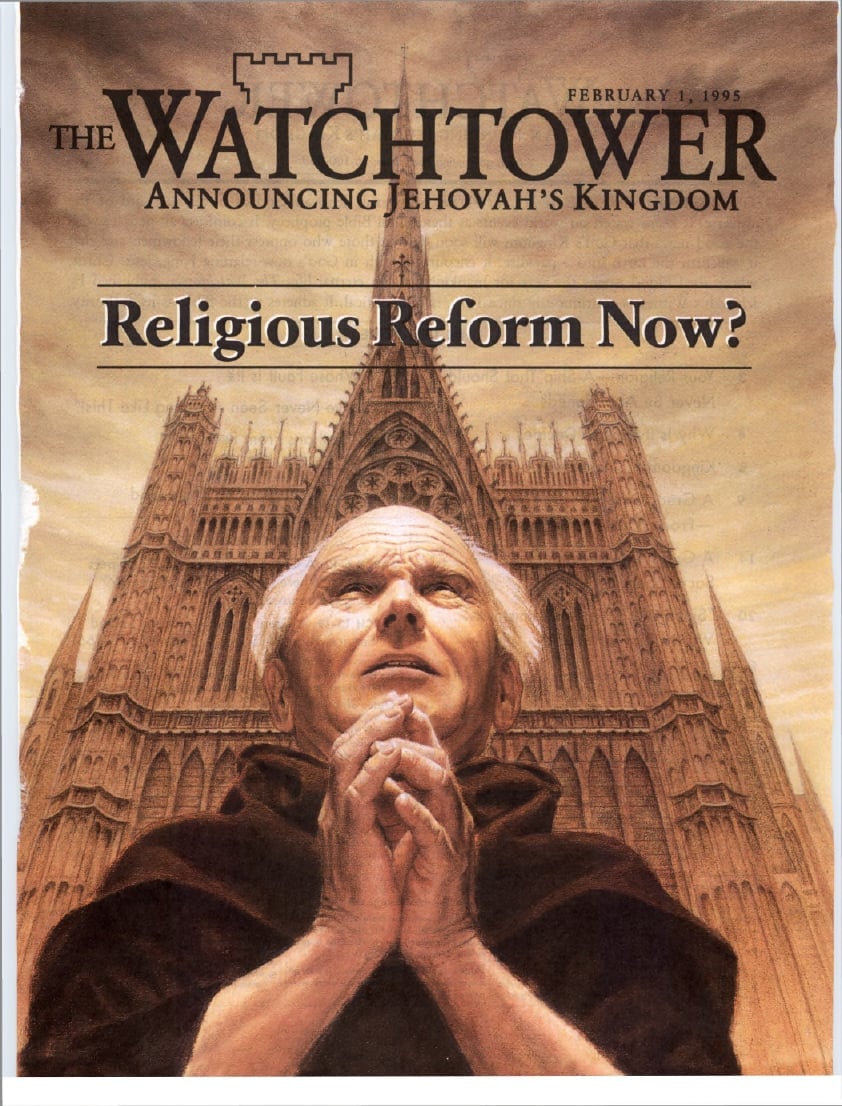
The Watchtower — February 1, 1995
Source: jw.org
Contents
Your Religion—A Ship That Should Never Be Abandoned?
Why Is It Time to Decide?
The Good News of the Kingdom Will Be Preached
A Great Crowd of True Worshipers—From Where Have They Come?
A Great Crowd Rendering Sacred Service
“Since We Have This Ministry . . . , We Do Not Give Up”
Whose Fault Is It?
“I’ve Never Seen Anything Like This!”
Questions From Readers
Creativity—A Generous Gift From God
Would You Welcome a Visit?
Your Religion—A Ship That Should Never Be Abandoned?
Your Religion—A Ship That Should Never Be Abandoned?
A SHIP is in the midst of a tempest. The crew, who are struggling desperately to save their vessel, are faced with a dramatic decision: either to stay aboard or to abandon ship and save themselves. Did you know that this terrifying scenario is used as a theological illustration?
Theologians, especially Catholic scholars, often compare their church to a ship that is weathering a storm. They say that this ship, with Jesus or Peter at the helm, represents the only means of salvation. The position of the clergy is, ‘Never abandon the ship. The church has been through serious crises before, but it is a ship that has weathered all of history’s tempests.’ Some say, ‘Why abandon her? What alternatives are there? Why not stay and help steer her into calmer waters?’
In harmony with this figurative language, many people, belonging to all manner of religions, reason, ‘I know that my religion is wrong in many things, but I hope it will change. I don’t want to abandon it. I would like to have a part in helping it overcome its difficulties.’ This kind of reasoning may be dictated by sincere affection for one’s ancestral religion or even by the fear of “betraying” it.
A case in point is that of Hans Küng, a well-known Catholic dissident theologian, who mused: “Should I abandon the boat during the storm, leaving those with whom I have sailed until now to face the wind, to bail the water, and perhaps to fight for survival?” He replied: “I will not give up my effectiveness within the church.” Another alternative would be “breaking with this church, because of its defection, for the love of higher values, and perhaps, to be more authentic Christians.”—Die Hoffnung bewahren.
But can a person stay aboard the boat of his own church in the hope that God, in his mercy, will allow all religions an unlimited period of time to reform? That is a serious question. As indicated by the illustration, hurriedly leaving an endangered ship by taking to insecure lifeboats would be as dangerous as staying aboard a sinking ship. Is it wise to stay in a church at all costs, whatever its condition? What prospects of reform do religions today offer? How long will God allow them to work against his will?
[Picture Credit Line on page 3]
Chesnot/Sipa Press
Why Is It Time to Decide?
Why Is It Time to Decide?
IN THE 16th century B.C.E., God chose the Israelites as his “special property out of all other peoples, . . . a holy nation.” (Exodus 19:5, 6) They soon lost their holiness, their religious purity, allowing themselves to be contaminated by the idolatry and corrupt practices of neighboring nations. They thus revealed themselves to be “a stiff-necked people.” (Deuteronomy 9:6, 13; 10:16; 1 Corinthians 10:7-11) During a period of more than three hundred years following the death of Joshua, Jehovah raised up judges, faithful guides who should have led the Israelites back to true worship. The people, however, “did not refrain from their practices and their stubborn behavior.”—Judges 2:17-19.
After that, God raised up faithful kings and prophets to induce the people to return to true worship. The prophet Azariah encouraged King Asa and his fellow countrymen to search for Jehovah: “If you search for him, he will let himself be found by you, but if you leave him he will leave you.” Asa implemented religious reform in the kingdom of Judah. (2 Chronicles 15:1-16) Subsequently, God had to renew the invitation through his prophet Joel. (Joel 2:12, 13) Later still, Zephaniah exhorted the inhabitants of Judah to “seek Jehovah.” Young king Josiah did so in a campaign of reforms to eliminate idolatry and corruption.—Zephaniah 2:3; 2 Chronicles 34:3-7.
Despite such episodes of repentance, the religious condition of the people was becoming more and more critical. (Jeremiah 2:13; 44:4, 5) Jeremiah denounced the religious system contaminated with idolatrous practices, describing it as irreformable: “Can a Cushite change his skin? or a leopard its spots? You yourselves would also be able to do good, who are persons taught to do bad.” (Jeremiah 13:23) For this reason, God inflicted a grave punishment on the kingdom of Judah. Jerusalem and its temple were destroyed in 607 B.C.E., and the survivors were deported as slaves to Babylon, where they remained for 70 years.
When that period of time was over, God showed mercy. He induced King Cyrus to free the Israelites, a remnant of whom returned to Jerusalem to reconstruct the temple. Instead of learning a lesson from all of this, they deviated from true worship once again, causing Jehovah God to renew his invitation: “Return to me, and I will return to you.”—Malachi 3:7.
Why Israel Was Rejected
What was the religious condition of the Israelites in Jesus’ time? The hypocritical religious leaders were “blind guides” teaching “commands of men as doctrines.” ‘They were overstepping the commandment of God because of their tradition.’ The people honored God “with their lips,” but their heart was far removed from him. (Matthew 15:3, 4, 8, 9, 14) Were they as a nation to receive yet another opportunity to repent? No. Jesus said: “The kingdom of God will be taken from you and be given to a nation producing its fruits.” He further said: “Your house,” the temple in Jerusalem, “is abandoned to you.” (Matthew 21:43; 23:38) Their error was too great. They rejected Jesus as Messiah and had him put to death, choosing the oppressive Roman Caesar as their king.—Matthew 27:25; John 19:15.
The Israelites did not want to understand that the period in which Jesus carried out his ministry was a time of judgment. To the unfaithful inhabitants of Jerusalem, Jesus said: “You did not discern the time of your being inspected.”—Luke 19:44.
At Pentecost 33 C.E., God formed a new nation, or people, the spirit-anointed disciples of his Son, Jesus Christ, who would be chosen out of every race and nation. (Acts 10:34, 35; 15:14) Was there any hope that the Jewish religious system would finally be reformed? The Roman legions provided the answer in 70 C.E., razing Jerusalem to the ground. God had totally rejected that religious system.—Luke 21:5, 6.
Christendom’s Great Apostasy
Spirit-anointed Christians also formed “a holy nation, a people for special possession.” (1 Peter 2:9; Galatians 6:16) But not even the primitive Christian congregation preserved its religious purity for very long.
The Scriptures foretold a great apostasy, or falling away from the true faith. The symbolic weeds of Jesus’ parable, that is, counterfeit Christians, would try to choke out the symbolic wheat, or true Christians, those anointed with God’s spirit. The parable reveals that the spread of false Christianity, promoted by God’s archenemy, the Devil, was about to begin, “while men were sleeping.” This took place after the death of Christ’s faithful apostles, during a period of consequent spiritual drowsiness. (Matthew 13:24-30, 36-43; 2 Thessalonians 2:6-8) As foretold by the apostles, many counterfeit Christians wormed their way into the fold. (Acts 20:29, 30; 1 Timothy 4:1-3; 2 Timothy 2:16-18; 2 Peter 2:1-3) John was the last of the apostles to die. In about the year 98 C.E., he wrote that “the last hour,” the final part of the apostolic period, had already commenced.—1 John 2:18, 19.
With the alliance of religion and political power sealed by Roman emperor Constantine, the spiritual, doctrinal, and moral condition of Christendom plummeted. Many historians agree that “the triumph of the Church during the fourth century” was, from the Christian point of view, “a disaster.” ‘Christendom lost her high moral level’ and accepted many practices and philosophies from paganism, such as “the cult of Mary” and the adoration of the “saints,” as well as the concept of the Trinity.
After her false triumph, the condition of Christendom deteriorated. Decrees and doctrinal definitions by popes and councils, not to mention the Inquisition, Crusades, and “holy” wars between Catholics and Protestants, produced an irreformable religious system.
In his book A World Lit Only by Fire, William Manchester writes: “The popes in the fifteenth and sixteenth centuries lived like Roman emperors. They were the wealthiest men in the world, and they and their cardinals further enriched themselves by selling holy offices.” During the great apostasy, small groups or single individuals sought to rediscover true Christianity, displaying the characteristics of the symbolic wheat. They often paid a high price. The same book says: “At times it seemed that the true saints of Christianity, Protestant and Catholic alike, had become blackened martyrs enveloped in flames.” Others, so-called Reformers like Martin Luther and John Calvin, managed to create enduring religious systems that were separate from the Catholic Church but that still shared its basic doctrines. They were also deeply involved in political affairs.
In the Protestant field, efforts were made to effect a so-called religious reawakening. During the 18th and 19th centuries, for example, these efforts resulted in vigorous foreign missionary activity. However, by the admission of the shepherds themselves, today the spiritual condition of the Protestant flock is far from encouraging. The Protestant theologian Oscar Cullmann recently admitted that “within the churches themselves, there is a crisis of faith.”
Reforms and counterreforms have also been promoted within the Catholic Church. From the 11th to the 13th century, in the face of the widespread corruption and immense wealth of the clergy, monastic orders that strictly followed the vow of poverty were formed. But they were watched closely and, according to scholars, were suppressed by the ecclesiastical hierarchy. Then came the 16th-century Counter-Reformation, promoted by the Council of Trent and largely directed at combating the Protestant Reformation.
In the first half of the 19th century, during the period of ecclesiastical restoration, the Catholic Church assumed an authoritarian and conservative stance. It cannot be said, though, that any real reforms were made to restore true Christianity. Rather, these were mere efforts to consolidate the clergy’s authority in the face of world religious, political, and social change.
More recently, in the 1960’s, it seemed that the Catholic Church wanted to launch a process of profound change with the ecumenical council Vatican II. However, an abrupt halt to the so-called conciliar renewal was imposed by the current pope to restrain the spirit of progressive members of the church. This phase, which some call the restoration of Wojtyła, has been defined by one Catholic group as “a new form of Constantinism.” As pointed out in the Jesuit journal La Civiltà Cattolica, the Catholic Church, like other religions, is facing “a radical and global crisis: radical because it involves the very roots of faith and Christian life; global because it involves all facets of Christianity.”
Christendom’s religions have not really undergone a process of reformation, nor could they, since true Christianity was only to be restored at the time of the “harvest,” with the gathering of the symbolic wheat into one pure congregation. (Matthew 13:30, 39) The long list of crimes and misdeeds perpetrated in the name of religion, whether claiming to be Christian or not, prompts the question, Is it realistic to expect true reform from Christendom?
Reform Impossible?
The book of Revelation, or Apocalypse, speaks of a symbolic great harlot bearing the mysterious name “Babylon the Great.” (Revelation 17:1, 5) For centuries Bible readers have sought to explain the mystery of this symbol. Many were disgusted by the wealth and corruption of the clergy. Some thought that Babylon the Great represented the ecclesiastical hierarchy. Among them were Jan Hus, a Bohemian Catholic priest burned alive in 1415, and Aonio Paleario, an Italian humanist who was hanged and burned in 1570. Both strove without success to reform the Catholic Church in the hope that it would return to “its primitive dignity.”
In contrast, chapters 17 and 18 of Revelation indicate that Babylon the Great represents the world empire of all false religion.a This composite “great harlot” is irreformable because “her sins have massed together clear up to heaven.” In fact, in this 20th century, virtually all religions, not just those of Christendom, share responsibility for wars that continue to spill much blood and for the severe moral degradation that afflicts mankind. Consequently, God has decreed “Babylon’s” destruction.—Revelation 18:5, 8.
Now Is the Time to “Get Out of Her”
Fulfillment of Bible prophecies reveals that our day corresponds to “the conclusion” of this wicked “system of things.” (Matthew 24:3) Anyone who sincerely wants to worship God cannot afford to follow his own ideas and preferences. He must ‘search for Jehovah while he may be found,’ yes, right now, because the “great tribulation” foretold by Jesus is at hand. (Isaiah 55:6; Matthew 24:21) As was true in the case of the people of Israel, God will not tolerate a religion’s corruption just because it boasts of its antiquity. Rather than strive to repair a ship that is destined to sink, all those who desire God’s approval and salvation must without delay obey the inspired command of Revelation 18:4: “Get out of [Babylon the Great], my people, if you do not want to share with her in her sins, and if you do not want to receive part of her plagues.”
But “get out” to go where? Where else is salvation to be found? Is there not the danger of seeking refuge in the wrong place? How can the only religion that has God’s approval be identified? The only trustworthy answers can be found in the Word of God. (2 Timothy 3:16, 17) Jehovah’s Witnesses invite you to examine the Bible more closely. You will be able to understand who are the ones that God has chosen as “a people for his name,” whom he will protect during the impending day of his anger.—Acts 15:14; Zephaniah 2:3; Revelation 16:14-16.
[Footnotes]
To identify symbolic Babylon the Great in a Scripturally correct way, see chapters 33 to 37 of the book Revelation—Its Grand Climax At Hand!, published in 1988 by the Watchtower Bible and Tract Society of New York, Inc.
[Picture on page 7]
If your religious ship is sinking, turn to the rescue ship of true Christianity
The Good News of the Kingdom Will Be Preached
Kingdom Proclaimers Report
The Good News of the Kingdom Will Be Preached
FOR centuries God’s chief enemy, Satan the Devil, has craftily used the political governments and false religion in his efforts to impede the spreading of true Christianity. But these methods will fail. Jesus foretold that the “good news of the kingdom will be preached [not, “might be preached” or, “could be preached”] in all the inhabited earth for a witness to all the nations.”—Matthew 24:14.
Satan’s failure has been evident in Greece. In that land the Greek Orthodox Church has attempted to restrict Jehovah’s Witnesses from preaching the good news of the Kingdom. But, as highlighted by the following experience, in due time Bible truths reach honesthearted people despite opposition.
Some 30 years ago, a Greek Orthodox priest accepted the good news and even expressed a desire to become one of Jehovah’s Witnesses. However, his relatives strongly opposed this step and pressured him into giving up his association with the Witnesses. To please his family, he continued to pursue his career as a priest; yet, he always recognized that Jehovah’s Witnesses had helped him to learn the truth and that he had given it up in exchange for a position of prominence in a false religion.
Nonetheless, he sometimes spoke in favor of Jehovah’s Witnesses when the opportunity arose. On several occasions he even admonished people that if they wanted to learn Bible truths, they should study with the Witnesses. Over the years some actually followed his recommendation.
Recently the priest became very ill and realized that he might soon die. While in the hospital, he summoned his children, and they all gathered at his bedside.a He then explained to them that if he died, they might meet him again. He spoke to them about the Bible’s teaching of humans’ being resurrected by Jehovah to live in a paradise on earth, but if they really wanted to see that occur, they had to learn the truth from the Bible and disassociate themselves from false religion. He entreated them to associate with Jehovah’s Witnesses and learn from them how to become genuine Christians.
Shortly afterward, the priest died. However, his parting counsel to his children reaped good results. His daughter, like most of his relatives, had been very much opposed to Jehovah’s Witnesses and their work. But she could not ignore the sincere appeal of her dying father, so she soon got in touch with Jehovah’s Witnesses and began studying the Bible. Recently she herself became a Witness, dedicating her life to Jehovah God and symbolizing her dedication by water baptism.
In Greece and in over 230 other lands, Jehovah’s Witnesses rely on the power of God’s holy spirit. It is with the full support of holy spirit that they share in the fulfillment of Jesus’ prophecy: “You will receive power when the holy spirit arrives upon you, and you will be witnesses of me both in Jerusalem and in all Judea and Samaria and to the most distant part of the earth.”—Acts 1:8.
[Footnotes]
The Greek Orthodox Church allows its priests to marry.
A Great Crowd of True Worshipers—From Where Have They Come?
A Great Crowd of True Worshipers—From Where Have They Come?
“Look! a great crowd, . . . out of all nations and tribes and peoples and tongues, standing before the throne and before the Lamb.”—REVELATION 7:9.
1. Why are the prophetic visions in Revelation of great interest to us today?
TOWARD the end of the first century C.E., the apostle John saw visions of marvelous events in connection with Jehovah’s purpose. Some of the things that he saw in vision are being fulfilled right now. Others are due to be fulfilled in the immediate future. All of these revolve around the dramatic culmination of Jehovah’s grand purpose to sanctify his name before all creation. (Ezekiel 38:23; Revelation 4:11; 5:13) Moreover, they involve the life prospects of each one of us. How is that so?
2. (a) What did the apostle John see in his fourth vision? (b) What questions regarding this vision are we going to consider?
2 In the fourth of the series of Revelation visions, John saw angels holding back winds of destruction until “the slaves of our God” are sealed in their foreheads. Then he saw a most exciting development—“a great crowd, which no man was able to number, out of all nations and tribes and peoples and tongues,” united in worshiping Jehovah and honoring his Son. These, John was told, were people who would come out of the great tribulation. (Revelation 7:1-17) Who are the ones described as “slaves of our God”? And who will make up the “great crowd” of tribulation survivors? Will you be one of them?
Who Are “the Slaves of Our God”?
3. (a) At John 10:1-18, how did Jesus illustrate his relationship to his followers? (b) What did Jesus make possible for his sheep by means of his sacrificial death?
3 About four months before his death, Jesus spoke of himself as “the fine shepherd” and his followers as “sheep” for whom he would lay down his life. He made special mention of sheep found by him within a figurative sheepfold and thereafter given special care by him. (John 10:1-18)a Lovingly, Jesus did surrender his soul in behalf of his sheep, providing the ransom price that was needed in order for them to be freed from sin and death.
4. Who are the first ones collected as sheep in line with what Jesus here said?
4 Before doing that, however, Jesus as the Fine Shepherd personally gathered disciples. The first ones were introduced to him by John the Baptist, the “doorkeeper” of Jesus’ illustration. Jesus was looking for people who would respond to the opportunity to become part of the composite ‘seed of Abraham.’ (Genesis 22:18; Galatians 3:16, 29) He cultivated in their hearts appreciation for the Kingdom of the heavens, and he assured them that he was going to prepare a place for them in the house of his heavenly Father. (Matthew 13:44-46; John 14:2, 3) Fittingly he said: “From the days of John the Baptist until now the kingdom of the heavens is the goal toward which men press, and those pressing forward are seizing it.” (Matthew 11:12) These who followed him so as to attain that goal proved to be within the sheepfold of which Jesus spoke.
5. (a) Who are “the slaves of our God” referred to at Revelation 7:3-8? (b) What shows that many more would join in worship with the spiritual Israelites?
5 At Revelation 7:3-8, those who successfully press forward toward that heavenly goal are also referred to as “the slaves of our God.” (See 1 Peter 2:9, 16.) Are the 144,000 there mentioned only natural Jews? Are those within the figurative sheepfold of Jesus’ illustration only Jews? Definitely not; they are members of the spiritual Israel of God, all of them associates with Christ in the spiritual seed of Abraham. (Galatians 3:28, 29; 6:16; Revelation 14:1, 3) The time would eventually come, of course, when the fixed number would be filled. Then what? As the Bible had foretold, others—a great crowd of them—would join with these spiritual Israelites in worshiping Jehovah.—Zechariah 8:23.
The “Other Sheep”—Are They Gentile Christians?
6. To what development does John 10:16 point?
6 After mentioning one sheepfold at John 10:7-15, Jesus brought another group into the picture, saying: “I have other sheep, which are not of this fold; those also I must bring, and they will listen to my voice, and they will become one flock, one shepherd.” (John 10:16) Who are those “other sheep”?
7, 8. (a) Why is the idea that the other sheep are Gentile Christians built on a wrong premise? (b) What facts regarding God’s purpose for the earth should have a bearing on our understanding of who the other sheep are?
7 Christendom’s commentators generally take the view that these other sheep are Gentile Christians and that those in the sheepfold referred to earlier are Jewish, those who were under the Law covenant, and that both groups go to heaven. But Jesus was born a Jew and was by birth under the Law covenant. (Galatians 4:4) Furthermore, those who view the other sheep as Gentile Christians who will be rewarded with heavenly life are failing to take into account an important aspect of God’s purpose. When Jehovah created the first humans and put them in the garden of Eden, he made it clear that his purpose was that the earth be populated, that all of it be a paradise, and that its human caretakers enjoy life forever—on the condition that they respect and obey their Creator.—Genesis 1:26-28; 2:15-17; Isaiah 45:18.
8 When Adam sinned, Jehovah’s purpose was not thwarted. God lovingly made provision for Adam’s offspring to have the opportunity to enjoy what Adam had failed to appreciate. Jehovah foretold that he would raise up a deliverer, a seed, through whom blessings would be made available to all nations. (Genesis 3:15; 22:18) That promise did not mean that all good people on earth would be taken to heaven. Jesus taught his followers to pray: “Let your kingdom come. Let your will take place, as in heaven, also upon earth.” (Matthew 6:9, 10) Not long before he spoke the illustration recorded at John 10:1-16, Jesus had told his disciples that it was only to a “little flock” that his Father had approved of giving the heavenly Kingdom. (Luke 12:32, 33) So when we read Jesus’ illustration of himself as the Fine Shepherd who surrenders his soul in behalf of his sheep, it would be a mistake to exclude from the picture the majority of those whom Jesus brings under his loving care, the ones who become earthly subjects of his heavenly Kingdom.—John 3:16.
9. As early as 1884, what did the Bible Students understand the identity of the other sheep to be?
9 As early as 1884, the Watch Tower identified the other sheep as being people who would be given opportunity to live on this earth under conditions that would fulfill God’s original purpose. Those early Bible Students realized that some of these other sheep would be people who had lived and died before Jesus’ earthly ministry. There were, however, some details that they did not understand correctly. For example, they thought that the gathering of the other sheep would take place after all the anointed ones had received their heavenly reward. Still, they did definitely realize that the other sheep were not simply Gentile Christians. The opportunity to become one of the other sheep is open to both Jews and Gentiles, to people of all nations and races.—Compare Acts 10:34, 35.
10. In order for us to be those whom Jesus really views as his other sheep, what must be true of us?
10 To fit the description given by Jesus, the other sheep must be people who, regardless of racial or ethnic background, recognize Jesus Christ as the Fine Shepherd. What does that include? They must manifest meekness and a willingness to be led, which qualities are characteristic of sheep. (Psalm 37:11) As is true of the little flock, they must “know [the fine shepherd’s] voice” and not allow themselves to be led off by others who may seek to influence them. (John 10:4; 2 John 9, 10) They must appreciate the importance of what Jesus did in surrendering his soul in behalf of his sheep and exercise full faith in that provision. (Acts 4:12) They must “listen” to the voice of the Fine Shepherd when he urges them to render sacred service only to Jehovah, to keep on seeking first the Kingdom, to keep separate from the world, and to show self-sacrificing love for one another. (Matthew 4:10; 6:31-33; John 15:12, 13, 19) Do you fit that description of those whom Jesus views as his other sheep? Do you want to? What a precious relationship opens up to all who truly become Jesus’ other sheep!
Respect for Kingdom Authority
11. (a) In the sign of his presence, what did Jesus say about the sheep and the goats? (b) Who are the brothers to whom Jesus refers?
11 Several months after he gave the above illustration, Jesus was again in Jerusalem. When seated on the Mount of Olives overlooking the temple area, he provided his disciples with details of ‘the sign of his presence and of the conclusion of the system of things.’ (Matthew 24:3) He again spoke of the gathering of sheep. Among other things, he said: “When the Son of man arrives in his glory, and all the angels with him, then he will sit down on his glorious throne. And all the nations will be gathered before him, and he will separate people one from another, just as a shepherd separates the sheep from the goats. And he will put the sheep on his right hand, but the goats on his left.” In this parable, Jesus showed that those thus given attention by the King would be judged on the basis of how they dealt with his “brothers.” (Matthew 25:31-46) Who are these brothers? They are spirit-begotten Christians who are therefore “God’s sons.” Jesus is God’s firstborn Son. Hence, they are Christ’s brothers. They are “the slaves of our God” mentioned at Revelation 7:3, the ones chosen from among humankind to share with Christ in his heavenly Kingdom.—Romans 8:14-17.
12. Why is the way that people deal with Christ’s brothers of great importance?
12 The way in which other humans deal with these heirs of the Kingdom is of vital importance. Do you view them as Jesus Christ does and as Jehovah does? (Matthew 24:45-47; 2 Thessalonians 2:13) A person’s attitude toward these anointed ones reflects his attitude toward Jesus Christ himself and toward his Father, the Universal Sovereign.—Matthew 10:40; 25:34-46.
13. To what extent did the Bible Students in 1884 understand the parable of the sheep and the goats?
13 In its issue of August 1884, the Watch Tower correctly pointed out that the “sheep” in this parable are ones who would have set before them the prospect of perfect life on earth. It was also understood that the parable must have application when Christ is ruling from his glorious heavenly throne. Yet, at that time they did not clearly discern when he would begin the separating work there described or how long it would last.
14. How did a convention discourse in 1923 help the Bible Students to appreciate when Jesus’ prophetic parable was to be fulfilled?
14 However, in 1923, in a convention discourse, J. F. Rutherford, then president of the Watch Tower Society, clarified the time for the fulfillment of the parable of the sheep and the goats. Why? In part, because the parable shows that the King’s brothers—at least some of them—would still be on earth. Among humans, only his spirit-begotten followers could truly be called his brothers. (Hebrews 2:10-12) These would not be on earth throughout the Millennium, affording opportunity for people to do good to them in the ways that Jesus described.—Revelation 20:6.
15. (a) What developments helped the Bible Students to identify correctly the sheep of Jesus’ parable? (b) How have the sheep given evidence of their appreciation for the Kingdom?
15 In that discourse in 1923, an effort was made to identify those who fit the Lord’s description of the sheep and of the goats, but other matters needed to be understood before the full import of the parable would be clear. During the following years, Jehovah progressively drew these important details to the attention of his servants. These included clearly understanding, in 1927, that “the faithful and discreet slave” is the entire body of spirit-anointed Christians on earth; also appreciating, in 1932, the need to identify oneself fearlessly with Jehovah’s anointed servants, as Jonadab did with Jehu. (Matthew 24:45; 2 Kings 10:15) At that time, on the basis of Revelation 22:17, these sheeplike ones were specifically encouraged to share in taking the Kingdom message to others. Their appreciation for the Messianic Kingdom would move them not merely to extend humanitarian kindness to the Lord’s anointed ones but to dedicate their lives to Jehovah through Christ and to become closely associated with his anointed ones, sharing zealously in the work that they are doing. Are you doing that? To those who do, the King will say: “Come, you who have been blessed by my Father, inherit the kingdom prepared for you from the founding of the world.” Before them will be the grand prospect of everlasting life in perfection in the earthly realm of the Kingdom.—Matthew 25:34, 46.
The “Great Crowd”—Where Are They Going?
16. (a) What misconceptions did the early Bible Students have regarding the identity of the great multitude, or great crowd, of Revelation 7:9? (b) When and on what basis was their view corrected?
16 For a time Jehovah’s servants believed that the great multitude (or, great crowd) of Revelation 7:9, 10 was different from the other sheep of John 10:16 and the sheep of Matthew 25:33. Because the Bible says that they are “standing before the throne,” it was thought that they would be in heaven, not on thrones, ruling as joint heirs with Christ, but in a secondary place in front of the throne. They were viewed as less faithful Christians, ones who did not show a spirit of true self-sacrifice. In 1935 that view was corrected.b An examination of Revelation 7:9 in the light of texts such as Matthew 25:31, 32 made it clear that people here on earth could be “before the throne.” Also it was pointed out that God does not have two standards of faithfulness. All who would have his approval must maintain integrity to him.—Matthew 22:37, 38; Luke 16:10.
17, 18. (a) What accounts for the great increase, since 1935, in the number of those looking forward to eternal life on earth? (b) In what vital work are those of the great crowd zealously sharing?
17 For many years Jehovah’s people had talked about God’s promises regarding the earth. Because of what they expected to occur back in the 1920’s, they proclaimed that “Millions Now Living Will Never Die.” But there were not millions who embraced God’s provisions for life at that time. In the majority who did accept the truth, holy spirit engendered the hope of heavenly life. Especially after 1935, however, a marked change took place. It was not that The Watchtower had ignored the hope of eternal life on earth. For decades Jehovah’s servants had talked about this and had looked for those who fit the Bible’s description. In Jehovah’s due time, though, he saw to it that these manifested themselves.
18 The available records show that for many years most Memorial attenders partook of the emblems. But within 25 years after 1935, the attendance at the annual Memorial of Christ’s death soared to over one hundred times the number of those who were partaking. Who were these others? Prospective members of the great crowd. Clearly, Jehovah’s time had come to gather them and to prepare them for surviving the great tribulation just ahead. As foretold, they have come “out of all nations and tribes and peoples and tongues.” (Revelation 7:9) They are zealously sharing in the work that Jesus foretold when he said: “This good news of the kingdom will be preached in all the inhabited earth for a witness to all the nations; and then the end will come.”—Matthew 24:14.
[Footnotes]
For a comprehensive, up-to-date discussion of the sheepfolds of John chapter 10, see The Watchtower, February 15, 1984, pages 10-20, 31.
The Watchtower, August 1 and 15, 1935.
What Is Your Comment?
□ Why is the vision in Revelation chapter 7 of special interest?
□ Why are the other sheep of John 10:16 not limited to Gentile Christians?
□ What must be true of those who fit the Bible’s description of the other sheep?
□ How does the parable of the sheep and the goats highlight respect for Kingdom authority?
□ What shows when Jehovah’s time came to gather the great crowd of Revelation 7:9?
A Great Crowd Rendering Sacred Service
A Great Crowd Rendering Sacred Service
“They are rendering him sacred service day and night in his temple.”—REVELATION 7:15.
1. What milestone of spiritual understanding was reached in 1935?
ON May 31, 1935, there was great joy among the delegates at a convention of Jehovah’s Witnesses in Washington, D.C. There, for the first time, the great multitude (or, great crowd) of Revelation 7:9 was clearly identified in harmony with the rest of the Bible and in accord with events that had already begun to unfold.
2. What indicated that a growing number had realized that God had not called them to heavenly life?
2 About six weeks earlier, at the celebration of the Lord’s Evening Meal in congregations of Jehovah’s Witnesses, 10,681 of those present (about 1 out of 6) had not partaken of the emblematic bread and wine, and 3,688 of these were active proclaimers of God’s Kingdom. Why did they refrain from partaking of the emblems? Because on the basis of what they had learned from the Bible, they realized that God had not called them to heavenly life but that they could share in Jehovah’s loving provisions in another way. So at that convention, when the speaker asked: “Will all those who have the hope of living forever on the earth please stand,” what happened? Thousands rose to their feet, followed by prolonged cheering on the part of the audience.
3. Why did the identifying of the great multitude give fresh impetus to the field ministry, and how did the Witnesses feel about this?
3 What the delegates learned at that convention gave fresh impetus to their ministry. They came to appreciate that now, before the end of the old system, not just a few thousand but a great multitude of people would be given the opportunity to come within Jehovah’s arrangement for the preservation of life, with a view to living forever on a paradise earth. What a heartwarming message was there presented to lovers of truth! Jehovah’s Witnesses realized that there was a great work to be done—a joyous work. Years later, John Booth, who became a member of the Governing Body, recalled: “That assembly gave us much to rejoice over.”
4. (a) To what extent has there actually been a gathering of the great crowd since 1935? (b) In what way are those of the great crowd giving evidence that theirs is a living faith?
4 During the years that followed, the number of Jehovah’s Witnesses increased dramatically. In spite of the often violent persecution heaped upon them during World War II, their numbers nearly tripled within a decade. And the 56,153 publishers who had been giving a public witness in 1935 increased, by 1994, to over 4,900,000 Kingdom proclaimers located in more than 230 lands. The vast majority of these look forward with eager anticipation to being included among those whom Jehovah favors with perfection of life on a paradise earth. Compared with the little flock, they truly have become a great crowd. They are not people who say they have faith and yet do not demonstrate it. (James 1:22; 2:14-17) All of them share with others the good news about God’s Kingdom. Are you one of that happy throng? Being an active Witness is an important identifying mark, but more is involved.
“Standing Before the Throne”
5. What is indicated by the fact that the great crowd are “standing before the throne”?
5 In the vision given to the apostle John, he saw them “standing before the throne and before the Lamb.” (Revelation 7:9) Their standing before the throne of God, as described in this context, indicates that they give full recognition to Jehovah’s sovereignty. This includes much. For example: (1) They acknowledge Jehovah’s right to decide for his servants what is good and what is bad. (Genesis 2:16, 17; Isaiah 5:20, 21) (2) They listen to Jehovah as he speaks to them through his Word. (Deuteronomy 6:1-3; 2 Peter 1:19-21) (3) They appreciate the importance of submitting to those whom Jehovah has entrusted with oversight. (1 Corinthians 11:3; Ephesians 5:22, 23; 6:1-3; Hebrews 13:17) (4) Though imperfect, they earnestly endeavor to respond to theocratic direction, not grudgingly, but readily, from the heart. (Proverbs 3:1; James 3:17, 18) They are before the throne to render sacred service to Jehovah, whom they profoundly respect and deeply love. In the case of this great crowd, their “standing” before the throne indicates the approval of the One seated on the throne. (Compare Revelation 6:16, 17.) Approval on what basis?
“Dressed in White Robes”
6. (a) What is meant by the great crowd’s being “dressed in white robes”? (b) How do the great crowd gain a righteous standing before Jehovah? (c) To what extent does faith in Christ’s shed blood influence the lives of the great crowd?
6 The apostle John’s description of what he saw says that the members of this great crowd are “dressed in white robes.” Those white robes symbolize their clean, righteous standing before Jehovah. How did they gain such a standing? We have already observed that in John’s vision they were standing “before the Lamb.” They recognize Jesus Christ as “the Lamb of God that takes away the sin of the world.” (John 1:29) John heard one of the elders who, in the vision, was present at God’s throne explain: “They have washed their robes and made them white in the blood of the Lamb. That is why they are before the throne of God.” (Revelation 7:14, 15) Figuratively, they have washed their garments by exercising faith in Christ’s redeeming blood. They do not give mere mental assent to the Bible’s teaching about the ransom. Appreciation for it affects the sort of person they are inside; thus, it is “with the heart” that they exercise faith. (Romans 10:9, 10) This has a far-reaching effect on what they do with their lives. In faith, they dedicate themselves to Jehovah on the basis of Christ’s sacrifice, symbolize that dedication by water immersion, truly live in harmony with their dedication, and thus come to enjoy an approved relationship with God. What a fine privilege—one to be carefully safeguarded!—2 Corinthians 5:14, 15.
7, 8. How has Jehovah’s organization helped the great crowd to keep their garments undefiled?
7 With loving concern for their lasting welfare, Jehovah’s organization has repeatedly pointed out attitudes and conduct that could spot, or defile, one’s garments of identification so that, in spite of outward professions, the person would not really fit the prophetic description at Revelation 7:9, 10. (1 Peter 1:15, 16) Reinforcing what had been published earlier, The Watchtower, in 1941 and thereafter, repeatedly showed that it would be grossly improper to preach to others and then, in off-hours, to engage in such conduct as fornication or adultery. (1 Thessalonians 4:3; Hebrews 13:4) In 1947 it was emphasized that Jehovah’s Christian marriage standards apply in all lands; regardless of what local custom might approve, those who continued to practice polygamy could not be Witnesses of Jehovah.—Matthew 19:4-6; Titus 1:5, 6.
8 In 1973, Jehovah’s Witnesses worldwide were shown that all of them must refrain from having anything to do with undeniably defiling practices, such as misuse of tobacco, no matter where they might be—not only in the Kingdom Hall or in the field service but also at secular work or in some secluded spot out of public view. (2 Corinthians 7:1) In 1987 at district conventions of Jehovah’s Witnesses, Christian youths were strongly counseled that in order to maintain a clean standing before God, they must guard against leading a double life. (Psalm 26:1, 4) Again and again, The Watchtower has warned against various aspects of the spirit of the world because “the form of worship that is clean and undefiled from the standpoint of our God and Father” includes keeping oneself “without spot from the world.”—James 1:27.
9. Who will actually stand approved before God’s throne after the great tribulation?
9 It is those whose faith moves them to live in such a way as to remain spiritually and morally clean who will still be “standing before the throne” as approved servants of God after the coming great tribulation. These are people who not only make a start in Christian living but loyally persevere in it.—Ephesians 4:24.
“Palm Branches in Their Hands”
10. Of what significance are the palm branches that were seen by John in the hands of the great crowd?
10 Among the outstanding features of the great crowd, as observed by the apostle John, is that “there were palm branches in their hands.” Of what significance is that? No doubt those palm branches reminded John of the Jewish festival of tabernacles, the most joyful festival on the Hebrew calendar, held following the summer harvest. In harmony with the Law, palm fronds, along with the branches of other trees, were used to make booths in which to dwell during the festival. (Leviticus 23:39-40; Nehemiah 8:14-18) They were also waved by the worshipers at the temple during the singing of the Hallel (Psalms 113-118). The waving of palm branches by the great crowd doubtless also reminded John of the occasion when Jesus rode into Jerusalem while a crowd of worshipers joyfully waved palm branches and shouted: “Blessed is he that comes in Jehovah’s name, even the king of Israel!” (John 12:12, 13) So the waving of palm branches indicates that the great crowd joyfully hail Jehovah’s Kingdom and his anointed King.
11. Why do servants of God truly find joy in serving Jehovah?
11 It is such a spirit of joy that the great crowd manifest even now as they serve Jehovah. This does not mean that they face no hardships or that they experience no grief or pain. But the satisfaction that comes from serving and pleasing Jehovah helps to offset those things. Thus, a missionary who served with her husband for 45 years in Guatemala told about the primitive conditions that surrounded them, the hard work and hazardous travel that was part of life as they reached out to the Indian villages with the Kingdom message. She concluded: “It was the time of our lives when we were supremely happy.” Though she was feeling the effects of advanced age and illness, among the last entries in her diary were the words: “It was a good life, so rewarding.” Earth wide, Jehovah’s Witnesses feel the same about their ministry.
“Sacred Service Day and Night”
12. Whether during the day or at night, what does Jehovah observe here on earth?
12 These joyful worshipers render to Jehovah “sacred service day and night in his temple.” (Revelation 7:15) Around the globe, millions are sharing in this sacred service. When it is nighttime in some lands and people are asleep there, in other lands the sun is up and Jehovah’s Witnesses are busy witnessing. As the globe turns, constantly, day and night, they are singing Jehovah’s praises. (Psalm 86:9) But the day-and-night service referred to at Revelation 7:15 is even more personal.
13. How do the Scriptures indicate what is meant by serving “day and night”?
13 Individuals who make up the great crowd render sacred service day and night. Does this mean that everything that they do is viewed as sacred service? It is true that no matter what they are doing, they learn to do it in a way that honors Jehovah. (1 Corinthians 10:31; Colossians 3:23) However, “sacred service” applies only to what directly involves one’s worship of God. Engaging in an activity “day and night” implies regularity or consistency as well as earnest effort.—Compare Joshua 1:8; Luke 2:37; Acts 20:31; 2 Thessalonians 3:8.
14. What would make our personal field service fit the description of “day and night” service?
14 As they serve in the earthly courtyard of Jehovah’s great spiritual temple, those who make up the great crowd endeavor to share regularly and consistently in the field ministry. Many have made it their goal to have some part in the field ministry every week. Others exert themselves as regular pioneers or auxiliary pioneers. Often these are busy witnessing on the streets and in shops early in the morning. To accommodate interested ones, some Witnesses conduct Bible studies late at night. They witness when shopping, when traveling, during lunch periods, and by telephone.
15. Apart from the field ministry, what is included in our sacred service?
15 Sharing in congregation meetings is also part of our sacred service; so is the work involved in building and caring for places of Christian assembly. Efforts put forth to encourage and help one’s Christian brothers and sisters, spiritually and materially, to keep alive in Jehovah’s service are included. This includes the work of our Hospital Liaison Committees. Bethel service in all its various forms, as well as volunteer service at our conventions, is all sacred service. Truly, when our lives revolve around our relationship with Jehovah, they are filled with sacred service. As the scripture says, Jehovah’s people render “sacred service day and night,” and they find great joy in doing so.—Acts 20:35; 1 Timothy 1:11.
‘Out Of All Nations, Tribes, Peoples, and Tongues’
16. How is it proving true that the great crowd come “out of all nations”?
16 Out of all nations, those of the great crowd are coming. God is not partial, and the ransom provision made through Jesus Christ is ample to cover all of them. When the great crowd was first Scripturally identified in 1935, Jehovah’s Witnesses were active in 115 lands. By the 1990’s, the search for sheeplike ones had reached out into more than twice as many lands.—Mark 13:10.
17. What is being done to help people of all ‘tribes, peoples, and tongues’ to be included in the great crowd?
17 In locating prospective members of the great crowd, Jehovah’s Witnesses have given attention not only to national groups but also to the tribes and peoples and language groups within those nations. In order to reach these people, the Witnesses publish Bible literature in over 300 languages. This involves training and maintaining teams of qualified translators, providing computer equipment able to process all these languages, as well as doing the actual printing. During just the past five years, 36 languages, spoken by some 98,000,000 people, have been added to the list. In addition, the Witnesses endeavor to call personally on these people to help them to understand God’s Word.—Matthew 28:19, 20.
“Out Of the Great Tribulation”
18. (a) When the great tribulation breaks out, who will be safeguarded? (b) What happy proclamations will then be made?
18 When the angels release the winds of destruction referred to at Revelation 7:1, not only will the anointed “slaves of our God” experience the loving protection of Jehovah but so will the great crowd who have joined them in true worship. As the apostle John was told, those of the great crowd will “come out of the great tribulation” as survivors. What a shout of gratitude and praise they will give then as they declare: “Salvation we owe to our God, who is seated on the throne, and to the Lamb”! And all of the loyal servants of God in the heavens will add their voices in declaring: “Amen! The blessing and the glory and the wisdom and the thanksgiving and the honor and the power and the strength be to our God forever and ever. Amen.”—Revelation 7:10-14.
19. In what joyful activity will the survivors be eager to share?
19 What a happy time that will be! All who live will be servants of the only true God! The greatest joy of all of these will be in serving Jehovah. There will be much work to be done—joyful work! Earth is to be transformed into Paradise. Thousands of millions of the dead are to be resurrected and then educated in Jehovah’s ways. What a joyful privilege it will be to share in it!
What Is Your Comment?
□ What effect did events in 1935 have on the field ministry of Jehovah’s Witnesses?
□ What is indicated by the fact that the great crowd are shown “standing before the throne”?
□ How should appreciation for the blood of the Lamb affect lives?
□ What is signified by their waving of palm branches?
□ How do the great crowd render sacred service day and night?
[Pictures on page 16, 17]
Their sacred service reflects regularity, diligence, and earnest effort
“Since We Have This Ministry . . . , We Do Not Give Up”
“Since We Have This Ministry . . . , We Do Not Give Up”
AS TOLD BY RONALD TAYLOR
In the summer of 1963, I found myself fighting for my life. While I was wading along the shore, I stepped into a treacherous hollow and was suddenly thrown into very deep water. A nonswimmer, I was at the point of drowning just a few yards from the shore. I had already gone under three times and had gulped down large quantities of seawater when a friend noticed my plight and dragged me to the shore. Thanks to prompt artificial respiration, I survived.
THIS was not the first time that I came to appreciate the importance of never giving up—even though things look hopeless. From an early age, I had to fight for my spiritual life.
It was during the dark days of the second world war that I first came into contact with Christian truth. I was one of the thousands of children who were evacuated from London to escape the dangers of the bombing raids. Since I was only 12 years old, the war did not really mean much to me; it was almost like an adventure.
An elderly couple in Weston-super-Mare, southwest England, looked after me. Soon after I arrived at the couple’s home, some pioneer ministers began visiting us. It was the Hargreaves family; all four of them—Reg, Mabs, Pamela, and Valeri—were special pioneers. My foster parents accepted the truth, and after studying the book The Harp of God, I also made the decision to serve Jehovah. Just six weeks later, I was invited to share in the preaching work.
I can still remember that first day out in field service. Without further ado, I was given some booklets and told: “You work down that side of the street.” And that was how I passed my first day of preaching. At that time, we often preached by using phonograph records containing powerful sermons. My happiest moments were when I could carry the phonograph from house to house and play recorded lectures. I considered it a real privilege to be used in that way.
I did quite a lot of witnessing at school, and I remember placing a set of books on Bible themes with the headmaster. At the age of 13, I was baptized at a nearby assembly in Bath. Another wartime convention I will never forget was the one held in Leicester in 1941 at the De Montfort Hall. I went up to the platform to receive my copy of the book Children, which contained a personal message from Brother Rutherford, who was then president of the Watch Tower Society. The stirring talk given to all the young ones present reinforced my desire to serve Jehovah forever.
Thus I spent two happy years growing up in the truth with my foster parents. But at the age of 14, I had to return to London and begin working for my living. Although I was reunited with my family, I now had to stand on my own feet spiritually, since no one at home shared my beliefs. Jehovah soon provided the help that I needed. Just three weeks after my arrival in London, a brother called at my home to ask for my father’s permission to take me to the local Kingdom Hall. The brother was John Barr, who is now a member of the Governing Body of Jehovah’s Witnesses. He became one of my spiritual “fathers” during those critical teen years.—Matthew 19:29.
I began attending the Paddington Congregation, which met in Craven Terrace alongside the London Bethel Home. Since I was a spiritual orphan, an elderly anointed brother, “Pop” Humphreys, was assigned to take a special interest in me. It was certainly a great blessing to be able to associate with the many anointed brothers and sisters who served in that congregation. Those of us who had the earthly hope—called Jonadabs—were in the minority. In fact, I was the only “Jonadab” in the Congregation Book Study that I attended. Although I did not have much association with ones my own age, that precious fellowship with mature brothers taught me many useful lessons. Perhaps the most important one was that of never abandoning Jehovah’s service.
In those days, we used to dedicate the whole weekend to the preaching activity. I was assigned to take care of the “sound car,” which was really a tricycle fitted out to hold sound equipment and a car battery. Every Saturday, I set out on the tricycle and went to different street corners, where we put on some music and then played one of Brother Rutherford’s talks. Saturdays were also used for doing street work with our magazine bags. Sundays we devoted to house-to-house work, offering booklets and bound books.
My association with zealous older brothers kindled in me the desire to pioneer. This desire was strengthened when I listened to pioneer talks at the district conventions. One convention that had a profound effect on my life was the one held at Earl’s Court, London, in 1947. Two months later, I enrolled in the pioneer service, and I have striven to maintain the pioneer spirit ever since. The joy I derived from conducting progressive Bible studies served to reaffirm that this was the right decision.
A Spanish Bride and a Spanish Assignment
In the year 1957, while still pioneering with the Paddington Congregation, I met a lovely Spanish sister named Rafaela. After a few months, we got married. Our goal was to pioneer together, but first we went to Madrid so that I could meet Rafaela’s parents. It was a visit that changed my life. While we were in Madrid, Brother Ray Dusinberre, the branch overseer of Spain, asked me if we would consider serving in Spain, where there was an enormous need for experienced brothers.
How could we refuse such an invitation? Thus, in 1958 we began our full-time service together in Spain. At that time the country was under Franco’s rule, and our activity was not legally recognized, which made the preaching work very difficult. Furthermore, I had to struggle with the Spanish language for the first couple of years. Once again, it was a case of not giving up, even though I wept on more than one occasion as a result of sheer frustration at not being able to communicate with the brothers in the congregation.
The need for overseers was so great that even though I could hardly speak any Spanish, within a month I was looking after a small group. Because of the clandestine nature of our work, we were organized into small groups comprising from 15 to 20 publishers, which functioned more or less like small congregations. At first, it was nerve-racking to conduct the meetings, since I could not always understand the answers from the audience. However, my wife sat at the back, and if she noticed I was confused, she would give me a discreet nod to confirm that the answer was correct.
I do not have a natural gift for languages, and more than once I felt like returning to England, where I could do everything much more easily. Nevertheless, from the outset, the love and friendship of our dear Spanish brothers and sisters compensated for my frustrations with the language. And Jehovah blessed me with special privileges that made all of it seem worthwhile. In 1958, I was invited to attend the international convention in New York as a delegate from Spain. Then in 1962, I received invaluable training at the Kingdom Ministry School organized for us in Tangier, Morocco.
Another problem I faced, apart from the language, was the constant concern over being picked up by the police. As a foreigner, I knew that being arrested would mean automatic deportation. To minimize the risk, we worked in pairs. While one was witnessing, the other would be listening for any signs of danger. After visiting one or two doors, often at the top of an apartment building, we would go two or three blocks away and call at another two or three homes. We used the Bible extensively, and we carried only a few booklets tucked away in our overcoats to offer to interested persons.
After a year in Madrid, we were assigned to Vigo, a large city in northwest Spain, where there were no Witnesses at all. For the first month or so, the Society recommended that my wife do most of the witnessing—to give the impression we were visiting as tourists. Despite the low-profile approach, our preaching attracted attention. Within a month Catholic priests began denouncing us over the radio. They warned their parishioners that a married couple were going from house to house talking about the Bible—almost an outlawed book at that time. The “wanted couple” consisted of a foreigner and his Spanish wife, who did almost all the talking!
The priests decreed that merely speaking to this dangerous couple was a sin that would be pardoned only if it was immediately confessed to a priest. And sure enough, at the close of an enjoyable conversation we had with one lady, she told us apologetically that she would have to go and confess. When we left her house, we saw her hurrying off toward the church.
Expulsion
Just two months after our arrival in Vigo, the police pounced. The policeman who arrested us was sympathetic and did not handcuff us for the trip to the police station. At the station, we saw a familiar face, a typist to whom we had witnessed recently. She was clearly embarrassed to see us treated like criminals and hastened to assure us that she had not incriminated us. Nevertheless, we were accused of endangering the “spiritual unity of Spain,” and six weeks later we were deported.
It was a setback, but we had no intention of giving up. There was still much work to do on the Iberian Peninsula. After three months in Tangier, we were assigned to Gibraltar—another virgin territory. As the apostle Paul says, if we value our ministry, we will keep going and will be rewarded. (2 Corinthians 4:1, 7, 8) This proved to be true in our case. At the very first home we visited in Gibraltar, we began a Bible study with an entire family. Before long, we were conducting 17 studies each. Many of the individuals we studied with became Witnesses, and in two years there was a congregation of 25 publishers.
…