The Watchtower, July 1, 1993
Download: PDF — The Watchtower, July 1, 1993
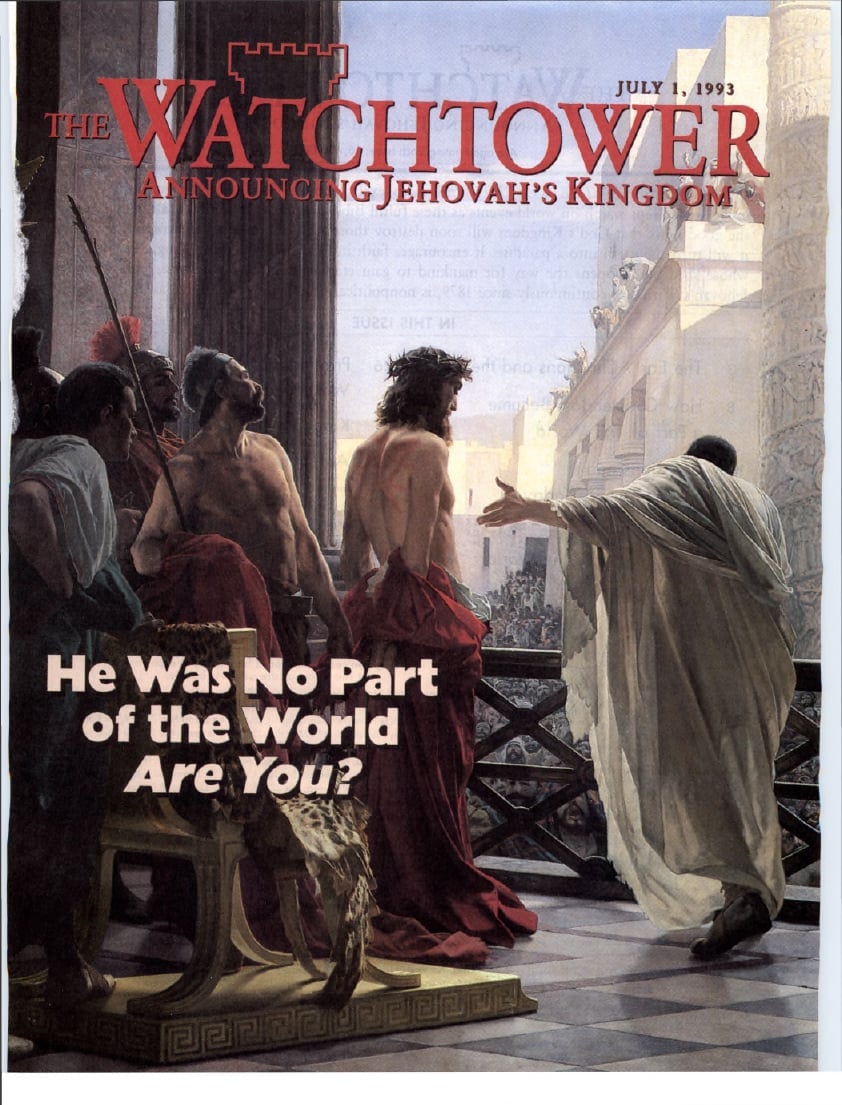
The Watchtower — July 1, 1993
Source: jw.org
Contents
The Early Christians and the World
How Christendom Became a Part of This World
Christians and Human Society Today
Walking in Wisdom with Regard to the World
Beer-sheba—Where a Well Meant Life
Printing Bible Literature While Under Ban
She Found a Purpose in Life
A Beauty That Does Not Fade
Would You Welcome a Visit?
The Early Christians and the World
The Early Christians and the World
ABOUT two thousand years ago, a most wonderful event occurred in the Middle East. The only-begotten Son of God was sent from his heavenly dwelling place to live for a short while in the world of mankind. How did most of mankind respond? The apostle John replies: “He [Jesus] was in the world, and the world came into existence through him, but the world did not know him. He came to his own home [Israel], but his own people did not take him in.”—John 1:10, 11.
The world just did not accept Jesus, the Son of God. Why not? Jesus explained one reason when he said: “The world . . . hates me, because I bear witness concerning it that its works are wicked.” (John 7:7) Eventually, this same world—represented by some Jewish religious leaders, an Edomite king, and a Roman politician—had Jesus put to death. (Luke 22:66–23:25; Acts 3:14, 15; 4:24-28) What about Jesus’ followers? Would the world be more ready to accept them? No. Shortly before his death, Jesus warned them: “If you were part of the world, the world would be fond of what is its own. Now because you are no part of the world, but I have chosen you out of the world, on this account the world hates you.”—John 15:19.
In Apostolic Times
Jesus’ words proved true. Just a few weeks after his death, his apostles were arrested, threatened, and beaten. (Acts 4:1-3; 5:17, 18, 40) Shortly thereafter, zealous Stephen was dragged before the Jewish Sanhedrin and then was stoned to death. (Acts 6:8-12; 7:54, 57, 58) Later, the apostle James was executed by King Herod Agrippa I. (Acts 12:1, 2) During his missionary journeys, Paul was persecuted at the instigation of Jews of the Diaspora.—Acts 13:50; 14:2, 19.
How did the early Christians respond to such opposition? When, in the early days, the religious authorities forbade the apostles to preach in the name of Jesus, the apostles stated: “We must obey God as ruler rather than men.” (Acts 4:19, 20; 5:29) This continued to be their attitude whenever opposition arose. Nevertheless, the apostle Paul counseled Christians in Rome to “be in subjection to the superior [governmental] authorities.” He also counseled them: “If possible, as far as it depends upon you, be peaceable with all men.” (Romans 12:18; 13:1) Hence, the early Christians had to strike a difficult balance. They obeyed God as their primary Ruler. At the same time, they were subject to national authorities and tried to live peaceably with all men.
Christians in the Roman World
Back in the first-century world of the Roman Empire, Christians undoubtedly benefited from the Pax Romana, or Roman Peace, maintained by the Roman legions. The stable rule of law and order, the good roads, and the relatively safe maritime travel created an environment that favored the expansion of Christianity. Early Christians evidently recognized their debt to society and heeded Jesus’ injunction to “pay back Caesar’s things to Caesar.” (Mark 12:17) Writing to Roman emperor Antoninus Pius (138-161 C.E.), Justin Martyr claimed that Christians, “more readily than all men,” paid their taxes. (First Apology, chapter 17) In 197 C.E., Tertullian told the Roman rulers that their tax collectors had “a debt of gratitude to Christians” for the conscientious way in which they paid their taxes. (Apology, chapter 42) This was one way that they followed Paul’s counsel that they should be subject to the superior authorities.
Moreover, as far as their Christian principles would allow, early Christians tried to live peaceably with their neighbors. But this was not easy. The world around them was largely immoral and was steeped in Greco-Roman idolatry, to which emperor worship had recently been added. Pagan Roman religion was essentially a State religion, so any refusal to practice it could be viewed as hostility to the State. Where did this leave Christians?
Oxford professor E. G. Hardy wrote: “Tertullian enumerates many things which were impossible for a conscientious Christian, as involving idolatry: e.g. oath usual at contracts; the illumination of doors at festivals, etc.; all Pagan religious ceremonies; the games and the circus; the profession of teaching secular [heathen classical] literature; military service; public offices.”—Christianity and the Roman Government.
Yes, it was difficult to live in the Roman world without betraying the Christian faith. French Catholic author A. Hamman writes: “It was impossible to take a step without encountering a divinity. The Christian’s position brought him daily problems; he lived on the edge of society . . . He faced recurring problems in the home, in the streets, at the market . . . In the street, whether a Roman citizen or not, a Christian should bare his head when passing a temple or a statue. How could he refrain from doing so without arousing suspicion, yet how could he comply without committing an act of allegiance? If he was in business and needed to borrow money, he had to swear to the money-lender in the name of the gods. . . . If he accepted public office, he was expected to offer a sacrifice. If enlisted, how could he avoid taking the oath and participating in the rites of military service?”—La vie quotidienne des premiers chrétiens (95-197) (Daily Life Among the Early Christians, 95-197 C.E.).
Good Citizens, Yet Maligned
About 60 or 61 C.E., when Paul was in Rome awaiting trial by Emperor Nero, leading Jews said concerning the early Christians: “Truly as regards this sect it is known to us that everywhere it is spoken against.” (Acts 28:22) The historical record bears out that Christians were spoken against—but unjustly so. In his book The Rise of Christianity, E. W. Barnes relates: “In its early authoritative documents the Christian movement is represented as essentially moral and law-abiding. Its members desired to be good citizens and loyal subjects. They shunned the failings and vices of paganism. In private life they sought to be peaceful neighbours and trustworthy friends. They were taught to be sober, industrious and clean-living. Amid prevailing corruption and licentiousness they were, if loyal to their principles, honest and truthful. Their sexual standards were high: the marriage tie was respected and family life was pure. With such virtues they could not, one would have thought, have been troublesome citizens. Yet they were for long despised, maligned and hated.”
Just as the ancient world did not understand Jesus, it did not understand the Christians and therefore hated them. Since they refused to worship the emperor and pagan divinities, they were accused of atheism. If a catastrophe occurred, they were blamed for having angered the gods. Because they did not attend immoral plays or bloody gladiatorial shows, they were considered antisocial, even ‘haters of the human race.’ Their enemies claimed that homes were broken up by the Christian “sect” and that it was therefore a danger to social stability. Tertullian spoke of pagan husbands who preferred that their wives commit adultery than that they become Christians.
Christians were criticized because they were against abortion, widely practiced at the time. Yet, their enemies accused them of killing children. It was alleged that at their meetings they drank the blood of sacrificed children. At the same time, their enemies tried to force them to eat blood sausage, knowing that this was against their conscience. Thus these opposers gave the lie to their own accusation.—Tertullian, Apology, chapter 9.
Despised as a New Sect
Historian Kenneth Scott Latourette wrote: “Still another set of charges held Christianity up to ridicule for its recent origin and contrasted it with the antiquity of its rivals [Judaism and the Greco-Roman pagan religions].” (A History of the Expansion of Christianity, Volume 1, page 131) In the early second century C.E., Roman historian Suetonius called Christianity “a new and mischievous superstition.” Tertullian attested that the very name Christian was hated and that Christians were a disliked sect. Speaking of the way officials of the Roman Empire viewed Christians in the second century, Robert M. Grant wrote: “The basic view was that Christianity was simply an unnecessary, possibly a harmful, religion.”—Early Christianity and Society.
Accused of Aggressive Proselytizing
In his book Les premiers siècles de l’Eglise (The Early Centuries of the Church), Sorbonne professor Jean Bernardi wrote: “[Christians] were to go out and speak everywhere and to everyone. On the highways and in the cities, on the public squares and in the homes. Welcome or unwelcome. To the poor, and to the rich encumbered by their possessions. To the small and to the governors of the Roman provinces . . . They had to take to the road, board ships, and go to the ends of the earth.”
Did they do this? Evidently they did. Professor Léon Homo relates that the early Christians had public opinion against them because of their “ardent proselytism.” Professor Latourette states that while the Jews lost their zeal for proselytizing, “Christians, on the other hand, were aggressively missionary and so aroused resentment.”
In the second century C.E., Roman philosopher Celsus criticized the Christians’ preaching methods. He stated that Christianity was for the uneducated and that it could ‘convince only the stupid, slaves, women, and little children.’ He accused Christians of indoctrinating “gullible people,” having them “believe without rational thought.” He claimed that they told their new disciples: “Do not ask questions; just believe.” Yet, according to Origen, Celsus himself admitted that “it was not the simple alone who were led by the doctrine of Jesus to adopt His religion.”
No Ecumenism
The early Christians were further criticized because they claimed to possess the truth of the one true God. They were not open to ecumenism, or interfaith. Latourette wrote: “Unlike most of the faiths of the time, they [the Christians] were hostile to other religions. . . . In contrast with the fairly broad tolerance which characterized other cults, they declared that they had final truth.”
In 202 C.E., Emperor Septimius Severus issued an edict forbidding the Christians to make converts. This, however, did not stop them from witnessing about their faith. Latourette describes the result: “In its refusal to compromise with the current paganism and with many of the social customs and moral practices of the times [early Christianity] developed a coherence and an organization which set it over against society. The very break required to join it gave to its adherents a conviction which constituted a source of strength against persecution and of zeal in winning converts.”
The historical record is, therefore, clear. In the main, the early Christians, while endeavoring to be good citizens and to live peaceably with all men, refused to become “part of the world.” (John 15:19) They were respectful of the authorities. But when Caesar forbade them to preach, they had no alternative but to keep on preaching. They tried to live peaceably with all men but refused to compromise on moral standards and pagan idolatry. For all of this, they were despised, maligned, hated, and persecuted, even as Christ had foretold they would be.—John 16:33.
Did their separateness from the world continue? Or with the passing of time, did those who claimed to practice Christianity change their attitude in this?
[Blurb on page 4]
“The Christian’s position brought him daily problems; he lived on the edge of society”
[Blurb on page 6]
“Christianity [was held up] to ridicule for its recent origin and contrasted . . . with the antiquity of its rivals”
[Picture on page 3]
Because Christians refused to worship the Roman emperor and pagan divinities, they were accused of atheism
[Credit Line]
Museo della Civiltà Romana, Roma
[Picture on page 7]
First-century Christians were known as zealous preachers of the Kingdom message
[Picture Credit Line on page 2]
Cover: Alinari/Art Resource, N.Y.
How Christendom Became a Part of This World
How Christendom Became a Part of This World
IN TIME the Roman Empire, in which early Christianity began, collapsed. Many historians claim that that collapse was also the time of the final victory of Christianity over paganism. Expressing a different viewpoint, Anglican bishop E. W. Barnes wrote: “As classical civilization collapsed, Christianity ceased to be the noble faith of Jesus the Christ: it became a religion useful as the social cement of a world in dissolution.”—The Rise of Christianity.
Before that collapse, during the second, third, and fourth centuries C.E., history records that in many ways those who claimed to follow Jesus kept themselves separate from the Roman world. But it also reveals the development of apostasy in doctrine, conduct, and organization, just as Jesus and his apostles had foretold. (Matthew 13:36-43; Acts 20:29, 30; 2 Thessalonians 2:3-12; 2 Timothy 2:16-18; 2 Peter 2:1-3, 10-22) Eventually compromises came to be made with the Greco-Roman world, and some who claimed to be Christian adopted the world’s paganism (such as its festivals and its worship of a mother-goddess and a triune god), its philosophy (such as belief in an immortal soul), and its administrative organization (seen in the appearance of a clergy class). It was this corrupted version of Christianity that attracted the pagan masses and became a force that the Roman emperors first tried to stamp out but later came to terms with and endeavored to use to their own ends.
Conquered by the World
Church historian Augustus Neander showed the risks involved in this new relationship between “Christianity” and the world. If Christians sacrificed their separateness from the world, “the consequence would be a confusion of the church with the world . . . whereby the church would forfeit her purity, and, while seeming to conquer, would herself be conquered,” he wrote.—General History of the Christian Religion and Church, Volume 2, page 161.
This is what happened. In the early fourth century, Roman emperor Constantine tried to use the “Christian” religion of his day to cement his disintegrating empire. To this end, he granted professed Christians religious freedom and transferred some of the privileges of the pagan priesthood to their clergy class. The New Encyclopædia Britannica states: “Constantine brought the church out of its withdrawal from the world to accept social responsibility and helped pagan society to be won for the church.”
State Religion
After Constantine, Emperor Julian (361-363 C.E.) made an attempt to oppose Christianity and restore paganism. But he failed, and some 20 years later, Emperor Theodosius I banned paganism and imposed Trinitarian “Christianity” as the State religion of the Roman Empire. With adroit precision, French historian Henri Marrou wrote: “By the end of the reign of Theodosius, Christianity, or to be more precise, orthodox Catholicism, became the official religion of the entire Roman world.” Orthodox Catholicism had replaced true Christianity and had become a “part of the world.” This State religion was vastly different from the religion of Jesus’ early followers, to whom he said: “You are no part of the world.”—John 15:19.
French historian and philosopher Louis Rougier wrote: “As it spread, Christianity underwent strange mutations to the point of becoming unrecognizable. . . . The primitive church of the poor, which lived by charity, became a triumphalist church that came to terms with the powers that be when it was unable to dominate them.”
In the early fifth century C.E., Roman Catholic “Saint” Augustine wrote his major work The City of God. In it he described two cities, “that of God and that of the world.” Did this work accentuate the separation between Catholics and the world? Not really. Professor Latourette states: “Augustine frankly recognized [that] the two cities, the earthly and the heavenly, are intermingled.” Augustine taught that “the Kingdom of God has already begun in this world with the institution of the [Catholic] church.” (The New Encyclopædia Britannica, Macropædia, Volume 4, page 506) Thus, whatever Augustine’s original purpose may have been, his theories had the effect of involving the Catholic Church more deeply in the political affairs of this world.
A Divided Empire
In 395 C.E., when Theodosius I died, the Roman Empire was officially divided in two. The Eastern, or Byzantine, Empire had its capital at Constantinople (formerly Byzantium, now Istanbul), and the Western Empire had its capital (after 402 C.E.) at Ravenna, Italy. As a result, Christendom became divided politically and also religiously. With regard to relations between Church and State, the church in the Eastern Empire followed the theory of Eusebius of Caesarea (a contemporary of Constantine the Great). Ignoring the Christian principle of separateness from the world, Eusebius reasoned that if the emperor and the empire became Christian, Church and State would become a single Christian society, with the emperor acting as God’s representative on earth. By and large, this relationship between Church and State has been followed over the centuries by the Eastern Orthodox churches. In his book The Orthodox Church, Timothy Ware, an Orthodox bishop, showed the result: “Nationalism has been the bane of Orthodoxy for the last ten centuries.”
In the West the last Roman emperor was deposed in 476 C.E. by invading Germanic tribes. This marked the end of the Western Roman Empire. Of the political vacuum that ensued, The New Encyclopædia Britannica states: “A new power was formed: the Roman Church, the church of the bishop of Rome. This church understood itself as the successor of the extinct Roman Empire.” This encyclopedia goes on to say: “The Roman popes . . . extended the secular claim of government of the church beyond the borders of the church-state and developed the so-called theory of the two swords, stating that Christ gave the pope not only spiritual power over the church but also secular power over the worldly kingdoms.”
National Protestant Churches
Throughout the Middle Ages, both the Orthodox and the Roman Catholic religions continued to be heavily involved in politics, worldly intrigues, and wars. Did the Protestant Reformation of the 16th century mark a return to true Christianity, separate from the world?
No. We read in The New Encyclopædia Britannica: “The Protestant Reformers of the Lutheran, Calvinist, and Anglican traditions . . . remained firmly attached to the views of Augustine, for whose theology they felt a particular affinity. . . . Each of the three main Protestant traditions of 16th-century Europe . . . found support from the secular authorities in Saxony [central Germany], Switzerland, and England and remained in the same position vis-à-vis the state as had the medieval church.”
Rather than bring about a return to genuine Christianity, the Reformation brought forth a host of national or territorial churches that have curried favor with the political states and actively supported them in their wars. In fact, both the Catholic and the Protestant churches have fomented religious wars. In his book An Historian’s Approach to Religion, Arnold Toynbee wrote concerning such wars: “They exhibited Catholics and Protestants in France, the Netherlands, Germany, and Ireland, and rival sects of Protestants in England and Scotland, in the brutal act of trying to suppress one another by force of arms.” The present-day conflicts that are dividing Ireland and the former Yugoslavia show that the Roman Catholic, Orthodox, and Protestant churches are still deeply involved in the affairs of this world.
Does all of this mean that true Christianity, separate from the world, no longer exists on earth? The following article will answer that question.
[Box/Picture on page 10, 11]
HOW “CHRISTIANITY” BECAME A STATE RELIGION
CHRISTIANITY was never meant to be a part of this world. (Matthew 24:3, 9; John 17:16) Yet, history books tell us that in the fourth century C.E., “Christianity” became the official State religion of the Roman Empire. How did this come about?
From Nero (54-68 C.E.) well into the third century C.E., all Roman emperors either actively persecuted Christians or permitted the persecution of them. Gallienus (253-268 C.E.) was the first Roman emperor to issue a declaration of tolerance for them. Even then, Christianity was a proscribed religion throughout the empire. After Gallienus, the persecution continued, and under Diocletian (284-305 C.E.) and his immediate successors, it even intensified.
The turning point came early in the fourth century with the so-called conversion to Christianity of Emperor Constantine I. Concerning this “conversion,” the French work Théo—Nouvelle encyclopédie catholique (Théo—New Catholic Encyclopedia) states: “Constantine claimed to be a Christian emperor. In reality, he was baptized only on his deathbed.” Nevertheless, in 313 C.E., Constantine and his coemperor, Licinius, issued an edict that granted religious freedom to Christians and pagans alike. The New Catholic Encyclopedia states: “Constantine’s extension of freedom of worship to Christians, which signified that Christianity was recognized officially as a religio licita [lawful religion] beside paganism, was a revolutionary act.”
However, The New Encyclopædia Britannica declares: “He [Constantine] did not make Christianity the religion of the empire.” French historian Jean-Rémy Palanque, member of the Institute of France, writes: “The Roman State . . . remained, however, officially pagan. And Constantine, when adhering to the religion of Christ, did not put an end to that situation.” In the work The Legacy of Rome, Professor Ernest Barker stated: “[Constantine’s victory] did not result in the immediate establishment of Christianity as the religion of the State. Constantine was content to recognize Christianity as one of the public worships of the empire. For the next seventy years the old pagan rites were officially performed in Rome.”
So at this point “Christianity” was a legal religion in the Roman Empire. When did it become, in the fullest sense of the expression, the official State religion? We read in the New Catholic Encyclopedia: “[Constantine’s] policy was continued by his successors with the exception of Julian [361-363 C.E.], whose persecution of Christianity was brought to an abrupt end by his death. Finally, in the last quarter of the 4th century, Theodosius the Great [379-395 C.E.] made Christianity the official religion of the Empire and suppressed public pagan worship.”
Confirming this and revealing just what this new State religion was, Bible scholar and historian F. J. Foakes Jackson wrote: “Under Constantine Christianity and the Roman empire were allied. Under Theodosius they were united. . . . From henceforward the title of Catholic was to be reserved for those who adored the Father, Son and Holy Ghost with equal reverence. The entire religious policy of this emperor was directed to this end, and resulted in the Catholic Faith becoming the one legal religion of the Romans.”
Jean-Rémy Palanque wrote: “Theodosius, while combating paganism, also came out in favor of the orthodox [Catholic] Church; his edict of 380 C.E. ordered all his subjects to profess the faith of Pope Damasus and the [Trinitarian] bishop of Alexandria and deprived dissidents of freedom of worship. The great Council of Constantinople (381) again condemned all heresies, and the emperor saw to it that no bishop would support them. Nicene [Trinitarian] Christianity had well and truly become the State religion . . . The Church was closely united with the State and enjoyed its exclusive support.”
Thus, it was not the unadulterated Christianity of the apostles’ days that became the State religion of the Roman Empire. It was fourth-century Trinitarian Catholicism, imposed by force by Emperor Theodosius I and practiced by the Roman Catholic Church, which was then as it is now, truly a part of this world.
[Credit Line]
Emperor Theodosius I: Real Academia de la Historia, Madrid (Foto Oronoz)
[Picture Credit Line on page 8]
Scala/Art Resource, N.Y.
Christians and Human Society Today
Christians and Human Society Today
“You will be objects of hatred by all the nations on account of my name.”—MATTHEW 24:9.
1. What was to be a distinctive mark of Christianity?
SEPARATENESS from the world was a distinctive mark of the early Christians. In prayer to his heavenly Father, Jehovah, Christ said of his disciples: “I have given your word to them, but the world has hated them, because they are no part of the world, just as I am no part of the world.” (John 17:14) When summoned before Pontius Pilate, Jesus stated: “My kingdom is no part of this world.” (John 18:36) The separateness of primitive Christianity from the world is attested to by the Christian Greek Scriptures and by historians.
2. (a) Was there to be any change in the relationship between Jesus’ followers and the world as time passed? (b) Was Jesus’ Kingdom due to come through the conversion of the nations?
2 Did Jesus later reveal that there would be a change in the relationship between his followers and the world and that his Kingdom would come through the conversion of the world to Christianity? No. Nothing that his followers were inspired to write after Jesus’ death even hinted at such a thing. (James 4:4 [written shortly before 62 C.E.]; 1 John 2:15-17; 5:19 [written about 98 C.E.]) On the contrary, the Bible links Jesus’ “presence” and subsequent “coming” in Kingdom power with “the conclusion of the system of things,” culminating in its “end,” or destruction. (Matthew 24:3, 14, 29, 30; Daniel 2:44; 7:13, 14) In the sign that Jesus gave of his pa·rou·siʹa, or presence, he said of his true followers: “Then people will deliver you up to tribulation and will kill you, and you will be objects of hatred by all the nations on account of my name.”—Matthew 24:9.
True Christians Today
3, 4. (a) How does a Catholic encyclopedia describe the early Christians? (b) In what similar terms are Jehovah’s Witnesses and the early Christians described?
3 What religious group today has earned for itself the reputation of faithfulness to Christian principles and separateness from this world, with its members being hated and persecuted? Well, what worldwide Christian organization corresponds in every respect to historical descriptions of the early Christians? Regarding these, the New Catholic Encyclopedia states: “The primitive Christian community, although considered at first but another sect within the Jewish milieu, proved unique in its theological teaching, and more particularly in the zeal of its members, who served as witnesses to Christ ‘in all Judea and Samaria and even to the ends of the earth’ (Acts 1.8).”—Volume 3, page 694.
4 Notice the expressions “considered . . . but another sect,” “unique in its . . . teaching,” “zeal . . . as witnesses.” And now observe how that same encyclopedia describes Jehovah’s Witnesses: “A sect . . . Witnesses are deeply convinced that the end of the world will come within a very few years. This vivid belief appears to be the strongest driving force behind their indefatigable zeal. . . . The fundamental obligation of each member of the sect is to give witness to Jehovah by announcing His approaching Kingdom. . . . They regard the Bible as their only source of belief and rule of conduct . . . To be a true Witness one must preach effectively in one way or another.”—Volume 7, pages 864-5.
5. (a) In what respects are the teachings of Jehovah’s Witnesses unique? (b) Give examples showing that the beliefs of Jehovah’s Witnesses are in harmony with the Scriptures.
5 In what respects are the teachings of Jehovah’s Witnesses unique? The New Catholic Encyclopedia mentions a few: “They [Jehovah’s Witnesses] condemn the Trinity as pagan idolatry . . . They consider Jesus as the greatest of Jehovah’s Witnesses, ‘a god’ (so they translate John 1.1), inferior to no one but to Jehovah. . . . He died as a man and was raised as an immortal spirit Son. His Passion and death were the price he paid to regain for mankind the right to live eternally on earth. Indeed, the ‘great multitude’ (Ap 7.9) of true Witnesses hope in an earthly Paradise; only 144,000 faithful (Ap 7.4; 14.1, 4) may enjoy heavenly glory with Christ. The wicked will undergo complete destruction. . . . Baptism—which Witnesses practice by immersion . . . [is] the exterior symbol of their dedication to the service of Jehovah God. . . . Jehovah’s Witnesses have attracted publicity by refusing blood transfusions . . . Their conjugal and sexual morality is quite rigid.” Jehovah’s Witnesses may be unique in these respects, but their position on all these points is solidly based on the Bible.—Psalm 37:29; Matthew 3:16; 6:10; Acts 15:28, 29; Romans 6:23; 1 Corinthians 6:9, 10; 8:6; Revelation 1:5.
6. What stance have Jehovah’s Witnesses maintained? Why?
6 This Roman Catholic work adds that in 1965 (apparently the year when the article was written) “the Witnesses did not yet consider that they belonged to the society in which they lived.” The author seems to have thought that as time went by and Jehovah’s Witnesses became more numerous and took on “more and more of the characteristics of a church as opposed to a sect,” they would become a part of this world. But such has not proved to be the case. Today, with over four times as many Witnesses as in 1965, Jehovah’s Witnesses have consistently maintained their stance with regard to this world. “They are no part of the world,” as Jesus was “no part of the world.”—John 17:16.
Separate but Not Hostile
7, 8. As was true of the early Christians, what is true of Jehovah’s Witnesses today?
7 Citing the defense of the early Christians by second-century apologist Justin Martyr, Robert M. Grant wrote in his book Early Christianity and Society: “If Christians were revolutionists they would remain in hiding in order to reach their goal. . . . They are the emperor’s best allies in the cause of peace and good order.” Likewise, Jehovah’s Witnesses today are known throughout the world to be peace-loving and orderly citizens. Governments, of whatever kind, know that they have nothing to fear from Jehovah’s Witnesses.
8 A North American editorialist wrote: “It takes a bigoted and paranoid imagination to believe that the Jehovah’s Witnesses pose any kind of threat to any political regime; they are as non-subversive and peace-loving as a religious body can be.” In his book L’objection de conscience (Conscientious Objection), Jean-Pierre Cattelain writes: “The Witnesses are perfectly submissive to the authorities and generally obey laws; they pay their taxes and do not seek to question, change, or destroy governments, for they do not concern themselves with the affairs of this world.” Cattelain goes on to add that only if the State claims their lives, which they have fully dedicated to God, do Jehovah’s Witnesses refuse to obey. In this they closely resemble the early Christians.—Mark 12:17; Acts 5:29.
Misunderstood by the Ruling Classes
9. Regarding separateness from the world, what is an outstanding difference between the early Christians and modern-day Catholics?
9 Most of the Roman emperors misunderstood the early Christians and persecuted them. Showing why, The Epistle to Diognetus, thought by some to date from the second century C.E., declares: “Christians dwell in the world, but are not part and parcel of the world.” On the other hand, the Second Vatican Council, in its Dogmatic Constitution on the Church, stated that Catholics should “seek the kingdom of God by engaging in temporal affairs” and “work for the sanctification of the world from within.”
10. (a) How were the early Christians viewed by the ruling classes? (b) How are Jehovah’s Witnesses often viewed, and what is their reaction?
10 Historian E. G. Hardy states that the Roman emperors considered the early Christians to be “somewhat contemptible enthusiasts.” French historian Étienne Trocmé speaks of “the contempt in which cultured Greeks and Roman officials held what they saw as a very strange Oriental sect [the Christians].” Correspondence between Pliny the Younger, Roman governor of Bithynia, and Emperor Trajan shows that the ruling classes were generally ignorant of the true nature of Christianity. Similarly today, Jehovah’s Witnesses are often misunderstood and even despised by the ruling classes of the world. However, this neither surprises nor dismays the Witnesses.—Acts 4:13; 1 Peter 4:12, 13.
“Everywhere It Is Spoken Against”
11. (a) What things were said of the early Christians, and what has been said of Jehovah’s Witnesses? (b) Why do Jehovah’s Witnesses not participate in politics?
11 Of the early Christians it was said: “As regards this sect it is known to us that everywhere it is spoken against.” (Acts 28:22) In the second century C.E., the pagan Celsus claimed that Christianity appealed only to the dregs of human society. Similarly it has been said of Jehovah’s Witnesses that “for the most part, they are drawn from the deprived in our society.” Church historian Augustus Neander reported that “the Christians were represented as men dead to the world, and useless for all affairs of life; . . . and it was asked, what would become of the business of life, if all were like them?” Because Jehovah’s Witnesses refrain from participating in politics, they too are often accused of being deadwood in human society. But how could they be political activists and at the same time be advocates of God’s Kingdom as mankind’s only hope? Jehovah’s Witnesses take to heart the apostle Paul’s words: “Share in suffering as a good soldier of Christ Jesus. No soldier on service gets entangled in civilian pursuits, since his aim is to satisfy the one who enlisted him.”—2 Timothy 2:3, 4, Revised Standard Version, an Ecumenical Edition.
12. In what important aspect of separateness do Jehovah’s Witnesses resemble the early Christians?
12 In his book A History of Christianity, Professor K. S. Latourette writes: “One of the issues on which the early Christians were at variance with the Græco-Roman world was participation in war. For the first three centuries no Christian writing which has survived to our time condoned Christian participation in war.” Edward Gibbon’s work The History of the Decline and Fall of the Roman Empire states: “It was impossible that the Christians, without renouncing a more sacred duty, could assume the character of soldiers, of magistrates, or of princes.” Jehovah’s Witnesses similarly adopt a position of strict neutrality and follow the Bible principles outlined at Isaiah 2:2-4 and Matthew 26:52.
13. What accusation is leveled at Jehovah’s Witnesses, but what do the facts show?
13 Jehovah’s Witnesses are accused by their enemies of breaking up families. True, there are cases of families that become divided when one or more members become Jehovah’s Witnesses. Jesus foretold that this would occur. (Luke 12:51-53) Statistics show, however, that marriages that break up for this reason are the exception. Among Jehovah’s Witnesses in France, for instance, 1 married couple in 3 includes a marriage partner who is not a Witness. Yet, the divorce rate among these mixed marriages is no higher than the national average. Why? The apostles Paul and Peter gave wise, inspired counsel to Christians married to unbelievers, and Jehovah’s Witnesses endeavor to follow their words. (1 Corinthians 7:12-16; 1 Peter 3:1-4) If a mixed marriage breaks up, the initiative almost always comes from the non-Witness partner. On the other hand, many thousands of marriages have been saved because the marriage partners became Jehovah’s Witnesses and started applying Bible principles in their lives.
Christians, Not Trinitarians
14. What accusation was brought against the early Christians, and why is this ironic?
14 It is ironic that in the Roman Empire, one of the accusations brought against the early Christians was that they were atheists. Dr. Augustus Neander writes: “The deniers of the gods, the atheists, . . . was the common name by which the Christians were designated among the people.” How strange that Christians, who worshiped the living Creator and not multiple gods, should be dubbed atheists by pagans who worshiped “no gods, but the workmanship of man’s hands, wood and stone.”—Isaiah 37:19.
15, 16. (a) What have some religionists said of Jehovah’s Witnesses, but what question does this raise? (b) What shows that Jehovah’s Witnesses are truly Christians?
15 Equally ironic is the fact that today some authorities in Christendom deny that Jehovah’s Witnesses are Christians. Why? Because the Witnesses reject the Trinity. According to Christendom’s biased definition, “Christians are those who accept Christ as God.” In contrast with this, a modern dictionary defines the noun “Christian” as “a person who believes in Jesus Christ and who follows his teachings” and “Christianity” as “a religion that is based on the teachings of Jesus Christ and the belief that he was the son of God.” What group fits this definition more closely?
16 Jehovah’s Witnesses accept Jesus’ own testimony as to who he is. He stated: “I am God’s Son,” not, “I am God the Son.” (John 10:36; compare John 20:31.) They accept the apostle Paul’s inspired statement concerning Christ: “Who, being in the form of God, did not count equality with God something to be grasped.”a (Philippians 2:6, The New Jerusalem Bible) The book The Paganism in Our Christianity states: “Jesus Christ never mentioned such a phenomenon [a coequal Trinity], and nowhere in the New Testament does the word ‘Trinity’ appear. The idea was only adopted by the Church three hundred years after the death of our Lord; and the origin of the conception is entirely pagan.” Jehovah’s Witnesses accept the Biblical teaching about Christ. They are Christians, not Trinitarians.
No Ecumenism
17. Why do Jehovah’s Witnesses not cooperate with the ecumenical, or interfaith, movement?
17 Two other complaints made against Jehovah’s Witnesses are that they refuse to take part in the ecumenical movement and that they engage in what is termed “aggressive proselytizing.” Both of these reproaches were also flung at the early Christians. Christendom, with her Catholic, Orthodox, and Protestant components, is undeniably a part of this world. Like Jesus, Jehovah’s Witnesses “are no part of the world.” (John 17:14) How could they ally themselves through interfaith movements with religious organizations that promote unchristian conduct and beliefs?
18. (a) Why can Jehovah’s Witnesses not be criticized for claiming that they alone practice the true religion? (b) While believing they have the true religion, what do Roman Catholics not possess?
18 Who can justifiably criticize Jehovah’s Witnesses for believing, as did the early Christians, that they alone are practicing the true religion? Even the Catholic Church, while hypocritically claiming to cooperate with the ecumenical movement, proclaims: “We believe that this one true religion continues to exist in the Catholic and Apostolic Church, to which the Lord Jesus entrusted the task of spreading it among all men when he said to the apostles: ‘Go therefore and make disciples of all nations.’” (Vatican Council II, “Declaration on Religious Liberty”) Apparently, though, such belief is not sufficient to infuse Catholics with indefatigable zeal in going forth to make disciples.
19. (a) What are Jehovah’s Witnesses determined to do, and with what motive? (b) What will be examined in the following article?
19 Jehovah’s Witnesses have such zeal. They are determined to go on witnessing as long as God wants them to do so. (Matthew 24:14) Their witnessing is zealous but not aggressive. It is motivated by love of neighbor, not by hatred of mankind. They hope that as many of mankind as possible will be saved. (1 Timothy 4:16) Like the early Christians, they endeavor to “be peaceable with all men.” (Romans 12:18) How they go about this will be discussed in the following article.
[Footnotes]
For a discussion of this passage in connection with the Trinity dogma, see The Watchtower, June 15, 1971, pages 355-6.
By Way of Review
□ What characterized the early Christians, and how do Jehovah’s Witnesses resemble them?
□ In what respects do Jehovah’s Witnesses show that they are good citizens?
□ How did the ruling classes view the early Christians, and is it any different today?
□ What does the Witnesses’ conviction that they have the truth move them to do?
[Picture on page 12]
Jehovah’s Witnesses are determined to go on witnessing as long as God wants them to do so
[Picture on page 17]
Pilate said: “Look! The man”—the One who was no part of the world.—John 19:5
[Credit Line]
“Ecce Homo” by A. Ciseri: Florence, Galleria d’Arte Moderna / Alinari/Art Resource, N.Y.
Walking in Wisdom with Regard to the World
Walking in Wisdom with Regard to the World
“Go on walking in wisdom toward those on the outside.”—COLOSSIANS 4:5.
1. With what were the early Christians confronted, and what counsel did Paul give to the congregation in Colossae?
THE early Christians living in the cities of the Roman world were continually confronted with idolatry, immoral pleasure-seeking, and pagan rites and customs. Those who lived in Colossae, a city in west-central Asia Minor, doubtless met up with the mother-goddess worship and spiritism of the native Phrygians, the pagan philosophy of the Greek settlers, and the Judaism of the Jewish colony. The apostle Paul counseled the Christian congregation to “go on walking in wisdom” toward such “outsiders.”—Colossians 4:5.
2. Why do Jehovah’s Witnesses today need to walk in wisdom toward those on the outside?
2 Today, Jehovah’s Witnesses meet up with similar wrong practices, and even more. They also, therefore, need to exercise wisdom in their relationship with those outside the true Christian congregation. Many in religious and political establishments as well as in the media are opposed to them. Some of these, either by outright attack or, more often, by innuendo, try to sully the reputation of Jehovah’s Witnesses and arouse prejudice against them. Just as the early Christians were unjustly viewed as a fanatical and even dangerous “sect,” Jehovah’s Witnesses today are often the butt of prejudice and misconceptions.—Acts 24:14; 1 Peter 4:4.
Overcoming Prejudice
3, 4. (a) Why will true Christians never be loved by the world, but what should we try to do? (b) What did an author write about Jehovah’s Witnesses detained in a Nazi concentration camp?
3 True Christians do not expect to be loved by the world, which, according to the apostle John, “is lying in the power of the wicked one.” (1 John 5:19) Nevertheless, the Bible encourages Christians to endeavor to win individuals over to Jehovah and his pure worship. This we do by direct witnessing and also by our good behavior. The apostle Peter wrote: “Maintain your conduct fine among the nations, that, in the thing in which they are speaking against you as evildoers, they may as a result of your fine works of which they are eyewitnesses glorify God in the day for his inspection.”—1 Peter 2:12.
4 In her book Forgive—But Do Not Forget, author Sylvia Salvesen said of women Witnesses who were her fellow inmates in a Nazi concentration camp: “Those two, Käthe and Margarethe, and many others, helped me a lot, not only by their faith but in practical matters. They procured for us the first clean rags we had for our sores . . . In short we found ourselves amongst people who wished us well, and who showed their friendly feelings by their actions.” What a fine testimony from “those on the outside”!
5, 6. (a) What work is Christ accomplishing at the present time, and what should we not forget? (b) What should be our attitude toward people of the world, and why?
5 We can do much to break down prejudice by the wise way in which we conduct ourselves toward outsiders. True, we are living at the time when our reigning King, Christ Jesus, is separating people of the nations, “just as a shepherd separates the sheep from the goats.” (Matthew 25:32) But never forget that Christ is the Judge; it is he who decides who are “the sheep” and who are “the goats.”—John 5:22.
6 This should influence our attitude toward those who are not part of Jehovah’s organization. We may think of them as worldly people, but they are a part of the world of mankind that “God loved . . . so much that he gave his only-begotten Son, in order that everyone exercising faith in him might not be destroyed but have everlasting life.” (John 3:16) It is far better to consider people to be prospective sheep than presumptuously to decide that they are goats. Some who were once violently opposed to the truth are now dedicated Witnesses. And many of these were first won over by acts of kindness, before they responded to any direct witnessing. See, for example, the picture on page 18.
Zealous, Not Aggressive
7. What criticism did the pope express, but what question might we ask?
7 Pope John Paul II criticized sects in general, and Jehovah’s Witnesses in particular, when he stated: “The almost aggressive zeal with which some seek out new adherents, going from house to house, or stopping passersby on street corners, is a sectarian counterfeit of apostolic and missionary ardor.” It might be asked, If ours is a “counterfeit of apostolic and missionary ardor,” where is the real evangelizing zeal to be found? Certainly not among Catholics nor, for that matter, among Protestants or members of the Orthodox churches.
8. How should we carry out our house-to-house witnessing, hopefully with what result?
8 Nevertheless, in order to give the lie to any accusation of aggressiveness in our witnessing, we should always be kind, respectful, and polite when we approach people. The disciple James wrote: “Who is wise and understanding among you? Let him show out of his fine conduct his works with a mildness that belongs to wisdom.” (James 3:13) The apostle Paul exhorts us “not to be belligerent.” (Titus 3:2) For example, rather than outrightly condemn the beliefs of a person we are witnessing to, why not show a sincere interest in his or her opinions? Then tell the person the good news as contained in the Bible. By adopting a positive approach and showing due respect for people with other beliefs, we will help them get in a better frame of mind to listen, and perhaps they will discern the value of the Bible’s message. The result may be that some will come to “glorify God.”—1 Peter 2:12.
9. How can we apply the counsel Paul gave (a) at Colossians 4:5? (b) at Colossians 4:6?
9 The apostle Paul counseled: “Go on walking in wisdom toward those on the outside, buying out the opportune time for yourselves.” (Colossians 4:5) Explaining this latter expression, J. B. Lightfoot wrote: “Letting no opportunity slip you, of saying and doing what may further the cause of God.” (Italics ours.) Yes, we must be ready with words and deeds at the opportune time. Such wisdom also involves choosing an appropriate time of day to make calls. If our message is refused, is it because people do not appreciate it, or is it because we called at a time that was likely inopportune? Paul also wrote: “Let your utterance be always with graciousness, seasoned with salt, so as to know how you ought to give an answer to each one.” (Colossians 4:6) This takes forethought and true love for neighbor. Let us always present the Kingdom message with graciousness.
Respectful and “Ready for Every Good Work”
10. (a) What counsel did the apostle Paul give to Christians living in Crete? (b) How have Jehovah’s Witnesses been exemplary in following Paul’s counsel?
10 We cannot compromise on Bible principles. On the other hand, we should not needlessly take issue with questions that do not involve Christian integrity. The apostle Paul wrote: “Continue reminding them [Christians in Crete] to be in subjection and be obedient to governments and authorities as rulers, to be ready for every good work, to speak injuriously of no one, not to be belligerent, to be reasonable, exhibiting all mildness toward all men.” (Titus 3:1, 2) Bible scholar E. F. Scott wrote about this passage: “Not only were Christians to obey authority, but they must be ready for any good work. This . . . means that, when occasion demanded, Christians should be among the foremost in showing public spirit. There would constantly be outbreaks of fire, plague, calamity of various kinds, when all good citizens would desire to help their neighbours.” Throughout the world there have been many instances of catastrophe striking and Jehovah’s Witnesses being among the first to perform relief work. They have helped not only their brothers but also outsiders.
11, 12. (a) How should Christians act toward the authorities? (b) What does subjection to authorities include when it comes to building Kingdom Halls?
11 This same passage from Paul’s letter to Titus also underscores the importance of adopting a respectful attitude toward the authorities. Young Christians who because of their stand on neutrality appear before judges should be particularly mindful to walk in wisdom toward those on the outside. They can do much to make or mar the reputation of Jehovah’s people by their appearance, their deportment, and the way they speak to such authorities. They should “render . . . to him who calls for honor, such honor,” and make their defense with deep respect.—Romans 13:1-7; 1 Peter 2:17; 3:15.
12 “Authorities” include local government officials. Now that more and more Kingdom Halls are being built, dealings with the local authorities are inevitable. Often, elders encounter prejudice. But it has been found that where congregation representatives establish a good relationship with the authorities and cooperate with the town planning commission, this prejudice can be broken down. Often a fine witness is given to people who previously knew little or nothing about Jehovah’s Witnesses and their message.
‘If Possible, Be Peaceable With All’
13, 14. What counsel did Paul give to Christians in Rome, and how can we apply it in our relations with outsiders?
13 Paul gave the following counsel to Christians living in pagan Rome: “Return evil for evil to no one. Provide fine things in the sight of all men. If possible, as far as it depends upon you, be peaceable with all men. Do not avenge yourselves, beloved, but yield place to the wrath; for it is written: ‘Vengeance is mine; I will repay, says Jehovah.’ But, ‘if your enemy is hungry, feed him; if he is thirsty, give him something to drink; for by doing this you will heap fiery coals upon his head.’ Do not let yourself be conquered by the evil, but keep conquering the evil with the good.”—Romans 12:17-21.
14 In our relations with outsiders, we as true Christians inevitably encounter opposers. In the above passage, Paul shows that the path of wisdom is to endeavor to overcome the opposition by kind actions. Like fiery coals, these acts of kindness may melt down the enmity and win the opposer over to a kinder attitude toward Jehovah’s people, perhaps even arousing his interest in the good news. When this happens, evil is conquered with the good.
15. When should Christians be particularly careful to walk in wisdom toward those on the outside?
15 Walking in wisdom toward those on the outside is particularly important in homes where one of the marriage partners has not yet accepted the truth. Observance of Bible principles produces better husbands, better wives, better fathers, better mothers, and children who are more obedient and study harder at school. An unbeliever should be able to see the wholesome effect Bible principles have on a believer. Thus, some “may be won without a word through the conduct” of dedicated family members.—1 Peter 3:1, 2.
‘Working What Is Good Toward All’
16, 17. (a) With what sacrifices is God well pleased? (b) How should we “work what is good” toward our brothers and also toward those on the outside?
16 The greatest good that we can work for our neighbor is to bring him the message of life and teach him about reconciliation with Jehovah through Jesus Christ. (Romans 5:8-11) Therefore the apostle Paul tells us: “Through him [Christ] let us always offer to God a sacrifice of praise, that is, the fruit of lips which make public declaration to his name.” (Hebrews 13:15) Paul adds: “Moreover, do not forget the doing of good and the sharing of things with others, for with such sacrifices God is well pleased.” (Hebrews 13:16) In addition to our public witnessing, we should not forget “the doing of good.” It forms an integral part of the sacrifices with which God is well pleased.
17 Naturally, we do good to our spiritual brothers, who may be in need emotionally, spiritually, physically, or materially. Paul indicated this when he wrote: “As long as we have time favorable for it, let us work what is good toward all, but especially toward those related to us in the faith.” (Galatians 6:10; James 2:15, 16) We should, however, not forget the words, “Let us work what is good toward all.” An act of kindness to a relative, a neighbor, or a work colleague could do much to break down prejudice against us and open up the person’s heart toward the truth.
18. (a) What dangers should we avoid? (b) How can we use our Christian goodness as a support for our public witnessing work?
18 To do this, we do not need to make close friends of those on the outside. Such associations are potentially dangerous. (1 Corinthians 15:33) And there is no intent to be friends with the world. (James 4:4) But our Christian goodness can support our preaching. In some lands it is becoming increasingly difficult to talk to people at their homes. Some apartment buildings are protected by devices that prevent us from contacting the occupants. In developed countries the telephone offers an avenue for preaching. In most countries street witnessing can be done. Yet, in all countries, being pleasant, polite, kind, and helpful opens up opportunities to break down prejudice and give a fine witness.
Silencing Opposers
19. (a) Since we are not out to please men, what can we expect? (b) How should we endeavor to follow Daniel’s example and apply Peter’s counsel?
19 Jehovah’s Witnesses are neither men pleasers nor men fearers. (Proverbs 29:25; Ephesians 6:6) They fully realize that in spite of all their efforts to be exemplary taxpayers and good citizens, opposers will spread malicious lies and speak slightingly about them. (1 Peter 3:16) Knowing this, they try to imitate Daniel, of whom his enemies said: “We shall find in this Daniel no pretext at all, except we have to find it against him in the law of his God.” (Daniel 6:5) We will never compromise Bible principles to please men. On the other hand, we do not seek martyrdom. We endeavor to live peaceably and heed the apostolic counsel: “So the will of God is, that by doing good you may muzzle the ignorant talk of the unreasonable men.”—1 Peter 2:15.
20. (a) Of what are we convinced, and what encouragement did Jesus give us? (b) How can we go on walking in wisdom toward those on the outside?
20 We are convinced that our position of separateness from the world is in full harmony with the Bible. It is supported by the history of the first-century Christians. We are heartened by Jesus’ words: “In the world you are having tribulation, but take courage! I have conquered the world.” (John 16:33) We do not fear. “Indeed, who is the man that will harm you if you become zealous for what is good? But even if you should suffer for the sake of righteousness, you are happy. However, the object of their fear do not you fear, neither become agitated. But sanctify the Christ as Lord in your hearts, always ready to make a defense before everyone that demands of you a reason for the hope in you, but doing so together with a mild temper and deep respect.” (1 Peter 3:13-15) While acting in this way, we will go on walking in wisdom toward those on the outside.
By Way of Review
□ Why do Jehovah’s Witnesses need to walk in wisdom toward those on the outside?
□ Why can true Christians never hope to be loved by the world, but what should they try to do?
□ What should be our attitude toward people of the world, and why?
□ Why should we “work what is good” not only toward our brothers but also toward those on the outside?
□ How can our walking in wisdom toward those on the outside help us in our public witnessing work?
[Picture on page 18]
At left: True Christians in France helping their neighbors after a flood
[Picture on page 20]
Christian acts of kindness can do much to break down prejudice
[Picture on page 23]
Christians should “be ready for every good work”
Beer-sheba—Where a Well Meant Life
Scenes From the Promised Land
Beer-sheba—Where a Well Meant Life
“FROM Dan to Beer-sheba.” That is a familiar phrase to Bible readers. It describes all Israel, from Dan, near the northern border, to Beer-sheba, in the south. The peace of Solomon’s reign was pictured thus: “Judah and Israel continued to dwell in security, everyone under his own vine and under his own fig tree, from Dan to Beer-sheba, all the days of Solomon.”—1 Kings 4:25; Judges 20:1.
The differences between Dan and Beer-sheba, though, involved more than their distance from each other. For example, Dan enjoyed ample rain; water flowed from the ground to form one of the headwaters of the Jordan River, as seen in the photograph to the right. How different Beer-sheba was, for it was located in an arid region, between the seacoast and the southern end of the Dead Sea.
In the area of Beer-sheba, the yearly rainfall was only from six to eight inches [15 to 20 cm]. Knowing that, note the above photograph of the tell, or mound, of Beer-sheba.a The green you see indicates that the photograph was taken after the limited rains of winter, when for a short time the fields around Beer-sheba are green. The nearby plains were—and still are—fine for grain crops.
Because the area was dry, Bible accounts about Beer-sheba emphasize wells and water rights. The city lay near roads or caravan routes that crossed the desert wilderness farther south. As you can imagine, travelers passing or stopping here would need water for themselves and for their animals. Such water did not bubble out of the ground, as at Dan, but it could be obtained from wells. In fact, the Hebrew word beʼerʹ referred to a pit or a hole dug to tap an underground water supply. Beer-sheba means “Well of the Oath” or, “Well of Seven.”
Abraham and his family long resided in and around Beer-sheba, and they knew the importance of wells. When Sarah’s maidservant Hagar ran away to the wilderness, she may have planned to get water from wells or from Bedouin who use them—such as the Bedouin woman on the following page, top, drawing water at a well in the Sinai Peninsula. When Abraham later had to drive Hagar away with her abusive son, he kindly provided a supply of water. What happened once that ran out? “Then God opened her eyes so that she caught sight of a well of water; and she went and began to fill the skin bottle with water and to give the boy a drink.”—Genesis 21:19.
From where did Abraham get the water to fill Hagar’s waterskin? Perhaps at the well he had dug, near which he planted a tamarisk tree. (Genesis 21:25-33) It might be said that scientists now see the appropriateness of Abraham’s choice of the tamarisk, for this tree has tiny leaves that lose little moisture, so it can thrive despite the dryness of this area.—See picture below.
Abraham’s digging a well was mentioned in connection with a dispute between him and a Philistine king. A well was a valuable asset because of the general scarcity of water and the labor required to dig a deep well. In fact, back then it was an invasion of property rights to use a well without permission.—Compare Numbers 20:17, 19.
…