The Watchtower, June 1, 1991
Download: PDF — The Watchtower, June 1, 1991
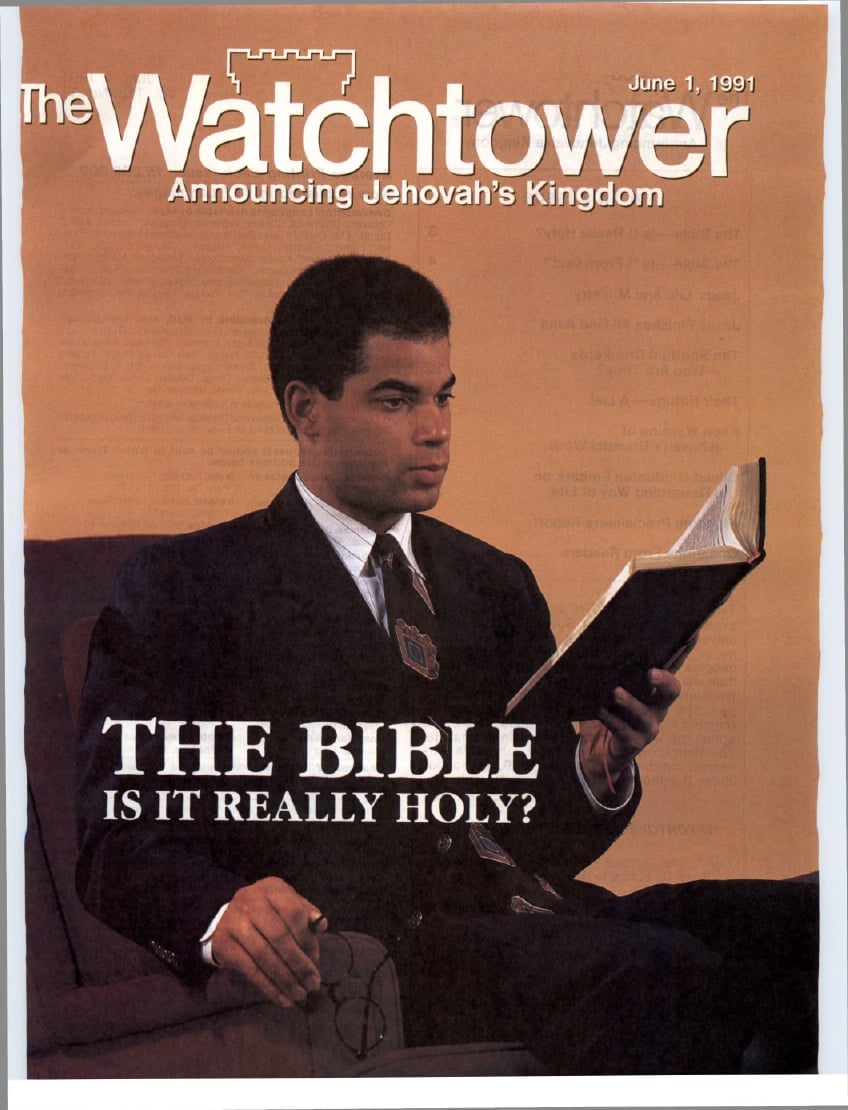
The Watchtower — June 1, 1991
Source: jw.org
Contents
The Bible—Is It Really Holy?
The Bible—Is It From God?
Jesus’ Life and Ministry
Jesus Finishes All God Asks
The Spiritual Drunkards—Who Are They?
Their Refuge—A Lie!
Keep Warning of Jehovah’s Unusual Work
Gilead Graduates Embark on a Rewarding Way of Life
Conduct That Adorns Our Christian Ministry
Questions From Readers
Attend the “Lovers of Freedom” District Convention!
The Bible—Is It Really Holy?
The Bible—Is It Really Holy?
HOW many people today view the Bible as holy, God’s Word? In this age of skepticism, many consider it out-of-date and irrelevant, doubting that it is truly holy. Even some of the religious leaders of Christendom teach that the Bible is saturated with legend and myth. They question ‘whether the biblical interpretation of history is one to which an intelligent person can subscribe.’—The Interpreter’s Dictionary of the Bible, Volume 2, page 611.
Prominent scholars are sowing seeds of doubt regarding the propriety of referring to the Bible as the Word of God. One said that “if one wants to use the Word-of-God type of language, the proper term for the Bible would be Word of Israel, Word of some leading early Christians.” (The Bible in the Modern World, by James Barr) What do you think? Is the Bible God’s Word? Is it really holy?
Who Wrote the Bible?
The writing of Genesis, the first book of the Bible, is traditionally credited to Moses, a Hebrew who lived some 3,500 years ago. According to the Bible itself, about 40 men from diverse walks of life shared in writing the rest of the Scriptures, resulting in the collection of the 66 books, or subdivisions, of the Bible. However, these men did not consider themselves to be the real authors of the Bible. One writer said: “All Scripture is inspired of God.” (2 Timothy 3:16) Another wrote of Bible writers: “Men spoke from God as they were borne along by holy spirit.”—2 Peter 1:21.
This places the writers in the category of penmen, or secretaries, controlled, or guided, by God. According to the Bible, the writer was usually allowed to select his own words in expressing the divinely supplied information. (Habakkuk 2:2) That is why there are many styles of writing throughout the Bible. But the writing was always guided by God.
Admittedly, the claims of these writers to divine inspiration are not in themselves proof that the Bible is the Creator’s divine message to humankind. Nevertheless, whether the Most High is the Bible’s Author or not should clearly be seen upon a careful and unbiased examination of the book itself. Does the Bible give evidence of divine authorship? Really, can we say with confidence that the Bible is holy?
The Bible—Is It From God?
The Bible—Is It From God?
JEHOVAH, a God of unlimited power and authority, certainly has the right to communicate with his human creation in whatever way he wishes. If he chose to communicate through the written word, he would also have to preserve his message through the ages. Has this been the case with the Bible?
About 1,500 years before Christ, when the writing of the Bible got started, there were many other religious writings in existence. However, all of these fell into disuse and eventually just vanished. Some have been unearthed by archaeologists and are now artifacts on display in museums. On the other hand, the portions of the Bible that were written over three thousand years ago were never forgotten, and copies have survived right up to our day. This is remarkable, especially when considering the hostility generated against the Bible throughout history. No other book has been the target of so much vicious opposition and hatred. Reading or distributing the Bible has been punishable with fines, imprisonment, torture, and often death.
How could a mere book survive under such circumstances? The Bible itself tells us: “The saying of Jehovah endures forever.” (1 Peter 1:25) The endurance and indestructibility of the Bible help to identify it as the holy Word of God.
Additionally, we should logically expect that God’s message to mankind would be available worldwide. Is this the case with the Bible? Indeed it is! No other book in history has come even close to the Bible in this. The Bible’s circulation has been estimated to be at the 3,000,000,000 mark. Moreover, no other book has been translated into so many languages. The Bible can now be read, in its entirety or in part, in more than 1,900 different tongues. The American Bible Society reports that it is now accessible to 98 percent of the world’s population. The New Encyclopædia Britannica calls the Bible “probably the most influential collection of books in human history.” It is not presumptuous, then, to describe it as the greatest book on earth.
The internal harmony of the Bible from beginning to end is in itself powerful evidence that it was indeed inspired by God. Would it be realistic to expect that the writings of some 40 different individuals over a period of 1,600 years could all prove to be harmonious and with one basic theme? This would be impossible if left to chance or to mere human direction. Yet, this is the case with the 66 books that make up the Bible. Only a superhuman, long-lived intelligence could effect such a remarkable production.
Not Just History
The historical contents of the Bible are remarkable. But a message from God consisting exclusively of historical data would prove of limited value to us. We need guidance and practical wisdom, and such can also be found in the Bible. For example, the Bible encourages us to cultivate “love, joy, peace, long-suffering, kindness, goodness, faith, mildness, self-control”—subjects on which much is written throughout its pages. (Galatians 5:22, 23; Colossians 3:12-14) The Bible recommends industriousness, cleanliness, honesty, marital faithfulness, respect and love for fellowmen; and it contains a vast wealth of advice on human behavior within the family and the community.
When applied, the Bible’s counsel stands out as truly beneficial. It sets us free from ignorance and superstition. (John 8:32) Its practical wisdom is unrivaled. Indeed, it contains, without question, divine wisdom.
The claim that “the word of God is alive and exerts power” fully harmonizes with the way the Bible actually changes people. (Hebrews 4:12) Millions today have overcome harmful personality traits and changed their destructive former course for the better as a result of taking to heart the Bible’s standards.—Ephesians 4:22.
What happens when Bible standards are ignored? The result is unhappiness and misery, wars, poverty, sexually transmitted diseases, and broken homes. Such things are only to be expected because disregarding the Holy Bible means rejecting the guidance of God, who created man and knows his needs.
The Bible also predicts the future, something impossible for humans to do. The rise of world powers from Babylon down through the centuries to our own day was prophetically announced in the Bible. (Daniel, chapters 2, 7, 8) Additionally, almost two thousand years ago, there was included in the Bible an accurate description of world conditions in this 20th century. (Matthew, chapters 24, 25; Mark, chapter 13; Luke, chapter 21; 2 Timothy 3:1-5; 2 Peter 3:3, 4; Revelation 6:1-8) The long list of fulfilled Bible prophecies assures us that the prospects for a happy future as described in its pages are genuine.
Our Responsibility
All of this is overwhelming evidence that God really has communicated with humans. True, God transmitted his message by the hand of imperfect men. But this is no reason to believe that the Bible is any less authentic than would be a word-of-mouth message from God, or one delivered through angels, or one miraculously written in heaven and hand delivered to men on earth.
However, acknowledging the holy, or divine, origin of the Bible imposes on us a responsibility. Jehovah rightfully expects us to read his Word regularly. (Psalm 1:1, 2) Fruitful Bible reading requires a proper attitude. One must keep in mind that the Bible is not to be read as if it were just any piece of literature. One must approach it, “not as the word of men, but, just as it truthfully is, as the word of God.”—1 Thessalonians 2:13.
Some things in the Bible may be hard to understand. But through frequent reading, a person grows in understanding and acquires a more complete picture of the will of God and of his purposes. (Hebrews 5:14) Perhaps you are not yet fully convinced that the Bible is the holy Word of God. But, consistently, how can you express belief or disbelief in the Bible if you have not carefully studied it?
Notwithstanding today’s skepticism regarding its divine origin, a careful examination of the Holy Bible has caused many thinking individuals to exclaim in the words of the apostle Paul: “Let God be found true, though every man be found a liar”!—Romans 3:4.
[Graph on page 4]
(For fully formatted text, see publication)
The Bible is now accessible to 98 percent of the world’s population
No other book in history has come close to the Bible’s estimated circulation of 3,000,000,000. The New Encyclopædia Britannica calls it “probably the most influential collection of books in human history”
[Pictures on page 4]
The Bible has survived, while other religious writings became mere museum artifacts
Above: Assyrian account of the Deluge
Right: Prayers to the Egyptian god Ra
[Credit Line]
Both: Courtesy of the Trustees of The British Museum
[Picture on page 5]
Written by some 40 different individuals over a period of 1,600 years, the Bible follows one basic theme from beginning to end. Only a superhuman, long-lived intelligence could effect such a remarkable production
[Picture on page 5]
The rise of world powers from Babylon down through the centuries to our own day was prophetically announced in the Bible. (Daniel 2, 7, 8)
Right: Caesar Augustus
[Credit Line]
Museo della Civiltà Romana, Roma
[Picture on page 6]
Almost two thousand years ago, the Bible accurately foretold world conditions today. (Matthew 24, 25; Mark 13; Luke 21; 2 Timothy 3:1-5; 2 Peter 3:3, 4; Revelation 6:1-8) The unerring accuracy of Bible prophecy assures us that God’s promise of a paradise earth is certain to be fulfilled
[Credit Line]
Reuters/Bettmann Newsphotos
Jesus’ Life and Ministry
Jesus’ Life and Ministry
THE article “Jesus Finishes All God Asks,” on the following pages, is the last segment of our long-running series “Jesus’ Life and Ministry.” This feature has appeared in The Watchtower for more than six years, in 149 consecutive issues, starting with the April 1, 1985, issue.
It is our hope that this series in The Watchtower has helped you to follow the apostle Paul’s admonition to ‘look intently at Jesus’ and to heed God’s command to “listen to him.” (Hebrews 12:2, 3; Matthew 17:5) Over the years, many have written to say that they have been helped to do this. “It’s as if I were there listening to him and watching what he does,” wrote one reader. “I have come to love him more because of these articles.”
Another reader wrote: “Every issue seems to contain a point that I had missed when reading the Bible account. I have enjoyed getting in mind the different events in Jesus’ life in better chronological order by reading each article.” Many have expressed similar appreciation for learning when and where Jesus taught and did things during his ministry.
A woman in Spain said: “I have kept all the articles since the beginning. They are so instructive for adults as well as for children. I am 44, and I am thrilled when I read these accounts. It is as if I were present in each historical incident.”
A mother in the United States wrote: “Because of the brevity of the articles and their simple expression, my husband has joined in our family study. My eight-year-old son asked me to write to thank you that his father now studies the Bible. He requests that some day when this series is completed the articles be published in a book so he can share them with his schoolmates.”
Perhaps you share the sentiments of the reader who recently lamented: “I feel a bit saddened to think the series will soon end as the final days of Christ’s life are considered. I shall truly miss their place in The Watchtower.” We hope that you will enjoy this final part of our series “Jesus’ Life and Ministry.”
Jesus Finishes All God Asks
Jesus’ Life and Ministry
Jesus Finishes All God Asks
WHEN the Warrior-King Jesus Christ removes Satan and his unrighteous world, what cause for rejoicing there will be! The peaceful Thousand Year Reign of Jesus begins at last!
Under the direction of Jesus and his associate kings, the survivors of Armageddon will clean up the ruins left by that righteous war. Likely, earthly survivors will also bear children for a time, and these will share in the delightful work of cultivating the earth into a gorgeous parklike garden.
In time Jesus will bring forth untold millions from their graves to enjoy this beautiful Paradise. He will do this in fulfillment of his own guarantee: “The hour is coming in which all those in the memorial tombs will . . . come out.”
Among those Jesus resurrects will be the former evildoer who died beside him on the torture stake. Recall that Jesus promised him: “Truly I tell you today, You will be with me in Paradise.” No, that man will not be taken to heaven to rule as a king with Jesus, nor will Jesus again become a man and live on the Paradise earth with him. Rather, Jesus will be with the former evildoer in the sense that He will resurrect him to life in Paradise and see to it that his needs, both physical and spiritual, are cared for, as illustrated on this page.
Think of it! Under Jesus’ loving attention, the entire human family—Armageddon survivors, their offspring, and the thousands of millions of resurrected dead who obey him—will grow toward human perfection. Jehovah, by means of his royal Son, Jesus Christ, will reside spiritually with humankind. “And,” as the voice John heard from heaven says, “he will wipe out every tear from their eyes, and death will be no more, neither will mourning nor outcry nor pain be anymore.” No person on earth will suffer or be sick.
By the end of Jesus’ Thousand Year Reign, the situation will be just as God originally purposed when he told the first human pair, Adam and Eve, to multiply and fill the earth. Yes, the earth will be filled with a righteous race of perfect humans. This is because the benefits of Jesus’ ransom sacrifice will have been applied to everyone. Death because of Adam’s sin will be no more!
Thus, Jesus will have accomplished all that Jehovah asked of him. Therefore, at the end of the thousand years, he will hand over the Kingdom and the perfected human family to his Father. God will then release Satan and his demons from the abyss of deathlike inactivity. For what purpose?
Well, by the end of the thousand years, most of those living in Paradise will be resurrected ones who have never had their faith tested. Before dying, they had never known God’s promises and so could not demonstrate faith in them. Then, after being resurrected and taught Bible truths, it was easy for them in Paradise, without any opposition, to serve God. But if Satan was given opportunity to try to stop them from continuing to serve God, would they prove loyal under test? To resolve this question, Satan will be released.
The revelation given to John reveals that after Jesus’ Thousand Year Reign, Satan will prove successful in turning an undetermined number of people away from serving God. But then, when the final test is finished, Satan, his demons, and all those whom he succeeds in misleading will be destroyed forever. On the other hand, the fully tested, loyal survivors will live on to enjoy the blessings of their heavenly Father throughout all eternity.
Clearly, Jesus has played, and will continue to play, a vital role in accomplishing God’s glorious purposes. What a grand future we may enjoy as a result of all that he accomplishes as God’s great heavenly King! Yet, we cannot forget all that he did while he was a man.
Jesus willingly came to earth and taught us about his Father. Beyond this he exemplified the precious qualities of God. Our hearts are moved when we consider his sublime courage and manliness, his unparalleled wisdom, his superb ability as a teacher, his fearless leadership, and his tender compassion and empathy. When we recall how he suffered indescribably as he furnished the ransom, by which alone we may gain life, surely our hearts are moved with appreciation for him!
Truly, what a man we have seen in this study of the life of Jesus! His greatness is obvious and overwhelming. We are moved to echo the words of the Roman governor Pontius Pilate: “Look! The man!”
By our accepting the provision of his ransom sacrifice, the burden of sin and death inherited from Adam can be removed from us, and Jesus can become our “Eternal Father.” All who would gain everlasting life must take in knowledge not only of God but also of his Son, Jesus Christ. It is our hope that your reading and study of this series of articles on Jesus’ life and ministry will have assisted you to take in such life-giving knowledge! 1 John 2:17; 1:7; John 5:28, 29; 3:16; 17:3; 19:5; Luke 23:43; Genesis 1:28; 1 Corinthians 15:24-28; Revelation 20:1-3, 6-10; 21:3, 4; Isaiah 9:6.
◆ What will be the happy privilege of Armageddon survivors and their children?
◆ Who in addition to Armageddon survivors and their children will enjoy Paradise, and in what sense will Jesus be with them?
◆ What will be the situation at the end of the thousand years, and what will Jesus do then?
◆ Why will Satan be released from the abyss, and what will eventually happen to him and all who follow him?
◆ How can Jesus become our “Eternal Father”?
The Spiritual Drunkards—Who Are They?
The Spiritual Drunkards—Who Are They?
“Woe to the eminent crown of the drunkards of Ephraim.”—ISAIAH 28:1.
1. What optimism have many felt, but will their hopes be fulfilled?
WE ARE living in stirring times. Many people have been excited by dramatic political changes around the world and in seeing more involvement by the United Nations. In December 1989 the Detroit Free Press said: “As the planet enters the 1990s, peace has broken out.” A Soviet magazine announced: “We are preparing to beat swords into ploughshares,” while the secretary-general of the United Nations declared: “We are no longer in the cold war.” Yes, hopes have been high, and without a doubt, the world scene is changing. More recently, the Gulf war has illustrated how rapidly changes may take place. But will this present world ever realize a time of actual peace and security, with all its attendant benefits? The answer is no. In fact, a serious crisis is brewing that will rock the world to its foundations! It is a crisis in which religion is deeply involved.
2. How was today’s situation paralleled in ancient Israel and Judah?
2 This crisis was foreshadowed by events in ancient Israel and Judah during the eighth and seventh centuries B.C.E. Back then, too, people thought that they might have achieved peace. But God, through his prophet Isaiah, warned that their hope for peace was a delusion, which would soon be exposed. In a similar way today, Jehovah, through his Witnesses, is warning mankind that they are deceived if they hope to achieve a lasting peace through human efforts. Let us read Jehovah’s prophetic warning and see how it applies today. It is found in the 28th chapter of Isaiah and was written before 740 B.C.E., likely during the reigns of wicked King Pekah of Israel and of wayward King Ahaz of Judah.
“The Drunkards of Ephraim”
3. What startling denunciation did Isaiah utter?
3 In verse 1 of chapter 28 Isa 28:1, we are jolted by a startling statement: “Woe to the eminent crown of the drunkards of Ephraim, and the fading blossom of its decoration of beauty that is upon the head of the fertile valley of those overpowered by wine!” How the Israelites must have been shocked to hear that scathing denunciation! Who were these “drunkards of Ephraim”? What was their “eminent crown”? And what is “the head of the fertile valley”? More important, what do these words imply for us today?
4. (a) What were Ephraim and the head of the fertile valley? (b) Why did Israel feel secure?
4 Since Ephraim was the largest of the ten tribes of Israel, the term “Ephraim” sometimes referred to the whole northern kingdom. So “the drunkards of Ephraim” were really the drunkards of Israel. The capital city of Israel was Samaria, which was situated on a commanding height at the head of a fertile valley. So the expression “the head of the fertile valley” refers to Samaria. When these words were written, the kingdom of Israel was very corrupt religiously speaking. Moreover, she had entered a political alliance with Syria against Judah and now felt secure. (Isaiah 7:1-9) That was about to change. A crisis was approaching, which was why Jehovah pronounced “woe to the eminent crown of the drunkards of Ephraim.”
5. (a) What was Israel’s eminent crown? (b) Who were the drunkards of Ephraim?
5 What was “the eminent crown”? A crown is a symbol of royal authority. Evidently, “the eminent crown” was Israel’s position as a separate kingdom, independent of Judah. Something was going to happen to destroy Israel’s royal independence. Who, then, were “the drunkards of Ephraim”? Doubtless, there were literal drunkards in Israel, since Samaria was the scene of licentious pagan worship. Yet, the Bible speaks of a worse kind of drunkenness. At Isaiah 29:9, we read: “They have become intoxicated, but not with wine; they have moved unsteadily, but not because of intoxicating liquor.” This was a spiritual drunkenness, an unclean, death-dealing intoxication. Israel’s leaders—particularly her religious leaders—clearly suffered from just such a spiritual intoxication.
6. What made ancient Israel drunk?
6 What was the cause of ancient Israel’s spiritual drunkenness? Basically, it was her alliance with Syria against Judah, which gave the nation’s leaders a good feeling of security. This spiritual drunkenness put Israel out of touch with reality. Like a literal drunkard, she was optimistic although there was no reason to be. Moreover, Israel wore her intoxicating alliance with Syria proudly, like a garland of beauty. But, as Isaiah says, it was a fading garland that would not last much longer.
7, 8. Despite her good feelings, what was ancient Israel due to experience?
7 Isaiah stresses this in Isa chapter 28, verse 2: “Look! Jehovah has someone strong and vigorous. Like a thunderous storm of hail, a destructive storm, like a thunderous storm of powerful, flooding waters, he will certainly do a casting down to the earth with force.” Who was this “someone strong and vigorous”? In ancient Israel’s time, it was the powerful Assyrian Empire. This cruel, ruthless world power would come upon Israel like a thunderous storm of powerful, flooding waters. With what result?
8 Isaiah goes on to say: “With the feet the eminent crowns of the drunkards of Ephraim will be trampled down. And the fading flower of its decoration of beauty that is upon the head of the fertile valley must become like the early fig before summer, that, when the seer sees it, while it is yet in his palm, he swallows it down.” (Isaiah 28:3, 4) Israel’s capital city, Samaria, was like a ripe fig to Assyria, ready to be plucked and swallowed. Israel’s garlandlike alliance with Syria was going to be trampled. It would have no value when the day of reckoning came. Even worse, her crownlike glory of independence would be crushed under the feet of the Assyrian enemy. What a catastrophe!
‘Priest and Prophet Gone Astray’
9. Why may Judah have expected a better message from Jehovah than ancient Israel got?
9 Yes, a terrible reckoning awaited Israel, and just as Jehovah God had warned, that reckoning came in the year 740 B.C.E. when Samaria was destroyed by Assyria and the northern kingdom ceased to exist as an independent nation. What happened to ancient Israel stands as a grim warning to unfaithful false religion today, as we shall see. But what of Israel’s sister kingdom to the south, Judah? In Isaiah’s time Jehovah’s temple still functioned in Jerusalem, the capital of Judah. The priesthood still operated there, and prophets such as Isaiah, Hosea, and Micah spoke in Jehovah’s name. What message, then, did Jehovah have for Judah?
10, 11. What disgusting situation existed in Judah?
10 Isaiah goes on to tell us: “These also [that is, the priests and the prophets of Jerusalem]—because of wine they have gone astray and because of intoxicating liquor they have wandered about. Priest and prophet—they have gone astray because of intoxicating liquor.” (Isaiah 28:7a) Evidently, Judah’s religious leaders were also drunk. Likely, as in Israel, some were drunkards in a literal sense, and if so, this was a disgrace. God’s Law specifically prohibited strong drink to priests when they were serving in the temple. (Leviticus 10:8-11) Literal drunkenness in God’s house would have been a shocking contravention of God’s Law.
11 More serious, though, there was spiritual drunkenness in Judah. Just as Israel had aligned herself with Syria against Judah, so Judah sought security through an alliance with Assyria. (2 Kings 16:5-9) Despite the presence of God’s temple and his prophets, Judah put faith in humans when she should have trusted Jehovah. Moreover, having formed such an ill-advised alliance, her leaders felt as carefree as their spiritually drunken neighbors to the north. Their irresponsible attitude disgusted Jehovah.
12. What would result from Judah’s spiritual drunkenness?
12 Isaiah goes on to say: “They have become confused as a result of the wine, they have wandered about as a result of the intoxicating liquor; they have gone astray in their seeing, they have reeled as to decision. For the tables themselves have all become full of filthy vomit—there is no place without it.” (Isaiah 28:7b, 8) Likely, in their drunken state, some literally vomited in the temple. But even worse, the priests and the prophets who should have given religious guidance vomited forth spiritual filth. Moreover, with the exception of a few faithful ones, the judgments of the prophets were warped, and they foresaw false things for the nation. Jehovah would punish Judah for this spiritual uncleanness.
Spiritual Drunkards Today
13. What parallel to the situation in Israel and Judah existed in the first century C.E., and what parallel exists today?
13 Were Isaiah’s prophecies fulfilled only on ancient Israel and Judah? By no means. Both Jesus and the apostle Paul quoted his words about spiritual drunkenness and applied them to the religious leaders of their time. (Isaiah 29:10, 13; Matthew 15:8, 9; Romans 11:8) Today, too, a situation like that in Isaiah’s time has arisen—this time in Christendom, a worldwide religious organization that claims to represent God. Rather than taking a firm stand for truth and relying on Jehovah, Christendom, Catholic and Protestant, puts her faith in the world. She thus staggers about unsteadily, like the drunkards of Israel and Judah. The spiritual drunkards of those ancient nations well foreshadow the spiritual leaders of Christendom today. Let us see exactly how.
14. How are the religious leaders of Christendom as drunk as were the leaders of ancient Samaria and Jerusalem?
14 Like Samaria and Jerusalem, Christendom has drunk deep of the wine of political alliances. In 1919 she was among the foremost promoters of the League of Nations. While Jesus said that Christians would be no part of the world, Christendom’s leaders cultivate relationships with political leaders. (John 17:14-16) The symbolic wine of such activity is stimulating to the clergy. (Compare Revelation 17:4.) They enjoy being consulted by politicians and associating with the great ones of this world. As a result, they have no true spiritual guidance to give. They vomit out uncleanness rather than speaking the pure message of truth. (Zephaniah 3:9) With their vision blurred and confused, they are no safe guides for mankind.—Matthew 15:14.
“Command Upon Command”
15, 16. How did Isaiah’s contemporaries respond to his warnings?
15 In the eighth century B.C.E., Isaiah exposed the wrong course of the spiritual leaders of Judah in particular. How did they respond? They hated it! When Isaiah persisted in proclaiming God’s warnings, the religious leaders retorted: “Whom will one instruct in knowledge, and whom will one make understand what has been heard? Those who have been weaned from the milk, those moved away from the breasts?” (Isaiah 28:9) Yes, did Isaiah think he was talking to little babies? Jerusalem’s religious leaders considered themselves to be grown men, fully capable of making decisions for themselves. They did not need to listen to the nagging reminders of Isaiah.
16 Those religionists even made a joke of Isaiah’s preaching work. They chanted at him: “For it is ‘command upon command, command upon command, measuring line upon measuring line, measuring line upon measuring line, here a little, there a little.’” (Isaiah 28:10) ‘Isaiah keeps repeating himself,’ they claimed. ‘He keeps saying: “This is what Jehovah has commanded! This is what Jehovah has commanded! This is Jehovah’s standard! This is Jehovah’s standard!”’ In the original Hebrew, Isaiah 28:10 is a repetitious rhyme, rather like a child’s nursery rhyme. And that is how the prophet seemed to the religious leaders, repetitious and childish.
17. How do many today react to the warning message proclaimed by Jehovah’s Witnesses?
17 In the first century C.E., the preaching of Jesus and his disciples sounded similarly repetitious and unsophisticated. Those who followed Jesus were viewed by the Jewish religious leaders as accursed, unsophisticated yokels, men unlettered and ordinary. (John 7:47-49; Acts 4:13) Jehovah’s Witnesses today are often viewed in the same way. They have not attended Christendom’s seminaries, and they do not use high-sounding titles or theological terminology as do the clergy. So the high ones in Christendom look down on them, imagining that they should know their place and give these religious leaders more respect.
18. What do religious leaders today overlook?
18 However, there is something that those religious leaders overlook. Even though the great ones of Isaiah’s day rejected his message, he was speaking the truth, and his warnings came true! Similarly, the warnings Jehovah’s Witnesses utter today are true, solidly based on God’s Word of truth, the Bible. (John 17:17) Hence, they will be fulfilled.
The Reckoning
19. How was Judah forced to pay heed to foreigners speaking a stammering language?
19 At Isaiah 28:11, we read: “For by those stammering with their lips and by a different tongue he will speak to this people.” Isaiah’s teaching sounded to Judah like foreign babble. Although Judah survived the Assyrian menace that overwhelmed Israel, in time Jehovah dealt with Judah by means of another foreigner, Nebuchadnezzar. (Jeremiah 5:15-17) The Babylonian language sounded harsh and stammering to those Hebrews. But they were forced to listen to it when Jerusalem and its temple were destroyed in 607 B.C.E. and the inhabitants were dragged off into Babylonian exile. In the same way today, Christendom will soon have to suffer because, like Judah of old, she ignores Jehovah’s exhortations.
20, 21. What do Jehovah’s Witnesses incessantly proclaim, but what do the leaders of Christendom refuse to do?
20 The prophecy says of such ones: “Those to whom he has said: ‘This is the resting-place. Give rest to the weary one. And this is the place of ease,’ but who were not willing to hear. And to them the word of Jehovah will certainly become ‘command upon command, command upon command, measuring line upon measuring line, measuring line upon measuring line, here a little, there a little,’ in order that they may go and certainly stumble backwards and actually be broken and ensnared and caught.”—Isaiah 28:12, 13.
21 Incessantly, just as Isaiah spoke God’s message, Jehovah’s Witnesses tell Christendom that she should rest her hope in Jehovah’s word. But she refuses to listen. To her, the Witnesses seem to be babbling in a foreign tongue. They speak a language she cannot understand. Christendom refuses to give rest to the weary one by telling about God’s Kingdom and the new world to come. Rather, she is drunk with the wine of her relationship with this world. She prefers to support political solutions to mankind’s problems. Like the Jews of Jesus’ day, she has not sought the Kingdom resting-place herself, and she will not tell others about it.—Matthew 23:13.
22. Of what does Jehovah put the leaders of Christendom on notice?
22 Hence, Isaiah’s prophetic words put the clergy on notice that Jehovah will not always speak by means of His harmless Witnesses. Soon, Jehovah will carry into effect his “command upon command, measuring line upon measuring line,” and the result will be catastrophic for Christendom. Her religious leaders and their flocks will “be broken and ensnared and caught.” Yes, like Jerusalem of old, Christendom’s religious systems will be utterly destroyed. What a shocking, unexpected development that will be! And what a frightful outcome because the clergy prefer spiritual drunkenness to Jehovah’s reminders!
Can You Explain?
□ Who were the drunkards of Ephraim, and what made them drunk?
□ How were the eminent crowns of the drunkards of Ephraim trampled down?
□ What disgraceful situation in Judah did Isaiah expose?
□ Where today do we see spiritual drunkenness?
□ Why should Christendom heed what happened to the ancient nation of Judah?
Their Refuge—A Lie!
Their Refuge—A Lie!
“We have made a lie our refuge and in falsehood we have concealed ourselves.”—ISAIAH 28:15.
1, 2. (a) Which organization today should take note of what happened to the ancient kingdom of Judah? (b) What misplaced confidence did Judah have?
DO THOSE words apply to Christendom today as they did to the ancient two-tribe kingdom of Judah? Surely, they do! And that parallel bodes ill for modern-day Christendom. It means that catastrophe will soon overtake that apostate religious organization.
2 To the north of Judah was the ten-tribe kingdom of Israel. When Israel proved faithless, Jehovah allowed her to be conquered by Assyria in 740 B.C.E. Her sister kingdom, Judah, witnessed this tragic event but clearly felt that such a thing would never happen to her. ‘Why,’ her leaders boasted, ‘is not Jehovah’s temple in Jerusalem? Are we not God’s favored people? Do not our priests and prophets speak in Jehovah’s name?’ (Compare Jeremiah 7:4, 8-11.) Those religious leaders were confident that they were safe. But they were wrong! They were just as faithless as their northern kinsmen. So, what happened to Samaria would also happen to Jerusalem.
3. Why does Christendom feel confident as to the future, but is there good reason for her confidence?
3 In a similar way, Christendom claims to have a special relationship with God. ‘Why,’ she boasts, ‘we have tens of thousands of churches and a professional clergy, as well as hundreds of millions of adherents. We also possess the Bible, and we use the name of Jesus in our worship. Surely, we are favored by God!’ But what happened to ancient Jerusalem stands as a stern warning. Despite recent extraordinary political developments, we know that Jehovah will soon act decisively against Christendom and all other false religions.
“A Covenant With Death”
4. What covenant did Judah think she had made?
4 In ancient times, unfaithful Jerusalem received many warnings through God’s true prophets, but she did not believe them. Instead, she bragged that death would never take her down into Sheol, the grave, as it had taken the northern kingdom of Israel down. Isaiah the prophet was inspired to say to Judah: “Therefore hear the word of Jehovah, you braggarts, you rulers of this people who are in Jerusalem: Because you men have said: ‘We have concluded a covenant with Death; and with Sheol we have effected a vision; the overflowing flash flood, in case it should pass through, will not come to us, for we have made a lie our refuge and in falsehood we have concealed ourselves.’”—Isaiah 28:14, 15.
5. (a) What was Judah’s supposed covenant with death? (b) What warning given to King Asa had Judah forgotten?
5 Yes, Jerusalem’s leaders thought they had an agreement, as it were, with death and Sheol so that their city would be preserved. But did Jerusalem’s supposed covenant with death mean that she had repented of her sins and now trusted in Jehovah for salvation? (Jeremiah 8:6, 7) Not at all! Rather, she turned to human political rulers for help. But her reliance on worldly allies was a delusion, a lie. The worldlings she trusted could not save her. And since she abandoned Jehovah, Jehovah abandoned Jerusalem. It happened just as the prophet Azariah had warned King Asa: “Jehovah is with you as long as you prove to be with him; and if you search for him, he will let himself be found by you, but if you leave him he will leave you.”—2 Chronicles 15:2.
6, 7. What steps did Judah take to ensure her security, but with what final result?
6 Confident in their political alliances, Jerusalem’s leaders were sure that no “overflowing flash flood” of invading armies would come near them to disturb their peace and security. When threatened by an alliance of Israel and Syria, Judah turned to Assyria for help. (2 Kings 16:5-9) Later, when menaced by the military forces of Babylon, she appealed to Egypt for support and Pharaoh responded, sending an army to help.—Jeremiah 37:5-8; Ezekiel 17:11-15.
7 But Babylon’s armies were too powerful, and Egypt’s troops had to withdraw. Jerusalem’s placing confidence in Egypt proved to be a mistake, and in 607 B.C.E., Jehovah abandoned her to the destruction he had foretold. So Jerusalem’s rulers and priests were wrong! Their trust in worldly alliances for peace and security was “a lie” that was swept away by the flash flood of Babylon’s armies.
Rejecting the “Tried Stone”
8. How has Christendom taken a position very much like that of ancient Judah?
8 Is there a parallel situation today? Yes, there is. The clergy of Christendom also feel that no calamity will overtake them. In effect, they say as Isaiah foretold: “We have concluded a covenant with Death; and with Sheol we have effected a vision; the overflowing flash flood, in case it should pass through, will not come to us, for we have made a lie our refuge and in falsehood we have concealed ourselves.” (Isaiah 28:15) Like ancient Jerusalem, Christendom looks to worldly alliances for security, and her clergy refuse to take refuge in Jehovah. Why, they do not even use his name, and they mock and persecute those who do honor that name. Christendom’s clergy have done just what the Jewish chief priests in the first century did when they rejected Christ. They have said, in effect, “We have no king but Caesar.”—John 19:15.
9. (a) Who is warning Christendom today in the same way that Isaiah warned Judah? (b) To whom should Christendom turn?
9 Today, Jehovah’s Witnesses warn that a flood of executional armies will soon sweep over Christendom. Moreover, they point to the true place of refuge from that flood. They quote Isaiah 28:16, which says: “This is what the Sovereign Lord Jehovah has said: ‘Here I am laying as a foundation in Zion a stone, a tried stone, the precious corner of a sure foundation. No one exercising faith will get panicky.’” Who is this ‘precious cornerstone’? The apostle Peter quoted these words and applied them to Jesus Christ. (1 Peter 2:6) If Christendom had sought peace with Jehovah’s King, Jesus Christ, then she would have avoided the coming flash flood.—Compare Luke 19:42-44.
10. What involvements has Christendom cultivated?
10 However, she has not done so. Instead, in her quest for peace and security, she insinuates herself into the favor of the political leaders of the nations—this despite the Bible’s warning that friendship with the world is enmity with God. (James 4:4) Moreover, in 1919 she strongly advocated the League of Nations as man’s best hope for peace. Since 1945 she has put her hope in the United Nations. (Compare Revelation 17:3, 11.) How extensive is her involvement with this organization?
11. What representation does religion have at the UN?
11 A recent book gives an idea when it states: “No less than twenty-four Catholic organizations are represented at the UN. Several of the world’s religious leaders have visited the international organization. Most memorable were the visits of His Holiness Pope Paul VI during the General Assembly in 1965 and of Pope John Paul II in 1979. Many religions have special invocations, prayers, hymns and services for the United Nations. The most important examples are those of the Catholic, the Unitarian-Universalist, the Baptist and the Bahai faiths.”
Vain Hopes for Peace
12, 13. Despite widespread hopes that peace is on the horizon, why are Jehovah’s Witnesses confident that their warnings are true?
12 One of the world’s most powerful political leaders echoed the hopes of many when he said: “This generation of people on earth may witness the advent of an irreversible period of peace in the history of civilization.” Was he right? Do recent developments mean that the warnings Jehovah’s Witnesses have issued concerning Jehovah’s execution of judgment on the nations will not come true? Are Jehovah’s Witnesses wrong?
13 No, they are not wrong. They know they are telling the truth because they put their trust in Jehovah and in the Bible, which is God’s own Word of truth. Titus 1:2 says: “God . . . cannot lie.” So they have full confidence that when a Bible prophecy says that a certain thing will happen, it will without fail come to pass. Jehovah himself states: “So my word that goes forth from my mouth will prove to be. It will not return to me without results, but it will certainly do that in which I have delighted.”—Isaiah 55:11.
14, 15. (a) What were the leaders of Judah proclaiming shortly before Jerusalem’s destruction in 607 B.C.E.? (b) What did Paul foretell would be proclaimed before sudden destruction would come upon this world? (c) What can we expect at the climax of the proclamation prophesied at 1 Thessalonians 5:3?
14 In the years before the destruction of Jerusalem in 607 B.C.E., Jeremiah reported that the leaders were crying, “There is peace! There is peace!” (Jeremiah 8:11) However, that was a lie. Jerusalem was destroyed in fulfillment of the inspired warnings of Jehovah’s true prophets. The apostle Paul warned that something similar would happen in our day. He said that men would be crying “Peace and security!” But then, he said, “sudden destruction” would be “instantly upon them.”—1 Thessalonians 5:3.
15 As we entered the 1990’s, newspapers and magazines everywhere were saying that the Cold War is over and that world peace is at last in sight. But then a shooting war broke out in the Middle East. However, sooner or later the world situation will develop to the point where the cry of “Peace and security!” prophesied at 1 Thessalonians 5:2, 3 will increase to a climax. With our hopes firmly anchored in God’s Word, we know that, as that climax is reached, God’s judgments will be executed swiftly and unerringly. No patched-up peace and security pronouncements should make us think that destruction foretold by God will not come. Jehovah’s judgments are unchangeably recorded in his Word the Bible. Christendom, along with all other false religion, will be destroyed. And then Jehovah’s destructive judgments will be expressed against the rest of Satan’s world. (2 Thessalonians 1:6-8; 2:8; Revelation 18:21; 19:19-21) Since Jehovah’s Witnesses are confident that Jehovah will fulfill his word, they continue to keep on the watch under the guidance of the faithful and discreet slave class and carefully observe how world events unfold. (Matthew 24:45-47) Certainly, no peacemaking efforts of man should make us think that Jehovah has abandoned his purpose to bring a flash flood of destruction on sin-laden Christendom.
‘God Is Our Refuge’
16, 17. How do Jehovah’s Witnesses respond if some take offense at the frankness of their message?
16 Some may take offense at the frankness of Jehovah’s Witnesses in proclaiming this. However, when they say that Christendom’s religious rulers have taken refuge in a lying arrangement, they merely relate what the Bible says. When they say that Christendom deserves punishment because she has become a part of the world, they merely report what God himself says in the Bible. (Philippians 3:18, 19) Moreover, because Christendom puts her confidence in the schemes proposed by this world, she actually supports the god of this world, Satan the Devil, who Jesus said is the father of the lie.—John 8:44; 2 Corinthians 4:4.
17 Therefore, Jehovah’s Witnesses declare: As for us, we do not encourage false hopes of world peace because of the changing political scene. Instead, we echo the words of the psalmist: “God is a refuge for us. . . . The sons of earthling man are an exhalation, the sons of mankind are a lie. When laid upon the scales they are all together lighter than an exhalation.” (Psalm 62:8, 9) Human schemes to promote and preserve Christendom and the rest of this system of things are a falsehood, a lie! All of them put together have no more power to forestall Jehovah’s purposes than does a mouthful of hot air!
18. What warning of the psalmist is appropriate today?
18 Jehovah’s Witnesses also quote Psalm 33, verses 17 to 19, which declares: “The horse [of Egypt, symbolizing warfare] is a deception for salvation, and by the abundance of its vital energy it does not afford escape. Look! The eye of Jehovah is toward those fearing him, to those waiting for his loving-kindness, to deliver their soul from death itself, and to preserve them alive in famine.” Today, true Christians trust in Jehovah and in his heavenly Kingdom, the only arrangement that can bring permanent peace.
Christendom “a Trampling Place”
19. Why is reliance on political organizations to bring world peace an illusion?
19 To trust any man-made substitute for God’s Kingdom makes that substitute an image, an object of worship. (Revelation 13:14, 15) Thus, encouraging reliance on political institutions, such as the United Nations, for peace and security is an illusion, a lie. Concerning such objects of false hopes, Jeremiah says: “His molten image is a falsehood, and there is no spirit in them. They are vanity, a work of mockery. In the time of their being given attention they will perish.” (Jeremiah 10:14, 15) Therefore, the war-horses of antitypical Egypt, that is, the military-political might of the nations today, will not protect the religious realm of Christendom in her day of crisis. The alliance of Christendom’s religions with this world will surely fail to protect them.
20, 21. (a) What happened to the League of Nations, and why will the United Nations fare no better? (b) How did Isaiah show that Christendom’s alliances with the world will not save her?
20 Christendom rested her hopes in the League of Nations, but it was overturned even without the coming of Armageddon. Now she has transferred her allegiance to the United Nations. But it will soon have to face “the war of the great day of God the Almighty,” and it will not survive. (Revelation 16:14) Even a revived UN can never bring peace and security. God’s prophetic Word shows that the United Nations organization with its member nations “will battle with the Lamb [Christ in Kingdom power], but, because he is Lord of lords and King of kings, the Lamb will conquer them.”—Revelation 17:14.
21 Jehovah’s Witnesses confidently say that there is no salvation for Christendom in her alliances with Satan’s world. And when they say this, they are merely pointing out what the Bible itself says. Isaiah 28:17, 18 quotes Jehovah as saying: “I will make justice the measuring line and righteousness the leveling instrument; and the hail must sweep away the refuge of a lie, and the waters themselves will flood out the very place of concealment. And your covenant with Death will certainly be dissolved, and that vision of yours with Sheol will not stand. The overflowing flash flood, when it passes through—you must also become for it a trampling place.”
22. When perfect justice is applied to Christendom, what will result?
22 When Jehovah’s judicial decision is carried out, it will be according to perfect justice. And Christendom’s basis for confidence, her “covenant with Death,” will be completely swept away as if by a flash flood. Isaiah goes on to say: “Morning by morning it will pass through, during the day and during the night; and it must become nothing but a reason for quaking to make others understand what has been heard.” (Isaiah 28:19) How terrifying it will be for onlookers to witness the full power of Jehovah’s judgment! How awful for Christendom’s clergy and their followers to find out, too late, that they have trusted in a lie!
Jehovah’s Name “a Strong Tower”
23, 24. Rather than seeking security in this world, what will Jehovah’s Witnesses do?
23 But what of Jehovah’s Witnesses? Even in the face of international hatred and persecution, they persist in keeping separate from the world. They never forget that Jesus said of his followers: “They are no part of the world, just as I am no part of the world.” (John 17:16) Throughout these last days, they have put their trust in Jehovah’s Kingdom, not in human schemes. Therefore, Christendom’s calamity will not cause Jehovah’s Witnesses to be terrified. As Isaiah foretold: “No one exercising faith will get panicky.”—Isaiah 28:16.
24 Proverbs 18:10 says: “The name of Jehovah is a strong tower. Into it the righteous runs and is given protection.” We therefore invite all sheeplike persons to take refuge in Jehovah and in his Kingdom by Christ. As a concealment place, Jehovah is no falsehood! His Kingdom by Christ is no lie! Christendom’s refuge is a lie, but the refuge of true Christians is the truth.
Can You Explain?
□ How did ancient Judah take refuge in a lie?
□ In what way has Christendom tried to conceal herself in falsehood?
□ How did Isaiah warn Judah, and how do Jehovah’s Witnesses utter a similar warning today?
□ How will Christendom find that her confidence is misplaced?
□ In contrast with Christendom, what stand do Jehovah’s Witnesses maintain?
[Box on page 17]
HIGH HOPES VOICED FOR THE UNITED NATIONS
“For the first time since World War II the international community is united. The leadership of the United Nations, once only a hoped-for ideal, is now confirming its founders’ vision. . . . The world can therefore seize this opportunity to fulfill the long-held promise of a new world order.”—President Bush of the United States in his State of the Union message to that nation, January 29, 1991
Keep Warning of Jehovah’s Unusual Work
Keep Warning of Jehovah’s Unusual Work
“Jehovah will rise up just as at Mount Perazim, he will be agitated just as in the low plain near Gibeon.”—ISAIAH 28:21.
1, 2. What unusual work did Jehovah perform in behalf of His people in David’s day?
A STRANGE deed! A most unusual work! That is what Jehovah performed in behalf of his people in ancient times back in the 11th century B.C.E. And this strange deed was a pattern for an even more unusual work that he is about to perform in the near future. What was that ancient deed? Soon after David was installed as king in Jerusalem, the neighboring Philistines launched an attack, and this triggered Jehovah’s strange deed. First, the Philistines began raiding in the low plain of Rephaim. David asked Jehovah what he should do and was instructed to go on the offensive. Obeying Jehovah’s word, David soundly defeated the mighty Philistine army at Baal-perazim. But the Philistines did not admit defeat. Soon they returned to ravage and pillage some more in the low plain of Rephaim, and David again sought direction from Jehovah.
2 This time he was told to go to the rear of the Philistines with his troops. Jehovah said: “When you hear the sound of a marching in the tops of the baca bushes, at that time you act with decision, because at that time Jehovah will have gone out ahead of you to strike down the camp of the Philistines.” And that is what happened. David waited until Jehovah produced the sound of marching in the top of the baca bushes—perhaps by means of a strong wind. Immediately, David and his troops leapt out from concealment and attacked the distracted Philistines, defeating them with a great slaughter. The religious idols that the Philistines left lying on the battlefield were gathered together and destroyed.—2 Samuel 5:17-25; 1 Chronicles 14:8-17.
3. Why was Jehovah’s strange deed of interest to the Jews of Isaiah’s day, and why should it be of interest to Christendom today?
3 This was an unusual work, a strange deed, accomplished by Jehovah against the Philistines and in behalf of his anointed king. This remarkable deed is of particular interest because the prophet Isaiah warned that Jehovah would do something equally strange and powerful against the spiritual drunkards of Judah. Hence, the unfaithful religious leaders of Isaiah’s day needed to take note. Christendom today should also take note because what happened to Judah was a pattern for Christendom’s eventual fate.
“The Couch Has Proved Too Short”
4, 5. (a) How does Isaiah graphically illustrate the uncomfortable situation of religious leaders of his day? (b) What is the cause of Christendom’s discomfort today?
4 First, Isaiah exposed the fact that the treaties in which those ancient spiritual drunkards trusted were a deception, a lie. Then he graphically illustrated the uncomfortable situation of those hoping in that lie. He said: “The couch has proved too short for stretching oneself on, and the woven sheet itself is too narrow when wrapping oneself up.” (Isaiah 28:20) Anyone stretching himself out on a bed that is too short finds that his feet stick out in the cold. On the other hand, if he draws his knees up to accommodate the shortness of the bed, the bed covering is too narrow and much of his body is still exposed. No matter what he does, some part of him is out in the cold.
5 That was the situation, symbolically speaking, of those in Isaiah’s day who put their trust in the refuge of a lie. It is also the uncomfortable situation of those who today put their trust in Christendom’s refuge of a lie. They are out in the cold, as it were. This is no time for seeking comfort within worldly arrangements for peace and security. Under the shadow of oncoming judgment acts by God, alliances with political rulers will provide no warm comfort for Christendom.
Jehovah’s Strange Deed
6. How was Jehovah going to act against Judah, and how will he act against Christendom?
6 Having graphically described the uncomfortable situation of unfaithful Jerusalem of his day—and of modern unfaithful Christendom—Isaiah went on to say: “Jehovah will rise up just as at Mount Perazim, he will be agitated just as in the low plain near Gibeon, that he may do his deed—his deed is strange—and that he may work his work—his work is unusual.” (Isaiah 28:21) Yes, Isaiah warned, soon Jehovah would rise up as he did at Baal-perazim. But this time he would act against his faithless people, and he would do so like an irresistible flood of water pouring out through a gap in a crumbling dam. Jerusalem’s covenant with death would be shown to be null and void. In a similar way, Jehovah will act in the near future against Christendom, and she will find that all her intoxicating agreements with this world are meaningless. Her vast organization will be broken up and her adherents scattered. Her false gods will be completely burned up.
7. Why were Jehovah’s purposes with regard to Judah termed “strange” and “unusual”?
7 Why does Isaiah call Jehovah’s act against Jerusalem a strange and unusual work? Well, Jerusalem was the seat of Jehovah’s worship and the city of Jehovah’s anointed king. (Psalm 132:11-18) As such, it had never before been destroyed. Its temple had never been burned. The royal house of David, once established in Jerusalem, had never been overthrown. Such things were unthinkable. It was highly unusual that Jehovah would contemplate allowing such things to happen.
8. What warning did Jehovah give of his coming unusual act?
8 But Jehovah gave fair warning through his prophets that shocking events were going to come to pass. (Micah 3:9-12) For example, the prophet Habakkuk, who lived in the seventh century B.C.E., said: “See, you people, among the nations, and look on, and stare in amazement at one another. Be amazed; for there is an activity that one is carrying on in your days, which you people will not believe although it is related. For here I am raising up the Chaldeans, the nation bitter and impetuous, which is going to the wide-open places of earth in order to take possession of residences not belonging to it. Frightful and fear-inspiring it is.”—Habakkuk 1:5-7.
9. In what way did Jehovah fulfill his warning against Jerusalem?
9 In 607 B.C.E., Jehovah fulfilled his warning. Having permitted the Babylonian armies to come against Jerusalem, he allowed them to destroy both the city and the temple. (Lamentations 2:7-9) Moreover, he allowed Jerusalem to be destroyed a second time. Why? Well, after 70 years of exile, repentant Jews returned to their homeland, and eventually another temple was built in Jerusalem. Again, though, the Jews drifted away from Jehovah. In the first century C.E., Paul quoted the words of Habakkuk to the Jews of his day, thus warning that there was to be a future application of the prophecy. (Acts 13:40, 41) Jesus himself had specifically warned that Jerusalem and its temple would be destroyed because of lack of faith on the part of the Jews. (Matthew 23:37–24:2) Did those first-century Jews take heed? No. Like their forefathers, they totally rejected Jehovah’s warning. Hence, Jehovah repeated his strange work. Jerusalem and its temple were destroyed in 70 C.E. by means of the Roman legions.
10. How will Jehovah act against Christendom in the near future?
10 Why, then, should anyone think that Jehovah will not do something similar in our own time? The fact is, he will fulfill his purpose even though it seems strange and unusual to doubters. This time the object of his action will be Christendom, which, like ancient Judah, claims to worship God but has become hopelessly corrupt. By his Greater David, Christ Jesus, Jehovah will come upon Christendom’s “Philistines” at an hour unexpected by them. He will perform his unusual work to the point of wiping out the last vestiges of Christendom’s religious systems.—Matthew 13:36-43; 2 Thessalonians 1:6-10.
Warning of Jehovah’s Act
11, 12. How have Jehovah’s Witnesses warned of Jehovah’s coming judgments?
11 For many years Jehovah’s Witnesses have warned of this coming judgment act by Jehovah. They have pointed out that the destruction of Jerusalem and its temple in 607 B.C.E. and again in 70 C.E. were prophetic warnings of what is to happen to Christendom. Moreover, they have demonstrated that Christendom, because of her apostasy, has become a part of the world empire of false religion, Babylon the Great. Because of this, God’s judgments on Babylon the Great will especially be visited on Christendom, since she is the guiltiest part of that satanic conglomerate.—Revelation 19:1-3.
12 Jehovah’s Witnesses have pointed to the Bible’s prophetic warning that in Jehovah’s due time, Babylon the Great’s political paramours will turn on her. Symbolizing these as the ten horns of a scarlet-colored wild beast, Revelation warns: “The ten horns that you saw, and the wild beast, these will hate the harlot [Babylon the Great] and will make her devastated and naked, and will eat up her fleshy parts and will completely burn her with fire.” (Revelation 17:16) Religious Christendom will be burned and destroyed along with all other false religions. This will be Jehovah’s strange deed, his unusual work for our day.
…