The Watchtower, December 15, 1990
Download: PDF — The Watchtower, December 15, 1990
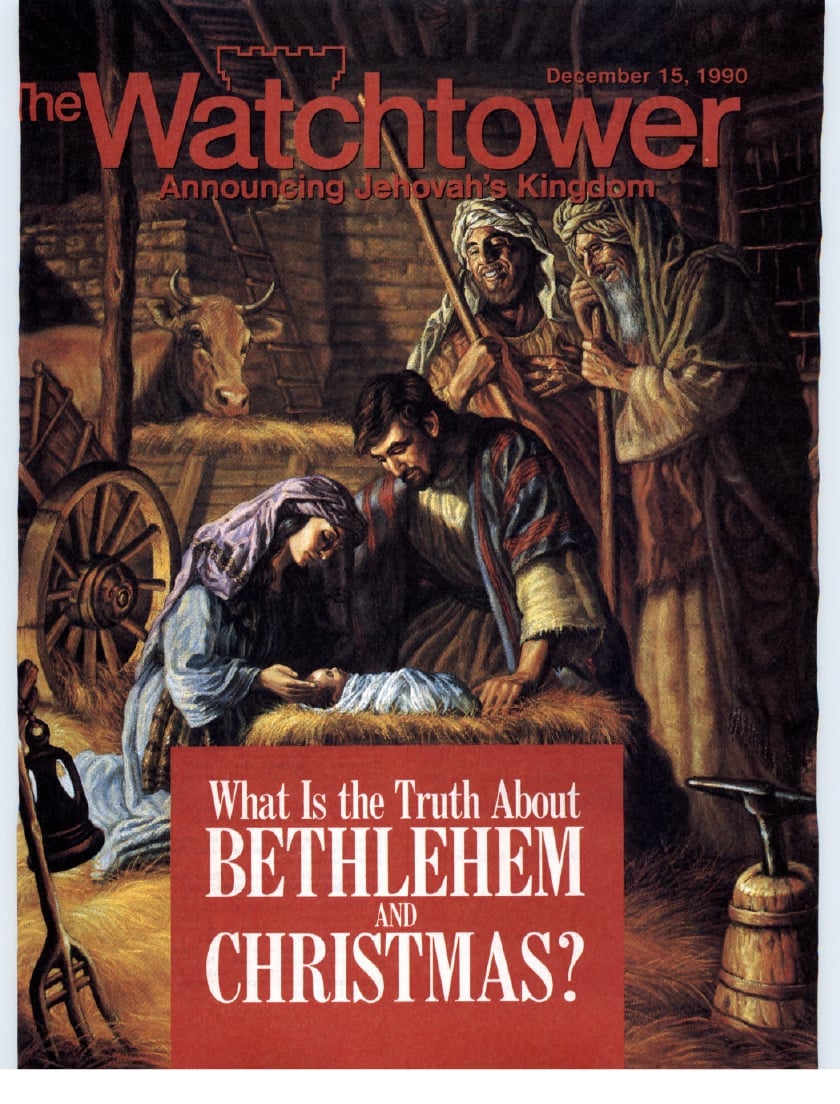
The Watchtower — December 15, 1990
Source: jw.org
Contents
Bethlehem—Symbol of Christian Unity and Love?
What Is the Truth About Bethlehem and Christmas?
From Pilate to Herod and Back Again
“Let Anyone Hearing Say: ‘Come!’”
Encourage One Another As the Day Draws Near
Insight on the News
Equipped for Missionary Service in the 1990’s
Modern “Cave of Robbers”
‘Seeking Delightful Words, Correct Words’
Do You Remember?
Subject Index for “The Watchtower” 1990
Bible Stories That Fascinate Children
Bethlehem—Symbol of Christian Unity and Love?
Bethlehem—Symbol of Christian Unity and Love?
“BETHLEHEM . . . is a proof of endless love, it is a lesson in humility.”—Maria Teresa Petrozzi, authoress of the book Bethlehem.
Does Bethlehem mean something like that to you? Perhaps so, since hundreds of millions of sincere, peace-loving people the world over look reverently toward Bethlehem, especially during the Christmas season. They are mindful that this small Middle Eastern city is the birthplace of the “Prince of Peace,” Jesus Christ. For centuries pilgrims have flocked here to visit one of Christendom’s holiest places and perhaps to venerate it. That is the Grotto of the Nativity, the traditional birthplace of Jesus Christ. It is in the large, historic complex called the Church of the Nativity.—Isaiah 9:6; Matthew 2:1.
However, in reality, have these traditional holy places served as focal points of Christian unity, love, and humility? What do you conclude from the following?
Catholic writer Maria Teresa Petrozzi comments in Bethlehem: “Starting from the 16th cent., [Bethlehem] suffered from the bitter and bloody struggles between Latins [Roman Catholics] and Greeks [Greek Orthodox believers] for the hegemony in the Nativity church.” These recurrent “bloody struggles” for control often centered on the silver star in the Grotto of the Nativity, which is located underground, beneath the Church of the Nativity. This star is said to mark the actual site of Christ’s birth. R. W. Hamilton reports in his book The Church of the Nativity, Bethlehem: “It is well known that two of the questions in the dispute between France and Russia which led up to the Crimean war were concerned with the rival claims to possession of the keys of the main doors of the basilica and of the crypt [Grotto of the Nativity], and with the mysterious theft one night in 1847 of the silver star with a Latin inscription which was let into a slab of marble beneath the altar of the Nativity.”
As a result of the continuous interdenominational conflicts throughout the centuries over rights in these places, “the rights of each denomination are now carefully prescribed. Of the 53 lamps in the grotto, for example, the Franciscans are allowed 19. The Altar of the Nativity is owned by the Greeks, and the Latins are not allowed to hold services there.”—Historical Sites in Israel.
During the Christmas season, if the political climate permits, each of the religious communities of Christendom present holds its own Christmas Mass and has a procession through Bethlehem. On December 24 and 25, the Latins have a procession and midnight Mass in Saint Catherine’s Church, next to the Church of the Nativity, which is now shared by the Greek and the Armenian Orthodox churches. On January 6, the Greek, the Syrian, and the Coptic Orthodox churches celebrate their Christmas Masses. On January 18, the Armenian Orthodox Christmas Mass is held, with a procession on January 19.
Does the foregoing suggest that Bethlehem’s traditional holy places are ‘a proof of endless love, a lesson in humility’? Additionally, do they reflect the truth about the circumstances of the birth of Jesus? For example, when was he born? Was he actually born in what is now the Nativity Grotto? And should you or anyone else venerate his birthplace?
[Picture Credit Line on page 3]
Pictorial Archive (Near Eastern History) Est.
What Is the Truth About Bethlehem and Christmas?
What Is the Truth About Bethlehem and Christmas?
“WHEN we think of the Mystery of Bethlehem we cannot prevent questions and doubts from coming to our mind.”—Bethlehem, by Maria Teresa Petrozzi.
‘Why questions and doubts?’ you may ask. After all, the various beliefs concerning Christmas, and the sites connected with these beliefs, are founded on fact. Or are they?
When Was He Born?
Regarding the birth date of Jesus, Maria Teresa Petrozzi asks: “When exactly was the Redeemer born? We would like to know not only the year but also the month, day, hour. Mathematic precision is not granted us.” The New Catholic Encyclopedia supports this: “The date of the birth of Jesus Christ can be calculated only approximately.” It says regarding the date attributed to Christ’s birth: “The date of December 25 does not correspond to Christ’s birth but to the feast of the Natalis Solis Invicti, the Roman sun festival at the solstice.”
So you may ask, ‘If Jesus was not born on December 25, when was he born?’ From Matthew chapters 26 and 27, we understand that Jesus died at the time of the Jewish Passover, which commenced April 1, 33 C.E. Moreover, Luke 3:21-23 informs us that Jesus was about 30 years of age when he commenced his ministry. Since his earthly ministry lasted three and a half years, he was about 33 1/2 years old at the time of his death. Christ would have been a full 34 years old six months later, which would thus be about October 1. If we count back to see when Jesus was born, we reach, not December 25 or January 6, but about October 1 of the year 2 B.C.E.
It is also noteworthy that during the month of December, Bethlehem and its surroundings are subject to wintry cold weather, chilling rains, and sometimes snow. One does not find shepherds with their flocks outside at night during that time. This is not a recent weather phenomenon. The Scriptures report that Judean king Jehoiakim “was sitting in the winter house, in the ninth month [Chislev, corresponding to November-December], with a brazier burning before him.” (Jeremiah 36:22) He needed the heat to keep warm. Further, at Ezra 10:9, 13 we find clear evidence that the month of Chislev was “the season of showers of rain, and it is not possible to stand outside.” All of this indicates that weather conditions in Bethlehem in December do not fit the Bible’s description of the events connected with the birth of Jesus Christ.—Luke 2:8-11.
At What Place?
What is the proper view of the site that was part of the inspiration for the Crimean war (1853-56), which ‘bloody struggle’ claimed the lives of over a hundred thousand French soldiers? Is that spot really the birthplace of Jesus?
To begin with, the Bible itself does not mention the precise site of Jesus’ birth. Matthew and Luke confirm that Jesus’ birth fulfilled the Messianic prophecy at Micah 5:2, which had predicted that “the one who is to become ruler in Israel, whose origin is from early times,” would come from Bethlehem. (Matthew 2:1, 5; Luke 2:4) Both Gospel accounts mention only the bare essentials, namely, that Jesus was born in Bethlehem and, according to Luke, that the baby was bound with cloth bands and laid in a manger.—Luke 2:7.
Why did the Gospel writers not add more details? Maria Teresa Petrozzi observes: “The Evangelists neglect these details, evidently because they consider them meaningless.” In fact, it is evident that Jesus himself did not consider the details of his birth as especially meaningful, for he never once is quoted as mentioning either his birth date or the precise site of his birth. Even though born in Bethlehem, Jesus did not regard that place as his home, but the area of Galilee was referred to as “his home territory.”—Mark 6:1, 3, 4; Matthew 2:4, 5; 13:54.
A reading of John 7:40-42 shows that people in general were ignorant of his birthplace, thinking that he was born in Galilee: “Some were saying: ‘The Christ is not actually coming out of Galilee, is he?’” Based on what was recorded at John 7:41, The Church of the Nativity, Bethlehem concludes: “That such discussions arose does not in itself disprove the fact that Christ was born in Bethlehem; but at least it shows that many of His associates were unaware of it.”
It is obvious that during Jesus’ own earthly lifetime, he did not advertise the details of his birth. No emphasis was put on the site of his birth. What, then, is the basis for the belief that the Nativity Grotto is the spot where Joseph brought Mary for her to give birth?
Petrozzi candidly admits: “It is not possible to know for sure whether the grotto was one of the numberless natural caves existing in the neighborhood of Bethlehem, or a cavern used as a stable in an inn. However, the tradition which goes back to the first half of the 2nd cent., is explicit; it is a grotto-stable.”—Italics ours.
Mere Tradition
Maria Teresa Petrozzi and R. W. Hamilton, along with various other students of the history of Bethlehem, indicate that Justin Martyr, of the second century C.E., was the first to claim that Jesus was born in a grotto, without specifying which one. Hamilton concludes regarding Justin Martyr’s statement: “This is a passing reference, and to assume that St. Justin had in mind a particular cave, still more that he was referring to the present Cave of the Nativity, would be to press too hard the evidence of a single word.”
In a footnote Hamilton writes: “An account of the Nativity which occurs in the apocryphal ‘Book of James’ or ‘Protevangelium’, written about the same period, also introduces a cave, but describes it as lying half-way to Bethlehem. So far as it has any historical value the story suggests that the tradition was not yet linked with any single spot, certainly not with the Cave of the Nativity.”
Third-century religion writers Origen and Eusebius tie the tradition as then known to a particular site. Hamilton reasons: “Once the story had become attached to a particular cave it was not likely to wander; and it is safe to infer that the cave shown to visitors soon after A.D. 200 was identical with the present Cave of the Nativity.”
W. H. Bartlett, in his book Walks About the City and Environs of Jerusalem (1842), surmised regarding this grotto: “Though the tradition that this is the birth-place of our Saviour, is of respectable antiquity, being mentioned by St. Jerome, who lived and died in a neighbouring cell, the spot is at variance with probability, as although it may occasionally happen that caverns are used as stables in Palestine, this is deeper underground than would be convenient for such a purpose; and when we consider, in addition, the tendency of the monks to fix the scene of remarkable scriptural events in grottoes, perhaps from the impressiveness of such spots, the presumption against the site appears almost conclusive.”
What can we conclude from the historical evidence at hand and, more important, from the Scriptural fact that neither Jesus nor his disciples assigned any importance to his birthplace? It is evident that when Queen Helena, the mother of Constantine the Great, fixed the site of the Church of the Nativity in the year 326 C.E., she did so on the basis of what Hamilton cites as ‘association by long tradition.’ It was not on the basis of historical or Biblical proof.
This leads to the further conclusion that the actual site of Christ’s birth is unknown. Is it logical, therefore, that the faithful are to go on pilgrimages to such places as the Grotto of the Nativity and venerate them? If, indeed, such were required of Christians, would not Jesus himself have informed his disciples of the obligation or even that kind of wish on his part? Would it not be recorded in God’s Word, the Bible, for the world of mankind to read? Inasmuch as such evidences are conspicuously absent from the Holy Scriptures, we do well to inquire what Jesus did consider worthy of commemoration.
Search as we may, the only occasion we will find that Jesus’ disciples were to commemorate through the generations was his sacrificial death. He died in the spring, shortly after celebrating his last Passover meal with his disciples. On that occasion he directed his faithful disciples to have a symbolic meal using unleavened bread, like matzoth, and red wine. Regarding this simple ceremony, which first took place April 1, 33 C.E., he commanded: “Keep doing this in remembrance of me.”—Luke 22:19, 20.
In obedience to this Scriptural command from Jesus himself, Jehovah’s Witnesses the world over annually celebrate the Memorial of Christ’s sacrificial death. They do not hold this Christian gathering at some special location in an upper room in Jerusalem, for Jesus did not specify that. But throughout the world, they assemble in their Kingdom Halls and at other suitable meeting places in their locality. The next celebration will take place on March 30, 1991, after sundown. You are invited to attend at the Kingdom Hall of Jehovah’s Witnesses nearest to your home.
To attend this important celebration in obedience to Jesus’ command, you do not have to travel to Jerusalem or to Bethlehem. Neither Jesus nor his disciples attributed importance to places as focal points of Christian worship. On the contrary, Jesus told a Samaritan woman, who centered her worship at Gerizim, a mountain in Samaria, north of Jerusalem: “Believe me, woman, The hour is coming when neither in this mountain nor in Jerusalem will you people worship the Father. Nevertheless, the hour is coming, and it is now, when the true worshipers will worship the Father with spirit and truth, for, indeed, the Father is looking for suchlike ones to worship him.”—John 4:21, 23.
Those who worship the Father with spirit and truth do not depend on special sites, such as Bethlehem, or on objects, such as images, in their worship. The apostle Paul said: “While we have our home in the body, we are absent from the Lord, for we are walking by faith, not by sight.”—2 Corinthians 5:6, 7.
However, you may still ponder, how can one worship God in a manner acceptable to him? The next time one of Jehovah’s Witnesses comes to your door, please ask him or her.
[Picture on page 5]
In winter, snow may blanket the ground near Bethlehem. Would shepherds sleep outside with their sheep?
[Credit Line]
Pictorial Archive (Near Eastern History) Est.
[Pictures on page 7]
Church of the Nativity in Bethlehem and its underground grotto
[Credit Line]
Pictorial Archive (Near Eastern History) Est.
[Credit Line]
Garo Nalbandian
From Pilate to Herod and Back Again
Jesus’ Life and Ministry
From Pilate to Herod and Back Again
WHEN the Jews charge Jesus with saying that he is a king, Pilate again enters the governor’s palace to question him. Although Jesus makes no attempt to conceal that he is a king, he explains that his Kingdom is no threat to Rome.
“My kingdom is no part of this world,” Jesus tells Pilate. “If my kingdom were part of this world, my attendants would have fought that I should not be delivered up to the Jews. But, as it is, my kingdom is not from this source.” Jesus thus acknowledges three times that he has a Kingdom, although it is not of an earthly source.
Yet, Pilate presses him further: “Well, then, are you a king?” That is, are you a king even though your Kingdom is no part of this world.
Jesus lets Pilate know that he has drawn the right conclusion, answering: “You yourself are saying that I am a king. For this I have been born, and for this I have come into the world, that I should bear witness to the truth. Everyone that is on the side of the truth listens to my voice.”
Yes, Jesus’ very existence on earth is to bear witness to “the truth,” specifically the truth about his Kingdom. Jesus is prepared to be faithful to that truth even if it costs him his life. Although Pilate asks: “What is truth?” he does not wait for further explanation. He has heard enough to render judgment.
Pilate returns to the crowd waiting outside the palace. Evidently with Jesus at his side, he tells the chief priests and those with them: “I find no crime in this man.”
Angered by the decision, the crowds begin to insist: “He stirs up the people by teaching throughout all Judea, even starting out from Galilee to here.”
The unreasoning fanaticism of the Jews must amaze Pilate. So, as the chief priests and older men continue shouting, Pilate turns to Jesus and asks: “Do you not hear how many things they are testifying against you?” Still, Jesus makes no attempt to answer. His calmness in the face of the wild accusations causes Pilate to marvel.
Learning that Jesus is a Galilean, Pilate sees a way out of responsibility for him. The ruler of Galilee, Herod Antipas (son of Herod the Great), is in Jerusalem for the Passover, so Pilate sends Jesus to him. Earlier, Herod Antipas had John the Baptizer beheaded, and then Herod became frightened when he heard about the miraculous works Jesus was performing, fearing that Jesus was actually John who had been raised from the dead.
Now, Herod is overjoyed at the prospect of seeing Jesus. This is not because he is concerned about Jesus’ welfare or that he wants to make any real attempt to learn whether the charges against him are true or not. Rather, he is simply curious and hopes to see Jesus perform some miracle.
Jesus, however, refuses to satisfy Herod’s curiosity. In fact, as Herod questions him, he does not say a word. Disappointed, Herod and his soldier guards make fun of Jesus. They clothe him with a bright garment and mock him. Then they send him back to Pilate. As a result, Herod and Pilate, who had formerly been enemies, become good friends.
When Jesus returns, Pilate calls the chief priests, the Jewish rulers, and the people together and says: “You brought this man to me as one inciting the people to revolt, and, look! I examined him in front of you but found in this man no ground for the charges you are bringing against him. In fact, neither did Herod, for he sent him back to us; and, look! nothing deserving of death has been committed by him. I will therefore chastise him and release him.”
Thus, Pilate twice has declared Jesus innocent. He is eager to free him, for he realizes that it is only because of envy that the priests have handed him over. But as Pilate continues to try to release Jesus, he receives another strong motivation to do so. While he is on his judgment seat, his wife sends a message, urging him: “Have nothing to do with that righteous man, for I suffered a lot today in a dream [evidently of divine origin] because of him.”
Yet, how can Pilate release this innocent man, as he knows he should? John 18:36-38; Luke 23:4-16; Matthew 27:12-14, 18, 19; 14:1, 2; Mark 15:2-5.
◆ How does Jesus answer the question regarding his kingship?
◆ What is “the truth” about which Jesus spent his earthly life bearing witness?
◆ What is Pilate’s judgment, how do the people respond, and what does Pilate do with Jesus?
◆ Who is Herod Antipas, why is he overjoyed to see Jesus, and what does he do with him?
◆ Why is Pilate eager to free Jesus?
“Let Anyone Hearing Say: ‘Come!’”
“Let Anyone Hearing Say: ‘Come!’”
Throughout the coming year, Jehovah’s Witnesses in more than 200 lands worldwide will be expending themselves in harmony with their 1991 yeartext: “LET ANYONE HEARING SAY: ‘COME!’”
“The spirit and the bride keep on saying: ‘Come!’ And let anyone hearing say: ‘Come!’ And let anyone thirsting come; let anyone that wishes take life’s water free.”—REVELATION 22:17.
1. To what “water” are we invited to “come!”
YOU are invited to “come!” Come for what? Why, come to quench your thirst with water. This is not ordinary water but the same water that Jesus Christ spoke of when he said to the Samaritan woman at the well: “Whoever drinks from the water that I will give him will never get thirsty at all, but the water that I will give him will become in him a fountain of water bubbling up to impart everlasting life.” (John 4:14) From where did Jesus get this “water”?
2. What is the source of the “water,” and only after what event could it flow?
2 The apostle John was privileged to see in vision the source from which this “water” issued forth, as he noted at Revelation 22:1: “He showed me a river of water of life, clear as crystal, flowing out from the throne of God and of the Lamb.” Yes, the source of this crystal-clear water with life-giving elements is none other than the Life-Giver, Jehovah himself, who makes it available through the Lamb, Jesus Christ. (Compare Revelation 21:6.) Since “the throne of God and of the Lamb” is mentioned, it must be after the establishment of the Messianic Kingdom in 1914, that is, after the Lord’s day began, that the water of life begins to flow.—Revelation 1:10.
3, 4. What does the “water” represent, and for whom is it to be available?
3 What does this water of life symbolize? It pictures God’s provision for restoring perfect human life, everlasting life in perfection on an earth transformed into a paradise. The water of life represents all the provisions for life through Jesus Christ. Is all of this available now? No, not all of it, for God must first remove the present wicked system of things with its invisible ruler, Satan the Devil. But we can take what is available of this “water” now by hearing and obeying the good news of the Kingdom and conforming our lives thereto.—John 3:16; Romans 12:2.
4 Thus, after showing John the ‘river of life,’ Jesus spoke to John about His purpose in sending His angel with the vision. Then John heard the proclamation: “The spirit and the bride keep on saying: ‘Come!’ And let anyone hearing say: ‘Come!’ And let anyone thirsting come; let anyone that wishes take life’s water free.” (Revelation 22:17) Hence, servants of God extend the invitation to thirsty ones to begin drinking of God’s provisions for gaining eternal life on earth through the Lamb of God.—John 1:29.
Need for Waters of Life Arises
5. How did mankind come to need this divine provision?
5 Sadly, the first parents of the human family did not adhere to the course in life that would have given their offspring the opportunity to enjoy perfect human life forever in a paradise home. Everlasting life for mankind required that Adam make the intelligent choice of serving his Creator obediently. Under the influence of a rebellious spirit creature, Eve started the movement that resulted in death to mankind, and Adam, her perfect husband, chose to join her in that death-dealing course. Thus, as the giver of natural life to succeeding generations of humankind, Adam was really the one that introduced the operation of death into the entire human family. So it is that the Bible states: “Through one man sin entered into the world and death through sin, and thus death spread to all men because they had all sinned.” (Romans 5:12) It was after Adam and Eve had fallen into sin that they began to add new members to the human family.—Psalm 51:5.
6. Why did Jehovah arrange for the “water” to be available?
6 Was God to be forever blocked in accomplishing his purpose of a paradise earth filled with perfect humans? The Biblical answer is, of course, no! Nevertheless, to the end of fulfilling his purpose, Jehovah made a loving provision that would counteract Adam’s disastrous failure and yet would be in full harmony with justice and righteousness, of which He is the complete and ultimate expression. He does this through the “river of water of life.” By means of it, he will restore perfect human life to obedient mankind, whose access to the Source of life was forfeited. This river flows in its fullest sense during the Thousand Year Reign of Jesus Christ. Thus, throughout Christ’s Millennial Rule, humans, including those resurrected from the dead, must drink of the “river of water of life.”—Compare Ezekiel 47:1-10; Acts 24:15.
7. On what basis is the provision for “water” made?
7 Jehovah enjoys his own life, and he also enjoys bestowing the privilege of intelligent life upon some of his creation. The basis of Jehovah’s life-giving provisions is Jesus’ ransom sacrifice. (Mark 10:45; 1 John 4:9, 10) Also involved is God’s Word, which the Bible at times terms “water.” (Ephesians 5:26) Jehovah God is free to say, “Come!” to human creatures, who suffered the loss of the original provisions that God made for the perfect human pair, Adam and Eve.
Bride Class Extend the Invitation, “Come!”
8. To whom and when was this “water” first provided?
8 The first to extend the invitation to “come!” are those who make up the figurative bride of the Lamb, the firstborn spiritual Son of Jehovah. (Revelation 14:1, 3, 4; 21:9) The spiritual bride of Christ is not saying, “Come!” to herself, that is, to those whom Jehovah God would yet gather as part of the bride class in order to make it 144,000 strong. Those words of invitation are extended to humans who hope to attain to perfect human life on earth after Armageddon. (Revelation 16:14, 16) During this conclusion of the system of things since 1914, we have heard the invitation being extended by “the bride,” in collaboration with the holy spirit of God.
9. How do we know that it is not for just a small group?
9 Thrillingly, the last book of the Bible shows that ‘a great crowd, whom no man could number,’ would respond to the proclamation of the good news of God’s Kingdom and would firmly put themselves on the side of that royal government. (Revelation 7:9, 10, 16, 17) Are you one of that great crowd? Then, “let anyone hearing say: ‘Come!’”
Spirit and Bride Say, “Come!”
10. Where must the symbolic water originate, and why?
10 But why are God and the figurative Bridegroom not mentioned at Revelation 22:17? First, note that the verse does not state under whose direction the spirit acts. Yet, the reference to spirit directs our attention to Jehovah God himself. The Father is not pushed out of the picture, since he is the very Source of holy spirit. Second, the Son cooperates fully with his Father, as he himself says: “The Son cannot do a single thing of his own initiative, but only what he beholds the Father doing.” (John 5:19) Moreover, while this invitation is an inspired utterance ultimately originating with Jehovah God, humans can receive divine direction, or “inspired expressions,” by means of Jesus Christ, “the Word.” (Revelation 22:6; also Re 22:17, Reference Bible, footnote; John 1:1) Appropriately, then, we associate Christ, the Bridegroom, with this invitation. Yes, we can be certain that both Jehovah God, the Father of the Groom, and Jesus Christ, the Bridegroom, join with “the bride” by means of the holy spirit in saying, “Come!”
11, 12. (a) What early indication was there that the invitation to drink would be expanded? (b) How did the matter become increasingly clear over the years?
11 For decades this invitation to “come!” has been going forth to people thirsting for “life’s water.” Even back in 1918, the bride class began preaching a message that particularly involved those who might live on the earth. It was the public talk entitled “Millions Now Living May Never Die.” This offered a hope that many would survive Armageddon and thereafter gain eternal life on the Paradise earth under God’s Messianic Kingdom. But that message did not definitely show the way to this survival privilege, except by righteousness in general.
12 To reach more people with the invitation, “Come!” in 1922 the message went out to all those who were interested in serving God: “Advertise the King and Kingdom.” In 1923 the bride class understood that “the sheep” and “the goats” of Jesus’ parable at Matthew 25:31-46 are manifest prior to Armageddon. Then, in 1929, The Watch Tower of March 15 featured the article “Gracious Invitation.” Its theme text was Revelation 22:17, and it highlighted the responsibility of the bride class to extend the invitation, “Come!”—Pages 87-9.a
Other Sheep Join in Saying, “Come!”
13, 14. In the 1930’s, what additional clarification was provided that others would drink of the symbolic water?
13 Moreover, as early as 1932, The Watchtower pointed out the responsibility of the “other sheep,” in their turn, to say, “Come!” (John 10:16) In its issue of August 1, page 232, paragraph 29 stated: “Jehovah’s witnesses now have the zeal like to that of Jehu and they should encourage the Jehonadab class [other sheep] to come along with them and to take some part in proclaiming to others that the kingdom of God is at hand.” Then, after quoting Revelation 22:17, the paragraph said: “Let the anointed encourage all who will to take part in telling the good news of the kingdom. They do not have to be anointed of the Lord in order to declare the Lord’s message. It is a great comfort to Jehovah’s witnesses to now know that they are permitted to carry the waters of life to a class of people that may be taken through Armageddon and given everlasting life on the earth by reason of the bounteous goodness of Jehovah.”b
14 From 1934 onward, the anointed remnant pointed out that these other sheep must now make a dedication of themselves to God and symbolize this dedication by water baptism and then join with the bride class in saying, “Come!” to yet other thirsty ones. Thus, there was now a definite invitation being extended by the bride class for gathering these thirsty other sheep together into the “one flock” under the “one shepherd,” Jesus Christ. (John 10:16) In 1935 the anointed remnant were stirred to learn at their general convention that year that the sheeplike class of people to whom they were saying, “Come!” was actually the “great crowd” of Revelation 7:9-17. This gave tremendous impetus to the invitation work.
15. How was “the spirit” involved in the invitation, “Come”?
15 In saying, “Come!” the bride class was in harmony with God’s spirit. By means of his spirit in opening up the meaning of the prophecies of his written Word, he caused the remnant of the bride class to extend the invitation. These prophecies on which their invitation was based had been inspired by the spirit of God. So it was, in effect, God’s spirit flowing through Christ and his bride that was saying to the great crowd of sheeplike people, “Come!”—Revelation 19:10.
16. How are the spirit and the bride tied in with the invitation today?
16 To this day the spirit and the bride, represented by the remnant, “keep on saying: ‘Come!’” The remnant tell these other sheep to invite still others to “come!” They are not to keep “life’s water,” as it is available today, to themselves. They must obey the command from “the spirit and the bride,” namely: “Let anyone hearing say: ‘Come!’” All those quenching their thirst must circulate the invitation. They must extend it to everyone without regard for race, nationality, language, or present religion—everyone everywhere! What there is available of “life’s water” at the present time is what Jehovah’s Witnesses invite and help all peoples to partake of, free!
17. What sort of “water” is available today?
17 Earth wide, the Lamb, Jesus Christ, is indeed guiding the great crowd “to fountains of waters of life.” (Revelation 7:17) No polluted water this, but clear, cool, wholesome water right from its Source. These symbolic waters mean more than waters in the sense of understanding Bible truth; they mean all of God’s provisions through Jesus Christ that begin even now to set the great crowd on the path to attaining to everlasting perfect life in happiness.
Join Now in the Proclamation
18. How extensive is the invitation in our time?
18 Already, this great crowd numbers several million. They zealously continue to proclaim the good news of the Kingdom in all the inhabited earth. They regularly report their field activities in preaching the Kingdom good news, which has now gone to 212 lands. As time during this conclusion of the system of things allows, the invitation will continue according to the patience and long-suffering of Jehovah God, the Great Timekeeper. He will know when the time is up and when it is the critical moment for him to make himself known to all as Jehovah, just as he has promised to do according to repeated statements in Bible prophecy.—Ezekiel 36:23; 38:21-23; 39:7.
19. Why can we say that this “water” is offered free?
19 While there is still time, therefore, members of the great crowd joyfully participate with the remnant of the bridal company in saying: ‘Come and partake of the waters of life free!’ The proclaimers of this lifesaving good news are freely making the proclamation, not charging for the services they render as they circulate the Kingdom message throughout the world.
20. What will result because this “water” is available?
20 Life’s waters are now available all around the globe, so that people who want to partake may do so to full satisfaction with lifesaving results. Redeemed mankind will enjoy endless life right here on this earth, which is to be transformed into a paradise, vindicating the precious purpose of Jehovah. Our Creator made the earth not in vain but to be a world-encircling garden of Eden, or Paradise of pleasure, inhabited by perfect human creatures in God’s image and likeness.
21. How will God’s purpose for the earth be accomplished?
21 Certainly, it will be an unspeakably grand privilege and joy to be in such a new world! Then the commission that God gave to the first human couple at Genesis 1:27, 28 will be abundantly fulfilled. Thanks to Jehovah’s masterfully handling the calamity that befell the human family, the earth will be subdued to the extent of being a paradise and will be filled with a perfect human race. Yes, God will see everything he has made, and, look, it will be very good. Will you be there? If so, then you must now appreciatively begin to partake of the water of life freely. “Come!” and drink your fill and quench your thirst with life’s water that has begun to flow now and will flow in fullness during the Millennium to come. And let anyone hearing this sweet invitation say: “Come!”
[Footnotes]
Among other things, this article said: “Never has there been so wide a witness of the truth as during the past few years. . . . The remnant bring them the glad message, and to them they say: ‘And whosoever will, let him take the water of life freely.’ They are told that they may now take their stand on the side of the Lord, and against the Devil, and receive a blessing. Is it not such a class of people that may now seek meekness and righteousness, and be hid in the day of his expressed wrath, and be carried beyond the great battle of Armageddon and live for ever and not die? (Zeph. 2:3) . . . The faithful remnant class join in the gracious invitation and say, ‘Come.’ This message is to be proclaimed to those who have a desire for righteousness and truth. It must be done now.”
The Watchtower of August 15, 1934, also referred to the responsibility of the other sheep and said on page 249, paragraph 31: “The Jonadab class are of those who ‘hear’ the message of truth and who must say to those in their hearing: ‘Come. And let him that heareth say, Come. And let him that is athirst come. And whosoever will, let him take the water of life freely.’ (Rev. 22:17) Those of the Jonadab class must go along with those who are of the antitypical Jehu company, that is, the anointed, and announce the message of the kingdom, even though they are not the anointed witnesses of Jehovah.”
What Is Your Answer?
□ What “water” is referred to at Revelation 22:17?
□ What is the source of the “water”?
□ Why is the “water” needed, and when only could it start to flow?
□ In our text, what does the reference to “spirit” indicate, and how is “the bride” involved?
□ Who can partake of the “water,” and with what result?
Encourage One Another As the Day Draws Near
Encourage One Another As the Day Draws Near
“[Be] encouraging one another, and all the more so as you behold the day drawing near.”—HEBREWS 10:25.
1, 2. What day draws near, and what should be the attitude of Jehovah’s people?
THOSE who today share in saying, ‘Come and partake of the water of life,’ do not isolate themselves. As the great day of Jehovah’s victory approaches, they apply the Biblical counsel: “Let us consider one another to incite to love and fine works, not forsaking the gathering of ourselves together, as some have the custom, but encouraging one another, and all the more so as you behold the day drawing near.”—Hebrews 10:24, 25.
2 The Scriptures prophesy about that “day” as “Jehovah’s day.” (2 Peter 3:10) Inasmuch as Jehovah is the Most High, the omnipotent God, no day could possibly outshine his day. (Acts 2:20) It means the vindicating of his sovereignty as God over all the universe. That day of unparalleled importance draws near.
3. How was Jehovah’s day drawing near for the Christians in the first century, and what about for us today?
3 The apostle Paul told Christians in the first century of our Common Era that Jehovah’s day was approaching. They looked forward to the coming of that day, but back there, that day was more than 1,900 years off. (2 Thessalonians 2:1-3) Despite that fact, they were to be encouraged because that day was definitely due to come, and if the Christians steadily pressed on in that faith, they would enter into that blessed day. (2 Timothy 4:8) Back there, that day was seen to be drawing near. As for us today, Jehovah’s day has indeed drawn near. All the marvelous fulfillments of Bible prophecy verify this joy-inspiring fact. Soon, the name of our God, Jehovah, will be sanctified for all eternity.—Luke 11:2.
Encouraged by the Divine Name
4. According to Revelation 19:6, who is to become King, and how is his name discerned?
4 The divine name should be a matter of interest to the entire human family. Today’s English Version states: “Praise God! For the Lord, our Almighty God, is King!” (Revelation 19:6) According to that 20th-century Bible translation, he is the Lord, the almighty God. That version, as well as many other modern versions, does not give the name of the divine Being who begins to rule as King. However, the divine name is included in the exclamation “Hallelujah!” (“Praise Jah” or, “Praise Jehovah”) found in the Revised Standard Version, the New International Version, and Moffatt’s translation of Revelation 19:6. For much of our Common Era, the divine name has been basically obscured in Bible translations. As we shall see, however, that name has been of great encouragement to God’s people, in both ancient and modern times.
5, 6. (a) Why did Moses need to know the name of the God whom he represented? (b) What must have been the effect on the Israelites when Moses emphasized the divine name?
5 We recall that when Moses was sent by the Most High God to the people of Israel enslaved in the land of Egypt, the question of who sent him raised itself in the minds of the people to whom Moses was sent. Moses anticipated that the suffering Jewish people would want to know the name of the God whom he represented. In this regard we read at Exodus 3:15: “God said once more to Moses: ‘This is what you are to say to the sons of Israel, “Jehovah the God of your forefathers, the God of Abraham, the God of Isaac and the God of Jacob, has sent me to you.”’ This is my name to time indefinite, and this is the memorial of me to generation after generation.”
6 When this information was emphasized to them, the Israelites must have felt very encouraged. Their deliverance was assured by the only true God, Jehovah. And how encouraging it must have been to have the prospect of getting acquainted with God when he would demonstrate the meaning of his personal name—not haughtily isolating himself!—Exodus 3:13; 4:29-31.
7. (a) How do we know that Jesus’ disciples were acquainted with the divine name? (b) How was God’s name pushed into the background?
7 The disciples of the Lord Jesus Christ were also greatly encouraged by the divine name, Jehovah, and what it stood for. (John 17:6, 26) During Jesus’ earthly ministry, he certainly did not push the divine name into the background, and it was not his purpose to have his own name, Jesus, take precedence. Only after the beginning of the foretold apostasy from the true Christian faith did the divine name get pushed into the background, yes, practically wiped out of the Christian interchange of conversation. (Acts 20:29, 30) Once the name of the Son of God would begin to be given greater prominence, overshadowing that of the Father, professed Christians would find their worship of the Father increasingly impersonal, lacking family closeness, and so not very encouraging.
8. What has been the continuing effect upon God’s people of the adoption of the name Jehovah’s Witnesses?
8 Thus, it was a reason for unspeakable joy when the International Bible Students associated with the Watch Tower Society adopted the name Jehovah’s Witnesses in 1931. Not only was it joy-inspiring but it was most encouraging. On this account, the newly named Bible students could encourage one another.—Compare Isaiah 43:12.
9. How do true Christians feel about the One of whom they are Witnesses?
9 Consequently, true Christians today find it appropriate to identify the One of whom they are the foretold Witnesses, even as Jesus Christ their Leader did when he was here on earth. (Revelation 1:1, 2) Yes, they identify him alone as the one whose name is Jehovah.—Psalm 83:18.
Filled With Joy and Holy Spirit
10-12. (a) What would be the effect of the active force upon Jesus’ followers? (b) How do the joy-inspired Witnesses of Jehovah want to treat one another?
10 Jesus Christ said in his parting words to his apostles: “Go therefore and make disciples of people of all the nations, baptizing them in the name of the Father and of the Son and of the holy spirit, teaching them to observe all the things I have commanded you. And, look! I am with you all the days until the conclusion of the system of things.”—Matthew 28:19, 20.
11 Note that newly taught Christians were to be baptized in the name of the holy spirit. This holy spirit is not a person but the active force of Jehovah God, which He employs by means of Jesus Christ. At Pentecost, Jehovah God, through Jesus, poured out this active force upon the dedicated followers of Jesus Christ. (Acts 2:33) They were filled with this holy spirit, and one of the expressions, or fruits, of the holy spirit is joy. (Galatians 5:22, 23; Ephesians 5:18-20) Joy is a stimulating quality. The disciples are to be filled with the joy of the holy spirit. The prayer worded by the apostle Paul is most appropriate: “May the God who gives hope fill you with all joy and peace by your believing, that you may abound in hope with power of holy spirit.”—Romans 15:13.
12 Filled with this joy-inspiring spirit, Witnesses of Jehovah today, including the “great crowd,” will want, yes, will be moved, to encourage one another in the midst of this unfriendly system of things. Accordingly, the apostle Paul spoke of “an interchange of encouragement.”—Revelation 7:9, 10; Romans 1:12; 14:17.
Every Reason to Be Encouraged
13. What reasons do we have for being encouraged and for encouraging one another?
13 Finding themselves to be in the midst of this system of things, of which the opposer of everything righteous is the ruler and even the god, Christians will want to encourage one another within the worldwide Christian congregation, which is permeated with the holy spirit of Jehovah God. (Hebrews 10:24, 25; Acts 20:28) We have every reason to be encouraged. Yes, how thankful we are to have accurate knowledge of Jehovah and of His Son and of the active force they use, namely, the holy spirit! How grateful we are for the hope that they give! Our worship is thus filled with joy. The apostle Paul told the Christians to whom he addressed his letter that they should encourage one another and be building one another up in their most holy faith. They were to do this ‘all the more so as they figuratively beheld the day drawing near.’ Moreover, when the political powers of this earth wipe out nominal Christianity, together with all other false religions, the situation will demand that we encourage one another even more.
14. Who should be encouraging one another, and how?
14 While the elders take the lead in encouraging the flock in their individual congregations, all Christians need to encourage one another, just as Hebrews 10:25 admonishes. In fact, this is a Christian requirement. If you are a member of a congregation, do you give this encouragement? You may wonder, ‘How can I? What can I do?’ First, just by your presence at meetings and by your support of the Christian arrangement, are not all the other brothers and sisters encouraged, even as you yourself are likely encouraged when seeing others faithfully attending the congregation meetings? They can also be encouraged by your example of faithful endurance. By your continuing in the Christian course despite life’s problems and difficulties, never giving out, you can set an inspiring example.
Counteract Discouragement From the Devil
15. Why does the Devil have “great anger,” and against whom?
15 We are not the only ones who know that Jehovah’s day is near. Satan the Devil does too. Revelation 12:12 tells us that there is now woe for the earth “because the Devil has come down to you, having great anger, knowing he has a short period of time.” As Revelation 12:17 indicates, his great anger is directed against those “who observe the commandments of God and have the work of bearing witness to Jesus.” No doubt about it—the Devil wants to discourage us! And he knows just how to try to do it. He knows our weaknesses and problems, and he plays upon these.
16. Why does Satan use discouragement as a weapon?
16 Why does the Devil use discouragement as a weapon? Because it often works. Even a person who has endured outright opposition and persecution may fall prey to discouragement. Satan wants to taunt Jehovah God and try to prove he can turn people away from serving Him. (Proverbs 27:11; compare Job 2:4, 5; Revelation 12:10.) If he can discourage you, he may cause you to slow down in your service to God; he may even cause you to stop, to become inactive in the preaching of the Kingdom good news.—2 Corinthians 2:10, 11; Ephesians 6:11; 1 Peter 5:8.
17. How were the negative effects of discouragement evident in Moses’ day?
17 The negative effects of discouragement can be noted in the case of the Israelites in ancient Egypt. After Moses spoke to Pharaoh, that tyrant greatly increased their burdens and his oppression of them. God told Moses to assure the Israelites that He would indeed deliver them, make them His people, provide their escape, and bring them into the land of promise. Moses spoke to this effect to the sons of Israel. But Exodus 6:9 reports: “They did not listen to Moses out of discouragement and for the hard slavery.” Until Jehovah convinced Moses and encouraged him, this reaction even discouraged Moses from wanting to speak to Pharaoh as he was commanded.—Exodus 6:10-13.
18. Why is there great need for God’s people to counteract discouragement caused by the Devil?
18 Satan the Devil well knows the negative effect that discouragement can have on a servant of God. As Proverbs 24:10 says: “Have you shown yourself discouraged in the day of distress? Your power will be scanty.” Since we are living so deep in the time of the end, we need to be powerful and strong spiritually. It is bad enough that we have to contend with our imperfections, weaknesses, and faults that may hold us back; but with Satan trying to exploit these faults, we need help.
Rely Firmly on Christ’s Sacrifice
19. What will help us counteract discouragement, and why?
19 A great help in this regard is the ransom provision that Jehovah made possible by means of Jesus Christ. We can be overcomers by relying firmly on the ransom. It is dangerous to minimize this provision. Yes, we will still err, or sin, as long as we are imperfect. But we do not have to be discouraged and quit, feeling there is no hope, and thereby fall into Satan’s trap. We know that we have a full sacrifice for sin. The ransom is able to remove sins. If we are of the “great crowd,” we must have full faith and trust that we can wash our robes and make them white in the blood of the Lamb.—Revelation 7:9, 14.
20. How does Revelation 12:11 indicate that the great discourager, the Devil, can be overcome?
20 At Revelation 12:10 Satan is described as “the accuser of our brothers . . . who accuses them day and night before our God.” How can we conquer such a wicked accuser and monstrous discourager? Re 12 Verse 11 of that chapter provides the answer: “They conquered him because of the blood of the Lamb and because of the word of their witnessing, and they did not love their souls even in the face of death.” So Jehovah’s people need to keep full confidence in the ransom sacrifice, the blood of the Lamb. Keep strong the encouragement that comes from witnessing, regularly sharing the good news of God’s Kingdom with everyone you can.
21. How might we inadvertently share in the Devil’s work of discouraging our brothers?
21 Sometimes, even inadvertently, we may share in the Devil’s work of discouraging our brothers. How? By becoming too critical, being too demanding, or being righteous overmuch. (Ecclesiastes 7:16) All of us have deficiencies and weaknesses. Let us not play upon them as does the Devil. Rather, let us speak encouragingly about our brothers and Jehovah’s people as an organized group. We want to keep on enheartening one another and so keep from disheartening one another.
Encouraging as the Day Nears
22, 23. (a) Why should we not leave it just to the elders to be sources of encouragement? (b) How can overseers in the Christian congregation be encouraged?
22 We should make it our firm resolve always to encourage one another as the day draws near. Encourage others by your faithful example and words of comfort. Imitate Jehovah and the Lord Jesus Christ in this regard. Do not leave it just to the congregation elders to be the source of encouragement. Why, the elders themselves need encouragement. They have weaknesses and frailties just as the rest of the flock, and they have to cope with the same problems in providing for their families in a decaying world. In addition to that, they have what Paul described as the anxiety for the congregations. (2 Corinthians 11:28, 29) Theirs is hard work—they need encouragement.
23 You can greatly encourage those in positions of oversight in the Christian congregation by cooperating with them. Then you will be following the counsel of Hebrews 13:17: “Be obedient to those who are taking the lead among you and be submissive, for they are keeping watch over your souls as those who will render an account; that they may do this with joy and not with sighing, for this would be damaging to you.”
24. In this day of discouragement, what should we be doing, and why?
24 We live in a day of discouragement. Men’s hearts are indeed faint out of fear and expectation of the things coming upon the inhabited earth, as Jesus foretold. (Luke 21:25, 26) With so many problems that tend to depress and dishearten, be “encouraging one another, and all the more so as you behold the day drawing near.” Follow the apostle Paul’s good counsel at 1 Thessalonians 5:11: “Keep comforting one another and building one another up, just as you are in fact doing.”
How Would You Answer?
□ Why should Christians be encouraging one another, even more than formerly?
□ How has knowledge of the divine name been encouraging to Jehovah’s people?
□ In what ways can we individually encourage one another?
□ Why must we avoid sharing in the Devil’s work of discouraging our brothers?
[Picture on page 17]
Elders take the lead in encouraging the flock in their congregations
Insight on the News
Insight on the News
Forbidden to Marry
Described by one Lutheran bishop as “a hidden problem for generations,” sexual misconduct by the clergy has finally ‘come out of the closet.’ However, the Los Angeles Times reports that along with it have come “embarrassing public disclosures and costly lawsuits that have forced several churches into bankruptcy.” The Times notes that insurance agents say that pending in the courts are as many as 2,000 sexual abuse cases involving the clergy.
It is also noteworthy that some of the most notorious offenders are reportedly Roman Catholic clergymen. A. W. Richard Sipe, a psychotherapist and former Benedictine monk, has conducted interviews with 1,000 priests and 500 other men and women, many of the latter claiming to have participated in sexual activity with members of the clergy. Time magazine reports that he estimates that approximately half of the 53,000 Roman Catholic priests in the United States are breaking their vow of celibacy. According to Sipe, about 28 percent of all priests have ongoing relationships with women, while, in addition, from 10 to 13 percent are sexually involved with adult men, and 6 percent pursue children for sex, usually boys. More than 100 settlements for clergy misconduct within the last six years have cost Catholic authorities between 100 million and 300 million dollars.
Many people feel that most of these problems would be eliminated if priests were allowed to marry. Some may be shocked to learn that nowhere does the Bible prohibit Christian ministers of God from marrying. The Catholic Church, however, has forbidden priests to marry since the 12th century. Interestingly, when referring to the great apostasy from true worship that would set in after the death of the apostles, Paul wrote that “some will fall away from the faith, paying attention to misleading inspired utterances and teachings of demons, by the hypocrisy of men who speak lies, . . . forbidding to marry.”—1 Timothy 4:1-3.
Why So Much Violence?
Canada was shocked and horrified to learn that 25-year-old Marc Lepine had committed mass murder on the campus of the University of Montreal. In cold blood he massacred 14 female engineering students, leaving 13 other students wounded, including 4 men, before turning the gun on himself. It was one of the worst massacres in the nation’s history. The prime minister described the senseless slayings as “a human tragedy of enormous proportions.”
According to The Toronto Star, in the United States, “there have been more than 100 multiple murderers since World War II and most of them appeared in the past two decades.” Yet, as the father of one of Lepine’s victims plaintively asked: “Why is there so much violence in the world? Why do human beings do this sort of thing to each other?”
The Bible’s explanation for the increase of violence in our time is plain. The apostle John wrote: “The whole world is lying in the power of the wicked one.” (1 John 5:19) Comparable to the air we breathe, a bad spirit originating with Satan, “the wicked one,” dominates the thinking, the desires, the very actions of most people. With his spirit of rebellion, selfishness, and pride, he “is misleading the entire inhabited earth.” (Revelation 12:9) True worshipers of God take comfort, however, in the knowledge that “the world is passing away and so is its desire, but he that does the will of God remains forever.”—1 John 2:17.
Where Is “the City of David”?
If you were to visit Jerusalem, and you asked someone to direct you to Mount Zion, most likely you would be sent to a ridge, or hill, that extends south of the Old City. Bordered on the east by the Tyropoeon Valley and on the west by the Hinnom Valley, this hill is marked by the presence of the Church of the Dormition, with its cone-shaped dome.
However, maps and illustrations published by the Watch Tower Society place Mount Zion on a smaller hill east of what is today called Mount Zion. This hill is separated from its counterpart on the west by the Tyropoeon Valley and bordered on the east by the Kidron Valley.
Which of these two locations marks the site of the original Mount Zion? The magazine Biblical Archaeology Review (May/June 1990) agrees that “the eastern ridge, or hill, was the original Mt. Zion, . . . which King David captured from the Jebusites.” After its fall, this Jebusite stronghold came to be known as “the City of David,” also called “Zion.” (2 Samuel 5:7) The Biblical Archaeology Review notes that “archaeologists have determined, without doubt, that this narrow spur,” often referred to as the eastern hill, is the Biblical Mount Zion where David established the administrative and religious headquarters for the nation of Israel.—2 Samuel 6:11, 12, 17.
Equipped for Missionary Service in the 1990’s
Equipped for Missionary Service in the 1990’s
A SPECIAL era is beginning for missionary service. With the doors of opportunity opening on many new fronts, all of Jehovah’s faithful Witnesses are eager to press on to even greater activity.
So it was with keen anticipation that the 24 students of the 89th class of the Watchtower Bible School of Gilead attended their graduation program on September 9, 1990. An audience of over 5,000 invited guests and members of the Bethel family gathered for the graduation of these new missionaries, who had already received assignments to ten countries. Originating at the Assembly Hall of Jehovah’s Witnesses in Jersey City, New Jersey, the entire program was also heard by those assembled at Brooklyn Bethel, Watchtower Farms, and the Watchtower Educational Center at Patterson, New York.
Promptly at 10:00 a.m., Theodore Jaracz, a member of the Governing Body of Jehovah’s Witnesses and chairman for the day, called for an opening song. Following this, prayer was offered by Arthur Worsley of the Brooklyn Bethel family. The chairman then referred to Acts 10:33, where the Roman centurion Cornelius said to Peter: “We are all present before God to hear all the things you have been commanded by Jehovah to say.” It was noted that the historic events taking place in Peter’s day were to open up the way for the good news to be declared to people of all nations.
Philip D. Wilcox, from Watchtower Farms, gave the first of seven stimulating talks. Drawing on Philippians 4:7, he took as his theme “Let the Peace of God Help You in Your Assignment.” He said: “Jehovah God is the Source of all true peace. He enjoys peace in a total, or absolute, sense and does not experience any distressing anxiety, apprehension, or mental uneasiness. Consequently, there is a serenity and peace surrounding the resplendent presence of Jehovah on his throne, as indicated by the emerald-green rainbow seen by John in vision. (Revelation 4:2, 3) His peace extends outward beyond himself to all those who will allow it to help them. Will you let it?” Brother Wilcox outlined two vital helps, prayer and a willingness to wait on Jehovah. (Micah 7:7; Philippians 4:6) Nothing God permits can cause us lasting injury, he observed.
Lloyd Barry, a member of the Governing Body, followed on the theme “Keep Smiling.” He began with the saying, “Laughter is good medicine.” He remembered that phrase because back in 1955 it was the cover topic for the first issue of the Awake! magazine to appear in the Japanese language. But what kind of laughter? Not the boisterous, senseless “laughter of the stupid one.” (Ecclesiastes 7:6) Rather, it is the cheerful, relaxed laughter of missionaries and others who respond to David’s invitation always to “rejoice in Jehovah.” (Psalm 32:11) Brother Barry observed that despite severe trials, Job could keep smiling, for he knew he was keeping integrity to God. Missionaries who are steadfast despite trialsome experiences like Job’s will receive the greater blessing at the end. (Job 29:24; 42:12) The speaker concluded: “Keep busy, keep smiling, and you too will reap Jehovah’s everlasting smile of approval.”
The next speaker was Richard E. Abrahamson, who chose the theme “Let Your Reasonableness Become Known to All Men,” based on Philippians 4:5. According to the underlying Greek, the word “reasonable” can convey the sense of “yielding.” Some missionaries have had problems solely because of personal preferences. One was shocked at the way a fellow missionary hacked off a piece of cheese at the table. After 22 years of missionary service, the one who had been shocked observed that most troubles start over matters of no greater consequence than how someone cuts cheese. The speaker advised: “Learn to adapt, like a tree in a windstorm. There are many benefits to being yielding, such as being better able to endure trials and stick to one’s assignment with peace of mind.”
…