The Watchtower, September 1, 1989
Download: PDF — The Watchtower, September 1, 1989
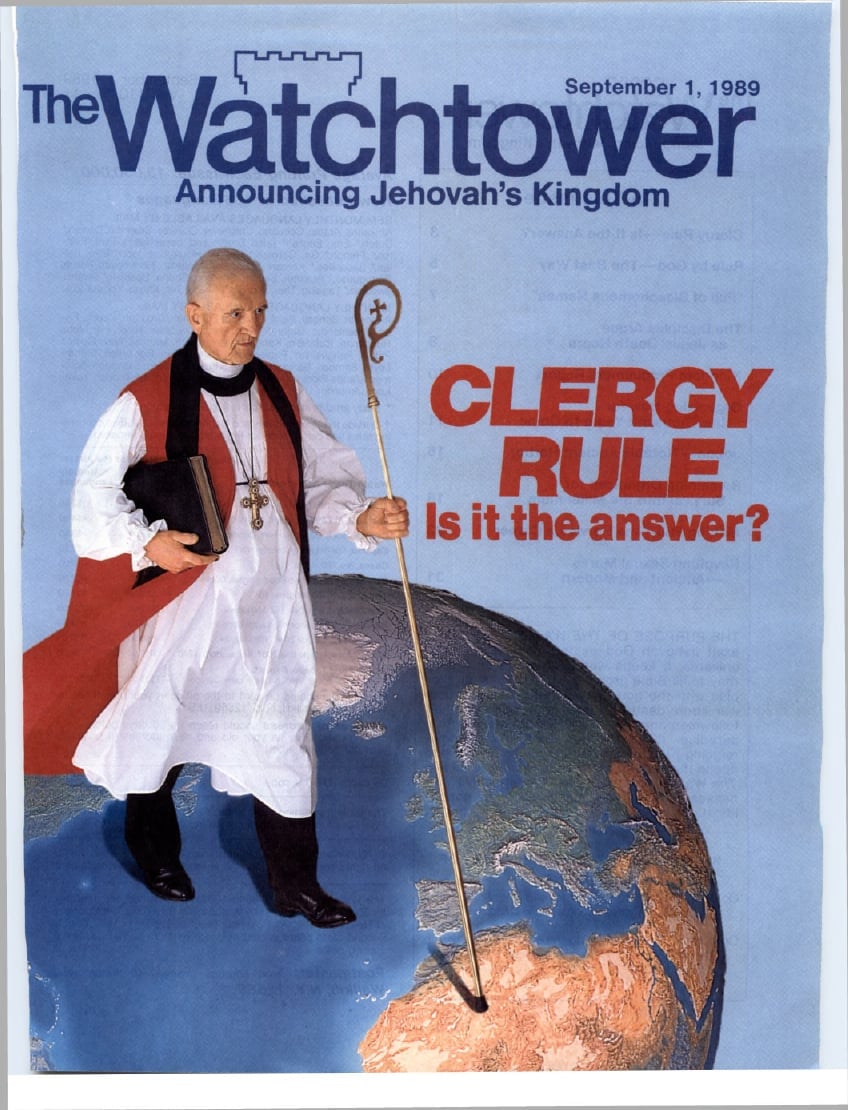
The Watchtower — September 1, 1989
Source: jw.org
Contents
Clergy Rule—Is It the Answer?
Rule by God—The Best Way
“Full of Blasphemous Names”
The Disciples Argue as Jesus’ Death Nears
‘The Desirable Things Come In’
Organizing Now for the Thousand Years to Come
Joppa—Notable Ancient Harbor
Remaining Organized for Survival Into the Millennium
Making Full-Time Service a Career
Revolting Sexual Mores—Ancient and Modern
“Hope of a Better World”
Clergy Rule—Is It the Answer?
Clergy Rule—Is It the Answer?
PEOPLE the world over are tired of injustice, oppression, and political corruption. They want something better, as is evident from their efforts to change political leaders. But new leaders seldom if ever bring the people contentment.
Some think that clergy rule would result in better government. They believe that clergymen would bring godly qualities into governmental affairs. It was probably with this in mind that cleric Marion (Pat) Robertson, a U.S. presidential hopeful in 1988, prayed that “godly people” would win political office. But would this really answer the need for better rulers?
When the Clergy Ruled Europe
During the Middle Ages, the clergy had tremendous secular power. Why, popes were able to crown and dethrone kings! In 800 C.E., Pope Leo III crowned the Frankish king Charlemagne as emperor of the Holy Roman Empire. For a thousand years, this empire represented the union of Church and State, and during that time the clergy enjoyed varying degrees of power over secular authorities.
Beginning in the 11th century, the papacy took over the role of leader in Europe. In this regard, The Columbia History of the World, edited by John Garraty and Peter Gay, says: “The church was Europe’s greatest government.” This book also observes that the church was able to “wield more political power than any other Western government.” What was the situation of the people under clergy rule?
No one was free to worship as he pleased or to express opinions conflicting with those of the clergy. This clerical intolerance created a climate of fear throughout Europe. The church established the Inquisition to root out individuals who dared to hold different views. Considered heretics, they were brought before inquisitors, who tortured them for confessions. Often, those found guilty were burned at the stake.
Regarding clergy rule in Spain, The Columbia History of the World states: “Wars and the crusading ideology had welded together an orthodox and snobbish aristocracy and clergy which held all the reins of power in the state. Intellectual life had been crippled by censorship and the Inquisition, which had been used against anyone protesting against either official theology or state policy.”
In his book The Age of Faith, Will Durant said: “Making every allowance required of an historian and permitted to a Christian, we must rank the Inquisition, along with the wars and persecutions of our time, as among the darkest blots on the record of mankind, revealing a ferocity unknown in any beast.” In the Middle Ages, clergy rule meant the destruction of personal liberties.
Did the Protestant reformer John Calvin differ from the Catholic clergy? Well, consider what happened when Michael Servetus fled from persecution by the Spanish clergy and was apprehended in Geneva, Switzerland. There, Calvin had set up a community over which he and his ministers ruled with absolute power. Because Servetus denied the Trinity, Calvin achieved what had eluded the Inquisition. Servetus was condemned to death for heresy and was burned at the stake. Calvin thus showed the same intolerance as the Catholic clergy.
Did clergy domination of secular governments mean peace for the people of Europe? No, indeed. Instead of enjoying peace, they had to endure years of clergy-inspired warfare. Pope Urban II launched the First Crusade and thus began a series of wars that lasted for 200 years. Moreover, clergy-fomented wars against people considered to be heretics resulted in the death of thousands of men, women, and children.
Did clergy rule eliminate corruption? Not in the least. The book A History of the Modern World, by R. R. Palmer and Joel Colton, states: “Increasingly the life of the church was corrupted by money. No one believed in bribery; but everyone knew that many high churchmen (like many high civil officials of the day) could be bribed.” Corruption among the clergy was a common complaint.
Did clergy rule result in compassion for the common people? By no means. For instance, consider what happened when Cardinal Richelieu of France gained control of governmental affairs during the reign of Louis XIII. The book The History of the Nations, edited by Henry Cabot Lodge, says that Richelieu’s “policy was based on the ruin of the French liberties.”
In Mexico during the 17th century, Indian towns were often ruled by the clergy. According to the book Many Mexicos, by Lesley Simpson, the clergy considered the whipping post “an indispensable aid for implanting and maintaining the Christian virtues, as well as for the punishment of secular offenses.”
History books thus enable us to examine the record of clergy rule over the centuries. What does that record reveal? Shocking disregard for the happiness, well-being, and liberties of the common people. Indeed, clergy rule has been unendurable despotism. As Daniel Defoe wrote in his work The True-Born Englishman: “And of all plagues with which mankind are curst, ecclesiastic tyranny’s the worst.”
Obviously, then, clergy rule is not the answer to man’s need for better government. So, to whom can we turn? The answer is within the reach of everyone, as we shall see.
[Picture on page 4]
Protestant Calvin showed the same intolerance as the Catholic clergy
[Credit Line]
Courtesy of the Trustees of the British Museum
Rule by God—The Best Way
Rule by God—The Best Way
THE history of governments makes it evident that imperfect humans cannot properly exercise power over other people. As Lord Acton of England said: “Power tends to corrupt and absolute power corrupts absolutely.” Thus, as the Bible says: “Man has dominated man to his injury.”—Ecclesiastes 8:9.
Originally, Jehovah God gave man dominion over the animals but not over other humans. God told his first created Son in the heavens: “Let us make man in our image, according to our likeness, and let them have in subjection the fish of the sea and the flying creatures of the heavens and the domestic animals and all the earth and every moving animal that is moving upon the earth.” (Genesis 1:26) Man’s Creator was his Ruler. How, then, did that change?
When man rebelled in the garden of Eden, he rejected God as his Ruler and has continued to do so since then. (Genesis, chapter 3) This was evident in ancient Israel, a nation that God had chosen as his own. When the Israelites demanded a human king, Jehovah told his prophet Samuel: “It is not you whom they have rejected, but it is I whom they have rejected from being king over them.”—1 Samuel 8:7.
God’s rulership over the Israelites was benevolent. Through his representative Moses, Jehovah gave them a code of laws that showed loving consideration for their welfare. It protected them from many diseases and promoted consideration for the elderly, the widows, and the orphans. The Law required respect for the property of others and honesty in business dealings. It condemned partiality, false testimony, and bribery. God’s rule was truly just and righteous.
Jehovah promised to rule not just Israel but all mankind. He would take away from sinful men the power to rule over other humans and give it to his only-begotten Son. Foretelling this, God said in Ezekiel’s prophecy: “It will certainly become no one’s until he comes who has the legal right, and I must give it to him.”—Ezekiel 21:27.
It was to Jesus Christ that God gave the legal right to rule mankind as a representative of Jehovah’s sovereignty. Because God’s Kingdom through Christ is the best way to rule all mankind, Jesus taught his listeners to pray for it. “You must pray, then, this way,” said Christ: “Our Father in the heavens, let your name be sanctified. Let your kingdom come. Let your will take place, as in heaven, also upon earth.”—Matthew 6:9, 10.
By the way Jesus treated people, he showed what kind of ruler he would be. Christ certainly had compassion, for “on seeing the crowds he felt pity for them, because they were skinned and thrown about like sheep without a shepherd.” (Matthew 9:36) Jesus showed the depth of his love for his followers when he said: “I am giving you a new commandment, that you love one another; just as I have loved you, that you also love one another.” (John 13:34) He loved people enough to give his life as a ransom. That sacrifice makes it possible for those accepting it to be liberated from sin, sickness, and even death.—1 John 2:1, 2; Revelation 21:1-4.
Foretelling how God’s rule through Jesus Christ would be just, righteous, and peaceful, the prophet Isaiah was inspired to write: “There has been a child born to us, there has been a son given to us; and the princely rule will come to be upon his shoulder. And his name will be called Wonderful Counselor, Mighty God, Eternal Father, Prince of Peace. To the abundance of the princely rule and to peace there will be no end, upon the throne of David and upon his kingdom in order to establish it firmly and to sustain it by means of justice and by means of righteousness, from now on and to time indefinite. The very zeal of Jehovah of armies will do this.”—Isaiah 9:6, 7.
Earthly representatives of God’s rule will be like men who now reflect Jesus’ loving qualities as overseers in the true Christian congregation. Unlike the tyrannical clergy, these men show loving concern for the flock, as did Jesus Christ. Regarding such godly men, the prophet Isaiah wrote: “Look! A king will reign for righteousness itself; and as respects princes, they will rule as princes for justice itself.” (Isaiah 32:1) Such representatives of God’s rulership will also serve divine interests in the new world.—Psalm 45:16.
A Great Change At Hand!
Before God’s Kingdom takes over uncontested rule of mankind, a great change must take place. This change will bring an end to national divisions. Instead of many conflicting human governments, there will be one righteous heavenly government uniting mankind as one people living in peace. Foretelling this, the prophet Daniel wrote: “In the days of those kings the God of heaven will set up a kingdom that will never be brought to ruin. And the kingdom itself will not be passed on to any other people. It will crush and put an end to all these kingdoms [human governments], and it itself will stand to times indefinite.”—Daniel 2:44.
God’s rule is the only answer to the governmental problems facing mankind today. The situation in which humans now find themselves threatens their very existence! And there is no human solution that can work. It would be wise, therefore, to pay attention to the Bible’s solution and look forward with confidence to the time not far off when righthearted humans will rejoice under the unchallenged and blessed rule by God.
[Picture on page 6]
“A king will reign for righteousness itself”
“Full of Blasphemous Names”
“Full of Blasphemous Names”
THE Bible book of Revelation describes a vision of “a scarlet-colored wild beast that was full of blasphemous names.” It exists for a while, then goes into an abyss from which it later arises. (Revelation 17:3, 8) Frequently, the pages of this magazine have identified this scarlet-colored beast with, initially, the League of Nations and, subsequently, its successor, the United Nations. But why is the scarlet-colored beast said to be “full of blasphemous names”?
The first draft of the Covenant of the League of Nations, based on joint British and American proposals, was made public on February 14, 1919. The next day, in an editorial entitled “The League of Peace,” The Times of London said: “It is a cause of legitimate pride to recognize in the Covenant so much of the work of Englishmen. . . . We venture to say that it is the most important international document ever published.” George Thayer, a minister of the First Congregational Church of Cincinnati in the United States, described it as “the most sublime declaration of the will and desire of the enlightened people of the earth which has ever been put upon paper.” Praise also came from the foreign-language press. “It is not a Bible,” stated the French newspaper L’Homme Libre, “but it is capable of being more than that, since neither the Bible, nor any Evangelist ever prevented men from killing one another. Idealism descends to reality.” The French newspaper Victoire described it as “the greatest collective effort ever made since the beginning of the world for setting up reason and justice on the earth.”
After the establishment of the League of Nations, General Jan Smuts, one of the representatives of Britain on that commission, wrote: “The covenant is one of the great creative documents of human history. . . . It must succeed, because there is no other way for the future of civilization. . . . One by one the peoples still outside the covenant will fall in behind this banner under which the human race is going to march forward to triumphs of peaceful organization and achievement.”
All such expectations were proved false when World War II erupted in 1939. The League failed. It was merely a human organization made up of imperfect men. So is its successor, the United Nations. Yet, on the day the UN Charter was signed, an editorial in The New York Times labeled it “the tree of peace” and said, “A great hope is born . . . Great things may come.” Similarly, church leaders have labeled the UN “the sole hope” for peace and “the last hope.”
Ascribing to human organizations things that God’s Kingdom alone will accomplish is blasphemous. Thus, the Bible foretells that after a short existence, the United Nations will go “off into destruction.” Only God’s perfect heavenly government can bring lasting peace to mankind.—Revelation 17:11, 12; Isaiah 9:6, 7; Daniel 2:44.
The Disciples Argue as Jesus’ Death Nears
Jesus’ Life and Ministry
The Disciples Argue as Jesus’ Death Nears
JESUS and his disciples are near the Jordan River, where they cross from the district of Perea into Judea. Many others are traveling with them to the Passover of 33 C.E., which is only a week or so away.
Jesus is walking on ahead of the disciples, and they are amazed at his bold determination. Recall that a few weeks earlier when Lazarus died and Jesus was about to go from Perea into Judea, Thomas encouraged the others: “Let us also go, that we may die with him.” Recall also that after Jesus resurrected Lazarus, the Sanhedrin laid plans to kill him. No wonder that fear grips the disciples as they now enter Judea again.
To prepare them for what lies ahead, Jesus takes the 12 off privately and tells them: “Here we are, advancing up to Jerusalem, and the Son of man will be delivered to the chief priests and the scribes, and they will condemn him to death and will deliver him to men of the nations, and they will make fun of him and will spit upon him and scourge him and kill him, but three days later he will rise.”
This is the third time in recent months that Jesus has told his disciples about his death and resurrection. And although they listen to him, they fail to comprehend. Perhaps it is because they believe in the restoration on earth of the kingdom of Israel, and they are looking forward to enjoying glory and honor in an earthly kingdom with Christ.
Among the Passover-bound travelers is Salome, the mother of the apostles James and John. Jesus has called these men “Sons of Thunder,” no doubt because of their fiery dispositions. For some time these two have harbored the ambition to be prominent in Christ’s Kingdom, and they have made their desires known to their mother. She now approaches Jesus in their behalf, bows before him, and requests a favor.
“What do you want?” Jesus asks.
“Give the word that these my two sons may sit down, one at your right hand and one at your left, in your kingdom.”
Realizing the source of the request, Jesus says to James and John: “You men do not know what you are asking for. Can you drink the cup that I am about to drink?”
“We can,” they answer. Even though Jesus has just told them that he faces terrible persecution and finally execution, they apparently do not comprehend that this is what he means by “the cup” he is about to drink.
Nevertheless, Jesus tells them: “You will indeed drink my cup, but this sitting down at my right hand and at my left is not mine to give, but it belongs to those for whom it has been prepared by my Father.”
In time the other ten apostles learn what James and John have requested, and they are angry. Perhaps James and John were prominent in the earlier argument among the apostles about who is the greatest. Their present request reveals that they have not applied the counsel Jesus has given on this matter. Sadly, their desire for prominence is still strong.
So to deal with this latest controversy and the ill will it has created, Jesus calls the 12 together. Counseling them lovingly, he says: “You know that the rulers of the nations lord it over them and the great men wield authority over them. This is not the way among you; but whoever wants to become great among you must be your minister, and whoever wants to be first among you must be your slave.”
Jesus has set the example they should imitate, as he explains: “Just as the Son of man came, not to be ministered to, but to minister and to give his soul a ransom in exchange for many.” Jesus not only has ministered in behalf of others but will do so to the extent of dying for mankind! The disciples need that same Christlike disposition of desiring to serve rather than to be served and to be a lesser one rather than to be in a position of prominence. Matthew 20:17-28; Mark 3:17; 9:33-37; 10:32-45; Luke 18:31-34; John 11:16.
◆ Why does fear now grip the disciples?
◆ How does Jesus prepare his disciples for what lies ahead?
◆ What request is made of Jesus, and how are the other apostles affected?
◆ How does Jesus deal with the problem among his apostles?
‘The Desirable Things Come In’
Kingdom Proclaimers Report
‘The Desirable Things Come In’
THE prophet Haggai penned these words in 520 B.C.E.: “‘And I will rock all the nations, and the desirable things of all the nations must come in; and I will fill this house with glory,’ Jehovah of armies has said.” (Haggai 2:7) “The desirable things” of all the nations that fill Jehovah’s house with glory are his God-fearing worshipers. Such honesthearted ones are responding to the good news in Italy, so that there are now 166,000 Witnesses teaching the people the Bible in that nation. The Catholic clergy in Italy consider our exceptional growth an “increasingly alarming phenomenon” that “worries and dismays” them. Let one truth seeker there relate what happened to her.
“I was a catechist for ten years, and I was convinced that this was the way to express my love for God and neighbor. Even though I had a friend who was one of Jehovah’s Witnesses, I never took the time to listen to the Bible’s message. Some time ago, however, when the Witnesses called on me, I invited them in. I wanted to tell them not to visit my mother-in-law again, as she was feeling disoriented. ‘Instead of visiting elderly people,’ I told them, ‘talk to people like me.’ From then on they regularly came to my home, but each time they touched on a doctrinal point, I would ask them to defer the conversation until later so I could research the matter.
“I spoke to several priests and noticed that they had no Bible answer. One of them, a missionary, told me it wasn’t really so important to attend Mass. ‘After all,’ he said, ‘in countries like Brazil, for example, people do other things instead of going to Mass. The important thing is to serve God as best one can.’ These words gave me the strength to sever my ties with the Catholic Church. Another priest told my husband, who was also a Catholic, that if I wanted to become one of Jehovah’s Witnesses, he should let me do so because Jehovah’s Witnesses have only one fault, that of being too zealous. I was baptized just recently along with one of my sons. My husband is also studying the Bible and showing interest in the Kingdom message.”
As Jehovah rocks the nations by having his judgments declared on earth, many righteously inclined people are abandoning dishonest practices in order to follow Bible principles. Before learning the truth, one Italian man went deeply in debt, figuring he could repay his debt with money from his regular salary and the dishonest “tips” he was receiving. Gaining a knowledge of the truth, he made a difficult decision and quit accepting dishonest “tips.” He and his wife were baptized and right away began serving in the full-time ministry. In the hospital where he works, he often has to undress corpses, and he has frequently found large sums of money on them. For example, once he found 150,000 lire (about $115), and another time 600,000 lire (about $460). Being honest, he returned the money, and this gave him opportunity to speak to the hospital management and doctors about the truth. The hospital management sent him letters of commendation for his honest and responsible conduct.
These experiences from Italy are but a sample of how “the desirable things” are abandoning this wicked, violent system and coming to Jehovah’s clean, peaceful organization before he finally rocks Satan’s political system into destruction at Armageddon.
Organizing Now for the Thousand Years to Come
Organizing Now for the Thousand Years to Come
“They . . . will rule as kings with him for the thousand years.”—REVELATION 20:6.
1. What will be the state of affairs on the earth more than a thousand years from now?
WHAT! Do we mean that more than a thousand years from now, mankind will still be here on earth? We mean exactly that! And what is more, all mankind will then be perfect in body, heart, and mind—like the first man and woman at the start of human existence on this globe. Yes, a thousand years from now, humans will be in the image and likeness of their God and Restorer. (Genesis 1:26-30) They will be enjoying life to the full in a “garden of Eden,” a paradise of pleasure, on a cleansed earth that will not be overcrowded with human inhabitants. (Genesis 2:15) All of this will be in fulfillment of the Creator’s original purpose toward the earth and those who were to reside upon it. This beautiful accomplishment will vindicate him as being faithful to his loving promise to bless all mankind despite all opposition.
2. How did people of some 19 centuries ago get a view of what perfected mankind will be like?
2 That blessed accomplishment will crown the Thousand Year Reign of God by means of his glorified Son, who spent 33 1/2 years on earth as a perfect man more than 19 centuries ago. As to the kind of appearance he presented at that time, we read: “The Word became flesh and resided among us, and we had a view of his glory, a glory such as belongs to an only-begotten son from a father; and he was full of undeserved kindness and truth.” (John 1:14) So in Jesus Christ, the people of Israel then saw what a perfect human creature is like. (Luke 3:23, 38) Yes, 19 centuries ago some people saw what perfected humankind will be like in the coming earthly Paradise.
3, 4. (a) How long will Jehovah’s reign by Jesus Christ and the 144,000 actually be? (b) What expression is used for that time period, and how was that reflected in the titles of certain Watch Tower publications?
3 The length of Jehovah’s Kingdom rule by Jesus Christ and his 144,000 glorified disciples was foretold to be a thousand years. Regarding that Thousand Year Reign, the aged apostle John wrote: “I saw thrones, and there were those who sat down on them, and power of judging was given them. Yes, I saw the souls of those executed with the ax for the witness they bore to Jesus and for speaking about God, and those who had worshiped neither the wild beast nor its image and who had not received the mark upon their forehead and upon their hand. And they came to life and ruled as kings with the Christ for a thousand years. (The rest of the dead did not come to life until the thousand years were ended.) This is the first resurrection. Happy and holy is anyone having part in the first resurrection; over these the second death has no authority, but they will be priests of God and of the Christ, and will rule as kings with him for the thousand years.”—Revelation 20:4-6.
4 Since a thousand years is a millennium, that period is called Christ’s Millennial Reign. Those who accept and teach this Bible doctrine are sometimes called millenarians or chiliasts, according to the Greek word for “thousand.” Interestingly, the volumes of Studies in the Scriptures (once published by the Watch Tower Bible and Tract Society) were originally called Millennial Dawn. And the songbook once used by the International Bible Students was entitled Hymns of the Millennial Dawn.
5. What will be the state of Satan and the demons during the Thousand Year Reign of Christ?
5 The expression “a thousand years” at Revelation 20:4 is not symbolic but refers to a thousand solar years. During that Millennium, Satan the Devil and his demon hordes will be in the abyss, for just before telling about Christ’s Thousand Year Reign, the apostle John said: “I saw an angel coming down out of heaven with the key of the abyss and a great chain in his hand. And he seized the dragon, the original serpent, who is the Devil and Satan, and bound him for a thousand years. And he hurled him into the abyss and shut it and sealed it over him, that he might not mislead the nations anymore until the thousand years were ended. After these things he must be let loose for a little while.”—Revelation 20:1-3.
6. (a) What date have some Roman Catholics given for the end of Christ’s Thousand Year Reign? (b) If Catholic claims were true, how long has the little time of Satan’s release from the bottomless pit already been?
6 Some Roman Catholics have claimed that Jesus Christ’s Thousand Year Reign ended in 1799 when French armies captured Rome and deposed the pope as its ruler, so that he was deported as a prisoner to France, where he died. The Catholic clergy have said that Satan and his demons were then released from “the bottomless pit,” or “the abyss,” to renew their deceptive work for “a little time.” (Revelation 20:1-3, Catholic Douay Version) If that were true, it would mean that the “little time” has already continued for 190 years, with no end in sight.
7. What does the Bible indicate about the time and nature of Jesus Christ’s Millennial Reign?
7 According to the Scriptures, however, the true Millennial Reign of Jesus Christ is still future. Present-day fulfillment of Bible prophecy shows that it is very close at hand. During the true Millennium, Satan and his demons will actually be abyssed, and Jesus Christ and his 144,000 joint heirs will reign over all mankind without interference from the Devil’s organization. The everlasting blessing of all redeemed mankind, in fulfillment of Jehovah’s covenant with his “friend” Abraham, will begin with the “great crowd,” who will survive the unparalleled “tribulation” with which this wicked system ends. It will extend to the billions of human dead ransomed by “the blood of the Lamb,” Jesus Christ. (James 2:21-23; Revelation 7:1-17; Genesis 12:3; 22:15-18; Matthew 24:21, 22) To this end, these will be resurrected from their death sleep in the memorial tombs to life on earth.—John 5:28, 29.
A Christian Organization
8. What organization did the book The New Creation describe, but what organizational work did it not envision?
8 In the outworking of the divine purpose, a new organization has preceded those blessings by centuries. Regarding that organization, we read: “If anyone is in union with Christ, he is a new creation.” “Neither is circumcision anything nor is uncircumcision, but a new creation [a new creature, King James Version] is something.” (2 Corinthians 5:17; Galatians 6:15) Back in 1904, the book The New Creation called attention to this new organization that came into existence in the first century C.E. (Studies in the Scriptures, Series VI, Study V, entitled “The Organization of the New Creation”) Owing to its view of what the end of the Gentile Times in 1914 would mean, that book did not envision the remarkable organizational work that was due to take place after the crippling effects of the first world war of human history.—Luke 21:24, KJ.
9. To what occasion did the remnant of the new creation rise?
9 The preservation of the remnant of the spiritual new creation to the end of World War I in 1918 and their being kept alive in the flesh into the postwar year of 1919 came as a wondrous surprise. But millennial conditions had not set in. Evidently, then, there was more work for the remnant of the new creation to do on earth before realizing its heavenly hope of sharing with Jesus Christ in the millennial work. Therefore, the great need was for the revival and reorganization of the remnant. So, with unshattered faith and eagerness for the thrilling work ahead, they rose to the occasion.
10. What questions arose with regard to the millions expected to survive into the new system of things?
10 Survival on earth by some of mankind through this wicked system’s catastrophic end and on into Jesus Christ’s Millennial Reign was expected by the anointed remnant. Especially was this so after the public talk “Millions Now Living May Never Die” was given at Los Angeles, California, in the war year of 1918. Were these millions of future Har–Magedon survivors to be organized? (Revelation 16:14-16) Before being ushered into the Millennium to become part of the “new earth,” would they engage in the Kingdom-preaching work along with the remnant? (2 Peter 3:13) These questions would be answered by postwar developments.
11. (a) What would have to be done with the other sheep due to become one flock with the remnant? (b) Why was a difference in hopes no reason for division between the remnant and the other sheep?
11 The following words of the Fine Shepherd, Jesus Christ, duly came to the fore: “I have other sheep, which are not of this fold; those also I must bring, and they will listen to my voice, and they will become one flock, one shepherd.” (John 10:16) If the anointed remnant needed to be organized for the postwar work from 1919 onward and if later the other sheep were to become one flock with the remnant in this fold, then what? Why, those other sheep would also have to get organized in conjunction with that remnant! The fact that the other sheep had a different hope—that of life in an earthly paradise of pleasure—was no cause for division between them and the remnant. All were following just the one Shepherd, and there would be no separation between the two groups until the glorification of the anointed remnant in the Kingdom.
12. (a) What is of far greater importance than the salvation of humankind? (b) When and why did it become of prime importance to advertise the Kingdom?
12 The salvation of humans from sin and death, the end of domination by Satan’s world, and the restoration of obedient mankind to Paradise reestablished earth wide are outstanding features of Jehovah’s loving purpose. However, there is something of far greater importance to all the universe. What is that? It is the vindication of Jehovah God’s universal sovereignty along with the sanctification of his holy name. The timeliness of advertising Jehovah’s Kingdom by the reigning King, Jesus Christ, was emphasized in 1922 at the second Cedar Point, Ohio, convention of the International Bible Students. Since the Gentile Times had ended in 1914, it was due time to carry out Jesus’ prophetic words: “This good news of the kingdom will be preached in all the inhabited earth for a witness to all the nations; and then the end will come.” (Matthew 24:14) The Kingdom that would vindicate Jehovah’s universal sovereignty and sanctify his holy name had been established in heaven in 1914, and Jesus Christ was ruling in the midst of his enemies. This was the grand good news to be preached with all available means for advertising the King and his Kingdom!
13. For the work of Kingdom proclamation, what did God provide, and why?
13 Jehovah is an organizer on a universal scale, for he is the Most High, the Supreme One. He now saw to the thorough organization, here on earth, of the work of proclaiming his Kingdom internationally before the end of this system comes. Members of the surviving remnant of anointed ones were welded, therefore, into an international organization to accomplish his will. These must proclaim to the world that in view of Satan’s having challenged Jehovah’s universal sovereignty, both the reality and the rightfulness of that sovereignty must be vindicated, justified, for all time.
Pre-Millennial Organization
14. (a) Before our Common Era, what organization became the earthly part of Jehovah’s universal organization? (b) How did David prove to be an outstanding organizer?
14 For 15 centuries before our Common Era, Jehovah God had a visible organization on earth. He used the prophet Moses as His mediator in organizing the nation of Israel after its deliverance from Egypt, the first world empire of Bible history. Under the Mosaic Law, Israel became the visible part of Jehovah’s universal organization. An outstanding organizer among these chosen people of God was the shepherd-king David, of whom we read: “David organized them [the Levites who served at Jehovah’s sanctuary] in divisions, called after Gershon, Kohath, and Merari, the sons of Levi.” “He organized them [the priests] by drawing lots among them, for there were sacred officers and officers of God in the line of Eleazar and in that of Ithamar.”—1 Chronicles 23:3, 6; 24:1, 5, The New English Bible.
15. (a) In what manner did the Israelites depart from Egypt? (b) Who also chose to leave Egypt, and did they remain with the Israelites?
15 Hundreds of years before David’s time, when the Israelites left Egypt, they did not rush out in a mad scramble but departed in an orderly manner. This indicated good organizational work on the part of their mediator, Moses. A great crowd of non-Israelites went out with them, choosing to throw in their lot with the people of the miracle-working God, Jehovah, who was mightier than all the gods of Egypt. Despite many hardships, some time later this “vast mixed company” having goodwill toward Jehovah’s chosen people was still with them in the awesome wilderness of Sinai. (Exodus 12:37-51; Numbers 11:4) Along with the Israelites, that mixed multitude evidently entered the Promised Land under the leadership of Moses’ successor, Joshua, for God ordained that provision be made there for such alien residents.
16. (a) Whom did the vast mixed company prefigure? (b) What must these do to survive this system’s end?
16 That vast mixed company from Pharaonic Egypt prefigured a great crowd of the 20th century. They are not spiritual Israelites but are other sheep of the Fine Shepherd, Jesus Christ. With the anointed remnant, they look forward to complete deliverance from antitypical Egypt, the world system of things of which the Greater Pharaoh, Satan the Devil, is the god. (John 10:16; 2 Corinthians 4:4; Revelation 7:9) But what must they do to survive the violent destruction of Satan’s old world and enter the promised new world under the Greater Joshua, Jesus Christ? (2 Peter 3:13) They must keep in line with the organizational arrangements of the nucleus of Jehovah’s visible organization, the anointed remnant.
17. In this disorganized world, how do those of the great crowd act, and to what do they look forward?
17 Especially since the middle of the fourth decade of the 20th century has the great crowd of other sheep been brought into the organized one flock under the glorified one Shepherd, the reigning King, Jesus Christ. In a world that continues getting more and more disorganized despite the existence of the United Nations organization, those of this great crowd wholeheartedly support the anointed remnant and thus give evidence of the unifying power of Jehovah’s holy spirit. Determinedly, they keep organized with the remnant while looking forward to special service on earth during Jesus Christ’s Thousand Year Reign.
What Are Your Thoughts?
□ What do the Scriptures indicate about the time and nature of Jesus Christ’s Millennial Reign?
□ What is far more important than the salvation of humankind?
□ Before our Common Era, what organization became the earthly part of Jehovah’s universal organization?
□ How do those prefigured by the vast mixed company survive into the Thousand Year Reign?
Joppa—Notable Ancient Harbor
Scenes From the Promised Land
Joppa—Notable Ancient Harbor
ANCIENT ISRAEL had a long, sandy coast. Yet the Israelites were not particularly known as a seafaring people. The nature of their coast may have been a factor.
It was an almost uninterrupted line of beaches and dunes, formed of sand carried to sea by the Nile River.a Had you sailed up it from Egypt’s border, you would not have found a truly outstanding natural harbor south of Mount Carmel.
But about midway up Israel’s coast you would have seen on a hill the city of Joppa. As the picture shows, a chain of offshore rocks formed a small cove. While the resulting harbor was inferior to the one farther north at Acre (Ptolemaïs), it still made Joppa notable. (Acts 21:7) Until Herod the Great built the artificial harbor of Caesarea, Joppa was the best spot along the coast for ships to dock. This illuminates some Biblical references to Joppa.
When offering to aid Solomon in building the temple, Hiram the king of Tyre said: “We shall bring [trees from Lebanon] to you as rafts by sea to Joppa, and you, for your part, will take them up to Jerusalem.” (2 Chronicles 2:1, 11, 16) These rafts may have left from the Phoenician ports of Tyre or Sidon. (Isaiah 23:1, 2; Ezekiel 27:8, 9) Passing Carmel, the cedar-tree rafts landed at Joppa. From there the cedars could be moved to Jerusalem, 34 miles [55 km] east/southeast. Joppa was also the docking port for cedar timbers when the Jews rebuilt the temple after the exile.—Ezra 3:7.
Perhaps workmen accompanying the timbers sailed aboard Phoenician ships, similar to the scale model. As you study it, recall that after Jehovah assigned Jonah to Nineveh, the prophet fled in the opposite direction. “[Jonah] finally came down to Joppa and found a ship going to Tarshish. So he paid its fare and went down into it, in order to go with them to Tarshish from before Jehovah.”—Jonah 1:1-3.
Apparently, Jonah boarded this kind of seaworthy cargo ship, which was able to make the long voyage from Joppa to Tarshish (likely ancient Spain). It probably had a high carved prow, near which hung a stone anchor. Passengers, rowers, and some cargo could fit on the deck, which is not shown in this model. Below deck was a hold, where more cargo would be stored and where Jonah went to sleep. The ship was made of sturdy juniper planks and had one cedar mast to support a large linen sail. Note on each side the line of long oars (probably of oak from Bashan). Now imagine the ship at sea and threatened by a violent storm. Hear the mariners cry out to their gods for help until finally they are forced to toss Jonah overboard so that they themselves would not perish.—Ezekiel 27:5-9; Jonah 1:4-15.
First-century Joppa was home to a congregation of Christians, some of whom may have been dockworkers or ex-sailors. A member of this bustling seaport congregation was the Jewess Dorcas (Tabitha). “She abounded in good deeds and gifts of mercy that she was rendering.” In the year 36 C.E., Dorcas fell sick and died, which caused many to weep, recalling her abundant good works. Fellow Christians brought the apostle Peter from Lydda (modern Lod, near the Tel Aviv airport) to Joppa. Peter resurrected this beloved sister, a miracle that “became known throughout all Joppa, and many became believers.”—Acts 9:36-42.
Peter stayed in Joppa for a time at the house of Simon, a tanner. Here the apostle had a vision that led him to take some brothers of the Joppa congregation north on the coastal road to the new port of Caesarea. There Peter preached to and baptized the Roman army officer Cornelius, the first uncircumcised Gentile to become a spirit-anointed Christian. (Acts 9:43–10:48) What joy and excitement there must have been in Joppa when the brothers returned with news of this crucial development in Christian history!
Today many visitors tour Joppa, which is part of modern Tel Aviv-Jaffa, and they can easily relive Biblical events that occurred at this notable port.
[Footnotes]
You can easily see this sandy coast in the satellite picture on the cover of the 1989 Calendar of Jehovah’s Witnesses. This calendar also provides a larger picture of the above view of Joppa.
[Picture Credit Line on page 16]
Pictorial Archive (Near Eastern History) Est.
[Picture Credit Line on page 17]
Pictorial Archive (Near Eastern History) Est.
Remaining Organized for Survival Into the Millennium
Remaining Organized for Survival Into the Millennium
“They will become one flock, one shepherd.”—JOHN 10:16.
1. To the ever-living God, a thousand years is like what?
JEHOVAH is the Creator of time for mankind. And to him, the immortal God who is from everlasting to everlasting, a thousand years is like but a swiftly passing day or even a mere watch period during one of our nights.—Psalm 90:4; 2 Peter 3:8.
2. What time period has Jehovah set aside for blessing all mankind?
2 God has set a symbolic day of a thousand years during which he will bless all families of the earth. (Genesis 12:3; 22:17, 18; Acts 17:31) This includes those now dead and those yet alive. How will God do this? Why, by means of His Kingdom by Jesus Christ, the “seed” of His symbolic woman!—Genesis 3:15.
3. (a) How was the heel of the Seed of God’s woman bruised, but how was that wound healed? (b) At the end of Jesus Christ’s Thousand Year Reign, what will he do to the symbolic serpent?
3 The symbolic heel of the Seed of God’s woman (or heavenly organization) was bruised when Jesus Christ suffered a martyr’s death and remained dead for parts of three days in the year 33 of our Common Era. But on the third day, Almighty God, the Great Life-Giver, healed that wound by resurrecting his loyal Son to immortal life in the spirit realm. (1 Peter 3:18) Since Jesus will never die again, he is in position to rule as King over mankind for a thousand years and to “bruise” the head of the symbolic serpent, crushing him out of existence after the end of the Thousand Year Reign. What a blessing that will be for faithful restored mankind!
4. What kind of program has God been carrying out with his people?
4 Much organizing has been in progress among Jehovah’s people earth wide during this “conclusion of the system of things” since the Gentile Times closed in 1914. (Matthew 24:3; Luke 21:24, King James Version) This organizational program preliminary to the Millennium is being carried on in harmony with the will and under the direction of the Great Organizer, Jehovah God. By means of his woman, his wifelike heavenly organization, the birth of his promised Kingdom by Jesus Christ took place in 1914, as verified by the fulfillment of Bible prophecy.
5. The birth of what was foretold at Revelation 12:5, and when was this first explained in The Watch Tower?
5 Thus have been gloriously fulfilled these words of Revelation 12:5: “She gave birth to a son, a male, who is to shepherd all the nations with an iron rod. And her child was caught away to God and to his throne.” The birth of Jehovah’s Kingdom by Christ, as pictured by the newborn child of God’s woman, was first explained in The Watch Tower of March 1, 1925. The birth of this Messianic Kingdom in heaven in 1914 differs from the birth of the “nation” of Zion’s ‘children’ on earth in 1919.—Isaiah 66:7, 8.
6. (a) The Kingdom’s birth called for what work foretold by Jesus? (b) Doing this work called for what on the part of Jehovah’s people, and what kind of front do they now present?
6 The birth of Jehovah’s Kingdom by which he will vindicate his rightful sovereignty over all the universe—ah, here was something that deserved to be advertised throughout all the earth! And here was the time for the fulfillment of these words of Jesus regarding proofs of his invisible “presence”: “This good news of the kingdom will be preached in all the inhabited earth for a witness to all the nations; and then the end will come.” (Matthew 24:3, 14) United, harmonious preaching on an international, earth-wide scale would indeed call for organizing the visible part of Jehovah’s universal organization. The Watch Tower Bible and Tract Society, as represented by its then president, J. F. Rutherford, was in favor of this. So, from the postwar year of 1919, the organizing of the Society’s loyal supporters as a restored nation went forward determinedly, with prayer for the guidance and blessing of the Supreme Organizer, Jehovah God. In the face of World War II, despite bitter opposition by the Fascists, the Hitlerite Nazi movement, and Catholic Action, Jehovah’s Witnesses earth wide presented a united front to the enemy world.
7. (a) Only by remaining in what relationship with one another may Jehovah’s people expect to survive the great tribulation? (b) How did the Flood survivors get through the global Deluge, and whom did they prefigure?
7 Only Jehovah’s Witnesses, those of the anointed remnant and the “great crowd,” as a united organization under the protection of the Supreme Organizer, have any Scriptural hope of surviving the impending end of this doomed system dominated by Satan the Devil. (Revelation 7:9-17; 2 Corinthians 4:4) They will make up the “flesh” that Jesus Christ said would be saved through the worst tribulation of all human history. As it was in the days of Noah, said Jesus, so it would be in the day when He would be revealed. Inside the ark that took many years of organized effort to complete, only eight human souls survived the global Deluge. They survived as a united family group. (Matthew 24:22, 37-39; Luke 17:26-30) Noah’s wife corresponds to the bride of Christ, and his sons and daughters-in-law to Jesus’ present-day “other sheep,” who have grown into an increasing great crowd, the final proportions of which we do not now know. (John 10:16) For survival into the Millennium under the Greater Noah, Jesus Christ, they have to remain organized with the anointed remnant, “the chosen ones” on account of whom the days of the “great tribulation” will be cut short.—Matthew 24:21, 22.
Survival Into the Millennium
8. In closing his prophecy regarding his presence, what illustration did Jesus give, and how was the date June 1, 1935, significant as to understanding it?
8 According to Matthew’s Gospel, Jesus closed his prophecy on the sign of his presence with an illustration. Commonly styled the parable of the sheep and the goats, it applies now, during the conclusion of this system of things, which began at the end of the Gentile Times in 1914. (Matthew 25:31-46) The date of Saturday, June 1, 1935, was significant as to understanding the identity of the sheep of this parable as being members of the great crowd. On that day, at a convention of Jehovah’s Witnesses in Washington, D.C., 840 individuals were baptized in symbol of their dedication to Jehovah God through Jesus Christ. The majority of these took this action in prompt response to a discourse on Revelation 7:9-17 given by J. F. Rutherford. It was their desire to become part of the great crowd of the Fine Shepherd’s other sheep, having the opportunity of surviving the oncoming great tribulation and of living right through this system’s end and on into the Millennial Reign of the Shepherd-King, Jesus Christ. Ultimately, they attain to everlasting life on a paradise earth.—Matthew 25:46; Luke 23:43.
9. Why are the sheep invited to inherit “the kingdom prepared for [them],” and how are they in the finest position to do good to the King’s brothers?
9 Why are these sheeplike ones invited to “inherit the kingdom prepared for [them] from the founding of the world”? The King tells them that it is because they did good to his “brothers,” and thereby did it to him. By the expression “brothers,” the King means the remnant of his spiritual brothers still on earth in this conclusion of the system of things. Having become one flock with these brothers of the Shepherd-King, Jesus Christ, they would keep in the closest possible association with the remnant of such and would thus be in the finest position to do good to them. Even in material ways, they would help Jesus’ brothers preach the message of the established Kingdom worldwide before the end would come. In this behalf, the sheep would treasure their privilege of keeping organized with the remnant as the one flock of the one Shepherd.
10. What does it mean for the sheep to “inherit the kingdom prepared for [them] from the founding of the world”?
10 Inheriting “the kingdom prepared for [them]” does not mean that these sheep will reign with Jesus Christ and his brothers in heaven for a thousand years. Rather, right from the Millennium’s start, the sheep will inherit the earthly realm of the Kingdom. Since they are the descendants of Adam and Eve, this earthly realm that the Kingdom of God by Christ will take over was prepared for them “from the founding of the world” of redeemable mankind. Furthermore, since the sheep become the earthly children of the King, who becomes their “Eternal Father,” they inherit an earthly realm, or estate, under God’s Kingdom.—Isaiah 9:6, 7.
11. How do the sheep show that they stand for the Kingdom, and because of this, what blessing is theirs?
11 In contrast with the symbolic goats, the sheeplike ones unmistakably show that they stand for the Kingdom. How? By deeds, not mere words. Because of the King’s invisibility in the heavens, they cannot do good directly to him in support of his Kingdom. So they do good to his spiritual brothers yet on earth. Although this incurs hatred, opposition, and persecution on the part of the goats, for such doing of good, the sheep are told by the King that they are ‘blessed by his Father.’
12. Whom will the surviving sheep be privileged to welcome back, and in this regard, what thought have members of the remnant entertained?
12 The great crowd of sheeplike benefactors of the King’s spiritual brothers will be blessed with the joyous privilege of surviving into the Millennium. In due course, they will share in welcoming back the human dead who are in the memorial tombs. (John 5:28, 29; 11:23-25) These will include the faithful patriarchs and prophets who suffered and endured much for the vindication of Jehovah’s sovereignty in order that they might “attain a better resurrection,” possibly an earlier one. (Hebrews 11:35) Such resurrected men and women of faith, partially listed in Hebrews chapter 11, would include John the Baptizer. (Matthew 11:11) Some of the anointed remnant have thought of surviving and living on to welcome back such resurrected faithful ones who died before Pentecost 33 C.E. Will the anointed be thus privileged?
13. Why would it not be necessary for the remnant to be present to welcome and care for those resurrected on earth?
13 This would not be necessary. The great crowd of tribulation survivors will be on hand in ample numbers to take care of the situation and to acquaint the resurrected ones with the “new earth” under the “new heavens.” (2 Peter 3:13) Even now, the great crowd is being organized for this. Today, when Jesus’ spiritual brothers on earth reportedly number less than 9,000, the survivors from among them would in any case be too few to take care of all the preparatory work leading up to the general resurrection. (Ezekiel 39:8-16) Here, then, is where the great crowd, whose number runs into the millions, will serve excellently. And such a privilege is doubtless reserved for them.
14. (a) Many of the great crowd are being trained for what, and why must a number of them now take on responsibility? (b) What events must shortly take place, and what work awaits the other sheep?
14 Many of the great crowd are already being trained in congregational responsibilities and through building programs that God’s organization is conducting throughout the earth. And it is encouraging to see additional spiritually mature men of the great crowd being assigned to take on greater responsibility in the organization that Jehovah now has functioning on the earth. Remaining ones of the anointed are getting along in years and are less able to carry the load. These brothers of the King welcome the loving organizational assistance that spiritually qualified elders and ministerial servants of the other sheep are able to give. Very shortly, Babylon the Great will be removed from the earthly scene. Then, as Revelation 19:1-8 indicates, the Lamb’s marriage with his bride of the entire 144,000 will be consummated in the heavens, and the other sheep, serving as a new earth under the new heavens, will represent the King in carrying on the grand work of restoration until all earth becomes a populated paradise to Jehovah’s praise.—Isaiah 65:17; compare Isaiah 61:4-6.
15. What prospects do the great crowd anticipate for the Millennium?
15 During Christ’s Millennial Reign, when the ransomed dead of mankind are resurrected, the surviving great crowd will enjoy tremendous and most honorable privileges. They will then become sons and daughters of the King. It will be possible for such sons among them to hold the rank of princes, even as King David’s sons were princes with various responsibilities.a This reminds us of Psalm 45, composed with reference to Jehovah’s anointed “king.”
16. To whom is Psalm 45 really addressed, and how can this be proved?
16 To what king is Psalm 45 really addressed? Why, to Jesus Christ! Hebrews 1:9 makes that application in quoting Psalm 45:7, which reads: “You have loved righteousness and you hate wickedness. That is why God, your God, has anointed you with the oil of exultation more than your partners.” So it is really to the glorified Jesus Christ that Psalm 45:16 says: “In place of your forefathers there will come to be your sons, whom you will appoint as princes in all the earth.”
17. In what and in whom is the King, Jesus Christ, especially interested?
17 Rightly, Jesus is more interested in his future as reigning King than in his earthly past. Of course, he does not forget that past and especially his human ancestors involved in Jehovah’s promise to bless all families by means of the Abrahamic Seed. But now his main interest is in the immediate future as purposed by the Kingmaker, Jehovah God. So Jesus’ earthly children, particularly the sons among them qualified to serve under him in princely offices, will take the place of interest—more so than his earthly forefathers.
18. How do certain renderings of Psalm 45:16 emphasize Jesus’ greater interest in princely sons than in his earthly forefathers?
18 Jesus’ greater interest in princely sons than in forefathers is emphasized by various Bible translations. Here is how some of them render Psalm 45:16: “Your sons shall step into your fathers’ place, and rise to be princes over all the land.” (Moffatt) “The place of your fathers your sons shall have; you shall make them princes through all the land.” (Verse 17, The New American Bible) “Instead of thy fathers children are born to thee: thou shalt make them princes over all the earth.”—The Septuagint Version, published by Samuel Bagster and Sons.
19. Certain men of the great crowd now have what congregation responsibility, and to what position may the King, Jesus Christ, appoint them during his Thousand Year Reign?
19 To our great delight, prospective princes are in our very midst. They are found among the other sheep who listen to the voice of the Fine Shepherd, Jesus Christ. Especially have they been listening to it since 1935, when Revelation 7:9-17 was explained at the convention of Jehovah’s Witnesses in Washington, D.C. Today, thousands of this great crowd of other sheep are serving as elders, or overseers, in the more than 57,670 congregations of Jehovah’s Witnesses in 212 lands around the world. By remaining organized with the remnant of Jesus’ spiritual brothers yet on earth, these men stand in line to be fully adopted as earthly sons of the King, Jesus Christ, during his Thousand Year Reign over the promised new earth. (2 Peter 3:13) As such, they may be appointed as princes to serve in the new earth.
20. (a) The King will have what attitude toward his appointees on earth? (b) The great crowd will welcome back whom, and what opportunity is set before those returning?
20 The King, Jesus Christ, will be pleased to recognize these newly appointed princes, just as he now recognizes the overseership of faithful other sheep in the present-day congregations of Jehovah’s Witnesses. All members of the great crowd of other sheep—the women as well as the men—will have the thrilling privilege of welcoming back from the dead all of those who will hear Jesus’ voice and arise to the opportunity of gaining everlasting life in human perfection on a cleansed earth that will be transformed into a global paradise. (John 5:28, 29) Those highly favored resurrected ones will include Jesus Christ’s redeemed forefathers, men of faith who were willing to prove their devotion to Jehovah God even to death in the hope of attaining “a better resurrection.” (Hebrews 11:35) But being uplifted to perfect human life during the Millennial Reign of their Redeemer-King, Jesus Christ, is only a start. By remaining unbreakably organized under Jehovah God during the final test upon restored mankind at the close of the Millennium, they will prove themselves worthy of being justified to endless life in Paradise as the earthly part of Jehovah’s universal organization.—Matthew 25:31-46; Revelation 20:1–21:1.
[Footnotes]
Compare 2 Samuel 8:18, New World Translation Reference Bible, footnote.
How Would You Answer?
□ Jehovah has set aside what time period for blessing all mankind?
□ Only by remaining in what relationship with one another can we survive the great tribulation?
□ What does it mean for the sheep to ‘inherit the kingdom prepared for them from the founding of the world’?
□ During the Millennium, in what privileges may the great crowd share?
Making Full-Time Service a Career
Making Full-Time Service a Career
AS TOLD BY MAX LARSON
IN 1910 my mother, whose parents had both died, left Denmark and took a ship to the United States. She was only 18, did not speak English, and did not know a single person in the country.
Upon arriving in New York City, she boarded a train for South Dakota, a trip of over 1,500 miles [2,400 km]. In South Dakota, where there was a Danish settlement, she met the man who would be my father. They were married September 20, 1911.
Early in 1913 Dad struck out by himself by covered wagon to Montana to homestead on available land. There he built a one-room log house. When this was completed in the summer, my mother came by train to join him, along with my brother, Norman, who was just a few months old.
Two years later a second child was on the way. As I’ve said in jest, I “helped” Mother shingle the roof, since that is what she was doing to an addition to the house the day before I was born. The next day, April 29, 1915, when Dad came in from the field for lunch, Mother said: “I think I’m going to have the baby.” That afternoon I was born. Yet by evening, when Dad came home again, Mother was up and had the evening meal ready for him!
Three years later my sister Jean was born at the same location. The following year our family moved to eastern Montana, where Dad rented a farm. In 1921 my second sister, Laverna, was born, and we four children grew up in the open plains of Montana.
…