The Watchtower, September 1, 1988
Download: PDF — The Watchtower, September 1, 1988
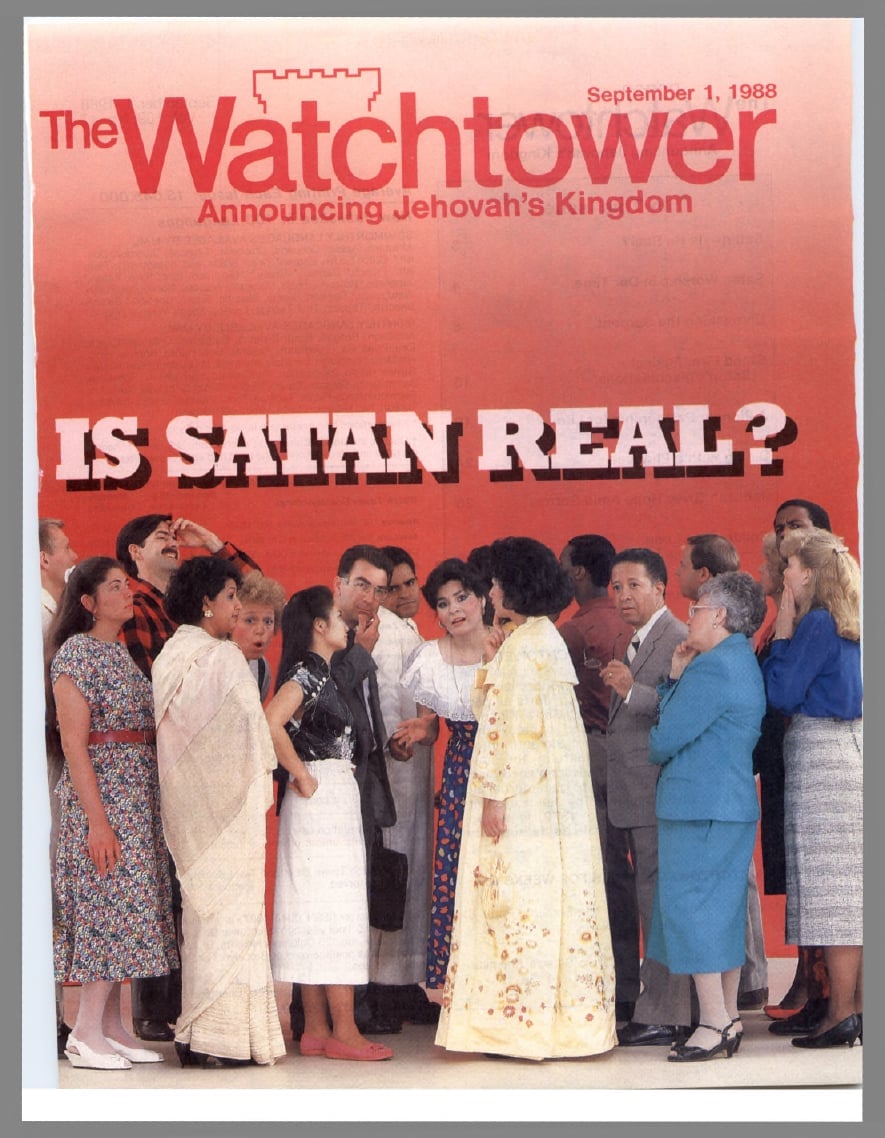
The Watchtower — September 1, 1988
Source: jw.org
Contents
Satan—Is He Real?
Satan Worship in Our Time
Unmasking the Serpent
Stand Firm Against Satan’s Machinations
A Pioneer Partnership for Life
Dining With a Pharisee
Jehovah Gives Hope Amid Sorrow
Children ‘on Loan’—How Wise Is the Practice?
Questions From Readers
No Further Complaints About the Music
Satan—Is He Real?
Satan—Is He Real?
DO YOU believe that Satan exists? If so, it seems you are part of a dwindling minority. “By the 1980s belief in the Devil had disappeared except among conservative Catholics, charismatics, conservative Protestants, Eastern Orthodox, Muslims—and a few occultists.” So states the book Mephistopheles—The Devil in the Modern World, by Jeffrey Burton Russell.
Not everyone, though, has stopped believing that Satan is real. “The devil is still alive and at work in the world,” said Pope John Paul II in a recent speech in Italy.
Is the pope correct? If so, Satan is in a good position to do what he wants in the world. If people do not believe in his existence, they will not oppose him. No wonder Cardinal Ratzinger, a foremost Vatican authority on doctrine, stated: “The devil can take refuge in his favorite element, anonymity.”
Does Satan really exist? If we believe the Bible, we have to answer yes! Satan is referred to many times by name in that inspired record. For example, the Bible writer Paul, warning of “false apostles” and “deceitful workers” in the ranks of the Christian congregation, wrote: “And no wonder, for Satan himself keeps transforming himself into an angel of light.” Paul viewed Satan as an intelligent, deceptive personage.—2 Corinthians 11:13, 14.
Why is it, then, that Satan’s existence is not taken seriously by most people today? Likely, it is a reflection of the spirit of the age. Living as we do in what some have called the post-Christian era, atheism, hedonism, materialism, and communism have replaced religious faith in many societies. Millions of people no longer believe in God, viewing his existence as unnecessary to their personal philosophies. And they have discarded Satan along with God. Some religious people in Christendom, even though they claim to believe in God, feel that belief in Satan is out-of-date in this 20th century.
It is noteworthy, however, that rejecting God is by no means new. Some 3,000 years ago, the Hebrew poet David wrote: “The senseless one has said in his heart: ‘There is no Jehovah.’ They have acted ruinously, they have acted detestably in their dealing.” (Psalm 14:1; 53:1) In another place he stated: “The wicked one according to his superciliousness makes no search; all his ideas are: ‘There is no God.’” (Psalm 10:4) Even back then, people acted as if God did not exist. And the logical conclusion must have been that if there is no God, there can be no Satan.
Some Still Believe
As already noted, however, some do still accept the belief in a literal Devil. There are those who believe the ancient Zoroastrian teaching of dualism, saying that good and evil, God and the Devil, must always have existed side by side. Others even say that good and evil are both facets of the Godhead. And there are still many in Christendom and Islam who believe in Satan’s existence. Indeed, for many of these, he still exists as a winged spirit entity with horns and tail who supervises the destiny of those “immortal souls” assigned to “hellfire,” much as depicted in works by the famous French illustrator Gustave Doré.
In fact, for some, belief in Satan goes even further. They worship him—either by name or by means of satanic or demonic rites. For millenniums, witchcraft and sorcery have been identified with Satan worship. Even in our modern, skeptical age, Satanism still flourishes. Hence, before we discuss what the Bible says about Satan himself, let us consider some facts about modern Satanism.
[Picture on page 3]
A Buddhist portrayal of a satanic “hell”
Satan Worship in Our Time
Satan Worship in Our Time
THERE is no doubt that Satan wants to be worshiped. When tempting Jesus, he offered to give him a huge reward on just one condition: “If you fall down and do an act of worship to me.” (Matthew 4:9) Jesus, of course, refused, but not everyone has followed his example. Satan worship is widespread in our modern world.
For example, in Canada The Calgary Herald ran a series of articles under the title “Devil’s Disciples.” The paper quoted a police investigator’s report, saying: “Through interviews I have learned that Satanism is not exclusive to any particular group in society. Intelligence gathered by the Calgary Police Service and the Royal Canadian Mounted Police reveals that in Calgary alone there are supposedly 5,000 practising Satanists.”
Other press reports show that the Satan cult, in different forms, is surfacing across the United States and Europe. Even the police show an interest in Satanism. Why? Because in many cases they are finding links between crimes and satanic cults. Just recently, a police detective was quoted as saying: “What we are dealing with is a religion and people who believe in it as others believe in Christianity, Judaism or Islam. What you are seeing are not crimes for crime’s sake, but crimes for the sake of a religion.”
One outstanding example was the murders by the Manson clan in California back in 1969. According to history professor Jeffrey Russell, “Manson claimed to be both Christ and Satan. . . . Manson’s follower Tex Watson announced, when he came to murder Sharon Tate, ‘I am the devil; I’m here to do the devil’s work.’” But Satanism is not always as overt as this.
Witchcraft, Spiritism, and Sorcery
Indeed, Satan worship is not limited to direct worship of Satan by name. The apostle Paul warned: “The things which the nations sacrifice they sacrifice to demons.” (1 Corinthians 10:20) And demon worship is really the same as Satan worship, since Satan is called “the ruler of the demons.” (Mark 3:22) What practices of “the nations” can be identified as demon worship, or worship of Satan? God’s words to Israel give us some examples: “There should not be found in you . . . anyone who employs divination, a practicer of magic or anyone who looks for omens or a sorcerer, or one who binds others with a spell or anyone who consults a spirit medium or a professional foreteller of events or anyone who inquires of the dead. For everybody doing these things is something detestable to Jehovah.”—Deuteronomy 18:10-12.
Thus, we are warned against the blood sacrifice and spirit communion practiced by the voodoo priests in Brazil or by the houngans and the mambos of Haiti. And we are warned against the very similar practices of Santeria, observed by some exiled Cubans in the United States. We are warned, too, against sorcerers who claim to communicate with dead souls to inspire fear in the living.—Compare 1 Samuel 28:3-20.
Witchcraft is prevalent in different parts of Africa. In South Africa, for example, witch doctors exert great power, and people take them very seriously. Recent cases reported in the press were of mobs burning alive people who were accused of causing lightning to strike fellow villagers! The local witch doctors accused innocent victims of these “unnatural” acts and then tied them to a tree to be burned. Such belief in sorcery or magic is likewise a worship of demons.
However, witchcraft is not confined to Africa. In 1985, Herbert D. Dettmer, serving a prison sentence at a correctional center in Virginia, U.S.A., was granted the right by the District Court for the Eastern District of Virginia to have access to clothing and articles so that he could practice his religion in prison. And what was his religion? According to the court record, he was a member of “the Church of Wicca (more commonly known as witchcraft).” Consequently, Dettmer had the legal right to use in his worship sulfur, sea salt, or uniodized salt; candles; incense; a clock with an alarm; and a white robe.
Yes, according to the indications, witchcraft is widespread in the West. The British newspaper Manchester Guardian Weekly reported: “Five years ago, there were thought to be some 60,000 witches in Britain: today [1985] the number is estimated by some witches to have grown to 80,000. Prediction, the monthly magazine for astrology and the occult, has a circulation of 32,000.”
Satanism and Music
Professor Russell, in his book Mephistopheles—The Devil in the Modern World, draws our attention to another way in which the purposes of Satan are being furthered. He writes: “Overt Satanism faded rapidly after the 1970s, but elements of cultural Satanism continued into the 1980s in ‘heavy metal’ rock music with its occasional invocation of the Devil’s name and considerable respect for the Satanic values of cruelty, drugs, ugliness, depression, self-indulgence, violence, noise and confusion, and joylessness.”—Italics ours.
Perhaps the musicians who incorporated elements of Satanism into their music were not being serious. They may just have been trying to shock or to be outlandish. Nevertheless, some impressionable individuals were strongly affected. Professor Russell notes that the “constant semiserious propaganda for evil has had decomposing effects on silly and weak minds. One result has been a rash of appallingly degenerate crimes, including the violation of children and the mutilation of animals.”
A recent case startled New Yorkers. According to a newspaper report, a 14-year-old boy, “obsessed by Satanism,” stabbed his mother to death and then committed suicide. A Canadian family counselor stated, as reported in Maclean’s magazine, that a growing number of troubled teenagers confessed to practicing “satanism, often in combination with drugs and the more oppressive varieties of heavy-metal rock music.”
Not Just a Fad
A fad sweeping the United States right now is called channeling. People often pay several hundred dollars to participate in sessions in which a “channel,” that is a medium, claims to put herself (channels are usually women) in communication with the spirit of a long-dead person. In the case of one channel, the press reported, sessions “are periodically relayed by a television satellite hookup to thousands of people at once in half a dozen cities.” This trend is in manifest disobedience to the Bible’s counsel to avoid spirit mediums and professional foretellers of events. Thus, it is the kind of worship that can be identified as demon worship. And like all spiritism, it is based on the satanic lie that the human soul is immortal.—Ecclesiastes 9:5; Ezekiel 18:4, 20.
The Devil’s Influence in a World Full of Hate
The appalling situation of mankind in this 20th century makes us wonder whether Satan’s influence does not reach even further. Professor Russell touches on this when he states: “At present, with arsenals of nuclear weapons estimated at seventy times the quantity needed to kill every living vertebrate on earth, we are stubbornly making preparations for a war that will profit no individual, nation, or ideology but will condemn thousands of millions to a horrible death. What force urges us down a path that is daily more dangerous? To whose advantage is the nuclear destruction of the planet? Only that force which from the beginning has with infinite cruelty and malice willed the destruction of the cosmos.”
Who or what is that force? The professor gives his own answer in these words: “The Devil has been defined as the spirit that seeks to negate and destroy God’s cosmos to the extent of his power. May not the force urging us to deploy nuclear weapons be the same force that has always striven to negate being itself? In this uttermost crisis of our planet, we cannot dismiss the possibility.” Christians certainly do not dismiss the possibility! Jesus himself showed Satan’s great influence on this world when He called him “the ruler of this world.” (John 12:31) Describing Satan’s mental attitude today, the book of Revelation says that he has “great anger, knowing he has a short period of time.” (Revelation 12:12) Referring to what Satan is trying to accomplish in our time, that same book says that he is using demonic propaganda to gather the rulers of this world “together to the war of the great day of God the Almighty.” (Revelation 16:14) No, we cannot rule out the influence of Satan the Devil when we try to understand the reason for mankind’s insanely self-destructive course.
The apostle Paul called Satan “the ruler of the authority of the air, the spirit that now operates in the sons of disobedience,” and “the god of this system of things.” (Ephesians 2:2; 2 Corinthians 4:4) Little wonder that many ask if all the atrocities of this “enlightened” scientific age—two world wars, genocides in Europe and Kampuchea, politically motivated famine in Africa, deep worldwide religious and racial divisions, hatred, murder, systematic torture, the criminal subversion of mankind by drugs, to name just a few—could not be following the master plan of some powerful, evil force that is bent on driving mankind away from God and perhaps even to global suicide.
Who, then, is Satan? What is he really up to? What can we as individuals do about it? We invite you to consider the discussion of these questions in the following two articles.
[Picture on page 7]
Shunning satanic music, God’s people seek wholesome entertainment
Unmasking the Serpent
Unmasking the Serpent
“Now it came to be the day when the sons of the true God entered to take their station before Jehovah, and even Satan proceeded to enter right among them.”—JOB 1:6.
1. (a) What are the origin and the meaning of the name Satan? (b) How many times does “Satan” appear in the Scriptures, and what questions arise?
WHAT is the origin of the name Satan? What does it mean? In its Biblical setting, it is formed from the three Hebrew characters ש (Sin), ט (Tehth), and נ (Nun). With their vowel points, these letters form the word “Satan,” which, according to scholar Edward Langton, is “derived from a root which means ‘to oppose,’ or ‘to be or to act as an adversary.’” (Compare 1 Peter 5:8.) Although the name Satan appears more than 50 times in the Bible, it occurs only 18 times in the Hebrew Scriptures and then only in the books of 1 Chronicles, Job, and Zechariah. So the questions arise, When did man become conscious of Satan’s rebellion and activity? When is Satan first clearly revealed in the Hebrew Scriptures?
2. What question was not answered immediately after the rebellion of Adam and Eve?
2 The Bible explains in simple but profound terms how sin and rebellion came to exist on earth, in what was a paradise garden in the Middle East. (See Genesis, chapters 2 and 3.) Although the promoter of the disobedience of Adam and Eve is identified as a serpent, no immediate clue is given as to who was the real power and intelligence behind the voice emitted by the serpent. Nevertheless, Adam had a long time to reflect on the events in Eden that led to his expulsion from the paradise park.—Genesis 3:17, 18, 23; 5:5.
3. Although not deceived, how did Adam sin, and what was the result to humankind?
3 Obviously, Adam knew that animals do not speak with human intelligence. He also knew that God had not spoken to him through any animal prior to Eve’s temptation. So who had told his wife to disobey God? Paul says that even though the woman was thoroughly deceived, Adam was not deceived. (Genesis 3:11-13, 17; 1 Timothy 2:14) Perhaps Adam realized that some invisible creature was offering an alternative to obedience to God. Yet, although he himself was not approached by the serpent, he chose to go along with his wife in disobedience. Adam’s deliberate and willful act of disobedience broke the mold of perfection, introduced the defect of sin, and led to the foretold condemnation of death. And thus, using the agency of the serpent, Satan became the original manslayer.—John 8:44; Romans 5:12, 14.
4, 5. (a) What prophetic judgment was given against the serpent? (b) What enigmas were embraced by that prophecy?
4 The rebellion in Eden resulted in a prophetic judgment from God. That judgment involved a “sacred secret” that it would take thousands of years completely to unlock. God said to the serpent: “I shall put enmity between you and the woman and between your seed and her seed. He will bruise you in the head and you will bruise him in the heel.”—Ephesians 5:32; Genesis 3:15.
5 This vital prophecy embraces several enigmas. Who was really meant by “the woman”? Was it Eve, or was it a symbolic woman of greater significance than Eve? Also, what was meant by ‘the seed of the woman’ and the ‘seed of the serpent’? And who really was the serpent whose seed would be at enmity with the woman’s seed? As we will discuss shortly, Jehovah evidently determined that these questions would get a fuller answer in his due time.—Compare Daniel 12:4 and Colossians 1:25, 26.
Further Evidence of Rebellion in the Heavens
6. What indication of a rebellion in the heavens was seen just before the Flood?
6 As Bible history develops, another indication of a rebellion at a higher level of life than that of humans is revealed just before the Flood, some 1,500 years after man’s fall into sin. The Bible account tells us that “the sons of the true God began to notice the daughters of men, that they were good-looking; and they went taking wives for themselves, namely, all whom they chose.” The hybrid offspring of these unnatural unions were known as “Nephilim,” “mighty ones who were of old, the men of fame.” (Genesis 6:1-4; compare Job 1:6 for the identity of “the sons of the true God.”) Some 2,400 years later, Jude briefly commented on this event when he wrote: “And the angels that . . . forsook their own proper dwelling place he has reserved with eternal bonds under dense darkness for the judgment of the great day.”—Jude 6; 2 Peter 2:4, 5.
7. In spite of man’s badness, what intriguing omission do we find in many of the historical books of the Bible?
7 At this point before the Flood “the badness of man was abundant in the earth and every inclination of the thoughts of his heart was only bad all the time.” Nevertheless, Satan was not specifically identified in the inspired book of Genesis as the powerful influence behind the angelic rebellion and man’s wickedness. (Genesis 6:5) Indeed, all through the history of the nations of Israel and Judah, with their constant relapses into idolatry and false worship, Satan is never named in the inspired Bible books of Judges, Samuel, and Kings as the invisible influence behind these events—this despite Satan’s own admission that he was “roving about in the earth.”—Job 1:7; 2:2.
8. Was Job initially aware of the part played by Satan in his suffering? How do we know?
8 Even when we consider the significant account of Job and his trials, we see that Job never attributes his tests to the adversary, Satan. Evidently, he was unaware at the time of the issue that hung on the outcome of his conduct. (Job 1:6-12) He did not realize that Satan had precipitated the crisis by challenging Job’s integrity before Jehovah. Thus, when Job’s wife reprimanded him with the words: “Are you yet holding fast your integrity? Curse God and die!” he simply answered: “Shall we accept merely what is good from the true God and not accept also what is bad?” Without knowing the true source of his trials, he apparently viewed them as coming from God and therefore something to be accepted. Thus, this became a very severe test of Job’s integrity.—Job 1:21; 2:9, 10.
9. What reasonable question can be raised regarding Moses?
9 Now a question arises. If, as we believe, Moses wrote the book of Job and therefore knew that Satan was roving about in the earth, why is it that he does not speak of Satan by name in any of the books of the Pentateuch, which he also wrote? Yes, why is Satan mentioned so seldom in the Hebrew Scriptures?a
Satan’s Limited Exposure
10. How was Satan given only limited exposure in the Hebrew Scriptures?
10 Even though denouncing demon-inspired activities, Jehovah in his wisdom evidently had good reasons for ensuring that his Adversary, Satan, should be given only limited exposure in the Hebrew Scriptures. (Leviticus 17:7; Deuteronomy 18:10-13; 32:16, 17; 2 Chronicles 11:15) Thus, although the Hebrew writers must have had some knowledge of Satan and his rebellious role in the heavens, they were inspired only to define and expose the sins of God’s people and of the nations around them and to exhort against their wickedness. (Exodus 20:1-17; Deuteronomy 18:9-13) Satan’s name was rarely mentioned.
11, 12. How do we know that the Hebrew Bible writers were not ignorant of Satan and his influence?
11 In view of the events in Eden, the degradation of “the sons of the true God,” and the record in the book of Job, the inspired Hebrew Bible writers were not ignorant of the evil, supernatural influence of Satan. The prophet Zechariah, who wrote in the late sixth century B.C.E., had a vision of the high priest Joshua with “Satan standing at his right hand in order to resist him. Then the angel of Jehovah said to Satan: ‘Jehovah rebuke you, O Satan, yes, Jehovah rebuke you.’” (Zechariah 3:1, 2) Also, the scribe Ezra, writing the history of Israel and Judah in the fifth century B.C.E., stated that “Satan proceeded to stand up against Israel and to incite David to number Israel.”—1 Chronicles 21:1.
12 Thus, by the time of Zechariah, holy spirit was letting Satan’s role become clearer in the Scriptures. But another five centuries would pass before this evil creature would be totally exposed in the Word of God. With Bible basis, what reason can we deduce for this timing in fully exposing Satan?
The Key to the Enigma
13-15. (a) What basic truths are the key to understanding why Satan was given limited exposure in the Hebrew Scriptures? (b) With the coming of Jesus, how was Satan brought out into the open?
13 For the Christian with faith in God’s Word, the basic key to these and previous questions we have raised is not to be found in higher criticism, as if the Bible were merely a literary masterpiece, solely the product of human genius. The key is revealed in two basic Bible truths. First, as King Solomon wrote: “The path of the righteous ones is like the bright light that is getting lighter and lighter until the day is firmly established.” (Proverbs 4:18; compare Daniel 12:4; 2 Peter 1:19-21.) Truth is revealed gradually in God’s Word at God’s time, in accordance with the need and his servants’ ability to absorb such truth.—John 16:12, 13; compare 6:48-69.
14 The second basic truth is contained in what the apostle Paul wrote to the Christian disciple Timothy: “All Scripture is inspired of God and beneficial for teaching, . . . that the man of God may be fully competent, completely equipped for every good work.” (2 Timothy 3:16, 17) God’s Son, Jesus, would expose Satan, and this would be recorded in Scripture, thus equipping the Christian congregation to stand fast against Satan in support of Jehovah’s sovereignty.—John 12:28-31; 14:30.
15 On these grounds the enigmas of Genesis 3:15 have been slowly unveiled. Under the direction of God’s holy spirit, or active force, the Hebrew Scriptures supplied glimmers of light on the forthcoming Messiah, or Seed. (Isaiah 9:6, 7; 53:1-12) Parallel to this, they have contained brief flashes of light on the role of Satan as the Adversary of God and the enemy of humankind. But with the coming of Jesus, Satan was brought completely into the open as he took blatant and direct action against the promised Seed, Jesus Christ. As events developed in that first century of the Christian era, the roles of “the woman,” Jehovah’s heavenly spirit organization, and of the Seed, Jesus Christ, were clarified in the Christian Greek Scriptures. At the same time, the role of Satan, “the original serpent,” was brought more fully into the open.—Revelation 12:1-9; Matthew 4:1-11; Galatians 3:16; 4:26.
Sacred Secret Unveiled
16, 17. What did “the sacred secret of the Christ” involve?
16 The apostle Paul wrote extensively about “the sacred secret of the Christ.” (Ephesians 3:2-4; Romans 11:25; 16:25) This sacred secret had to do with the true “seed” that would eventually crush the original serpent, Satan the Devil. (Revelation 20:1-3, 10) The secret involved the fact that Jesus was the first and primary member of that “seed” but that he would be joined by others, “joint heirs,” first from the Jews and then from the Samaritans and the Gentiles, to complete the number of that “seed.”—Romans 8:17; Galatians 3:16, 19, 26-29; Revelation 7:4; 14:1.
17 Paul explains: “In other generations this secret was not made known to the sons of men as it has now been revealed to his holy apostles and prophets by spirit.” And what was that secret? “Namely, that people of the nations should be joint heirs and fellow members of the body and partakers with us of the promise in union with Christ Jesus through the good news.”—Ephesians 3:5, 6; Colossians 1:25-27.
18. (a) How does Paul show that time was needed to reveal the meaning of “the sacred secret”? (b) How would this revealing affect the understanding about “the original serpent”?
18 Paul was impressed that he of all people should be used to declare “the good news about the unfathomable riches of the Christ and should make men see how the sacred secret is administered which has from the indefinite past been hidden in God, who created all things.” Or as he put it to the Colossians: “The sacred secret that was hidden from the past systems of things and from the past generations. But now it has been made manifest to his holy ones.” Logically, if the secret regarding the “seed” was finally revealed, it would also involve the complete unmasking of the great Adversary, “the original serpent.” Evidently, Jehovah did not choose to make the issue with Satan paramount until the coming of the Messiah. And who better to unmask Satan than the Seed, Christ Jesus himself?—Ephesians 3:8, 9; Colossians 1:26.
Jesus Exposes the Adversary
19. How did Jesus expose the Adversary?
19 Early in his ministry, Jesus roundly rejected the Tempter with the words: “Go away, Satan! For it is written, ‘It is Jehovah your God you must worship, and it is to him alone you must render sacred service.’” (Matthew 4:3, 10) On a different occasion, Jesus exposed his slanderous religious enemies who had murderous intent toward him by denouncing their promoter and exposing him as the power behind the serpent in Eden, saying: “You are from your father the Devil, and you wish to do the desires of your father. That one was a manslayer when he began, and he did not stand fast in the truth, because truth is not in him. When he speaks the lie, he speaks according to his own disposition, because he is a liar and the father of the lie.”—John 8:44.
20. What basis did Jesus have for exposing Satan?
20 How could Jesus be so sure in his denunciation of Satan? How could he know him so well? Because he had coexisted with Satan in the heavens! Even before that one had proudly rebelled against the Sovereign Lord Jehovah, Jesus, as the Word, had known him. (John 1:1-3; Colossians 1:15, 16) He had observed his crafty actions through the serpent in Eden. He had seen his subtle influence upon the fratricidal Cain. (Genesis 4:3-8; 1 John 3:12) Later, Jesus was present in Jehovah’s heavenly court “when the sons of the true God entered . . . , and even Satan proceeded to enter right among them.” (Job 1:6; 2:1) Oh, yes, Jesus knew him to the core and was ready to expose him for what he was—a liar, a murderer, a slanderer, and an adversary of God!—Proverbs 8:22-31; John 8:58.
21. What questions remain to be answered?
21 With such a powerful enemy influencing mankind and its history, the questions now are: To what further extent is Satan exposed in the Christian Greek Scriptures? And how can we resist his crafty schemes and maintain our Christian integrity?—Ephesians 6:11, Kingdom Interlinear.
[Footnotes]
Professor Russell states in his book The Devil—Perceptions of Evil From Antiquity to Primitive Christianity: “The fact that the Devil is not fully developed in the Old Testament is not a ground for rejecting his existence in modern Jewish and Christian theology. That would be the genetic fallacy: the notion that the truth of a word—or a concept—is to be found in its earliest form. Rather, historical truth is development through time.”—Page 174.
Do You Remember?
□ What enigmas in relation to Genesis 3:15 needed to be explained?
□ What evidence of rebellion in the heavens is there in the Hebrew Scriptures?
□ What two truths help us to understand why Satan is seldom mentioned in the Hebrew Scriptures?
□ What does “the sacred secret of the Christ” have to do with the revealing of Satan and his role?
[Pictures on page 9]
Satan’s influence was clearly evident among mankind in the pre-Flood world
[Picture on page 10]
It was Satan—a real person—that challenged God as to Job’s integrity
Stand Firm Against Satan’s Machinations
Stand Firm Against Satan’s Machinations
“Put on the complete suit of armor from God that you may be able to stand firm against the machinations [Greek, “crafty acts”] of the Devil.”—EPHESIANS 6:11.
1. What evidence that Satan exists is provided by the temptations of Jesus?
DOES Satan really exist? Some people argue that in the Bible, “Satan” refers only to the evil within man. They deny his existence as a creature. But what do the Scriptures tell us? The Gospel accounts of Matthew and Luke show that Christ Jesus was directly tempted three times by Satan, and each time Jesus rejected him, using Scripture. Why did Jesus answer him from the Hebrew Scriptures? Because Satan came to him misapplying those very Scriptures in order to make him sin and fail as the Son of God, the promised Seed.—Matthew 4:1-11; Luke 4:1-13.
2. How do we know that Jesus did not imagine his encounters with Satan?
2 Obviously, Jesus, a perfect man, did not imagine these encounters. (Hebrews 4:15; 7:26) He was confronted by the same one who was the power behind the serpent in Eden, his own former angelic brother who ages before had rebelled and now was out to thwart the fulfillment of Genesis 3:15. Satan wanted to break the integrity of the promised Seed. Wise to his crafty acts, Jesus firmly rejected the Tempter. What was Satan’s reaction? “So the Devil, having concluded all the temptation, retired from him until another convenient time.” Clearly, Jesus did not retire from himself! Satan, frustrated, left him, “and, look! angels came and began to minister to [Jesus].”—Luke 4:13; Matthew 4:11.
3. What does one historian say about the significance of the existence of the Devil to Christianity?
3 Reasonably, one historian comments: “To deny the existence and central importance of the Devil in Christianity is to run counter to apostolic teaching and to the historical development of Christian doctrine. Since defining Christianity in terms other than these is literally meaningless, it is intellectually incoherent to argue for a Christianity that excludes the Devil. If the Devil does not exist, then Christianity has been dead wrong on a central point right from the beginning.”a That conclusion presents a challenge for every person on earth today. Do you recognize the existence of an invisible enemy who is out to subvert God’s sovereignty and man’s allegiance?
Satan’s True Identity
4. How did a perfect spirit creature become Satan?
4 Satan is a powerful spirit creature, originally created by God as an angel, a spirit son with access to Jehovah’s heavenly court. (Job 1:6) However, Satan exercised his free will in opposition to God; with cunning he led Eve and, through her, Adam into disobedience and death. (2 Corinthians 11:3) Thus, he became Satan, meaning “Adversary”—a rebel, a demon, a manslayer, and a liar. (John 8:44) How appropriate is Paul’s expression that “Satan himself keeps transforming himself into an angel of light,” when in actual fact he is a ‘world ruler of this darkness’! (2 Corinthians 6:14; 11:14; Ephesians 6:12) By enticing other angels to rebel, he led them out of God’s light into his own darkness. He became “the ruler of the demons.” Jesus also identified him as “the ruler of this world.” Obviously, in order to be a ruler, he has to exist as a created spirit person.—Matthew 9:34; 12:24-28; John 16:11.
5. How clearly is Satan identified in the Christian Greek Scriptures?
5 While Satan is rarely mentioned in the Hebrew Scriptures, he is fully exposed in the Christian Greek Scriptures—so much so that we encounter the name Satan there 36 times and the word Devil, 33 times. (See Comprehensive Concordance of the New World Translation of the Holy Scriptures.) He is also identified under other names and titles. Two of these were used by John at Revelation 12:9: “So down the great dragon was hurled, the original serpent, the one called Devil and Satan, who is misleading the entire inhabited earth.”—See also Matthew 12:24-27; 2 Corinthians 6:14, 15.
6. What is the meaning of the word “Devil”?
6 Here in Revelation appears the Greek word di·aʹbo·los, translated “Devil.” According to Greek scholar J. H. Thayer, it literally means “a calumniator, false accuser, slanderer.” (Compare 1 Timothy 3:11; 2 Timothy 3:3, Kingdom Interlinear.) W. E. Vine describes the Devil as “being the malignant enemy of God and man.”b
7. Why can Satan concentrate his efforts on Jehovah’s people?
7 The great Adversary is not idle. (1 Peter 5:8) Perhaps that is why a proverb says, “The Devil finds work for idle hands to do.” He is out to subvert all genuine Christians. (2 Timothy 3:12) And he can concentrate on Jehovah’s people for one simple reason—he already has the rest of the world in his power! (1 John 5:19) Today’s world is Satan’s world. He is its ruler and god, whether people recognize it or not. (John 12:31; 2 Corinthians 4:4) As a consequence, he will resort to every crafty or subtle act or suggestion in order to subvert Jehovah’s people, either individually or collectively. Let us examine some of the ways he operates.—Mark 4:14, 15; Luke 8:12.
Satan’s Subtle and Crafty Acts
8. With what advantage may Satan be working against us?
8 Satan has had a long time to study human psychology, to analyze human nature with all its inborn and acquired defects. He knows how to play on our weaknesses and our vanity. Now, what is the situation if your enemy knows your weaknesses and you fail to recognize them yourself? Then you are ill-equipped to defend yourself, since you are not aware of the chinks in your spiritual armor. (1 Corinthians 10:12; Hebrews 12:12, 13) How appropriate the words of a Scottish poet: ‘O would some power the gift give us to see ourselves as others see us! It would from many a blunder free us.’
9. What may be the unhappy result if we fail to analyze ourselves and change?
9 Are we willing to see ourselves as others see us—especially as God or Satan might see us? That requires honest self-analysis and appraisal and the will to make a change. Self-deception is so easy. (James 1:23, 24) How we sometimes rationalize to justify our course of action! (Compare 1 Samuel 15:13-15, 20, 21, 24.) And how easy it is to say, “Well, nobody is perfect, you know!” That is just what Satan knows, and he takes advantage of our imperfection. (2 Samuel 11:2-27) How sad to reach middle age and come to realize that because of the despotic, impersonal, or unkind way one has dealt with others over the years, one has become friendless; or to realize that one has done little or nothing to make other people happy. With subtlety Satan has perhaps led us through life using our inborn selfishness to blind us. We have failed to capture the essence of the true mind of Christ—love, compassion, and kindness.—1 John 4:8, 11, 20.
10. What questions might we ask ourselves, and why?
10 Therefore, in order to resist Satan, we must examine ourselves. Do you have a weakness that Satan could exploit or is exploiting right now? Do you have an ego problem? Must you always be number one? Is pride your hidden motivating force? Does jealousy, envy, or love of money distort your personality? Do you have a chip on your shoulder? Are you cold and cynical? Or are you hypersensitive when offered suggestions or criticism? Do you resent or even refuse counsel? If we know ourselves, we can rectify such problems, provided we are humble. Otherwise, we are leaving ourselves open to Satan.—1 Timothy 3:6, 7; Hebrews 12:7, 11; 1 Peter 5:6-8.
11. By what subtle means might Satan try to undermine our spirituality?
11 Satan can also undermine our spirituality in a subtle, insidious way. Perhaps we get upset about the way things are being done in the congregation or the organization. Often we do not have all the facts, but we easily jump to conclusions. If our relationship with Jehovah is weak, then it is a short step to negative thinking and doubts about the truth. Some may look for a self-justifying way out of the responsibilities that the truth entails. Satan then puts disloyalty and treason into their hearts. Soon they are victims of apostasy, and Satan rejoices.—Luke 22:3-6; John 13:2, 27; 2 John 9-11.
12. (a) How have some been emboldened by Satan? (b) How does Satan trap many into immorality?
12 Others are emboldened by Satan not only to commit gross sins worthy of disfellowshipping but even to resort to lies and deception in order to try to fool the congregation elders. Like Ananias and Sapphira, they think they can deceive the angels and God’s holy spirit. (Acts 5:1-10) Many thousands in recent years have fallen into Satan’s trap of immorality. The Devil knows that mankind’s sexual impulses are powerful, and through his world system, he highlights, perverts, and distorts the role of sexuality. (Numbers 25:1-3) Unmarried Christians may be tempted into fornication or other sexual abuses. (Proverbs 7:6-23) If married Christians allow their minds and hearts to wander, they can easily fall into treasonable conduct, betraying the spouse to whom they vowed fidelity.—1 Corinthians 6:18; 7:1-5; Hebrews 13:4.
13. (a) How could television shape our thinking? (b) How can we resist such influence?
13 We live in a world in which lies, deceit, and violent anger are commonplace. Satan makes full use of the media to put across this degraded mentality. Television serials or soap operas portray attractive-looking people living in a web of mutual deceit. If we allow that thinking to affect us, we can soon start giving way to “minor” sins, which become the thin edge of the wedge for “major” ones. Satan’s subtle suggestions easily insinuate themselves into our thinking. How can we resist such influences? Never “allow place for the Devil,” as Paul counseled. That also means to control whom you allow into your home through the television. Should we not abhor the intrusion of violent, immoral, foulmouthed persons who bring pollution into our living room?—Ephesians 4:23-32.
How Can We Resist Satan and Remain Faithful to God?
14. What twofold resolve is needed in order to resist Satan, and what does this require?
14 With such a powerful, superhuman enemy ranged against us imperfect human creatures, how can we keep our integrity? The key is found in James’ words: “Subject yourselves, therefore, to God; but oppose the Devil, and he will flee from you.” (James 4:7) Notice that James’ counsel is twofold. While we oppose the Devil and his will, we must subject ourselves to God’s will. That involves loving God’s will and hating Satan’s. (Romans 12:9) Thus, James says: “Draw close to God, and he will draw close to you. Cleanse your hands, you sinners, and purify your hearts, you indecisive ones.” (James 4:8) Yes, in our resistance to Satan, there is no room for halfheartedness and indecision. We cannot afford to risk our integrity by seeing how close we can come to the line of demarcation from wickedness. We must thoroughly “hate what is bad.”—Psalm 97:10.
15. Why is “the complete suit of armor from God” essential? Illustrate.
15 Outstanding counsel on resisting Satan is found in Ephesians chapter 6. How does Paul say we can resist Satan’s “craftiness,” “schemes,” or “tactics”? (Ephesians 6:11, Phillips, New International Version, The Jerusalem Bible) “Put on the complete suit of armor from God,” he counsels. This expression “complete suit” leaves no room for a sloppy attitude toward Christianity, any more than a Roman soldier could afford to be sloppy when preparing for battle. How would the soldier fare if he prepared himself with the entire suit of armor except the shield and the helmet? He could have thought, ‘That really is a large shield, and the helmet is so heavy. They weigh a lot, and I don’t really need them.’ Imagine the situation—a Roman soldier armed to fight but without his main items of defense.—Ephesians 6:16, 17.
16. (a) How must we follow Jesus’ example in using our “sword”? (b) How may we keep up our guard against Satan’s “burning missiles,” and with what result?
16 Imagine, too, a soldier without his sword. “The sword of the spirit” is a fine defense, as it is used to slash away the weaponry that Satan brings against the Christian. Our “sword” should be ever at the ready. It will be that way if we do not neglect our personal and family Bible study. But preeminently, this “sword . . . God’s Word” is our instrument of offense. Jesus used it both ways. (Matthew 4:6, 7, 10; 22:41-46) So must we. We must keep sharpening our appreciation of the truth. We cannot maintain our spirituality on the basis of what we learned in our first few months or years in the truth. If we failed to renew the spiritual circuits of our mind, our spiritual vision would become dimmed. Our zeal for Jehovah’s true worship would diminish. We would become spiritually feeble. We would no longer be able to repel the attacks of relatives, friends, companions, and apostates who may heap scorn upon our beliefs. But God will save us from the Devil and his “burning missiles” if we keep equipping ourselves with “the complete suit of armor from God.”—Isaiah 35:3, 4.
17, 18. Against whom is our fight, and how can we win?
17 Yes, Paul emphasized the danger involved in the Christian fight when he wrote: “For our fight is not against human foes, but against cosmic powers, against the authorities and potentates of this dark world, against the superhuman forces of evil in the heavens.” (Ephesians 6:12, The New English Bible) How can we puny humans resist and win in such an uneven battle? Paul reiterates his point: “On this account take up the complete suit of armor from God, that you may be able to resist in the wicked day and, after you have done all things thoroughly, to stand firm.” (Ephesians 6:13) The key expression is: “After you have done all things thoroughly.” This again leaves no room for halfhearted or distracted Christianity.—1 John 2:15-17.
18 Therefore, let us stand firm in the truth, loving Jehovah’s righteousness, preaching the good news of peace, holding fast with a strong faith in the salvation that Jehovah gives through Christ Jesus, while we rely on God’s Word as our mainstay. (Ephesians 6:14-17) Remember, God cares for us and will help us to triumph over the trials and anxieties that come our way in Satan’s system of things. May all of us heed the warning: “Keep your senses, be watchful. Your adversary, the Devil, walks about like a roaring lion, seeking to devour someone.” Yes, “take your stand against him, solid in the faith.”—1 Peter 5:6-9.
19. (a) What further essential provision must we use in order to resist Satan? (b) What will eventually happen to Satan?
19 Let us not forget Paul’s essential addition to the “suit of armor.” He says: “While with every form of prayer and supplication you carry on prayer on every occasion in spirit. And to that end keep awake with all constancy and with supplication in behalf of all the holy ones.” (Ephesians 6:18) Our invisible enemy is so powerful that we need “every form of prayer and supplication.” How genuine and varied, then, our prayers must be! Our total reliance on Jehovah is vital if we are to win the fight and maintain integrity. Only he can supply “the power beyond what is normal” that will enable us to resist our relentless Adversary. What a comfort it is to know that our great Adversary will soon be abyssed and then finally annihilated forever!—2 Corinthians 4:7; Revelation 20:1-3, 10.
[Footnotes]
Satan—The Early Christian Tradition, by Jeffrey Burton Russell, page 25.
An Expository Dictionary of New Testament Words.
Can You Answer?
□ How do we know that Satan is a real person?
□ Why are Satan’s other names and titles fitting?
□ What self-analysis might help us to resist Satan’s subtle attacks?
□ What counsel will help in overcoming Satan, and why?
[Picture on page 15]
One way to resist Satan’s influence is to be outgoing, helpful, loving
[Picture on page 16]
We should guard against being like Ananias and Sapphira, who yielded to Satan
[Picture on page 17]
To repel Satan’s missiles, we cannot omit any part of our spiritual armor
A Pioneer Partnership for Life
A Pioneer Partnership for Life
In a neat and simply furnished room in Cardiff, Wales, the Congregation Book Study has just concluded. The study conductor thanks the two pioneer sisters, Maud Clark and Mary Grant, now in their 90’s, for their hospitality and encourages them to reminisce . . .
Maud: It is now 65 years since Mary and I first met and started pioneering together.
Mary: Yes, it was in 1923, on a cold, snowy January night! Do you remember, Maud? I took you straight from Much Wenlock railway station to my accommodations. We had a bite to eat, and then we studied Tabernacle Shadows together. Next morning we set off on our bicycles to preach to the Shropshire farmers.
Early Contacts
Maud: Of course, we were ready for this. You see, we had both been pioneering for some time. Even when I was a young girl, God’s Word always interested me. Why, I can remember reciting seven psalms at church so as to obtain a free Bible! It was in 1908, when I was 11, that my eldest sister read the book The Divine Plan of the Ages and left the church we attended, becoming a Bible Student. Bible truths became the topic of our conversations at home. But when my father died, I began to wonder, ‘Where are the dead?’
What a thrill to find the answer when I went to see The Photo-Drama of Creation, presented in my hometown of Sheffield! In those moving pictures, synchronized with the phonograph records, I saw portrayed the raising of the Shunammite woman’s son. Yes, I learned that the dead are unconscious until resurrected.—2 Kings 4:32-37.
I promptly resigned from the Anglican Church and took up what we called pastoral work, offering Bible literature right in the very same area where I was known for distributing church magazines. I symbolized my dedication to Jehovah in August 1918 at an assembly in the nearby city of Leeds.
After spending happy vacation times with two colporteur sisters in Derbyshire, I made up my mind to make the pioneer service my life’s work. In August 1922, I took up my first assignment: Biggleswade in Bedfordshire.
One of the colporteurs said to me: “If you can stick it out for the first six months, you will be all right.” Those initial months were not easy. I had an accident on my bicycle. Then my first pioneer companion returned home. But I was determined to continue, so I wrote to the Society asking for a partner. And Jehovah gave me Mary!
Mary, you took a stand for the truth earlier than I did, didn’t you?
Mary: Yes, Maud. At the time we were living in Cardiff, South Wales. When I was 16, my grandmother invited me to read the book The Divine Plan of the Ages, which she had obtained at a public meeting organized by the Bible Students. I had always wanted to understand the Bible and be a missionary when I grew up. As I read this volume, I knew I had found the truth.
I began to attend the Bible Students’ meetings, in spite of my mother’s great disapproval. You see, my parents were well-to-do, and as they did not allow me to work, I found conditions at home very restrictive. Nevertheless, I managed to obtain the rest of the set of Bible study aids. When my mother found out, she angrily burned the books and told me I was too young to know about such things. To replace them I had to smuggle books into my home one by one, after early morning visits to the home of one of the Bible Students some two miles [3 km] away. I used to read these avidly before the rest of the household awoke, hiding them in the garden shed during the day.
In 1913, when I was 17, I traveled to London for a sight-seeing vacation. Happily, this coincided with a visit by Brother Russell to an assembly held at the Kingsway Hall. There I expressed my desire to be baptized. The colporteur sister who worked in Cardiff approached Brother Russell to ask him if he thought I was too young. He asked me how old I was and questioned me to see if I understood the Scriptures and to determine whether I had dedicated my life to Jehovah. As a result, I donned a long black gown and joined the other candidates for immersion at the London Tabernacle. I remember so well the words we sang as we came out of the water:
“Buried with Christ
and raised with him too,
What is there left for me to do?
Simply to cease from
struggling and strife,
Simply to walk in the newness of life.”
Afterward, a brother approached me and said: “You must be the last one of the 144,000 to come in; you only have such a short time left to make your calling and election sure.” Such were the thoughts of many who viewed the approaching year, 1914, with great expectation. For me, though, this proved to be a time of testing as I put up with great opposition at home. I attended the meetings as often as I could. In 1916, I enjoyed the privilege of serving as an usherette at the showing of The Photo-Drama of Creation in Cardiff. After completing my nurse’s training in Manchester, I started the full-time pioneer service in 1922.
Country Witnessing
Maud: We really had to take the initiative back then. We told everyone that we were engaged in a Christian work. People in those days were readers. We offered The Harp of God and the series Studies in the Scriptures. Of course, we needed quite a large case in which to carry all this literature. Mine was so big that when I arrived at an isolated farm one day, the farmer’s wife thought I was a relative coming from Canada to visit. How we laughed!
Since pioneering was our life, we received our livelihood from the work of distributing the books containing the Kingdom message. We used our resources carefully and lived frugally, exchanging books for butter and other farm produce and picking up potatoes, swedes, and cabbages that fell from farm carts on the rough, dusty lanes. We became skilled in mending the flat tires of our bicycles, and we developed into good seamstresses, making our own clothes.
As the brothers who served as itinerant speakers delivered Bible talks in the towns, Mary and I came along behind them to follow up the interest their preaching sparked. Small groups of interested ones sprang up in Shrewsbury and other towns. And how we looked forward to the assemblies! I think the 1926 London convention was outstanding. There we enjoyed the added privilege of distributing the booklet The Standard for the People on the streets of the capital. Then our excitement grew as we read the contents of a letter from the Society. It was a change of assignment for us: Northern Ireland.
Pioneering New Territories
We arrived in County Antrim, Northern Ireland, to pioneer among a religiously divided people. We stayed first at Greenisland. It was wet and cold, and we had no fires for weeks because of a coal strike in England. I can picture us now, sitting with our coats and gloves on in the evenings, trying to study while shivering from the cold. Then the summer came, and how we thanked Jehovah for the privilege of working in the beautiful surroundings of the Antrim glens. The people listened well to the Kingdom message. Oh, yes, they often argued, but they were kind. “Come awa’ in,” they would say, and they would put the kettle on the greesha (red-hot peat) to boil, and our discussions continued.
Mary: Since we were now four pioneer girls together in our assignment, we stuck to a full theocratic schedule of meetings. Each morning we discussed a Scripture text and read “My Morning Resolve,” which said, in part, ‘Daily will I remember at the Throne of Heavenly Grace the general interests of the harvest work, particularly the share that I myself am privileged to enjoy in that work, and the dear colaborers at Bethel and everywhere.’ Wednesday night we had our Prayer, Praise, and Testimony Meeting. Sundays we studied The Watchtower together, and we would gather around the small organ often found in people’s homes to sing from the Hymns of the Millennial Dawn, such as:
“Ne’er think the victory won,
Nor once at ease sit down
Thine arduous task will not be done
Till thou hast gained thy crown.”
Maud: What a change it was when we were assigned a special work that opened up—we became “business-house pioneers.” How could we ever witness to businessmen, bank managers, and the like? Those big buildings in Belfast looked formidable. But we remembered Philippians 4:13: “For all things I have the strength by virtue of him who imparts power to me.” And we would not think of turning down our assignment. What grand experiences we had talking to those men and placing much literature with them! By 1931 we had finished the business houses and had spent five years in Northern Ireland. We wondered where our next assignment would be. To our amazement it was the business houses of Dublin.
To Tarshish or Nineveh?
We must admit that, at first, we felt like Jonah, who was assigned to preach to Nineveh and headed instead for Tarshish. We would have preferred a different assignment. We soon realized how we must rely on Jehovah. Yet, how daunting it was to stand by Nelson’s Pillar in Dublin and see streets full of priests and nuns, men raising their hats and women crossing themselves in honor of ‘the blessed Virgin.’ At that time there were just four Bible Students in Dublin.
We managed to obtain rooms with a Roman Catholic household. Of course, we had to hide our literature under the bed, for the priest made regular visits to the house. One day a Dublin businessman called at our accommodations, saying: ‘You left books at my bank.’ He was so thrilled with them that he went to every shop to see if they sold Judge Rutherford’s books. He then wrote to New York and was given our address. He arranged a party for all his friends to tell them about what he had learned.
Later that year, we attended a convention in Liverpool, England, where we learned of our new name, Jehovah’s Witnesses. On our return to Dublin, we shared in the campaign to distribute the booklet The Kingdom, the Hope of the World, which contained the convention resolution. We made calls at all the monasteries, convents, and business houses, presenting free copies of the booklet. All were accepted!
Mary: One day we saw a boat cruising down the river Liffey, and this gave us the idea of witnessing to the crews of the ships in dock. When we tried to enter the dock area, it was barred by a policeman, who asked what we were doing. On showing him the books, he said, “Go ahead.” We found several ship captains from other countries who knew of the Witnesses. When we look back on those experiences, we marvel at the way Jehovah cared for us as we each went alone aboard the ships.
Witnessing During the Blitz
Maud: In 1939 when war broke out, we returned to Liverpool and joined 20 other pioneers who lived at the pioneer home. We now lived through air raids and bombings and witnessed wherever people would listen. We often found ourselves putting the records on our phonographs, discussing the Kingdom message, and then running back to the pioneer home, or dashing from one air-raid shelter to the next. Throughout this period, we were not frightened, for we were doing the Lord’s work.
Many times as we went down the streets, people hurled abuse at us because of the neutral stand the Witnesses maintained during this time of conflict. I remember that at one house a young man listened to the recordings and accepted a regular Bible study. A difficulty arose. He had just volunteered to join the British Navy. He wrote a letter to the authorities stating his neutral position and received in return a complete exemption from military duty. He later joined us in the full-time service.
Mary: I will never forget those war days, Maud. Do you recall what happened when we moved to Knutsford in Cheshire in 1942? A lady shouted out to us, ‘What are you doing for the war effort?’ Before we could answer, a passerby answered, ‘She’s doing work we haven’t the courage to do.’ An elderly man chimed in, ‘They’re doing a good work.’
Maud: Indeed, the Bible study work was the big thing. I had a grand experience when I called at a farm and met a lady who told me that her little boy had been killed in a road accident. I placed with her the booklet Hope for the Dead and started a Bible study. After just seven studies, this lady began to accompany me in the witness work. A few months later her husband accepted the truth, and within two years this couple sold their farm and began pioneering. Their daughter later joined them in the full-time work, and now she and her husband serve in the London Bethel.
At the 1941 Leicester assembly, Brother Schroeder announced that the special pioneers were to receive a small monetary allowance to help them with the necessities of life. For nearly 20 years, Jehovah had blessed our literature distribution work and in this way provided us with what we needed. Jehovah never let us down. We have proved that “there has not failed one word of all his good promise that he has promised.”—1 Kings 8:56.
Finding “Sheep” in Wales
1954 found us in Milford Haven, Wales. Despite clergy opposition, we preached and found some sheeplike ones who responded. These we organized into a group and showed them how to conduct meetings and give short, meaningful comments. What a joyful occasion it was to see seven baptized in a sheep-dip filled with warm water carried there in milk churns!
In the Welsh valley town of Abercynon, a magazine-route call brought good results. Although the lady who regularly accepted copies of the magazines said, “I don’t believe what you’re telling me,” she agreed to read the magazines. On a later visit, I found the husband busy decorating the house. After a friendly talk, arrangements were made to start a Bible study the next week. We made friends with the three sons who came to join in the study. Eventually, the mother and her sons dedicated their lives to Jehovah and were baptized. To date, 35 members of that family have accepted the truth, some serving as auxiliary, regular, or special pioneers, and some as elders.
Now here we are in Cardiff, reminiscing about our lives. We have no regrets. Jehovah has supplied our every need in a material way. We have had a wonderful life serving together as pioneers, and we still count the full-time service as our greatest treasure in life.
Now our hearts thrill to see the growing pioneer ranks. And all those young ones taking up this precious service—how we rejoice! Mary and I have pioneered together for 65 years. Our lives have been simple but busy, hard but rewarding. We really do recommend pioneering for life.
[Picture on page 23]
Maud (left) and Mary still find their greatest treasure in full-time service to Jehovah
Dining With a Pharisee
Jesus’ Life and Ministry
Dining With a Pharisee
AFTER Jesus answers critics who question the source of his power to heal a man who could not talk, a Pharisee invites him to dinner. Before they eat, the Pharisees engage in the ritual of washing their hands up to the elbow. They do this before and after a meal and even between courses. Although the tradition does not violate God’s written law, it goes beyond what God requires in the matter of ceremonial cleanness.
…