The Watchtower, August 1, 1988
Download: PDF — The Watchtower, August 1, 1988
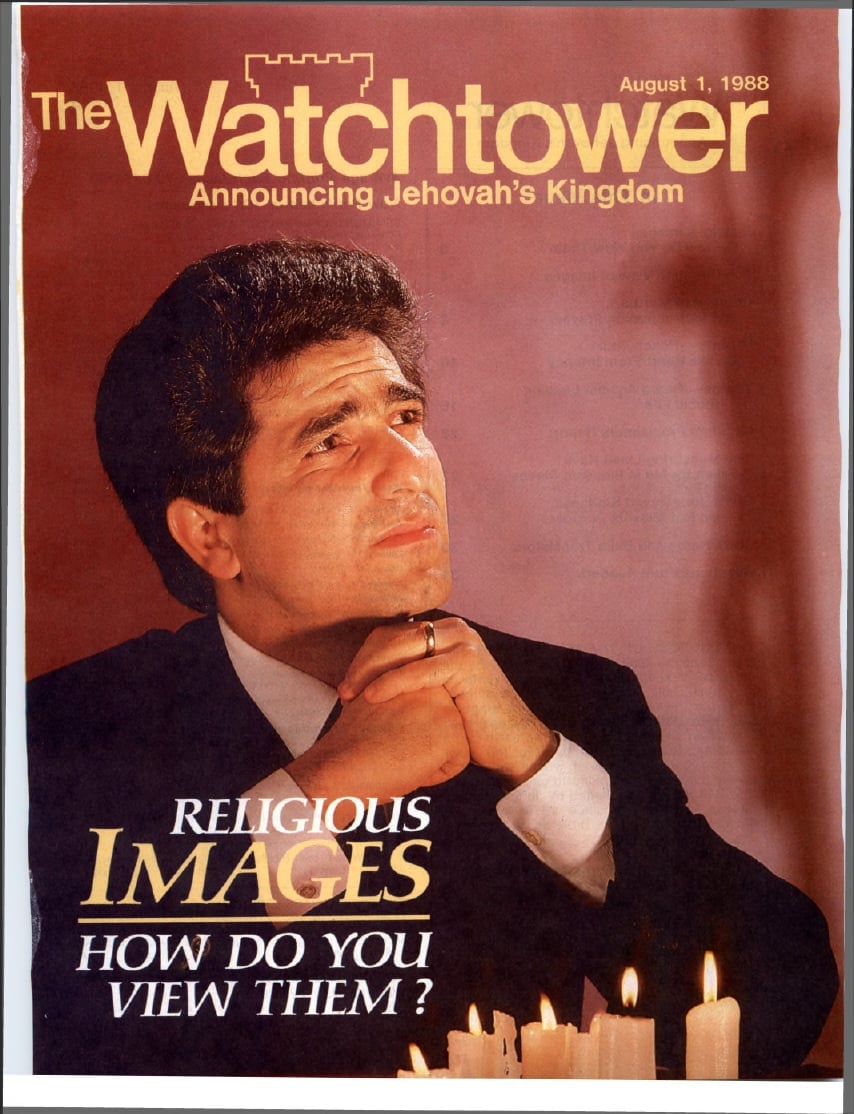
The Watchtower — August 1, 1988
Source: jw.org
Contents
Religious Images—How Do You View Them?
The Christian View of Images
Counsel to Martha, and Instruction on Prayer
Parents—Reach Your Child’s Heart From Infancy
Youths—Guard Against Leading a Double Life
Experiences From Tuvalu
‘The Measuring Lines Have Fallen for Me in Pleasant Places’
God’s Undeserved Kindness—Do Not Miss Its Purpose!
God’s Name and Bible Translators
Questions From Readers
Annual Meeting—October 1, 1988
The Watchtower on Cassette—A Wonderful Blessing
Religious Images—How Do You View Them?
Religious Images—How Do You View Them?
IN 1888 there was massive flooding in Canton, China. Continuous rain ruined the crops. Desperately the peasants prayed to their god Lung-wong to make the downpour cease, but in vain. Angered by the indifference of their deity, they jailed his image for five days! Some years before, the same god had ignored their prayers to end a drought. They chained his image outdoors in the searing heat.
In 1893 a drought struck Sicily. Religious processions, candles lit in the churches, and prayers to images all failed to produce rain. Having lost patience, the peasants stripped some images of their robes, turned the faces of others to the wall, and even dunked some in horseponds! In Licata, “Saint” Angelo was stripped, chained, reviled, and threatened with hanging. In Palermo, Italy, “Saint” Joseph was dumped in a parched garden to await rain.
These incidents, related in the book The Golden Bough, by Sir James George Frazer, have disturbing implications. They indicate that both professed Christians and non-Christians seem to have identical views of religious images. In both cases, worshipers used their images as a means of contacting a “saint” or a god. And interestingly, both tried to spur their tardy “saints” or gods to action by inflicting upon them the uncomfortable conditions their worshipers were experiencing!
Today, though, many who use religious images would view such actions as extreme, perhaps even laughable. They would argue that for them images are merely objects of respect—not worship. They might even claim that statues, crosses, and religious paintings are legitimate aids in worshiping God. Perhaps you feel the same way. But the question is: How does God feel about this? Could it be that veneration of an image really amounts to worshiping it? Is it possible that such practices actually pose hidden dangers?
The Christian View of Images
The Christian View of Images
“YOU broke with idolatry . . . and became servants of the real, living God,” wrote the apostle Paul to Christians in Thessalonica. (1 Thessalonians 1:9a) Yes, many early Christians were at one time pagan idolaters. (1 Corinthians 6:9-11) But upon becoming Christians, they ceased idolatrous practices.
Bowing before idols was so common, however, that Christians were mocked because they worshiped without images. Some pagans even accused them of being atheists! How, then, did the veneration of images later become so widespread in Christendom?
Christendom’s Images—From Where?
Many pagan practices were introduced among “Christians” after the so-called conversion of the Roman emperor Constantine. “From the days of Constantine,” states religious historian Edwyn Bevan in his book Holy Images, “the use of the Cross as a symbol throughout the Christian world became common and forms of homage were soon addressed to it.” This paved the way for other forms of image worship. The same book observes: “It seems probable that before the offering of homage to pictures and images the custom had come in of offering homage to the symbol of the Cross, which itself . . . is not found on Christian monuments or objects of religious art before Constantine set the example in the labarum [military standard incorporating a cross].”
This development continued. In the eighth century C.E., John of Damascus, considered a “saint” by the Roman Catholic and the Eastern Orthodox churches, wrote: “As the holy Fathers overthrew the temples and shrines of the devils, and raised in their places shrines in the names of Saints and we worship them, so also they overthrew the images of the devils, and in their stead raised images of Christ, and God’s Mother, and the Saints.”
To this, Thomas Aquinas, Roman Catholic “saint” of the 13th century, added: “The same reverence should be displayed towards an image of Christ and towards Christ Himself . . . The Cross is adored with the same adoration as Christ, that is, with the adoration of latria [Catholic definition for the highest form of worship], and for that reason we address and supplicate the Cross just as we do the Crucified Himself.”
Aquinas is still viewed as an important contributor to the doctrine of the “veneration of images.” According to the New Catholic Encyclopedia, the “veneration of images” had to await him “to find its own fullest explanation.” Nevertheless, it is clear that “Christian” image worship merely served to replace pagan image worship.
Justifying the Use of Religious Images
Many today who venerate religious images would object to being called image worshipers. Their objections to such a designation, however, are not new. In the fourth century, so-called Saint Augustine mocked the reasonings of idol-worshiping non-Christians, saying: “There is a certain disputer who seemeth unto himself learned, and saith, I do not worship that stone, nor that image which is without sense; . . . I worship not this image; but I adore what I see, and serve him whom I see not.” In other words, they claimed to worship only the invisible person represented by their idols. “By giving this account of their images,” Augustine added, “they seem to themselves able disputants, because they do not worship idols, and yet do worship devils.”—Expositions on the Book of Psalms by Augustine, Psalm xcvii 9.
Though Roman Catholic theologians have been quick to condemn pagan idolatry, when it comes to their own use of images, they have often resorted to the very justifications that the so-called pagan has used. For example, regarding images of Christ, Mary, and the “saints,” the 16th-century Council of Trent declared: “Due honor and veneration is to be given them; not, however that any divinity or virtue is believed to be in them by reason of which they are to be venerated.” Why, then, the veneration? “Because the honor which is shown them,” explained the council, “is referred to the prototypes which they represent, so that by means of the images which we kiss and before which we uncover the heads and prostrate ourselves, we adore Christ and venerate the saints, whose likeness they bear.”
To this day the Roman Catholic Church continues to justify idolatry on the same grounds: that images are simply a means to focus attention upon the heavenly one represented by them and that no virtue or power resides in the images. To what extent, though, has this proved true in actual practice? Do all who use images really believe that there is no ‘divinity or virtue in them’?
Images—The Worshiper’s Viewpoint
In Seville, Spain, a fanatical rivalry exists between the followers of the Virgin la Macarena and the Virgin de la Esperanza. In Chartres Cathedral, France, there are three Virgins—Our Lady of the Pillar, Our Lady of the Crypt, and Our Lady of the “Belle Verriere”—each having its own devotees. Apparently the worshipers are convinced that their image of the Madonna is somehow superior to the other images—even though all three images represent the same person! Clearly, then, homage is being paid, not to what is represented, but to the images themselves.
So, what the Roman Catholic Church excuses as relative worship often turns out to be actual worship of an image. Theological subtleties mean very little in the face of centuries of actual practice.
What Does the Bible Say?
The Bible’s counsel contradicts the theories of theologians. God made plain to ancient Israel that idolatry was totally condemned. (Exodus 20:4, 5; Deuteronomy 4:15-19) True, some representations, such as the copper serpent Moses made, were permitted. Bowing down in worship of such objects, though, was strictly forbidden.—Numbers 21:9; 2 Kings 18:1, 4.
At times Israel disobeyed this prohibition on idolatry. For example, at Sinai, Israel made a golden calf for worship. How blasphemous it was for them to ‘exchange God’s glory for a representation of a bull, an eater of vegetation’! (Psalm 106:20, NW) But like some religionists today, they claimed to worship, not the bull, but God himself! “‘Here is your God, Israel,’ they cried ‘who brought you out of the land of Egypt!’” (Exodus 32:1-5) Jehovah, however, did not tolerate this “relative” worship, this blatant reversion to Egyptian religion. (Acts 7:39-41) It directly violated the covenant they had entered into at Sinai, and it brought Israel into danger of obliteration.—Exodus 32:9, 10, 30-35; Deuteronomy 4:23.
Why, though, did Jehovah God take such a strong position against images? For one thing, images are powerless; they are nothing. (Deuteronomy 32:21a; Psalm 31:6) Jeremiah said they were like scarecrows, with no breath in them. (Jeremiah 10:5, 14) Isaiah likewise ridiculed those who use part of a tree to make a fire for cooking and another part to make a god. The prophet warns that such idol worshipers “know nothing, understand nothing. Their eyes are shut to all seeing, their heart to all reason.”—Isaiah 44:13-18.
One particularly lethal danger connected with image worship is the possibility of an image serving as a contact point with demonic forces. The psalmist said of the Israelites: “Serving the pagans’ idols, they found themselves trapped into sacrificing their own sons and daughters to demons.” (Psalm 106:35-37; compare Leviticus 17:7; Deuteronomy 32:17.) As a result, the way was opened for other superstitious, spiritistic practices. Another example is that of King Manasseh, who revived idolatry in Israel. Subsequently, “he built altars to the whole array of heaven in the two courts of the Temple” and “practised soothsaying and magic.”—2 Kings 21:1-6.
The Christian Greek Scriptures warn of the same dangers. The New Bible Dictionary says: “The Old Testament polemic against idolatry . . . recognizes the same two truths which Paul was later to affirm: that the idol was nothing, but that nevertheless there was a demonic spiritual force to be reckoned with, and that the idol therefore constituted a positive spiritual menace.” Paul wrote: “We know that idols do not really exist in the world and that there is no god but the One.” But later he warned: “The sacrifices that they offer they sacrifice to demons who are not God. I have no desire to see you in communion with demons.”—1 Corinthians 8:4; 10:19, 20.
Yes, wicked spirit forces are eager to bring individuals under their control. Paul wrote: “For it is not against human enemies that we have to struggle, but against the Sovereignties and the Powers who originate the darkness in this world, the spiritual army of evil in the heavens.” (Ephesians 6:12) Image worship of any sort therefore deadens one’s spiritual perceptions, encourages superstition, and facilitates manipulation by the occult rulers of this dark, evil world.
Worshiping ‘in Truth’
Many sincere people use images to draw closer to the Hearer of prayer. Drawing close to God is desirable. But are we free to choose our own method of approach? Surely we must seek the approach that pleases God, not our own. Jesus said: “I am the Way, the Truth and the Life. No one can come to the Father except through me.” (John 14:6) This would preclude using idolatrous images. Jesus further taught: “But the hour will come—in fact it is here already—when true worshippers will worship the Father in spirit and truth: that is the kind of worshipper the Father wants. God is spirit, and those who worship must worship in spirit and truth.”—John 4:23, 24.
Can one who is spirit be represented by a material image? No. Regardless of how imposing an image may be, it can never match the glory of God. So an image of God could never be truthful. (Compare Romans 1:22, 23.) Would a person therefore be ‘worshiping in truth’ if he approached God through some fraudulent image?
Jehovah’s Witnesses have helped thousands of individuals forsake idolatrous practices and become ‘the kind of worshipers the Father wants.’ After being shown from the Bible how God views images, many have been moved to eliminate images from their homes and their form of worship. (Compare Deuteronomy 7:25.) True, it has not always been easy for such ones to do so. But they have been moved by a sincere desire to adhere closely to God’s Word the Bible, which exhorts true Christians: “Children, be on your guard against false gods [literally, idols].”—1 John 5:21, footnote.
[Footnotes]
Unless otherwise marked, all Scripture quotations are from the Catholic Jerusalem Bible.
[Box on page 7]
Do ‘Icons Never Become Idols’?
“Icon” refers to a specific kind of image, namely, religious paintings venerated by members of the Eastern Orthodox Church. Some are representations of Christ; others represent the Trinity, Mary, “saints,” or angels. Like Roman Catholics, Orthodox theologians justify the veneration of icons as a relative act that passes devotion on to the heavenly one represented. “The icon,” claims Russian theologian, Sergey Bulgakov, “remains only a thing and never becomes an idol or a fetish.”
At the same time, though, the Eastern Orthodox Church teaches that an icon can bring special benefits to a worshiper who prays in front of it, provided the icon has been “sanctified” by the church. “The rite of the blessing of the icon,” states Bulgakov in his book The Orthodox Church, “establishes a connection between the image and its prototype, between that which is represented and the representation itself. By the blessing of the icon of Christ, a mystical meeting of the faithful and Christ is made possible. It is the same with the icons of the Virgin and the Saints; their icons, one may say, prolong their lives here below.”
Furthermore, many icons of Mary are believed to possess miraculous powers. “Although she remains in heaven,” asserts Bulgakov, “she still lives with us the life of our world, suffers with its suffering, and weeps with its tears. She intercedes for the world before the throne of God. She reveals herself to the world in her wonder-working icons.”
Counsel to Martha, and Instruction on Prayer
Jesus’ Life and Ministry
Counsel to Martha, and Instruction on Prayer
DURING the course of Jesus’ Judean ministry, he enters the village of Bethany. This is where Martha, Mary, and their brother Lazarus live. Perhaps Jesus met these three earlier in his ministry and so is already close friends with them. In any event, Jesus now goes to the home of Martha and is welcomed by her.
Martha is eager to provide Jesus with the very best that she has. Indeed, it is a great honor to have the promised Messiah visit one’s home! So Martha becomes involved in preparing an elaborate meal and seeing to many other details designed to make Jesus’ stay more enjoyable and comfortable.
On the other hand, Martha’s sister Mary sits down at Jesus’ feet and listens to him. After a while, Martha approaches and says to Jesus: “Lord, does it not matter to you that my sister has left me alone to attend to things? Tell her, therefore, to join in helping me.”
But Jesus refuses to say anything to Mary. Rather, he counsels Martha for being overly concerned with material things. “Martha, Martha,” he kindly reproves, “you are anxious and disturbed about many things. A few things, though, are needed, or just one.” Jesus is saying that it is not necessary to spend a lot of time preparing many dishes for a meal. Only a few or even just one dish is sufficient.
Martha’s intentions are good; she wants to be a hospitable hostess. Yet, by her anxious attention to material provisions, she is missing out on the opportunity to receive personal instruction from God’s own Son! So Jesus concludes: “For her part, Mary chose the good portion, and it will not be taken away from her.”
Later, on another occasion, a disciple asks Jesus: “Lord, teach us how to pray, just as John also taught his disciples.” Possibly this disciple was not present about a year and a half earlier when Jesus provided the model prayer in his Sermon on the Mount. So Jesus repeats his instructions but then goes on to give an illustration to emphasize the need to be persistent in prayer.
“Who of you will have a friend,” Jesus begins, “and will go to him at midnight and say to him, ‘Friend, loan me three loaves, because a friend of mine has just come to me on a journey and I have nothing to set before him’? And that one from inside says in reply, ‘Quit making me trouble. The door is already locked, and my young children are with me in bed; I cannot rise up and give you anything.’ I tell you, Although he will not rise up and give him anything because of being his friend, certainly because of his bold persistence he will get up and give him what things he needs.”
By this comparison Jesus does not mean to imply that Jehovah God is unwilling to respond to petitions, as was the friend in his story. No, but he is illustrating that if an unwilling friend will respond to persistent requests, how much more so will our loving heavenly Father! So Jesus continues: “Accordingly I say to you, Keep on asking, and it will be given you; keep on seeking, and you will find; keep on knocking, and it will be opened to you. For everyone asking receives, and everyone seeking finds, and to everyone knocking it will be opened.”
Jesus then makes a reference to imperfect, sinful human fathers, saying: “Indeed, which father is there among you who, if his son asks for a fish, will perhaps hand him a serpent instead of a fish? Or if he also asks for an egg, will hand him a scorpion? Therefore, if you, although being wicked, know how to give good gifts to your children, how much more so will the Father in heaven give holy spirit to those asking him!” Indeed, what motivating encouragement Jesus provides to be persistent in prayer. Luke 10:38–11:13.
◆ Why does Martha go to such extensive preparations for Jesus?
◆ What does Mary do, and why does Jesus commend her instead of Martha?
◆ What prompted Jesus to repeat his instructions on prayer?
◆ How did Jesus illustrate the need to be persistent in prayer?
Parents—Reach Your Child’s Heart From Infancy
Parents—Reach Your Child’s Heart From Infancy
“Go on bringing [your children] up in the discipline and mental-regulating of Jehovah.”—EPHESIANS 6:4.
1. What occurred during a particularly trying period in Jesus’ life?
JESUS CHRIST and his disciples were on their way to Jerusalem. Not long before, on two different occasions, Jesus had told his disciples that he would undergo many sufferings and be put to death in that city. (Mark 8:31; 9:31) During this especially trying period for Jesus, the Bible account says: “People began to bring him also their infants for him to touch these.”—Luke 18:15.
2. (a) Why may the disciples have tried to turn the people away? (b) How did Jesus respond to the situation?
2 What response was there to this? Well, the disciples scolded the people and tried to send them away, no doubt believing that they were doing Jesus a favor by protecting him from unnecessary disturbance and stress. But Jesus became indignant with his disciples, saying: “‘Let the young children come to me; do not try to stop them’ . . . And he took the children into his arms and began blessing them.” (Mark 10:13-16) Yes, despite all that must have been on his mind and heart, Jesus took time for infants.
What Lesson for Parents?
3. What lesson should parents learn from this incident?
3 A lesson from this for parents should be: Despite any other obligations you have or the troubles you face, spending time with your children needs to be given priority. The time spent together will allow you to inculcate the spiritual values that will safeguard the hearts of your children and set them on the right course. (Deuteronomy 6:4-9; Proverbs 4:23-27) Eunice and Lois, respectively the mother and the grandmother of Timothy, took the time to give him the instruction that touched his little heart and shaped his life so that he grew up to be a devoted servant of God.—2 Timothy 1:5; 3:15.
4. How precious are children, and how should parents show that they appreciate them?
4 Christian parents cannot afford to neglect the children that Jehovah God has granted to them. Yes, children are a precious gift from Jehovah. (Psalm 127:3) So spend time with them—reach their hearts—even as Timothy’s mother and grandmother set the example. Not only should you spend time talking with your children about their conduct and disciplining them but you also need to eat meals with them, read with them, play with them, help them to get ready for bed at night. All this time spent with your children is vital.
5. Give an example of one father who showed appreciation for his parental responsibilities.
5 A prominent Japanese businessman who became one of Jehovah’s Witnesses recognized this fact. Beneath the headline, “Top JNR Exec Quits To Be With Family,” the Mainichi Daily News of February 10, 1986, reported: “A top executive of the Japanese National Railways (JNR) chose resignation rather than separation from his family . . . Says Tamura, ‘The job of the director general can be taken by anybody. But I am the only father of my children.’” Do you take your parental responsibilities as seriously?
Why Special Efforts Needed Now
6. Why is it so hard to rear children properly today?
6 Probably never in human history has it been so difficult to rear children in the way God’s Word instructs, “in the discipline and mental-regulating of Jehovah.” (Ephesians 6:4) The reason for this is that we are living “in the last days,” and Satan and his demons are causing great woe because they are angry, knowing they have only a short time left. (2 Timothy 3:1-5; Revelation 12:7-12) Thus, the efforts of parents to rear their children in a godly way are being thwarted by the symbolic “air” over which Satan exercises authority. That “air,” or spirit of selfishness and disobedience, is as pervasive as the literal air we breathe.—Ephesians 2:2.
7, 8. (a) What can television bring into the home, and yet what do many parents do? (b) Why is using television as a baby-sitter a sad neglect of parental responsibility?
7 Television, in particular, carries into the home this “spirit of the world,” this poisonous “air.” (1 Corinthians 2:12) Actually what appears on television is often strongly influenced by a powerful immoral and homosexual segment of the entertainment field. (Romans 1:24-32) Your children are especially susceptible to the ungodly thinking and moral filth presented, even as they are to literal air pollution. But what do many parents do?
8 They use television as a baby-sitter. “Not now, honey. I’m busy. Go watch television,” they tell their children. A prominent television broadcaster says that these are “the most often spoken words in many American households.” And yet sending children off to watch whatever may be on television amounts, in effect, to letting them on the loose. (Proverbs 29:15) It constitutes a sad neglect of parental responsibility. As this broadcaster noted regarding raising children: “It is time consuming and a great responsibility this parenting business and it may not be delegated, certainly not to the television set.”
9. From what pollution do children particularly need protection?
9 However, because of the pressure of the times in which we live, you may be inclined, as the disciples were, to turn children aside so that you can attend to what may be thought of as more important business. But what is more important than your own children? Their spiritual lives are at stake! You may recall that when the Chernobyl nuclear accident occurred in the Soviet Union in 1986, children were removed from the region to protect them from the pollution. Similarly, if you are to guard the spiritual health of your children, you need to protect them from the world’s poisonous “air,” which is so often spewed out from the television set.—Proverbs 13:20.
10. What other sources of poisonous “air” are a danger to children, and what Bible example illustrates this?
10 There are other sources of poisonous “air,” however, that can destroy moral values and can harden young minds. Improper association with children in the neighborhood and at school can also crowd out Bible truths planted in tender hearts. (1 Corinthians 15:33) A lesson can be drawn from Jacob’s young daughter Dinah, who “used to go out to see the daughters of the land” and, as a result, was violated by one of the young men. (Genesis 34:1, 2) Children need to be well instructed and trained to avoid the moral pitfalls of a world that is even more debased today than it was then.
Why Train From Infancy?
11. (a) When should parental training begin? (b) What fine results can be expected?
11 But when should parental training begin? The Bible says that Timothy received his training “from infancy.” (2 Timothy 3:15) Interestingly, breʹphos, the Greek word here, is often used of an unborn child, as at Luke 1:41, 44. There the infant John was said to leap within his mother’s womb. But breʹphos is also used of the newborn Israelite babies whose lives were threatened in Egypt in the time Moses was born. (Acts 7:19, 20) In Timothy’s case, the word clearly refers to a mere infant, or baby, and not simply to a young child. Timothy received instruction from the holy writings from as far back as his memory could reach, from the time when he was only a baby. And with what fine results! (Philippians 2:19-22) Yet, can newborn babies really benefit from such early teaching?
12. (a) When may infants begin absorbing impressions and information? (b) When and how should parents begin providing spiritual instruction for their children?
12 “One of the most exciting developments in the whole field of psychology is our new understanding of the great ability of the infant to learn,” reported Dr. Edward Zigler, a professor at Yale University, in 1984. In fact, the magazine Health says: “Babies still in the womb may be able to see, hear, taste—and ‘feel’ emotions, new research suggests.” Evidently, parents can never start too early to instruct their children. (Deuteronomy 31:12) They can start by showing their children pictures from books and sharing stories with them. “The crucial years,” says Masaru Ibuka, author of the book Kindergarten Is Too Late, “are the years from birth to three.” This is because the young mind is especially malleable, absorbing information more easily, as is evidenced by an infant’s quick mastery of a new language. A professor in early childhood education at New York University even said that “parents should begin teaching kids to read the moment they bring them home from the hospital”!
13. What illustrates the ability of infants to learn?
13 A mother from Canada writes regarding her child’s ability to learn: “One day I was reading a story from My Book of Bible Stories to my four-and-a-half-year-old son, Shaun. As I paused at one point, I found to my amazement that he began to continue the story, word for word, as it appears in the Bible Stories book. . . . I tried another and then another, and he had memorized every one. . . . He has actually memorized, word for word, the first 33 stories, including difficult names of places and people.”a
14. (a) Who are not surprised by the accomplishments of infants? (b) What should be the goal of Christian parents? (c) For what do children need to be prepared, and why?
14 Those well acquainted with the potential of infants to learn are not surprised by such feats. “The world could be full of intellectual giants like Einstein, Shakespeare, Beethoven and Leonardo da Vinci if we taught babies instead of children,” claims Dr. Glenn Doman, director of The Institutes for the Achievement of Human Potential. Of course, the goal of Christian parents is not to produce intellectual giants but to reach the hearts of their children so that the children never depart from serving God. (Proverbs 22:6) Such efforts need to be made long before the child enters school, in order to prepare him for the tests he will face there. Kindergarten or day-care programs, for instance, feature birthday and holiday parties that can be fun for children. So the child needs to understand why Jehovah’s servants do not participate. Otherwise he may grow to hate his parents’ religion.
How to Reach a Child’s Heart
15, 16. What can parents use to help them reach their child’s heart, and how can these provisions be effectively utilized?
15 To help parents reach their child’s heart, publications such as Listening to the Great Teacher have been provided by Jehovah’s Witnesses. This book talks about parties and how “they can be lots of fun” in its chapter “Two Men Who Celebrated Birthdays.” Yet the chapter explains that the only two birthday parties mentioned in the Bible were celebrated by pagans, who did not worship Jehovah, and that at each party ‘someone’s head was chopped off.’ (Mark 6:17-29; Genesis 40:20-22) How can you use this information to reach your child’s heart?
16 You can employ the appealing method of the Great Teacher book by saying: “Now, we know that everything that is in the Bible is there for a reason.” Then ask: “So, what would you say that God is telling us about birthday parties?” Your child is thus helped to reason on the matter and reach right conclusions. Besides the Great Teacher book, other literature has been provided for use by parents, including My Book of Bible Stories and the serial “Jesus’ Life and Ministry” that has appeared in each issue of The Watchtower since April 1985. Have you been using these articles in teaching your children as well as yourself?
17. What practical suggestions are here offered to parents?
17 With your child, you need to go over and over material that covers issues and situations that he will face in school. Let your child know that both of you are accountable to Jehovah. (Romans 14:12) Highlight the good things Jehovah does for us, thus moving the child’s little heart to want to please Jehovah. (Acts 14:17) Make learning sessions a happy time. Children love stories, so really work at imparting instruction in an animated way that will reach your child’s heart. Many families miss a marvelous opportunity for such sessions by failing to have meals together regularly. Do you eat together as a family? If not, can you correct the situation?—Compare Acts 2:42, 46, 47.
18, 19. (a) How should parents schedule the teaching of their children, and what cannot be overemphasized? (b) What features of a modern example of parental training impress you, and what do you believe would result if a parent employed them?
18 The learning session should be adjusted to the child’s age. So with an infant, whose attention span is limited, have a number of short daily sessions. Then, progressively, make them longer and expand their content. The importance of having regular periods for teaching your children simply cannot be overemphasized. (Genesis 18:19; Deuteronomy 11:18-21) One father, now in his seventies, set a fine example in rearing his son, who now is a Christian elder. Years ago he described his program, explaining:
19 “When our boy was about one I began telling him bedtime Bible stories, related in an enlarged, colorful way to make a vivid impression. As soon as he began to talk in his second year we would kneel by his bedside and I would have him repeat after me, phrase by phrase, the ‘Lord’s Prayer.’ . . . When he was three I began to have a regular Bible study with him . . . He would follow in his book, verbally repeating the words after me. He thus came to pronounce words well and learned to enunciate clearly even the big words. . . . To aid in making Bible truths sink deeply into his heart, when he was three we began to have him memorize simple Bible texts. By the time he entered kindergarten he knew about thirty texts, and last September when he started the first grade he had memorized seventy scriptures. . . . Before our boy goes to bed I have him repeat some of his scriptures. Likewise when he gets up in the morning he often recites a few Bible texts as part of his greetings for the day.”
20. What should be included in a teaching program, and how can a child enjoy the house-to-house ministry?
20 Such a progressive teaching program, including proper parental example and the application of consistent discipline, will provide your child with a start in life for which he will be forever grateful. (Proverbs 22:15; 23:13, 14) A vital part of the program should be training in the public ministry from an early age. Make it a pleasant experience by preparing your child to have a meaningful share. The father mentioned above further commented regarding his son: “His ability to quote scriptures makes him very effective in the house-to-house ministry, since many householders are amazed and cannot resist the offer of Bible magazines he presents. He has shared in this Christian service since he was three years old, and is now [at age 6] often more effective in placing Bible literature with people than my wife and I.”—Awake!, January 22, 1965, pages 3-4.
21. (a) What is the grandest gift parents can leave their children? (b) What admonition is given parents, and what should all parents with minor children be having?
21 Truly, Christian parents have a marvelous inheritance, a knowledge of Jehovah, to leave their children and with it the prospects of unending life, peace, and happiness in a glorious new world. (Proverbs 3:1-6, 13-18; 13:22) Above all else, in your little ones’ hearts build confidence in the reality of that grand future, along with a desire to serve Jehovah. Make true worship a natural and happy experience for them. (1 Timothy 1:11) Inculcate trust in Jehovah from infancy. And never, no, never, neglect regular learning sessions with them! Give these your highest priority, continually reexamining what information your children need and how you can best reach their hearts with it. You are busy and under pressure; Satan and his world see to that. But remember Jesus’ example! Never be too busy to have a regular study with your children!
[Footnotes]
Long before he could read, he had learned those stories simply by listening to the recorded cassettes of the book.
How Would You Respond?
□ What Bible evidence shows that parents should give priority to the needs of their children?
□ Why are special efforts by parents now needed in protecting their children?
□ Why is it so vital that children be trained from infancy?
□ What are some practical suggestions for parents in reaching their child’s heart?
□ What should Christian parents never neglect?
[Picture on page 12]
Parental training cannot start too early
Youths—Guard Against Leading a Double Life
Youths—Guard Against Leading a Double Life
“Rejoice, young man, in your youth . . . But know that on account of all these the true God will bring you into judgment.”—ECCLESIASTES 11:9.
1, 2. What example is there of a youth leading a double life?
“FROM infancy I was brought up in a Christian environment, among Jehovah’s Witnesses,” wrote a youth. “Still, the life I lived, even while at home, was the complete opposite of the standards and thinking of my parents. My life for the most part was a loose life, an undisciplined life of the world.”
2 The youth further explained: “Even before I reached the age of ten, I started playing both worlds as best I could—to get acceptance and friendship at school and still be accepted by my parents. At school I conformed as much as I could in style and conduct . . . But at home I was completely different. I was the well-behaved Christian my parents expected.”
3. (a) What confidence do we have, yet what do we realize? (b) What prompts our directing attention to youths?
3 We realize that this youth’s conduct is not representative of most of you young ones in the congregation. The majority of you, we are confident, are honest with your parents and the congregation, and this warms our hearts. At the same time, we know that some put on a front of being upright, and as best they can, they conceal from older ones a course of wrongdoing. Hence the question: Are you the kind of person that you make us think you are, or are you leading a double life? We do not ask this in a spirit of finding fault but, rather, because we truly love you and want to help you to enjoy your youth by living it in a way that will please Jehovah.—Ecclesiastes 11:9, 10; 12:14; 2 Corinthians 5:10.
4. How have some adults also led double lives, but what has been noted recently among young people?
4 Still, you may ask: ‘Why pick on us young ones? What about adults?’ There is no question that they also must guard against leading a double life. Gehazi, the attendant of Elisha, acted deceptively, trying to cover up the fact that he accepted gifts from Naaman. (2 Kings 5:20-26) And Ananias and Sapphira, who were adults, played false by saying that they had given to the apostles the entire price of the field—trying to make themselves look good—when actually they held back some of the money for themselves. (Acts 5:1-4) The reason, however, we are directing attention to you young ones is that there has apparently been an increase in the incidence of this problem among you.
Why Some Lead a Double Life
5. (a) Why do some youths lead a double life? (b) How are youths often treated when they live commendable lives, and so what do some do?
5 Why is this? One youth pinpointed a major reason, explaining: “I didn’t want to lose my friends by being different.” It is true that being different in a wholesome way often makes one the brunt of ridicule. (Compare 1 Peter 3:16; 4:4.) To avoid this and to gain the acceptance of their peers, some youths will even get drunk or have sex relations. A 13-year-old non-Witness girl, who earned all A’s and always participated in class discussions, lamented: “Guys will never be interested in someone as predictably good as me. . . . I’m considering letting my grades slip or something to liven up my reputation.”
6. How was Peter influenced into wrong conduct, and so how should this affect our judgment of youths?
6 Significantly, the apostle Peter himself once thought more of his image, or reputation, than of doing what he knew was right. When Jewish Christians from Jerusalem visited Antioch, Peter withdrew from association with the Gentile Christians because of fear of criticism by the Jews for mingling with these Gentiles. (Galatians 2:11-14) Since even mature Christians have thus succumbed to peer pressure, is it any wonder that inexperienced youths might do so too?—Proverbs 22:15.
7. What may tempt some youths to lead a double life?
7 A related reason why some young ones lead a double life is that they believe they are missing out on fun. They hear youngsters at school talk about their activities—how great the party was, the terrific music, the drinking, the drugs, what a great high they had! Or they hear how he, or she, can kiss and make love. So a desire to experience these things is aroused, and the young ones are influenced to try out what the Bible calls “the temporary enjoyment of sin.”—Hebrews 11:24, 25; 1 Corinthians 10:6-8.
8. What is the basic reason youths lead double lives?
8 However, the fundamental reason some youths lead a double life is that Jehovah and the coming new world simply are not real to them. They do not truly believe Jehovah’s promises or the warnings issued through his Word and his visible organization regarding the consequences of disobeying Jehovah. (Galatians 6:7, 8) They are unlike Moses, of whom the Bible says: “He looked intently toward the payment of [God’s] reward. . . . He continued steadfast as seeing the One who is invisible.” To Moses, Jehovah and His promises were real. But those who lead a double life lack that faith. All they see is what Satan wants them to see—the glitter of his system. And so they go after the temporary enjoyment of sin and yet, at the same time, try to put on a front of holiness.—Hebrews 11:26, 27.
Parents, You Can Contribute
9. (a) How can parents contribute to their children’s leading a double life? (b) What do older ones need to appreciate and be alert to do?
9 The youth quoted at the outset observed: “What made me unpopular at school brought acceptance and a smile of approval at home. But I needed more than that. I needed someone I could hold on to, talk to, and confide in, and I wasn’t getting that from my parents.” Parents, are you being careful not to contribute to your children’s leading a double life? Are you providing them with the personal attention and guidance they need? Older ones must appreciate the tremendous, faith-undermining pressures that our young ones face in school and be alert to do everything possible to encourage and help them.—Psalm 73:2, 3; Hebrews 12:3, 12, 13.
10. (a) What curiosity is it the responsibility of parents to address? (b) What often is the consequence when parents fail to provide guidance?
10 Often a youth’s questions revolve around relationships with members of the opposite sex, a subject that, unfortunately, many parents avoid. “They never had a heart-to-heart talk with me,” related a pretty 15-year-old honor student. “Everything I learned about sex I had to learn on my own. . . . I was too ashamed to bring it up although there were so many things I wanted to know.” What was the result? She said: “The invisible wall grew thicker between my parents and me, and I became a very curious, foolish and susceptible girl.” Yes, she succumbed to the sexual advances of a young man, but who would you say shared responsibility for this?—Proverbs 22:3; 27:12.
11. (a) How can parents show that they love their children? (b) How are youths likely to respond to such love?
11 It is vital that parents show their youngsters that they truly love them by spending time with them, sharing in confidential talk, and providing guidelines. (Proverbs 15:22; 20:18) “I have the feeling if they really cared about me they would make some rules,” observed another youth. Even if young ones resent your rules and regulations now, later they will look back on them with appreciation. A youth wrote her mother: “As one who was constantly testing the boundaries, looking for soft spots and ways to escape the tough rules and regulations, I am ever so grateful you kept a tight rein on me.” So show that you love your children by requiring that they comply with your guidelines. May you never contribute to their leading a double life by failing to keep open the lines of communication or by failing to be there when they need you!
12. What unwise attitude of some parents contributes to their children’s leading a double life?
12 Parents can also contribute in quite a different way to their children’s leading a double life. The remarks of a New Jersey state superior court judge illustrate. “Teachers,” the judge said, “try to discipline children for wrongdoing in school and then are upbraided by parents instead of being supported.” It seems some parents mistakenly believe that their youngsters can do no wrong. Even when Christian elders or other responsible ones in the congregation bring the wrongdoing of their children to their attention, the parents turn a deaf ear. By so doing, they contribute to the duplicity of their young ones.
What a Double Life Really Is
13. Leading a double life really amounts to what?
13 This is vital to consider: Leading a double life really amounts to playing false—being an impostor, a hypocrite. (Psalm 12:2; 2 Timothy 3:13) It is being like Satan, who “keeps transforming himself into an angel of light.” (2 Corinthians 11:14, 15) It also means being like those religious leaders of whom Jesus said: “Woe to you, scribes and Pharisees, hypocrites! because you resemble whitewashed graves, which outwardly indeed appear beautiful but inside are full of dead men’s bones and of every sort of uncleanness. In that way you also, outwardly indeed, appear righteous to men, but inside you are full of hypocrisy and lawlessness.” (Matthew 23:27, 28) Clearly, leading a double life is a serious offense against God.
14. Why should one want to avoid leading a double life?
14 Another fact for serious consideration is this: A hypocritical course cannot be concealed indefinitely. “Even by his practices a boy makes himself recognized as to whether his activity is pure and upright,” the Bible says. (Proverbs 20:11; Luke 12:1-3) Yes, your activity, whether good or bad, will eventually become known. And the Bible shows that God will punish hypocrites with severity. (Matthew 24:51) Surely you should want to avoid leading a double life!
How to Avoid It
15. What will help youths avoid leading a double life?
15 One way to avoid leading a double life is to face up to what it really amounts to and then ask yourself: Is that how I want to be remembered, as a hypocrite, as an imitator of Satan and the Pharisees? Of course not! Something else that will help you avoid leading a double life is to think of the personal heartache and tragedy such a life will bring you. Recall what happened to Gehazi for trying to live a lie. Naaman’s leprosy stuck to him, and he was a leper for the rest of his life. And Ananias and Sapphira were both struck dead by God for trying to put on a pretense of generosity.—2 Kings 5:27; Acts 5:5, 9, 10.
16. What happened to one youth who got involved in a worldly life-style?
16 There are also modern examples. A youth in the United States had begun to study the Bible and attend meetings at the Kingdom Hall. But then he began dabbling in a worldly life-style and discontinued association. Years passed, and he wrote: “About two months ago I asked God to send me a Witness because I felt the desire to start over again. I started to study again when the bomb exploded. I was diagnosed a month ago as having Kaposi’s sarcoma, part of the new incurable AIDS syndrome.” He concluded: “If I had only followed and obeyed Scriptural warnings back then, I would not be in this situation today.” Surely you want to avoid any such sad consequences! The world really has nothing of value to offer.—1 John 2:15-17.
17. What further consideration should help youths avoid leading a double life?
17 What will also help you avoid leading a double life is to consider the effect that doing so will have on Jehovah’s name. The youth mentioned in the introduction said that someone who saw him accept a cigarette commented: “I didn’t know Jehovah’s Witnesses could smoke. Aren’t you a Witness?” He later said that the question made him feel terrible because what he was doing was bringing reproach on Jehovah. Do you want that? Do you think so little of our God that like unfaithful Israel of old you will bring shame upon his name?—Psalm 78:36, 37, 41; Ezekiel 36:22.
18. (a) How would parents likely react if they learned that their child was leading a double life? (b) Why should this deter Christian youths from leading a double life?
18 Besides, consider the name and the feelings of your parents. “The day came when my parents learned what I really was,” wrote the above-mentioned youth. “It shocked them. And for the first time in my life I saw my mother and father cry. They were so hurt by what I had done.” Your parents would probably cry, too, if they learned you were leading a double life. Is that what you want? “A good name is more desirable than great wealth,” the Bible says. (Proverbs 22:1, The Jerusalem Bible) By leading a double life, you destroy your own good name. But that is not all. You also spoil the good name of your parents and drag it in the mud, causing them humiliation and embarrassment.—Proverbs 10:1; 17:21.
19. How did the misconduct of Jacob’s sons reflect on him, and what lesson can be drawn from this?
19 Jacob’s sons well illustrate how children can ruin their parents’ good name. When Jacob’s daughter Dinah was violated, her brothers slaughtered the men of the city and then plundered the city, causing Jacob to lament: “You have brought ostracism upon me in making me a stench to the inhabitants of the land.” God even directed Jacob to leave the area. (Genesis 34:30; 35:1) You too can cause the name of your father and mother to stink, making them ashamed to face even their neighbors and friends. Indeed, as the Bible says: “A stupid son is a vexation to his father and a bitterness to her that gave him birth.”—Proverbs 17:25.
20. What grand gift have Christian parents made available to their children?
20 We are confident, however, that you do not want your parents to suffer vexation and bitterness. So consider the effects of your actions upon them. Also, if you are privileged to have Christian parents, think of what they have given you—not just life—but something more precious. The Bible says of Jehovah: “Your loving-kindness is better than life.” (Psalm 63:3) By rearing you in the truth, your parents have made God’s loving-kindness available to you, helping you to have a relationship with him. Having this is better than having life itself because even if you should die, God will restore you to eternal life in Paradise.
Help Others Avoid It
21. (a) What responsibility do youths have that know of the wrongdoing of others? (b) What fine example did one 13-year-old provide?
21 What if you know of someone who is leading a double life? First, encourage the person to approach the elders. And what if he or she refuses to do that? Then it is your Scriptural responsibility to report it. (Leviticus 5:1) We realize this may not be easy, but it is the right thing to do. “The wounds inflicted by a lover are faithful,” the Bible says. (Proverbs 27:6) A 13-year-old girl, after hearing a talk explaining her Scriptural responsibility, went to a friend that she knew was engaging in wrongdoing and told her she should confess to the elders. “I went and checked to see if she had talked to any elder,” the girl writes. “She hadn’t. So I went and talked to one of them.” The young girl asked: “Did I do the right thing by turning in my ‘ex-best friend?’” Of course she did! While the immediate consequences of doing this may be grievous, the result afterward can be joyous, even lifesaving to the wrongdoer.—Hebrews 12:11.
22. What wise course are youths encouraged to take, and what will be its outcome?
22 Yet all of this can be avoided if you do not lead a double life in the first place. So be wise. Develop a strong personal relationship with God, as you would with a close friend. Do this by regularly praying to him, by asking for his help, and by diligently studying his Word, the Bible, so that you truly come to appreciate his qualities. Youths, you will then be blessed and will make the heart of your parents glad. But even more important, you will make the heart of Jehovah glad.—Proverbs 27:11.
How Would You Respond?
□ Why do some youths lead a double life?
□ How do some parents contribute to their children’s leading a double life?
□ Leading a double life really amounts to what?
□ How can youths avoid leading a double life?
□ What responsibility do youths have if they know of other young ones who have committed serious wrongs?
[Picture on page 18]
Talking confidentially demonstrates the parent’s love
[Picture on page 20]
If you are aware that another has committed a serious offense, encourage that one to report it
Experiences From Tuvalu
Kingdom Proclaimers Report
Experiences From Tuvalu
THE good news of the Kingdom is being proclaimed in the beautiful islands of Tuvalu, in the South Pacific, and a good witness has been given even to men in high station. An Australian brother who with his wife is serving in the traveling work in Tuvalu tells us of his experience:
“My wife and I were invited to attend a meal at the home of the Prime Minister of Tuvalu. The occasion was the visit of Australia’s Minister for Foreign Affairs. During the course of the meal, my wife and I had a fine opportunity to witness to both the Australian minister and his wife. When introducing us, the Prime Minister mentioned what a wonderful work Jehovah’s Witnesses are doing in Tuvalu, particularly with regard to the translation of our literature into the Tuvaluan language. ‘I have copies of all their publications in my library, and they are excellent!’ he said. Both the minister and his wife were interested to hear of the progress of our work in Tuvalu.
“Later in the evening, we attended some local entertainment of traditional dancing. Afterward the Governor General of Tuvalu approached us and mentioned that some Witnesses had visited his residence the week before and had left some copies of the Watchtower and Awake! magazines. He noticed on the back of one of the magazines an advertisement for the New World Translation of the Holy Scriptures and wanted to know how he could get one locally. We stated that we would gladly give him a copy. The next Sunday, I went up to his residence with the Bible, and we had a fine discussion for about an hour. He mentioned how much he appreciated our work and publications. In fact, when we arrived at his home, his wife was reading the Live Forever book in Tuvaluan. So we were happy to be able to witness to some ‘who are in high station.’”—1 Timothy 2:1-4.
On another occasion the Prime Minister of Tuvalu visited the Solomon Islands. The community of Tuvaluans who live there hosted a feast in his honor. Among those invited to the feast was one sister, who reported the following experience:
“At the conclusion of the feast, the Prime Minister allowed an opportunity to ask questions about the latest developments in Tuvalu. One question asked was, ‘Are there any new religions in Tuvalu?’ The Prime Minister replied that ‘there are some new religions that have been allowed into Tuvalu but only one good one.’ When asked which one that was, he replied, ‘Jehovah’s Witnesses.’
“Everyone was surprised by his answer, and the obvious question arose as to why Jehovah’s Witnesses are the ‘only good religion.’ He stated: ‘Because our pastors sit at home all day and only ring a bell on Sundays for us to go up and listen to them. But Jehovah’s Witnesses actually come to you, and even though you may not go to church, they will teach you about the Bible in your own home.’”
So, although some would criticize our door-to-door ministry, obviously others appreciate our taking the message to their very homes.—Acts 5:42.
‘The Measuring Lines Have Fallen for Me in Pleasant Places’
‘The Measuring Lines Have Fallen for Me in Pleasant Places’
As told by D. H. MacLean
THERE I sat, hour after hour, with one of the Royal Canadian Mounted Police by my side. I was his prisoner. We were headed for the prison camp at Chalk River, Ontario, Canada, and it seemed the 1,500-mile [2,400 km] train trip would never end.
It was 1944, and World War II was at its height. But what was I doing here headed for prison? Well, it was largely because of what Dad had taught me from childhood on. He would usually end any serious discussion with me by applying to his own life the psalmist’s words: “The measuring lines themselves have fallen for me in pleasant places.” Then he would urge me to strive for the same experience.—Psalm 16:6.
A Spiritual Upbringing
The things Dad had seen while serving for four years as a sergeant during World War I, especially what he had seen of the clergy’s hypocritical conduct, disillusioned him. So, in 1920, when an enthusiastic Bible Student explained God’s solution to world problems, the Bible truths struck a responsive chord in Dad’s heart. Mother also took an interest and became a devoted servant of Jehovah. Hence, my sister Kay and I had the advantage of a spiritual upbringing.
In time, Dad sold his business, and he and Mom began traveling from town to town in the full-time preaching work. Thus, during the 1928 school year, when I was six and Kay was eight, we were enrolled in eight different schools! We continued this itinerant life-style for the next 18 months. But when it became increasingly difficult to give proper attention to our education, my parents bought a filling station and garage to which was attached a small confectionary store. Nevertheless, those 18 months of pioneering left a lasting impression on my sister and me.
Our home near Halifax, Nova Scotia, was always an open house for pioneers and traveling overseers. Dad was generous and helpful to those needing car repairs or spare parts, while Mother cared for the domestic needs of our many visitors. I have vivid memories of the faith-strengthening experiences told by those full-time workers. I can also remember the time when I was 18 years old and one of the traveling brothers invited me to accompany him for three weeks as he visited nearby congregations. That unexpected privilege has remained engraved on my mind.
Excitement During the Ban
In 1940, when I was only 17, the authorities in Canada declared illegal the “Jehovah’s Witness Organization,” and the Witnesses’ evangelizing work was banned. The Watchtower was printed secretly in our house, and from there it was circulated throughout the province of Nova Scotia. I remember the excitement when a courier would arrive in the middle of the night with stencils and supplies of paper and ink.
During the early part of the ban, we shared as a family in the nationwide midnight distribution of a special booklet entitled End of Nazism. But I must confess my heart was pounding as I got out of the car in the black of that frosty night. Dad gave hurried, clear directions. Then we separated and each went a different way.
You can imagine our concern when Kay did not return to the car at the time we had agreed upon. After waiting for more than an hour, there was nothing we could do but go home. To our great relief, she was there, anxiously waiting for us. She had been picked up by the police but not for distributing illegal literature. A policeman had spotted her and wondered why an attractive teenage girl was walking alone on the streets of Halifax in the early hours of a cold winter morning. So when he offered to drive her home, Kay accepted—all her booklets had been distributed anyway. The campaign was a great success and gained publicity throughout Canada.
How I Came to Be a Prisoner
After finishing high school in 1941, I worked secularly for nearly two years. Then I attended a district convention in the United States, where I met Milton Bartlett, a zealous pioneer of my own age. His exuberance for the truth and obvious joy in pioneering were largely instrumental in my decision to leave secular employment and enter the full-time ministry in March 1943.
Since the ban was still in force, Bible preaching from house to house was a virtual game of cat and mouse with the police. At a new assignment in Charlottetown, Prince Edward Island, I was so anxious to get out in the ministry to see the reaction of the people that I forgot to make note of the address of my accommodations.
I had only visited a few homes when I was apprehended by the police, who searched my bag and arrested me. Since I could not give an address, I ended up in jail, where I was held incommunicado for four days. Fortunately, the daughter of a Witness in the congregation overheard the chief of police speak of a young Witness they were holding, and this led to my being bailed out by the brothers.
My trial was postponed for several months, and so I continued the door-to-door ministry. Then I was given another assignment, to Glace Bay, Nova Scotia. A few months later, I received a summons to appear in court back in Charlottetown. I prepared diligently for my trial, hoping to present strong proof of my ministry.
The judge was satisfied that I met all the qualifications of a minister of religion. He added, however, that it was the custom to send Jehovah’s Witnesses to prison camps in harmony with national service regulations. This is how I came to be on that train to the prison camp at Chalk River, Ontario. During the next two years, I was sent to three different camps.
…