The Watchtower, December 15, 1986
Download: PDF — The Watchtower, December 15, 1986
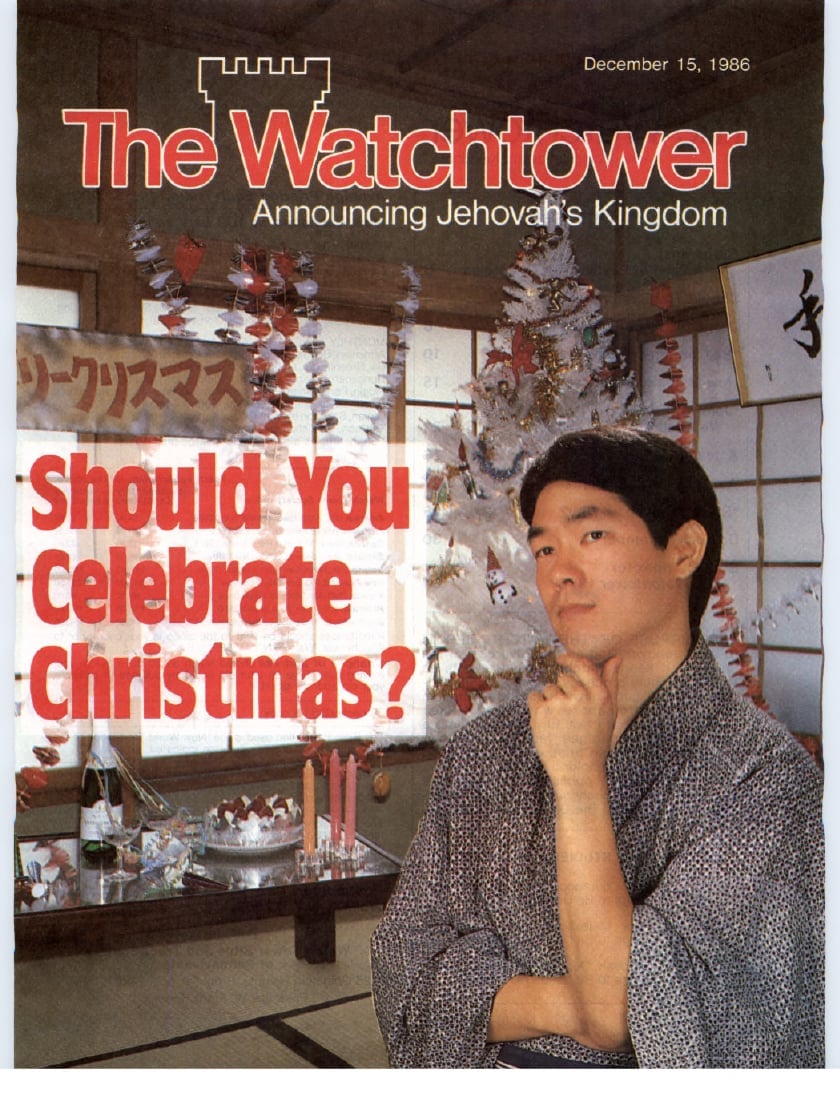
The Watchtower — December 15, 1986
Source: jw.org
Contents
Christmas—A Time of Festivity for Orientals
Should You Celebrate Christmas?
Jesus Dispels a Widow’s Grief
“Be Courageous and Very Strong”
How Majestic Is Jehovah’s Name!
“Jehovah Our God We Shall Serve”
A Jesuit Confession
Astrology in Synagogues?
“Bless Jehovah”—Why?
Do You Remember?
Subject Index for “The Watchtower” 1986
‘Something So Nice for So Little’
Christmas—A Time of Festivity for Orientals
Christmas—A Time of Festivity for Orientals
GIANT Christmas trees, bright lights, colorful banners—they are seen in every shopping center and department store. Strains of Christmas carols blare over loudspeakers, and announcements encourage people to buy more. Men and women clad in Santa Claus costumes stroll up and down the streets offering giveaways in a patronizing manner. Is this a scene in a “Christian” country? No, this is in Japan, where less than 1 percent of the population claims to be Christian.
Similarly, on the neighboring island of Taiwan, both “Christians” and non-Christians celebrate Christmas with their traditional gift giving. And in the Chinese communities in Malaysia, firecrackers add a new dimension to the festivities of the “Christian” holiday.
Why do these people celebrate Christmas? Do they believe in Christmas? Or do they believe in the festivities of Christmas? The evidence shows that “eat, drink, and be merry” is the message that they get from the Christmas celebrations. Many practice “Christianity” on December 24 and 25 but go back to their own way—Buddhism, Shintoism, Taoism, or whatever—the next day. How, though, could people of such diverse religious backgrounds possibly take part in a “Christian” holiday?
When a little boy in Japan was asked about whether he believes in Santa Claus, he answered, ‘I believe in Santa because he gave me many games.’ His answer reflects the thinking of many in the Orient: ‘Be open-minded. Do not be too rigid about religion. If you can get something out of it, enjoy it. But keep it in its place so that it does not affect other aspects of your life.’
This way of thinking is clearly seen in a survey conducted by a major Japanese newspaper. One of the questions asked was: “In Japan, it is common for the same person to participate in various religious events such as omiyamairi [a Shintoist event to celebrate the growth of children], ohigan [a semiannual Buddhist ritual to commemorate the deceased], and Christmas. Do you think this is objectionable?” Only 19 percent answered “objectionable.” Even among those who claim to be Christians, 60 percent felt there was nothing wrong in celebrating festivals of different religions.
This mentality results in a peculiar religious phenomenon—many claim to be adherents of more than one religion. According to the Agency for Cultural Affairs, the grand total of adherents of religious groups in Japan was 207,080,000 at the end of 1982, whereas the estimated population of Japan in 1982 was only 118,600,000. This means that the total membership of the religions in Japan amounted to 170 percent of the total population!
“Impossible!” people in monotheistic cultures might exclaim. But the same ambivalence in religious attitudes prevails in the Western way of celebrating Christmas too. How could this be? And if it is so, should you celebrate Christmas?
[Picture on page 3]
Total membership of religions in Japan: 207,080,000
Total Japanese population: 118,600,000
Should You Celebrate Christmas?
Should You Celebrate Christmas?
TO ILLUSTRATE the similarity and the difference between the Eastern and the Western way of celebrating Christmas, the information here presented takes the form of two letters exchanged between a Japanese writer and his friend in England. The information will help you to answer the question: Should I celebrate Christmas?
Dear David,
They are at it again. The merchants are leading the people like chief priests. Santa Claus is the master of ceremonies. Christmas trees serve as the symbol of the celebration. And offerings of Christmas cakes and toys are presented. The merchants are propagating the religion of Christmas in Japan. Their mission has been quite successful in the past three or four decades. An enormous number of Japanese are converted to this “religion”—at least for a couple of days a year!
This has intrigued me. I have often wondered why so many Japanese, who are mainly non-Christians, would be celebrating a “Christian” holiday. When did the Japanese begin to celebrate Christmas to such an extent? What is behind all of this?
Looking for the origin of the Japanese Christmas, I found this interesting story. Sōseki Natsume, a great writer of the Meiji era (1868-1912), sent a Christmas postcard from England to Shiki Masaoka, a famous poet, describing the fascinating Christmas scene in London at the end of the year 1900. Shiki even composed a haiku, the shortest form of Japanese poetry, about a small chapel on a Christmas Day. Apparently, Christmas was still a novelty at the turn of the century in Japan. So, exactly when did the Japanese celebrate their first Christmas?
You may be interested to know that some authorities claim that Christmas was celebrated in a girls’ school in Ginza as early as the eighth year of Meiji (1875). Yet “the custom of celebrating Christmas did not really begin to take hold in Japan until 1945,” observed The Christian Century. That was when the Japanese saw the families of American soldiers and missionaries celebrating Christmas. After being defeated in World War II and being left in a spiritual vacuum, the Japanese in general needed something to cheer them.
Christmas satisfied that need. As you can imagine, merchants did not waste any time in using Christmas decorations to promote their year-end sales. Christmas decorations “worked like magic in drawing customers,” says a newspaper columnist, Kimpei Shiba. “This,” he added, “was because these ornamentations were attractive and generated gaiety.”
But, David, since you live in England, you may not know that the Japanese had the custom of exchanging year-end gifts long before Christmas presents came along. December has always been a boon for retailers. People with thick wallets from their year-end bonus go out on a spending spree. “This atmosphere [of Christmas],” however, “put the people into a merry, spending mood and induced them to buy more osei-bo [year-end gifts] than they usually did, so the custom of using Christmas decorations has continued,” explains Mr. Shiba.
Today, department stores and retailers climb on the bandwagon to make the best of the “Christmas spirit” that seems to work so well. Toymakers and bakeries zero in on this atmosphere to take advantage of the season. In December, sales at Kiddy Land, the biggest toy-store chain in Japan, have been four times higher than other months. It is estimated that 5 to 10 percent of all the cakes produced in Japan each year are what could be termed “Christmas cakes.”
I found out that some people are annoyed because commercialism rules the Christmas scene in Japan. For instance, The Daily Yomiuri quotes an American who has lived a long time in Japan: “The Japanese have adopted nearly all of the Christmas gimmickry but somehow the spirit of the season is not here.” He was talking about the religious aspect of Christmas.
This prompted me to look into the religious side of Christmas. Churchgoers claim that Christmas (December 25) is Christ’s birthday. How surprised I was to find in the Encyclopedia of Japanese Religions that it cannot be established that Jesus was born on December 25! The encyclopedia says: “Though the actual date of Jesus’ birthday is not known, Christmas has been celebrated on December 25 starting around the third century . . . This date falls approximately on the day of the winter solstice, and it took over the pre-Christian festival of the rebirth of the Sun.” Rebirth of the sun? I thought it was supposed to be the birthday of Jesus. Well, how could sincere Christians celebrate a festival that originally was a pagan celebration of the winter solstice? It was not the birthday of Jesus but the festival of the rebirth of the sun. How could Western churchgoers criticize the Japanese as being unprincipled in celebrating a “Christian” holiday while they themselves have essentially the same kind of observance?
So, David, I would appreciate it if you could answer these questions for me, as they are most disturbing.
Your friend,
Ichiro
Dear Ichiro,
Thank you very much for your letter describing the Christmas celebration in your country. It is most interesting for us Westerners to learn how Eastern people celebrate a Western holiday.
If I may be quite pointed, you are perfectly justified in saying that Christmas is a pagan holiday. Almost any reference work will tell you that the festival of Christmas originated in the pagan celebration of Saturnalia, the Roman festival for their agricultural god Saturn.
Yes, just as you Japanese people have taken Christmas into your Buddhist and Shintoist cultures, the churches of Christendom have taken pagan festivals into their “Christian” tradition. In a sense it may be even more sinful because while the Japanese celebrate Christmas as a foreign festival, the churchgoers observe the pagan celebration of Saturnalia as a “Christian” Christmas.
Actually, there was a time here in England when the secular and religious celebration of Christmas was outlawed as a pagan practice. That was when the Puritans ruled England. In the Massachusetts Bay Colony in North America, the Puritans who left England because of their beliefs also banned Christmas and imposed fines for merrymaking during this season.
But I think you should know the Bible’s view of fusing Christianity with pagan religions. “Do not become unevenly yoked with unbelievers.” That is what the apostle Paul urged in 2 Corinthians 6:14-16. Then in 2Cor 6 verse 17 he went on to quote from the book of Isaiah (52:11, for your reference): “‘Therefore get out from among them, and separate yourselves,’ says Jehovah, ‘and quit touching the unclean thing.’”
How can we separate ourselves from unbelievers while still celebrating a festival originating in pagan religions? This question has moved many sincere Christians to abandon their tradition of celebrating Christmas. (It should prove to be interesting for you to open your Bible to Matthew 15:3-6 and read Jesus’ words recorded there.) Yet there are more reasons to shun such celebrations.
If December 25 is not the birthday of Jesus, celebrating that date as his birthday amounts to lying. Just as you have mentioned in your letter, how can a Christian who loves truth and is commanded to be honest promote falsehood? (Ephesians 4:25) From the date itself to the Santa Claus story, Christmas has become packed with lies. Christians, however, are told at Revelation 22:15 that “everyone liking and carrying on a lie” will end up without the divine blessing of everlasting life.
Then, why do so-called Christians in the West celebrate Christmas? One of the reasons is commercialism, just as it is in your country. I read about a Baptist minister over in the United States who lamented: “If the commercial aspect were removed entirely, most folks would feel that they had not experienced Christmas. But the religious focus could be removed entirely and a large number of people would not notice the difference.” These words apply in England as well.
Interestingly, the Bible reveals a close tie between commercialism and what it calls “Babylon the Great.” After depicting the fall of this “Babylon the Great,” the Bible (in Revelation 18:2, 11-19) says: “The traveling merchants of the earth are weeping and mourning over her, because there is no one to buy their full stock anymore . . . The traveling merchants of these things, who became rich from her, will stand at a distance because of their fear of her torment and will weep and mourn.”
Can you identify “Babylon the Great”? Well, who has given “the traveling merchants of the earth” here in England and in Japan enormous profits by spreading false teachings about Christmas? Is it not Christendom’s religions? Yes, I have learned from my studies that “Babylon the Great” stands for the worldwide empire of false religion, including Christendom.
What do you think we should do? The Bible account of “Babylon the Great” helped me to decide what I should do. Revelation 18:4 urges: “Get out of her, my people, if you do not want to share with her in her sins, and if you do not want to receive part of her plagues.”
‘Getting out of her,’ that is, leaving religion that promotes falsehood, meant decisive action on my part. It was not easy to break away from all the customs blended in with Christmas. Christmas is a social as well as a religious holiday here. I had to muster up courage to be different from others. The words I found in Proverbs 29:25 proved to be helpful: “Trembling at men is what lays a snare, but he that is trusting in Jehovah will be protected.”
I came to see these points with the help of Jehovah’s Witnesses. Thousands of people in England have taken the same step and ‘got out of Babylon the Great’ with all its false religious practices, including the Christmas celebration. But it does not mean we do not honour Jesus Christ. We honour him, not by showing a “Christmas spirit” only once a year, but by displaying the Christlike spirit all year round.
Your sincere friend,
David
(See Ephesians 4:20-24; Philippians 2:1-6; Colossians 3:1-14 for the Christlike spirit that they try to cultivate.—Editor.)
[Blurb on page 4]
The merchants are like chief priests. Santa Claus is the master of ceremonies
[Blurb on page 5]
Merchants used Christmas to promote year-end sales
[Blurb on page 5]
This prompted me to look into the religious side of Christmas
[Blurb on page 6]
“Therefore get out from among them . . . and quit touching the unclean thing”
[Blurb on page 6]
“The traveling merchants of the earth are weeping and mourning over her”
[Blurb on page 7]
“Trembling at men is what lays a snare, but he that is trusting in Jehovah will be protected”
Jesus Dispels a Widow’s Grief
Jesus’ Life and Ministry
Jesus Dispels a Widow’s Grief
SHORTLY after healing the army officer’s servant, Jesus leaves for Nain, a city over 20 miles (32 km) to the southwest of Capernaum. His disciples and a great crowd accompany him. It is probably toward evening that they approach the outskirts of Nain, where they meet a funeral procession. The dead body of a young man is being carried out of the city for burial.
The mother’s situation is especially tragic, since she is a widow and this is her only child. When her husband died, she could take comfort in the fact that she had her son. Her hopes, desires, and ambitions became wrapped up in his future. But now there is no one in whom to find consolation. Her grief is great as the townspeople accompany her to the place of burial.
When Jesus catches sight of the woman, his heart is touched by her extreme sadness. So with tenderness, and yet with a firmness that imparts confidence, he says to her: “Stop weeping.” His manner and action arrest the crowd’s attention. So when he approaches and touches the bier on which the body is being carried, the bearers stand still. All must wonder what he is going to do.
It is true that those accompanying Jesus have seen him miraculously heal many persons of diseases. But apparently they have never seen him raise anyone from the dead. Can he do such a thing? Addressing the corpse, Jesus commands: “Young man, I say to you, Get up!” And the man sits up! He starts to speak, and Jesus gives him to his mother.
When the people see that the young man truly is alive, they begin to say: “A great prophet has been raised up among us.” Others say: “God has turned his attention to his people.” Quickly the news concerning this amazing deed spreads out into all Judea and all the surrounding country.
John the Baptizer is still in prison. But his disciples report to him about all these things they see Jesus doing. What is John’s response? And what is the response of so many others in the areas in which Jesus performs his miracles? Our next issue will answer. Luke 7:11-18.
◆ What is happening as Jesus approaches Nain?
◆ How is Jesus affected by what he sees, and what does he do?
◆ How do the people respond to Jesus’ miracle?
“Be Courageous and Very Strong”
“Be Courageous and Very Strong”
“You men must not be afraid of them, for Jehovah your God is the One fighting for you.”—DEUTERONOMY 3:22.
1. (a) What was the situation in Israel at the end of the wilderness trek? (b) What exhortation did Moses then give?
THE time had come for momentous happenings in Israel’s history. God’s holy nation must now prepare to enter the Promised Land! For 40 years, Moses had led the Israelites through a great and fear-inspiring wilderness. But now, in the region of the Jordan River in the land of Moab, he addressed God’s people for the last time. At 120 years of age, “his eye had not grown dim, and his vital strength had not fled,” nor had his vocal powers failed. Joshua, who was about to succeed him, and all Israel must have thrilled to hear Moses’ powerful expositions of Jehovah’s law and his forceful exhortation to be courageous when they moved in to take possession of the land.—Deuteronomy 1:1-5, 19, 21, 29, 30; 3:22; 31:6, 7, 23; 34:7.
2. How do we know that the record of these things is for our instruction today?
2 Are those happenings of so long ago merely historical? Far from it! The apostle Paul tells us: “All the things that were written aforetime were written for our instruction, that through our endurance and through the comfort from the Scriptures we might have hope.” (Romans 15:4) That record has modern-day parallels. It can strengthen us today for spiritual warfare. It also serves as “a warning to us upon whom the ends of the systems of things have arrived,” helping us to avoid Satan’s snares.—1 Corinthians 10:11; 1 Peter 4:7.
Joshua’s Strength—From What Source?
3, 4. (a) Why do we need to cultivate fearlessness? (b) How may we do this?
3 Very soon now, God’s people will march into Jehovah’s new system of things. In view of events that are shaping up in the world, we need to cultivate fearlessness. How can we do this? As Joshua prepared to enter the Promised Land, God instructed him: “Only be courageous and very strong to take care to do according to all the law that Moses my servant commanded you. Do not turn aside from it to the right or to the left, in order that you may act wisely everywhere you go. This book of the law should not depart from your mouth, and you must in an undertone read in it day and night, in order that you may take care to do according to all that is written in it; for then you will make your way successful and then you will act wisely.”—Joshua 1:7, 8.
4 Ah, there is the secret! Read the Bible daily. It contains God’s law for us. Meditate on it. Heed its reminders. Do not let yourself be turned aside into the materialistic, immoral world around you. In whatever situation you find yourself, act with wisdom. Make practical application of the accurate knowledge and spiritual understanding that you have gained through your study of God’s Word. Speak about it to others. By doing so and by relying on Jehovah, you can indeed ‘be courageous and very strong, and make your way successful.’—Compare Psalm 1:1-3; 93:5; 119:165-168.
5. (a) Like Joshua, how can youthful ministers today gain strength? (b) What fine goal may young Witnesses have today?
5 Joshua had been “the minister of Moses from his young manhood” onward. (Numbers 11:28) No doubt this close association had helped him to gain spiritual strength. Likewise, youthful ministers today can gain strength through working along with devoted parents, pioneers, longtime Witnesses, and other loyal servants of Jehovah. Engaging in house-to-house witnessing with such zealous ones can be a joy and can help to build in our youths maturity and a desire to move forward in the ministry. (Acts 20:20, 21; Isaiah 40:28-31) What finer goal could young Witnesses have than full-time service in behalf of Jehovah’s Kingdom!—Psalm 35:18; 145:10-12.
6. How was Joshua an example to us in connection with the campaign against Amalek?
6 When Moses sent Joshua to fight the Amalekites, “Joshua did just as Moses had said to him.” He was obedient; so, he gained the victory. We, too, will share in Jehovah’s vindication if we pay close attention to the battle instructions that we receive through his organization. Jehovah told Moses to memorialize His triumph over Amalek by writing it in a book and propounding it in Joshua’s ears. No doubt Joshua further magnified Jehovah’s victory by speaking about it to others. In the same way, we today can make known the mighty acts of the Sovereign Lord Jehovah, and we can proclaim his impending “day of vengeance” upon the wicked.—Exodus 17:10, 13, 14; Isaiah 61:1, 2; Psalm 145:1-4.
7, 8. (a) What confidence did Joshua and Caleb express on returning from Canaan? (b) What warning and encouragement do we find in Jehovah’s handling of matters at that time?
7 When Moses sent 12 chieftains to spy out the Promised Land, he included Joshua in their number. On returning, ten of the spies expressed great fear of the Canaanite inhabitants of the land and persuaded the people to campaign for a return to Egypt. But Joshua and Caleb boldly declared: “If Jehovah has found delight in us, then he will certainly bring us into this land and give it to us, a land that is flowing with milk and honey. Only against Jehovah do not rebel; and you, do not you fear the people of the land, for they are bread to us. Their shelter has turned away from over them, and Jehovah is with us. Do not fear them.”—Numbers 13:1–14:38.
8 However, the assembly of Israel continued to murmur, so that Jehovah stepped in and condemned those fearful Israelites to 40 years of wandering in the wilderness. Except for Caleb and Joshua, all their men of war died without seeing the Promised Land. What a warning for us today! Let us never murmur against Jehovah’s arrangements. Even if we meet up with difficult witnessing territories, let us be courageous and strong in going to the people’s homes with the lifesaving Kingdom message. May we never be like those modern-day apostates who, rather than give a public witness, prefer to slander their brothers and to fall back into the ways of the world—antitypical Egypt.—Numbers 14:1-4, 26-30; Luke 12:45, 46; compare Acts 5:27-29, 41, 42.
Jehovah’s Name to the Fore!
9. How did Joshua live up to his new name?
9 The Bible list of 12 spies names Joshua as Hoshea, meaning “Salvation.” But at this point the record says: “Moses continued to call Hoshea the son of Nun Jehoshua [meaning, ‘Jehovah Is Salvation’].” Why did Moses thus emphasize Jehovah’s name? It was because Joshua served primarily for the vindication of that name. Joshua became a living example of obedience to the command that Moses would later emphasize to Israel: “You must love Jehovah your God with all your heart and all your soul and all your vital force.” In so doing, he was privileged to demonstrate that ‘Jehovah is salvation.’—Numbers 13:8, 16; Deuteronomy 6:5.
10. (a) What does Jehovah’s name mean to you? (b) What strength can we draw from Jehovah’s further words to Joshua?
10 Have we not also come to regard Jehovah’s name as most precious and deserving of all praise? His illustrious name means “He Causes to Become” with regard to fulfilling his promises. How heartwarming his Kingdom promises are! With zeal like that of Joshua, we should want to magnify Jehovah’s name and purposes before all who may yet embrace the hope of his clean and righteous new system of things. In these trying times, we can draw strength from Jehovah’s further words to Joshua: “Have I not commanded you? Be courageous and strong. Do not suffer shock or be terrified, for Jehovah your God is with you wherever you go.”—Joshua 1:9.a
11. (a) How was the meaning of Jesus’ name emphasized when he rode into Jerusalem? (b) How did Jesus regard Jehovah’s name, and what shows this?
11 The Greek equivalent of the name Joshua, or Jehoshua, is Jesus, also meaning “Jehovah Is Salvation.” It is through Jesus Christ that Jehovah provides salvation for mankind. In 33 C.E. when Jesus rode into Jerusalem on a colt, the crowd kept crying out: “Save, we pray! Blessed is he that comes in Jehovah’s name!” (Mark 11:9; Zechariah 9:9) Joshua was a true type of Jesus, who ‘left us a model for us to follow his steps closely.’ (1 Peter 2:21) Like Joshua, Jesus held Jehovah’s name to be precious, and he exalted that name. Twice in his final prayer with his disciples, he emphasized God’s name, saying: “I have made your name manifest to the men you gave me out of the world. . . . I have made your name known to them and will make it known, in order that the love with which you loved me may be in them and I in union with them.” (John 17:6, 26) What a privilege we have to make that name known to others!
12. What mighty acts do we await today, and why?
12 As we read the Bible record of Joshua’s loyal leadership, we can have in mind that the Greater Joshua, Jesus Christ, is leading God’s people today. “Jehovah’s day” of vindication is now at hand. How eagerly we await the fulfillment of his promise of a righteous new system that will follow that day! (2 Peter 3:10-13, 17, 18) Confidently, then, we look forward to further mighty acts of Jehovah, even mightier than those he performed through Joshua.
Jehovah’s Miracle at Jordan
13. (a) What seemingly impossible situation faced Israel on the east side of the Jordan? (b) How was Israel’s obedience rewarded?
13 It was the time of harvest in the year 1473 B.C.E., and the Jordan River was at flood stage. How could several million souls, old and young, men, women, and children, be brought through that raging torrent? Yet Jehovah had commanded Joshua: “Now get up, cross this Jordan, you and all this people.” In turn, the people told Joshua: “All that you have commanded us we shall do.” Israel broke camp. The priests marched out first, bearing the ark of the covenant, which was carefully covered and which represented Jehovah’s presence with them. Jehovah then started to ‘do wonderful things in their midst,’ for “at the instant that the carriers of the Ark came as far as the Jordan and the feet of the priests carrying the Ark were dipped in the edge of the waters . . . the waters descending from above began to stand still.” The waters below “were cut off,” to flow on to the Dead Sea, “and the people passed over.” (Joshua 1:2, 16; 3:5-16) A stupendous miracle indeed!
14. What parallel exists in this day, and what has been the result of the witness given?
14 The rampaging Jordan finds a parallel in the flood of humanity that is now plunging headlong toward destruction at Armageddon. (Compare Isaiah 57:20; Revelation 17:15.) Today, as mankind stands at the brink of that final plunge, Jehovah fortifies his people, now numbering over 3,000,000—a number comparable to that of God’s people who marched with Joshua.—Compare Habakkuk 2:3.
15. (a) What in modern times resembles the courageous action of the priests back there? (b) How is the “great crowd” represented in this picture?
15 While the millions of Israel were passing over the riverbed, “the priests carrying the ark of Jehovah’s covenant kept standing immovable on dry ground in the middle of the Jordan,” to represent the interruption of matters by Jehovah God. (Joshua 3:17) It was in 1919 that the small band of anointed Witnesses stepped courageously before the “waters” of mankind. In 1922 they boldly answered the call to ‘advertise, advertise, advertise the King and his Kingdom,’ saying in effect: “Here I am! Send me.” Jehovah assures them: “In case you should pass through the waters, I will be with you; and through the rivers, they will not flood over you.” In 1931, he honored them by bestowing upon them the name Jehovah’s Witnesses. (Isaiah 6:8; 43:2, 12) Among those who crossed over the Jordan would be the non-Levitical Israelites and the descendants of the non-Israelite “vast mixed company” that had left Egypt with Moses. In like manner, the “great crowd” today shares in crossing over to God’s new system, while the remaining ones of the spiritual priestly class stand “steadfast, unmovable,” exemplary in their faith.—Exodus 12:38; Revelation 7:9; 1 Corinthians 15:58.
Memorializing the Miracle
16. (a) How was the Jordan miracle memorialized? (b) What does this suggest as to Jehovah’s mighty acts today?
16 Jehovah proceeded to memorialize this Jordan miracle, commanding that 12 men, representing the tribes of Israel, take up 12 stones from the riverbed and deposit these on the western shore at Gilgal. Those stones would stand there as a lasting memorial to Jehovah’s name and his mighty acts. Future sons of Israel were to be told that this memorial was “in order that all the peoples of the earth may know Jehovah’s hand, that it is strong; in order that you may indeed fear Jehovah your God always.” (Joshua 4:1-8, 20-24) In modern times, marvelous acts of Jehovah in preserving his people, despite vicious attacks by political and religious leaders, stand as a memorial that he is with his people. No doubt his grand modern-day works in vindication of his name will be memorialized permanently in his new system of things.—Revelation 12:15, 16; Psalm 135:6, 13.
17. (a) What further memorial did Joshua set up? (b) Humankind has been unable to evade what similar testimony today?
17 A further memorial was in order: “There were also twelve stones that Joshua set up in the middle of the Jordan on the standing place of the feet of the priests carrying the ark of the covenant, and they continue there until this day.” As the priests came up out of the riverbed and Jehovah released the dammed-up floodwaters, these came swirling around the 12 stones of testimony. (Joshua 4:9) Henceforth, that flood could not escape the presence of those stones. Likewise today, humankind plunges ever more swiftly toward the “Dead Sea” of Armageddon. But it cannot escape the testimony that Jehovah’s Witnesses have piled up worldwide as they stand “firm in one spirit, with one soul striving side by side for the faith of the good news.” (Philippians 1:27, 28) Available records show that, during the 67 years up until this year 1986, the Witnesses have placed in the homes of the people earth wide over 570,000,000 bound books and more than 6,400,000,000 copies of the Watchtower and Awake! magazines, as well as millions of magazine subscriptions—a monumental testimony indeed!
18. (a) What qualities has the priestly class shown today? (b) How have all of God’s people been stimulated?
18 We can be happy that the witness has continued until this year 1986. Doing God’s will has been hard work, as when the 12 men each shouldered his memorial stone and carried it all the way to Gilgal. But a grand pioneer spirit has united God’s modern-day people, stimulating them constantly to “be courageous and very strong.”—Psalm 27:14; 31:24; Zephaniah 3:9.
19. In reviewing further events of Joshua’s day, what confidence may we have?
19 Other events in Joshua’s day should encourage us to move forward, confident that Jehovah will perform further miracles in behalf of his people. Our next article will review some of these.
[Footnotes]
Asher Goldenberg writes in Metre and Its Significance in the Bible (Hebrew) that in the First Temple period, proper names were commonly given a longer form, incorporating part of the Tetragrammaton, to indicate loyalty to Jehovah. He comments that “in the Pentateuch, Moses changes the name of Hoshe ben-Nun into ‘Jehoshua’ when he sends him to go spying; thus he foresaw that [Joshua] would not betray [Jehovah].”
Reflecting on Events in Joshua’s Day—
□ Why must these be viewed as more than mere history?
□ How may we cultivate courage and spiritual strength?
□ What fine pattern did Joshua leave for us?
□ In what ways did Joshua foreshadow Jesus?
□ What happenings today parallel those at the Jordan?
How Majestic Is Jehovah’s Name!
How Majestic Is Jehovah’s Name!
“O Jehovah our Lord, how majestic your name is in all the earth!”—PSALM 8:1, 9.
1. Why did Jehovah have the land ‘vomit out’ the Canaanites?
AT LAST, in 1473 B.C.E., Israel stood in the land of promise. But some years of theocratic warfare lay ahead, for they must purge the land of its depraved inhabitants. Were those Canaanites really that bad? Indeed they were! Their idolatry and immoral way of life were detestable in Jehovah’s sight and a danger to God’s people. Hence, God had Moses announce that He would use His holy nation, Israel, as His executioner. Thus, Jehovah would have the land ‛vomit out’ those unclean nations.—Leviticus 18:1-30; Deuteronomy 12:29-32.
2. What “fruits” have the world’s religious systems been bringing forth?
2 Today, also, we might ask the question, Is this world so bad as to deserve destruction? Well, what of the world’s religious systems? Sadly, these fail to honor the Creator, Jehovah God. People in Christendom have left him, “the source of living water, in order to hew out for themselves cisterns, broken cisterns, that cannot contain the water.” (Jeremiah 2:13) Their sectarian beliefs contain no “water” of truth. They have shown themselves to be part of the world by supporting its wars and politics and by countenancing its sexual mores. As Jesus said, they are to be recognized “by their fruits.”—Matthew 7:16, 17; compare Galatians 6:7, 8.
3. What has been the result of the world’s violating God’s law?
3 What of the world’s morals? In recent years, there has been global escalation of abortions, teenage pregnancies, and broken families, notably in so-called Christian lands. In some countries, as many as 50 percent of all marriages end in divorce. The “sexual revolution” of the 1960’s has had other disastrous consequences. One of these was cited in The New York Times of June 13, 1986, under the front-page headline: “TENFOLD INCREASE IN AIDS DEATH TOLL IS EXPECTED BY ’91.” The article indicated that by 1991, the number of AIDS (Acquired Immune Deficiency Syndrome) patients in the United States alone could be more than 100,000, with a yearly medical cost of up to 16 billion dollars. This fatal disease is transmitted mainly by homosexual activity, drug abuse, and blood transfusions—all of which are in violation of God’s law.—1 Corinthians 6:9, 10; Galatians 5:19-21; Acts 15:19, 20.
4. (a) How does our warfare differ from that of Israel in Joshua’s day? (b) To what extent should we associate with worldly people, and why?
4 In Joshua’s day, Jehovah sent His holy nation to cleanse the Promised Land through literal warfare. Today, our warfare is spiritual. (2 Corinthians 10:3, 4) We Witnesses do not take violent action to remove those who ignore God’s Word. Jehovah will remove them in his own due time and in his own way. (Deuteronomy 32:41, 43) We do not take unprincipled people into our intimate association, though we can show genuine love by making known to them the good news of the Kingdom. (1 Corinthians 15:33) We can study God’s Word with them and encourage them to ‘repent, and turn around, so as to get their sins blotted out.’—Acts 3:19; Matthew 21:31, 32; Luke 5:27-32.
Rahab and Her Household
5, 6. (a) Why did the spies go to Jericho and to Rahab’s house? (b) Today, how has Jehovah often answered cries for help? (c) How did Rahab show herself to be “a friend of peace”?
5 Even before Israel crossed the Jordan River, Jehovah directed attention to the city of Jericho. Joshua dispatched two spies, representing all Israel, and told them: “Go, take a look at the land and Jericho.” Why spy on Jericho? Though the city was small and was no match for the army of Israel, it commanded the approaches to Canaan. As things worked out, the presence there of the spies afforded some opportunity for those in Jericho to identify themselves clearly as being for or against Jehovah. “So [the spies] went and came to the house of a prostitute woman whose name was Rahab, and they took up lodging there.” (Joshua 2:1-7) No doubt divine guidance led those spies to Rahab’s house, just as angelic guidance today often leads Jehovah’s Witnesses to persons praying for spiritual help! “The eyes of Jehovah are toward the righteous ones, and his ears are toward their cry for help.”—Psalm 34:15; see also 2 Chronicles 16:9.
6 Why would those spies enter the house of a prostitute? Not for immoral purposes but likely to mislead Canaanite observers. Rahab’s words to the spies indicated that she had no immoral interest in them. Knowing that they were servants of Jehovah, she could tell them of her keen desire to become a worshiper of Jehovah. She even risked her life by hiding them on her roof. She was like the “sheep” of Jesus’ parable, who show kindness to the Lord’s “brothers.” (Matthew 25:31-46) While acting discreetly, Jehovah’s Witnesses today do not hesitate to visit and study the Bible with such interested ‘friends of peace.’—Luke 10:5-7.
7. (a) How did Rahab express her faith in Jehovah? (b) What attitude should new ones show today, and how should they act?
7 Rahab had learned of the mighty acts of Jehovah. To the concealed spies she could express faith, saying: “I do know that Jehovah will certainly give you the land, and that the fright of you has fallen upon us, and that all the inhabitants of the land have become disheartened because of you.” After telling of the report she had heard about Jehovah’s mighty acts, Rahab continued: “Jehovah your God is God in the heavens above and on the earth beneath. And now, please, swear to me by Jehovah that, because I have exercised loving-kindness toward you, you also will certainly exercise loving-kindness toward the household of my father, and you must give me a trustworthy sign.” (Joshua 2:9-13) Like Rahab, new ones learning God’s truth today need no longer feel afraid because of the judgment due to be executed in “the day of Jehovah.” (Zephaniah 1:14-18) Rather, they turn from worldly ways and seek the help of Jehovah’s Witnesses toward gaining salvation.—Psalm 3:6-8; Proverbs 18:10.
8. (a) What today corresponds to Rahab’s displaying a “cord of scarlet thread” in her window? (b) Why was Rahab declared righteous, and with what result?
8 The sign that the spies gave Rahab was in the form of a “cord of scarlet thread” that she was to tie in the window by which the spies made their escape. (Joshua 2:17-21) Because of Rahab’s displaying this sign, her house would be spared when Jericho was destroyed. Similarly today, those who display faith like Rahab’s are identified for deliverance as dedicated, baptized worshipers of Jehovah. Revelation 7:9, 10, 14 describes them as “a great crowd” who have “washed their robes and made them white in the blood of the Lamb.” They exercise faith in Jesus’ sacrificial blood and back this up with Christian works. (Romans 10:9, 10) We read at James 2:24, 25: “You see that a man is to be declared righteous by works, and not by faith alone. In the same manner was not also Rahab the harlot declared righteous by works, after she had received the messengers hospitably and sent them out by another way?”
9. (a) Of what did Rahab’s “works” consist? (b) What has resulted from fearless witnessing today?
9 Rahab’s “works” included protecting the two spies and gathering others to her house for salvation. In the same way, the “great crowd” of modern times busy themselves in loyal support of the anointed “faithful and discreet slave” as this group provides spiritual “food at the proper time” and supervises the global Kingdom-preaching activity. (Matthew 24:45-47) For her part, Rahab was fearless in witnessing to her father’s household—an activity that was fraught with danger, for she could have been betrayed. (Compare Matthew 10:32-36.) Similarly, in many lands where there is opposition today, Jehovah’s Witnesses must be fearless in giving the witness. This has resulted in a grand ingathering, and often entire families have come out of Babylon the Great to take their stand for the pure worship of Jehovah.—Psalm 73:28; 107:21, 22.
Jericho—Then and Now
10. What special attention was to be given to Jericho?
10 Let us look at these dramatic events from a different angle. “Jericho was tightly shut up because of the sons of Israel, no one going out and no one entering.” This was the first Canaanite city to come under Jehovah’s sword of execution. For that reason, as firstfruits devoted to God, it was to receive special attention. Joshua explained: “The city must become a thing devoted to destruction; it with everything that is in it belongs to Jehovah.”—Joshua 6:1, 17; compare Exodus 22:29; Leviticus 27:26.
11. (a) What striking parallel do we note today? (b) Cite an example of the “fright” of Babylon the Great.
11 How well this corresponds to Babylon the Great, the world empire of false religion that has reached the zenith of its iniquity in this bloodstained 20th century! It has tried to shut its gates against intrusion by Jehovah’s Witnesses. In Rahab’s words, “the fright” of God’s people has fallen upon it. For example, the Italian newspaper La Repubblica of November 12, 1985, carried the headline “CRY OF ALARM FROM THE CHURCH AGAINST JEHOVAH’S WITNESSES.” The article reported on a meeting, shared in by a Roman Catholic cardinal, that was convened in Bologna to counteract the “menace” of Jehovah’s Witnesses. The pope sent a telegram of encouragement and support. The cry was sounded forth: “Already they are swarming all over the world,” and it was declared that “now the church will mobilize itself” to meet this “danger.” But will it prevail?—Jeremiah 1:17-19.
12. (a) How does Babylon the Great’s idea of “god” contrast with the truth? (b) Why will Jehovah fight for his witnesses?
12 Babylon the Great embraces a confusing multitude of gods, ranging from Christendom’s mystic Trinity to the millions of gods of Eastern religions. Before commissioning Joshua, Moses had declared: “Listen, O Israel: Jehovah our God is one Jehovah.” Today, Jehovah’s Witnesses stand alone in exalting this “one God and Father.” (Deuteronomy 6:4; Ephesians 4:6) Jehovah will fight for us as he did in the days of Joshua and other loyal leaders in Israel.—2 Chronicles 20:15, 17; 32:7, 8; Isaiah 54:17.
Execution of Judgment
13. (a) What happenings led up to the siege of Jericho? (b) What parallels do we note today?
13 Joshua made thorough preparation for Jericho’s siege. The men who had grown up in the wilderness were circumcised. This symbolized their putting away everything that might hinder wholehearted devotion to Jehovah. (Deuteronomy 10:16; 30:5, 6) Observance of the Passover was resumed. The people began to be nourished by the produce of the land as the miraculously provided manna ceased. Moreover, the “prince of the army of Jehovah,” no doubt the prehuman Logos, appeared to Joshua, reassuring him. And Joshua humbly acknowledged that One’s presence. In all of this, we can note parallels in the experience of the modern-day witnesses of Jehovah as they have devoted themselves to the work at hand. Our spiritual food has become more varied and richer in content as “the faithful and discreet slave” has moved progressively forward under the leadership of the Lord Jesus Christ.—Joshua 5:1-15.
14. What strange tactics does Jehovah order for the siege of Jericho?
14 Look now at the scene of battle. Jehovah has called for strange tactics indeed! Once each day for six days, priests of Israel march around Jericho, carrying the Ark, which represents the presence of Jehovah. They are preceded by seven priests blowing on rams’ horns, with soldiers of Israel marching ahead of and behind them. But on the seventh day they get up ‘early, as soon as the dawn ascends,’ and march around the city seven times. How those Jerichoites must shudder!—Joshua 6:2-15.
15. What parallel is seen in the activity of Jehovah’s Witnesses today?
15 We find a remarkable parallel to this in what Jehovah’s Witnesses are doing today earth wide. Recently, there has been a notable expansion of our Kingdom activity. In the five years up to 1985, pioneer ranks increased 134 percent. The army of pioneers and other faithful Kingdom publishers get up “early,” often in a literal sense, and share zealously in proclaiming Jehovah’s judgments. To the leaders of Christendom’s religions, these Witnesses appear to be “a people numerous and mighty.” The clergy are in “severe pains” as they note how the proclamation of the truth is causing many honest ones to leave them and take their stand for Jehovah.—Joel 2:1-3, 6.
16. (a) What miracles mark the fall of Jericho? (b) How is Rahab’s faith rewarded?
16 At last Joshua commands the people: “Shout; for Jehovah has given you the city.” A great war cry thunders forth. The earth shakes and—miracle of miracles—Jericho’s walls fall down flat. The Israelites obediently rush forward to destroy every living thing in the city. They burn it with fire. But look! One small section of the outer wall is still standing, and in its window is a scarlet cord. Rahab and her father’s family are led out unharmed. In time, Rahab’s faith is further rewarded in that she becomes wife to the Israelite Salmon and an ancestress of Jesus Christ.—Joshua 6:16-26; Matthew 1:5.
17. What do these miracles foreshadow?
17 “So Jehovah proved to be with Joshua, and his fame came to be in all the earth.” In like manner, Jehovah’s majestic name will be vindicated when Babylon the Great is devastated and stripped of her wealth and glory at the onset of the “great tribulation.”—Joshua 6:27; Revelation 17:16; 18:9, 10, 15-17; Matthew 24:21, 22.
An Apostate Fails
18. (a) Why did ‘the heart of the people begin to melt’? (b) How did Joshua react to that crisis?
18 Shortly after the resounding victory at Jericho, an amazing thing happened. The attack force that Joshua sent to strike down the neighboring city of Ai was routed! “Consequently the heart of the people began to melt and became as water.” The distraught Joshua cried out in prayer: “Alas, Sovereign Lord Jehovah, . . . what will you do for your great name?”—Joshua 7:2-9.
19, 20. (a) How did Jehovah dispose of Achan’s folly, and with what assurance to Joshua? (b) What modern-day parallel may be noted?
19 Jehovah then revealed to Joshua that “a disgraceful folly” had been committed in Israel. Achan of the tribe of Judah was identified as the offender. From the spoil of Jericho he had stolen a “good-looking” Babylonian garment, as well as gold and silver. Jehovah ‘brought ostracism’ on Achan, and he and his family were pelted with stones. Then they and their possessions were burned with fire. As a lasting testimony to that execution of Jehovah’s judgment, a big pile of stones was raised up over Achan himself, and the location was called “Low Plain of Achor,” which name means “Ostracism; Trouble.” Again, Jehovah said to Joshua: “Do not be afraid or be terrified.” Jehovah’s name was exalted in that Joshua never again failed in battle.—Joshua 7:10–8:1.
20 Is there a modern-day parallel to Achan’s sin? Yes, there is. The apostle Paul warned of “oppressive wolves” who would ignore theocratic order and pursue their own selfish way. Since 1919, from time to time such greedy ones have appeared among God’s people. For a recent example, during the mid-1970’s some prominent elders became disgruntled. It was below their “dignity” to witness from house to house, proclaiming the Kingdom message after the pattern of Jesus’ apostles. (Acts 5:42; 20:20, 21, 29, 30) It looked good to them to go back to Babylonish teachings. Slyly they tried to raise doubts about “the last days” and to slow down the work of Jehovah’s Witnesses. (2 Peter 3:3, 4) Finally, they had to be disfellowshipped.—2 John 10, 11; compare Philippians 1:15-17; Hebrews 6:4-8.
21. (a) What appears to have been one reason for a slowdown in the late 1970’s? (b) What may have helped in ‘speeding up’ the work since that time?
21 The Watchtower of July 15, 1979, came out forthrightly in showing the Scriptural basis for our house-to-house ministry and the importance thereof. Loyal Witnesses moved forward vigorously into the 1980’s! Likely the presence of a small number of apostates had contributed to the slowing down of Jehovah’s work during the last half of the 1970’s—when the average yearly increase in the active ranks of Jehovah’s Witnesses fell to less than 1 percent. However, the annual increase in the last five years has averaged more than 6 percent. Kingdom publishers reached a worldwide peak of 3,024,131 in 1985, compared with 2,179,256 in 1975. Jehovah continues to ‛speed up’ his work!—Isaiah 54:2, 3; 60:22.
22. As we look further into the book of Joshua, what must we appreciate about Jehovah’s name?
22 Truly, Jehovah’s name has become majestic in all the earth! But he ‘tells’ us much more through the book of Joshua, as we shall now see.—Isaiah 42:8, 9.
In the Book of Joshua—
□ What pattern do we find of the world today?
□ What do we learn from the account about Rahab?
□ What do we find that parallels our stepped-up activity?
□ What is foreshadowed by the fall of Jericho?
□ What is indicated by the handling of Achan’s sin?
“Jehovah Our God We Shall Serve”
“Jehovah Our God We Shall Serve”
“As for me and my household, we shall serve Jehovah.”—JOSHUA 24:15.
1. How does the book of Joshua serve for our encouragement and protection?
THE stirring events of the book of Joshua are recorded “for our instruction” and as “examples” to encourage and protect us “upon whom the ends of the systems of things have arrived.” (Romans 15:4; 1 Corinthians 10:11) Godly qualities, such as endurance, faith, and obedience, are highlighted. “By faith the walls of Jericho fell down after they had been encircled for seven days. By faith Rahab the harlot did not perish with those who acted disobediently, because she received the spies in a peaceable way.” (Hebrews 11:30, 31) The faith of Joshua, Rahab, and other loyal ones back there should stimulate us to be courageous and strong, in order to finish God’s work today.—Joshua 10:25; John 4:34.
2. (a) How did Joshua show obedience even to the last detail? (b) What took place at the mountains of Ebal and Gerizim?
2 After the decisive victory at Ai, Joshua gave attention to the detailed instructions recorded at Deuteronomy 27:1–28:68. At Mount Ebal he erected an altar of whole stones, and there he carried out the command: “You must sacrifice communion sacrifices and eat them there, and you must rejoice before Jehovah your God.” Other stones were erected as a memorial, whitewashed, and the words of the Law were written upon them. Then the tribes were divided, one group standing on Mount Gerizim “to bless the people” and the other “for the malediction on Mount Ebal.” With raised voices the Levites pronounced the curses for disobedience, and all the people responded, “Amen!” Then the blessings for obedience were pronounced. But woe betide Israel if they failed to ‘carry out all the words of the law and to fear the glorious and awe-inspiring name of Jehovah God’!—Joshua 8:32-35.
3, 4. (a) What powerful lesson does Israel’s course provide for us today? (b) Why should we never tire of hearing the same things over and over again? (c) What is required in order to enter “the narrow gate”?
3 Did Israel keep on obeying ‘the words of the law’? Despite the oft repeated exhortations of Moses, and later of Joshua, they failed miserably. What a powerful lesson this provides for us today! Despite continual warnings, there are always some who think that they can flout God’s requirements, ‘go it on their own,’ and yet survive. What folly! In referring back to the experiences of Israel, Paul stated: “Let him that thinks he is standing beware that he does not fall.”—1 Corinthians 10:12; Ecclesiastes 2:13.
4 Some of God’s people have criticized warnings that have been given, saying that they get tired of hearing the same things over and over again. But these ones are often the first to fall into a trap of Satan. The inspired Bible book of Deuteronomy (in Hebrew Mish·neh’ hat·to·rahʹ meaning, “Repetition of the Law”) consists mainly of four discourses by Moses; these made it clear to Israel that they must obey Jehovah’s previously stated laws. Moses used over four times as many words in warning of disobedience and the resulting “curses” as he used in relating the “blessings.” At Mount Ebal, Joshua again put Israel on notice that they must obey. Does this not indicate to us how important it is to strive to “go in through the narrow gate”?—Matthew 7:13, 14, 24-27; 24:21, 22.
5. What confederation now faced Israel, and what corresponding situation do we see today?
5 A decisive showdown was now shaping up. The gateway city of Jericho had been disposed of, much as false religion will be devastated when the “great tribulation” starts. Ai had fallen. But now “all the kings who were on the side of the Jordan in the mountainous region and in the Shephelah and along the whole coast of the Great Sea and in front of Lebanon, the Hittites and the Amorites, the Canaanites, the Perizzites, the Hivites and the Jebusites . . . began to assemble themselves all together to make war against Joshua and Israel unanimously.” (Joshua 9:1, 2) In modern-day parallel to this, we find the nations of earth now banded together as a so-called United Nations. They are seeking peace and security for themselves on their own terms but “have massed together as one against Jehovah and against his anointed one,” the Greater Joshua. (Psalm 2:1, 2) What will be the outcome?
Acting With Shrewdness
6, 7. (a) In what did the Gibeonites show interest, and what strategy did they adopt? (b) How did Joshua adjudge the matter?
6 Like Rahab before them, other non-Israelites now began to show an interest in survival. These were the inhabitants of Gibeon, a great city to the north of Jebus, or Jerusalem. They had heard of Jehovah’s mighty acts and determined that they would seek peace and security on Jehovah’s terms. But how? They sent to Israel’s camp at Gilgal men carrying dry and crumby provisions and worn-out sacks and skin-bottles, and wearing patched garments and sandals. Approaching Joshua, these men said: “It is from a very distant land that your servants have come in regard to the name of Jehovah your God, because we have heard of his fame.” Hearing this, “Joshua went making peace with them and concluding a covenant with them to let them live.”—Joshua 9:3-15.
7 However, Israel soon learned that the Gibeonites were in fact ‘dwelling in their very midst’! How did Joshua now regard their ruse? He honored the oath previously made to them, ‘to let them live, and become gatherers of wood and drawers of water for all the assembly.’—Joshua 9:16-27; compare Deuteronomy 20:10, 11.
8. In what ways do the Gibeonites foreshadow the “great crowd”?
8 Many of the Nethinim, who in later years served at Jehovah’s temple, were likely of Gibeonite extraction. Thus the Gibeonites may well foreshadow the “great crowd” that are now rendering God “sacred service day and night in his temple.” (Revelation 7:9, 15) Though living in a Canaanlike world, these at heart are “no part of the world.” Formerly, they had to put up with “crumby” spiritual provisions, such as are found in Christendom’s churches, and they had no “wine” of joy. Coming in contact with God’s people, they have recognized that Jehovah is performing mighty acts through his witnesses. They have made the long trek from Satan’s world in order to exchange tattered ‘garments’ for a new identification as humble servants of Jehovah, clothed with the new personality.—John 14:6; 17:11, 14, 16; Ephesians 4:22-24.
Organizational Support
9. (a) What crisis next arose? (b) How did Joshua respond, and with what assurance?
9 When Adoni-zedek, king of Jerusalem, got to hear that the Gibeonites had made peace with Israel, “he became very much afraid, because Gibeon was a great city, like one of the royal cities, . . . and all its men were mighty ones.” He joined forces with four other kings, and they laid siege to Gibeon. Immediately, the Gibeonites appealed to Joshua: “Come up to us quickly and do save us and help us.” At once, Joshua responded, and Jehovah reassured him, saying: “Do not be afraid of them, for into your hand I have given them. Not a man of them will stand against you.” Joshua and his valiant mighty men marched up “all night long” so as to take the enemy completely by surprise.—Joshua 10:1-9.
10. (a) What kind of action today parallels the siege of Gibeon? (b) What determination do modern-day Gibeonites express?
10 Like those five kings, some heads of government today become angry at seeing so many of their people—even “mighty ones”—taking their stand for the Greater Joshua and his global Kingdom of righteousness. These rulers believe that nationalistic boundaries should be retained, even though nations are constantly quarreling and fighting one another. Hence they try to cut off supplies of spiritual food from the peace-loving “great crowd,” to ban meetings where they partake of this “food,” and to stop them from speaking to others about spiritual matters. But these modern Gibeonites stand loyally with spiritual Israel, saying: “We will go with you people.”—Zechariah 8:23; compare Acts 4:19, 20; 5:29.
11. How do Jehovah’s Witnesses handle crises today?
11 When the “great crowd” appeal to their “mother” organization for help, this is given instantly and in good measure. The alacrity with which Jehovah’s Witnesses get things done is seen also in many other ways—as in setting up relief measures immediately after natural disasters and in quickly building needed Kingdom Halls and other places of assembly for dispensing “food.” When a convention was scheduled this past June at Yankee Stadium, New York, an army of volunteer cleaners moved in at midnight after a baseball game; that stadium never looked more spick-and-span than it did during the four days that followed. Responsible elders of Jehovah’s Witnesses move quickly, also, to handle crises that arise over preaching the good news.—Philippians 1:6, 7.
Jehovah Fights for Israel
12. What miracles does Jehovah perform in fighting for Israel in defense of the Gibeonites? (Compare Habakkuk 3:1, 2, 11, 12.)
12 But look, now, at Gibeon. Jehovah is throwing those enemy forces into confusion. Israel is pursuing them with a mighty slaughter. And what do we see hurled down from the heavens? Great chunks of ice! More are being killed by these huge hailstones than by the warriors of Israel. Now, listen. Joshua is speaking to Jehovah, and what does he say “before the eyes of Israel”? This: “Sun, be motionless over Gibeon, and, moon, over the low plain of Aijalon.” Another awesome miracle! “For about a whole day,” the sun illuminates that battlefield, until God’s vengeance is completely executed. It is not for us to debate how Jehovah performed that miracle, any more than we question how he ‘made’ two great luminaries to shine through on his fourth creative “day.” (Genesis 1:16-19; Psalm 135:5, 6) The record is conclusive: “No day has proved to be like that one, either before it or after it, in that Jehovah listened to the voice of a man, for Jehovah himself was fighting for Israel.”—Joshua 10:10-14.
13. How does Joshua further encourage his commanders, and with what final result?
13 Mop-up operations are climaxed by the slaying of the five kings, at which time Joshua says to his commanders: “Do not be afraid or be terrified. Be courageous and strong, for it is like this that Jehovah will do to all your enemies against whom you are warring.” This has already proved to be true with regard to seven kings of Canaan, and it continues to be true as another complete number of 24 kingdoms are overthrown. Then only, after six years of warfare, does the land have rest.—Joshua 10:16-25; 12:7-24.
14. With what attitude and confidence should we face Armageddon?
…