The Watchtower, February 15, 1986
Download: PDF — The Watchtower, February 15, 1986
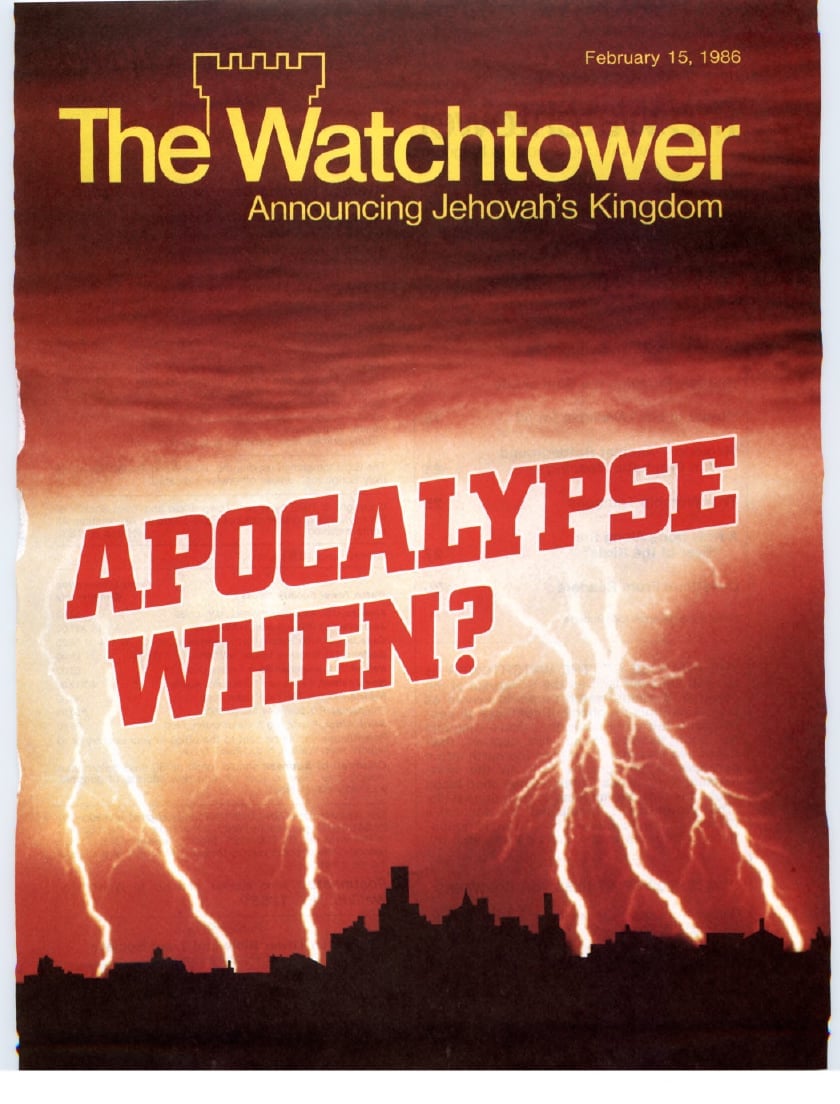
The Watchtower — February 15, 1986
Source: jw.org
Contents
Apocalypse—What Is It?
Apocalypse—When?
The Pope and the Apocalypse
In His Hometown Synagogue
Unitedly Pursuing the Goal of Life
“Bread of Life” Available for All
Megiddo—Ancient Battleground With Prophetic Meaning
True Worship Triumphs
A New Song Along the “River of the Birds”
Questions From Readers
Now You Have Help!
Apocalypse—What Is It?
Apocalypse—What Is It?
“THE Apocalypse!” What comes to your mind when you hear that expression? Is it doomsday? Holocaust? World War III? The end of the world? If these mental pictures appear, you are not alone in that respect. Science and the news media paint man’s future as gloomy. So is it any wonder that many link the apocalypse with human extinction by some catastrophic event?
“Apocalypse is today not merely a biblical depiction but it has become a very real possibility,” warned UN Secretary-General Javier Pérez de Cuéllar in his inaugural speech. “Never before in human experience have we been placed on the narrow edge between catastrophe and survival.” What was he referring to? It was to nuclear confrontation arising from an intensification of the present arms race. Reinforcing his warning to the United Nations, he stated that “some 500,000 scientists all over the world are devoting their knowledge to the search for weaponry more sophisticated and more deadly.”
Others, too, are aware of today’s situation. Hans Jonas, emeritus professor of philosophy at the New School for Social Research, says that his main fear is an “apocalypse threatening from the nature of the unintended dynamics of technical civilization.” He links the apocalypse with ‘exhaustion, pollution, desolation of the planet, as well as the threat of sudden destruction by the atom bomb.’
Similarly, historian Golo Mann stated: “We cannot have another world war. War is the wrong word. We should ban the term ‘World War III’ and say instead apocalypse or holocaust.”—Hamburg’s Die Zeit, August 30, 1985.
Yes, man recognizes that he is on the brink of self-destruction. But will he trigger the apocalypse? Not according to the Bible, which states that “Jehovah God, the Almighty”—not man—will “bring to ruin those ruining the earth.” (Revelation 11:17, 18) Therefore, understanding what the apocalypse is from the Bible’s viewpoint may give you a different outlook, an entirely new and brighter one.
What It Really Is
The apocalypse is described in a letter to the Thessalonians. There the apostle Paul states: “It is righteous on God’s part to repay tribulation to those who make tribulation . . . but, to you who suffer tribulation, relief along with us at the revelation [or, apocalypse] of the Lord Jesus from heaven with his powerful angels in a flaming fire, as he brings vengeance upon those who do not know God and those who do not obey the good news about our Lord Jesus. These very ones will undergo the judicial punishment of everlasting destruction.”—2 Thessalonians 1:6-10.
The apocalypse, therefore, is the revelation of Jesus during a period of “great tribulation.” (Matthew 24:21) According to W. E. Vine’s An Expository Dictionary of New Testament Words, the Greek word a·po·kaʹly·psis refers to “the Lord Jesus Christ when He comes to dispense the judgments of God.” Elsewhere, the Bible refers to this revelation, or apocalypse, as “the war of the great day of God the Almighty” at Armageddon.—Revelation 16:14, 16; 19:11-21.a
True, regarding the apocalypse, we have seen that the Bible speaks of “tribulation,” “vengeance,” and “punishment.” Nevertheless, it also speaks of “relief” for those innocent ones who have suffered tribulation. God’s Word promises us that “just a little while longer, and the wicked one will be no more.” (Psalm 37:10) So the apocalypse will relieve mankind of all wicked influences. It will be a turning point to better conditions for the honest-hearted—not an event for them to fear.
Thus, rather than complete annihilation of all, or extinction, the apocalypse will be the righteous solution to mankind’s problems. Does not the idea of living in a new era—an era of righteousness, peace, and comfort—appeal to you and your family?
But are we approaching the Biblical apocalypse? If so, do we have a way of knowing its exact time?
[Footnotes]
See also the article on Megiddo, on pages 21-4 of this magazine.
Apocalypse—When?
Apocalypse—When?
IT IS almost like reading the latest newspaper—wars, earthquakes, pestilences, disease, famine, crime, and fear! All these developments and more are prophesied in the Bible. They pinpoint the times in which all of us live as “the last days.” This means the era leading up to the imminent and promised apocalypse. How can you be sure of this?
You are witnessing fulfillment of Bible prophecies today. “You must face the fact,” says the Bible, “the final age of this world is to be a time of troubles. Men will love nothing but money and self; they will be arrogant, boastful, and abusive; with no respect for parents, no gratitude, no piety, no natural affection; they will be . . . strangers to all goodness, . . . swollen with self-importance. They will be men who put pleasure in the place of God, men who preserve the outward form of religion, but are a standing denial of its reality.” (2 Timothy 3:1-5, The New English Bible) Do you not see these very conditions on every hand?
Many alive today, perhaps even you, recall times when conditions were not as bad as they are now. People were more considerate of one another. Children were more respectful toward their parents and older ones. Men, women, and children were not afraid to walk down the street, even at night. But times are changing rapidly. Even if some of these conditions do not seem to be prevalent in your area, certainly the possibility of a nuclear war—due to man’s arrogant quest for power—affects all of us.
Yes, just as God through his Word, the Bible, has so clearly prophesied “the final age of this world,” so, too, he has provided us with information regarding the time of the apocalypse, when Jesus comes to execute judgment.
Closer Than Many Think
“Fresh things I now foretell,” God says. “Before they appear I tell you of them.” (Isaiah 42:9, The Jerusalem Bible) Yes, he has outlined for us in the Bible the main events that will take place just before the apocalypse.
For example, Jesus spoke of a message to be sounded worldwide and tied it in with the apocalypse. He said: “This good news of the kingdom will be preached in all the inhabited earth for a witness to all the nations; and then the end will come.” (Matthew 24:14) That “end” includes the apocalypse. Today, Jehovah’s Witnesses spend hundreds of millions of hours a year diligently proclaiming that Kingdom message from door to door and by any other possible means, in more than 200 lands around the globe!
Drawing a striking parallel for the benefit of his followers, Jesus compared the time leading up to the apocalypse to the time before the Flood of Noah’s day. In Noah’s time people were so absorbed in eating and drinking and having a good time that “they took no note” of Noah’s message concerning the imminent destruction. They were indifferent to his warnings.—Matthew 24:37-39.
How closely our day parallels the circumstances before the Flood! People are so preoccupied with their daily routines that they do not heed warnings and evidence of the approaching apocalypse.
Still, the apocalypse is closer than many think. Regarding the sign of the last days, Jesus declared that “this generation will by no means pass away until all these things occur.” (Matthew 24:34) Of which generation was Jesus speaking?
The 1914 Generation
Referring to “the relatively peaceful and prosperous Victorian age of Great Britain,” former Prime Minister Harold Macmillan said that he considered ‘the world he was born in’ to be one that would get “better and better.” But “suddenly, unexpectedly, one morning in 1914 the whole thing came to an end.” Calling it the end of “100 years of peace and progress,” Macmillan recalled how World War I signaled “the end of an era” and the “start of the confusion that is still happening.” Many others, particularly those who lived through 1914 and are still alive, know this to be true.
Yes, as this magazine has drawn to the attention of its readers over the years, the evidence points to the 1914 generation as the generation spoken of by Jesus.a Thus, “this generation will by no means pass away until all these things [including the apocalypse] occur.”
Even though more than 70 years have gone by since 1914, there are still individuals around who lived through that era. According to The American Legion Magazine for December 1984, in the United States some 272,000 World War I veterans are still alive, and it is similar in other lands. Nevertheless, the number is diminishing quite rapidly. So how long will it be until the last World War I veteran marches into history?
While this statistic may draw our attention to the final hours of the 1914 generation, how specific can we be regarding the exact time of the apocalypse?
“A Thief in the Night”
The Bible forewarns: “As for the times and the seasons, . . . you yourselves know quite well that Jehovah’s day is coming exactly as a thief in the night.” (1 Thessalonians 5:1, 2) Would you reasonably expect a thief to send a telegram announcing when he is planning to burglarize your home?
Appropriately, then, Jesus counsels us regarding the exact hour: “Keep looking, keep awake, for you do not know when the appointed time is.” (Mark 13:32-37) Even so, we have noted that Jesus described various happenings that pinpoint the 1914 generation. And the Bible describes future events that will signal the imminent apocalypse. What may we expect?
A Change of Events
The apostle Paul said: “Whenever it is that they are saying: ‘Peace and security!’ then sudden destruction is to be instantly upon them just as the pang of distress upon a pregnant woman; and they will by no means escape.” (1 Thessalonians 5:3) So as we progress toward the finale of these “last days,” we can expect some outstanding attention to be given to “Peace and security!” in fulfillment of Paul’s words. Then what?
Bible prophecies indicate that world religion, described as “Babylon the Great,” will suddenly be attacked by earthly political powers and will come to an abrupt end! (Revelation 17:5, 16; 18:10, 17) This will mark the beginning of a “great tribulation such as has not occurred since the world’s beginning until now.” (Matthew 24:21) But how will this affect those who have ‘kept awake’ and on the watch for the apocalypse?
True Christians can be confident that Jehovah will deliver them. (2 Peter 2:9) Yes, as long as they know Jehovah God and unselfishly serve him, they will have no cause for fear when God and Christ come forth to fight the war of Armageddon.—Revelation 11:17, 18; 16:14, 16.
Next, the apocalypse will lead to the isolation of Satan the Devil and his invisible forces from mankind. (Revelation 20:2, 3) Yes, the wrath that is coming will go beyond ridding the earth of people unwilling to serve God. Even wicked spirits who today influence the world around us will be eliminated. (2 Thessalonians 1:6-9) This will mean everlasting blessing for the survivors of the apocalypse.
Apocalypse—Prelude to Paradise
Regarding earth’s inhabitants, the book of Revelation (The Apocalypse, Douay) tells us that God “will wipe every tear from their eyes. There will be no more death or mourning or crying or pain, for the old order of things [will have] passed away.” (Revelation 21:4, New International Version) Instead of a gloomy aftermath of the apocalypse, the Bible reveals that man will be capable of living forever in a paradise on earth.—Psalm 37:9-11, 29.
Paradise? Everlasting life on earth? Just imagine, perfectly healthy, happy people from all races enjoying life to the full! ‘How could this be the result of an apocalypse?’ you may ask. God has given his word. It will be as in the case of God’s dealings with Israel, that “not a promise failed out of all the good promise that Jehovah had made . . . ; it all came true.”—Joshua 21:45.
So, concerning the exact day and hour of the apocalypse nobody knows, but the evidence shows that we are living in the era of the apocalypse. When it strikes, may we be found awake and “on the watch.” For “the world is passing away and so is its desire, but he that does the will of God remains forever.”—Mark 13:33, 37; 1 John 2:17; Matthew 24:36.
[Footnotes]
For further details about 1914, see the book “Let Your Kingdom Come,” published by the Watchtower Bible and Tract Society of New York, Inc., chapter 14.
The Pope and the Apocalypse
The Pope and the Apocalypse
AVERTING ARMAGEDDON is the title that two reporters gave to their 1984 book on recent papal politics. Gordon Thomas and Max Morgan-Witts have been reporting on the papacy for over 17 years. What insight can we gain from them as to concern in the top levels of the Catholic Church about the apocalypse?
According to these reporters, Monsignor Emery Kabongo, personal secretary to John Paul II, stated: “The Pope is like a spiritual Hercules trying to keep the superpowers apart, trying to avert nuclear Armageddon.”
It appears that church leaders are especially concerned about a global destruction through human deeds rather than about God’s selective intervention in human affairs—the apocalypse that the Bible foretells. Thus, Averting Armageddon says: “Among those engaged with Kabongo, there is no outward sign of strain in trying to stave off the apocalypse they detect. . . . But behind this routine there is a tension which is a direct carryover from the international Synod of Bishops. It had concluded deliberations on a doom-laden note, deploring ‘warlike aggressiveness, violence and terrorism, the building up of arsenals of both conventional and especially nuclear arms, and the scandalous trade in all weapons of war.’” Even the pope is involved. Thomas and Morgan-Witts report that on the bookshelves in his study are works such as International Defense Review, The Problems of Military Readiness, and Surprise Attack: Lessons for Defense Planning. They add:
“Close to the encyclicals are books dealing with a subject that now rivets the Pope: eschatology, the study of Biblical teachings which argue that God will inaugurate His Kingdom on earth through a series of ‘happenings’ to close an age. John Paul believes with a fervor . . . that, possibly before the end of the century, something ‘decisive’ may sweep the world. Could it be pestilence, a second Black Death? Or drought or famine on an unimaginable scale? Or nuclear war? He frequently now fears the latter; perhaps, he has been known to ponder, he has been cast in the role of head of the Church during what could be the final decade of the world before it is permanently blighted by a nuclear holocaust.”
Averting Armageddon also calls attention to the symbolic “doomsday clock” that is regularly highlighted in the Bulletin of the Atomic Scientists. When this “clock” was first published in December 1947, it was set at seven minutes before midnight to show “how close the world was to a nuclear Armageddon.” After the 1972 arms limitation agreement (SALT), the hands on the clock were moved back to 12 minutes before midnight. In 1984 Thomas and Morgan-Witts wrote: “The clock now reads just three minutes to midnight. This is the closest it has been to doomsday for thirty years.”
Despite any papal efforts “to avert nuclear Armageddon,” in November 1985, the hands still showed just three minutes to go. Let us, though, not be diverted by concern over whether the nations will destroy mankind. Instead of trying to avoid the apocalypse, we will be wise to seek God’s way of salvation out of the apocalypse, for this is certain “to come upon the whole inhabited earth.”—Revelation 3:10.
In His Hometown Synagogue
Jesus’ Life and Ministry
In His Hometown Synagogue
WHEN Jesus returns home, we can imagine the stir of excitement in Nazareth. Before he left to be baptized by John a little over a year before, Jesus was known as a carpenter. But now he has the widespread reputation as a miracle worker. The local residents are eager to see him do some of these marvelous things among them.
Their anticipation rises as Jesus, according to his custom, goes to the local synagogue. During the services, he stands up to read, and the scroll of the prophet Isaiah is handed to him. He finds the place where it tells of the One anointed by Jehovah’s spirit, which place in our Bible today is chapter 61.
After reading about how this One would preach a release to the captives, a recovery of sight to the blind, and about Jehovah’s acceptable year, Jesus hands the scroll back to the attendant and sits down. All eyes are intently fixed upon him. Then he speaks to them, probably at some length, explaining: “Today this scripture that you just heard is fulfilled.”
The people marvel at his “winsome words” and say to one another: “This is a son of Joseph, is it not?” But knowing that they want to see him perform miracles, Jesus continues: “No doubt you will apply this illustration to me, ‘Physician, cure yourself; the things we heard as having happened in Capernaum do also here in your home territory.’” Evidently, Jesus’ former neighbors feel that healing should begin at home, for the benefit of his own people first. So they feel they have been slighted by Jesus.
Realizing their thinking, Jesus relates some applicable history. There were many widows in Israel during the days of Elijah, he notes, but Elijah was sent to none of these. Rather, he went to a non-Israelite widow in Sidon, where he performed a lifesaving miracle. And in the days of Elisha, there were many lepers, but Elisha cleansed only Naaman from Syria.
Angered by these unfavorable historical comparisons that expose their selfishness and lack of faith, those in the synagogue rise up and rush Jesus outside the city. There, on the brow of the mountain upon which Nazareth is built, they try to throw him over the edge. But Jesus escapes from their grasp and gets away safely. Luke 4:16-30; 1 Kings 17:8-16; 2 Kings 5:8-14.
◆ Why is there a stir of excitement in Nazareth?
◆ What do the people think of Jesus’ speech, but then what makes them so angry?
◆ What do the people try to do to Jesus?
Unitedly Pursuing the Goal of Life
Unitedly Pursuing the Goal of Life
“This means everlasting life, their taking in knowledge of you, the only true God, and of the one whom you sent forth, Jesus Christ.”—JOHN 17:3.
1. (a) On what occasion did Jesus first speak of “everlasting life”? (b) Who may reach this goal?
STEALTHILY he comes, unobserved, through the shadows of the night. It is Nicodemus. He has been impressed by the signs that Jesus performed in Jerusalem at Passover time of 30 C.E. To this Pharisee, the Son of God makes his first recorded mention of “everlasting life,” adding these heartwarming words: “God loved the world so much that he gave his only-begotten Son, in order that everyone exercising faith in him might not be destroyed but have everlasting life.” (John 3:15, 16) What a grand opportunity is now opening up for the world of redeemable mankind! Why, even a proud Pharisee may humble himself so as to reach the goal.
2. (a) Under what circumstances did Jesus again speak of “everlasting life”? (b) To whom are life-giving waters made available?
2 Shortly thereafter, Jesus is traveling from Jerusalem to Galilee. He pauses at a well in Samaria while his disciples go off to buy food. A woman comes to draw water. Jesus says to her: “Whoever drinks from the water that I will give him will never get thirsty at all, but the water that I will give him will become in him a fountain of water bubbling up to impart everlasting life.” (John 4:14) Since the Samaritans are despised by the Jews, why does Jesus hold out such a precious hope to this woman? Further, as Jesus knows, this woman has had five husbands and is now living immorally with a man who is not her husband. Yet, as Jesus here states, life-giving waters of truth are to be made available even to despised ones of the world of mankind if only these will repent and clean up their lives.—Compare Colossians 3:5-7.
3. (a) What kind of “food” does Jesus recommend? (b) How has John 4:34-36 been fulfilled?
3 “Everlasting life”! Jesus further develops this theme when his disciples return and urge him to eat. He tells them: “My food is for me to do the will of him that sent me and to finish his work.” What is that work? Jesus says: “Lift up your eyes and view the fields, that they are white for harvesting. Already the reaper is receiving wages and gathering fruit for everlasting life.” Such a harvest was in prospect, even among the lowly Samaritans, and it became a joyful reality, as the record shows. (John 4:34-36; Acts 8:1, 14-17) Harvesting for everlasting life continues to this day, but now the field is the world. Disciples of Jesus Christ still have plenty to do in this work of the Lord.—Matthew 13:37, 38; 1 Corinthians 15:58.
“The Gift of Life”
4. How does Jesus answer the Jews as to Sabbath keeping?
4 A year passes. Now it is Passover time of 31 C.E. As is his custom, Jesus is present in Jerusalem for the feast. But the Jews go to persecuting him because he performs loving acts of healing on the Sabbath. How does Jesus answer them? He says: “My Father has kept working until now, and I keep working.” So they seek to kill him.—John 5:17, 18.
5, 6. (a) What precious union does Jesus now describe? (b) In what respect does Jesus have “life in himself”?
5 Jesus goes on, however, to describe a most precious union—the unity, or oneness, that exists between him and the Father. He tells those Jews: “For the Father has affection for the Son and shows him all the things he himself does, and he will show him works greater than these, in order that you may marvel.” He indicates that the Father has committed to him extraordinary power, saying: “He that hears my word and believes him that sent me has everlasting life, and he does not come into judgment but has passed over from death to life.”—John 5:20, 24.
6 Yes, even those “dead” in God’s sight because of their inherited sinfulness may “hear the voice of the Son of God” and come to life. But how? Jesus explains: “For just as the Father has life in himself, so he has granted also to the Son to have life in himself.” Those words, “life in himself,” may also be rendered, “in himself the gift of life.” (John 5:25, 26, Ref. Bi., footnote) So Jesus is able to give humans a fine standing before God. Furthermore, he is able to resurrect and impart life to those asleep in death.—John 11:25; Revelation 1:18.
7. (a) What does Psalm 36:5, 9 tell us about God? (b) How has Jehovah rewarded his integrity-keeping Son?
7 Jehovah has always had life in himself. It is written of him: “With you is the source of life.” (Psalm 36:5, 9) But now the Father has raised up his integrity-keeping Son from the dead as “the firstfruits of those who have fallen asleep in death.” Having “in himself the gift of life,” Jesus has been empowered to forgive sins, to judge, and to raise the dead, with everlasting life in view.—1 Corinthians 15:20-22; John 5:27-29; Acts 17:31.
A Joyful Union
8, 9. (a) How may we keep the goal of everlasting life in view? (b) What does God arrange as to everlasting life? (c) Who come to share in these blessings, and how?
8 Thus, Jesus’ disciple Jude admonishes us: “Keep yourselves in God’s love, while you are waiting for the mercy of our Lord Jesus Christ with everlasting life in view.” (Jude 21) What a precious goal—everlasting life! And this is to be life in perfection, according to the will of our perfect Creator and the arrangement that he makes through his Son. It will be free of the drudgery that so often marks the struggle for survival in the present system of things. In the coming system of things, sorrow, sickness, lawlessness, corruption, even death, will be no more!—Micah 4:3, 4; 1 Corinthians 15:26.
9 Who are to share in the realization of these promises, and where? It is those who come to exercise faith in Jesus’ sacrifice and who add godly works to that faith. These become harmoniously joined together with fellow Christians worldwide in the unity of the faith.—James 2:24; Ephesians 4:16.
10. (a) In God’s “administration,” what is first in order? (b) To what does the “administration” next proceed?
10 According to his good pleasure, God has purposed “an administration . . . to gather all things together again in the Christ, the things in the heavens and the things on the earth.” (Ephesians 1:8-10) This is God’s household arrangement that begins with the gathering of Christ’s 144,000 joint heirs. These are “bought from among mankind as firstfruits to God and to the Lamb [Jesus Christ].” They have part in “the first [the heavenly] resurrection” so that they may serve with Christ as kings and priests for a thousand years. Next, God’s administration proceeds to gather “the things on the earth,” starting with an innumerable “great crowd . . . out of all nations and tribes and peoples and tongues.” These servants of God will come out of “the great tribulation” with the prospect of gaining everlasting life in “a new earth.”—Revelation 14:1, 4; 20:4, 6; 7:4, 9-17; 21:1, 4.
11. (a) To what precious “union” does Ephesians 1:11 refer? (b) How does John 15:4, 5 apply to those in this “union”?
11 The spirit-anointed sons of God, who are “the things in the heavens,” enjoy a very intimate relationship with Jesus and with the Father. They are “assigned as heirs” of the Kingdom in union with Jesus. (Ephesians 1:11) Jesus encouraged them to remain in union with him, just as branches remain attached to a vine, in order to bear much fruit. Unless this precious union with Christ Jesus is maintained, the branches “can do nothing at all.”—John 14:10, 11, 20; 15:4, 5; 1 John 2:27.
“Other Sheep” Now Share
12. (a) What is the relationship of the “other sheep” to the “little flock”? (b) What application does 1 John 2:1-6 have with regard to each of these groups?
12 However, what of the millions of other sheeplike people who have been separated from worldly “goats” over the past 50 years? (Matthew 25:31-40) These are not of Jesus’ “little flock” who are given the Kingdom, but as “other sheep,” they join these as part of a larger flock that serves at unity with the Father and the Son. (Luke 12:32; John 10:16) The apostle John gives the assurance that Jesus Christ “is a propitiatory sacrifice for our sins [that is, those of the “little flock”], yet not for ours only but also for the whole world’s.” Thus these “other sheep,” gathered from the world of mankind, may also enjoy a precious union, or concord, with God and Christ. It is similar to what John goes on to say: “Whoever does observe his word, truthfully in this person the love of God has been made perfect. By this we have the knowledge that we are in union with him.” First the “little flock” and then the “other sheep” come under obligation to walk just as Jesus walked.—1 John 2:1-6.
13. (a) At John 17:20, 21, for what does Jesus pray? (b) What shows that this petition is not limited to Christ’s joint heirs?
13 So today, both groups, the heavenly and the earthly, are ‘in union with the Father and with the Son’—at full accord with them in accomplishing God’s work. Jesus prayed, “That they may all be [at unity], just as you, Father, are in union with me and I am in union with you, that they also may be in union with us.” This oneness is not limited in meaning to joint heirship, for obviously Jesus’ disciples do not become part of any ‘body of Jehovah’ or ‘joint heirs with Jehovah.’ They are “in union” in that they show oneness in cooperation, being of one heart and mind with both Jehovah and Christ, as they witness to the world of mankind.—John 17:20, 21.
14. In what special way is the heavenly class in union with Christ, and what makes them aware of this?
14 However, the ones of the anointed heavenly class enjoy that union now in a special way, as they have been declared righteous as to life, through the application of the merit of Christ’s sacrifice. Hence, they can be spirit begotten with the prospect of becoming joint heirs with Christ Jesus. They acknowledge their adoption as sons, saying: “The spirit itself [God’s begetting active force] bears witness with our spirit [dominant mental inclination] that we are God’s children.”—Romans 3:23, 24; 5:1; 8:15-18.
15. What do the present and the future hold for those with earthly life prospects?
15 Concerning those with earthly life prospects, they are now declared righteous as to friendship with God, just as were Abraham, Rahab, and others of ancient times. During Christ’s Millennial Reign, they will gradually be raised to human perfection, so that after a final testing “the creation itself also will be set free from enslavement to corruption and have the glorious freedom of the children of God.” (Romans 8:19-21; James 2:21-26) Thus, obedient humans will be declared righteous for everlasting life on earth.—Compare John 10:10; Isaiah 9:7; 11:1-9; 35:1-6; 65:17-25.
16. (a) In what respects do the “little flock” and the “other sheep” show “union” with one another? (b) But why does John 3:3-5 apply only to the “little flock”?
16 As individuals, those of the “little flock” and the multitudinous crowd of the “other sheep” show comparable joyful zeal for God’s service. (Luke 12:32; John 10:16; Titus 2:13, 14) Most of the remaining anointed ones may be far more advanced in age and in Christian experience, but both groups display the Christian personality and the fruitage of the spirit. (Ephesians 4:24; Galatians 5:22, 23) There is a difference, though, as Jesus indicated to Nicodemus even before he spoke of everlasting life. He said: “Unless anyone is born again, he cannot see the kingdom of God.” (John 3:3-5) So a spiritual rebirth is experienced by those baptized Christians whom God calls to be joint heirs with Jesus in his Kingdom. (1 Corinthians 1:9, 26-30) The “other sheep” do not need any such rebirth, for their goal is life everlasting in the restored earthly Paradise as subjects of the Kingdom.—Matthew 25:34, 46b; Luke 23:42, 43.
Memorial—And the New Covenant
17. (a) Why should all who have the goal of life meet with God’s people on March 24? (b) What do we note about the 1985 Memorial celebration?
17 March 24 after sundown is the time for Jehovah’s Witnesses worldwide to observe the 1986 Memorial of Jesus’ death. Attention will be focused on Jesus’ sacrificing his perfect human body and lifeblood in vindication of his Father’s name and purpose and in behalf of sinful mankind. (1 Corinthians 11:23-26) Hence, all who have the goal of life (whether in heaven or on earth) will want to assemble with God’s people worldwide for this joyous occasion. In 1985 a grand total of 7,792,109 persons so memorialized Jesus’ death. However, those partaking of the Memorial bread and wine, symbolizing Jesus’ human body and blood, numbered only 9,051. Why so few?
18, 19. (a) What covenants does Jesus refer to at Luke chapter 22? (b) What purpose does each covenant serve? (c) As foreshadowed by Moses, how does Jesus serve as the “one mediator”?
18 Well, what did Jesus say on that evening of instituting the Memorial of his death? After passing the loaf to his disciples, he next offered the wine in the same way, saying: “This cup means the new covenant by virtue of my blood, which is to be poured out in your behalf.” Later, he went on to amplify the reason for taking them into the new covenant, saying: “You are the ones that have stuck with me in my trials; and I make a covenant with you, just as my Father has made a covenant with me, for a kingdom, that you may eat and drink at my table in my kingdom, and sit on thrones to judge the twelve tribes of Israel.”—Luke 22:19, 20, 28-30.
19 The prophet Jeremiah had foretold the new covenant, stating that through it Jehovah would be forgiving the error and sin of his people so that they might “know Jehovah” in a most intimate relationship. (Jeremiah 31:31, 34) Just as Moses was “mediator” of the Law covenant with fleshly Israel, so Jesus becomes “mediator of [this] correspondingly better covenant” that God makes with the spiritual “Israel of God.” This is in order to ransom those who are called to become Kingdom heirs with Christ. Thus they “receive the promise of the everlasting inheritance.” (Galatians 3:19, 20; 6:16; Hebrews 8:6; 9:15; 12:24) It is particularly in this Biblical sense that Christ Jesus serves as the “one mediator between God and men.”—1 Timothy 2:5, 6.
20. (a) Who properly partake of the Memorial emblems? (b) Why is this so?
20 Who, then, may properly partake of the Memorial emblems of the bread and the wine? It is only the group that God takes into the new covenant made over Jesus’ sacrifice. (Psalm 50:5) The purpose of this covenant is to justify Jesus’ 144,000 joint heirs to human life first, so that they may sacrifice this life-right and be taken into the heavenly Kingdom. (Romans 4:25; 2 Timothy 2:10, 12) But what of the “other sheep”?
21. (a) How are the “other sheep” benefited as observers at the Memorial? (b) On what does the Memorial celebration focus, and what question arises?
21 Those of the “other sheep” class are not in the new covenant and so do not partake. However, all of them are richly benefited by attending the Memorial celebration as respectful observers. Their appreciation of spiritual matters is sharpened in line with the words of Jesus’ prayer to his Father: “This means everlasting life, their taking in knowledge of you, the only true God, and of the one whom you sent forth, Jesus Christ.” (John 17:3) Remember, the Memorial celebration focuses attention on Jesus’ flesh and blood. The sacrificed flesh and blood of Christ are vitally important to all who are pursuing the goal of everlasting life. How is this true with regard to the “other sheep,” who have not been taken into the new covenant and so do not partake of the Memorial emblems? Let us consider this in the following article.
How Would You Answer?
□ How, progressively, did Jesus impart understanding about the prospect of everlasting life?
□ How has God proceeded with his “administration”?
□ Why may it be said that the “other sheep” are “in union” with the Father, the Son, and Christ’s brothers?
□ Why is it that only anointed Christians partake of the Memorial emblems?
[Picture on page 13]
The “little flock” and the “other sheep” are “in union”—doing God’s work as Jesus did it
“Bread of Life” Available for All
“Bread of Life” Available for All
“I am the living bread that came down from heaven; if anyone eats of this bread he will live forever; and, for a fact, the bread that I shall give is my flesh in behalf of the life of the world.”—JOHN 6:51.
1. What tragic situation faces mankind today?
THE world of mankind has long been sustained by bread, the most widely eaten food on earth. Appropriately, it has been called the staff of life. But today hunger for bread has become a tragic issue. Hunger and famine now affect one quarter of earth’s inhabitants. Recently, The Globe and Mail of Toronto, Canada, stated, “Famine, like war, knows no frontiers.” The paper quoted an executive of UN emergency operations in Africa as warning that Africa is on the brink of “one of the greatest human tragedies, one of the greatest human challenges, that we’ve ever faced.”
2, 3. (a) Food shortages are part of what sign? (b) How will food problems be solved? (c) What more is needed, and what happy assurance does Isaiah 25:8 give?
2 Jesus prophesied that food shortages would be part of the sign of his presence in Kingdom power. (Matthew 24:3, 7, 32, 33; 25:31, 32; Luke 21:11) How glad we can be that his Kingdom is at hand! Shortly, this glorious King will vanquish all enemies of mankind, doing away with the political and economic injustices that have brought such cruel suffering. Then all peoples will rejoice at receiving their bread for each day.—Matthew 6:10, 11; 24:21, 22; Daniel 2:44; Proverbs 29:2.
3 Under righteous government, our good earth will be capable of producing “an overflow” of food, enough to satisfy many more than the present world population. (Psalm 72:12-14, 16, 18) Jehovah will make “a banquet” of good things for his people. (Isaiah 25:6) But something additional is needed. As the years roll by, will humans still get ill and die? Happily, Isaiah 25:8 goes on to say of Jehovah: “He will actually swallow up death forever, and the Sovereign Lord Jehovah will certainly wipe the tears from all faces.” How does this come about?
Jehovah’s Loving Provision
4. What loving provision did Jehovah arrange in Egypt?
4 When Joseph was food administrator in Egypt, there was grain in abundance. This was because Joseph, after being appointed by Pharaoh, prepared wisely for the foretold seven years of famine, and Jehovah lovingly added his blessing. (Genesis 41:49) There was plenty for all, and there was some to spare. When Joseph’s father Jacob, Joseph’s brothers, and their families came down to join Joseph in Egypt, they benefited greatly by that divine providence. No doubt those Israelites here became well acquainted also with fermented wheat-dough bread, as this apparently originated in Egypt.
5. (a) How did Jehovah provide sustenance in the wilderness? (b) Who shared with Israel in this blessing, and why?
5 Later, Jehovah made further loving provision for his people. This was when the millions of Israelites left Egypt to pass through the Sinai wilderness. How could this great crowd find sustenance in that bleak, unfriendly desert? Though Jehovah had been angered by their lack of faith, he “opened the very doors of heaven. And he kept raining upon them manna to eat, and the grain of heaven he gave to them.” “With bread from heaven he kept satisfying them” for 40 long years. (Psalm 78:22-24; 105:40; Exodus 16:4, 5, 31, 35) And do not forget that the Israelites were not alone in eating manna. “A vast mixed company” of non-Israelites exercised faith in Jehovah and joined them in the exodus from Egypt. God provided manna for them also.—Exodus 12:38.
6. (a) What greater need does man have, and why? (b) What did Israel’s sacrifices emphasize, and what did they foreshadow?
6 However, mankind has always had a need greater than that for literal “bread from heaven.” Even those who ate the miraculously provided manna grew old and died, for man’s inherited sinful condition makes death inevitable, no matter what his diet. (Romans 5:12) Israel’s sacrifices provided a means to maintain a good relationship with God, but those sacrifices also emphasized the nation’s sinfulness. They were “at no time able to take sins away completely.” Further, those offerings foreshadowed Jesus’ “one sacrifice,” which provides for removing sins “perpetually.” From his exalted position in heaven, Jesus is now able to administer the merit of that sacrifice.—Hebrews 10:1-4, 11-13.
“True Bread From Heaven”
7. (a) Jesus’ words in John chapter 6 must be viewed in what new context? (b) Why did Jesus rebuke the crowd?
7 Let us turn now to John chapter 6. Jesus’ remarks here are not a continuation of what is recorded in Joh chapter 5. The context is different, for another year has passed. It is now 32 C.E. The setting is no longer among the self-righteous Jews in Jerusalem but among the common people in Galilee. Jesus has just performed the miracle of feeding 5,000 men from five barley loaves and two small fishes. The next day, the crowd follows Jesus, expecting another free meal. So Jesus tells them: “You are looking for me, not because you saw signs, but because you ate from the loaves and were satisfied. Work, not for the food that perishes, but for the food that remains for life everlasting.” Jesus had been sent by his Father to provide such food for all who would exercise faith in him. This would be “the true bread from heaven,” with more lasting effects than the literal manna that the ancient Israelites ate.—John 6:26-32.
8. How may one attain to everlasting life?
8 Jesus goes on to explain the benefits to be derived from that “food,” telling them: “I am the bread of life. He that comes to me will not get hungry at all, and he that exercises faith in me will never get thirsty at all. . . . For this is the will of my Father, that everyone that beholds the Son and exercises faith in him should have everlasting life, and I will resurrect him at the last day.”—John 6:35-40.
9, 10. (a) How does “the bread of life” contrast with manna? (b) According to John 6:42-51, for whom did Jesus give his flesh? (c) How do these ‘eat his flesh’?
9 Those materialistic Jews take issue with these words. They see in Jesus nothing more than a son of Joseph and Mary. Jesus warns them: “Stop murmuring among yourselves. No man can come to me unless the Father, who sent me, draws him; and I will resurrect him in the last day.” Then he repeats: “I am the bread of life. Your forefathers ate the manna in the wilderness and yet died. This is the bread that comes down from heaven, so that anyone may eat of it and not die. I am the living bread that came down from heaven; if anyone eats of this bread he will live forever; and, for a fact, the bread that I shall give is my flesh in behalf of the life of the world.”—John 6:42-51.
10 Consequently, it was for “the life of the world”—the entire world of redeemable mankind—that Jesus gave his flesh. And “anyone” of the world of mankind who eats symbolically of that “bread,” by showing faith in the redeeming power of Jesus’ sacrifice, may enter onto the way to everlasting life. Here, the “vast mixed company” that shared with the Israelites in eating the manna in the wilderness foreshadow the great crowd of Jesus’ “other sheep” who, along with the anointed remnant of “the Israel of God,” are now eating Jesus’ flesh in a figurative sense. This they do by exercising faith in his sacrifice.—Galatians 6:16; Romans 10:9, 10.
11. What further words of Jesus shocked the Jews, and why?
11 Back in Galilee, many of Jesus’ listeners are shocked by his talk. So while still on the topic of his flesh, he even goes a step further, telling them: “Most truly I say to you, Unless you eat the flesh of the Son of man and drink his blood, you have no life in yourselves. He that feeds on my flesh and drinks my blood has everlasting life, and I shall resurrect him at the last day; for my flesh is true food, and my blood is true drink.” (John 6:53-55) Shocking indeed! Not only is the idea of cannibalism repulsive to those Jews but the Law at Leviticus 17:14 positively forbade eating “the blood of any sort of flesh.”
12. (a) What is Jesus here emphasizing? (b) What scriptures show that this is not restricted to Jesus’ joint heirs?
12 Of course, Jesus is here emphasizing that anyone who is to attain to everlasting life must do so on the basis of exercising faith in the sacrifice that Jesus later made in offering up his perfect human body and pouring out his lifeblood. (Hebrews 10:5, 10; 1 Peter 1:18, 19; 2:24) This provision is not restricted to Jesus’ joint heirs. It must also include the “great crowd,” who survive “the great tribulation,” for these “have washed their robes and made them white in the blood of the Lamb.” Their having faith in Jesus’ sacrifice, as demonstrated also by their rendering God “sacred service,” results in their preservation through earth’s greatest time of distress. Similarly, Rahab was declared righteous and survived when Joshua devoted Jericho to destruction.—Revelation 7:9, 10, 14, 15; Joshua 6:16, 17; James 2:25.
“Life in Yourselves”
13. (a) In comparing John 5:26 and John 6:53, what is to be noted? (b) What common Greek grammatical construction helps us to understand John 6:53? (c) Hence, what does it mean to have “life in yourselves,” and to whom do these words apply?
13 At John 6:53, 54, Jesus equates “everlasting life” with having “life in yourselves.” So, in this context, the expression “life in yourselves” seems to have a different significance from that used by Jesus in John 5:26. Expressions of the same grammatical construction as having “life in yourselves” occur elsewhere in the Greek Scriptures. For example: “Have salt in yourselves” (Mark 9:50) and “receiving in themselves the full recompense” (Romans 1:27).a In these examples, the phrase does not signify power to bestow salt or recompense on others. Rather, internal completeness or fullness is indicated. Thus, according to the context of John 6:53, having “life in yourselves” would here mean entering at last into the very fullness of life. The “little flock” of Kingdom heirs experience this at their resurrection into the heavens. The “other sheep” experience it after the end of the thousand years, when they are tested and declared righteous for everlasting life in the Paradise earth.—1 John 3:2; Revelation 20:4, 5.
14. Who else will benefit from the “bread from heaven,” and how?
14 Others, too, can benefit from the “bread from heaven.” Jesus said of the one that ‘eats his flesh and drinks his blood’ but who dies: “I shall resurrect him at the last day.” It is understood that anointed Christians sleeping in death are raised at the sounding of “the last trumpet,” which takes place during the “manifestation” of Jesus Christ in Kingdom glory. (1 Corinthians 15:52; 2 Timothy 4:1, 8) But what of the prospective “other sheep” who fall asleep in death? Martha’s words at the time of Lazarus’ death are of interest here, for at that time God-fearing Jews had no hope other than an earthly resurrection. Martha’s faith was expressed in the words: “I know he [Lazarus] will rise in the resurrection on the last day.” (John 11:24) We who are living now at Christ’s presence can therefore hope that faithful ones of the “great crowd” that fall asleep in death will have an early resurrection here on earth, so that they may again partake of the “bread from heaven,” with everlasting life in view. What a grand hope that is, a hope assured in that Jesus himself was raised from the dead!—1 Corinthians 15:3-8.
“In Union With Christ”
15. Jesus’ words “in union with me” apply to whom, and why do you so answer?
15 Jesus continues: “He that feeds on my flesh and drinks my blood remains in union with me, and I in union with him.” (John 6:56) This, then, is true of “anyone” who thus exercises faith in Jesus’ sacrifice, with the prospect of having ‘life in himself.’ All who manifest such faith can come to be “in union with” Jesus. Of course, the “great crowd,” having earthly hopes, are not “in union with Christ” in the sense of being joint heirs with him, members of his bride who receive a heavenly resurrection like his. (Romans 8:1, 10; 1 Corinthians 1:2; 2 Corinthians 5:17; 11:2; Galatians 3:28, 29; Ephesians 1:1, 4, 11; Philippians 3:8-11) Yet all with earthly hopes can be, actually must be, in complete harmony with the Father and the Son in knowing and doing the “perfect will of God,” even as is true of the “little flock.”—Romans 12:2; compare John 17:21.
16. (a) In what vital ways are all who exercise faith in Christ’s sacrifice “in union with” Jesus? (b) In what is their oneness of purpose and effort reflected?
16 Consequently, the sacrificial value of the flesh and blood of Christ is available to all today who exercise faith, and all who avail themselves of it can, in vital ways, be “in union with” Jesus. All are to become part of the universal family of Jehovah God. In these critical “last days,” they enjoy a worldwide unity of belief, purpose, and activity. Exercising faith in Jesus, they are enabled to “do works greater” in scope than those that Jesus performed here on earth. And let it be noted that the millions of the “great crowd” now form 99.7 percent of those doing Jehovah’s work at this time. (John 14:12; Romans 10:18) This oneness of purpose and effort is reflected in the grand global witness and willing support of the Watch Tower Society’s building programs. (Psalm 110:3) How many of the world of mankind will yet believe and come into this precious unity remains to be seen. A recent report shows 3,024,131 active Witnesses.
17. What points should be appreciated by all attending the Memorial?
17 It is hoped that many interested persons will swell the ranks of those attending the 1986 Memorial celebration. Millions of the “other sheep” will be present, together with the dwindling thousands of the “little flock”—all deeply appreciative of Jehovah’s loving provision through Christ, recognizing how vital the flesh and blood of Christ are. However, all should clearly discern where they stand. Partaking of the Memorial emblems does not bestow everlasting life. These are symbols of Jesus’ sacrifice, which is first applied in connection with the “new covenant.” Those anointed ones taken into that covenant, and they alone, properly partake of the emblems. One is either in that new covenant or not. (1 Corinthians 11:20, 23-26) Those who are not in the new covenant and who have not been taken by Jesus into a covenant for a kingdom do not partake of the Memorial emblems, but they still should recognize how important to them Jesus’ sacrificed flesh and blood are. (Luke 22:14-20, 28-30) This sacrifice is the means whereby they can gain everlasting life on earth.
18. What happiness results from clearly discerning all that Jesus’ sacrifice means?
18 May we therefore approach this Memorial occasion with clear discernment of all that Jesus’ sacrifice means for mankind. May those of the “little flock” treasure their calling, and may the growing crowd of the “other sheep” rejoice in the prospect of having perfect earthly ‘life in themselves,’ while they value highly their union, right now, with the Father, the Son, and the diminishing number of the anointed remnant yet on earth. How happy we are that “the bread of life” is now available for all!
[Footnotes]
See also Matthew 3:9; 9:3; 13:21; Mark 5:30; 6:51; Luke 7:39, 49; 12:17; 18:4; John 5:42; 11:38; Acts 10:17; 2 Corinthians 1:9.
Questions in Review
□ In 32 C.E., Jesus spoke of what two kinds of manna, as provided for whom?
□ Whom does Jesus invite to ‘feed on his flesh and drink his blood,’ and how do they do this?
□ What is meant by having “life in yourselves,” and how and when is this attained?
□ What happiness may all now share with regard to “the bread of life”?
Megiddo—Ancient Battleground With Prophetic Meaning
Megiddo—Ancient Battleground With Prophetic Meaning
“THUS let all your enemies perish, O Jehovah.” So concluded a victory song composed over 32 centuries ago. It celebrated a military triumph near the ancient city of Megiddo.
According to the Bible account, Judge Barak of Israel was commanded by God to station 10,000 armed men on Mount Tabor. An impressive number? Perhaps. But the 10,000 volunteers were woefully underequipped. “A shield could not be seen, nor a lance.” (Judges 5:8) Not so with the opponent, however. Led by General Sisera, the Canaanite army was equipped with the very latest in military technology: “Nine hundred war chariots with iron scythes.” (Judges 4:3) These gave the Canaanites the edge in speed and maneuverability and also an enormous psychological advantage.
Victory, though, was not to be the fruit of military prowess and equipment. Sisera’s vastly superior troops were lured into the then-dry torrent valley of Kishon. Jehovah gave Barak the signal to descend. Just picture 10,000 men streaming down the mountain into the valley plain! But then, unexpectedly, Jehovah caused a thunderstorm. Wind and rain now lashed into the face of the enemy. The Kishon River valley was turned into a raging torrent, immobilizing Sisera’s war chariots in a sea of mud. Thrown into confusion, Sisera’s troops fled in terror, only to be pursued and executed. “Not as much as one remained.”—Judges, chapters 4 and 5.
No wonder this stunning victory inspired the words: “Thus let all your enemies perish, O Jehovah, and let your lovers be as when the sun goes forth in its mightiness.” (Judges 5:31) Note, however, that word “thus.” It suggested that the battle was prophetic, pointing forward to a greater war in which all enemies of God would perish.
However, the hostile peoples surrounding Israel quickly forgot this disastrous encounter. Only 47 years later a combination of nations under the lead of Midian “gathered together as one and proceeded to . . . camp in the low plain of Jezreel,” the valley extending from Megiddo. (Judges 6:33) These encamped enemies were “as numerous as locusts.” This time, however, the army of Israel was only a small but courageous band of 300 men, standing “all around the camp” under the leadership of Gideon. At a signal, the 300 blew horns, loudly smashed water jars, waved torches, and let out a terrifying war cry: “Jehovah’s sword and Gideon’s!” The Midianites panicked! “Jehovah proceeded to set the sword of each one against the other,” and Gideon’s tiny band completed the rout!—Judges, chapter 7.
We today dare not make the mistake of the Midianites nor shrug off the significance of Megiddo. Some 12 times the Bible speaks of this ancient battle site. Further, Bible prophecy indicates that what took place at Megiddo has serious implications for our day. Let us therefore take a look at what both the Bible and archaeology say about this historic place.
Crossroads of the Ancient World
Megiddo, along with the cities of Hazor and Gezer, once dominated a major military and trade route connecting Asia and Africa. Megiddo lay between the other two cities and hence was the one most strategically located. From all directions natural gateways, mountain passes, and roads converged into her valley plain. “Megiddo,” explains The Geography of the Bible, “stood at a crossroads, in fact at one of the great crossroads of the ancient world.”
Megiddo dominated a large valley plain extending some 20 miles (32 km) along the northeastern side of the Carmel mountain range. During the rainy winter, water descending from the surrounding mountains caused the nearby Kishon River to swell. Thus the region is also called “the torrent valley of Kishon.” (Judges 4:13) Says the book Geography of Israel: “With the winter rains” the soil of the valley “is liable to turn into deep mud. . . . The [K]ishon’s gradient is very small, and the outlet . . . easily blocked; swamps thus spread here.” Sisera and his armies found out just how muddy this plain can get. Nevertheless, in the dry summer, this open plain was an ideal place for chariots to train for war. (Compare Song of Solomon 6:11, 12.) Military troops could also assemble conveniently there.
No wonder, then, that King Solomon took steps to fortify Megiddo: “Now this is the account of those conscripted for forced labor that King Solomon levied to build . . . the wall of Jerusalem and Hazor and Megiddo and Gezer.” (1 Kings 9:15) A 70-foot-high (21 m) mound, overlooking a wide, open valley, now marks the spot where Megiddo once stood. In ancient times, new buildings were often constructed on top of the ruins of old ones. Each level of construction may therefore mark a particular time in history. The archaeologist, starting from the top, digs his way down through layer after layer of history. At least 20 of such layers have been discovered at Megiddo, indicating that the city was rebuilt many times. And how has the Bible helped these patient diggers?
Building city gates was doubtless a vital part of Solomon’s project of fortifying Megiddo, Hazor, and Gezer. Some time ago such gates were discovered at Megiddo. Soon thereafter identically styled gates were found at Hazor. So, taking a clue from the Bible, archaeologists also began searching at Gezer. Not surprisingly, the same style gates were found there too. The significance for Bible students? A well-known archaeologist, Professor Yohanan Aharoni, states:
“In the excavations conducted at the three places, gates identical in plan were discovered in strata from the tenth century B.C.E. . . . Gates like these, with three guardrooms and four sets of piers on each side of the passageway, have been discovered thus far only in two other places. . . . Therefore, there is virtually complete agreement among scholars that the gates of Hazor, Megiddo, and Gezer with their triple chambers belong to the reign of Solomon.”
Dr. Yigael Yadin similarly concludes: “The discovery of Solomon’s fortifications at Hazor, Megiddo, and Gezer is an instructive example of how important and practical a guide is the Bible to archaeologists.”
A Decisive Battleground
In view of Megiddo’s strategic location, it quite understandably came to be linked with the idea of a battleground early in history. Actually, the ancient Hebrew word for “Megiddo” is said to mean “rendezvous, or, assembly of troops.” Wrote Professor Aharoni:
“Megiddo was a fortified city of major importance despite the fact that it is not mentioned in historical sources until the fifteenth century B.C. At that time it appears in the inscriptions of Thutmose III. The annals of this pharaoh record that Megiddo led a confederation of rebel Canaanite cities. . . . The Egyptian army and the Canaanite chariotry fought the decisive battle of this rebellion . . . near Megiddo. This is the earliest military engagement whose details have been preserved. After thoroughly routing the Canaanite force in the field, Pharaoh captured a rich booty, including 924 chariots!”
Dr. Zev Vilnay, author of The New Israel Atlas, further describes the valley as being “the scene of famous battles from the dawn of history until World War I.”
Megiddo—Site of the Final War?
The last book of the Bible, Revelation, records a vision of “the kings of the entire inhabited earth” being gathered together “to the war of the great day of God the Almighty” at “Har–Magedon” [“Mountain of Megiddo”], or Armageddon. (Revelation 16:14, 16) Because of the similarity in names, some have concluded that this war will take place at the literal site of Megiddo. However, the mound of Megiddo hardly qualifies as a “mountain.” Consider too: Is Megiddo’s valley big enough to accommodate all earth’s rulers together with their large armies and vast array of military equipment? “This is apocalyptic language,” the International Standard Bible Encyclopedia tells us, “and it is possible that Armageddon is used not as a name for a particular locality but as a symbolic term for the final decisive conflict.”
What, then, is “Har–Magedon”? It is obviously figurative. Drawing on Megiddo’s history as the site of decisive battles, Revelation uses it to picture the approaching situation when hatred for God’s people by “all the nations” will reach a climax. (Matthew 24:9, 14) Because true Christians continue loyally to support God’s Kingdom, earth’s rulers will unite and, in effect, “assemble” to destroy them. Jehovah’s Witnesses will not retaliate, however. (Isaiah 2:1-4) God has appointed their King, the Lord Jesus Christ, to fight for them. At the crucial moment, this heavenly King together with “the armies . . . in heaven” will intervene and attack “the kings of the earth and their armies.” This global battle will be decisive, just like those fought at Megiddo. All earthly foes will “perish,” even as the victory song of Deborah and Barak prophesied!—Revelation 19:11-21; Judges 5:31.
Will you be found among Jehovah’s lovers—or among his enemies? The Bible makes clear that those who do not take their stand with Jehovah God and his people are in real danger of losing life. (Zephaniah 2:3; 2 Thessalonians 1:7-9) Consequently, there is no time to delay! “Look! I am coming as a thief,” warns the glorified Jesus Christ with specific reference to the climax of the “great tribulation” at Armageddon.—Revelation 16:15; Matthew 24:21.
“The war of the great day of God the Almighty” will have a glorious outcome. It will open the way for God’s Kingdom to transform this earth into a paradise. (Matthew 6:9, 10; Revelation 21:3-5) But best of all, it will vindicate the greatest name in the universe in a magnificent fulfillment of the ancient prophetic prayer:
…