The Watchtower, January 15, 1986
Download: PDF — The Watchtower, January 15, 1986
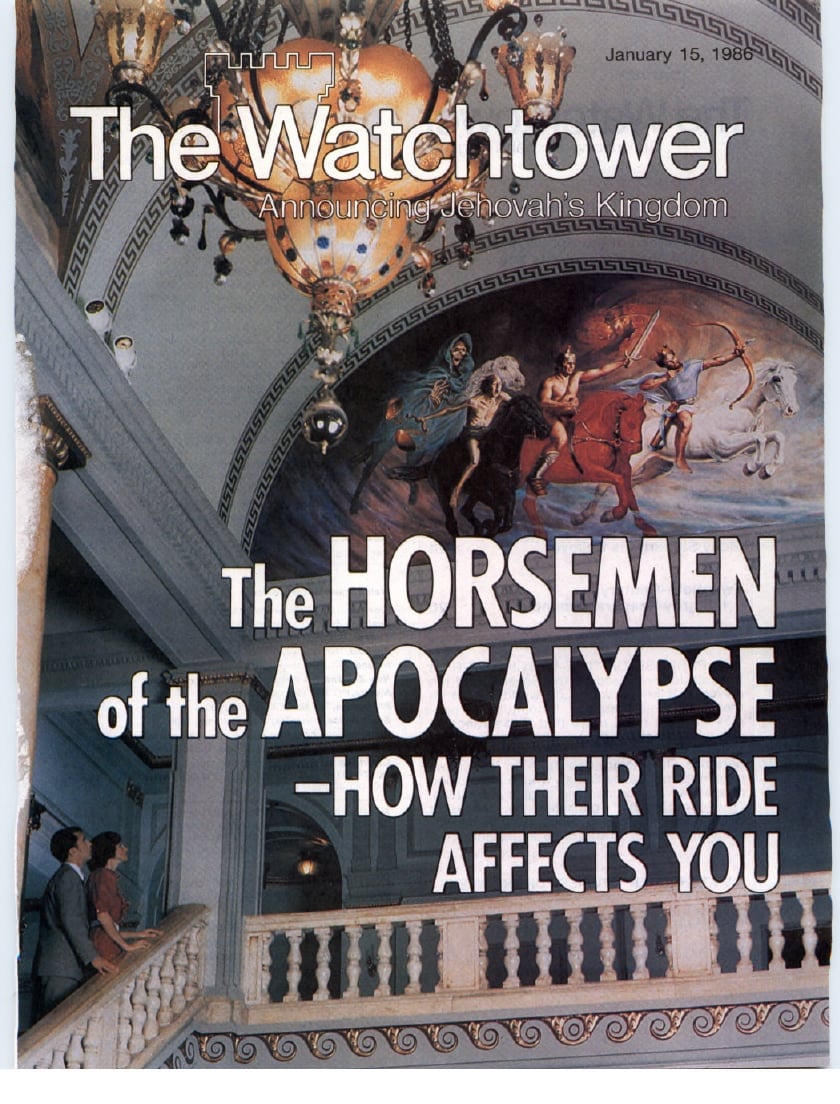
The Watchtower — January 15, 1986
Source: jw.org
Contents
The Horsemen of the Apocalypse—How Their Ride Affects You
“Bible Highlights” to Provide Greater Insight
Jehovah Fulfills His Promises!
“Exert Yourselves Vigorously”
Regaining Power, Not Tiring Out
Do You “Follow the Course of Hospitality”?
Many Samaritans Believe
Twentieth-Century Integrity Keepers Assemble!
‘Man Does Not Live on Bread Alone’
The Horsemen of the Apocalypse—How Their Ride Affects You
The Horsemen of the Apocalypse—How Their Ride Affects You
MONDAY, April 1, 1985, was like no other day for many commuters in Toronto, Canada. Would-be bombers had threatened to blow up the city’s subway tracks. Why? To call attention to what they said was an attempt years ago to destroy the Armenian people in Turkey, something the Turkish government has repeatedly denied.
Doubtless, most of those commuters knew little or nothing about that matter of years ago. Yet they suffered some hardship and anxiety. Often we are affected by things about which we know very little.
During the second decade of the 20th century, notable events began to occur in fulfillment of the remarkable Bible prophecy found at Revelation (or, Apocalypse) 6:1-8. As revealed to the Christian apostle John, horsemen were to ride forth in the last days. And though millions do not know about it, the ride of those horsemen of the Apocalypse is affecting everyone on earth. You, too, are affected. But how? We shall see as we discuss each of the horsemen.
The Fiery-Colored Horse
One of the mounts seen by John was “a fiery-colored horse; and to the one seated upon it there was granted to take peace away from the earth so that they should slaughter one another; and a great sword was given him.”—Revelation 6:4.
This horseman’s “great sword” symbolizes warfare. Accordingly, since 1914 some 69 million people died in the two world wars. What a slaughter! Truly, a huge crowd of widows and orphans attests that the rider of the fiery-colored horse, denoting international warfare, has directly affected their lives.
Moreover, continuing wars and war threats weigh heavily on the younger generation. In lands where active conflict rages, teenagers are doing much of the fighting. The effect of war on these young people is summed up in this question posed by the chairman of one human-rights agency: “How can they ever grow up as sane and balanced adults?”
Youths in various countries directly affected by war have learned to count time in hours and days instead of in months and years. They ask: “Later, who cares about later? Can you guarantee that a shell won’t come into my room tonight when I go to bed?”
What of the children living in peaceful lands? Do they feel the effects of the war horseman? Yes, the gloomy threat of nuclear warfare has had profound psychological consequences for them. Regarding the despair expressed by her students, one teacher remarked: “Over and over as I heard these comments I was just washed with a feeling of disbelief. These young children felt a level of despair that I don’t allow myself to feel.” Dr. Richard Logan of Quebec, Canada, adds: “Helplessness and powerlessness is the psychological definition of depression. That’s what we’re seeing in a great many young people.”
But what if you do not live in a war-torn country or do not feel you are emotionally affected by the problem? Still the rider of the fiery-colored horse affects your life. Every minute $1.3 million is spent for direct military purposes—some $660 thousand million a year worldwide. Who pays for all of this? You do. Wherever you live, you are affected by the rider of the fiery-colored horse.
The Black Horse
Another horse of the tableau is described by John in these words: “And I saw, and, look! a black horse; and the one seated upon it had a pair of scales in his hand. And I heard a voice as if in the midst of the four living creatures say: ‘A quart of wheat for a denarius, and three quarts of barley for a denarius; and do not harm the olive oil and the wine.’”—Revelation 6:5, 6.
Are you hungry? Millions are. They are directly affected by the rider of the black horse, denoting famine. Every minute 30 children die for lack of adequate food or medicine—more than 15 million a year! Hundreds of millions of other people live in deplorable conditions. According to former World Bank President Robert McNamara, they are “so limited by illiteracy, malnutrition, disease, high infant mortality and low life expectancy as to deny them the very potential of the genes with which they are born.”
In recent months, it has been common to see pictures of starving African men, women, and children. Graphically portraying the scope of such suffering, UN Secretary-General Javier Pérez de Cuéllar warned: “More human beings may die in sub-Saharan Africa than during the entire Second World War. Even those who survive may be impaired for the rest of their lives, either physically or mentally.” These victims are directly affected by the ride of the black horse.
You may not be hungry, but surely you have been affected by the sad pictures of the famine stricken. According to a New York Times editorial of May 20, 1985, more than a billion dollars had by then been contributed to supply aid to the famished. While you may not have contributed directly, some governments have made large contributions, using tax money. Yes, the ride of the black horse has both a direct and an indirect effect on the whole population.
The Pale Horse
The vision John saw continues with the description of another horse and its rider: “I saw, and, look! a pale horse; and the one seated upon it had the name Death. And Hades was closely following him. And authority was given them over the fourth part of the earth, to kill with a long sword and with food shortage and with deadly plague and by the wild beasts of the earth.”—Revelation 6:8.
Death rides the pale horse, and “deadly plague” is just one of the various ways that life is being snuffed out during this horseman’s ride. Despite the modern advances of medical science, the world still faces disease on all fronts. While we may not now face an epidemic having the scope of the so-called Spanish flu that followed World War I, still the toll taken by cancer, heart problems, and many other diseases is staggering. For instance, the World Health Organization estimates that 5.9 million new cases of cancer occur worldwide each year. River blindness, malaria, snail fever, cholera, and a host of other diseases add to the current plagues still suffered.
However, you may reason, ‘I don’t have any of these diseases.’ That may be true, but you are affected by the ride of the pale horse. Hospital and medical costs are enormous. This leads individuals to secure some form of health insurance. Many countries provide social medicine paid for through taxes. And think of the tremendous cost in loss of working time, which eventually is transmitted to you in increased prices. Yes, the ride of the pale horse affects you.
What the White Horse Brings
After considering the harmful effects as the other horsemen ride forth, it is heartening to note what John said about the white horse and its rider, which lead out ahead of the others. The apostle said: “I saw, and, look! a white horse; and the one seated upon it had a bow; and a crown was given him, and he went forth conquering and to complete his conquest.”—Revelation 6:2.
Jesus Christ rides the white horse. (Revelation 19:11) His heavenly reign began in 1914 with exciting events. War in heaven resulted in the Devil and his angels being thrown down to the earth. Thereafter, a voice from heaven declared: “Woe for the earth and for the sea, because the Devil has come down to you, having great anger, knowing he has a short period of time.” This marked the beginning of the ride of the horsemen.—Revelation 12:7-12.
But how does the ride of Jesus Christ affect you? In connection with his reign, Jesus foretold: “This good news of the kingdom will be preached in all the inhabited earth for a witness to all the nations; and then the end will come.” (Matthew 24:14) Today, in more than 200 lands and islands of the sea, Jehovah’s Witnesses are proclaiming Christ’s established Kingdom. Have they called at your home? Then you have been affected by the ride of this horseman.
In further foretelling how people would be affected by his reign, Jesus prophesied: “When the Son of man arrives in his glory, and all the angels with him, then he will sit down on his glorious throne. And all the nations will be gathered before him, and he will separate people one from another, just as a shepherd separates the sheep from the goats. And he will put the sheep on his right hand, but the goats on his left.”—Matthew 25:31-33.
As a result of this separating work done during Jesus’ ride on the white horse, all mankind is identified as being either “sheep” or “goats.” Notice the outcome. The “goats” “will depart into everlasting cutting-off, but the righteous ones [the “sheep”] into everlasting life.” (Matthew 25:46) Thus, how you respond to the preaching of the Kingdom message will mean either life or death for you.
Even if you have not previously considered how the horsemen of the Apocalypse affect you, we urge you to respond to the good news that their ride soon will end. Thereafter, the earth will enjoy many blessings under the rule of Jesus, the rider of the white horse. The Bible prophetically described some of them this way: “In his days the righteous one will sprout, and [with the rider of the fiery-colored horse gone] the abundance of peace until the moon is no more. [Since the rider of the black horse will be absent,] there will come to be plenty of grain on the earth; on the top of the mountains there will be an overflow.”—Psalm 72:7, 16.
When Jesus Christ was on the earth, he demonstrated God-given power over such things as loathsome disease and even death. He will display such power on a far grander scale during his reign as King and will rid the earth of all plagues, famines, and wars. Thus, the rider of the white horse will bring an end to the destructive ride of the other horsemen of the Apocalypse.
[Box on page 3]
THE HORSEMEN IDENTIFIED
The January 1 issue of The Watchtower showed how the ride of the horsemen of the Apocalypse began to be fulfilled.
WHITE HORSE: Jesus Christ rides this horse as the newly crowned King in heaven. He is pictured going forth as a righteous conqueror since his enthronement in 1914.
FIERY-COLORED HORSE: The rider of this horse denotes warfare. Peace is taken from the earth, and the outbreak of world war is marked.
BLACK HORSE: The rider of this horse denotes food shortages and famine. While millions are starving, others are still able to buy luxury foods.
PALE HORSE: Death rides the pale horse. Premature death is signified. It results from pestilence and other factors.
“Bible Highlights” to Provide Greater Insight
“Bible Highlights” to Provide Greater Insight
WHEN the Jews returned from exile in Babylon during the sixth century B.C.E., responsible men among them “gathered themselves together to Ezra the copyist, even to gain insight into the words of the law.” What resulted from their increased understanding? Why, the people held an extraordinary Festival of Booths with “very great rejoicing”!—Nehemiah 8:13-18.
As that example so well illustrates, the gaining of insight into the Scriptures can have a very good effect upon God’s people. Accordingly, in the issues of January 15, February 15, and March 15, 1986, The Watchtower will contain a feature entitled “Bible Highlights.” These articles will enable our readers to gain deeper insight into the Bible books of Ezra, Nehemiah, and Esther.
These studies will help us to relive the thrilling events associated with the restoration of true worship in Jerusalem, the construction of Jehovah’s temple there, and the preservation of God’s people in the face of enemy assault. Indeed, by reading these books as suggested in “Bible Highlights,” Jehovah’s Witnesses and their associates will be able to derive greater benefit from coverage of the same Scriptural material in the weekly Theocratic Ministry School. Additionally, brothers assigned to present “Highlights From Bible Reading” on the school program can use the feature “Bible Highlights” to very good advantage in answering Scriptural questions and pointing out lessons for us.—Romans 15:4.
[Chart on page 7]
Persian Kings Mentioned in Ezra, Nehemiah, and Esther
Reign (B.C.E.) Secular Name Bible Name Scripture
Reference
c. 550-529 Cyrus the Great Cyrus Ezra 1:1; 4:5
529-522 Cambyses II Ahasuerus Ezra 4:6
522 (8 months) Gaumata (Smerdis) Artaxerxes Ezra 4:7-23
521-486 Darius I Darius Ezra 4:5, 24;
Ezr 6:1-15
486-474 Xerxes I Ahasuerus Book of Esther
474-423 Artaxerxes I Artaxerxes Ezra 6:14;
(Longimanus) Ezr 7:1-26;
Nehemiah 2:1-18
Jehovah Fulfills His Promises!
Bible Highlights Ezra 1:1–10:44
Jehovah Fulfills His Promises!
Liberation! Restoration! How heartwarming this news must have been to Jewish exiles in Babylon! True to God’s promise, and after 70 years of bondage, the Jews were being restored to their homeland. (Jeremiah 25:12; Isaiah 44:28–45:7) Moreover, the items taken from Jehovah’s temple were being returned to their rightful place. What joy!
The Bible book of Ezra begins with these thrilling events. Written in Jerusalem by the copyist Ezra about 460 B.C.E., it covers some 70 years, from the Jews’ release to the completion of the second temple and the cleansing of the priesthood (537-c. 467 B.C.E.). Highlighted is the way that Jehovah fulfills his promises. The book also contains valuable lessons for Jehovah’s Witnesses today.
Exiles Liberated
Please read Ezra 1:1–3:6. His spirit roused by Jehovah, Persian king Cyrus issues a proclamation: The temple at Jerusalem will be rebuilt, and Jehovah’s worship is to be restored there! All Israelites may have a share. Those who can do so are free to return to their homeland for rebuilding work. Others are urged to contribute freely toward the project. The utensils of the original temple, taken to Babylon by Nebuchadnezzar, are to be returned. Under the leadership of Zerubbabel, almost 50,000 make the journey of nearly 1,000 miles (1,600 km) back to Jerusalem. They rebuild the sacred altar and offer up sacrifices to Jehovah. Next, in the fall of 537 B.C.E., they celebrate the Festival of Booths. The foretold 70 years of desolation end exactly on time!—Jeremiah 25:11; 29:10.
◆ 1:3-6—Were the Israelites remaining in Babylon unfaithful?
Not necessarily, although materialism and lack of appreciation may have been factors in some cases. Cyrus’ decree did not require that all return but made it a voluntary matter. Such circumstances as old age, infirmities, or family obligations may have prevented some from making the journey. But they were to give support to those who could return.
◆ 1:8—Who was Sheshbazzar?
Most likely, this was an official Chaldean court name given to Zerubbabel. (Compare Daniel 1:7.) What is attributed to Sheshbazzar is elsewhere credited to Zerubbabel. (Ezra 5:16; Zechariah 4:9) Both are given the title “governor.” (Ezra 5:14; Haggai 2:21) And at Ezra 2:2 and Ezr 3:1, 2, Zerubbabel is acknowledged as leading the returning exiles; so, fittingly, the name Sheshbazzar is not mentioned.
◆ 2:61-63—What were the Urim and the Thummim?
They are thought to have been sacred lots used when a question needed an answer from Jehovah. According to Jewish tradition, they disappeared when the temple was destroyed in 607 B.C.E. This is supported by the fact that claimants to priestly descent were barred from the priesthood and the eating of most holy things “until a priest stood up with Urim and Thummim.” But there is no record of their use then or thereafter.
Lesson for Us: A situation similar to that of the Jewish exiles exists with Jehovah’s Witnesses today. Not all are able to engage in the full-time ministry or leave their homes to serve where the need is greater. Yet they do all they can to advance the interests of clean worship by making voluntary contributions and giving encouragement to those who can engage in increased activity.
Restoration Opposed
Read 3:7–4:24. With great rejoicing, the returned Jews lay the foundation of Jehovah’s house. But for years adversaries attempt to dishearten the temple builders. Finally, convincing the king that a “rebellious and bad city” is being rebuilt, these foes have the work stopped by royal command. The ban continues “until the second year of the reign of Darius the king of Persia.”
◆ 3:12—Why did these men weep?
These very old men could recall how gorgeous the divinely designed temple of Solomon had looked. What lay before their eyes now—a mere groundwork—was as nothing in comparison. Likely they were disheartened, doubting that their efforts would bring back the former glory.—Haggai 2:2, 3.
◆ 4:1-3—Why was the offer of help rejected?
These non-Jews, brought in by the king of Assyria to repopulate the land, were not true worshipers of God. (2 Kings 17:33, 41) Accepting their help would have meant compromising true worship, and Jehovah had specifically warned his people against any such interfaith movements. (Exodus 20:5; 34:12) Moreover, the account calls these non-Jews “adversaries.”
Lesson for Us: When confronted with hostility in serving God, we should imitate the resettling Jews who immediately gathered for worship as “one man.” Trusting in Jehovah and putting his worship first strengthened them to get the assigned work accomplished.—Ezra 3:1-12.
Temple Completed
Read 5:1–6:22. Stirred up by the prophets Haggai and Zechariah, the building work continues with renewed zeal. Unable to stop it, the adversaries again complain. King Darius investigates and finds Cyrus’ original decree. Not only are the opposers ordered to ‘cease and desist’ but they are also commanded to assist materially! With continued encouragement from Jehovah’s prophets, the temple is completed in 515 B.C.E. and is inaugurated. With joy it is dedicated to God, whose promises are fulfilled!
◆ 5:5—Why did the opposers not stop the building work?
Jehovah’s watchcare was upon his faithful servants. (2 Chronicles 16:9) Strengthened by God’s spirit, the elders refused to be intimidated. They referred to the long-forgotten decree of Cyrus. Since Persian law was unalterable, the adversaries feared opposing a royal decree. (Daniel 6:8, 15) Jehovah’s direction was evident, and the work continued.
◆ 6:21—Who separated “from the uncleanness of the nations”?
They may have been proselytes who returned with the Jews, Samaritans then inhabiting the land, or even Jewish returnees who had been corrupted by pagan influences. (Compare Ezra 9:1.) The progress of Jehovah’s pure worship in Jerusalem apparently moved them to make needed changes in their lives.
Lesson for Us: Christian elders today should also seek Jehovah’s guidance. He gives the insight needed when we face opposers.—Psalm 32:8.
Ezra Returns
Read 7:1–8:36. Time passes. In 468 B.C.E., King Artaxerxes grants Ezra “all his request,” enabling him to render aid in Jerusalem. The king’s order encourages all willing Jews to return also, and he grants silver and gold to provide for all necessities at Jehovah’s house. Ezra is empowered to appoint magistrates and judges, who will enforce the law of both Jehovah and the king. With trust in God’s backing, Ezra strengthens himself and sets out on the perilous journey. He does not request an armed escort, lest this be viewed as a lack of faith in Jehovah’s protective ability. With God’s backing, the Jews arrive safely.
◆ 7:1, 7, 11—Who was this Artaxerxes?
This was the Persian king Artaxerxes I (Longimanus). In his 20th year, he granted Nehemiah permission to return to Jerusalem and rebuild its walls and gates. (Nehemiah 2:1-8) Ancient historians credit this Artaxerxes with a generally benign and generous disposition. Because of his large donation, he was included at Ezra 6:14 as one whose orders contributed to the finishing of the temple, although its construction was completed some 47 years earlier. He differs from the Artaxerxes who halted the rebuilding work. (Ezra 4:7-23) That one was Gaumata, who ruled but eight months in 522 B.C.E. “Artaxerxes” apparently was a throne name or title.
Lesson for Us: Ezra set a fine example for Jehovah’s servants today. A skilled copyist who diligently studied God’s Word, he gave all credit to the Most High and had more concern for Jehovah’s glory than for his personal safety.—Ezra 7:27, 28; 8:21-23.
Nation Cleansed
Read 9:1–10:44. Ezra soon learns that many “have not separated themselves from the peoples of the lands as regards their detestable things.” The Jews, including priests and Levites, have intermarried with the pagan Canaanites. Ezra is stunned. He prayerfully lays the matter before Jehovah, contritely confessing the nation’s errors. Under his leadership, the people repent and resolve to dismiss their foreign wives. The uncleanness is cleared out within about three months.
◆ 9:2—Why was such intermarriage a sin?
It posed a threat to the restoration of true worship. (Deuteronomy 7:3, 4) These were unbelieving, idol-worshiping women. Intermarriage with them could eventually have resulted in assimilation into the surrounding pagan nations, and pure worship might have vanished from the earth.
◆ 10:3, 44—Why were the children dismissed as well?
Young children usually need their mothers. Moreover, through the influence of the children, the dismissed wives may have returned in time. Pure worship of Jehovah had to take precedence.
Lesson for Us: Like faithful Jews of Ezra’s time, Jehovah’s Witnesses cling to God’s standards for marriage. They realize that they should marry “only in the Lord.”—1 Corinthians 7:39.
Jehovah kept his promise to have pure worship restored in ancient Jerusalem. Similarly, he will fulfill his promise to have his clean worship practiced earth wide. (Habakkuk 2:14) Will you be among his worshipers when the great Promise-Keeper brings peace and happiness to this earth?—Psalm 37:10, 11; Revelation 21:3, 4.
“Exert Yourselves Vigorously”
“Exert Yourselves Vigorously”
“Exert yourselves vigorously to get in through the narrow door, because many, I tell you, will seek to get in but will not be able.”—LUKE 13:24.
1. What do most people desire?
ASK six-year-old Robbie why he likes to go to the Kingdom Hall, and he will answer: “I learn about Jehovah and Paradise where I can live for a long, long time with good animals.” His three-year-old cousin, Dustin, senses enough about his parents’ routine to know exactly when to blurt out: “Want to go to Kingdom Hall!” What Robbie expresses, and what Dustin is learning to express, would appeal to most people—life, everlasting life. People want to be “saved.” But how? Simply by attending religious services?
2. (a) Why can salvation not be earned? (b) How do Jesus’ words at Luke 13:24 show what is required for salvation?
2 Salvation cannot be earned by attendance at meetings or in any other way. It is free, a gift from God. Yet, Jehovah God does require efforts on our part if we are to receive his gift of everlasting life. (Romans 6:23) What are they? For one, vigorous exertion in his service! These actions must be motivated by genuine appreciation. God’s Son, Jesus Christ, once had a man inquire of him: “Lord, are those who are being saved few?” Jesus’ answer embraced not only the questioner but also all others interested in salvation, including us. He replied: “Exert yourselves vigorously to get in through the narrow door, because many, I tell you, will seek to get in but will not be able.”—Luke 13:23, 24.
3. (a) Why was the man’s question unusual? (b) How does Jesus involve us in his answer?
3 The unnamed man’s question was unusual. He asked: “Are those who are being saved few?” not, “Will I be among the few saved?” or, “How can I be saved?” Perhaps the Jewish philosophy that only a limited number of people would merit salvation prompted his speculative query.a Whatever the source of his curiosity, Jesus quickly took the question from the arena of abstract theory to that of practical application—personal application. He forced the inquirer to think of what he needed to do for salvation. But more than that, since Jesus’ words, “exert yourselves vigorously,” are in the plural form, they should also stir us to think deeply about our manner of worship.
4. What must we do to gain everlasting life?
4 Everlasting life, therefore, is not as easy to attain as some people may imagine. Jesus stresses hard work, constant effort, as the way to “get in through the narrow door.” This unflagging exertion is powered by a durable faith, one built on obedience to Christ’s teachings. So to gain salvation, we must do more than ‘hear his words’; we must persist in ‘doing them.’—Luke 6:46-49; James 1:22-25.
You Must “Struggle” Now
5. (a) What is implied by Jesus’ words, “Exert yourselves vigorously”? (b) How do those words add more meaning to your view of sacred service?
5 What does the phrase “exert yourselves vigorously” mean? In the original Greek, the expression is a·go·niʹze·sthe, derived from a word (a·gonʹ) meaning “place of contest.” “Be struggling,” is how The Kingdom Interlinear Translation puts it. Interestingly, from this same Greek verb we get the English word “agonize.” So visualize an ancient stadium and picture the athlete now agonizing, or exerting himself vigorously with all his power, to win the prize. Thus, although the Greek verb here involved can be a technical term for competing in the Grecian games, it underlines Jesus’ admonition to take whole-souled action. Halfhearted effort just will not do.—Luke 10:27; compare 1 Corinthians 9:26, 27.
6. Why must we exert ourselves vigorously now?
6 When and for how long must we “struggle to get in through the narrow door”? (Luke 13:24, The New English Bible) Look closely at Jesus’ words in Luke 13:24 and notice how he contrasts the present, “exert yourselves vigorously,” with the future, “will seek.” Thus, right now is the time to be struggling. Apparently, those barred from entering seek to get in at a time convenient only to them. But by then it is too late; the door of opportunity is shut and bolted. Jesus goes on to say at Luke 13:25 that once the householder has locked the door, people will start knocking and pleading: “‘Sir, open to us.’ But in answer he will say to you, ‘I do not know where you are from.’” What a sad outcome awaits those who do not make the worship of Jehovah their chief purpose in life now!—Matthew 6:33.
7. How does Philippians 3:12-14 denote constant exertion, and why is it necessary?
7 Our struggling is an ongoing thing. None of us have entered completely through “the narrow door.” Paul realized this. His race for life was a strenuous day-by-day effort. He wrote: “Not that I have already obtained all this, or have already been made perfect, but I press on to take hold of that for which Christ Jesus took hold of me. Brothers, I do not consider myself yet to have taken hold of it. But one thing I do: Forgetting what is behind and straining toward what is ahead, I press on toward the goal to win the prize for which God has called me heavenward in Christ Jesus.” (Italics ours.)—Philippians 3:12-14, New International Version.
8. (a) What bars the “many” from everlasting life? (b) What warning does this sound for us?
8 Who are the “many,” and why are they not able to get in? The “many” are identified with Christendom, especially its clergy class. They make a pretense of intimately knowing Jesus, being part of his family, by claiming that they ‘ate and drank with him.’ But because they want salvation on their own terms, not God’s, Jesus flatly denies knowing them and views them as “workers of unrighteousness.” (Luke 13:26, 27) Individuals locked out from entering into everlasting life could even include those who have slacked off in their sacred service to Jehovah and now have a take-it-easy approach to true worship. Their zeal for Kingdom interests has become lukewarm. (Revelation 3:15, 16) True, they may still ‘have a form of godly devotion’—token field service and meeting attendance—but lack evidence of the kind of faith that is the real driving force behind pure worship. (Compare 2 Timothy 3:5.) They fail to realize that just seeking to get through “the narrow door” is not enough. One must struggle to get through.
Why Through a “Narrow Door”
9. Why does entering through the narrow door require vigorous exertion?
9 The narrow door to salvation stands open to all. But the “many” do not like to struggle to enter. What are some factors about going through the narrow door that require vigorous exertion? A person must first gain accurate knowledge of Bible truth, and get to know Jehovah God and Christ Jesus. (John 17:3) This means casting aside the traditions and practices of worldly religions, including those of Christendom. It requires doing God’s will, as Jesus did it while here on earth. (1 Peter 2:21) As a dedicated, baptized Christian, one must also avoid the materialism, the immorality, and the uncleanness of the world. (1 John 2:15-17; Ephesians 5:3-5) These must be stripped off and replaced by Christlike qualities.—Colossians 3:9, 10, 12.
10. What relationship does self-control have to our gaining everlasting life?
10 The “few” know the value of zeal in the ministry, accompanied by displaying the fruitage of the spirit, including self-control. (Galatians 5:23) With the help of Jehovah’s holy spirit, they struggle to get the upper hand over their body and direct it toward the goal of everlasting life.—1 Corinthians 9:24-27.
What Do Jesus’ Words Mean to You?
11. (a) In what areas of life may some need to exert themselves vigorously, and why? (b) In what activity can all exert themselves vigorously?
11 Whether we are newly baptized or have been active with Jehovah’s organization for decades, there can be no slacking off in our effort to please him. As Jesus’ words plainly indicate, we must be whole-souled in our devotion to Jehovah, willing to enter through the narrow door at any cost. Although Jesus was not simply discussing improvements and increases in our service to God, for some of us, vigorous exertion is needed to improve our conduct or to get rid of bad habits so that we ‘in no way give any cause for stumbling.’ (2 Corinthians 6:1-4) Others of us need to give constant attention to a thorough program of personal study so that our ‘love may abound with accurate knowledge and full discernment.’ (Philippians 1:9-11) Still others need to put forth a greater effort to attend and participate regularly in congregation meetings, including the Congregation Book Study. (Hebrews 10:23-25) But all of us can look at our own personal field ministry to see if we are truly exerting ourselves vigorously in doing “the work of an evangelizer.”—2 Timothy 4:5.
12. To test the degree of our spiritual exertion, what questions might we ask?
12 For an increasing number, progress in exerting themselves vigorously to please Jehovah has qualified them for auxiliary pioneer, regular pioneer, or Bethel service. But what about you? If you are a Kingdom publisher, can you engage in auxiliary pioneer service several times a year or even become a regular pioneer? If you already are an auxiliary pioneer, are you reaching out for regular pioneer service? If not, why not consider doing so? In this way you could be blessed in cultivating an even closer relationship with Jehovah God and Jesus Christ.—Psalm 25:14.
Can You Exert Yourself so as to Pioneer?
13. (a) If you want to be a pioneer, what two things are vital? (b) In order to pioneer, in what areas of life may adjustments need to be made?
13 If you could be a regular pioneer but are not, can you “struggle” to make adjustments in your life so as to pioneer? Two things are essential. First, you must have the desire. Second, you must have the right circumstances. If you lack the desire, pray for it. Talk to pioneers. Increase your present activity as a congregation publisher. Participate in auxiliary pioneer service whenever possible. If your circumstances do not allow for such service now, see if an adjustment can be made. A working wife may not have to work. One past retirement age may not have to keep working. A high standard of living, expensive vacations, the latest cars, and the like, are not essential to life.—Luke 12:15; 1 John 2:15-17.
14. (a) Why was a certain married couple not content to remain as congregation publishers? (b) What goal have they set before their children?
14 One father of three sons, two of preteen age, began pioneering six years ago. Why? “I wanted to do more,” he explains. “If I could be a regular pioneer and was not, I would not be living up to my dedication.” His wife also began regular pioneering. Why? “I had been auxiliary pioneering on a regular basis for four years and finally realized that it had become easy,” she says. “I wanted to have a fuller share in this never-to-be-repeated work and to set the proper example for our sons.” Both husband and wife learned the truth after university training. “Our parents required us to go to college for four years,” states the father. So, what goals have they set for their sons? “I let my boys know we would like them to pioneer and spend at least four years at Bethel.”
15. (a) For what reasons have some exerted themselves to serve as regular pioneers? (b) For what reason would you desire to be in the full-time service?
15 The following are reasons why others have decided to become regular pioneers:
“I wasn’t getting anywhere spiritually, which bothered me.” (Robert H.)
“I was never content as a regular publisher.” (Rhea H.)
“Pioneering gives my life direction and purpose.” (Hans K.)
“I wanted to serve Jehovah completely, and pioneering was my way of doing just that.” (Charanjit K.)
“I would regret it if I did not use my energies, strength, and youth to share in this great work.” (Gregory T.)
“Jehovah only blesses effort. I needed to give him something to bless.” (Graceann T.)
“Pioneering helps me to express how I feel about Jehovah.” (Marco P.)
“Working secularly full time did not bring me the happiness that I observed among the pioneers.” (Nancy P.)
What reasons could you add to this list?
Are You Doing All You Can?
16. Are pioneers the only ones who exert themselves vigorously? Explain.
16 A number of Jehovah’s Witnesses have honestly and prayerfully examined their personal situation and have found that they are doing all they can under their present circumstances. Maybe you are one of them. If so, take heart. Jehovah and his Son care about you and truly appreciate your whole-souled service. (Compare Luke 21:1-4.) For example, because of unfavorable political or economic conditions, in some countries our brothers have to work nine hours a day, five or six days a week, just to obtain the necessities of life. In a country where the work of Jehovah’s Witnesses is under strict governmental ban, those who pioneer—and these countries have an increasing number of pioneers—are usually the retired ones, youths who have night jobs, and mothers (with children) who have been exempted from secular work by the State.
17. How does the case of Epaphroditus show that Jehovah does not measure our degree of exertion solely by the amount of work we do in his service?
17 Yet you may say, ‘I wish I had more physical strength. If only I were young again!’ But do not be discouraged. Our exertion is not rigidly measured by the amount of work we do in God’s sacred service. Remember Epaphroditus? When he was sick, the amount of vigorous activity possible for him in “the Lord’s work” would not have compared with what he did when he was well. Yet Paul commended him for his exertion. In fact, as Paul indicated, we should ‘keep holding men and women of that sort dear.’—Philippians 2:25-30.
18. (a) How can those with limiting circumstances promote full-time service in the congregation? (b) What can you do to encourage the pioneer spirit in your congregation?
18 However, there is something you can do to promote the full-time service in the congregation. What is it? Exert yourself vigorously in displaying the pioneer spirit. For example, if you cannot presently be a pioneer because of family obligations, can you free others in your family—your wife, children, brother, or sister—to pioneer? Those who may be in poor health or are otherwise handicapped can take a real interest in those who are able to pioneer, getting into the field service with them as circumstances permit. (Compare 1 Corinthians 12:19-26.) In this way all in the congregation can exert themselves in stressing full-time service. The results can be very encouraging to all!
19. What should be our determination?
19 What does exerting yourself vigorously mean to you? Does it mean progressing toward baptism? Overcoming some bad habit? Strengthening your relationship with Jehovah in some way? Could it mean auxiliary pioneering? Regular pioneering? Bethel service? Whatever it requires of you in order to make spiritual progress, it is worth the vigorous effort now. Therefore, let all of us keep up the struggle to get through the narrow door leading to everlasting life!
[Footnotes]
The number of those saved was a much debated theological problem among the rabbis. One Bible reference work notes: “Among the strange cabbalistic fancies of the Rabbis, one was an attempt to fix the number of the saved by the numerical value of the letters of this or that text.”
Points to Consider
□ What did Jesus mean when he counseled, “Exert yourselves vigorously”?
□ When and how do Jesus’ words apply to you?
□ Why are the “many” not able to get through the narrow door?
□ How may those with limiting circumstances exert themselves?
□ For how long must we struggle to get through the narrow door?
Regaining Power, Not Tiring Out
Regaining Power, Not Tiring Out
“He is giving to the tired one power; and to the one without dynamic energy he makes full might abound.”—ISAIAH 40:29.
1, 2. How would you illustrate what Christians have in common with marathon runners?
ON AN October morning in 1984, a human sea of some 16,000 contestants surged into the streets for the beginning of the New York City Marathon. The finish line was some 26.2 miles (42.2 km) away. That unseasonably warm autumn day carried with it stifling heat and high humidity that sapped the runners’ energy and tested their endurance. The race became an exhausting struggle for even the best of the athletes. Many runners tired out and dropped from the race; nearly 2,000 did not finish. Those who did had overcome very difficult conditions.
2 Christians, too, are in a race. The prize? Everlasting life. And similar to the marathon runner, they must struggle right to the finish. Endurance is needed. Power must be maintained and fatigue avoided. Our race for life is not like a short sprint but, rather, like a long-distance run. Paul said to his fellow Christians in Corinth: “Do you not know that the runners in a race all run, but only one receives the prize? Run in such a way that you may attain it.” (1 Corinthians 9:24) The way Christians run is with vigorous exertion.—Luke 13:24.
3. How only can Christians keep a vigorous pace until they finish the race?
3 But you may wonder: ‘Who can keep up that pace to finish the race?’ None of us can in our own strength. To gain the prize, we must tap the very Source of dynamic energy, Jehovah God.—Job 36:22; Psalm 108:13.
Jehovah—The Source of Dynamic Energy
4. According to the prophet Isaiah, why can we have confidence in Jehovah’s ability to sustain his servants?
4 Jehovah unquestionably can sustain his servants. By the mouth of his prophet Isaiah, the Almighty spoke of the limitlessness of His abilities and the incomparableness of His powerful works. “Raise your eyes high up and see,” He said. “Who has created these things? It is the One who is bringing forth the army of them even by number, all of whom he calls even by name. Due to the abundance of dynamic energy, he also being vigorous in power, not one of them is missing. . . . Have you not come to know or have you not heard? Jehovah, the Creator of the extremities of the earth, is a God to time indefinite. He does not tire out or grow weary. There is no searching out of his understanding.”—Isaiah 40:26-28.
5, 6. Give examples of the evidence of Jehovah’s dynamic energy.
5 From the finite to the infinite, the display of Jehovah’s creative power is awesome! For example, consider the building blocks from which all matter, including us, is constructed—atoms. They are so tiny that a drop of water contains 100 billion billion atoms (American system of numeration). Amazingly, though, contained within the nucleus of atoms is enough energy to unleash, in one case, an explosion powerful enough to blast a crater in the ground 32 stories deep and a quarter of a mile wide.
6 Toward the other end of the size scale, consider the sun. This gigantic nuclear furnace, weighing billions of tons, heats our solar system. It is fueled by the energy derived from tiny atoms. Although all life on earth—plants, animals, and humans—depends on the energy given off by that gigantic celestial power plant, only a minute amount of the sun’s energy actually reaches earth. Yet, that is sufficient to support life. In his book Astronomy, astronomer Fred Hoyle writes: “The very tiny fraction of the Sun’s energy that falls on the Earth—estimated at about five parts in a hundred million million—is about 100,000 times greater than all the energy used in the world’s industries.”
7. How should we feel about Jehovah after contemplating the power manifest in his creation?
7 Nevertheless, the sun is only one of the billions of stars comprising our Milky Way galaxy—and it is a medium-sized star at that. Additionally, astronomers estimate that there are about 100,000,000,000 galaxies in the known universe. This is staggering to contemplate, is it not? No wonder that the man Job, after reflecting on how Jehovah ‘stretched out the heavens by himself,’ said that God was “doing great things unsearchable, and wonderful things without number.”—Job 9:8-10.
Jehovah Can Invigorate You
8. (a) Who only can draw fully upon Jehovah’s power, and why? (b) How is the promise at Isaiah 40:29-31 faith strengthening?
8 True worshipers of Jehovah may freely and fully draw upon this Fountain of dynamic energy that created and sustains the universe. Jehovah’s servants can be ‘made mighty with power through his holy spirit,’ with no fear of a power shortage. (Ephesians 3:16; Psalm 84:4, 5) Really, our winning the race for life depends upon implicit trust that God’s mighty hand can sweep us past the finish line. He can invigorate us. As the prophet Isaiah says of Jehovah: “He is giving to the tired one power; and to the one without dynamic energy he makes full might abound. Boys will both tire out and grow weary, and young men themselves will without fail stumble, but those who are hoping in Jehovah will regain power. They will mount up with wings like eagles. They will run and not grow weary; they will walk and not tire out.” (Isaiah 40:29-31) Why, just reading those words can fire our spirit!
9. How can Jehovah help you with your ‘mountainous’ problems?
9 When faced with seemingly massive problems that threaten to block your zeal for true worship, you may feel small and insignificant. Do not despair. Turn to your omnipotent heavenly Father. He strengthens ‘all those hoping in him.’ Cannot the Creator of the atom infuse his people with dynamic energy powerful enough to move those ‘mountains’? He surely can!—Mark 11:23.
10. (a) What things can tire out Christian runners? (b) What does Satan want to do to you?
10 On the other hand, some Christians may be so fatigued from the day-to-day battle against the pressures from a world that flaunts its disregard for Christian principles that they feel like slowing down or even stopping in the race for life. Sickness, financial reverses, family problems, loneliness, or other difficulties can also cause discouragement. And discouragement can quickly sap a Christian’s strength, as easily as a sultry day can rapidly drain energy from a marathon runner. The great Adversary, Satan the Devil, uses such things to try to break your integrity as a servant of Jehovah. (1 Peter 5:8) Do not let the Devil do it! Look to the Creator of those myriads of heavenly galaxies to replenish your spiritual energy supply. Jehovah can support you.—Psalm 37:17; 54:4.
11. What can we learn from the way David faced obstacles?
11 When faced with obstacles, David always found Jehovah to be a source of new vigor. Revitalized by holy spirit, David was thus able to ‘climb over’ any opposition. He said: “By you I can run against a marauder band; and by my God I can climb a wall.” David also declared: “By God we shall gain vital energy, and he himself will tread down our adversaries.” (Psalm 18:29; 60:12) Jehovah can do the same for you.
Fight Spiritual Fatigue
12. (a) Why must spiritual tiredness be quickly relieved? (b) What are the symptoms of spiritual fatigue? (c) What provisions has Jehovah made to revive those who are spiritually tired?
12 We must be quick to notice signs of spiritual tiredness and then be just as quick to cope with them. Why? Because it is only those few who ‘exert themselves vigorously to get in through the narrow door,’ or those runners who pass over the finish line, who gain the prize of eternal life. (Luke 13:24; Philippians 3:12, 13) Examine the accompanying box entitled “Some Ways to Fight Spiritual Fatigue.” Do you recognize some of the symptoms in yourself or in a family member? If so, take immediate steps to make adjustments. Revitalize your spirituality by drawing strength from the listed provisions of Jehovah.
13, 14. (a) What examples can help renew our spiritual power? (b) How can the advice from one longtime servant of Jehovah help us stay in the race?
13 You can resist the tendency to tire out by imitating the examples of victorious servants of God of Bible record. There were many, men and women, young and old, who endured to the end. Read of them in scriptures such as Hebrews 11:4-40. Likewise, in modern times we have many dear brothers and sisters who continue to serve Jehovah tirelessly.
14 George, who lives in the southern part of the United States, is an example of a Christian runner who has not tired out. After more than 50 years in the race for eternal life, he is still going strong. What advice does he give us?
“I would say emphatically, stick to the organization. Remember that Jesus Christ, as Jehovah’s Appointed One, is running the organization. So don’t be discouraged if someone very close to you becomes unfaithful. If there is something you don’t fully understand or that you find hard to accept, trust that after a while it will be cleared up. Jehovah’s organization has brought us this far. Trust it to guide us into the New System.”—John 6:66-68.
15. If fine examples are to refresh our spirit, what must we do?
15 There may be some of these precious ones in your congregation, or you can meet them at circuit assemblies. Talk to them. Learn from them. In addition, examples of other faithful ones are found in the Yearbook, The Watchtower, and other Watch Tower publications. Read these accounts. See how you can draw strength from those experiences.
Elders—Be ‘Strengthening Aids’
16. (a) How can elders assist fellow Christians to regain power? (b) What caution do elders need to exercise when giving encouragement and counsel?
16 Congregation elders especially should be alert to assist members who show signs of faltering. Isaiah 35:3 offers fine counsel in saying: “Strengthen the weak hands, you people, and make the knees that are wobbling firm.” But how can you elders do your part in that? For one thing, be observant. Discover the real cause for an apparent slowdown. Offer practical, Scriptural suggestions that are tailor-made for that person. But be careful. You want to encourage, not discourage, your brother.a Therefore, do not impose your conscience on someone else, or pressure the individual into following your solution, or brand him as an immature Christian if he is reluctant to adopt your personal view. Elders must base their counsel and encouragement on the Bible. They would not want to slow down their fellow runners by piling on them unnecessary congregational rules.—Contrast Matthew 11:28, 29 with Matthew 23:2-4.
17. How can elders counter Satan’s tactics that are designed to slow down fellow Christians?
17 Elders can set fine examples as followers of Christ by being quick to commend members of the congregation. Make them feel sincerely wanted and needed! Satan’s system is always more than ready to make the Christian feel inadequate. At this point in their race for life, our brothers need, not critics, but friends to cheer them on to victory. For example, when a middle-aged sister had to stop pioneering, her heart burned with a desire to get back into full-time service. But she could not because of financial circumstances. Although he meant well, an elder asked her in a rather critical way: “When are you going to pioneer again?” Her terse reply surprised him: “When my husband can pay the rent.” What the elder failed to realize, but later learned, was that her pioneering was financed mainly by the earnings of her husband. But when his employer took on more and more work that was questionable for a Christian, her husband’s conscience moved him to seek other employment. At his age, jobs were not easily found. So he had to settle for a much lower-paying job; hence, it was necessary for his wife to work full time.
18. In what way can elders be a “strengthening aid”?
18 From the foregoing experience, are we to understand that elders should hesitate to counsel fellow Christians? No. Rather, when counsel or encouragement is needed, elders should discern their brothers’ actual circumstances and not just look at the surface appearances. (James 2:15, 16) In this way, elders can be a “strengthening aid” in their congregation.—Colossians 4:11.
19. What can you do to help pioneers not to tire out?
19 A growing number of Kingdom publishers have picked up their pace and are now regular pioneers. The roar of the crowd can encourage marathon runners to regain power. So what are you doing to cheer on to victory the pioneers in your congregation? Doug and Joanne have made the full-time service their career in life. It can be discouraging when others ask them, “When are you going to have children?” or, “When will you finally settle down?” However, what happens when fellow Witnesses give them moral support by saying, “Keep up the fine work. We are glad to have you as pioneers in our congregation”? Why, they not only avoid spiritual fatigue but are helped to soar like eagles in their pioneer service!—Compare Isaiah 40:31.
How Pioneers Can Regain Power
20, 21. How have some in full-time service regained power?
20 Listen to this married couple, Frederick and Marian. They know how to regain power. Both are missionaries serving in a Central American country, and both are in their 70’s. He started his missionary service in 1946, she in 1950. What keeps them going in Jehovah’s service? Frederick answers: “In addition to love for Jehovah and the desire to help other people, it is keeping the goal of everlasting life in mind.” His wife replies that ‘God’s promises have kept us going.’ How do they keep from tiring out? “Whatever your assignment is,” he advises, “busy yourself in it.” She recommends “constancy in theocratic work” and adds: “As you get older, you cannot do all you want to do. That could irritate me, but I talk to Jehovah about it in prayer.” Frederick concludes with this fine piece of advice: “We pray every night and ask Jehovah to help us.”—1 Peter 4:7.
21 Lavonia is 67 years old and has been a regular pioneer for the last 20 years. Within the last year, she spent 15 days in the hospital and is currently taking medication for her heart. The death of several family members, including her husband and her father, has been an emotional drain on her. Still she keeps exerting herself. How has she regained power? “Being able to share more fully in the preaching work has actually been a help,” she says, “because when I’m able to talk to others about Jehovah, it takes my mind away from my problems and gives me peace of mind and a joy that makes life worth living.” She does not plan to quit pioneering either but says: “Seeing others learn about Jehovah and his grand purposes gives me such great joy that I wouldn’t even think about stopping pioneer service.”—Acts 20:35.
22. To win the race for everlasting life, what must we continue to do?
22 Whether we are able to exert ourselves as pioneers at this point in life or not, all of us can remain close to the Source of dynamic energy, Jehovah, and his organization. Let us continue to regain power by loyally serving our God. Then, like Habakkuk, we can say: “Jehovah the Sovereign Lord is my vital energy; and he will make my feet like those of the hinds.” (Habakkuk 3:19) Thus we will not tire out or grow weary. Remember that the race is almost finished. We are near the goal!
[Footnotes]
Interestingly, the word for encouragement at Philippians 2:1 and Hebrews 6:18 comes from a Greek verb meaning “to exercise a gentle influence by words” or “to speak to someone, in a positive, benevolent way.”
Review Questions
□ Who only can freely draw upon Jehovah’s dynamic energy?
□ What are some signs of spiritual fatigue?
□ What provisions of Jehovah can help us to regain power?
□ How can elders and others in the congregation help pioneers stay in the “race”?
[Box on page 19]
Some Ways to Fight Spiritual Fatigue
Symptoms of Fatigue
□ Lack of self-control in eating, drinking, and pursuit of pleasure
□ Loss of enthusiasm for the truth, complacent spirit
□ Harboring serious and lingering doubts
□ Neglecting association at congregation meetings
□ Lack of zeal and joy in field ministry
□ Becoming overly critical of elders and the organization
Aids to Endurance
□ Prayer for help by holy spirit—Luke 11:13; Galatians 5:22, 23; 1 Peter 4:7
□ Personal study—Psalm 1:1, 2
□ Meditation on Scriptural matters—Psalm 77:12
□ Regular attendance at meetings and assemblies—Nehemiah 8:1-3, 8, 10;
Hebrews 10:23-25
□ Regular participation in field service—Acts 20:18-21
□ Spiritual help from congregation elders, traveling overseers—Romans 1:11, 12; Hebrews 13:17
[Pictures on page 17]
Jehovah, the Creator of the universe, helps his Witnesses regain power
[Credit Line]
NASA photo
Do You “Follow the Course of Hospitality”?
Do You “Follow the Course of Hospitality”?
IT WAS a warm day. A group of Jehovah’s Witnesses, young and old, were working hard, cleaning, painting, and doing various chores in the process of renovating a Kingdom Hall. By mid-afternoon, they were getting rather tired, and some were sitting down for a little rest.
Just then, in walked three of their Witness sisters, carrying sandwiches, cookies, cakes, coffee, tea, and other drinks. What a pleasant surprise for those tired souls! The spontaneous expression of hospitality and love on the part of the three sisters not only refreshed the workers physically but also contributed much toward the warm and loving spirit among the entire association of brothers and sisters there that afternoon.
A Mark of True Christianity
Hospitality and love, of course, are not limited to such special occasions. Regarding his genuine followers, the Founder of true Christianity, Jesus Christ, pointed out: “By this all will know that you are my disciples, if you have love among yourselves.” Likewise, the apostle Paul admonished his fellow Christians: “Follow the course of hospitality.” (John 13:35; Romans 12:13) In other words, the course of hospitality motivated by unselfish love for others is a way of life for true Christians.
Such qualities, however, do not come automatically when one becomes a Christian. Rather, one must work hard to cultivate them. This is especially so in today’s world, where the love of most people has grown cold, just as the Bible foretold. (Matthew 24:12) But what a contrast where such qualities exist! In a closely knit family, members enjoy one another’s company and are happy to spend time together. Similarly, when members of the Christian congregation associate regularly in meetings, the field ministry, and on other occasions, they really get to know one another. They become true friends, perhaps even closer than family members. (Proverbs 18:24) This bond of friendship between fellow witnesses of Jehovah serves as a strong hedge against the unwholesome influences of the world.
The Role of Christian Women
Even though all Christians are admonished to “follow the course of hospitality,” Christian women play a significant role in the matter. In fact, is it not usually the women, particularly the wives, who do most of the actual work in connection with showing hospitality? When the husband invites certain ones in the congregation home for some Christian fellowship, is it not the wife who usually cleans the house, prepares the food and drink, and does the cleanup work afterward? Even though the husband and children may be able, and should be willing, to lend a helping hand, it is inevitably the wife who bears the burden of seeing to it that everything is cared for properly.
Commendably, many Christian wives willingly exert themselves in order to show true hospitality to their spiritual brothers and sisters. Take, for example, Dip Yee, a full-time pioneer minister in Hong Kong whose husband is an elder in the local congregation. Even though it does mean a lot of work for her when they invite the brothers and sisters, sometimes even a whole book study group, to their home, she happily shows hospitality. “We keep the meal simple,” she says. “It is good to see the brothers enjoy the association so much and to be built up by it.” Indeed, through their hospitality Christian women play a very large role in building up a warm spirit in the congregation.
In view of all that is involved in showing hospitality, surely it calls for industriousness and self-sacrifice on the part of Christian women. But they can rest assured that their labors of love are greatly appreciated by their husbands and other grateful recipients. Of course, occasionally some may not show proper appreciation for what is done for them, but that is really no cause for becoming discouraged or resentful, or to stop being hospitable. Remember, while it is gratifying to receive expressions of thanks from others and to realize that our efforts are appreciated, we want to show hospitality primarily because it is the right and loving thing to do. Above all, it pleases Jehovah God that we do so.
Having the Balanced View
In these days of rising prices, some may hesitate to show hospitality because they feel that they cannot afford to do so. This is where it is important for us to have a balanced view of the matter. While having something special in the way of food and drink may add to the pleasantness of the occasion, it is not the most important factor. God’s Word very wisely points this out: “Better is a dish of vegetables where there is love than a manger-fed bull and hatred along with it.” (Proverbs 15:17) What we have or serve is not the important thing. What is important and appreciated is the mutually upbuilding association and the spirit of love that we show.
Consider the case of Fung Hing, a sister in her 40’s with an opposing husband. She lives in a very small one-room unit in one of the mammoth public housing estates in Hong Kong. She is by no means well off. In fact, she has to do part-time work to supplement the family income. Yet, she is generous with what she has. When the Witnesses in the congregation come to her neighborhood to do house-to-house preaching work, she often invites them into her home for a little refreshment. Such a loving gesture not only is appreciated by her fellow Christians but also serves to show that one does not have to be well-to-do to show true hospitality.
…