The Watchtower, November 1, 1985
Download: PDF — The Watchtower, November 1, 1985
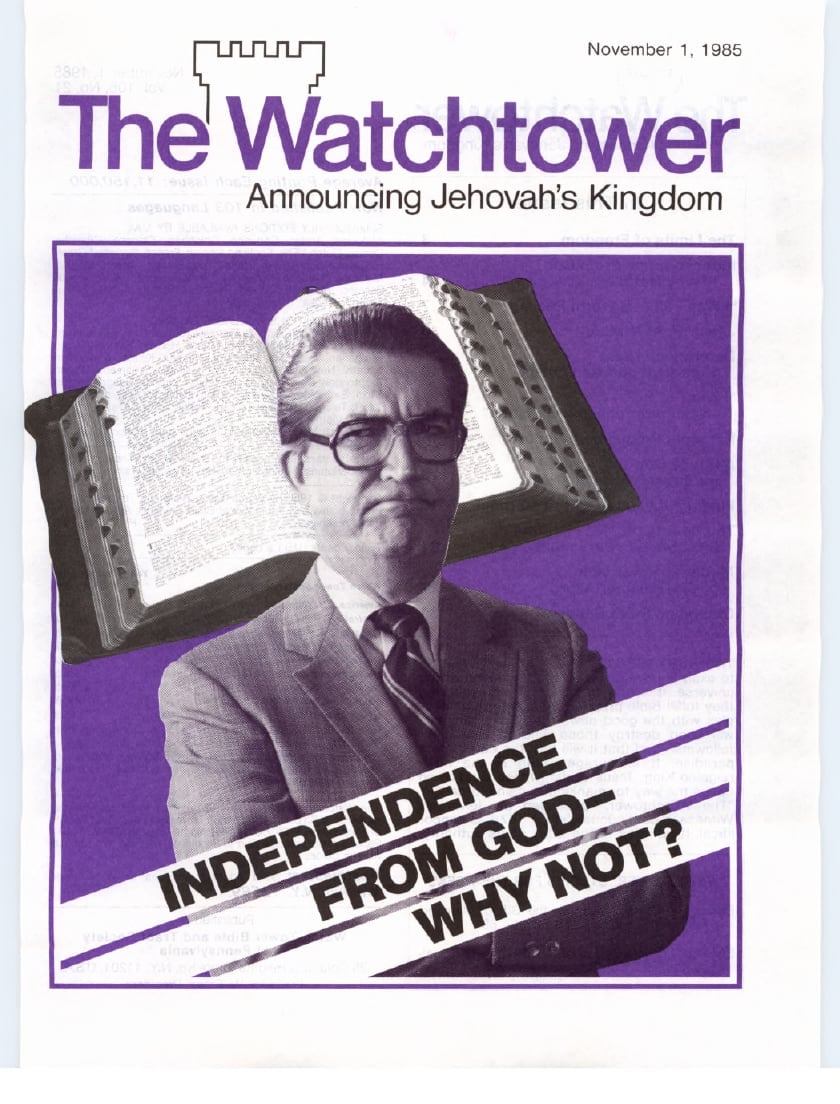
The Watchtower — November 1, 1985
Source: jw.org
Contents
The Limits of Freedom
Independence From God—Why Not?
“I Was Full of a Warm Feeling”
Jesus’ First Miracle
Determined to Be ‘Steadfast and Unmovable’
“I Want to Be an Uncompromising Christian”
Conventioners Commended
A Happy Day for Japan’s Missionaries
Finding Joy in the Gift of Marriage
The Beauty of the Christian Personality
Part 1—Modern Stewardship of God’s Sacred Word
Questions From Readers
How This Marriage Was Saved
The Limits of Freedom
The Limits of Freedom
“None are more hopelessly enslaved than those who falsely believe they are free.”—Goethe.
FREEDOM! What a ring that word has. But what does it mean to you? Does freedom mean that you have the inalienable right to do as you please, when or where you please, without regard for other people? Of course not! Limits are placed on your actions by lawmaking bodies to protect the rights and interests of others. Is this not vitally necessary when people live together as a community?
For example, you may have the freedom to travel, but you can operate your vehicle only within lawful limits. These limits, or laws, were established as a protection not only for others but also for you. Therefore, true freedom does not mean immunity from all restraint, discipline, and sacrifice; neither does it mean the absence of laws that are right and beneficial. Interestingly, Black’s Law Dictionary defines freedom this way:
“The state of being free . . . without other check, hindrance, or prohibition than such as may be imposed by just and necessary laws and the duties of social life.”
To enjoy freedom, we must live our lives within two boundaries—natural laws and moral laws.
Physical Laws Limit Man
It is impossible for any human to have total freedom even if he isolates himself on a tiny island in the middle of a vast ocean. The natural demands of his body and his dependence on the environment would impose limitations on his freedom. The Creator, Jehovah God, has established these natural boundaries and has established others by means of his laws and principles.—Acts 17:26-28.
God put in operation physical laws that keep the universe in marvelous harmony. These laws work for our good. For instance, do you feel tyrannized by God’s natural law of gravity? Of course not! It is the necessary force that holds the universe together and keeps you from flying off the earth.
However, what if you deliberately were to ignore the law of gravity and jump from a one-hundred-foot cliff? You would fall to your death or else be severely injured. The result: not freedom but an increase in limitations. We cannot slight physical laws without paying a penalty. Yet, when we work within their limits, we reap the benefits.
Laws to Limit Behavior
About 300 years ago, the English philosopher John Locke summed up what you may have discovered about freedom and human law. He wrote: “Where there is no law there is no freedom. For liberty is to be free from restraint and violence from others, which cannot be where there is no law; and is not, as we are told, ‘a liberty for every man to do what he lists [wishes].’ For who could be free, when every other man’s humour might domineer over him?”
How appropriate those words are when applied to human laws that limit harmful conduct! If man sees the need for law to govern social behavior, would not his Creator also have seen that need? Are we to think that God would cause physical laws to come into existence but leave mankind without laws to guide his conduct? Not at all.—Matthew 6:8.
The Creator’s laws for mankind are written down and preserved so that we can know the best way to handle our affairs. (2 Timothy 3:16, 17) Of their quality, The Bible in Living English says: “Jehovah’s instructions are unerring, life-restoring; Jehovah’s lessons are trustworthy, enlightening simpletons; Jehovah’s mandates are acceptable, gladdening hearts; Jehovah’s commandment is honest, brightening eyes.”—Psalm 19:7, 8.
A person trying to live free from all proper moral limits is like a ship that has lost both compass and rudder. Both are adrift and must find a safe course or face disastrous consequences. This, therefore, raises a serious question. Can we safely navigate our life independently from God?
Independence From God—Why Not?
Independence From God—Why Not?
“I’M LOOKING for excitement.” “I’m sick and tired of being told what to do!” “Get off my back!” Expressions such as these may indicate a spirit of independence. Sometimes these words can even be heard coming from the lips of Christians.
How may Christians be infected by the spirit of independence, even independence from God? Usually it begins by adopting a distorted view of Jehovah God’s requirements. (Psalm 73:2, 13, 14) They see God’s laws as fun barriers, rather than as protectors of their enjoyment of life. The glitter and glamour of the ungodly world has fooled them into believing that they are missing out on pleasure. What about you? What are your feelings about independence from God?
An Age-Old Problem
The wanting of independence from God is not new. It is almost as old as man. The spirit of independence was introduced by Satan the Devil. He deceived the first woman, Eve, into thinking that she could be happier if she were only free from her Creator’s guidance. Eve believed that such an independent course would open up for her many eye-opening experiences and pleasures withheld from her by God.—Genesis 3:1-5; Revelation 12:9.
With eyes blinded by her newly formed selfish desires, Eve appealed to her husband to join the rebellion. Adam chose independence from God too. The result: Sorrow replaced happiness. Sin, shame, sickness, pain, and death followed, not just for Adam and Eve but for all their offspring as well.—Genesis 3:6, 16-19; Romans 5:12.
The Bible records that angels, too, decided to follow the path of independence from God by seeking illicit pleasure with the ‘good-looking daughters of men.’ Did such an independent course bring genuine satisfaction? No. Rather, it produced so much gross immorality and violence that Jehovah determined to destroy that world of ungodly people. The independent angels became demons, who now promote this same destructive spirit of rebellion among mankind.—Genesis 6:1-7, 11; Ephesians 2:2; Jude 6-12.
The Need for Divine Guidance
The foregoing facts should help us appreciate a basic truth: In order to have a successful and delightful way of life, man must depend on God for guidance. That is one reason why the Bible says: “I well know, O Jehovah, that to earthling man his way does not belong. It does not belong to man who is walking even to direct his step.” (Jeremiah 10:23) The ancient wise man Solomon recognized the danger of setting up personal standards for life independent of divine guidance. He wrote: “There exists a way that is upright before a man, but the ways of death are the end of it afterward.”—Proverbs 14:12.
Let us illustrate this point in two ways. If all the commercial aircraft pilots ignored the directions given at airports and landed their airplanes at any time or location they pleased, how safe would air travel be? Or if a group of construction workers threw away the blueprints and each decided to do just as he fancied with his part of the construction, what type of building would result? We understand that standards must be followed if any orderly society is to exist.
No one is better qualified to provide these guidelines than the Creator of man, Jehovah. By reason of his Creatorship, Jehovah God, not the creature, man, has the absolute right to set the standards by which his intelligent creatures should live. He knows our limits; he knows exactly where the boundary line between happiness and sorrow lies. (Acts 17:26, 27) Time and time again, the experiences of life prove that God’s way really works. It is the best way for us.
We do not have to guess what Jehovah’s standards are; he kindly tells us in his Word, the Bible: “This book of the law should not depart from your mouth, and you must in an undertone read in it day and night, in order that you may take care to do according to all that is written in it; for then you will make your way successful and then you will act wisely.” (Joshua 1:8) The apostle Paul explains how all-embracing God’s standards are. He wrote at 2 Timothy 3:16, 17: “All Scripture is inspired of God and beneficial for teaching, for reproving, for setting things straight, for disciplining in righteousness, that the man of God may be fully competent, completely equipped for every good work.”
Jehovah invites us to test his standards, ‘to prove to ourselves the good and acceptable and perfect will of God.’ (Romans 12:2) Of course, to do this properly, a thorough study of the Bible is necessary. Whether we are new to Bible study or have been studying God’s Word for decades, the goal of gaining accurate knowledge and insight into God’s will is important. If we fail to train our perceptive powers by using them, we will not keep Jehovah’s guidelines in clear focus.—Hebrews 5:14.
To ignore God’s standards is to invite disaster. There are just too many obstacles that a person has to cope with for him to succeed on the basis of his own understanding. First, a person has to contend with the subtle superhuman influences of Satan and his demons. (1 John 5:19; Revelation 12:12) Then there is the worldwide human system of things imbued with the spirit of disobedience and extreme selfishness. (Ephesians 2:2; 1 John 2:15-17) And, of course, our own imperfections and deceptive heart-inclinations have to be fought. (Psalm 51:3-5; Jeremiah 17:9, 10) So to live without Jehovah’s guidance makes about as much sense as it does to ride in a car without a steering wheel.
Jesus Christ is the best example of someone who appreciated divine guidance. Although perfect, he said of himself: “The Son cannot do a single thing of his own initiative, but only what he beholds the Father doing.” (John 5:19) Jesus did not live to please himself. On another occasion he said: “I do nothing of myself: what the Father has taught me is what I preach; he who sent me is with me, and has not left me to myself, for I always do what pleases him.” (John 8:28, 29, The Jerusalem Bible) Do you desire to be guided by the same standard Jesus Christ acknowledged?—1 Peter 2:21.
Value of Accepting Divine Guidance
Jehovah is “the happy God.” (1 Timothy 1:11) He does not want to rob us of wholesome pleasure, excitement, or happiness. Think for a moment about the plainly stated words found at Romans 1:28-32. The results of independence from God bring only bad consequences, for the account states, according to The New English Bible:
“Thus, because they have not seen fit to acknowledge God, he has given them up to their own depraved reason. This leads them to break all rules of conduct. They are filled with every kind of injustice, mischief, rapacity, and malice; they are one mass of envy, murder, rivalry, treachery, and malevolence; whisperers and scandal-mongers, hateful to God, insolent, arrogant, and boastful; they invent new kinds of mischief, they show no loyalty to parents, no conscience, no fidelity to their plighted word; they are without natural affection and without pity. They know well enough the just decree of God, that those who behave like this deserve to die, and yet they do it; not only so, they actually applaud such practices.”
On the other hand, those who choose to follow God’s standards are encouraged to put away their old personality with its independent spirit and substitute for it a new Christlike one. The new personality includes becoming kind, tenderly compassionate, freely forgiving. (Ephesians 4:20-32) And it is one that manifests the fruits of God’s holy spirit: “love, joy, peace, long-suffering, kindness, goodness, faith, mildness, self-control.”—Galatians 5:22, 23.
After taking a good look at both personalities, what sort of person are you? Which of the two would you prefer to see in your associates?
In addition, the Bible teaches that in the very near future all ungodly persons will suffer destruction at the hands of God. (2 Peter 3:7; 2 Thessalonians 1:7-9) Jesus Christ predicted that, just prior to this divine cleansing of the earth, people in general would be as indifferent to following God’s standards as were the people in Noah’s day. (Luke 17:26-30) So it is urgent that we gain full appreciation for the value of the guidelines that God has set. To survive, this is just as necessary for us today as it was for Noah in his day.
Therefore, independence from God does not bring real happiness; doing God’s will does. Those submitting to Jehovah’s guidance will be rewarded with everlasting life on an earth filled with people who have the Christlike personality.—Psalm 37:27-29.
[Picture on page 5]
What type of building would be constructed if each worker threw away the blueprints and built as he pleased?
[Picture on page 6]
You have the freedom to travel, but to do it safely you must operate your vehicle only within lawful limits
“I Was Full of a Warm Feeling”
“I Was Full of a Warm Feeling”
Burt lives in England. He spent six weeks in Australia, visiting his brother Eric and his wife who are Jehovah’s Witnesses. Being of a different religion, Burt hesitated when his brother invited him to attend a meeting at the Kingdom Hall. But he was so surprised by the warm, friendly spirit with which he was greeted that, after his return to England, he wrote this letter of appreciation to the congregation:
“I must admit that I am not a Witness, being an active member of the Church of England, so it was with a certain amount of trepidation that I accompanied Eric and Joan to their Sunday worship.
“I need not have had any fears whatever. The welcome I received from almost the whole congregation was not only most brotherly and sincere but I was full of a warm feeling that, although a complete stranger, I was accepted, not so much as a visitor but as a welcome member of the congregation.
“While I did not fully understand your service and witness, I nevertheless took my leave at the end of the meeting feeling that I had benefited greatly from the experience and wondering why the love and sincerity that was evident during the whole service could not spread across this very troubled world of ours.
Yours very sincerely,
Burt B.”
Jesus’ First Miracle
Jesus’ Life and Ministry
Jesus’ First Miracle
JESUS and his newly acquired disciples have just left the Jordan Valley. It has been only a day or two since Andrew, Peter, John and perhaps James, Philip and Nathanael have become Jesus’ first disciples.
They are now on their way home to the district of Galilee, where all of them originated. Their destination is Cana, the hometown of Nathanael, located in the hills not far from Nazareth where Jesus himself grew up. They have been invited to a wedding feast in Cana.
Jesus’ mother, too, has come to the wedding. As a friend of the family of the ones getting married, Mary appears to have been involved in ministering to the needs of the many guests. So she is quick to note a shortage, which she reports to Jesus: “They have no wine.”
When Mary thus, in effect, suggests that Jesus do something about the lack of wine, Jesus at first is reluctant. “What have I to do with you?” he asks. As God’s appointed King, he is not to be directed in his activity by family or friends. So Mary wisely leaves the matter in her son’s hands, simply saying to those ministering: “Whatever he tells you, do.”
Well, there are six large stone water jars, each of which can hold over ten gallons. Jesus instructs those ministering: “Fill the water jars with water.” And the attendants fill them to the brim. Then Jesus says: “Draw some out now and take it to the director of the feast.”
The director is impressed by the fine quality of the wine, not realizing that it has been miraculously produced. Calling the bridegroom, he says: “Every other man puts out the fine wine first, and when people are intoxicated, the inferior. You have reserved the fine wine until now.”
This is the first miracle of Jesus, and on seeing it, the faith of his new disciples is strengthened. Afterward they, along with his mother and his brothers, travel to the city of Capernaum near the Sea of Galilee. John 2:1-12.
◆ When does the wedding in Cana occur?
◆ Why does Jesus object to his mother’s suggestion?
◆ What miracle does Jesus perform, and how are others affected?
Determined to Be ‘Steadfast and Unmovable’
Determined to Be ‘Steadfast and Unmovable’
As told by Paul Smit
IN THE 1830’s many white farmers of the Cape Province of South Africa were very restless. Being of Dutch descent, they found British rule irksome. Thousands trekked north into the little-known interior. After overcoming many obstacles, some settled north of the Orange River in what later became the Orange Free State. Others crossed the Vaal River and settled in what is now called the Transvaal. Among them were my Afrikaans-speaking forebears who settled in the Northern Transvaal in the 1860’s. I was born near the small town of Nylstroom in 1898.
The life-style of the few inhabitants of the area was very simple in those days. The plentiful game was the main source of livelihood, supplemented by some farm produce. Then, in 1899, came war—the South African, or Boer, War. The British had decided to extend their authority over the two Afrikaner Republics, the Orange Free State and the Transvaal. So for three years Briton and Boer (“farmer” in Afrikaans) fought bitterly for supremacy. In the course of this period, our family was interned in a concentration camp.
When hostilities ceased, we returned to find our farm badly damaged and ransacked. There had been terrible suffering. Thousands of men had died fighting, and thousands of women and children had expired in concentration camps. The country was poverty stricken. So were we. However, a government grant of wheat helped us to survive, and my parents worked industriously on the farm, growing vegetables and other produce.
The Truth Causes a “Cyclone”
Then came the memorable year 1915. As a schoolboy of 16, I received through the post a booklet entitled What Say the Scriptures About Hell? published by Jehovah’s Witnesses of that time. A school friend, Abraham Stroh, and I read it together and agreed it was the truth. It was thrilling to learn that God does not torment people forever; the dead are unconscious, asleep in death, and awaiting Jesus’ promise of a resurrection. (Ecclesiastes 9:5, 10; Ezekiel 18:4; John 5:28, 29) We were enthused into action. Nylstroom became a centre of commotion, as if struck by a cyclone, as we two schoolboys made it known, positively and fearlessly, that the doctrines of the Dutch Reformed Church were false. The clergy, of course, were upset and denounced this “new religion” from their pulpits.
As a result, Abraham and I were no longer welcome at our friends’ homes. Even my father threatened to put me out of the house. But my mother, a really sheeplike person, never said an unkind word. In time my dear old father, who had deep respect for the Bible, got used to the “new religion,” and Witnesses were hospitably entertained in our home. In those early days, we knew nothing of the Society and relied entirely on Jehovah. Later, colporteurs (now called pioneers) visited us and brought us into contact with the Society and its office 1,000 miles (1,600 km) away in Cape Town. This led to my baptism in 1918.
Two years later I attended an assembly in Pretoria. Some 23 brothers and sisters were present, with Brother Ancketill, the Society’s representative, presiding. How grand it was to be with fellow believers even though there were so few of us! The programme was composed mainly of doctrinal matters and “testimonies,” or experiences, but was sufficiently stimulating for me to remain firm. I needed it.
A Disappointment—Then Blessings
The greatest shock of my life came when my close friend, Abraham, after leaving school and being employed by the local School Board, was later threatened with dismissal unless he gave up his religion. He did leave the truth and joined the Dutch Reformed Church. That left me, young and new in the truth, entirely alone in the Northern Transvaal. I shed many a tear over losing my companion, but I prayed without ceasing to Jehovah and was strengthened to be “steadfast, unmovable, always having plenty to do in the work of the Lord.”—1 Corinthians 15:58.
Then came the early 1920’s. Jehovah blessed my persistent efforts to live the truth to the best of my ability. I began to find “sheep” in my neighbourhood. The young son of a nearby farmer accepted the good news of the Kingdom, thus making up for my loss of a companion. This brother, Hannes Grobler, remained faithful until his recent death. I also started a study with a family of seven, the Vorsters, using the book The Harp of God.a
Every Saturday I happily walked four miles (6.4 km) through the veld, or countryside, to conduct the study. The parents became baptised Witnesses and remained faithful until death.
In 1924, Brother George Phillips, who had recently arrived in South Africa to serve in the branch at Cape Town, made a visit to Nylstroom—a thrilling event for me. It began a close friendship and period of theocratic cooperation lasting until he finished his earthly course in 1982.
The local interest developed, and we soon had a fine group of 13 brothers and sisters—the first Witness group north of Pretoria. In time the message of the Kingdom radiated out into the vast area of the Northern Transvaal.
Problems and Progress in Pretoria
However, that same year my bank employers transferred me to Pretoria, where there was a small group of eight Bible Students (Jehovah’s Witnesses). But only one had a proper appreciation for theocratic matters, and he died soon after I arrived. The others—some were educated men—failed to appreciate the arrangement of the Society to organize the congregations for service, and two of them left.
Meanwhile, the “elder” of the group, in spite of the Society’s disapproval, was writing a book with his own interpretation of the Scriptures. I personally appealed to him to abandon the idea. The climax came one Sunday morning. His book was already printed, and he brought some copies and asked the group to distribute it. I was shocked. I stood up and opposed his request. As a result, the “elder” and four or five others left the organization. This left only a dear old invalid sister, together with my wife and me. But we were determined to be ‘steadfast and unmovable’ and loyally support the Society. From then on, slowly but surely, Jehovah gave the increase.—1 Corinthians 3:6; 15:58.
In due time Jehovah added many more workers to the Pretoria Congregation. For example, in 1931 two black brothers came to our study centre and introduced themselves. After that, for some years it was my responsibility to serve both Europeans (whites) and Africans (blacks)—a rare privilege in South Africa. To help the African brothers, I conducted a group study in their own township, or separate residential area. I also used Brother Rutherford’s recorded talks in the township. In addition to this, an African brother, Hamilton Kaphwitti Maseko, used to help me every Sunday evening to transmit these lectures by means of a powerful transcription machine on Church Square, the very heart of Pretoria.
With Jehovah giving the increase, an African congregation was formed. For many years, as city overseer, I arranged their special meetings. From small beginnings, the work among the Africans in Pretoria expanded to 16 congregations in the area by 1984.
A Wartime Ban
The outbreak of World War II in September 1939 brought tremendous suffering to many countries. South Africa, however, was an exception. Nevertheless, because of the world-shaking events, many South Africans awoke from their complacency and directed their minds to the fulfillment of Bible prophecy. As a result, there was an outstanding growth in Kingdom activity with a 50-percent increase in publishers for the 1941 service year. This aroused the ire of the churches, notably the Catholic Church, which accused the Society of being dangerous to the State. The Government then banned many of the Society’s publications.
About that time, my wife Anna and I with our two children, Paul and Anelise, paid a visit to Nylstroom, where I had to give a talk. I took the opportunity to show the local brothers the feasibility of presenting our magazines on the street. I chose a position just outside the Magistrate’s Court. Soon a Police Sergeant told me that I was doing an illegal work and must report to the Charge Office immediately. Nevertheless, since we had decided to work for an hour, I just carried on. Then a constable came to inform me that the Chief of Police was waiting for me. But I did not move. Another constable came with a similar message and got the same response. We completed the hour with good results, and then my family and I retired to a café for a cup of tea.
When I finally went to the Charge Office, I was asked what had happened to the literature. I explained that it had been distributed to the public. Later, the police came to my parents’ farm where we were staying and took all the magazines they could find.
After discussing the matter with local brothers, we decided not to take the matter lying down. So the next week 30 of us were out in full force on the streets of Nylstroom, and the following week at Warmbad, 18 miles (29 km) south. Contrary to expectations, no one stopped us. Later, after considerable difficulty, all the publications not under ban were returned.
‘Steadfast and Unmovable’ Despite Old Age
My wife Anna gave me loyal support until she died in 1949. Since 1954, when I remarried, I have had the loyal support of my dear wife Maud. From an early age, the two children, Paul and Anelise, accompanied me in all features of Kingdom service. Both became pioneers on leaving home. Anelise and her husband, Jannie Muller, are still in that service. Paul later drifted away from the truth and pursued a university career, but in recent years he has renewed his association. My five grandchildren are Jehovah’s Witnesses; two of them, together with their marriage mates, are serving full time in the ministry. I can strongly recommend that parents keep close to their children and, by precept and example, train them to love Jehovah and serve him whole-souled.—Deuteronomy 6:6, 7.
During 69 years of theocratic service, I have seen thrilling expansion. Back in 1931 there were five Kingdom proclaimers in the vicinity of Pretoria. Now there are over 1,500 associated with 26 congregations. All praise and honour for this belong to Jehovah! Now, at 86 years of age, health permitting, I still enjoy the challenge of house-to-house witnessing and offering the Watchtower and Awake! magazines on the street. Maud and I are determined to be ‘steadfast and unmovable,’ faithful to Jehovah, blessing his name forever and ever.
[Footnotes]
Published by the Watch Tower Bible and Tract Society.
“I Want to Be an Uncompromising Christian”
“I Want to Be an Uncompromising Christian”
After reading a book entitled “Let Your Kingdom Come,” published by the Watchtower Society, a young man in Zimbabwe was moved to write the following:
“I have been observing over the past few years that here in Zimbabwe it is you people, Jehovah’s Witnesses, who are really trying to follow Christ’s own example. I am a Seventh Day Adventist member, but it seems as if my Church in this country has lost the inspiration of the holy spirit. We are compromising with the world. For example, we believe, just as you do, that Christ was not born on the 25th [of] December, and yet our pastors tell us that we can celebrate Christmas as long as we keep in mind that Christ died for our sins. . . .
“Personally, I am sick and tired of professing to be a Christian while my way of life is contrary to Jesus’ example. I want to be an uncompromising Christian . . . You are the only group, so far, that has managed to convince me of God’s love and the power of His gospel, through your living and not only through speeches and writings. You are living and preaching the gospel while many, many people are preaching the gospel but not living it.”
Conventioners Commended
Kingdom Proclaimers Report
Conventioners Commended
“KEEP doing good, and you will have praise from it,” said the apostle Paul at Romans 13:3. This proved true at last year’s “Kingdom Increase” conventions in Brazil.
For example, after the convention in João Pessoa, the club director told the convention committee: “I congratulate you for the excellent way the assembly was held and for the fine behavior of you and your children. No other religious organization displays such good conduct. When we rent to you, we have no worries. The club doors are always open whenever you want to use our facilities.”
Similar comments were heard from many others:
□ “I have worked for years with large crowds of people, but you are the best organized, the cleanest, and the most cooperative.”—The administrator of the Maracanãzinho Stadium in Rio de Janeiro.
□ “I am really impressed with your movement. If Jesus Christ were to come now, I believe that the religion he would approve would be yours.”—A fireman on duty at one of the Rio de Janeiro conventions.
□ “You don’t bother us [policemen] a bit. I just wish that everyone was like you people. It would be marvelous. When I blow my whistle, I know that I’ll be obeyed without any argument.”—A traffic policeman assigned to the convention in Curitiba.
□ “We want to take this opportunity to congratulate you on your orderliness and marvelous, spontaneous discipline, and we wish you every success in future events, for which this Prefecture [Municipality] is always at your service.”—A letter received by the convention overseer from the mayor’s office in Santo André.
□ “There was a great contrast between your behavior and that of others who have used our hotel rooms. Your people kept all the installations clean and orderly, and their conduct revealed flawless respect for others.”—A hotel manager in Novo Hamburgo.
□ “You folks must be well paid.”—A bakery owner supplying bread for the convention in Sorocaba, after seeing how hard the brothers there worked. When he learned that they were all unpaid, volunteer workers, he returned to his bakery and brought his whole crew to the stadium to observe their diligence and dedication!
The Brazilian conventions even came to the attention of the news media. The Tribuna da Bahia gave this report: “With Bible in hand, looking in its verses for an explanation for human violence and deceit, the Witnesses do not discuss politics, do not interfere in social procedures, and know nothing about direct elections. Justification for this is in the fact that no matter who is the ruler, he will never be balanced, since only God can govern the world perfectly. . . . The basis for their faith is the coming of a new world that can be attained only by untiring study of the Bible and by changing evil habits to a pure heart.”
Of course, Jehovah’s Witnesses make no claim of being perfect but believe that God’s Kingdom will bring in a perfect new order. They have, nevertheless, endeavored to apply the Bible’s counsel at 1 Peter 2:12: “Maintain your conduct fine among the nations, that . . . they may as a result of your fine works of which they are eyewitnesses glorify God.”
[Picture on page 14]
Christian conduct glorifies God
A Happy Day for Japan’s Missionaries
A Happy Day for Japan’s Missionaries
FRIDAY, May 17, 1985, was a spiritually sunny day for Japan’s 76 missionaries. As the largest group in any one country, these missionaries after nearly 40 years are still actively spreading Bible truths. Excited about this once-a-year privilege of getting together, they made their way to the Ebina branch from their ten missionary homes scattered throughout the country. Some came from distant assignments in the traveling work.
Enthusiastic greetings and conversation among this happy group were interrupted at 1:00 p.m. The zone overseer called the meeting to order. As roll was called, each missionary told his country of origin, Gilead class number, and years in foreign service. How encouraging it was to see missionaries from as far back as the seventh class still active and faithful in their assignment after some 37 years! Following the presenting of information on the establishment of Gilead School in 1943, the zone overseer warmly commended the missionaries for learning the difficult Japanese language. Next, questions were entertained on improving the Bible educational service offered to the people of Japan. A lively exchange followed.
Experienced ministers told how they use the booklet “Look! I Am Making All Things New” to give an overall view of the Bible’s historical record and teachings. Regarding this discussion, one missionary summed up everyone’s feelings like this: “It was so satisfying to know how much the brothers at headquarters care about helping the work here—just knowing that keeps us going.” All the missionaries were overjoyed at being able to “share in the meeting” and, as they said, “express our needs for effectively carrying out the ministry that is so close to our hearts.” One missionary appreciated that such interest on the part of Jehovah’s organization truly “showed an effort to understand the situation” there. Another declared, “We were especially glad for the suggestion to prepare various presentations to cope with the problem of frequent territory coverage.”
After this animated discussion, the missionaries were next treated to spiritually stimulating answers to Bible questions. Some said, “This presentation was reminiscent of Gilead days.” Another noted: “It helped me to be determined really to dig into God’s Word.” All then adjourned to one of the dining rooms for refreshments and to get reacquainted with those from distant assignments. The evening was spent considering many interesting experiences as told by missionaries who shared in them. One involved a young woman who was moved to learn the truth because as a child she had observed the fine conduct of busy missionaries who lived near her home in Nagasaki. Today, both she and her husband are in the truth! Another told of a good Bible study that was started because the missionary had made “that one last call” at the end of the day.
Filled with renewed zeal and enthusiasm, the missionaries returned home to their assignments refreshed and grateful for the personal care extended to them by Jehovah through his loving organization. On the following Sunday, the zone overseer, A. D. Schroeder, addressed by telephone tie-in an audience of 174,959 assembled throughout Japan. As the climax to his talk, he released the Japanese edition of the 1,792-page New World Translation of the Holy Scriptures—With References—another fine new instrument for use by Japan’s 102,206 Witnesses!
Finding Joy in the Gift of Marriage
Finding Joy in the Gift of Marriage
“What God has yoked together let no man put apart.”—MATTHEW 19:6.
1. What familiar words of Jesus are well known in Christendom, but what questions are there in connection therewith?
ARE those words familiar to you? They are no doubt familiar to millions of people in Christendom, who make up a large portion of the world’s population, for they are the words of the Lord Jesus as he spoke to the religious Pharisees of his day. While the words may be familiar, what about the meaning of the statement of Jesus? Is the import of such advice followed by mankind in general? Let us see.
2-4. (a) What is the situation today in many lands as far as heeding Jesus’ words at Matthew 19:6 is concerned? (b) What attitude is revealed by those who ignore the Bible’s advice on the permanency of marriage?
2 In many lands today, there is very little regard on the part of the people for the marriage arrangement and for continuing that which God has yoked together. Divorce has reached what could be described as epidemic proportions in country after country. In lands where divorce is not legally permitted by the government, the picture is no brighter, for in such lands people often leave marriage mates and take up living with someone else. So the worthy advice of Jesus at Matthew 19:6 is not being heeded by millions of people in Christendom and elsewhere. Is this because the advice Jesus gave is bad, or is it because people do not listen when Jesus speaks, and they care little about the advice of Jesus in this regard?
3 The evidence is that a large percentage of people do not view marriage as a lifetime contract if it interferes with their own life-styles and desires. To such ones, a marriage need be only a temporary arrangement if it interferes with one’s pursuits, likes, or dislikes. So it would almost seem that as easily as one sheds a coat or a hat, others shed a marriage mate, never thinking for a moment about the advice Jesus gave to those who enter into the marriage relationship.
4 With this everybody’s-doing-it attitude so prevalent, those wishing to follow the secure advice of the Bible can be influenced in a manner that leads them away from the good teaching of God’s Word. Fine counsel is given by the printed page and orally, but failure to heed the Bible’s advice can lead to marriage problems. (Compare Psalm 19:7-11.) If we adopt the attitude that anything in marriage interfering with our life-style, our pleasures, our desires, can be changed by our not abiding by God’s directions on marriage, then we are in danger. To have such an attitude brings us face to face with one of mankind’s greatest problems, that of selfishness. For generally it is selfishness that lies at the root of marriage problems. Why do we say that?
The Role of Sin
5. How does the apostle Paul at Romans 7:15-20 outline the problem we have as a result of being born in sin?
5 Men and women, offspring of Adam and Eve, are born in sin and imperfection. This means that because of the inheritance of sin, man misses the mark and is lawless to one degree or another. (1 John 3:4) The apostle Paul spoke of the tremendous burden sin places upon mankind, for he found himself doing what he did not want to do and not doing what he should do. (Romans 7:15-20) Anyone deliberately breaking God’s law is selfish. With some individuals it may be selfishness on a small scale, but with others it becomes the total way of life, and their selfishness becomes gross.
6, 7. What are two problems selfishness causes in marriage, leading us to what logical question?
6 In the arrangement of marriage instituted by God, it is selfishness that is often at the root of a problem between marriage mates. The woman who wants to be waited on hand and foot, as the expression goes, as she may have been spoiled by her mother or father, is basically selfish. The man who wants to continue a life-style of singleness, that of always being with the “boys” after his marriage, is basically selfish. Think about all the ways in which husband and wife have differences, and you will see that selfishness is at the root of so many of the problems.
7 In striving to cope with the problems occurring in marriage, how does one overcome this inborn tendency toward selfishness? There are a number of things that can be done and which, when applied, can help a marriage that is foundering. But each partner in the marriage arrangement has to be willing to do his or her share. It is not a one-way street. Let us examine some of the factors involved.
Unselfishness in Marriage
8. How is marriage a sharing?
8 Marriage is a sharing, meaning that neither marriage partner can take the other for granted and feel that only as long as one of the partners gives and the other takes will all be well. That will not work to the blessing of either. For example, the relatives on both sides have to be taken into consideration. This should not be allowed to become a sore point in the marriage arrangement, so that one’s own parents or other relatives are taken into consideration and not those of one’s mate. Where a family will spend vacations or other periods of relaxation should not always be one-sided decisions. Thoughtful concern shown in such matters will help make a marriage successful. Never take each other for granted but display unselfishness.—Philippians 2:4.
The Age Factor
9. To what unfortunate results does a light view of marriage lead?
9 Because of the prevailing view among many of this generation that if a marriage does not work out it can be terminated in divorce, many young people start out with that light view of the marriage arrangement. This can and does lead to breakups of many teenage marriages. It also leads to bringing many unwanted children into the world. These young ones often grow up never knowing what it is to have a mother and a father who deeply love and care for them.
10. In what ways can Galatians 5:22, 23 be of help to those considering marriage?
10 How old should a person be before considering marriage? It would not be the course of wisdom to make rules on this score. Yet the Scriptures give good advice on what constitutes mental and spiritual maturity—the kind of maturity needed by those entering married life. Please read Galatians 5:22, 23, wherein you will find listed the fruitage of the spirit. Examine carefully each one of the fruits there mentioned. Those are the qualities that one needs to cultivate in life. It is not after marriage that a person should begin showing such qualities but long before in his daily life as a Christian.
11. What self-examination may be made by those contemplating marriage?
11 For example, are you a person who is joyful in life, happy to be alive, serving the interests of the Kingdom of Christ? Are you at peace with others, promoting peaceful relations with them? Or are you contentious, given to fits of anger and abusive speech? Are you long-suffering, able to put up with the weaknesses of your brother or sister, mother or father? Or are you short-tempered and prone to anger if others do not immediately line up with what you want? Do you find that you show kindness to others in your dealings with them, being mild and doing good to them? Or are you selfish, egotistical, lacking in self-control, apt to fly off at others with the least provocation? Have you genuine love for others, wanting to help them, going out of your way, giving of yourself and your resources to bring happiness to others? Or do you want others to show love toward you, always giving to you from their resources?
12. The man or the woman whose life has been molded prior to marriage holds what advantage?
12 It is correct to say that none of us have these qualities in a perfect way. However, the man or the woman who has been molded by some years of life, and who has had an opportunity to cultivate such spiritual qualities, is in a fine position to make a success of marriage—a much better position than that of the person who does not start trying to master these fruits of the spirit until after the marriage vows.—Compare 2 Peter 1:5-8.
13, 14. (a) What opportunity does the passage of time provide with regard to cultivating spiritual values? (b) What can parents do to assist their children?
13 Why not honestly examine yourself, your likes and dislikes? Do you not see that your appreciation for life has been enhanced by the passage of time? Did you have the same values at 13 that you had at 5, or the same values at 20 that you had at 13? Has your understanding and appreciation for life grown or lessened as you have gained greater experience over the years? Do you now, as an adult, look for the same qualities in people that you did as a child? Is it not often true that the “only” boy in a girl’s life when she is 16 or 17 years old is long forgotten as she grows to womanhood and attaches greater importance to a man’s godly traits and personality? Her view at 22 or 23 years of age will likely be centered more on the spiritual, mental, and emotional aspects of a man than on the physical characteristics. The same can be said for the young boy growing to manhood. His hopes and aspirations as far as a wife is concerned ripen as he matures. In his later years, as values change, what he will look for in a marriage mate is someone who is understanding and kind, who has ability to be a homemaker and a mother, and who has in her heart a deep-seated desire to please first her Creator, Jehovah, and to do his will.—Proverbs 31:10, 26, 27.
14 The point of the matter is that time changes a person’s outlook on values. Therefore, rushing into matrimony at a young age is fraught with many dangers. It may not be possible to persuade two very young persons to wait for some time to pass before entering into a marriage. But parents, especially in the early years of their children’s lives, can encourage them to think seriously about life, about being spiritually, emotionally, and mentally prepared for marriage before entering into a lifetime contract with another individual for better or for worse.
15. Since late marriage is not always the answer to all problems, what counsel is provided about keeping the right outlook?
15 This is not to say that marrying when one is older is the total answer either. There can be problems then as well, especially if the attitude of selfishness is allowed to creep in and drive a wedge between two people. The mental, emotional, and spiritual needs of each one in the marriage bond must be taken into consideration. Some Christians have allowed themselves to become deeply involved in secular work, to the exclusion of congregational activity, including attending meetings and sharing in the preaching and disciple-making work. Then they try to make up for what they feel is a lack in their lives by indulging in a lot of recreation. They seem to think that as long as they are occupied, their problems will somehow be solved for now, and then in the New Order of things they will get around to each other’s needs emotionally, mentally, and spiritually. But life does not work that way. Paul’s advice was that a man should care for his wife as he does for his own body. (Ephesians 5:28) That means giving attention now to the needs of his mate, even as he daily gives attention to his own needs. The same can be said for the woman.
A Balanced Approach to Married Life
16-18. (a) Why is a balanced approach to life and marriage necessary, and how are we cautioned with regard to our wants and others’ needs? (b) Why is it good to ponder on such matters before marriage?
16 A balanced approach to life will assist in a balanced approach to marriage. The balanced person will realize that due to inherited selfish tendencies he must at all times work to overcome such blemishes. It is so easy never to think of the needs of others as coming before one’s personal wants. The small child wants all the toys and generally, if not properly trained by the parents, will not share these with others. His selfishness will, in later years, stretch into other fields. Thus we often find the teenagers and young adults wanting things exclusively their own way, and in their quest for satisfying their wants, they are unconcerned that others may be hurt or suffer. In later adult years, such persons are always craving what they like, not caring in the least about the needs of others.
17 The balanced person will not deprive himself entirely, but he will manage his individual life so that others, too, are taken into consideration. He will ask what he can do to assist others, to give of himself and of what he has to benefit others. He will not insist on having his own way first, last, and always. The book of Proverbs says: “The generous soul will itself be made fat, and the one freely watering others will himself also be freely watered.”—Proverbs 11:25.
18 Following such a course in single life will be most beneficial to a person later in married life. His or her mate will always be taken into consideration in any decisions made. Rather than thinking of marriage as an experiment or a temporary arrangement, such a person will look at marriage as the permanent arrangement Jehovah God had in mind when he joined the first human pair together in Eden. (Genesis 2:22-24) At every turn, efforts will be made to keep the marriage together, to help the mate, as both grow in appreciation for God and for each other.
In Summary
19-21. (a) How can we make sure we will not view marriage as just an experimental arrangement? (b) What should be borne in mind by all persons, young or old, who seek genuine happiness in marriage?
19 “What God has yoked together let no man put apart.” Yes, those words of counsel by Jesus are filled with meaning for the true Christian. Marriage is no experimental arrangement that can be dropped if one finds the going difficult. We must constantly battle the imperfect flesh to keep the human tendency to selfishness in check and so gain God’s approval. (Compare Romans 7:21-25.) To make a success of the marriage contract, both partners must learn to give and take, to provide and be provided for, and never to take the other for granted.—Ephesians 5:21-23, 28, 33.
20 And while no set age can be insisted upon as a rule of law for a person wanting to get married, beyond that which is set as the legal age by government, each one can certainly bear in mind the need to grow spiritually in harmony with Galatians 5:22, 23, in order to be a well-qualified marriage mate. Time does indeed change the outlook of a person. Hence, no one should rush into marriage. First, let each one cultivate the Christian personality so as to be properly prepared for the marriage yoke. And never forget that no one should put apart that which God has joined together.—Matthew 19:4-6.
21 By taking the balanced approach to life and then to marriage, one can find genuine joy and happiness in the arrangement ordained by Jehovah God himself for man and woman, as shown by the first marriage in Eden. (Proverbs 5:18) But just what can each one further do in life to prove himself or herself prepared to take on the role of husband or wife? Read, please, what follows on this matter as regards the personality of Christian men and women.
In review, how would you answer the following?
□ What attitudes toward marriage are to be avoided?
□ How may mates cope with inborn tendencies toward sin?
□ Why should youthful Christians not rush into marriage?
□ What balanced approach to married life is recommended?
[Picture on page 19]
Honest self-examination can reveal faults for us to remedy
The Beauty of the Christian Personality
The Beauty of the Christian Personality
“Put on the new personality which was created according to God’s will in true righteousness and loyalty.”—EPHESIANS 4:24.
1. What beauty do we here desire to describe?
THERE is a saying that ‘beauty is in the eyes of the beholder,’ meaning that beauty is relative. What is the beauty of a Christian man or a Christian woman? That is what we want to discuss now.
Defining Beauty in the Christian Man
2. Why do physical attributes alone fail to make a man of God?
2 Let us begin by considering the qualities that give a Christian man the pleasant appearance that will cause others to be pleased to be in his company. Physical qualities alone do not make a “man of God.” (1 Timothy 6:11) A man’s outward appearance, becoming as it may be, means little if he is empty-headed in his reasoning. If he is proud, rude, uncouth, and ignorant, he does not attract—he repels. If his manners show him to be unappreciative, he certainly can be a cause for stumbling to others. If he is only concerned with himself and how he looks or impresses others, he will not be the kind of person with whom others want to associate.
3, 4. (a) What are some of the qualities of a man of God as exemplified by the man Jesus Christ? (b) How would you explain some of the characteristics of a man of God?
3 Rather, a man of God will have cultivated the qualities of justice, mercy, love, and kindness. Jesus Christ was not known for his perfect body but for his loyalty to principle and to truth. His way of teaching identified him as one who spoke with authority from God. (Matthew 7:28, 29; John 7:46) A man of God will not be corrupted by the desire for power or prominence. The advantages of a certain position cannot buy him. He is a man who possesses willpower. He loves humility and will not lie. He displays a wholesome fear of Jehovah. (Proverbs 22:4) These are some of the qualities that are to be found in a man of God.
4 A man of God has conscience, a good heart, and proper motive. (1 Timothy 1:5; Proverbs 4:23) He will not do things that violate his conscience, ignoring righteous principles. Having a good heart and proper motive, he will not use devious methods in his dealings with others. (Hebrews 13:18) He will not allow his good motives to be undermined by unclean conduct and actions. (Hosea 4:11) He consistently disciplines himself to keep his heart from becoming treacherous. In word and in deed he stands out as a man of principle.—Psalm 15:1, 2.
5. What role does compassion play in the life of a man of God?
5 A man of God has compassion for others, is forgiving and kind. A compassionate man is a sympathetic man. He can show empathy and understanding when others have problems that are difficult to deal with and that bring anxiety. More than that, he can be forgiving when someone does him wrong. He can rise above the instinctive desire to repay injury for injury and reviling for reviling. Truly he fits the words of 1 Peter 3:8, 9. By bestowing a blessing rather than a cursing, he shows himself to be kind and in control of those baser desires that mark the petty man, the man without ability to be compassionate, forgiving, and kind to others.—Ephesians 4:31, 32.
6. (a) What other outstanding qualities of a man of God are there, and what do they mean? (b) What view will such a man’s wife and children have of him?
6 Another outstanding quality marking a man of God is his generosity. And if married, he is a true husband and an honest father. In his capacity as a married person, the man of God has a tremendous opportunity to be an influence and pattern for good both for his wife and for his children. (Colossians 3:19, 21) In the matter of being generous, such a man follows the fine advice of the Lord Jesus Christ, who said: “Practice giving, and people will give to you. They will pour into your laps a fine measure, pressed down, shaken together and overflowing. For with the measure that you are measuring out, they will measure out to you in return.” (Luke 6:38) In his family relationships, such a man will indeed care for those of his household. But he will also follow the fine admonition of Ephesians 4:28, to do “what is good work, that he may have something to distribute to someone in need.” As a true husband, the man of God will keep fidelity in the marriage arrangement. His wife will be able to have complete trust and confidence in him as a man that truly is one with her in the marriage bond. (Proverbs 5:18, 19) Additionally, if there are children, he will show himself to be an honest father, not a cheater or dishonest in his dealings with others. Thus, he will inculcate the principles of honesty in his children. (Proverbs 4:1-5) What a fine example such a man is to the impressionable mind of his children! They will be able to look to him as a loyal man, an integrity keeper.—Proverbs 11:3, 4.
7. What balanced view of indebtedness will be taken by the man of God?
7 In this respect also, the man of God will watch that he and his family do not accumulate burdensome debts, knowing that these can lead to trying problems. This, of course, means he will not allow himself and his family to live beyond their means. He is a person who will count the cost before embarking on a particular course. (Luke 14:28-30) He can deny himself in the present time for the sake of the future and is able to give up the seen for the unseen, as it were. (Compare Hebrews 11:8-10.) Living in this way will help the man of God to maintain his Christian scruples in his everyday living.
8. How will such a man face unpleasant circumstances in his life?
8 In the lives of all mankind, due to sin and imperfection, it is necessary to face up to unpleasant circumstances at times. But the man of God will be courageous and principled in such situations, after the pattern set by Jesus. (John 16:33) In the strength of his God, Jehovah, he will face the difficult problems with courage, relying on Jehovah for help and guidance.—Proverbs 18:10.
9. How would you describe the moral life of a man seeking to please Jehovah?
9 A true man of God is the master of his body. That is, he keeps his desires and passions under control, aware that his body is a proper servant but a very bad master. He remembers constantly the inspired words of the apostle Paul: “I pummel my body and lead it as a slave.” (1 Corinthians 9:27) Therefore, he seeks always to cultivate that fruit “of the spirit . . . self-control,” avoiding those things that would corrupt him. (Galatians 5:22, 23) He is wise in knowing that giving in to immoral thinking can lead to immoral action. Again, his reliance is on his God, Jehovah, and the strength He supplies.—Philippians 4:13.
10, 11. (a) What redeeming quality is exhibited by a man of God when he makes errors in judgment? (b) What pattern will family heads follow with regard to family study?
10 And finally, the man of God can admit his mistakes, say he is sorry, express such sorrow to his marriage mate and to others he may offend or hurt in one way or another due to his imperfections. He can go to Jehovah and with a clean heart ask to be forgiven of his sins because he has asked his wife, his fellowman, his children, to forgive him. The ability to say, “I’m sorry, I was wrong” is indeed the mark of a real man, especially of a man of God.—Matthew 18:21, 22; Mark 11:25.
11 Would you not say that a man, a husband, a father, of that caliber would have the help of Jehovah? (Psalm 54:4) Indeed, he would be equipped to cope with the problems that this modern world brings on all of us due to Satan’s designs and purpose to wreck everything good, including marriage and the happy family unit. He would look after the spirituality of family members, leading them in regular study of God’s Word and in prayer, after the pattern of faithful servants of God in Bible times.—Deuteronomy 11:18-21; Proverbs 7:1-3.
12. What important role will we next consider?
12 But there is more to consider. There is also the role of the wife in coping with problems in the family. Let us now give our attention to those qualities she will want to cultivate in her life.—Proverbs 19:14.
Defining Beauty in the Christian Woman
13, 14. What steps can a woman take to win the approval of Jehovah and, if she is married, of her family, and what was the apostle Peter’s counsel at 1 Peter 3:1-5 to womankind?
13 The book of Proverbs tells us something about a woman of God: “Charm may be false, and prettiness may be vain; but the woman that fears Jehovah is the one that procures praise for herself.” (Proverbs 31:30) How, then, does a woman acquire those qualities that endear her to her husband and children, or to others if she is single, and make her a person that others enjoy being near? To begin with, a woman of God is an openhearted person, meaning that she is generous, desirous of helping others in whatever ways she is able, materially or spiritually. When there are those in need, she is among the first to want to help, taking a genuine interest in the needs of others. But, of course, she balances such interest with the care and attention she, if married, must give to her own family.—Titus 2:3-5.
14 Further, such a woman is humble-minded, not haughty; kind, not surly; tidy, not unkempt; sympathetic, not belligerent. And, if married, she strives to follow the counsel that the apostle gives at 1 Peter 3:1-5.
…