The Watchtower, August 1, 1985
Download: PDF — The Watchtower, August 1, 1985
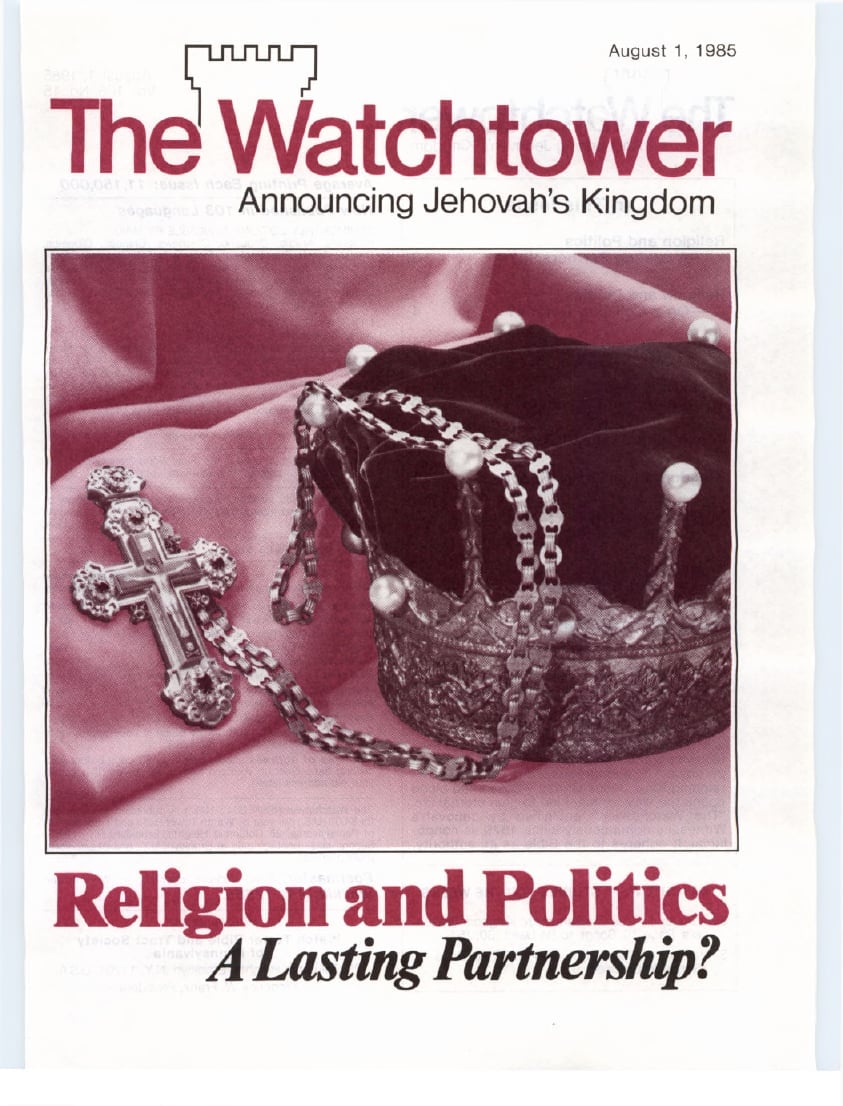
The Watchtower — August 1, 1985
Source: jw.org
Contents
Religion and Politics—A Lasting Partnership?
Religion and Politics—On a Collision Course?
Jesus’ Early Family Life
True Christians Are Kingdom Preachers
Teach With Skill and Zeal
‘They Adorn the Teaching of Our God’
Missionary Service—Come What May!
“Walk Worthily . . . With Long-Suffering”
Annual Meeting—October 5, 1985
Questions From Readers
A Remedy for Bad Nerves
Religion and Politics—A Lasting Partnership?
Religion and Politics—A Lasting Partnership?
THE Russian ruler Vladimir I decided one day that his pagan people should become “Christians.” He himself had been converted in 987 C.E., after marrying a Greek Orthodox princess, and he now decreed mass baptism of his subjects—at sword point if necessary. Gradually the Russian Church gained independence from its “mother,” the Greek Church, eventually even becoming a department of the State. And though the Soviet rulers today officially deny the existence of God, Church and State in Russia still maintain an uneasy partnership.
Centuries later, King Henry VIII of England also succeeded in forming a close partnership between Church and State, though by different methods. In 1532 he was worried because his wife, Catherine of Aragon, had failed to produce a male heir to the throne. To solve the problem, Henry secretly married his ladylove, Anne Boleyn. This was with the connivance of the Archbishop of Canterbury, who pronounced Henry’s first marriage annulled. In 1534 this adulterer and tyrant declared himself the head of the Church of England, a title enjoyed by England’s monarch to this very day. Church Synod decisions are subject to parliamentary approval, and bishops, as members of the House of Lords, take part in governing Britain. Church and State have thus been married in England for over 450 years.
Modern Church-State Marriages
In 1936 a revolt in Spain against the Republican government led to civil war and General Franco’s rise to power. To the dismay of left-wingers, Franco gave the clergy considerable power in return for their exuberant support.
In 1983 the WCC (World Council of Churches) assembled in Vancouver, Canada. Its general secretary, Philip Potter, told them to “stay political.” Grants of money from the WCC to militant political groups in a number of countries have been a source of grave concern to many churchgoers.
There is, therefore, little question that religion meddles in politics. The crucial question, though, is, Should it do so? Is it good or bad? Does religion’s political involvement raise the moral standards of politics, or does it pervert religion? And what of the future? Will religion and politics continue to enjoy their ‘love affair,’ or will it sour and place them on a collision course?
[Picture on page 3]
The first head of the Church of England
Religion and Politics—On a Collision Course?
Religion and Politics—On a Collision Course?
THE policy of combining political and religious power in one man did not originate with Henry VIII. In his day it was already a well-tried political ploy designed to promote national unity.
For example, the ancient empire of Egypt had many gods. “Pharaoh himself was one of the gods, and a central figure in his subjects’ lives,” says The New Bible Dictionary. The Roman Empire likewise had a pantheon of gods, including the emperors. One historian describes emperor worship as “the most vital force in the religion of the Roman world.”
But in spite of the fact that Church-State unions are centuries old, Christendom’s modern-day excursions into politics have placed her on a collision course with the very ones whose favor she woos. Why so? To answer this question, let us now take a look at how Christendom became involved in politics in the first place.
True Christianity—A Contrast
Jesus Christ, the founder of Christianity, rejected all political power. On at least one occasion, the people, enthused by his miracles, tried forcibly to make him king, but he “withdrew again into the mountain all alone.” (John 6:15) Asked by the Roman governor if he was a king, Jesus replied: “My kingdom is no part of this world. If my kingdom were part of this world, my attendants would have fought that I should not be delivered up to the Jews.”—John 18:36.
Christ further told his disciples: “Because you are no part of the world, but I have chosen you out of the world, on this account the world hates you.” (John 15:19) So, early Christians did not become sidetracked by social or political problems. Slavery, for example, was then a major problem, but Christians did not campaign so as to abolish it. Instead, Christian slaves were commanded to be obedient to their masters.—Colossians 3:22.
Rather than dabbling in politics, these early Christians set about to accomplish the work of preaching “concerning the kingdom of God.” (Acts 28:23) In just a few decades their message reached the limits of the then-known world. (Colossians 1:23) And with what effects? Thousands responded and became spiritual ‘brothers and sisters.’ (Matthew 23:8, 9) Jews and Gentiles who became Christians ceased their hostilities. Between the Jews and the Samaritans even major differences disappeared because of the “intense love” Christians had for one another.—1 Peter 4:8.
Christian love, however, extended even to their enemies. (Matthew 5:44) They therefore refused to join Caesar’s armies. ‘But,’ some may object, ‘did not Jesus say, “Pay back . . . Caesar’s things to Caesar?”’ True. However, was Jesus talking about military service? No, he was merely discussing the issue of whether to ‘pay taxes to Caesar or not.’ (Matthew 22:15-21) So Christians paid their taxes. But they viewed their lives as being dedicated to God and refused to do harm to their fellowman.
Becoming a Friend of the World
‘But look at Christendom today,’ some may say. ‘It is hopelessly divided, its members often slaughter one another, its clergy are embroiled in politics. What happened to Christianity?’ Well, Jesus warned that false Christians would be ‘sown’ in among true Christians. (Matthew 13:24-30) Paul likewise prophesied: “I know that . . . oppressive wolves will enter in among you and . . . men will rise and speak twisted things to draw away the disciples after themselves.”—Acts 20:29, 30.
Even in the first century this trend had begun. The disciple James found it necessary to write these graphic words: “You are as unfaithful as adulterous wives; don’t you realise that making the world your friend is making God your enemy?” (James 4:4, The Jerusalem Bible; italics ours.) Many chose to disregard this divine counsel—so much so that in the fourth century a wolf in sheep’s clothing, the Emperor Constantine, was able to compromise corrupt “Christianity” further by making it the official religion of the Roman Empire. But in becoming a ‘friend of the world,’ Christendom became God’s enemy. An eventual collision became inevitable.
By the 13th century the Church, ruled by its “pope,” or “father,” had reached “the summit of its power,” setting the stage for an even closer marriage of Church and State. Pope Innocent III became convinced that “the Lord gave Peter the rule not only of the Universal Church but also the rule of the whole world.” (Italics ours.) Continues professor of history T. F. Tout in The Empire and the Papacy: “Innocent’s work was that of an ecclesiastical statesman, . . . making and unmaking kings and emperors at his will.” But adds the same writer: “The more political the papal authority became, the more difficult it was to uphold its prestige as the source of law, of morality, of religion.”
Religion and War
War is politics on a more violent scale. Pope Innocent III, however, personally organized a military campaign against the Albigenses of southern France. This led to the ghastly massacre of thousands at Béziers in 1209 and the mass burning of victims by the Holy Inquisition. A crusade, originally intended for Palestine, was diverted by political intrigue to include Constantinople. There, “Christian” knights engaged in a “hideous three days of plunder, murder, lust, and sacrilege.” On whom? On fellow “Christians”! Says one historian: “The very churches were ruthlessly pillaged.”
The un-Christlike methods of the Church eventually led to Martin Luther’s nailing of his challenging theses to the castle church door at Wittenberg in 1517—and the Reformation was on. But, says H. A. L. Fisher, in History of Europe: “The new confession was . . . closely dependent upon princely and governmental favour.” Germany became divided along politico-religious lines. In France, Calvinists likewise mixed with political leaders. The ensuing wars of religion were therefore fought not only for religious liberty but also because of “rivalry between Protestants and Roman Catholic nobles for control of the Crown.” Thus, the history of religion in Europe is written in blood!
The 20th century dawned with Briton and Boer locked in combat in South Africa. Clergymen on both sides fanned the flames with “exhortations from the pulpit.” Says historian R. Kruger: “The volume of supplication addressed heavenward by either side in the course of the war was only matched by its variety of denominational inspiration.” White “Christians” slaughtered one another while asking God to help them do it!
This pattern was repeated on a colossal scale in 1914 when German troops marched into Belgium wearing belts inscribed with the words “Gott mit uns” (God with us). On both sides the Church was prolific in prayers for victory and vitriolic in abuse of the enemy.
Multitudes were disillusioned by religion’s role in World War I. Calling religion “the opium of the people,” atheists and communists multiplied. Nevertheless, the clergy continued their involvement in politics, supporting Fascist dictators such as Mussolini and Franco. In 1933 the Roman Catholic Church even concluded a concordat with the Nazis. Cardinal Faulhaber wrote to Hitler: “This handshake with the Papacy . . . is a feat of immeasurable blessing . . . May God preserve the Reich Chancellor [Hitler].”
Even the possibility of another world war has not swayed the clergy from politics. One recent trend has been for some churches to swerve toward a left-wing political stance. Says one writer: “The latest generation of theologians from Latin America . . . insists that Marxism is the unavoidable political expression of Christianity.” But the Bible warns: “They sow the wind, they will reap the whirlwind.”—Hosea 8:7, JB.
Reaping the Whirlwind
Yes, the Bible sounds a solemn warning: A terrible clash between religion and politics is coming. In Revelation chapter 17, the Bible depicts the world empire of false religion stained with blood as a “great harlot who sits on many waters.” These “waters” represent ‘peoples and nations.’ (Re 17 Verses 1, 15) The harlot is named “Babylon the Great, the mother of the harlots and of the disgusting things of the earth,” and she is “drunk with the blood of the holy ones.” (Re 17 Verses 5, 6) “Babylon” is a fitting name for organized false religion, inasmuch as many of her doctrines stem from the ancient city of Babylon.a She has earned her murderous reputation by her persecution of true Christians throughout the centuries.
The world empire of false religion is further pictured as riding a beast with “seven heads and ten horns . . . [which] mean ten kings.” (Re 17 Verses 3, 12) Previous articles in this journal have identified this “beast” as the instrument entrusted with maintaining world peace, the United Nations. The churches have gone on record as supporting this organization. In October 1965, Pope Paul VI described the UN as “the last hope of concord and peace.” In 1979, Pope John Paul II addressed the UN General Assembly. Without ever mentioning Christ or his Kingdom, he spoke of the UN as “the supreme forum of peace and justice.”
But why is this union of religion and the UN so dangerous? Because “the ten horns . . . and the wild beast, these will hate the harlot and will make her devastated and naked . . . and will completely burn her with fire.” (Re 17 Verse 16) False religion is therefore headed straight for a catastrophic collision with politics. Being denuded and her rank uncleanness revealed, she will be destroyed utterly.
That will spark the “great tribulation” that Jesus spoke of, culminating in the battle of Armageddon. Christ, backed by invincible heavenly hosts, will “crush and put an end to” Satan’s worldwide system, leaving only the ‘meek that will inherit the earth.’ These will be true Christians who have, among other things, steered clear of divisive politics.—Matthew 24:21; Daniel 2:44; Psalm 37:10, 11; Matthew 5:5; Revelation 6:2; 16:14-16.
If you are one who is distressed over the suffering and reproach that false religion has brought on God’s name, what should you now do? The Bible commands: “Get out of her [false religion], my people, if you do not want to share with her in her sins.” (Revelation 18:4) Only Jehovah’s Witnesses are urging people to heed this command. They, like the early Christians, keep out of war and politics and hence will not be in line for destruction when religion collides with politics. So contact them. They will gladly show you how to find the “narrow gate” that leads not to destruction but to everlasting life.—Matthew 7:13, 14; John 17:3.
[Footnotes]
a For details, see the book “Babylon the Great Has Fallen!” God’s Kingdom Rules!, published by the Watchtower Bible and Tract Society of New York, Inc.
[Picture on page 6]
In 1914, at a drum altar on the steps of St. Paul’s, the Bishop of London stirred up patriotism in British troops
Jesus’ Early Family Life
Jesus’ Life and Ministry
Jesus’ Early Family Life
WHEN Jesus is growing up in Nazareth, it is a rather small, unimportant city. It is located in the hill country of an area called Galilee, not far from the beautiful Jezreel Valley.
When Jesus, perhaps about two years old, is brought here from Egypt with Joseph and Mary, he is evidently Mary’s only child. But not for long. In time, James, Joseph, Simon, and Judas are born, and Mary and Joseph become parents to girls too. Eventually Jesus has, at the very least, six younger brothers and sisters.
Jesus has other relatives too. We already know about his older cousin John, who lives many miles away in Judea. But living closer by in Galilee is Salome, who apparently is Mary’s sister. Salome is married to Zebedee, so their two boys, James and John, would be Jesus’ cousins. We do not know if, while growing up, Jesus spent much time with these boys, but later they became close companions, as we will see.
Joseph has to work very hard to support his growing family. He is a carpenter. Joseph raises Jesus as his own son, so Jesus is called ‘the carpenter’s son.’ Joseph teaches Jesus to be a carpenter too, and he learns well. That is why people later say of Jesus, ‘This is the carpenter.’
The life of Joseph’s family is built around the worship of Jehovah God. In keeping with God’s law, Joseph and Mary give their children spiritual instruction ‘when they sit in their house, when they walk on the road, when they lie down, and when they get up.’ There is a synagogue in Nazareth, and we can be sure that Joseph also regularly takes his family along to worship there. But no doubt they find their greatest enjoyment in regular trips to Jehovah’s temple in Jerusalem, as we will consider in our next article. Matthew 13:55, 56; 27:56; Mark 15:40; 6:3; Deuteronomy 6:6-9.
◆ How many younger brothers and sisters did Jesus have, and what were the names of some of them?
◆ Who were three well-known cousins of Jesus?
◆ What was Jesus’ secular occupation?
True Christians Are Kingdom Preachers
True Christians Are Kingdom Preachers
“This good news of the kingdom will be preached in all the inhabited earth for a witness to all the nations; and then the end will come.”—MATTHEW 24:14.
1, 2. (a) Why must the Kingdom message now be declared worldwide? (b) What questions might each witness of Jehovah ask?
ANNOUNCING JEHOVAH’S KINGDOM. For decades, that has been the main objective of this journal. In fact, it is part of the magazine’s title. And it is vital that the Kingdom message now be declared worldwide. Why? Because of what Jesus Christ said after citing other features comprising “the sign” of his invisible “presence” and the end of this system. Jesus said: “This Good News of the kingdom will be proclaimed to the whole world as a witness to all the nations. And then the end will come.”—Matthew 24:3, 14, The Jerusalem Bible.
2 Today, “the end” is near indeed. Hence, each dedicated witness of Jehovah might well ask: How do I feel about the Kingdom-preaching work? Am I participating in it regularly? And is my ministry being carried out with skill and zeal?
The Commission to Preach
3. Jesus’ words recorded at Matthew 5:14-16 indicate what about his followers?
3 No genuine Christian can rightly shun the privileged work of proclaiming the “good news” to others. Jesus told his disciples: “You are the light of the world. A city cannot be hid when situated upon a mountain. People light a lamp and set it, not under the measuring basket, but upon the lampstand, and it shines upon all those in the house. Likewise let your light shine before men, that they may see your fine works and give glory to your Father who is in the heavens.” (Matthew 5:14-16) That indicated that Jesus’ disciples would be Kingdom preachers.
4. What has been said about the foremost Kingdom proclaimer?
4 Concerning the foremost Kingdom preacher, it has been said: “As our Lord preached the kingdom He proceeded . . . to prepare and organize its Ministry . . . He began the prophetic ministry . . . and made both the Twelve and the Seventy partakers of the same. As He preached the coming kingdom and wrought ‘signs,’ He sent them before His face with a like message and like powers. By a wonderful course of minute teaching, . . . He trained them the meanwhile for positions of higher trust afterwards to be given.”—A Church History, by Milo Mahan.
5. As regards Kingdom preaching, what did Jesus do?
5 Jesus provided fine instruction for his apostles and the 70 disciples he sent out. (Luke 6:12-16; 10:1-22) Moreover, our Exemplar himself “went journeying from city to city and from village to village, preaching and declaring the good news of the kingdom of God.” With him were the apostles and certain women “who were ministering to them from their belongings.” (Luke 8:1-3) Yes, Jesus was a zealous proclaimer of the good news and took steps to initiate a Kingdom-preaching organization.
6. Before ascending to heaven, what commission did Jesus give his followers?
6 After a three-and-a-half-year ministry, Jesus finished his earthly course. But before he ascended to heaven, he gave his followers this commission: “Go . . . and make disciples of people of all the nations, baptizing them in the name of the Father and of the Son and of the holy spirit, teaching them to observe all the things I have commanded you. And, look! I am with you all the days until the conclusion of the system of things.” (Matthew 28:19, 20) They would, indeed, be Kingdom preachers.
7. Although Jesus’ disciples originally lacked accurate knowledge about the Kingdom, why would they succeed in being his witnesses?
7 When Jesus was about to leave the earth, his disciples asked: “Lord, are you restoring the kingdom to Israel at this time?” In reply, he told them: “It does not belong to you to get knowledge of the times or seasons which the Father has placed in his own jurisdiction.” Even though the disciples then lacked accurate knowledge about the Kingdom, Jesus could assign them to be its proclaimers, for they would have the needed help to carry out their commission. “But you will receive power when the holy spirit arrives upon you,” Jesus added, “and you will be witnesses of me both in Jerusalem and in all Judea and Samaria and to the most distant part of the earth.” (Acts 1:6-8) Under the guidance of the holy spirit, Jesus’ followers eventually would realize that the Kingdom would be a heavenly government. (John 16:12, 13) And in time the facts about that Kingdom would be proclaimed “to the most distant part of the earth.”
8. How successful was the first-century preaching work?
8 Those witnesses did their work very well. Of course, Jehovah was with them, and they had the support of the glorified Jesus Christ. (Acts 8:1-8; 11:19-21) No wonder that as early as 60 to 61 C.E. the apostle Paul could say that the “good news” had already been ‘preached in all creation under heaven’!—Colossians 1:23.
9. As here noted, what is the chief work of the Christian congregation?
9 Regarding the work of witnessing, it has been written: “The proclamation of the gospel is . . . not one activity among many in which the Church of the N[ew] T[estament] engages, but it is her basic, her essential activity. . . . Note well, Jesus did not say [at Acts 1:8], You shall witness to me, or, You shall bear witness to me, but, You shall be my witnesses. The use of the verb ‘to be’ here has a value which must be taken with full and literal seriousness. The expression [in Greek] does not merely state what the Church would do, but what the Church would be. . . . The Church of Jesus Christ is . . . a witnessing body.” (Pentecost and the Missionary Witness of the Church, by Harry R. Boer, pages 110-14) Yes, witnessing is the chief work of the true Christian congregation.
By Divine Providence
10, 11. (a) Basically, how were first-century Kingdom proclaimers organized? (b) What happened when new circumstances developed?
10 First-century Kingdom proclaimers received direction from a governing body. Traveling elders served within the organization, and congregational duties were shouldered by overseers and ministerial servants. (Acts 15:1, 2, 22-36; Philippians 1:1) But what happened when new circumstances developed?
11 Well, consider what took place shortly after Pentecost of 33 C.E. Greek-speaking Jews began murmuring against Hebrew-speaking Jews “because their widows were being overlooked in the daily distribution.” To solve the problem, the apostles appointed “seven certified men” to care for this food distribution. (Acts 6:1-8) Concerning this we read: “At first, the care that the daily public meals were impartially distributed was all, so far as we are told, for which the ‘seven’ were set apart, but, of course, other duties would be added as they rose, for while the principles of the new faith were unchangeable, the machinery and modes of presentment, by which these might be most effectually established and extended, were left to the wisdom and practical experience of successive generations . . . Adaptation and modification of non-essential details . . . is imperative in any great organisation.”—Hours With the Bible, New Testament Series, volume II, by Cunningham Geikie.
12. (a) What contributed to the progress of early Christianity? (b) Where and how did Jesus’ followers come to be called Christians?
12 Prayerful reliance upon God, along with “the wisdom and practical experience” of the governing body, contributed to the progress of early Christianity. And things certainly were happening by divine providence. For instance, Jesus’ early followers were said to belong to “The Way.” (Acts 9:1, 2) But perhaps as early as 44 C.E. at Antioch, Syria, “the disciples were by divine providence called Christians.” (Acts 11:26) This was a God-given name that they readily accepted.—1 Peter 4:16.a
13. As Jehovah’s Witnesses now use modern publishing methods, what did the early Christians put to use in their Kingdom-preaching work?
13 Among those early Christians, other developments also were within the divine providence. For instance, as Jehovah’s Witnesses now use modern publishing methods, so the early Christians pioneered the use of the codex—a real boon to their zealous Kingdom-preaching work. In this regard, C. C. McCown wrote: “The Christians’ religious books, both the Old Testament and the new writings . . . were not for the leisurely reading of the well-to-do. Hard-working business people wanted as much as they could get into a book. They and the earnest Christian missionaries wished to be able to refer to this or that proof text quickly, without having to unroll many feet of papyrus.”—The Biblical Archaeologist Reader, page 261.
14. Jesus’ apostles were eager to preach under what circumstances?
14 Being “able to refer to this or that proof text quickly” was very important because of the Kingdom-preaching methods employed by the early Christians. At times, of course, they witnessed to people informally, as Jehovah’s Witnesses often do today. Of this it has been said: “One of the peculiar features of the apostolic preaching was its incidental character. There was no waiting of an apostle for a great opportunity. His only state occasion was when, like Paul before Felix, he was led as a prisoner before a ruler in purple to give an account of himself and answer the charge of infraction of the laws. He was not without his opportunities, but they were furnished him in the prison, by the wayside, and in the humble home where he might be sheltered for the night. . . . He felt that his message was largely to human units, though equally ready to present it to the multitude. He was equally at home with any audience. He had not forgotten the example of Christ, . . . [whose] stoa was the dusty highway, or the crowded street, or the pebbly shore of Jewish Galilee . . . [The apostles] had not forgotten that he had given them early in their companionship with him special instructions as to the best methods of preaching his doctrines, had reinforced these first lessons by others, and, just before his ascension, pointed them to the world as their field and every creature as their auditor.”—History of the Christian Church, by John F. Hurst, volume I, page 96.
“From House to House”
15. How were the apostles carrying out the preaching work in the days following Pentecost of 33 C.E.?
15 In the days following Pentecost of 33 C.E., Jesus’ disciples were already using a superb method of preaching the “good news.” After the persecuted apostles had been dishonored because of Jesus Christ’s name, what did they do? Why, “every day in the temple and from house to house they continued without letup teaching and declaring the good news about the Christ, Jesus”! (Acts 5:41, 42) Yes, the apostles witnessed from house to house.
16. In what kind of preaching activity did Paul give training to the elders in Ephesus?
16 Later, the apostle Paul could remind appointed elders from Ephesus: “I did not hold back from telling you any of the things that were profitable nor from teaching you publicly and from house to house. But I thoroughly bore witness both to Jews and to Greeks about repentance toward God and faith in our Lord Jesus.” (Acts 20:20, 21) Paul did not mean that he was teaching appointed elders in their homes. Rather, he was witnessing to unbelieving Jews and Greeks about repentance toward Jehovah God and faith in Jesus Christ. Without question, Paul also taught those elders how to witness from house to house.
17. What have various scholars said about Paul’s house-to-house ministry in Ephesus?
17 Concerning the apostle’s ministry in Ephesus, it has been said: “Paul’s general practice was to work at his trade from sunrise till 11 a.m. (Acts 20:34-35) at which hour Tyrannus had finished his teaching; then from 11 a.m. to 4 p.m. to preach in the hall, hold conferences with helpers and private talks with candidates, plan extensions into the interior; then lastly to make a house-to-house evangelistic canvass that lasted from 4 p.m. till far into the night (Acts 20:20-21, 31).” (A. E. Bailey) Other scholars have stated: “He was not content merely to deliver discourses in the public assembly, and dispense with other instrumentalities, but zealously pursued his great work in private, from house to house, and literally carried home the truth of heaven to the hearths and hearts of the Ephesians.” (A. A. Livermore) “Publicly and from house to house, in the city and throughout the province, he had preached the gospel.” (E. M. Blaiklock) “It is worth noting that this greatest of preachers preached from house to house and did not make his visits merely social calls.”—A. T. Robertson.
18. (a) Why would you say that there is a solid Scriptural basis for the house-to-house ministry of Jehovah’s Witnesses? (b) Like Jesus and his early disciples, where and how do Jehovah’s Witnesses preach the Kingdom message?
18 House-to-house witnessing was done by Jesus’ apostles in 33 C.E. It was part of Paul’s ministry in Ephesus and undoubtedly elsewhere. So there is a solid Scriptural basis for the house-to-house ministry of Jehovah’s Witnesses. And this is true of various other methods they use to spread the Kingdom message. Interestingly, McClintock and Strong’s Cyclopedia states: “Our Lord and his apostles found places for preaching wherever people could be assembled. The mountain-side, the shores of seas and rivers, the public street, private houses, the porch of the Temple, the Jewish synagogue, and various other places were found available for the proclamation of the Gospel.” (Volume VIII, page 483) Like Jesus and his early disciples, Jehovah’s Witnesses preach the Kingdom message in “the public street, private houses, . . . and various other places.” For instance, they engage in magazine street work (with this journal and its companion Awake!) and are especially known for their house-to-house witnessing.
19. How are decisions made regarding the preaching methods now used by Jehovah’s Witnesses?
19 The basic forms of the ministry now used by Jehovah’s Witnesses were well established in the first century, and, besides this, it is proper for the present-day Governing Body of anointed Christians to decide what preaching methods are suitable at this time. Such decisions can partly be based on “the wisdom and practical experience” of these men. Especially, however, do they make decisions as did the first-century Christian governing body. God’s direction and the guidance of his holy spirit are sought in prayer, and Scriptural precedents are followed when determining what preaching methods are most suitable in these “last days.”—2 Timothy 3:1; Acts 15:23, 28.
20. (a) Why can we be sure that there is divine approval of the preaching methods used by Jehovah’s Witnesses? (b) What attitude should all of Jehovah’s servants have toward the Kingdom-preaching work?
20 It is evident that the preaching methods used by Jehovah’s Witnesses are within the divine providence, for God has crowned these efforts with abundant success and blessing. (Proverbs 10:22) Throngs are embracing true worship and joining the remnant of Jesus’ anointed followers as part of the only organization that honors Jehovah’s holy name and fearlessly declares the good news of the established heavenly Kingdom. May all of Jehovah’s servants therefore continue exerting themselves in the disciple-making work as this system nears its end. This we must do faithfully, for true Christians unquestionably are Kingdom preachers.
[Footnotes]
a See page 316 of Aid to Bible Understanding, published by the Watchtower Bible and Tract Society of New York, Inc.
What Is Your Understanding?
◻ Why should the Kingdom message now be declared earth wide?
◻ What is the chief work of all true Christians?
◻ Why can it be said that among Jehovah’s servants things do happen by divine providence?
◻ The house-to-house preaching work of Jehovah’s Witnesses has what sound basis?
[Picture on page 11]
Jesus told his followers: ‘Go, make disciples.’ Are you zealously doing this chief work of all true Christians?
[Picture on page 13]
Are you regularly witnessing from house to house? Jesus’ early apostles did it. So did the zealous Kingdom proclaimer Paul
Teach With Skill and Zeal
Teach With Skill and Zeal
“Go therefore and make disciples of people of all the nations, . . . teaching them to observe all the things I have commanded you.”—MATTHEW 28:19, 20.
1. What is encouraged by Proverbs 22:29, and how so?
JEHOVAH’S WORD encourages skill and industriousness. For instance, it states: “Have you beheld a man skillful in his work? Before kings is where he will station himself; he will not station himself before commonplace men.” (Proverbs 22:29) Of course, there is nothing demeaning about working for “commonplace men.” But the skillful artisan’s fine work will not remain a secret. Why, news of his skill may reach the ears of a king, who may well seek his services!
2. (a) To develop skill in any profession, what is necessary? (b) Why is a Christian minister’s effectiveness as a teacher so important?
2 Knowledge and skill are needed in any profession. A man may study carpentry and may also learn much by observing those skilled in that trade. But to develop skill himself, he must put acquired knowledge to work on the job. A surgeon needs to be educated. But to become competent, he must put his knowledge to use in the operating room. And in that profession skill is vital, for competence can often make the difference between life and death for the patient. Yet, of far greater importance is proficiency as a minister. Why? Because the minister’s effectiveness as a teacher can well affect the way that people respond to the good news. In turn, their response can make the difference between everlasting life and eternal death for them.—Deuteronomy 30:19, 20; John 17:3.
3. The making of disciples requires what?
3 The commission that Jesus Christ gave his followers involves teaching. He said: “Go therefore and make disciples of people of all the nations, baptizing them in the name of the Father and of the Son and of the holy spirit, teaching them to observe all the things I have commanded you. And, look! I am with you all the days until the conclusion of the system of things.” (Matthew 28:19, 20) Of course, skill is required to teach the honest-hearted all the things Jesus commanded.
4. (a) Skillful teaching should be done with what attitude? (b) How did Apollos benefit from being in the company of Aquila and Priscilla?
4 Such skillful teaching should be done with zeal. Yes, Christians should be “zealous for fine works,” and these certainly include the imparting of spiritual instruction in the ministry and in the congregation. (Titus 2:14) As skillful teachers, Aquila and Priscilla “took [Apollos] into their company [at Ephesus] and expounded the way of God more correctly to him.” This benefited Apollos greatly, for later in Achaia “with intensity he thoroughly proved the Jews to be wrong publicly, while he demonstrated by the Scriptures that Jesus was the Christ.” (Acts 18:24-28) Clearly, Apollos taught with both skill and zeal.
‘Pay Attention to Your Teaching’
5. According to 1 Timothy 4:16, why should we teach skillfully and zealously?
5 The apostle Paul told his Christian associate Timothy: “Pay constant attention to yourself and to your teaching. Stay by these things, for by doing this you will save both yourself and those who listen to you.” (1 Timothy 4:16) Since the very salvation of both teacher and student is at stake, surely such instruction should be imparted skillfully and zealously.
6. How can you become adept in handling the Scriptures, and what appropriate questions can be considered?
6 Carpenters and surgeons surely must pay attention to themselves. They must be able to use their tools or instruments competently. So must the Christian minister, whose chief implement is ‘the sword of the spirit, God’s word.’ (Ephesians 6:17) How can you become adept in handling the Scriptures? Through regular study and use, of course. So, have you read the Bible from cover to cover, taking time to meditate on its superb counsel? Do you read it daily? Are you using it regularly in the field ministry? And are you taking full advantage of the rich spiritual food being provided by Jehovah through “the faithful and discreet slave”?—Matthew 24:45-47.
7. What suggestions are offered regarding time for study, and how can the need for study be shown Scripturally?
7 Be sure to set aside time for study of God’s Word and true Christian publications. This will fill your mind with wholesome information that will benefit you and that can be used to answer sincere inquirers. (1 Peter 3:15; Colossians 4:6) Times for study and meditation vary with families and with individuals. Some may find it beneficial to study at day’s end. Others may be more alert upon arising. Still others may find a midday hour to be most suitable for them. In any case, regularity and diligence are of utmost importance. Joshua and kings of Israel were to read God’s Word daily.—Joshua 1:7, 8; Deuteronomy 17:18-20.
Work to Become a Better Teacher
8. How can the use of mental association improve your teaching skill?
8 Improvement of teaching skill calls for hard work. One way to enhance your ability as a teacher is to use mental association when studying the Bible or Christian publications. Associate new ideas with those you already know. This will help you to outline information in your mind so that you can explain matters clearly when teaching others. Doubtless, you have used association when studying in the past. For instance, at one time you may not have realized that Christians are to be in relative subjection to governmental “superior authorities.” But you now know that obedience to God must come first. (Romans 13:1-8; Mark 12:17; Acts 5:29) You understand this because you have associated new points with those already known.
9. Illustrate how you can visualize an incident recorded in the Bible.
9 Another way to enhance your teaching ability is by visualizing incidents recorded in the Bible. Why not do this now with Judges 7:19-22? Under the cover of darkness, Gideon and 300 men surround a Midianite camp where sentries have just been posted. Suddenly, you hear Gideon’s band of 100 blow their horns, and you see them smash the large water jars they have been carrying. The 200 other Israelites do the same thing. And as they all raise flaming torches aloft, you hear them shout: “Jehovah’s sword and Gideon’s!” As the terrorized Midianites begin to flee, Gideon’s three companies continue blowing their horns, and you find that Jehovah has set the swords of the fleeing enemies against one another. Because you have visualized this event, doubtless you will remember it well and will be able to use it when teaching others. Surely, one lesson it teaches is that Jehovah can deliver his people without a powerful human military force.—Psalm 94:14.
10. In teaching, how might you use the illustration found at Judges 9:8-15?
10 Fine illustrations, including those in the Scriptures, can also enhance your skill as a teacher. As an example, consider Judges 9:8-15. Gideon’s son Jotham told of a time when the trees went to anoint a ruler over them. Whereas the olive tree, the fig tree, and the vine refused a position of rulership, the lowly bramble eagerly accepted it. The valuable plants represented worthy persons who did not seek kingship over their fellow Israelites. However, the bramble, useful only as fuel, represented the kingship of arrogant, murderous Abimelech, who wanted to dominate others but met a bad end in fulfillment of Jotham’s prophecy. (Judges 9:50-57) This illustration might be used to emphasize the need to do what is right and to be humble, not arrogant.—Psalm 18:26, 27; 1 Peter 5:5.
11. (a) What points are emphasized by Jesus’ illustration recorded at Matthew 13:45, 46? (b) The nature of that illustration suggests what about the illustrations used by Christian teachers?
11 The Great Teacher, Jesus Christ, is well known for his excellent illustrations. For example, consider his words: “The kingdom of the heavens is like a traveling merchant seeking fine pearls. Upon finding one pearl of high value, away he went and promptly sold all the things he had and bought it.” (Matthew 13:45, 46) Jesus thus illustrated the preciousness of the Kingdom and showed that a person appreciating the true value of gaining it would be willing to part with anything in order to do so. There was nothing complicated about that illustration, and Christian teachers do well to keep that standard in mind when using illustrations as a teaching aid.
Meetings Can Make Us More Skillful
12. How can attending public talks help you to improve your teaching ability?
12 Christian meetings play a significant role in making Jehovah’s servants skillful and zealous teachers. As Jesus’ Sermon on the Mount shows, public talks are a fine means of providing spiritual instruction. (Matthew 5:1–7:29) Hence, public talks are among the meetings of Jehovah’s Witnesses today. Do you attend regularly? Are you an attentive listener? Do you consult your Bible when texts are read by the speaker? Is it your practice to take notes? These are ways to improve your ability as a teacher, and the fine Scriptural instruction should increase both your skill and your zeal as a disciple maker.
13, 14. (a) When did the disciple-making work take on particular significance among Jehovah’s servants? (b) What questions can well be asked regarding the Watchtower Study and the Congregation Book Study?
13 The disciple-making work took on particular significance among Jehovah’s servants with the call to ‘Advertise the King and Kingdom,’ first sounded during their convention at Cedar Point, Ohio, in 1922. Also in that year, group studies of The Watch Tower were first organized. This journal certainly has kept Bible teaching and Kingdom preaching to the fore, its very name being The Watchtower Announcing Jehovah’s Kingdom. Are you an avid reader of God’s Word with The Watchtower as an aid? Do you actively participate in the weekly Watchtower Study?
14 The weekly Congregation Book Study also provides opportunities to improve your ability as a teacher of the good news. When answering questions at these smaller gatherings, as well as at the Watchtower Study, do you express matters in your own words? Do your comments reflect what you believe in your heart?
15. What is the purpose of the Service Meeting, and how is guidance provided for it?
15 Prior to 1922, Jehovah’s servants customarily gathered for a midweek Prayer, Praise, and Testimony Meeting. It was an occasion for singing, giving testimonies, and engaging in prayer. But with the increased emphasis on house-to-house Kingdom proclamation, this gathering developed into the Service Meeting, which stresses the preaching work. Of particular help was the Bulletin, which contained field service instructions and “canvasses,” or testimonies, that could be used in the ministry. Today, Our Kingdom Ministry provides similar assistance, as well as guidance for weekly “Meetings to Help Us Make Disciples.” Do you regularly participate in such meetings? Are you applying the counsel designed to help you teach with skill and zeal?
16. As stated at its inception, what is the purpose of the Theocratic Ministry School?
16 To promote skillful teaching, the Theocratic Ministry School was instituted in the congregations of Jehovah’s Witnesses in 1943. Regarding the school’s chief purpose, its first guidebook stated: “This course is not provided to take away from your time spent in field service, but is arranged to make you more proficient therein. Stated in more specific terms, the purpose of this ‘Course in Theocratic Ministry’ is to prepare all ‘faithful men’, those who have heard God’s Word and proved their faith therein, to ‘be able to teach others’ by going from door to door, by making back-calls [return visits], by conducting model studies and book studies, and, in short, by engaging in every phase of the Kingdom service. It is to the one end of making each one a more efficient Theocratic minister to the honor of the Lord’s name; that he may be better equipped to publicly present the hope that is within him; that he may be ‘apt to teach, patient, in meekness instructing’. (2 Tim. 2:24, 25) Let no one lose sight of this primary purpose of the course.” (Course in Theocratic Ministry, page 4) This remains the principal purpose of the Theocratic Ministry School. Have you been applying the fine information on teaching, reading, public speaking, and the like, that appears in this school’s textbooks?a Are you an enrollee? Do you gratefully accept and fulfill your assignments on the school program? This provision of Jehovah through his organization can help to make you a skillful and zealous minister.
Training for Zealous Teaching
17. What spiritual provisions has Jehovah made for those who teach others his sacred truth?
17 Jehovah is making abundant spiritual provisions for those privileged to teach others his sacred truth. Among other things, he provides Bible literature, weekly meetings, and larger assemblies. Such fine provisions enable his dedicated Witnesses to become skillful and zealous teachers.
18. Following the examples of Jesus and Paul, what arrangements may elders make to advance field ministry today?
18 But what if we are appointed as elders or are more experienced witnesses of Jehovah? Then love for others should move us to help new and less experienced Christians to become more skillful and zealous teachers. Surely this is proper, for Jesus sent out the 70 disciples only after giving them instructions for their ministry. (Luke 10:1-24) Paul taught the overseers of Ephesus “publicly and from house to house,” and this would involve training them to witness to unbelievers while going from door to door in the field ministry. (Acts 20:20, 21) Similarly, elders, pioneers, and others may gladly train fellow Witnesses in the field ministry today. Do you sense a need for such training? Then by all means seek it and accept it. Are you an elder? Then make arrangements for training others in the ministry while you yourself take a zealous lead in the field service.
Continue Developing Skill
19. Why should we pray about our ministry?
19 Surgeons, carpenters, and others can become more skillful through continued study and application of acquired knowledge. The same is true of Christian ministers. Therefore, how vital it is that each dedicated witness of Jehovah work hard to increase his skill as a teacher of the good news! And since this is Jehovah’s work, it should be the subject of our earnest prayers. If we seek God’s help and guidance, we can be confident that he will bless our zealous ministry. As the apostle John said: “Whatever we ask we receive from [Jehovah God], because we are observing his commandments and are doing the things that are pleasing in his eyes.”—1 John 3:22.
20. As Jehovah’s Witnesses, what should be our determination as this system nears its end?
20 As the present wicked system of things nears its end, therefore, may we exert ourselves vigorously in the ministry. May we ‘pay attention to ourselves and our teaching,’ to our own salvation and to that of those who heed the Kingdom message. Yes, let us make every effort to teach with skill and zeal.
[Footnotes]
a For instance, please see Theocratic Ministry School Guidebook and Qualified to Be Ministers (Revised Edition), published by the Watchtower Bible and Tract Society of New York, Inc.
What Would You Say?
◻ Besides preaching, the disciple-making work calls for what?
◻ Why is it so important to ‘pay attention to your teaching’?
◻ What are some ways to enhance teaching skill?
◻ How can Christian meetings help us to be skillful and zealous teachers of God’s Word?
◻ What may elders and other experienced Witnesses do as regards the field ministry?
[Picture on page 17]
Visualizing Bible events can help you to become a better teacher
[Picture on page 19]
The Theocratic Ministry School instructor helps students to be skillful in Kingdom service
‘They Adorn the Teaching of Our God’
Kingdom Proclaimers Report
‘They Adorn the Teaching of Our God’
THE simplicity and clarity of Kingdom truth can be ‘adorned’ by those who proclaim it to others. How? By their good conduct. Notice how the apostle Paul showed this. Christian slaves were counseled to exhibit “good fidelity to the full, so that they may adorn the teaching of our Savior, God, in all things.” (Titus 2:10) The following experiences from Argentina demonstrate the practicalness of this counsel.
◻ Six of Jehovah’s Witnesses were employed in a supermarket where the owner was considered to be very strict. When they asked for time off to attend the Memorial of Christ’s death, they were told, “Choose between your work and your meetings.” Although work was scarce, they chose to attend the Memorial. The next day, they went to work thinking that they would be fired. What a surprise they had when not only were they kept on but four of them who were temporary workers were given permanent jobs. And all six received an increase in pay! Later, two of them decided to become regular pioneers, so the supermarket owner gave them a shift arrangement for their convenience. His reason for being so considerate of them? He did not want his honest, diligent workers to quit.
So the honesty and good work habits of these six Witnesses ‘adorned’ their teaching to Jehovah’s honor.
◻ A sister was working in a pharmacy, but because of the long hours, she was not attending all the Christian meetings, nor could she be a pioneer, which was her desire. The owner of the pharmacy would not give her the work schedule she wanted, so she left her job. She then worked as a maid, and this permitted her to auxiliary pioneer. A few months later, the pharmacy owner came to her house and offered her a job “with whatever working schedule she wanted.” Why? “Because of her excellent conduct,” says the report.
◻ The good conduct of one Witness ‘adorned’ her teaching in a different way. The report from Argentina explains that when two Witnesses approached the door of a beautiful, luxurious house with a big, modern car outside, they felt a little afraid because of the evident show of wealth. How surprised they were to receive a cordial welcome. A two-hour discussion followed, answering questions. The Witnesses stated: “We agreed to return the following week. We left very happy but puzzled because we did not know the real reason for such a welcome. The following week we found out what that reason was.”
The lady of the house explained: “I used to live in Mar del Plata and knew a young woman who led a very wild life. In time she began to study the Bible with Jehovah’s Witnesses, and immediately a change in her personality became evident. The neighbors and I could not believe the change in her because not a trace of her former wild personality was noticeable. She is now a respectable woman, the wife of an elder, as you call them, and now has a family that is an example to all.”
The changed conduct of this young person when she became one of Jehovah’s Witnesses now moved the lady to consider seriously the teachings of Jehovah’s Witnesses. A Bible study was arranged then and there with this couple, and they began to attend the meetings at the Kingdom Hall. The Witnesses concluded this experience by stating: “This shows that our conduct can also give a witness, all to the glory and honor of Jehovah’s name.”
Missionary Service—Come What May!
Missionary Service—Come What May!
As told by Eric Britten
THE place: Coventry, England. The time: seven o’clock in the evening, November 14, 1940. Suddenly, air-raid sirens began to wail as a prelude to what was to be one of the longest raids in the history of modern warfare. When the bombs started falling, ten other pioneers (full-time preachers) and I huddled together under the stairway of our “pioneer home.” My thoughts turned to my wife, who was away visiting her mother. Was she safe?
We poured out our hearts to Jehovah for protection. How happy we were to come through this ordeal unscathed and to learn later that my wife and all members of our little congregation were also safe! We felt as did the psalmist who declared, “Your own loving-kindness, O Jehovah, kept sustaining me.”—Psalm 94:18.
Early Tragedy
From the time of my birth in January 1910, I was reared in a strict religious home, and that early Bible training helped me considerably in later years. This was especially true after my mother’s death in January 1922, when I was just 12 years old.
About that time my father, although a Christadelphian, obtained from the Bible Students (as Jehovah’s Witnesses were then known) a set of C. T. Russell’s Studies in the Scriptures. One thing that impressed my father was the reasonable explanation of the ransom doctrine. (Matthew 20:28) Father felt strongly that if a Christian accepts the ransom doctrine, he is responsible to tell others about it. He realized, too, that the Bible Students were doing just that, so he sought them out.
In the early 1920’s he began attending meetings of the Bible Students in Coventry and took me along with him. Soon we both began to share in the preaching work. Dad reached the point of consecration (now called dedication), and in 1924 he was baptized. In 1926, at the age of 16, I, too, was baptized. The following year, in October 1927, tragedy struck again—my father died, leaving me and my younger sister to be cared for. She went to live with our grandparents, whereas I continued to live alone.
I was just 17, and I had to identify Father’s body and make the necessary arrangements for his burial. To me this was a formidable task, but the Christian brothers came to my aid. They invited me to their homes for meals, studied the Bible with me, and accompanied me in the preaching work until I felt stronger again. How I appreciated their kindness during this difficult period!
Although living in Coventry, I found employment in the nearby city of Birmingham. During the week, I was able to attend meetings there. It was at these midweek meetings that I later met Christina, who was to become my wife.
Although raised a Methodist, Chris visited other churches, searching for something more satisfying. One Sunday morning two Bible Students visited her home and left three booklets with her. Shortly thereafter, Chris’ mother attended a meeting of the Bible Students and acquired three books for Chris. Little did her mother realize how these books were to influence her daughter’s life, even to the point of Chris’ going from house to house with the Kingdom message—something Chris had said she would never do!
War Declared
In 1934 Chris and I were married. We both entered married life with the purpose of ‘seeking first God’s Kingdom,’ and we can truthfully say that Jehovah has blessed us for pursuing this course. (Matthew 6:33) As our goal, we kept in mind entering the full-time pioneer ministry. So we made arrangements for others to share our home and to work as pioneers along with us. But by this time, 1939, war clouds were looming up, and it seemed as though everyone in Coventry was making arrangements for a long period of austerity and for protection against possible bombings.
World War II was a very difficult period for everyone but especially for our brothers. For nearly six years, Coventry, as an industrial centre, was the special target of the German bombers. This meant many sleepless nights. We took turns staying up one night a week to protect our “pioneer home” and also the homes of our neighbours, while they in turn protected our home on other nights. There were some pretty close calls too. Why, on one occasion Chris was visiting a home to share a Bible message when a raid started. Bombs fell, and the houses on both sides of the home she was visiting were completely destroyed.
In and Out of Prison
Adding to our discomfort was the harassment by the authorities because of our neutrality. As a result, Chris and I were imprisoned for a short term. As soon as I had served my sentence, I was charged again, and I ended up going back to prison. This we called cat and mouse, since a cat will often release a mouse only to pounce on it again.
Even though we had little contact with the prison officers, at times we were able to preach to some of them. I recall one officer, named Beveridge, who during my first sentence ridiculed our neutral stand. When I was imprisoned the second time, his attitude had improved some. During my third sentence, he was quite favourable, although opportunities to talk with him were limited. When I finally left prison, I lost contact with him.
Years later, when we were in Portugal, a letter came from the Society’s office in Brooklyn advising us that Eric Beveridge, a graduate of Gilead (the Watchtower school for training missionaries) was being assigned to Portugal. How happy we were to learn that his father had been that favourable prison officer! He later retired from prison service and became a baptized Witness.
Missionary Service and Unusual Challenges
With the end of the war in 1945, the Kingdom work in England, as in other parts of the earth, entered a period of prosperity and expansion. Brother Knorr, then the president of the Watch Tower Society, and Brother Henschel visited England and held a special meeting with all pioneers interested in attending the Watchtower Bible School of Gilead, which had been opened in February 1943. Christina and I attended the meeting, filled out our preliminary applications, and wondered if we would ever be called.
In 1946 the Society invited me to do circuit work in England, visiting a number of congregations. I enjoyed this privilege for three years, and then, when least expected, the final applications for missionary school arrived! These we filled out immediately, and shortly thereafter we were invited to attend the 15th class, beginning in February 1950. The next five months in Gilead School in upper New York State were an unforgettable experience of intensive Bible study and mature Christian association. Before we realized it, we were attending graduation at Yankee Stadium on July 30, 1950. Our assignment? Brazil.
A missionary home was opened in the coffee-exporting port of Santos, Brazil, and we were part of a group of eight missionaries assigned to start our work there. There was the initial period of adapting to new customs and the Portuguese language. For a child, learning a new language may be relatively simple. But for us, at 40 years of age, it was far from easy. On one occasion I went with another missionary to buy bread. The Portuguese word for bread (pão) sounds similar to the word for stick (pau), the former having a slight nasal sound. Not yet having mastered the nasal sound, we asked for sticks (paus), and the astonished baker said that he did not have any!
Another custom that it took a while to get used to was how to accept hospitality when a householder offered it. We would say: “Muito obrigado” (Thank you very much), expecting to receive some refreshments. This, however, to the householder meant no! Finally, we learned the right expression: “Aceito” (I accept), which brought pleasure to the householder—and to us.
We found that we even had to learn how to “knock” at a door. You see, the Brazilian custom is to clap the hands loudly at the front gate. At first it was always a surprise for us to have the householder answer our “knock,” but we soon got used to it.
Unhappily, within six months of our arrival in Brazil, I contracted an intestinal disorder with amoebas. The prolonged treatment for the illness left me very weak, and finally, in March 1954, acting upon the doctor’s advice, we sadly returned to England. There, in the temperate climate, I gradually recovered, but during my recuperation we received an unexpected letter.
A Very Different Missionary Assignment
The Society invited us to go to Portugal! There the work had been banned, and the two previous branch overseers had been expelled from the country. I was able to gain entrance into Portugal as a business representative of an English firm, and we arrived there in November 1954.
Having worked in Brazil where our preaching work was carried on openly, we soon realized that here in Portugal we would have to exercise care and much tact. Since our work was banned, we could not openly identify ourselves as Jehovah’s Witnesses. Door-to-door preaching was a challenge since we never knew whom we would meet. If anyone seemed overly curious or antagonistic, we simply left the territory, to return another day. It was not easy to get invited into the homes since people were understandably suspicious of strangers. However, Chris did start a study with a lady who later told her that she really had been afraid to let anyone into her home. Why did she do so?
…