The Watchtower, April 1, 1984
Download: PDF — The Watchtower, April 1, 1984
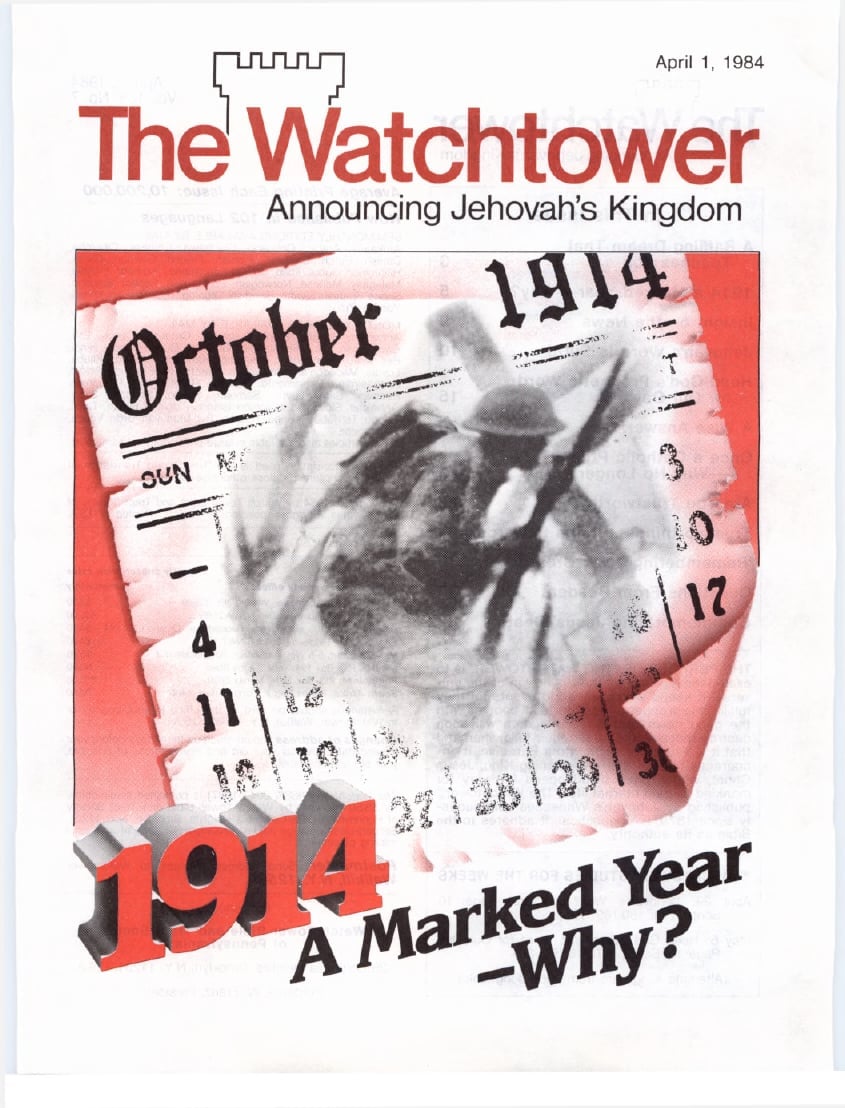
The Watchtower — April 1, 1984
Source: jw.org
Contents
A Baffling Dream That Touches You
1914 a Marked Year—Why?
Insight on the News
Jehovah’s Word Is Sure!
Heed God’s Prophetic Word for Our Day
A Wise Answer
Once a Catholic Priest—Why No Longer?
Are You Trustworthy?
Trustworthiness Brings Rewards
‘Remembering Their Creator’
Questions From Readers
Commemorating Jesus’ Death
A Baffling Dream That Touches You
A Baffling Dream That Touches You
IT FRIGHTENED and puzzled him. ‘I have had dreams before,’ the king no doubt mused, ‘and my priests, with their magic, would give me their interpretation. If they could not reveal the hidden meaning of a dream, then I would call my conjurers to explain it for me. If they failed, surely my astrologers would unravel the mystery. But this dream, why is it so baffling?’
So Nebuchadnezzar of Babylon, the ruler of the greatest world power of the sixth century B.C.E., may well have wondered. He could not find an interpreter for his strange dream throughout his entire empire, except one—the foreign captive Daniel of Judah. Once before, this worshiper of the God Jehovah had explained a dream for Nebuchadnezzar that no one else was able to solve.—Daniel 2:1-45.
But you may ask: ‘Why should this interest me? Dreams are a normal part of human life. Why should this one be any different?’ Well, it is different. How? Because its meaning touches you and everyone else who has lived since the year 1914.
The King’s Dream
While relaxing in his terraced garden palace, Nebuchadnezzar dreams of an unusually large tree:
“Now the visions of my head upon my bed I happened to be beholding, and, look! a tree in the midst of the earth, the height of which was immense. The tree grew up and became strong, and its very height finally reached the heavens, and it was visible to the extremity of the whole earth. Its foliage was fair, and its fruit was abundant, and there was food for all on it. Under it the beast of the field would seek shade, and on its boughs the birds of the heavens would dwell, and from it all flesh would feed itself.”—Daniel 4:10-12.
What the king sees next in his dream startles him; an angel shouts out the command:
“Chop the tree down, and cut off its boughs. Shake off its foliage, and scatter its fruitage. Let the beast flee from under it, and the birds from its boughs. However, leave its rootstock itself in the earth, even with a banding of iron and of copper, among the grass of the field; and with the dew of the heavens let it be wet, and with the beast let its portion be among the vegetation of the earth. Let its heart be changed from that of mankind, and let the heart of a beast be given to it, and let seven times pass over it. By the decree of watchers the thing is, and by the saying of holy ones the request is, to the intent that people living may know that the Most High is Ruler in the kingdom of mankind and that to the one whom he wants to, he gives it and he sets up over it even the lowliest one of mankind.”—Daniel 4:13-17.
The Dream’s Meaning for the King
World rulership is the theme of the king’s dream. The dream has a twofold meaning. One involved Nebuchadnezzar. The other affects you. Daniel explains what the heaven-high tree pictures for Nebuchadnezzar: “It is you, O king, because you have grown great and become strong, and your grandeur has grown great and reached to the heavens, and your rulership to the extremity of the earth.”—Daniel 4:22.
Next, Daniel disentangles the meaning of the rest of the proud king’s vision: Nebuchadnezzar will experience a temporary fall from rulership due to an illness that will cause him to act like a grazing beast. It will last for seven years. But once those “seven times” pass, his sanity will be restored and so will his rulership. This was pictured by the two constricting metal bands wrapped around the dream tree’s rootstock. Remove the bands and at once the tree will sprout again. The point to all of this, says Daniel, is to prove “that the Most High is Ruler in the kingdom of mankind, and that to the one whom he wants to he gives it.”—Daniel 4:23-26.
Twelve months after Daniel interprets the king’s dream, it comes true—Nebuchadnezzar suddenly loses his senses and his crown. Seven years later, again true to Daniel’s words, Nebuchadnezzar’s sanity is recovered and he is restored to his throne with “greatness extraordinary,” thus prompting the king to admit: “Now I, Nebuchadnezzar, am praising and exalting and glorifying the King of the heavens, because all his works are truth and his ways are justice, and because those who are walking in pride he is able to humiliate.”—Daniel 4:29-37.
The lesson was learned. The Almighty God, Jehovah, had the final say as to who will rule the earth and when. But the meaning of Nebuchadnezzar’s dream was not limited to affecting people in Babylon. Its prophetic import of world rulership reaches into this 20th century and touches even you.
[Blurb on page 4]
The Babylonian king’s dream has a twofold meaning. One affects you
1914 a Marked Year—Why?
1914 a Marked Year—Why?
WHERE were you in the year 1914? Would you answer: ‘I was not born’? But a few million people today can still remember the year 1914.
In 1914 Mary was completing her last year in high school, learning German and anticipating a rewarding career as a schoolteacher. That summer, before going off to college, she was out in the fields of her father’s farm on the northeastern coast of the United States picking worms off the shiny skins of ripening tomatoes when halfway around the world, in Sarajevo, an assassin’s bullet cut short the life of an Austrian archduke. It sparked the explosion of World War I. When news of the war reached Mary, she thought: ‘It has come true! Just what the Bible Students were saying has come true; 1914 is going to be a marked year!’
Mary was not the only one who felt that way about world events. On August 30, 1914, the arresting headline “End of All Kingdoms in 1914” blazed across page 4 of the Sunday magazine section of The World, a leading New York newspaper. “The terrific war outbreak in Europe has fulfilled an extraordinary prophecy,” stated this feature article. “For a quarter of a century past, through preachers and through press, the ‘International Bible Students [Jehovah’s Witnesses],’ best known as ‘Millennial Dawners,’ have been proclaiming to the world that the Day of Wrath prophesied in the Bible would dawn in 1914. ‘Look out for 1914!’ has been the cry of the hundreds of traveling evangelists who, representing this strange creed, have gone up and down the country enunciating the doctrine that ‘the Kingdom of God is at hand.’”
Whether you were alive in that year or not, 1914 should mean more to you than a mere calendar sheet curled and yellowed with age or a headline on a crumbled magazine page. It is a momentous year that touches your life today.
Why Is 1914 a Marked Year?
How did Jehovah’s Witnesses know more than 30 years in advance that 1914 would be an important date for divine rulership? Though the Witnesses at the time did not understand the full implication of events about to take place, the Watch Tower magazine as far back as December of 1879 pointed to 1914 as a marked date in regard to Bible prophecy. And the March 1880 issue of the Watch Tower linked God’s Kingdom rule with the ending of what Jesus Christ referred to as “the appointed times of the nations,” or “the times of the Gentiles.” (Luke 21:24; Authorized Version) That Watch Tower said: “‘The Times of the Gentiles’ extend to 1914, and the heavenly kingdom will not have full sway till then.”
What is meant by the expression ‘Gentile Times,’ or “appointed times of the nations”? And how is it connected with God’s Kingdom? To answer these questions, let us take a more detailed look at Jesus’ words. He said: “Jerusalem will be trampled on by the nations [Gentiles], until the appointed times of the nations [Gentiles] are fulfilled.”—Luke 21:24.
What is meant by “Jerusalem”? It points to God’s Kingdom. How do we know? Ancient Israel was God’s chosen people from 1513 B.C.E. down to the first century of our Common Era. (Exodus 19:6; Matthew 23:37, 38) Jehovah organized them under a typical theocratic government, or God-rule. Jerusalem became the capital city. It was there that the God-anointed line of kings from David sat “upon Jehovah’s throne.” They ruled as kings for Jehovah. (1 Chronicles 29:23; 2 Chronicles 9:8) The Cyclopaedia by M’Clintock and Strong states: “Jerusalem had been made the imperial residence of the king of all Israel; and the Temple, often called ‘the house of Jehovah,’ constituted at the same time the residence of the King of kings, the supreme head of the theocratical state.”
When and how was Jerusalem trampled on by the Gentiles? The trampling began in 607 B.C.E. How? By the abrupt ending of the Davidic dynasty. King Zedekiah was dethroned and the city of Jerusalem destroyed by waves of invading Babylonians under Nebuchadnezzar. The Bible at Ezekiel 21:26, 27 foretold this breach in the Davidic line of kings by saying: “Lift off the crown . . . it will certainly become no one’s until he comes who has the legal right, and I must give it to him.” God’s rule was under restraint until “the appointed times of the nations” would end. Thus, the Gentile Times were a time period when the nations ruled without Jehovah God’s having a government to represent his rulership in the earth.
When the Gentile Times ended, Jehovah was to give the power to rule to the One “who has the legal right,” Jesus Christ. Therefore, 1914 would mark the time when Christ began to rule as King in God’s heavenly Kingdom, and since his rulership extends down to this day, it touches you.
How was the chronology figured to mark 1914? The June 1880 issue of the Watch Tower magazine explains: “The long period of 2520 years and their bitter experience under the dominion of the beasts, (human governments, Dan. vii.) is clearly represented in Dan. iv., by the ‘seven times’ of Nebuchadnezzar and his bitter experience among the beasts.” So we must return to the baffling dream of the Babylonian king to trace its line of chronology to 1914.
Prophetic Blueprint
Jehovah, by means of his prophets, has always given his people a prophetic blueprint to follow. “For the Sovereign Lord Jehovah will not do a thing unless he has revealed his confidential matter to his servants the prophets,” states Amos 3:7. For example, Noah was God’s special messenger over 4,000 years ago. Jehovah gave Noah a prophetic warning of the watery destruction that was to come upon that wicked world. (Genesis 6:3; 7:4) What occurred then was also a pattern of a future destruction of the ungodly during the invisible “presence of the Son of man,” Jesus Christ. (Matthew 24:37-39) So it should not seem unusual that what Daniel traced out for Nebuchadnezzar’s world rulership—his fall and his return to power—was also a small-scale illustration of variations in theocratic world domination by God’s anointed King.
What do we see when we examine the prophetic pattern of Daniel 4:10-17? The giant, heaven-high tree represents divine rulership. The tree was cut down when God’s Kingdom of Judah with its capital in Jerusalem fell in 607 B.C.E. After “seven times” of beastly rule by the nations passed, the two constraining bands of metal were released, and divine rulership was restored when Jesus Christ began to rule as King in God’s heavenly government in 1914.
A Day for a Year
How do we know that the “seven times” are 2,520 years? The calculations are made in a way similar to those made by the Watch Tower Society’s first president, C. T. Russell, in 1877 and recorded in the book he coauthored entitled The Three Worlds. This is how it is done: In Revelation chapter 12, verses 6 and 14, we learn that 1,260 days are equal to “a time [that is, 1 time] and times [that is, 2 times] and half a time,” or a total of 3 1⁄2 times. So “a time” would be equal to 360 days. “Seven times” would be 360 multiplied by 7, or 2,520 days. Now if we count a day for a year, according to a Bible rule, the “seven times” equal 2,520 years. (Numbers 14:34; Ezekiel 4:6) Therefore, the duration of the “seven times,” the Gentile Times, is from 607 B.C.E. to 1914 C.E.
What reasons are there for believing that Nebuchadnezzar’s prophetic tree dream stretches into our 20th century and finds fulfillment in God’s Kingdom? One reason is this: Much of the book of Daniel involves prophecies that find fulfillment in world rulership and God’s Kingdom after the lifetime of Daniel. Read, for example, Daniel chapter 2. It depicts a multimetal image representing successive world powers that are pulverized. By what? God’s Kingdom! (Daniel 2:44) Or read Daniel chapter 7 where successive world governments are seen as wild beasts rising out of the sea and finally being replaced by one rulership. Which one? God’s Kingdom! (Daniel 7:14) Or read Daniel chapters 11 and 12. In those chapters a king of the north and a king of the south keep testing each other out in a battle for world supremacy until they meet their defeat at the hand of Prince Michael. (Daniel 12:1) Who is this Michael? Jesus Christ, ruler in God’s Kingdom!
Thus the year 1914 was marked for a very good reason. It signaled the start of the righteous rule toward the earth by God’s Kingdom. It spelled doom for the wicked. It pointed to “the last days” of this ungodly system of things. (2 Timothy 3:1) It signaled a countdown to the start of a Paradise earth.
There are other reasons why 1914 is a marked year that touches you. These will be considered in future issues of The Watchtower.
[Blurb on page 6]
The Watchtower magazine, as far back as December of 1879, pointed to 1914 as a marked date
[Blurb on page 6]
God’s rule was under restraint until the Gentile Times ended
[Blurb on page 7]
When the Gentile Times ended, Jehovah gave the power to rule to Jesus Christ
[Blurb on page 7]
1914 marked the time when Christ began to rule as King in God’s heavenly government
[Box on page 8]
Another prophecy, found in the ninth chapter of Daniel, focuses on the human arrival of the Messiah—the future King of God’s Kingdom—even pinpointing the very year of his appearance! A time period of “seventy weeks” is involved. (Daniel 9:24-27) It is generally recognized by Bible scholars that each day of those prophetic weeks is equal to one year. Since one of Daniel’s prophecies correctly predicted the human arrival of the Messiah, it should not be so unusual if another one of his prophecies predicted the invisible arrival of the Messiah, or Christ, in God’s heavenly Kingdom.
[Chart/Picture on page 8]
WHAT THE KING’S DREAM MEANS FOR YOU
Tree Divine Rulership
Tree Chopped Down and Banded 607 B.C.E., Rule by God Through
Human Kings Ends
Seven Gentile Times 2,520 Years of Rule by Beastly
Governments
Bands Released 1914 C.E., Rule by God Through
Heavenly King, Christ Jesus,
Begins
[Picture on page 5]
In its August 30, 1914, issue, the New York newspaper The World drew attention to the remarkable fact that the International Bible Students Association (Jehovah’s Witnesses) had pointed to 1914 as a marked date in Bible prophecy
Insight on the News
Insight on the News
Asking God
If you could, what three questions would you ask God? That was the query posed in a recent Gallup poll of men and women throughout 300 cities and towns. As reported in New York’s Daily News, evangelist Pat Robertson decided to find out, by means of the poll, whether others in the United States agreed with the question he would like to ask God if given the chance: “When will the world end?” The results surprised him. “People are more concerned about what happens now rather than about what happens sometime in the future,” Robertson said.
“Will there ever be a lasting world peace?” turned out to be the question people would most like to ask. Next, in order, were: (2) “How can I be a better person?” (3) “What does the future hold for me and my family?” (4) “Will there ever be a cure for all diseases?” (5) “Why is there suffering in the world?” and (6) “Is there life after death?”
Yet, God has not kept man in ignorance on any of these questions. Lovingly, through the pages of his Word, the Bible, he has clearly set out the answers. Indeed, a number of them are answered in but one verse—part of the apostle John’s inspired vision of “the things that must shortly take place.” John wrote: “He [God] will wipe out every tear from their eyes, and death will be no more, neither will mourning nor outcry nor pain be anymore. The former things have passed away.” (Revelation 1:1; 21:4) Complete, Bible-based answers to all the foregoing questions can be found in issues of this magazine.
Pagan Beliefs “Christianized”
“In A.D. 601, Pope Gregory the First, known as Gregory the Great, issued an edict to his missionaries concerning the native beliefs and customs of the peoples he hoped to convert,” states a recent issue of Natural History magazine. “Instead of trying to obliterate peoples’ customs and beliefs, the pope’s instructions were, use them. If a group of people worship a tree, rather than cut it down, consecrate it to Christ and allow them to continue their worship.” Calling this a “brilliant concept” and the “basic principle in Catholic missionary work,” the article continues: “Catholic holy days were purposely set at the time of native holy days. Christmas, for instance, was assigned the arbitrary date of December 25 because it corresponded to the midwinter celebration of many peoples. For the same reason, Saint John’s day was set at the summer solstice.”
However “brilliant” the idea was toward the spreading of so-called Christianity, it certainly is not God’s way of doing things. When the Israelites were about to enter the Promised Land, they were instructed by God to destroy thoroughly all pagan worship there. (Numbers 33:52; Deuteronomy 7:5, 6) And for true Christians, “clean and undefiled” worship requires that they keep themselves “without spot from the world.”—James 1:27.
Abolish Religion?
“If ways cannot be found to insulate politics and statecraft from religion, consideration [should] be given to abolishing religion itself.” So suggests author John Bartlow Martin, a former ambassador, writing in USA Today. Mentioning religion’s dominance in such past events as the Crusades and the Spanish Inquisition, its divisive force today and the bloodshed and unrest caused by modern “apostles of zealotry,” Mr. Martin says: “If one watches the evening television news, one cannot but be struck by how much of the world’s trouble is rooted in religion. And few secular political rivalries ever generate the bloodthirsty fervor of religious war.”
Jehovah God, too, has taken note of the “bloodthirsty” ways of false religion. Calling it Babylon the Great, his Word foretells the annihilation of false religion at the hands of the political powers—this as the harbinger of the complete destruction of the present wicked system of things. While Mr. Martin states that the realization of his suggestion to abolish religion is ‘probably impossible,’ God assures us that His just decision against false religion will be carried out.—Revelation 17:1-6, 15-17; 18:4, 5.
Jehovah’s Word Is Sure!
Jehovah’s Word Is Sure!
‘I Jehovah make good my servant’s word.’—ISAIAH 44:24-26, Byington.
1. What future was predicted back in 1864?
WHAT will tomorrow bring? People would like to know. But how unsatisfying their forecasts! To illustrate: Back in 1864 naturalist Alfred R. Wallace predicted this man-made ‘future for the human race’: “Each one will . . . work out his own happiness in relation to that of his fellows; . . . the well balanced moral faculties will never permit any one to transgress on the equal freedom of others; . . . each man will be guided by the best of laws; a thorough appreciation of the rights, and a perfect sympathy with the feelings, of all about him.” Why, Wallace foretold that man would convert our earth into “as bright a paradise as ever haunted the dreams of seer or poet”!
2. The failure of mere human forecasts leads to what questions?
2 The author of those words died just nine months before mankind was plunged into the dark night of World War I. Where, then, was that ‘bright paradise’ filled with compassionate people? And what of today? Unquestionably, ‘the love of the greater number has cooled off’—and that despite any predictions to the contrary. (Matthew 24:12) But should this make us doubt all prophecy? Jehovah God identifies himself as the One ‘who reverses wise men and makes their knowledge foolish, while making good his servant’s word.’ (Isaiah 44:24-26, By) However, some may ask: ‘Can we rely on Bible prophecies? Is Jehovah’s Word really sure?’
Ruin and Restoration
3. In keeping with Leviticus 26:27-35, what happened to Judah and Jerusalem in the seventh century B.C.E.?
3 There is an abundance of evidence to prove that we can, indeed, rely on Bible prophecy. For instance, prophecies of ruin and of restoration came true in the case of God’s ancient people, the Israelites. When they faithfully worshiped Jehovah, they prospered in their God-given ‘land of milk and honey.’ (Leviticus 20:24; 1 Kings 4:1, 20) But they had been forewarned that this virtual paradise would become a devastated wilderness if they disobeyed. (Leviticus 26:27-35) In the year 607 B.C.E., some 900 years after Moses recorded Leviticus, the Babylonians conquered Judah and Jerusalem. Not long thereafter, Jews remaining in the land fled to Egypt, and the foretold desolation was complete.—Jeremiah 39:8-10; 40:5; 41:2; 43:1-7.
4. (a) Long before Jerusalem’s destruction in 607 B.C.E., what promise had Jehovah made to his people? (b) How was this promise fulfilled?
4 More than a century before Jerusalem’s destruction, however, Jehovah had promised to return his repentant people to their desolated homeland and to restore its paradisaic splendor. (Isaiah 35:1-4) God also had said: “I Jehovah, . . . who make good my servant’s word and execute my messengers’ plan, am he who says of Jerusalem ‘it shall be inhabited’ and of the cities of Judah ‘they shall be rebuilt and I will rehabilitate her wastes.’” (Isaiah 44:24-26, By) In 539 B.C.E., Babylon was conquered by the Medes and the Persians led by Cyrus, even as Isaiah had foretold. (Isaiah 44:27–45:6) Cyrus’ decree allowing the Jews to return to their homeland and rebuild the temple went into effect in 537 B.C.E., and in time the land of Judah did undergo the foretold transformation. (Ezra 1:1-4; Isaiah 35:5-10; Ezekiel 36:35) How sure Jehovah’s Word!
Tyre Could Not Defy Prophecy
5. Through Ezekiel, what had Jehovah foretold regarding Tyre?
5 Divinely inspired prophecy also was fulfilled upon the ancient city of Tyre, rightly called “the Queen of the Sea.” Concerning this Phoenician seaport, Jehovah had declared: “I am against you, O Tyre, and I will bring up against you many nations . . . Here I am bringing against Tyre Nebuchadrezzar the king of Babylon . . . and your towers he will pull down . . . And your stones and your woodwork and your dust they will place in the very midst of the water. . . . And I will make you a shining, bare surface of a crag. A drying yard for dragnets is what you will become.”—Ezekiel 26:3-14.
6. In fulfillment of prophecy, what happened to ancient Tyre?
6 Such a downfall seemed impossible. According to the Jewish historian Josephus, the Babylonian siege of Tyre lasted 13 years. (Josephus, Against Apion, Book I, Chapter 21) History does not record how effective Nebuchadnezzar’s efforts were, although the loss of Tyrian property and lives must have been great. A later prophetic pronouncement through Zechariah indicated that God would destroy the city completely. (Zechariah 9:3, 4) This prophecy was fulfilled nearly 200 years after it was given. By then those living in the nearby island city of Tyre felt secure behind its formidable walls. However, in 332 B.C.E., the forces of Alexander the Great overthrew that island city, using debris from mainland Tyre to build a causeway leading to the island. Since then this artificial peninsula has been enlarged by sand deposited there by the water. Moreover, in the present seaport village, fishermen can be seen drying their nets—another fulfillment of prophecy. Certainly, Jehovah’s Word is sure!
The “City of Bloodshed” Bows
7, 8. (a) Through his prophets, what had Jehovah foretold regarding Nineveh? (b) Why would it have seemed impossible for Nineveh to become a “desolate waste”?
7 God’s prophetic Word also proved true in the case of ancient Nineveh, the capital of the Assyrian Empire that oppressed Jehovah’s people. (2 Kings 17:1-6; 1 Chronicles 5:6, 26) Concerning Nineveh, at the height of its power Jehovah declared through his prophets: “Plunder silver, you men; plunder gold; as there is no limit to the things in arrangement. . . . Emptiness and voidness, and a city laid waste! . . . Woe to the city of bloodshed.” (Nahum 2:9, 10; 3:1) “He will make Nineveh a desolate waste, . . . and in the midst of her, droves will certainly lie stretched out.”—Zephaniah 2:13, 14.
8 How could this possibly occur? Nineveh was “the great city.” (Jonah 1:2) According to ancient historian Diodorus, Nineveh had a 100-foot (30-m) wall, wide enough for three chariots abreast to travel upon it. In the prophet Jonah’s day (the ninth century B.C.E.), more than 120,000 men inhabited the city. (Jonah 4:11) Was all of this to become a “desolate waste”?
9. How has Nineveh supplied further proof that Jehovah’s Word is sure?
9 In 632 B.C.E., 16 or more years after Zephaniah’s prophecy, the Babylonians and the Medes besieged Nineveh. According to Diodorus (Book II, Chapter 27), “heavy and continuous rains” caused the Tigris River to overflow its banks. It “both inundated a portion of the city and broke down the walls for a distance of twenty stades.” Nineveh was taken. “They carried off much spoil from the city and temple-area and turned the city into a ruin-mound and heap of debris,” states the ancient Babylonian Chronicle. Nineveh became a lost city for centuries. Its overthrow certainly was “good news” to God’s people, who were reassured that “Jehovah is good” and “is cognizant of those seeking refuge in him.” (Nahum 1:7, 15) Today, a visitor to Nineveh’s ruins in Iraq may see sheep grazing near its mounds, just as foretold. In this we have further proof that Jehovah’s Word is sure.
“A Conspicuous Horn” Is Broken
10. (a) What prophetic vision is recorded in Daniel 8:1-8? (b) How did Gabriel explain the features of this prophecy?
10 In a prophetic vision, Daniel saw a two-horned ram killed by a male goat with “a conspicuous horn.” This horn was broken and four horns replaced it. (Daniel 8:1-8) What could this mean? The angel Gabriel explained: “The ram that you saw possessing the two horns stands for the kings of Media and Persia. And the hairy he-goat stands for the king of Greece; and as for the great horn that was between its eyes, it stands for the first king. And that one having been broken, so that there were four that finally stood up instead of it, there are four kingdoms from his nation that will stand up, but not with his power.”—Daniel 8:16, 20-22.
11, 12. How was Daniel 8:20-22 fulfilled?
11 Mighty Babylon had been conquered by Medo-Persia, the envisioned two-horned ram. But God’s angel had foretold that “the hairy he-goat,” Greece, would kill the ram. This is exactly what occurred in the fourth century B.C.E., when Greek-speaking armies of Alexander the Great overthrew the Medo-Persian Empire. However, Alexander unexpectedly died at the age of 32 in 323 B.C.E., leaving behind no qualified successor. With Alexander’s death, the “conspicuous horn” was broken. But what about the foretold ‘four horns that finally stood up instead of it’?
12 Alexander had a number of generals, but four of them finally established themselves in power. So it was that the “conspicuous horn” was broken and eventually was replaced by ‘four horns,’ or “four kingdoms.” By 301 B.C.E., these generals had established themselves in power: Ptolemy Lagus (Egypt and Palestine); Seleucus Nicator (Mesopotamia and Syria); Cassander (Macedonia and Greece); and Lysimachus (Thrace and Asia Minor).a Again we see that Jehovah’s Word is sure.
“Messiah the Leader” Appears!
13. What does Daniel 9:24, 25 say about the appearance of the Messiah?
13 The book of Daniel also provides particularly outstanding evidence that Jehovah’s Word is sure. Centuries in advance, Daniel was inspired to pinpoint the time for the Messiah’s appearance on earth. This thrilling prophecy said, in part: “There are seventy weeks that have been determined upon your people and upon your holy city, in order to terminate the transgression, and to finish off sin, and to make atonement for error, and to bring in righteousness for times indefinite, and to imprint a seal upon vision and prophet, and to anoint the Holy of Holies. And you should know and have the insight that from the going forth of the word to restore and to rebuild Jerusalem until Messiah the Leader, there will be seven weeks, also sixty-two weeks.”—Daniel 9:24, 25.
14. (a) On what Scriptural basis can we say that in the “weeks” of Daniel 9:24, 25 each day counts for one year? (b) In what year did ‘the word to rebuild Jerusalem’ go forth? (c) How long were the 69 “weeks,” and when did they begin and end?
14 Were these “weeks” literal? No, for all the things prophesied here regarding the Messiah did not occur within 70 weeks, or less than a year and a half. These proved to be “weeks” in which each day counted for one year. (Compare Numbers 14:33, 34.) “The word to restore and to rebuild Jerusalem” went forth in the 20th year of Persian King Artaxerxes (Longimanus). (Nehemiah 2:1-18) Since he began ruling in 474 B.C.E., his 20th year was 455 B.C.E. Hence, the 69 weeks of years from ‘the word to rebuild Jerusalem until Messiah the Leader’ amounted to 483 years (7 × 69) and extended into 29 C.E.
15. In 29 C.E., what expectation existed among the Jews?
15 In that year John the Baptizer was busy “preaching baptism in symbol of repentance for forgiveness of sins.” And what about the Jews? “The people were in expectation and all were reasoning in their hearts about John: ‘May he perhaps be the Christ?’” (Luke 3:3-6, 15) With regard to such expectation, Jewish scholar Abba Hillel Silver stated: “The first century, however, especially the generation before the destruction [of Jerusalem], witnessed a remarkable outburst of Messianic emotionalism. This is to be attributed . . . not to an intensification of Roman persecution but to the prevalent belief induced by the popular chronology of that day . . . The Messiah was expected around the second quarter of the first century C.E.” That “popular chronology” was based on the book of Daniel.
16. (a) Why was the 15th year of the reign of Tiberius Caesar significant? (b) When Jesus was baptized, what took place?
16 Daniel’s prophecy had indicated that the 69 weeks of years would extend into 29 C.E. Well, did the Messiah appear on time in that year? Indeed he did! John the Baptizer had begun his preaching and baptizing “in the fifteenth year of the reign of Tiberius Caesar.” (Luke 3:1-3) Since Tiberius became Roman emperor on August 17, 14 C.E. (Gregorian calendar), John’s work began during the 15th year after that, or in the spring of 29 C.E. In the fall of that year Jesus of Nazareth was baptized by John, and the holy spirit then descended from heaven to anoint Jesus as the Christ, or Messiah. (Luke 3:21, 22) Messianic prophecy had been fulfilled.b Once again it had been proved that Jehovah’s Word is sure.
17. What were some Messianic prophecies fulfilled in connection with Jesus Christ?
17 Many other Hebrew Scripture prophecies were fulfilled in connection with Jesus Christ. For instance, Jesus was born of a virgin in Bethlehem. (Isaiah 7:14; Micah 5:2; Matthew 1:18-23; 2:3-6) Young children were killed after his birth. (Jeremiah 31:15; Matthew 2:16-18) He had a forerunner. (Isaiah 40:3; Matthew 3:1-3) Jesus carried our sicknesses. (Isaiah 53:4; Matthew 8:16, 17) He entered Jerusalem on the colt of an ass. (Zechariah 9:9; John 12:12-15) One apostle betrayed him for 30 pieces of silver. (Psalm 41:9; Zechariah 11:12; Matthew 26:14-16, 46-56; John 13:18) After Jesus’ impalement, soldiers apportioned his clothing among themselves and cast lots for his inner garment. (Psalm 22:18; John 19:23, 24) His bones were not broken, but he was pierced. (Psalm 34:20; Zechariah 12:10; John 19:33-37) After parts of three days in the grave, he was resurrected. (Jonah 1:17; 2:10; Matthew 12:39, 40; Mark 9:31; Acts 10:40) These are mere examples of how Jesus fulfilled Messianic prophecies. But they, too, prove that Jehovah’s Word is sure.
The Future Can Be Known
18, 19. (a) Why is it not futile to ask what tomorrow will bring? (b) What further questions are raised?
18 Jesus, the Messiah, himself uttered hope-inspiring prophecy. For example, he foretold his future “presence.” (Matthew 24:3-14) In fact, heartening prophecies with 20th-century significance were recorded by various Bible writers. So it is not futile to ask, ‘What will tomorrow bring?’ We can find out!
19 So far, we have considered some Scriptural prophecies that were fulfilled in times past. But what about our day? Do we have further thrilling evidence that Jehovah’s Word is sure?
[Footnotes]
a For details, please see pages 188-95 of the book “Your Will Be Done on Earth,” published in 1958 by the Watchtower Bible and Tract Society of New York, Inc.
b For further details on the “seventy weeks,” please see chapter 7 of the book “Let Your Kingdom Come,” published by the Watchtower Bible and Tract Society of New York, Inc.
Can You Remember?
□ As foretold, what happened to ancient Tyre?
□ How has Nineveh provided evidence that Jehovah’s Word is sure?
□ What happened in fulfillment of Daniel 8:20-22?
□ How long were the 69 “weeks,” and when did they start and end?
□ What were some of the Messianic prophecies fulfilled in connection with Jesus?
Heed God’s Prophetic Word for Our Day
Heed God’s Prophetic Word for Our Day
“See how former predictions have come true. Fresh things I now foretell; before they appear I tell you of them.”—ISAIAH 42:9, The Jerusalem Bible.
1. Why can we say that Jehovah is the God of unfailing prophecy?
JEHOVAH is the God of unfailing prophecy. This certainly proved true in the ruin and restoration of Jerusalem, the fall of ancient empires and the fulfillment of Messianic prophecy! But were all Bible prophecies fulfilled only in the past? How wrong to think so!
2. As regards prophecy, how do Jehovah’s servants differ from the world?
2 God told his ancient people: “See how former predictions have come true. Fresh things I now foretell; before they appear I tell you of them.” (Isaiah 42:9, JB) By opening up an understanding of prophecies already in the Bible, Jehovah is still giving his loyal servants advance knowledge, and surely we should pay attention to it. As the apostle Peter so well expressed matters: “You will be right to depend on prophecy and take it as a lamp for lighting a way through the dark until the dawn comes.” (2 Peter 1:19, JB) In fact, heeding God’s prophetic word marks Jehovah’s people as different from this dark, confused world. Proverbs 4:18, 19 aptly states: “The path of the virtuous is like the light of dawn, its brightness growing to the fulness of day; the way of the wicked is as dark as night, they cannot tell what it is they stumble over.”—JB; compare Psalm 119:105.
Listen When God’s Son Speaks!
3. What proof is there that Jesus is present today?
3 It is vital that Jehovah’s Witnesses “pay more than the usual attention” to things spoken by Jesus Christ. (Hebrews 2:1-4) And what a dramatic prophecy he gave regarding our day! Pointing to the final days of this dying system of things, Jesus gave a striking “sign” of his “presence.” He foretold such developments as total warfare, pestilences, famines and earthquakes. (Matthew 24:3-8) Can any well-informed person deny the overwhelming evidence of Jesus’ presence today? World War I killed over 9 million combatants and millions of civilians, whereas the second world war cost 55 million lives. The Spanish flu of 1918-19 brought death to some 20 million. According to an estimate by the Food and Agriculture Organization, 450 million people are even now at the point of starvation, and as many as a billion have too little to eat. Earthquakes have claimed the lives of some 1,600,000 people in the 20th century—over 22,000 yearly since 1914.
4. (a) When did the Gentile Times begin, and when did they end? (b) What evidence is there that Jehovah’s people had advance knowledge about 1914?
4 That year 1914—what of it? Over a century ago, C. T. Russell (who became the first president of the Watch Tower Society) linked the Gentile Times with the “seven times” mentioned in the book of Daniel. (Daniel 4:16, 23, 25, 32; Luke 21:24, Authorized Version) Writing in the Bible Examiner of October 1876, Russell said: “The seven times will end in A.D. 1914.” He also was a joint publisher of the 1877 book Three Worlds, and the Harvest of This World, which showed (on pages 83 and 189) that the 2,520-year period of Gentile world domination without interference by any kingdom of God began with the Babylonian overthrow of the kingdom of Judah in the late seventh century B.C.E. and would end in 1914 C.E. Similarly, the Watch Tower issue of March 1880 stated: “‘The Times of the Gentiles’ extend to 1914, and the heavenly kingdom will not have full sway till then.”
5. How could Jehovah’s Witnesses have known in advance about the significance of 1914?
5 Today, Jehovah’s Witnesses point to the “sign” given by Jesus and look back upon 1914 as the year when his invisible presence in Kingdom power became a reality. But how could they have had advance knowledge of such a momentous event? Not because of extraordinary human wisdom. No, but because they have prayerfully studied the Scriptures, heeded God’s prophetic word and paid more than usual attention to what God’s Son foretold. (2 Peter 1:19; Hebrews 1:1, 2; 2:1) Grateful that Jehovah has ‘told them fresh things before they have appeared,’ the Witnesses are delighted to be spreading this knowledge earth wide. (Isaiah 42:9) They do so in keeping with Jesus’ words: “This good news of the kingdom will be preached in all the inhabited earth for a witness to all the nations.” Then what? “And then the end will come”!—Matthew 24:14.
Rival Kings in Conflict
6. What two kings are discussed in Daniel chapter 11, and what questions arise concerning them?
6 Before “the end” comes, however, other 20th-century developments merit our consideration. For instance, the prophecy of Daniel declares: “In the time of the end the king of the south will engage with [the king of the north] in a pushing, and against him the king of the north will storm.” (Daniel 11:40) Who are these battling kings, and of what significance are their foretold actions?
7. (a) When did the conflict between the two kings begin? (b) Why were the names “king of the north” and “king of the south” appropriate? (c) With what first-century power is “the king of the north” identified, and how was it that ‘an exactor passed through the kingdom’?
7 The conflict between these kings began after the empire of Alexander the Great was divided. In part, Seleucus Nicator got control of Syria and Ptolemy Lagus established a dynasty in Egypt. These battling dynasties, situated north and south of the land of Jehovah’s people, the Israelites, became the first “king of the north” and “king of the south.” (Daniel 11:2-5) But as time passed, the identity of these kings changed. By the first century C.E., the Roman imperial power had become “the king of the north.” At that point in history ‘one was to stand up and cause an exactor to pass through the splendid kingdom.’ (Daniel 11:20-22) As foretold, Caesar Augustus dispatched an “exactor” by calling “for all the inhabited earth to be registered.” Because of this decree, Joseph and Mary went to Bethlehem for registration in 2 B.C.E., resulting in Jesus’ birth at that foretold location.—Luke 2:1-7; Micah 5:2.
8. (a) How do we know that there were to be 20th-century developments involving the two kings? (b) When was “the appointed time” for “the king of the north” to come against the south? (c) With what powers earlier in this century can the two kings be identified?
8 In the spring of 33 C.E., Jesus Christ gave a marvelous prophecy on “the time of the end.” He quoted from Daniel 11:31 and thus indicated that there would be dramatic 20th-century developments involving “the king of the north” and “the king of the south.” (Matthew 24:15) It had been foretold that “the king of the north” would come against the south “at the time appointed.” (Daniel 11:29, 30) When was that? Why, in 1914—the very year in which the Gentile Times ended and the Kingdom of God was established in heaven! In that year a Germanic “king of the north” began fighting against “the king of the south,” the Anglo-American World Power. Germany and her allies were defeated in World War I and again in the second world war. “The king of the north” then assumed a new identity.
9. (a) What position do Jehovah’s Witnesses maintain as regards political affairs? (b) Does this prevent them from seeing certain political developments in advance?
9 Jehovah’s Witnesses maintain strict Christian neutrality. They are no part of this world and do not involve themselves in its political affairs. (John 17:16) Nevertheless, they do heed God’s prophetic word, and this has enabled them to see how Daniel’s prophecy now moves into its final stage of fulfillment. (Isaiah 42:9) Again, in the post-World War II period, two superpowers hold the center of the stage, each vying with the other in a suicidal arms race that has forced the world’s annual military budget up into the $800 billion (U.S.) bracket.
10. (a) What is the “disgusting thing” of Daniel 11:31? (b) How have both kings treated Jehovah’s people, and why?
10 Speaking of Daniel’s prophecy concerning “the disgusting thing that causes desolation,” Jesus said: “Let the reader use discernment.” (Matthew 24:15; Daniel 11:31) “Discernment” of the fulfillment of Bible prophecy has shown that “disgusting thing” to be the UN organization, which has been brought forth in opposition to God’s Kingdom. “Discernment” also leaves no question as to the identity (at this climax of the prophecy’s unfolding) of “the king of the north” as he competes with “the king of the south” in their final all-out power struggle. Neither he nor “the king of the south” is willing to relinquish sovereignty to God’s heavenly Kingdom, now being announced earth wide by Jehovah’s Witnesses. Both kings have shared in the persecution of the Witnesses.—Daniel 11:36-39; Matthew 5:10-12; John 15:19, 20.
11. (a) What claim does “the king of the north” make? (b) How does this “king” speak against Jehovah?
11 Concerning “the king of the north,” the prophecy says: “He will exalt himself and magnify himself above every god; and against the God of gods he will speak marvelous things. . . . Over everyone he will magnify himself.” (Daniel 11:36, 37) This atheistic “king of the north” claims that the State has the right to demand much from its subjects. Moreover, this “king” speaks against Jehovah by aiming for world domination to the exclusion of God’s Kingdom. Of course, “the king of the south” wants nothing to do with that Kingdom either, any pious Bible-quoting by his political spokesmen notwithstanding.—Revelation 11:17, 18.
“King” With an Unusual God
12. To what god does “the king of the north” give glory?
12 As irreligious as “the king of the north” may seem to be, however, he does have a god. Says the prophecy: “But to the god of fortresses, in his position he will give glory.” (Daniel 11:38) Has this “king” paid homage to “the god of fortresses,” exalting modern, scientific militarism as the savior of the peoples of his bloc of nations?
13. Why can it be said that both of these kings are ‘putting their trust in war chariots’?
13 Indeed he has! According to The Military Balance 1981-1982, The International Institute for Strategic Studies placed the armed forces of the principal nation in the realm of the ‘northern king’ at more than 4,000,000, compared with over 2,049,000 for the leading nation of the “south.” In mid-1982, SIPRI (Stockholm International Peace Research Institute) reported that the “south” was capable of delivering 9,540 nuclear warheads having a total explosive power of 3,448 megatons, compared with 8,802 warheads of the “north” with a force of 4,535 megatons. How potentially devastating, since one megaton alone has an explosive force equal to that of a million tons of TNT! Clearly, both rival kings are ‘putting their trust in war chariots.’—Isaiah 31:1.
14. (a) What “pushing” is now taking place? (b) Can you give evidence that mankind is imperiled?
14 “The king of the south” is now “pushing” his rival politically, even militarily. (Daniel 11:40) In progress today is a relentless arms race that threatens mankind with nuclear holocaust. Highlighting the peril, the SIPRI Yearbook 1982 warned:
“The balance between the two great powers in intercontinental nuclear weapons is becoming unstable. . . . Instead of what might once have seemed to be a stable system of deterrence—a balance of mutually assured destruction (MAD)—we have the fear of a first strike being used as the rationale for the very big increases now in prospect in strategic weapon programmes and procurement. Between them, the two great powers, with the nuclear weapons at their command, have a total destructive power which is probably equivalent to about half a million Hiroshima bombs: but that is not enough. There can be no better example of the way in which developments in weapon technology—in this case the increasing accuracy of intercontinental ballistic missiles (ICBMs)—lead to a reduction rather than to an increase in security.”
15. (a) Would these kings ever use their weapons against each other? (b) But what does God’s prophetic word make clear?
15 “Pushing” by “the king of the south” was to cause “the king of the north” to ‘storm against him with chariots, horsemen and many ships.’ Yes, the kings would have some occasion to use at least their conventional weapons against each other. “The king of the north” would also gain control of many “desirable things” of this world. (Daniel 11:40-43) By 1981 “the king of the north” wielded authority over some 1.5 billion people in 16 nations, and time alone will tell how far this “king” will extend his power. But the judgment of destruction upon these kings comes from another source. God’s prophetic word makes that clear.
Disturbing Reports—And Then the End!
16. Where do the ‘disturbing reports’ originate, and how do they reach “the king of the north”?
16 This dramatic prophecy concludes: “But there will be reports that will disturb him, out of the sunrising and out of the north, and he will certainly go forth in a great rage in order to annihilate and to devote many to destruction. . . . And he will have to come all the way to his end, and there will be no helper for him.” (Daniel 11:44, 45) These disturbing reports really issue from Jehovah through Jesus Christ. The Scriptures locate God relatively in the north, and he and Christ are symbolically called “kings from the rising of the sun,” the east. (Revelation 16:12; Psalm 48:2; 75:6, 7) But how can these “reports” reach “the king of the north”? Why, through God’s earthly organization, Jehovah’s sanctuary class and their companions of the “great crowd”!
17. (a) Because of the “reports,” what will “the king of the north” do? (b) Will “the king of the south” stand idly by? (c) What will Jehovah then do in behalf of his loyal witnesses?
17 God will determine the contents of these “reports.” Whatever their nature, however, they will so infuriate “the king of the north” that he will act to destroy Jehovah’s people. In fact, Satan the Devil, the symbolic Gog of Magog, will maneuver both “the king of the north” and “the king of the south” into his full-scale assault upon God’s true servants. (Ezekiel 38:10-12) But Jehovah’s loyal witnesses need not fear annihilation. The Most High will rescue them, and both kings will be among those destroyed in “the war of the great day of God the Almighty” at Har–Magedon.—Revelation 16:14-16; Ezekiel 38:18-23.a
18. (a) Do Jehovah’s Witnesses need to fear future developments? (b) Why do they have continued confidence in God’s prophetic word?
18 Down to the end of this system of things, therefore, Jehovah’s Witnesses will fearlessly declare the Kingdom message. (Matthew 24:14) Neither “the king of the north” nor “the king of the south” nor the Devil and his demon hordes will be able to stop them. We are absolutely certain of this. Why? Because such conviction is solidly based on the promises of our heavenly Father, and Jehovah’s word is sure. (2 Peter 3:13; Revelation 21:1-5) Divine prophecies and promises have always been fulfilled. With wholehearted trust, then, may all of Jehovah’s organized people continue to heed God’s prophetic word for our day.
[Footnotes]
a For further information on these kings, please see chapters 10 and 11 of the book “Your Will Be Done on Earth,” published in 1958 by the Watchtower Bible and Tract Society of New York, Inc.
Can You Remember?
□ How do we know that Jesus is present in Kingdom power today?
□ Regarding political affairs, what position is maintained by Jehovah’s Witnesses?
□ What is the present-day identity of “the king of the north” and of “the king of the south”?
□ What end awaits these kings?
□ Why should we have confidence in God’s prophetic word?
[Chart on page 16]
607 B.C.E. 1914 C.E.
October, 607 B.C.E.—October, 1 B.C.E. = 606 YEARS
October, 1 B.C.E.—October, 1914 C.E. = 1,914 YEARS
SEVEN GENTILE TIMES = 2,520 YEARS
[Picture on page 18]
“The king of the north” gives glory to “the god of fortresses”
A Wise Answer
A Wise Answer
A youth attending school in Sierra Leone was asked by his teachers to attend church services. He answered that he already was attending religious meetings at the Kingdom Hall of Jehovah’s Witnesses and then related some of the things he had learned at such meetings. One teaching he explained was how God’s Kingdom will bring peace to the earth and eliminate sickness and death.—Revelation 21:3, 4.
“Do you know about these things?” he asked his teachers.
“No,” they answered.
“These things and many more I have learned just by going to the Kingdom Hall,” he continued. “So I do not see any reason to attend church services where these things are not known.”—Matthew 21:16.
Once a Catholic Priest—Why No Longer?
Once a Catholic Priest—Why No Longer?
As told by Ferdinando Piacentini
“Life is short, and death awaits, its hour alone uncertain.
What will become of us then, if we lose our only soul? . . .
This life is soon to end, but eternity is unending.”
THIS simple hymn that the parish priest taught us to sing kindled in me a desire for godliness and eternal life right from the early age of 13. So it was that, drawn by the friendship of two others of like inclination, I decided to become a priest.
I was born on January 8, 1925, in Casola, a small village in the mountains near the town of Montefiorino, in the province of Modena, Italy. I was the fifth of eight boys in our middle-class family. My father, a building contractor, opposed the idea of my becoming a priest. But I was encouraged to take up the priesthood by one of my sisters who was a zealous member of Catholic Action and eventually became (and still is) a nun.
The Seminary Regime
In October of 1938 I entered the lower seminary at Fiumalbo, a town high in the Apennines, near Modena. Later I attended the higher metropolitan seminary in Modena. What was life like in the seminary, you ask?
It is guided by the bell, which the good seminarian obeys. When the bell rang at 6:30 a.m., the prefect (the theologian who supervised the dormitory) turned on the lights. The rule was that we were to dress in the morning and undress at night under the blankets.
Having made our beds, again at the sounding of the bell we went to the chapel for the morning prayer. It consisted of a few expressions read and recited in choir with a special cadence. This was followed by about a half hour of meditation, then Mass and breakfast. Afterward came study, lessons, recreation and a walk.
Before supper in the evening, there was a spiritual reading from a book on asceticism. This was followed by the rosary and a song to the Madonna. After supper and a short break, we went back to the chapel for prayer and self-examination. Finally, we went to bed.
Seminarians had to address one another with the formal third person, never directly by name. We were forbidden to talk with a seminarian belonging to another dormitory. Another rule prohibited the touching of another seminarian for any reason. For example, we could not shake hands or put a hand on somebody else’s shoulder. When home on vacation, we were not to go out with any girls, not even our fleshly sisters.
Fear of Hell or Love for God?
During those early years in the seminary, I was obsessed by the desire to purify myself of the sins committed in my childhood. So I often went to confession. Yet, I must say that I was more influenced by the fear of hellfire than by a love for God. This fear was constantly fomented in my mind by required daily meditation on the book Apparecchio alla morte (Preparation for Death), by S. Alfonso de Liguori. Portions of this book echoed and reechoed through my mind, especially the words of the XXVI Consideration:
“Hellfire was expressly created by God to torment the damned soul. . . . He will be immersed in fire like a fish in water, yet the fire will not only surround him but also enter into his entrails to torment him. His very body will become a flame of fire, so that his entrails will burn inside his belly, his heart within his chest, his brain inside his head, his blood in his veins and even the marrow in his bones; each damned soul will himself become a furnace of fire.”
Can you see why thoughts about the eternal torment of hell tortured me day and night? Try to put yourself in the shoes of an impressionable adolescent who has constantly been scared by the concept of a God more like a tyrant than a loving father. I was confused. Why, there were times when I doubted the very existence of God! When I confided in my superiors, they would say: “My son, these are tests God sends to try the ones he loves. Even the great saints have had their doubts.”
Becoming a Priest
The years slowly passed by, and the time approached when I would have to make a final decision about my future. More and more, I began to think about leaving the seminary. I decided to speak to the rector about it.
“If you don’t go ahead with your vocation,” he quickly replied, “you will miss out on the divine calling like the rich young man, and you will be in serious danger of going to hell forever!” Needless to say, his words about hellfire really struck me!
After much mental anguish, the day came when I had to make known my decision. That same day one of my companions, who was to have become a deacon, fainted in front of the altar and had to be taken outside. Perhaps he was feeling as troubled as I felt. He left the seminary and, although in a way I envied him, I remained. I decided to go ahead with my vocation.
The desire to become a good priest motivated me. I wanted to do good by helping others to worship God. So on September 3, 1950, at the age of 25, I was ordained in Modena by the archbishop of Modena, Msgr. Cesare Boccoleri. For the next seven years, I served as a chaplain, a parish priest’s assistant.
In 1957 I was assigned as parish priest at Casine of Sestola, a small village in the northern Italian Apennines. I was parish priest there for the next 17 years. I think the people considered me to be a good priest. For my part, though, I was not satisfied. It probably seems absurd, but the fact was that I had no basis for my faith. True, during my 12 years in the seminary, I had to study the Bible. But it was considered a subject of secondary importance compared to others such as Ethics, Dogmatic Theology and Canon Law.
Plagued by Doubts
In time I began to read and hear about the innovations brought about by the Second Vatican Council (1962-1965). My confusion became even greater. Now there were contrasting ideas on what hell was. Some now held that God would not send anyone to hell, whereas die-hard traditionalists maintained that it would be the clergy’s fault if crime increased because without a belief in hell people would no longer be as God-fearing as before. My doubts grew stronger.
At the beginning of 1973 I subscribed to a number of religious magazines, including some that criticized the Roman Catholic Church and its teachings. Now certain inconsistencies became ever more evident to me. For example, at one time eating meat on Friday was forbidden. When this church teaching was changed, I thought: ‘According to that teaching, those who ate meat on Friday committed a mortal sin. For a mortal sin, one can be punished with hellfire—an irreversible punishment. But if in hell there are some who did not repent for eating meat on Friday, what will they think now?’
I remember the pope’s official speech one Easter time. With reference to those leaving the priesthood, he said: “Individual cases may be different, but on the whole, these ones leaving the priesthood remind one of Judas and his betrayal.” I was deeply offended—no, indignant! What I saw happening in the church, together with what I was reading, was undermining my faith in God. Then an unexpected encounter totally changed my life.
Finding the Truth
I visited a friend who was the priest at the parish of Roncoscaglia of Sestola, Modena, about 13 kilometersa from Casine where I had my parish. “Guess what?” my friend said. “In our village there is a family of Jehovah’s Witnesses who is very much respected.”
I did not get to know that family then, but I did manage to get ahold of some of their Bible literature, including the book The Truth That Leads to Eternal Life. I read it right away and was struck by its simplicity. The discussion about hell helped me to understand that hell is simply the common grave of dead mankind. At last a different concept of God began to take shape—one of love, not torment! More than once I broke out in gooseflesh at the sensation it gave me of being freed at last!
My thirst for Bible truth grew. Upon being invited to start Bible discussions with the Witnesses, I was somewhat hesitant and, not unmindful of my religious position, I said to myself, ‘You’re embarking on quite a venture!’
Over the next seven months, I had six Bible discussions with the Witnesses. Due to the distance, we could not meet more often. Giordano Morini, the Witness who studied with me, lived in Formigine, Modena, about 71 kilometers away. However, during this time I read the publications he gave me, along with my Catholic version of the Bible. Now the Bible was a source of new and logical religious ideas that intimately reassured me.
During this period I read an article in The Watchtower that deeply impressed me. Entitled “Organized to Praise God,” it explained that C. T. Russell, the first president of the Watch Tower Society, had in his early 20’s become disturbed by the doctrine of hellfire, just as I had. By studying the Bible he, too, had been able to understand that a fiery hell did not exist. Russell’s experience deepened my desire to continue acquiring accurate knowledge of the Bible.
“People Who Really Love God!”
When I attended my first meeting at the Kingdom Hall of Jehovah’s Witnesses in Sassuolo, I was very nervous. Although I received a very warm welcome, this did not overcome my embarrassment. Quite frankly, I felt like a fish out of water.
…