The Watchtower, December 15, 1983
Download: PDF — The Watchtower, December 15, 1983
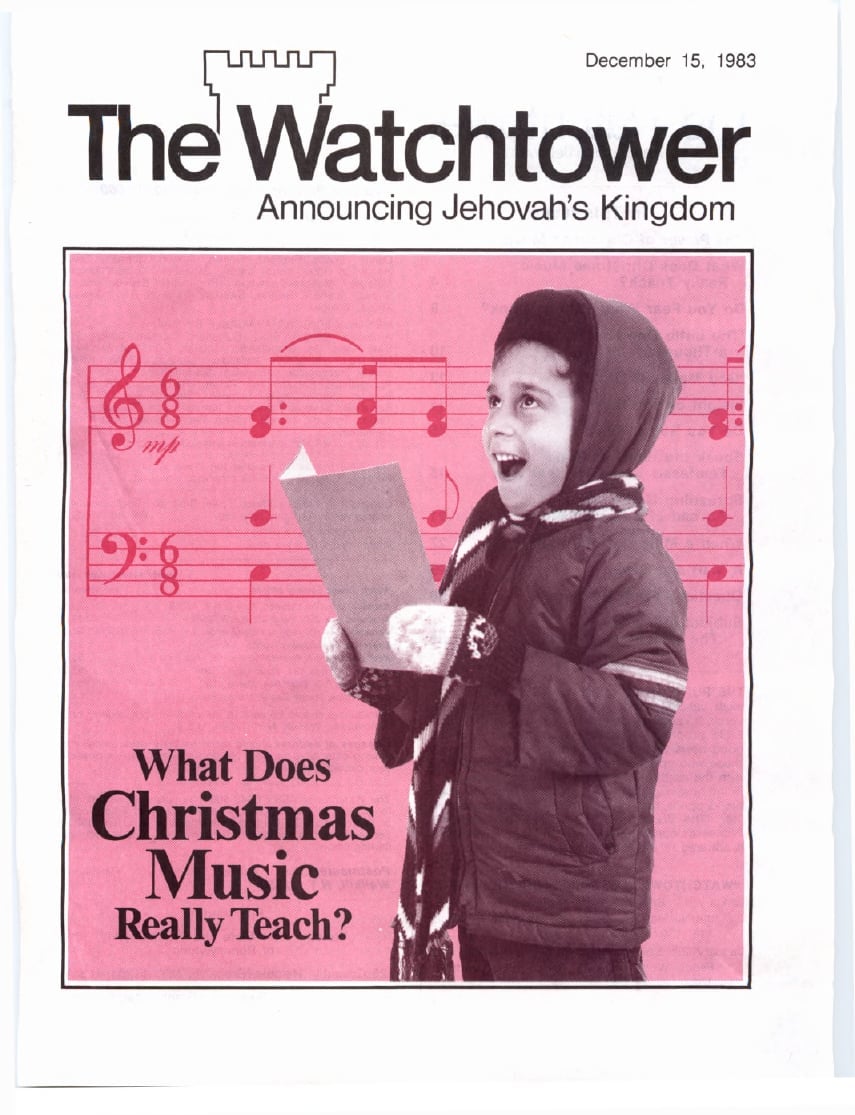
The Watchtower — December 15, 1983
Source: jw.org
Contents
The Power of Christmas Music
What Does Christmas Music Really Teach?
Do You Fear What Others Think?
‘The Little One Has Become a Thousand’ in Italy
‘God Makes It Grow’
Insight on the News
Do You Remember?
Speak the Word of God Fearlessly in the Nuclear Age
Spreading God’s Word Abroad in a Fearful World
When a Mate Is Unfaithful
A Marriage Saved
Questions From Readers
Subject Index for “The Watchtower” 1983
‘Excellent for Teaching Children the Bible’
The Power of Christmas Music
The Power of Christmas Music
CHRISTMASTIME is here again! Once again Christmas music fills the air. No doubt you have noticed how all other music fades into the background during this holiday season in Christendom. Yes, Christmas melodies have power. This is because they have qualities that play very much on human sentimentality, more so, it seems, than the music of any other holiday. Religion-oriented and very moving, these catchy tunes tug strongly at the heartstrings of many persons.
Why, just a short refrain from a familiar carol can stir emotions peculiar to Christmas! Yes, and depending on which land you live in, there are Christmas delights that appeal to the senses—the pungent smell of fresh pine, the sweet taste of candy canes, the tinsel against the bright red and green that characterize this festival. And a simple Christmas tune that fills the ear can trigger an onslaught of nostalgia—memories of the family coming together for the holidays, the sumptuous feast at the table, the gift-giving around the Christmas tree, the singing of carols together, visiting old friends and seeing old acquaintances again.
Naturally, what adds considerably to the power of this infectious music to conjure up such thoughts are the words—a curious mixture based on Bible events, folklore, old customs and traditional practices. For example, verses in certain carols tell of Christ’s birth at Bethlehem, the angels announcing this to the shepherds and a call for all the faithful to come and adore him. Still others buoyantly urge decorating the house with boughs of holly or warn children to be good so that Santa Claus will bring them the toys they want.
Whether sung by one voice or many, played on an organ or by an orchestra, the emotion-charged music of Christmas tends to program people for its celebration. On the surface, the power inherent in this music may seem good and beneficial. After all, many verses of these Christmas songs deal with religious themes and encourage kindness, generosity, goodwill and peace. Nevertheless, when Christmas music and its words are examined in the light of God’s truth as revealed in the Holy Bible, some startling facts come into view.
What Does Christmas Music Really Teach?
What Does Christmas Music Really Teach?
THERE is no denying the power of Christmas music and its lyrics. However, their impact on human emotions does not necessarily prove that they teach Jehovah God’s truths.
Much as we may feel moved by some pleasant things that touch our emotions, would you not agree that in religious matters involving Jesus, truth ought to be one’s foremost concern if one wants to please the God of the Bible? Actually, emotionalism would be a deterrent if it distracted a person from the facts. If people want to know what Christmas carols really teach and promote, then they must be objective and open-minded in their investigation.
Are They Truthful?
It might surprise you that anyone would raise questions about the truthfulness of popular Christmas songs. But as you will see, some oft-overlooked facts deserve our honest attention. ‘What facts?’ you may wonder.
For example, a number of carols declare that Jesus was born on Christmas Day, December 25. Is this true? To be frank, the facts answer no! Why do we say that, and why should it be of concern to you?
In his Holy Word, the Bible, God indicates that Jesus was born, not in cold winter, but in the fall of the year. Let us note the facts of the matter. The lyrics of some Christmas carols paraphrase Luke 2:8, where we read of “shepherds living out of doors and keeping watches in the night over their flocks.” But these tunes move this statement out of its time context in the early, warm fall of the year to a winter eve in December. Can we be sure of this? If so, then why is it significant, or why should it be important to singers of the words of these carols?
If you had opportunity to be in that area in late December, you would know that in this season the hills around Bethlehem are usually cold and rainy, and that sometimes the ground is covered with snow. In fact, you can find some clear Biblical evidence of this noteworthy point. If you consulted almost any Bible encyclopedia, you would find that our month of December corresponds to the latter part of the ninth month (Chislev) of the ancient Hebrew calendar and the early part of the tenth month (Tebeth). With this in mind, consider the account in Ezra 10:9 about something that happened just a few miles from Bethlehem:
“All the men of Judah and Benjamin collected themselves together at Jerusalem within three days, that is, in the ninth month on the twentieth day of the month, and all the people kept sitting in the open place of the house of the true God, shivering because of the matter and on account of the showers of rain.”
Do you appreciate the significance of this text? No sane Hebrew shepherd would endanger his flock in icy fields where there is little greenery on which to forage. Yet Bible writer Luke assures us that at the time of Jesus’ birth there were shepherds with their flocks in the fields around Bethlehem. This could not have been late, wintry December. Do not these musical verses about Christmas amount, then, to errors or distortions of truth? They might even be described as falsehood set to melody.
Obviously, these songs are not teaching the truth about the Christmas season. Could they be pleasing, therefore, to the One about whom the apostle Paul said, ‘God cannot lie’? (Titus 1:2) Further, is singing them the way to worship God “with spirit and truth,” which Jesus said is so important? (John 4:24) Actually, “Jehovah the God of truth,” and his Son, Jesus Christ, who is “the way and the truth and the life,” are honored by truth, not by melodic falsehoods. (Psalm 31:5; John 14:6) Furthermore, at Christmastime when these carols are sung, many clergymen quote Luke’s words about the shepherds as a basis for the December 25 celebration of Christmas. (Luke 2:8-14) However, neither this nor any other scripture gives support to the Christmas festive season. The Bible makes it clear that manipulating God’s Word to make it say something it is not saying leads to his adverse judgment. In the extreme case of the false prophets in Israel who “changed the words of the living God,” they paid with their lives.—Jeremiah 23:16-22, 29-32, 36; Deuteronomy 12:32; 18:20; Proverbs 30:5, 6.
Hence, no matter how beautiful Christmas music may sound, we cannot ignore the seriousness of its lyrics that contradict God’s Word. Jehovah is repelled by untruth, especially when it runs directly counter to his revealed truth. (Psalm 5:4-6) Many humans may be so moved by glorious harmonies and delightful melodies that they ignore any falsehoods being sung, but we can be sure that that is not the case with God and with his Son, Jesus. They do not desire praise to the extent that they will approve of lyrics peppered with flattering falsehoods.
Should We Commemorate?
Here is another aspect to consider: Do you know of any Biblical evidence that Jehovah God and Jesus Christ want us to commemorate Jesus’ birth, even if we intended to do it at the time of year that corresponds to Biblical evidence?
Like the good Father that he is, Jehovah God is always very specific about what he requires of his worshipers. He carefully spells out what we must do to gain his favor and blessings. He often repeats things to avoid any misunderstanding on our part.a Why, then, do we find in God’s written Word no direct command or even a hint that we should commemorate his Son’s earthly birthday? Because Jehovah places emphasis on Jesus’ death and resurrection, requiring Christians to celebrate annually the Memorial of his death only. (Luke 22:19, 20; 1 Corinthians 5:7, 8; 11:23-26) Thus, Christmas carols that presumptuously call for the celebration of Christ’s birth “go beyond the things that are written” in the Bible. (1 Corinthians 4:6) So do you think that people who know this and yet sing these lines are pleasing Jehovah God? No matter how sincere a person may be, presumptuousness and disobedience never win God’s favor.—1 Samuel 15:22, 23.
Customs and Beliefs
Jehovah God explicitly warns against mixing pagan practices and beliefs with his pure worship. (2 Corinthians 6:14-17) Pagan practices? Yes, as we shall now show, many pagan practices are tied in with Christmas. Such practices are repulsive to God, like the practices of the Canaanites of whom Moses said: “Everything detestable to Jehovah that he does hate they have done.” (Deuteronomy 12:31) Since ‘Jehovah does not change,’ how do you think he would view Christmas carols that, in the name of Christianity, encourage a mixture of pagan practices and pure worship?—Malachi 3:6; Deuteronomy 12:1-3, 29-32.
For example, the musical call to “Deck the Halls With Boughs of Holly” is rooted in ancient pagan superstition. In the booklet Discovering Christmas Customs and Folklore, Margaret Baker pointed out that decorating homes with evergreens was a Roman and a Norse custom. She further observed:
“Greenery brought into the house at the winter solstice seemed to be a charm to ensure the return of vegetation to the earth. . . . Holly had many associations with good fortune. In Louisiana berries were kept for luck. . . . A piece kept back from church decorations was especially lucky. . . . And a tree planted outside the house protected it from thunder, lightning, fire and the evil eye.”—Pages 29, 32.
If you study the lines of other Christmas carols, you will find that they endorse various superstitious customs.b Jehovah God cannot approve of these practices, for they enslave people to fear and ignorance, which keeps them from turning to him. Music that teaches or promotes superstitions is simply not fitting for Christians seeking his favor.
Christmas music that deals with Santa Claus touches a very sensitive area—little children! Emotions may be stirred up, but the question must be asked, What do these tunes teach little ones? Misconceptions such as that a white-bearded mythological figure in a red suit is practically omniscient. He knows when all children are good or bad. And he brings toys to only good boys and girls, so they are encouraged to behave to get these materialistic gifts.
Here we must let our reason rule and not our deceptive hearts. (Jeremiah 17:9) Santa Claus is just another product of pagan tradition, and sparkling melodies with lyrics telling children that he is real do not change that fact. Furthermore, such music ascribes to Santa the all-knowing quality that only Jehovah God possesses. Should God-fearing parents teach their children to believe and sing such things? Should they pretend to their children that the pagan Santa Claus is linked to the Christianity of the Bible?
Wise parents do not bribe their children to be good. Yet Christmas music leads children to believe that if they behave an imaginary Santa Claus will leave them toys. The bribery is there—subtle, but unmistakable. You can appreciate that such ideas can damage the moral fiber of children in their formative years. Jehovah declares that “foolishness is tied up with the heart of a boy; the rod of discipline [not bribery with Christmas toys] is what will remove it far from him.” (Proverbs 22:15) The conclusion should be clear—Christmas songs about Santa Claus are a gross deception. They can only undermine respect for true Bible principles.
Idealistic, starry-eyed little children need to feed on the “bread” of God’s truth. Their inquisitive minds cannot be satisfied with ‘stones’ of falsehood.—Matthew 7:9.
Who Is Behind It?
We all need to face up to the fact that Christmas and its music are not from Jehovah, the God of truth. Then what is their source? Reason should suggest that they are from someone whose sole aim now is to mislead as many people as possible. The Bible tells us that this is the goal of Satan the Devil. So you can appreciate why Christmas and its trappings can be perfect tools for his efforts. They tickle the senses while blinding the mind to Bible-based truth. (2 Corinthians 4:4) Satan knows the powerful effect music has on humans. In diverse churches and temples around the earth he cunningly camouflages his God-dishonoring teachings and customs with sweet melodies and lovely lyrics. So why should it be different with Christmas music?
Quite apropos here are Tertullian’s observations on pagan entertainment. This second-century professed Christian wrote:
“Grant that you have there things that are pleasant, things both agreeable and innocent in themselves; even some things that are excellent. Nobody dilutes poison with gall [something both distasteful and poisonous] . . . The accursed thing is put into condiments well seasoned and of sweetest taste. So, too, the devil puts into the deadly draught which he prepares, things of God most pleasant and most acceptable. Everything there, then, that is either brave, noble, loud-sounding, melodious, or exquisite in taste, hold it but as the honey drop of a poisoned cake.”—The Shows (De Spectaculis), chapter 27.
Yes, Satan the Devil can ingeniously make Christmas music appear to be of God and the singing of it a Christian duty that honors Him and his Son. In reality, it does just the opposite.—2 Corinthians 11:14.
Those seeking to gain Jehovah God’s favor that leads to eternal life will not let themselves be deluded by the deceptive power and beauty of Christmas music. They will shun it as “the honey drop of a poisoned cake.”
[Footnotes]
a Note the details outlined by God on how the Israelites were to celebrate his festivals at Exodus 12:1-27; 23:14-17; Leviticus 23; Deuteronomy 16:1-16.
b See “The Music of Christmas,” Awake!, December 22, 1969, pages 5-8.
[Pictures on page 5]
At Jesus’ birth, was it . . .
a warm season or cold winter?
Do You Fear What Others Think?
God’s Word Is Alive
Do You Fear What Others Think?
“JEHOVAH’S WITNESSES aren’t Christians,” this schoolgirl is saying. “They don’t even celebrate Christmas.” Others in the classroom join in ridiculing Jehovah’s Witnesses for their beliefs.
Suppose that you are a Witness youth and that you are present while these things are being said. Those in the classroom do not realize that Christmas actually is a pagan celebration and that it was not celebrated by early Christians.a Nor do they know that the other things being said against the Witnesses are false also. What if one of your classmates then turns to you and says in a voice that others can hear: “You are one of Jehovah’s Witnesses, aren’t you?” What will you say?
You will be in a situation similar to that faced by the apostle Peter the night before Jesus Christ was put to death. That night Jesus was led away to the house of the high priest where there was a meeting of the religious leaders. Peter followed along and waited outside in the courtyard. One of the servant girls of the high priest saw Peter and said: “This man also was with him.” But Peter denied it.
After a while another person saw Peter and said: “You also are one of them.” Peter answered: “I am not.” After about an hour, others began insisting: “Certainly you are one of them, for, in fact, you are a Galilean.” Then Peter, as you can see, responded: “I do not know this man of whom you speak.”—Luke 22:54-60; Mark 14:53-71.
But this was not the truth. Peter definitely did know Jesus. In fact, a few short hours before, he had asserted to Jesus: “Lord, I am ready to go with you both into prison and into death.” (Luke 22:33) What caused this sudden change in Peter’s attitude? Fear. On this night the truth was being distorted. What was right was made to appear as wrong, and the innocent one as guilty. So, because of fear of what others might think and perhaps do, Peter did not tell the truth. He did not honor God or his Son, Jesus Christ.
Similar circumstances can arise today. It is true that Peter was deeply repentant over his denials and that he obtained the forgiveness he so earnestly sought. (Luke 22:61, 62) But how much better that an experience such as this be avoided! Are you prepared to meet situations similar to the one faced by Peter—for example, during the Christmas season? Have you made a firm determination to stand up for the truth and to honor Jehovah God and his Son regardless of the circumstances that may arise?
[Footnotes]
a See pages 6, 7.
‘The Little One Has Become a Thousand’ in Italy
‘The Little One Has Become a Thousand’ in Italy
“THE little one himself will become a thousand, and the small one a mighty nation. I myself, Jehovah, shall speed it up in its own time.”—Isaiah 60:22.
Jehovah’s Witnesses in Italy have indeed “become a thousand” in the years since World War II. As the second largest religious body in Catholic Italy today, the number of Witnesses there has multiplied more than a thousandfold in that period of time—from 95 in 1946 to over 100,000 now.
The credit for this phenomenal growth clearly belongs to Jehovah. But instrumental also are the efforts of the zealous Italian Witnesses, their faithful endurance through difficult times and their willingness to use their time, strength and material resources in Jehovah’s service. To keep pace with all of this, and to provide the needed direction and support, the branch office of the Watch Tower Society in Italy has also undergone expansion through the years.
Expansion at the Branch
The very first branch office in Italy was established at Milan in 1946. After two years it was transferred to a small house purchased by the Society in Rome. By 1972 the number of Witnesses in Italy had grown to 25,000. So in that year, at a site that had been acquired at the northern periphery of Rome, the Society constructed a building that became the new branch and Bethel home.
Just four years after moving into that building, the number of Kingdom publishers in Italy increased to 60,000. Once again it became necessary to enlarge the branch facilities. Obtaining a building permit, however, proved to be a tedious process. Finally, in 1978 work was begun on a farm building and it was completed in 1980. In the autumn of 1979, construction began on a new Bethel residence building and a printing plant.
The New Buildings
The Bethel residence building is a four-story structure with a basement. On the ground level is a comfortable lounge with marble floor and olive-wood paneling. There are also a dining room and a fully equipped kitchen. The dining room can accommodate 200 persons. Its walls are decorated with pleasant landscape murals. A 350-seat Kingdom Hall is located on the first floor. A library is on the second floor. In the basement are the electric shop, the machine shop and some storage space.
The rest of the building consists of 70 comfortable rooms, each with a private bath and a terrace. Combined with the rooms in the existing building, there is now space for a total of 170 persons, thus comfortably accommodating the 158-member Bethel family.
The factory building is exceptionally bright and airy, thanks to its ample windows. It has a main floor and a basement, each measuring 12,500 square feet (1,161 sq m). Three M.A.N. presses have been installed. Two of these, along with an automatic book-binding line, are recent additions.
Each month this printing plant is turning out over 2,300,000 Watchtower and Awake! magazines. This certainly is progress, considering the fact that in 1946 the 95 Kingdom publishers distributed just 268 copies of these journals in Italy. The plant is also capable of producing 60,000 books a week.
The farm building is situated along a shady roadway a few hundred yards from the new buildings. All together the farm has 123.5 acres (50 ha) of land and produces meat, eggs, milk, vegetables and fruits for the Bethel family. Wholesome food is thus provided at a comparatively low cost. All the buildings are equipped with roof-top solar panels to operate the water-heating systems.
A Combined Effort
Construction work is commonplace nowadays. But what was different about putting up this new Bethel home and printery? All the work was done by about a thousand Witnesses who volunteered their services. Carpenters, designers, laborers, bricklayers, electricians, painters, plumbers and others came from all over Italy, including Sicily and Sardinia. Professionals and executives came and did hard manual work. Three carpenters—a father and his two sons—came and worked from time to time, even though they recently had suffered considerable financial loss due to a fire at their workshop. Another brother working at the construction site traveled about 62 miles (100 km) every weekend for several months so that he could also spend some time with his family.
Many brothers left their home and job, or took their annual vacation to come and work for extended periods of time. Much credit must go to the families they left behind for the sacrifices they made to enable one family member to come and work on this special project.
The fact that most brothers could stay for only a limited time meant that the personnel of the work force changed nearly every week. This presented quite a challenge to the brothers overseeing the work. Yet everyone was ready to adapt and to follow the instructions given. Their willingness to cooperate was truly a manifestation of “the fruitage of the spirit.”—Galatians 5:22, 23.
Many brothers contributed by putting their private businesses at the Society’s disposal. For example, one firm owned by brothers made 300 doors for the new Bethel residence building. Those who could not come to work offered money, materials and equipment. Even children were eager to help. A small child donated his savings of five years—the entire contents of his money box.
Reflecting on the fine spirit of the volunteers, one job overseer said: “It was encouraging and touching when it was time to say good-bye to these brothers. They would thank us for the privilege of contributing their work to the advancement of pure worship.” In this regard, the coordinator of the Branch Committee commented: “This building has not been brought about by the effort of a single person or a number of persons. It has been built because of the combined efforts of the whole of God’s people in Italy. It is an evidence of Jehovah’s blessing.”
Inauguration and Dedication
The completion of the new branch facilities brought great joy to the brothers. How clearly this was demonstrated on a special occasion—the inauguration and dedication of the new buildings to Jehovah! This took place on April 24, 1982. But how could a greater number of Jehovah’s Witnesses share in the joy of this encouraging event? To make this possible, the special program in the Kingdom Hall at the new building was linked by wire with meeting places in Rome, Novara, Ascoli Piceno, Naples, Syracuse and Cagliari.
The appointed day turned out to be windy, cold and rainy. Despite this and although most of the groups met in open stadiums, an enthusiastic crowd of 27,372 enjoyed the program. Concerning those meeting in Novara, Corriere della Sera reported:
“The rain was pelting down in the cold, windswept streets. Most people were barricaded in their homes or at the bar, but they [Jehovah’s Witnesses] were the exception. They had traveled down from Trieste, Gorizia, Verona and Alessandria by train, buses and small cars. The children wrapped up in ski suits, old ladies padded like mattresses, and elderly couples sheltering under blankets as they perched in the small grandstand of the stadium. . . . There was not a sign of unruliness, murmuring or impatience.”
A national television channel gave the event some coverage in the evening news. It included parts of the meeting and showed scenes of the new branch facilities.
Present for the meeting at the branch itself was M. G. Henschel, the principal speaker and a member of the Governing Body of Jehovah’s Witnesses. Also on hand were missionaries who have been serving in Italy for over 30 years. Present, too, were members of the Bethel family, some of whom have served at the branch for over 35 years.
In opening his dedication address, Brother Henschel quoted the statement, “the little one himself will become a thousand.” These words brought back special memories to the old-timers. But they also aroused in all those present heartfelt gratitude to Jehovah God, who has, indeed, ‘speeded it up in its own time.’—Isaiah 60:22.
Further Expansion
Although “the little one” in Italy has already “become a thousand,” it is evident that there is still much work for Jehovah’s Witnesses to do there. With the new and enlarged branch facilities, they feel well equipped for the work ahead. Confidently they look to Jehovah to give the increase.
Indeed, Jehovah has continued to give the increase. Last March a total of 233,042 persons—more than twice the number of Kingdom publishers in Italy—attended the Memorial of the death of Jesus Christ. The brothers are happy that they have the privilege of helping these interested people to make spiritual advancement. Many of them have responded favorably. In May 1983 a new peak of 105,463 persons shared in proclaiming the Kingdom good news in the Italian field.
Jehovah’s Witnesses in Italy feel that God truly has made “all his undeserved kindness abound toward” them. In addition to numerical increases, they have enjoyed abundant spiritual riches. They are thankful for Jehovah’s generosity, and it is their resolve to go on sowing even more abundantly in the years to come.—2 Corinthians 9:8-10.
‘God Makes It Grow’
‘God Makes It Grow’
A farmer may plant a seed, water and cultivate it, but he must patiently wait for God to make it grow to maturity. It is likewise with Christian ministers. As the apostle Paul said: “I planted, Apollos watered, but God kept making it grow.” (1 Corinthians 3:6) Although we may proclaim the “good news” and teach God’s Word to interested people, it is God who makes the “seed,” or implanted word, come to full Christian growth, even as the following experience illustrates.—Matthew 24:14; Luke 8:11-15.
“In 1953 I started a Bible study with Mable and her mother. We had three studies. But Mable’s husband was so opposed that he sold the house and moved the family. She had such a love for the Bible that I often wondered what happened to her.
“Last month I received this letter, which helped me to appreciate that it is Jehovah who makes the ‘seed’ grow.
‘Dear Virginia,
‘We are finally sisters after all these years. I hope you didn’t think I had given up the truth for good. It just took all those years and finally Jehovah’s spirit to make me strong enough to take my stand.
‘I have often thought of the “seeds” you planted so many years ago, and I just wanted you to know that I finally made it.’”
Insight on the News
Insight on the News
War Habit
“Wars offer the greatest variety, in practically every shape, size and color,” columnist Flora Lewis writes in The New York Times. Citing country after country embroiled in some form of armed struggle, the columnist notes: “The list reads like the index of an atlas.” The reason? “The fact is that nobody is running the world anymore and keeping a semblance of order,” she says. Has the United Nations curbed the war habit? “With its emphasis on sovereignty, pride of nation, expression of grievance, the U.N. has become a logrolling conclave to keep small disputes aflame while the big power conflict festers.” After a myriad of conferences with the supposed intent of preventing war, “enough people still want to fight to keep the war habit going,” remarks Lewis.
For the generation since 1914, war has indeed become a habit. Why? The Bible book of Revelation foresaw a symbolic horseman, brandishing a great sword, thundering forth on his fiery-colored steed with the commission “to take peace away from the earth.” (Revelation 6:4) That prophecy has come true in this century, for not only has the earth witnessed the horrors of two world wars but it has also seen an almost constant stream of bloodspilling conflicts.
Sincere lovers of peace, though, look forward to the breaking of the enslaving “war habit” by Revelation’s crowned symbolic rider on the white horse. He is Christ Jesus, the “Prince of Peace.” Since 1914 he has been galloping forth “conquering.” First, he subdued the heavenly opposers of divine rule, and next he will “complete his conquest” over all earthly resisters. Then earth will experience the habit of peace.—Isaiah 9:6; Revelation 6:2; 12:7-12.
“Men Have Forgotten God”
Exiled Soviet novelist and Nobel prize winner Alexander Solzhenitsyn pinpointed the reason for the worldwide decline of spirituality in his acceptance speech for this year’s Templeton Award at Buckingham Palace. He said: “If I were called upon to identify briefly the principal trait of the entire 20th century, here too, I would be unable to find anything more precise and pithy than to repeat once again: ‘Men have forgotten God.’ The failings of human consciousness, deprived of its divine dimension, have been a determining factor in all the major crimes of this century. The first of these was World War I, and much of our present predicament can be traced back to it.”
Mr. Solzhenitsyn, noting this “same kind of defect” woven into society from World War II to the present, next stated: “Today’s world has reached a stage which, if it had been described to preceding centuries, would have called forth the cry: ‘This is the Apocalypse!’”
Since World War I mankind has been in the Biblical “last days”—a time period characterized by mankind’s having “a form of godly devotion but proving false to its power.” (2 Timothy 3:1, 5) With what result? To ancient Jerusalem at one period in its history, God said: “You have forgotten me and you keep putting your trust in falsehood.” Like that spiritually drained city of old, Christendom, along with this ungodly world, is facing certain ruin.—Jeremiah 13:25.
Are You a “Friend”?
“The greatest myth about friendship is that it will come to people without their doing something in exchange for it,” says Eugene Kennedy, professor of psychology at Loyola University of Chicago and author of many books on human behavior. U.S.News & World Report also quotes him as saying: “People have difficulty in knowing how to go about making friends because our society has told them that self-gratification will make them successful and happy.”
“There is more happiness in giving than there is in receiving,” said Jesus. (Acts 20:35) Unselfish giving of your resources, time and interest, especially in Christian activities, will help you to become a friend and to have ‘friends that will stick closer than a brother.’—Proverbs 18:24.
Do You Remember?
Do You Remember?
Have you enjoyed the last several issues of The Watchtower? See if you can recall the following points:
◻ What is involved in our ‘believing on the Lord Jesus Christ and getting saved’? (Acts 16:30, 31)
This is more than just a brief, emotional experience. It involves learning the truth of God’s Word, studying the Scriptures regularly and applying them in our life. (Acts 2:41, 42; 17:11) It also involves accepting Jesus Christ as our Ransomer and obeying him, recognizing him as Jehovah’s King and Vindicator. (1 Timothy 2:5, 6; Hebrews 5:9; Revelation 7:10)—8/15, pages 6-8.
◻ How can we show our heartfelt appreciation for the Creator?
Our love and gratitude for the Creator should motivate us to serve him voluntarily. This means more than living a clean life and not doing what is bad in God’s eyes. Godly conduct is essential, but serving Jehovah involves praising him actively and joyously, telling others about Jehovah’s great deeds and grand purposes. (Psalm 96:2-4)—9/1, page 7.
◻ Into how many religious groups is humanity divided?
It has been estimated that there are 10 main religions and 10,000 sects.—9/15, page 3.
◻ Why are Jehovah’s Witnesses not a sect?
Jehovah’s Witnesses are not disciples of a human leader or teacher. Jehovah God and Christ Jesus are their teachers. Hence, Jehovah’s Witnesses are not a sect.—9/15, page 9.
◻ What is the world for which Jesus would not pray? (John 17:9)
It is the organized human society that exists apart from God’s visible organization, or outside it. This is made up of three closely connected parts: false religions, political governments and commercial systems. (Revelation 17:3, 5; 13:1, 2; 18:11, 15)—9/15, page 28.
◻ What is needed for earth to become a Paradise?
Paradise requires far more than beautiful natural surroundings and all the animal creation living at peace with one another and with man. Paradise also involves people who have developed godlike personalities with peaceful dispositions, all getting along with one another in love.—10/1, pages 3, 4.
◻ In what sense does a paradise exist on earth today?
Compared to the strife, disunity and immorality in the world today, the love, peace of mind and unity among Jehovah’s Witnesses make a spiritual paradise for them. This is a foretaste of how humans will live together peacefully on this earth in a physical Paradise during the Thousand Year Reign of Christ Jesus. (Isaiah 11:6-9)—10/1, pages 4-7.
◻ What did Jesus mean when he said to the evildoer: “You will be with me in Paradise”? (Luke 23:43)
The evildoer was not a faithful Christian conqueror who qualified for life as a coruler in heaven with Christ. Therefore Jesus was not promising a heavenly paradise to the dying thief. Jesus’ words mean that he will be with the evildoer by raising him from the dead into Paradise on earth and then caring for his needs, both physical and spiritual.—10/15, pages 4, 5.
◻ What are some of the things we can learn from the book of Exodus?
Jehovah is depicted in the book of Exodus as one who sustains his people, as the incomparable Deliverer and as the God of theocratic organization. This strengthens the faith of Jehovah’s Witnesses today that he will act similarly toward them.—10/15, page 31.
◻ What is the real significance of the word “Har–Magedon”?
The meaning of the word is “mountain of assembly of troops.” Thus Har–Magedon, or Armageddon, is not literally a place on earth, but it is the state of the world rulers in being gathered together against God the Almighty in warfare. (Revelation 16:13-16)—11/1, pages 3-6.
◻ How can a Christian keep enjoyment of pleasure in its proper place?
Enjoyment of pleasure can be kept in its proper place by yielding to the guiding principles of the Bible regarding quality, quantity, timing and cost of things.—11/1, page 25.
◻ What is the re-creation spoken of by Jesus in Matthew 19:28?
Jehovah originally purposed for humans to live forever on earth enjoying true peace and security. This purpose will be realized during Christ’s Thousand Year Rule, resulting in a restoration of Edenic conditions. In other words, the theocratic system with which humankind began life on this earth will be re-created.—11/15, pages 8, 9.
◻ What advantages are there in following the Biblical example of using God’s personal name?
Doing so helps us to view God as a Person, not just a force. It helps us to draw closer to him, and it eliminates confusion, sharpening our thinking about him, bringing our thoughts closer to what the Bible really teaches.—12/1, pages 10-13.
Speak the Word of God Fearlessly in the Nuclear Age
Speak the Word of God Fearlessly in the Nuclear Age
“Speak the word of God fearlessly.”—PHILIPPIANS 1:14.
1. The Creator of the atom with its nucleus has had what fearlessly spoken during the past 48 years?
THE nuclear age is upon us. The whole world is now menaced with nuclear warfare! The Almighty Creator of the atom with its nucleus well knows that. What is his Word for our day that needs to be preached worldwide? In our time he has had a figurative ‘man clothed with linen, with a secretary’s inkhorn at his side,’ doing a marking work.
2. What marking work has progressed, and for what purpose?
2 This “man” has been marking the foreheads of the people who are crying and sighing over all the detestable things that are being done, particularly in the religious realm of Christendom, which professes to worship God. (Ezekiel, chapter 9) Recalling the course of conduct of Christendom’s clergy during World Wars I and II, these people feel distress at what they have reason to believe those religious leaders would do during a likely nuclear war on a world scale. Expecting better things of so-called Christian leaders, they are deeply disturbed at what the clergy now make allowance for in this highly immoral, violent and religiously divided world. In a system of things that is doomed to early destruction, these righthearted ones are being marked for preservation into a new and righteous system of things.
3. Grief over what is more important than grief over prospective mass extermination, and what has the doing of the marking work called for?
3 No improvement of worldly things is in sight. In the case of so many righthearted people inside and outside of Christendom, what will quiet their fears of being violently exterminated en masse shortly? Well, they may be grieved at the shape of things. But, most importantly, are they grieved because the name of the God of the Holy Bible is involved and is being made a subject of reproach owing to the way those who claim to be his people are carrying on? However, who is the figurative ‘man clothed in linen’ who is marking more and more of these grieved persons, and how is he doing so? This marking work is not appreciated by the clergy of Christendom and has been vigorously opposed by them. It has therefore called for the exercise of great fearlessness for the marking work to be done.
4. The man doing the marking was prefigured by whom, and so what qualifications are called for in those doing the marking at present?
4 Yet it has gone forward with even greater impetus since 1935. It has been done by a class of Christians dedicated to Jehovah God through Jesus Christ, and who were prefigured by the prophet Ezekiel, a priest of ancient Israel. He was the one that had the vision of the ‘man clothed with linen who had the secretary’s inkhorn at his side.’ They are dedicated to the same God as Ezekiel was and so, like him, they are witnesses of Jehovah. The modern-day Ezekiel of 1983 is a priestly class, belonging to spiritual Israel, to which the apostle Peter wrote the words found at 1 Peter 2:9: “But you are ‘a chosen race, a royal priesthood, a holy nation, a people for special possession, that you should declare abroad the excellencies’ of the one that called you out of darkness into his wonderful light.”
5. How many underpriests are there to be under the one whom Jehovah swears into the high priesthood?
5 Hence, we recognize the Ezekiel class of today to be made up of those who serve in a spiritual way as underpriests, under the High Priest, Jesus Christ, whom Jehovah God swore into the priesthood “according to the manner of Melchizedek,” who was king of ancient Salem and “priest of the Most High God.” (Psalm 110:4; Genesis 14:18; Hebrews 5:10; 6:20; 7:10, 11, 15-17) From the first century, in which the apostle Peter wrote his letter, Jehovah God has picked out the members of this “royal priesthood,” who are to number finally 144,000 under the High Priest, Jesus Christ.—Revelation 7:1-8; 14:1-4.
6. How many of that “royal priesthood” are yet in the flesh on earth, and as what figurative person do they serve?
6 Today there is only a small remnant of the members of the “royal priesthood” yet in the flesh on earth, according to the world report from the celebration of the Lord’s Evening Meal on March 29, 1983. These serve together as the figurative linen-clad man, who does the marking of worthy ones in their foreheads.
7. What do those today who were prefigured by the linen-clad man with the inkhorn have to trust Jehovah to do for them?
7 The prophet Ezekiel of old had to muster up great courage in order not to fear the Israelite opposers of his day. But Almighty God made the promise that he would make the face of Ezekiel just as hard as the faces of his antagonists, yes, even harder. So he should not be afraid of his merely human opposers. (Ezekiel 2:4; 3:8; Isaiah 51:12) Likewise, the remnant of spirit-anointed Christians that makes up the class prefigured by the man clothed with linen and with the inkhorn at his side need to trust in the God of Ezekiel to harden their faces to confront unflinchingly the hard-set countenances of opposers inside and outside Christendom.
8. What instructions appropriate for today did Jesus give?
8 Nineteen centuries ago Jehovah’s Chief Messenger, Jesus Christ, sent forth his disciples on an errand of speaking the Word of God fearlessly in their own country. Before dispatching them, he said: “Do not become fearful of those who kill the body but cannot kill the soul; but rather be in fear of him that can destroy both soul and body in Gehenna.” (Matthew 10:28) In addition, in the last book of the Bible he tells the anointed remnant of our own time: “Do not be afraid of the things you are about to suffer. Look! The Devil will keep on throwing some of you into prison that you may be fully put to the test, and that you may have tribulation ten days. Prove yourself faithful even to death, and I will give you the crown of life.” (Revelation 2:10) How encouraging those words are!
9. (a) The imprisonment of so many of Jehovah’s Witnesses today indicates that they are obeying what instructions given above? (b) What opposite effect is shown in Paul’s case?
9 When we call to mind that today there are witnesses of Jehovah in more than 40 lands where their work is banned or under legal restriction—doubtless more Christians now than the number imprisoned in the first and second centuries—Jehovah’s Witnesses of today are not fearful of the things they must suffer, including imprisonment. The imprisonment of Christians can have an effect upon fellow Christians opposite to what the enemy contemplated. The imprisoned apostle Paul wrote from his confinement: “Most of the brothers in the Lord, feeling confidence by reason of my prison bonds, are showing all the more courage to speak the word of God fearlessly.”—Philippians 1:14.
10. (a) Jehovah’s Witnesses today are appointed to speak out a message from what source? (b) What position like that of the apostles 19 centuries ago must they take?
10 Today, as in Paul’s day, it is not a man-made message that the witnesses of Jehovah are fearlessly speaking. It is the timely message drawn from the Holy Bible, the inspired Word of the Most High God, Jehovah. In that Word he tells his dedicated, baptized people that they must be his witnesses, testifying to his Godship and his Kingship. (Isaiah 43:10, 12) Since he tells them to speak forth his infallible Word, what creature, high or low in station, has the right or authority to order or force them to stop speaking it? The position of the Christian apostles of 1,900 years ago must be taken, when they said to officials: “We must obey God as ruler rather than men.”—Acts 5:29.
11. Have men deified themselves by inventing the nuclear bomb, and what about authority on their part to oppose the speaking forth of the Kingdom message?
11 Men have not made gods out of themselves by inventing the nuclear bomb, and they must answer to the Most High God as to how they use it. (Note Psalm 82:6, 7.) By producing the nuclear bomb as a deterrent, the governments seek to perpetuate their domination of the earth, rather than to advance the interests of the Kingdom of God by Jesus Christ. They resent and interfere with the proclaiming of that Kingdom by the true, obedient followers of Jesus Christ today. This nuclear age has not made out of date or impractical Christ’s prophetic words: “These [things] are a beginning of pangs of distress. As for you, look out for yourselves; people will deliver you up to local courts, and you will be beaten in synagogues and be put on the stand before governors and kings for my sake, for a witness to them. Also, in all the nations the good news has to be preached first. But when they are leading you along to deliver you up, do not be anxious beforehand about what to speak; but whatever is given you [to speak] in that hour, speak this, for you are not the ones speaking, but the holy spirit is.”—Mark 13:8-11.
12. Despite violent opposition, what was to be preached first, and of what was this to be a most outstanding sign?
12 World pangs of distress began in 1914. The foretold persecution of the faithful and obedient followers of Jesus Christ followed and continues down to this day. All the evidence indicates that we are living in “the conclusion of the system of things,” yes, nearing its grand climax in this nuclear age. (Matthew 24:3; Mark 13:3, 4) But before the complete end yet comes, “the good news” has to be “preached first.” So this worldwide ‘speaking the Word of God fearlessly’ in behalf of the Kingdom is one of the most outstanding proofs that we are living in “the conclusion of the system of things.”—Matthew 24:14.
Eating God’s Word and Speaking It Forth Worldwide
13. What experience like that described in Revelation chapter 10 did the anointed remnant have after World War I, and after the refreshment was taken, what command was given?
13 John, the last of the surviving disciples chosen by Jesus as an apostle, finished his earthly career near the end of the first century. During this “conclusion of the system of things” since 1914 there has been a remnant of dedicated, baptized Christians anointed with Jehovah’s spirit. This remnant was prefigured by John, the writer of the last book of the Bible canon, Revelation. In the first postwar year of 1919 this remnant had an experience like that which John describes respecting himself in Revelation chapter 10. This experience was to occur near the time when “the mystery of God,” or his “sacred secret,” was to be brought to a finish. (Revelation 10:7, Authorized Version, NW) After they got spiritual refreshment, as it were, by eating the sweet-tasting “little scroll” that was held out to them, those who made up this modern class prefigured by John were, in effect, told: “You must prophesy again with regard to peoples and nations and tongues and many kings.”—Revelation 10:10, 11.
14. By means of whom is the commission to the apostle John on Patmos fulfilled?
14 Whether the apostle John on the island of Patmos was able to fulfill his assignment of service of such a wide scope and at his old age, we have no inspired record. But what about those anointed ones today whom John prefigured? This class is what fulfills his prophetic status and sees the commission to him carried out in full. The expression, “You must prophesy again,” indicates that the free carrying out of his witness work was being interfered with by his exile on Patmos. It is evident that what was said to him there was really meant for his modern counterpart today. That being the case, we are obliged to ask: In how many lands and tongues are Jehovah’s Witnesses speaking the Word of God fearlessly as they endeavor to preach “this good news of the kingdom . . . in all the inhabited earth for a witness”?—Matthew 24:14.
15. To what extent by now is the preaching being done?
15 The 1983 Yearbook of Jehovah’s Witnesses reports 205 lands, with Bible literature being published in some 190 languages. Those lands include people black, white, yellow, red and brown, also of various tribes, clans and sects along with dialects. Since World War I the number of “kings” on thrones has been greatly reduced, but there are many other types of political rulers now in office. Regardless of their official designation or their political cast, the message of Jehovah’s Witnesses today involves and applies to all of them. The banning of Jehovah’s Witnesses in so many lands gives proof of this fact.
16. So what proclamation has gone forward irresistibly, in spite of the religious prayers of world leaders for what?
16 So in spite of the League of Nations and its successor, the United Nations, which were set up as the means for advancing and maintaining a united world, the fearless proclamation of the Kingdom of God by Christ as the only hope for mankind has gone forward irresistibly. Such “good news of the kingdom” has not seemed “good” to world leaders, as it differs so much from what they have thought to be good, yes, the best, for afflicted humankind. They feel that they themselves can take care of earthly affairs as their own business. If they feel the need of superhuman help, it is really to “the god of this world” that their religious prayers have gone and no higher. The divine Originator of “this good news of the kingdom” is not in favor of “this world,” of which Satan the Devil is the god.—2 Corinthians 4:4, AV.
17. (a) Why has the written Word of God failed to be stamped out by opposers? (b) By means of whom has that Word been made vocal since 1919?
17 The prophetic Bible boldly declares that the word of God is to time indefinite and that it will endure forever. (1 Peter 1:23-25) To this day those statements have not been disproved. The Bible, God’s inspired written Word, has not been blotted out, despite all human efforts to destroy it by religious bans and bonfires. Correspondingly, the preaching of that written Word of God needed someone to make it vocal and hearable. The fearless speaking of that Word of God has gone doggedly onward by Jehovah’s Witnesses since the postwar year of 1919 by an increasing number of mouths, despite the attempts of the infuriated opposers to stifle the fearless speakers.
18. Till when will Jehovah continue to harden the foreheads of such ones?
18 Can there be any room for doubt that the Heavenly Giver of that Word will continue to harden diamondlike the foreheads of his modern-day Ezekiel class and their courageous companions to face the hardheaded opposers till destruction suppresses their opposition? None at all! He has made the way of his witnesses successful until now. He will keep on making their way prosperous until the ‘prophesying again regarding peoples and nations and tongues and kings’ has been fearlessly completed. This he can be expected to do, to his own credit and to the vindication of his universal sovereignty.
Can You Recall?
□ What was prefigured for our day by the ‘man clothed with linen who had a secretary’s inkhorn,’ and what work is he now doing?
□ Why is fearlessness called for on the part of Jehovah’s Witnesses?
□ When the apostle John ate a “little scroll,” what was he then to do, and what parallels this in modern times?
[Picture on page 17]
In this nuclear age a figurative man in linen is carrying on a fearless work. Are you involved in that work?
[Picture on page 19]
As John received a symbolic scroll and a command to “prophesy again,” so Christians today fearlessly declare God’s message
Spreading God’s Word Abroad in a Fearful World
Spreading God’s Word Abroad in a Fearful World
1. What unparalleled state of world fear did the greatest prophet in human history foretell?
THE greatest prophet in all human history, Jesus Christ, foretold concerning the world-changing era that set in with the outbreak of World War I in 1914 the international mental state as follows: “Men become faint out of fear and expectation of the things coming upon the inhabited earth; for the powers of the heavens will be shaken.”—Luke 21:26, 27.
2. Who are the ones not giving way to fear, and why so?
2 However, strange as it may seem, there are those who are not becoming fearful and fainting with a sense of helplessness. They are the witnesses of Jehovah who are now found in 205 lands. They do what Jesus urged: “But as these things start to occur, raise yourselves erect and lift your heads up, because your deliverance is getting near.”—Luke 21:28.
3. Why has the Messianic Kingdom not been set up at Jerusalem in Israel, and why have the League of Nations and its successor not warded off the nuclear age?
3 Today the fact remains more confirmed than ever that “the appointed times of the nations,” “the times of the Gentiles,” ended in the latter half of 1914 and that then the promised Kingdom of Jehovah God by Jesus Christ was installed in the heavens to rule amid its enemies. (Luke 21:24, NW, Authorized Version) So, to this day that Messianic Kingdom has not been set up at earthly Jerusalem. Logically, also, the League of Nations failed to be “the political expression of the Kingdom of God on earth.” The League’s successor, the United Nations, has, after more than 35 years of operation, failed Christendom’s prayers; it has not warded off the nuclear age.
4. Against what was the League of Nations really a conspiracy?
4 From the very time of the proposal of a league of nations toward the close of World War I, Jehovah’s Witnesses have fearlessly served notice that man-made substitutes of such kind for the real thing, Jehovah’s royal government by Christ, would fail. They have guided their course of action by the prophecy of Isaiah 8:12: “Say ye not, A confederacy, to all them to whom this people shall say, A confederacy; neither fear ye their fear, nor be afraid.” (AV) That man-made scheme is really a “conspiracy,” yes, a conspiracy against the precious interests of God’s Kingdom by Christ. (NW, Revised Standard Version) How, then, could it ever have the blessing and backing of the King of kings, Jehovah God?
5. (a) In spite of the contents of “the roll,” how did it taste as Ezekiel ate “the roll of a book”? (b) To have God’s Word put in our mouths so as to serve as his witnesses is what kind of experience?
5 The Kingdom message that Jehovah’s Witnesses still keep on proclaiming is a challenging one, indeed, in a world otherwise oriented. They have had an experience like that of the prophet Ezekiel, when he was a captive in the land of Babylon, some years before the destruction of Jerusalem by the Babylonians in 607 B.C.E. Like the apostle later on the isle of Patmos, Ezekiel was given a “roll of a book.” The prophet tells us: “It was written upon in front and on the back; and there were written in it dirges and moaning and wailing.” (Ezekiel 2:9, 10) After obeying God’s instructions to eat this “roll of a book,” Ezekiel comments: “It came to be in my mouth like honey for sweetness.” (Ezekiel 3:1-3) Today, for any of us to have the Word of God put in our mouth so as to serve as his message-bearers is a sweet privilege, regardless of all the contents of that Word, even dirges, moaning and wailing. (Compare Psalm 19:7-10.) Jehovah’s Witnesses prize the revealed Word of God after having eaten it from the postwar year of 1919 onward. It strengthened them, just as literal honey strengthened Jonathan.—1 Samuel 14:26, 27.
6. As the day of God’s vengeance draws near, why is courage called for, but of what may Jehovah’s Witnesses be certain?
6 As “the day of vengeance on the part of our God” comes on apace, it calls for courage on the part of Jehovah’s Witnesses to point to “dirges and moaning and wailing” in the near future for all human society. (Isaiah 61:1, 2) Relief-seeking people of this threatened world are not disposed to listen to such information at the mouths of Jehovah’s Witnesses. But since God sends them forth to spread his Word, they can be certain that he will back them up to the very day of his vengeance.
7. How would Jehovah make Ezekiel equal to his assignment?
7 It is not pleasant to have people refuse to listen, but let us give heed to what God said to Ezekiel: “As for the house of Israel, they will not want to listen to you, for they are not wanting to listen to me; because all those of the house of Israel are hardheaded and hardhearted. Look! I have made your face exactly as hard as their faces and your forehead exactly as hard as their foreheads. Like a diamond, harder than flint, I have made your forehead. You must not be afraid of them, and you must not be struck with terror at their faces, for they are a rebellious house. . . . And go, enter in among the exiled people, among the sons of your people, and you must speak to them and say to them, ‘This is what the Sovereign Lord Jehovah has said,’ regardless of whether they hear or they refrain.”—Ezekiel 3:7-11.
8. How did the Ezekiel class face the forbidding situation after World War I, and what if the clergy had listened?
8 A forbidding situation like that was what faced the remnant of those Christians who had been begotten by God’s spirit to be his spiritual sons and who had been anointed with his spirit to be his appointed witnesses. They make up the 20th-century Ezekiel class. So, like Ezekiel, they have not shrunk back because of the forbidding countenances of the professional, impressively frocked clergy of Christendom, who may claim to be spiritual Israelites. If such religious leaders had softened their faces and given an obedient ear to the Kingdom message as proclaimed by the anointed remnant since 1919, Christendom would not have launched off into the second world war of far larger proportions and more damaging worldwide than the first one.
9. How have the remnant and their dedicated companions been made equal to their assignment?
9 Today, even with the growing threat of nuclear war in spite of the United Nations organization, the religious leaders have not undergone a change of visage toward the Kingdom proclaimers. So the anointed remnant as Kingdom ambassadors and their dedicated, baptized associates out of all the nations have had to harden their own faces like a diamond in view of the stiffened religious opposition. They persist in speaking the Word of God fearlessly.
10. Jehovah’s Witnesses should have been listened to by the clergy and their parishioners for what reason, and what fact will such religionists yet have to acknowledge?
10 Particularly the clergy of Christendom and their parishioners should have understood the message and the counsel of Jehovah’s Witnesses. The Witnesses draw what they have to say from the very same Bible that the religionists of the so-called Christian world claim to accept and that their Bible societies spread abroad in many languages. It has proved to be just as Jehovah God said to Ezekiel, according to the New World Translation: “And the sons insolent of face and hard of heart—I am sending you to them, and you must say to them, ‘This is what the Sovereign Lord Jehovah has said.’ And as for them, whether they will hear or will refrain—for they are a rebellious house—they will certainly know also that a prophet himself happened to be in the midst of them.”—Ezekiel 2:4, 5.
11. What qualities have been displayed by Christendom toward Jehovah’s commissioned remnant, and how has he enabled the remnant to carry out this challenging commission?
11 Insolence of face and hardness of heart have been displayed on the part of professed spiritual Israel, Christendom, toward the anointed remnant whom the Sovereign Lord Jehovah has commissioned to deliver his final message during this “conclusion of the system of things.” (Matthew 24:3, 14) Almighty God knew that he could instill in the modern counterpart of Ezekiel the fearlessness that would nerve this anointed remnant to undertake and carry out this challenging commission.
12. What false charge is Jehovah thus warding off, and what pertinent event will leave him with a clean record?
12 The irreproachable God has purposed to ward off all possibility of being charged with negligence, of having failed to give due warning to the endangered ones. Circumstances are closing in upon us to the extent where we shall be shown up for what we are. Then the unheeding ones will be forced to own up to the fact that a prophet from Jehovah has been among them. This will be when Babylon the Great, the world empire of false religion, goes down in everlasting destruction at the hands of the political powers with which she used to practice shameless spiritual harlotry. This will leave the God of pure worship with a clean record.
…