The Watchtower, August 1, 1980
Download: PDF — The Watchtower, August 1, 1980
The Watchtower — August 1, 1980
Source: jw.org
Contents
Page Two
Is Your Giving Good, Better or Best?
“Glad Tidings” Bring Joy to Central Africa
The Sustaining Power of God’s Word
‘How Good a Word at the Right Time!’
Confident in a World Beset by Doubts
Remain “Solid in the Faith”
Insight on the News
The Lollards, Courageous Bible Preachers
Do You Find Entertaining What God Hates?
Questions From Readers
Who Rules the World?
A Day Well Spent
Page Two
Page Two
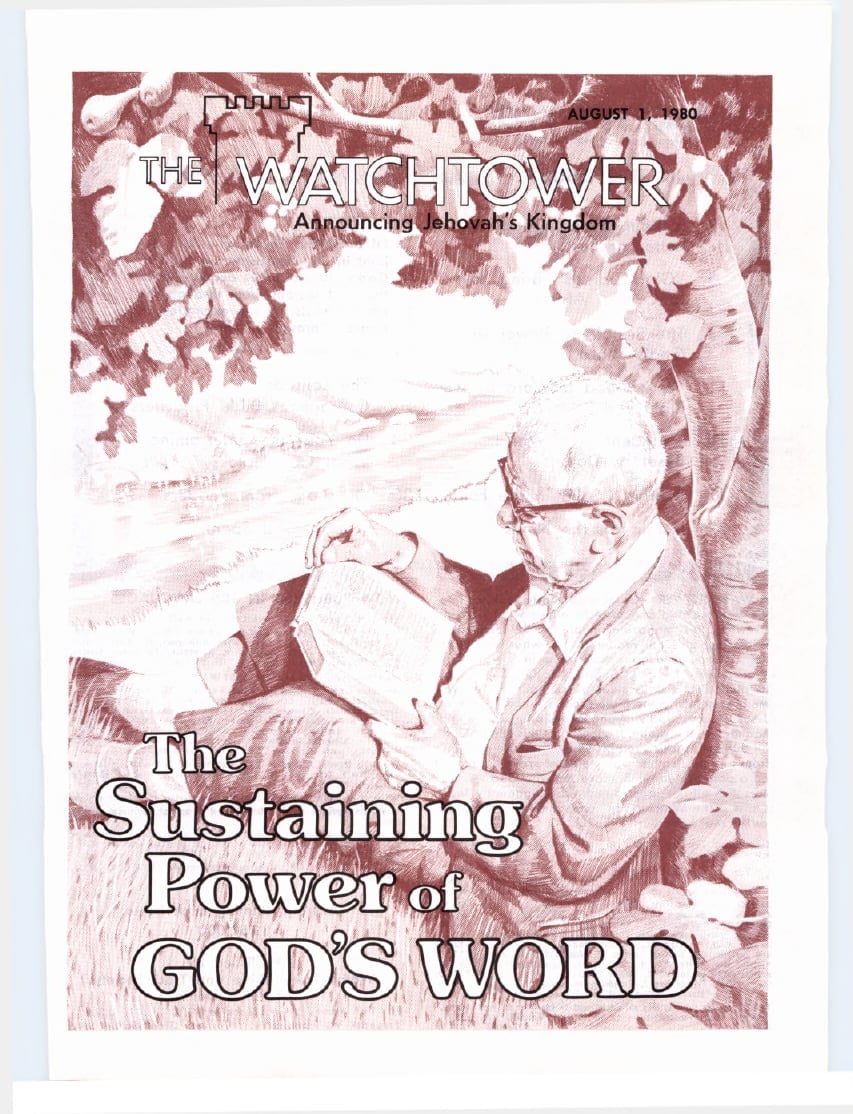
OUR COVER: Those who find delight in the life-sustaining truth of God’s Word may acquire faith that will sustain them through the hardest trials, as the examples on pages 8 through 11 show
Is Your Giving Good, Better or Best?
Is Your Giving Good, Better or Best?
HAVE you not found that contentment makes for peace of mind as well as being conducive to peace with others? That is why the apostle Paul could write: “It is a means of great gain, this godly devotion along with self-sufficiency. For we have brought nothing into the world, and neither can we carry anything out. So, having [food] and [clothing], we shall be content with these things.” In fact, he went farther, encouraging contentment with one’s lot, whether slave or freeman, whether married or single.—1 Tim. 6:6-8; 1 Cor. 7:12-27.
However, when it comes to giving expression to Christian virtues, such as generosity, we may well ask if we should be prone to be content with our performance. Are we content with simply doing what might be termed “good,” when we could be doing that which is better or even best?
For example, what about giving to a truly worthy cause or helping a deserving needy person? To make a modest contribution might be said to be good in that it is certainly better than not giving anything; and regardless of the amount, it will do some good. In this regard, some pride themselves in giving the tithe, or tenth, of their income. This certainly might be said to be good, even though there is nothing in God’s Word requiring Christians to tithe. However, the fact is that for the very poor or well-nigh destitute, a tithe may represent a real hardship, whereas for the affluent it represents no sacrifice at all.
If all such giving might be considered “good,” then what would be considered “better” giving? It would be giving in proportion to one’s means. This is what Jehovah God required of the Israelites in connection with their annual festivals. He commanded them: “Three times in the year every male of yours should appear before Jehovah your God in the place that he will choose: in the festival of the unfermented cakes [in connection with the Passover] and the festival of weeks [at the time of Pentecost] and the festival of booths [at the end of the harvest season], and none should appear before Jehovah empty-handed. The gift of each one’s hand should be in proportion to the blessing of Jehovah your God that he has given you.”—Deut. 16:16, 17.
Certainly that is a just requirement, and it was recognized as such by the apostle Paul. Thus, when encouraging the prosperous Christians at Corinth to make contributions for their needy brothers in Jerusalem, he wrote: “For if the readiness is there first, it is especially acceptable according to what a person has, not according to what a person does not have. For I do not mean for it to be easy for others, but hard on you; but that by means of an equalizing your surplus just now might offset their deficiency, in order that their surplus might also come to offset your deficiency, that an equalizing might take place. Just as it is written: ‘The person with much did not have too much, and the person with little did not have too little.’”—2 Cor. 8:12-15.
This matter of giving in proportion to what one has might be said to be both a comforting and a heart-searching principle. How so? It is a comforting principle for the Christian who has little to give. As long as what he gives is in proportion to what he has he can be content. On the other hand, it is a heart-searching principle for the Christian who has many possessions, who is rich, for he may well ask himself if his gift, though larger than that of others, is in proportion to his wealth.
If giving proportionately to one’s means can be said to be “better” giving, then what might be termed “best” when it comes to expressing generosity? It would be giving at great personal sacrifice. In this regard the Creator, Jehovah God, gives us the finest example, for what do we read at John 3:16? “God loved the world so much that he gave his only-begotten Son,” his most costly treasure and possession, “in order that everyone exercising faith in him might not be destroyed but have everlasting life.” And God’s Son, Jesus Christ, gave in the same way, for as he said: “No one has love greater than this, that someone should surrender his soul in behalf of his friends.”—John 15:13.
In this Jesus serves as a model for us to follow his steps closely, even as he himself stated: “I am giving you a new commandment, that you love one another; just as I have loved you, that you also love one another. By this all will know that you are my disciples, if you have love among yourselves.”—John 13:34, 35; 1 Pet. 2:21.
The Christians at Philippi expressed this kind of love. We read at 2 Corinthians 8:1-4: “Now we let you know, brothers, about the undeserved kindness of God that has been bestowed upon the congregations of Macedonia, that during a great test under affliction their abundance of joy and their deep poverty made the riches of their generosity abound. For according to their actual ability, yes, I will testify, beyond their actual ability this was, while they of their own accord kept begging us with much entreaty for the privilege of kindly giving and for a share in the ministry destined for the holy ones,” that is, for the needy Christians in Jerusalem. Not without good reason did Paul counsel those affluent Christians at Corinth: “May you also abound in this kind giving.”—2 Cor. 8:7.
Why should we not content ourselves with mere nominal, token giving when we can give what is better or even best? Because such is the obligation laid upon Christians by God’s Word, both by precept and by example, even as we have seen. Further, there is a certain satisfaction in knowing one has overcome the selfish hoarding instinct and has given generously. And, more than that, there is also that Scriptural principle governing such matters, the effect of which we cannot escape, namely: “He that sows sparingly will also reap sparingly; and he that sows bountifully will also reap bountifully.” Reap what? Not material but spiritual rewards, in keeping with the words of Jesus: “There is more happiness in giving than there is in receiving.”—2 Cor. 9:6; Acts 20:35.
“Glad Tidings” Bring Joy to Central Africa
“Glad Tidings” Bring Joy to Central Africa
‘YOU will be witnesses of me to the most distant part of the earth’ were among the last words of the resurrected Jesus Christ before ascending to heaven. While in many minds Central Africa is isolated and ‘one of the most distant parts of the earth,’ this has not prevented the truth of God’s Word or the message of his kingdom from being carried even to the smallest and remotest villages there.—Acts 1:8.
In 1947 interested persons on their own initiative requested that Bible literature be sent to them by the Watch Tower Society. Without any direct contact with Jehovah’s Witnesses, they met together to read and discuss the publications received by mail. At first only men assembled. But soon they recognized the need to have their wives and children attend. So they translated the French material orally into the local language. On learning that immersion was a Christian requirement, this group arranged for a baptism in 1949. Since no one among them had been baptized previously, they selected one person to be immersed first. He, in turn, immersed others. Though lacking in understanding of certain Bible principles, they demonstrated remarkable zeal.
This did not escape the notice of religious enemies. In 1950 restrictions were placed on the importation and circulation of all literature published by the Watch Tower Society. When colonial rule ended in the late 1950’s, however, Jehovah’s Witnesses were granted legal recognition and the right to import Bible literature. That and the arrival of missionaries gave a boost to the Kingdom-preaching work.
A Religion That Does Not Fear the Dead
Very shortly, even in far-off villages, people learned of a religion whose members do not fear the dead. (Eccl. 9:5, 10; Ezek. 18:4) For centuries, people of Central Africa have lived in terror of the dead. In fact, much of their life revolves around death and customs concerning the dead. Sacrifices are made to appease the deceased, and food must be left out for the spirits. Therefore, the condition of the dead is a frequent topic of conversation in the preaching activity of Jehovah’s Witnesses.
The truth of the Bible has opened the eyes of many. For example, a man who claimed that his dead aunt regularly visited him at night was asked what she wanted. He replied: ‘That a sacrifice be made for her down at the edge of the river.’ And what if the sacrifice was not made? There was the threat of death. While living, this aunt had been a very loving person who raised him from infancy. But, after dying, she supposedly acted like a menacing, threatening tyrant. Could this really be the same person? With reasoning and the use of the Scriptures, this man and others like him have been freed from fear of the dead. These persons have learned that the visions, voices and apparitions are the work of fallen angels, demons.—Compare 2 Corinthians 11:3, 14; Ephesians 6:12; Revelation 16:14.
Nevertheless, faithful adherence to Bible teaching brings many difficult tests. After the body of a dead relative is buried, the family gathers at the home where a wake is held and follows practices that are said to make the spirit of the deceased happy. Usually there is wild dancing. To share in such practices would be an open admission that a person believes in unscriptural teachings about the dead. This a true Christian simply cannot do. But how is nonparticipation viewed? It is regarded as a public admission that a person is responsible for the death of the deceased. What a test it is for Jehovah’s Witnesses to be accused by their family of being murderers, even though all realize that such a charge is entirely false and ridiculous!
But there was something else that came as a surprise to many. Jehovah’s Witnesses adhere to the standard set forth in the Christian Greek Scriptures with reference to marriage. The Catholic and Protestant missions had turned a blind eye to the practice of taking secondary wives. For people in Central Africa, security rests in the having of many children because of high infant mortality. A person’s having numerous children is a way of ensuring that there will be someone to look after a man in sickness and old age. To have many children requires a number of wives. So polygamy is accepted as a tradition and as an economic necessity. Usually no one tries to contend that having several wives under the same roof makes for a happy way of life. In fact, many husbands and other wives have been poisoned due to rivalries and jealousies between feuding women.
To the amazement of many, Africans gave up polygamy upon becoming Jehovah’s Witnesses. But this has not been without difficulties. Often there is intense family pressure for a man to take more wives. Imagine returning from your place of employment one day to find that your family had purchased a second wife for you and, while you were at work, had already placed her in your house! The choice between enduring the wrath of an enraged family, perhaps numbering upward of 200 people, and upholding Bible principles is one of the many tests faced by servants of Jehovah in Central Africa.
Preaching in Central Africa
To discuss religious subjects with the people is as natural as a conversation about the weather or sports in North America or in Europe. Knocking on doors is unnecessary in the villages, since almost all work is performed outdoors under the shade of a tree. A quick glance determines whether anyone is at home or not. Often by the end of a Bible discussion, a Witness has an audience of 10, 20 or even 30 as passersby stop to listen. In the country, Witnesses may travel many kilometers by bicycle to reach the inhabitants of a small village, only to find that the people already have heard about God’s Word from a visiting relative who had carried what he had heard back to his native village. Usually the villagers are ready to hear more.
During the 1960’s and early 1970’s, Jehovah’s Witnesses built Kingdom Halls from one end of the country to the other. There Witnesses from different tribes assembled in unity. This was no small feat, as can be seen from what happens in Protestant churches. For example, once when a pastor of one tribe was sent to oversee a church with a membership from another tribe, he was so severely beaten by his new “flock” that he and his wife had to be hospitalized.
In Central Africa the work and principles of Jehovah’s Witnesses, though not always appreciated, were universally respected and admired. But, then, nationalistic pressure built up, and their work came under ban in 1976. The then existing government felt that an organization that did not participate in political functions could not be tolerated. However, there was no hostility toward individual Witnesses. Meetings were conducted in private homes. House-to-house activity was not possible, but the general interest of the people in religious matters opened up many opportunities to share Bible truth with them. While about 40 Witnesses spent up to several months in prison and a few lost their employment, the courts were fair and the circumstances provided occasions for declaring God’s name.
September 20, 1979, brought a change in government, and the country reverted to its original name of Central African Republic. The new government promised to restore full liberty to the people. How great was the joy of Jehovah’s Witnesses when, on September 27, 1979, a decree announced the removal of the ban!
No account about the activity of Jehovah’s Witnesses in Central Africa can be complete without mentioning the vital role played by traveling overseers who regularly visit all congregations. The land is sparsely populated, with towns and villages linked by dirt roads that are often impassable during the rainy season. Transportation between places has no fixed schedule, and buses and trucks frequently break down. Many times traveling overseers go for months without having the benefit of electricity or running water, living under very difficult conditions. Yet these brothers faithfully continue in their work, appreciating that their visits can do much to encourage the congregations.
Jehovah’s Witnesses in Central Africa appreciate being free from the fear of the dead. They are glad that their thoughts are not restricted to one tribe or village, but that they are part of an earth-wide brotherhood united by love. Their diligence and work have made the hope of God’s kingdom known throughout this land. Also, their principles have gained the respect of many, even of those who do not wish to accept the Christian way of life themselves. Jehovah’s Witnesses rejoice in continuing to make known the “glad tidings” in this “most distant part of the earth.”—Rev. 14:6, 7.
The Sustaining Power of God’s Word
The Sustaining Power of God’s Word
A CUT flower can last only a few days before it withers and dies. But a tree planted in a well-watered area can grow large and strong and may live for hundreds or even thousands of years. Interestingly, the Bible likens the person whose “delight is in the law of Jehovah” to “a tree planted by streams of water, that gives its own fruit in its season and the foliage of which does not wither.”—Ps. 1:1-3.
A tree having a good water supply is able to grow strong and maintain its fruitfulness. Similarly, a person who regularly drinks of the precious life-sustaining truth of God’s Word through serious study and meditation is able to grow strong spiritually and continue to bear fruitage.
Just as water is essential to sustaining both plant and animal life, so truth contained in God’s Word is vital to maintaining spiritual life. Today Jehovah’s servants are in a life-or-death struggle. As the apostle Paul pointedly said: “We have a wrestling, not against blood and flesh, but against . . . the wicked spirit forces in the heavenly places.” (Eph. 6:12) Hence, Christians must wage spiritual warfare against powerful, superhuman creatures. In efforts to destroy the relationship that Jehovah’s servants have with God, these wicked spirits resort to violent frontal attacks like persecution and subtle pressures, such as temptations involving immorality and materialism.
In view of the superhuman strength and cunning of our enemies, we really have no hope of surviving their attacks in our own strength. However, as God’s servants, we can rely on the strength that Jehovah supplies. As long as we put our complete trust in the Almighty God, we can have the confidence displayed by the apostle Paul, who declared: “For all things I have the strength by virtue of him who imparts power to me.”—Phil. 4:13.
Paul’s declaration was not a piece of high-sounding rhetoric. He wrote with a conviction born of long years of personal experience. According to his own testimony, the apostle was ‘in prisons plentifully, in blows to an excess, in near-deaths often.’ (2 Cor. 11:23-27) But by the power imparted to him by God, he was able to endure faithfully in godly activity, right up to his death at enemy hands.
However, to acquire spiritual strength and the ability to face the future as an integrity-keeper, a Christian must have a good knowledge of God’s Word. By means of the Scriptures, our loving heavenly Father has given us an indispensable guide to happy living and an incomparable source of spiritual strength. God’s Son certainly appreciated the life-sustaining value of his Father’s Word, as can be seen by his quoting it and saying in answer to one of Satan’s temptations: “It is written, ‘Man must live, not on bread alone, but on every utterance coming forth through Jehovah’s mouth.’”—Matt. 4:4.
Time and Effort Required
Nevertheless, we cannot expect God miraculously to grant us knowledge of the Bible. In order to have a good grasp of God’s Word, we have to expend time and effort in studying the Bible and meditating on what we learn from it.
True, due to human imperfection, very few of us have a so-called ‘photographic memory’ that might enable us to remember everything we study. But if we have made a serious effort in studying the Bible, we can rely on Jehovah’s spirit to bring to our mind Scriptural thoughts that will provide the guidance and encouragement needed to face various trials and the information required to defend our faith. Jesus assured his disciples: “When they deliver you up, do not become anxious about how or what you are to speak; for what you are to speak will be given you in that hour; for the ones speaking are not just you, but it is the spirit of your Father that speaks by you.”—Matt. 10:19, 20.
Of course, it is not always a case of giving a testimony before rulers or those who demand an explanation of our faith and Christian activities. Very often it is a matter of suffering hardships and persecution, even prolonged imprisonment. Does God’s Word have sustaining power under such circumstances? Indeed it does.
Living Examples
Many of God’s servants can testify to the wonderful sustaining power of God’s Word. For example, consider true Christians in China, some of whom endured much hardship in prisons and labor camps. For many years, they did not have copies of the Bible and had no opportunity to associate with fellow Christians. Yet what they had learned from God’s Word before their incarceration sustained them through years of trials.
One of these individuals was Stanley Jones, who was arrested in 1958 and was sentenced to seven years of imprisonment. Though not having a Bible, he was able to recall many scriptures and drew much comfort and strength from meditating on these. One text that gave him much comfort was Romans 12:12, which reads: “Rejoice in the hope. Endure under tribulation. Persevere in prayer.”
Another example is that of Harold King, who was arrested and sentenced to five years’ imprisonment in China. Brother King had studied God’s Word for 26 years. In fact, for 22 years he had made constant use of the Bible while engaging in the full-time preaching work. This enabled him to have a good grasp of God’s Word. When he found himself in jail and separated from all his spiritual brothers, he prayed to Jehovah about the situation, asking when and how this trial would end. Jesus’ words at Matthew 6:31-34 came to mind and his anxiety disappeared. It was as though Jehovah was saying to him: ‘Live your life one day at a time and do not worry about tomorrow. I shall look after you well, as I always have.’ Brother King also thought of God’s prophet Jeremiah, who once was lowered into a miry cistern and apparently was left there to die. (Jer. 38:6) However, Jeremiah was delivered out of that seemingly hopeless situation. Thinking about this ancient example of faithfulness, Harold King felt that Jehovah eventually would deliver him, so that he would be able to return to his brothers and continue his service in freedom.
Further drawing on the sustaining power of God’s Word, Harold King tried to recall as many scriptures as possible, just as Stanley Jones did. If these two Christians had failed to make a serious and diligent study of the Bible previously, would they have been able to recall many scriptures that could help to sustain them spiritually?
Then there is the example of Nancy Yuen, who spent 20 years in prisons and labor camps in China. During her long detention, she was separated from her family besides being under constant pressure to renounce her faith. However, she was able to survive the long, hard ordeal by relying on Jehovah for strength and drawing on the sustaining power of his Word. By the help of God’s spirit, she was able to recall scriptures that seemed most fitting in meeting her needs under various circumstances. As she put it: “There were always appropriate scriptures that came to my mind to give me proper guidance and strength to cope with every situation.”
For instance, when Sister Yuen was confronted with threats of violence and physical abuse, she recalled Jehovah’s comforting words to the prophet Ezekiel: “Do not be afraid of them; and of their words do not be afraid.” (Ezek. 2:6) When she missed her family sorely, these words of Jesus came to her mind: “He that has greater affection for father or mother than for me is not worthy of me; and he that has greater affection for son or daughter than for me is not worthy of me. And whoever does not accept his torture stake and follow after me is not worthy of me.” (Matt. 10:37, 38) This filled her with renewed determination to maintain her integrity, no matter how great the cost.
When Sister Yuen was deliberately humiliated and maltreated, she recalled how Jesus’ apostles reacted to being flogged for preaching the “good news.” She bore in mind that they “went their way from before the Sanhedrin, rejoicing because they had been counted worthy to be dishonored in behalf of [Christ’s] name.” (Acts 5:40-42) So she was able to bear the shame gladly. When suffering from material privation, she recalled that ‘man does not live by bread alone.’—Luke 4:4.
Sister Yuen thought of many faithful servants of Jehovah who had maintained their integrity to God through hardships and trials. She drew much comfort from the fine examples set by Job and Daniel, as she felt that she was undergoing experiences similar to those endured by those faithful men of old. Of course, the greatest example of all, that of Christ Jesus, was a constant source of encouragement.
In many other cases, God’s modern-day servants in different parts of the world have endured long, hard trials of faith. These Christians, who have triumphed over trials, are just ordinary men and women like all of us. But their complete reliance on God has enabled them to endure tremendous hardships. Indeed, ‘the power beyond what is normal is God’s and not that out of themselves.’—2 Cor. 4:7.
God’s Word Is “Alive and Exerts Power”
True, not all worshipers of Jehovah are required to undergo the same hard trials, such as being incarcerated for their faith. But all of God’s servants have to go through trials of one kind or another in order to have their faith thoroughly tested. The trials may come in the form of opposition from family members, immoral temptations, pressures from fellow companions to follow some unscriptural course, anxieties of life, ill health, various personal problems, and so forth. However, no matter how difficult the trials may be, we can be sure that the comfort and strength drawn from God’s Word will be of invaluable aid to us in our time of need, enabling us to stand firm and maintain our faith in God.—Rom. 15:4.
Thousands of Jehovah’s people can testify to the sustaining power of his Word. They have been able to endure opposition from family members day in and day out for many years. It has been possible for them to maintain fine Christian conduct in an increasingly immoral and lawless world. They have been able to display firm faith despite jeers and contempt from a faithless society. These actual, living examples show that God’s Word is “alive and exerts power.” (Heb. 4:12) It may be likened to a sword for both offensive and defensive purposes. However, a sword is not of much use in the hand of an individual who has never been trained to use it. So God’s Word is of little benefit to a person who has very limited knowledge of it and does not know how to apply it in life.—Eph. 6:17.
God’s Word is the product of Jehovah’s holy spirit, which is the most powerful force in the universe. For a proper understanding of this Word, we need to study it prayerfully with the help of God’s spirit and in association with the congregation of his people. (Matt. 24:45-47; Acts 8:30-35; 1 Cor. 2:10) Although this world is undergoing a period of unprecedented turmoil and trouble, resulting in very trying conditions, we can draw strength from the Scriptures. Now, indeed, is the time to study God’s Word diligently so as to benefit fully from its marvelous sustaining power.
‘How Good a Word at the Right Time!’
‘How Good a Word at the Right Time!’
“A WORD at its right time is O how good!” exclaimed the wise writer of a Bible proverb. (Prov. 15:23) And how true that is!
In a certain eastern European land, two of Jehovah’s Witnesses were walking in a park one day and struck up a conversation with a young man strolling there with his child. This led to an invitation to the apartment of one of the Witnesses. There the man and his wife were introduced to the Bible’s message. Eventually, this couple and the young man’s mother embraced the truth of God’s Word.
Interestingly, on the day that he first met the two Witnesses, the young man had stopped at a chapel in the park and had prayed: ‘God, if you exist, please let me know you.’ For three years, the man had been going for walks in that park. But on that very day he met the two witnesses of Jehovah. How fine that they were eager to spread the “good news”! The young man considered this to be God’s answer to his prayer.
Confident in a World Beset by Doubts
Confident in a World Beset by Doubts
“Blessed is the able-bodied man who puts his trust in Jehovah, and whose confidence Jehovah has become.”—Bible
‘An easy and elegant skepticism is the attitude expected of an educated adult.’—Worldly philosophy
1, 2. What was the attitude of certain Greeks, and what has this world’s higher learning produced?
“WHAT is truth?” That reply given by Pontius Pilate to Jesus Christ is typical of the skeptical attitude of many people. (John 18:38) Of the ancient Greek skeptics it has been said that they “aimed at an undisturbed tranquillity of mind, to be attained by a constant balancing of opposing arguments, thus reducing everything to a state of uncertainty and doubt.”
2 Variants of this attitude of skepticism were developed nearer our day by such philosophers as Frenchman René Descartes, Dutchman Spinoza, Scotsman David Hume and the German philosopher Kant. Through the influence of these men and many others, systematic doubt has become an article of faith of higher learning. Universities in all countries have thus produced a generation of doubters, for whom “everything is relative.”
3. (a) What is one of the bad effects of systematic doubt? (b) What better attitude is encouraged in the Bible?
3 Speaking of the bad effects of such systematic uncertainty, one authority states that a “consequence of the attitude of relativism and scepticism in our own age is quite simply a lack of reverence for truth as such.” It goes on to say:
Reverence for truth is not simply the pseudo-cynicism of our own age which tries to “unmask” everything, in the belief that no one and nothing can genuinely lay claim to truth. It is the attitude which combines joyful confidence that truth can indeed be found, with a humble submission to truth whenever and wherever it emerges. Such openness to truth is required of those who worship the God of truth. . . . This is the attitude . . . to which both the [Old Testament] and the [New Testament] bear witness.—“New International Dictionary of New Testament Theology,” 1978, Volume 3, pages 900, 901.
Joyful Confidence in the Truth
4, 5. (a) How do the Scriptures inspire confidence, not doubt? (b) What are the good effects of openness to the “healthful words” of the Bible?
4 Yes, the entire Bible inspires in its readers, not doubt, but confidence. The Hebrew Scriptures state: “Blessed is the able-bodied man who puts his trust in Jehovah, and whose confidence Jehovah has become.” (Jer. 17:7) And in the Christian Greek Scriptures Paul writes: “I have lost no confidence, because I know who it is that I have put my trust in, and I have no doubt at all that he is able to take care of all that I have entrusted to him until that Day.” No skepticism there!—2 Tim. 1:12, The Jerusalem Bible.
5 After having thus expressed his complete confidence in God, Paul adds: “Keep holding the pattern of healthful words that you heard from me with the faith and love that are in connection with Christ Jesus.” (2 Tim. 1:13) Openness to the “healthful words” to be found in the Bible increases our faith and love and gives us joyful confidence in the truthfulness of all the precious promises Jehovah has given us. This, in turn, gives us hope, which is “an anchor for the soul, both sure and firm.”—Heb. 6:17-19.
6. To be able to tell out the “good news” to others, what do we need ourselves?
6 It is such joyful confidence in the truth that enables us to go forth and preach the good news of God’s kingdom as the only hope for mankind. One must be thoroughly convinced of the truthfulness of the message of hope to tell it out to others. Thus we can say to those who listen to us: “The good news we preach did not turn up among you with speech alone but also with power and with holy spirit and strong conviction.” “When you received God’s word, which you heard from us, you accepted it, not as the word of men, but, just as it truthfully is, as the word of God.”—1 Thess. 1:5; 2:13.
7, 8. In the early Christian congregation, who helped the brothers to banish doubts?
7 In the early Christian congregation faithful overseers helped their fellow Christians to banish doubts and to be firm in the faith. With the help of the holy spirit the first-century governing body, made up of the apostles and elders of the Jerusalem congregation, made decisions, issued instructions and sent out faithful men to build up the brothers. In the Bible book of Acts we read: “Now as they [Paul, Silas and their traveling companions] traveled on through the cities they would deliver to those there for observance the decrees that had been decided upon by the apostles and older men who were in Jerusalem. Therefore, indeed, the congregations continued to be made firm in the faith and to increase in number from day to day.”—Acts 16:4, 5; 15:23-29.
8 Writing to the congregation in Colossae, Paul spoke of the faithful Christian Epaphras as “always exerting himself in your behalf in his prayers, that you may finally stand complete and with firm conviction in all the will of God.” (Col. 4:12) Even in those days, there could be no room for skepticism and doubt. Those early Christians needed ‘firmness in the faith,’ “firm conviction.”
Overcoming Doubts
9. Why is Christian confidence particularly important today?
9 Is Christian confidence any less important in our day, in a world where, to quote British philosopher Bertrand Russell, ‘an easy and elegant skepticism is the attitude expected of an educated adult’? No. If anything, firm conviction is even more important because, more than ever, “the spirit that now operates in the sons of disobedience” encourages mistrust and doubt. (Eph. 2:2) Therefore the Christian who is beset by doubts should recognize the danger and take the necessary steps so as “finally [to] stand complete and with firm conviction.”
10, 11. (a) If doubts begin to take root in our mind, what questions should we ask ourselves? (b) How would over 2,000,000 people answer those questions?
10 If insidious doubts ever begin to creep into his mind, the Christian would do well first to weigh the situation and ask himself a few pointed questions:
Where did I learn that God’s name is Jehovah, what that name means, what is God’s loving purpose for mankind and why he has allowed suffering to go on so long on earth?—Ps. 83:18; Rev. 21:3, 4; 2 Pet. 3:9, 13.
Who taught me that Jesus Christ is not a second part of a Trinitarian godhead, but Jehovah’s only-begotten Son, and who was it that helped me to understand the full meaning of redemption from sin through Christ’s ransom sacrifice?—John 3:16; 14:28; 1 Cor. 15:27, 28.
What religion cleared up in my mind the question of the holy spirit, not a personal “Holy Ghost,” but Jehovah’s active force, and where have I found a group of persons who sincerely endeavor to produce the fruitage of the spirit?—Acts 2:33; Gal. 5:22, 23; Col. 3:12-14.
Which religious organization set me straight on the ancient pagan idea of the immortality of the human soul, proving from the Bible that the soul is mortal and thus giving real meaning to the Bible doctrine of the resurrection and freeing me from the God-dishonoring dogma of hellfire?—Ezek. 18:4; Acts 24:15; Rom. 6:23.
Who has been preaching God’s kingdom as mankind’s only hope, and who has helped me to become aware that we are living in the “last days” and that we should “keep on the watch” for the coming of the Son of man?—Mark 13:10, 33-37; Luke 21:34-36; 2 Pet. 3:3-7.
With whom have I found a real purpose in life, “the peace of God,” protection from the temptations and pitfalls of this world and practical wisdom in solving life’s problems?—Matt. 24:45-47; 1 Tim. 3:15; Phil. 4:6-9.
Finally, what group of Christians genuinely have ‘love among themselves’ (John 13:34, 35), really respect the principles outlined in John 17:14, 16 and Isaiah 2:4, and are persecuted, not because they meddle in politics, but simply ‘on account of Jesus’ name,’ that is, for being real Christians?—Matt. 24:9; John 15:18, 19.
11 For over 2,000,000 persons living in more than 200 lands and island groups, the candid answer to those questions is: Jehovah’s Witnesses, as fed spiritually by the “faithful and discreet slave” class and its governing body.—Compare Luke 12:42-44.
Keep a Positive Attitude
12. Where do doubts begin?
12 To avoid catching the spirit of the world, a spirit of suspicion, mistrust and skepticism, it is necessary to watch one’s deeper motives. To the 11 faithful apostles and other disciples who had trouble believing that he was really resurrected, Christ said: “Why are you troubled, and why is it doubts come up in your hearts?” (Luke 24:38) Yes, that is where doubts begin—in the heart.
13, 14. (a) Of what can doubts be a sign? (b) What lesson can we learn from unfaithful Israel?
13 So if disturbing doubts ever start troubling us, we should begin by examining our motives. Are our doubts genuine, or are they a pretext for slowing down? Do they betray a lack of endurance? Do they reflect a lack of faith in God’s power to forgive? Has some individual been sowing seeds of doubt? (1 John 1:9; Acts 20:30) Paul writes: “Beware, brothers, for fear there should ever develop in any one of you a wicked heart lacking faith by drawing away from the living God. . . . ‘Do not harden your hearts.’”—Heb. 3:12-15.
14 If we keep a positive attitude and remember all that Jehovah has done for us through his Son Jesus Christ and all we have learned about his purposes and promises through the spiritual food provided by means of the “faithful and discreet slave,” we will avoid becoming ungrateful like Israel, of whom Jehovah said: “Cattle know who owns them, and donkeys know where their master feeds them. But that is more than my people Israel know.”—Isa. 1:3, Good News Bible.
These Regained Confidence
15. How was one elder helped to overcome his doubts?
15 One elder in the west of France began to have doubts about being associated with God’s true congregation because, as he put it, the spiritual food being served seemed to him to be always the same. So he asked to be relieved of his Christian duties as an elder. However, his family and the other elders did not treat him as if he were an apostate. They lovingly helped him through prayer and upbuilding conversations. Gradually, this brother was helped to realize that there cannot be new explanations all the time, any more than a mother can serve entirely different meals three times a day and 365 days a year. The same basic ingredients come back in different forms, but an appreciative palate helps one to enjoy the food, digest it and draw strength from it. This brother was also helped to reflect on the dearth of spiritual food elsewhere. He gradually regained confidence, deepened his appreciation for the good things learned in the Watch Tower publications, got his spiritual strength back and experienced newfound joy in Jehovah’s service. Now, he is once again serving as a Christian elder.
16. What caused doubts in the mind of a young French Witness and how was he set straight?
16 A young Witness in the south of France, who had had libertarian ideas before coming into the truth, came across a book on anarchism (“the theory that all forms of government interfere unjustly with individual liberty and should be replaced by the voluntary association of cooperative groups”). He read it, found it interesting, bought more books in the same vein and while reading these began to lose faith and to have doubts. Then, suddenly, to quote him, “I realized that I was allowing bad spiritual food to arouse in me traits of my old personality, one of which was a spirit of rebellion.” Two Watchtower articles set things straight in his mind: “The Way of Life—Narrow but Free,” in the October 15, 1977, issue, and “How God’s Kingdom Can Benefit You,” in the January 15, 1978, issue. He regained confidence, entered the full-time preaching work and is now serving as a special pioneer.
Confidence Brings Happiness
17, 18. What does James say about doubters, and what counsel does he give them?
17 These are just two examples of Christians who were beset by doubts, but who overcame them and recovered their happiness in God’s service. If they had yielded to their doubts, today they would be unhappy and without hope. The Bible says: “He who doubts is like a wave of the sea driven by the wind and blown about.” (Jas. 1:6) Yes, doubts make us vulnerable. James adds that the doubter “is an indecisive man, unsteady in all his ways.”—Jas. 1:8.
18 Strong confidence in Jehovah, in his Word and in his organization eliminates paralyzing doubts and brings real happiness. This is the path of true wisdom. “So,” says James, “if any one of you is lacking in wisdom, let him keep on asking God, for he gives generously to all and without reproaching; and it will be given him. But let him keep on asking in faith, not doubting at all.”—Jas. 1:5, 6.
19. Why should we avoid “the spirit of the world,” and what will help us to hold on to “the confidence we had at the beginning”?
19 If we pick up the “spirit of the world,” doubting will become a part of our thinking pattern. But Paul writes: “Now we received, not the spirit of the world, but the spirit which is from God, that we might know the things that have been kindly given us by God.” (1 Cor. 2:12) If we are fully conscious of all “the things that have been kindly given us by God,” and if we recognize honestly that we have come to know these things by studying the Bible with Jehovah’s Witnesses, our deep gratitude to Jehovah will move us to banish doubt and “make fast our hold on the confidence we had at the beginning firm to the end.”—Heb. 3:14.
20. What are two of the rewards of confidence?
20 If we ‘make fast our confidence’ in God, his infallible Word and his earthly congregation under the direction of Christ, we will reap rich rewards both now and in the future. One of these, not to be underestimated, is peace of mind. The psalmist wrote: “Abundant peace belongs to those loving your law, and for them there is no stumbling block.” (Ps. 119:165; see also Colossians 3:15.) Most rewarding also are our healthful associations with faithful Christians who are appreciative of “the things that have been kindly given us by God,” through his spirit, his Word and his visible congregation.—Ps. 1:1-3; 2 Thess. 3:6, 14; Heb. 10:24, 25.
21, 22. (a) What other benefits does confidence bring? (b) What will be examined in the following article?
21 Holding fast “the confidence we had at the beginning” enables us to be zealous in God’s service, bringing joy to Jehovah and to ourselves. (Prov. 27:11) The joy we feel is a reward in itself (Matt. 25:23), but in addition it is a protection, a “stronghold,” for us. (Neh. 8:10) Such joy in Jehovah’s service gives us a positive outlook, one that becomes ever brighter as we see prophecies being fulfilled. We have a purpose in life. We know where we are heading. We have a glorious hope, centered on the “city” or Messianic kingdom to which Abraham looked forward.—Heb. 11:10, 16.
22 However, “the inspired utterance says definitely that in later periods of time some will fall away from the faith.” (1 Tim. 4:1) Why is this, and why should it not trouble us unduly? We will examine this in the following article.
Remain “Solid in the Faith”
Remain “Solid in the Faith”
“The inspired utterance says definitely that in later periods of time some will fall away from the faith.”—1 Tim. 4:1.
1. Should we be unduly shocked if someone falls away from the faith?
ARE you profoundly shocked and unduly disturbed when you see or hear of a Christian you know yielding to doubts, cooling off and perhaps even becoming rebellious to the point of deserting the Christian congregation and trying to draw others away with him? If so, you may be comforted in knowing that, sad as such occurrences may be, the Scriptures forewarn us that they will happen.
2, 3. (a) What does the word “apostasy” mean, and who was the first apostate? (b) What did a course of apostasy bring upon Israel and Judah?
2 The word “apostasy” comes from a Greek term that means “a standing away from,” “a falling away, defection,” “rebellion, abandonment.” The first one to fall away from the true worship of Jehovah was Satan the Devil. He was therefore the first apostate. (John 8:44) He caused the first human couple to become apostates. (Genesis, chapter 3) Very early in the history of Israel there was a “falling away” or ‘turning aside’ from true worship. We read:
“Even to their judges they did not listen, but they had immoral intercourse with other gods and went bowing down to them. They quickly turned aside from the way in which their forefathers had walked by obeying the commandments of Jehovah.”—Judg. 2:17.
3 Later, many of the kings of both Israel and Judah became apostates and led the nations they were ruling over into a course of apostasy. God first punished the northern kingdom of Israel, saying: “Against an apostate nation [Israel] I shall send him [Assyria].” (Isa. 10:6) And just before the destruction of Jerusalem, capital of Judah, by the Babylonians, Jehovah stated: “From the prophets of Jerusalem apostasy has gone forth to all the land.” (Jer. 23:15) Apostasy or falling away from the true faith certainly brought no blessings to Israel and Judah.
Apostasy Among the Early Christians
4. What warning did Jesus give against apostates?
4 Early on during his earthly ministry, Jesus warned his followers against apostates. In his Sermon on the Mount, he said:
“Go in through the narrow gate; because broad and spacious is the road leading off into destruction, and many are the ones going in through it; whereas narrow is the gate and cramped the road leading off into life, and few are the ones finding it. Be on the watch for the false prophets that come to you in sheep’s covering, but inside they are ravenous wolves. By their fruits you will recognize them.”—Matt. 7:13-16.
5. What did Paul say about apostates?
5 Twenty-five years later, Paul warned the Christian elders of Ephesus: “I know that after my going away oppressive wolves will enter in among you and will not treat the flock with tenderness, and from among you yourselves men will rise and speak twisted things to draw away the disciples after themselves.” (Acts 20:29, 30) In the last of his inspired writings Paul named a few of such first-century apostates. He warned Timothy: “Shun empty speeches that violate what is holy; for they will advance to more and more ungodliness, and their word will spread like gangrene. Hymenaeus and Philetus are of that number. These very men have deviated from the truth, . . . and they are subverting the faith of some.” “Alexander the coppersmith did me many injuries . . . be on guard against him, for he resisted our words to an excessive degree.”—2 Tim. 2:16-18; 4:14, 15.
6. What are some of the identifying features of typical apostates?
6 If we analyze these warnings given by Jesus and Paul, the following identifying features of typical apostates emerge:
(1) Deviation from the truth
(2) Twisted, empty speech
(3) Efforts to subvert the faith of some and draw away disciples after themselves
(4) Hypocrisy (‘wolves in sheep’s covering’)
(5) Recognizable by their fruits; they ‘advance to more and more ungodliness’
Such telltale signs were meant to enable the early Christians quickly to identify apostates and to ‘be on guard against them.’
Apostasy “in Later Periods of Time”
7. When did mass apostasy occur, as foretold by what scripture?
7 The apostasy that was “already at work” while some of Christ’s apostles were still alive became prolific “in later periods of time,” that is, after their death. The five telltale signs became increasingly apparent from the second century on and reached a climax in the fourth century. This mass apostasy was due to occur before the “presence of our Lord Jesus Christ” and “the day of Jehovah.”—2 Thess. 2:1-12.
8, 9. (a) What warning did Peter give concerning the last days? (b) Would these “ridiculers” and “law-defying people” be exclusively outside the Christian congregation?
8 But other scriptures make it clear that even during “the last days” of the present system of things, cases of apostasy would occur within the true Christian congregation. The apostle Peter wrote:
“In the last days there will come ridiculers with their ridicule, proceeding according to their own desires and saying: ‘Where is this promised presence of his?’ . . . You, therefore, beloved ones, having this advance knowledge, be on your guard that you may not be led away with them by the error of the law-defying people and fall from your own steadfastness.”—2 Pet. 3:3, 4, 17.
9 Peter was not merely warning his brothers against “ridiculers” and “law-defying people” in the world. Christians have always been well aware of danger from that quarter. Peter was also speaking of the danger of being “led away” by some within the Christian congregation who would become “ridiculers,” making light of the fulfillment of prophecies concerning Christ’s “presence” and adopting a law-defying attitude toward “the faithful and discreet slave,” the Governing Body of the Christian congregation and the appointed elders.
Causes and Effects of Apostasy
10, 11. (a) What is one important cause of apostasy? (b) What are some parallel meanings of the Greek word translated “to doubt,” and how does the apostate set himself up as a judge?
10 Among the various causes of apostasy, one of the foremost is unquestionably a lack of faith through doubt. (Heb. 3:12) Interestingly, The New International Dictionary of New Testament Theology supplies the following information on the Greek verb that is often translated by “to doubt”: “Diakrinō, make a distinction, judge, . . . ; doubt, waver. . . . In some [New Testament] passages doubt appears as a lack of faith and thus as sin (Rom. 14:23). . . . In Rom. 4:20f. doubt comes close to disbelief. . . . Doubt is thus a lack of trust in the act of God which he has still to perform and which men are to await. . . . In the NT the doubter sins against God and his promises, because he judges God falsely.”
11 Thus the one who doubts to the point of becoming an apostate sets himself up as a judge. He thinks he knows better than his fellow Christians, better also than the “faithful and discreet slave,” through whom he has learned the best part, if not all that he knows about Jehovah God and his purposes. He develops a spirit of independence, and becomes “proud in heart . . . something detestable to Jehovah.” (Prov. 16:5) Some apostates even think they know better than God, as regards his ordering of events in the outworking of his purposes. Two other causes of apostasy are therefore ingratitude and presumption.—2 Pet. 2:10b-13a.
12. What are some of the effects of rebellion and apostasy?
12 As to the effects of a course of apostasy, one immediate result is a loss of joy. The apostate becomes hardened in his rebellious ways. Another is he fails to take in the spiritual food provided by “the faithful and discreet slave”—this leading to spiritual weakness and breakdown of spirit. Contrasting the happiness of his loyal servants with the sad condition of apostates, Jehovah stated prophetically:
“Look! My own servants will eat, but you yourselves will go hungry. Look! My own servants will drink, but you yourselves will go thirsty. Look! My own servants will rejoice, but you yourselves will suffer shame. Look! My own servants will cry out joyfully because of the good condition of the heart, but you yourselves will make outcries because of the pain of heart and you will howl because of sheer breakdown of spirit.”—Isa. 65:13, 14.
13. What is meant by ‘looking down on lordship,’ and in what does this result? (Jude 8, 10)
13 After having yielded to such works of the flesh as “enmities, strife, jealousy, fits of anger, contentions, divisions, sects,” apostates often fall victim to other fleshly works such as “drunken bouts,” “loose conduct” and “fornication.” (Gal. 5:19-21) Peter warns us against those who “look down on lordship” by despising theocratic order, who “speak abusively” of those entrusted with responsibility within the Christian congregation, and so ‘abandon the straight path.’ He says that their “final conditions have become worse for them than the first.”—Read carefully 2 Peter, chapter 2.
How to Avoid ‘Falling Away from the Faith’
14, 15. How can we avoid presumptuousness?
14 We have seen that one of the basic causes of apostasy is a lack of faith through destructive doubt, and that the word translated “doubt” also means “to distinguish.” The apostate makes himself a decider of what is true and what is false, of what is “good and bad” in the way of spiritual food. He becomes presumptuous.—Compare Genesis 2:17; 3:1-7.
15 So to avoid falling away from the faith, the Christian should beware of a lack of faith, “the sin that easily entangles us,” and “run with endurance the race that is set before us.” (Heb. 12:1; 3:12, 19) Paul gives us this advice: “Keep testing whether you are in the faith, keep proving what you yourselves are.” (2 Cor. 13:5) Paul is not inviting us to have doubts about “the faith,” but to question ourselves, as to whether we are living up to the faith or not. Such honest self-examination should fill us with modesty and humility, thus protecting us from the independent spirit and presumptuousness of the apostate.
16. (a) What other pitfall should we avoid? (b) What twofold lesson can we learn from the Beroean Jews?
16 To avoid falling away from the faith, we also need to guard against ingratitude. We should be thankful for the abundant spiritual food we are receiving through the “faithful and discreet slave.” (Matt. 24:45) This does not mean that we should not convince ourselves of things as we go along. In this respect, a twofold lesson can be learned from the Beroean Jews. To be sure, they ‘carefully examined the Scriptures daily as to whether these things were so,’ but they were also “noble-minded” because “they received the word [being preached to them by Paul and Silas] with the greatest eagerness of mind.”—Acts 17:11.
17, 18. What should we be able to distinguish, and what advice does Paul give on this?
17 Such grateful eagerness to learn will help us to cultivate love and acquire accurate knowledge, together with full discernment. These Christian qualities will, in turn, enable us to distinguish between things of major importance and those of lesser importance. Is some point we have trouble in understanding really important? Does it affect the truly important things we have learned with the help of the “slave” class? Is it worth stumbling ourselves and perhaps others? Does it prevent us from bearing Christian fruitage?
18 Paul counsels us: “This is what I continue praying, that your love may abound yet more and more with accurate knowledge and full discernment; that you may make sure of the more important things, so that you may be flawless and not be stumbling others up to the day of Christ, and may be filled with righteous fruit, which is through Jesus Christ, to God’s glory and praise.”—Phil. 1:9-11.
‘Snatching the Doubters out of the Fire’
19. (a) What other distinction needs to be made? (b) What further upbuilding counsel does Jude give?
19 Since we have been warned that “some will fall away from the faith,” we should be ready “to put up a hard fight for the faith that was once for all time delivered to the holy ones.” (1 Tim. 4:1; Jude 3) But a distinction needs to be made between trouble-making apostates, as mentioned in 2 Peter, chapter 2, and Christians who become weak in faith and have doubts through lack of accurate knowledge. Jude makes this distinction. After warning against “murmurers, complainers,” who “are admiring personalities,” and against “ridiculers,” who “are the ones that make separations,” he says: “Keep yourselves in God’s love, while you are waiting for the mercy of our Lord Jesus Christ with everlasting life in view. Also, continue showing mercy to some that have doubts; save them by snatching them out of the fire.”—Jude 16-23.
20. How should doubters be helped, but what if they refuse help and “fall away from the faith”?
20 Yes, such doubters need to be shown that they are in danger of being consumed by destructive doubts. Their Christian brothers, and particularly the elders, should endeavor to help them, snatching them, if at all possible, out of the “fire” that could destroy them spiritually. As to those who refuse such patient, loving help and who really “fall away from the faith,” we should not be unduly disturbed. With the apostle John, we will say: “They went out from us, but they were not of our sort; for if they had been of our sort, they would have remained with us.”—1 John 2:19.
“Solid in the Faith” to the Very End
21, 22. (a) What encouragement does Peter give toward remaining strong in the faith? (b) What must spiritual Israelites and the “great crowd” continue to do in order to realize their respective hopes?
21 There can be no doubt that Satan would like to see all of us ‘fall away from the faith.’ So Peter counsels us:
“Take your stand against him, solid in the faith, knowing that the same things in the way of sufferings are being accomplished in the entire association of your brothers in the world. But, after you have suffered a little while, the God of all undeserved kindness, who called you to his everlasting glory in union with Christ, will himself finish your training, he will make you firm, he will make you strong.”—1 Pet. 5:8-10.
Yes, those of spiritual Israel, who have been called to reign with Christ in “everlasting glory,” must remain faithful in “the hour of test,” if they wish ‘no one to take their crown.’—2 Tim. 2:10; Rev. 3:10, 11.
22 Their companions, members of the “great crowd,” also realize that they must remain “solid in the faith” if they wish to “come out of the great tribulation.” (Rev. 7:9, 10, 14) Both those Christians who have the heavenly hope, and their companions whose hope is to live forever in the restored paradise on earth, are determined to continue faithfully preaching “this good news of the kingdom.” (Matt. 24:14) The fine expansion in many parts of the world, down to this year 1980, is proof to them that Jehovah’s blessing is on his organization, and that there is still work to be done. They therefore heed Paul’s counsel: “Let us not give up in doing what is fine, for in due season we shall reap if we do not tire out.”—Gal. 6:8, 9.
23. What gives all of us “strong encouragement” to remain “solid in the faith”?
23 As we see the things foretold for “the last days” taking place before our very eyes, we have strong confidence that “the great tribulation” and the dawning of God’s righteous new order are right at the doors. The marvelous blessings that lie just ahead for us, either in heaven or in the earthly paradise, give us “strong encouragement” to remain “solid in the faith” to the very end, in order to “lay hold on the hope set before us.”—Heb. 6:17-19.
“But you, beloved ones, by building up yourselves on your most holy faith, and praying with holy spirit, keep yourselves in God’s love, while you are waiting for the mercy of our Lord Jesus Christ with everlasting life in view.”—Jude 20, 21.
[Box on page 19]
CAUSES
Lack of faith
Spirit of independence
Ingratitude
Presumption
[Box on page 19]
EFFECTS
Loss of joy
Rebelliousness
Lack of spiritual nourishment
Works of the flesh
[Picture on page 21]
“Save them by snatching them out of the fire”
Insight on the News
Insight on the News
“Dehumanising Threat”
● The London “Daily Telegraph” recently published an analysis of disco written by their medical consultant. He declared that under the flashing lights and tom-toms of disco, merriment becomes hysteria. “All sense of proportion is lost, inhibitions disappear, the veneer of civilisation vanishes and human nature appears in all its crudity, bestiality and cruelty,” he wrote. “When the disco atmosphere is accompanied by alcohol and/or drugs the results can be catastrophic. It is the male members of the species who become most repellantly anti-social under the influence of this dehumanising threat to civilisation.”
The Bible forewarned us that there would be such a “dehumanising threat” in the “last days” because people would be “without self-control, fierce, . . . lovers of pleasures rather than lovers of God.”—2 Tim. 3:1-4.
…