The Watchtower, November 1, 1979
Download: PDF — The Watchtower, November 1, 1979
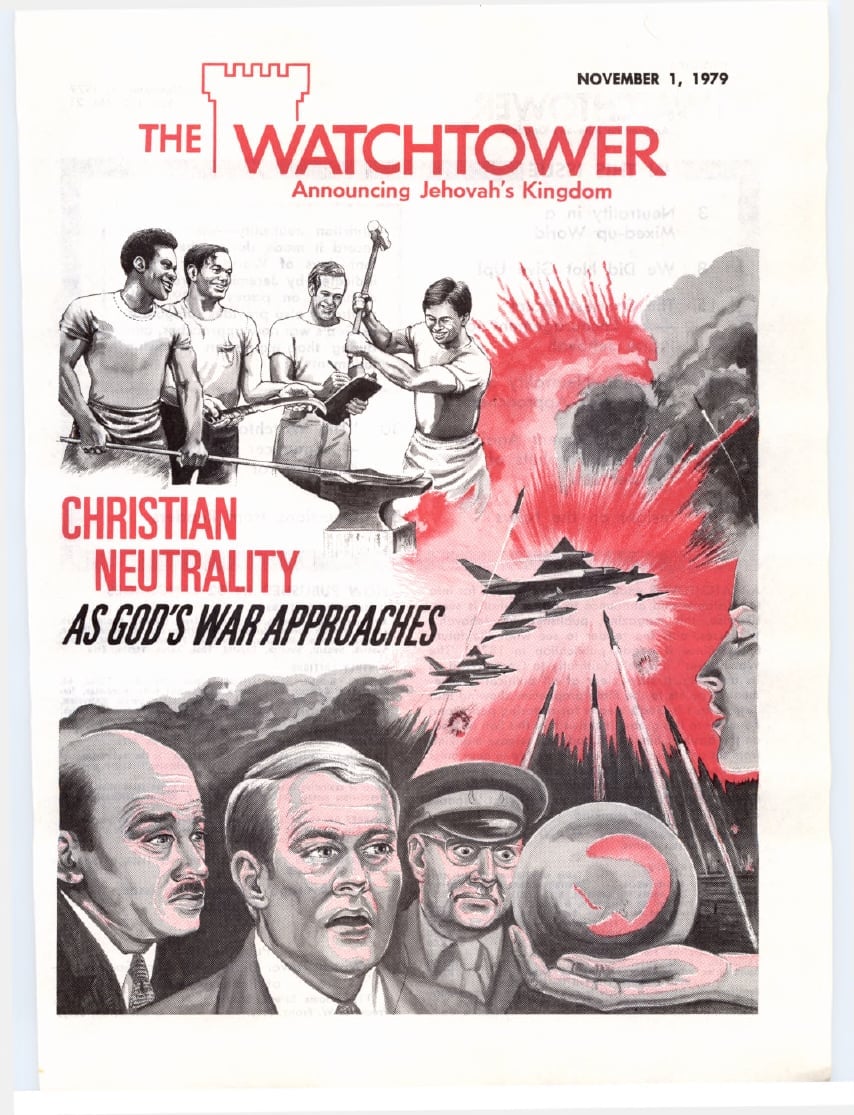
The Watchtower — November 1, 1979
Source: jw.org
Contents
Page Two
Neutrality in a Mixed-up World
We Did Not Give Up!
The Shortest Psalm—An Encouragement to Praise Jehovah
Christian Neutrality as God’s War Approaches
Divine Judgment Against the False Prophets of Christendom
Insight on the News
The Watchtower—Announcer of Jehovah’s Kingdom for 100 Years
Questions From Readers
What Do You Know About the Bible?
Page Two
Page Two
Christian neutrality—what a fine record it made during the turbulent days of World War II! As indicated by Jeremiah’s prophecy, discussed on pages 16-29, such neutrality also provides safeguards as God’s war now approaches, and during that expression of divine judgment
Neutrality in a Mixed-up World
Neutrality in a Mixed-up World
EXACTLY 40 years have passed since November 1, 1939. On that date, The Watchtower published a leading article under the title “Neutrality.” How timely that information proved to be!
Just two months earlier, on September 1, the Nazi juggernaut had launched an unprovoked attack on Poland. In the space of five weeks, and aided by a Soviet invasion from the east, Germany had crushed that country. In the meantime, Great Britain, Canada, Australia, New Zealand, India, South Africa and France had declared war on Germany. But for seven months there was quiet on the Western front, with little military action. It came to be called the “phony war.”
It was during this period that many young men gave close attention to the Bible and the material presented in that Watchtower article on “Neutrality.” In view of the gathering clouds of World War II, what stand should the Christian take? Should Christian young men on either side of the battle lines go forth to slaughter those on the other side, even though clergymen, Catholic and Protestant, on both sides declared that this was a person’s duty before God? If the world should go to war, were these young men duty bound to share in the bloodshed on whatever side they happened to live? Many of them recalled Jesus’ words, such as: “These things I command you, that you love one another. . . . You are no part of the world, but I have chosen you out of the world.”—John 15:17-19; 17:14, 16; 18:36.
As a result of a diligent study of God’s Word, these young Christians were able to make a decision. No one else made this decision for them. They were able to make it individually, on the basis of each one’s Bible-trained conscience. Their decision was to refrain from acts of hatred and violence against their fellowmen of other nations. Yes, they believed in, and wanted to share in, the fulfillment of Isaiah’s well-known prophecy: “They will have to beat their swords into plowshares and their spears into pruning shears. Nation will not lift up sword against nation, neither will they learn war anymore.” (Isa. 2:4) These young men of all nations did just that.
FRUITS OF NEUTRALITY
Thus it was that, during those six tumultuous years that followed, never did one of Jehovah’s Witnesses in any nation kill his Christian brother of another nation. Many Protestants were slain by Protestants, and many Catholics by Catholics, but never could any bereaved person lay the slaying of her husband or son at the door of one of Jehovah’s Witnesses. Imagine the result if all Catholics, Protestants, yes, and Jews throughout the world had taken a similar stand! There simply would have been no war. And if Pope Pius XII had excommunicated Catholic Hitler, as he was urged to do, what bloodshed and sorrow might the world have been spared! That is, if it had stopped Hitler and his military collaborators.
However, World War II ran its course. And what was its toll? The World Book Encyclopedia tells us: “World War II killed more persons, cost more money, damaged more property, affected more people, and probably caused more far-reaching changes than any other war in history. It opened the Atomic Age, and brought sweeping changes in warfare.” Some 16 million soldiers and two and a half times that many civilians died as a result of the war. It “cost more than $1,150,000,000,000. More than 50 countries took part in the war, and the whole world felt its effects.”
Indeed, it was a world war, and the world reaped a distressing harvest. But what of those who followed Jesus’ admonition to be “no part of the world”? Actually, in some ways it was harder for these than it was for those who went along with the world. It is one thing to show bravery in a foxhole, in the heat of battle; it is quite a different matter to stand courageously by one’s Bible-trained conscience, through reproach and ridicule, surviving in often vermin-infested prison cells, and at times in the shadow of a firing squad or the guillotine. These neutrals of World War II were no pacifists. They were fighters in a spiritual sense, well trained in the use of “the sword of the spirit, that is, God’s word.” (Eph. 6:17) They were integrity-keepers. And often they sealed their integrity with their lifeblood. They were not afraid to die for a righteous cause.
This was borne out in the case of many young Christians whose lives were snuffed out by Hitler and his henchmen. As the 1974 Yearbook of Jehovah’s Witnesses reported: “The numerous executions that took place [in Germany] during the Third Reich take a special place in the history of persecution. At least 203 brothers and sisters, according to incomplete reports, were either beheaded or shot. This figure does not include those who died from starvation, disease and other brutal treatment.” All of this was in line with Jesus’ words: “If you were part of the world, the world would be fond of what is its own. Now because you are no part of the world, but I have chosen you out of the world, on this account the world hates you. . . . If they have persecuted me, they will persecute you also.”—John 15:18-20.
Note here some reports concerning integrity-keepers:
Shortly before his execution on November 9, 1940, a young man wrote his father: “Now I, too, have been given an opportunity to prove my faithfulness to the Lord unto death, yes, in faithfulness not only up unto death, but even into death. My death sentence has already been announced and I am chained both day and night—the marks (on the paper) are from the handcuffs—but I still have not conquered to the full. Remaining faithful is not made easy for one of Jehovah’s witnesses. . . . My dear father, in spirit I call to you, remain faithful, as I have attempted to remain faithful, and then we will see one another again. I will be thinking of you up until the very last.—Your son Johannes. Auf Wiedersehen!”
A Christian wife described the culmination of months of bitter trial in these words: “On October 11, 1941, my husband was beheaded. In his last letter, which he was permitted to write just a few hours before his execution, he said: ‘When you get this letter, my beloved Maria and my four children, Christa, Walter, Waltraud and Wolfgang, everything will already be over and I will have won the victory through Jesus Christ and my hope is that I have been a conqueror. From my heart I wish you a blessed entry into Jehovah’s kingdom. Remain faithful! Three young brothers, who will be going the same way that I am tomorrow morning, are here beside me. Their eyes are aglow!’”
And many more examples are documented.
TRULY, “NO PART OF THE WORLD”
In describing the stand taken by Jehovah’s Witnesses in Nazi concentration camps, the Polish sociologist Anna Pawelczynska wrote as follows in her book of Values and Violence in Auschwitz, published first in 1973:
“This little group of prisoners was a solid ideological force and they won their battle against Nazism. The German group of this sect had been a tiny island of unflagging resistance existing in the bosom of a terrorized nation, and in that same undismayed spirit they functioned in the camp at Auschwitz. They managed to win the respect of their fellow-prisoners . . . , of prisoner-functionaries, and even of the SS officers. Everyone knew that no Jehovah’s Witness would perform a command contrary to his religious belief and convictions or any action directed against another person, even if that person was a murderer and an SS officer. On the other hand, he would perform every other job, even the most obnoxious, to the best of his ability, if it was morally neutral for him. The political prisoners struggled actively in the camp, organizing resistance and battling for the survival of their fellow inmates. The Jehovah’s Witnesses waged passive resistance for their belief, which opposed all war and violence.” (Italics added)
However, not only in Germany, but also in all the warring nations around the world, Jehovah’s Witnesses were united in placing God’s command to “love your neighbor” above the world’s demand to hate one’s fellowman. (Matt. 22:39; Acts 5:29) Depending on the country in which they lived, their punishment ranged from the death penalty to months, and even years, of detention. In one prison, a man who was serving a life sentence told one of the Witnesses: “I’m ‘in’ for killing a policeman, and you’re ‘in’ because you refuse to kill. It’s kind of odd, isn’t it?” But whether or not it seemed “odd” to others, Jehovah’s Witnesses were pursuing the Bible-based course of being “no part of the world” or of its orgy of bloodshed.
AVOIDING BLOODGUILT
In his widely known Sermon on the Mount, the Leader of Jehovah’s Witnesses, namely, Jesus Christ, said, among other things: “Happy are the peaceable, since they will be called ‘sons of God.’ . . . You heard that it was said to those of ancient times, ‘You must not murder; but whoever commits a murder will be accountable to the court of justice.’ However, I say to you that everyone who continues wrathful with his brother will be accountable to the court of justice; but whoever addresses his brother with an unspeakable word of contempt will be accountable to the Supreme Court; whereas whoever says, ‘You despicable fool!’ will be liable to the fiery Gehenna.” Gehenna figuratively pictured eternal destruction, for Jesus later said to his disciples: “Do not become fearful of those who kill the body but cannot kill the soul; but rather be in fear of him that can destroy both soul and body in Gehenna.” (Matt. 5:9, 21, 22; 10:28) Consequently, the witnesses of Jehovah have always sought to be peaceable in a mixed-up world and have always avoided murderous tendencies even in wrathfulness and violent speech.
So their warfare has been of a spiritual kind that does not violate peaceableness, for the apostle Paul said to his fellow Christians of the first century: “For the weapons of our warfare are not fleshly, but powerful by God for overturning strongly entrenched things. For we are overturning reasonings and every lofty thing raised up against the knowledge of God; and we are bringing every thought into captivity to make it obedient to the Christ.” (2 Cor. 10:4, 5) In this way Jehovah’s Witnesses have avoided bloodguilt.
Bloodguilt contributed to the downfall of ancient Israel, and in this connection it is interesting to note the course of King Manasseh. Of him, it is written: “And he went on to build altars to all the army of the heavens in two courtyards of the house of Jehovah. And he himself made his own sons pass through the fire [as human sacrifices] in the valley of the son of Hinnom, and practiced magic and used divination and practiced sorcery and made spiritistic mediums and professional foretellers of events. He did on a grand scale what was bad in the eyes of Jehovah, to offend him.” (2 Chron. 33:5, 6) Later during his 55-year reign, Manasseh repented of his bad course and took action to remove idolatrous worship from Jerusalem. But bloodguilt remained, for “there was also innocent blood that Manasseh shed in very great quantity, until he had filled Jerusalem from end to end.” (2 Ki. 21:16) This shedding of blood had been self-willed. It had not been shed in righteous warfare commanded by Jehovah.
The bloodguilt incurred by Manasseh was not canceled with the passing of that king. It remained as a stain on Israel. There had been no satisfying of justice so as to remove it. Hence, Jehovah sent Nebuchadnezzar, the king of Babylon, as His executioner against Jerusalem. “It was only by the order of Jehovah that it took place against Judah, to remove it from his sight for the sins of Manasseh, according to all that he had done; and also for the innocent blood that he had shed, so that he filled Jerusalem with innocent blood, and Jehovah did not consent to grant forgiveness.”—2 Ki. 24:1-4.
The modern-day counterpart of faithless Jerusalem is Christendom, within whose realm the two bloody world wars of our century erupted. Thus Christendom, too, has sacrificed countless ‘sons and daughters’ to the god of war. (Jer. 7:31) What bloodguilt Christendom carries, totaling into the tens of millions of souls! If Manasseh’s bloodguilt could not find forgiveness, how much less that of Christendom! Religious organizations that have supported the violence of the two world wars, and of other wars of this century, must share in that bloodguilt. Christendom forms a major part of “Babylon the Great,” the world empire of false religion, described by the apostle John as “drunk with the blood of the holy ones and with the blood of the witnesses of Jesus.” It is no wonder that the “voice out of heaven” cries out to lovers of righteousness: “Get out of [Babylon], my people, if you do not want to share with her in her sins, and if you do not want to receive part of her plagues. For her sins have massed together clear up to heaven, and God has called her acts of injustice to mind.”—Rev. 17:5, 6; 18:4, 5.
Though Christendom is doomed, because of her idolatry and her bloodguilt, hundreds of thousands of sincere persons have come out of that system, repented of their past connections and gained a clean standing before God and the Lamb, Christ Jesus. (Rev. 7:9, 10) They include many thousands who have fought as soldiers in the world wars and other conflicts of this century. These repentant ones can be confident of God’s forgiveness of their past course. (1 John 1:9, 10; Isa. 1:18) His blessing will be with them as they now prove themselves to be disciples of the “Prince of Peace,” who said on the occasion of his own arrest and trial: “My kingdom is no part of this world. If my kingdom were part of this world, my attendants would have fought.” (John 18:36; Isa. 9:6, 7) They, too, must henceforth be “no part” of this bloodguilty world. They must remain under Christ’s protection.—Compare Numbers 35:11, 32.
NEUTRALITY A PROTECTION
Many Christian witnesses of Jehovah in Nazi Germany and elsewhere lost their lives in maintaining neutrality. As they faced death they drew comfort from Jesus’ words: “Do not become fearful of those who kill the body but cannot kill the soul; but rather be in fear of him that can destroy both soul and body in Gehenna [eternal death].” (Matt. 10:28) Their resurrection is assured. (1 Cor. 15:22, 23; Heb. 11:35) The neutrality of others has also served as a protection, often under unusual circumstances.
Take, for example, Jehovah’s Witnesses in Africa. In the villages, these are hospitable people, and they have provided meals at their homes for any individual stranger who may have come along. However, they drew the line at serving in or on behalf of any factional organization. On one occasion, when guerrilla soldiers called an indoctrination meeting for local villagers, the neutral Witnesses declined to attend. So, when opposing forces moved in on that meeting, machine-gunning down 105 persons in attendance, the Witnesses’ absence meant survival for them. With the intensification of hostilities, the position of the Witnesses became more difficult, but always they showed themselves to be “no part of the world.”
During the oncoming “war of the great day of God the Almighty” at Har–Magedon, the neutrality of Jehovah’s people will again work toward their salvation. (Rev. 16:14, 16) Being “no part of the world,” they will be free of its bloodguilt. On the other hand, God will execute on bloodguilty Christendom (and indeed on the entire world) the kind of judgment that befell ancient Jerusalem, of which Ezekiel prophesied: “This is what the Sovereign Lord Jehovah has said: ‘O city that is shedding blood in her midst till her time comes, and that has made dungy idols within herself in order to become unclean, by your blood that you have shed you have become guilty, and by your dungy idols that you have made you have become unclean. . . . Look! I have struck my hand . . . over your acts of bloodshed that have proved to be in the midst of you . . . , and I will destroy your uncleanness out of you. And . . . you will have to know that I am Jehovah.’”—Ezek. 22:3, 4, 13-16.
“The great day of Jehovah is near”! (Zeph. 1:14) Very soon, an entire bloodguilty world will go down in destruction. But to those who fearlessly “are no part of the world,” Jehovah will extend the invitation: “Go, my people, enter into your interior rooms, and shut your doors behind you. Hide yourself for but a moment until the denunciation passes over. For, look! Jehovah is coming forth from his place to call to account the error of the inhabitant of the land against him, and the land will certainly expose her bloodshed and will no longer cover over her killed ones.” (Isa. 26:20, 21) After Jehovah has reckoned with the bloodguilty world, his clean people will emerge from their miraculously provided place of hiding to enjoy eternal peace on an earth that will never again be stained with the blood of wars and violence. (Ps. 46:8, 9) Then, those who were “no part of the world” that perished will remain in God’s new order, doing his will forever. (1 John 2:17) Thus, for themselves, they will have contributed to a blood-free history of Christian neutrality in a mixed-up world.
We Did Not Give Up!
We Did Not Give Up!
As told by Ilse Unterdörfer
Over 100 years in God’s service despite great tests of faith
IN September 1939 my friend Elfriede Löhr and I found ourselves in the Ravensbrück concentration camp in Germany. World War II had just begun.
Heinrich Himmler, the head of the Nazi SS (Schutz-Staffel, or Elite Guard), visited us at the Lichtenburg concentration camp shortly before we were taken to the newly erected camp of Ravensbrück. His purpose was to get Jehovah’s Witnesses to abandon their faithfulness to God and to support the Nazi war effort. But, to a person, we refused. At this Himmler flew into a great rage and cried: “If you like, your Jehovah may reign in heaven, but here upon earth it is we who rule! We’ll show you who will endure longer, you or we!”
For nearly six long years, Elfriede and I, along with many of our Christian sisters, endured some of the most horrible conditions imaginable. Yet, we Witnesses survived, although Himmler, Hitler and their crowd are gone!
Years earlier, while we were still teenagers, both Elfriede and I had resolved to use our lives in God’s service and that nothing would ever make us give up! Before being sent to the concentration camp, we experienced God’s comforting care as we preached the Kingdom good news in the face of rising Nazi persecution. And today we are still at it, having just completed 100 years of dedicated service between us. But let me tell you how we came to be in Ravensbrück.
OUR EARLY YEARS IN GOD’S SERVICE
In 1926, when she was only 16, Elfriede symbolized her dedication to God by undergoing water baptism. Her heart’s desire was fulfilled when she was able to enter the full-time preaching work in the winter of 1930. Although a serious illness limited what she could do for a time, when I first met Elfriede in March 1937 she was active in the underground work. You see, the activities of Jehovah’s Witnesses had been banned in Germany under the Nazi regime, and, at the risk of our freedom and even our lives, many of us shared in distributing spiritual food throughout the country.
My own goal as a young girl had been to help my fellow humans; I wanted to be a high-school teacher. But in 1931 I accompanied my mother to an assembly of Jehovah’s Witnesses in Paris, France. What I learned and experienced there changed my life. The following year, at 19 years of age, I was baptized.
Hitler and his Nazi party came to power in 1933 and almost immediately began persecuting Jehovah’s Witnesses. It was a great joy to me when I was given the privilege of serving as a courier in our underground activity in Saxony. In August 1936, the German gestapo (secret police) began a concerted campaign against our underground organization. Fritz Winkler, who had oversight of our work, and most of the regional directors were arrested and imprisoned.
In September 1936, I was able to get to Lucerne, Switzerland, for a convention, along with about 300 others from Germany. There J. F. Rutherford, then the president of the Watch Tower Society, entrusted Erich Frost with the responsibility of reorganizing our badly disrupted underground activity, and some days later I was appointed to work along with him.
It was an assignment from Brother Frost that sent me to Munich to locate Elfriede Löhr. The only thing I knew about her was that her father was a dentist. I found their address in the telephone directory and, as a precaution, phoned first. When we met, I told Elfriede that she had been invited to work full time with us. Thus began a close friendship of nearly 43 years. We have been companions in concentration camps and partners in the full-time preaching work for over 40 of those years.
WORKING UNDERGROUND
The gestapo were looking for all of us. So we usually traveled by train at night, sleeping as best we could. During the day we would meet the brothers and sisters at various designated places to hand over to them mimeographed copies of The Watchtower and other vital information. Occasionally, we would spend the night with interested persons or at summer houses of brothers who were not yet so well known to the gestapo.
We never carried written addresses or any other notes. We memorized everything. Thus, if we were arrested, the police would not obtain evidence to incriminate anyone. We repeatedly felt Jehovah’s protection. This was especially true when we were organizing for the distribution of the resolution adopted at the Lucerne convention. This resolution raised strong objections to the cruel treatment of Jehovah’s Witnesses by the Roman Catholic Hierarchy and their allies in Germany. On December 12, 1936, between 5 and 7 p.m., some 3,459 brothers and sisters throughout Germany shared in distributing hundreds of thousands of copies of this powerful message.
Then, on March 21, 1937, less than two weeks after I first met Elfriede, Brother Frost and I were arrested. About the same time, certain regional service directors also fell into the hands of the gestapo. Brother Heinrich Dietschi, a regional service director who was still free, assumed oversight of the work in Brother Frost’s absence.
When neither Brother Frost nor I showed up at a prearranged meeting at the end of March, Elfriede knew that something was wrong. She could not return home, for the gestapo were looking for her. She wondered: “Who is Brother Frost’s successor, and how can I meet him?” After praying to Jehovah, it came to her mind to seek contact in the town of Leutkirch, about 150 km (90 mi.) from Munich. In Leutkirch, on that very day she met the brother whom Brother Dietschi had sent to locate her. Surely this seemed to be by angelic direction!
Since the Nazis claimed that the contents of the resolution we had distributed on December 12 were untrue, arrangements were under way to distribute throughout Germany an “Open Letter” that gave specific proofs of the persecution of Jehovah’s Witnesses. Brother Frost and I had been arrested in the course of preparing for this big campaign. Now Elfriede worked closely with Brother Dietschi in completing preparations, and the campaign was successfully carried out on June 20, 1937. Elfriede’s report in the 1974 Yearbook of Jehovah’s Witnesses explains:
“Brother Dietschi organized the campaign. We were all courageous, everything had been wonderfully arranged and each region had sufficient letters. I picked up a large suitcase of them at the train station for the territory around Breslau and took them to the brothers in Liegnitz. I also had my own, which at the appointed time I distributed like all the other brothers.”
For months prior to this campaign the gestapo had boasted that they had destroyed our organization. So what a humiliating surprise it was to them when, in such an organized way, hundreds of thousands of copies of this letter were delivered throughout Germany! It really threw them into a state of shock.
MEETING EACH OTHER AGAIN
Thus, while Elfriede was free, I found myself in the grip of the gestapo. At first I was sentenced only to a year and nine months. But immediately after serving the sentence, I was arrested again and sent to the Lichtenburg concentration camp, early in 1939. To my great surprise, Elfriede was there when I arrived.
In the summer of 1939 all of us Christian sisters in Lichtenburg were taken to the new Ravensbrück camp. Time and again we had been threatened: “Just wait until you get to Ravensbrück. There we’ll break you.” The surroundings of the new camp resembled a sandy desert. The high walls, with barbed wire on top, as well as the barracks for the prisoners and houses for the SS, had been completed. But everything else was waste and waiting for workers, namely, for inmates.
A TEST OF OUR FAITH
There were about 500 of us women, Jehovah’s Witnesses, in Ravensbrück in the fall of 1939. It was on December 19 that several sisters refused to sew ammunition pockets on soldiers’ uniforms; they could not conscientiously support the war effort in this way. Thereupon all of us were called to the camp square and asked whether we would do the work. All of us refused. As a result, a campaign was begun to force us to abandon our position of Christian neutrality and to support the war effort.—Isa. 2:4.
First, they made us stand outside in the cold from morning till night while wearing only light summer clothes. And it was one of the coldest German winters, with temperatures often 15 to 20 degrees below zero Celsius! At night we were locked in the cell block where we had to sleep on the bare floor without blankets, and with the windows open to create a frigid draft. Moreover, we were not given a thing to eat on the first day. During the following four days of this treatment, we received only a half ration of food. Then we were locked in a dark cell for three more weeks, being allowed something warm to eat only once every four days. The other days, we received a piece of bread and a cup of black coffee in the morning. During their Christmas celebration (December 25 to 27), we received nothing at all.
Afterward, we were returned to our barracks, which were declared penal barracks for three months. This meant less and poorer food, and hard pick-and-shovel work from morning till night seven days a week. And we were denied medical aid. Time and again, the SS commanders would say: ‘If you don’t agree to support the war effort, you won’t get out of here except through the chimney!’
By the spring of 1940 we were nothing but skeletons. We should have died off like flies. But Jehovah God, who had been directly challenged by Himmler, showed that He can sustain His people under the worst circumstances. Not one of our 500 sisters fell seriously ill, nor did any die. Even a few SS people said: “That’s because your Jehovah has helped you.” And, more importantly, not one sister had given up; all had remained loyal. It was a real triumph of integrity to Jehovah!
I might say that both Elfriede and I had settled accounts with life. We had determined to remain faithful to Jehovah regardless of what came. With the apostle Paul, we could say: “For both if we live, we live to Jehovah, and if we die, we die to Jehovah. Therefore both if we live and if we die, we belong to Jehovah.”—Rom. 14:8.
DAILY LIFE IN RAVENSBRÜCK
However, for us conditions soon changed for the better. Many agricultural workers were inducted into the army, creating a farm-labor shortage. Therefore, camp inmates were sent to work on farms in the vicinity of Ravensbrück. Since the risk of such workers escaping was greater, and since it was known that Jehovah’s Witnesses would not try to get away, many of us were sent to the farms to work. There we were given food to eat in addition to the meager fare of the concentration camp.
But spiritual feeding was of greatest concern to us. We would build one another up spiritually by sharing the Bible knowledge that we had acquired before we were imprisoned. Also, newcomers to the camp would share what they had learned more recently in their Bible studies. How glad we were when several Bibles were smuggled into the camp! Whenever possible, we gave a witness to other inmates, as well as to our overseers. Nothing could stop us from demonstrating our faithfulness to Jehovah. Our decision was: “Rather die than give up!”
Elfriede was assigned to do gardening for SS officers, and I, along with other sisters, was sent to work on an SS farm. Toward the end of 1942, we began to sleep overnight at the farm rather than returning to the camp barracks; thus we enjoyed considerable freedom. In the spring of 1943, I succeeded in contacting Brother Franz Fritsche by letter. He was a courageous brother who was active in smuggling spiritual food into the concentration camps. Once I was able to meet him in a forest adjacent to the farm. Arrangements were made for us to begin receiving The Watchtower and other publications regularly. There were a number of ways that we got literature into the camp.
But then conditions changed again. Brother Fritsche was arrested. The gestapo finally discovered that through organized channels the Bible literature regularly was being smuggled right into the concentration camps. What a shock this discovery was to them! And what powerful evidence that after 10 years of vicious persecution the spirit of God’s people had not been broken, either within the camps or outside! Immediately, Himmler ordered that all suspected camps be searched for Bible literature.
SURVIVING THE WORST YEAR
The gestapo quite unexpectedly appeared in Ravensbrück on May 4, 1944. They made a sudden thorough search for Bibles and Bible literature, particularly The Watchtower. Also, they went to where Elfriede was doing gardening for the SS and to the SS farm where I was assigned. Finally it was determined that 15 sisters regarded as the ones responsible would suffer for all. Elfriede and I were included in this number.
First, we were locked in the notorious cell block. There we were crammed into small dark cells, and for seven weeks we were not allowed into the open air. Then we were taken to the “punishment building,” where Elfriede and I again came in close touch. What we lived through there during our last year in Ravensbrück can hardly be expressed with words. But we always felt Jehovah’s protection and loving care. He gave us the strength to endure. A great help was the spiritual food that the sisters who remained at the farm were able to smuggle in to us. The gestapo had not found the literature there, since we had good hiding places.
During the final months, conditions at the camp grew progressively worse, particularly where we were—in the punishment building. The barracks were crammed. Originally they had been designed for 100 prisoners, but finally the punishment building had to accommodate 1,200 to 1,500 persons. Six or seven slept in two beds, and so no one could really sleep well. Due to the poor, often insufficiently washed food, intestinal diseases were the order of the day. Prisoners perished miserably by the hundreds.
Elfriede also became seriously ill. She contracted an inflammation of the lungs and ran a high temperature. Before I could prevent it, she was taken to one of the barracks for the sick, which was crowded with those in the throes of death. No one was allowed to leave the punishment block alone. However, with the help of the room leader I was, on occasion, able to get out to take Elfriede something to drink.
It became clear that Elfriede would not live much longer where she was. Trucks regularly pulled up in front of the barracks for the sick, and the dead and the dying were thrown onto them and taken to the crematory. So, with the help of the room leader, two of us went to Elfriede. Her bed was near a window. Summoning all of our strength, we were able to get her out through the window. We then carried her back to the punishment building. There an inmate, a Russian woman who was a doctor, applied a simple though painful treatment so that the inflammation in Elfriede’s lungs subsided. Her life was saved.
By the early spring of 1945, World War II was coming quickly to a close. It was the intention of the Nazi SS troops to blow up the camp. But the Russians came with such speed that the Nazis were not able to carry out their devilish plans. On April 28 Ravensbrück fell into Russian hands without a fight. Thus we were released from that ‘fiery furnace’ after nearly six long years. This was in addition to about two years of imprisonment before coming to Ravensbrück.
MAINTAINING OUR FIRM DECISION
We had both promised Jehovah that, should we ever be free again, all our time and strength would be devoted to his service. On our difficult way home, we visited Brother Frost, who showed the same attitude. He invited us to come, as soon as possible, to Magdeburg, from where the preaching work in Germany was to be reorganized.
Soon after I arrived home in Olbernhau, however, the local government offered me the job of directing the criminal investigation department. I did not give this job offer a single thought; my decision to enter full-time service had long since been made. Only three weeks later, Elfriede and I were among the first five Bethel workers to return to Magdeburg.
In 1947 Brother N. H. Knorr, then the president of the Society, visited West Germany. He encouraged certain brothers and sisters to attend the Watchtower Bible School of Gilead. So Elfriede and I applied for this missionary training. In time, we received our invitations, and in 1949 we departed for the United States to attend school.
After being cut off for many years from regular meetings and service activities of Jehovah’s organization, what a blessing it was for us to drink in the spiritual blessings at Gilead! We considered it a great reward and wonderful compensation for the many hardships that we had gone through. Then, as a climax, in the summer of 1950 we attended the Theocracy’s Increase Assembly of Jehovah’s Witnesses at Yankee Stadium in New York city. The graduation exercises of our 15th class of Gilead were held on opening day.
MISSIONARY SERVICE
Our first missionary assignment was Cologne, Germany, located on the banks of the Rhine River. We began working with the local congregation of 35 publishers and soon were conducting many productive Bible studies and assisting others to share in Kingdom service. After three and a half years there, we received a new assignment, to Austria. But in the meantime the congregation in Cologne had increased to 214 publishers, and we saw the dedication of a new Kingdom Hall.
In our last 24 years serving in Austria, we have had assignments in many places, including the valley of Gastein, at Gmunden on the beautiful Traunsee Lake, at Hohenems in Vorarlberg and at Telfs in Tyrol. Presently, we are working in Vorarlberg again, in the Forest of Bregenz. In our various assignments, we have aided in obtaining seven Kingdom Halls. Also, when we started in three of our assignments, there were either no Kingdom publishers or only one or two. But, in time, we saw the founding of new congregations in these places. Although we do not have children of our own, we have many spiritual children and grandchildren with whom we are united in a surpassing bond of warm love.
WHAT HAS HELPED US NOT TO GIVE UP
Even after surviving great tests of our faith in concentration camps, we have experienced temptations to give up our full-time service to Jehovah. There have been health problems due to advancing age and the aftereffects of our years in concentration camps. And in recent years the indifference of people in territories where materialism has such a hold has often been discouraging. Thus the wish has sometimes arisen for a more tranquil life with more ease and conveniences than are enjoyed by a full-time Kingdom proclaimer. What has helped us to endure?
For one thing, we have kept our eyes on the examples of faithful servants of Jehovah who left everything behind to serve him—persons like Abraham, Sarah, Moses, the apostle Paul and our greatest example, Jesus Christ. This has helped us to maintain the right attitude and hold to true values. We have kept in mind Jesus’ advice: “Keep on, then, seeking first the kingdom and his righteousness.” Also, we have remembered what Jesus said earlier in his Sermon on the Mount: “For where your treasure is, there your heart will be also.”—Matt. 6:33, 21.
This is what we have always tried to do, to keep our hearts focused on the kingdom of God and on serving him with all that we have. Holding this as a precious treasure is what enabled us to endure the cruel tyranny of Nazism. Firmly holding this same Kingdom hope has helped us in the years since then to continue on full time in God’s service without giving up.
Truly, ours has been a richly satisfying life! Time and again we have experienced the truthfulness of the words at Malachi 3:10: “‘Test me out, please, in this respect,’ Jehovah of armies has said, ‘whether I shall not open to you people the floodgates of the heavens and actually empty out upon you a blessing until there is no more want.’” Our wish and prayer are that we might, with Jehovah’s help, continue in the full-time service on into eternity in association with Jesus Christ and in the presence of Jehovah God.
[Picture on page 9]
Ilse Unterdörfer and Elfriede Löhr as they appear today
The Shortest Psalm—An Encouragement to Praise Jehovah
Psalms
The Shortest Psalm—An Encouragement to Praise Jehovah
OF THE 150 inspired psalms, Psalm 117 is the shortest. It reads: “Praise Jehovah, all you nations; commend him, all you clans. For toward us [the Israelites] his loving-kindness has proved mighty; and the trueness of Jehovah is to time indefinite. Praise Jah, you people!”
This song of praise is an invitation for all the nations to praise Jehovah because of having witnessed the grand way in which he has dealt with his people Israel. His dealings reveal him to be a God worthy of praise and commendation.
Despite the sinfulness and repeated failings of the Israelites, Jehovah was merciful and compassionate. He loyally stuck to his promise made to Abraham that ‘by means of his seed all nations of the earth would bless themselves.’ (Gen. 22:18) All during the centuries until that seed of promise finally came, Jehovah God did not cast Israel off as his people. Thus, he proved himself to be a God of loving-kindness. He also manifested his trueness by fulfilling his word of promise. Joshua, for example, reminded the Israelites: “You well know with all your hearts and with all your souls that not one word out of all the good words that Jehovah your God has spoken to you has failed. They have all come true for you.”—Josh. 23:14.
Especially with the coming of Jesus Christ as the seed of promise, the time had arrived for peoples of all nations to praise Jehovah. This is the point the apostle Paul made when writing to Christians at Rome: “Christ actually became a minister of those who are circumcised in behalf of God’s truthfulness, so as to verify the promises He made to their forefathers, and that the nations might glorify God for his mercy. Just as it is written: ‘That is why I will openly acknowledge you among the nations and to your name I will make melody.’ And again he says: ‘Be glad, you nations, with his people.’ And again: ‘Praise Jehovah, all you nations, and let all the peoples praise him.’”—Rom. 15:8-11.
While Jehovah God dealt exclusively with the Israelites for many centuries, he was actually working out matters for the blessing of all mankind through the seed of Abraham, primarily Jesus Christ. On the basis of Jesus’ giving his life in sacrifice, peoples of all nations can have their sins forgiven and can gain an approved standing before the Most High. Truly, then, people of all nations have reason to give thanks to Jehovah for his loving-kindness and trueness in producing the seed of promise as a natural descendant of Abraham.
Christian Neutrality as God’s War Approaches
Christian Neutrality as God’s War Approaches
“As regards the prophet that prophesies of peace, when the word of the prophet comes true the prophet whom Jehovah has sent in truth will become known.”—Jer. 28:9.
1. Why do the words of Jeremiah 27:9 against occultism fit right in with the world situation today?
“AND AS for you men, do not listen to your prophets and to your practicers of divination and to your dreamers and to your practicers of magic and to your sorcerers, who are saying to you: ‘You men will not serve the king of Babylon.’” Such words of long ago during the days of the Babylonian Empire fit right in with the world situation today. Why so? Because the world still abounds with dreamers, magicians, diviners and sorcerers. (Jer. 27:9) World capitals, like Washington, D.C., are notorious for their spiritists, and these are eagerly consulted by perplexed politicians. Because such fortune-tellers, clairvoyants, spirit mediums, interpreters of dreams and predictors of future events give advice and counsel to government officials, those dealers with the occult can have an important effect upon the politics of the world. Yet these occultists are not directly meddling in politics.
2. Is the Bible, because of predicting world developments, meddling in politics, and what answer does 1 John 2:15-17 provide for that question?
2 There is an ancient book that advises its readers against all forms of occultism but it contains many predictions about world developments in our own 20th century. It has much to say about the political affairs of our times. But, because of this, is this book meddling in the politics of our day? Is this book encouraging its readers to dabble in human politics so as to interfere with political rulers? To politicians who want to accuse the Holy Bible of being such a book, we answer, No! In one of the last books of the Bible the Christian apostle John writes:
“Do not be loving either the world or the things in the world. If anyone loves the world, the love of the Father is not in him; because everything in the world—the desire of the flesh and the desire of the eyes and the showy display of one’s means of life—does not originate with the Father, but originates with the world. Furthermore, the world is passing away and so is its desire, but he that does the will of God remains forever.”—1 John 2:15-17.
The very last book of the Bible, also written by this same apostle John, describes how this world and its politics will pass away.
3. What attitude toward politics do religious leaders urge upon Christians, and to whom do they point as Bible examples in support?
3 However, there are religious leaders, even popes, patriarchs and archbishops, that argue against Christian neutrality and say that it is the bounden duty of each and every Christian to take an active part in the political affairs of this world. For Bible examples to support their stand, they will point to ancient Hebrew prophets, like Jeremiah the son of priest Hilkiah of the seventh century before our Common Era. In fact, the words of Jeremiah 27:9, quoted at the start of this article, were part of what Jehovah God told Jeremiah to say to the diplomatic representatives from the kingdoms of Edom, Moab, Ammon, Tyre and Sidon. (Jer. 27:1-4) So, then, since the “war of the great day of God the Almighty” at Har–Magedon is now rapidly approaching, let us examine God’s use of Jeremiah at that ancient time. Does the example of Jeremiah allow for true Christians of today to violate Christlike neutrality and to dabble in worldly politics of any kind? Let us find out.
4. In the first year of Jehoiakim’s reign, what did Jehovah by means of Jeremiah say he would do to the temple and Jerusalem under certain circumstances?
4 We pick up our story in the year 628 B.C.E., or 21 years before the Babylonians destroyed Jerusalem. This was the first year of the reign of Jehoiakim, the third last king of Jerusalem. In the fourth year after that Jeremiah gave his prophecy concerning King Nebuchadnezzar of Babylon and the “cup” of Jehovah that was to be served on more than 20 kings and kingdoms, including Edom, Moab, Ammon, Tyre and Sidon. (Jer. 25:1-3) The prophet dates the matter for us, saying:
“In the beginning of the royal rule of Jehoiakim the son of Josiah, the king of Judah, this word occurred from Jehovah, saying: ‘This is what Jehovah has said, “Stand in the courtyard of the house of Jehovah, and you must speak concerning all the cities of Judah that are coming in to bow down at the house of Jehovah all the words that I will command you to speak to them. Do not take away a word. Perhaps they will listen and return, each one from his bad way, and I shall have to feel regret for the calamity that I am thinking to execute upon them because of the badness of their dealings. And you must say to them: ‘This is what Jehovah has said, “If you will not listen to me by walking in my law that I have put before you, by listening to the words of my servants the prophets, whom I am sending to you, even rising up early and sending them, whom you have not listened to, I will, in turn, make this house like that in Shiloh, and this city I shall make a malediction to all the nations of the earth.”’”’”—Jer. 26:1-6.
5. By delivering the foregoing message, why was Jeremiah not mixing priestcraft with politics?
5 Jeremiah was a priest, and yet, by obeying this divine command, he was not attempting to mix priesthood and statecraft. He was just giving a warning from Jehovah for the benefit of the nation. He left it up to the governmental rulers and the people to heed that divine warning. Jehovah had a right and an obligation to warn the Kingdom of Judah because its people were in a national covenant with him as their God. In his Law given to them through Moses he warned the nation of what would result if they broke this covenant between God and man. So God’s prophet Jeremiah was not trying to mix priestcraft with statecraft, but was merely giving the people a warning from the God with whom they had a covenant. If they broke this covenant still further, their temple at Jerusalem would lose Jehovah’s ark of the covenant just as Shiloh’s tabernacle had lost it.
6. The absence of what commission from Jehovah bars the Jeremiah class from meddling in the politics of Christendom, and respecting her, what words of Jesus does this class heed?
6 Jeremiah was not there setting an example for the clergymen of modern-day Christendom to meddle in national politics. Today those of the Jeremiah class realize that they have no right to butt in on politics in any nation or bloc of nations, not even nations of Christendom. They know that, despite her claims, Christendom is not in a covenant with Jehovah. She may claim to be in the new covenant that was mediated by the One who is greater than Moses, Jesus Christ, but the facts belie that claim. Hence, those of the Jeremiah class know full well that they have no commission from Jehovah God to dictate to the nations of Christendom or to take an active part in the politics of such nations. Their faithfully declaring Jehovah’s warning to Christendom as well as to the non-Christian nations is no taking part in worldly politics. They do not love “either the world or the things in the world,” but stay true to Jesus’ words: “They are no part of the world.” (John 17:14, 16; 1 John 2:15) In strict neutrality they abstain from political matters of all kinds.
THE RELIGIOUS REACTION
7. In closing his defense before the Jerusalem court, what, according to Jeremiah 26:12-15, did Jeremiah say?
7 The other priests and the so-called “prophets” haled Jeremiah before a judicial session of the princes and before the people at an entrance to the temple. They accused him of seditious talk. “To this man the judgment of death belongs,” they said, “because he has prophesied concerning this city just as you have heard with your own ears.” (Jer. 26:7-11) In closing his defense, Jeremiah said to the Jerusalem court: “Only you should by all means know that, if you are putting me to death, it is innocent blood that you are putting upon yourselves and upon this city and upon her inhabitants, for in truth Jehovah did send me to you to speak in your ears all these words.”—Jer. 26:12-15.
8. How have the clergy of Christendom acted similarly to Jerusalem’s “patriots” toward the Jeremiah class?
8 What a spirit of nationalism these seekers for Jeremiah’s blood exhibited! It should have swept the court off its feet, just as similar patriotic pleas in other courtrooms have recently done. The plea of Jehovah for their reformation was overlooked. Their guiltiness before Him they passed over, stilling their conscience. Similar have been the cases involving the anointed Jeremiah class of modern times. The religious leaders of Christendom have put forth the same demand for drastic action. They have taken the lead in the clamor for putting the Jeremiah class to death, thus to be freed from the pricks of their own bad consciences.
9. In Jeremiah’s case did the princely judges yield to religious pressure, and how did they want to avoid calamity?
9 Among the princes who worked for the deliverance of Jeremiah from the death sentence was Ahikam the son of Shaphan. The princes did not yield to the religious pressure. They recognized Jeremiah as really being Jehovah’s mouthpiece. They did not want Jehovah to charge them with the innocent blood of his faithful servant. They decided in favor of Jeremiah: not guilty! His defense put them in the mood to recall historical examples. For instance, they were nearly 100 years closer to what Micah had prophesied against Judah and Jerusalem. King Hezekiah kept himself from bloodguilt by not having Micah put to death for supposedly seditious language, harmful to the State. “So,” said the elders in arguing for cautious handling of Jeremiah’s case, “we are working up a great calamity against our souls.”—Jer. 26:16-19, 24; Mic. 3:9-12.
10. How did the conduct of King Jehoiakim toward prophet Urijah contrast with that of King Hezekiah?
10 As a contrast to King Hezekiah who took to heart Jehovah’s warning by Micah, there was Hezekiah’s great-great-grandson then in his first year on the throne of Jerusalem, Jehoiakim himself! He bloodied up the very first year of his reign by having Urijah the son of Shemaiah put to death. To escape the wrath of King Jehoiakim, the prophet Urijah had fled to Egypt. But, without any reported arrangement with Egypt for extraditing Urijah, the vengeful king sent men to hunt down Urijah and forcibly drag him back to the land of Judah to suffer a martyr’s death. (Jer. 26:20-23) Thus later on in that same opening year of the new king, Jeremiah had additional ground for prophesying what he did, at Jehovah’s command. In this connection it should be noted that Pharaoh Nechoh had made Jehoiakim king over Judah. (2 Ki. 23:34, 35) So Pharaoh Nechoh may have cooperated with King Jehoiakim in crime.
11. What calamity did Jehoiakim thus procure for himself?
11 Jehoiakim did procure calamity for himself. In his eighth year of rule, King Nebuchadnezzar besieged Jerusalem and made Jehoiakim a vassal king to the new world power of Babylon. Three years later Jehoiakim met an apparently untimely death. His corpse was pitched outside Jerusalem’s wall to have the “burial of a he-ass.” It was just as Jeremiah had prophesied. (Jer. 22:18, 19; 2 Chron. 36:5-8; 2 Ki. 24:1-6) How terrible!
12. Like Jeremiah of old, how has the Jeremiah class of today been delivered from death at the hand of the religious element?
12 Like Jeremiah the son of Hilkiah, the Jeremiah class of our 20th century has been spared from death. Not in all cases, and not in all lands, have the judicial courts yielded to the malicious desire of the powerful religious elements of Christendom. There have been judges who have recognized the religious rights and freedom of the Jeremiah class, who, here on earth, represent the wifelike organization of Jehovah God. So what happened was quite like what was pictured in Revelation 12:15, 16. Popular, democratic elements of the “earth” came to the aid of the representatives of God’s “woman” and counteracted the efforts of Satan the Devil’s religious henchmen to engulf the Jeremiah class in lasting ruin.
13. What do those of the Jeremiah class continue to declare, while not compromising on what issue?
13 Those of the Jeremiah class continue to declare all that God commands them to declare against the modern counterpart of Judah and Jerusalem, as well as against all other political parts of this system of things. Even though they are driven “underground” in some areas, they do not work to subvert established governments in order to force what they declare to come true. They resist all pressure to make them compromise with this or that political party. They refuse to abandon Christian neutrality.
14. The Jeremiah class recognizes that the fight belongs to whom, and, after the fight, what kind of place will the earth be for living?
14 Thus, intransigent, they keep themselves “no part of the world.” They well know that Jehovah God the Almighty can take care of himself. The war is his! It is not theirs to fight! They stand firm in Christian integrity, confident that “the war of the great day of God the Almighty” has approached, inasmuch as unseen demon forces with their occult powers are gathering earthly rulers to the world situation that is symbolically called Har–Magedon. (Rev. 16:13-16) So the Jeremiah class rejoices that its unflinching Christian neutrality is in support of Jehovah’s universal sovereignty. What a grand place our earth will be for the Jeremiah class and their fellow Christian neutrals after they witness the triumph of Jehovah’s sovereignty at Har–Magedon!
THE PLOT AGAINST JEHOVAH’S SERVANT-KING
15. Why is this the time of the greatest international plot in all human history, and what does Revelation 14:12 say this will mean for God-fearing Christians?
15 However, the present is the time for Christians of the real Bible kind to be specially tested as to their neutrality and integrity. It is the time of the greatest international plot in all human history, for now it is the time of the United Nations, which today has 151 members. Why call the U.N. an international plot or conspiracy? Because it is a man-made organization for counteracting and holding off, as long as possible, the rightful rule of Jehovah’s kingdom by means of his Christ. Which will prevail, Jehovah’s Messianic kingdom or the United Nations? The security and peace of all peoples are implicated. Foretelling how trialsome the period of the United Nations as an agency for world protection would be, Revelation 14:12 says: “Here is where it means endurance for the holy ones, those who observe the commandments of God and the faith of Jesus.”—Compare Isaiah 8:12, 13.
16. What international conspiracy was there 19 centuries ago, and to what did its partial fulfillment of Psalm 2:1-4 point forward?
16 Nineteen centuries ago there was an international plot or concerting of efforts against Christ himself, God permitting this to bring about the martyrdom of Jesus. (Acts 3:13; 4:27; 13:28, 29; 1 Tim. 6:13) This was foretold in Psalm 2:1-4. Both this psalm and its partial fulfillment 19 centuries ago pointed forward to the international conspiracy against Jehovah and his Christ at this time when the full right to the “kingdom of the world” belongs to them both.—Rev. 11:15-18.
17. The witnesses of Jehovah recognize the present world organization to be operating against whom, and to what stand, taken in 1919, do they stick today?
17 True Christians will recognize the present international plot as in operation against Jehovah and his Christ. So they will continue to endure in their Christlike neutrality, holding fast to the position that they took back in 1919 at the Cedar Point (Ohio) convention of the International Bible Students Association, advocating Jehovah’s kingdom by Christ as against the proposed League of Nations for world peace and safety, such League being now succeeded by the United Nations. Their position is the one that the prophet Jeremiah himself would take today, for he gave inspired warning about a like plot against the rule of Jehovah’s royal “servant.”
18. In the first year of Jehoiakim’s rule, what was Jeremiah told to make, and to whom was he to send them along with a message?
18 Consequently, the prophecy of Jeremiah, chapter 27, has up-to-date meaning for us. There the prophet’s record says:
“In the beginning of the kingdom of Jehoiakim the son of Josiah, the king of Judah [in 628 B.C.E.], this word occurred to Jeremiah from Jehovah, saying: ‘This is what Jehovah has said to me, “Make for yourself bands and yoke bars, and you must put them upon your neck. And you must send them to the king of Edom and to the king of Moab and to the king of the sons of Ammon and to the king of Tyre and to the king of Sidon by the hand of the messengers who are coming to Jerusalem to Zedekiah the king of Judah. And you must give them a command for their masters, saying: ‘This is what Jehovah of armies, the God of Israel, has said; this is what you should say to your masters.’”’”—Jer. 27:1-4.
19. According to the regular Hebrew text, when did Jeremiah get Jehovah’s message, and on what occasion did he act upon it?
19 We note that here two kings are named as reigning over Judah and Jerusalem, first Jehoiakim, and then his brother Zedekiah, who reigned after Jehoiakim and his son Jehoiachin. If the name Jehoiakim is correct in Jeremiah 27:1, then Jeremiah got this prophecy in 628 B.C.E. and kept it in reserve for 11 years before acting upon it. But three Hebrew manuscripts and the Syriac and Arabic versions of Jeremiah 27:1 say “Zedekiah” instead of “Jehoiakim,” and this is how many modern Bible translations state the matter.a At any rate, Jeremiah’s taking action in obedience to Jehovah’s command is laid in the reign of King Zedekiah and on the occasion when the envoys from five neighboring lands, Edom, Moab, Ammon, Tyre and Sidon, came to Jerusalem to deal with King Zedekiah. By this time Nebuchadnezzar had been emperor of Babylon at least eight years and had deported King Jehoiachin to Babylon and had put his uncle Zedekiah on the throne of Jerusalem. As a vassal king, Zedekiah owed allegiance to Babylon.
20. What kind of movement did the coming of those five envoys represent, and why were they told not to listen to the words of the occultists?
20 The coming of envoys from five neighboring lands was a concerted action. It represented a concerted movement. From what Jeremiah was told to say to these envoys, it is evident that a plot was afoot to stir up a combined revolt against Emperor Nebuchadnezzar. The predictors and the practicers of occult arts favored the revolt. That is why Jeremiah was told to say to the envoys: “And as for you men, do not listen to your prophets and to your practicers of divination and to your dreamers and to your practicers of magic and to your sorcerers, who are saying to you: ‘You men will not serve the king of Babylon.’ For falsehood is what they are prophesying to you, for the purpose of having you taken far away from off your ground; and I shall have to disperse you, and you will have to perish.”—Jer. 27:9, 10.
…