The Watchtower, August 1, 1979
Download: PDF — The Watchtower, August 1, 1979
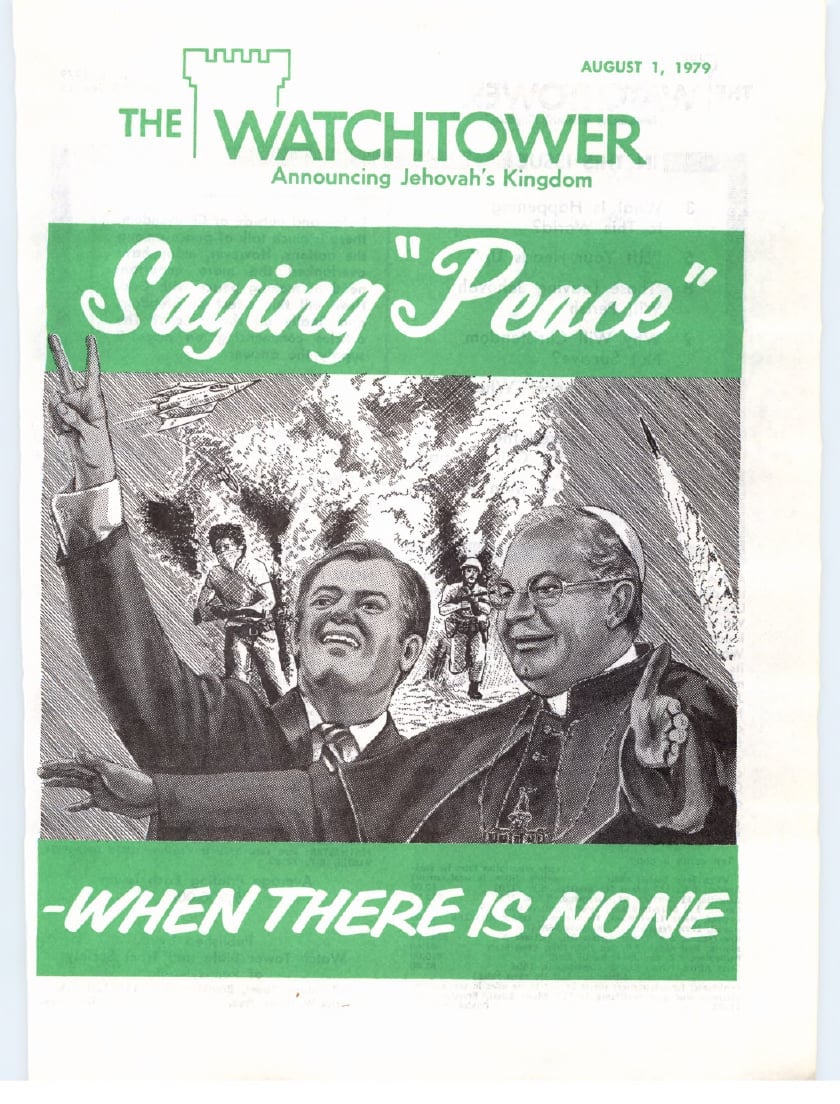
The Watchtower — August 1, 1979
Source: jw.org
Contents
Page Two
What is Happening to This World?
“Lift Your Heads Up”
‘Those Leaving Jehovah Will Perish’
Why Will Christendom Not Survive?
Saying “Peace” When There Is None
They Answered the “Macedonian” Call to Guam
Nathanael—A Man Without Deceit
Insight on the News
Jehovah Blesses Those Who Exert Themselves Vigorously
What Is Better than Life?
Questions From Readers
It Shoots Straight to the Mark
Page Two
Page Two
Inside and outside of Christendom, there is much talk of peace among the nations. However, many have overlooked the more important need of making peace with God. How will this affect Christendom, and finally all the nations? The articles commencing on page 9 supply the answer
What is Happening to This World?
What is Happening to This World?
IT IS apparent to all reasonable persons that something is very wrong with this world. While people everywhere want to enjoy life, ever so many things now interfere with that enjoyment.
For example, it gets harder and harder to make a decent living as prices keep going up. Then, too, crime, family breakdown, poverty, civil disorders, wars and other problems distress the human family.
As the pressures of life grow, more and more persons say that they do not see any way out of all these problems. And this is just what Jesus Christ foretold of our day when he said that there would be “on the earth anguish of nations, not knowing the way out.”—Luke 21:25.
Too, in early 1979 something else of great significance has been added to this “anguish of nations.” For the first time in the history of international Communism, nations that are Communist have gone to war among themselves.
“THE RED BROTHERHOOD AT WAR,” is the way the headline of a main editorial in the New York Times put it. The newspaper observed:
“They are singing ‘The Internationale’ on all sides of the Asian battles this week as they bury the hopes of the Communist fathers with the bodies of their sons.
“There was once a time when Communists . . . felt themselves to be brothers incapable of war against each other . . . the Red brotherhood believed that the only international wars that could still occur—which were in fact ‘inevitable’—were those growing out of the contradictions inherent in capitalism.”
Yet antagonisms among Communist nations have grown over the past two decades. Finally, these exploded into open warfare in early 1979 when Communist Vietnam invaded Communist Cambodia. China, favoring Cambodia, then invaded Vietnam, which was backed by the Soviet Union, and tensions increased between China and the Soviet Union. The war caused shock waves throughout the world. The Times noted its significance:
“The conflict that spread this weekend from Cambodia to the border of China and Vietnam and to hostile exchanges between China and the Soviet Union provides the final proof that no ideology makes men immune to ethnic and racial strife, or aggression and chauvinism. While an impotent United Nations looks on, hotheaded governments with no apparent economic interest at stake risk even major war. Ugly nationalism has triumphed once again in the human family.”
Thus, as with every other political ideology before it, Communism shows that it too is incapable of bringing true peace and unity to all mankind. As the Times concluded: “Nations live as nations have always lived, by the code of outlaws.”
Are you discouraged by the many depressing events that have taken place in world affairs during your lifetime? Many people are. Yet, when viewed in the light of Bible prophecy, these very events give rise to great encouragement and hope for the future.
How can this be so? Because these events are all part of the great “sign” of the times given by Jesus in prophecy. That “sign” marks our era as unique in human history, since it will be the last one to experience such distressing conditions.—Matt. 24:3.
Jesus said that this era would begin with a series of unprecedented world events. He stated: “Nation will rise against nation and kingdom against kingdom.” He also said that, among other things, there would be “great earthquakes, and in one place after another pestilences and food shortages.”—Matt. 24:7; Luke 21:10, 11.
That combination of events, unparalleled in history, began with mankind’s first global war, World War I. It took the lives of about 9,000,000 fighting men and 5,000,000 civilians. Its carnage was so enormous that a German soldier wrote in horror: “This generation has no future, and deserves none.” He was closer to the truth than he may have imagined.
The war was accompanied, or shortly followed, by other significant events that fulfilled prophecy. A killer plague, the Spanish influenza, took over 20,000,000 lives. Devastating earthquakes struck places such as Italy, China and Japan, taking hundreds of thousands of lives. Truly, the events surrounding World War I were “a beginning of pangs of distress,” as Jesus foretold.—Matt. 24:8.
A grim reminder of that “beginning” can be observed to this day. It is reported that during 1979 Belgian army troops using electronic detectors have dug up—each day—an average of one ton of unexploded artillery shells from World War I battlefields in that country alone!
Yet, World War II produced a worse inferno, killing 55 million people! Hideous new methods and machines of war were introduced.
One grisly reminder of that conflict can be seen today at Pearl Harbor in Hawaii. There a monument stands astride the sunken battleship Arizona, which contains the remains of over 1,000 members of its crew still entombed in the ship’s hull. It is another grim testimony to man’s capacity for destruction and his inability to solve his problems.
The spirit of violence and anarchy demonstrated by governments in their dealings with one another during our time has infected the masses of mankind. As a result, crime, violence and other forms of antisocial behavior are epidemic, prompting a New York Post editorial to say:
“In truth, life is so traumatic, so bloodied with horror that it takes a cast iron stomach to read the daily news. On TV, the agony is compounded in living color.
“Where, one wonders, is the end of it—of the killing, the maiming, the broken heads, the battered children, the casual murders for two dollars and a cheap wristwatch? . . .
“Violence, in the 1970s, has been aptly called ‘the cancer of our soul.’ . . . No adult can remember anything quite like it.”
Yes, we are eyewitnesses to the unique, crucial period of time Jesus was talking about when he foretold the “anguish of nations, not knowing the way out.” However, does this mean that there is no way out?
No, for when Jesus uttered his prophecy about the “anguish of nations, not knowing the way out,” these words immediately followed it: “But as these things start to occur, raise yourselves erect and lift your heads up, because your deliverance is getting near.” (Luke 21:28) But why should we ‘lift our heads up’ in encouragement and hope when surrounded by so much trouble?
“Lift Your Heads Up”
“Lift Your Heads Up”
NO PREVIOUS generation in human history has witnessed the distressing events that our generation has. Why, then, when speaking of this very time, would Jesus say: “As these things start to occur, raise yourselves erect and lift your heads up, because your deliverance is getting near”?—Luke 21:28.
Clearly, Jesus was saying that there was a lasting and satisfying solution to all these disturbing problems. And what is it? For instance, do prophecies such as those Jesus gave, and many others in the Bible, indicate that this deliverance will come by human efforts? No, not at all.
The harsh lesson of history is that men and nations, however sincere, are simply unable to bring true peace, security and lasting happiness to mankind. Their best efforts have ended in failure, sooner or later. Thus, nowhere are we told in Bible prophecy that humans would gradually perfect society through their own efforts.
Instead, Jesus foresaw that world conditions would get worse and worse until the entire system of things was caught up in what he called a “great tribulation such as has not occurred since the world’s beginning until now, no, nor will occur again.” (Matt. 24:21) Right now, events throughout the world are building up to that situation.
Since that is so, why could Jesus be so optimistic? Because he knew that the coming unprecedented convulsion in human affairs would be the final one. It would pave the way for a new system of things, one that the Bible prophetically calls “new heavens and a new earth” in which “righteousness is to dwell.”—2 Pet. 3:13.
WHY SO LONG?
However, if it is God’s purpose to establish a righteous new order here on earth, why has he allowed so many thousands of years of misery and trouble? One important reason concerns an issue that was raised when the first man and woman decided to rebel against God’s rule.
Our first parents faced the proposition that by being independent from God they could “be like God, knowing good and bad.” (Gen. 3:5) Since they already had God’s law as to what was good or bad, this statement in Genesis 3:5 likely indicates that what humans wanted was to determine for themselves what would be good or bad. What our first forefathers chose to say, in effect, was that they did not need God to direct their lives, that they could successfully run their own affairs.—Deut. 32:4, 5.
Why would God permit this? Because God created humans as free moral agents, not robots. So he would allow their departure from his laws to demonstrate, once and for all time, whether humans could successfully govern their own affairs independently of God.
God has been very patient and long-suffering. He has given human rulers, and the people, every opportunity to prove their inability to rule. In the past millenniums of time every conceivable form of human rule and social system has been tried. But history, especially the history of our generation, testifies to the fact that not one of these has brought lasting blessings to all mankind. The failure of the nations to provide true peace or lasting security even in local regions of this earth plainly shows that humans are not capable of governing themselves successfully, independent of their Creator.
Why not? Because humans were not created with that ability or capacity. Instead, God created them to be dependent upon him and his laws. (Gen. 2:16, 17) He created them with a real need for his direction. Departing from his arrangements could only result in harm, as has been shown throughout the centuries. It is like someone’s ignoring the rules for mental health and expecting to be mentally sound, or ignoring the need for nutritious food and expecting good health, or ignoring the law of gravity by jumping off a high building and not expecting to get hurt, or constantly ignoring traffic laws and expecting never to be penalized.
Thus, it has been proved clearly that what God’s Word says is the truth: “To earthling man his way does not belong. It does not belong to man who is walking even to direct his step. Correct me, O Jehovah.” (Jer. 10:23, 24) The result of mankind’s ignoring God and his ways is as the Bible says: “What you think is the right road may lead to death.”—Prov. 14:12, Today’s English Version.
The record that men and nations have made throughout the centuries plainly shows that they do not deserve to govern this beautiful earth. As a chief justice of the California Supreme Court said: “If we were here on a month-to-month basis, we would have been evicted long ago.”
While not on a “month-to-month” basis, mankind’s rule of this earth independent of God is by no means permanent. It is only temporary, for a limited period of time. And Bible prophecy shows that this time limit is nearing its end. Now that the various issues related to human rule have been amply demonstrated, God’s time is at hand to destroy this unsatisfactory system. After clearing it out of the way, he will usher in a new order of his making, one that will bring true and permanent peace, with real security and genuine happiness to this earth.
DESTROYING THIS SYSTEM
The destruction of this system is described in the book of Revelation (the Apocalypse) in this symbolic language: “I saw also an angel standing in the sun, and he cried out with a loud voice and said to all the birds that fly in midheaven: ‘Come here, be gathered together to the great evening meal of God, that you may eat the fleshy parts of kings and the fleshy parts of military commanders and the fleshy parts of strong men and the fleshy parts of horses and of those seated upon them, and the fleshy parts of all, of freemen as well as of slaves and of small ones and great.’”—Rev. 19:17, 18.
That will be the culmination of what Jesus called the “great tribulation such as has not occurred since the world’s beginning until now, no, nor will occur again.” (Matt. 24:21) So God’s heavenly rule by Jesus Christ “will crush and put an end to all these kingdoms [now existing]” and provide a government over all the earth “that will never be brought to ruin.”—Dan. 2:44.
SURVIVORS
There will be survivors of the coming world catastrophe, just as there were when the global flood of Noah’s day destroyed the corrupt world of that time. (2 Pet. 2:5) God’s Word says: “Turn to the LORD, all you humble people of the land, who obey his commands. Do what is right, and humble yourselves before the LORD. Perhaps you will escape punishment on the day when the LORD shows his anger.” “It must occur that everyone who calls on the name of Jehovah will get away safe.”—Zeph. 2:3, TEV; Joel 2:32.
The final book of the Bible, too, assures us that there will be survivors. They are spoken of as being “a great crowd” who “come out of the great tribulation.” Why are they spared? Because, as the prophecy says, they are “rendering him [God] sacred service day and night.”—Rev. 7:9, 14, 15.
The gathering of these prospective survivors from all nations is proceeding right now. All over the world those who want to learn about God’s purposes and who want to do his will are being brought together into one international society of people, which will be the foundation of God’s incoming “new earth.” (2 Pet. 3:13) Unlike the nations of this world, they have already learned to “beat their swords into plowshares and their spears into pruning shears.” By so doing, they even now have fulfilled the prophecy: “Nation will not lift up sword against nation, neither will they learn war anymore.”—Isa. 2:2-4.
So while the nations independent of God plunge into ever greater distress, God’s purpose to gather a people to inherit the earthly realm under God’s kingdom goes on majestically. (Matt. 25:34) Because of what these are now learning regarding this wicked system’s near end, and the righteous new system just ahead, they no longer view the future with hopelessness. Instead, they ‘lift their heads up, since their deliverance is drawing near.’ (Luke 21:28) They have great confidence in the future because they know for a certainty that, as the Bible says, “People may plan all kinds of things, but the LORD’S will is going to be done.”—Prov. 19:21, TEV.
[Picture on page 6]
“I saw also an angel standing in the sun, and he cried out with a loud voice and said to all the birds that fly in midheaven: ‘Come here, be gathered together to the great evening meal of God.’”—Rev. 19:17.
‘Those Leaving Jehovah Will Perish’
‘Those Leaving Jehovah Will Perish’
In the time of the prophet Isaiah, many of the inhabitants of Jerusalem and the land of Judah were unfaithful to Jehovah their God. They were steeped in idolatrous practices. It was, therefore, against them that Jehovah directed these words through Isaiah: “Those leaving Jehovah will come to their finish. For they will be ashamed of the mighty trees that you people desired, and you will be abashed because of the gardens that you have chosen.”—Isa. 1:28, 29.
In the gardens or sacred groves the people would offer sacrifices and burn incense to false deities. (Isa. 65:3; 66:17) “The mighty trees” also played a role in such idolatry. At the time for the executing of Jehovah’s judgments, the sacred trees and gardens would prove to be a cause for the idolaters to be ashamed. The deities whom they had served would be unable to shield them or protect them from the day of wrath.
The prophecy of Isaiah continues: “For you will become like a big tree the foliage of which is withering, and like a garden that has no water.” (Isa. 1:30) Thus transferring the figure of the “big tree” and the “garden” to the idolaters, the prophecy showed how the unfaithful people would ‘wither’ from the heat of God’s anger, drying up as a garden in a season of drought. “And” the prophecy goes on to say, “the vigorous man [the idolater] will certainly become tow [like the combustible, broken, coarse parts of flax], and the product of his activity [the idol] a spark; and both of them [the idolater and the idol] will certainly go up in flames at the same times with no one to do the extinguishing.” (Isa. 1:31) What a strong warning this is against idolatry! Unquestionably, ‘those leaving Jehovah will perish.’
Why Will Christendom Not Survive?
Why Will Christendom Not Survive?
“Look! They have rejected the very word of Jehovah, and what wisdom do they have? . . . from the prophet even to the priest, each one is acting falsely.”—Jer. 8:9, 10.
1. Why is it not strange that Jerusalem should prove to be disappointing as a peace factor?
JERUSALEM of today, the city prized by three of this world’s major religions, seems again to be playing a world role. Will she yet prove to be the city of the Prince of Peace? Will she yet prove to be the essential factor for the establishment of world peace? In these respects she will prove to be disappointing to those who attach high religious value to her. This need not seem strange to us, for even ancient Jerusalem itself failed the very God whose glorious temple crowned the height of Mount Moriah, one of her famous hills.
2. (a) What can we miss out on by listening to Christendom’s mouthpieces? (b) What has Jehovah raised up to warn Christendom?
2 Let us not be among those who today take the course that leads to inevitable disappointment. Christendom, who places high hopes in modern Jerusalem, has long had a commanding voice in affairs religious and political. In spite of her prestige, we can fail to get the everlasting life that we desire if we listen to what her mouthpieces have to say in this most critical time of all human history. According to the infallible Word of the God whom Christendom professes to worship, that system of nominal, professed Christianity is doomed, even as Jerusalem of the prophet Jeremiah’s day was. (Jer. 6:1-8) By means of persons fully dedicated to God as Jeremiah was, Christendom has been duly warned of the sure destruction in store for her. Yes, just like during the final days of Jerusalem in Jeremiah’s days, Jehovah God has raised up his anointed witnesses to be a modern Jeremiah class. (2 Chron. 36:15, 16) Regularly, to the church members of Christendom, Jehovah has sent these Christian witnesses of his, he, as it were, “daily getting up early and sending them.” (Jer. 7:25, 13) But all in vain!
3. What pattern of reaction to such warning have Christendom’s “prophets” and “priests” followed?
3 However, Christendom’s “prophets” and “priests” have refused to take heed. They do not like to have their “flocks” disturbed. So they give them false assurances that belie God’s prophecies. It was like that in Jeremiah’s day. It was like that in the days of Christ’s apostles. (Jer. 5:20, 21; Matt. 13:13-15; Acts 28:25-27) Do we want to be like those misled people and refuse to take heed? No!
MISPLACED TRUST IN A RELIGIOUS CHARM
4, 5. (a) In what kind of structure are people of Christendom putting trust today? (b) How does Jeremiah describe people who made a like mistake in his day?
4 Millions today put their trust in a doomed religious structure. The clergy of Christendom induce their church members to do so. The people of Jerusalem and of the land of Judah made a like mistake in the days of Jeremiah. We do not desire to imitate them. Jeremiah was commanded by Jehovah to stand in the gate of the temple of Jerusalem and publicly say to those coming in there:
5 “‘Do not put your trust in fallacious words, saying, “The temple of Jehovah, the temple of Jehovah, the temple of Jehovah they are!” . . . Here you are putting your trust in fallacious words—it will certainly be of no benefit at all. Can there be stealing, murdering and committing adultery and swearing falsely and making sacrificial smoke to Baal and walking after other gods whom you had not known, and must you come and stand before me in this house upon which my name has been called, and must you say, “We shall certainly be delivered,” in the face of doing all these detestable things? Has this house upon which my name has been called become a mere cave of robbers in your eyes? Here I myself also have seen it,’ is the utterance of Jehovah.”—Jer. 7:4-11.
6. During what action did Jesus use Jeremiah’s figures of speech regarding the temple of Jerusalem?
6 Jeremiah was not authorized to clean out the temple of all the defiling things put there by those who would carry out a fusion of Jehovah’s worship with pagan idol worship. (Jer. 7:30, 31) But more than 630 years after the destruction of that temple Jesus Christ, as the Son of God, cleansed the rebuilt temple of Jerusalem on two occasions. When doing so, Jesus used Jeremiah’s figures of speech. We read: “Jesus entered into the temple and threw out all those selling and buying in the temple, and overturned the tables of the money changers and the benches of those selling doves. And he said to them: ‘It is written, “My house will be called a house of prayer,” but you are making it a cave of robbers.’” (Matt. 21:12, 13; see also John 2:15, 16.) That defiled temple was destroyed in 70 C.E.
7. (a) At the same time that religionists of Christendom carry on their worship, into what do they convert their religious structure? (b) What do they call Jesus Christ, and yet what will he call them?
7 Particularly since 1919 C.E. the modern Jeremiah class has been calling the world’s notice to the defiled state of Christendom. At the same time that church members carry on their worship in this professed Christian system of things, they take part in “stealing, murdering and committing adultery and swearing falsely.” They religiously sacrifice to other gods (Baals, Lords) in addition to the Lord Jesus Christ. Materialistically they convert their religious structure into a “mere cave of robbers.” (Jer. 7:9-11) In spite of all these things detestable to Jehovah, the religionists of Christendom pay lip service to Jesus Christ and call him “Lord.” They think that because of doing this everything is all right and that their worship is acceptable to God and Christ. But Jesus Christ will surprise them by calling them “workers of lawlessness,” because of their not doing his Father’s will.—Matt. 7:21-23.
8. Why do the religionists of Christendom think that their religious structure has a charmed life?
8 Like the Israelites to whom Jeremiah delivered Jehovah’s message, the religionists of Christendom view their “temple,” upon which they call the name of Christ, as if it were a charm against calamity at God’s hands. They point to their nominally Christian structure of things and say: “The temple of Jehovah they are!” (Jer. 7:4) The Roman Catholic Church claims to be apostolic by building up a line of apostolic successors going all the way back to Christ’s twelve apostles. The Anglican Church of Great Britain does something similar with regard to its “bishops” (episcopal clergy). The patriarchates of the Eastern Orthodox Churches depend upon an imagined unbroken succession of their bishops back to the twelve apostles, who, they argue, had apostolic successors. The papacy of Rome maintains that it is built upon the apostle Peter as “this rock” and so the “gates of hell” cannot prevail against it. (Matt. 16:18, 19, Douay) Because of such claimed continuity of things from Christ’s own day, they consider Christendom to have a charmed life, safe from extermination.
9, 10. (a) What question arises about worshipers who put trust in the ‘charmed life’ of Christendom? (b) What did Jehovah tell Jeremiah to say about the Jews who trusted in their temple?
9 However, if a person puts his trust in Christendom’s ‘charmed life,’ does this guarantee his safety from calamity and destruction with her? The apostle Paul warns that in the “last days” people would be “having a form of godly devotion but proving false to its power; and,” he added, “from these turn away.” (2 Tim. 3:1-5) So, then, when a person goes through outward formalities in a house or institution professedly dedicated to God but at the same time defiled by mixture with false worship and worldliness, does this ensure his being protected from God’s expression of righteous displeasure? Well, what did Jehovah tell Jeremiah to say to the Israelites who trusted in their “temple”? Listen:
10 “‘Go, now, to my place that was in Shiloh [about 20 miles (32 km) north of Jerusalem], where I caused my name to reside at first, and see what I did to it because of the badness of my people Israel. And now for the reason that you kept doing all these works,’ is the utterance of Jehovah, ‘and I kept speaking to you, getting up early and speaking, but you did not listen, and I kept calling you, but you did not answer, I will do also to the house upon which my name has been called, in which you are trusting, and to the place that I gave to you and to your forefathers, just as I did to Shiloh. And I will throw you out from before my face, just as I threw out all your brothers, the whole offspring of Ephraim.’”—Jer. 7:12-15.
11. In Samuel’s days, what happened at Shiloh that shocked the religious susceptibilities of the Israelites?
11 What happened to Shiloh in the days of the young prophet Samuel shocked the religious susceptibilities of the Israelites. They trusted in the sacred ark of the covenant to save them from defeat at the hands of the Philistines. So it was taken out of the Most Holy of the tabernacle that was in Shiloh, and lawbreaking priests, the sons of high priest Eli, carried it into the battle. But the Ark did not protect them from the consequences of their violations of Jehovah’s law. Alas, the Ark fell into the hands of the pagan Philistines, Eli’s priestly sons, Hophni and Phinehas, were killed, and, on receiving the sad news, fat high priest Eli swooned backward, broke his neck and died. The Israelites continued under oppression by the Philistines, and never again did the Ark, the symbol of Jehovah’s presence, return to its place in the sacred tabernacle in Shiloh, even though it was sent back by the plagued idolatrous Philistines.—1 Sam. 3:1 through 7:2.
12. How did Jehovah treat Jerusalem and the land of Judah as he had treated once-favored Shiloh?
12 By Jeremiah, Jehovah warned that he would do the same to Jerusalem as he did to once-favored Shiloh. So he let the Babylonians destroy Jerusalem in 607 B.C.E. Even the temple that King Solomon had built and that housed the ark of the covenant was demolished. The Ark itself disappeared from all record, its whereabouts not being known today. After the calamity upon Shiloh, the Philistines let the Israelites stay there. But after the Babylonians destroyed Jerusalem and its temple, they deported most of the surviving Jews to faraway Babylon. The few Jews left behind finally forsook the land in terror and fled to Egypt. This left the whole land of Judah uninhabited. Thus Jehovah threw those covenant-breaking Jews out from before his face!
13. What lesson should we learn from that case of misplaced trust?
13 Let us today learn a lesson from this. Let us not put our trust in what the clergy of Christendom think will serve as a religious charm to save her from obliteration. The “great tribulation” that is shortly coming upon her will be worse than that which overtook Jerusalem and its temple 37 years after Jesus cleansed what had been turned into a “mere cave of robbers,” the defiled temple of Jerusalem.—Matt. 24:1, 2, 21, 22.
FROM RELIGIOUS SANCTITY TO POLLUTION
14. Why should we not pray to God for Christendom”s preservation?
14 No true lover of the God of the Bible will pray that such a strange thing may never befall Christendom. Jehovah ordered his prophet Jeremiah not to pray for Jerusalem and its profaned temple to be spared from the execution of His righteous indignation. Jerusalem’s modern counterpart, Christendom, has proved unreformable. After all these years that Jehovah has sent his Christian witnesses to warn the people of Christendom, she keeps on in her badness to where she is unpardonable.—Jer. 7:18-26; 5:7-9.
15, 16. (a) In view of what course of conduct does Christendom not deserve pity? (b) In giving an illustration of this, what did Jehovah say in Jeremiah 7:30, 31?
15 We should not pity Christendom because her destruction will affect so many human lives. Her course has brought great reproach upon God. Why should we not, first of all, think about him? He is more important than all human creatures. Think of how Christendom with her hundreds of millions of church members has brought shame upon his name and has persecuted his faithful witnesses who proclaimed his warnings and his lifesaving counsels. Do we have more compassion for unheeding, disobedient humans than for the name of the Most High God? True, their perishing with Christendom is lamentable, but their present course of shameful religious conduct is no less lamentable. In illustration of this, Jehovah said:
16 “‘The sons of Judah have done what is bad in my eyes,’ is the utterance of Jehovah. ‘They have set their disgusting things in the house upon which my name has been called, in order to defile it. And they have built the high places of Topheth, which is in the valley of the son of Hinnom [outside the south wall of Jerusalem], in order to burn [what?] their sons and their daughters in the fire, a thing that I had not commanded and that had not come up into my heart.’”—Jer. 7:30, 31; note Leviticus 18:21; 20:2-5.
17. (a) What question comes up about pity toward the human sacrifices and the parents who offered them? (b) Who originated the idea of such human sacrifices?
17 So, now, when it comes to pity, for whom do we have more pity? For the idolatrous parents who faced an accounting with Jehovah? Or for the sons and daughters screaming as they were being offered as human sacrifices to the false god Molech (King), on a high altar at Topheth in the valley of the son of Hinnom? (Jer. 32:35) How could those heartless parents associate such worship of the fiendish idol-god Molech with worship at the holy temple just to the north of the valley? It was not at Jehovah’s command that they offered up such live human sacrifices to a false god. The idea of such human sacrifices came into the heart of the religious apostates back there, but never into the heart of Jehovah God. What do men who try to blend such worship with Jehovah’s worship deserve?
18. Numerically, how do such sacrifices of old compare with those offered up by Christendom in less than a century now?
18 Back there, the sacrifices of children by the renegade “sons of Judah” pale into insignificance as to number when compared with the human sacrifices that Christendom has offered up to her unchristian gods during the centuries. Though pretending to be the visible kingdom of the Prince of Peace, she has offered up countless sons and daughters to the god of war, her Molech or “King.” In now less than a century, she has sacrificed scores of millions of her finest young church members in the two most sanguinary wars of all human history, and in many minor wars. Blasphemously Christendom calls this Christianity. Such sacrifices she counts as “the supreme sacrifice” that gains for the sacrificed ones an immediate passport into Christ’s presence up in heaven!
THE SACRIFICES PLEASING TO JEHOVAH GOD
19. Well, then, what does a Christian’s presenting his body as a “sacrifice living, holy” to God mean for him?
19 Such sacrifices are not the kind that Jehovah God recommends to the followers of his Son Jesus Christ. Rather, at Romans 12:1, 2 he inspired the apostle Paul to write: “I entreat you by the compassions of God, brothers, to present your bodies a sacrifice living, holy, acceptable to God, a sacred service with your power of reason. And quit being fashioned after this system of things, but be transformed by making your mind over, that you may prove to yourselves the good and acceptable and perfect will of God.” The Christian’s presenting of his body as “a sacrifice living, holy,” does not mean his committing suicide or his having a religious priest kill him and offer him on an altar. That would not be a “sacred service with your power of reason.” Rather, it means the Christian’s leading a self-sacrificing life in behalf of God’s service, not his deliberately making a martyr of himself for show.
20. By living in such a way “acceptable to God,” what sacrifices can a live Christian offer to God?
20 By continuing to live in a way “acceptable to God,” the true Christian can offer to God the sacrifices mentioned in Hebrews 13:15, 16: “Through him [Christ, God’s High Priest] let us always offer to God a sacrifice of praise, that is, the fruit of lips which make public declaration to his name. Moreover, do not forget the doing of good and the sharing of things with others, for with such sacrifices God is well pleased.”
21. For his chosen people, what did Jehovah put ahead of their offering of animal victims, and so what about human sacrifices?
21 The sacrifices thus described do not admit of our blending Jehovah’s worship with the offering of human or animal victims to the false gods of this world. (Isa. 42:8) The primary thing that God wants of his people is obedience, our obeying “the good and acceptable and perfect will of God.” When Jehovah rescued his chosen people from death-dealing oppression in ancient Egypt, he did not put to the fore, as of first importance, the offering of animal sacrifices to him: “But this word I did express in command upon them, saying: ‘Obey my voice, and I will become your God, and you yourselves will become my people; and you must walk in all the way that I shall command you, in order that it may go well with you.’” (Jer. 7:22, 23; 1 Sam. 15:22) So if Jehovah did not demand animal sacrifices of his chosen people, much less would he ask human sacrifices of them. The idea of human sacrifices, such as those to Baal or Molech, did not even “come up into [his] heart.”—Jer. 7:31.
22, 23. (a) How has Christendom, with all her record of shedding human blood, failed to offer sacrifices acceptable to God? (b) What was to happen to her ancient prototype to show whether she would go unpunished?
22 Christendom, despite all her gory record of shedding human blood, has not offered to God the sacrifices pleasing to him. Obedience to the Bible’s God has been missing on her part. (Mic. 6:6-8) To this day she has not repented of her disobedient course, so as to offer to God the appropriate sacrifice: “The sacrifices to God are a broken spirit; a heart broken and crushed, O God, you will not despise.” (Ps. 51:17) Does she deserve to go unpunished? Will she go unpunished? Her ancient prototype, Jerusalem, underwent due punishment, just as Jehovah said:
23 “‘Therefore, look! days are coming,’ is the utterance of Jehovah, ‘when it will no more be said to be Topheth and the valley of the son of Hinnom, but the valley of the killing; and they will have to bury in Topheth without there being enough place. And the dead bodies of this people must become food for the flying creatures of the heavens and for the beasts of the earth, with nobody to make them tremble. And I will cause to cease from the cities of Judah and from the streets of Jerusalem the voice of exultation and the voice of rejoicing, the voice of the bridegroom and the voice of the bride; for the land will become nothing but a devastated place.’”—Jer. 7:32-34; 19:6-9.
24. When did the typical fulfillment of that solemn prophecy occur?
24 The carrying out of this solemn prophecy did not occur during the reign of King Josiah, who did an idol-smashing work and defiled the places that had been devoted to the worship of Molech and other demon gods. (2 Ki. 23:3-20) The turning of Topheth and the valley of Hinnom into a valley of the killing, strewn with the Judean corpses, with no graves to keep flesh-eating birds and beasts from devouring them, occurred in 607 B.C.E., when long-besieged Jerusalem fell to the Babylonians and the miserable survivors were deported and the city was left a devastated place. For 70 years Jerusalem and Judah lay desolate.—2 Chron. 36:17-21.
25. In view of the foregoing, Christendom will not escape the fulfillment of what prophecy of Jeremiah?
25 Bloodguilty Christendom of today, with her pagan customs, man-made traditions, and mixture of heathen philosophies with Bible teachings, will fare no better than her ancient prototype. She will not escape sharing in the fulfillment of Jehovah’s prophecy: “A great tempest itself will be roused up from the remotest parts of the earth. And those slain by Jehovah will certainly come to be in that day from one end of the earth clear to the other end of the earth. They will not be bewailed, neither will they be gathered up or be buried. As manure on the surface of the ground they will become.” (Jer. 25:32, 33) No! Christendom will not survive the impending “great tribulation.” (Matt. 24:1, 2, 21, 22) Moreover, all the rest of the world empire of false religion will closely follow her into destruction!
[Box on page 9]
The Bible prophecy of Jeremiah points lovers of righteousness to “the way of life.” It describes also Jehovah God’s execution of judgment on false religion and on the nations that oppose his will. That hour is at hand! It is timely, therefore, for “The Watchtower,” in this issue, and in succeeding ones, to discuss the modern-day fulfillment of Jeremiah’s prophecy.
[Picture on page 13]
Saying “Peace” When There Is None
Saying “Peace” When There Is None
1. Where does the Jeremiah class of today find itself with regard to the proclaimers of “Peace!” when there is none?
THE prophet Jeremiah was not among those of his day who were saying “Peace!” when there was none. Likewise, the Jeremiah class of today is not among those mouthpieces of Christendom who imitate those men who persisted in saying “Peace!” in Jeremiah’s day. Who finally will prove to be the truth-tellers, those proclaimers of “Peace!” or the so-called “calamity howlers”?
2, 3. (a) To what are men feeling obliged to look as the source for a stable, lasting peace? (b) To illustrate the helplessness of such source of peace, what was Jeremiah next told to say?
2 For a peaceful outcome of worldly matters men are feeling obliged to look upward for supernatural help. But it is not to the God of the ancient prophet Jeremiah that they look as the Source of a stable, lasting peace. The supernatural forces for peace to which they look will prove to be false gods, absolutely helpless! Warning all of us of the blasting of the foundationless dreams of peace on the part of kings, princes, priests, prophets and the concerned populace when their false gods of peace fail them, the inspired prophet Jeremiah was told to say of that time:
3 “‘At that time [as foretold in Jeremiah 7:32-34],’ is the utterance of Jehovah, ‘people [the Babylonian conquerors] will also bring forth the bones of the kings of Judah and the bones of its princes and the bones of the priests and the bones of the prophets and the bones of the inhabitants of Jerusalem from their graves. And they will actually spread them out to the sun and to the moon and to all the [starry] army of the heavens that they have loved [as objects of worship] and that they have served and that they have walked after and that they have sought and that they have bowed down to. They [the bones] will not be gathered, nor will they be buried. As manure upon the face of the ground they will become.’”—Jer. 8:1, 2.a
4. So the desecration of graves manifests what for the worshipers of false gods, and what do they not deserve to experience?
4 Ah, yes, the heavenly bodies that had beamed down so promisingly upon the inhabitants of Jerusalem and the land of Judah would then look down so helplessly during that calamitous time when the question would be settled, Who is the God of truth? The desecration of graves of persons prominent in religion and politics would show the contempt felt toward those who worshiped false gods in violation of Jehovah’s Ten Commandments. Even the peace with which they slept in death would be broken. (Job 3:13-19) In Jehovah’s eyes, devout worshipers of false gods do not earn for themselves protective sanctity or holiness, especially not when they claim to be in Christian relationship with the God of the Bible and yet break his plainly stated commandments. (Ex. 20:1-6; 1 John 5:21; 2 Cor. 6:16) Respect for the dead they do not deserve to experience!
5. How will persecutors of Jehovah’s Witnesses find that their taunts respecting Jehovah apply as to their own gods?
5 So the day of reckoning will come for those who have persecuted the Christian witnesses of Jehovah, taunting them with the defiant words, ‘Where is your God Jehovah? Let him come and save you now!’ (Ps. 22:7, 8) In the approaching “great tribulation” in which Christendom will go down, the persecutors who pleased her by their acts will find out whether their false gods can help them. Then they will learn that their gods will be unable to save them from judgment by the God whom they ridiculed.
6, 7. (a) What would the deportees to Babylon have preferred, and why? (b) In spite of Jehovah’s appeals for a returning to him, how has the response been like that in Jeremiah’s day?
6 In Jeremiah’s day there were to be survivors of Jerusalem’s destruction. What about them? They were to be deported to the land of Babylon. There, as far as they were concerned, “death will certainly be chosen rather than life.” (Jer. 8:3) Even though Jehovah appealed to the covenant-breaking Israelites to return to peaceful relationship with him, they took the “popular course” of this world down till 607 B.C.E. So they laid no secure foundation for a peaceful future under Jehovah’s blessing. In modern times also, Christendom has taken the popular course. For decades now since 1919 C.E., the Jeremiah class as made up of anointed witnesses of Jehovah has made known the way to come back into peaceful relations with the God of the Bible. But most church members of Christendom have refused to take heed. It is just like what Jeremiah said:
7 “Why is it that this people, Jerusalem, is unfaithful with an enduring unfaithfulness? They have taken hold of trickiness; they have refused to turn back. . . . There was not a man repenting over his badness, saying, ‘What have I done?’ Each one is going back into the popular course.”—Jer. 8:4-6.
8. The trouble back there consisted of what failure of discernment, as is also true now?
8 What was the trouble back there in Jeremiah’s day during the time for Jehovah’s inspecting of his covenant people? Also, what is the trouble today with the people of Christendom? It was and is their not using their powers of discernment such as those that migratory birds have to discern the time for the arrival of springtime. Birds from the north that had taken haven in warm southern areas during the northern winter like that in Palestine promptly return to their roosting and mating places up north. “But,” says Jehovah by way of contrast, “as for my people, they have not come to know the judgment of Jehovah.” (Jer. 8:7) It was the same in the days of Jesus and his apostles, before the Romans destroyed Jerusalem in 70 C.E. (Matt. 16:2-4; Luke 19:44) It has proved to be the same with Christendom in these days of the Jeremiah class.
BREAKDOWN NOT HEALED
9, 10. (a) On what basis do Christendom’s clergy claim to be wise and versed in law? (b) In disproof of their claim, what foreview does Jehovah give us of the consequences of their dealings?
9 The clergy of Christendom claim to be wise, not basically due to having the Bible but because of having theological seminary training. They insist that they are informed on the law of the Bible’s God and know how to interpret it and apply it. But the God of the Bible knows differently. He looks ahead to the near future, when the consequences of their handling of Christendom’s affairs will actually face them. With such a foreview Jehovah says:
10 “How can you men say: ‘We are wise, and the law of Jehovah is with us’? Surely, now [at the outbreak of the final trouble], the false stylus of the secretaries has worked in sheer falsehood. The wise ones have become ashamed. They have become terrified and will be caught. Look! They have rejected the very word of Jehovah, and what wisdom do they have? Therefore [at the invasion of the enemy forces] I shall give their wives to other men, their fields to those taking possession; for, from the least one even to the greatest one, each one is making unjust gain; from the prophet even to the priest, each one is acting falsely.”—Jer. 8:8-10.
11, 12. (a) How has the “stylus of the secretaries” of Christendom “worked in sheer falsehood”? (b) According to Jeremiah 8:9, what is the reason for the pen of Christendom’s writers to set out false things?
11 In writing things contrary to what Jehovah has foretold, the “stylus of the secretaries” of modern-day Christendom will shortly prove to have been a “false” pen. It has not written the truth. Consequently, in this “time of the end,” when so much has been written in behalf of Christendom, that religious pen or “stylus” has certainly “worked in sheer falsehood.” (Dan. 12:9) Why has that been so?
12 “Look!” said Jehovah in Jeremiah 8:9, “They [the reputed wise men] have rejected the very word of Jehovah, and what wisdom do they have?” O yes, Christendom’s clergy may quote a theme text from the Bible, but in their sermon that follows they will depart from what the Bible says. They will teach man-made traditions that invalidate God’s written Word. They will discuss politics or a popular program of social reform. They pose as being divinely “wise,” but put Grecian philosophy and the “wisdom of this world” ahead of what the Bible says about the human soul, about the state of the dead, about God’s personality, and so forth. (1 Cor. 3:19) However, they are walking into a trap. They will at last be “caught” by the failure of their own worldly-wise policies. They are put to shame and subjected to terrifying consequences.
13. Who are largely responsible for Christendom’s church members making “unjust gain,” from the least to the greatest of them? And how so?
13 The clergy have encouraged their “flocks” in worldly pursuits that hold promise of fame or material rewards. They have favored the rich to the hurt of the poor. They have demanded financial compensation for their religious services. Setting such an example, they bear much responsibility for the fact that their church members, the least as well as the greatest, put spiritual interests last and “unjust gain” or “dishonest gain” first. (1 Pet. 5:1, 2) How fitting, then, that Jehovah does not prevent such professed Christians from losing all their “unjust gain” in the approaching “great tribulation” upon Christendom! Jehovah’s prophetic Word will thus come true upon them.
14. To what extent have the clergy healed the spiritual breakdown of Christendom?
14 The clergy of Christendom are still looked to as spiritual physicians. But since the end of World War I in 1918, have they succeeded in healing the spiritual wound, “the breakdown [Hebrew: shéber],” that Christendom has suffered? The record of now 60 years since then furnishes the facts about the clergy and their associate religious leaders. It shows that they have failed to get at the root cause of what ails her and why she will not survive the “great tribulation” but will experience destruction under God’s adverse judgment. They merely keep treating the symptoms but do not treat the real cause of Christendom’s doomed position before God. They have healed her breakdown superficially, slightly, skin-deep, “lightly,” as if it were a light matter with Jehovah God.
15. How do the clergy feel about the religious remedies that they have applied, and with what words do they assure their flocks?
15 Since the end of World War I Christendom has grown tremendously in church membership, but what about the spiritual condition of these members and their relationship with Jehovah God? The religious remedies that the clergy have applied have not improved matters, have not prevented rank worldliness from invading the churches. We do not need to detail this for our readers. The clergy feel quite confident about the remedies that they have applied. With words that throw their ailing flocks off guard, the modern-day “priests” and “prophets” keep assuring Christendom with the words: “There is peace! There is peace!” or, “All is well, all is well.”—Jer. 8:11; An American Translation; see also The New English Bible.
16. How do the clergy speak contrary to what the Jeremiah class says?
16 Thus these religious leaders act falsely. They make their flocks feel that there is nothing basically wrong with Christendom. They assert that her relationship with God is good, and hence there is no tribulation to be expected at his hands. So, do not pay attention to predictions that the Jeremiah class makes about early destruction for Christendom in a “great tribulation.”—Jer. 6:14.
17. Why is there actually no peace between Jehovah and Christendom?
17 The threatening situation is thus falsified by Christendom’s mouthpieces in their giving such assurances of peace, “when there is no peace.” There is no peaceful relationship between Jehovah God and Christendom. Her sins are not covered by the atoning blood of Christ. Her sky-high mass of sins is unpardonable. So God is not at peace with her. Destruction, not “peace” or spiritual prosperity, awaits her, because her clergy and church members have shamelessly ‘done even what is detestable’ to Jehovah.—Jer. 8:12.
18. The destruction will befall Christendom how, and to what extent will the destruction go?
18 With the clergy and their flocks in such an off-guard attitude destruction will befall them “suddenly,” yes, as if “in a moment.” (Jer. 4:20; 6:25, 26) Since the close of World War I in 1918 a thorough inspection of Christendom has been made by Jehovah, and shortly, at his appointed time, he must give her due attention, just as he did to ancient Jerusalem. Then her self-confident religionists will stumble to their fall into destruction. Jehovah will make a clean sweep; there will be nothing to glean like leftovers. Whatever material things Jehovah has permitted them to acquire “will pass by them” and on into enemy hands.—Jer. 8:12, 13.
19. (a) What did Jesus tell his disciples to do when early destruction of Jerusalem was indicated? (b) What did those in the open country in Jeremiah’s day do, at the disappointment of their expectations?
19 Back in the year 33 C.E., when Christ foretold the destruction that was to come upon Jerusalem in 70 C.E., what did he tell the Jews to do? To get out of Jerusalem and all the province of Judea when the nearness of impending destruction was indicated. The person in the field or rural areas was not to go into Jerusalem but at once was to get out of all Judea, for security and survival. (Matt. 24:15-18; Luke 21:20, 21) But in Jeremiah’s day, at the approach of the Babylonian destroyers, the people felt it to be better to leave the open country and take refuge in Jerusalem and other fortified cities. There, in such possible holdouts during siege, they preferred to come to silence in death, if need be. But aid from Jehovah, the God of their temple, did not come. Instead, he let them drink a bitter potion, death-dealing “poisoned water.” Due to the assurances of their false “prophets,” “there was a hoping for peace,” but what? “But no good came; for a time of healing, but, look! terror!” The sounds or reports of the invading forces of destruction were in their ears.—Jer. 8:14-16.
20. According to Jeremiah 8:17, who was responsible for the sending of death-dealing forces, and how was this prophecy fulfilled?
20 In Jeremiah’s day Jehovah was the One who sent his agents of destruction against the covenant-breaking Israelites. They had done detestable things before him, polluting his temple and his land. “‘For here I am sending in among you serpents, poisonous snakes, for which there is no charming, and they will certainly bite you,’ is the utterance of Jehovah.” (Jer. 8:17) There was then no Moses in Israel to hoist a copper snake upon a pole for Israelites to get healed from snakebite by merely looking at the copper snake in faith. (Num. 21:4-9; John 3:14, 15) The Babylonian destroyers and desolators meant business; back there in 609 B.C.E. nothing done by the besieged Israelites could charm these away from their God-given task. “Fortified cities,” in which the Israelites had taken refuge, could not shield them from Jehovah’s judgment.
21. How, in Jeremiah 8:18, 19, did Jehovah show that he had no heartfelt pleasure in bringing the national calamity?
21 Jehovah had no heartfelt pleasure in bringing this national calamity. So he gave due warning, foretelling the depopulating of the land of Judah and the deporting of most of the survivors to faraway Babylon. There the miserable deportees, surprised at Jehovah’s ‘strange work,’ would cry out to him for help. So he said: “A grief that is beyond curing has come up into me. My heart is ill. Here there is the sound of the cry for help of the daughter of my people from a land [Babylon] far away: ‘Is Jehovah not in Zion? Or is her king not in her?’”—Jer. 8:18, 19.
22. Why did that work of God seem to be strange, and what did Jehovah say was the reason for it?
22 The Jewish exiles would not be able to bring themselves to think that Jehovah would leave Jerusalem (Zion) so abased with no temple as the house of their God and with no royal throne on which a descendant of King David sat as Jehovah’s anointed king. What a reproach to His name, for the time being! Strange as that was back there, Christendom’s impending destruction will seem even stranger. Why it comes Jehovah shows in his answer to the cry of the Jewish exiles for help: “Why is it that they have offended me with their graven images, with their vain foreign gods?”—Jer. 8:19b; Isa. 28:21.
23. According to Jeremiah 8:20, what is to happen to the hopes of Christendom’s adherents for salvation by their works?
23 Christendom’s hopes for salvation are unscriptural; they must perish! The time is due to come when the adherents of Christendom must say: “The harvest has passed, the summer [for producing means of salvation] has come to an end; but as for us, we have not been saved!” (Jer. 8:20) Let us not be among those saying this!
24. Grief at such a calamitous message as ours was reflected by what exclamation in Jeremiah 8:21, 22?
24 Persons who today adhere to Christendom may feel grieved at such a message as ours. Long ago Jeremiah felt grieved at the prospect of destruction to the temple at which he served as priest and because the nation of which he was a member was to suffer slaughter and dispersion. In despair of the spiritual recovery of his own people and in all sincerity and with no vindictive feelings, he could exclaim: “Over the breakdown [shéber, or shattering] of the daughter of my people I have become shattered [shabár]. I have grown sad. Outright astonishment has seized hold of me. Is there no balsam in Gilead? Or is there no healer there? Why is it, then, that the recuperation of the daughter of my people has not come up?”—Jer. 8:21, 22.
25. Is any healing remedy available for Christendom today, and what should lovers of lasting peace now do?
25 The shattered spiritual condition of ancient Jerusalem and the land of Judah was unhealable. They were therefore really shattered by the Babylonians in 607 B.C.E. Today, at this late date, no spiritual ‘balsam of Gilead’ exists, able to heal Christendom. So now, before destruction strikes her “suddenly,” let all lovers of true and lasting peace with Jehovah God flee from her.
(This series of articles on Jeremiah’s prophecy to be continued.)
[Footnotes]
Note Baruch 2:24, 25, Douay Version.
They Answered the “Macedonian” Call to Guam
They Answered the “Macedonian” Call to Guam
THE Pacific island of Guam is magnificently lush in greenery and has a very warm, humid climate. Breathtaking indeed are the sheer cliffs that drop sharply to the sapphire-green waters! Hundreds of varieties of tropical fish swarm within its reefs. Farmers grow such crops as corn, rice, bananas, pineapples, coffee, citrus fruits, yams, sugarcane and papayas.
ANSWERING A CALL TO SERVICE
Seeds of Bible truth were planted on Guam by Filipino Christians who preached here while carrying out work contracts. Later, missionaries and zealous Christian families came here to serve where the need was great. This may well bring to mind the apostle Paul’s prompt response to a vision entreating him to “step over into Macedonia and help us.”—Acts 16:8-12.
In 1948, a Filipino Witness heard a Kingdom song being whistled by a man on the roof of a government building on Guam. He recalls: “I asked him, . . . ‘Are you a Jehovah’s Witness, too?’ After a joyful, ‘Yes,’ this carpenter scooted down the ladder and we clasped each other, laughing like long-lost brothers.”
Military authorities did not then permit house-to-house witnessing on Guam. Nevertheless, Filipino brothers doing reconstruction work had a share in spreading the “good news” here, though in a limited way. During that time, a Bible study was conducted with a professional boxer. Due to opposition in his home, he studied along the beach. The boxer accepted the truth. This young man, who had married a Guamanian girl, was the first Filipino to become a permanent resident of Guam. He gave up boxing and was baptized in 1954.—1 Tim. 4:8.
MORE HELP ARRIVES
The years 1954 to 1964 saw much activity, with the influx of many missionaries and others who came to serve where the need was great. The highlight of 1964 was the two-day visit (in September) of Brother N. H. Knorr, then the Watch Tower Society’s president. At that time six of Guam’s 12 missionaries were reassigned to service elsewhere in Micronesia.
However, by 1965 only 30 percent of the territory on Guam was receiving a witness once in six months, and the population was approximately 100,000. With the expansion of the Kingdom Hall and missionary home in 1969, it was possible to house four more missionaries. Hence, in that year, a married couple and two single sisters were sent to Guam from Hawaii. Publishers reached 50 in 1969, when Guam and other Micronesian islands were placed under the supervision of the Society’s branch office in Hawaii. As time passed, Jehovah blessed their efforts. In 1971, for example, 336 persons gathered here to commemorate the death of Jesus Christ. Also, that year saw a new peak of 124 publishers and pioneers (full-time Kingdom proclaimers), representing a 58-percent increase over the 1970 service year!
During the five-year period from 1971 to 1976, Kingdom publishers grew to the number of 136, and a steady witness was being given. During that time, families from the United States mainland moved in and out, responding to the opportunity to serve where the need was great. All of them contributed toward covering Guam with the Kingdom message.
On May 13, 1976, Guam was hit by super-typhoon Pamela. It sustained winds of some 140 miles (225 km) per hour, with greater gusts, making it one of the worst typhoons ever to strike the island. Eighty percent of the buildings were damaged, at least half of them beyond repair. The Kingdom Hall and the adjacent missionary home were totally destroyed. Happily, though, none of Jehovah’s servants lost their lives.
…