The Watchtower, March 15, 1976
Download: PDF — The Watchtower, March 15, 1976
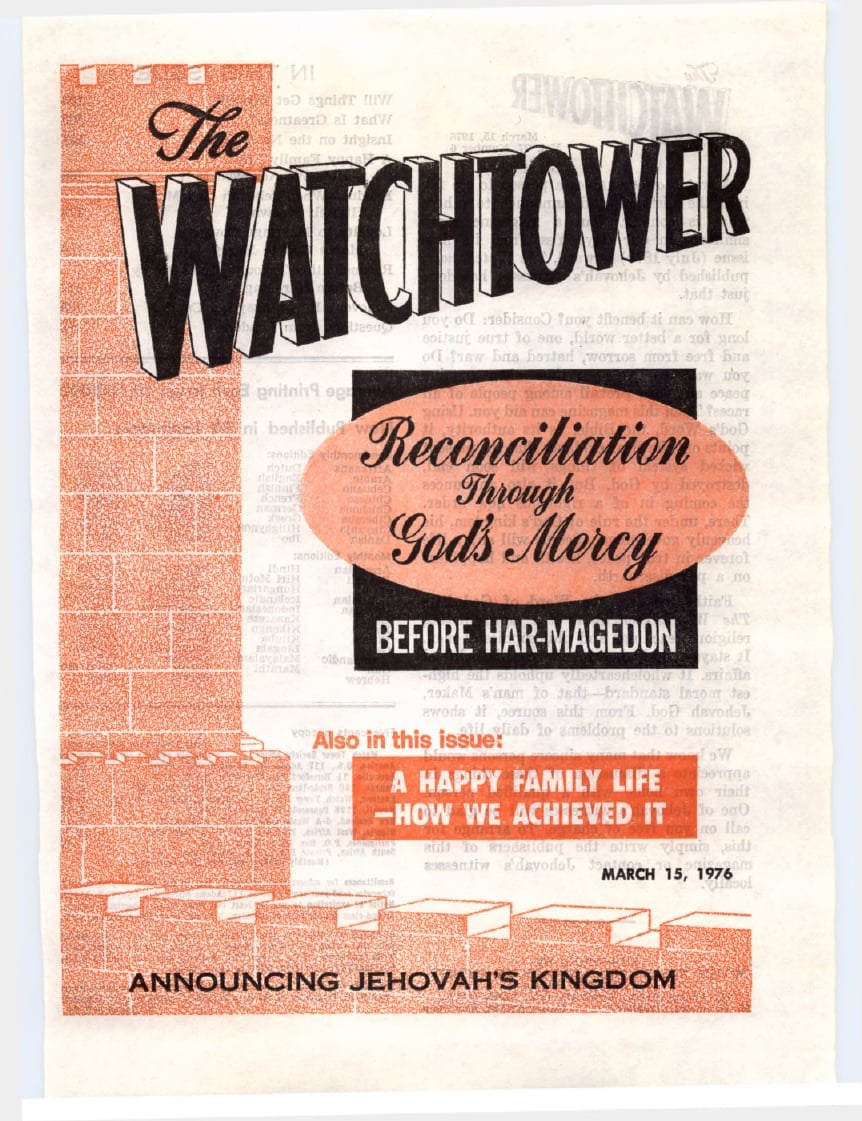
The Watchtower — March 15, 1976
Source: jw.org
Contents
Will Things Get Better?
What Is Greatness?
Insight on the News
A Happy Family Life—How We Achieved It
Exodus—When Jehovah God Made Himself Known
Loyalty to Marriage Covenant Moves God to Mercy
Reconciliation Through God’s Mercy Before Har–Magedon
Nineveh—Proud Assyrian Capital
Questions From Readers
Could the World’s End Be Near?
Will Things Get Better?
Will Things Get Better?
“MANY of my friends,” said a white-haired Indian shopkeeper in Old Delhi, “believe now that things will get better for us.” Then he added: “But I don’t know. I don’t see how things can get better. The greed and folly of man has brought us to where we are, and we have only man to make things better. Why should we count on the creature who made things bad to make things better? This will not happen.”
When it comes to the future, many people today share the gloomy outlook of this Indian shopkeeper.
Yet it may be asked, Does man’s inability to bring about better conditions really mean that there is no basis for hope in the future? One of the wisest men ever to walk the earth did not think so. That man was a prophet whose words have been distributed more widely and translated into more languages than those of any other man. That prophet was Jesus Christ.
His prophecies always came true. One of his outstanding prophecies pertained to the city of Jerusalem and its temple. Jesus Christ foretold that Jerusalem would fall and that the conquerors would “not leave a stone upon a stone” in the city. (Luke 19:44) Regarding the magnificent temple, he said: “The days will come in which not a stone upon a stone will be left here and not be thrown down.” (Luke 21:6) In fulfillment of those words, the year 70 C.E. saw the Roman armies under the command of Titus utterly destroy Jerusalem and the glorious temple. This is but one example, of many, vindicating Jesus Christ as a true prophet.
Surely, then, we also have good reason to take seriously what he said about the coming of better times for humankind. To his disciples he pointed out that relief from injustices, oppression, insecurity, famines, wars and other problems would come at a time of unprecedented fear and anxiety. He said: “On earth nations will stand helpless, not knowing which way to turn . . . men will faint with terror at the thought of all that is coming upon the world.” (Luke 21:25, 26, New English Bible) Is this not what we see today?
Jesus Christ, however, did not simply paint a picture of hopelessness and helplessness. He continued: “When all this begins to happen, stand upright and hold your heads high, because your liberation is near.” (Luke 21:28, NE) Then, by means of an illustration, Jesus Christ called attention to the nearness of that liberation and also the instrument through which it would be brought about. “Look at the fig-tree,” he said, “or any other tree. As soon as it buds, you can see for yourselves that summer is near. In the same way, when you see all this happening, you may know that the kingdom of God is near. I tell you this: the present generation will live to see it all.”—Luke 21:29-32, NE.
So deliverance from today’s distressing world situation will not come through any man or group of men but through God’s kingdom. Jesus Christ himself is the king of that government. His receiving royal authority was revealed in a prophetic vision as follows: “With the clouds of the heavens someone like a son of man happened to be coming; and to the Ancient of Days [the Most High] he gained access, and they brought him up close even before that One. And to him there were given rulership and dignity and kingdom, that the peoples, national groups and languages should all serve even him.” (Dan. 7:13, 14) Thereafter all the ruling powers of the earth that refuse to serve him are shown to have their authority ripped away from them. (Dan. 7:17, 18) Never again will ‘man dominate man to his injury.’—Eccl. 8:9.
As world ruler, Jesus Christ has the wisdom to bring about, not just better times, but the very best of conditions on the earth. Prior to his miraculous birth on earth, he had been in the heavens with his Father, the Most High God. (Luke 1:30-38) He was the “Word,” that is, his Father’s spokesman to all other intelligent creatures. In his prehuman existence, the “Word” shared with his Father in creation. The Bible tells us: “The Word, then, was with God at the beginning, and through him all things came to be; no single thing was created without him.”—John 1:2, 3, NE.
Accordingly, Jesus Christ knows what life is and how it can be perpetuated for all eternity. He also knows how earth’s resources can best be utilized, without causing needless pollution of land, water and air. Under his rule, therefore, this earth can be transformed into a delightful paradise.
While on earth as a man, Jesus Christ opened the eyes of the blind, unstopped the ears of the deaf, enabled the speechless ones to speak, restored soundness of limb to the crippled and even raised the dead. Having been resurrected, Jesus Christ will certainly do no less for mankind after he takes over the managing of earth’s affairs. He will prove true to his words: “I am the resurrection and the life. He that exercises faith in me, even though he dies, will come to life.”—John 11:25.
The rule of Jesus Christ will reflect the same concern and warmth that his invitation to become his disciples did. He said: “Come to me, all you who are toiling and loaded down, and I will refresh you. Take my yoke upon you and become my disciples, for I am mild-tempered and lowly in heart, and you will find refreshment for your souls.”—Matt. 11:28, 29.
How can we be certain that Jesus Christ, as a mighty heavenly king, will be just as humble and concerned about bringing relief and refreshment to humankind as he was while on earth? Might he not have changed? The Holy Scriptures give us this comforting assurance: “Jesus Christ is the same yesterday and today, and forever.”—Heb. 13:8.
Things will indeed get much, much better in the not-too-distant future when God’s kingdom by Christ replaces the rule of imperfect men. What grand relief that will bring from injustices, oppression, suffering, pollution, sickness and death!
Surely we have good reason to want Jesus Christ as our King. Are you acquainted with his requirements for those who would be his loyal subjects? The group of Christians known as Jehovah’s witnesses are eager and willing to help anyone to gain a better understanding of these requirements as contained in the Bible. Why not avail yourself of their help the next time they call on you?
[Blurb on page 164]
“On earth nations will stand helpless, not knowing which way to turn . . . men will faint with terror at the thought of all that is coming upon the world . . . When all this begins to happen, stand upright and hold your heads high, because your liberation is near.”—Luke 21:25, 26, 28, “New English Bible.”
What Is Greatness?
What Is Greatness?
WHAT makes a person great? For many it is prominence, being able to tell others what to do and being waited on by them. But is having tremendous authority what makes a person truly great?
God’s view of greatness is very different from that of many people. Jesus Christ, who perfectly reflected his Father’s mind on matters, made this clear. Directing his comments to his disciples, he said: “You know that the rulers of the nations lord it over them and the great men wield authority over them. This is not the way among you; but whoever wants to become great among you must be your minister [servant], and whoever wants to be first among you must be your slave.” (Matt. 20:25-27) Jesus Christ backed up these words by setting the example in serving. He added: “Just as the Son of man came, not to be ministered to, but to minister.” Yes, Jesus did not come seeking to be waited on, but he himself did the serving, even giving “his soul a ransom in exchange for many.”—Matt. 20:28.
The Son of God was outstanding in not being ‘position-minded.’ In his prehuman existence he occupied the foremost place among millions of spirit sons of God. Yet he willingly gave up that position to serve in the interests of sinful mankind. Calling attention to this, the apostle Paul encouraged fellow believers: “Keep this mental attitude in you that was also in Christ Jesus, who, although he was existing in God’s form, gave no consideration to a seizure, namely, that he should be equal to God. No, but he emptied himself and took a slave’s form and came to be in the likeness of men.”—Phil. 2:5-7.
As a man, not only was Jesus “a little lower than angels” but he did not even enjoy any special prominence among his fellow countrymen. (Heb. 2:7) Though they were born into the royal line of David, neither his foster father Joseph nor his mother Mary possessed riches or influence. When presenting an offering for her purification, Mary could not afford to sacrifice a sheep and therefore she had to take advantage of the law that permitted offering up instead “a pair of turtledoves or two young pigeons.” (Luke 2:24; Lev. 12:8) Regarding his own circumstances, Jesus once remarked: “Foxes have dens and birds of heaven have roosts, but the Son of man has nowhere to lay down his head.”—Matt. 8:20.
In the heavens, the Son of God had lacked nothing. That is why the apostle Paul could write that “though he was rich he became poor.” (2 Cor. 8:9) As a relatively poor man on earth, Jesus humbly served others. He brought spiritual and physical healing to many, opening the eyes of the blind, unstopping the ears of the deaf and restoring the crippled to soundness of limb. In everything that he did Jesus was motivated by love.
The Bible reports that when his privacy was interrupted by a great crowd of people “he was moved with pity for them, because they were as sheep without a shepherd.” (Mark 6:32-34) He manifested the same self-sacrificing attitude when healing people. He deeply wanted to bring relief to those who were suffering. There was the time when a leper entreated him: “If you just want to, you can make me clean.” “Moved with pity,” Jesus “stretched out his hand and touched him,” saying: “I want to. Be made clean.” (Mark 1:40, 41) Such healings drew on Jesus’ vitality. The Scriptures tell us that, in connection with one miraculous cure, Jesus ‘perceived that power went out of him.’ (Luke 8:46) Nevertheless, he was willing and eager to serve sinful humans in this way.
The example of Jesus Christ in humbly serving gave real force to his teaching about what constitutes “greatness.” When pointing out to his disciples that they should not conduct themselves like worldly kings and others who are called “Benefactors,” Jesus directed attention to his own example: “For which one is greater, the one reclining at the table or the one ministering? Is it not the one reclining at the table? But I am in your midst as the one ministering.”—Luke 22:25-27.
However, a person’s willingly serving others does not in itself make him great. The individual must be rightly motivated, doing everything as unto the Creator. One who appreciated this was the apostle Paul. In a letter to the Corinthian Christians, he said: “If I give all my belongings to feed others, and if I hand over my body, that I may boast, but do not have love, I am not profited at all.” (1 Cor. 13:3) So, then, true greatness comes from serving others because of deep love for them and the Creator, Jehovah God.
The so-called “greatness” of those who wield extensive authority and are waited on by others often leads to serious problems. The person having a position of prominence strives to maintain his control by keeping others down. His underlings, as a result, may build up resentment toward him. Among those aspiring for a comparable position of “greatness” a competitive spirit usually prevails. This gives rise to bitter disputes, envies and frustrations. On the other hand, the person who unselfishly gives of himself endears himself to others and experiences much happiness.
This is well illustrated in the case of the apostle Paul. He labored willingly and eagerly in behalf of others. To the elders of the congregation at Ephesus, he could say: “Bear in mind that for three years, night and day, I did not quit admonishing each one with tears. . . . I have coveted no man’s silver or gold or apparel. You yourselves know that these hands have attended to the needs of me and of those with me. I have exhibited to you in all things that by thus laboring you must assist those who are weak, and must bear in mind the words of the Lord Jesus, when he himself said, ‘There is more happiness in giving than there is in receiving.’”—Acts 20:31-35.
Paul’s serving others in the way that he did brought him much happiness. It also endeared him to the hearts of his fellow workers. When, for example, the elders of the Ephesus congregation heard that they might never again see Paul on earth, “quite a bit of weeping broke out among them all, and they fell upon Paul’s neck and tenderly kissed him.”—Acts 20:37.
Yes, true greatness comes from humble service, motivated by love for God and fellowmen. Is this the kind of greatness for which you are striving? Have you rejected the world’s view of greatness, a view based on being able to command rather than on being willing to serve God and fellow humans? It is the greatness that comes from serving that pays rich dividends. Such greatness brings much happiness to its possessor and proves to be a source of fine encouragement and uplift to others.
Insight on the News
Insight on the News
Darwin “Being Discarded”
● More than a century ago when Charles Darwin promoted his theory that man evolved from the lower animals, he suggested that a key mechanism was “natural selection.” This was the idea that the stronger survive and keep improving to the point where newer forms of life are produced. However, in recent years that idea has come under assault. It has become evident that just surviving does not result in anything new.
In “Harper’s” magazine of February, Tom Bethell, an editor for “The Washington Monthly,” states: “The conclusion is pretty staggering: Darwin’s theory, I believe, is on the verge of collapse.” He added: “Darwin, I suggest, is in the process of being discarded, but . . . it is being done as discreetly and gently as possible, with a minimum of publicity.”
The facts continue to support the truth on this matter as stated at Isaiah 45:12, where God declares: “I myself have made the earth and have created even man upon it.” No, man did not get here by evolution. He got here by creation.
World Government Needed
● Advances in transportation and communications have ‘shrunk’ the world into something like a single community. Thus today’s problems have become global in nature, shared by all. Yet, the nations keep pulling in different directions. An article in the Montreal “Gazette” noted that world leaders “have said that some form of world government will be necessary.” It commented: “Surely it is worth working for when one considers the probable alternatives—a breakdown in society or world dictatorship.” Even food shortages in various places, it acknowledged, are “caused by confused priorities and a lack of global management.” The report observed that “people must soon equate national or group allegiance with a much broader loyalty to all of mankind, a form of world or planetary citizenship.”
Is one government for all the world just a dream? By the efforts of humans, yes, as history shows. But one government over all the earth will be a reality because that is God’s purpose. Bible prophecy shows that soon God will rip control away from all the divisive political systems and bring them to an end. (Dan. 2:44) There will then be only one government over all mankind, his heavenly kingdom in the hands of Jesus Christ. (Matt. 6:10) Those who submit to God’s Kingdom rule will survive the end of this present unsatisfactory system of political rule. They will enter God’s new order as a united society of people “out of all nations and tribes and peoples and tongues.”—Rev. 7:9.
Who Is to Blame?
● The Roman Catholic publication “Commonweal” states in its January 2, 1976, issue: “Today, at the end of the Holy Year, a year after the closing of the bishops’ synod on evangelization, and ten years after the closing of the Second Vatican Council, the word of God is preached no more clearly and effectively than it was a year ago. The preachers, it seems, are talking to themselves. The listeners, supposedly hungry for the word, have turned them off.”
This Catholic magazine further states: “The evidence is in the polls and sociological surveys, and before our eyes in the empty confessionals and pews. More and more of the people of God, kicking the dust from their heels, have walked out of the church . . . while those ultimately responsible for preaching the word, the bishops, have again become preoccupied in a fruitless political squabble, an ecclesiastical power play in which they will recklessly squander what little moral authority they retain.”
God’s Word long ago foretold the moral bankruptcy we now see in Christendom’s religions. The Bible also notes: “For truly, if the trumpet sounds an indistinct call, who will get ready for battle? In the same way also, unless you through the tongue utter speech easily understood, how will it be known what is being spoken? You will, in fact, be speaking into the air.” (1 Cor. 14:8, 9) The clergy have not taught the clear truths of God. They have prevented their flocks from learning God’s will and purpose. As a result, they have not been blessed by God, and the consequences are plain for all to see.
A Happy Family Life—How We Achieved It
A Happy Family Life—How We Achieved It
As told by Joseph Allen
THERE are many persons who try to predict the future with accuracy but fail. For instance, if someone had told me when I was a boy growing up in Montreal, Canada, that someday I would be a father of seven children and that I would be enjoying the blessings and peace of mind that I do now, I wouldn’t have believed him.
However, let’s go back in time, for what happened in my early life affected the kind of father I became. I was born in 1923. My mother and father had arrived from England in 1912, and by the time of my birth they already had four children, three girls and one boy. Two years later another brother arrived, and that made six children in the family. So, as you can see, I grew up as a member of a big family, which contributed to my being able to handle my own large family in later years.
I learned how necessary it was for a father to exercise his headship if peace and harmony were to be enjoyed by all. Many times discipline was administered, not only by word of mouth, but also by use of the literal “rod of correction.” When Dad was away at work, Mother carried out the necessary duties to keep the family in line. We had deep respect for her right hand, with which she aimed the strap in the right direction, just before we managed to duck under the bed. That was our place of refuge, as Mother was too stout to pursue us.
As a large family, we learned to work together. We were all assigned different chores around the home. My first job was to crawl under all the beds—a place I was quite familiar with—and dust all the springs and angle irons. As I grew older, I graduated to more responsible jobs, such as regularly setting and clearing the meal table; then, washing and drying dishes, dusting the furniture, vacuuming carpets, washing and waxing floors and inside stairs. At the time, I thought it was most unfair to subject any child to these tasks. But in later years I realized that my early childhood training was a great asset in the training of our own children.
Looking back now, after having to support my own family, I can appreciate the hard times my parents had in providing for us all during the depression years. My father was a workingman—delivering bread from door to door—and so he always managed to put three wholesome meals on the table. He was also aware of our spiritual needs, making sure that we all went to church on Sunday.
The older ones would attend the church service, while we younger ones went to Sunday-school classes. One thing that always puzzled me was why Dad and Mother never attended with us. One day I got up enough courage to ask Dad why, and his reply was that he had had his fill of it and didn’t need that sort of thing anymore. This puzzled me for years, but now I understand perfectly.
LEAVING HOME: STARTING A FAMILY
Soon I approached manhood and was ready to step out into the big, exciting world. What would I do? My immediate future was already decided, for World War II was raging. I still recall very clearly the tear-filled faces of my family and the fears I felt as the troop train separated our family for the first time.
I was seventeen years old then, and the four years I spent in the Navy seemed to pass by quickly. In December 1945 I was discharged. Fortunately, I was still in good health, a little older, and a good deal wiser. To celebrate our family reunion, it was decided that we all attend church service on Christmas Day, parents included.
The past few years had changed my outlook toward religion—I wanted no part of it. I felt that I had been enlightened, like my father in previous years; I didn’t need it. My family could not understand this, since I had taken such an active part in the church as a young man, even to the point of assisting the clergyman at the altar, serving the bread and wine to the participants. However, to please my mother, I went. Really, I was very happy I did, because that evening at church I was introduced to the one who was to play a major role in my life—my future wife.
The past four years of military training had taught me to respond quickly to situations. I did in this case, and we were married five months later in May 1946. My wedding day proved to be one of the few times I had stepped into a church since reaching manhood.
We moved away from Montreal to a place in the country. Here, with the assistance of the Veteran’s Land Commission, we purchased half an acre of land and began to build our “dream home.” I worked as an electrician in a paper mill, but at other times was totally engrossed in building our home. My wife still liked to go to church, which she managed to do occasionally. She tried many times to encourage me to attend. As our home took shape, we discussed the number of rooms to build and the number of children we would like to have. It was decided on, not seven, but four; two boys and two girls. Well, things just didn’t work out that way. The third year of our marriage our first son was born; two years later a second. Now it was time for a daughter, but, much to our surprise, a third son was born.
It was now 1952, and the future in a small Quebec French town for an English Protestant family didn’t look too bright, nor at that time very “healthy.” This was made quite plain to me by my fellow workers. Practically everyone was Roman Catholic, and we were Anglican. So we decided that it would be best to sell out and move to Vancouver, where one of my married sisters, whom we had not seen for a number of years, was now living. In June 1952, with all our worldly possessions packed in our car, we said good-bye to Quebec and eastern Canada for good—we thought.
REMARKABLE CHANGE—HOW IT CAME ABOUT
After living in Vancouver for three years, and after our fourth son was born, one of Jehovah’s witnesses called at our door. It was the first time that this occurred in our lives. This eventually led my wife and me to become Jehovah’s witnesses. Let me tell you how this came about.
With four young boys growing up, my wife felt that the home training and disciplining that they were receiving was not sufficient. She felt that we needed to associate with and attend the Anglican Church. This I bitterly opposed. I didn’t want contact with any religion, and I didn’t feel I needed any outside help to raise my family. I emphasized the point that my next visit to a church would be at my funeral. However, I told her, if she wanted to go to church and take the children, that was up to her and I wouldn’t interfere.
She took me at my word and went. I stayed home to baby-sit for the younger ones. As time went on, she would come home each Sunday and very tactfully tell me how nice the minister was. She explained that they were going to have card parties in the church hall and put on a few suppers, and so forth, to raise funds for the church. She pleaded with me please to consider joining the men’s church club, as she would like to join the women’s club. Also, wouldn’t I reconsider and come to church to keep the family united in the Christian faith?
I continued to resist all such persuasion. I told her that I wouldn’t go to church until she could prove to me that there was something worth while to listen to, not just boring church services that everyone blindly followed. As for the church’s being a place to learn about God, I had given up on that years ago. We had never really used the Bible in church. It’s true the clergyman did read a few passages each Sunday, but he never explained what they meant. Consequently we never knew what was in the Bible.
Our family had a King James Version of the Bible in the home somewhere. We had tried to read it, but always became discouraged before completing a full page because we didn’t understand it. The Bible eventually ended up buried away in a safe place at home with a beautiful rose petal between its pages. Quite a funeral!
Persistence on the part of my wife paid off, however, and eventually I submitted and joined her in going to church. I reasoned that it was easier sitting in church enjoying the organ music than to “face the music” when she arrived home every Sunday. About six months went by, and it was smooth sailing. Then she really rocked my boat! She told me that she was not going back to church anymore. “You can go if you want to,” she said, “but I’m not going anymore.”
“Why? Why? Why?” I asked dumbfounded. Then she proceeded to tell me that she had been studying the Bible with Jehovah’s witnesses and was amazed at what she was learning as compared to what she had learned during all the years she had been an Anglican. She asked me to sit down with her and listen to what she had to show me from the Bible (which she had by this time resurrected, because it had become important to her again).
In one short hour, I learned that God’s name is Jehovah (Ps. 83:18); that this time period we are living in is spoken of in the Bible as the “last days” (2 Tim. 3:1-5); that Armageddon is the war of God Almighty against the wicked system, and is very near (Rev. 16:14-16); and how we, as a family unit, would be able to live on earth forever, happily united in peace and security, enjoying perfect conditions under Jehovah God’s kingdom with his Son Jesus Christ as King.—Ps. 37:9-11, 29; Rev. 11:15, 17; 21:3, 4.
Well, I never had heard of such wonderful things before in all my life. It was too good to believe, and, sad to say, I didn’t believe it. While not violently opposing my wife, I did ridicule her. In my ignorance, I would call her “Jehovah,” and remind her that I wasn’t having any part of that fanatical religion. If she wanted it, fine, but not I.
She continued to whet my appetite with things she was learning from God’s Word, but I clung desperately to the church, knowing all the time that my grip was weakening. My wife was wielding the “sword of the spirit,” and eventually I lost. But really, I’ve never been so happy over losing in all my life. I left the church and started studying the Bible. In the spring, when all of God’s creation is coming to life again, my wife and I too really came to life and began living for Jehovah and his Kingdom interests, undergoing water baptism in the North Vancouver Kingdom Hall on March 31, 1956.
FAMILY BLESSINGS RESULT
Since then we have enjoyed untold blessings, not only spiritual, but also material. We came to realize that this was not just another religion, but that Jehovah’s witnesses are being used by Jehovah God to accomplish the preaching of the “good news” of the Kingdom world wide, according to Matthew 24:14. We wanted to be part of this loving Christian family.
The Watchtower and Awake! magazines provided us needed help in raising our family successfully, assisting us to understand and apply the counsel of God’s Word in our family life. We came to understand, for example, the true meaning of obedience and discipline, and the fact that Jehovah disciplines those he loves. We also learned the importance of teaching our children, and of spending time with them.—Heb. 12:5-11; Deut. 6:4-9.
The result of all of this was a family that always enjoyed doing things together. The boys were a big help to me in building our home, even as little tots. When they were too young for school, I would often take them with me on my electrical jobs. We eventually were blessed with two daughters, and my wife took great delight in training them to sew and cook and do other chores around the home. Mind you, there were still times when the literal rod of correction was applied, and this we did where Jehovah put the most padding on the human body.—Prov. 23:13, 14.
ASSEMBLIES—A FAMILY HIGHLIGHT
Another aspect of Christian activity that we have loved so much is assemblies. We especially look forward to the district assemblies of Jehovah’s witnesses, which we always incorporate into our annual vacation. We have traveled to many big cities in the United States and Canada, and have enjoyed the variety of Jehovah’s creation, along with visits to the Watchtower Society’s factories and farms. All of this has been a practical way to broaden our children’s education.
One outstanding assembly that we attended was in New York in 1958. On our way there from Vancouver, we parked the car in Spokane, Washington, to do some shopping, telling the children to remain in the car. On our return, they told us that a man had come over to talk with them. They pointed him out to us in a nearby store. He waved and approached the car. He told us that he had noticed our bumper sticker advertising the New York assembly and identified himself as one of Jehovah’s witnesses. He invited us to his home for a steak dinner, followed by an evening of Christian fellowship and a pleasant night’s rest.
Farther on, in Lusk, Wyoming, our bumper sign brought us another blessing, very similar to that experienced in Spokane. My car engine developed a loud knock during the day. A Witness in that little town, noticing our bumper sign, suggested that we stay overnight at his place while he worked on the engine. It turned out that he was the county mechanic and had access to a large garage with all the necessary tools to make the repair. The next morning we were on our way again, grateful for the love and hospitality that Jehovah’s people show to one another. This was further evidenced among the 250,000 delegates at Yankee Stadium and the Polo Grounds in New York city.
SHARING IN KINGDOM EXPANSION
After we returned, a curious workmate asked why I would go to such expense and travel such a distance to attend one of my religious conventions. When I explained the importance of such meetings and the pleasant association with so many clean-living, God-fearing people, he naturally had many more questions to ask about the Bible. I answered him, using, along with the Bible, various publications provided by the Watch Tower Society. He was so impressed with our home library that he wanted all these publications too, and a Bible study was started with him. It wasn’t long until he became our spiritual brother. About this same time my mother-in-law began to show interest, which eventually led to her also becoming a witness of Jehovah.
In the twenty years that we have been Jehovah’s witnesses, we have seen a tremendous increase in Kingdom preachers. This has, in turn, led to the building of many new Kingdom Halls. We, as a family, have had a share in constructing at least four of these, plus two large mobile kitchens used at circuit assemblies around the Vancouver area. Since moving back to eastern Canada, our share in Kingdom interests has increased.
I need to work only part time on a secular job now, and am pleased to have had the privilege of working on our new Assembly Hall near Toronto. Also, last year I was invited to work at the Toronto Bethel for approximately four months, helping with a large extension to the factory and the addition of a new Kingdom Hall. On all these various building projects, it has been a rewarding experience to work alongside men and women who volunteer their skills and time, all for the love of their God and fellowman. This to me is a foretaste of the promised New Order living, so near at hand.
OUR PROTECTED FAMILY
As world conditions worsen and this system rapidly deteriorates, family life is adversely affected for many. But, thanks to Jehovah and his Christian organization, our family has been protected. By applying Bible principles and counsel, we have kept free from the many snares of the world. The result is that our whole family is truly happy, and is having a full share in serving God.
Our four eldest sons have married zealous Christian women, and are carrying out their duties as elders and ministerial servants in the Christian congregation. The eldest son, with the help of his wife, enjoys the full-time pioneer service here in Ontario. Our second son and his wife are now serving where the need for Kingdom preachers is greater in the Province of Quebec. And the two younger sons are happily married and living in the West. We still have our two daughters and youngest son with us, and, like their older brothers, they show great love and appreciation for God’s Word. Two of them have already publicly shown this by water baptism.
Although some of our family are miles away, the unity of Jehovah’s organization makes us feel always close. We are especially united by the Bible-based hope of living on earth forever in peace and security, enjoying perfect conditions under Jehovah God’s kingdom. Indeed, the words at Psalm 37:37 have taken on a special meaning for my family and myself: “Watch the blameless one and keep the upright one in sight, for the future of that man will be peaceful.”
Exodus—When Jehovah God Made Himself Known
Exodus—When Jehovah God Made Himself Known
WHAT a wealth of information the book of Exodus contains! It records the birth of one of the oldest nations on earth and relates how Israel was chosen, delivered from Egyptian bondage and brought into a covenant with Jehovah God. It contains the finest legislation ever given a people and tells of a great many amazing miracles taking place. Most important of all, it reveals how the true God Jehovah, the Creator, made himself known as never before. Moreover, it is filled with prophetic types and shadows of better things to come.
All very well, some of our readers may say, but how can we be certain that Exodus is truly historical and that it was Moses who wrote it? For one thing, there are many, many references in the rest of the Bible that treat the events of Exodus as historical and that attribute the record of these things to Moses.a Further testifying to the authenticity of Exodus is its candor, for Moses spares neither himself nor his people. And there is also the testimony of ancient Jewish tradition, which treats the Pentateuch, of which Exodus is a part, as authentic and as having been written by Moses.
Chronologically, Exodus, which covers about 145 years of Israel’s history, may be viewed in three parts: the sojourn of the Israelites in Egypt (1:1–12:36); their march from Rameses in Egypt to Mount Sinai in Arabia (12:37–18:27); and their stay in the wilderness at Mount Sinai (19:1–40:38). During each of these three periods Jehovah truly makes himself known—his name, his purposes, his qualities—both by words and by deeds. All of this Moses appears to have put down in writing by about 1512 B.C.E.
THE ISRAELITES IN EGYPT
The first two chapters Ex 1, 2 tell of the experiences of Jacob’s descendants in Egypt. There they increase so rapidly that the Pharaohs make them slaves, but still they keep increasing. So Pharaoh decrees death for all male babies. Escaping such a fate is an infant whose mother places it in a chest and sets it afloat on the Nile. The princess of Egypt discovers the babe, adopts it and names it Moses, meaning “saved out of water.” Moses is reared in Pharaoh’s house. At the age of forty he takes the side of his oppressed people by killing an Egyptian, and he is forced to flee to Midian. There he marries and lives as a shepherd for forty more years.
Then one day Moses notes a bush burning but not being consumed, and out of the bush he hears Jehovah’s angel calling to him. He is told that where he is standing is holy ground, and he is apprised of his commission to return to Egypt and deliver his people from oppression. When Moses asks who he should say sent him, God replies by his angel: “Say to the sons of Israel, ‘I SHALL PROVE TO BE has sent me to you.’”—Ex. 3:14.
Moses asks for credentials to show that Jehovah actually appeared to him. So Jehovah empowers him to perform three miracles on the spot. The first of these is that of causing his staff to become a serpent and then revert to a staff, and the second is that of causing his hand to become leprous and then to be healed. These two miracles, together with that of changing water into blood, Jehovah commands Moses to perform in front of the elders of his people. But Moses is extremely diffident, and so Jehovah commissions his brother Aaron to be his spokesman.
Chapters five and six tell of Moses and Aaron appearing before Pharaoh and asking permission for the Israelites to sacrifice to Jehovah in the wilderness. But Pharaoh contemptuously and defiantly asks: “Who is Jehovah, so that I should obey his voice to send Israel away?” Adding injury to insult, Pharaoh increases the burdens of the Israelite slaves. So Jehovah assures Moses that by means of His power He will bring Pharaoh around to let the Israelites go, and states further: “I used to appear to Abraham, Isaac and Jacob as God Almighty, but as respects my name Jehovah I did not make myself known to them.” True, they had heard the name Jehovah itself, but now Jehovah was going to make a name for himself in a way that he had never done before: “You will certainly know that I am Jehovah.”b—Ex. 5:2; 6:3, 7.
Continuing, the record tells of Moses performing several miracles before Pharaoh, some of which his magicians appear to imitate. To make Pharaoh know Jehovah, Moses is empowered to perform further miracles that serve as plagues upon Egypt—plagues of turning water into blood, of frogs, of gnats, of flies, of disease upon their livestock and a plague of boils on man and beast. After the sixth plague Pharaoh is told: “For this cause I [Jehovah] have kept you in existence, for the sake of showing you my power and in order to have my name declared in all the earth.” (Ex. 9:16) In line with that statement, Jehovah makes himself known further by sending a hailstorm accompanied with fire, by a devastating plague of locusts and by three days of a darkness so dense that it could be felt. Underscoring that Jehovah sent these plagues is Israel’s being untouched by them from the fourth plague onward. All of this and more is covered in chapters 7 through 10.
Then in anticipation of the tenth plague Jehovah commands a “passover” celebration. The Israelites must take a lamb or a kid for each household on Nisan 10, kill it on Nisan 14, sprinkle its blood on the doorposts and lintels of their houses, roast it and eat it after sundown with bitter herbs and unleavened bread, while all the families remain within their houses. About midnight Jehovah’s angel goes through the land slaying all the firstborn of Egypt, from Pharaoh’s firstborn to that of the lowliest beast of burden.—Ex. 11:1–12:36.
FROM RAMESES TO MOUNT SINAI
Jehovah’s making himself known in this way makes Pharaoh let the Israelites go. First they rendezvous at Rameses. But Pharaoh soon regrets his action and with his military might goes in hot pursuit to bring the Israelites back. To provide escape for the Israelites, who appear to be hemmed in, Jehovah makes himself known to them by opening a wide corridor in the Red Sea. Pharaoh and his army pursue the Israelites into the opened corridor. But after the Israelites are safely on the other side, Jehovah causes the sea to close in on Pharaoh and his army, drowning them all. What great rejoicing for the Israelites, but, for the Egyptians, what a way to get to know Jehovah!—Ex. 12:37–15:21.
From there on to Mount Sinai in Arabia the Israelites repeatedly get to know Jehovah better. He changes bitter water to sweet, provides meat in the form of a flock of quails and sends from the sky a tasty cereal-like substance that they call “manna.”—Ex. 15:22–18:27.
AT THE FOOT OF MOUNT SINAI
In the third month after leaving Egypt the Israelites encamp at the foot of Mount Sinai. The remaining chapters of Exodus deal with events taking place during the next nine months. There, both by spoken word and by supernatural phenomena, they learn to know still more about their God Jehovah, particularly about his majesty, his awesomeness, his wisdom, justice, love and power.
There they enter into a covenant with Jehovah and he gives to them his laws, chief of which are the “Ten Words,” or the Decalogue. These have proved to be the basis for the laws of many civilized nations in modern times. The Israelites were to have no rival gods before Jehovah; they were not to worship any image or likeness; they were not to take Jehovah’s name in vain; they were to keep the seventh day of the week, the sabbath, sacred; they were to honor their parents; and they were commanded not to murder, commit adultery, steal, nor bear false witness, and they were not to covet anything belonging to their fellowman.—Ex. 19:1–24:18.
For forty days Moses is up in the mountain receiving instructions as to Jehovah’s way of worship and regarding the construction of a portable temple or tabernacle. (Ex. 25:1–31:18) The Israelites, wearying of his failure to return, make and worship a golden calf. Upon coming down from the mountain and seeing this, Moses becomes so incensed that he smashes the two tablets containing the Ten Words. After due punishment has been meted out upon the idolaters, Moses again ascends into the mountain and receives another set of two tablets.
At this time Moses is given a view of God’s glory and he hears a voice declaring: “Jehovah, Jehovah, a God merciful and gracious, slow to anger and abundant in loving-kindness and truth, . . . pardoning error and transgression and sin, but by no means will he give exemption from punishment.” With this pronouncement Jehovah was again helping Moses and his people to know their God better.—Ex. 34:6, 7.
Upon Moses’ returning to the Israelites again, the work of building the tabernacle or tent of worship gets under way. By the end of the first year of their exodus from Egypt the Israelites have completed this tent and all the furnishings prescribed for it. After it is set up and fully equipped, Jehovah God again magnifies his name, by filling and covering the tabernacle with his glory.
Truly, the book of Exodus reports on the time when the Israelites, as well as their enemies, got to know Jehovah better than they had ever known him before, even as he promised. By our learning about these things, taking them to heart and acting upon them, we too can get to know better the true God Jehovah, and that to our everlasting benefit.
[Footnotes]
For details see Aid to Bible Understanding, pages 547, 548.
This expression occurs nine times in the book of Exodus alone.
Loyalty to Marriage Covenant Moves God to Mercy
Loyalty to Marriage Covenant Moves God to Mercy
“And I will engage you to me in righteousness and in justice and in loving-kindness [loyal love] and in mercies. And I will engage you to me in faithfulness; and you will certainly know Jehovah.”—Hos. 2:19, 20, marginal reading.
1. In our twentieth century, what questions arise as to a husband’s action toward a wife guilty of acts of adultery?
AN UNFAITHFUL wife, guilty of acts of adultery, has little reason to expect mercy from her legal husband. She has no solid reason to feel secure by depending upon her extramarital lovers to provide for her all the time. After a lengthy period of sexual satisfaction, even passionate lovers can tire of such a whorish adulteress and seek other flesh. In such an event, where can she go? Loyalty to her marriage contract ought to lead her back to her legal husband. But will he show mercy and take his adulterous wife back? How often is it the case that such a thing occurs in this merciless world, in our twentieth century?
2. Whose thinking and acting are superior to those of us humans, and so what did He do for His covenant people in 537 B.C.E.?
2 However, there is one who says to humans: “The thoughts of you people are not my thoughts, nor are my ways your ways . . . For as the heavens are higher than the earth, so my ways are higher than your ways, and my thoughts than your thoughts.” Who is that one of such superior thinking and acting? It is the One who is heaven-high above us humans. This One, the speaker of the foregoing words, identifies himself as Jehovah, and he does so through his ancient prophet Isaiah the son of Amoz. (Isa. 55:8, 9; 1:1) Jehovah spoke those words when foretelling the restoration of his exiled covenant people from the pagan land of Babylon back to their God-given land in the Middle East. Contrary to all human thought or reasoning, this God of mercy brought about such a restoration in the year 537 B.C.E.
3. This restoration occurred in connection with the handling of what kind of problem, and how was Mount Sinai in Arabia tied in with this?
3 This restoration of an exiled people to their distant homeland after it had lain uninhabited for seventy years occurred in connection with the handling of a marriage problem that Jehovah had on his hands. Almost a thousand years earlier he had engaged himself in marriage to that exiled people, the ancient nation of Israel. The location of the marriage was the neighborhood of Mount Sinai at the lower western end of the Arabian Peninsula. The man that officiated between the marriage parties was the prophet Moses, who acted as mediator between God and men. As the fundamental set of rules to govern the marriage relationship, God proclaimed the Ten Commandments, the first commandment of which says: “I am Jehovah your God, who have brought you out of the land of Egypt, out of the house of slaves. You must not have any other gods against my face.”—Ex. 20:1-3.
4. To whom did those liberated twelve tribes of Israel really belong, and into what relationship did they choose to enter, and how?
4 By liberating the twelve tribes of Israel from unjust oppression and detention in ancient Egypt, Jehovah had really bought or redeemed this national “wife” for himself. (Isa. 63:7-9) Rightly she belonged to him. So he, as Husbandly Owner, chose to bring this wifelike nation into a marriage contract with himself. Such contract was the solemn contract based on God’s code of laws and it is generally spoken of as the Mosaic Law covenant. In order to get blessings and security due to having God as their Heavenly Owner, the Israelites entered the marriage relationship. They promised loyalty to their marriage contract, the Mosaic Law covenant. They became the only covenant people of God on earth. So Jehovah said: “I myself had husbandly ownership of them.”—Jer. 31:31, 32.
5. In an immoral world, to what did the nation of Israel find it hard to be true, and whose course was Hosea’s wife Gomer used to illustrate?
5 In the midst of an immoral world that had attached itself to Baal and many other false gods, the nation of Israel found it very hard to hold true to its marriage covenant, its contract with Jehovah as God and Husbandly Owner. So the nation in general gave way to spiritual adultery toward Jehovah. (Jas. 4:4) In 997 B.C.E. a split took place within the twelve-tribe kingdom of Israel. The adulterous course of the section called the ten-tribe kingdom of Israel was illustrated by the wife of the prophet Hosea, named Gomer.
6, 7. (a) How did Jehovah come to have a legal case against the ten-tribe kingdom of Israel? (b) After whom did that Kingdom of Israel unsuccessfully chase, and to whom would she want to return?
6 Gomer turned out to be a “wife of fornication.” She came to have “children of fornication.” (Hos. 1:1-3) This illustrated how the ten-tribe kingdom of Israel entered into political alliances with the idol-worshiping nations. The wifelike nation of Israel began depending upon such pagan nations instead of on its Husbandly Owner, Jehovah. The economic well-being that she was enjoying was now attributed to those worldly nations instead of to Jehovah. She took up worshiping the gods of those nations and flagrantly violated her marriage covenant with her Redeemer and Husbandly Owner, Jehovah. For this reason He had a legal case against this spiritually adulterous kingdom of Israel. According to the terms of the marriage covenant, he had the legal right and obligation to take action against apostate Israel. Finally he did so. He said to her:
7 “Therefore here I am hedging your way about with thorns; and I will heap up a stone wall against her, so that her own roadways she will not find. And she will actually chase after her passionate lovers, but she will not overtake them; and she will certainly look for them, but she will not find them. And she will have to say, ‘I want to go and return to my husband, the first one, for I had it better at that time than now.’ But she herself did not recognize that it was I who had given to her the grain and the sweet wine and the oil, and that I had made silver itself abound for her, and gold, which they made use of for Baal [or, which they made into a Baal image].”—Hos. 2:6-8, marginal reading.
8. Thus, whom did Jehovah purpose to discipline, but without reversing what decision of his?
8 According to those words, Jehovah purposed to discipline the people of the ten-tribe kingdom of Israel. Not that this would save the kingly rule of the nation, for Jehovah would not reverse what he said earlier in Hosea’s prophecy: “I must cause the royal rule of the house of Israel to cease. And it must occur in that day that I must break the bow of Israel in the low plain of Jezreel.”—Hos. 1:4, 5.
9. (a) Who could benefit from the disciplinary action against the kingdom of Israel? (b) At what event did the marriage covenant between Israel and Jehovah terminate?
9 Still, there were individual Israelites who could benefit from the disciplinary treatment given to the apostate nation. Take, for instance, those seven thousand Israelites that had not bent the knee to Baal. (1 Ki. 19:18; Rom. 11:1-5) Let us not overlook this fact: When Jehovah caused the kingdom of Israel to cease and let the surviving Israelites be deported to Assyria in 740 B.C.E., he did not cancel his marriage covenant with the whole nation of Israel. When, in 607 B.C.E., Jehovah let Jerusalem be destroyed and the surviving Jews be carried into exile in Babylonia, he did not abolish the Mosaic Law covenant by which twelve-tribe Israel had entered into marriage relationship with him as Heavenly Husband. The legal marriage relationship between Jehovah and all Israel was not blotted out until Jewish leaders had Jesus Christ put to death in 33 C.E.—Col. 2:14.
10. How did the “passionate lovers” of the kingdom of Israel fall her, but who could benefit from Jehovah’s disciplinary action?
10 Although the ten-tribe kingdom of Israel sought help from worldly nations that had been her passionate lovers, Jehovah’s time for holding an accounting with Israel came mercilessly upon her. She could find none of her eagerly sought “lovers” capable of helping her. As if by an impenetrable thornbush thicket, she was hedged off from procuring efficient help. The one-time lovers proved to be unable to get the needed aid to Israel, even though they wanted to do so. After three years of siege by the Assyrians, Israel’s capital city Samaria fell in 740 B.C.E. The surviving Israelites were deported to the land of their captors. That kingdom of ten Israelite tribes was never restored in its God-given land. Who, then, could benefit from Jehovah’s disciplinary action? Only individuals from among the deported exiles in Assyria. They would reflect on matters. They would recall how good things had been when their forefathers served Jehovah as Heavenly Husband and God. Realizing now what was the better state of affairs, they would turn away from Baal worship and seek renewed covenant relationship with Jehovah.
11, 12. When was the opportunity offered to the Israelite exiles in Assyria to return to Jehovah’s worship at Jerusalem, and how did this come about?
11 When was the opportunity offered for those Israelite exiles in Assyria to return unitedly to Jehovah’s worship at his appointed place? First in 537 B.C.E., under a new world power. How so? Well, about the year 632 B.C.E., Assyria’s capital Nineveh fell to the Babylonians, and the Babylonian World Power gained the topmost position. So Assyria’s provinces with their Israelite exiles became provinces of the Babylonian Empire. About twenty-five years later Jehovah’s penal judgment was executed upon the now renegade kingdom of Judah. Thus, in 607 B.C.E., he let Jerusalem and her temple of worship be destroyed. Thousands of surviving Jews were deported to Babylonia, to join the Israelite exiles in the erstwhile Assyrian provinces.
12 In the seventieth year afterward, Jehovah saw that sufficient discipline had been administered to his wayward wifelike organization on earth. In his mercy Jehovah had raised up the foretold Cyrus the Persian to overthrow Babylon in 539 B.C.E. Shortly thereafter, in 537 B.C.E., Jehovah moved this Cyrus the Great to declare a release for repentant Israelites to return to their beloved homeland.
13. Why, in the light of Deuteronomy 24:1-4, was this an exceptional mercy on God’s part toward his wifelike covenant people?
13 Was that not an exceptional act of mercy on the part of the Heavenly Husband toward his covenant people, the twelve tribes of Israel? Yes; for according to the Mosaic Law covenant this was not to be expected. In the Law, we read: “In case a man takes a woman and does make her his possession as a wife, it must also occur that if she should find no favor in his eyes because he has found something indecent on her part, he must also write out a certificate of divorce for her and put it in her hand and dismiss her from his house. And she must go out of his house and go and become another man’s. If the latter man has come to hate her and has written out a certificate of divorce for her and put it in her hand and dismissed her from his house, or in case the latter man who took her as his wife should die, the first owner of her who dismissed her will not be allowed to take her back again to become his wife after she has been defiled; for that is something detestable before Jehovah, and you must not lead the land that Jehovah your God is giving you as an inheritance into sin.”—Deut. 24:1-4.
14. In Jeremiah 3:1, how did Jehovah say that he had grounds for a permanent divorce from Israel?
14 In the prophet Jeremiah’s day, Jehovah emphasized that law to the covenant-breaking Jews in the kingdom of Judah. Stressing the fact that he had grounds for a permanent divorce from Israel, Jehovah inspired Jeremiah to say: “There is a saying: ‘If a man should send away his wife and she should actually go away from him and become another man’s, should he return to her anymore?’ Has that land [of Judah] not positively been polluted? ‘And you yourself have committed prostitution with many companions; and should there be a returning to me?’ is the utterance of Jehovah.”—Jer. 3:1.
15. When and how did the break in marriage relationship come, and how was Jehovah’s mercy expressed toward individual Jews?
15 In the face of that, only Jehovah’s all-excelling mercy permitted his marriage covenant with all Israel to continue on for centuries after Jerusalem was destroyed in 607 B.C.E. But the breaking point came in 33 C.E., when the nation rejected the Messiah Jesus and had him slain outside Jerusalem’s walls. Then the nation was divorced from marriage relationship with Jehovah God. Does Jewish history since then prove that? Yes. Mercifully, though, Jehovah let individual Jews who believed in the Messiah Jesus renew their relationship with him in a new covenant, the covenant mediated by the Messiah Jesus.
16. Why does the remnant of spiritual Israelites escape destruction with Christendom, and who else avail themselves of Jehovah’s mercy?
16 Today Christendom claims to be in that new covenant. Yet, despite her claim, despite the 1975 Holy Year of the Roman Catholic Church, despite other religious revivals, Christendom is doomed to destruction during the impending “great tribulation” upon this ungodly world. Yet, in his loving mercy, Jehovah has called forth a repentant remnant of spiritual Israelites out from Babylonish Christendom. In this way they escape destruction with her. (Rev. 18:4) But not just a remnant of spiritual Israelites has come out of her. A “great crowd” of other sheeplike persons has taken advantage of Jehovah’s expanded mercy since the year 1935 C.E. They have gotten out of all parts of Babylon the Great and have joined the remnant in giving exclusive devotion to Jehovah.—Rev. 7:9-17; John 10:16.
PENALTIES FOR SPIRITUAL ADULTERY
17, 18. (a) Why is Christendom obliged to suffer God’s curses? (b) In a warning of this, what did Jehovah say in Hosea 2:9-13?
17 Because of claiming to be in covenant relationship with the God of the Bible, Christendom’s religious organizations must suffer the penalties for prostituting themselves by friendship with politicians and militarists. Let them remember that ancient Israel was bound to suffer God’s curses as penalties for violating the Mosaic Law covenant between itself and Jehovah as Heavenly Husband of his wifelike organization. As a warning of this, Jehovah said further by Hosea:
18 “‘Therefore I shall turn back and certainly take away my grain in its time and my sweet wine in its season, and I will snatch away my wool and my linen [or, flax] for covering her nakedness. And now I shall uncover her private parts to the eyes of her passionate lovers, and there will be no man to snatch her out of my hand. And I shall certainly cause all her exultation, her festival, her new moon and her sabbath and her every festal season to cease. And I will lay desolate her vine and her fig tree, of which she has said: “They are a gift to me, which my passionate lovers have given to me”; and I will set them as a forest, and the wild beast of the field will certainly devour them. And I will hold an accounting against her for all the days of the Baal images to which she kept making sacrificial smoke, when she kept decking herself with her ring and her ornament and kept going after her passionate lovers, and I was the one that she forgot,’ is the utterance of Jehovah.”—Hos. 2:9-13.
19. According to the Law covenant, what were Jehovah’s obligations toward an adulterous nation?
19 Let us note that Israel forgot Jehovah. What treatment did she deserve for this? According to his plain warnings in his marriage covenant with Israel, he was obliged to withdraw his material blessings because of infidelity to Him as Heavenly Husband. He was not obliged to provide for an adulteress, a nation that broke its covenant and turned to worshiping Baal images and having adulterous relations with worldly lovers. Jehovah could properly lay bare to public gaze the nation’s moral unreliableness and looseness, so that even its worldly allies would turn against it in disdain.
…