The Watchtower, December 15, 1973
Download: PDF — The Watchtower, December 15, 1973
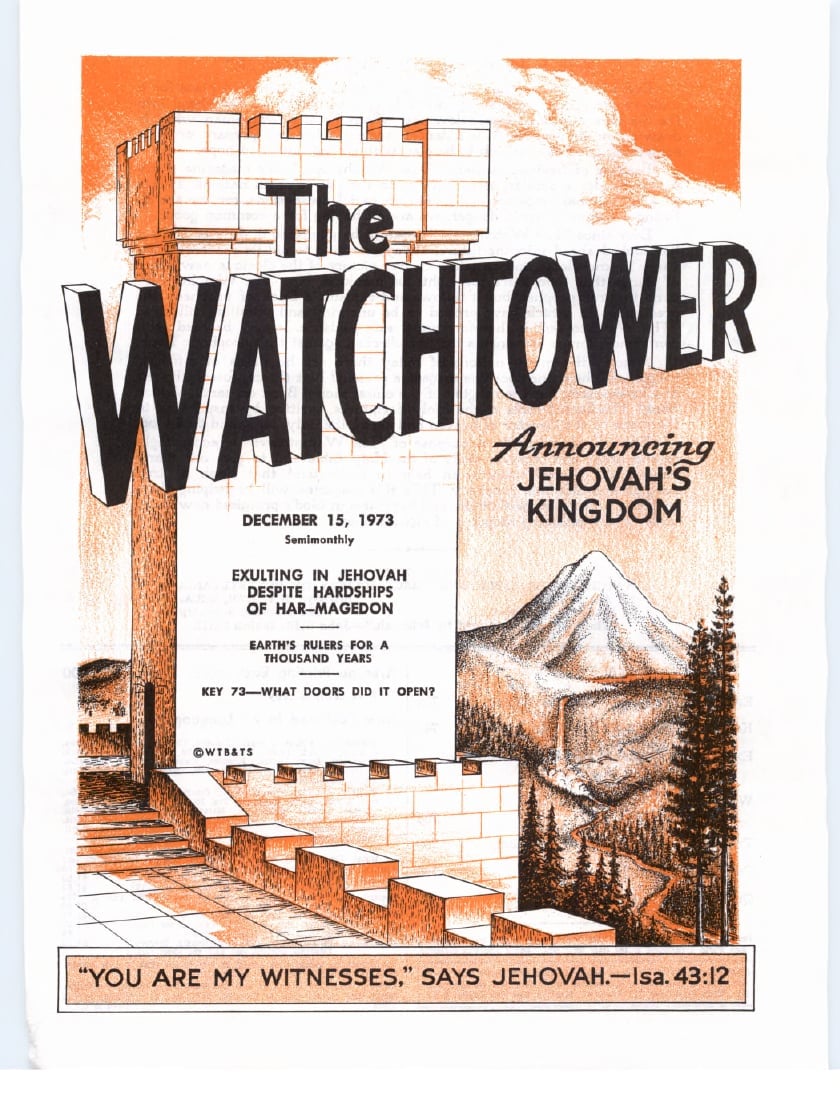
The Watchtower — December 15, 1973
Source: jw.org
Contents
Earth’s Rulers for a Thousand Years
Key 73—What Doors Did It Open?
Exulting in Jehovah Despite Hardships of Har–Magedon
Why Exult in Spite of Personal Hardships?
Trusting Jehovah with All My Heart
Can the Bible Help You?
Questions From Readers
Over 1,750,000 Witnesses World Wide Last Year!
Earth’s Rulers for a Thousand Years
Earth’s Rulers for a Thousand Years
THE earth has seen many rulers come and go. Both rulers and ruled have tried every conceivable form of human government, but none have brought real relief and happiness to the people. This has been going on now for nearly six thousand years.
But, actually, for this long period of time there has been one ruler over the earth who has operated all this world’s system of things. How? By exerting his influence on the imperfect men making up those systems. We can see whether this ruler has been good or bad by following the Bible’s cause-and-effect principle: “When the righteous are in power the people rejoice, but they groan when the wicked hold office.”—Prov. 29:2, The New English Bible.
Yes, for six millenniums the people have groaned because they have been invisibly ruled by the one Scripturally called “the god of this system of things,” and “the ruler of the world,” who is the enemy of God. (2 Cor. 4:4; John 12:31; 14:30) The Bible identifies him as Satan the Devil. (Rev. 12:9) The rulership over earth’s governments was shown to be his when he offered Jesus Christ all the kingdoms of the world for the price of an act of worship to him.—Matt. 4:8-10.
Now, people who want peace, life and freedom can look to something better than the present situation. They can take heart in the truth of another Bible proverb: “When the wicked become many, transgression abounds; but those who are righteous will look on their very downfall.” Today, wickedness is alarmingly widespread. But its end is near.—Prov. 29:16.
Six thousand years of human history are nearing their close, and to humans, that seems very long. But to the Universal Ruler, and in universal time, six thousand years is merely as a few days, or hours. Yet it has allowed men ample opportunity to see the hopelessness of man’s own efforts and the need for God’s kingdom, which he has prepared and which is ready to replace all other rulership of the earth.—2 Pet. 3:8, 9.
In a thousand years God’s Messianic kingdom will undo all the bad effects of Satan’s six-thousand-year rulership of earth. Christ Jesus is the King, but he has with him 144,000 associate kings. What kind of rulers are they? How can we be sure they will not let corruption enter into government? (For the least deviation from right principles can eventually spread to corrupt an entire government and its people. “A little leaven ferments the whole lump.” [Gal. 5:9]) How do these rulers qualify for such important offices?
Jesus Christ, of course, is greatly concerned with the quality of the kings he will have with him. These kings receive repeated mention in the vision he gave to his apostle John. John reports:
“I saw thrones, and there were those who sat down on them, and power of judging was given them. Yes, I saw the souls of those executed with the ax for the witness they bore to Jesus and for speaking about God, and those who had worshiped neither the wild beast nor its image and who had not received the mark upon their forehead and upon their hand. And they came to life and ruled as kings with the Christ for a thousand years. (The rest of the dead did not come to life until the thousand years were ended.) This is the first resurrection. Happy and holy is anyone having part in the first resurrection; over these the second death has no authority, but they will be priests of God and of the Christ, and will rule as kings with him for the thousand years.”—Rev. 20:4-6.
The thrones John saw were up in heaven, not on earth, for Christ’s throne is in heaven. (Rev. 3:21) And they were not indefinite in number. The number was 144,000, to correspond with the 144,000 spiritual Israelites who were sealed with the “seal of the living God” and who “keep following the Lamb [Jesus Christ] no matter where he goes.” (Rev. 7:1-8; 14:1-5) John here saw the beginning of the glorious judicial day of one thousand years’ duration. This day was spoken of to the Court of Areopagus, Athens, more than nineteen centuries ago, in these words:
“[God] has fixed the day on which he will have the world judged, and justly judged, by a man of his choosing; of this he has given assurance to all by raising him from the dead.”—Acts 17:31, NE (1970).
“EXECUTED WITH THE AX”
How can we be sure that these 144,000 rulers will be as faithful and loyal to righteousness as is their Leader the Messianic King Jesus Christ? The vision tells us that before their resurrection to be kings, they were “executed with the ax.” Why? “For the witness they bore to Jesus and for speaking about God.” (Rev. 20:4) They, like Jesus, gained the victory over the world by refusing to break their loyalty to God. They continued to bear witness to God’s kingdom, to Jesus as its King and to God as its Creator, and to its coming rule of earth. Only their deaths could stop their loyal witnessing.
The scripture does not mean that every one of the 144,000 prospective kings would be executed with a literal ax, or beheaded. The apostle James was killed by the sword at the order of Herod Agrippa I. (Acts 12:1, 2) Tradition has it that the apostle Paul was beheaded at Rome, Italy. (2 Tim. 4:6-8) Others were killed by different means of execution, while some died in a “normal” way.
All, however, had to be faithful until death. (Rev. 2:10) They had to die in order to receive a change of nature from human to “divine” (Godlike, spirit) nature by a resurrection, just as Christ did. (2 Pet. 1:4) They had to die “a death like his” in order to “attain to the earlier resurrection from the dead.” (Phil. 3:10, 11) So they do not die for their sins. Their death is therefore counted as “sacrificial” with Christ. Paul writes: “If we have become united with him in the likeness of his death, we shall certainly also be united with him in the likeness of his resurrection.”—Rom. 6:5.
How, then, can they be said to be “executed with the ax”? Well, in the Roman Empire the power of execution was symbolized by an ax wrapped within a bundle of rods, called the fasces. Benito Mussolini popularized the symbol during his “Fascist” regime in Italy.
So the political state, in effect, executes the 144,000 Kingdom heirs by judging them as unworthy to live under its authority. It sentences them to death, as it were. This is because the world hates them. (John 17:14; Matt. 24:9) They are “undesirable” in the eyes of the religious and political leaders of the world, even as were the apostles.—1 Cor. 4:13.
NO WORSHIP OF THE “WILD BEAST”
We can also be assured of the continued faithfulness of these 144,000 as kings by considering another reason for which they were “executed with the ax.” It was because they “had worshiped neither the wild beast nor its image” and “had not received the mark upon their forehead and upon their hand.”—Rev. 20:4.
Thus it was not due to any fanatical religious or revolutionary activities nor any meddling in politics that they were “executed with the ax.” It was because they were neutral as to the political situation in all its varied expressions and activities throughout the earth. They were for God’s kingdom as the only hope for mankind. Neither have the remaining ones of these Kingdom heirs in this twentieth century worshiped the United Nations organization for world peace and security.
Not ‘worshiping’ the political state or its “image,” the United Nations, would mean not transferring to these man-made agencies hope in and allegiance to God’s kingdom. Instead, these spiritual brothers of Christ continue to proclaim the Kingdom. They do not have the “mark upon their forehead and upon their hand.” That is, they do not have the identification as slaves of the state and do not lend an active hand in carrying on its worldly activities, often beastly. They do not run for political offices, or vote for political candidates. They refuse to share in its sanguinary warfare.
But these Christian witnesses to God’s sovereignty never interfere with the political state in these matters. They ‘pay back Caesar’s things to Caesar’ by complying with registration and tax laws and by obeying all the laws of the land that are not contrary to God’s laws as stated in the Bible. It is only when “Caesar” demands what belongs to God, namely, worship, devotion or anything that detracts from their acknowledgment of Jehovah’s sovereignty, that they must refuse, choosing to “obey God as ruler rather than men.” This brings about their symbolic, and sometimes their literal, ‘execution with the ax.’—Matt. 22:21; Acts 5:29.
This ‘execution with the ax’ is not one that they undergo because of their own will. They are not seeking persecution or martyrdom. Nevertheless, they know in advance that they are going to incur the world’s hatred by their bearing witness to Jesus as Christ and King and speaking about God as the rightful ruler of the universe (including our earth). They know they must follow Christ’s footsteps to a death of integrity to God, as was his.—1 Pet. 2:21.
RIGHTEOUS GOVERNMENT ASSURED
Can we not be absolutely certain of a just, righteous, equitable and merciful rule by such kings under Christ? Of them, the Bible says, “and no falsehood was found in their mouths; they are without blemish.” (Rev. 14:5) God is sure of them, and his judgment and discernment are perfect and infallible. He says that they are “holy,” which means they are thoroughly clean, righteous. (Rev. 20:6) The apostle Paul, after describing God’s bringing to completion his spiritual Israel, which composes the full body of 144,000 Kingdom heirs, exclaims: “O the depth of God’s riches and wisdom and knowledge! How unsearchable his judgments are and past tracing out his ways are!”—Rom. 11:33.
Can we have at least a glimpse of the thousand-year reign? Yes, the Bible gives us a preview. In articles to follow we hope to present some of these good things as a foretaste.
In the meantime, by studying the Bible and by association with some of these Kingdom heirs remaining on earth today, along with their companions, you can even enjoy a “token” taste of what that righteous rule will do toward establishing true peace, unity and love among all mankind. Jehovah’s witnesses love this association, and we are confident that you will also. You are invited to attend meetings at their local Kingdom Hall to prove this matter for yourself.
Key 73—What Doors Did It Open?
Key 73—What Doors Did It Open?
“EVANGELISM IS ON THE MOVE! It has found a new integrity, a new enthusiasm, and a bold new thrust.”
“The fulfillment of Key 73 may well mean Open Doorway 74 for evangelical Christianity in America.”
What is this “Key 73” about which such stirring hopes were voiced? Were those hopes realized?
A TREMENDOUS GOAL
Key 73 was conceived in 1967 by a group of religious leaders from more than a dozen denominations. Because they met near Francis Scott Key Bridge (linking Virginia and Washington, D.C.), and because they believed it would take another five years to launch the project successfully, they christened it Key 73.
Forecast as “the biggest cooperative evangelism project in the history of the Christian Church,” Key 73 was designed to unite adherents of many religions in an unprecedented witnessing campaign throughout the United States and Canada. The campaign’s slogan was “Calling Our Continent to Christ” and its aim was to revive apathetic church members and bring in many new converts.
The Denver Post (December 30, 1972), commenting on the project, said: “Presumably, no suburban pre-fab, arctic igloo, city high-rise or . . . adobe hut will be untouched by the most ambitious campaign for conversion ever to fire the energies of the American church.”
Massive publicity was planned, by television broadcasts, widespread newspaper coverage, by “Gospel-rock concerts” for young people. And all of this was to prepare the field for the witnessing activity.
“Every Christian should be carrying the message of Christ to a nonbeliever,” said Key 73’s executive director, Theodore A. Raedeke. Churchman Arthur F. Glasser, writing in the religious weekly Christianity Today (January 19, 1973), urged: “Reach every home with a winsome witness to Jesus Christ! . . . In short, the call is to ‘follow him.’ And what will be the result? He will make us fishers of men. (Matt. 4:19). And those who do not reach out after others this year are not faithful followers of Jesus Christ. . . . Let’s end the snide remarks about those who go from house to house and persuade men to embrace Christ.”
Along with “Coffee Pot Evangelism” and witnessing at shopping centers, the good news was to be carried right to the homes of the people, particularly to give out copies of portions of the Bible (Luke-Acts). But that was not all. The Key 73 Congregation Resource Book says:
“The development committee was unanimous in its recommendation that ‘bare’ Scripture distribution programs are of little value. . . . Laymen must be trained to give a brief explanation of the Scriptures and to follow that explanation with an invitation to join an evangelistic Bible study group, or to enroll in an evangelistic Bible correspondence course, administered by the local church. The main emphasis of this event then is to get people to study the Bible—not just to place a portion of Scripture on a doorstep or in a mail box.”
Who would share? During the five-year preparation period the number of denominations pledging their support grew to over 140, involving an estimated 300,000 local churches. Virtually all the main branches of the Baptist, Methodist and Lutheran groups were included and many Pentecostal organizations. The National Council of Churches endorsed it and, to the surprise of many, so did the U.S. Conference of Catholic Bishops.
Not that support was unanimous. Major holdouts as to full endorsement included the Episcopal Church and the United Presbyterian Churches. Nevertheless, the total number of members in the churches backing the campaign added up to some one hundred million persons. Potentially a mighty army of evangelizers!
Have you ever wondered what would happen if such a large number of churches got together to bear witness to the good news to their neighbors? What would it produce? What, actually, did happen?
“KEY ’73 FAILS TO UNLOCK SPIRITUAL DOOR”
Thus read the headline on one newspaper report about the campaign. (The Courier-News, September 1, 1973) The Atlanta Constitution (September 20, 1973) said: “Key 73 Evangelism Dream Fizzles.” What went wrong? A number of things.
One early problem was lack of financial support. The campaign had a goal of $2,000,000 for use in television programs and other mass publicity. But even after five years of preparation, and the hiring of a professional fund-raising firm, what happened? Just three months before the end of 1973, campaign officials expressed little hope of receiving more than about one fourth the money needed!
Genuine enthusiasm on the part of both ministers and members for such proclaiming of the good news never really developed on a wide scale. The National Observer noted one Key 73 official as saying: “The average American pastor is not a fisher of men, he’s the keeper of the aquarium. We’re going to have to convince him and his congregation that it’s just as important to witness as it is to worship.” The Key 73 Congregational Resource Book had referred to the people in the pews as “frozen assets” of the church. “More than 99 percent of the world’s Christians are in this category,” it said. “No massive movement in evangelism can be envisioned without their involvement and cooperation. They are one of the greatest untapped spiritual resources in the world.” Yet when Key 73 sought to turn on a great flow of zeal from this source, it got only a dribble.
True, in some areas and in some cases there were momentary signs of life—some large meetings, some mass distribution of Bible portions. But the overall picture was very weak. In Georgia, a Key 73 task force arranged for a statewide “Day for Evangelism” and invited supporters to the Peachtree Presbyterian Church with its 1,000-person seating capacity. Less than one hundred came. In Chicago, Minister Daniel A. Barret said that two attempts to hold mass rallies there “could most charitably be termed ‘disastrous.’”
The United Methodist Reporter, which had supported the Key 73 campaign, ran an editorial asking “Whatever Happened to Key 73?” Its own answer was that in most local congregations it “seems to have produced nothing more than a giant yawn.” Similarly, The Texas Methodist said: “We believe it is time for Christians to drop the gimmicks and face the facts: our continent is not being effectively called to Christ because relatively few Christians make an effort to share their faith with others.”
But why is this the case?
THE REAL CAUSE OF THE FAILURE
Key 73’s leaders and spokesmen generally failed to recognize the root causes of the campaign’s failure. They were these:
Christendom’s clergy themselves have not been, and are not now, an example to their own flocks as to proclaiming the good news. Rather than get out among the people and carry the good news to the homes as the apostles and early disciples did, these men ring church bells and wait for the people to come to them. (Acts 5:42; 20:20) These sectarian ministers are themselves the chief ones who have made “snide remarks about those who go from house to house and persuade men to embrace Christ.”
In this connection, a comment by Ken Briggs of Newsday is noteworthy. He said: “Getting the laity to go door-to-door like Jehovah’s Witnesses was not as simple as it might have seemed. . . . the average Christian knows precious little about his faith and would be tongue-tied in trying to explain it to himself, let alone convincing anyone else.”
Yes, the religious leaders have consistently failed to equip their followers to share the good news. They are like those religious leaders to whom Jesus said: “Woe to you who are versed in the Law, because you took away the key of knowledge; you yourselves did not go in, and those going in you hindered!”—Luke 11:52.
Finally, how could these churches ‘call the Continent to Christ’ when “Christ exists divided” among them due to their scores of different sects and denominations? The Bible shows that Christ’s true followers would be at unity.—Read John 17:21, 23; 1 Corinthians 1:10-13.
By contrast, during the last ten days of September 1973, Jehovah’s witnesses earth wide distributed tens of millions of tracts alerting people to the urgency of our times and pointing out clearly what steps they now need to take for a happy future. World wide, Jehovah’s witnesses now conduct some 1,200,000 Bible studies in the homes of interested persons each week. And they have been ministering the good news to people in their homes in this way—not just in 1973—but year in and year out for decades!
Slogans and similar devices will never open the doors to lasting benefits. The truth will. Do you know where to find it?
Exulting in Jehovah Despite Hardships of Har–Magedon
Exulting in Jehovah Despite Hardships of Har–Magedon
“Although the fig tree itself may not blossom, and there may be no yield on the vines; . . . yet, as for me, I will exult in Jehovah himself; I will be joyful in the God of my salvation.”—Hab. 3:17, 18.
1. What is Har–Magedon, who are seen being gathered there and under what agencies?
ALL the nations of mankind are fast approaching that stage in the hostile relations between God and men that is called Har–Magedon or Armageddon. The inspired writer of the last book of the Holy Bible says that there are “expressions inspired by demons” and that “they go forth to the kings of the entire inhabited earth, to gather them together to the war of the great day of God the Almighty. . . . And they gathered them together to the place that is called in Hebrew Har–Magedon.”—Rev. 16:14-16.
2, 3. Who have taken the term Armageddon into their vocabulary, and how is it being applied publicly?
2 According to this brief description, the war of Har–Magedon (or Armageddon) means a confrontation between hostile men and God the Almighty. Since the end of World War II in the year 1945, prominent men and editorial writers have taken the name Armageddon into their vocabulary and made a modern-day application of it. Said one editorial writer in the newspaper The Spectator of Canada, under date of December 8, 1971, and under the heading “United Nations and War,” these words: “Although the leaders of nations are fully aware that situations such as the Middle East impasse and the India-Pakistan war could quickly involve the nuclear powers, some would rather risk Armageddon than concede any authority to an international body, even one representing most of mankind.” (Paragraph five)
3 Shortly thereafter, under date of January 1, 1972, in the newspaper The Philadelphia Inquirer, the editorial writer entitled his article “We Welcome a New Year with Armageddon Still at Bay,” and closed the article with this paragraph: “But, last midnight, it could be said that mankind made it through another 365 calendar leaves without obliterating itself, and the nation endured another twelvemonth without bloody revolution. And if in 1972 Armageddon can once again be staved off, it will again be worth the time.”
4. (a) Between whom will the war at Har–Magedon really be? (b) What will this war entail upon all mankind, and, in view of that, what questions arise about one’s reaction?
4 In those editorial statements we note that Armageddon is viewed as merely a war between humans on earth. The writers failed to take the Bible view that Armageddon will be a war between humans on earth and God the Almighty the Creator of man and earth. All wars have caused hardship to the people and nations involved, but the “war of the great day of God the Almighty” at Har–Magedon will bring hardship to all humans around the globe. It will be the greatest war in all human experience. Necessarily so, because it will be a war of all the political rulers of the entire inhabited earth against the greatest Warrior in all existence, God the Almighty. Well, then, with serious hardship bound to come then upon all mankind, will it be possible for anyone on earth to exult at Har–Magedon? What reason could there then be for anyone among mankind to exult? Of what help and benefit will it be for anyone to exult at Har–Magedon? The sacred Book that is the source of the name Har–Magedon gives the only answers to these questions.
5. (a) What prophet of the seventh century B.C.E. also had a vision of that war, and what does his name mean? (b) How does Habakkuk 3:1 indicate that he was interested in sacred music?
5 Seven centuries before the Christian prophet John gave the name of the battlefield of the coming universal war, Har–Magedon, there was a Hebrew prophet who gave a description of that same war. His Hebrew name was Habakkuk, which means “Embrace (of love),” or, “Ardent Embrace.” He finished writing his thrilling prophecy about the year 628 before our Common Era. He was interested in sacred music. This is indicated in the third and last Hab chapter 3 of the book of his prophecy, which is in the form of a lyric, a poem that was to be set to music. The opening verse of this chapter Hab 3:1 suggests mournful strains of music, such as those of dirges, saying: “The prayer of Habakkuk the prophet in dirges”; or, as The Jerusalem Bible says: “tone as for dirges.” Other Bible translations give the Hebrew word here for “dirges,” and read: “Upon Shigionoth,” or, “according to songs, or, tunes,” or, according to the Authorized Version Bible margin: “according to variable songs, or, tunes.” (Jewish Publication Society; An American Translation; Authorized Version) The New American Bible says: “To a plaintive tune.”
6. (a) What does the close of Habakkuk 3:19 further suggest regarding the prophet? (b) What building did he doubtless have in mind, and why?
6 The chapter closes with another musical reference, reading: “To the director on my stringed instruments.” (Hab. 3:19; Byington; AT) Other translations render the Hebrew term for “director” as “choirmaster” and “Leader.” (Revised Standard Version; Je; JP) Moffatt’s translation reads: “From the Choirmaster’s collection.” These musical references have suggested to some that Habakkuk was a member of the choir of the temple at Jerusalem and hence was a Levite. At least, on finishing his lyrical prayer, the prophet Habakkuk handed it to the musical director at the temple for him to compose a suitable melody for it. The prophet Habakkuk doubtless had the temple in mind, for, immediately before his lyrical prayer, he says: “But Jehovah is in his holy temple. Keep silence before him, all the earth!”—Hab. 2:20.
7. Which one was the temple referred to in Habakkuk 2:20?
7 Likely the temple at Jerusalem was the one that Habakkuk had in mind, but the real reference is to Jehovah’s heavenly spiritual temple, that He built, and not King Solomon of Jerusalem. It was into the Most Holy of this spiritual temple that Jesus the Messiah entered after his resurrection from the dead and his ascension to heaven in the year 33 of our Common Era.—Heb. 8:2; 9:23, 24.
8, 9. Where do the Holy Scriptures locate the fulfillment of Habakkuk’s prophetic prayer, and how so?
8 As we study Habakkuk’s lyrical prayer, we can appreciate why he called for plaintive tunes or dirgelike melody for it. He did not live to see his prophetic prayer answered. The Christian Greek Scriptures quote from Habakkuk’s prophecy and locate its final fulfillment in the future, in our own generation. That is why we are interested in it. Our faith in the inspiration of the prophecy and its sureness leads us to look for its fulfillment in our generation. The book of Hebrews, written to the Christianized Hebrews about the year 61 of our Common Era, quotes from Habakkuk’s prophecy, Hab chapter two, verses three and four, and says:
9 “You have need of endurance, in order that, after you have done the will of God, you may receive the fulfillment of the promise. For yet ‘a very little while,’ and ‘he who is coming will arrive and will not delay.’ ‘But my righteous one will live by reason of faith,’ and, ‘if he shrinks back, my soul has no pleasure in him.’ Now we are not the sort that shrink back to destruction, but the sort that have faith to the preserving alive of the soul.”—Heb. 10:36-39.
A “PRAYER” FOR WHOM, FOR WHAT?
10. (a) While speaking in the first person, in what way was Habakkuk speaking? (b) Thus how could the prayer be answered in behalf of the one prayed for?
10 In his prophetic prayer, Habakkuk speaks in the first person, using the pronouns I, my, me. Really, though, he is speaking representatively. He represents the nation of his people, the people of the kingdom of Judah with Jerusalem as its capital. This is clear from Hab chapter three, verses thirteen through sixteen, where we read: “And you went forth for the salvation of your people, to save your anointed one. . . . With his own rods you pierced the head of his warriors when they moved tempestuously to scatter me. . . . and in my situation I was agitated, that I should quietly wait for the day of distress.” So the one that was to be scattered by an army of warriors under a military leader was, not Habakkuk himself, but the nation of which the prophet Habakkuk was a member. So the answer to Habakkuk’s prayer could come after he himself was dead, and yet it would come upon the quietly waiting nation for whom he prayed.
11. What is there to say about whether Habakkuk’s prayer was fulfilled upon the Israelites in 607 B.C.E., or 539 B.C.E., or 70 C.E., and in 1967 C.E.?
11 In the year 607 before our Common Era the city of Jerusalem and its temple were destroyed by the armies of Babylon, but there was no answer to Habakkuk’s prayer then. Nor in the year 539 B.C.E., when the mightily walled city of Babylon on the Euphrates River fell to the victorious armies of the Medes and Persians under the Persian king, Cyrus the Great. The city of Jerusalem that was rebuilt thereafter, from 537 B.C.E. onward, suffered a destruction and its rebuilt temple along with it. That was in the year 70 of our Common Era, by the military legions of Rome under General Titus. And yet there was no answer to Habakkuk’s prophetic prayer at that time. On the site of the wrecked city of Jerusalem a new city was built by the Romans. Even down to the outbreak of World War I in the year 1914 that city continued under non-Jewish or Gentile rulers. The capture of the old walled city of Jerusalem by the Israelis in the six-day war of June 5-10, 1967, was not the answer to Habakkuk’s prayer. Nothing like what is described in chapter three of Habakkuk happened then or since to the Israelis.
12, 13. (a) Upon whom, then, is Habakkuk’s prayer due to be fulfilled? (b) What does the Christianized Hebrew Paul call these?
12 In the light of the facts it is plain that Habakkuk’s prophetic prayer is not to have a fulfillment upon the political Republic of Israel nor upon the Zionist movement nor the natural Israelites who are citizens of the various Gentile countries all around the globe. There is a reason for this. To the Christianized Hebrews of the first century C.E., it was revealed that Habakkuk’s prophecy must have its fulfillment in favor of the faithful followers of Jesus the Messiah. These true disciples of him were anointed with the holy spirit of Jehovah God in the year 33 C.E. and thereafter, and so these form a spiritual Israel of God. They are spiritual Israelites, spiritual Jews. (Rom. 2:28, 29) Referring to this spiritual Israel, the Christianized Hebrew, the apostle Paul, wrote to the Christians in the province of Galatia:
13 “Never may it occur that I should boast, except in the torture stake of our Lord Jesus Christ, through whom the world has been impaled to me and I to the world. For neither is circumcision anything nor is uncircumcision, but a new creation is something. And all those who will walk orderly by this rule of conduct, upon them be peace and mercy, even upon the Israel of God.”—Gal. 6:14-16; Moffatt, The Jerusalem Bible, Revised Standard Version.
14. (a) What is to be said as to whether Christendom is the “Israel of God”? (b) How do the spiritual Israelites of the first century and those of today correspond as to their experience?
14 In the days when the apostle Paul wrote those words, Christendom did not exist, and so Paul was not calling Christendom the “Israel of God.” First three centuries later did Christendom come into existence, in the days of the Roman Emperor Constantine the Great, the pagan Pontifex Maximus, and even down till now Christendom has not shown itself to be the spiritual Israel of God, blessed with “peace and mercy.” Both World War I and World War II broke out in Christendom, and the nations who then showed no mercy to one another were mostly nations of Christendom. The faithful Christians of the first century whom the apostle Paul called “the Israel of God” came under persecution by the Roman Empire. Correspondingly, the surviving remnant of that spiritual Israel of God that was living in the time of World Wars I and II came under persecution by the warring nations of Christendom. Why? Because such spiritual Israelites, anointed with God’s holy spirit, tried to “walk orderly by this rule of conduct,” not having any active part in shedding blood with the nations of Christendom.
15. Who make up this remnant of spiritual Israel since 1914 C.E., and how were they to be identified?
15 Who made up that remnant of spiritual Israelites anointed with holy spirit of Jehovah God? The facts of history identify them. They were the ones concerning whom Jesus Christ said in his prophecy about the “conclusion of the system of things”: “Then people will deliver you up to tribulation and will kill you, and you will be objects of hatred by all the nations on account of my name.” (Matt. 24:9) Those spirit-anointed Christians upon whom those prophetic words had their fulfillment since 1914 C.E. were the faithful Bible students known as Jehovah’s Christian witnesses. Their Christlike neutral position toward national politics, revolutions and international wars is well known world wide, and has focused upon them the hatred and persecution by Christendom and also nations no part of Christendom. Nevertheless, they are loved by Jehovah their God. As it were, they are in his ‘loving embrace,’ a fact that is suggested in the prophet’s name, Habakkuk.
16, 17. (a) Why is it very urgent for the remnant of spiritual Israel to make Habakkuk’s prayer their own? (b) Why was it appropriate for Habakkuk to instruct the “director” to set the prayer to dirge tones?
16 These spiritual Israelites today make the prophetic prayer of Habakkuk their own, and upon themselves they expect its fulfillment as an answer from Jehovah, whose spirit-anointed witnesses they are. There is very urgent reason for them to offer such a prayer to God. In the light of Bible prophecies and the situation that is developing throughout the earth, they expect that shortly, within this generation, the “great tribulation” will overtake Christendom and all the rest of this system of things and will reach its greatest intensity in the “war of the great day of God the Almighty” at Har–Magedon. They realize that this will mean great hardship for them and for all those who take their stand alongside the spirit-anointed remnant and become their loyal companions in suffering. Already there is a “great crowd” of such God-fearing companions, who are like strangers or ‘alien residents’ within the gates of spiritual Israel. (Rev. 7:9, 10, 14; Ex. 20:10; Matt. 24:21, 22) It was therefore quite fitting that the prophet Habakkuk should instruct the musical “director” of the temple at Jerusalem to compose the somber tones of a dirgea for these opening words:
17 “O Jehovah, I have heard the report about you. I have become afraid, O Jehovah, of your activity.”—Hab. 3:2.
NATURALLY “AFRAID” AT SUPERNATURAL “ACTIVITY”
18. How did Habakkuk hear the “report” about Jehovah, and how does the remnant of spiritual Israel hear the “report”?
18 Like the Israelite prophet Habakkuk, the spirit-anointed remnant of spiritual Israelites today have heard the report about this God of the Holy Bible, whose name is Jehovah. By the time of Habakkuk’s prophecy, the greater part of the inspired Hebrew Scriptures had been written, and through the pages of these he had “heard the report” about Jehovah. Today the remnant of spiritual Israelites have all the inspired Hebrew Scriptures, and, in addition to them, all twenty-seven books of the inspired Greek Scriptures. By a diligent study of all these Sacred Scriptures the spirit-anointed remnant have “heard the report,” the true-to-fact report, about Habakkuk’s God, Jehovah. It is an awe-inspiring report of what actually took place because of Jehovah God.
19, 20. (a) How do the anointed remnant, like Habakkuk, see the ancient activity of Jehovah? (b) What effect should the “report” of such divine activity have upon the anointed remnant?
19 Through the Scriptural “report” the prophet Habakkuk saw his God Jehovah in action. Likewise, the anointed remnant of today, drawing a mental picture of Jehovah’s “activity” as described in the Scriptural “report,” have also seen Him in action. If they had been personally on the scene back there to be eyewitnesses of Jehovah’s activity, they would have “become afraid,” just as Habakkuk said that he was at the report alone. Just think of Jehovah’s activity in the year 1513 B.C.E., when he liberated the enslaved ancestors of Habakkuk in Egypt and then destroyed the chariots and horsemen of Pharaoh of Egypt as they madly pursued the escaping Israelites through the dried-up bed of the Red Sea.
20 Think, too, of the fear-inspiring demonstration that Jehovah gave at Mount Sinai in Arabia at the time that he declared the Ten Commandments to the encamped Israelites. Think, further, of what activity he miraculously displayed in behalf of his chosen people during their forty-year wandering in the dangerous wilderness and how, at the end of those forty years, he brought this migrant people through the Jordan River at flood stage and into the Promised Land, in 1473 B.C.E. Think still further of Jehovah’s activity during the centuries when he raised up the judges to act as deliverers of his oppressed people. Yes, think of when, not too long before the time of Habakkuk, Jehovah used his heavenly angel to wipe out 185,000 Assyrian invaders in a single night and delivered Jerusalem from capture by the God-defying Assyrian king Sennacherib. If we try to visualize all this activity on the part of this Almighty God Jehovah, it should have no other effect than to make us afraid. Habakkuk admitted he was afraid.
21, 22. (a) Why was there need to bring to mind such a fear-inspiring “report,” both in Habakkuk’s case and in that of the anointed remnant? (b) So what fervent prayer of Habakkuk for action is it now the time for the remnant to take up?
21 Why, though, make oneself afraid? Why bring to mind such a fear-inspiring “report”? There was a need to do so as Habakkuk looked ahead prophetically to the future and foresaw an international attack upon the true worshipers of Jehovah. For the anointed remnant of today there is a need to do likewise, for now this remnant knows that it is getting close to the time of that international attack by the enemies of Jehovah. It is now a time to believe and depend on it that this God of such ancient “activity” is not dead! For the sake of the anointed remnant and their loyal companions he needs to be alive and just as active. So it is time for them to take up the fervent prayer of Habakkuk and say:
22 “In the midst of the years O bring it to life! In the midst of the years may you make it known. During the agitation, to show mercy may you remember.”—Hab. 3:2.
23, 24. (a) For what to be brought to life in the midst of the years was Habakkuk thus praying? (b) Whose “agitation” was it here and against whom, and in what way was the showing of mercy to be remembered?
23 For what was Habakkuk here praying while prophetically speaking for the anointed remnant of today? It was for Jehovah God to repeat his activity, to revive it, to make it come alive again, in the course of the years, at the critical time during those years. Let Him again make known his activity in behalf of his endangered worshipers. There is reason for Jehovah to be agitated into taking action. If his agitation is at his anointed remnant and the “great crowd” of loyal companions because of any shortcomings on their part, may He graciously remember to show mercy to them for his holy name’s sake. But if His agitation is against persecutors and attackers of his worshipers, then, during the action that his agitation moves him to take against these arrogant enemies, may he remember to show mercy to the remnant and the “great crowd” of companions in their distress. Let him not permit the “great tribulation” to result in their death. Let him fulfill the prophecy of his Son Jesus Christ concerning the “great tribulation”:
24 “For then there will be great tribulation such as has not occurred since the world’s beginning until now, no, nor will occur again. In fact, unless those days were cut short, no flesh would be saved; but on account of the chosen ones those days will be cut short.” (Matt. 24:21, 22) “In fact, unless Jehovah had cut short the days, no flesh would be saved. But on account of the chosen ones whom he has chosen he has cut short the days.”—Mark 13:20, NW; The Christian’s Bible—New Testament, by George N. LeFevre (1928), which also uses the name Jehovah here.
GOD ON THE MARCH!
25, 26. (a) From what two historical places does Habakkuk now describe God as marching? (b) What were the features of those two localities?
25 After the prophet Habakkuk prays for Jehovah to bring to life again his activity of old in the coming years, the kind of activity for which Habakkuk prays he now describes, saying: “God himself proceeded to come from Teman, even a Holy One from Mount Paran. Selah. His dignity covered the heavens; and with his praise the earth became filled. As for his brightness, it got to be just like the light. He had two rays issuing out of his hand, and there the hiding of his strength was. Before him pestilence kept going, and burning fever would go forth at his feet.”—Hab. 3:3-5.
26 Habakkuk here names two historical places in the Middle East, namely, Teman and Mount Paran. Teman was associated with the land of Edom. Edom (meaning “Red”) was the nickname that was given to Abraham’s grandson Esau after he sold his Abrahamic birthright to his twin brother Jacob for some red pottage to satisfy his raging hunger. (Gen. 25:27-34) Paran was a mountainous wilderness region that lay north of Mount Sinai. In this wilderness region the migrant nation of Israel wandered about for some thirty-eight years prior to their invading the Promised Land. (Num. 10:11, 12; Deut. 2:14) The land of Edom lay to the northeast of this, between the Gulf of Aqabah and the Dead Sea. The “King’s Highway” passed through Edom. As for Teman (meaning “southern”), there was a descendant of Edom (Esau) named Teman, and the place named for Teman may have been an Edomite city. But Jewish authorities locate it to the northeast of Edom. But it was from Teman that “God himself proceeded to come” when leading his chosen people to the Promised Land.
27, 28. (a) How did the migrant Israelites keep advancing in spite of enemies and unfriendly peoples? (b) How do Moses’ references agree with those of Habakkuk as to the starting point of Israel’s march?
27 Because of Edomite disapproval and opposition, the migrant nation of Israel did not use the King’s Highway through the land of Edom, but likely passed northward alongside the eastern boundary of Edom and around Moab toward the Dead Sea. (Num. 20:14-21) Thus, enemies and unfriendly people along the line of march did not stop the Israelites in their progress from the mountainous region of Paran and past Teman and toward the Promised Land. The prophet Moses was the visible leader of the marching nation, and his description is in agreement with that of Habakkuk regarding the southern point of departure for the advancing Israelites. Just within two months before the Israelites crossed the Jordan River into the Promised Land, he began his blessing on Israel by saying:
28 “Jehovah—from Sinai he came, and he flashed forth from Seir [occupied by the Edomites] upon them. He beamed forth from the mountainous region of Paran, and with him were holy myriads, at his right hand warriors belonging to them. He was also cherishing his people; all their holy ones are in your hand.”—Deut. 33:1-3.
29. How did Jehovah go before his marching people, and what kind of record did he make for himself?
29 Of course, Jehovah God did not visibly appear at the head of the marching columns of the Israelites. However, although remaining invisible to human eye, he did make a praiseworthy record for himself as their unseen Leader. Also, the visible representation of Him, namely, the pillar of cloud by day and the pillar of fire by night, went before them.—Ex. 13:21, 22; Num. 14:14; Deut. 31:15.
30. After decades in obscurity, how were the Israelites again brought into the light?
30 When, in the year 1474 B.C.E., Jehovah finally moved his homeless people from the mountainous region of Paran with the Promised Land as their destination, the Gentile nations became aware of it. It was like a shining light that made things manifest to them. It was evidence that God himself in dignity was on the march. For decades his people had been in obscurity in the wilderness of the Sinai Peninsula, and now they were brought into the light. It was the powerful “hand” of Jehovah that was being seen in action. It was as if double rays of light were issuing from his “hand,” beaming forth light in both directions, on both sides. Strength is hidden in Jehovah’s hand. The light therefrom is a strong light. Enemy nations cannot bedim it or fail to see its glory.—Hab. 3:4.
31, 32. (a) How does Habakkuk 3:5 undergo fulfillment concerning pestilence and burning fever? (b) How, at the plains of Moab, did Jehovah demonstrate his ability to do this?
31 Concerning the “time of the end,” which history proves began in the year 1914 C.E. as marked by World War I, Jesus prophesied that, not only would there be international war, but there would also be earthquakes, famines and pestilences. (Matt. 24:3, 7, 8; Luke 21:10, 11; Dan. 12:4) Such pestilences were produced by the unsanitary conditions created by immoral and war-afflicted mankind. But, when, in the near future, Jehovah marches to the “war of the great day of God the Almighty” at Har–Magedon, he will bring death upon many of his enemies by the nonviolent, silent means of execution, pestilence.
32 It will then be dangerous, fatal, to get in the way of Jehovah’s line of march to victory, for ahead of his steps he will send the pestilence and behind his heels he will leave victims afflicted with death-dealing burning fever. As Habakkuk 3:5 said of the oncoming Jehovah: “Before him pestilence kept going, and burning fever would go forth at his feet.” His ability to do this he illustrated during the final days of Moses, when Jehovah laid low in death 24,000 immoral Israelites on the plains of Moab across the river from the Promised Land, because they broke his commandments and committed fornication with pagan women and turned to worshiping the false god, Baal of Peor.—Num. 25:1-9.
NATIONS TO BE STARTLED
33. Before proceeding against the enemy forces at Har–Magedon, what will Jehovah do, as suggested in Habakkuk 3:6?
33 According to the way that Jehovah has acted long ago under given circumstances, he will survey the battlefield of Har–Magedon and take note of the deployment of the enemy battle lines. So Habakkuk’s dirgelike prayer continues on to say: “He stood still, that he might shake up the earth. He saw, and then caused nations to leap. And the eternal mountains got to be smashed; the indefinitely lasting hills bowed down. The walkings of long ago are his. Under what is hurtful I saw the tents of Cushan. The tent cloths of the land of Midian began to be agitated.”—Hab. 3:6, 7.
34. (a) How will the earth be shaken up by Jehovah’s standing still? (b) How will the nations leap when Jehovah ‘sees’?
34 Jehovah does not impulsively rush pell-mell into anything. He takes his position and turns his attention to the situation that calls for action, to see that he has his enemies just where he wants them, fully exposing themselves as to their intents. His taking his stand, ready for action, causes a commotion in the figurative “earth” that lies before him; it causes, as it were, an earthquake in the earthly organization of the enemy. When it becomes evident that it is indeed Jehovah who has approached and stands before them, the earthly organization gets all shaken up prior to falling to ruin. When the nations at last realize that Jehovah God the Almighty ‘sees’ them and that he is giving his attention to them, they are indeed startled. Awakening now to the real state of affairs, they leap, not for joy, but with a shock, in a burst of agitation. They will be like the Egyptian charioteers and cavalrymen, who, when bogged down in the midst of the Red Sea, saw the real cause of their trouble and began crying out: “Let us flee from any contact with Israel, because Jehovah certainly fights for them against the Egyptians.”—Ex. 14:25.
35. (a) What will happen to organizations, like mountains and hills, in Jehovah’s line of march? (b) In what way will the “walkings of long ago” be those of Jehovah then?
35 No earthly organization, even though imposingly high like a mountain, will be allowed to obstruct Jehovah’s march to triumph. All such mountainlike organizations, though appearing to be eternal for age, will be smashed. Other less prominent earthly organizations, whose capacity for endurance seemed to be indefinitely lasting, like that of the hills, will have to bow in defeat, letting Jehovah march ahead, trampling them underfoot. His ways of walking at Har–Magedon will be like his “walkings of long ago,” only on a greatly magnified scale. What He did of old he can do today. He will bring to life again his activity of olden time.
36. (a) What is illustrated by the tents of Cushan feeling hurt and the tent cloths of Midian being agitated? (b) Such ones are not among what exultant people?
36 What the God of Habakkuk does as he pushes forward irresistibly strikes terror into all those who hear the report of it, these ones not being friendly to Jehovah and his chosen people. As an illustration of these, Habakkuk uses the tent dwellers of Cushan and of the land of Midian, closely related or neighboring territories. Although the land of Midian lay east of the Gulf of Aqabah and was not in the direct line of march of the Israelites on their way to the Promised Land, yet the Midianites were agitated, as it were even the tent cloths taking on the agitation of the dwellers inside. The prophet Habakkuk saw “what is hurtful” upon the tents of Cushan. The tenters felt that Jehovah’s passing by with his redeemed people meant no good for those in Cushan. The depressed and tense feelings that afflicted them hurt them, pained them, kept them in suspense. Certainly it will not be good to be among those who are afflicted with painful feelings and agitation at the report of Jehovah’s forward movements at Har–Magedon. They are not among those who exult in Jehovah under such circumstances, although hardships may be involved.
[Footnotes]
Compare the subscription of Habakkuk 3:19 with the superscriptions of Psalms 4 and 54.
[Map on page 752]
(For fully formatted text, see publication)
PARAN
EDOM
RED SEA
Mt. Sinai
Gulf of Aqabah
Teman
Dead Sea
[Picture on page 748]
Jehovah’s “activity” destroyed Pharaoh’s army as they pursued the Israelites through the Red Sea
[Picture on page 750]
The Bible “report” shows that Jehovah brought the Israelites miraculously through the Jordan River at flood stage and into the Promised Land
Why Exult in Spite of Personal Hardships?
Why Exult in Spite of Personal Hardships?
1, 2. (a) Those able to exult at Har–Magedon are called what? (b) What display of superhuman power with waters on the part of Jehovah does Habakkuk now describe?
BLESSED are those who will be able to exult at Har–Magedon in spite of the personal hardships that will then befall them. Habakkuk finally sets forth the reason for such exultation as he carries forward his prophetic prayer. Still describing the exploits of Jehovah God as He enters into the “war of the great day of God the Almighty” at Har–Magedon, the prophet says:
2 “Is it against the rivers, O Jehovah, is it against the rivers that your anger has become hot, or is your fury against the sea? For you went riding upon your horses; your chariots were salvation. In its nakedness your bow comes to be uncovered. The sworn oaths of the tribes are the thing said. Selah. With rivers you proceeded to split the earth. Mountains saw you; they got to be in severe pains. A thunderstorm of waters passed through. The watery deep gave forth its sound. On high its hands it lifted up. Sun—moon—stood still, in the lofty abode thereof. Like light your own arrows kept going. The lightning of your spear served for brightness.”—Hab. 3:8-11.
3. How did Jehovah, in the years 1513 and 1473 B.C.E., demonstrate that things like a sea and river are no obstacle to Him?
3 Not only do mountainlike obstacles fail to halt Jehovah in his march, but also seemingly uncrossable things like rivers and seas do. In the year 1513 B.C.E. the Red Sea learned that fact, when Jehovah divided its waters from east to west in order to bring his liberated people through to safety on the shores of the Sinai Peninsula. In the year 1473 B.C.E. the flooding Jordan River was taught the same fact when God the Almighty cut off its flood tide from the north and dried up the riverbed for his people under General Joshua to cross over and set foot at length upon the Promised Land. At such treatment of obstructing waters, the prophet could well ask whether wrath and fury were against rivers and sea. Whereas Egypt’s Pharaoh and his horsemen and chariots were swallowed up in the attempted Red Sea crossing, Jehovah and his heavenly armies, riding as it were on war horses, plunge right in and churn their way through anything like rivers and sea seemingly blocking passage. His symbolic chariots, instead of conveying their drivers to a watery grave, bear the riders to salvation, to victory!
4. How can God split the earth with rivers and cause the watery deep to raise up it “hands” on high?
4 How faith-strengthening this is to Jehovah’s anointed remnant of spiritual Israelites today, who, like the tribes of ancient Israel, are under sworn oaths to Him, through the new covenant with Him as mediated through his Son Jesus Christ! They know that flash floods are at the disposal of the Creator to split the earth and engulf the enemies, as in the days of Judge Barak and the prophetess Deborah. Waters from the skies above can pour down in a thunderstorm. In contrast to waters dropping from above, the waters of the deep under the earth can be made to geyser or spout up, as if the deep were lifting up its hands on high to play a part in the destruction of the enemies.—Hab. 3:9, 10.
5. How does Habakkuk 3:11 picture Jehovah’s brilliant weapons of warfare?
5 While mountains writhe as if in severe pains, Jehovah displays himself as a warrior with superhuman weapons of war. His winged darts of death and his means of propelling them are no mere man-made arrows and bow. They will not be left covered, concealed, as if in a bow cover and a quiver. Roaring thunderbolts and crackling lightnings are in his divine armory. At the flashing of God’s means of death to his enemies the light will be so intense by day and night, that the natural sun and moon will, as it were, feel themselves not needed for illumination. It will be as if they “stood still,” not functioning as light bearers, but letting Jehovah’s radiant missiles put on a display of illuminating power. To add to the awe-inspiring spectacle of speedy flashing missiles of destruction, Jehovah’s larger weapon, like a spear, will be sent streaking through the air and add to the brightness by its lightnings. Imagine the mental effect of such war action upon the foes of Jehovah and of his people!
FOR WHOSE SALVATION THE WAR IS WAGED
6. What warning should the nations take as regards those to be saved at Har–Magedon?
6 Let the nations of the earth take warning. The very ones whom they have now for decades made the “objects of hatred by all the nations” are the ones whom Jehovah will save at Har–Magedon, whereas the nations themselves suffer for hating those whom He loves. Under inspiration, the prophet Habakkuk makes this plain, as he goes on to say: “With denunciation you went marching through the earth. In anger you went threshing the nations. And you went forth for the salvation of your people, to save your anointed one. You broke to pieces the head one out of the house of the wicked one. There was a laying of the foundation bare, clear up to the neck. Selah.”—Hab. 3:12, 13; Matt. 24:9.
7, 8. (a) After what great religious event will this salvation take place? (b) To preserve what on earth will Jehovah perform this salvation, and how will he treat the nations?
7 Thus the worshipers of Jehovah God may have confidence that He will come to their aid at Har–Magedon. They are the ones that will be under attack by all the worldly nations. As the book of Revelation, chapters seventeen through nineteen, shows, this will be after the surprising destruction of that international prostitute, Babylon the Great, the world empire of false religion, including Christendom. Jehovah’s worshipers who have come out from bondage in that Babylonish religious empire, will be preserved clear through the destruction of Christendom and all the rest of Babylon the Great.
8 The irreligious nations who will have brought about this destruction will then concentrate on trying to wipe out from the earth the pure worship of the one living and true God, Jehovah. In order not to let the godless nations succeed in this, Jehovah will have to go forth for the salvation of ‘his people.’ So in “denunciation” of the evil-intentioned nations He will march through the earth and angrily thresh the nations, pounding them underfoot like grain on a threshing floor.
9, 10. Who is the “anointed one” whom Jehovah goes forth to save?
9 The “anointed one” whom Jehovah goes forth to save is not his glorified Son, Jesus the Messiah or Anointed One. Revelation 17:14 and Re 19:11-16 reveal that Jesus Christ needs no salvation from the earthly nations, but, rather, leads the armies of heavenly angels against the nations that are attacking Jehovah’s “people” at Har–Magedon. This “people” is composed of the remnant of spirit-anointed disciples of Jesus Christ, and, together, these spirit-begotten anointed members of spiritual Israel make up Jehovah’s “anointed one” at Har–Magedon. As it is written in Psalm 28:8, 9, prophetically, concerning spiritual Israel:
10 “Jehovah is a strength to his people, and he is a stronghold of the grand salvation of his anointed one. Do save your people, and bless your inheritance; and shepherd them and carry them to time indefinite.”—See also 1 John 2:20, 27; 2 Corinthians 1:21.
11. Who else on earth will be saved along with the “anointed one” at Har–Magedon?
11 Along with Jehovah’s “anointed one” there will be a “great crowd” of fellow worshipers that will be saved at Har–Magedon. These also will have fled from the Babylonish world empire of false religion before the destruction of Babylon the Great. Although not being of the spiritual Israelites who make up Jehovah’s “anointed one,” they will join the “anointed one” in worshiping and serving Jehovah at his spiritual temple. Revelation 7:9-15 assures us that they will survive the “great tribulation.”
12. What, however, will happen then to the “house of the wicked one”?
12 In dramatic contrast with the salvation of the “anointed one” and the “great crowd” there will be the complete desolation of the “house of the wicked one.” Like a house that is laid bare and destroyed from the roof to the foundation, the wicked system of things that they established under the unseen influence of Satan the Devil will be knocked to pieces. The head ones of this international “house” will be crushed in, broken to pieces, and those making up the underpart of the worldwide structure will be demolished clear to the base, not even the “foundation” being left covered in the ground as a base for a new building thereon. The foundation will be laid bare, exposed in a wrecked condition. The “house of the wicked one” will be no more on earth.
13, 14. (a) When speaking of the nations moving tempestuously to scatter “me,” of whom is Habakkuk speaking? (b) Who is the “afflicted one” whom the nations expect to devour gleefully in a place of concealment?
13 At the battlefield of Har–Magedon the nationalistic enemies of Jehovah’s “anointed one” will be thrown into suicidal confusion. In a prophetic vision of this, the prophet Habakkuk says in his prayer to Jehovah as a Warrior: “With his own rods you pierced the head of his warriors when they moved tempestuously to scatter me. Their high glee was as of those bent on devouring an afflicted one in a place of concealment. Through the sea you trod with your horses, through the heap of vast waters.”—Hab. 3:14, 15.
…