The Watchtower, July 1, 1973
Download: PDF — The Watchtower, July 1, 1973
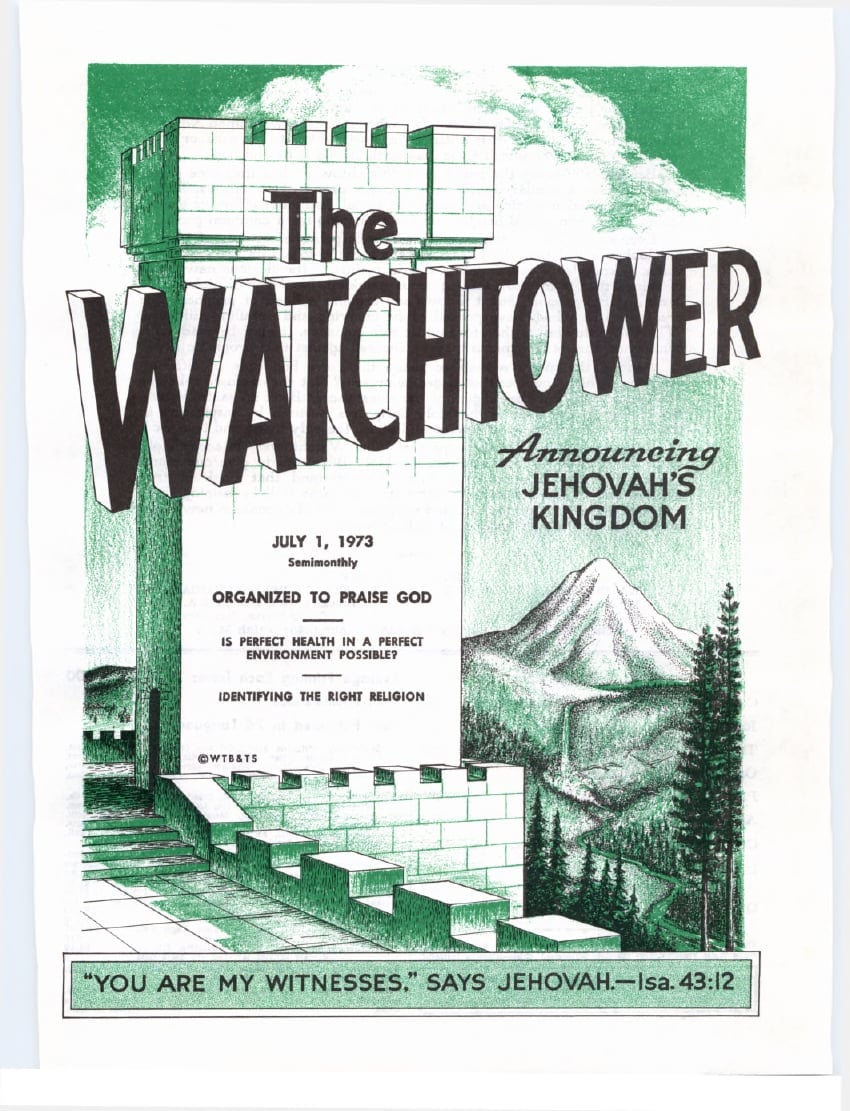
The Watchtower — July 1, 1973
Source: jw.org
Contents
Can You Be Sure Your Religion Is Right?
Identifying the Right Religion
Their Search for True Religion Rewarded
Organized to Praise God
Praise Jehovah with His People
A “Simple Eye” Is Needed
Conscientious in Doing Good Toward All
Is Perfect Health in a Perfect Environment Possible?
Questions From Readers
Can You Control Your Children?
Can You Be Sure Your Religion Is Right?
Can You Be Sure Your Religion Is Right?
RELIGION has had a tremendous impact on people’s lives, often influencing their conduct and their entire outlook on life. Truly, then, there is good reason to be sure about one’s religion.
Today, however, a growing number of people are having doubts about what their church is doing. In fact, some voice open disagreement. The editor of The American Church News, for example, decried the fact that the Episcopal Church, for claimed financial reasons, is unable to fulfill “the one and only task with which Jesus charged His Church”—evangelism. He listed a number of projects that were being financed by his denomination and then added, “but there is no money for evangelism. . . . We do not put first things first. We leave them out altogether.”
Others, while perhaps not expressing such open disagreement, are, nevertheless, very confused by what is being done in their church. A Jesuit weekly declared that many Catholics today “flounder” because of the changes in their church.
Are you also disturbed because beliefs you have long cherished are being cast aside by your church? Do you find it disturbing that more and more clergymen speak approvingly of premarital sex relations, of adultery and of homosexuality?
Many who have been disturbed by what they have seen in their churches have simply left them. A considerable number of these people still believe in God. To them there is overwhelming evidence that he exists. But they do not feel that the churches of Christendom are properly representing God. Still others continue supporting their church even though they may not be in full harmony with it.
In view of this, it might be asked, Does God approve of the doctrines and practices of these churches?
Many sincere persons, after making a careful investigation of the available evidence, have come to the conclusion that the Bible is a sound basis for judging religion.—2 Tim. 3:16, 17.
We invite you to undertake a comparison of what the Bible contains with what is being taught in the churches of Christendom. Many who have done this have been amazed to find that the very things that offended them in the churches of Christendom were not taught in the Holy Scriptures. What they learned from a serious consideration of God’s Word enabled them to identify the true religion.
Identifying the Right Religion
Identifying the Right Religion
THAT which is right must be in full harmony with a standard of truth. Most people who belong to a church of Christendom believe that their religion agrees with the Bible. This being the case, we can reasonably use the Bible as a basis for identifying the right religion.—John 17:17.
Why not get your copy of the Bible and consider some of the basic truths it contains. While the renderings of your translation may differ in wording, you will find that the meaning conveyed is the same as in the Bible translations quoted in this article.
THE TRUE GOD
The focal point of religion is the One to whom worship should be directed—God. What have you been taught about God? Has his name been brought to your attention? Have you been taught his view of images? Note what the Bible says at Psalm 83:18: “You, whose name is Jehovah, you alone are the Most High over all the earth.” And Isaiah 42:8 reads: “I am Jehovah. That is my name; and to no one else shall I give my own glory, neither my praise to graven images.”
So, then, could religions that minimize the importance of using God’s name be right? Could the One who does not share his glory or praise with graven images approve religions that uphold bowing before and kissing images, claiming that such acts are merely relative worship?
GOD’S SON, JESUS CHRIST
Besides teaching the truth about God, the right religion should also be pointing out the proper manner in which to approach God in worship. Concerning this, Jesus Christ stated: “I am the way and the truth and the life. No one comes to the Father except through me.” (John 14:6) Accordingly, the right religion must be teaching the truth about Jesus Christ.
Surely no one was better qualified to explain his position to others than Jesus himself. To his disciples, he said: “If you loved me, you would rejoice that I am going my way to the Father, because the Father is greater than I am.” (John 14:28) After his resurrection from the dead, he told Mary Magdalene: “Stop clinging to me. For I have not yet ascended to the Father. But be on your way to my brothers and say to them, ‘I am ascending to my Father and your Father and to my God and your God.”’—John 20:17.
Do these statements agree with the religious teaching that Jesus and God are equal? Do they not rather show that Jesus recognized his Father as his God?
Yet someone might object, Are there not scriptures that speak of Jesus as being equal with God?
One passage that is pointed to in proof of this is John 14:8, 9. According to the rendering of the Revised Standard Version, this text states: “Philip said to him, ‘Lord, show us the Father, and we shall be satisfied.’ Jesus said to him, ‘Have I been with you so long, and yet you do not know me, Philip? He who has seen me has seen the Father.”’
What did Jesus mean when he said this? The Bible itself explains. Earlier, Jesus had said: “I do nothing on my own authority but speak thus as the Father taught me. . . . I always do what is pleasing to him.” (John 8:28, 29, RS) So, Jesus faithfully represented his Father, speaking his Father’s words and doing his works. Yes, since Jesus reflected the personality of his Father perfectly, the disciples really came to know the Father through him.
THE KINGDOM OF GOD
Another basic teaching of the Bible relates to the kingdom of God. Jesus Christ and his apostles made this a prominent part of their message, and Jesus foretold that “this good news of the kingdom will be preached in all the inhabited earth.” (Matt. 24:14) When was the last time you heard a minister of Christendom point to this kingdom as the remedy for the present world distress?
Many may find this question unusual. They believe that the Kingdom is a condition in one’s heart. Is this what you have heard? Compare this with what the Bible says at Daniel 2:44: “In the days of those kings the God of heaven will set up a kingdom which shall never be destroyed, nor shall its sovereignty be left to another people. It shall break in pieces all these kingdoms and bring them to an end, and it shall stand for ever.” (RS) What is this kingdom that will break in pieces all other kingdoms? Obviously it is a government, the heavenly government of God in the hands of Jesus Christ.
This gives real force to the petition of Jesus’ model prayer: “Thy kingdom come, thy will be done, on earth as it is in heaven.” (Matt. 6:10, RS) This is a request for God’s kingdom to come against its enemies, removing them and ushering in a time when God’s will will be done on “earth as it is in heaven.” What will that mean for the earth? With God’s kingdom in full control of earth’s affairs, no human, no, not even an animal will “do any harm or cause any ruin.” (Isa. 11:9) Also, “[God] will wipe out every tear from their eyes, and death will be no more, neither will mourning nor outcry nor pain be anymore. The former things have passed away.” (Rev. 21:4) What a glorious prospect this is! No more doctors, no more drug stores, no more medicines, no more hospitals or mental institutions, no more undertakers, no more funerals, no more graves! Yes, and no more crime, no more policemen, no more prisons! Is that not “good news”? If you are a church member, is this the glorious hope to which your church is directing people’s attention?
THE RIGHT RELIGION’S PRINCIPLES OF CONDUCT
Adherence to the right religion is not only a matter of understanding and believing certain basic truths, but also a matter of acting on those beliefs and proving one’s faith by work. Should we not expect the right religion to make people better husbands, better fathers, better wives, better mothers, better children and better neighbors? Do you find that to be the case with church members you know? Do you feel confident that you will be dealt with honestly when you do business with a church member? Does the fact that he goes to church regularly give you reason to believe that he will not lie to you nor try to cheat you?
If he truly is one who adheres to the Bible, you should be able to have this confidence. God’s Word declares: “Now that you have put away falsehood, speak truth each one of you with his neighbor.” (Eph. 4:25) “Surely you know that the wicked will not receive God’s Kingdom. Do not fool yourselves; people who are immoral, or worship idols, or are adulterers, or homosexual perverts, or who rob, or are greedy, or are drunkards, or who slander others, or are thieves—none of these will receive God’s Kingdom.”—1 Cor. 6:9, 10, Today’s English Version, Third Edition.
Of course, some may feel that the church to which they belong is trying to help people to live a good life but that many are just not responding properly. Yet what is done in the case of those who practice what the Bible condemns and have no desire to change? What if a minister openly condones sexual immorality? Consider what the Bible says should be done: “In the letter that I wrote you I told you not to associate with immoral people. What I meant was that you should not associate with a man who calls himself a brother but is immoral, or greedy, or worships idols, or is a slanderer, or a drunkard, or a thief. Don’t even sit down to eat with such a person. After all, it is none of my business to judge outsiders. God will judge them. But should you not judge the members of your own fellowship? As the scripture says, ‘Take the evil man out of your group.”’—1 Cor. 5:9, 11-13, TEV.
Do the churches with which you are acquainted expel lawless persons from their midst? In view of the clear Scriptural admonition, do you think God could approve of religions that fail to take action against practicers of sin? Should not the right religion be zealous for aiding people to conform to God’s lofty requirements rather than to adopt the thinking of those who have no regard for his Word?
Of course, true worship is not just a matter of refraining from doing what is wrong. It also involves doing positive good. In particular are Christians commanded to cultivate the fruitage of God’s holy spirit—“love, joy, peace, long-suffering, kindness, goodness, faith, mildness, self-control.” (Gal. 5:22, 23) Of these qualities, the greatest is love, an unselfish, self-sacrificing concern for the welfare of others. (1 Cor. 13:13) This kind of love is the identifying mark of those who practice the right religion. Said Jesus Christ to his disciples: “I am giving you a new commandment, that you love one another; just as I have loved you, that you also love one another. By this all will know that you are my disciples, if you have love among yourselves.”—John 13:34, 35.
Is this the kind of love you see being manifested among those whom you know to be members of a church of Christendom? Do they keep free from the conflicts of the world and thus refrain from doing harm to fellow humans of another race or nationality? Are they willing to sacrifice of their time and energies to help others to gain an accurate knowledge of God’s purposes?
The right religion must not only be teaching the truth as found in the Bible, but those adhering to it must be living in harmony with it. Today there is a group of Christians scattered throughout the earth who are indeed practicing true worship. For you to hear the expressions of those who are now associating with this group because of having positively identified the true religion on the basis of God’s Word, we encourage you to read the next article.
Their Search for True Religion Rewarded
Their Search for True Religion Rewarded
EACH year many thousands of sincere searchers for the true religion are rewarded by what they find. Among such are the following:
✔ A young couple in Massachusetts had become greatly distressed by what they heard their Methodist preacher say. He openly approved of such practices as premarital sex and homosexuality. He also expounded a modern philosophy that belittled the Bible. So they stopped going to his church. But they still felt the need to worship God. What were they to do?
A Witness friend of theirs spoke to them about Jehovah God and his righteous principles as contained in his Word, the Bible. Before long they were regularly attending the congregation meetings of Jehovah’s witnesses and telling their friends and relatives about how they found the true religion. Soon five of their relatives were also studying the Bible with the Christian witnesses of Jehovah. This couple is so happy to be associated with people whose doctrines and practices they have found to square up with the Bible.
✔ Then there was a devout Catholic who lived in Maryland. Her priest once told her that the reason her young brother had been suddenly killed was because her father had not been going to church for twenty years. This caused her father to repent and again attend church. But when, after nine months, the father suddenly died, and the priest said that this showed that God knew what he was doing for both ‘died in God’s grace,’ she became confused.
“A Witness called on me,” she tells, “and gave me real comfort from the Bible. But I wanted to show her that the Catholic Church was right and she was wrong, and so many times I called the priest on the telephone to ask about what I had been taught in the Catholic Church. Each time the result was that I felt that for years I had been deceived. As I continued to study with the Witnesses I learned the meaning of John 8:32: ‘You will know the truth, and the truth will set you free.’ For the first time I was truly happy. Soon I made my dedication to Jehovah and was baptized.”
✔ Another sincere searcher for true Christianity was a Baptist living in Detroit, Michigan, who tells: “By the time I was twenty years old I was a pianist for church choirs and I was disillusioned when I saw that those who committed immoral acts never lost their positions. I felt that if God was going to accept these people I didn’t want him or his Bible. Still I played for whatever church paid me well. After some twenty years I began to think seriously about the wonders of creation. Noting my desire to understand the Bible, my sister persuaded me to study with the Witnesses. What I began to learn was just the opposite of what I had been taught as a child. There was the opportunity to live forever on earth in Paradise! The wicked would not burn forever. Jehovah was not condoning wickedness. He has appointed a time to clean up the earth!
“Now I could no longer play for churches. Although my church salary had helped to give my children a comfortable living, I quickly gave this up and took a job in a restaurant until a more favorable opportunity presented itself. I progressed to the point of dedication and symbolized it by baptism.”
✔ And then there was a devout Roman Catholic living in an Illinois monastery. While there he was given books to read about the lives of “saints.” But, instead of inspiring him to become a saint, these books discouraged him and so he quit the monastery. Not long thereafter he got married. Then one day at his church the senior priest distributed a questionnaire that itemized proposed changes and asked the parishioners to check what changes they favored. He and his wife checked off a few and then added at the bottom of the list, “Bible study courses.” Shortly thereafter they approached their senior priest and asked him personally about organizing a Bible study class at their church, but he replied: “I don’t think there are enough people in the parish interested to form a group.” So they tried studying the Bible by themselves.
After they started studying the Bible with Jehovah’s witnesses they asked to have their names removed from the church roll. Then one day when a young priest chanced to meet them and asked them why they were no longer coming to church, they told him about their Bible study with the Witnesses. He asked if he could attend and was told he could. At the beginning he said he believed in the Bible, but it soon became apparent that he did not. During the study he took exception to the point about Christians needing to keep separate from the world, and expressed disbelief in the existence of a personal Devil. In regard to the resurrection of Lazarus, the priest insisted that Lazarus had not actually died. All such remarks by the priest only caused the couple to be more convinced that they had found the true religion among Jehovah’s witnesses. Soon they were attending all the meetings of the Witnesses.
✔ A Catholic living in Portland, Oregon, had a somewhat similar experience: “My search for the truth began when I began to see so many controversies within the Church, such as regarding birth control. I heard of changes taking place, but for a long time I would not believe it as I did not see them in my own church. But when I attended other parish services I saw, to my surprise, many changes. It bothered me so much that I lost my faith in the Church. Among those that shattered my security in it were those regarding the liturgy, prayer and ceremonies. The day before Easter of 1969 I quit the Catholic Church. A few months later I attended the ‘Peace on Earth’ International Assembly of Jehovah’s Witnesses with my family.
“I was asked if I would like to study the Bible and I agreed. At first I was slow to progress and accept the truth. But progress came as I prepared for the congregational meetings as well as for my own Bible study. The Witness I was studying with always had the answers or was able to find them. One day after studying the chapter ‘Popular Customs That Displease God,’ in the Bible study aid The Truth That Leads to Eternal Life, I threw away all my rosaries and images. That was the turning point in my accepting the truth of the Bible. I sent in my resignation to the Catholic Church and was baptized as a Witness.”
If you have not as yet attended a meeting of Jehovah’s witnesses at one of their Kingdom Halls, why not do so this week? You, too, may well be as favorably impressed with what you see and hear. And if you want to understand the Bible, why not ask one of Jehovah’s witnesses to study the Bible with you as hundreds of thousands of others have done? If it is understanding of God’s Word for which you pray, along with a way of life that is in harmony with that Word, you will find the answer to your prayer.
Organized to Praise God
Organized to Praise God
“I will laud you, O Jehovah, with all my heart; I will declare all your wonderful works. I will rejoice and exult in you, I will make melody to your name, O Most High.”—Ps. 9:1, 2.
1, 2. (a) What does it mean to be organized, as illustrated by ancient temple musicians? (b) Why does orderly, harmonious organization befit Jehovah?
WHAT a thrill it is to hear beautiful music and song! Especially is this so when the praises of Jehovah God are being sung. As Israelites of old celebrated festivals at Jehovah’s sanctuary, they heard singers and musicians of the tribe of Levi. (1 Chron. 6:16, 31, 32) The words to many of the songs they sang have been preserved to this day in the Bible book of Psalms. How moving were those songs of praise to the Most High!
2 Those artisans of music and song were well organized. (1 Chron. chapter 25) That is, they were each assigned duties with a view to unifying their efforts, putting them in readiness for cooperative action. An organization is a group of persons united for some purpose. Orderly, harmonious organization—like that of those Levites—befits Jehovah, for “God is a God, not of disorder, but of peace.” (1 Cor. 14:33) Those who listened did so with gratitude as the Levites extolled Jehovah in song, because they were hearing music used for its highest purpose.
3. The organization of holy angels serves what purpose?
3 As those Levites were organized to praise God, so others have been organized to praise him too. If you could peer into the spirit realm, you would behold a marvelous organization—holy angels by the millions. (Dan. 7:9, 10; Rev. 5:11, 12) What purpose do they serve? Under divine inspiration David exclaimed: “Bless Jehovah, O you angels of his, mighty in power, carrying out his word, by listening to the voice of his word. Bless Jehovah, all you armies of his, you ministers of his, doing his will.” (Ps. 103:20, 21) For the holy angels to carry out Jehovah’s word and do his will, they certainly must be well organized.—Isa. 6:1-6; compare Hebrews 12:22.
‘OUT OF DARKNESS INTO GOD’S WONDERFUL LIGHT’
4. Despite apostasy, how do we know that some persons had favor from God during the spiritually dark centuries?
4 In the first century of our Common Era, God called honest-hearted persons “out of darkness into his wonderful light.” They became part of the Christian congregation, which was also organized to praise God and ‘declare abroad his excellencies.’ (1 Pet. 2:9) In time, however, apostasy occurred and spiritual darkness prevailed among mankind. (Acts 20:29, 30; 1 Tim. 4:1, 2) Yet, in keeping with a parable of Jesus Christ, during those spiritually dark centuries some individuals enjoyed light and favor from God. (Ps. 43:3) Some true Christians, likened by Jesus to “wheat,” grew amidst “weeds” or imitation Christians. As the “harvest” or “conclusion of a system of things” drew near, Jehovah acted to identify the wheatlike ones. (Matt. 13:24-30, 36-43) Like the first-century Christians, they proved to be persons called “out of darkness into his wonderful light.” These modern-day Christians can readily be identified because of their zeal in ‘declaring abroad Jehovah’s excellencies,’ lauding him with all their heart and making melody to his name. (Ps. 9:1, 2) A brief review of their history shows that they too are organized to praise God.
5. Who was Charles Taze Russell, and what were some of his early religious experiences?
5 In this regard, events of the nineteenth century C.E. command our attention. Some religious groups then expected that the bodily coming of Jesus Christ was imminent. But our interest centers on Allegheny, Pennsylvania. Born there in 1852 was Charles Taze Russell, son of Joseph L. and Eliza Birney Russell. Even in childhood Charles displayed keen interest in God. Though raised a Presbyterian, he later joined the Congregational Church. But young Russell was greatly troubled by the doctrines of predestination and eternal torment. By the age of seventeen he was a skeptic. Then something significant happened. Of this, Russell later wrote:
Seemingly by accident, one evening I dropped into a dusty, dingy hall in Allegheny, Pa., where I had heard that religious services were held, to see if the handful who met there had anything more sensible to offer than the creeds of the great churches. There, for the first time, I heard something of the views of Second Adventism, by Jonas Wendell . . .
Though his Scripture exposition was not entirely clear, . . . it was sufficient, under God, to reestablish my wavering faith in the Divine inspiration of the Bible, and to show that the records of the Apostles and the Prophets are indissolubly linked.
6. Did Russell and those meeting with him for Bible study receive spiritual light from God?
6 Shortly thereafter Russell and a few others began meeting weekly for prayerful, systematic Bible study. The spiritual light they received from God intensified, for “the path of the righteous ones is like the bright light that is getting lighter and lighter until the day is firmly established.” (Prov. 4:18) For instance, they recognized that Jesus would return as a spirit, and so be present though invisible.—1 Pet. 3:18.
7. (a) What was C. T. Russell’s relationship with N. H. Barbour, and what happened to it? (b) When was The Watchtower first published, and what is its stand on the doctrine of the ransom?
7 About January 1876, C. T. Russell came in touch with the journal The Herald of the Morning, published by N. H. Barbour of Rochester, New York. It advocated belief in an invisible presence of Jesus Christ. Eventually Russell’s Pittsburgh Bible class became affiliated with Barbour’s group and Russell became coeditor of the Herald, also giving financial aid. But in 1878, according to Russell, Mr. Barbour wrote a Herald article “denying that the death of Christ was the Ransom-price for Adam and his race.” Writing in the journal, Russell firmly upheld the Biblical doctrine of the ransom. (1 Tim. 2:5, 6) But this was to no avail, and so Russell severed ties with Barbour. Then, in July 1879, C. T. Russell published the first issue of Zion’s Watch Tower and Herald of Christ’s Presence, now called The Watchtower. In no uncertain terms this journal has always declared the Scriptural truth about the ransom.
8. What gives evidence that The Watchtower has had divine backing?
8 That was a “day of small things,” but it was not to be despised. (Zech. 4:10) The first issue of Zion’s Watch Tower consisted of only about 6,000 copies. But the Bible students publishing it desired to praise God and believed that the journal had Jehovah’s backing. Today its circulation exceeds an average of 7,800,000 copies per issue in over 70 languages. Such an accomplishment in the face of the international opposition that developed is evidence of divine support.—John 17:14-17; Ps. 127:1.
9. State the origin and purpose of the Watch Tower Society.
9 Marking 1881 was the formation of the “Watch Tower Tract Society,” which was incorporated under Pennsylvania law in 1884 as “Zion’s Watch Tower Tract Society” (now called “Watch Tower Bible and Tract Society of Pennsylvania”). No selfish commercial interests were involved. Its charter states:
The purpose for which the Corporation is formed is, the dissemination of Bible truths in various languages by means of the publication of tracts, pamphlets, papers and other religious documents, and by the use of all other lawful means which its Board of Directors, duly constituted, shall deem expedient for the furtherance of the purpose stated.
This and other corporations of similar purpose are merely legal instruments used by Jehovah’s servants as they serve and praise God.
10. (a) How did the Bible Students ‘honor Jehovah with valuable things’? (b) What was the “Bible House”?
10 The Bible Students voluntarily donated funds for the advancement of the work. They ‘honored Jehovah with their valuable things,’ and he blessed them abundantly. (Prov. 3:9, 10; 2 Cor. 9:7, 11) God provided quarters and facilities designed to meet increasing demands for Bible literature. In 1889 they moved into their new four-story brick building called the “Bible House,” constructed in Allegheny at a cost of $34,000. Some years later, when the title of ownership for the entire establishment was donated to the Society, its board of directors valued the net equity of the building and equipment at $164,033.65.
11-13. (a) By what means was spiritual food provided? (b) How did some persons respond to spiritual food in Zion’s Watch Tower and kindred publications?
11 As Jehovah’s holy spirit or active force continued giving direction and enlightenment, abundant spiritual food was provided through a composite “faithful steward” and its governing body. (Luke 12:42-44; compare Acts 15:4-29.) Excellent spiritual fare reached truth seekers through Zion’s Watch Tower and kindred publications. C. T. Russell himself penned six volumes of Millennial Dawn (later called “Studies in the Scriptures”) from 1886 to 1904. In the meantime, house-to-house preaching by “colporteurs” (now called “pioneers”) carried God’s truth direct to the people’s homes.—Acts 5:42; 20:20.
12 But how did people respond to such spiritual food? There can be no doubt that Jehovah’s spirit directed matters. For instance, from London, England, came this request in 1882: “Please instruct me how and what to preach so as to accomplish the blessed work God wishes done.” An 1887 letter from Nebraska stated: “I shall consider it not only a duty but a blessed privilege to assist, by every means at my command, in proclaiming this gospel.”
13 Jehovah’s spirit was also at work in more distant lands. By 1887 and 1888 some truth had spread to China. From Macedonia, European Turkey, came this 1888 report: “Turks, Jews, Bulgarians and Macedonians are much interested in the truth.” Shortly thereafter, despite persecution, the truth was reportedly “gaining ground” along Africa’s coast. And, from Deccan, India, came an 1890 letter from one of Christendom’s missionaries “30 miles out in the jungles” who read Zion’s Watch Tower and Bible Student tracts “with much interest.” He subscribed for two years and ordered other literature.
14. (a) How did J. F. Rutherford express his appreciation for volumes of Millennial Dawn? (b) Give some details concerning Brother Rutherford’s later activities.
14 In 1894 volumes of Millennial Dawn were obtained by a man who said, in part, in a letter received by the Society:
I took the books home, and thought little of them, until a few weeks ago, when I had some spare time, I began reading the first volume, and it was so very interesting that I could not stop. The result is, my dear wife and myself have read these books with the keenest interest, and we consider it a God-send and a great blessing that we have had the opportunity of coming in contact with them. They are indeed a “helping hand” to the study of the Bible. The great truths revealed in the study of this series have simply reversed our earthly aspirations; and realizing to some extent, at least, the great opportunity for doing something for Christ, we intend to take advantage of this opportunity in distributing these books, first, among our nearest relatives and friends, and then among the poor who desire to read them and are unable to purchase.
This letter was signed by J. F. Rutherford, who was baptized in 1906, in symbol of his dedication to God, and who eventually succeeded C. T. Russell as president of the Watch Tower Society.
JEHOVAH’S BLESSING ENRICHES
15. Who were the pilgrims associated with the Society, and how did they aid fellow believers?
15 “The blessing of Jehovah—that is what makes rich, and he adds no pain with it.” (Prov. 10:22) How true! With divine blessing, congregations of Bible Students were growing in number. In time, “pilgrims”—traveling representatives of the Watch Tower Society—regularly visited them. The pilgrims got joy from their service and ‘longed to see fellow believers to impart some spiritual gift to them’ through discourses and by other means. (Rom. 1:11, 12) “How these added to our ever-flowing stream of joy and to the riches of our faith!” exclaims Hazelle M. Krull concerning these pilgrims. “And how they aided us to appreciate Jehovah’s organization!”
16. (a) Meetings of Jehovah’s Christian witnesses afford what opportunity? (b) Are collections taken at these gatherings?
16 Meetings held by the Bible Students provided excellent Biblical instruction. They also afforded opportunity to ‘incite one another to love and fine works.’ (Heb. 10:24, 25) To this day, meetings of Jehovah’s Christian witnesses are advertised with the motto “Seats free, no collection.” “You received free, give free,” said Jesus Christ.—Matt. 10:8.
17. When and where was the Society’s first branch office established outside the United States, and how many branch offices were there by 1972?
17 C. T. Russell had traveled abroad in 1891. Thereafter literature of the Watch Tower Society was published in German, French, Swedish, Dano-Norwegian, Polish, Greek and later in Italian. The Society’s first branch office outside the United States was established in London, England, in 1900. The story is one of increase and divine blessing ever since. By 1972, branch offices of the Society numbered ninety-five.
18. What occurred in connection with the Society’s headquarters in 1909?
18 The years 1908 and 1909 brought further expansion. Representatives of the Society purchased the old “Plymouth Bethel,” a mission structure at 13-17 Hicks Street, and the Henry Ward Beecher home at 124 Columbia Heights, Brooklyn, New York. The “Plymouth Bethel” was renamed the “Brooklyn Tabernacle” and the old Beecher home was called “Bethel,” a residence for members of the Society’s headquarters staff. So, by 1909, Brooklyn was the location of the Society’s world headquarters. Today the Watchtower Bible and Tract Society of New York, Incorporated, owns an extensive complex of residence, office and factory buildings in Brooklyn. All these facilities are used by Jehovah’s witnesses as they praise God and declare the good news of the Kingdom.—Mark 13:10.
19, 20. (a) How did the Bible Students use a newspaper syndicate? (b) Describe the Photo-Drama of Creation.
19 The Bible Students kept Scriptural truths before the public also through an international newspaper syndicate that they organized. At one time about 3,000 newspapers in the United States, Canada and Europe were publishing C. T. Russell’s sermons. However, for years the Bible Students had declared that the 2,520-year-long Gentile Times or “appointed times of the nations” would expire in 1914. (Luke 21:24) As that year approached, Russell conceived of a bold new way to declare the good news.
20 Motion pictures were still in their infancy. Commercially successful synchronization of film and sound had not yet been achieved; nor had color motion pictures been perfected for general use. But in 1912 Russell determined to give a great witness through this medium. He wrote and produced the Photo-Drama of Creation, an eight-hour-long slide, motion picture and sound production outlining the divine purpose for the earth and mankind from creation down to the end of Jesus Christ’s thousand-year reign. (Rev. 20:6) Shown in four parts, the Photo-Drama combined phonograph recordings with slides and motion pictures. It was seen by millions and was a grand witness concerning Jehovah’s purposes.
21. Was the work of the Bible Students dependent upon one man?
21 While on a preaching tour, ailing Charles Taze Russell died aboard a train at Pampa, Texas, on October 31, 1916. Despite resulting sorrow, however, the majority of Bible Students knew that their work was not dependent upon one man. It was Jehovah’s work, directed by his holy spirit. God would have it continue and succeed.—Acts 5:38, 39.
ADVERTISING THE KING AND KINGDOM
22. What difficulties did Jehovah’s Christian witnesses experience shortly after J. F. Rutherford became president of the Watch Tower Society, but how did matters turn out?
22 J. F. Rutherford succeeded C. T. Russell as the elected president of the Watch Tower Society. But he came face to face with ambitious, opposing men within the organization who sought control of it, and some time passed before their efforts were completely foiled. At the same time, clergy-inspired persecution raged against the Christian witnesses of Jehovah. (Matt. 24:9) Furthermore, it seemed that their work would be seriously crippled when, on May 7, 1918, J. F. Rutherford and seven others prominently associated with the Society were arrested, later tried, and finally convicted on false charges. It was charged that they—
Unlawfully and feloniously did conspire, combine, confederate and agree together, and with divers other persons to the said Grand Jurors unknown, to commit a certain offense against the United States of America, to wit: the offense of unlawfully, feloniously and wilfully causing insubordination, disloyalty and refusal of duty in the military and naval forces of the United States of America when the United States was at war . . . by personal solicitations, letters, public speeches, distributing and publicly circulating throughout the United States of America a certain book called “Volume VII. Bible Studies. The Finished Mystery,” and distributing and publicly circulating throughout the United States certain articles printed in pamphlets called “Bible Student’s Monthly,” “Watch Tower,” “Kingdom News” and other pamphlets not named.
After months in the federal penitentiary at Atlanta, Georgia, they were freed on bail. By May 14, 1919, their erroneous convictions were reversed, and on May 5, 1920, they were completely exonerated. Figuratively speaking, God’s “two witnesses,” Christ’s anointed followers, had been dead. After release of the Society’s representatives from prison, “spirit of life from God” enlivened them and they again sallied forth, organized to praise God.—Rev. 11:3-12.
23, 24. (a) The Bible Students’ convention at Cedar Point, Ohio, in 1919 affected their work in what way? (b) What significance did the 1922 convention have with regard to Kingdom proclamation?
23 The year 1919 brought a thrilling convention in Cedar Point, Ohio—one that gave renewed impetus to the work of the Bible Students. Among other things, there they received a new instrument for use in their preaching work. It was The Golden Age, a journal exposing religious error and drawing attention to the hope and comfort found in the Holy Scriptures. Now, more than half a century later, it still accomplishes the same purpose under a new name—Awake!
24 Once again the Bible Students assembled at Cedar Point, in 1922. This time J. F. Rutherford’s discourse of Friday, September 8, on the subject “The Kingdom” was especially significant. Powerfully he concluded it with the words: “Behold, the King reigns! You are his publicity agents. Therefore advertise, advertise, advertise the King and his kingdom.” With that, a thirty-six-foot-long banner was unfurled above the speaker’s stand. It read “Advertise the King and Kingdom!” God’s servants have advertised the Kingdom ever since.
25. Under what circumstances did the Bible Students embrace the name “Jehovah’s witnesses”? Is it Biblical?
25 Came the year 1931. The Bible Students assembled in convention at Columbus, Ohio. There by resolution they heartily embraced the Biblical name “Jehovah’s witnesses.” (Isa. 43:10-12) Gladly they have borne Jehovah’s name, witnessing about God and his purposes throughout the earth.
SUPPORTED BY THE GOD THEY PRAISE
26, 27. Cite an example showing that, for those organized to praise him, Jehovah has been “a secure height in times of distress.”
26 Succeeding years brought rich blessings, but also much persecution. For instance, many trialsome experiences befell Jehovah’s servants during World War II. One brother, incarcerated by the Nazis, stated:
Being so often deprived of food and having to do heavy work every day, our physical strength was waning visibly. I was in such a state that I was hardly able to move my skeleton. Two brothers would support me under the arms when marching into the camp. Often I swallowed a handful of sand so that my stomach had something to do. Other brothers did this too. So we did everything possible to stay alive and thus brand Satan and his SS men as liars, for they often said: “Where is your Jehovah? Let him help you!” I must say that he helped us in a wonderful way.
27 Jehovah does indeed aid his servants. His spirit rests upon his people as an organization and as individuals. Time and again, for those who are organized to praise God, Jehovah has proved to be “a secure height in times of distress.”—Ps. 9:9.
EDUCATED AND STRENGTHENED TO PRAISE GOD
28. When was the Watchtower Bible School of Gilead inaugurated, and what has it accomplished?
28 J. F. Rutherford died on January 8, 1942. Five days later N. H. Knorr was unanimously elected president of the Watch Tower Society. He and his associates promptly embarked upon an extensive educational work. February 1, 1943, marked the dedication and inauguration of the Watchtower Bible School of Gilead. Through the years this institution has equipped thousands of ministers for foreign missionary work and other important service assignments in the expanding organization of Jehovah’s servants.
29. In what way does the Theocratic Ministry School benefit individuals?
29 Also in 1943 a new school was started in the individual congregations of Jehovah’s witnesses. It was the Theocratic Ministry School, originally open for male enrollment. Today it aids men, women and children who are enrolled, and greatly benefits all who attend its weekly sessions. Enrollees are taught to gather, develop and present Biblical information. Education received at this and other meetings of Jehovah’s witnesses deepens Bible knowledge and appreciation and enhances ministerial ability.
30. When was the Kingdom Ministry School instituted, and what is its purpose?
30 In 1959 another organizational provision had its beginning. This was the Kingdom Ministry School. Conveniently located and operating under the Watch Tower Society’s direction in various lands, these schools train spirit-appointed overseers to discharge their responsibilities within the Christian congregation.—Acts 20:28; 1 Tim. 3:1-10, 12, 13; 1 Pet. 5:1-4.
31. What significant gathering of Jehovah’s witnesses took place in 1958?
31 Jehovah’s earthly organization has expanded as God has prospered the work of his devoted worshipers. Of no little significance have been their large gatherings. Among these was the “Divine Will” International Assembly of Jehovah’s Witnesses, July 27–August 3, 1958, when 253,922 packed out New York city’s Yankee Stadium and Polo Grounds for the public talk by N. H. Knorr on the subject “God’s Kingdom Rules—Is the World’s End Near?”
32. Why has Jehovah’s earthly organization experienced spiritual strengthening and increase?
32 Divine blessing has brought about spiritual strengthening of Jehovah’s earthly organization and has also resulted in productivity in the Kingdom-preaching work. Today it is being carried on in 208 lands under the direction of the Watch Tower Society’s 95 branch offices. To Jehovah alone must this increase be attributed. God has blessed his faithful servants, and his holy spirit has backed them up in their work of declaring his purposes and making disciples.—Matt. 28:19, 20.
33. What questions is it appropriate for those who have learned the truth in recent years to ask themselves?
33 Many more thousands have continued to flock into Jehovah’s organization right down till the present time, and it is grand to see them come! But what will they do with the good news that they are learning? Will they show the kind of zeal that those zealous servants of God did in years past? Will they show the same perseverance? Remember, there are in Jehovah’s organization today persons who have been going out in the field service for over fifty years, continuing despite bad weather, ill health and persecution. It is genuine love for Jehovah that has impelled them to press on.
34. (a) In harmony with the example set by Jehovah, how should we view one another in Jehovah’s organization? (b) In what urgent work is there plenty for all of us to do?
34 Perhaps you have come into association with Jehovah’s organization only in the past few years. You may not have known these older ones very long; you see them only in their later years of life. How do you view them? Recently a letter received by the Watch Tower Society said regarding this: “I wish to express my appreciation for the 1973 Yearbook. . . . Perhaps the one single paragraph that impressed me most was paragraph three on page thirty-two under ‘Acts of Jehovah’s Witnesses in Modern Times.’ This paragraph calls attention to a circumstance that does indeed exist. ‘Sometimes the present generation just thinks of what it is accomplishing. Really, the present generation of Jehovah’s witnesses is building on what faithful evangelizers did years ago.’ What a truth! The way the 1973 Yearbook is prepared, it will help us ‘younger ones in the truth’ to look at the ‘older brothers in the truth’ through different eyes, and not view them as merely ‘old friends’ or ‘old brothers and sisters.”’ Each one of Jehovah’s servants has a place in his organization, and each one is precious to Jehovah. There is work for all of them to do, and the Bible urges us to have “plenty to do in the work of the Lord,” knowing that such is the most worthwhile work that anyone can do. (Zech. 2:8; Hag. 2:7; 1 Cor. 15:58) As a united group, Jehovah’s witnesses earth wide will continue to extol their heavenly Father, grateful that they have been organized to bring praise to him.
[Picture on page 394]
C. T. RUSSELL
[Picture on page 399]
At the Cedar Point assembly in 1922 the Society’s president, J. F. Rutherford, put great emphasis on preaching God’s kingdom, powerfully urging: “Advertise, advertise, advertise the King and his kingdom!”
[Picture on page 400]
After N. H. Knorr became president of the Watch Tower Society, great emphasis was put on education. One of the schools established was the Watchtower Bible School of Gilead
Praise Jehovah with His People
Praise Jehovah with His People
“I will sing to Jehovah throughout my life; I will make melody to my God as long as I am.”—Ps. 104:33.
1, 2. (a) What is the “new song,” and how have some responded to it? (b) Cite some personal questions that merit consideration.
JEHOVAH is being praised in a song that is heard throughout the earth today. No, it is not being sung by Levites. Nor can we hear an angelic chorus extolling God in the heights above. But we can hear the “new song,” sung in unison by prospective heirs of Jehovah’s heavenly government. (Rev. 14:1-4; 20:6; 22:5; Ps. 96:1, 10) It is the stirring anthem of God’s established kingdom that has functioned in heaven since 1914 C.E. with the glorified Jesus Christ as King. Thousands have heard that gripping song with deep appreciation.
2 Have you responded appreciatively to this “new song”? Are you praising Jehovah with his people? Have you associated with the organization God is using to declare earth wide “this good news of the kingdom”? (Matt. 24:14) If so, do you really appreciate Jehovah’s earthly organization? There are many reasons to esteem it highly. Briefly consider but a few.
WHY APPRECIATE GOD’S ORGANIZATION
3. Jesus’ anointed followers and their companions are privileged to represent what and whom?
3 For one thing, Jesus’ anointed followers, who are part of Jehovah’s earthly organization, are “ambassadors substituting for Christ.” Their companions with earthly hopes also serve the interests of the Kingdom. (2 Cor. 5:20) Mind you, they are not ambassadors and envoys of a mere human government and of sinful rulers. They represent Jehovah, his exalted spirit king Jesus Christ and the mighty kingdom of God. What an inestimable privilege! Of course, to serve and praise the Universal Sovereign, one must associate with the organization of Jehovah’s Christian witnesses.
4. Why can those in Jehovah’s earthly organization understand spiritual things?
4 Consider, too, the fact that Jehovah’s organization alone, in all the earth, is directed by God’s holy spirit or active force. (Zech. 4:6) Only this organization functions for Jehovah’s purpose and to his praise. To it alone God’s Sacred Word, the Bible, is not a sealed book. Many persons of the world are very intelligent, capable of understanding complex matters. They can read the Holy Scriptures, but they cannot understand their deep meaning. Yet God’s people can comprehend such spiritual things. Why? Not because of special intelligence on their part, but as the apostle Paul declared: “For it is to us God has revealed them through his spirit, for the spirit searches into all things, even the deep things of God.” (1 Cor. 2:10) Jesus Christ praised his heavenly Father for ‘hiding such things from the wise and intellectual ones but revealing them to babes.’ (Matt. 11:25) How very much true Christians appreciate associating with the only organization on earth that understands the “deep things of God”!
5. Direction by God’s spirit enabled Jehovah’s servants long ago to understand what about 1914 C.E.?
5 Direction by God’s spirit enables Jehovah’s servants to have divine light in a world of spiritual darkness. (2 Cor. 4:4) For instance, long ago they understood that 1914 C.E. would mark the end of the Gentile Times or “appointed times of the nations,” during which the Gentile nations were allowed uninterrupted rulership of the earth. (Luke 21:24) This 2,520-year period began with the destruction of Jerusalem and its temple by the Babylonians in the late seventh century B.C.E. For example, Zion’s Watch Tower of March 1880 had declared: “‘The Times of the Gentiles’ extend to 1914, and the heavenly kingdom will not have full sway till then.” Only God by his holy spirit could have revealed this to those early Bible students so far in advance.
6. As to life, what prospect does the Christian organization set before us?
6 Another reason to appreciate the organization of Jehovah’s Christian witnesses is that it aids us to understand God’s provisions for blessing obedient ones, and then to bring our lives into harmony with the divine will. (Matt. 24:45-47) This brings us happiness now despite world gloom, for it is truly satisfying to know that one is pleasing God. By its publications and through other means, the true Christian organization keeps prominently before us the Biblical prospect of endless, happy life under the rule of God’s kingdom. (Rev. 21:3-5) What a blessing! How much we should appreciate God’s earthly organization and our opportunities to praise Jehovah with his people!
7. What purpose is served by “gifts in men”?
7 Furthermore, this organization alone is supplied with “gifts in men,” such as evangelizers, shepherds and teachers, who serve God’s purpose in connection with the spiritual development and welfare of his people. (Eph. 4:7-16) Appointed overseers or elders and ministerial servants meet Scriptural requirements for their responsible places in Jehovah’s organization. Among other things, they welcome honest-hearted people into the Christian congregation and help to educate them in Jehovah’s ways. (1 Tim. 3:1-10, 12, 13; Titus 1:5-9) Under the influence of God’s holy spirit, you can share in this grand work of finding, welcoming and educating those who will become fellow praisers of Jehovah. What a blessed privilege!
8. Persons of what kind make up Jehovah’s earthly organization?
8 Think of the people themselves—those praising Jehovah as part of his earthly organization. They are indeed “the desirable things of all the nations.” (Hag. 2:7) True Christians have many spiritual brothers, sisters, mothers and children. (Mark 10:29, 30) Having association with such moral, godly praisers of Jehovah who live according to the Holy Scriptures is something to appreciate.
GRATEFUL TO BE PART OF GOD’S ORGANIZATION
9. How did one fifteen-year-old express gratitude for association with God’s people?
9 No wonder so many persons are deeply grateful to be associated with Jehovah’s earthly organization and to be praising God with his people. A fifteen-year-old said:
I just wanted to write to tell you how happy I am to be one of Jehovah’s witnesses. I am so grateful to my parents for teaching me about the truth. . . . Seeing the corruption in the world, I am proud and grateful to be able to say that I’m not part of it, and that I am one of Jehovah’s witnesses.
10. Jehovah’s organization and spirit meant what to one bereaved family?
10 After the accidental death of their son, one Christian family told about the love fellow believers showed them, and also wrote:
Let me assure you—from our hearts—that Jehovah has made his love, the love of our brothers and of his organization so real to us. Through a tragedy we have seen Jehovah’s spirit working right in front of our eyes. We are so humbly grateful to be among these that Jehovah calls the ‘desirable ones from the nations.’ . . .
We hope that we have made you realize to a small degree how grateful we are to have brothers like you, to be a part of Jehovah’s organization, to feel the working of God’s spirit and to have his comfort. The joy cannot be put on paper.
11. How was Bethel viewed by a man who served there for many years?
11 A man who served faithfully for many years at the world headquarters of Jehovah’s witnesses (called Bethel) in Brooklyn, New York, stated:
In the years since [my wife’s] death, I have come to appreciate Bethel even more. . . . Bethel can be considered a crossroads, the crossroads of Jehovah’s people. We are continually meeting people from everywhere, going everywhere. Twice a year there are . . . students coming here to attend Gilead School [for missionaries]. There are visiting missionaries and traveling representatives of the Society. Also, of course, there are the members of the [Bethel] family itself to meet. . . . After forty-five years here I am always meeting people I know or who share mutual acquaintances. My family of friends spreads round the globe.
12. Is it proper for Christians to express appreciation for fellow believers?
12 How fine to have a “family of friends” earth wide! Why, those who are part of God’s organization rightly express their appreciation to Jehovah for their fellow believers. The apostle Paul did. He wrote concerning his Christian associate Timothy: “I am grateful to God, to whom I am rendering sacred service as my forefathers did and with a clean conscience, that I never leave off remembering you in my supplications, night and day longing to see you, as I remember your tears, that I may get filled with joy.” (2 Tim. 1:3, 4) Regarding fellow worshipers in Rome, Paul said: “I give thanks to my God through Jesus Christ concerning all of you, because your faith is talked about throughout the whole world.” (Rom. 1:8) Indeed, for such fine associates, and for many other reasons, those who are part of God’s earthly organization deeply appreciate their privilege of praising Jehovah with his people.
DISPLAYING YOUR APPRECIATION FOR GOD’S ORGANIZATION
13. Why read and study the Bible and Christian publications regularly?
13 But how can you show that you really appreciate Jehovah’s organization? Among other things, you can regularly study the Bible and the Christian publications that God provides through his organization. Do not neglect them. The counsel given for kings of Israel merits thought in this regard. Through Moses, God said: “And it must occur that when he takes his seat on the throne of his kingdom, he must write in a book for himself a copy of this law from that which is in the charge of the priests, the Levites. And it must continue with him, and he must read in it all the days of his life, in order that he may learn to fear Jehovah his God so as to keep all the words of this law and these regulations by doing them; that his heart may not exalt itself above his brothers and that he may not turn aside from the commandment to the right or to the left, in order that he may lengthen his days upon his kingdom, he and his sons in the midst of Israel.” (Deut. 17:18-20) Jehovah’s Word and true Christian publications inculcate God’s righteous laws and principles. So read and study them regularly. Cherish the spiritual guidance they furnish. Be like the psalmist who said: “Blessed you are, O Jehovah. Teach me your regulations. . . . For your statutes I shall show a fondness. I shall not forget your word.”—Ps. 119:12-16.
14, 15. If we appreciate Jehovah’s earthly organization, how will we view Christian meetings and assemblies, and how do we benefit from them?
14 Another way to show that you appreciate Jehovah’s organization and your privilege of praising God with his people is by attending Christian meetings regularly. It pleased David greatly to be among Jehovah’s worshipers at God’s sanctuary. He declared: “One thing I have asked from Jehovah—it is what I shall look for, that I may dwell in the house of Jehovah all the days of my life, to behold the pleasantness of Jehovah and to look with appreciation upon his temple.” (Ps. 27:4) If we truly appreciate Jehovah’s earthly organization, we will long to be at Christian meetings and assemblies.—Ps. 84:1-4.
15 By not neglecting God’s house of ancient times (Neh. 10:39), but by appreciatively supporting it and attending festivals there, the Israelites were helped to apply God’s instructions in life. They had to face tests of faith and temptations. As was true of other people, certainly they were beset by temptations to lie, steal, commit adultery or engage in other wrongdoing. But if a test arose, they might well reflect on what had been read to them at their assemblies. (Deut. 31:10-13) They could recall Jehovah’s laws and promises. It would then be possible to surmount trials and maintain integrity to God. We benefit similarly by attending Christian meetings and assemblies today. Also, by our presence we incite each other “to love and fine works.”—Heb. 10:24, 25.
16. Of what importance is loyalty to Jehovah’s organization?
16 If we truly appreciate Jehovah’s earthly organization, we will remain loyal to it, knowing that the organization is his. If we were to leave it, where else could we go? There is no other organization that is doing the divine will or that is educating people for life everlasting. When many abandoned Jesus Christ, he asked his apostles: “You do not want to go also, do you?” Peter replied: “Lord, whom shall we go away to? You have sayings of everlasting life; and we have believed and come to know that you are the Holy One of God.” (John 6:66-69) Faithful early Christians endured intense persecution and yet remained loyal to God and to his organization, the Christian congregation. For instance, persecuted Christians in Rome sought refuge in that city’s catacombs, underground burial areas. Family burial chambers there provided places for small group meetings. Early Christians recognized their spiritual need and the necessity of gathering for encouragement and instruction, even if this required going underground in a literal way. If we have Christian appreciation, we, too, will stay with Jehovah’s organization, his Christian congregation, despite difficulties and persecution today.
17. Why engage in the Christian ministry with a sense of urgency?
17 You can also show appreciation for God’s earthly organization by joining wholeheartedly in the Christian ministry, taking God’s Word to other people. Thus you further the educational work that the organization carries on. There is need to participate in that work with a sense of urgency, too, for the end of this wicked system of things is drawing near. The time is short. The harvest is great and the workers are few. (Matt. 9:37, 38) What a privilege it is to be one of the industrious modern-day harvest workers and to do a lifesaving preaching work! By all means, keep busy in the Christian ministry, “always having plenty to do in the work of the Lord, knowing that your labor is not in vain in connection with the Lord.”—1 Cor. 15:58.
18. To do well in the ministry, how important are prayer and God’s holy spirit?
18 Faithful, appreciative ones wish to offer a fine “sacrifice of praise” to God. (Heb. 13:15) But how can this be done? Seek Jehovah’s help in prayer. Guidance by his holy spirit is needed to aid sheeplike persons and to do one’s best in the ministry. So pray for God’s spirit to rest upon you. Jehovah graciously grants it to his dedicated servants who make this plea. Jesus Christ stated: “Therefore, if you, although being wicked, know how to give good gifts to your children, how much more so will the Father in heaven give holy spirit to those asking him!”—Luke 11:13.
19, 20. (a) What connection did God’s spirit and the holy angels have with the Christian ministry in the past? (b) Do God’s holy spirit and angelic direction still affect Christian preaching activities?
…