The Watchtower, May 1, 1972
Download: PDF — The Watchtower, May 1, 1972
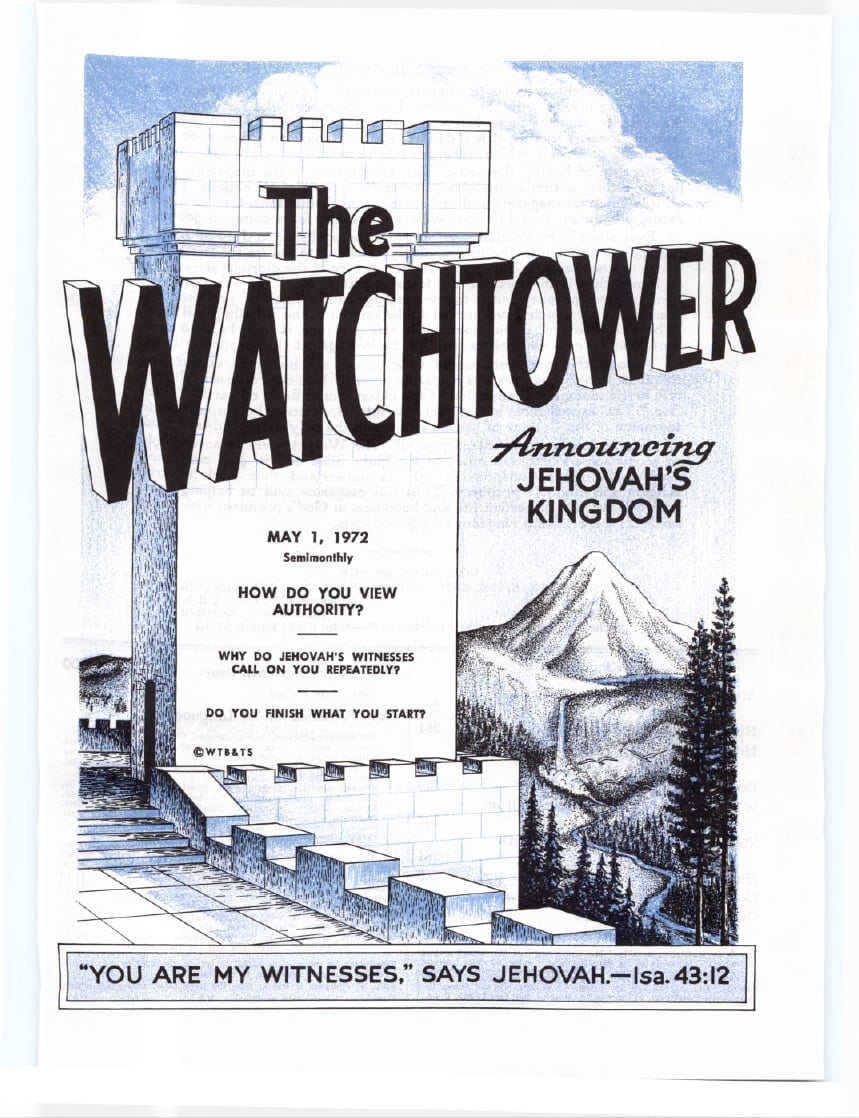
The Watchtower — May 1, 1972
Source: jw.org
Contents
Are You Getting the Happiness You Want?
How Do You View Authority?
How Your View of Authority Affects Your Life
Do You Finish What You Start?
Why Do Jehovah’s Witnesses Call on You Repeatedly?
‘Recommending Ourselves as God’s Ministers’
Humility Urged at Gilead Graduation
Do You Remember?
Questions From Readers
Will Science Ruin Our Environment?
Are You Getting the Happiness You Want?
Are You Getting the Happiness You Want?
WHAT are the things that make people unhappy? Most common is the inability to reach certain goals. Often there is a feeling of failure, resulting in frustration. Perhaps you have experienced this. You will probably agree that, to be fully happy, you must have a purpose in living.
However, a vague idea of your purpose will not bring success. Neither can it succeed if carried out in a haphazard or careless manner. You need “vision,” that is, guidance from a reliable source. All around us we see the results of following human wisdom: disorder, desperation and unrestrained violence. Actually, divine guidance is the only solution. Read how accurately the situation is described in the Bible at Proverbs chapter twenty-nine, verse eighteen.
The Bible tells us that its words are the words of God, and says: “The orders from Jehovah are upright, causing the heart to rejoice; the commandment of Jehovah is clean, making the eyes shine.” (Ps. 19:8) However, some persons are prejudiced against the Bible because of religious hypocrisy. But hypocrites are not following the Bible. If you follow the Bible’s principles, you will find that they are practical. For when put into practice they work.
UNHAPPINESS FROM IGNORING BIBLE STANDARDS
In a world that is quite unhappy, you likely know among your acquaintances some who have unhappy family lives. Doubtless you have observed that selfishness, misunderstanding and neglect have been causes. You see in such families untrained, frustrated, irritated children who have not received the love and direction they so much need.
Today the tendency is to make the family unit unimportant. But in your own experience, are not families much happier where there is family unity, where the parents are real friends to their children and direct them in the right way to go? Who established this wholesome arrangement of the family as the basic unit of society? Man’s Creator, God. And where is it actually a law that the family unit be kept strong? In the Bible.—Gen. 10:31, 32; Deut. 6:6, 7; Eph. 3:14, 15.
Many children, irritated by parental neglect, have turned to drugs and violence. But had the parents only followed the Bible’s principles on marriage and parental love, they might well have avoided such sorrows. Do you think it likely that the children would have gone the way they did if the parents had known and taken seriously the Bible’s advice: “You, fathers, do not be irritating your children, but go on bringing them up in the discipline and mental-regulating of Jehovah”?—Eph. 6:4.
Again, the Bible says: “Even when a person has an abundance his life does not result from the things he possesses.” (Luke 12:15) Today we see family life neglected because both husband and wife work, or husbands have two jobs. They choose to sacrifice family association and spiritual welfare for greater conveniences of life, often to give their children ‘more than they had.’
But does such concentration on material benefits bring happy results? No, it tends toward spiritual bankruptcy. In far too many cases the children, though provided even a college education, find their lives shallow and meaningless and are wholly unsatisfied. How Bible counsel would have benefited these families!
A SUCCESSFUL WAY OF LIFE
If you really take the Bible for what it says, you find that it presents the only practical, reasonable way in all avenues of life. For the Bible tells us how all of us ought to live and behave as humans. One of its writers says: “He has told you, O earthling man, what is good. And what is Jehovah asking back from you but to exercise justice and to love kindness and to be modest in walking with your God?” What could be more reasonable than that? Should not everyone do these things? And if they did so, would not the earth be a happier place to live?—Mic. 6:8.
If you were asked the question, ‘Do you know whether you are living up to really right standards, or not?’ could you sincerely answer Yes? If not, you will delight in looking into the Bible and discovering its pure, beneficial standards. Then you can have real satisfaction and happiness when you begin to check your own ways and find that you conform more and more to God’s standards. It costs something in time and effort, but you will find your life becoming happier day by day.
In making such an investigation of the Bible you cannot rely on things that you have sincerely followed in the past through custom, religious tradition or professional counselors. Otherwise, why would conditions today be so bad, and why would the Bible say: “Quit being fashioned after this system of things, but be transformed by making your mind over, that you may prove to yourselves the good and acceptable and perfect will of God”?—Rom. 12:2.
God’s own Son knew, and he said: “Man must live, not on bread alone, but on every utterance coming forth through Jehovah’s mouth.” (Matt. 4:4) Jehovah’s witnesses have found that, to the extent that they have measured up to the Bible’s standards, they have found happiness, freedom from frustration, a restoration of human dignity and the feeling of fulfillment—a real purpose in life. They feel that their life is more in harmony with the purpose that God had in creating man and woman.
They cannot keep this good news to themselves. They are happy with what they have found and know that others are also seeking happiness. God is not partial. He holds out the same happiness for anyone who sincerely looks into his Word of truth, the Bible.—Acts 10:34, 35.
How Do You View Authority?
How Do You View Authority?
1, 2. (a) How is the common view of authority illustrated? (b) Why is it important to us to examine our own view of authority?
ONE morning in October 1969, the city police in Montreal, Canada, instead of reporting for duty, went to an arena to discuss strike tactics. How would the people of the city react to this sudden absence of police authority? As anticipated, rioting and looting broke out at the hand of thugs, militant students and other opportunists. But what about the ordinary citizen, the person who might be one’s next-door neighbor? An eyewitness reported:
“I don’t mean hoodlums and habitual lawbreakers, I mean just plain people committed offenses they would not dream of trying if there was a policeman standing on the corner. I saw cars driven through red lights. Drivers shot up the wrong side of the street because they realized no one would catch them.”—The New York Times, Friday, October 10, 1969, page 2.
2 Is your view of authority the same as that of these “just plain people”? Is authority just something to tolerate, yet to flout if given the opportunity? ‘Of course not!’ you might respond. But careful self-scrutiny is in order, since one’s thinking and actions may have been influenced in ways one does not realize. To most of today’s generation, “authority” is a word with a distasteful ring; they feel that authority unduly restricts freedom of action that even the most conservative persons would like to have. So we find this generation undermining authority in every conceivable way. It may be in the form of extremely vocal and even violent dissent. Or, it may be the silent, but nonetheless destructive, defiance of authority in areas that may go unobserved, among “just plain people” who make up the majority of today’s society.
3. How do prominent persons speak of the current trends with regard to respect for authority?
3 Dr. Amitai Etzioni, chairman of Columbia University’s Department of Sociology, commented on the “blatant disrespect for authority, any kind of authority, that he sees in many college students,” saying:
“After World War II, something broke down in child-rearing . . . There was a widespread reaction against authoritarianism—an overreaction it seems. . . . Now we have all these children born in the 1940s, grown up, who cannot accept authority in any way—from a teacher, a cop, a judge, even from one another. . . . I also see a danger to the civil order, the very fabric of society.”—The National Observer, Monday, February 2, 1970, page 20.
United States Senator John L. McClellan, during an interview on reasons why crime keeps rising in the land, spoke in a similar vein:
“Another is the general climate in this nation—of civil disobedience, of nonconformity and of disrespect for authority—this so-called philosophy of each ‘doing his own thing’ irrespective of its relation to or impact upon others. A great deal of it is in the nature of rebellion against constituted authority.”— U.S. News & World Report, March 16, 1970, page 18.
4. (a) What is authority? (b) How have some expressed their view of authority?
4 Just what is authority, that it should provoke such increasingly hostile feelings toward it as are to be found on every side today? One dictionary says that it is “power to influence or command thought, opinion, or behavior.” Those in authority, then, influence or command a person’s actions in a course on which he may or may not wish to go. As a result, the exercise of authority has come to be considered by many as contrary to freedom. In the sense of removal of authority, freedom has been cast by some as the ultimate goal toward which men are striving. An American philosopher of the last century, Henry Thoreau, in his essay “Civil Disobedience,” put it this way:
“I heartily accept the motto,—‘That government is best which governs least;’ . . . Carried out, it finally amounts to this, which also I believe,—‘That government is best which governs not at all.”’—Man & The State: The Political Philosophers, page 301.
A modern teen-age film star expressed the same feeling in the vernacular of today: “It’s rotten to take orders from anyone. . . . there are dads who think they have the divine right to rule their offspring simply because they have engendered them.” (New York Sunday News, November 17, 1968) With this kind of thinking becoming the norm rather than the exception, is it any wonder that “the very fabric of society” is in danger?
THE SOURCE OF DISRESPECT FOR AUTHORITY
5. How is the source of disrespect for authority identified?
5 What is causing this powerful movement to throw off the bonds of all authority? A comment in the International Herald Tribune of June 7, 1968, inadvertently refers to the primary source of disrespect for authority: “There is something in the air of the modern world, a defiance of authority, a contageous irresponsibility, a kind of moral delinquency no longer restrained by religious or ethical faith.” This “something in the air” is simply a result of the current activities of what the Bible terms the “ruler of the authority of the air, the spirit that now operates in the sons of disobedience.” (Eph. 2:2) Today’s generation is seeing the abundant fruitage of this one’s work in cultivating disrespect for authority. However, the roots of it go back to this ‘ruler’s’ encounter with the first human pair.
6, 7. (a) How did man’s Creator test the way Adam and Eve viewed his authority? (b) How did Satan break down their respect for authority, and why is knowing this important to us?
6 Since at all costs one should want to avoid being viewed by God as a ‘son of disobedience,’ it is wise to examine the kind of thinking that the “ruler of the authority of the air” has engendered among mankind. This was first illustrated with Adam and Eve, when they were tested as to their view of the Creator’s authority as ruler. God asserted his right to make and enforce laws to govern his creation. He clearly defined the bounds of their freedom. Their obedience would constitute acceptance of his supreme authority or sovereignty over them. He said: “From every tree of the garden you may eat to satisfaction. But as for the tree of the knowledge of good and bad you must not eat from it, for in the day you eat from it you will positively die.”—Gen. 2:16, 17.
7 The one who was later termed the “ruler of the authority of the air” took it upon himself to question Jehovah’s authority. In doing so he became Satan, which means “opposer.” Speaking through a serpent, he questioned Jehovah’s rightful assertion of authority by misrepresenting God’s command. Satan asked Eve: “Is it really so that God said you must not eat from every tree of the garden?” (Gen. 3:1) Eve knew that God had not unduly restricted their freedom by forbidding them to eat from every tree. He had set only a reasonable limitation, just one tree. When Eve indicated that she knew this, Satan went on to charge God with lying to keep the humans under His authority, claiming that their life did not depend on obedience, and, in fact, there would be new vistas of freedom open to them if they defied Jehovah’s rulership. This is the same false premise that Satan continues to use today in leading men from all forms of authority. The course of self-determination and independence is made to appear as enticingly preferable to being governed by the wishes of another. If Satan can make one chafe under authority just a little, then the way is set for more serious rebellion in the future.—Gal. 5:9.
OTHER FACTORS AFFECTING ONE’S VIEW
8. How does example affect one’s view of authority?
8 There are a number of additional factors that may affect one’s view of authority. It is good to be aware of them so they will not turn our thinking in the direction that the rest of this system is going. For instance, there is the poor example set by adults who are in authority or supposed to be upholding it. Civil servants such as the police, teachers and mailmen, parents and even the clergy ostensibly advocate law and order but often they do not want to end their own illegal actions. This has led many persons to conclude that the law is to be obeyed only if it does not result in personal inconvenience or interfere with selfish interests. So we find them evading taxes or customs duties in devious ways, breaking traffic laws when they think they can get away with it, stealing from their employers by “padding” expense accounts or by walking away with company property. They participate in illegal strikes accompanied by name-calling and emotional demonstrating and often involving violence. Adults also often use disparaging terms for law officers and elected officials and even these officials publicly denounce their political opponents in an uncomplimentary fashion, thus setting a poor example for youth. If adults behave this way, is it not to be expected that youthful observers would have little regard for their demands to show respect?—Prov. 26:22.
9. In what ways have men abused their authority?
9 Another factor that influences some in their view of authority is the fact that those in authority often abuse the power they have. The father, the divinely authorized head of the household, can become a tyrant. Public scandal makes us aware of the common practice of bribe taking by police and politicians. (Prov. 29:4) Political leaders frequently mislead the public with statements that are later shown to be untrue, and a “credibility gap” results. Getting a favorable judgment in a court of law is too often only for those who can afford a “good” lawyer, and through the efforts of these unscrupulous lawyers they may even “buy” exemption from punishment for crimes they do commit. Minorities suffer. In other instances, there are clearly wicked men who misuse authority through force, such as Hitler and other despots who have arisen in recent years.
10. How has apathy on the part of authorities encouraged disrespect?
10 Seeing apathy or failure to act on the part of authorities contributes to a feeling of scorn for their double standards of meting out justice. It is a matter of general knowledge that in many countries the underworld of crime is almost immune from criminal prosecution, even being called “untouchable” by the public in the United States. This apathy encourages other persons to a lawless course. Senator McClellan pointed this out in his further comments on why crime keeps rising in the United States: “Crime that goes unpunished breeds crime. . . . the chance of being apprehended, convicted and punished for a serious crime is less than 1 out of 20.” (U.S. News & World Report, March 16, 1970, pages 18, 19) This bears out what the wise King Solomon said: “Because sentence against a bad work has not been executed speedily, that is why the heart of the sons of men has become fully set in them to do bad.”—Eccl. 8:11.
11. What questions does the foregoing raise?
11 In review, we can see that a number of things may affect one’s view of authority. The influence of Satan, man’s own fleshly tendencies, poor human examples, abuse of power and failure to act, all serve to cause persons to develop a feeling of rebellion toward authority. Truly, “man has dominated man to his injury.” (Eccl. 8:9) With such an unpleasant picture of the exercise of authority through the years, many persons use such things to rationalize the course they take in opposition to authority when they break laws or engage in various forms of dissent. But should these things unbalance our view of authority and the purpose it serves? Should they cause us to rebel outspokenly against what we consider to be the wrongs perpetrated on those subject to authority? Should they make us resentful in less obvious ways and ready to disobey authority whenever we think we will not be seen or can “get away with it”?
12. How can we learn the proper view of authority?
12 One thing that should be evident from the observations made thus far is that “it does not belong to man who is walking even to direct his step.” (Jer. 10:23) The Christian must be guided, then, in his view of contemporary authorities, and authority generally, by his Creator. The right view is made clear in two ways: (1) by observing the physical principles demonstrating the value and necessity of authority as found in the laws of creation and (2) by learning right principles provided in the Creator’s written revelation of his view of authority, the Holy Bible. We can here briefly review some of these principles.
RIGHT VIEW OF AUTHORITY SUGGESTED BY CREATION
13. (a) How does your body exercise authority over you? (b) How do you react to your body’s commands?
13 We are governed by certain physical laws that restrict our actions or make us do things. In some cases this is quite forcible. For example, your body ‘influences’ or ‘commands’ you with undeniable authority to take in fuel, food. If you want to stay alive, you must eat. Your body must also rid itself of the wastes produced through its metabolism. It gives one an authoritative command, as it were, to eliminate. Consider your need for sleep, air and water. Your body commands you, and eventually will force you, to obtain these things even though you may desire otherwise. Do you feel that your freedom has been taken away from you because of these things? Are you going to rebel and become violent with your body simply because it exercises a form of authority over you? This would be absurd, would it not? Those who try to violate these physical laws only harm themselves. Yet the proper adherence to them is beneficial and can actually bring pleasure. Who does not enjoy a good night’s sleep? . . . a delicious meal? . . . a cold glass of water on a hot day?
14. Give an example of authority exercised by a law of creation.
14 The same is true of laws outside our bodies and which we must obey. The existence of stairways and elevators is a constant reminder of the power that gravity exerts over us. Would you deny the authority of gravity by stepping out of a tenth-floor window instead of using the stairs? Even though these laws are inflexible and continual in their effect, who can deny that they are really quite beneficial? Gravity holds to the earth its atmosphere, oceans and other things so necessary to life. If we recognize the laws of creation and work in harmony with them, we may find that they can be used for even greater benefit and pleasure. For example, men recognized the authority of the law of gravity, studied it along with other applicable laws, and they eventually developed the airplane. This is not a rebellion against the authority of gravity any more than the existence of birds or flying insects would be considered such. They are merely working in harmony with divinely instituted laws, with benefit to those who recognize them.
15. (a) How is authority demonstrated in the standards of the universe? (b) What are some standards that affect our lives today?
15 Another area in which authority provides real benefit to us is found in the uniformity of the universe. The human body illustrates this. Its organs, with rare exceptions, are always found in the same location, and all of the external body members are arranged symmetrically. Imagine the chaos in the practice of medicine, and especially surgery, if a person’s appendix could not be counted upon to be in the same place as that of others! What if one’s legs were customarily of differing lengths? However, this is not the case. A designer with the authority to do so has already standardized our bodies for us. The Bible psalmist David said in admiration: “And in your book all its parts were down in writing.” (Ps. 139:14-16) It was not left up to us to determine these things. Yet within the bounds of His standards, He has allowed for endless variety and freedom of choice, to our delight. Applying the principle of uniformity to life today, we find benefits and a clear need of some authority to determine standards. There are weights, measures and monetary exchange to be decided, as well as the side of the road on which to drive. It is obvious what would happen if each one were to do as he wished in these matters. The exercise of authority, then, eliminates confusion and provides a measure of safety by setting up certain standards.
16. What are some of the benefits that men gain from the exercise of authority?
16 From our brief review of some laws of creation, we can see that the exercise of authority through them works to keep us alive and makes for orderly existence. It does not inhibit freedom in the true sense when we recognize its direction and work in harmony with it. Authority evident in creation actually contributes to our joy in living.
RIGHT VIEW OF AUTHORITY COMES FROM THE CREATOR
17. What is it in man that makes authority necessary? Illustrate.
17 God’s arrangement of authority to guide intelligent creatures is necessary because he gave them something that only the omnipotent Creator could give, the ability to choose their own direction, a “free will.” He realized that this freedom brings them a choice among alternatives, some of which may not be in the best interests of the one choosing or of others. Therefore, a form of guidance would be necessary so that intelligent creatures might live peacefully and equitably. To illustrate, a man might wish to build his home in a certain beautiful spot, but would his choice infringe on the freedom of others? The spot may have already been selected by someone else, or perhaps it would be a fine location to set aside as a community park for the benefit of everyone in the locality. Clearly there must be a way of deciding what is best for all, since men must exist alongside other men. God’s way of doing this is through the principle of headship.
18. How has Jehovah arranged the exercise of authority? What does this show about Jehovah?
18 The headship principle is illustrated at 1 Corinthians 11:3: “I want you to know that the head of every man is the Christ; in turn the head of a woman is the man; in turn the head of the Christ is God.” When expanded to include all intelligent creatures and their activities, this principle permeates Jehovah’s arrangement for governing the universe, including us here on earth. It demonstrates a warm concern for His creatures, not a disinterested aloofness. It is the concern of a loving father for his children. The apostle Paul wrote: “God is dealing with you as with sons. . . . for whom Jehovah loves he disciplines.” (Heb. 12:6, 7) Jehovah’s exercise of authority may take the form of needed discipline or counsel, just as with a human father who administers these to his children. But it shows that he cares, he is interested and wants the best for the one who receives his direction. And it makes for peaceful relations with God and one’s fellowman, as the apostle goes on to say: “Afterward to those who have been trained by [discipline] it yields peaceable fruit, namely, righteousness.”—Heb. 12:11.
NEED FOR CIVIL AUTHORITY
19. (a) What purpose do civil authorities serve? (b) What things do we receive from civil authorities, and what do we give in return?
19 Even though the full benefit of Jehovah’s arrangement for governing has been temporarily interrupted with respect to earthly government, he acknowledges that some form of authority must exist until his rule is fully restored here. Therefore, we find that Christians are told to “be in subjection and be obedient to [existing civil] governments and authorities as rulers” rather than rebel against them because they have imperfections. (Titus 3:1) These “authorities” help to maintain a measure of order in society, without which chaos from anarchy would reign. In this the authorities reflect the remnants of man’s God-given conscience. (Rom. 2:14, 15) They have the necessary authority to sustain some degree of order in areas such as public services (sanitation, water supply, mail, highway construction, education); crime, fire and judicial protection; government relief measures and safety legislation (construction, fire prevention, sanitation, pollution, food, drug, traffic). In recognition of these benefits, the Christian gives the secular authorities relative subjection and taxes. (Rom. 13:6, 7; Mark 12:17) As a result, he can, for the most part, “go on leading a calm and quiet life with full godly devotion and seriousness” under men “who are in high station,” the governmental authorities.—1 Tim. 2:2.
20. How does the mature Christian view authority?
20 So what is the mature Christian’s view of authority? First, he appreciates that it is necessary to all aspects of his existence. He sees in the Creator’s exercise of it a loving interest in the welfare of His creatures. He recognizes secular authorities now as serving in the Creator’s overall purpose and that they “stand placed in their relative positions by God.” (Rom. 13:1, 2; John 19:11) He realizes that it is necessary to render relative subjection to the authority exerted by those in various phases of secular life—the teacher, the employer, the policeman, the judge and the tax collector. He continues to maintain this Godly viewpoint despite apparent abuses or shortcomings of present authorities, realizing “one that is higher than the high one is watching, and there are those who are high above them.” (Eccl. 5:8; Prov. 15:3) He remains confident that Jehovah’s will is to exert his loving authority through “an administration at the full limit of the appointed times.” (Eph. 1:10) He looks to the time when “all authority . . . in heaven and on the earth” will be administered by Jesus through faithful Christian servants like those who are working hard now among him and his Christian brothers.—Matt. 28:18.
[Box/Pictures on page 266]
In recognition of the benefits provided by secular authorities, the Christian gives them relative subjection and taxes
Mail Delivery
Water Distribution
Police Protection
Sanitation
Fire Fighting
Education
[Picture on page 264]
Your body ‘commands’ you to eat and sleep. Are you going to rebel because of its authority over you?
How Your View of Authority Affects Your Life
How Your View of Authority Affects Your Life
1. To what extent is your life affected by your view of authority, and how can you appraise what your view is?
THE majority of your relationships with other persons and the happiness you achieve from them are affected by the way you view authority. This affects family, religious and secular associations that cover almost every hour of every day. The important thing to remember in these relationships is not just that you recognize authority, but how you view that authority. Do you see it as necessary and in many cases a loving provision for your benefit? Or do you look upon it as something to be circumvented if it becomes inconvenient or contrary to what you would like? You can obtain a clear appraisal of your view of authority by briefly reviewing the areas of your life that are affected, considering situations that may arise as a result of the way you view it. These relationships can be broadly divided into two groupings, those outside and those inside the Christian congregation. We will review them in turn.
GOVERNMENTAL AUTHORITY
2. (a) How does one’s view of governmental authority become evident? (b) What is the proper way to view such authorities?
2 Your view of governmental authority usually is shown by the way you view representatives of the government under which you live. You may come in contact with representatives such as policemen, judges, government officials, tax collectors or teachers. In dealing with such authorities outside the Christian congregation, the proper view is reflected by recognition and acceptance of the principle of relative subjection. There is a common tendency to see the authorities as being inherently bad and thus disrespect them. This disrespect often becomes evident in one’s failure to obey what seem to be unnecessary or unjust laws such as certain traffic regulations, or one’s engaging in “little” dishonesties in connection with customs and taxes. Or it may take the form of using derogatory slang names for policemen and other representatives of the government. With respect to this latter practice, it is interesting to note what Solomon advised Jews under the kingdom of Israel: “Even in your bedroom do not call down evil upon the king himself.” (Eccl. 10:20; Acts 23:5) And Peter showed that Christians ought to apply this principle to secular rulers today: “Honor men of all sorts, . . . have honor for the king.”—1 Pet. 2:17.
3. Why is it important to develop the proper view of governmental authority now?
3 Why is this so important, since these authorities are part of a passing system? It is because of the view or mental outlook toward authority that it cultivates, not only in ourselves, but also in our children and those with whom we associate. The existing governmental authorities are now acting as “God’s minister to you for your good,” and must be viewed in this light, however imperfect the individual administrators may be. To take a position against them in even small matters would be to take “a stand against the arrangement of God” for our time. (Rom. 13:2, 4) In Jehovah’s new order, we will need the right view of the authority that will be taken over by the Kingdom government, no doubt through earthly administrators. At that time these may have to handle much of what we now consider to be secular functions. It would certainly be unwise to carry over an attitude of disrespect for men appointed to administer these things under God’s government.
4. Give an example of how to maintain a balanced view of secular authority without compromising Christian principles.
4 Even in areas where secular authority and God’s authority seem to be in conflict, it is wise to show respect for governmental authority to the extent possible. For example, your child may attend a school where the educational authority requires children to learn about the theory of evolution. Would it be proper to speak slightingly of the teacher to your child and thus cultivate in him disrespect for this authority? No, instead, you might explain that a Christian could show proper respect for authority by listening to what is taught, recognizing that the teacher is required to teach the subject. You could also point out that this does not mean that a person has to believe everything he hears, any more than he has to agree with the views of the political party in power merely because it exercises authority over him. (Prov. 14:15) A proper, balanced view of the teacher’s authority is thus maintained without compromising Christian principles.
5. Is it wise to get involved with rebellion against existing authorities, and why?
5 It is also unwise for one to be taken up by the current trends toward dissent against the existing civil authorities. Proverbs 24:21, 22 speaks about “those who are for a change” from the administration of Jehovah’s anointed king. The advice given is: “With those . . . do not intermeddle. For their disaster will arise so suddenly, that who is aware of the extinction of those who are for a change?” This principle could certainly be applied by Christians faced with the modern rebellion against authority, which rebellion often takes the form of violence. The ones hurt most are usually the rioters themselves. The Christian will wait on Jehovah to remedy mankind’s ills when His kingdom “stone . . . cut out not by hands” strikes and crushes “all these kingdoms” without any overt acts on our part.—Dan. 2:34, 44.
EMPLOYMENT
6. (a) How do some view the authority of their employer? (b) Can such a view be justified? Why?
6 Often in this old system of things the policy is to do as little as possible for one’s secular employer, just enough to “get by.” Sometimes employees are heard to brag about how little they can do on the job and “get away with it.” One who knows what the Bible indicates about the near future might even rationalize: “The business will soon be destroyed at Armageddon anyway, so why work hard to perpetuate it?” He may even use such specious reasoning to condone spending time when he is unobserved to do other things, such as prepare a Bible talk or preach to other employees during hours he has agreed to work for his employer. He ought to ask himself: “Is this honest? Is it fair to my employer? If I asked my employer if I could do these things, what would his reply be?” Whether the employer is himself dishonest or unfair does not enter into the matter. Any activity beyond what you have agreed with your employer to do during the time he is paying you would make your view of his authority suspect. A person who does these things would not like to think of himself as a thief, but do his actions not amount to taking dishonestly time for which the employer is paying?—Heb. 13:18.
7. (a) How are some influenced by others on the job? Illustrate. (b) How is the proper view of authority in employment displayed?
7 Another related matter that is good to think about is this: “Have I let other employees influence my view of the employer’s authority? Do I follow their bad habits of coming to work late, stopping early or just ‘loafing’?” The Bible’s counsel respecting a person’s relationship to his “owner” or employer is: “Please them well, . . . not committing theft, but exhibiting good fidelity to the full, so that [the Christians] may adorn the teaching of our Savior, God, in all things.” (Titus 2:9, 10; Col. 3:22, 23) One can ‘commit theft’ in ways other than taking money or things from one’s employer, as shown above. Also, if, without the knowledge of one’s employer, one takes off paid “sick leave” when really not ill, one is showing disrespect for the employer’s authority as well as Jehovah’s laws on lying and theft. In these things considered “little” by employees in general, one can reflect on one’s view of authority and whether one has the Christian traits that Jehovah desires of those who will live in His new order. One can show one’s proper view of authority by finding joy in accomplishment, mastering one’s job and becoming efficient at it, thus developing good habits for the future when one will be under the authority of Jehovah’s righteous overseers.
FAMILY AUTHORITY
8. (a) Whose responsibility is a child’s view of authority? (b) Is it easier to be a parent who is lax in administering discipline?
8 Moving on to relationships inside the congregation, we come to that between parent and child. With regard to parental authority, it is not up to the child to develop the proper view on his own. Parents must take the initiative, especially in the child’s early formative years. This means to do as the Proverb (Pr 13:24) advises: “The one loving [his son] is he that does look for him with discipline.” When discipline is needed, following through every time with well-thought-out correction and counsel usually creates in children a fine respect for parental authority. However, to many parents, this seems just too much effort to make when they want rest from the cares that come with the other aspects of their lives. The farsighted parent, though, sees beyond the immediate work of disciplining his child. He sees the heartwarming benefits that a child who has developed the proper view of authority can bring to all the family. Solomon said: “Chastise your son and he will bring you rest and give much pleasure to your soul.” (Prov. 29:17) So a child will actually prove to be a source of refreshment and less work for the parent who is willing to put forth the effort in early stages to instill in him a deep respect for parental authority.
9. (a) Do children appreciate parents who do not exercise authority? (b) How far-reaching is parents’ cultivation of respect for authority in children?
9 The parent who indulges his child, letting him have his own way rather than exerting parental authority where called for will find this result to be true: “If one is pampering one’s servant from youth on, in his later life he will even become a thankless one.” (Prov. 29:21) Youths have meager thanks to give a parent who does not show enough interest to give of himself with discipline rather than of his pocketbook with material things. You parents are largely responsible for your child’s view of authority and there is little sympathy to be found in God’s Word for those who say: “I just can’t control my child.” Youths’ view of parental authority has a profound effect on the way they view authority outside the family as well; thus parents should consider carefully the next time they would rather “rest” than administer needed discipline.
10. How can a Christian wife enhance her children’s view of authority, and with what benefits to herself?
10 Another thing that strongly affects youths’ view of authority is what they observe of the way parents display their own view in application of the headship principle. (1 Cor. 11:3) Does your husband constantly say when his child asks for a decision on something: “Go ask your mother”? Are you a wife who usually operates independently of her husband, exercising all the authority with the children so that they come to you with almost everything instead of going to their father? You may find that this will contribute to the above attitude in your husband, or perhaps it will cause him to become resentful of your taking over the father’s rightful authority. Try directing the children to their father on the more important issues. In many cases it will bring a threefold benefit—he will find a feeling of accomplishment in fulfilling his proper role as head, you will have the satisfaction of having a husband who really is the “head of the house” and the children will grow up with the proper view of authority. They will see parental authority as a stable and united front, worthy of their respect.
11. (a) What problem may arise with regard to a wife’s respect for her husband’s authority? (b) How will the wise wife handle the situation?
11 One of the biggest problems a wife may have with regard to family authority is in the case where she has the more dominant or capable personality. Perhaps she finds it difficult to maintain the proper view of her husband’s authority if he does not measure up to her expectations. Two courses are open to her. She may take over his authority, though this is contrary to God’s instruction, or she may show that she has the right view of authority, whether the authority meets up with her expectations or not. The wife who takes the latter course and lovingly looks to her husband for decisions will find herself much happier than if she tried to take over from him. By her humble and tactful consideration of him, he may even increase in the qualities necessary to the exercise of authority. This will enhance the other qualities that caused her to love him in the first place, making for a happy relationship not possible without the Bible’s wise counsel. (Eph. 5:33) Even in situations that seem to test the wife’s respect to the limit, if she has the proper view of authority, she will not at once assume that her case is the exception. She will first examine herself and endeavor to apply the sound principles of God’s Word and the suggestions of His servants.
CONGREGATIONAL AUTHORITY
12. How is the arrangement of authority in the Christian congregation to be viewed by women who are part of it?
12 Somewhat similar to the authority of male over female in marriage, in the Christian congregation the man also has certain authority over the woman. This is sometimes difficult to accept for the woman who has been “emancipated” in modern society. The majority of those in Jehovah’s organization are women, and for them to assent to male authority is a testimony to the way Jehovah’s Word can work. A woman coming into this organization who has a secular job where she has authority over a large number of others, including men, may find it difficult to restrain herself in the presence of a male who is not so able to direct others as she is. However, if she continues to accept her place in Jehovah’s arrangement and see in it His way, she will make a valuable contribution to the peace and harmony of the congregation.—1 Tim. 2:12.
13. When the individual disagrees with the decisions of those in authority, how should he view the situation?
13 Thoughts or actions to the effect that one is superior in ability or judgment to the one in authority can result in frustration to the individual and dissension in the congregation. But what if we find it difficult to submit to a certain decision or way of doing things set out by the overseer in authority? Rather than brooding over it or trying to make others see how wrong it is, display the proper view by accepting the direction of the one who has the appointed authority to handle the matter. Even if your judgment is better in this one case, are you better qualified or willing to handle his position in other respects? Then, too, one could be mistaken. Sometimes a seemingly wrong course turns out to be right in the outcome, perhaps through Jehovah’s direction.
14. What can one do to help persons who complain against the decisions of the appointed overseer?
14 And if someone should try to stir up sentiment ‘for a change,’ by word and deed help him to get the proper view of authority. Then the one presiding ‘will not have to act with severity according to the authority he has, to build up and not to tear down.’ (2 Cor. 13:10; Heb. 13:17) The peace and harmony that come to the congregation when those in it have the proper view of authority is far more important than doing things in the most “efficient” way. If we have a suggestion that we are sure is important enough for consideration, it is best to wait for the proper time and in the right manner present it to the one with authority to handle it, just as Queen Esther did in ancient times.—Esther 4:11; 5:1, 2; 7:1-3.
15. How should we view the authority of the visible governing body of Jehovah’s organization?
15 The visible governing body of Jehovah’s organization has also been given authority by Him to direct the work of His worshipers on earth at this time. (Matt. 24:45-47) The congregation and its overseers show their proper view of authority by accepting willingly its counsel provided through the printed page, letters or its traveling representatives. Sometimes there is a tendency to doubt the fitness of certain counsel, perhaps about the matter of dress or hairstyle, regarding it as an undue invasion of privacy and one’s “freedom.” Yet one with the proper view of authority will realize the concern Jehovah’s organization has for the way God is represented to the world through us. (1 Cor. 4:9) He will view the instructions, not as arbitrary rules, but as an evidence of Jehovah’s loving interest in his worshipers.—Prov. 3:12.
16. How have some been affected by progressive dispensation of spiritual food, but what is the right view?
16 Sometimes persons speak against the understanding of certain Scriptural teachings that the Watch Tower Society has set forth. For example, there were those who had difficulty accepting the change of understanding regarding the “superior authorities” of Romans 13:1. Some even stumbled from their dedicated relationship to Jehovah over this matter. They did not have the proper view of the authority of Jehovah’s organization for providing spiritual “food at the proper time.” When some of the disciples had difficulty accepting what Jesus was teaching on one point, saying: “This speech is shocking; who can listen to it?” they “went off to the things behind and would no longer walk with him.” Peter, with the right view of Jesus’ teaching authority, realized there was no other place to go for truth and so remained in the way of life.—John 6:60, 66-69.
JEHOVAH’S AUTHORITY
17. How does one show one’s acceptance of Jehovah’s authority?
17 The most important relationship that one has is with one’s Creator through dedication. This, too, is affected by the way we view authority. Do we accept Jehovah as the one “searching the heart” and therefore ‘in all our ways take notice of him’? (Jer. 17:10; Prov. 3:6) The way we can show respect for Jehovah’s authority in this personal dedicated relationship is by obedience, especially in areas that may be unobserved by others. Such things as self-abuse and wrong or immoral thinking can be controlled when we have the proper view of Jehovah’s authority. This will demonstrate how seriously we take our unique relationship with Him. We will be constantly conscious of his loving interest in us and accept the guidance of his authority in our lives. We will fear to violate his laws, not because of reprisals, but because we realize he knows what is best for us and that any other course would be to our harm.
18. Illustrate how one’s view of Jehovah’s authority may be tested, explaining the proper view in this case.
18 One situation that is particularly difficult for some is when they “fall in love” with someone who is not dedicated to Jehovah. This is especially true where there are few potential marriage mates for one among those serving God. The question of how we view Jehovah’s authority in this matter where powerful emotions are involved becomes a very real one. One’s desire for “freedom” in this area could set in motion the chain of events that has drawn many back into the old system in bondage to a mate who has no respect for Jehovah’s authority or his righteous principles. Those with the proper view will not find themselves in this situation, because they see Jehovah’s counsel in such matters not as just authority speaking, but as based on a loving interest in what is best for his worshipers, eternally. They will be content to wait until the situation can be remedied in Jehovah’s way and due time.
AUTHORITY IN THE NEW ORDER
19. When is the time to cultivate the proper view of authority, and why?
19 Now is the time to begin molding our thinking with respect to authority for the new order. There is no reason to believe that Jehovah will change his way of dealing with men. He will no doubt use his representatives to administer the operation of earthly activities. Do you find it difficult to accept the authority of these representatives in a spiritual way now? Then how will you react if directed by them at that time to care for some mundane responsibility such as collecting the garbage?
20. How may our view of authority be important to us in the future, and of what is this view a reflection?
20 Remember, it was on this matter of respect for authority that the first man was tested and it may be that at the end of Christ’s thousand-year reign this principle will also be involved in the final test. This could be indicated by the fact that there would be “nations in the four corners of the earth” that would be led to attack Jehovah’s authority as represented by the “camp of the holy ones and the beloved city.” (Rev. 20:8, 9) Our view of authority is really a reflection of our understanding, our appreciation of Jehovah’s purpose in all its connected parts. When a person lacks understanding, then he becomes “like a horse or mule without understanding, whose spiritedness is to be curbed even by bridle or halter.” (Ps. 32:9) Rather than be curbed at Armageddon or later, it is wise to develop and display understanding with respect to authority so we will be the kind of persons Jehovah wants in his new order of righteousness. Then we will work in harmony with his direction through Christ’s Kingdom reign and make our peaceful Paradise earth a grand testimony to the benefits that come when we have the right view of authority.
[Picture on page 269]
Do you respect the authority of your employer, or do you do as little as you think you can get away with?
[Picture on page 270]
A child will be a source of refreshment and less work to the parent who instills in him a deep respect for parental authority
Do You Finish What You Start?
Do You Finish What You Start?
Helpful facts that young people want to know
MUCH of human happiness comes through accomplishment. The person who decides to learn to play a musical instrument, and stays with it until he can, gets enjoyment from it. The one who quits soon after starting never gets that joy.
The same is true of manual arts, woodworking, carpentering, mechanics, sewing, or projects of a mental kind, such as learning a language or mathematics. In any undertaking, assignment or job, if you see it through, you will get satisfaction and pleasure from it.
However, in this matter of finishing what we start, we all have certain tendencies we have to outgrow or overcome.
WHERE THE PROBLEM LIES
For example, in our first few years as children we had a very limited attention span. Even in play a small child’s attention does not stay fixed very long; it is easily distracted.
As we grow, our powers of concentration develop. But to a large degree we have to cultivate these. It is worth it because this can change learning from a painful chore to something bringing enjoyment.
The ability to concentrate requires that we overcome another trait characteristic of small children: impatience. Children usually want things NOW! And when they try to do something and do not succeed in a few attempts, they generally are ready to quit. Appreciating that some of the most worthwhile things in life take considerable time and effort to attain will help you not to give up easily.
Another trait to be overcome is that of undertaking things hastily, just on impulse. Proverbs 21:5 tells us: “The plans of the diligent one surely make for advantage, but everyone that is hasty surely heads for want.” So, before you embark on some project or accept some assignment or job, first of all make sure it is something genuinely worth while.
In some cases the wise thing to do is not to finish what you start. How so? Because sometimes it was a bad idea from the beginning. The goal may be a wrong one, one that is out of harmony with right principles and the counsel of God’s Word.
On the other hand, the goal may not be bad in itself, but is it a good one for you? And is it worth the time and effort it is going to take to reach it? Do you have good reason to believe you can reach it?
Jesus told of the man who sets out to build a tower without first figuring out the cost and whether he can meet it or not. As Jesus said, the man may lay the foundation and then find that he can go no farther, causing observers to laugh and say, “This man started to build but was not able to finish.” (Luke 14:28-30) So, if you want to finish what you start, count the cost beforehand.
Weigh advantages against disadvantages. Ask others their opinion, especially your parents. Benefit from their experience; they have made mistakes and can steer you away from these. The Bible is an outstanding source of wise and practical counsel. King Solomon, for example, did about all a man can do in the way of seeking pleasure in purely material things. He gives us the result: It was just “a striving after wind.” So, why should we take up a similar worthless pursuit?—Eccl. 2:3-11; compare 1 Timothy 6:17-19.
Confidence that your goal is really worth while can keep you from quitting. Planning how to reach that goal is also vital. What steps or methods will you use?
Many young persons fail to finish what they start because they become discouraged. They find that what they undertook is harder than they thought it would be. Or some unforeseen, and perhaps unforeseeable, problems or obstacles spring up. What now?
It is easy to quit. But this situation reveals what a person is really made of.
If you let hardships fill you with negative and pessimistic thoughts, this will rob you of the strength to go on. Proverbs 24:10 says: “Have you shown yourself discouraged in the day of distress? Your power will be scanty.” Instead, look on the situation as a challenge. Rise to meet it with extra effort—extra thought, energy and time. Challenges can make life interesting if we do not run away from them. By overcoming, you grow in confidence and resourcefulness. You can then undertake future tasks with greater assurance and enjoyment.
So avoid developing a wrong habit or personality pattern of quitting just because the going gets hard. Otherwise, the next time things get difficult, your tendency will be to do the same, “throw in the towel,” quit. By not letting this habit get a start, you can keep your life from becoming just a series of failures and unfinished projects.
GOD VALUES THOSE WHO PERSEVERE
The Bible shows that God expects his servants to show determination, stick-to-itiveness. Consider Noah. The ark that he and his sons built was a three-story chestlike structure half again as long as a football field. It was no “weekend project.” But because he saw the job through to its finish, Noah and his family survived the Deluge and we, his descendants, are alive today.
Among Christians, the apostle Paul gives us a real example of tenacity and resourcefulness. To him, his particular assignment or ministry was a treasure, worth enduring all manner of hardship to retain. He was willing to undergo tribulations, cases of need, beatings, stoning, imprisonment, hard labor, sleepless nights, thirst, hunger, cold and lack of clothing, being falsely accused, experiencing dangers, not only from enemies of the truth but also from common criminals and even wild beasts and the forces of nature, as he traveled over land and sea. (2 Cor. 6:3-10; 11:23-28) Because he was not a quitter, he could truthfully say he had ‘fought the fine fight, run the course to the finish, observed the faith.’ He was confident of coming off victorious and receiving the promised reward. (2 Tim. 4:6-8; Rom. 8:35-39) Would not you say he was a worthwhile person to imitate?
DEVELOPING PERSEVERANCE IN YOUTH
Youth is the time to begin building a pattern of perseverance, of seeing things through to their finish. In school, some courses are easier, some appeal to you more than others. But if you work just as hard or even harder at those you do not like so well, you get double benefit. You not only get knowledge but also strengthen your powers of concentration and determination. Some educators say that the most valuable thing any of us get from school is learning how to study, how to apply ourselves, to dig out information, get the sense of it and make it our own.
So, too, with any jobs you take on outside of school. Some jobs appeal, some do not. But you can learn something from any job. Do not look just at the surface or immediate benefits a job may give in training, abilities to be acquired, or pay. Think also of the molding effect it can have on you as a person. Even a simple, low-paying, laborious job can do a lot in maturing you and developing your strength of personality.
Learn perseverance too in personal relations. To be really happy we must be able to get along well with others, work effectively with others and get their cooperation, gain their respect, and feel we are appreciated by others. You cannot do this if you are quick to “give up on” people, initiating friendships and then dropping them at the first sign of disagreement or letting friction break up work arrangements with others. Examine yourself. Do you not sometimes give offense to others? Do you give up on yourself? Then why be quick to give up on others? Take the time needed to work out problems with patience and determination, building along positive lines, using thought and resourcefulness. (Compare Proverbs 14:29; 2 Timothy 2:23, 24.) Being able to do this is what spells the difference between success and failure in most marriages.
If you prove that you are not one who gives up easily, not a quitter or a dropout, you will earn the confidence and respect of others. While yet a young man, Timothy was “well reported on by the brothers” in two different towns. (Acts 16:2) That is why the apostle Paul selected him as a traveling companion. Timothy had unique privileges, going with the apostle throughout many parts of the Roman Empire. After about a dozen years of faithful service, he was entrusted with weighty responsibility, was authorized to appoint overseers in congregations. (Phil. 2:19-22; 1 Cor. 4:17; 1 Tim. 3:1-15) He did not have the best of health. (1 Tim. 5:23) But he heeded the apostle’s exhortation to “stay by” the things learned, to ‘accomplish fully’ the particular ministry assigned him, both in favorable season and in troublesome season, proving himself a real soldier of Christ Jesus, willing to endure hardships and unpleasantness. (1 Tim. 4:11-16; 2 Tim. 4:2-5; 2:3) Yes Timothy could be relied on to stay with his assignment and do thorough work. He was a man to be trusted. But it took time and perseverance to merit that trust.
Yes, by proving yourself a person who sees things through, you can gain many privileges and benefits. Really, life itself is at stake in this matter. Jesus said of those following him: “He that has endured to the end is the one that will be saved.” (Matt. 24:13) We are in a race for life everlasting as persons enjoying God’s approval. We will gain that prize only if we develop the ability to see things through, proving our mettle in the face of problems and hardships. By finishing what we start in smaller things, we can persevere in the bigger ones too.—Luke 16:10; 1 Cor. 9:24-27; 2 Tim. 2:5.
So “whatever you are doing, work at it whole-souled as to Jehovah, and not to men,” for it is from God that you will receive the reward that really counts.—Col. 3:23, 24.
Why Do Jehovah’s Witnesses Call on You Repeatedly?
Why Do Jehovah’s Witnesses Call on You Repeatedly?
WHEN you are busy, or you feel like relaxing and being left alone, it is disconcerting when you hear a knock at your door. Visions of unexpected guests, or of a salesman pressuring you to buy his product, make you reluctant to answer. Or perhaps you are afraid of being robbed or injured.
But the call that Jehovah’s witnesses make is a different type of call. They know, of course, that you may be busy, or even afraid. But they feel impelled to call because of a danger on the horizon that you may have been too busy to recognize. (See Luke 21:34-36.) Jehovah’s witnesses truly call out of love and consideration for you. They believe that your life is in danger.
…