The Watchtower, November 15, 1971
Download: PDF — The Watchtower, November 15, 1971
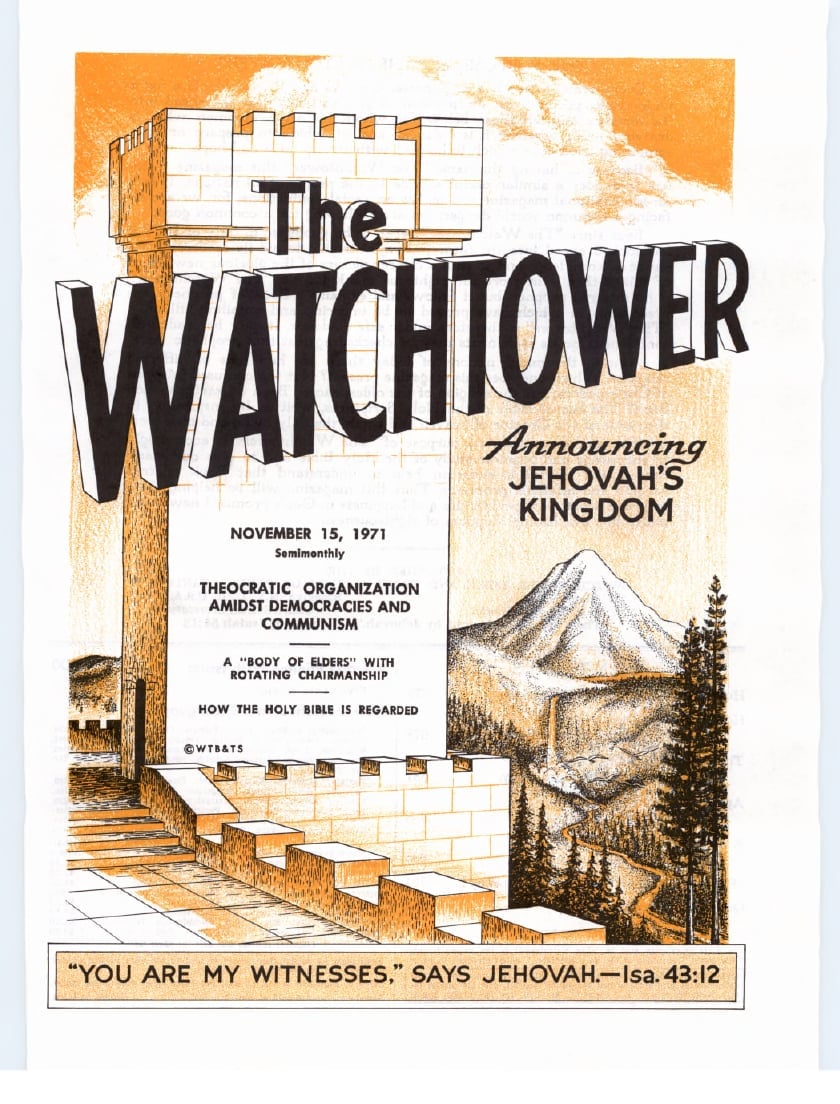
The Watchtower — November 15, 1971
Source: jw.org
Contents
How the Holy Bible Is Regarded
How Precious Are Christian Meetings to You?
Theocratic Organization Amidst Democracies and Communism
Appointed Officers in the Theocratic Organization
A “Body of Elders” with Rotating Chairmanship
“Preach the Word”—Where and Why?
Questions From Readers
Teaching Begins in Infancy
How the Holy Bible Is Regarded
How the Holy Bible Is Regarded
THERE are many religions in Christendom, the realm where the Bible has been most widely circulated. And today some people say, “It doesn’t matter much which church you go to. They’re all teaching the Good Book, the Bible.” But are they?
Agreed that all of Christendom’s churches use the Bible. But how do they regard it? Do church leaders really accept it as the inspired Word of God, reliable and true, free from error? Do they teach their church members that the Bible contains divine standards by which people must abide if they want life? Let us see.
MODERN RELIGIOUS ATTITUDE
Consider first the attitude toward the Bible in religious seminaries where future ministers are taught and trained. Religious editor Louis Cassels quotes Presbyterian theologian John R. Bodo as saying that a young man “should have a shockproof faith” if he decides to attend a seminary. Why? Because of the erosion of faith that often results. As Cassels goes on to say: “The more famous the seminary, the more corrosive the atmosphere of skepticism pervading its faculty and student body is apt to be.”
An evidence of the degree of skepticism is seen in the statement by the dean of a very prominent Episcopalian seminary that ‘very few of his students engaged in private prayer.’ The reason: ‘most of them didn’t believe in the kind of personal God to whom one might pray’!
Perhaps you find this strange, rather difficult to believe. Well, remembering that Jesus said that a ‘tree is known by its fruits’ (Matt. 7:16-20), consider some of the fruitage of these seminaries: the ministers they have produced.
Under the heading “What Is Faith?” an article in the Los Angeles Herald-Examiner (January 24, 1968) discusses a survey made of 3,000 Protestant ministers throughout the United States. What did it show? The article says: “A majority of the younger clergymen could not be said to believe any longer in the virgin birth, or to regard Jesus as divine in the traditional way in which most older Protestants were brought up. And the Bible had lost stature: ‘The Bible is not only not to be taken literally—less than five per cent of the whole sample did so—but also there is little specific guidance in it for specific problems,’ the surveyors concluded.”
Illustrating the lack of faith in the Bible’s divine inspiration, a leading American Protestant weekly, The Christian Century (August 19, 1970), carried an article by United Presbyterian clergyman Dr. R. E. Willis. He accused the Bible of containing anti-Semitic passages and says these portions will have to be “branded as enemies of the truth of God.” “To achieve this aim,” this minister continues, “the church will need to develop a description of the truth of God that is not slavishly dependent on accepting the New Testament in toto as the Word of God.”
But is this attitude only characteristic of Protestant faiths? Evidently not. The Morning Record of Meriden, Connecticut (March 26, 1970), reports on a talk given by priest Edward J. McLean of the Hartford Catholic Information Center. Among other things, the priest is quoted as saying, “The story of Adam and Eve is not an historical account of human origins . . . It’s a theological account, an allegory or literary form.” The ‘stories of Paradise, Noah and the tower of Babel were meant to be interpreted the same way,’ according to this Catholic clergyman.
Another source, the Daily Oklahoman of April 30, 1971, reports on the views of Dr. Gregory Baum, a leading Catholic theologian. He is quoted as saying that ‘more and more religious people are turning from the “invisible friend” kind of God that many find they can no longer talk to, and are beginning to find the new God in their everyday experiences.’ This “new God,” according to the Catholic theologian, will be found ‘through self-knowledge, through talking with other people and deciding through political and social growth what is right and what is wrong.’ No longer, he says, will there be ‘specific doctrines’ imposed on church members. Where does this leave the Bible with its revelation of God and its specific doctrines?
THE “FUNDAMENTALIST” VIEW
True, not all of Christendom’s churches and religious leaders regard the Bible in these ways. Some, such as the so-called “Fundamentalist” churches, still claim to accept the entire Bible as inspired. But what of the doctrines in their church creeds? For example, the Bible states: “The soul that sinneth, it shall die.” (Ezek. 18:4, Authorized Version) Do these churches teach that? Or do they teach that the human soul is immortal?
The Bible says that “the wages of sin is death,” and that the “dead know not any thing.” (Rom. 6:23; Eccl. 9:5, AV) Is this the doctrine of these churches? Or do they teach that the wages of sin is eternal fiery torment in conscious suffering?
Jesus is quoted in the Bible as saying: “My Father is greater than I.” (John 14:28, AV) Is that what these churches teach? Or do they present Jesus as part of a trinity, as “coequal and coeternal” with his Father? What does your own church teach? Have you ever investigated?
THE VIEW OF JEHOVAH’S WITNESSES
What is the viewpoint of the Christian congregation of Jehovah’s witnesses toward the Bible? Does it compare with that of the modernist clergy who doubt the complete inspiration of the Bible? Or is it like that of the “Fundamentalist” churches? Neither.
Jehovah’s witnesses accept the entire Bible as inspired of God. Rather than skepticism, they have full confidence and conviction as to its truthfulness. One reason why is that they have found that its counsel works, that by applying Bible principles and teachings in their daily lives they have the way to solve their problems and lead happy, fruitful lives. Yes, they have proved that, as the psalmist said to God, “your word is a lamp to my foot, and a light to my roadway.”—Ps. 119:105.
These Christian witnesses find that the Bible’s revelation of God and of his grand purposes for mankind is one of the most convincing proofs of its authenticity and divine inspiration. Though once discouraged by the frustration of trying to find God and to make real meaning out of life simply through “self-knowledge” and political and social activity, they now see how the Bible’s prophecies marvelously illuminate the happenings of our day and point to a righteous new order of God’s making.
While recognizing that the Bible contains parables and expressions that are symbolic and figurative, Jehovah’s witnesses do not try to ‘water down’ other parts obviously meant to be taken literally. They accept the Bible’s history as authentic, not mere allegory. They agree with Jesus and his apostles as to the factualness of the Bible’s account of the creation of man in Eden, the coming of the Flood and other historic events. (Matt. 19:4-6; 24:37-39; 1 Cor. 15:45-48; 2 Pet. 2:5) They have only one creed: the Bible itself, and they do not try to alter its teachings to conform to creedal teachings of a trinity of deities, inherent immortality of the soul, or eternal torment.
Stop and think. If a person doubts your word, doubts its truthfulness, is this not an insult to your integrity? If a person misrepresents your word or advocates things contrary to it while pretending to accept it, is this not treachery, a hypocrisy that you find disgusting? Then, if, with regard to God’s Word, Christendom’s churches are guilty of either of these courses, do you believe that God is pleased with those churches? Will he be pleased with you if you associate with and support such churches? Or should you now be looking for and associating with those who firmly and honestly support, teach and live by God’s Word, the Bible?
[Box on page 677]
JEHOVAH’S WITNESSES—Their Teachings and Practices
They really believe the Bible and endeavor to live by it, using it as their guide in all matters of life.—2 Tim. 3:16, 17.
There is no clergy-laity distinction among them.—Mark 10:42-45.
Their religion is not a set of rituals but a way of life.—Rom. 12:1, 2.
They keep free from racial discrimination.—Acts 17:26; 10:34, 35.
They insist on honesty and moral cleanness.—1 Pet. 1:14-16; 4:3, 4.
“Perhaps the most notable thing about the Witnesses is their insistence upon their primary allegiance to God, before any other power in the world.”—“These Also Believe,” C. S. Braden (Acts 5:29).
They honor and respect and use God’s own name, Jehovah.—Ps. 83:18.
They believe that Jesus Christ is truly God’s Son and that all hope for future life is dependent on faith in him.—Acts 4:12.
Instead of warring against their fellowman, they have in every country ‘beaten their swords into plowshares . . . neither will they learn war anymore.’—Isa. 2:4.
They believe that in the very near future God’s kingdom will destroy the present wicked system and will transform this earth into a Paradise.—Dan. 2:44; Luke 23:43.
Each Witness has a part in sharing the good news from God’s Word with others. They are active today in 206 lands.—Matt. 28:19, 20.
How Precious Are Christian Meetings to You?
How Precious Are Christian Meetings to You?
IT WAS midwinter and the temperature was below zero. But that did not prevent a Christian mother living in Wisconsin from starting out on foot on an eight-mile walk to town with four of her children. Happily for her, after they had trudged for three miles, a neighbor in an auto happened to come along and gave them a lift, driving them the remaining five miles to their destination.
Why would a mother want to start out on a hike like that? Because she wanted to associate with fellow Christians for worship and for study of God’s Word. That is how precious those meetings were to her. Especially did she want to attend the meetings that Sunday, as a traveling representative of the Watch Tower Society was to speak. There being no buses and her husband refusing to let her use the family car, she had no alternative but to go on foot. Are Christian meetings that precious to you? Do you have a like awareness of your spiritual need?—Matt. 5:3.
Jesus encourages Christians to meet together, for he promised: “Where there are two or three gathered together in my name, there I am in their midst.” (Matt. 18:20) And the apostle Paul wrote: “We ought to see how each of us may best arouse others to love and active goodness, not staying away from our meetings, as some do, but rather encouraging one another, all the more because you see the Day drawing near.”—Heb. 10:24, 25, The New English Bible.
How precious Christian meetings are to you, you show by the price you are willing to pay to attend them.
In Cuba three Christians were put into prison after their homes were raided by officials on April 29 and 30, 1969. In each case all their Bible literature was taken, as well as other possessions. But why? They were charged with having illegal meetings, meetings for study of the Bible.
In a town in Thessaly, Greece, thirteen Christians were imprisoned because they had gathered for a Bible study. Their meetings were so precious to them that they were willing to risk prison to attend them.
Lesser obstacles can also reveal how precious Christian meetings are to a person.
POOR HEALTH AND PHYSICAL INFIRMITY
It takes a measure of health and strength to be able to attend Christian meetings. But, with effort, problems can often be overcome. A newly interested woman in Ceylon keeps attending meetings at the Kingdom Hall although she is semiparalyzed. And in spite of this condition she has enrolled in the congregation’s Theocratic Ministry School and has begun witnessing to others.
In Nicaragua the traveling circuit minister noticed an attender having tears stream down over her face for about the first fifteen minutes of each meeting. Why? He learned that this was due to her high blood pressure and rheumatism in her legs. It took fifteen minutes or so after getting to the Kingdom Hall for the pain to subside enough for her to be able to stand it without weeping. Still, unless she is confined to her bed, she is a regular attender of the congregation meetings.
If you are missing meetings because of such an obstacle you might well ask yourself, in view of such examples, Does it present a challenge that I can overcome or one that I must yield to? Do not deprive yourself of spiritual blessings needlessly!
THE TRANSPORTATION PROBLEM
For others, it is the problem of transportation that keeps them from attending meetings regularly. If it is lacking, how far or how long would you be willing to walk to attend Christian meetings? In the Congo (Brazzaville), a youth of seventeen walks nine miles to attend meetings. In Nicaragua in one congregation twelve Witnesses walk two hours each way to get to the meetings, and they seldom miss.
In Sierra Leone a Witness past eighty-six years of age comes twice each week to the Kingdom Hall in all kinds of weather. He never fails. Yet to do so he must walk more than five miles up and down a steep mountain. A group of new Witnesses in Honduras each Sunday walk three hours to get to the meetings and three hours to get back home. And in the Philippine Republic a sixty-eight-year-old Witness living in a mountainous territory walks twenty-four miles over a stretch where there are no roads. Because of a previous leg fracture he must walk very slowly, so he leaves home a day early in order to get to the meetings on time—and he always is on time!
But what would you do if it just was not safe to travel to the meetings? A newly interested woman living in the Caribbean island of Anguilla, at the opposite end of town from where the meetings were held, was distressed because she could not attend the midweek meetings, as they were held in the evening and it was not safe for her to go out alone at night. So what did she do? She overcame this obstacle by moving to a house near the Kingdom Hall!
Is your problem similar to any of these? Can you overcome it?
FAMILY OPPOSITION
Jesus Christ warned his followers that they could expect opposition from their own families: “Indeed, a man’s enemies will be persons of his own household,” he said.—Matt. 10:34-36.
Opposition by members of one’s own family to one’s attending Christian meetings has also furnished opportunities for God’s servants to show how precious those meetings are to them. In Okinawa an unbelieving husband would lock out his wife on meeting nights. So she used an old blanket and slept out in the garden under a corrugated metal sheet. This she has done week after week even though faced with the danger of being bitten by poisonous habu snakes and suffering from many mosquito bites. When asked about it, she said that it was nothing when compared to what Christians had been experiencing elsewhere.
In Surinam a Christian wife had a similar experience. To discourage her, her husband not only took away her literature —to burn it, he said—but every time she went to the meetings and she came home she found the door locked, and so she had to sleep in the chicken coop. She did not give up. Finally one day her husband said to her: “Okay, you win. This is beating the wind. Keep your books. Study with Jehovah’s witnesses. . . . I can’t fight the tide anymore.”
Could it be that you have a like obstacle to attending Christian meetings regularly? If so, take encouragement from what these women were willing to put up with for the sake of meeting with their fellow Christians. Be like the psalmist who said: “A day in your courtyards is better than a thousand elsewhere.”—Ps. 84:10.
DO HOURS OF EMPLOYMENT INTERFERE?
Could it be that you have not been attending Christian meetings regularly because of the hours of your secular employment? If so, it seems that there is a conflict between your obligation to associate with your fellow Christians and that of providing for yourself and your family. (1 Tim. 5:8; Heb. 10:24, 25) Could you solve this conflict in favor of attending meetings regularly? Many have.
In Belgium a Witness explained to his Works Manager that he would like to have a change in his hours, as they were interfering with his attending congregation meetings. What response did he get? He was fired, given five days’ severance pay and a dole ticket. He at once set out looking for another job. But four days later the Works Manager called at his door, offering him a better job with hours that would enable him to attend all the meetings.
A student in Andorra who was studying the Bible with Jehovah’s witnesses had such working hours that he could not attend any of the meetings. He quit his job and finally took employment as a bricklayer’s helper. Although not accustomed to working outside in cold weather, he prefers doing that because it gives him time, not only to attend Christian meetings, but also for personal study and the field ministry.
In Ethiopia a Witness found that he was forty-five minutes late to the congregation meetings every other week due to shift changes. So he arranged with a fellow worker to come forty-five minutes early on those days and relieve him. In return the Witness agreed to work a complete seven-hour shift, either the day before or the day after. Now the Witness is never late for meetings and he is happy and willing to exchange fourteen hours of work a month for just ninety minutes of meetings, so great is his appreciation for Jehovah’s spiritual table!
Are you engaged in secular employment that interferes with your attending Christian meetings? What you can do about it, of course, depends upon your circumstances, but do not forget God’s promise: “I will by no means leave you nor by any means forsake you.”—Heb. 13:5.
All Christians who would keep their integrity toward Jehovah God must be conscious of their spiritual need. That means studying God’s Word and associating with one’s fellow Christians at the congregation meetings to the extent that one is able to do so. If these meetings are truly precious to you, you will not be easily turned aside or prevented from attending them. Rather, you will do all you possibly can to overcome any obstacles. Doing so can result in great happiness and many blessings both now and in the coming system of things.
Theocratic Organization Amidst Democracies and Communism
Theocratic Organization Amidst Democracies and Communism
“The god [The·osʹ, Greek] of all undeserved kindness, who called you to his everlasting glory in union with Christ, will himself finish your training, he will make you firm, he will make you strong. To him be the might [kraʹtos, Greek] forever.”—1 Pet. 5:10, 11.
1, 2. (a) Is the word Theocracy a new word for today? (b) Who coined the word, and how did he explain it?
IT MAY be a new word for many readers—this word Theocracy, but it is at least nineteen hundred years old. Yes, it was used in the first century of our Common Era, and at that time it seemed to be a strange word.
2 The word was coined by a historian, namely, Flavius Josephus of Jerusalem. In answer to accusations leveled against his people, Josephus wrote his work, in two volumes, entitled “Against Apion.” In volume 2, paragraph 45, he refers to “Moses, our excellent legislator,” and in paragraph 52 he introduces the new word, in the course of these words written in Greek: “Several nations have their several forms of government, and their diversities of laws. Some governments are committed to a single person, others to the people. Our legislator had no regard to any of these forms, but ordained a government, that, by a strained expression, may be termed a Theocracy [the·o·kra·tiʹa, Greek], or Holy Commonwealth, in ascribing all authority and power to God, and persuading the people to regard him as the author of all the good things that were enjoyed either in common by all mankind, or by each individual in particular. To him he directs us to fly for succour in our distresses, as he hears our prayers, and searches into the very secrets of our hearts. He inculcates the doctrines of one God, the uncreated, immutable, and eternal Being, infinitely glorious, and incomprehensible one, further than what we know of him by his works.”a
3, 4. (a) To which government did Josephus apply the term Theocracy? (b) To what has the term been applied in this twentieth century by The Watchtower, and with what words?
3 So the word Theocracy was coined to mean a “rule of God,” a government by the Most High God as Ruler, in contrast with a government “committed to a single person” (an autocracy) and a government committed “to the people” (a democracy) and a government committed to the rich people (a plutocracy) and a government committed to many bureaus (a bureaucracy). The historian Josephus applied the term Theocracy to the government that was established by the legislator Moses at the command of God, who told Moses that His name was Jehovah (or Yahweh). In our twentieth century, however, the term Theocracy has been used in connection with the true Christian church or congregation, in these times when political democracies have increased and political communism has been forcibly established in many lands. Accordingly, the Christian congregation is a theocratic organization, governed by God the great Theocrat, Jehovah. In full recognition of this the issue of The Watchtower dated June 1, 1938, page 163, paragraph 1, said:
4 “Jehovah’s organization is in no wise democratic. Jehovah is supreme, and his government or organization is strictly theocratic. This conclusion is not open to successful contradiction.”
5. Whereas Josephus applied the term Theocracy as he did, what must we say as to whether the government established by the Israelis in Jerusalem is a theocracy?
5 The historian Josephus witnessed the destruction of Jerusalem by the Roman legions in the year 70 of our Common Era. He applied the term Theocracy to the national Jewish organization that had existed prior to that terrible calamity. At the present time, since the six-day war of 1967, the Jews hold possession of all of what is called Jerusalem today, and they have their national capital established there. But can we regard the government that they have established in their ancient homeland a successor to the Theocracy that Moses was used to establish in the year 1513 before our Common Era? Is the national government now functioning with old Jerusalem as its capital a theocracy at all? How could it be such when it is called a “republic” and has a democratically elected president, and has since the year 1949 been a member of the Gentile organization for world peace and security, namely, the United Nations? Not even the president of the Republic of Israel and the members of the national Parliament, the Knesset, will claim that their government is a theocracy, a theocratic organization. In the ranks of the Israeli politicians there is great strife over the issue of adhering strictly to the Law of Moses or not. What has happened? This:
6. What did the Jewish nation cease to be in the first century C.E., and what outcry before the Roman governor proves this?
6 In the first century of our Common Era the Jewish nation ceased to be a theocratic organization. This occurred even before Jerusalem’s destruction in the year 70. Historically recorded events point to that solemn fact. On the Passover day of the year 33, when the surging crowd was massed before the Roman governor, Pontius Pilate, and cried out for the criminal Barabbas to be released to them instead of the man whom Pilate personally wanted to release as innocent, what did that crowd there in Jerusalem cry out? This: “If you release this man, you are not a friend of Caesar. Every man making himself a king speaks against Caesar. . . . We have no king but Caesar.” (John 19:12-15) This outcry stood out in shocking contrast to what their ancient prophet Isaiah had long previously said: “Jehovah is our Judge, Jehovah is our Statute-giver, Jehovah is our King.”—Isa. 33:22.
7, 8. Later, who presided at a session in the Sánhedrin hall, and how did the men on trial answer his complaint?
7 Two months or more later another scene was enacted in that same Jerusalem. It was in the courtroom of the national tribunal called the Sánhedrin, composed of seventy-one members. The high priest presided at this particular trial, and twelve native Jews were to be tried for proclaiming certain religious teachings that were offensive to this Sánhedrin or Supreme Court. On this we read:
8 “So they brought them and stood them in the Sánhedrin hall. And the high priest questioned them and said: ‘We positively ordered you not to keep teaching upon the basis of this name, and yet, look! you have filled Jerusalem with your teaching, and you are determined to bring the blood of this man upon us.’ In answer Peter and the other apostles said: ‘We must obey God as ruler rather than men. The God of our forefathers raised up Jesus, whom you slew, hanging him upon a stake. God exalted this one as Chief Agent and Savior to his right hand, to give repentance to Israel and forgiveness of sins. And we are witnesses of these matters, and so is the holy spirit, which God has given to those obeying him as ruler.’”—Acts of the Apostles 5:27-32.
9. According to the testimony thus given, with whom was Jehovah’s theocracy then to be found?
9 This testimony at this court trial revealed who were the ones acting theocratically, recognizing God as ruler or as Theocrat. According to that testimony, with whom was the theocratic organization—with the Sánhedrin, the representatives of the Jewish nation, or with those twelve apostles of the Jesus whose death that Sánhedrin had recently brought about? Beyond all denial, Jehovah’s theocracy was with those twelve apostles of Jesus Christ.
10, 11. (a) By what powerful proof on the day of Pentecost was it substantiated that the Theocracy has ceased to be with the Jewish nation? (b) How was the untheocratic conduct of the Jewish Sánhedrin hinted by Gamaliel’s counsel to them?
10 The fact that the divine Theocracy had ceased to be with the nation of Israel and was now with these twelve apostles and other disciples of Jesus Christ had been substantiated by a powerful proof. By what proof? This, that God had poured out his holy spirit upon these disciples of Christ who were recognizing God as ruler rather than men who opposed God as ruler. It was with the help of that outpoured spirit that Peter and the other eleven apostles gave their courageous testimony to the Jewish Sánhedrin. Some days earlier, on the feast day of Pentecost, God had poured out this spirit upon them in fulfillment of the prophecy of Joel 2:28, 29. This prophecy was quoted by the apostle Peter that day when he explained to the thousands of Jewish celebrators of Pentecost the miracle that had just happened. It was on that occasion that Peter said to the inquiring Jews: “Therefore let all the house of Israel know for a certainty that God made him both Lord and Christ, this Jesus whom you impaled.” (Acts 2:14-36) That the Jewish nation was no longer acting theocratically the Jewish Law teacher named Gamaliel hinted at when he said to the Sánhedrin concerning the twelve apostles on the witness stand before them:
11 “Men of Israel, pay attention to yourselves as to what you intend to do respecting these men. . . . I say to you, Do not meddle with these men, but let them alone; (because, if this scheme or this work is from men, it will be overthrown; but if it is from God, you will not be able to overthrow them;) otherwise, you may perhaps be found fighters actually against God.”—Acts 5:34-39.
12. Later, what proved that “this scheme or this work,” as Gamaliel called it, was “from God,” and so what transfer had really taken place?
12 What this Jewish Pharisee Gamaliel called “this scheme or this work” did prove to be “from God,” for the Sánhedrin and all the Jewish people inside and outside the Roman Empire were unable to overthrow it, even though they persecuted the spirit-anointed followers of Jesus Christ. But in the year 70 C.E. the Jewish capital of Jerusalem was destroyed and the national Jewish Sánhedrin was put out of business. And three years later, in 73 C.E., the last Jewish stronghold in the province of Judea, namely, Masada on the west side of the Dead Sea, fell to the Roman legions. But before all this the faithful Jewish Christians had fled from Jerusalem and all other parts of the province of Judea, because Jesus Christ had told them to do so when he was prophetically describing the coming destruction of Jerusalem. (Matt. 24:15-22; Mark 13:14-20; Luke 21:20-24) Very manifestly, then, Jehovah’s theocracy had been transferred from the nation of natural circumcised Israel to the spirit-filled organization of the disciples of Jesus Christ, the Son of God. To this day they are preaching the kingdom of God, not preaching the Republic of Israel or any other human government.
THEOCRATIC ORGANIZATION IN THE FIRST CENTURY C.E.
13. We should examine as to whether dedicated Watchtower readers are adhering to what, and why so?
13 The magazine The Watchtower has called and repeatedly calls attention to the theocratic organization, and, to be consistent, we should examine to see whether the dedicated, baptized Christian readers of this magazine are adhering to theocratic organization or not.
14. The apostles knew that the pre-Christian Israel had been structured with what kind of administration, and how was this shown by those to whom Moses presented himself on returning to Egypt?
14 No doubt, we need to turn back to the first century, to the days of Christ’s apostles to see how their theocratic organization was structured. The apostles were all natural circumcised Jews or Israelites, the same as Jesus Christ had been. They were well acquainted with the fact that the pre-Christian structure of the theocratic nation of Israel had had certain appointed officials or administrators. They knew that when Jehovah sent Moses back to Egypt to liberate His enslaved people he told Moses: “You go, and you must gather the older men [zeqe·nim’, Hebrew] of Israel, and you must say to them, ‘Jehovah the God of your forefathers has appeared to me.’” (Ex. 3:16) Those “older men” were not just men of advanced age, but had the rank of “older men,” possibly on this occasion being representatives of the whole house of Israel.
15. How did the seventy men whom Moses took up with him into Mount Sinai rank, and how is this shown?
15 Months later, when the prophet Moses mediated the Law covenant between God and the nation of Israel, God said to Moses at Mount Sinai: “Go up to Jehovah, you and Aaron, Nadab and Abihu and seventy of the older men [zeqe·nimʹ] of Israel.” That these seventy “older men” were representatives of the nation is clear from Exodus 24:11, which tells us: “And he [Jehovah] did not put out his hand against the distinguished men of the sons of Israel, but they got a vision of the true God and ate and drank.” So they were “distinguished men,” and not merely men of advanced age. (Ex. 24:1, 14) They ranked as “older men.”
16. What was the rank of the seventy men upon whom Jehovah put some of the spirit that was upon Moses?
16 Later, when Jehovah was about to put a share of the spirit that was upon Moses upon seventy other Israelites, he said to Moses: “Gather for me seventy men of the older men [zeqe·nimʹ] of Israel, whom you do know that they are older men of the people and officers of theirs, and you must take them to the tent of meeting, and they must station themselves there with you.” After this order was obeyed, Jehovah took some of the spirit that was upon Moses and “put it upon each of the seventy older men,” and “they proceeded to act as prophets.” (Num. 11:16-25) Those seventy men were associated with “officers,” or, possibly, as “older men” they themselves were special officers of the people.
17. According to Jehovah’s instructions to Moses, what were the cities in Israel to have, and how was this shown to have come true even in Jesus’ days?
17 According to Jehovah’s instructions to Moses, when the Israelites got into the Promised Land their cities were to have “older men,” as they were designated. (Deut. 19:12; 21:2-20; 22:15-18; 25:7-9) Bible history shows that this became true of the cities and towns in the land of Israel. (Judg. 8:14-16; 1 Ki. 21:8-11; Ezra 10:14) This came to be true even in the days of Jesus Christ and his apostles. When he began telling them about his coming violent death, he told them that “he must go to Jerusalem and suffer many things from the older men and chief priests and scribes, and be killed.” (Matt. 16:21) These were not just men of advanced age, but they ranked officially as “older men.” These men were associated with the chief priests and with the scribes at the arrest and the trial of Jesus. (Matt. 26:47 to 27:41) These “older men” joined in with the chief priests in bribing the men who had been on guard at Jesus’ tomb to say that he had not been resurrected but his body had been stolen by his disciples.—Matt. 28:12.
18. (a) As with Jesus, at whose hands did his apostles have to suffer? (b) These were “older men” in what sense, and at their meetings what did they need to have, and for how long?
18 Like Jesus Christ, his apostles had to suffer at the hands of the “older men” in association with the chief priests. When the apostles Peter and John were released after imprisonment and trial, then, as the account says, “they went to their own people and reported what things the chief priests and the older men had said to them.” (Acts 4:5-23) All this serves to show that these associates of the high priests were officially “older men.” The cities of ancient Israel did not have what are called “mayors,” but they had their board of “older men.” Such a board would have to have a chairman or presiding officer, and likely the chairmanship rotated among them, each member having his turn for a period. How the qualified ones were made “older men” is not shown.
19. (a) So what question arises as to God’s new theocracy since Pentecost of 33 C.E.? (b) What suggestion has been made as regards “elders,” and what questions does this suggestion arouse?
19 When natural circumcised Israel ceased to be a theocracy and Jehovah established his theocracy over the church or congregation of the disciples of his Son from Pentecost of 33 C.E. onward, did this new theocratic organization also have “older men” officially? It has been suggested that, as respects the Christian congregation, “all of the anointed of God are elders.”b This application would include even the women who by reason of their dedication to God followed by water baptism and begetting by God’s spirit were anointed with his spirit. But what do the features of the Christian theocratic organization in the first century actually show? Do they show that no dedicated, baptized men are to be installed as “older men” officially in the Christian congregation? Let us see.
20. (a) According to Peter’s quotation of Joel 2:28, 29, what kind of men would be in the Christian congregation? (b) According to the word used in Joel 2:28, why could these be official “elders” or just plain “old men”?
20 The apostle Peter’s quotation of Joel 2:28, 29 on the day of Pentecost of 33 C.E. showed that there were to be “old men” in the Christian congregation, which men would “dream dreams.” But when this prophecy is rendered into the Greek, the Septuagint Version uses the Greek word pres·byʹte·ros, which really means, in English, “presbyter,” or, “elder.” This is because the Hebrew word (za·qenʹ) used in Joel 2:28 is the word regularly applied to “elders,” such as those elders of cities and so forth. The Hebrew word, however, can also mean just old persons, like Abraham and Sarah. (Gen. 18:11; 25:8) At any rate, these presbyters, elders, or “old men” of Joel 2:28 and Acts 2:17 were part of the “every sort of flesh” upon which Jehovah would pour out his spirit in the “last days.” They could be official “elders” or just plain “old men.”
21. (a) To whom specifically was the “relief ministration” sent from Antioch to Jerusalem, and what does this indicate regarding the primitive congregation? (b) What is a “presbyter”?
21 Were there, however, official “old men” or elders or presbyters in the primitive Christian congregation? To satisfy ourselves on this point let us turn to Acts 11:30. The Christian prophet Agabus had predicted that “a great famine was about to come upon the entire inhabited earth,” which famine did historically take place in the reign of Emperor Claudius. So the disciples of Christ in the city of Antioch of Syria determined to send a relief ministration to their needy Christian brothers in the Roman province of Judea. Now to whom did these contributors specifically send this relief ministration (di·a·ko·niʹa, Greek)? The account says: “And this they did, dispatching it to the older men [presbyters, elders] by the hand of Barnabas and Saul.” (Acts 11:27-30, marginal reading, 1971 edition) So the “older men,” presbyters or elders were the direct recipients and these officials saw that it was distributed to the congregations of Judea. Webster’s Third New International Dictionary defines “presbyter” as “an official in the early Christian church vested with the task of providing leadership as an overseer usually over a local congregation.” By the Holy Scriptures we can find out whether that is a correct definition or not.
GOVERNING BODY—COMPOSED OF WHOM?
22. To whom did the Antioch congregation submit the question of circumcision, who received their representatives and afterward who gathered there to see about this matter?
22 When the matter of circumcising non-Jewish converts to Christianity became a hot issue in Antioch of Syria, to whom did the congregation there send to have the issue settled? “To the apostles and older men in Jerusalem regarding this dispute.” On arrival at Jerusalem Paul and Barnabas and others from Antioch were received by whom? “By the congregation and the apostles and the older men [presbyters, or elders].” In this account we notice that the “older men” as well as the apostles are distinguished from the congregation. Not the whole Jerusalem congregation, but “the apostles and the older men gathered together to see about this affair.”—Acts 15:2, 4, 6, marginal reading, 1971 edition.
23. Who favored sending the Jerusalem decree to the congregations, and who signed as issuing the decree?
23 After the decision against circumcising the newly converted Gentiles, then, as the account says, “the apostles and the older men [presbyters, elders] together with the whole congregation favored sending chosen men from among them to Antioch along with Paul and Barnabas, namely, Judas who was called Barsabbas and Silas, leading men among the brothers; and by their hand they wrote: ‘The apostles and the older men, brothers, to those brothers in Antioch and Syria and Cilicia who are from the nations [Gentiles]: Greetings!’”—Acts 15:22, 23.
24. Who were some of those “older men,” and as being what did the apostles and older men act, and who was chairman at the meeting?
24 Thus it appears that the apostles and these associated “older men” (presbyters, elders) acted as a governing body for all the Christian congregations throughout the earth, but they had the backing of the Jerusalem congregation. Among those “older men” were James the half brother of Jesus Christ, and Judas (Barsabbas) and Silas (Silvanus). (2 Cor. 1:19; 1 Thess. 1:1; 2 Thess. 1:1; 1 Pet. 5:12) It is usually understood that at this meeting of the governing body at Jerusalem this older man (presbyter, or elder) named James the son of Mary acted as the chairman. But the fact that he proposed the decree and its contents regarding the necessary obligations of newly converted Gentiles does not, in itself, make that chairmanship of his certain.—Acts 15:13-21.
25. In the cities visited, Paul and Silas delivered the decrees issued by whom, and what is indicated about those associated with the apostles in deciding upon the decree?
25 Acts 16:4 reports on the movements of the apostle Paul and his companion Silas (a member of the governing body), saying: “Now as they traveled on through the cities [of Asia Minor] they would deliver to those there for observance the decrees that had been decided upon by the apostles and older men who were in Jerusalem.” The fact that these “older men” were associated with the apostles and were part of the Christian governing body makes it certain that they were officially “older men,” presbyters, elders.
26. On his final journey to Jerusalem, with whom did Paul have a farewell meeting in Miletus, and what does Acts 21:17, 18 indicate as to the makeup of the Jerusalem congregation?
26 Years later the apostle Paul was journeying on his final trip to Jerusalem. He stopped at the seaport of Miletus and got in touch with the congregation nearby at Ephesus, Asia Minor. Did he send for the whole congregation of Ephesus to come and let him have a farewell visit with them? Here is what Acts 20:17 tells us: “However, from Miletus he sent to Ephesus and called for the older men [presbyters, elders] of the congregation.” (Marginal reading, 1971 edition) So the congregation at Ephesus had its official “older men” or elders. Acts 21:17, 18 reminds us that the Jerusalem congregation also had such officials, for there we read Doctor Luke’s report: “When we got into Jerusalem the brothers received us gladly. But on the following day Paul went in with us to James; and all the older men were present.” James the half brother of Jesus Christ was also one of those “older men.” In Galatians 2:9 Paul speaks of James as a spiritual pillar, saying: “James and Cephas [Peter] and John, the ones who seemed to be pillars, gave me and Barnabas the right hand of sharing together.”
27. According to 1 Timothy 5:17, who were to be reckoned worthy of double honor, and why, and whose prayers were specially beneficial?
27 As bearing witness to the official nature of an “older man” (or presbyter, elder) of the congregation, the apostle Paul wrote to Timothy, about the years 61 to 64 C.E., these instructions: “Let the older men who preside in a fine way be reckoned worthy of double honor, especially those who work hard in speaking and teaching.” (1 Tim. 5:17) Thus such “older men” presided officially in the congregation and worked at speaking and teaching the Bible. According to James 5:14 the prayers of such “older men” were specially beneficial.
[Footnotes]
See page 482, paragraph 3, columns 1 and 2 of the translation by William Whiston, M.A., as published in Boston, Massachusetts, in 1849.
See paragraph 1, page 266, of The Watchtower as of September 1, 1932.
[Picture on page 686]
The governing body, composed of the apostles and other older men, made the decision against circumcising Gentile Christians. The disciple James may have acted as chairman
Appointed Officers in the Theocratic Organization
Appointed Officers in the Theocratic Organization
1. What questions does 1 Peter 5:1-3 raise as to whether all members of the congregation were “elders”?
ABOUT the years 62 to 64 C.E. the apostle Peter while at Babylon in Mesopotamia had something to write about “older men.” He says: “Therefore, to the older men [presbyters, elders] among you I give this exhortation, for I too am an older man with them and a witness of the sufferings of the Christ, a sharer even of the glory that is to be revealed: Shepherd the flock of God in your care, not under compulsion, but willingly; neither for love of dishonest gain, but eagerly; neither as lording it over those who are God’s inheritance, but becoming examples to the flock.” (1 Pet. 5:1-3) If, now, all the “flock of God” were to be considered as “elders,” what would be the sense of Peter in speaking about the “older men among you”? Then, too, how could it be said that that flock of God was “in your care,” that is, in the care of the “older men”? How would they “shepherd the flock” if all the flock were “elders” and hence all shepherds?
2. Why must those addressed here by Peter have been officially “older men,” and with how many “older men” did the Jerusalem congregation start out on Pentecost of 33 C.E.?
2 The apostle Peter classes himself as an “older man” with the “older men” whom he addresses. So, if Peter was an “older man” in an official sense, those whom he addresses were also officially “older men.” Certainly an apostle of Jesus Christ should be officially an “older man.” Consequently, when the Christian congregation started out on Pentecost day of 33 C.E., it had twelve official “older men,” namely, the twelve apostles of Jesus Christ. (Acts 1:13 to 2:37) Those apostles were all like Peter in being each “a witness of the sufferings of the Christ,” because they had been associated together from the time of Jesus’ baptism until his ascension to heaven. (Acts 1:21, 22; 1 Pet. 5:1) As official “older men” those apostles did “work hard in speaking and teaching,” from Pentecost of 33 C.E. onward.—1 Tim. 5:17; Acts 2:37-42; 4:33; compare 2 John 1 and 3 John 1.
“OLDER MEN”—HOW MADE
3. (a) How were the twelve apostles made “older men”? (b) According to Acts, chapter 14, in what connection do we learn how “older men” were made for the other congregations back there?
3 The eleven faithful ones of the apostles of Jesus Christ had been disciples of him, some as long as more than a year before he appointed them to be apostles. (John 1:35 to 2:2; Matt. 4:12-22; 10:1-4; Luke 6:12-16) Consequently they were made “older men” (presbyters, or elders) by being appointed by Jesus. The later twelfth apostle named Matthias was chosen by lot after Jesus’ ascension to heaven, and hence not by man’s appointment. (Acts 1:15-26) How were the later “older men” of the Jerusalem congregation put in office, also the “older men” of other congregations that were established after Pentecost of 33 C.E.? This is indicated for us in the Acts of the Apostles, chapter fourteen. The apostle Paul was on his first missionary tour with Barnabas and got as far as Derbe, Iconium, Lystra and Antioch of Pisidia, Asia Minor, and started congregations there. On their way back they visited these young congregations.
4. How were the “older men” made in the congregations revisited by Paul and Barnabas, and how was this method theocratic?
4 How did these recently established congregations get their “older men”? Acts 14:22, 23 tells us, saying that Paul and Barnabas went “strengthening the souls of the disciples, encouraging them to remain in the faith and saying: ‘We must enter into the kingdom of God through many tribulations.’ Moreover, they appointed older men for them in [each] congregation and, offering prayer with fastings, they committed them to Jehovah in whom they had become believers.” Manifestly, then, the congregations did not set up their own “older men” by a popular vote or election among their members. This could not be called a “democratic” method of installing “older men.” Paul had been chosen by Jesus Christ as an apostle and he and Barnabas had been sent out on this missionary trip from Antioch by instructions of God’s holy spirit. So their appointing of “older men” in the congregations was theocratic.—Acts 13:1-4.
5. What did Paul write to Titus to do about the congregations in Crete, and what qualifications did Titus have to observe?
5 Years afterward, about the years 61 to 64 C.E., which was after Paul’s release from his first imprisonment in Rome, he wrote to his fellow worker Titus, who was then in the island of Crete. Paul said: “For this reason I left you in Crete, that you might correct the things that were defective and might make appointments of older men in city after city, as I gave you orders.” (Titus 1:5) Then Paul sets out the requirements for one’s being appointed as an “older man,” by adding: “If there is any man free from accusation, a husband of one wife, having believing children that were not under a charge of debauchery nor unruly. For an overseer must be free from accusation as God’s steward, not self-willed, not prone to wrath, not a drunken brawler, not a smiter, not greedy of dishonest gain, but hospitable, a lover of goodness, sound in mind, righteous, loyal, self-controlled, holding firmly to the faithful word as respects his art of teaching, that he may be able both to exhort by the teaching that is healthful and to reprove those who contradict.”—Titus 1:6-9.
6. How was Paul here using the terms “older men” and ‘overseers,’ and how is this shown?
6 By beginning to discuss the requirements for being an appointed “older man” and then going on to say, “For an overseer must be free from accusation,” and so forth, Paul shows that an “older man” is also an “overseer” (e·piʹsko·pos, Greek). So at the same time that Titus would be appointing “older men” he would be also appointing overseers in the congregation. Thus Paul here uses the words “older men” and “overseers” as being synonymous, as expressing the same idea, as being interchangeable. So an overseer must be an “older man,” and an “older man” must carry out the duties of an overseer. Paul showed this at Miletus.
7. For whom did Paul at Miletus send to come from Ephesus, and what did he tell them to do?
7 We read: “From Miletus he sent to Ephesus and called for the older men of the congregation. When they got to him he said to them: ‘ . . . Pay attention to yourselves and to all the flock, among which the holy spirit has appointed you overseers [e·piʹsko·poi, Greek], to shepherd the congregation of God, which he purchased with the blood of his own Son.’”—Acts 20:17-28.
8. How had Paul’s visitors been made “older men,” what service were they obliged to render, and to whom were they primarily responsible?
8 According to those words, those “older men” had been put in office, not by any democratic election or voting, but by appointment of God’s holy spirit acting through the visible governing body over all the congregations. By being thus appointed to be “older men” (presbyters, elders) they were simultaneously appointed to be “overseers,” and the duty of overseer obliged them to act as shepherds of the flock, God’s congregation. They were accountable primarily, not to the governing body, but to the Great Overseer, Jehovah God. (1 Pet. 2:25; Isa. 53:6) Paul’s words to the “older men” of Ephesus agree with those of the apostle Peter, when telling the “older men among you” to shepherd God’s flock.—1 Pet. 5:1, 2.
OVERSEERS AND MINISTERIAL SERVANTS
9. (a) In connection with filling the place vacated by unfaithful Judas, how is it indicated that the apostles were “overseers”? (b) With how many “overseers” did the Jerusalem congregation start at Pentecost of 33 C.E.?
9 The apostle Peter and the other eleven apostles were, not only “older men,” but also “overseers.” This becomes apparent at the time that Peter recommended to the Jerusalem congregation to fill the place that had been vacated by the unfaithful apostle Judas. As calling for this, Psalm 109:8 was quoted by Peter, as he said: “It is written in the book of Psalms, . . . ‘His office of oversight let someone else take.’” (Acts 1:20) The Hebrew word for “office of oversight” was rendered in the Greek Septuagint Version by the word e·pi·sko·peʹ, which refers to the office of an overseer (e·piʹsko·pos, Greek). Logically, then, the office of an apostle was the office of an overseer, and the apostles were overseers appointed by Jesus Christ. For this reason, on the day of Pentecost of 33 C.E., the Jerusalem congregation of about one hundred and twenty members started out with twelve overseers. (Acts 1:15 to 2:43) Thereafter as “older men” were appointed to help in taking care of the growing congregation, more than twelve overseers were serving in it.
10. (a) When Paul sent from Miletus to Ephesus, how was the oversight of the Ephesian congregation being taken care of? (b) According to Philippians 1:1, how was the congregation in Philippi being served?
10 About twenty-three years after that Pentecost, when Paul was en route to Jerusalem and stopped at Miletus, the congregation at nearby Ephesus had a number of overseers, for all the “older men” whom he summoned to see him were overseers. (Acts 20:17-28) Four or five years later the congregation of Philippi in Macedonia had a number of overseers as well as a number of ministerial servants to act as assistants to the overseers. That is why Paul, when writing from Rome, opened up his letter to the congregation in that city by saying: “Paul and Timothy, slaves of Christ Jesus, to all the holy ones in union with Christ Jesus who are in Philippi, along with overseers [e·piʹsko·poi] and ministerial servants [di·aʹko·noi, Greek].”—Phil. 1:1.
11. To judge from the Philippi congregation, how were all other congregations with sufficient manpower staffed, in contrast with the later system of “bishops”?
11 From this there is no mistaking that the Philippian congregation had more than one overseer as well as more than one ministerial servant (di·aʹko·nos). This was doubtless true of all other first-century Christian congregations that had enough competent manpower to provide overseers and ministerial servants for their needs. It was a later development after the death of the twelve apostles to have one overseer over a congregation or over a number of congregations in a certain area.a
“BODY OF OLDER MEN” (“PRE·SBY·TEʹRI·ON”)
12. According to 1 Timothy 4;14, what would the congregation group of “older men” compose, and how did they compare with one another as to status?
12 The congregational group of overseers would compose a “body of older men,” or “presbytery” (Authorized Version; American Standard Version), or, “elders as a body” (New English Bible), such as the apostle Paul mentions in 1 Timothy 4:14. (Compare Luke 22:66; Acts 22:5 as to “the assembly of older men.”) The members of such a “body [or, assembly] of older men” were all equal, having the same official status, and none of them was the most important, most prominent, most powerful member in the congregation. Each member gladly took his share of the responsibility of overseeing and shepherding the whole congregation.
13. According to 1 Timothy 3:1, what was a desirous man aspiring to be and do?
13 Accordingly, what did the apostle Paul mean by what he wrote in 1 Timothy 3:1? There he said to Timothy: “If any man is reaching out for an office of overseer [e·pi·sko·peʹ, Greek], he is desirous of a fine work.” He did not mean that such a desirous Christian man is reaching out to become the most important, responsible, prominent and powerful person in the congregation as its sole overseer, something like a “bishop” in Christendom, who reigns over an area (a diocese) containing a number of congregations. (1 Tim. 3:1, AV; AS; Revised Standard Version; Douay Version; New American Bible) No, but this desirous man is merely wanting to share with other overseers in the congregation the duties of watching over the spiritual condition of the congregation, feeding it spiritually, guiding it in Jehovah’s worship. He strives to meet the requirements for overseership that are set out by the apostle Paul in the succeeding verses, in 1 Timothy 3:2-7, and which correspond with the requirements set out in Titus 1:6-9. Such requirements prove that he is “desirous of a fine work.”
14. (a) What was needed for maintaining the order of meetings of the “body of older men,” and how was this need supplied? (b) How long did one’s membership in this “body of older men” continue, and why so?
14 Of course, in such a congregational presbytery or “body [assembly] of older men” there would have to be a chairman, to direct the order of meetings of the “body of older men.” Just how a member was appointed as the chairman is not shown in the Scriptures. It would not be a permanent chairmanship, but likely it was temporary, for a period of time, and was rotated among all the coequal members of the “body of elders.” When one elder reached the end of his chairmanship and relinquished it to the next one in order, he did not cease to be an “older man” or an “overseer.” He still remained a member of the “body of older men.” The members not being put in office by regular elections of a democratic kind on the part of the congregation, his theocratic appointment by the governing body continued indefinitely as long as he proved faithful in office.
15. (a) Why were there no assistant overseers or assistant elders in the congregations? (b) What does the Greek work di·aʹko·nos basically mean, and how broad an application does it have?
15 There was no assistant overseer or assistant elder. Either an appointed man was an overseer, or he was not. Those who assisted the overseers by taking care of congregational matters that were not of a specifically spiritual kind were appointed as “ministerial servants” (di·aʹko·noi, Greek). The requirements for these “ministerial servants” are set out by the apostle Paul in 1 Timothy 3:8-10, 12, 13. The name “deacon” is merely the Anglicized or transliterated form for the Greek name di·aʹko·nos, which ordinarily means a “minister” in the sense of a servant. Thus the word “minister” (di·aʹko·nos) can have a very broad, general meaning. Hence when the apostle Paul speaks of our being “ministers of a new covenant,” or ‘ministers of God’ or “ministers of Christ,” he does not mean that he and his fellow workers were “ministerial servants” of a congregation, who assisted the “older men” or “overseers.” (2 Cor. 3:6; 6:4; 11:23) However, such assistant officials could be “ministers” of that larger responsibility in serving God and Christ and God’s Word.—Acts 6:4.
16. What public work did the first-century Christians have to do, and to what extent did they accomplish it along with their elders, overseers, and ministerial servants?
16 Circumstances do not now allow for a further consideration of the theocratic organization of the Christian congregation of apostolic times in the first century C.E. Among other things, the Christian congregation back there had a big public work to do. What was that? To carry out Jesus’ words, “This good news of the kingdom will be preached in all the inhabited earth for a witness to all the nations”; and also, “Go therefore and make disciples of people of all the nations, baptizing them in the name of the Father and of the Son and of the holy spirit, teaching them to observe all the things I have commanded you.” (Matt. 24:14; 28:19, 20) This they did with the aid, guidance and leadership of their “older men” (presbyters, elders), overseers, and ministerial servants. Even before the destruction of Jerusalem in the year 70 C.E. the “good news of the kingdom” was being preached inside and outside the Roman Empire, and the apostle Paul could write from his prison quarters in Rome: “That good news which you heard, and which was preached in all creation that is under heaven.” (Col. 1:2, 23) The theocratic organization back there favored this exploit. It is an example for us today.
THEOCRATIC ORGANIZATION IN THE TWENTIETH CENTURY
17. According to the Watch Tower of 1884, what was the heavenly kingdom of God’s holy ones called, but on what basis was the visible earthly organization of these holy ones carried on?
17 The commands of the Lord Jesus Christ as quoted in the preceding paragraph still apply today, especially since Jehovah God established the kingdom of his Messiah, Jesus, at the end of the Gentile Times in 1914 C.E. We are therefore interested to see how the organization of those dedicated, baptized Christians who are carrying out those commands harmonizes with the apostolic pattern of the first century. In the issue of Zion’s Watch Tower as of August, 1884, page 7, it said: “The kingdom of the saints is on the contrary a Theocracy which will rule the world (during the period of its imperfection and restoration) without regard to their consent or approval.” However, with regard to the organization of the saints or holy ones on earth, this visible, earthly organization was conducted largely on the congregational basis for these dedicated, baptized followers of Jesus Christ. Their individual congregations had their elders and deacons, these being elected at least annually by a popular or democratic voting on the part of the dedicated, baptized ones. This procedure was according to the understanding then held of Acts 14:23.b
…