The Watchtower, August 1, 1971
Download: PDF — The Watchtower, August 1, 1971
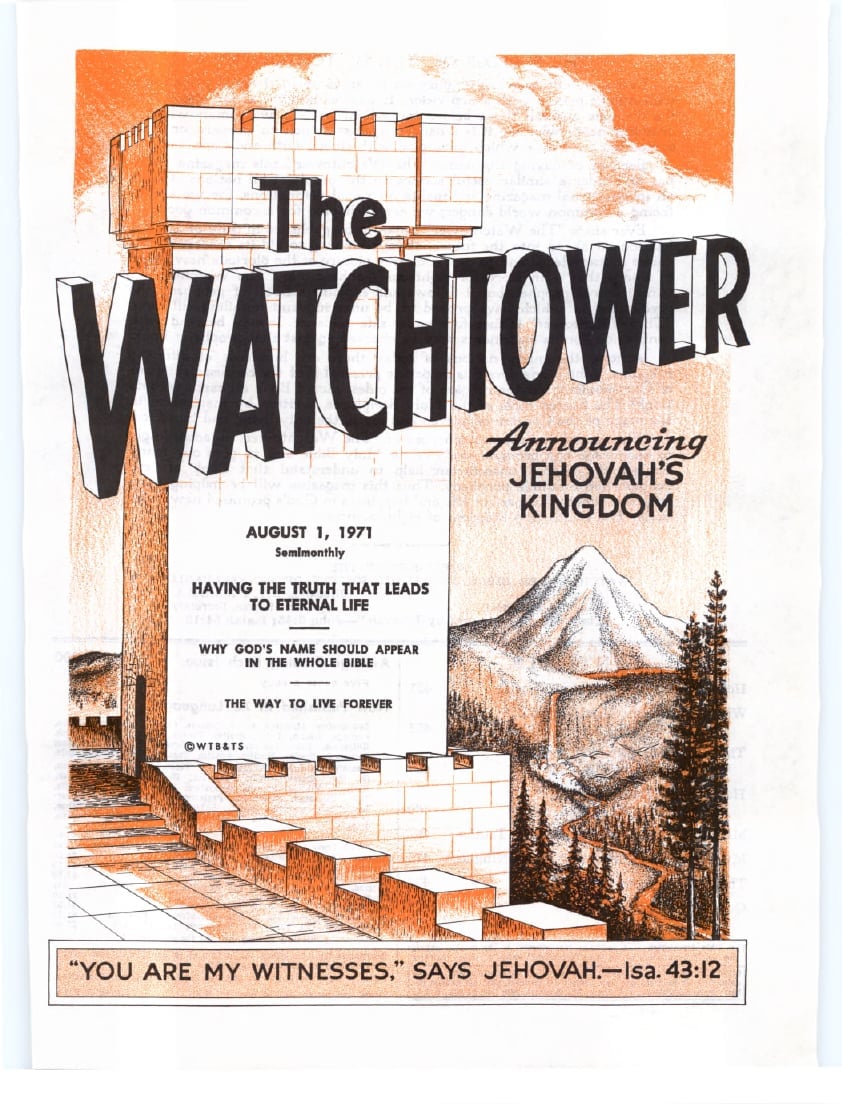
The Watchtower — August 1, 1971
Source: jw.org
Contents
How Christian Morals Are Viewed
Why God’s Name Should Appear in the Whole Bible
The Christian Ministry—What Does It Include?
Having the Truth That Leads to Eternal Life
Making Known God’s Prophetic Truths
My Career of Proclaiming God’s Kingdom
The Way to Live Forever
Questions From Readers
Announcements
How Christian Morals Are Viewed
How Christian Morals Are Viewed
WHAT makes a Christian really a Christian? Should not his morals play a large part in this, and should not his moral standards be higher than those of non-Christians? If not, then in what way could the Christian believe that his religion is superior to the non-Christian religions? And, finally, if one claims to be a Christian, should not his moral standards be those found in the Bible?
There was a time when Christendom’s churches, by and large, based their morals on the Holy Bible. But how do the churches of Christendom view Christian morals today?
A report from the Dallas Morning News of August 6, 1970, says: “Churches Examine Sexuality. United Presbyterian, Lutherans, Adopt Contemporary View.” What is this contemporary view?
The report goes on to show that according to the Lutheran statement “sexual intercourse outside of marriage is a growing reality of our time” and “to state categorically that it is wrongful is to come at it legalistically rather than contextually.” In much the same vein the Presbyterian statements hold that “there may be exceptional circumstances where extramarital sexual activity may not be contrary to the interest of a faithful concern for the well-being of a marriage partner.”
Committees of experts appointed by the two denominations worked out the statements, which take a like liberal and contemporary view not only regarding fornication and adultery but also in regard to homosexuality, abortion, masturbation and artificial insemination. All these are not wrong in themselves, it is claimed; ‘it all depends upon the circumstances.’ The Lutheran document was formally accepted as the position of that church. The Presbyterian statement was accepted for study by that church.
Then again, in a Methodist church in San Francisco, minister Lloyd Wake performed a marriage uniting two male homosexuals. (Daily Pilot, March 27, 1971) And Anglican theologian Norman Pittenger, of Cambridge University, has come out with a suggested code of ethical conduct for homosexuals.—Caspar Star-Tribune, January 16, 1971.
It is true, of course, that not all religions may openly or officially endorse such views regarding morality, nor do all clergymen. Yet most of them give tacit approval by allowing members who practice such things to remain in good standing within the church. Have you not found this to be so?
The Roman Catholic Church, as is well known, has firmly opposed abortion as well as divorce and birth control. But it is equally well known that many predominantly Catholic lands have a very high rate of illegitimacy. To cite but one example, the official Catholic weekly Orientación (September 24, 1967) gave figures showing that 66.5 percent of all births in El Salvador were illegitimate. Prostitution is also high in many Catholic lands, the Italian weekly Lo Specchio reporting that 100,000 prostitutes were active in Rome itself in recent years. Despite the high rate of concubinage, adultery and fornication in many such lands, excommunication for these practices is rare. So they continue to flourish.
Have you ever inquired of the pastor of your church what his view is on Christian morals? His answer might surprise you.
How do the views and position of Jehovah’s witnesses compare with those given above? Do they follow the modern trend?
Their position briefly is this: They believe the Bible account that, in creating man, God gave humans their male and female characteristics. (Gen. 1:27) Because of this, and because the sex powers relate to the procreation of life (which the Bible presents as sacred), they acknowledge that God alone has the authority and right to say what is proper and good and what is improper and bad as to the use of our sexual powers. Also because of this sacredness of life, they consider the deliberate destruction of a living fetus by abortion to be murder.—Gen. 9:6; Ex. 21:22, 23.
Commenting on the beliefs of Jehovah’s witnesses, the New Catholic Encyclopedia (1967) Vol. 7, p. 846, says: “Except for birth control, which they leave to the couple’s own decision, their conjugal and sexual morality is quite rigid. . . . They regard the Bible as their source of belief and rule of conduct.”
What does the Bible itself say about sexual morality? Does it make allowance for “exceptional circumstances” as justification for adultery, fornication or homosexuality? Hebrews 13:4 states: “Let marriage be honorable among all, and the marriage bed be without defilement, for God will judge fornicators and adulterers.” And at 1 Corinthians 6:9, 10 we read: “What! Do you not know that unrighteous persons will not inherit God’s kingdom? Do not be misled. Neither fornicators, nor idolaters, nor adulterers, nor men kept for unnatural purposes, nor men who lie with men, nor thieves, nor greedy persons, nor drunkards, nor revilers, nor extortioners will inherit God’s kingdom.” Is this not clear and unmistakable in its meaning?
Jehovah’s witnesses also believe that to retain God’s favor they must remain clean as a congregation. They recognize that, just as a little leaven will ferment a whole batch of flour or a bad apple will cause a whole basket of apples to rot, in the same way an immoral person allowed to remain in a congregation will have a polluting effect on others therein. So, any who practice immoral acts make themselves liable to “disfellowshiping,” that is, expulsion from all congregations of Jehovah’s witnesses. While it is true that such persons may be accepted back after a period of time, this is only when sincere repentance and elimination of the wrong practice are evident.
What does the Bible say on this? The apostle Paul commanded concerning a man in the Christian congregation at Corinth who was living immorally: “Remove the wicked man from among yourselves.” And in that connection he stated: “Now I am writing you to quit mixing in company with anyone called a brother that is a fornicator or a greedy person or an idolater or a reviler or a drunkard or an extortioner, not even eating with such a man.” (1 Cor. 5:11-13) Is this instruction followed in the church you attend?
The rule in God’s Word is that ‘what a person sows he will reap.’ (Gal. 6:7, 8) What does the modern trend regarding sex lead to? Is it not true that divorce and broken homes are increasing and that such broken families are fertile soil for juvenile delinquency? Is it not true that health authorities now warn that venereal diseases are getting out of hand, reaching epidemic proportions? And is it not true that illegitimacy is skyrocketing, with ever younger unwed girls becoming mothers or undergoing abortions to avoid this? Do you think that these fruits are the product of sowing what is good?
God’s laws are not only authoritative but also wise and for man’s good. “Godly devotion is beneficial for all things, as it holds promise of the life now and that which is to come.” (1 Tim. 4:8) Yes, living by Bible principles leads to happy, united homes and to the reward of endless life in God’s favor. Is this what you want? If so, then you doubtless appreciate the importance of Christian morals. In a world experiencing moral decay, should you not avoid those who show themselves Christians in name only and seek rather to associate with those who are morally clean? You will find such association refreshing and stimulating to clean and wholesome conduct.
Why God’s Name Should Appear in the Whole Bible
Why God’s Name Should Appear in the Whole Bible
PERHAPS in your Bible reading you have come across God’s name in the so-called “Old Testament.” For example, you may have read in the King James Version: “That men may know that thou, whose name alone is JEHOVAH, art the most high over all the earth.”—Ps. 83:18; Isa. 12:2.
However, in your reading of the “New Testament” or Christian Greek Scriptures you may never have come across God’s name. Most translators have left it out when translating that part of the Bible. Why? One reason is that so far no ancient manuscript copies of the original text of the Christian Greek Scriptures have been found containing the divine name in its full form.
But, on the other hand, God’s name does occur in its abbreviated form in both the old Greek manuscripts and the translations of them. In your Bible reading have you observed at Revelation 19:1, 3, 4, 6, the expression “Alleluia” or “Hallelujah”? According to Webster’s New Collegiate Dictionary “Hallelujah” means: “Praise ye Yah (Jehovah).”
This appearance of God’s name in abbreviated form reveals that use of the name was not obsolete among early Christians. Why, then, does God’s name in its full form not appear in any existing manuscript copy of the Greek Bible text? Does this absence of God’s name in these old manuscripts indicate that Jesus and his disciples did not use the name Jehovah?
EXPLANATION THAT IS NO LONGER VALID
It was long believed that the reason God’s name in its full form is not found in any known manuscript copies of the Christian Greek Scriptures is that early Christians used the Greek Septuagint translation of the Hebrew Scriptures, and that they simply followed its practice of omitting the divine name. This Greek Septuagint version had been prepared for Greek-speaking Jews beginning about 280 B.C.E., and is the translation of the Hebrew Scriptures that early disciples of Jesus Christ are thought to have used.
The consensus of opinion used to be that, because of a Jewish superstition regarding God’s name, the Greek Septuagint translators had substituted in their version the Greek titles Kyʹrios (Lord) or ho The·osʹ (the God) for the Tetragrammaton, the four Hebrew letters (יהוה) that represent God’s name Jehovah. But comparatively recent discoveries have shown that the oldest fragments of the Greek Septuagint actually do contain God’s name in its Hebrew form!
Commenting on this fact, Dr. Paul E. Kahle says: “We now know that the Greek Bible text [the Septuagint] as far as it was written by Jews for Jews did not translate the Divine name by kyʹrios [Lord], but the Tetragrammaton written with Hebrew or Greek letters was retained in such MSS [manuscripts].”
Who, then, replaced the divine name in copies of the Greek Septuagint with the titles “Lord” or “God”? Dr. Kahle goes on to answer: “It was the Christians who replaced the Tetragrammaton by kyʹrios [Lord], when the divine name written in Hebrew letters was not understood any more.”—The Cairo Geniza, pp. 222, 224.
But when did “Christians” in their Greek translations of the Hebrew Scriptures replace God’s name in its Tetragrammaton form by the titles Kyʹrios (Lord) and ho The·osʹ (the God)? If we can determine this, it will shed light upon whether the writers of the Christian Greek Scriptures actually used God’s name in their inspired writings, and whether the earliest copies of their original writings contained the divine name.
WHEN THE DIVINE NAME WAS REPLACED
The replacing of God’s name in Tetragrammaton form in the Christian Greek Scriptures evidently occurred in the centuries following the death of Jesus and his apostles. This is apparent because in Greek translations of the “Old Testament” or Hebrew Scriptures made in the first centuries of the Common Era by professed Christians the divine name is found. For example, in Aquila’s Greek version, dating from about the year 128 C.E., the Tetragrammaton still appeared in Hebrew characters.
Also, around 245 C.E., the noted scholar Origen produced his Hexapla, a six-column reproduction of the inspired Hebrew Scriptures. On the evidence of the fragmentary copies now known, Professor W. G. Waddell says: “In Origen’s Hexapla . . . the Greek Versions of Aquila, Symmachus, and LXX [Septuagint] all represented JHWH by ΠΙΠΙ; in the second column of the Hexapla the Tetragrammaton was written in Hebrew characters.”a Others believe the original text of Origen’s Hexapla used Hebrew characters for the Tetragrammaton in all its columns. Origen himself stated that “in the most faithful manuscripts THE NAME is written in Hebrew characters, that is, not in modern, but in archaic Hebrew.”
As late as the fourth century, Jerome, the translator who produced the Latin Vulgate, says in his Prologus Galeatus prefacing the books of Samuel and Malachi: “We find the four-lettered name of God (i.e., יהוה) in certain Greek volumes even to this day expressed in the ancient letters.”
What does such information indicate? It makes clear that the so-called “Christians” who “replaced the Tetragrammaton by kyʹrios” in the Septuagint copies were not the early disciples of Jesus. They were persons of later centuries, when the foretold apostasy was well developed and had corrupted the purity of Christian teachings.—2 Thess. 2:3; 1 Tim. 4:1.
USED BY JESUS AND HIS DISCIPLES
There is irrefutable evidence, then, that God’s name was found in copies of the Scriptures used in the time of Jesus and his disciples, both in Hebrew manuscripts and in Greek manuscript translations. Surely these men used the divine name as they read and taught people from such copies of the Scriptures. Also, when writing the Christian Greek Scriptures, the disciples of Jesus without question would follow the God-approved practice of using the divine name in their writings. Their master Jesus Christ certainly set them the example as he magnified his Father’s name.
Consider the very name “Jesus.” This was the name that the heavenly angel directed Mary to give the child that was to be born to her. (Luke 1:30, 31) And that name “Jesus” gives prominence to God’s name, for in Hebrew it means: “Salvation of Jah [Jehovah].”
What is more, Jesus repeatedly held the name of his Father before the people in his ministry. For example, he taught his disciples to pray: “Our Father in the heavens, let your name be sanctified.” (Matt. 6:9) His works, he said, were done “in the name of my Father.” (John 10:25) And in prayer on the night of his death, he said that he had ‘made his Father’s name manifest’ to his disciples.—John 17:6, 26.
In view of all this, when Jesus quoted the Hebrew Scriptures or read from them he certainly used the divine name, Jehovah. For example, he would do so when he quoted from the Hebrew Scriptures at Deuteronomy 8:3, and said: “It is written, ‘Man must live, not on bread alone, but on every utterance coming forth through Jehovah’s mouth.’” (Matt. 4:4; also compare Matthew 22:37 with Deuteronomy 6:5; Matthew 22:44 with Psalm 110:1; and Luke 4:16-21 with Isaiah 61:1, 2.) Logically, those disciples of Jesus who were inspired to write the Christian Greek Scriptures would follow their Master’s example of using the divine name, thus incorporating it into their Bible writings.
Why, then, is the name absent from the ancient manuscripts of the Christian Greek Scriptures or so-called “New Testament” we now have? Evidently because by the time those ancient copies were made, which was from the third century C.E. onward, the original text of the writings of the apostles and disciples had been altered. The divine name (possibly in Tetragrammaton form) was undoubtedly replaced with Kyʹrios and ho The·osʹ by later copyists, precisely what the facts show was done in later copies of the Septuagint translation of the Hebrew Scriptures.
Recognizing that this must have been the case, some translators have included the name “Jehovah” in their renderings of the Christian Greek Scriptures. There is sound basis for this. Yes, God’s name does belong in the whole Bible.
[Footnotes]
The Journal of Theological Studies, Vol. XLV, July-October, 1944, pp. 158, 159.
The Christian Ministry—What Does It Include?
The Christian Ministry—What Does It Include?
THE mention of the Christian ministry brings different things to mind to different persons. What do you think of? Like many, do you think of a man who preaches and teaches in a congregation? Or, like others, do you think of carrying the good news of God’s kingdom to persons in their homes? Which is correct?
Actually each of these ideas represents a ministry of Christians. But neither in itself—nor even both together—expresses the Christian ministry in its full sense. In fact, if we viewed the Christian ministry as limited to such activities only, then we would have an incomplete, imperfect grasp of what it embraces. Since this would impair our service to God, let us investigate and see what the Christian ministry consists of according to God’s own Word.
WHAT IT MEANS TO MINISTER
Jesus Christ told his disciples: “The Son of man came, not to be ministered to, but to minister and to give his soul a ransom in exchange for many.” He showed that he was thereby setting an example for all his followers. They, too, should be active in ministering to others, not seeking for others to minister to them. (Matt. 20:26-28; Luke 22:26, 27) How would they do this?
The expression “to minister” in this text translates a Greek verb (di·a·ko·neʹo) meaning literally “to serve.” Yes, basically the Christian ministry is Christian service. If we keep this in mind we will be better able to grasp the full meaning of such ministry.
This Greek term lays emphasis on a particular aspect of service, that of a personal service. In fact, one of its earliest uses in the Greek language is to describe the service of ‘waiting at table’ for another, serving food to the one eating, being his attendant.
Did you realize that the Bible uses the Greek words for ministering a number of times in this same early sense? For example, Jesus gave the illustration of a master whose slave comes in from the field where he has been plowing or minding the flocks (rendering service, true, but not of a very personal nature), and the master tells his slave: “Get something ready for me to have my evening meal, and put on an apron and minister [form of di·a·ko·neʹo] to me.” (Luke 17:7, 8) Both Martha and Peter’s mother-in-law ‘ministered’ in similar ways, serving food, rendering personal service. (Mark 1:30, 31; Luke 10:40; John 12:2; compare John 2:5-9.) Yes, “to minister” has a broad meaning. But could activities like those just described ever be properly spoken of as part of the “Christian ministry”? Let us see.
As Jesus had said, he came, not ‘to be ministered to, but to minister to others.’ Nevertheless, certain ones did minister to Jesus and he accepted their service, for it was done voluntarily and with the desire to enable him and his disciples to use their time and energies in spiritual activity. For example, we read of a number of women “who had accompanied Jesus from Galilee to minister to him” and to his disciples. The mother of James and John was among these. (Matt. 27:55; Mark 15:40, 41) How did they ‘minister’?
Likely by rendering services such as the preparing of meals, mending or washing clothes, perhaps even making such garments. (Compare Acts 9:36-39; Romans 16:1, 2.) And they evidently used their own funds and possessions to provide many of the needs of Jesus and his disciples, for Luke 8:3 says they “were ministering to them from their belongings.”
But by caring for the needs of Jesus and his male disciples so that they could concentrate on preaching and teaching, were these women performing a Christian ministry? Most assuredly, and a fine ministry indeed. Such ministry was highly appreciated by Jesus himself and merited particular mention in God’s Word. (Compare also Mark 14:3-9.) This can also be seen by Jesus’ parable of the sheep and the goats as recorded at Matthew 25:31-46.
In this account we find the goatlike ones, judged adversely by Jesus, saying to him, “Lord, when did we see you hungry or thirsty or a stranger or naked or sick or in prison and did not minister to you?” Jesus replied that “to the extent that you did not do it to one of these least ones [of Jesus’ spiritual brothers], you did not do it to me.” The sheeplike ones, on the other hand, had performed such ministry and were richly blessed for doing so. Do you share in such ministry? Do you gladly avail yourself of opportunities to render help and aid to those of Christ’s brothers today? Yes, even for the “least ones,” as well as those more prominent?
‘MINISTERING’ TO THE APOSTLES
After Jesus’ death, the Bible record shows, some, including young John Mark, Timothy and others, ministered to certain of the apostles (Acts 13:5; 19:22; 2 Tim. 4:11), and some ‘rendered services’ (from di·a·ko·neʹo) to Paul while he was in prison. (2 Tim. 1:16-18; Philem. 13) What services did they render? The record does not give particular details. Aside from providing food and other physical needs we know they carried messages and relayed instructions from the apostles to others, and they doubtless did secretarial work, made purchases, perhaps of writing materials, and performed other similar tasks as true assistants to the apostles. Surely they looked upon such service as a Christian ministry and a real privilege, just as it was.
By their ministering to Paul and others, these made it easier for the ones served to concentrate their efforts on their own particular ministry. Paul had a special ministry assigned him by Christ Jesus and that was “to bear thorough witness to the good news of the undeserved kindness of God,” particularly to the “nations” or Gentiles, to whom Paul was an apostle. (Acts 20:24; 21:19; Rom. 11:13; Eph. 3:5-7) Also in serving as a ‘minister of a new covenant,’ Paul was aiding persons to become part of the nation of spiritual Israel in that new covenant. And, even more importantly, he was serving those already in that new covenant, rendering service as a shepherd, helping Christians to stay faithful to that covenant’s terms and see its benefits realized toward them.—2 Cor. 3:5, 6; 4:1; Col. 1:23-25.
In time, some of those who ‘ministered’ to Paul were themselves charged with doing shepherding work within spiritual Israel, the Christian congregation. Timothy, for example, was asked to stay in Ephesus to aid the congregation there for a period of time.—1 Tim. 1:3.
THE MORE VITAL ASPECTS OF THE CHRISTIAN MINISTRY
Yes, all these many services were ministries, all part of the Christian ministry. Some services, of course, were more vital than others. This was made evident shortly after the founding of the Christian congregation at Pentecost of 33 C.E. There was a rapid growth in the number of disciples, with three thousand newly baptized ones. This gave rise to a need for aid in the form of food and other supplies, since many of those new believers were visitors to Jerusalem, away from their home cities or lands. To cope with this, there was a wholehearted donating of funds by disciples to meet the needs of others among these new brothers and sisters. (Acts 2:5, 41; 4:32-37) But, for some unstated reason, the widows of Greek-speaking Jews came to be overlooked in the “daily distribution” (literally the “daily service [or ministration, Gr., di·a·ko·niʹa]”) of supplies. Who should handle this problem that was causing a murmuring among the Greek-speaking Jews against the Hebrew-speaking Jews?
On being informed, the apostles said: “It is not pleasing for us to leave the word of God to distribute food [or “to be ministering” (di·a·ko·neinʹ)] to tables.” So they had the brothers select seven qualified men and then the apostles appointed these over this “necessary business,” saying, “but we shall devote ourselves to prayer and to the ministry of the word.”—Acts 6:1-6.
So, there were two ministries involved here. One ministry had to do with the equitable and impartial distribution of food supplies (and doubtless also the handling of funds and purchasing of some supplies) for those in need. But there was a more vital ministry to be performed involving, not material food or funds, but the supplying of spiritual food and riches by prayerful study, research, teaching and shepherding. The apostles realized that this latter “ministry of the word” merited their undivided attention. They rightly appraised matters, and the result was that “the word of God went on growing, and the number of the disciples kept multiplying in Jerusalem very much.” (Acts 6:7) It is noteworthy that those assigned to minister to tables did not conclude that nothing more was required in their case. Stephen, for example, had a powerful share in public proclamation of God’s Word.—Acts 6:8–7:60.
SHARING IN THE CHRISTIAN MINISTRY TODAY
Seeing the broad scope of the Christian ministry, we can understand why the apostle says at 1 Corinthians 12:4-7: “Now there are varieties of gifts, but there is the same spirit; and there are varieties of ministries, and yet there is the same Lord [Jesus Christ]; and there are varieties of operations, and yet it is the same God who performs all the operations in all persons. But the manifestation of the spirit is given to each one for a beneficial purpose.”—1 Cor. 12:12-28.
Yes, there are many ministries within the Christian ministry. For the Christian congregation is like a body, and for that body to function properly under its Lord and Head, Jesus Christ, there are many services, many ministries, that must be performed. All of them are essential, though some are more vital than others. Clearly, then, there is something available for everyone to do and, among the “varieties of ministries” to be performed under the direction of the one Lord, there is a wide field of opportunity and privileges.
Many persons today, including not only young men but also mature men and also women, perform services similar to those of first-century Christians who ministered to Jesus and his apostles. Hundreds of Jehovah’s witnesses do so on a full-time basis serving in Bethel homes, printing factories, farms and branch offices throughout the earth. But since, in many cases, their work may be very similar to, if not the same as, work done by persons in secular establishments, are they engaging in the Christian ministry by such activity? Yes, for their work is done in the interests of Christ’s kingdom; it contributes toward others’ being able to concentrate on teaching and shepherding work, to devote themselves “to prayer and to the ministry of the word,” providing the spiritual food needed by Christ’s congregation and by persons in the world of mankind. Yes, and those today caring for what might be termed “necessary business” also can and do have a part themselves in personally ministering the word of life to others, sharing the good news of Christ’s kingdom with their brothers and with those of the world of mankind. They recognize this to be a vital part of their ministry.
In more than 26,000 congregations around the globe, spiritually qualified men serve as shepherds and teachers of the sheep of God’s flock—overseeing their spiritual welfare, counseling, reproving, comforting, strengthening—while other devoted men care for additional necessary duties. (Eph. 4:11, 12; 1 Tim. 3:1-13) Within each congregation there are many services to be rendered. There are sick persons to be visited, perhaps needy ones to be cared for, meeting places to be provided and maintained. Yes, even performing such services as cleaning Kingdom Halls, doing repair work, making curtains, painting signs—all these are opportunities for ‘ministering.’ Men, women and even children can share in caring for these necessary things. And God through his Son also grants to them all the grand privilege of ministering the good news to one another and to honest-hearted persons outside the congregation. (Acts 2:17, 18; Heb. 10:24, 25) Surely there is ample to do for all true Christians in the Christian ministry with its variety of services!
Having this broadened understanding of what the Christian ministry embraces is beneficial. It helps us to find joy and satisfaction in serving. Christian men can see that there are many outlets for their varied abilities and talents. And they should be encouraged to develop their spiritual abilities to serve among the overseers in the “fine work” of shepherding God’s sheep. (1 Tim. 3:1) Wives can realize the value of their ministering to the needs of Christian husbands and their children, being assured that this service has merit in the eyes of the congregation’s Head, Jesus Christ, and of God. (1 Pet. 2:21; 3:1-5) Young people, too, can make themselves helpful at home, at meeting places, performing services for those who are aged or ill, offering themselves for assignments of work under the direction of overseers. And all can and should share in telling forth God’s praise within the congregation and outside thereof, doing all this to their own salvation and the salvation of those listening to them.—Rom. 10:10.
How, then, can you share in the Christian ministry? By accepting Christ Jesus as your God-appointed Head and submitting to his direction, serving with his congregation. You can be helpful to those doing shepherding and teaching work; you can aid others in their worship and service to God and Christ; you can make known the good news to others. Whatever assignment may come your way, large or small, accept it with appreciation. Yes, “in proportion as each one has received a gift, use it in ministering to one another as fine stewards of God’s undeserved kindness expressed in various ways.”—1 Pet. 4:10.
Having the Truth That Leads to Eternal Life
Having the Truth That Leads to Eternal Life
“If you remain in my word, you are really my disciples, and you will know the truth, and the truth will set you free.”—John 8:31, 32.
1. As to the present system of things, what is becoming clearer to thinking people?
MORE clearly than ever before we see this system of things breaking down. Daily the evidence of its deterioration mounts. One by one the things in which people have put their trust are proving unable to overcome the distressing conditions. The Bible truthfully foretold of our age: “In the last days critical times hard to deal with will be here.” (2 Tim. 3:1) Jesus Christ also truthfully prophesied of our time: “On the earth anguish of nations, not knowing the way out because of the roaring of the sea and its agitation, while men become faint out of fear and expectation of the things coming upon the inhabited earth.”—Luke 21:25, 26.
2. (a) To whom can honest-hearted persons today be compared? (b) What resulted from having the “mark” and not having it?
2 Jehovah God has permitted sufficient time for this present system of things to come to full fruition. Now there can be no doubt as to its true nature. Persons who are honest-hearted are truly disgusted with conditions. In this they are like those whom the prophet Ezekiel saw in a vision concerning Jerusalem before its destruction in 607 B.C.E. In that vision Jehovah told a man with a secretary’s inkhorn: “Pass through the midst of the city, through the midst of Jerusalem, and you must put a mark on the foreheads of the men that are sighing and groaning over all the detestable things that are being done in the midst of it.” (Ezek. 9:4) Then to the forces of destruction Jehovah said: “Pass through the city after him and strike. Let not your eye feel sorry, and do not feel any compassion. Old man, young man and virgin and little child and women you should kill off—to a ruination. But to any man upon whom there is the mark do not go near.” (Ezek. 9:5, 6) That mark meant life when destruction came.
3. (a) What ‘marking’ work is going on in our time? (b) What is the basis for being marked for eternal life?
3 There is a similar ‘marking’ going on today. In these “last days” individuals are also being identified. Jesus foretold: “When the Son of man arrives in his glory, and all the angels with him, then he will sit down on his glorious throne. And all the nations will be gathered before him, and he will separate people one from another, just as a shepherd separates the sheep from the goats. And he will put the sheep on his right hand, but the goats on his left.” (Matt. 25:31-33) Those on the left “will depart into everlasting cutting-off.” Those on the right hand of favor go “into everlasting life.” (Matt. 25:34, 41, 46) What kind of person is marked for eternal life? At 1 John 2:17 we read: “The world is passing away and so is its desire, but he that does the will of God remains forever.” Those to be spared for eternal life are identified as persons who do the will of God. And how do they know what the truth is about God’s will?
4. Why did Jesus have such complete confidence that what he had was the truth?
4 Jesus knew the truth about God’s will. He had complete confidence that what he taught others was the truth. Why was he so sure? Concerning his followers he said to his heavenly Father: “I have given your word to them . . . Sanctify them by means of the truth; your word is truth.” (John 17:14, 17) He also said: “I do nothing of my own initiative; but just as the Father taught me I speak these things. And he that sent me is with me; he did not abandon me to myself, because I always do the things pleasing to him.” (John 8:28, 29) Jesus, in his prehuman existence, had been with the heavenly Father for untold ages of time. When on earth he would be able to tell the truth about the Creator’s will and purpose. (John 1:14, 18; 16:28) In addition, throughout his earthly ministry Jesus used the Hebrew Scriptures, which were available in his day. These contained God’s thoughts in written form. So when Jesus referred to God’s word as being the truth, he included the entire Hebrew Scriptures as well as the additional information he had as a result of his intimate association with Jehovah.
5. How can we learn what God’s will is and be marked for survival?
5 Thus when Jesus spoke, he spoke the truth because he spoke God’s thoughts. He knew the truth about Jehovah better than anyone else who had ever walked the earth. The truthful teachings of Jesus, and later those of his faithful followers, were recorded in the Scriptures. Jehovah saw to it that all the information God’s servants needed would be recorded. So today those who sincerely want to learn the truth about God’s will and do it so as to gain eternal life have the entire inspired written Word of God as their guide. (2 Tim. 3:16, 17) By means of the truths it contains, individuals can develop the Christian personality that will mark them for survival.—Rom. 12:2; Col. 3:10.
USED TO DISPENSE TRUTH
6. (a) After Jesus’ death, whom did God use to dispense the truth? (b) What evidence did Jehovah give as to whom he was using?
6 Jesus showed who would be used to dispense the truth to mankind after his death. No, it would not be the hypocritical religious leaders of that time. It would be those humble people who faithfully followed Jesus. They were the ones who were doing God’s will. To them Jesus stated: “I have many things yet to say to you, but you are not able to bear them at present. However, when that one arrives, the spirit of the truth, he will guide you into all the truth, for he will not speak of his own impulse, but what things he hears he will speak, and he will declare to you the things coming.” (John 16:12, 13) Here Jesus was speaking about God’s powerful holy spirit. It would assist the faithful followers of Jesus to become the Christian congregation, guiding them in the way of the truth. At Pentecost, this spirit from Jehovah was poured out on those followers of Jesus, showing that now Jehovah was using them to dispense the truth to mankind. (Acts 2:1-4, 14-18) God had abandoned the Jewish religious system. (Matt. 23:38) It took place just as Jesus had said to the Jewish religious leaders: “The kingdom of God will be taken from you and be given to a nation producing its fruits.”—Matt. 21:43.
7. What is absolutely essential in order to understand the truth?
7 Later, the apostle Paul said: “We speak God’s wisdom in a sacred secret, the hidden wisdom, which God foreordained before the systems of things for our glory. This wisdom not one of the rulers of this system of things came to know, for if they had known it they would not have impaled the glorious Lord. But just as it is written: ‘Eye has not seen and ear has not heard, neither have there been conceived in the heart of man the things that God has prepared for those who love him.’ For it is to us God has revealed them through his spirit, for the spirit searches into all things, even the deep things of God.”—1 Cor. 2:7-10.
8. Who can expect to be guided by God’s spirit in the way of truth?
8 But who, specifically, get God’s spirit to guide them in the way of the truth? Peter and the other apostles said to the Jewish Sanhedrin: “We must obey God as ruler rather than men.” (Acts 5:29) What could those who obey God as ruler expect in return? The apostles said: “We are witnesses of these matters, and so is the holy spirit, which God has given to those obeying him as ruler.” (Acts 5:32) Yes, those who do God’s will, “obeying him as ruler” in everything, are the ones who can expect to receive his spirit. That spirit will direct them to the proper understanding of the things God wants his servants to know.
GATHERING GOD’S SERVANTS
9. What final separation of God’s servants takes place?
9 After the death of the apostles and other spiritually mature men of the first century, the Christian congregation began to be overgrown with “weeds.” These were men who pretended to serve God, but who would not really obey him as ruler. Jesus foretold this growth of weedlike imitation Christians among wheatlike true Christians, and also the final outcome, saying: “‘Let both grow together until the harvest; and in the harvest season I will tell the reapers, First collect the weeds and bind them in bundles to burn them up, then go to gathering the wheat into my storehouse.’ . . . so it will be in the conclusion of the system of things. The Son of man will send forth his angels, and they will collect out from his kingdom all things that cause stumbling and persons who are doing lawlessness, and they will pitch them into the fiery furnace.”—Matt. 13:30, 40-42.
10. What responsibility would be given God’s servants in the “last days”?
10 All the evidence in fulfillment of Bible prophecy indicates that God’s kingdom was established in the heavens in the year 1914 C.E. At that time the “last days” for Satan’s system of things began. (2 Tim. 3:1-5) Now would come the final gathering of God’s servants to Christ’s right hand of favor. And as they were gathered, they would be given heavy responsibilities, for Jesus had prophesied: “Who really is the faithful and discreet slave whom his master appointed over his domestics, to give them their food at the proper time? Happy is that slave if his master on arriving finds him doing so. Truly I say to you, He will appoint him over all his belongings.” (Matt. 24:45-47) Note carefully that when God’s kingdom was established, those on earth obeying God as ruler would be given the supervision over all the Kingdom interests under the direction of Christ Jesus and his angelic forces in heaven. God would use these whom he likens to “wheat” to dispense his truths to whoever wants them. These latter would be clearly identified and set apart from those who are likened to “weeds” or “goats.”
11. Who make up God’s faithful slave today, and on what basis can this be said?
11 Those who make up the “faithful and discreet slave”—who are they? They are the anointed remnant of Jehovah’s dedicated servants. How can it be said with such certainty that they are the ones God is using to dispense the truth to those who are “sighing and groaning over all the detestable things that are being done” in the religious world? Jesus showed how a person could identify those who had the truth, saying: “Every good tree produces fine fruit, but every rotten tree produces worthless fruit; a good tree cannot bear worthless fruit, neither can a rotten tree produce fine fruit. Every tree not producing fine fruit gets cut down and thrown into the fire. Really, then, by their fruits you will recognize those men. Not everyone saying to me, ‘Lord, Lord,’ will enter into the kingdom of the heavens, but the one doing the will of my Father who is in the heavens will.” (Matt. 7:17-21) Those whom God uses must be those who are doing his will, obeying him as ruler in everything.
“LOVE AMONG YOURSELVES”
12. (a) What vital fruit must be evident among those who have the truth? (b) Is it displayed by the churches of Christendom?
12 What are some of the major identifying marks of those who are doing God’s will? What “fruit” must they be producing? Among the many identifying marks is this vital one given by Jesus: “By this all will know that you are my disciples, if you have love among yourselves.” (John 13:35) This Christian love must be in evidence among those who have the truth. Those who do not have this kind of love cannot possibly have the truth. Now then, have the church systems of Christendom produced this kind of fruit? What have they done in periods of faith testing, such as during wartime? The facts are beyond dispute: they have violated this requirement and sent their followers to slaughter one another. For example, of the largest religion in Christendom the New York Times of December 29, 1966, reported: “Traditionally Catholics support the nation’s war efforts and leave moral responsibilities for the wars’ conduct to the political authorities. . . . In the past local Catholic hierarchies almost always supported the wars of their nations, blessing troops and offering prayers for victory, while another group of bishops on the other side publicly prayed for the opposite outcome.” Significantly, the report notes: “The contradiction between the Christian spirit and the conduct of war, which was often obscured by theological subtleties, seems increasingly clear to many, as weapons grow more brutal.”
13. What clear identification does God’s Word make of those who are children of God and those who are not?
13 God’s Word of truth makes the identification very clear: “The children of God and the children of the Devil are evident by this fact: Everyone who does not carry on righteousness does not originate with God, neither does he who does not love his brother. For this is the message which you have heard from the beginning, that we should have love for one another, not like Cain, who originated with the wicked one and slaughtered his brother.” (1 John 3:10-12) Those who do not obey God as ruler and who ‘slaughter their brother’ could not possibly have the truth. Only those who consistently obey God as ruler by refusing to participate in such mutual slaughter could be identified with the truth.
14. Who today really practice true Christian love?
14 What group has truly obeyed God as ruler in this vital matter wherever they live on this earth? The Sacramento, California, Union commented editorially on July 9, 1965: “Suffice it to say that if all the world lived by the creed of the Jehovah’s Witnesses there would be an end of bloodshed and hatred, and love would reign as king.” Yes, the worldwide bond of genuine Christian love displayed by the more than one million witnesses of Jehovah shows that they have the mark of true Christians. They really do practice the kind of love toward their Christian brothers and sisters that God requires. Regardless of the country in which they live, they refuse to join in the wars of the nations, for that would result in their slaughtering one another.
15. For showing true Christian love, what have God’s servants undergone?
15 Rather than disobey God as ruler in this matter, Jehovah’s witnesses are willing to suffer persecution. In Germany, many were executed in concentration camps for obeying God’s law of love and refusing to participate in the slaughter resulting from Nazi rule. In Communist Russia, they were sent to labor camps in Siberia for the same reason. In the United States, to this very day, they are given jail sentences of up to five years—for obeying God as ruler and showing true Christian love! Similar persecution has taken place in many other countries. But regardless of what the nations may do, Jehovah’s witnesses continue to “obey God as ruler rather than men.” For doing so, what can they rightly expect from Jehovah? “The holy spirit, which God has given to those obeying him as ruler.”
OTHER IDENTIFYING MARKS
16, 17. (a) What attitude toward the Bible must be shown by those who have the truth? (b) Contrast the attitude toward the Bible on the part of the clergy with that of Jehovah’s witnesses.
16 Among other identifying marks, those who have the truth will show respect for God’s Word, the Bible. In this Jesus set the pattern. He accepted the Scriptures of his day as God’s inspired Word. He quoted from them frequently and recommended them to his followers. (Matt. 19:4-6; Luke 24:44, 45) Never did he water down or ridicule the Scriptures. But can we say this about the religious leaders of Christendom today? Are they taking the lead in building respect for God’s Word, upholding it against its enemies? Are they recommending the Bible’s standards of behavior? No, but they belittle the Bible and call parts of it myth. More and more of them flout the Bible’s moral standards and excuse or even condone premarital sex relations, adultery, homosexuality and violence. Truly, instead of defending the Bible against its enemies, they themselves have become its enemies!
17 That the clergy of Christendom have not respected God’s Word or really taught it to their people can be demonstrated by asking persons who go to church to explain God’s purposes and requirements from their own Bibles. So few are able to do so that it is obvious they are not being taught from God’s Word. The Reader’s Digest of May 1966 commented: “Many of the church’s top leaders today—especially in what are called the ‘mainstream’ denominations—are sorely failing its members in two ways: 1) by succumbing to a creeping tendency to downgrade the Bible as the infallible Word of God, and 2) by efforts to shift the church’s main thrust from the spiritual to the secular.” But of Jehovah’s witnesses the French publication France-Soir of August 6, 1969, said: “The doctrines of Jehovah’s witnesses are based on the Bible.” And England’s Weekly News of September 27, 1969, commented: “Perhaps the real secret of the Witnesses’ success is because they know their Bible so well.” Yes, Jehovah’s witnesses accept the entire Bible as the Word of God. They teach it freely to anyone who wants to learn its truths. This is manifest by the fact that they conduct well over a million Bible studies weekly in the homes of interested persons in over 200 lands throughout the world. This is by far the largest home Bible study program in existence. Indeed, it is the largest ever in the history of the world!
18. How are God’s servants identified in connection with his name?
18 Jesus said in prayer: “Our Father in the heavens, let your name be sanctified.” (Matt. 6:9) He also prayed: “I have made your name known to them and will make it known.” (John 17:26) The true servants of God would be called out to be “a people for his name.” (Acts 15:14) Thousands of times in the Bible, the name of God—Jehovah in English—is mentioned. But from whom have you heard this name? You know that if it were not for Jehovah’s witnesses you likely would never have heard the name, as the churches of Christendom rarely use it. Only Jehovah’s witnesses today make known the fact “that thou, whose name alone is JEHOVAH, art the most high over all the earth.”—Ps. 83:18, Authorized Version.
19. Who keep themselves “without spot from the world”?
19 Those who have the mark of true Christians must keep themselves “without spot from the world.” (Jas. 1:27) God’s Word clearly warns: “Whoever, therefore, wants to be a friend of the world is constituting himself an enemy of God.” (Jas. 4:4) The reason for this becomes apparent when we consider that Satan the Devil is the “ruler of this world,” the “god of this system of things.” (John 12:31; 2 Cor. 4:4) The clergy have constantly supported this world’s wars and have become involved in its political intrigues. They are definitely part of this world. But what about Jehovah’s witnesses? Chicago’s Today of October 18, 1969, observed: “Their belief pattern, moreover, calls for total noninvolvement with the political society in which they dwell.” Jehovah’s witnesses, obeying God as ruler, are no part of this world.
20. What message must be highlighted by those who obey God as ruler?
20 Another identifying mark would be the fulfilling of this key prophecy given by Jesus for the “last days”: “This good news of the kingdom will be preached in all the inhabited earth for a witness to all the nations; and then the end will come.” (Matt. 24:14) That Kingdom was the theme of Jesus’ teaching. (Matt. 4:17) He taught his followers to pray: “Let your kingdom come. Let your will take place, as in heaven, also upon earth.” (Matt. 6:10) This was the kingdom spoken of by Daniel the prophet centuries before when he said: “It will crush and put an end to all these [other] kingdoms, and it itself will stand to times indefinite.” (Dan. 2:44) Who today teach people that the only hope for mankind is God’s kingdom? Who teach that this heavenly government is the agency God will use to end wickedness and bring peace and eternal life to obedient mankind? The clergy hardly mention it anymore. But for the more than nine decades of their modern history, Jehovah’s witnesses have forcefully proclaimed Jehovah’s kingdom as mankind’s only hope, as the announcement on the cover of this magazine indicates.
21. Is Jehovah using the church systems of today? Give a reason for your answer.
21 Even this very brief examination of some of the fruitage that must be produced by those whom God uses to dispense the truth makes it obvious that Jehovah certainly is not using the church systems of this world. They are in utter confusion and decay, and “God is a God, not of disorder, but of peace.” (1 Cor. 14:33) To growing numbers of sincere persons it is becoming clear that the clergy of Christendom do not have the truth, that God is not using them. Rather it is becoming more obvious all the time that the clergy are actually the modern counterparts of the religious leaders to whom Jesus declared: “You are from your father the Devil, and you wish to do the desires of your father. . . . If I speak truth, why is it you do not believe me? He that is from God listens to the sayings of God. This is why you do not listen, because you are not from God.”—John 8:44-47.
22. What is an additional way that we can determine whom Jehovah is using today to dispense the truth?
22 There is an additional way, among others, to determine whom Jehovah is using today. Bible prophecy, history written in advance, comes from God. (2 Pet. 1:20, 21) He can foresee future conditions with total accuracy and keep his servants abreast of them. Jehovah is “the One telling from the beginning the finale, and from long ago the things that have not been done.” (Isa. 46:10) These things Jehovah has made known to those who obey him as ruler: “The Sovereign Lord Jehovah will not do a thing unless he has revealed his confidential matter to his servants the prophets.” (Amos 3:7) In this century who has been correctly informed about the future? the clergy? the political leaders? the economic heads? Or has it been the witnesses of Jehovah? The next article will examine this question.
[Pictures on page 464]
During 1970 the Witnesses invited people all over the world to hear 1,103,567 Bible discourses in their Kingdom Halls
Witnesses use every opportunity to share Bible truths, as this one does when the postman calls. They offer Bible publications in 165 languages
[Pictures on page 465]
In 1970 Jehovah’s witnesses conducted 1,146,378 regular home Bible studies with people of all nationalities
In 206 lands around the world Jehovah’s Christian witnesses teach people the truths from God’s Word the Bible
Making Known God’s Prophetic Truths
Making Known God’s Prophetic Truths
1. What vital information does Jehovah provide his servants? Why?
JEHOVAH GOD knows the truth about the future. He says: “Surely just as I have figured, so it must occur; and just as I have counseled, that is what will come true.” (Isa. 14:24) Those who obey him as ruler Jehovah enlightens with vital information about future events: “New things I am telling out. Before they begin to spring up, I cause you people to hear them.” (Isa. 42:9) These new things are revealed progressively: “The path of the righteous ones is like the bright light that is getting lighter and lighter until the day is firmly established.” (Prov. 4:18) This knowledge about the future strengthens the faith of God’s servants. Jesus said: “I have told you before it occurs, in order that, when it does occur, you may believe.” (John 14:29) Also, Jehovah wants his servants to know these prophetic truths so that they can take them to other persons, giving these ones the opportunity for eternal life too.—John 17:3.
2. Who should have God’s prophetic truths?
2 Previously we examined some of the main identifying marks, or the fruitage, that those who know the truth about God must bear. We have seen that Jehovah’s witnesses do bear those identifying marks. Then we should expect them to have God’s prophetic truths. Does the evidence show this? Let us examine what Jehovah’s witnesses have been saying down through the years and compare it with what has been said by the political, religious and commercial leaders of this system of things. Who has told the truth? Who today deserve our confidence as they tell of events to come in the very near future?
3. What view of world conditions was widely held before World War I?
3 In the book 1914 James Cameron describes the view that prevailed before World War I in 1914 C.E. He says: “Never before had Europe presented a face so prosperous and buoyant; . . . it was an enlightened age . . . Not only was the future full of promise; the present itself was a thing of congratulation, and if a moment’s uncertainty should intervene, the record was there for all to examine—look at the motor car, look at the Marconi telegraph, look at the flying-machine . . . War was scarcely even a speculation, . . . Western Europe had known no war for close on two generations.” The political, religious and commercial elements of this world widely accepted that view.
4, 5. What view did Jehovah’s witnesses have?
4 However, Jehovah’s witnesses held a view that was just the opposite! In the July 1879 issue of their official publication, The Watchtower (at that time known as Zion’s Watch Tower) its readers were told: “God teaches in many Scriptures that a great time of trouble will come upon the nations.” In its October issue that same year The Watchtower said: “‘Great and terrible’ things are coming upon the world—overturning of all governments, law and order—utter wreck of society.” It spoke of a “time of trouble such as was not since there was a nation.” In all the years that followed, Jehovah’s witnesses (then known as “Bible Students”) consistently preached this message, that the world was headed into the worst trouble ever. They called attention to God’s prophetic Word at Daniel 12:1, which spoke of “a time of distress such as has not been made to occur since there came to be a nation until that time.” They noted Jesus’ prophecy that “then there will be great tribulation such as has not occurred since the world’s beginning until now, no, nor will occur again.”—Matt. 24:21.
5 From Bible chronology, Jehovah’s witnesses as far back as 1877 pointed to the year 1914 as one of great significance. The Watchtower as of March 1880 said: “‘The Times of the Gentiles’ extend to 1914, and the heavenly kingdom [of God] will not have full sway till then.” While they were not yet clear on just what the details would be, in the nearly four decades preceding 1914 they sounded the warning that the future for this present system would not be one of peace, security and prosperity for mankind, but that in 1914 the world would come to the greatest time of trouble ever. In 1897 the book The Battle of Armageddon, (at first entitled “The Day of Vengeance”) published by Jehovah’s witnesses, said that this trouble would be “more general and widespread, and more destructive, as the machinery of modern warfare signally suggests. Instead of being confined to one nation or province, its sweep will be over the whole world, especially the civilized world, Christendom.”
6. Whose view was proved to be the truth by the events that began in 1914?
6 The momentous year of 1914 came, and with it World War I, the most widespread upheaval in history up to that time. It brought unprecedented slaughter, famine, pestilence and overthrow of governments. The world did not expect such horrible events as took place. But Jehovah’s witnesses did expect such things, and others acknowledged that they did. On August 30, 1914, the New York World said: “The terrific war outbreak in Europe has fulfilled an extraordinary prophecy. For a quarter of a century past, through preachers and through press, the ‘International Bible Students’ . . . have been proclaiming to the world that the Day of Wrath prophesied in the Bible would dawn in 1914. ‘Look out for 1914!’ has been the cry of the . . . evangelists.”
7. How did Jehovah’s witnesses know these things?
7 How could Jehovah’s witnesses have known so far in advance what world leaders themselves did not know? Only by God’s holy spirit making such prophetic truths known to them. True, some today claim that those events were not that hard to predict, since mankind has long known various troubles. But if those events were not hard to predict, then why were not all the politicians, religious leaders and economic experts doing so? Why were they telling the people the opposite? And why did they persecute Jehovah’s witnesses for telling things that were later seen to be the truth?
PREACHING THE TRUTH AFTER WORLD WAR I
8. What view of the future prevailed after World War I?
8 World War I ended in 1918. What then? Once more the leading elements of this world began to predict a future of peace, security and prosperity. In Saturday Review of November 9, 1968, professor of history Henry Steele Commager, noting that World War I had been fought to “make the world safe for democracy,” stated: “Surely the world had a right to exult when this greatest and most terrible of wars dragged to its weary end. Militarism had been crushed, aggression frustrated, tyranny ended, injustice rectified, democracy vindicated, and peace assured; for now, after centuries of yearning and striving, men of good will had set up a league to preserve peace. No more wars, no more tyranny—mankind had at last sailed into the safe harbors of peace.” When the League of Nations was established, some of the clergy of Christendom even hailed it as the ‘political expression of God’s kingdom on earth.’
9, 10. What was the message of Jehovah’s witnesses after World War I?
9 However, what were Jehovah’s witnesses saying? Again, just the opposite! The March 1, 1919, issue of The Watch Tower declared: “Lasting relief to suffering humanity will come neither through human uplift nor through socialism nor through governmental regulation nor through any league of nations, however desirable such an arrangement might be, but only through the power of the Christ, Jesus and his church, bringing order out of chaos by the establishment of the universal kingdom of peace and righteousness. . . . As men come to realize, through troublous experiences now upon the earth, the futility of lasting happiness amidst human selfishness and depravity, the number of those who will long to welcome back the King will increase. They will come to appreciate that the eradication of selfishness from the earth is a work for the great heavenly Physician, far beyond the power of imperfect mortal man.”
…