The Watchtower, April 15, 1971
Download: PDF — The Watchtower, April 15, 1971
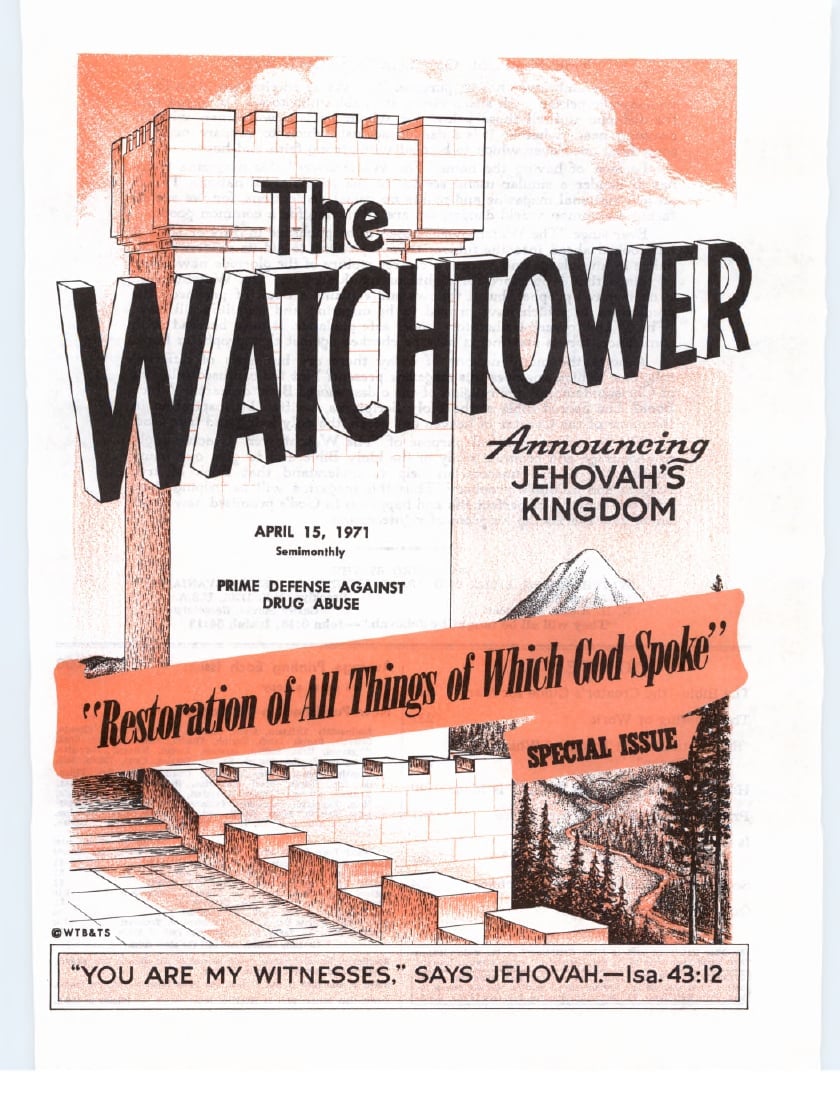
The Watchtower — April 15, 1971
Source: jw.org
Contents
The Bible—the Creator’s Guide for Man
The Blessing of Work
“Restoration of All Things of Which God Spoke”
How “Restoration of All Things” Is Made
Prime Defense Against Drug Abuse
Is Gabon Really “the Country of Friendship”?
Seeing the Condition of the Churches
Questions From Readers
Announcements
The Bible—the Creator’s Guide for Man
The Bible—the Creator’s Guide for Man
“A LAMP to my foot, and a light to my roadway.” That is how the Bible psalmist described God’s Word. And appropriately so, because the Bible serves as a light to guide all men in the way God wants them to go. Surely such a book as this—the Creator’s Guide for all mankind—deserves careful study. Not only should all lovers of God’s Word be well acquainted with its contents, but they also ought to know how it was produced and why it can be said that it is “inspired of God.”—Ps. 119:105; 2 Tim. 3:16.
Bible writing dates back to the year 1513 B.C.E., when Moses was directed to begin the record. It was late in the first century C.E. when the apostle John finished his writing, thus bringing Bible writing to an end—after about sixteen centuries. No other book took so long to complete as the Bible.
Today the Bible is available, in whole or in part, in over 1,400 languages. Though few books reach a circulation in the millions, the Bible has been published by the thousands of millions. No other book can equal that record.
Of course, the mere writing of a religious book, its preservation for hundreds of years and its esteem by millions do not prove that it is of divine origin. It must bear credentials of Divine Authorship demonstrating that it was inspired by God. A careful examination of the Bible convinces sincere persons that it truly has such credentials.
Originally written in Hebrew, Aramaic and Greek, the Bible, as we know it, has sixty-six books. The exact number of books is not important (whether a certain two are combined or left separated), nor is the particular order in which they follow one another. The books remained as separate rolls long after the Bible canon or catalog of inspired books was closed, and ancient catalogs vary in the order in which the books are listed. What is most important, however, is what books are included. In reality, only those books now in the canon have any solid claim to inspiration. From ancient times efforts to include other writings have been resisted.
The Bible was originally written in continuous, unbroken lines of letters. It was not until the ninth century C.E. that any system of dividing sentences by punctuation marks was devised. The main features of our modern system of punctuation began in the fifteenth century C.E. as a result of the introduction of printing. Subdivision of the Bible into chapters and verses (the Authorized Version has 1,189 chapters, 31,173 verses) was not done by the original writers either. This came centuries later. The Masoretes, Jewish scholars, divided the Hebrew Scriptures into verses. Then in the thirteenth century C.E. chapter divisions were added.
“INSPIRED OF GOD”
About forty different individuals served as secretaries of the one great Author to record the inspired Word of Jehovah. “All Scripture is inspired of God,” wrote the Christian apostle Paul. And this includes the writings of the Christian Greek Scriptures along with “the rest of the Scriptures.” (2 Tim. 3:16; 2 Pet. 3:15, 16) But what is meant when one speaks of the Bible’s inspiration?
By “inspiration” is meant, not a mere heightening of the intellect and emotions to a higher degree of accomplishment (as is often said of secular artists or poets), but the production of unerring writings that have the same authority as if written by God himself. How did the Creator accomplish this?
God caused his own spirit to become operative on faithful men whom he used to record things at his direction. For this reason the apostle Peter could declare: “Prophecy was at no time brought by man’s will, but men spoke from God as they were borne along by holy spirit.” (2 Pet. 1:21) In at least one case, however, the information was supplied in written form by God himself. This was the set of Ten Commandments, God giving it to Moses on two “tablets of stone written on by God’s finger.”—Ex. 31:18.
In some cases information was transmitted word for word, by verbal dictation. (Ex. 34:27) The prophets also were often given specific messages to deliver. (1 Ki. 22:14; Jer. 1:7) The evidence indicates, however, that the men used by God to record the Scriptures did not always simply record dictated material. For example, John received the Revelation through God’s angel “in signs” and John was told: “What you see write in a scroll.” (Rev. 1:1, 2, 10, 11) So, God apparently saw good to allow the Bible writers to select words and expressions to describe the visions they saw, while he always exercised sufficient guidance over them so that the end product was accurate and suited his purpose. (Eccl. 12:10) This doubtless explains the different styles evident in the books of the Bible.
That the writings of Moses were inspired of God there can be no doubt, in the light of internal evidence. It was not Moses’ idea to become the leader of the Israelites. At first Moses drew back at the suggestion. (Ex. 3:10, 11; 4:10-14) Rather, God raised Moses up and gave him miraculous powers. Even magic-practicing priests had to acknowledge that what Moses did originated with God. (Ex. 4:1-9; 8:16-19) In obedience to God’s command and with the divine credentials of holy spirit, Moses was moved first to speak and then to write down part of the Bible.
Following Moses’ death, the writings of Joshua, Samuel, Gad and Nathan (Joshua, Judges, Ruth, 1 and 2 Samuel) were added. Kings David and Solomon also made contributions to the growing canon of the Holy Writings. Then came the prophets from Jonah to Malachi, each contributing to the Bible canon. And each in turn met the requirements of true prophets as outlined by Jehovah: They spoke in the name of Jehovah, their prophecies came true and they turned the people toward God.—Deut. 13:1-3; 18:20-22.
COLLECTING THE INSPIRED WRITINGS
Just as Jehovah inspired men to write, it logically follows that he would direct the collecting of these inspired writings. According to Jewish tradition, Ezra had a hand in this work after the exiled Jews were resettled in Judah. He was well qualified for the work, being one of the inspired Bible writers, a priest, and also “a skilled copyist in the law of Moses.”—Ezra 7:1-11.
The canon of the Hebrew Scriptures was well fixed by the end of the fifth century B.C.E. It contained the same writings that we have today. No council of men made them canonical; from their beginning they had divine approval. The most conclusive testimony on the canonicity of the Hebrew Scriptures is the unimpeachable word of Jesus Christ and the writers of the Christian Greek Scriptures. Though they used the inspired Hebrew Scriptures freely, never did they quote from the apocryphal books.—Luke 24:44, 45.
THE BIBLE CANON COMPLETED
The writing and collecting of the twenty-seven books of the Christian Greek Scriptures was similar to that of the Hebrew Scriptures. Christ “gave gifts in men,” yes, “he gave some as apostles, some as prophets, some as evangelizers, some as shepherds and teachers.” (Eph. 4:8, 11-13) With God’s holy spirit upon them they set forth sound doctrine for the Christian congregation. Jesus assured his apostles that God’s spirit would help them, teaching, guiding and recalling to their minds the things they had heard from him, as well as revealing to them future things. (John 14:26; 16:13) This assured the truthfulness and accuracy of their Gospel accounts.
The real test of canonicity is not how many times or by what nonapostolic writer a certain book has been quoted. The contents of the book itself must give evidence that it is a product of holy spirit. Consequently, it cannot contain superstitions or demonism, or encourage creature worship. It must be in total harmony with the rest of the Bible. Each book must conform to the divine “pattern of healthful words,” and be in harmony with the teachings of Jesus.—2 Tim. 1:13.
The apostles clearly spoke with divine authority. By holy spirit they had “discernment of inspired utterances” as to whether such were of God or not. (1 Cor. 12:4, 10) With the death of John, the last apostle, this reliable chain of divinely inspired men came to an end. And so with the Revelation, John’s Gospel and his letters, the Bible canon closed.
The sixty-six books of our Bible, by their harmony, testify to the oneness of the Bible, and recommend it to us as indeed Jehovah’s Word of inspired truth.
INFORMATION OTHERWISE UNAVAILABLE TO MEN
The Bible contains information that otherwise would not be available to men. The Genesis account, for example, provides information about earth’s creation; it gives us knowledge of things that took place before man was on the scene. (Gen. 1:1-31) The Bible also tells us about conversation that took place in the heavens, conversation that no human ears could hear, unless God provided the information.—Job 1:6-12; 1 Ki. 22:19-23.
Moreover, the Bible acquaints us with Jehovah. It relates details of miraculous visions of Jehovah with which his servants were favored. (Dan. 7:9, 10) Also the Bible acquaints us with God’s name “Jehovah,” which name occurs more than 6,800 times in the Masoretic text of the Hebrew Scriptures. In the Bible we learn of Jehovah’s outstanding qualities, such as love, wisdom, justice, mercy, long-suffering, generosity, perfection in knowledge, changelessness.—Ex. 34:6, 7.
Furthermore, the Bible tells us much about God’s Son and the important place that he occupies in God’s purpose. (Col. 1:17-20; 2:3; 2 Cor. 1:20) More than any others, the Son of God, when on earth, was able to enlarge our acquaintanceship with Jehovah. For he was able to say: “He that has seen me has seen the Father also.” (John 14:9) Yet, if Jesus’ teachings and sayings were not written down and made part of the Bible, we would not have this accurate information today.
A PROPHETIC AND PRACTICAL GUIDE
Details as to the development of God’s purpose are revealed in the Bible. All of the foretold blessings for obedient man were centered in a promised Savior whom Jehovah would raise up. He was described prophetically in the Garden of Eden by God as the “seed” of God’s woman. (Gen. 3:15) In time God promised that this Seed would come through Abraham. (Gen. 22:18) He showed that the promised Savior would be an everlasting king and priest “according to the manner of Melchizedek!” (Ps. 110:4; Heb. 7:1-28) He gave the Law covenant to Israel with its priesthood and sacrifices, all of which were a “shadow of the good things to come.”—Heb. 10:1; Col. 2:17.
To David promise was made that the kingship would everlastingly remain in his family. (2 Sam. 7:11-16) And the heir of that promise, as well as the one to whom all the other prophecies pointed as the Deliverer, is shown to be Jesus Christ. Yes, throughout its pages the Bible focuses on the theme of the inspired writings—the kingdom of God in the hands of Jesus Christ as the means that Jehovah has provided for carrying out his purpose.
As a book of prophecy, the Bible is outstanding. Thus it gives significance to events of history and shows why they turned out as they did. (Luke 19:41-44) It shows the future of all present worldly governments—that they will all be crushed by God’s heavenly kingdom, and that kingdom will stand forever. (Dan. 2:44) It explains events of our days, showing that we live in the foretold “time of the end” of this old system and that soon God will clear out all the wicked.
Without the Bible we would not know the real purpose of a dedicated person’s life: “Fear the true God and keep his commandments. For this is the whole obligation of man.” (Eccl. 12:13) It makes clear that man is not a product of blind chance, but a creation of God, who has a loving purpose for mankind. And it explains what God’s will is for us now and how we can find real satisfaction in life.—Rev. 4:11; 1 Tim. 2:3, 4; Ps. 16:11.
Human history demonstrates that man, apart from God, cannot successfully direct his steps. (Jer. 10:23) Only the Bible provides the guidance that he needs. It gives guidance regarding morals, showing what God condemns and what he approves. (Gal. 5:19-23) It proves to be a most practical help amid a world that has thrown off moral restraint. It helps us to get the viewpoint of God and to be pleasing to him.
Is it not obvious why this Book of books should be mankind’s primary textbook for study? Christians, above all, are keenly concerned about investigating this Book that is authored by the One to whom God’s Son said: “Your word is truth.” (John 17:17) The more you become familiar with the sixty-six books of the Bible the more you will be convinced that it is indeed the Creator’s Guide for all mankind.
The Blessing of Work
The Blessing of Work
An article specially designed for parents to read with their children
WHICH would you rather do, work or play? It’s true that we all enjoy playing. But would it really be good if we played all the time? Have you ever thought what would happen if no one ever worked? Let’s think about it for a moment.
Look at the clothes you have on. Do you know where they came from? They were probably made from the wool of an animal or the cotton that grows from the ground. But if people didn’t work to make wool and cotton into clothes, you wouldn’t have anything to wear. So aren’t you glad that people work to make clothes?
Think about the food you eat. Do you know where it comes from? Most of it grows from small plants and large trees. But if no one cared for them and picked the fruits and vegetables that they produce, what would you eat? Isn’t it good that people work so that you have food to eat?
Look around the home in which you live. Do you have a bed to sleep in? Are there chairs on which to sit and also a table? Aren’t you glad someone worked to make these things?
How did Jesus, the Great Teacher, feel about work? Let’s see.
Mary’s husband Joseph was a carpenter. He made things out of wood. And he raised Jesus as his own son. That’s why the Bible calls Jesus “the carpenter’s son.” In those days a young boy would work with his father. He would learn to do the same jobs his father did. So Jesus no doubt worked with Joseph.—Matt. 13:55.
It may have been hard at first. But with years of practice, he learned to do it well. The Bible tells us that Jesus became a carpenter too.—Mark 6:3.
Do you think this work brought Jesus pleasure? Would you be happy if you could make fine tables and chairs and other things for people to use? You can get great pleasure from work. The Bible says it’s good for one to “rejoice in his works.” Work gives a kind of pleasure that you cannot get from play. It’s not wrong to play, but it’s not good to play all the time.—Eccl. 3:22.
Jesus did not work as a carpenter all his life. Jehovah God had special work for him to do on earth. Do you know what that work was? Jesus said: “I must declare the good news of the kingdom of God, because for this I was sent forth.” Yes, God had a preaching work for Jesus to do.—Luke 4:43.
How did Jesus feel about doing this work? Did he want to do it?
Jesus said: “My food is for me to do the will of him that sent me and to finish his work.” How much do you like to eat your favorite food? This gives you an idea of how much Jesus liked the work that God gave him. That work was a blessing to him, just as it is a blessing to eat when you are hungry.—John 4:34.
Since Jesus found pleasure in working, do you think that you can find pleasure in working too? I am sure you can. When you learn to do a job well, then it can bring you real pleasure.
God made us so that we are happy when we learn to work. He says that it is his gift to man that he should “rejoice in his hard work.” So, if you learn to work when you are young, your whole life will be more enjoyable.—Eccl. 5:19.
That does not mean that a young child can do the work of a big man, but we can all do some work. Your father works day after day so that we will have food to eat and a home in which to live. Do you know what kind of work your father does? He doesn’t work just for himself. He works for the good of the whole family. And your mother works to prepare our meals. She keeps our home and our clothing clean.
What work is there that you can do that will be a blessing to the whole family? You can help to set the table, wipe the dishes, clean your room and pick up your toys. Perhaps you already do some of those things. Is that work really a blessing?
Let’s take just one example: Putting away your toys after you play. Why would you say that is important? It helps to make the house neat. It is also important because it can prevent accidents. If you don’t pick up your toys, your mother may come along someday with her arms full and step on one of them. She may trip and fall and crack her head. She may even have to go to the hospital. Wouldn’t that be terrible? So, when you put away your toys after you play, that is a blessing to all of us.
There is other work that children have too. I am thinking of schoolwork. At school you learn how to read. Some children find reading to be fun, but some say it is hard. Even if it seems hard at first, you will be glad if you learn to read well. When you know how to read, there are so many interesting things that you can learn. Reading opens up great treasures of knowledge. You will even be able to read God’s own book, the Bible, for yourself! So, when you do your schoolwork well, it is really a blessing, isn’t it?
There are some people who try to avoid work. Maybe you know someone who does that. But since God made us to work, do you think that people of that sort are happy? No; we need to learn how to enjoy work.
Here are some things that can help. When you are given any work to do, make it a habit to figure out why it needs to be done. When you know why something is important, it is easier to do it. And whether the work seems to be big or little, do a good job of it. If you do that, you will be able to rejoice in the work of your hands. Then you will know from your own experience that work really is a blessing.
“Look! The best thing that I myself have seen, which is pretty, is that one should eat and drink and see good for all his hard work with which he works hard.”—Eccl. 5:18.
“Restoration of All Things of Which God Spoke”
“Restoration of All Things of Which God Spoke”
“The times of restoration of all things of which God spoke through the mouth of his holy prophets of old time.”—Acts 3:21.
1. The restoration is to be of things of which who spoke, and why can we be glad on that account?
HOW glad we can be that the promised restoration was to be, not of the things of which human politicians and philosophers spoke, but of the “things of which God spoke”! Those things should therefore be good for all mankind. They should be certain of being restored. We ought to want those things to be restored, for, better than anyone else, our Creator knows what needs to be restored to us. But do we want those things?
2. How do we desire to answer that question, and so what questions come flooding into our minds?
2 We do not care to answer this question blindly, ignorantly. We are gifted with the right of free moral agency. We desire to know first what the things involved are, in order that we may make an intelligent, enlightened choice. What are all those things? How can we find out that God spoke of all of them? Who heard him speaking? When did he speak of them? And how? Questions like these come flooding into our minds. They deserve to be answered with the backing of a reliable authority. They can be.
3. Who raised this subject of restoration of all things, and when, where and why?
3 A man who figured prominently in the first century of our Common Era brought up this subject, and he did so in a city the name of which is mentioned much in the world news of today. That man has had many places on earth named after him. The man’s name was Peter, the son of John, of a city in the controversial Middle East. The place where he spoke was in the temple of the city of Jerusalem. Today that temple, constructed by famous King Herod the Great, does not stand at that location. It was destroyed in the year 70 of the first century, when the Roman armies destroyed the whole city of Jerusalem. At that location there is now a place of worship of a different religious belief. But back there when Peter, the son of John, spoke, it was yet thirty-seven years before that news-making event of the year 70 C.E. A great crowd of worshipers had gathered around Peter. What had happened through the agency of Peter raised questions in their minds. It was on that occasion that Peter uttered the meaningful phrase, “the times of restoration of all things of which God spoke through the mouth of his holy prophets of old time.”—Acts 3:21.
4, 5. (a) Why were those men not false prophets, and how has what they spoke been preserved? (b) Why is there hardly any excuse for us not to know today what those men spoke?
4 Ah, here we have answers to our questions. It was in “old time,” even before the time of Peter, that God spoke. It was by means of “his holy prophets” that he spoke of these vital things. No false prophets were they, but they were “holy prophets” of God. He spoke to them, and they, in turn, used their mouths to tell to others the things spoken by God. The voices of those holy prophets died down more than twenty-three centuries ago. Their voices were not preserved on phonograph records or on recording-machine tapes. The messages that God sent through the mouths of those holy prophets were recorded in writing. That writing, which took over a thousand years to complete, has been jealously safeguarded in the first thirty-nine books of the Authorized Version of the Holy Bible. Peter the son of John read those books. That is why he knew what he was talking about.
5 We also can know the things that God spoke through the mouth of his holy prophets by reading those selfsame books. There is hardly any excuse for us not to know, for the Holy Bible is the most widely distributed book in the most languages on earth. This imperishable Book is our reliable authority for backing up what we say.
6. (a) Why did Peter accept those writings in the way that he did? (b) Where do we find what Peter wrote and what he said in the temple?
6 Years later Peter wrote a letter concerning those Holy Scriptures, addressing it to Bible readers. In it he wrote: “You know this first, that no prophecy of Scripture springs from any private interpretation. For prophecy was at no time brought by man’s will, but men spoke from God as they were borne along by holy spirit.” (2 Pet. 1:20, 21) Knowing this, Peter accepted what those spirit-borne men prophesied as being, not man’s word, but God’s word. We, although being of this twentieth century, should accept those inspired writings in the same way in which Peter did, for those writings stand unchanged today. What Peter there wrote and what he spoke in the temple of Jerusalem are preserved for us in the last twenty-seven books of the Holy Bible.
7. Of what did the crowd gathered around Peter and John want an explanation?
7 Why, though, did that crowd of worshipers gather around Peter and his companion, John the son of Zebedee? An excitement of curiosity! A crippled beggar at the temple had looked to Peter for a charitable money gift. Peter gave him something better. He said: “Silver and gold I do not possess, but what I do have is what I give you: In the name of Jesus Christ the Nazarene, walk!” The beggar, lame from birth, was helped by Peter to get onto his feet and walk. Was this not enough to make any crowd gather? Yes. So the crowd wanted an explanation from Peter.
8. What had happened to that one named by Peter, so that Peter’s use of that name worked for the cripple?
8 Now let us remember that in early spring of that year 33 C.E. a murder had occurred in open daylight in public, just outside the walls of Jerusalem. It was the murder of that one whom Peter named, “Jesus Christ the Nazarene.” That meant Jesus the Messiah of the city of Nazareth. Roman soldiers were employed to nail him to a stake to die like a criminal, but his friends got permission to bury him nearby. But on the third day of his burial the sealed tomb was opened by an angel and was found to be empty. In proof that Jesus Christ was no guilty criminal, Almighty God raised him from the dead, to life, not in flesh again, but in spirit. Peter and John had seen the resurrected Jesus Christ appear a number of times thereafter by his materializing in flesh on certain occasions before many reliable eyewitnesses during forty days. On the fortieth day Peter and John and their companions saw this Jesus Christ ascend heavenward and disappear. Now Peter’s use of the name of Jesus Christ the Nazarene worked for the cripple.
9. With what words did Peter disclaim any credit for the miracle, and also speak of fulfillment of prophecy?
9 Peter disclaimed any credit for this marvelous miracle. To the inquisitive crowd, Peter said: “The God of Abraham and of Isaac and of Jacob, the God of our forefathers, has glorified his Servant, Jesus, whom you, for your part, delivered up and disowned before [Governor] Pilate’s face, when he had decided to release him. Yes, you disowned that holy and righteous one, and you asked for a man, a murderer, to be freely granted to you, whereas you killed the Chief Agent of life. But God raised him up from the dead, of which fact we are witnesses. Consequently his name, by our faith in his name, has made this man strong whom you behold and know, and the faith that is through him has given the man this complete soundness in the sight of all of you. And now, brothers, I know that you acted in ignorance, just as your rulers also did. But in this way God has fulfilled the things he announced beforehand through the mouth of all the prophets, that his Christ would suffer.”—Acts 3:1-18.
10. Why was the murder of Jesus, although committed in ignorance, not excusable and without consequences for that Jewish crowd?
10 Even though it had been done in ignorance as far as that crowd was concerned, a crime had been committed. What was worse, it was committed upon God’s own Messiah or Christ. The fact that God had foretold by his prophets that his Messiah or Christ would suffer did not excuse the crowd. According to God’s Law as given to the Jews through the prophet Moses, even manslaughter committed unwittingly or unintentionally had to be made up for, in order that the land might not be polluted with innocent blood. (Num. 35:9-34) Those listening to Peter knew that. They knew that community responsibility for the murderous killing of Jesus Christ, the faithful Servant of God, rested upon them. What should they do to escape the consequences of this crime? How could their sins in this regard be blotted out? Likely this miracle-worker Peter knew. He did. So he told that crowd:
11. How could those Jews get their sins blotted out, and what was to follow this in due time?
11 “Repent, therefore, and turn around so as to get your sins blotted out, that seasons of refreshing may come from the person of Jehovah and that he may send forth the Christ appointed for you, Jesus, whom heaven, indeed, must hold within itself until the times of restoration of all things of which God spoke through the mouth of his holy prophets of old time.”—Acts 3:19-21.
HOW TO GET SINS BLOTTED OUT
12. What pattern for having sins blotted out does this set for us today, and why?
12 Those words of Peter set the pattern for us today. We all have sins that need to be blotted out according to God’s loving arrangement, for we are all born sinners, by inheritance of sin from our first human parents, Adam and Eve. (Gen. 3:1-24; Rom. 5:12, 18, 19) We must remember that “the wages sin pays is death.” (Rom. 6:23) If we are anxious to gain life everlasting, in the favor of God, then it is necessary that we repent, that is, feel sorrow and regret for our sinfulness and imperfection and our sins against God’s law. If we really feel sorry and hate ourselves for being sinners against God, we will try to get out of that sinful state and to cease from sinning. How, though?
13. What in addition to repentance was necessary for those Jews, and what course did this call upon such Jews to take?
13 Peter said one must take action in harmony with one’s repentance. He added: “And turn around so as to get your sins blotted out.” Mere repentance will not get our sins blotted out. We have to “turn around” and go in the opposite direction from the course of sinning, making the effort to cease from it. For those Jews back there, that meant to stop resisting Jesus Christ and, rather, to start walking in his footsteps as the “Christ [or, Messiah] appointed for you, Jesus.” (Acts 3:19, 20) Those Jews were already dedicated to Jehovah as God by reason of their having been born into the covenant that Jehovah had made with their forefathers through Moses. So now they had to accept the one whom Jehovah had appointed as their Messiah or Christ and present themselves to Jehovah as believers in and followers of His Messiah. Some days earlier Peter told some three thousand repentant Jews that they needed to symbolize their repentance and conversion by being baptized in water in the name of Jesus as now being their accepted Messiah, the Son of God.—Acts 2:37-42.
14, 15. (a) What fine result comes to the forgiven one from having his sins blotted out? (b) As to whether the blotting out of sins comes from the water of baptism, what does John have to say?
14 What did Peter say would be the fine result of such turning around from the way of being contrary to God’s purpose and appointment and going in the way of his approval and will? This: “that seasons of refreshing may come from the person of Jehovah.”
15 Certainly it would be most refreshing for them to have their sins blotted out, and no longer have the condemnation of sin nor a guilty conscience before him, especially after having been in opposition to the Messiah or Christ of Jehovah. The blotting out of their sins resulted not from the water in which they were baptized, but from the shed blood of Jesus Christ as a perfect human sacrifice for the sins of all mankind. Just as Peter’s companion, John the son of Zebedee, wrote later on concerning our walking with God, saying: “If we are walking in the light as he himself is in the light, we do have a sharing with one another, and the blood of Jesus his Son cleanses us from all sin.” (1 John 1:7) Thus God no longer looks on us as sinners, and the peaceful relation with God that results from this mercy on God’s part brings us tremendous refreshment indeed.
16. What did Peter mean by saying that those “seasons of refreshing” come “from the person of Jehovah,” and in that regard what does history show regarding the Jews since 70 C.E.?
16 Since these “seasons of refreshing” are said to “come from the person of Jehovah,” it means that his face is turned toward us with favor. He is giving us his favorable attention. His goodwill is toward us, during the “year of goodwill on the part of Jehovah.” We have become his “men of goodwill.” (Isa. 61:1, 2; Luke 2:14) In the days of the Christian apostle Peter it was urgent upon those Jews to gain Jehovah’s goodwill after the murder of His Messiah at Jerusalem, inasmuch as the destruction of the city of Jerusalem and the breaking up of the Jewish nation in the land of Judah was getting very close. The sad history of the Jewish people after the destruction of Jerusalem by the Romans in the year 70 C.E. proves that the dispersed Jewish people have not been enjoying ‘seasons of refreshing from the person of Jehovah [literally, from the face of Jehovah].’
17. In this same regard what must be said about Christendom, and what does Jerusalem’s destruction in 70 C.E. indicate for her?
17 Also, as we examine the history of the religious organization of Christendom since its establishment in the fourth century, we are obliged to admit that Christendom has not been enjoying the ‘seasons of refreshing from the person of Jehovah’ during the more than sixteen centuries of her existence until now. All through her history she has been torn by inside religious disputes and wars, sectarian divisions and disunity and ever-worsening religious confusion. The destruction of Jerusalem back in the year 70 C.E. was a type foreshadowing the destruction of Christendom at the hands of worldly, secular enemies in the near future. Jehovah’s face of favor is turned away from Christendom, and he will no more protect her against the approaching destruction than he protected Jerusalem in the year 70 C.E.
18. What counsel is it therefore urgent upon all people to follow now, and who have already done so and with what result?
18 This is why it is now urgent upon the people, Jew and Gentile alike, to do what the apostle Peter advised, “Repent, therefore, and turn around so as to get your sins blotted out [or, forgiven].” This is what the Christian witnesses of Jehovah have done, and all the evidence proves that they are, in a spiritual sense, enjoying abundantly the ‘seasons of refreshing from the person of Jehovah.’ By the presenting of themselves to Him in a full dedication through his Messiah, Jesus, they have become his “men of goodwill.” As a reward for this they are enjoying what the angels said in the hearing of the shepherds at the birth of Jesus in Bethlehem, “upon earth peace among men of goodwill.” They do not want to be destroyed with unpeaceful Christendom nor with all the rest of the world empire of false religion in the near future. They feel great “refreshing” because of being relieved of any community share in the sins of Christendom and of that religious world empire, Babylon the Great.—Rev. 18:2-5.
A SECOND SENDING OF MESSIAH AND WHY
19. How do Christendom and the natural Jews differ as to Messiah’s coming, and for it to result in “refreshing” what does Christendom need to do?
19 Christendom claims to be waiting for the return of Jesus Christ, and she expects to experience “seasons of refreshing” as a result of his return. But for this to be so, Christendom would have to do what Peter told the sin-guilty Jews to do, “Repent, therefore, and turn around [or, be converted] so as to get your sins blotted out.” Such times of refreshing follow such a course, just as Peter went on to show, saying: “That seasons of refreshing may come from the person of Jehovah and that he may send forth the Christ appointed for you, Jesus, whom heaven, indeed, must hold within itself until the times of restoration of all things of which God spoke through the mouth of his holy prophets of old time.” (Acts 3:19-21) The natural, circumcised Jews that do not believe that the Messiah came nineteen centuries ago look for him to come for the first time in the future. But Peter and John and the other Christianized Jews looked for the Messiah to return or to come a second time and for a different purpose. Peter and John had seen him ascend back to heaven.
20. Why was the return of the Messiah a necessity, and why had God sent him the first time?
20 Peter and John remembered Jesus’ words to the Jews: “What, therefore, if you should behold the Son of man ascending to where he was before?” On his resurrection day he appeared to Mary of the city of Magdala and said: “I have not yet ascended to the Father. But be on your way to my brothers and say to them, ‘I am ascending to my Father and your Father and to my God and your God.’” (John 6:62; 20:17) He ascended back to heaven on the fortieth day after his resurrection from the dead. But to fulfill all the prophecies concerning the Messiah, he had to come again. So the apostle Peter, after speaking of “seasons of refreshing” from the person of Jehovah, went on to say: “And that he may send forth the Christ appointed for you, Jesus.” The first time that Jehovah sent his Son to earth, it was that he might die as a ransom sacrifice for all mankind. Hence Peter said to the crowd of Jews around him: “In this way God has fulfilled the things he announced beforehand through the mouth of all the prophets, that his Christ would suffer.”—Acts 3:18.
21. What other things did Jehovah’s prophets foretell about the Messiah, as indicated by Peter in his letter, and why does Jehovah send him the second time?
21 Other things announced beforehand through the mouth of all the prophets of Jehovah told of his coming glory in the Messianic kingdom. In his first letter to Christian believers the apostle Peter wrote concerning those prophets, saying: “They kept on investigating what particular season or what sort of season the spirit in them was indicating concerning Christ when it was bearing witness beforehand about the sufferings for Christ and about the glories to follow these.” (1 Pet. 1:10, 11) Peter remembered the words of Jesus Christ in his prophecy concerning the destruction of Jerusalem, saying: “When the Son of man arrives in his glory, and all the angels with him, then he will sit down on his glorious throne.” (Matt. 25:31) His sufferings in the flesh on earth, as foretold for him through the prophets, would then be forever past. When Jehovah sends him to earth the second time, it is that he might reign in heavenly glory to fulfill all the other prophecies concerning the kingdom of Messiah.
22. As to when this fulfilling of Kingdom prophecies would be, what do Psalm 110:1, 2 and Hebrews 10:12, 13 indicate?
22 Now just when would that be? King David of Jerusalem, who was a royal ancestor of Jesus Christ, said prophetically concerning his ascension to heaven: “The utterance of Jehovah to my Lord is: ‘Sit at my right hand until I place your enemies as a stool for your feet.’ The rod of your strength Jehovah will send out of Zion, saying: ‘Go subduing in the midst of your enemies.’” (Ps. 110:1, 2) In comment on this prophetic psalm Hebrews 10:12, 13 says concerning Jesus Christ and his perfect human sacrifice: “This man offered one sacrifice for sins perpetually and sat down at the right hand of God, from then on awaiting until his enemies should be placed as a stool for his feet.” This prophecy meant that the glorified Jesus Christ in heaven at God’s right hand would be victorious over all persons on earth who would oppose his reigning over all mankind as Jehovah’s Messiah.
23. So what vital question does each one do well to ask himself, and why?
23 Each one of us does well, therefore, to ask himself the vital question, ‘Am I an enemy of Jehovah’s Messianic kingdom by Jesus Christ?’ Christendom is! Babylon the Great, the world empire of false religion, is! So are the political nations that make up the world organization for international peace and security, the United Nations. All such enemies are to be subdued, crushed! According to Bible prophecy and world conditions, this is near!
24. Until what “times” was heaven to hold the Messiah Jesus within itself, and so now what is the key question for us?
24 Why are we convinced of that world disaster as being near? For the reason that the apostle Peter prophesied that this ascended Jesus Christ “heaven, indeed, must hold within itself until the times of restoration of all thingsa of which God spoke through the mouth of his holy prophets of old time.” (Acts 3:21) The key question here is, What are those “all things” until the times of the restoration of which the heaven must hold within itself the ascended Messiah Jesus, who is seated at Jehovah’s right hand waiting for his enemies to be made his footstool?
25. Briefly, what are those “all things,” and what questions does this brief answer raise up?
25 Those “all things” are the Messianic kingdom and its interests at the earth. Is this a surprising answer to the question? Is anyone of us inclined to ask, How could this be so, when, back in the apostle Peter’s day, that Messianic kingdom of Jehovah was yet to come? Since that kingdom of the Messiah had not been established and been lost, how could it be restored?
26. Concerning the restoration of what had Peter and fellow apostles asked Jesus before he ascended, and what was his reply?
26 The apostle Peter, however, knew what he was talking about. He knew how that kingdom could be restored. He was one of the apostles who asked the resurrected Messiah Jesus just before he ascended to heaven: “Lord, are you restoring the kingdom to Israel at this time?” To this question the resurrected Messiah Jesus replied: “It does not belong to you to get knowledge of the times or seasons which the Father has placed in his own jurisdiction; but you will receive power when the holy spirit arrives upon you, and you will be witnesses of me both in Jerusalem and in all Judea and Samaria and to the most distant part of the earth.” After saying that, and as he was blessing them, he was taken up from his disciples on the Mount of Olives into heaven.—Acts 1:6-11; Luke 24:5-53.
[Footnotes]
Jesus Christ used a similar expression, in Matthew 17:11, when he said: “Elijah, indeed, is coming and will restore all things.” This statement had reference to Malachi 4:5, 6. But then Jesus went on to make an application of this prophecy about Elijah to John the Baptist. (Matt. 17:12, 13) John the Baptist also served as the forerunner of Jesus Christ, and for that reason he proclaimed: “The kingdom of the heavens has drawn near.” (Matt. 3:1, 2) But as to modern times, after World War I and since the year 1919 a work like that of Elijah has been carried on by Jehovah’s Christian witnesses. By them a witness to Jehovah’s Messianic kingdom has been given since that time until now such as has never before been given world wide in all previous human history.—Matt. 24:14; Mark 13:10.
Since 1919 C.E. these Christian witnesses of Jehovah discern a spiritual fulfillment toward them of the words of Isaiah 1:25-27: “And I will turn back my hand upon you, and I shall smelt away your scummy dross as with lye, and I will remove all your waste products. And I will bring back again judges for you as at the first, and counselors for you as at the start. After this you will be called City of Righteousness, Faithful Town. With justice Zion herself will be redeemed, and those returning of her, with righteousness.”
[Picture on page 234]
Peter’s healing of a man lame from birth set the stage for his words about the “restoration of all things of which God spoke”
[Picture on page 238]
Each one ought to ask himself: Am I really a loyal supporter of God’s Messianic kingdom by Jesus Christ? If so, how do I prove it?
How “Restoration of All Things” Is Made
How “Restoration of All Things” Is Made
1. What question did the political situation of the Jews in Jesus’ days make it appropriate for his apostles to ask him, and what does Israel’s position today show as to his action?
ALL who are familiar with history know that at the time of Jesus’ ascension the nation of Israel did not have a kingdom. For some years they had had a kingdom of the Maccabees, but that had been a kingdom of Jewish priests of the tribe of Levi and had been overthrown by the Roman Empire in the year 63 before our Common Era. Also, the later kingdom of Herod the Great had been no Jewish kingdom but an Edomite kingdom and had been imposed upon the Jews by the Roman Senate. But when Jesus ascended to heaven, Jerusalem was under the Roman governor Pontius Pilate, who had handed him over to be put to death; and the province of Galilee was being ruled by Herod Antipas, the son of Herod the Great. (Luke 3:1, 2; 23:6-15) So the disciples could properly ask Jesus Christ before he ascended: “Lord, are you restoring the kingdom to Israel at this time?” (Acts 1:6) He did not then do so, and to this day Israel has no kingdom. The government of Israel in the Middle East is a Republic and is a member of the organization for world peace and security, the United Nations.
2. What is the attitude of the U.N. toward Jehovah’s Messianic kingdom, but who wants it restored?
2 The United Nations does not want the Messianic kingdom to come by means of the Republic of Israel. In fact, the United Nations does not desire or pray for Jehovah’s Messianic kingdom at all. Not Christendom, but Jehovah’s Christian witnesses do desire that Messianic kingdom and have given their allegiance to it.
3. How did the apostles by their question show that establishment of the Messianic kingdom then would be a restoration, and how did they expect him to make it?
3 The establishment of that Messianic kingdom, not on earth, but in heaven, means a “restoration,” according to the Holy Scriptures. How so? Let us remember that the apostles of Jesus Christ knew and acknowledged that he was the Messiah or the Christ appointed by Jehovah for His people. On one occasion the apostle Nathanael said to Jesus: “Rabbi, you are the Son of God, you are King of Israel.” And on a later occasion the apostle Peter said to him: “You are the Christ, the Son of the living God.” (John 1:49; Matt. 16:16) The title Christ is the Greek word for the Hebrew word Messiah. Consequently, when the apostles asked the resurrected Jesus, “Lord, are you restoring the kingdom to Israel at this time?” they were asking whether the real Messiah would restore the kingdom. As he was truly the Messiah or Christ, they expected him to “restore” the kingdom. How? By his becoming King himself over Israel at that time.
4. So what kind of kingdom must the Jewish kingdom have been down to the year 607 B.C.E., and why was the Son of God from heaven born into David’s line?
4 Ah, do we now get the point? The ancient kingdom of Israel down to its overthrow by the Babylonian Empire in the year 607 B.C.E. was a Messianic kingdom. That kingdom was the government of the royal family of David of Bethlehem. When God sent his only-begotten Son from heaven, he was born into the family of King David and was given the name Jesus, the name meaning “Jehovah Is Salvation.” Thereby Jesus was an heir to the throne of King David. (Matthew 1:1 to 2:6; Luke 3:23-31) Even an angel from heaven declared that Jesus was the Christ or Messiah. On the night of his birth in Bethlehem, this angel from Jehovah said to God-fearing shepherds: “Have no fear, for, look! I am declaring to you good news of a great joy that all the people will have, because there was born to you today a Savior, who is Christ the Lord, in David’s city.”—Luke 2:8-11.
5. Into what kind of line, then, was Jesus born, and what is there to prove that Israel’s kings were referred to as Messiahs?
5 This Jesus, who was to be the “Lord” of King David, was born into a Messianic line. How is that? Because the adjective Messianic means “having to do with the Messiah.” Well, then, were the kings of David’s line in ancient Israel called “Messiahs”? Or, would the Greek-speaking Jews call them “Christs”? Yes, because the title Messiah means Anointed One, and Christ means Anointed One. This title applied to these kings of David’s royal line because they had been anointed by Jehovah’s high priest in Israel with holy anointing oil to be kings over Jehovah’s chosen people. (1 Ki. 1:34-39) Repeatedly David spoke of King Saul, the first king of the twelve tribes of Israel, as being the “anointed [or, Messiah] of Jehovah.” Likewise, David himself as king was constantly spoken of as Jehovah’s anointed or Messiah. (1 Sam. 24:6, 10; 26:9-23; 2 Sam. 1:14-16; 19:21; 22:51; 23:1) Even Zedekiah, the last king of David’s line on the throne of Jerusalem, is called “the anointed one [or, Messiah] of Jehovah.”—Lam. 4:20, footnote of 1958 edition.
6. In view of what event in 607 B.C.E., why would God’s promise to King David require that the Messianic kingdom be restored?
6 After the overthrow of King Zedekiah at the destruction of Jerusalem in 607 B.C.E., there was no Messianic king on the throne of Israel. But 463 years before this Jehovah, in a solemn covenant with King David, promised him: “Your house and your kingdom will certainly be steadfast to time indefinite before you; your very throne will become one firmly established to time indefinite.” (2 Sam. 7:16) This meant, therefore, that the Messianic kingdom in the royal line of David had to be restored.
7. Why was Jesus Christ the one in whom to make restoration of the Messianic kingdom?
7 Jesus Christ was the one by means of whom to make this restoration of the Messianic kingdom, for Jesus was born into the line of King David. Before his human birth an angel said concerning Jesus: “Jehovah God will give him the throne of David his father, and he will rule as king over the house of Jacob forever, and there will be no end of his kingdom.” And at Jesus’ birth in Bethlehem an angel announced that he was to be “Christ [or, Messiah] the Lord.” (Luke 1:32, 33; 2:11) That fixed matters; the restoration of the Messianic kingdom was to be with Jesus.
8. Although not anointed by the high priest at Jerusalem, why was Jesus nevertheless the Messiah, and why can he now reign forever?
8 True, Jesus was not anointed to be king over Jacob or Israel by having the high priest pour the holy anointing oil upon his head at Jerusalem. To the contrary, in the year 33 C.E. the high priest of Jerusalem called for the death of Jesus by being executed at the hands of the Romans. But this did not prove that Jesus was not the Anointed One or Messiah. (Luke 24:20; John 19:6, 15, 21) Jesus was anointed by someone higher than the high priest of Israel. He was in a very special sense “the Anointed One of Jehovah,” for he was anointed by Jehovah himself, and not with holy anointing oil, but with Jehovah’s spirit. This took place after Jesus was baptized in water by John the Baptist. (Matt. 3:13-17; Acts 10:38) His death on an execution stake outside Jerusalem did not prevent him from becoming the Messianic Heir of King David forever, for, on the third day of his death, God Almighty resurrected him and rewarded him with immortality, with incorruptible life in the spirit. (Rom. 1:3, 4; 1 Cor. 15:3-8; 1 Pet. 3:18-22) So by reason of his endless life in heaven he can reign as Messianic King forever.
FORETOLD BY MOSES AND LATER PROPHETS
9, 10. (a) How did Peter indicate who was to be the Prophet like Moses, but greater? (b) How is that one greater than Moses, and so why do we not want to resist him?
9 In order to show how great this Jesus is, the apostle Peter went on to say to the crowd of Jews around him in the temple: “In fact, Moses said, ‘Jehovah God will raise up for you from among your brothers a prophet like me. You must listen to him according to all the things he speaks to you. Indeed, any soul that does not listen to that Prophet will be completely destroyed from among the people.’” (Acts 3:22, 23) Peter was there quoting the words of the prophet Moses as found in Deuteronomy 18:15-19.
10 Jesus Christ is that promised Prophet, who was to be like Moses but greater than Moses. He did more and greater miracles than Moses did, and he mediates the New Covenant between Jehovah and the Christian congregation, a covenant that is far better than the Law Covenant as mediated by Moses at Mount Sinai in Arabia. (Acts 2:22; Jer. 31:31-34; Heb. 8:6; 9:15; 12:24; 13:20) Certainly, then, we do not desire to be found among those who oppose the restoration of the Messianic kingdom in the person of Jesus Christ, the Prophet King who is greater than Moses. To be found among them would mean our complete destruction.
11. According to Peter’s words, who besides Moses had declared those days and the blessing for which the Israelites were in line?
11 Moses, however, was not the only one who prophesied under divine inspiration about this Jesus the Messiah. There were many others, and so the apostle Peter went on to say to Jews crowded around him in the temple: “And all the prophets, in fact, from Samuel on and those in succession, just as many as have spoken, have also plainly declared these days. You are the sons of the prophets and of the covenant which God covenanted with your forefathers, saying to Abraham, ‘And in your seed all the families of the earth will be blessed.’ To you first God, after raising up his Servant, sent him forth to bless you by turning each one away from your wicked deeds.”—Acts 3:24-26.
12. (a) How were those words true with respect to the prophets? (b) How did Jehovah arrange to have Israel blessed first by Messiah?
12 The prophet Moses was the one that recorded Jehovah’s covenant with the patriarch Abraham for all families and nations of the earth to be blessed by means of his Seed or Offspring. (Gen. 12:3; 22:18) The prophet Samuel was the one who first anointed David of Bethlehem to become the king of all Israel; and this in itself was a prophetic act pointing forward to Jesus Christ. (1 Sam. 16:11-13) The succession of Hebrew prophets after Samuel all had something to say with reference to Jehovah’s Messianic kingdom. From these prophecies we are helped to appreciate how much the Messianic kingdom of the Son of God will mean to all mankind. Jesus Christ was primarily that promised Seed of Abraham for blessing all families and nations. (Gal. 3:3-16) God raised him up and commissioned him as “his Servant” to bring blessings to the people. God sent this anointed Servant to bless first the natural, circumcised Jews, by having his Son Jesus born as a Jew in the family line of King David. To get the blessing those Jews had to turn from wicked works.
13. When Peter called on those Jews to repent, was he setting before them an earthly hope or a heavenly one, and why?
13 So by calling upon those Jews to ‘repent and turn around’ or be converted, the apostle Peter was not setting before those Jews an earthly hope, a hope of inheriting an earthly Paradise under the Messianic kingdom of the heavens. He was not pointing them forward to the long-distant future with the prospect of being restored to perfect human life and health in a Garden of Eden restored to earth. Rather, Peter was pointing them to the opportunity of becoming associated with that Jesus Christ the primary Seed of Abraham and thus sharing with Jesus Christ in blessing all the families and nations of the earth. This would mean that they would also be associated with him in his Messianic reign, reigning with him in the heavens for the blessing of all mankind. So they, also, would receive the anointing with Jehovah’s spirit and become his spiritual sons. Their being natural circumcised Israelites no longer counted with God. They needed to become spiritual Israelites, circumcised at heart, and making up the spiritual “Israel of God.”—Gal. 6:15, 16.
14. (a) When the vast majority of the Jews turned down the Kingdom opportunity, who were allowed to take advantage of it? (b) Why are a remnant of these Kingdom heirs rejoicing today?
14 When the vast majority of the Jews refused to take advantage of this wondrous opportunity to become associated with Jesus Christ in his heavenly Messianic reign, the opportunity was offered to all non-Jewish nations. God’s predetermined number are acting upon this opportunity. (Acts 10:1 to 11:18; 15:7-14; 13:46-48) A remnant of these spirit-begotten heirs of the Messianic kingdom are on earth today, and eagerly they look forward to sharing with the Messiah Jesus in his heavenly kingdom. (Rom. 8:14-17; 2 Tim. 2:10-12; Rev. 20:4-6) They specially rejoice today because they know that “times of restoration of all things of which God spoke through the mouth of his holy prophets of old time” have broken upon them. (Acts 3:21) The Messianic kingdom has been restored! Since when?
15. Since when has the Messianic kingdom been restored, and so because of going on in what course will the nations be destroyed?
15 Since the end of the “times of the Gentiles,” or, “the appointed times of the nations,” in the year 1914 C.E. (Luke 21:20-24) Jesus Christ did not ‘restore the kingdom’ at the time of his ascension to heaven in the year 33 C.E. He knew he had to wait, and he did wait, until those Gentile Times ended in that year when the first world war erupted upon mankind. At that time he was authorized to make request of Jehovah, and Jehovah foretold that he would then grant the request of his Messiah. He would give the Messiah or Christ the political nations for his inheritance and the “ends of the earth” for his possession. Today these nations are interested in world domination by politicians not anointed with Jehovah’s spirit. They are giving themselves over to selfish nationalism along with national sovereignty, in spite of belonging to the United Nations organization. Even in their desperate circumstances today they are not seeking and praying for Jehovah’s restored Messianic kingdom. Their keeping on in this course will mean their annihilation.—Ps. 2:1-9.
RESTORATION OF UNIVERSAL SOVEREIGNTY
16. With due regard for God, what would we desire to see reestablished?
16 How about us, though? Do we have faith in the Holy Bible and in its prophecies and its timetable for human affairs? Are we rejoicing in these “times of restoration of all things” of which the God of the Bible spoke? If we do have faith and we are therefore rejoicing, then the first thing that we should unselfishly desire with due respect to God is the reestablishment of the universal sovereignty of Jehovah so as to include our earth. This would mean that Jehovah would positively prove that he as God the Creator still owns the earth and controls it the same as all the rest of the boundless realm of creation, heavenly and earthly.
17. What change in things will such a reestablishment mean, and with what refreshing to us?
17 This would mean an all-inclusive change in things. It would mean the reestablishment of peace through all the universe heavenly and earthly. What a great “refreshing” it will be for us when that greatest of all peace disturbers, Satan the Devil, and his demons will be bound by Jehovah’s Messianic kingdom and be hurled into an abyss so as not to be able to mislead and oppress earth’s inhabitants! (Rev. 20:1-6) By destroying Satan’s entire organization God’s kingdom will vindicate his universal sovereignty.
18. What do the “all things” that are to be restored include?
18 God’s Messianic kingdom has rightful interests in the earth. These interests belong to the “all things” of which God spoke through the mouth of his prophets of old time and which must have a restoration here. So subjects are included. All human creatures living on this earth must become subjects of that kingdom in order to come under the universal sovereignty of Jehovah.
19, 20. (a) Who already submit themselves to the Messianic kingdom, and with what prospects for after the end of this system? (b) How does Isaiah 11:1-5 describe their King?
19 A “great crowd” of sheeplike persons today acknowledge and subject themselves to that Messianic kingdom as set up in the heavens at the end of the Gentile Times in 1914 C.E., even now before the destruction of Satan’s organization visible and invisible. After the disastrous end of this wicked system of things, they will not experience opposition and persecution for further submitting themselves to the Messianic government then in full undisputed power and control. (Rev. 7:9-17) Unitedly they will worship the divine Sovereign of the universe, Jehovah. As his “men of goodwill” they will receive every help and blessing from his Messianic kingdom, as well as from their fellowmen. How refreshing will be the peace that will then reign over all the earth! What a wise, just and merciful King they will have in the Messiah Jesus! Speaking of him as the descendant of Jesse of Bethlehem, who was also the direct father of King David, the prophecy of Isaiah 11:1-5 says:
20 “And there must go forth a twig out of the stump of Jesse; and out of his roots a sprout will be fruitful. And upon him the spirit of Jehovah must settle down, the spirit of wisdom and of understanding, the spirit of counsel and of mightiness, the spirit of knowledge and of the fear of Jehovah; and there will be enjoyment by him in the fear of Jehovah. And he will not judge by any mere appearance to his eyes, nor reprove simply according to the thing heard by his ears. And with righteousness he must judge the lowly ones, and with uprightness he must give reproof in behalf of the meek ones of the earth. And he must strike the earth with the rod of his mouth; and with the spirit of his lips he will put the wicked one to death. And righteousness must prove to be the belt of his hips, and faithfulness the belt of his loins.”
…